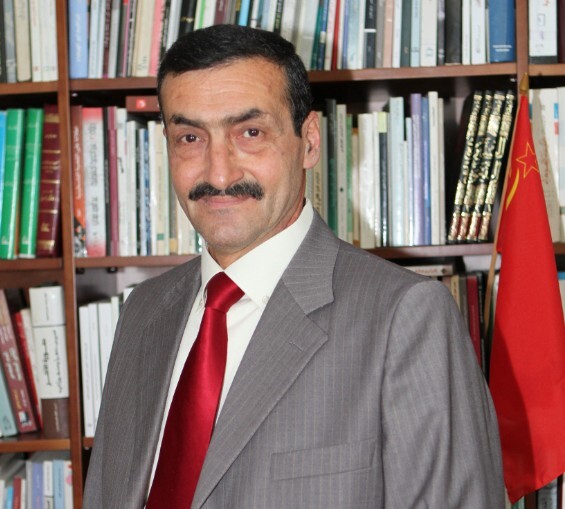
On the anniversary of al-Hakim's departure, I am reminded of a saying by which he defined himself (I am a Marxist, leftist in culture, and the Islamic heritage is an integral part of my intellectual and psychological structure. I am concerned with Islam as much as any Islamic political movement cares. Arab nationalism is also an integral component of my components... I am in a state of harmony With my nationalism, my Christianity, my Islamic culture, and my progressive Marxism).
From the beginnings, he linked the Palestinian fate to the Arab destiny, the national struggle to the national struggle. The issue of Palestine is an Arab issue and the essence of the Arab conflict, and there is no solution to the Palestinian issue except within the framework of an Arab solution, and there is no victory for the cause without an Arab victory. His disagreement or intersection with the nationalist and communist parties stemmed from this angle.
In his message to the "inside", in the mid-1980s, he borrowed Arab symbols, "We have to be the bearers of a message like Muhammad and Jesus, and have the courage of Khaled and the justice of Omar." But after the collapse of the Soviet regime in the late eighties and the disintegration of the state alloy, he wrote, "I am affected by the collapse less than anyone else." I know that capitalism is not eternal and that humanity dreams and seeks justice.”
In the global stage, when class polarization worsened and the monopoly of the minority became widespread while the majority became poorer and oppressed, there is no solution to the contradiction in capitalism between the development of the productive forces and the stagnation of production relations, except by transcending the socio-economic formation, as history does not stop and has no end.
Accordingly, the national pillar and the ideological pillar are two fundamental pillars and analysis tools in the intellectual-political structure of the wise man, and he is guided by them and is never separated from them. He intensified this with a famous saying, "Neither tactics should violate strategy nor politics should violate ideology."
The question of nationalism and the question of Marxism may seem complex and contradictory, but whoever follows al-Hakim and his political practice discovers a solution and a remedy.
Obviously, the question of nationalism and Marxism is great and ambiguous, and delving into the legacy of al-Hakim and Praxis al-Hakim is also a complex issue. Al-Hakim bequeathed to us a process that has not yet been researched, despite what dozens of Arab intellectuals wrote about him. The condition of research work is that his legacy, consisting of thousands of pages, be compiled and published. “I collected 95% of it,” as he put it. And such a huge file of a thinker, theoretician and political leader at the same time, should not be kept on the shelves or allowed to expire in time, as it transcends in its importance the limits of Palestinian factionalism to research centers, students and the Arab revolution movement in general, and whoever knows about Al-Hakim’s global connections knows that his importance is not limited In the Arab region as well.
And in the haste imposed by the logic of the question and the space of the place, I will give an answer, perhaps it will cover enough of the question’s eloquence and ambiguity, with what it requires of dismantling and recombination, noting that the vast areas of the wise’s vision were linked and generated by political practice, which gives them privacy and strength in what liberates them. Of "kalalogia" and "academia" without academics, bearing in mind that al-Hakim has been persevering for six decades in meeting and dialogue with the most prominent Arab thinkers and intellectuals with his listening characteristic, as he is "perfect at listening to you, as if he wants to know more from you than you want to know." You know from him, it is the humility of adults who listen to the changing rhythm of time. Darwish, who moved from a university professor after his average as a student was 96% to a doctor and a professional revolutionary, so he collected the cultural and political early, which prompted him to assign an intellectual, Dr. "He gets to know Kanafani, Bilal Al-Hassan, Fadl, Essam Al-Naqeeb, and Ahmed Khalifa" since that period.... Just as it was not surprising that he harmonized with Dr. Wadih Haddad, with his exceptional merits, and the trade unionist-intellectual Ahmed Al-Yamani, with his class sense mixed with the popular bottom.
The Nakba - the ethnic cleansing of 1948, as a historical tragedy whose chapters continue to this day, was the turning point that decided the personality of al-Hakim, who spent his life to defeat this Nakba and defeat its effects. Since then, he concluded that "Arab backwardness and the Arab experience are the reason..." and thus "the traditional and feudal systems fell" without dropping his dream, which he clung to and did not budge from, "the liberation of Palestine, every inch" as a steadfast national and national position, rejecting the 1947 partition decision that grants the Jewish Yishuv 56 % While the Jews had only 5.6% of the land and a resistance "was what resulted from the Nakba of 1948.... At the time he praised the national role of Haj Amin al-Husseini, he paved the way for building a new political-cultural-social movement.
National stations in the wise thought and practice
The beginning was the establishment of the Arab Nationalist Movement, which began its precursors in the early fifties of the last century, and acquired this name officially in 1956, as indicated in the book “Revolutionaries Never Die,” and it spread to most Arab countries.
It is true that al-Hakim relied on the productions of Sati’ al-Husari and Constantine Zureik, and with his early companions he studied Arab history and religions…..but he emphasized that “nationalism is an affiliation that stems from geography, history, common interests, and culture.” It is not interjected or imagined, it is a process and a process at the same time and is differentiated over other nationalities.
He expressed his early admiration for the Nasserite "revolution" and its achievements. Indeed, the nationalists joined the Egyptian-Syrian unity government in 1958. Al-Hakim's meetings with Abdel Nasser indicate that Al-Hakim criticized the absence of democracy, and that this absence is a major factor in the disintegration of the unity contract and the environment from which the enemies of unity benefited. ... "Since the masses can only be mobilized through democracy.... Freedom and democracy are the conditions for marching towards unity, development and development, investing the nation's potential and confronting national enemies."
The branch of the Arab nationalists in Yemen led the liberation struggle against the British occupier and wrested independence for South Yemen. While their branch in the Dhofar region fought fierce fighting.
Without underestimating the role of the movement in spreading enlightenment and renaissance culture that is biased towards science, reason, citizenship, and the pluralistic and electoral democratic demand... along with adopting national policies hostile to colonialism and the enemy camp, and showing the interdependence between its circles.
As for the defeat of June 1967, al-Hakim considered it a "defeat of the regimes and their programs" and did not detract from the ability of the Arab nation to rise and win.... Therefore, he greatly cheered the canonical uprising of 1987 as a popular initiative that put the occupation in a state of defense, and he would suddenly repeat in his speeches or while eating a meal "Nothing is louder than the voice of the uprising," and the same thing was in the victory of the Lebanese resistance in 2000 and 2006... Certainly, he could have seen the victory of the Tunisian uprising armies today as a credibility for his trust in the people and his bet on the nation.
Even when the Syrian judiciary sentenced him to death in the early sixties and arrested him in 1968 by the head of intelligence, Al-Junaidi, who went to meet him in the hope that he would obtain facilities for the resistance activity, only to find himself in solitary confinement for eight months until the martyr Wadih Haddad liberated him in a smart operation without bloodshed... He disagreed with Abdel Nasser over the Rogers project of 1970, the eradication of the Palestinian gun from Jordan, and his role with other resistance factions in revolutionizing and supporting the Lebanese national movement that took control of 82% of the country in 1976 before being massacred... and Camp David 1978 and Oslo 1993.
Al-Hakim carefully and closely examined the class-economic-political-cultural transformations that took place in Egypt in the seventies and led to Camp David, and showed the implications of that for the Arab nation and the Palestinian cause, and the resulting detachment of Egypt from the front of the conflict, and... and did not His confidence in Arab nationalism is shaking.
As for al-Hakim's disagreement with President Saddam's policies, it did not prevent him from taking risks and traveling from Damascus to Baghdad amid the beating of the drums of war, knowing that he might be prevented from returning to Syria, but President al-Assad said, "This is an honest nationalist man, even if we disagree with him," and he assured President al-Assad, "I Arab, and I have the right to reside in Syria.” Hence his participation in many popular Arab conferences that included all colors of the political and intellectual spectrum.
Al-Hakim is a national story. And his story starts from the ground of the first national cause (the Palestinian cause) to which he devoted his life, in every sense of the word, making history and participating in its struggles, struggles and battles, with the political and military massacres that the revolution was subjected to, and (his clear intellectual and moral structure was very tight and coherent). And stubbornness) M. Darwish... He did not hesitate in the fateful cohesion with his brother Abu Ammar in the Great Battle of Beirut in 1982 and the strategic dispute with him over the Oslo option and his refusal to return "under the banner of Oslo, without the return of millions of refugees" and his persistent confrontation of right-wing tendencies that violate historical and national rights.
Whether the activity of the Arab Nationalist Movement, which he led as a first man, or the establishment of the Popular Front and its leadership as a first man as well, when it was a second force filling the world with its presence, the goal was “the liberation of Palestine and the return of the people of the country to their homeland.” The front is a ramified march, and it deserves, like other major factions, to conduct research studies about it, and on the way is a book of mine related to the matter.