OPINIONS

Date unavailable - Jerusalem Time

America, Iran, and Controlled Madness: Calculations of a War That Won't Happen

Despite the escalation in rhetoric, the unprecedented military buildup of American capabilities in the region, and President Donald Trump's "brinkmanship" policy, contrasted with Iranian Supreme Leader Ali Khamenei's statements reflecting a tone of defiance and insistence on responding to American and Israeli threats; the pressing question is: Are we on the verge of an imminent military confrontation between Washington and Tehran? What are the chances of the United States succeeding in changing the political regime in Iran? Conversely, what are the limits of Iran's military response capability? Can Iran target aircraft carriers and American bases in the region? And finally, what are the repercussions of all this on the security and stability of the region and the world?

Anyone who reads the scene with a cool eye, away from media sensationalism, will realize that what is happening is closer to "controlled madness" than to a blind rush towards war. The United States fully understands that any comprehensive war with Iran will not be a quick military picnic, nor will it end with a limited surgical strike. Instead, it could open the doors of the region to strategic chaos extending from the Gulf to the Eastern Mediterranean. The experiences of Iraq and Afghanistan are still fresh in American memory, with the costs in money, reputation, and lives.
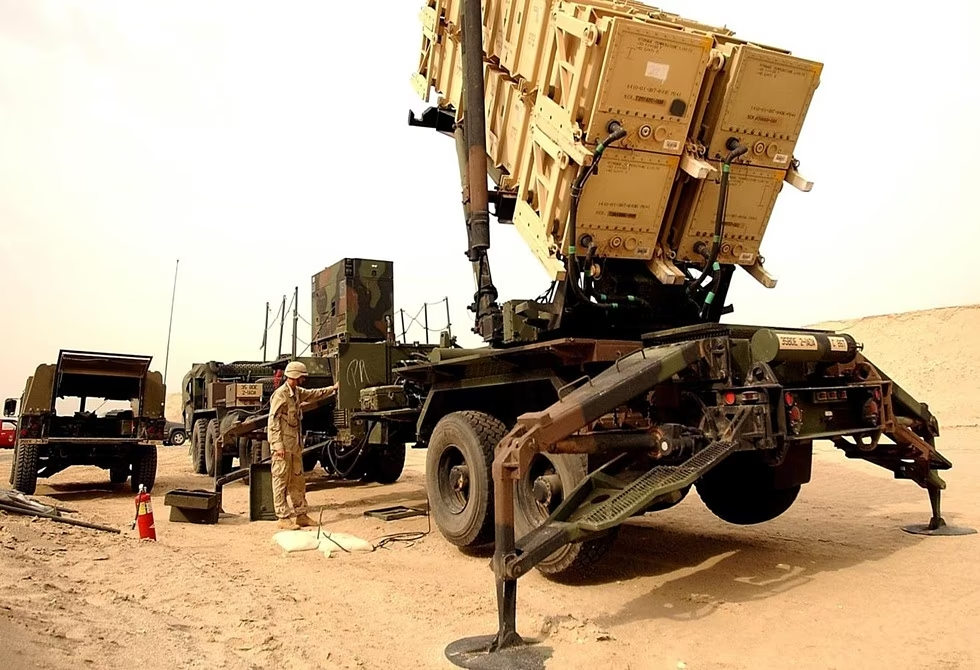
As for talk of regime change in Iran, it is a slogan that has been repeated in the corridors of American politics for decades, but it has never turned into an executable strategy. The Iranian regime, despite its internal crises and suffocating sanctions, has proven an extraordinary ability to adapt and endure, relying on a cohesive institutional security and military structure, and an impressive network of regional and international alliances.

Conversely, Iran's capabilities cannot be underestimated. Over the past years, Tehran has developed an advanced missile system and has demonstrated its ability to operate in multiple theaters through its regional allies. While targeting American aircraft carriers or major bases would remain a high-cost and extremely risky option, it is not impossible should an open confrontation erupt. Any direct hit on strategic American interests would certainly mean the region entering a spiral of escalation whose outcomes cannot be controlled.

This is precisely where the danger of the situation lies: if war breaks out, it will not remain bilateral between Washington and Tehran, but will affect Gulf security, threaten the stability of Iraq, Syria, and Lebanon, and perhaps extend its effects to global energy markets, threatening the international economy with a new crisis. Therefore, the precise cost-benefit calculations of both parties make the option of a comprehensive war more likely to be brandished than actually implemented.

In my estimation, Trump will continue to mobilize, threaten, and warn, but he will not launch a military strike that leads to a wide regional war. The man realizes that any major slip could turn the tables on him domestically, especially in light of the political crises and scandals pursuing him, and the unrest and decline in support within his party. Despite the image he tries to project of himself as a president who does not hesitate to use force, he is not at all interested in the "Samson option" that would bring down the temple on himself and his adversaries at home and abroad.

It is more likely that this round of escalation will end in negotiated outcomes related to the Iranian nuclear program, which will be marketed domestically in Washington as a political and security achievement. If this happens, Israeli Prime Minister Benjamin Netanyahu will not dare to go it alone into a military confrontation with Iran, because any open war could mean the end of his political future, and perhaps plunge the Hebrew state into an existential dilemma, especially given its escalating international isolation after the Gaza war and the growing global calls for a just solution to the Palestinian issue.

As for Iran, it will not initiate a preemptive strike, nor will it seek to ignite a war it does not need at this stage. However, at the same time, it will not stand idly by in the face of what it considers existential threats. It will continue to develop its deterrent capabilities and strengthen its relations with Russia and China, thereby solidifying its position as a significant regional power within an international system that is gradually leaning towards multipolarity.

Iran, in historical memory, is not an emergent state, but the heir to the Persian Empire that once extended its influence over vast areas of the world. It understands that bowing under American pressure would mean undermining its regional project and international standing. Therefore, it will maneuver, negotiate, and accumulate power assets, without rushing into a comprehensive confrontation.

In conclusion: We are facing a calculated escalation, and fiery rhetoric that serves deterrence calculations more than it paves the way for war. A comprehensive military confrontation will not occur, because its exorbitant cost exceeds the capacity of both parties to bear. The Iranian regime will likely emerge with a greater presence and influence, while Washington seeks to save face through a new agreement or understanding. These are precise calculations for a war that is intended to be threatened, not to happen.

PALESTINE

Mon 08 Jun 2026 9:29 pm - Jerusalem Time

Two martyrs and wounded in Israeli raids targeting displaced persons' tents in Khan Yunis

Two Palestinians were martyred and several others sustained varying injuries today, Monday, as a result of an aerial raid carried out by an Israeli occupation army drone targeting a tent sheltering displaced persons in the Mawasi Khan Yunis area, south of the Gaza Strip. Field sources reported that the drone fired at least two missiles at citizens who were in front of their tent in the Al-Attar area, leading to their immediate martyrdom and causing material damage to the site.

In another field development, three Palestinians were injured as a result of Israeli shelling targeting a civilian vehicle traveling on a dirt road near the city of Asdaa, northwest of Khan Yunis. Ambulance crews rushed to the targeting site to transport the injured to nearby hospitals for treatment, amid continuous intensive drone flights over the area.

Areas east and central of Khan Yunis witnessed intense artillery shelling by occupation forces, coinciding with the firing of flare and smoke bombs that covered the sky of the area. These attacks come within the framework of an ongoing military escalation targeting residential areas and displacement zones for citizens who fled military operations in other parts of the Strip.

In the northern Gaza Strip, a Palestinian youth sustained moderate injuries after being directly shot by occupation forces stationed near the Beit Lahia roundabout. Medical sources confirmed that crews dealt with the injury and transported him to a nearby medical point, amid a state of extreme tension prevailing in the border and northern areas of the Strip.

In Jabalia camp, local sources reported that several artillery shells fell near the Halawa camp, which is crowded with displaced persons, causing a state of panic and fear among the families residing there. Artillery shelling continues to randomly target residential blocks and the vicinity of shelter centers, exacerbating the suffering of civilians besieged in those areas.

On the administrative and political level, Israeli occupation authorities announced the closure of all crossings leading to the Gaza Strip, including the Karem Abu Salem commercial crossing and the Rafah land crossing, until further notice. This decision came after recent security developments, threatening to halt the entry of already scarce humanitarian aid and exacerbate the living crisis within the Strip.

Official data indicates that the death toll from the ongoing aggression on the Gaza Strip has risen to 72,971 martyrs since October 2023, in addition to tens of thousands of injured and missing. International organizations continue to warn against the continued targeting of civilians and infrastructure, amid the collapse of the health and service systems in most areas of the Strip.

Occupation forces continue shelling operations and violating understandings in Gaza, with the death toll rising to over 72,000 martyrs.

PALESTINE

Mon 08 Jun 2026 9:28 pm - Jerusalem Time

Turkish Minister's Remarks on 'Jerusalem Province' Ignite Fierce Debate with Israel

The diplomatic arena witnessed a wave of severe tension following statements made by Turkish Interior Minister, Mustafa Çiftçi, in which he expressed his aspiration for the city of Jerusalem to return to Turkish sovereignty in the future. The minister clarified during his participation in a party event in the capital Ankara that he has had an old wish since he was a governor to have the opportunity to administer the 'Jerusalem Province,' even for a short period, affirming his inevitable belief in the realization of this historical scenario.

Çiftçi linked in his speech what he described as the 'liberation' of cities like Damascus, Aleppo, and the Karabakh region, with the future of the city of Jerusalem, which he believes will witness a similar day of freedom under the Turkish flag. The minister stressed that the areas historically belonging to the Ottoman Empire will once again be under the disposal and administration of the Turkish state, while at the same time praising the global leadership role played by President Recep Tayyip Erdoğan.

In contrast, the Israeli response to these statements was not delayed, as Security Minister Yisrael Katz launched a scathing attack, describing these ambitions as 'Ottoman imperial dreams' that will not find a way to be implemented. Katz affirmed in press statements that Jerusalem will remain the eternal capital of Israel, pointing out that his country possesses sufficient strength to defend its sovereignty and confront any external threats targeting the city's status.

The Israeli minister continued his criticisms of the current Turkish leadership, accusing it of overturning the principles established by the founder of the Republic, Mustafa Kemal Atatürk. Katz considered that Ankara's current orientations seek to drag the region towards what he described as 'dark and backward ages,' stressing that Israel is not an empire in decline as some portray it, but rather a strong and capable state.

This verbal altercation comes at a very sensitive time, as relations between Ankara and Tel Aviv have been in an unprecedented state of deterioration since the start of the Israeli aggression on the Gaza Strip. Over the past months, both sides have exchanged a series of harsh accusations, particularly regarding war crimes in Gaza and the stance on Islamic holy sites in occupied Jerusalem.

Observers believe that these statements reflect the depth of the ideological and political gap between the two sides, as Turkey insists on adopting a discourse that links it to its historical roots in the region, while Israel considers these positions a direct threat to its legitimacy. This incident is expected to further complicate diplomatic efforts aimed at calming the situation in the already turbulent region.

I hope God grants me the opportunity to take over the governorship of Jerusalem, even for one day, and I believe that those days will come, and these lands will return under our rule and disposal.

PALESTINE

Mon 08 Jun 2026 9:28 pm - Jerusalem Time

Joint List Negotiations Stalled: Crucial Meeting Thursday to Save Political Unity at Home

Efforts to revive the Joint List of Arab parties within the 48 territories continue to face complex challenges that have so far prevented a final agreement. Despite repeated declarations of a desire for unity, the last meeting held in Nazareth ended without a tangible breakthrough, necessitating the scheduling of additional meetings this week.

Arab parties agreed to hold two crucial meetings next Tuesday and Thursday, in a final attempt to overcome outstanding differences before it's too late. These moves come under widespread popular pressure demanding unified and strong Arab representation within the Knesset to confront the increasing political and social challenges facing the Arab community.

The core point of contention revolves around the nature of the list, as the parties had previously agreed on a 'technical list' formula. This designation, supported by the National Conciliation Committee, aims to grant each party political freedom of action after the elections, whether by remaining in opposition or supporting a specific government coalition according to its interests and vision.

However, the United Arab List, led by MK Mansour Abbas, expressed reservations about the extent to which the other parties would adhere to this principle in actual application. The United List demanded clear guarantees to prevent its leaders from being subjected to 'treason' campaigns if they decided to join an alternative government coalition, convinced of the necessity of influencing from within decision-making centers.

Conversely, the Hadash, Balad, and Arab Movement for Change parties refuse to make prior commitments to governments that have not yet been formed and whose political features are unknown. These parties believe that pledging political positions now is an unjustified concession, especially given the lack of clarity regarding the stances of opposition Israeli parties on the Palestinian issue and the rights of those within the 48 territories.

The last meeting witnessed heated discussions, with MK Ahmad Tibi directly questioning Mansour Abbas on how to deal with sensitive issues such as the incursions into Al-Aqsa Mosque. Tibi affirmed that the three parties had already agreed to the working paper submitted by the Conciliation Committee, calling on the United List to join it to end the political debate and move on to technical matters.

For his part, Mansour Abbas defended his movement's position, emphasizing that the United List has practical experience in political influence away from grand slogans. He explained that his movement seeks understandings that ensure tangible achievements for the Arab community, considering that political work requires a delicate balance between 'averting harm and bringing benefits'.

Balad issued a statement expressing its deep concern about the continued 'procrastination' in the ongoing negotiations. Balad indicated that returning to proposing prior political conditions brings the negotiations back to square one, undermining the efforts made in recent weeks to overcome obstacles to unity.

Balad stressed that the path towards achieving the Joint List must pass through respecting the independence of the parties and their organizational specificity without imposing political guardianship. It called on all parties to act with national responsibility and avoid proposing new conditions that could lead to the fragmentation of the Arab ranks at a delicate historical stage.

In its response to these criticisms, the United List affirmed that it enters negotiations with a clear vision and specific demands aimed at ensuring the stability of any future alliance. The United List criticized what it described as the 'opposition mentality' that merely rejects clauses without offering practical alternatives that serve the interests of the Arab citizen within the 48 territories.

The United List questioned the usefulness of raising the slogan of overthrowing Netanyahu without a clear plan to support a realistic alternative that guarantees the rights of Palestinians within the 48 territories. It considered that the experience of the previous 'change government' proved the necessity of solid understandings to prevent the far-right from returning to power by exploiting political loopholes.

The National Conciliation Committee, headed by the writer Muhammad Ali Taha, is monitoring these developments with concern, trying to bridge the views between the competing poles. The committee believes that failure to form the Joint List could lead to a state of frustration among Arab voters, which could negatively reflect on overall voting rates.

Intensive behind-the-scenes contacts are expected in the coming days to try to draft a final document that satisfies all parties. Efforts are now focused on finding a linguistic and political formula that guarantees the United List 'political security' and the three parties 'national constants' without direct conflict.

Thursday remains the deadline set by the political forces to definitively decide the fate of the Joint List. Either an announcement of the launch of a broad electoral alliance that restores hope to the Arab street, or going to elections with fragmented ranks that could put Arab representation in the Knesset at real risk.

We cannot determine our position on an alternative government that has not yet been born, and it is not known who its participants are or what its policies are regarding our national issues.

ARAB AND WORLD

Mon 08 Jun 2026 9:28 pm - Jerusalem Time

International warnings of a nuclear arms race and expansion of major military arsenals

International researchers have issued serious warnings regarding the current trends of nuclear states towards enhancing their combat readiness, by transferring warheads from central storage to direct launch platforms. A recent report by the Stockholm International Peace Research Institute (SIPRI) indicated that nuclear weapons are playing an increasingly pivotal role in the contemporary international political and security landscape.

According to statistics in the report, the world currently has approximately 12,187 warheads, of which 9,745 are stored and ready for immediate use if necessary. Despite a slight decrease in the total number compared to previous years, the pace of dismantling old weapons has begun to slow significantly in the face of accelerating new manufacturing and modernization operations.

Informed sources reported that the real concern lies in the escalating intensity of nuclear threats despite the slight quantitative decline in global stockpiles. Experts anticipate a shift in the downward curve of stockpiles in the coming years, as the number of warheads is likely to start rising again with advanced weapons entering active service.

The report attributed these risks to the collapse of strategic arms control systems and international agreements that regulated competition between major powers. This erosion of international commitments has created an environment of uncertainty, prompting nuclear states to re-evaluate their military doctrines and rely more heavily on nuclear deterrence.

The United States and Russia hold the lion's share of the global arsenal, jointly controlling about 83% of the world's total nuclear weapons. Each country possesses more than 5,000 nuclear warheads, with ongoing comprehensive modernization programs to keep pace with rapid technological developments in launch systems.

The American modernization program has faced challenges related to planning and funding, which could lead to delays in timelines and significantly increase overall costs. In contrast, Russian programs have suffered some failures in intercontinental ballistic missile tests, affected by economic sanctions and pressures resulting from the ongoing war in Ukraine.

China stands out as the fastest-growing nuclear power currently, working to expand its arsenal at an unprecedented pace compared to other countries. Estimates indicate that Beijing possesses about 620 warheads, with ambitions to bring its intercontinental ballistic missile capabilities to levels close to those of Washington and Moscow by 2030.

On the European front, France and Britain have maintained relative stability in their nuclear stockpiles, with 290 and 225 warheads respectively. However, forecasts indicate a potential increase in the British stockpile in the future, while French presidential orders have been issued to increase nuclear capabilities to enhance defensive sovereignty amid regional changes.

In South Asia, India has increased its nuclear arsenal to 190 warheads, while Pakistan has maintained an estimated stockpile of 170 warheads. Despite the stability of the Pakistani number, the continued accumulation of fissile materials clearly indicates Islamabad's intention to expand its nuclear capabilities over the next decade to address security challenges.

As for the Korean Peninsula, Pyongyang continues to achieve its declared goals of rapidly expanding its arsenal, with the institute estimating it possesses about 60 nuclear warheads. North Korea continues to develop its ballistic missile technologies despite international pressure and sanctions imposed on it, which further complicates the security landscape in East Asia.

Regarding Israel, which follows a policy of nuclear ambiguity and does not acknowledge possessing these weapons, the report indicated that it is actively working to modernize its arsenal. International sources estimate that the Israeli stockpile reached about 90 nuclear warheads at the beginning of this year, with continued development of multiple launch systems.

The report concludes that the world is entering a new phase of the nuclear race characterized by high complexity and danger due to the absence of strategic dialogue. This trend towards the militarization of international politics and reliance on nuclear weapons as a tool of pressure threatens to undermine decades of efforts aimed at arms control and global disarmament.

What is alarming is that despite the decrease in the quantities of nuclear weapons, the level of nuclear risks and threats is significantly increasing.

PALESTINE

Mon 08 Jun 2026 9:27 pm - Jerusalem Time

Trump demands immediate ceasefire from Israel and Iran, reveals negotiations for a final agreement

US President Donald Trump, on Monday, called on both Israel and Iran for an immediate and comprehensive ceasefire, indicating in a post on his 'Truth Social' platform that both parties are already looking for a way out to de-escalate. Trump affirmed that the diplomatic path has not stopped, as intensive negotiations are underway to reach a final peace agreement, while emphasizing that the imposed blockade will remain in place as a pressure tool until the agreement is finalized.

Trump's call comes at a time when the region is witnessing an unprecedented military escalation, with Tehran and Tel Aviv exchanging missile attacks since the early hours of dawn. Sources reported that this escalation occurred despite a direct request from Trump to Israeli Prime Minister Benjamin Netanyahu to refrain from launching additional attacks and to allow an opportunity for the ongoing political efforts behind the scenes.

On the ground, the Iranian Revolutionary Guard announced the execution of missile strikes targeting vital centers within Israel, including the strategic 'Nevatim' and 'Tel Nof' airbases. The Iranian side clarified that these barrages came in response to Israel's targeting of radar sites in three Iranian regions, in addition to the raid that targeted the southern suburb of the Lebanese capital, Beirut, on Sunday evening.

In contrast, Israeli fighter jets launched a series of raids targeting military sites in central, northern, and southwestern Iran, hitting a massive petrochemical complex. An Israeli military official stated that the army has multiple options to deal with Iranian threats, affirming readiness to continue military operations 'whatever it takes' and once political instructions are issued.

Regarding political moves, reports revealed that Trump held a phone call with Netanyahu, described as calm, in which he urged him to exercise caution and not to be drawn into a wide regional confrontation. Accordingly, Netanyahu held urgent security consultations with the small ministerial council 'the Cabinet' early today to discuss American proposals and international mediations led by regional parties.

Media sources quoted Iran's Tasnim news agency warning from a high-ranking military source, who confirmed that Tehran is prepared for a long-term conflict if Israeli escalation continues. The source warned that American interests in the region would not be safe from targeting if Washington directly engaged in supporting offensive operations against Iranian territory.

Inside Israel, shrapnel and missiles fell in various areas including 'Beit Shemesh' west of Jerusalem and the city of Beersheba in the Negev, in addition to the vicinity of the 'Itamar' settlement north of the West Bank. These barrages caused a widespread state of security alert, amidst warnings from the Home Front Command to settlers to remain near shelters as tensions continue.

Diplomatic data indicates active mediations led by Pakistan and Qatar to bridge viewpoints and prevent the situation from fully exploding. Circles within the American administration anticipate the possibility of reaching an initial draft agreement between Tehran and Washington in the coming days, which explains Trump's intense pressure on the Netanyahu government to commit to a temporary calm.

Observers believe that Netanyahu faces dual pressures, as his political survival is linked to the continuation of military operations to avoid internal legal prosecutions, while clashing with Trump's desire to quickly resolve the Iranian issue. Trump had previously stated in interviews with international media that he has the absolute decision-making power in drafting any future agreement with Iran, which puts the Israeli government in difficult choices.

In conclusion, the scene in the region remains suspended between the muzzles of cannons and negotiation tables, as the world awaits the results of the coming hours to determine the fate of de-escalation. With Tehran's insistence on responding to the targeting of its radars, and Tel Aviv's adherence to the right to respond to missile barrages, Trump's call for a ceasefire remains the true test of Washington's influence over its allies and adversaries alike.

Israel and Iran must cease fire immediately, peace negotiations are ongoing, and the blockade will remain in place until a final agreement is reached.

LATEST NEWS

Mon 08 Jun 2026 9:27 pm - Jerusalem Time

Cracks within the Democratic Party: Report reveals growing sense of 'alienation' among Jewish voters

A recent journalistic report has revealed a growing sense of marginalization and alienation among a wide segment of Jewish Democrats within the American Democratic Party. These shifts come amidst deep divisions caused by the ongoing Israeli war on the Gaza Strip, and the accompanying changes in the party's internal political discourse regarding Middle East issues.

The report, prepared by field researchers, clarified that many Jewish leaders and voters now feel that criticisms directed at Israel have exceeded the bounds of traditional political objection. These individuals believe that the current discourse now touches upon Jewish identity in the United States, creating a gap between the party's traditional base and emerging trends that adopt more radical positions towards Tel Aviv.

Political observers warned that these cracks could have a tangible impact on the electoral map in the 2028 presidential elections. Concerns are particularly prominent in swing states such as Pennsylvania, Michigan, and Georgia, where Jewish electoral blocs hold significant voting power capable of deciding results amidst fierce competition between the two major parties.

Media sources quoted Democratic strategist Howard Wolfson as saying that the prevailing sentiment among Jewish Democrats is that their historical political institution no longer provides them with adequate protection. Wolfson indicated that the continuation of this hostile climate might push segments of voters to reconsider their party loyalty and seek political alternatives that guarantee their interests and identity.

Amidst this debate, a number of Jewish figures are emerging as potential candidates to succeed the current leadership, including Pennsylvania Governor Josh Shapiro and Illinois Governor J.B. Pritzker. These individuals face a dual challenge: maintaining the cohesion of the Jewish electoral base while accommodating increasing pressure from the party's progressive wing, which demands stricter policies towards Israel.

Data indicates a significant decline in levels of unconditional support for Israel within the young Democratic base in particular. This generational shift has been clearly reflected in the language of political discourse, as the progressive current has become more daring in criticizing the Israeli government's practices in the Palestinian territories, which some see as a threat to the historical alliance between Jews and Democrats.

Reports highlighted incidents that caused widespread concern, including the appearance of controversial symbols associated with new Democratic candidates in states like Maine. These incidents, along with statements considered antisemitic, have reinforced the fears of Jewish Democrats regarding their future within the party and their ability to influence the formulation of its strategic decisions.

For his part, Democratic Representative Jared Moskowitz affirmed that feelings of fear are once again seeping into American Jewish circles due to the charged political climate. Moskowitz explained that there are signs of some voters drifting away from the party, warning that ignoring these signals could lead to the loss of a voting bloc that has historically been most loyal to Democratic programs.

In a related context, Representative Elissa Slotkin criticized attempts to stereotypically link Jewish donors to political pressure groups, considering that this fuels hate speech. Slotkin emphasized the need to distinguish between legitimate political disagreements about Middle East policies and attacks targeting individuals' religious or national affiliation.

Regarding internal operations, Jewish employees in Democratic institutions revealed their feelings of isolation and the need to constantly defend their personal positions. Former US administration officials indicated that the current political environment is placing unprecedented pressure on Jewish employees, affecting their productivity and their sense of belonging to the political institution.

Despite these challenges, another group within the party believes that talk of a mass exodus of Jews is exaggerated and not yet based on accurate statistical data. They assert that the Republican Party also suffers from structural problems in its relationship with minorities, and that the current debate is a healthy sign of the party's vitality and its ability to review its historical positions.

Many Jewish Democrats feel that the party has become the latest institution to welcome them only to turn into a hostile environment for them.

PALESTINE

Mon 08 Jun 2026 9:27 pm - Jerusalem Time

Discussions in Cairo to Draw a Roadmap to End the Stalemate in the Gaza Agreement

The Egyptian capital, Cairo, hosted an extensive meeting that included high-level officials from the mediating countries, namely Egypt, Qatar, and Turkey, along with representatives from Palestinian factions. The discussions focused on formulating a practical roadmap aimed at completing the implementation of the ceasefire agreement in the Gaza Strip and overcoming obstacles hindering the path to calm.

Informed sources reported that the meeting saw the participation of the head of the Egyptian General Intelligence Service, Minister Hassan Rashad, and the Prime Minister and Minister of Foreign Affairs of Qatar, Sheikh Mohammed bin Abdulrahman Al Thani, in addition to the head of Turkish Intelligence, Ibrahim Kalin. The attendees sought to coordinate regional efforts to push ongoing negotiations towards implementing the second phase of the framework agreement.

The statement issued after the meeting described the atmosphere as 'positive,' with a consensus among the participating parties on the necessity of adhering to the outcomes of the Sharm El Sheikh Peace Summit. Participants also expressed their appreciation for Egypt's pivotal role and the intensive efforts made by all concerned parties to end the humanitarian suffering in the Strip.

The attendees emphasized the importance of all parties assuming their responsibilities to ensure the achievement of sustainable calm, which paves the way for the initiation of large-scale reconstruction operations. Participants considered that the success of this roadmap would directly reflect on improving the deteriorating living conditions of Palestinians facing harsh circumstances.

These diplomatic moves come at a time when mediating parties are striving to break the stalemate that has affected the implementation of the Sharm El Sheikh agreement. Sources confirmed that there is insistence on completing the provisions of the peace plan proposed by US President Donald Trump, with a focus on a smooth transition between the different phases of the agreement.

In a related context, Egyptian Foreign Minister Badr Abdel Aty held a bilateral meeting with his Qatari counterpart, Sheikh Mohammed bin Abdulrahman Al Thani, in Cairo. The two sides discussed ways to enhance joint cooperation and coordinate positions on regional issues, emphasizing the priority of the Palestinian file and safeguarding Arab national security in light of current challenges.

During their meeting, the two ministers affirmed the necessity of implementing the requirements of the first phase of the proposed peace plan, which includes an immediate cessation of military operations. Both sides indicated that adherence to this phase is a cornerstone for moving to more advanced steps that ensure regional stability and the protection of civilians.

The requirements of the first phase, according to the proposed vision, include the entry of large quantities of humanitarian aid and early recovery supplies into all areas of the Strip. The plan also includes starting the rehabilitation of essential infrastructure and hospitals that have been severely damaged by ongoing military operations.

The proposed roadmap stipulates a gradual withdrawal of Israeli forces from populated areas in the Gaza Strip, to enable local authorities to resume their role. It also provides for empowering the National Committee for Gaza Administration to carry out its temporary administrative tasks from within the Strip to ensure the provision of basic services to the population.

Among the discussions, the idea of deploying an international stabilization force emerged, tasked with monitoring the ceasefire and ensuring that the agreement is not violated by any party. This measure aims to create a safe environment that allows the Palestinian people to exercise their right to self-determination, leading to the establishment of their independent state on the June 4, 1967 borders.

Hamas had sent a leadership delegation to Cairo earlier this week to engage in these technical and political discussions. Sources affiliated with the movement stated that the meetings aim to evaluate what has been achieved in the first phase and discuss mechanisms for an immediate transition to the second phase, which includes a broader exchange of prisoners.

The roots of the current agreement date back to the initiative announced by the US President in September 2025, which received initial acceptance from the concerned parties at the time. That initiative included a comprehensive ceasefire, a mutual release of detainees, with a guarantee of 600 aid trucks flowing daily to meet urgent needs.

Despite the Palestinian factions' commitment to the understandings of the first phase, field reports indicated violations and reneging on some commitments. This prompted mediators in Egypt, Qatar, and Turkey to intensify their pressure to ensure that the negotiation track does not collapse and return to a full-scale escalation.

The mediators hope that the current round of discussions in Cairo will lead to a specific and clear timeline for the implementation of all phases of the agreement without partiality. The ongoing bet is on the extent of the field parties' response to the international guarantees provided, and the ability of the mediators to bridge the remaining gaps in the withdrawal and reconstruction files.

The meeting discussed a proposed roadmap for completing the implementation of the agreement in a positive atmosphere, with the aim of achieving sustainable calm and reconstructing the Strip.

PALESTINE

Mon 08 Jun 2026 9:27 pm - Jerusalem Time

Dahlan presents a vision for managing the Gaza Strip during faction meetings in Cairo

Informed media sources revealed that Palestinian leader Mohammed Dahlan intends to present a comprehensive action plan aimed at managing the Gaza Strip, during his participation in the Palestinian faction meetings currently held in the Egyptian capital, Cairo. This step comes amidst intense political activity in the region to discuss the future of the Strip and the administrative and security arrangements required for the next phase.

The sources explained that the vision Dahlan intends to present includes a comprehensive concept for dealing with the current challenges in Gaza, with a focus on governance and local administration mechanisms. These developments coincide with extensive meetings involving representatives of various Palestinian national and Islamic forces, where the deteriorating humanitarian and political conditions in the Strip dominate the agenda.

The circulation of Dahlan's name in the corridors of the Cairo meetings has aroused widespread interest among political circles and observers, given his political weight and history in Palestinian security and political work. Observers believe that presenting such plans at this time reflects the complexity of the Gaza administration file and the need for consensual solutions among the different parties.

Despite the media buzz surrounding these reports, no precise official details have been released yet regarding the plan's provisions or its implementation mechanisms on the ground. The organizers of the meetings in Cairo, as well as the participating factions, have remained silent about these leaks, awaiting the outcome of the official deliberations behind closed doors.

These moves come in the context of intensive regional and international efforts seeking to formulate an acceptable formula for the 'day after' arrangements in the Gaza Strip, ensuring the addressing of escalating humanitarian crises. The question remains about the extent of the Palestinian factions' ability to agree on a unified vision to manage the affairs of the Strip and end the current state of division and political confusion.

The plan includes a comprehensive vision for managing the Strip during the next phase, coinciding with the discussion of complex political and humanitarian issues.

PALESTINE

Mon 08 Jun 2026 9:27 pm - Jerusalem Time

Occupation bullets assassinate the dreams of the boy Muhammad Abu Jayab off the coast of Gaza

The joy of the 16-year-old Palestinian boy Muhammad Abu Jayab was not complete with the diving moments he documented with his own camera off the coast of the Gaza Strip. While he was practicing his hobby in the sea on Sunday, a bullet fired by the Israeli occupation army struck him in the head, turning the scene of joy and play into a tragedy that shook the feelings of Palestinians.

Activists circulated emotional video clips on social media platforms documenting the difficult moments of retrieving the body of the martyr Abu Jayab from the middle of the sea. Palestinian fishermen rushed to retrieve him and transport him by a small boat to the beach of Deir al-Balah city in the central Strip, amidst a state of sadness and popular anger due to the targeting of the boy who posed no threat.

In a related context of maritime violations, field sources reported that the Israeli navy arrested four Palestinian fishermen on the same day while they were working off the coast of Gaza City. These attacks come within a systematic policy pursued by the occupation to restrict fishermen, including direct shooting and destruction of boats to prevent them from securing their daily livelihood.

On the ground, Israeli attacks did not stop at sea, as medical sources confirmed the martyrdom of five Palestinians, including an elderly man and a child, and the injury of 32 others with varying injuries on Monday. These targets were concentrated in various areas north and south of the Gaza Strip, reflecting a continuous military escalation despite existing understandings.

Reports from Gaza indicate that this escalation represents a clear violation of the ceasefire agreement that came into effect on October 10, 2025. Palestinian parties accuse the occupation authorities of deliberately targeting civilians and vital facilities to undermine the state of relative calm and increase the suffering of the besieged population in the Strip.

Regarding the total toll, medical sources in Gaza announced that the number of victims of the ongoing Israeli aggression since October 7, 2023, has risen to 72,980 martyrs. The number of injured has also exceeded 171,000, in an unprecedented humanitarian catastrophe documented by official reports and local news agencies.

The young fisherman Muhammad Abu Jayab went to sea in search of a livelihood to support his family in a time of genocide and hunger, but the sea he sought for life brought him back carried on shoulders.

LATEST NEWS

Mon 08 Jun 2026 9:26 pm - Jerusalem Time

Israeli Airstrike Targets Karun Petrochemical Complex in Southwest Iran

The Israeli army announced on Monday that it had carried out an aerial operation targeting the Karun Petrochemical Complex located in the southwestern region of Iran. This strike comes as part of a new round of direct military confrontations between Tel Aviv and Tehran, with the bombing focusing on destroying industrial infrastructure belonging to the Iranian energy sector.

Military sources reported that the attack resulted in clear material damage to various parts of the industrial complex due to direct shell impacts. Despite confirmation of damage to the facility, official authorities have not yet issued an accurate and comprehensive toll detailing the extent of operational or human losses resulting from this targeting.

The Karun Petrochemical Plant is considered one of Iran's most prominent industrial facilities, located in the strategic Mahshahr area of Khuzestan province. This region holds particular importance as a vital center for chemical and oil industries, making its targeting a direct blow to one of the most important pillars of the Iranian economy linked to the export sector.

The facility is an integral part of the infrastructure associated with the oil and gas sectors, specializing in the production of a complex series of basic chemical materials. These products are used to meet the needs of the local Iranian market, in addition to their pivotal role in supplying the state treasury with hard currency through extensive export operations to foreign markets.

The plant benefits from its geographical location near ports overlooking the Arabian Gulf, which facilitates maritime shipping operations and international logistics. This location has made the Karun Complex a focal point in the petrochemical industrial zone in Bandar Imam Khomeini, which explains the Israeli military's focus on neutralizing these production capabilities.

In terms of production capacity, the plant specializes in producing 'isocyanates,' which are highly reactive and sensitive organic chemical materials. The complex's annual production capacity reaches approximately 80,000 tons, making it one of the first plants to introduce this industrial technology to the Middle East region several years ago.

The materials produced at the Karun Complex are used in a wide range of heavy and manufacturing industries that concern both citizens and industry. Prominent uses include the manufacture of sponges, thermal insulation used in construction, industrial plastics, in addition to their use in manufacturing car parts, home furniture, and artificial leather.

Targeting this complex represents a qualitative escalation in Israel's target bank deep within Iran, as it goes beyond purely military targets to strike economic facilities. International circles are monitoring the repercussions of this attack on the stability of energy markets and chemical supply chains, amidst the ongoing escalating tension in the region.

The aerial operation targeted an industrial site used in the petrochemical sector and resulted in damage to the complex and parts of it being affected.

LATEST NEWS

Mon 08 Jun 2026 9:26 pm - Jerusalem Time

Israeli hints at expanding aggression towards Nabatieh: Military pressure to bypass American 'immunity'

Media sources have revealed extensive movement within the Israeli occupation army's command to pressure the political level with the aim of completing the destruction of infrastructure in strategic areas in southern Lebanon. While estimates indicate understandings that grant Beirut a kind of 'immunity' from intensive attacks, military leaders see the necessity of shifting military weight towards the city of Nabatieh, which represents a significant urban and economic center.

Hebrew reports stated that occupation forces have already begun implementing field operations on the outskirts of Nabatieh, including the use of advanced robots to locate explosive devices and detect armed cells. Major General Rafi Milo, commander of the Northern Command, is leading an initiative aimed at undermining Hezbollah's capabilities in this vital area located between the Litani and Zahrani rivers, considering that controlling it will change the balance of power on the ground.

Israeli military circles view Nabatieh as a target of paramount symbolic and logistical importance, as it houses command headquarters for active military units such as 'Badr Unit'. Sources confirm that the city has, over the years, become a center for managing operations and storing weapons, benefiting from its urban density and its geographical location connecting logistical axes leading to the Israeli border.

Officers in the occupation army believe that delivering a strong blow to Nabatieh will go beyond the direct military impact to reach the popular base, given the city's status as a regional and economic center for Shiites in the south. It is believed that targeting this urban center will represent unprecedented moral pressure, especially since the occupation previously avoided entering into a comprehensive confrontation within major population centers of this size.

In a related context, information available to occupation intelligence indicates that Hezbollah has extensively fortified the underground infrastructure in Nabatieh since the end of the 2006 war. These sources claim that the party exploited the geographical distance from the border to build fortified facilities against air raids, making the proposed ground operation a military challenge that the army seeks to overcome by intensifying field and political pressure.

The attack on the city of Nabatieh will constitute a severe moral blow to the Iranian axis, and will affect the entire area located between the Litani and Zahrani.

PALESTINE

Mon 08 Jun 2026 9:26 pm - Jerusalem Time

Hands and feet tied.. Shocking details about the detention conditions of Dr. Hussam Abu Safiya in solitary confinement

Lawyer Nasser Odeh, representing the detained Palestinian doctor Hussam Abu Safiya, reported that his client is facing extremely harsh detention conditions inside the occupation prisons, where he is deprived of the most basic human rights, including potable water and sufficient food. Odeh explained that the last visit revealed that the doctor remains permanently handcuffed and shackled, despite suffering from chronic diseases that require intensive medical care not available to him in his current detention.

Legal sources indicated that the prison administration transferred Abu Safiya on June 3rd from Naqab Prison to solitary confinement in Nafha Desert Prison, which increased his family's fears about his fate given the قطع communication with him. This escalatory step comes after months of abuse and beatings the doctor was subjected to during transfers between prisons, causing him severe and continuous back and neck pain without proper treatment.

The lawyer described the details of the legal visit as taking place under strict camera surveillance and in the presence of heavily armed guards, with communication via phone from behind a thick glass barrier. He confirmed that these measures, in addition to the short duration of the visit, prevented the prisoner from speaking freely about the details of the violations he is subjected to, fearing further punitive or retaliatory measures by the jailers.

Occupation forces arrested Dr. Hussam Abu Safiya in late December last year while he was performing his professional duty as director of Kamal Adwan Hospital in the northern Gaza Strip. Since then, he has been transferred for detention under the so-called 'Unlawful Combatant Law,' a legislation that allows Israeli authorities to detain Palestinians for indefinite periods without formal charges or clear legal evidence.

Medical and human rights reports indicate a severe deterioration in Abu Safiya's health, as he has lost about 25 kilograms of weight due to the policy of starvation and deliberate medical neglect. The doctor also suffers from heart disease and high blood pressure, in addition to contracting scabies, which has spread in prisons due to poor hygiene and the deteriorating living conditions imposed by the occupation on prisoners.

The Israeli High Court of Justice is scheduled to hear an appeal filed by the legal team on the tenth of this month against the continued detention of Abu Safiya under the Unlawful Combatant Law. International organizations, including the United Nations and the World Health Organization, demand the immediate release of Palestinian medical personnel and the guarantee of their physical and psychological safety in accordance with international Geneva Conventions.

It is worth noting that Dr. Abu Safiya's case highlights the suffering of about 9,500 Palestinian prisoners held in occupation prisons, where they face systematic policies of torture and abuse. Human rights organizations have warned that the continuation of these policies has led to the martyrdom of dozens of prisoners due to deliberate medical neglect and the inhumane conditions imposed by the prison administration since the beginning of the last aggression.

The visit took place in a camera-monitored room, during which Abu Safiya remained handcuffed and shackled, and communication was via phone from behind a glass barrier.

ARAB AND WORLD

Mon 08 Jun 2026 9:26 pm - Jerusalem Time

Leaked British police document describes the occupation army as a 'terrorist organization' and sparks a political storm

Political and security circles in Britain are in a state of turmoil following the leak of an internal policy document issued by the National Association of Muslim Police, which included strong positions regarding the ongoing war in the Gaza Strip. The document, revealed by the British newspaper 'The Telegraph', sharply criticized the Israeli occupation army, describing it as a 'Zionist terrorist group', raising major questions about professional neutrality within law enforcement agencies.

Reports indicated that the leaked paper defended Hamas in the face of what it described as 'unsubstantiated narratives' that spread after the October 7, 2023 attack. The document considered that the circulation of some media reports about widespread violence directly contributed to fueling feelings of hatred against Islam and Muslims in Western societies.

The document, drafted by Khaldoun Qabbani, then Vice President of the Association, went further by considering Zionism a form of hostility towards Muslims. This proposition provoked the indignation of official institutions and Jewish bodies in the United Kingdom, which saw these statements as a blatant deviation from the professional standards that police personnel should adhere to.

In terms of content details, the document questioned the accuracy of Israeli and Western narratives that spoke of large numbers of children killed during the initial attack by Palestinian factions. The paper indicated that some of these figures were later questioned, claiming that only one child's death was confirmed two days after the attack, which contradicts international and UN reports.

The document also included sharp criticism of Western media, accusing it of adopting narratives aimed at 'demonizing Palestinians' and portraying them as perpetrators of atrocities against civilians. The paper used strong language in comparing Israeli practices in the Gaza Strip to the mechanisms of 'dehumanization' used by historical oppressive regimes, referring in the context of comparison to the Nazi Holocaust in Auschwitz.

The sensitivity of this document lies in the role played by the National Association of Muslim Police, as it has cooperative relations with several police forces in England and Wales. The association provides advisory and training services related to personnel matters and worship needs, making its political positions potentially influential on the working environment within the security establishment.

The angry reactions were not delayed, as British Jewish organizations considered the content of the document a direct threat to the integrity of police work in the country. These bodies affirmed that the document contains misleading information aimed at distorting historical facts, which undermines mutual trust between society and security agencies.

For its part, the Campaign Against Antisemitism entered the crisis, demanding that the British Home Office open an urgent and immediate investigation into the circumstances of the preparation and publication of this paper. The campaign called for accountability for those responsible for this content, and a review of the role played by the Association within official police institutions to ensure that security work is not politicized.

Observers believe that this leak reopens the debate about the concept of 'police neutrality' in Britain, especially in light of the sharp societal division regarding the Palestinian issue. Security agencies face increasing pressure to strike a delicate balance between respecting the cultural diversity of their employees and adhering to complete neutrality on thorny international political issues.

Media sources indicated that the document had been briefly published online by 'The Spectator' magazine before being deleted, but its circulation in the British press brought it back to the forefront. This controversy reflects the extent of tensions caused by the war in Gaza on the social and institutional structure in countries supporting the occupation.

In a related context, the Jewish community considered that such positions issued by a body representing police officers contribute to creating a hostile environment for Jews within the security apparatus. It warned that adopting narratives that question the 'Holocaust' or compare it to contemporary events is a transgression of legal and political red lines in the United Kingdom.

Although the Association is a representative body and not an executive one, its influence in providing religious and professional guidance makes its opinions subject to close scrutiny. Right-wing political forces are demanding the necessity of disassociating the Home Office from any associations that adopt positions described as 'extremist' or biased against a party in an international conflict.

To date, no extensive official comment has been issued by the British Home Office regarding the measures taken against the author of the document or the Association in general. However, media and parliamentary pressure may push towards a comprehensive review of all documents and policies issued by professional associations within the police force to ensure their alignment with national laws.

In conclusion, this incident highlights the complexity of the British internal scene in dealing with the repercussions of the Israeli-Palestinian conflict, where internal documents become material for public political debate. The biggest challenge for the British government remains to maintain the cohesion of the security establishment and prevent the infiltration of political divisions into the ranks of its officers.

The document described the Israeli occupation army as a Zionist terrorist group and considered Zionism a form of hatred against Muslims.

ARAB AND WORLD

Mon 08 Jun 2026 9:26 pm - Jerusalem Time

Iran announces cessation of military operations, Israel responds to Trump's request amid warnings of escalation in Lebanon

Iran's Central Operations Room, known as the 'Khatam al-Anbiya' headquarters, announced the end of its military operations against Israel as of this Monday. The statement clarified that this decision came after carrying out what Tehran described as a 'painful' response to previous Israeli airstrikes, while simultaneously affirming its readiness to return to more violent escalation.

Iran's military command warned that any continuation of Israeli aggression, especially in areas of southern Lebanon, would be met with harsher military measures than before. The statement emphasized that the cessation of current operations is linked to the other side's commitment to halting hostile actions that threaten the region's security and stability.

In contrast, media sources revealed that Israeli Prime Minister Benjamin Netanyahu responded to a direct request from US President Donald Trump to halt attacks on Iranian territory. The sources indicated that this Israeli retreat aims to provide an opportunity for diplomatic efforts led by the White House to achieve a comprehensive de-escalation.

Despite the direct de-escalation with Iran, an Israeli official confirmed that military operations in southern Lebanon would continue at full strength in the coming days. The official added that the Israeli army would not hesitate to target the southern suburbs of Beirut if rocket attacks on Israeli towns and settlements continued.

Monday witnessed an important phone call between Netanyahu and Trump, preceding the latter's announcement via social media platforms of both parties' desire to reach an immediate ceasefire. According to informed sources, the call focused on the necessity of containing the situation and preventing the region from sliding into a comprehensive regional war with dire consequences.

For his part, US President Donald Trump stated that Israel and Iran are seriously seeking to end the direct military confrontation. Trump warned that 'ignorance or foolishness' could hinder the final negotiations currently underway, noting that the recent exchange of strikes almost undermined the fragile understandings reached previously.

Trump affirmed in a post on 'Truth Social' that the US blockade imposed on Iranian ports would remain in effect and strictly enforced. He clarified that the lifting of these economic restrictions would only occur after reaching a final and comprehensive deal that guarantees the interests of the United States and its allies in the region.

In Tehran, Iranian President Masoud Pezeshkian affirmed that his country remains strongly engaged in the diplomatic path to end the war in the Middle East. Pezeshkian stressed that Iran's national strength is based on two parallel tracks: military defense and active diplomacy, asserting that his country will not withdraw from either.

These developments come after the renewal of direct confrontations between Tehran and Tel Aviv for the first time since a truce was announced about two months ago. Observers believe that this latest escalation puts international efforts aimed at achieving peace to a real test, especially given the complex field conditions on the Lebanese front.

Pakistan is currently leading active mediation between Washington and Tehran, which began weeks ago coinciding with the announcement of the initial ceasefire. Despite the optimism expressed by the US President about the imminent conclusion of an agreement, the field still witnesses intermittent tensions that threaten to collapse the negotiation process at any moment.

The current conflict is linked to a series of events that began last February, leaving the region in a state of constant alert. International parties are currently seeking to establish new rules of engagement to prevent the recurrence of mutual attacks that targeted the depth of both countries in recent hours.

Anticipation remains the master of the situation, awaiting the outcomes of the ongoing behind-the-scenes negotiations in the coming days. While reports speak of a desire for peace, mutual threats and military operations in Lebanon and the southern suburbs remain pressure factors that could lead to a renewed explosion of the situation.

Defense and diplomacy are pillars of national strength.. We have not left the field nor the negotiating table.

OPINIONS

Mon 08 Jun 2026 8:39 am - Jerusalem Time

Dahiyeh Changes the Rules of Engagement… Trump Sets the Pace and Netanyahu is the Biggest Loser

On the evening of June 7, 2026, the region entered a new phase of escalation after Iranian strikes targeted Israel, in response to the Israeli attack on the southern Dahiyeh in Lebanon. The importance of the event lies not only in the exchange of strikes, but in the context that preceded it, as Iran had previously warned that targeting Dahiyeh would be met with a direct response. When the attack occurred, the response was swift, confirming that it was not a fleeting reaction, but part of a deterrence equation being practically established.

What happened does not represent a complete reversal in the balance of power, but it reflects a clear adjustment in the rules of engagement. The traditional pattern that the region was accustomed to, where Israel initiates the attack and the response comes later within the calculations of “the right time and place,” was tested differently this time. The direct Iranian response carried an important implication: a relative shift in pace from the position of the recipient to the position of the initiator, even if the basic balance of power remained the same.

This move was not isolated from precise calculations of the American position. Washington, despite its commitment to Israel's security, does not seem willing to engage in a wide regional war. The cost of escalation, domestically and internationally, makes the option of containment more present than the option of open war. Therefore, Iran gambled that the United States would support Israel and deter adversaries, but at the same time would work to control the ceiling of escalation and prevent a slide into a comprehensive confrontation.

In this context, an important political angle related to US President Donald Trump emerges. These developments give him an opportunity to show that he is an independent decision-maker, acting according to purely American calculations, not according to Benjamin Netanyahu's pace. If he chooses to contain and control the escalation, he can present himself as someone who holds the decision of war and peace, and prevents the United States from sliding into confrontations that do not serve its direct interests. Thus, “setting the pace” becomes a message of political strength, confirming that the decision in Washington is not managed by proxy.

In contrast, Israel seems more inclined to expand the circle of confrontation, whether to restore the image of deterrence or to redefine the rules of engagement in the region. But this trend clashes with a cautious American ceiling, creating a clear duality: Israeli push towards escalation, versus American control to try to contain it. The result is a continued exchange of strikes within calculated limits, without reaching a comprehensive war.

In this context, Netanyahu appears to be one of the biggest political losers so far. The attack on Dahiyeh was intended to raise the level of deterrence or impose a new equation, but the direct Iranian response, coupled with American containment, limited the Israeli government's ability to turn the escalation into a clear strategic gain. Iran's shift to the position of initiator weakened the narrative of absolute superiority, and made any Israeli military achievement less likely to turn into a decisive political achievement.

Moreover, establishing the equation of “Dahiyeh for a direct Iranian response” adds a new constraint to the Israeli decision, and makes the cost of any future escalation higher and more complex. Instead of expanding the margin of maneuver, Netanyahu found himself in a more restricted regional environment for his movement.

Nevertheless, risks remain. This phase is based on precise estimates of intentions and limits of probability, and any miscalculation could turn containment into a wider explosion. What happened on June 7, 2026, does not represent the end of the conflict, but a reshaping of the balance of deterrence. The equation has not been canceled, but it has become more complex and balanced.

Between Israel's desire for escalation, the United States' efforts to set the pace, and Iran's attempt to impose a new deterrence equation, the region stands at a delicate and sensitive stage. A comprehensive war is not the likely option for most parties, but the continuation of mutual strikes keeps everyone in a continuous test of political will as much as it is a test of military capability.

ARAB AND WORLD

Mon 08 Jun 2026 8:39 am - Jerusalem Time

100 Days into the Strait of Hormuz Crisis: How Has the 'Chokepoint' Reshaped Global Energy and Political Calculations?

Today, the world enters the first hundred days of one of the most complex geopolitical and economic crises in recent decades, as the Strait of Hormuz continues to operate under the weight of unprecedented disruption in maritime traffic. This situation has directly impacted the stability of global oil markets and international trade flows, as well as directly affecting interest rate forecasts and global inflation rates.

According to estimates issued by international research centers, the crisis, which began on February 28, 2026, took the form of an actual and extended disruption of navigation due to mutual military escalation. This blockage led to a sharp decline in ship traffic through a passage that carries about one-fifth of global oil trade, turning military operations into a prolonged attrition.

The crisis went through five main stages, beginning with the 'blockade shock and military surprise' phase, which caused global astonishment and a sudden halt in shipping traffic. It then quickly moved to the 'peak' phase with the influx of US military forces and the soaring cost of operations to record levels, amidst real fears of an all-out war in the region.

These developments pushed international powers towards the third stage, which involved searching for alternative routes and activating land pipelines to compensate for the shortage. Despite the high costs of these alternatives, figures revealed their inability to compensate for one-fifth of the world's oil that usually passes through the Strait, keeping economic pressures strong and persistent.

Last May, the crisis entered its fourth phase, 'fragile de-escalation and navigational maneuvering,' following a truce reached under Pakistani sponsorship on April 8. This period witnessed a strategic shift led by Britain and France, who spearheaded an international coalition of more than 40 countries to coordinate navigation protection tasks and secure transit corridors.

On the ground, these movements translated into the deployment of the British destroyer 'Dragon' and an increase in military funding by £115 million, in parallel with the arrival of the French aircraft carrier 'Charles de Gaulle' in Djibouti. These reinforcements aim to establish a sustainable ceasefire and protect oil tankers from any potential threats in the region.

In contrast, this Western buildup was met with Iranian deterrence and a complex war of nerves, as Tehran announced the readiness of its light 'Ghadir' submarines and fast attack boats. The Revolutionary Guard also conducted ground maneuvers and a show of force, making actual passage through the Strait limited to tankers moving in 'stealth mode' to avoid detection.

With the completion of 100 days, the crisis entered the stage of 'forced coexistence,' where the disruption of the Strait transformed from an emergency event into a semi-permanent variable in international calculations. Central banks, insurance companies, and policymakers began to integrate these risks into their long-term economic forecasts, awaiting a comprehensive political settlement to end the paralysis.

Despite the temporary ceasefire agreement coming into effect, satellite ship tracking data indicates a gap between political promises and reality. Transit traffic still shows a significant decline, while operational risks continue to rise, reflecting shipping companies' lack of confidence in the sustainability of the current de-escalation.

Economically, the repercussions extended to energy, currency, and metal markets, with gold recording high investment demand as a safe haven. At the same time, the dollar moved in a volatile range, affected by inflationary pressures resulting from rising oil prices and the cost of global transportation and shipping, which doubled during the crisis months.

Politically, negotiations are hitting a complex wall of reciprocal conditions, with the Trump administration insisting on the complete dismantling of Iranian nuclear facilities as a condition for any solution. In contrast, Tehran adheres to its nuclear program and links any progress in the navigation file to the release of $24 billion of its frozen funds abroad.

The United States is currently intensifying its economic pressure by imposing new sanctions on 15 entities and 8 vessels involved in transporting Iranian oil. This escalating diplomatic stalemate keeps the Strait of Hormuz a global flashpoint, pressuring the international economy, awaiting a political solution to end the partial paralysis in the global trading system.

The actual disruption of the Strait has transformed from an emergency event into a semi-permanent variable that central banks and insurance companies integrate into inflation and interest rate calculations.

PALESTINE

Mon 08 Jun 2026 8:39 am - Jerusalem Time

Warnings of a 'rehearsal' for widespread forced displacement in the West Bank amid escalating settler attacks

The occupied Palestinian territories in the West Bank are witnessing an unprecedented wave of escalation, described by observers as having transcended mere transient attacks to become a systematic plan paving the way for widespread displacement operations. This escalation has manifested in intensive military incursions into the center of Ramallah, coinciding with brutal attacks carried out by settlers in the town of Huwara and various other areas, reflecting a desire to impose a new reality on the ground.

In a crime that shook the Palestinian street, infant Sam Fahd Abu Heikal, who was not more than seven months old, was martyred by occupation forces' bullets in the city of Hebron. This incident comes as part of a bloody toll and daily violations documented by the Wall and Settlement Resistance Commission, confirming that May alone witnessed more than 1,600 attacks carried out by the occupation army and settlers in various West Bank governorates.

Political analysts believe that what is currently happening represents a 'live rehearsal' for upcoming scenarios aimed at uprooting Palestinians from their land. Experts pointed out that these attacks are not random, but rather a functional tool to disrupt the Palestinian citizen's ability to connect with their land, making the continuation of daily life under these circumstances extremely difficult.

Shocking figures indicate that the silent displacement policy has already led to the evacuation of more than 33 Palestinian communities over the past two years. These coercive measures have also affected approximately 3,000 citizens in Area 'C' and the Jordan Valley, where residents are subjected to dual pressures from the occupation army and armed settler militias operating under political and legal cover.

On the diplomatic front, the Arab Group at the United Nations expressed its categorical rejection of all Israeli measures aimed at changing the legal and historical status of the territories occupied in 1967. The group warned of the danger of the settlement expansion project known as (E1), considering that these moves definitively undermine any remaining chance for a two-state solution and push the region towards further explosion.

In a related context, the issue of seizing natural resources emerged as one of the tools of pressure, as settlers seized the springs of Ein Samiya village east of Ramallah. The occupation transformed these springs into private tourist sites under strict guard, in a move aimed at depriving Palestinians of their historical water sources and entrenching settler control over vital resources.

For his part, former US Ambassador to Tel Aviv, Thomas Pickering, criticized his country's foreign policy regarding this issue, describing it as based on 'ignorance'. Pickering explained that the current US administration is turning a blind eye to what is happening in the West Bank due to political and electoral calculations, which gives the occupation government the green light to implement the agendas of the Likud party and the settlers.

Pickering warned that the continuation of chaos in the Middle East is linked to the absence of a real solution to the Palestinian issue, especially in light of the ongoing massacres in the Gaza Strip. He stressed that ignoring what is happening in the West Bank will deepen the international crisis, especially with the number of victims in Gaza reaching catastrophic levels, exceeding 70,000 between martyrs, wounded, and missing.

In an analysis of the Palestinian social structure, specialists believe that the occupation seeks to re-engineer society by shifting citizens' concerns from national liberation issues to daily survival concerns. Israeli authorities impose strict security surveillance, where Palestinians may face years of detention for social media posts, creating a state of psychological siege.

Experts in Israeli affairs described the current situation as having moved from traditional occupation to 'racist settler colonialism'. They pointed out that the practices of extremist ministers such as Itamar Ben-Gvir and Bezalel Smotrich reflect a racist superiority aimed at completely erasing the Palestinian presence, using state tools such as the army, judiciary, and armed militias.

According to observers, the current Israeli government adopts 'metaphysical racism' that leads settlers to believe they are carrying out sacred orders to uproot Palestinians. This ideological shift has made field crimes a daily practice that does not require international legal justifications as was the case previously, but has become part of a fully-fledged 'apartheid' system.

In conclusion, the question remains about the international community's ability to intervene to stop these plans before they reach a point of no return. Field data indicate that the West Bank is on the verge of a pivotal stage, where the occupation is racing against time to impose a greater Israeli sovereignty at the expense of the legitimate national rights of the Palestinian people.

What is happening on the ground is a prelude to a widespread forced displacement operation, which now only lacks an official political decision to turn it into a new demographic reality.

PALESTINE

Mon 08 Jun 2026 8:38 am - Jerusalem Time

Russian Activist Sparks Controversy in Israeli Circles by Documenting Occupation Violations in the West Bank

Media sources reported that Russian activist Andrei Kharganovsky, known as 'Andrei X,' has become a source of concern for right-wing circles in Israel due to his extensive activity in documenting occupation violations. The 28-year-old immigrant has succeeded in building a massive following on social media platforms, where he conveys the harsh reality of life under occupation in West Bank villages to hundreds of thousands of followers.

Kharganovsky's journey began in 2022 when he arrived in the occupied territories under the 'Law of Return,' fleeing the repercussions of the Russian-Ukrainian war. However, his on-the-ground residency led him to a radical review of his political stances, especially after his direct exposure to the suffering of Palestinians and the forced displacement operations carried out by occupation authorities and settlers in Bedouin and rural communities.

The activist explained in press statements that his previous work in a Palestinian cafe and bookstore in Jaffa was a pivotal turning point in his political and human rights awareness. This direct interaction revealed to him what he described as the prevailing 'normalization' within Israeli society with military and racist tendencies directed against Palestinians, which prompted him to engage in solidarity fieldwork.

Since 2023, Andrei has dedicated himself to documenting daily attacks in the West Bank, using English to reach a wide global audience. One of his photos, taken in the village of Umm al-Khair south of Hebron, received significant international resonance after it was reposted by famous American content creator 'Ms. Rachel,' highlighting the suffering of children there.

Kharganovsky believes that the power of social media lies in its ability to break media barriers and raise global awareness of the Palestinian issue. However, he shows realism regarding the limited impact of this documentation on the ground amidst ongoing systematic violations, calling on Israelis to visit the West Bank to witness the realities that are being concealed from them.

This human rights activity provoked angry reactions from right-wing and nationalist organizations in Israel, which quickly listed him among the 'radical left.' These entities accuse him of working to distort the state's image abroad and promote hostile narratives, which places him under constant pressure and pursuit by security agencies and settler groups.

The Russian activist has been subjected to a series of security harassments, including his detention by Israeli police for placing stickers demanding freedom for Palestine near the Gaza Strip border. Reports also indicated that he was subjected to physical and verbal assaults by individuals who recognized him during his participation in protest events against apartheid policies and displacement.

Regarding the funding of his activities, Andrei asserts that he refuses to accept any support from external parties or political organizations, relying entirely on individual donations from his followers. This financial independence allows him to move freely in the field and cover events that traditional media might ignore or try to embellish.

Kharganovsky concludes his remarks by emphasizing his feeling of 'moral responsibility' to document what is happening in the occupied Palestinian territories. He believes that his presence in this region imposes on him a humanitarian duty to reveal the facts, asserting that his human rights and media path is a natural result of what he has witnessed of daily injustice and oppression practiced against the Palestinian people.

My daily interaction with Israeli society revealed to me the normalization with military and racist tendencies against Palestinians.

ARAB AND WORLD

Mon 08 Jun 2026 8:38 am - Jerusalem Time

Trump calls on Tehran to negotiate after widespread Iranian missile attack on Israel

The region witnessed a dangerous military escalation on Sunday evening, as Tehran announced widespread missile strikes targeting Israeli territory. The Iranian leadership described this operation as a direct warning message in response to the raids that targeted the southern suburb of Beirut earlier the same day.

The Iranian Revolutionary Guard Corps confirmed in an official statement that the attack included the launch of salvos of ballistic missiles, specifically targeting the Ramat David Airbase. The statement warned that any upcoming Israeli adventure would be met with a harsher and more comprehensive response affecting all interests associated with the occupation and its allies in the region.

For his part, US President Donald Trump entered the crisis, calling on the Iranian leadership to stop the military escalation and immediately return to the negotiating table. Trump indicated in press statements that these attacks complicate diplomatic efforts that were close to achieving a tangible breakthrough.

Trump expressed cautious optimism about the possibility of reaching a comprehensive agreement in the coming days, despite the current tensions. He sent a direct message to the Iranians that the display of missile power was over, and that it was time to conclude a deal that would end the ongoing conflict.

In a related context, Trump revealed his intention to communicate with Israeli Prime Minister Benjamin Netanyahu to urge him not to respond militarily to the Iranian attack. The US President expressed his displeasure with the Israeli raids that targeted the Lebanese capital, Beirut, describing them as an unsatisfactory step.

On the ground, media sources reported the detection of three salvos of missiles launched from Iranian territory towards areas in northern Israel. These barrages activated sirens in wide areas, while air defense systems attempted to intercept targets in the skies of Galilee and Tiberias.

The field developments led to a near-complete paralysis of vital Israeli facilities, as air traffic at Ben Gurion International Airport was halted. Israeli authorities also announced the cancellation of schooling in all educational institutions in anticipation of the expansion of the missile bombardment.

On the Lebanese side, an Israeli raid had targeted the southern suburb of Beirut, resulting in the death of two people and the injury of 11 others in an initial toll. Tehran considered this attack a violation of the understandings that aimed to achieve a comprehensive de-escalation on all fronts.

The commander of the Khatam al-Anbiya headquarters, Ali Abdullah Ali Abadi, stated that the Israeli army must immediately stop its attacks on southern Lebanon and the suburb. Abadi threatened that any Israeli response to the Iranian strike would be met with destructive strikes exceeding what the region has witnessed in recent hours.

Inside Israel, sources quoted security officials as confirming that Tel Aviv would not leave the Iranian attack without a deterrent response. The Hebrew Broadcasting Corporation clarified that security consultations are taking place at the highest levels to determine the nature and timing of the anticipated response to the missile bombardment.

For his part, Iranian Parliament Speaker Mohammad Bagher Ghalibaf considered that American and Israeli bases in the region have become legitimate targets for Iranian forces. Ghalibaf accused Washington of giving Israel the green light to continue its military operations targeting civilians and leaders in the region.

Hebrew reports indicated material damage in the city of Tiberias as a result of missile fragments or interceptor missiles falling in populated areas. Despite the scale of the attack, American sources quoted Trump as saying that the strikes did not result in serious human casualties, which could open a window for containing the situation.

These developments come after a period of relative calm that began on April 8, putting fragile agreements to the test. Observers believe that the coming hours will be crucial in determining the course of the conflict, either towards a full-scale explosion or a return to de-escalation.

Finally, the National Security Committee of the Iranian Parliament is closely monitoring the rapid developments in Lebanon and Palestine, affirming its readiness to act militarily or diplomatically. Anticipation remains the master of the situation, awaiting the outcome of intensive international contacts to prevent the region from sliding into a widespread regional war.

You have launched your missiles, that is enough... return to the negotiating table and reach an agreement.

PALESTINE

Mon 08 Jun 2026 8:37 am - Jerusalem Time

Killed and wounded in a shooting operation in the 'Kochav Yair' settlement and the death of the perpetrators

An Israeli settler was killed and four others were injured with varying degrees of severity, as a result of a shooting operation described by the occupation as a series, which occurred in four different locations within the 'Kochav Yair' settlement located within the Green Line. Field sources explained that the attack focused on the northeastern area of Qalqilya city and near the city of Tira in the Triangle region, causing widespread security confusion among the occupation forces.

The Israeli police announced that they are treating the incident as a 'national operation' and not a criminal one, noting that the perpetrators were able to move between several points within the settlement before they were targeted. Hebrew media sources later confirmed the death of two Palestinian youths by Israeli security forces, claiming they carried out the armed attack that shook the settlement's security.

According to what was reported by the Israeli Broadcasting Authority, one of the perpetrators is from the city of Tayibe within the Green Line, and was driving a vehicle with Israeli license plates to facilitate his movement. This development led to a major alert among the security agencies, which began extensive investigations into how the perpetrators arrived and carried out the operation in several scattered locations.

Following the attack, Israeli Prime Minister Benjamin Netanyahu quickly held urgent security consultations with intelligence and military leaders to assess the situation. These meetings aim to discuss the repercussions of the security operation and potential escalatory steps in the Triangle region and the West Bank to confront the escalation of armed operations.

For its part, Israeli medical sources reported that five injured people were transferred to hospitals, two of whom were described as being in serious condition, while the injuries of the rest ranged from moderate to minor. The operation caused a state of panic among the settlers, which prompted the mayor of 'Kochav Yair' to issue strict instructions to residents not to leave their homes until the area was completely secured.

In the context of Israeli incitement, National Security Minister Itamar Ben-Gvir made extremist statements via the 'X' platform, calling for the execution of the perpetrators if they were arrested alive. Ben-Gvir said that 'Jewish blood is not spilled in vain,' stressing the need to enact laws that allow the hanging of anyone who carries out operations targeting Israelis, in a move that reflects the extent of anger and confusion within the right-wing government.

On the Palestinian side, the Islamic Resistance Movement 'Hamas' blessed the operation, describing it as a natural and legitimate response to the ongoing occupation crimes in the Gaza Strip and the West Bank. The movement said in a press statement that this operation proves the failure of the Israeli security system to tame the Palestinian people or deter them from the option of resistance.

The movement affirmed that the policies of settlement, Judaization, and repeated incursions into Palestinian cities and Al-Aqsa Mosque will not bring security to the occupation, but will rather increase the pace of confrontation. Hamas called in its statement on the international community to curb the state terrorism practiced by the occupation and hold its leaders accountable for the massacres committed against civilians in all Palestinian territories.

This operation comes amid escalating security tension in the occupied territories, where Israeli warnings of an explosion of the situation within the Green Line and in the West Bank are increasing. Observers believe that the arrival of operations to the Triangle areas reflects a qualitative development in the resistance's ability to overcome security barriers and reach sensitive targets in the depth.

Jewish blood is not spilled in vain, and whoever kills a Jew will be hanged.

PALESTINE

Mon 08 Jun 2026 8:37 am - Jerusalem Time

Writer Amal Abu Assi Faces 'Battle for Survival' Against Cancer and Siege in Gaza

Palestinian writer and novelist Amal Abu Assi is fighting a harsh battle with breast cancer, facing the imminent threat of death due to a severe shortage of essential medicines in the Gaza Strip. Field sources reported that the life of the displaced writer is in grave danger due to the absence of radiation therapy, a medical facility that thousands of patients in the besieged strip have been deprived of.

Abu Assi revealed in special statements the deterioration of her health condition, as the disease has progressed to the second stage with the appearance of new cancerous foci in the breast and armpit area. She explained that the absence of accurate diagnosis represents a major obstacle, especially after the loss of her tumor sample due to the displacement of the medical laboratory and the damage to laboratory contents.

The Palestinian writer is currently awaiting a response from any host country to receive her case, emphasizing that her suffering is not an individual case but a reflection of a bitter reality experienced by thousands of patients. She pointed out that a patient in Gaza is forced to fight the disease on multiple fronts, starting from searching for shelter and ending with trying to obtain permission to travel through closed crossings.

Abu Assi stressed that cancer does not recognize truces or political negotiations, but continues to spread within the bodies of the exhausted without stopping. She considered that depriving a patient of their right to treatment makes them pay the price of the disease twice, once from their body and once from their dignity and right to life guaranteed by international laws.

Regarding the medical reality, the writer mentioned that 'red type' chemotherapy has only been available in the Strip for two months and in very limited quantities. She also noted that surgical operations to remove tumors have become complicated and dangerous due to the lack of appropriate antibiotics and the contaminated health environment that increases the chances of infection.

The Palestinian novelist touched upon logistical challenges, as the Strip suffers from a severe shortage of specialized medical staff compared to the huge number of cancer patients. The destruction of health facilities and major hospitals has further complicated the scene, making it a distant dream for many to get a seat in a hospital waiting room.

Abu Assi affirmed in her speech that cancer patients in Gaza are not just numbers in daily statistics, but human beings with families and dreams they strive to achieve. She said that these patients do not ask for anyone's pity, but demand their legitimate rights to receive the necessary medical care to save their lives from certain death.

Regarding nutritional needs, the writer explained that patients lack the most basic nutritional components that help their bodies resist the disease and boost immunity. Under the siege, healthy, balanced food, which is an essential part of the treatment protocol to combat the deadly side effects of chemotherapy, is absent.

The writer sent a moving message to the international community, noting that she has a voice and readers who convey her message, but there are thousands of silent people facing death in secret. She appealed to humanitarian organizations and the Royal Family in Jordan to intervene urgently to save more than 15,000 patients awaiting medical referrals abroad.

For its part, the Ministry of Health in Gaza warned that the health situation has reached a stage of 'catastrophic deterioration,' where the crisis directly threatens the lives of more than 4,000 cancer patients. The ministry confirmed in a statement that the scarcity of specialized medicines puts the health system in complete inability to provide life-saving services.

The disease runs through the body and does not wait for truces or negotiations, and no one deserves to pay the price of their illness twice.

PALESTINE

Mon 08 Jun 2026 8:37 am - Jerusalem Time

UCAS Technology Incubator in Gaza: The Will to Survive Rises from the Rubble of Destruction

The ongoing war of extermination in the Gaza Strip was not merely targeting residential buildings; it extended to the vital nerve center of the Palestinian youth's future, represented by the technology and entrepreneurship sector. The UCAS Technology Incubator, affiliated with the University College of Applied Sciences, stands out as one of the most prominent examples of this systematic targeting after its headquarters in the Tal al-Hawa neighborhood was reduced to rubble.

The incubator, which for thirteen years represented a window of hope for thousands of graduates, saw its facilities and training system suffer comprehensive destruction, including specialized laboratories and halls. This destruction disrupted the path of hundreds of young people who were preparing to integrate into the global digital labor market, escaping the reality of unemployment and siege.

Speaking about the current situation, Abdullah Al-Tahrawi, the incubator's director, affirmed that the institution was established with the aim of investing in Palestinian minds and fostering a culture of innovation. He explained that the incubator has historically succeeded in supporting more than 500 young men and women, and embracing qualitative projects in the fields of technology, commerce, and creative industries.

Before the war, the incubator included 13 advanced facilities, including media production studios and co-working spaces that provided a fertile environment for creativity. It also offered strategic programs that supported startups with financial grants ranging from 5,000 to 10,000 dollars, which helped transform ambitious ideas into productive projects on the ground.

The human and material losses were devastating, as the incubator lost a number of its creative staff, some martyred and others imprisoned during the aggression. According to field assessments covering 100 startups, it was found that more than 95% of these companies' operational environments became unusable due to total or partial destruction.

Statistical data issued by the incubator indicate that about 23% of the competencies working in these projects were forced to leave the Gaza Strip in search of safety and job opportunities abroad. This bleeding of human capital represents the biggest challenge to restoring the entrepreneurial momentum that was growing at a rapid pace before the war.

Despite this bleak picture, the incubator's management announced the launch of an urgent recovery plan aimed at restoring basic programs and providing alternative workspaces. The first phase of this plan targets more than 100 beneficiaries, in an attempt to bring life back to the innovation system destroyed by the occupation.

Before the war, the digital economy represented one of the most promising sectors in Gaza, where young people were able to overcome the siege through freelancing and software development. Many Gazan startups reached Arab and international markets, providing stable sources of income for hundreds of families amid difficult economic conditions.

For his part, Engineer Mohammed Al-Safadi, supervisor of the "E-Lancer" project, pointed out that the war disrupted the professional path of hundreds of trainees in programming and web development. He stressed that the destruction of technical laboratories and computers will not deter those in charge of the project from continuing to train digital competencies as a primary path to recovery.

The "E-Lancer" project, funded by the incubator, aims to empower graduates with digital system design skills and mechanisms for working through global platforms. Student Tharaa Al-Sharif, one of the beneficiaries, believes that the project provides her with the practical experience necessary to compete in the digital market despite the exceptional circumstances the sector is experiencing.

The incubator did not stop at the technical aspect; its efforts extended to include economic empowerment for the most affected groups, such as the "Jawari Al-Rasool" project dedicated to orphans. This project, in partnership with the Al-Amal Institute for Orphans, aims to train girls who have lost their breadwinners in the arts of fashion and professional sewing.

Amina Hamou, design specialization coordinator, explains that the training is conducted according to modern professional standards, with all necessary equipment and materials for production provided free of charge. The program seeks to transform participants from aid recipients into productive individuals capable of supporting their families with dignity and professional competence.

Student Bayan Al-Sharfa, one of the participants in the design program, confirms that the project gave her the confidence to transform her ideas into marketable products in the local market. Bayan believes that acquiring a real professional skill represents a lifeline for her and her family in the face of the repercussions of war and increasing poverty.

Ultimately, the UCAS incubator's attempts to rise from the rubble remain a message of steadfastness reflecting the Palestinian people's will to build and give. For this institution, reconstruction does not begin with stones, but with empowering people and equipping them with the tools of the future, no matter how severe the current challenges.

We did not only lose infrastructure; we lost part of the human capital that formed the core of our work, yet we have begun a plan for recovery and rebuilding the innovation system.

PALESTINE

Mon 08 Jun 2026 8:37 am - Jerusalem Time

Occupation arrests academic Bilal Al-Shobaki and launches widespread raids in the West Bank

Israeli occupation forces and settlers have escalated their attacks in various governorates of the occupied West Bank since dawn on Sunday. These operations included home invasions, property destruction, and arrests of academics and citizens in different areas.

In Hebron, occupation forces arrested Dr. Bilal Al-Shobaki, head of the Political Science Department at Hebron University, following a violent raid on his home. Local sources confirmed that occupation soldiers assaulted Al-Shobaki during the search and arrest operation before taking him to an unknown destination.

In occupied Jerusalem, Israeli bulldozers began extensive excavation and leveling work in the Iraq Al-Deir area, southeast of the city. These works target vast areas located between the 'Ma'ale Adumim' and 'Mishor Adumim' settlements to enhance settlement expansion.

Jerusalem Governorate clarified that these field movements are part of a new colonial project aimed at seizing more Palestinian citizens' lands. Official bodies warned of the danger of these plans, which aim to isolate Jerusalemite villages and towns from their natural surroundings.

In the context of field attacks, groups of armed settlers attacked Palestinian workers in the village of Jaljilya, north of Ramallah. Sources reported that the attack caused panic among the workers and is part of a series of organized attacks targeting the livelihoods of Palestinians.

In Salfit Governorate, occupation forces carried out a raid in the village of Qira, resulting in the arrest of three brothers: Adai, Saddam, and Hassan Adel Bakr. The search of the Bakr family home lasted for more than two hours, during which extensive damage to contents and intimidation of residents occurred.

Balata refugee camp, east of Nablus, witnessed the infiltration of Israeli special forces, where soldiers stormed a commercial store and detained a number of young men inside. These forces also imposed a siege on a house in the camp amid sporadic clashes with citizens.

On external roads, settlers pelted Palestinian citizens' vehicles with stones near the 'Yitzhar' settlement, built on lands south of Nablus. These attacks caused material damage to a number of cars, disrupting traffic and causing fear among travelers.

In the Masafer Yatta area, south of Hebron, occupation forces arrested a Palestinian citizen while he was grazing livestock on his land in the Wadi Abu Shaban area. This area is subjected to continuous pressure from the occupation and settlers with the aim of displacing its original inhabitants.

Official data issued by the Wall and Settlement Resistance Commission indicate a sharp escalation in violations, with more than 1100 army attacks recorded last month. Settlers also carried out more than 550 attacks, reflecting a systematic policy to restrict the Palestinian presence in the West Bank.

The invasion of Jerusalem falls within a new colonial project targeting citizens' lands in the Iraq Al-Deir area.

PALESTINE

Mon 08 Jun 2026 8:36 am - Jerusalem Time

The Dialectic of Sovereignty and Human Rights: Has Rejecting Resettlement in Libya Become a Crime?

The recent popular protests in Libyan cities against projects to resettle irregular migrants have reopened a strategic debate about the dialectical relationship between human rights and the state's right to protect its national security. Voices have emerged criticizing these movements, describing them as racist, which has raised questions about the accuracy of this legal and objective description in light of the challenges facing the Libyan state.

Observers believe that the automatic link between demanding border control and violating human rights lacks depth, as the primary function of public authority since the emergence of the modern state has been to provide security and stability. Without a stable state that controls its borders, the exercise of rights and freedoms becomes practically impossible.

The philosophy of protecting the state's entity is based on historical experiences and solid political theories, where thinkers like Thomas Hobbes considered security the primary goal of the social contract. This approach was evident in the policies of global leaders such as Winston Churchill and Charles de Gaulle, who prioritized the survival and stability of the state above all other considerations during major crises.

In the modern era, Western democracies have adopted a conciliatory approach based on balancing the requirements of national security with human rights obligations. This balance grants the state the right to take exceptional measures to protect its borders, provided that these measures are necessary, proportionate, and subject to strict legal and judicial oversight.

Regarding the issue of irregular migration, international law does not compel states to accept the permanent settlement of foreigners or to forcibly change their demographic composition. Regulating entry and residence is at the core of national sovereignty, which all states exercise daily to protect their supreme interests and societies.

Major countries such as the United States, France, and Italy have adopted strict policies towards uncontrolled migration flows, considering this a natural exercise of their sovereign prerogatives. These countries have not been accused of deviating from international principles; rather, they have considered border protection the fundamental pillar of the state's existence and continuity.

The Libyan situation is particularly complex due to its open geographical location and vast land borders that are difficult to fully control. Institutional fragility and political division further heighten the sensitivity of the migration issue, directly linking popular fears of resettlement to the future of the national entity.

Libyan concerns are not limited to security and economic aspects but extend to national identity, demographic balance, and social cohesion. Societies have a legitimate right to preserve their cultural components, a debate that is strongly present even in the oldest Western democracies, which are witnessing controversy over the effects of migration.

Peaceful expression of rejection of resettlement falls within the freedom of opinion and participation in public affairs and should not be used as a pretext to betray citizens. Demanding the regulation of foreign presence is not a crime in itself; rather, it is a sovereign demand found in the programs of major political parties around the world.

The Libyan legislator, in Law No. (19) of 2010 concerning combating irregular migration, emphasizes that border control is an integral part of protecting public order. Subsequent legislation has reinforced this direction, considering the issue a strategic matter that goes beyond mere regulation of residence to protecting the state's entity.

It is essential to clearly distinguish between rejecting resettlement policies and practices of hatred or violence against migrants, as respecting human dignity is an undisputed moral and legal duty. However, this respect does not necessarily mean waiving the state's right to protect its demographic composition and national security from external threats.

A state that fails to protect its sovereignty will inevitably fail to protect the rights of its citizens or residents on its territory, leading to the collapse of the social contract. Therefore, defending borders is essentially defending the legal framework that allows for the existence and flourishing of rights and freedoms.

The fundamental question facing Libya today is not about the legitimacy of border protection but about how to exercise this right legally and fairly. This requires building strong institutions capable of managing the migration file away from emotional reactions, ensuring the nation's interest without compromising human dignity.

Ultimately, the responsibility of the modern state remains to find that fine line between sovereignty and humanity. A state that squanders rights weakens its legitimacy, and a state that compromises its sovereignty loses its existence, and between these two paths lies the future of stability in Libya.

There is no freedom for those who have no state, and no rights for those who have no security; national sovereignty is the primary guarantor of the exercise of freedoms.

PALESTINE

Mon 08 Jun 2026 8:36 am - Jerusalem Time

'Kochav Yair' Operation: A Deep Security Breach and Political Repercussions Serving Netanyahu's Agenda

The settlement area of 'Kochav Yair', located northeast of Qalqilya city and near the Triangle region, witnessed a qualitative shooting operation carried out at four different points. The attack resulted in the death of a 35-year-old settler and injuries to four others, two of whom were described as critical according to field medical reports.

Following the operation, Israeli occupation forces swiftly raided the city of Tayibe inside the Green Line, where they stormed the perpetrator's home and began extensive search operations. These actions come amidst a state of severe security alert imposed by Israeli authorities around settlements close to the West Bank contact line.

For his part, researcher on Israeli affairs Adel Shadid explained that the timing of the operation carries highly sensitive political implications, coinciding with the approaching parliamentary elections. He pointed out that the ruling group in Tel Aviv will try to exploit this event to reinforce its security rhetoric, despite what it represents as a clear intelligence failure in protecting the Israeli heartland.

Observers believe that the operation exposed the falsity of Benjamin Netanyahu's claims about achieving absolute victories on various fronts, as the security collapse reached the heart of stable areas. The targeting of individual security in an area far from the Gaza borders or the northern front puts the Israeli government in a predicament before an angry public opinion.

In a related context, Netanyahu seems to have a direct interest in re-exporting the security file to the forefront of public discussion to escape pressing internal obligations. Raising security concerns contributes to obscuring corruption and bribery files, and postpones demands for the formation of official investigation committees into the failures of last October 7th.

Analytical readings indicate that the operation carried out by two young men is an indicator of the beginning of the crystallization of small, organized cells within the Palestinian interior, a development not witnessed by the occupation for decades. This shift reflects a fundamental change in the perception of the Palestinian community inside its role and national identity in confronting Israeli policies.

Hebrew media described the operation as 'deadly', a term expected to open the door for sharp discussions within Israeli society about the effectiveness of the current security system. This description is expected to lead to an escalation of racist and incitement rhetoric against Palestinian citizens in the 1948 occupied territories.

Israeli security agencies face increasing difficulty in monitoring millions of Palestinians, especially with the spread of weapons and the rise in crime rates that authorities have neglected for years. The intertwining of security factors with social tension makes it difficult to predict the trajectory of individual or organized operations in the coming period.

In conclusion, the 'Kochav Yair' operation is not just a fleeting security breach, but a political cry that reorders priorities within the Palestinian interior. While the Israeli right tries to exploit bloodshed for electoral gains, the reality on the ground continues to confirm the failure of deterrence policy in curbing the escalating resistance.

The operation strikes individual security in Israel and reveals a security collapse in areas that were classified as the most stable.

PALESTINE

Mon 08 Jun 2026 8:36 am - Jerusalem Time

Isolated by the occupation in 'Nafeh'.. Dr. Hussam Abu Safiya seeks help from his martyred colleague Anas Al-Sharif, unaware of his passing

Human rights sources reported that the Israeli occupation authorities transferred Palestinian doctor Hussam Abu Safiya, former director of Kamal Adwan Hospital, to solitary confinement cells in the desert prison of 'Nafeh'. This escalatory step comes amidst alarming reports of a severe deterioration in his health due to the harsh detention conditions he has been subjected to since his arrest from the Gaza Strip.

The Prisoners' Information Office revealed painful details accompanying the lawyer's last visit to Dr. Abu Safiya, where the latter requested that a message and the suffering of the prisoners be conveyed to the world through journalist Anas Al-Sharif. The detained doctor was unaware that Al-Sharif had been martyred months earlier, due to the news blackout policy and complete isolation imposed by the jailers on Palestinian prisoners.

Journalist Anas Al-Sharif was martyred along with four of his colleagues on August 11, 2025, as a result of a treacherous Israeli raid that targeted a journalists' tent near Al-Shifa Hospital in Gaza City. This informational disconnect for Dr. Abu Safiya reflects the magnitude of the crime committed by the occupation through isolating medical and national personnel from the tragic reality of their people.

In the context of legal actions, informed sources confirmed that a petition was submitted to the Israeli Supreme Court about ten days ago, demanding an end to the arbitrary detention of Dr. Abu Safiya. This judicial move aims to pressure the prison administration to end his solitary confinement, which began on June 3rd, and to provide him with the necessary medical care.

Reports indicate that the occupation deliberately uses solitary confinement as a punitive tool to pressure prisoners and prevent them from resorting to legal avenues or demanding their basic rights. Prisoners in these cramped cells face various forms of physical and psychological torture, in addition to systematic deprivation of food and potable water.

It is worth noting that the occupation army arrested Dr. Hussam Abu Safiya on December 27, 2024, during a barbaric raid on Kamal Adwan Hospital in the northern Strip. Abu Safiya was known for his legendary steadfastness and insistence on providing medical services to the wounded and injured under the sound of bullets and tank shells that besieged the hospital for weeks.

After his arrest, Abu Safiya was transferred to the notorious 'Sde Teiman' center in the Negev desert, which witnessed grave violations against Gaza detainees, before being transferred to Ofer Prison and then to Nafha. The occupation detains the doctor under what is called the 'unlawful combatant' law, a legal cover that allows the detention of Palestinians for long periods without formal charges or a fair trial.

These violations come at a time when Israel continues its genocidal war on the Gaza Strip, which has entered its second year, leaving tens of thousands martyred and wounded. Despite fragile ceasefire announcements, daily shelling continues to claim civilian lives, with hundreds martyred since last October in continuous breaches of international agreements.

The Gaza Strip suffers from a suffocating siege that prevents the entry of essential medical supplies and medicines, placing the remaining medical staff before impossible challenges to save the lives of the injured. This catastrophic reality extends to approximately 2.4 million Palestinians living in inhumane conditions, amidst near-total destruction of infrastructure and the health system.

Regarding the prisoner movement, about 9,500 Palestinian prisoners are held in occupation prisons, living in conditions described by human rights organizations as the harshest in decades. These prisoners are subjected to policies of starvation and deliberate medical neglect, which has led to the martyrdom of dozens of them inside prisons due to the lack of healthcare and continuous torture.

Dr. Hussam Abu Safiya's case remains a symbol of the suffering of Palestinian medical personnel who have been directly targeted during the war, whether by killing or arrest. Human rights organizations demand urgent international intervention to release doctors and detainees, and to ensure their protection from the Israeli repressive machine that constantly violates international laws.

Abu Safiya, during his meeting with his lawyer, requested that the voice of the prisoners be conveyed through the martyred journalist Anas Al-Sharif, believing he was still alive, due to his complete isolation from news inside solitary confinement.

PALESTINE

Mon 08 Jun 2026 8:36 am - Jerusalem Time

Arrest of a Palestinian youth who confronted a settlement project to raise Israeli flags in the West Bank

The main roads in the occupied West Bank witnessed field tension after an Israeli settler began implementing a provocative project aimed at extensively spreading Israeli flags over wide areas. Sources reported that this move comes in the context of attempts to impose complete visual control over the routes used by both Palestinians and settlers, which sparked a wave of popular anger.\n\nReports revealed that settler Eyal Spiegel, from the 'Ariel' settlement built on Salfit lands, is responsible for this initiative targeting the vital Road 60. Spiegel seeks to install flags at close distances not exceeding 40 meters, to cover a total distance of up to about 50 kilometers deep into the occupied Palestinian territories.\n\nIn statements made by the settler, he confirmed that the project receives financial and logistical support from the far-right 'Im Tirtzu' organization, noting that the flags are placed everywhere, including at the entrances to Palestinian villages. He stressed that the goal is to make the Israeli flag permanently at eye level for passersby, considering this step to enhance what he described as Jewish sovereignty over the area.\n\nOn the ground, the Palestinian popular response to these provocations was not delayed, as a Palestinian youth removed a group of those flags that were installed on the road connecting the cities of Ramallah and Nablus. Activists considered this act to express an absolute rejection of the visual and spatial Judaization policies practiced by settlers under the protection of the occupation army.\n\nFollowing the removal operation, Israeli forces launched a swift search campaign that led to the arrest of the Palestinian youth on the sixth of this month, and his transfer to an unknown destination. No precise details are available yet regarding the legal status of the arrested youth or the charges against him, amid official silence from the occupation authorities regarding the circumstances of the arrest.\n\nFor his part, settler Spiegel boasted in video clips of his ability to replace any removed flag by placing two additional flags in its place, in a clear challenge to the Palestinian will. He reiterated his ideological claims that the West Bank is the sole property of the settlers, equating the rights and sovereignty between the occupied cities within the Green Line and the illegal settlements.\n\nThese developments come amid an unprecedented escalation in systematic settler attacks against Palestinian citizens and their property in various governorates of the West Bank. Observers believe that the flag project is not just a symbolic step, but rather part of a broader plan to entrench the reality of settlement and make the Palestinian presence besieged by Israeli symbols in all its daily movements.\n\n"The land of Israel belongs to the people of Israel, and there is no difference between Tel Aviv and here, and this is my home."

PALESTINE

Mon 08 Jun 2026 8:36 am - Jerusalem Time

Detention of Iraqi national team top scorer Ayman Hussein at Chicago airport due to a photo of Muqtada al-Sadr

Informed sources revealed that the historical top scorer of the Iraqi national football team, Ayman Hussein, was subjected to strict security procedures immediately upon his arrival in the United States. Chicago airport authorities stopped the international player for a lengthy investigation that lasted for several continuous hours.

Reports circulated that the reason for the detention was due to immigration officers at the airport finding a photo stored on the player's personal phone showing him with the leader of the Shiite National Trend, Muqtada al-Sadr. This incident sparked a wide wave of controversy among Iraqi sports and political circles.

For its part, the Embassy of the Republic of Iraq in Washington issued a clarifying statement regarding the circumstances of the incident, confirming its diligent follow-up on the arrival of the national team delegation. The embassy explained that it had contacted the US Department of State and relevant authorities to facilitate the entry of the 62-member delegation.

The embassy confirmed that all members of the delegation were able to enter the United States on June 5, 2026, smoothly, with the exception of two individuals who underwent additional scrutiny procedures. Sources indicated that one of these individuals was star Ayman Hussein, who faced an exceptional interrogation.

Regarding the details of the procedures, the embassy stated that the entry of one of the two individuals was completed after the investigation concluded, while the entry of the other individual was not possible for reasons described as private. It clarified that these reasons are related to the immigration systems in force with the competent US authorities at airports.

The Iraqi diplomatic mission stressed that entry procedures fall within the exclusive jurisdiction of the US immigration authorities as an independent body. It added that these laws are applied according to specific standards that are not subject to external interference from political or diplomatic parties.

On the international level, the famous French journalist Romain Molina entered the crisis, strongly criticizing the actions of the US authorities towards the Iraqi player. Molina considered that dealing with an international top scorer in this manner reflects clear discrimination based on nationality.

Molina questioned in his statements the legal justifications that allow a professional athlete to be treated as if he poses a security threat merely because of a political photo on his phone. He pointed out that this type of procedure violates individual rights and affects the reputation of international sports competitions.

In the Iraqi street, social media platforms were flooded with angry reactions from fans and activists who considered the incident an insult to Iraqi football. Bloggers called for the necessity of providing greater diplomatic protection for national team players during their foreign trips to represent the country.

It is worth noting that the Iraqi national team is in the United States as part of its preparations for upcoming football commitments, with great hopes placed by the public on top scorer Ayman Hussein. This incident once again highlights the complexities of travel procedures faced by Iraqi citizens at Western airports.

The player was treated as if he were a terrorist, and being Iraqi seemed sufficient to deprive him of his rights and to be dealt with in this manner.

PALESTINE

Mon 08 Jun 2026 8:36 am - Jerusalem Time

Cairo Negotiations: Israel Rejects Field De-escalation and Insists on Disarmament as a Condition for Reconstruction

Intensive meetings continue in the Egyptian capital, Cairo, involving representatives from eight Palestinian factions with mediators from Egypt, Qatar, and Turkey, aiming to explore ways to develop the ceasefire agreement in the Gaza Strip. These movements come amid significant field complexities imposed by ongoing Israeli escalation and new conditions set by the occupation government to obstruct reaching final understandings.

Informed sources reported that the first day of discussions saw three separate meetings, primarily focused on reviewing proposals for developing de-escalation and addressing obstacles set by Israel. During these meetings, Palestinian factions stressed the necessity of adhering to the full implementation of the first phase of the previous agreement before moving on to any discussions related to the second phase.

In the context of the pressures exerted, mediators are striving to present approaches aimed at overcoming fundamental points of contention, especially with Israel's insistence on linking the transition to the second phase with the start of implementing the 'disarmament of the resistance' clause. Tel Aviv, supported by positions from the 'Peace Council,' also links any reconstruction operations or the entry of humanitarian aid to Gaza with the fulfillment of this condition, which the resistance completely rejects.

Sources confirmed that the negotiating atmosphere faces extreme difficulties, particularly after Israel rejected mediators' requests for 'field de-escalation' coinciding with the current round. Instead, occupation forces escalated killing and destruction operations and targeted displacement centers, in a direct message reflecting their intention to continue the policy of assassinations and widespread military control.

Participating factions called on international mediators to demand that the US administration and international bodies take firm stances obliging the occupation to stop the escalation. They clarified that no negotiating round can achieve tangible success amid the continued suffocating siege and systematic killing operations targeting civilians in various areas of the Strip.

Regarding reports about 'Dahlan's plan' to manage the Gaza Strip, the informed source denied discussing this proposal during official meetings in Cairo. He affirmed that there is a national consensus on forming a specialized committee to manage Gaza's affairs during a transitional phase, away from previous organizational forms, stressing that the multiplicity of external proposals contributes to the failure of the national project.

For their part, political analysts warned that proposing projects for Gaza's administration in isolation from the Palestine Liberation Organization and the Palestinian Authority could lead to the final geographical and political separation between the Strip and the West Bank. They considered that the absence of major national forces from these negotiations serves agendas seeking to transform the Palestinian issue from a national liberation cause into merely a humanitarian and security crisis.

In press statements, the spokesman for the Hamas movement affirmed that the movement is open to any approaches that guarantee the rights of the Palestinian people and stop the genocide war. He called for the necessity of correcting the performance of the 'Peace Council' to be faithful in implementing the ceasefire plan, instead of siding with the Israeli narrative that aims to impose a new security reality.

Resistance leaders stressed that a unified Palestinian stance is the essential pillar for confronting international pressures, affirming that the factions will carefully study what the mediators present to build a joint response. They clarified that any attempt to link the humanitarian file with complex political or military files is an attempt to blackmail the Palestinian people in their livelihood and security.

On the sidelines of the de-escalation meetings, the Popular Front, the Democratic Front, and the National Initiative held a tripartite meeting to discuss developments in the internal situation and presidential decrees related to elections. These forces affirmed that rebuilding the Palestinian political system requires a comprehensive national dialogue that includes all components without exception, to ensure the legitimacy of national institutions.

The three forces called for the necessity of agreeing on the laws regulating the democratic process, including the electoral system for the Palestinian National Council, to enhance the principle of partnership. They believed that the true value of elections lies in their connection to a national project that restores respect for the resistance and places the fixed rights of the Palestinian people at the forefront of priorities.

In contrast, criticisms emerged from PLO factions that were absent from the Cairo meetings, considering that the dialogues were taking place under a 'low political ceiling.' Officials in these factions pointed out that the absence of the legitimate and sole representative raises questions about the ability of any resulting understandings to address the core of the conflict with the occupation.

Observers warned that the ongoing arrangements might turn into mere 'crisis management' instead of resolving it, giving the occupation additional time to impose new realities on the ground through settlement and annexation. They affirmed that the greatest danger lies in imposing political and security guardianship over parts of the homeland, which blocks the path to establishing an independent Palestinian state with Jerusalem as its capital.

The deliberations in Cairo concluded that the next phase requires field and political unity that transcends current divisions to face fateful challenges. The bet remains on the ability of mediators to pressure the Israeli side to stop its aggression and provide real guarantees for implementing a comprehensive agreement that ends the suffering of millions of Palestinians in the Gaza Strip.

Mladenov's map for Gaza's administration represents political and humanitarian blackmail, as it links aid, fuel, and reconstruction to the disarmament of the resistance.