OPINIONS

Sat 06 Jun 2026 3:52 pm - Jerusalem Time

The West Bank and Scenarios of Transformation: Fragile Stability on the Brink of a Deferred Explosion

Dr. Ibrahim Nairat

Opinion Writer

Dr. Ibrahim Nairat

In the West Bank, the future does not appear as a straight path leading to a clear outcome, but rather as a situation open to multiple possibilities where politics intersects with geography, security with economics, and the daily with the strategic. There is a growing feeling that what is happening is not just a fleeting phase, but a long pattern of reshaping reality under constant pressure, without a definitive horizon to rely on or a clear moment of resolution to build upon.

In this context, the question of the future recurs: What next? And does the West Bank hold a major transformation that could redraw the entire scene and overturn the balances, or is what we see the most that current circumstances can produce in terms of continuous conflict management without resolution, with everything remaining in a state of slow motion that reaches neither an explosion nor a settlement?

One of the most prominent paths is the continuation of the status quo, where there is neither a political settlement nor a comprehensive explosion. In this framework, security control over the land continues, and settlement expansion proceeds gradually, while the Palestinian Authority remains in a position of limited powers, facing accumulated economic and administrative crises, and dealing with a reality that changes before it without full ability to control its direction. In contrast, tensions do not disappear, but appear in the form of intermittent confrontations, individual operations, and security reactions, within a state of unstable calm; it appears stable from the outside but carries within it a slow change in facts, where small transformations accumulate until they become a different reality over time without official announcement.

In addition, another path emerges, represented by the escalation of intermittent waves of confrontation that do not take the form of an organized intifada, but are distributed across cycles of escalation and de-escalation. In this pattern, individual or local operations recur, and hotspots emerge in specific areas, with more severe security responses, in a scene not led by a single center or subject to unified leadership, but formed by multi-party interactions influenced by field, economic, and social conditions. This type of escalation does not fundamentally change the general structure of the conflict, but it exhausts it, puts it under constant pressure, increases its fragility, and makes the idea of stability itself more difficult to achieve.

And in a third, deeper layer of possibilities, a slower but highly impactful path can be observed, represented by the gradual erosion of the existing political system. Here, there is no sudden collapse or clear moment of fall, but a gradual decline in the ability of institutions to perform their functions, widening gaps in administration and governance, declining public trust, and the emergence of local forces or decentralized social and security networks filling the vacuum in some areas. This path reshapes reality in an undeclared way, where the actual structure of authority on the ground changes without a major political announcement or official transition, and over time it becomes difficult to distinguish between what exists and what is forming.

At the same time, an internal dimension emerges, no less important than political and field factors, represented by the strained relationship between society in the West Bank and political leaders at various levels. With the accumulation of crises and the exacerbation of economic and social conditions, from rising unemployment rates, declining growth opportunities, and the pressure of daily life under continuous restrictions, there is a growing sense that the ability to influence the course of events has become limited for all political actors. This feeling does not mean a complete collapse of trust, but it reflects a gradual shift in the general mood, where a part of society tends to assign broader responsibilities to the leadership system with all its spectrums, amid a growing feeling that the actual impact on reality has become weak compared to the magnitude of the accumulated challenges. And as the gap between expectations and reality widens, the question of political effectiveness becomes more prominent, not only towards the authority, but towards all existing forms of political representation.

In contrast, the possibility of a widespread explosion remains present in the analysis, although it depends on the accumulation of exceptional factors that are not easily available individually. This scenario could form if a major security escalation intertwines with a severe political or economic collapse, or a shocking event that widely re-mobilizes the scene, or a moment of comprehensive loss of confidence in the possibility of the current situation continuing. Then the scene could shift from a state of daily conflict management to a widespread confrontation in which popular participation expands, the nature of political and field action changes, and the traditional boundaries between different areas and hotspots recede, but this path remains conditional on complex circumstances and cannot be considered an inevitable or necessarily imminent outcome.

Between these paths, there is a less prominent but theoretically existing possibility of a partial re-engineering of the situation through limited political, security, or economic arrangements. In this scenario, regional or international understandings or interventions may emerge that lead to improvements in some aspects of movement, economy, or local administration, without reaching a radical solution to the conflict and without changing its essence, which means a new management of balances more than a transformation in the nature of the problem itself.

But what makes the West Bank a highly complex case is that these scenarios do not compete as separate alternatives, but coexist within the same reality and operate simultaneously. The scene moves in more than one direction at the same moment: relative stability in one place, escalation in another, and slow erosion in the structure of governance, with the possibilities of explosion or partial de-escalation remaining open depending on the interaction of local, regional, and international factors, and on unexpected transformations that may suddenly appear without clear precursors.

In this sense, the “unknown” in the West Bank does not seem to be a single hidden event awaiting its moment of appearance, but rather the product of a continuous interaction between multiple forces that shape reality day by day, so that the future itself becomes the result of this interaction and not a predetermined destination. Therefore, the West Bank does not face a single answer for the future, but a wide spectrum of possibilities, one of which may advance over the other at a certain moment without prior warning.

In the end, the question remains open to more than one possibility: Will the West Bank continue to manage a long, unresolved conflict, with the continuous reproduction of the same reality in different forms, or will it enter a phase of deeper transformations that redefine the shape of the entire scene, either gradually in the long term or through sudden transformations that rearrange all that exists?

PALESTINE

Sat 06 Jun 2026 3:21 pm - Jerusalem Time

Assassination of Lebanese Army Officers in Israeli Raid in Nabatieh: Pressure Messages Under Fire

The Israeli occupation army escalated its aggression against Lebanese territories, with its aircraft carrying out a series of intense raids targeting various areas in the south. The shelling directly hit a Lebanese Army vehicle while it was moving on the Kfartibnit - Khardali road in the Nabatieh district, resulting in human casualties among the military institution.

The airstrike resulted in the martyrdom of two officers, a brigadier general and a captain, in addition to a soldier who was with them, in a field development that reflects the extent of Israeli escalation against official Lebanese forces. This incident comes amid the ongoing military operations launched by the occupation on border villages and towns for months.

For its part, the occupation army tried to justify the crime by claiming to have received intelligence indications that Hezbollah intended to open fire from the same area where the military vehicle was located. It issued a statement claiming that the targeting of the vehicle carrying the Lebanese officers is currently under investigation to ascertain its circumstances.

In an official response, the Lebanese Army Command affirmed that this repeated and deliberate aggression will only increase the military institution's determination to carry out its national duties. The statement indicated that the occupation seeks, through these targeting operations, to undermine efforts aimed at reaching a political solution that guarantees a ceasefire and withdrawal from the occupied territories.

Political observers believe that the assassination operation was not accidental, but rather a clear political and military message directed at the Lebanese leadership. The occupation aims, through pressure by fire, to force the army to evacuate its positions in the areas south of the Awali River, to ensure a buffer zone under its fire control.

Analytical sources explained that Israel rejects the diplomatic moves led by the Lebanese Army Command in international forums to establish stability. It appears that the occupation is disturbed by the role played by the military institution in maintaining the cohesion of the state and preventing comprehensive security collapse in the border areas.

In the same context, experts in Israeli affairs indicated that Tel Aviv promotes accusations claiming cooperation between the Lebanese Army and Hezbollah to justify its targeting. Israeli security circles doubt the Lebanese Army's ability or desire to disarm the resistance, which places it in the direct targeting circle according to the current combat doctrine.

On the military level, analysts considered that targeting a clearly identifiable military vehicle reflects an Israeli desire to empty the south of any sovereign or official security presence. The occupation possesses precise surveillance technologies through satellites and drones that allow it to distinguish Lebanese military targets from others with complete ease.

Field data indicates that Lebanese sovereignty is subjected to flagrant and continuous violation, as the occupation seeks to impose its security conditions under the weight of shelling and assassinations. These pressures come at a sensitive time when international demands for de-escalation and a return to the negotiating path to implement international resolutions are increasing.

Military readings concluded that the pattern of Israeli targeting reflects a consistent strategy based on maintaining the momentum of military pressure despite diplomatic efforts on the horizon. The Lebanese Army remains in the face of major challenges to maintain its national role amid the ongoing aggression that does not differentiate between military and civilian targets.

The brutal and deliberate Israeli aggression against the army continues to strengthen our resolve and determination to confront attempts aimed at thwarting stability efforts.

ARAB AND WORLD

Sat 06 Jun 2026 3:21 pm - Jerusalem Time

Trump: Iran 'strong and proud' but will eventually be forced to agree

US President Donald Trump announced that the Iranian leadership has not yet reached a final agreement formula with Washington to end the ongoing military conflict, considering that Tehran is acting from a position of being 'strong and proud'. Trump indicated that the new reality imposed by events will eventually force Iran to sit at the negotiating table and make concessions it did not expect.

In a recently broadcast media interview, Trump explained that diplomatic negotiations with the Iranian side require a long time and cannot be resolved in days. He stressed that the US administration is monitoring the field developments that impose very limited options on Tehran to exit the current crisis, which has entered its fourth month.

These statements come amid intensive international efforts to end the war that erupted between the two parties, which witnessed periods of fragile calm. The two sides had reached a ceasefire agreement last April, but tensions repeatedly renewed due to the exchange of military strikes in the strategic Strait of Hormuz region.

For his part, US Secretary of State Marco Rubio affirmed before the House of Representatives that the large-scale military operation known as 'Epic Fury' has completed its primary objectives. Rubio explained that the recent military movements were purely defensive in nature, aiming to protect US interests from continuous threats.

Rubio indicated that US forces changed their strategy to directly target the elements responsible for launching drones, instead of merely shooting down the drones themselves. He stressed that Washington is ready to stop these strikes as soon as Iranian attacks targeting international navigation and ships near the strait cease.

The conflict had earlier caused the closure of the Strait of Hormuz, which led to severe disruptions in global energy markets and a record rise in oil prices. This closure placed significant economic and political pressure on the US administration, prompting it to seek a balance between military response and containing economic repercussions.

During his speech, Trump criticized repeated demands to expedite the end of the war, noting that major conflicts historically take many years to reach permanent solutions. He compared the current situation to the Vietnam War, which lasted for nearly two decades, emphasizing that his administration is moving at record speed given the scale of the challenges.

The US President said that the armed forces have inflicted severe damage on Iranian military capabilities over the past three months. He added that intelligence assessments indicate the destruction of most of the infrastructure dedicated to manufacturing and launching drones and ballistic missiles that Tehran relied on.

Despite confirming the extent of the destruction, Trump acknowledged that Iran still retains a portion of its military arsenal capable of carrying out limited attacks. Military experts estimated that Tehran still possesses approximately 22 percent of its missile inventory that was available to it before the outbreak of direct confrontation.

Trump pointed to recent attacks in the Gulf region, which targeted vital facilities such as Kuwait International Airport, as evidence of the remaining Iranian offensive capabilities. He considered these attacks to reflect desperate attempts by the Iranian side to assert its presence despite the heavy losses incurred by the regime.

The US President defended the decision to begin military operations involving regional parties, affirming that the primary strategic goal was to prevent Iran from developing a nuclear weapon. He considered military action necessary to ensure regional security and prevent Tehran from possessing unconventional threat tools.

Regarding the diplomatic path, Trump hinted at the possibility of current efforts failing if Iranian intransigence in accepting US conditions continues. He said that he might be forced to make decisive and difficult decisions if an agreement that guarantees the security interests of the United States and its allies is not reached.

Trump warned that the alternative to a political agreement would be 'another path that is not pleasant,' in a clear reference to the possibility of an unprecedented escalation of military operations. He affirmed that Washington has ready plans to deal with all possible scenarios if negotiations completely collapse.

Finally, Trump stressed that economic and military pressures will eventually lead to the Iranian leadership's submission, no matter how much it tries to show strength at present. He considered that time is on the side of the United States, which has the ability to continue the confrontation for long periods until its goals are achieved.

Either we sign a deal, or we go the other way, and the other way is not pleasant.

PALESTINE

Sat 06 Jun 2026 3:21 pm - Jerusalem Time

Summer Lee Attacks "Moral Rot" Within Democratic Party Following Targeting of Tlaib and Hamoui

Democratic Congresswoman Summer Lee launched a scathing attack on her party's leadership, criticizing what she described as an unjustified silence regarding a wave of anti-Muslim rhetoric targeting her congressional colleagues. Lee asserted that this disregard reflects a 'moral rot' permeating the party's corridors, warning that allowing this type of hatred to grow will make it uncontrollable in the near future.

These sharp statements came via a video Lee posted on social media platforms, where she described the Democratic silence as a 'cancer' threatening the party's ability to provide moral leadership. She emphasized the necessity of not standing idly by in the face of attempts to dehumanize any marginalized group within American society or within the legislative institution.

The crisis erupted following heated debates in the House of Representatives over a resolution introduced by Palestinian-American Congresswoman Rashida Tlaib, aimed at preventing US forces from getting involved in Israeli military operations in Lebanon. During the session, Republican Congressman Max Miller directly accused Tlaib of 'defending terrorists daily,' which sparked widespread outrage.

The attacks were not limited to Miller; Republican Congressman Brian Mast joined him, describing the representatives supporting the resolution as 'agents of Hezbollah.' Despite the severity of these accusations, which impugn the patriotism of elected members, the reactions from Democratic leaders were described as weak and disappointing by the party's progressive wing.

In a move that angered advocates for Palestinian rights, Democratic Minority Leader Hakeem Jeffries and over a hundred Democratic representatives joined Republicans to vote against Tlaib's resolution. This bipartisan alliance against the peaceful initiative was seen by Summer Lee as further evidence of the moral gap the party suffers from in its handling of Arab and Islamic issues.

Lee clarified that the attack on Tlaib is not an isolated incident but part of a recurring pattern targeting her for being Palestinian and Muslim. She stated that describing a congressional colleague as a terrorist simply because of her existence and identity represents a dangerous decline in American political discourse and necessitates a firm response from all democratic forces.

The congresswoman linked what Tlaib experienced to the campaign targeting Dr. Adam Hamoui, a former US Army surgeon and the winning Democratic candidate in the New Jersey primary elections. Hamoui faced harsh criticism and attempts to tarnish his reputation based on old social connections within the Egyptian-American community.

Sources indicated that some Democrats contributed to this incitement, including Congressman Jared Moskowitz, who publicly stated that Hamoui 'does not align with our values.' Lee considered this type of statement to be the use of the worst stereotypes and clichés against Muslims from within their supposed political home.

Lee addressed the media's role in this crisis, noting that major newspapers like 'The New York Times' focused on controversial aspects of Hamoui's life before later adjusting their headlines. She believed that this implicit complicity contributes to isolating competent Muslims and excluding them from the political scene through systematic 'demonization.'

The congresswoman warned that the continuation of this approach threatens the unity of the political alliances on which the Democratic Party is built, questioning how the party can claim to defend justice and equality while failing to protect its members from racism. She affirmed that the party's message will lose credibility if it continues to apply double standards to issues of discrimination.

In a related context, the Lebanese arena has witnessed a dangerous military escalation since last March, with sources reporting the martyrdom of over 3,500 people and the displacement of approximately 1.2 million others. Tlaib's legislative attempts come within the framework of seeking to limit American involvement in this conflict, which observers describe as a worsening humanitarian catastrophe.

Summer Lee concluded her message by emphasizing the interconnectedness of issues of liberation and justice for all groups, stressing that no marginalized group should be left alone in the face of targeting. She called for dealing with 'Islamophobia' with the same seriousness with which any other form of racial or religious discrimination is dealt with to ensure the integrity of the American political fabric.

The silence of Democrats when Muslim colleagues and candidates are attacked is a cancerous rot, and we cannot lead our country if we are willing to accept the abuse of any marginalized group.

OPINIONS

Sat 06 Jun 2026 10:04 am - Jerusalem Time

The Departure of Edgar Morin.. The Absence of the Philosopher of 'Complex Thought' and the Contemporary Conscience of Humanity

Ramallah - “Alquds ” dot com

Ramallah - “Alquds ” dot com

Opinion Writer

The global intellectual scene has lost the prominent French philosopher Edgar Morin, who passed away on May 29, 2026, at the venerable age of 104. His departure was not merely a fleeting piece of news in cultural circles, but rather a moment of profound reflection on the journey of a man who embodied intellectual conscience and a moral compass for many decades.

Morin is considered one of the most present and influential Western thinkers in contemporary Arab intellectual discussions, where Arab intellectuals found in his theses an escape from the dilemmas of simplification and reduction. The deceased provided cognitive tools that helped the Arab mind understand itself and its surroundings, away from sharp dichotomies and deeply rooted intellectual conflicts.

The 'Complex Thought' project emerged as Morin's most significant contribution, resonating widely in the Arab region. It is an explicit call to connect things rather than separate them. Morin believed that truth is not a straight line but a complex network that requires a holistic understanding that transcends fragmentation in politics, religion, education, and identity.

Morin was distinguished by a rare intellectual fairness towards the Arab world, refusing to reduce it to stereotypes or preconceived orientalist judgments. He viewed Arab crises as part of a global modernity crisis, while at the same time criticizing Western policies that fueled conflicts in the Middle East.

The late philosopher defended the right of Arab peoples to self-determination, calling for a genuine convergence between cultures based on mutual understanding, not domination. He saw in the Arab world great energies and potentials that could flourish if they shed the obstacles of traditional and insular thinking.

In the field of education, Morin's works, such as 'The Seven Necessary Knowledges for the Education of the Future,' left a clear mark on curricula and educational discussions. He advocated moving beyond rote memorization towards critical thinking that connects knowledge with human life in its broad, holistic context.

Morin diagnosed the crisis of educational systems as suffering from excessive fragmentation, lacking a comprehensive view of reality, which makes an increase in information of no real value. He believed that the solution lies in an approach that helps future generations understand complexity and face future challenges with a clear human vision.

In his later years, Morin warned against the rise of populism and the decline of rational discourse amidst the noise of accelerating technology and its complex algorithms. He always reiterated that technological progress without an intellectual vision leads to information without knowledge, and a speed that swallows the meaning and purpose of human existence.

Morin was not merely a 'friend' to Arabs in an emotional sense, but a friend to truth, which he saw above all considerations and interests. He directed his criticisms at Arabs when they became insular, just as he criticized the West when it fell into the trap of arrogance and oversimplification of historical facts.

The late philosopher believed that Arabs are experiencing a complex crisis in which identity intertwines with the state, education with thought, and the relationship with the outside world. He did not offer ready-made solutions to these crises, but rather presented an approach that calls for self-confrontation and acknowledging complexities as a first step towards real change.

Morin was explicit in his writings when he pointed out that Arabs face a highly complex world with simple and outdated thinking tools. He emphasized that the desire for democracy and change cannot be achieved without accepting pluralism and changing the mindset that fears confronting major existential questions.

Morin left a profound lesson summarized in the necessity of self-vigilance and not lying to oneself, a piece of advice that observers see as an urgent need for Arab societies today. For courageous confrontation of mistakes and the ability to acknowledge global changes are the only way to rise again.

With the passing of this sage, the world loses an exceptional thinker who taught us that knowledge is the art of connecting things to each other, not merely collecting separate facts. His impact on the Arab mind will continue as long as there remains a need for an approach that unravels crises and opens new horizons for understanding.

The best tribute to Edgar Morin's legacy is not through eulogies, but by continuing his project of deep thinking and self-questioning before questioning the world. For the death of a thinker does not mean the end of his thought, but rather the transition of that wisdom to become a collective property that illuminates the paths of those seeking truth.

Technology advances, but thought recedes; the world can only be understood through connection, not separation.

ARAB AND WORLD

Sat 06 Jun 2026 10:04 am - Jerusalem Time

Bloody escalation in Nabatieh as Netanyahu retracts ceasefire understandings with Lebanon

The Nabatieh governorate in southern Lebanon witnessed a new wave of bloody military escalation, as the Lebanese Ministry of Health announced the martyrdom of five citizens, including a woman and a paramedic, due to an Israeli airstrike that targeted the area this Friday evening. These raids come amid intensified occupation operations that have affected various towns, leading to injuries and severe material damage to properties and infrastructure.

In field details, the death toll from the raid that targeted the town of Marwahiniyah rose to three martyrs, following the announcement of the death of municipal member Hussein Hashem due to his serious injuries. Hashem was injured in a targeting operation carried out by an Israeli drone in the town square, an attack that initially led to the martyrdom of two other people before Hashem joined them this evening.

Attacks did not stop there, as Israeli warplanes launched two consecutive raids on the town of Deir al-Zahrani, part of the Nabatieh governorate, causing a state of panic among local residents. These field developments coincide with the continued intensive overflights of reconnaissance and drone aircraft in the skies of southern Lebanon, portending additional rounds of shelling.

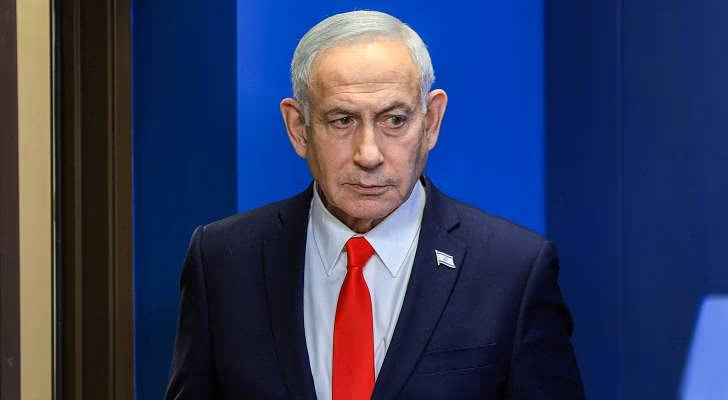
On the political front, Israeli Prime Minister Benjamin Netanyahu dropped a surprise by disavowing the understandings recently announced by Washington, confirming during a meeting of the ministerial cabinet (the 'Kabinett') that there is currently no actual agreement with Lebanon. Netanyahu clarified that the ceasefire draft has not been fully formulated and its pillars have not yet been completed, indicating that his country does not consider itself bound by any non-final understandings.

Netanyahu attributed the stalled agreement to what he described as Hezbollah's opposition to the proposed conditions, considering that this rejection makes the agreement non-existent from the Israeli point of view. He also stressed the importance of coordination with US President Donald Trump, describing him as a strategic partner with whom discussions must be allowed to continue to reach a formula that serves Israeli security interests.

For his part, Israeli Army Chief of Staff Eyal Zamir briefed the ministers on military readiness, confirming that the armed forces are prepared to expand the scope of fighting in Lebanon if the political level decides to do so. Zamir called for a clear definition of the next phase's path, noting that reaching an agreement on Tel Aviv's terms today is better than reaching it later with the same terms after additional attrition.

Israel adheres to a set of strict conditions for approving any calm, foremost among them the disarmament of Hezbollah in the area extending from the border to the Litani River. Tel Aviv also demands the retention of a security strip under its direct control, and ensuring what it calls 'freedom of military movement' within Lebanese territory to confront any immediate threats that may arise in the future.

In contrast, the Lebanese response came through Parliament Speaker Nabih Berri, who confirmed in an official statement that Hezbollah is ready to commit to a comprehensive ceasefire and withdrawal from border areas. Berri stipulated that this withdrawal must be parallel to a full Israeli withdrawal from all territories occupied by occupation forces during recent operations, rejecting any formula that grants Israel security superiority or military presence.

In the past few days, cautious optimism had emerged after the US State Department announced initial understandings that included the deployment of the Lebanese army in 'experimental areas' in the south to be the sole controlling force there. However, this proposal faced significant obstacles with Hezbollah's insistence on a full Israeli withdrawal and its rejection of any foreign supervisory role that infringes on Lebanese sovereignty or changes the previous rules of engagement.

These successive developments indicate a wide gap between Israeli demands and Lebanese conditions, putting international mediation efforts at risk. With continued airstrikes and civilian casualties, the field remains the primary driver of events, amid continuous Israeli threats to escalate military operations if its security conditions in the south are not met.

There is currently no agreement with Lebanon for a ceasefire, and the final formula has not yet been completed due to Hezbollah's opposition.

ARAB AND WORLD

Sat 06 Jun 2026 10:04 am - Jerusalem Time

Escalation in the Gulf of Oman: Iran Demands $24 Billion for Agreement and Announces Targeting of American Destroyers

Mohsen Rezaei, advisor to Iran's Supreme Leader, announced that reaching any political agreement with the current US administration is contingent on a practical step: the release of detained Iranian assets. Rezaei clarified that the value of these assets amounts to $24 billion, emphasizing that this demand represents the cornerstone of any future negotiations between the two parties to end the existing state of tension.

In a related context, Iranian diplomatic sources revealed details of the proposed timeline for receiving these funds, with Tehran demanding $12 billion immediately upon signing the memorandum of understanding. Kazem Gharibabadi, Deputy Foreign Minister for Legal Affairs, indicated the necessity of scheduling the remaining amounts to be paid within a period not exceeding 60 days, which is the specified duration for technical negotiation rounds.

The Islamic Republic insists on the necessity of lifting all economic sanctions that Washington reimposed after its unilateral withdrawal from the nuclear deal in 2018. Tehran views the restoration of access to its frozen funds abroad as a legal right that cannot be waived, considering that the continued freezing of these assets hinders any real progress in the stalled diplomatic path between the two countries.

On the ground, the Gulf of Oman region witnessed a remarkable military development, as the Iranian armed forces announced the execution of a 'warning missile' operation targeting two US Navy destroyers. A military statement mentioned that the American ships were forced to change their course and leave the area towards the Indian Ocean after these missile volleys, the exact date of which Tehran did not specify.

The Iranian army described the US Navy's movements in the region as 'illegal acts,' calling the forces present there 'terrorist.' The statement affirmed that these operations come within the framework of defending Iranian maritime sovereignty and confronting the threats posed by foreign warships in the strategic waterways near the Strait of Hormuz.

In contrast, the US Central Command (CENTCOM) quickly denied the Iranian narrative in its entirety, asserting that its ships had not been subjected to any attack or gunfire. Washington considered such claims a blatant violation of the ceasefire agreement that came into effect on April 8, warning of the repercussions of spreading misleading information about navigation security.

US military sources stressed that their forces continue to move freely in international waters and are committed to carrying out their missions, including the blockade measures imposed on Iranian ports. These verbal and field skirmishes threaten the fragile truce recently reached, amid stalled negotiations aimed at ending the state of military hostility that erupted last February.

The region is experiencing a state of constant alert since the expansion of regional confrontations, with Iran imposing strict control over the Strait of Hormuz in response to US movements. Despite the existence of communication channels aimed at reaching a final agreement, the gap between Tehran's financial demands and US security requirements still hinders the achievement of a comprehensive settlement to end the crisis.

Any potential agreement between Washington and Tehran depends on the approval of US President Donald Trump's administration to release frozen Iranian assets worth $24 billion.

PALESTINE

Sat 06 Jun 2026 10:04 am - Jerusalem Time

Cairo hosts factional meetings to discuss the future of Gaza, and a Hamas delegation arrives in the Egyptian capital

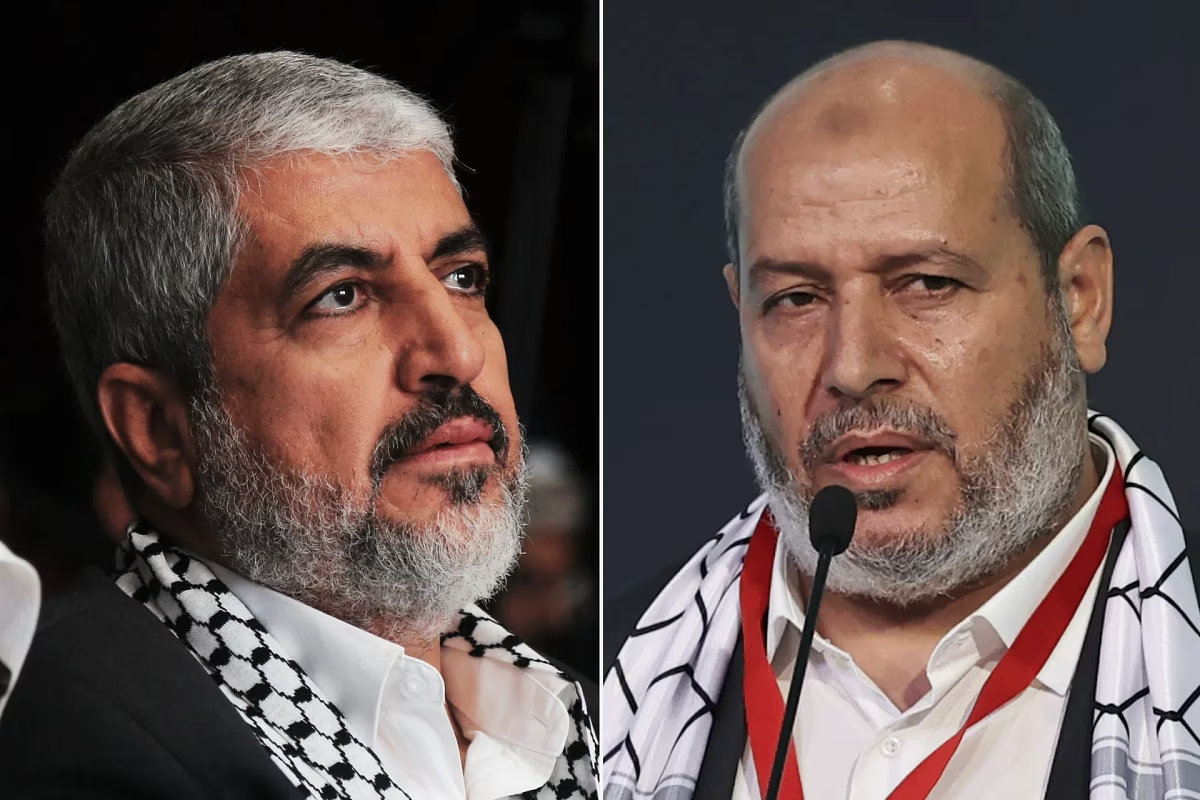
A leading delegation from the Islamic Resistance Movement (Hamas), headed by Khalil al-Hayya, head of the movement in the Gaza Strip, arrived in the Egyptian capital, Cairo, on Friday evening. This visit comes within the framework of intensive diplomatic activity through which the movement aims to discuss with Egyptian officials and international mediators the mechanisms for completing the implementation of the first phase of the ceasefire agreement.

Tomorrow, Saturday, expanded meetings are scheduled to begin, including several Palestinian factions, at an official invitation from Cairo, where deliberations will continue for two consecutive days. These meetings aim to discuss the future of the Gaza Strip in light of the current circumstances, and to explore ways to consolidate the fragile ceasefire, which faces continuous field challenges.

Political sources reported that the meeting will witness the participation of representatives from Hamas and Islamic Jihad movements and the Popular Front for the Liberation of Palestine, in addition to other national forces. In contrast, expectations indicate the absence of the Fatah movement from this round of talks, while the 'Reform Current' led by Mohammed Dahlan participates with active representation in these discussions.

Leaked data indicates that the talks will delve deeply into proposals related to granting Mohammed Dahlan a broader role in managing administrative and security affairs within the Gaza Strip. Dahlan, according to sources, seeks to persuade Palestinian forces to transfer administrative responsibilities to him to facilitate the transition to the second phase of the war-ending agreement and the introduction of specialized technocrat committees.

The Hamas delegation participating in this round includes prominent leading figures, among them the head of the movement in the West Bank, Zaher Jabarin, and members of the political bureau, Hussam Badran and Ghazi Hamad. This high-level representation reflects the movement's desire to reach comprehensive understandings covering the outstanding political and field issues with the Egyptian side and mediators.

In a related context, these discussions are expected to be completed on Sunday with an expanded meeting including representatives of the mediating countries involved in the truce file. Nikolay Mladenov, the High Representative of the 'Peace Council' established by the US administration, will join these sessions, giving an international character to the arrangements being discussed for the future of the Strip.

Hamas confirmed in an official statement that its delegation will work to find appropriate mechanisms to enter the second phase of the agreement, with a focus on stopping repeated aggressions. The movement also stressed the importance of formulating a unified national position that brings together Palestinian forces to confront the major challenges imposed by the current phase on the Palestinian people.

These moves come after the postponement of meetings that were supposed to be held in the coastal city of El Alamein last Wednesday, with deliberations moving to Cairo. The issue of the 'day after' the war and the administration of the Gaza Strip is considered one of the most complex issues in the ongoing negotiations, as local visions intertwine with regional and international pressures.

Diplomatic sources stated that the plan presented by Dahlan focuses primarily on security aspects and reorganizing the administrative apparatus in Gaza through non-partisan figures. This vision aims to break the current stalemate in the reconstruction file and facilitate the flow of humanitarian aid through administrative channels acceptable to active international parties.

It is worth noting that the last round of negotiations conducted by Hamas with mediators in Cairo was last April, and the parties are currently seeking to build on what was previously achieved. Political circles are closely monitoring the outcomes of Saturday and Sunday's meetings, for what they may bring in terms of fundamental changes in the form of the future administration of the Gaza Strip.

We seek to present a unified national position on various issues and agree on ways to deal with the challenges facing the Palestinian people.

PALESTINE

Sat 06 Jun 2026 10:03 am - Jerusalem Time

In the presence of Turkish President Recep Tayyip Erdoğan... Shinar at the Al Baraka Islamic Economy Summit: The Palestinian Experience is a Model of Financial Resilience Despite Exceptional Challenges

His Excellency the Governor of the Monetary Authority, Mr. Yahya Shinar, reviewed Palestine's experience in strengthening financial resilience and stability in Palestine, during the third Al Baraka Islamic Economy Summit 2026, explaining that the measures implemented by the Monetary Authority constituted a model reflecting the ability to manage monetary and financial policies in an exceptional environment lacking full monetary sovereignty, and subject to complex restrictions on the movement of individuals, goods, and capital. He added that these measures helped in dealing with the repercussions of the war on the Gaza Strip and the resulting slowdown in economic activity.

The third Al Baraka Islamic Economy Summit was held in Istanbul under the title "Capital in the Islamic Economy: Structuring Wealth for Sustainable Development," in the presence of His Excellency the President of the Republic of Turkey, Mr. Recep Tayyip Erdoğan, the Governor of the Central Bank of Turkey, Dr. Fatih Karahan, the Governor of the Central Bank of Malaysia, Mr. Abdul Rasheed Ghaffour, the UN Special Envoy for Sustainable Development Finance, Dr. Mahmoud Mohieldin, the Chairman of the Board of Trustees of the "Al Baraka Islamic Economy Forum," Mr. Abdullah Saleh Kamel, and a member of the Council of Senior Scholars, Imam and Preacher of the Grand Mosque, and Advisor to the Saudi Royal Court, Sheikh Dr. Saleh bin Abdullah bin Humaid, with the participation of a number of ministers, policymakers, and representatives of Islamic banks from various countries around the world.

On the sidelines of the summit, His Excellency the Governor of the Monetary Authority, Mr. Yahya Shinar, was honored by the office of His Excellency the Turkish President Recep Tayyip Erdoğan, in appreciation of his contributions to the development of the Palestinian financial and banking sector, and his efforts in promoting financial stability and supporting the resilience of the Palestinian economy in light of exceptional challenges.

Shinar explained that the Monetary Authority continued to play its role in maintaining financial stability and ensuring the banking system's continued provision of services to the public under extremely complex circumstances and during the war, despite the challenges associated with the accumulation of shekels and the continuous threats of cutting correspondent banking relationships.

He pointed out that the Monetary Authority developed the digital payments infrastructure, including the E-Sadad bill presentation and payment platform, the iBuraq instant payment and transfer system, and a direct installment system. It also created a working environment to facilitate the use of electronic payment systems, including the establishment of electronic wallets and licensing the work of payment and fintech companies, which contributed to maintaining the financial cycle and the continuity of the economy and facilitating the execution of payments during the war and also under the isolation policies implemented by the Israeli occupation in Palestinian cities and villages in the West Bank.

The Governor reviewed the role of the financing programs and funds managed by the Monetary Authority, foremost among them the Sustainability Fund, in supporting small and medium-sized enterprises and institutions affected by crises, thereby enhancing their ability to continue and stimulate growth in the national economy.

Shinar referred to the Monetary Authority's efforts in developing the regulatory framework for Islamic banking and strengthening Sharia and supervisory governance, in line with international standards, and contributing to expanding the role of this sector as a source of financing supporting the real economy.

The Governor emphasized that Islamic finance provides a practical framework based on linking finance to actual economic activity, thereby enhancing the efficiency of resource allocation and reducing risks associated with short-term speculation, and supporting financial stability and sustainable development.

Shinar called for strengthening cooperation between central banks and international financial institutions to develop the Islamic finance system, and expand Sharia-compliant liquidity tools and financial safety nets, thereby contributing to raising the efficiency of the financial system and enhancing its ability to withstand shocks.

PALESTINE

Sat 06 Jun 2026 10:02 am - Jerusalem Time

Thirst Threatens Thousands of Lives: Water Crisis Suffocates Displaced Camps in Mawasi Khan Yunis

The severity of the humanitarian suffering is escalating in the displacement camps spread across the sands of Mawasi Khan Yunis, south of the Gaza Strip, where escaping bombardment is no longer the only concern for the displaced. Hundreds of thousands there face a harsh daily battle to secure the most basic necessities for survival: drinking water, which has become extremely scarce.

This coastal area hosts about 200,000 displaced people who were forced to leave the city of Rafah, with tents distributed in more than 118 camps lacking the minimum infrastructure. Fears of an environmental and health catastrophe are growing with the approach of summer and rising temperatures, which increase the population's need for water.

Field sources reported that obtaining a few liters of water has turned into an arduous journey that drains the energy of children, women, and the elderly alike. Displaced people spend long hours of their day in queues or walking long distances in search of a usable water source.

_The roots of the crisis lie in the severe shortage of fuel, oils, and spare parts necessary to operate the already dilapidated water wells and pumping stations. Strict restrictions on the entry of these essential materials into the Strip have caused an almost complete paralysis in the water supply system within the overcrowded displacement areas.

At the heart of this suffering, the scene of children carrying heavy gallons and walking more than two and a half kilometers to reach 'Zannoun Well' stands out. This well is the only available source for thousands of families who are forced to rely on highly saline water to manage their daily affairs.

One of the displaced children recounts that his family of ten relies entirely on what he brings in four to six arduous daily trips. He explained that these small quantities run out very quickly, forcing them to ration water use to critical levels that affect their hygiene and health.

Testimonies from inside the camps indicate that the water crisis is not new, but rather an extension of continuous suffering for more than a year and three months. Residents await simple technical solutions, such as extending direct water lines to tent clusters, to alleviate the physical and psychological burden on the displaced.

In an attempt to make their voices heard, thousands of displaced people organized protests to demand an increase in water quotas reaching the camps and the provision of fuel for pumps. Participants in these events affirmed that their demands have not yet received any tangible response from international bodies or relief organizations working in the field.

For his part, Moein Sheikh Al-Eid, an official in the displaced camps, stated that appeals and official messages have been sent to all relevant parties without success. He warned that the continuation of the current situation threatens the spread of epidemics and skin diseases due to the forced lack of personal hygiene caused by water scarcity.

Sheikh Al-Eid considered the thirst crisis to be part of a broader context of living pressures, including food shortages and declining medical services. He affirmed that preventing the entry of generators and essential operating materials aims to exacerbate the humanitarian crisis and push the population towards the brink of total collapse.

In turn, Abu Ibrahim Mansour, an administrative official in the camps, explained that the crisis has reached unprecedented levels in recent weeks. He pointed out that reliance on dilapidated engines and insufficient wells has made it impossible to meet the needs of thousands of families who completely lack fresh water.

Mansour proposed urgent solutions, such as increasing the number of distribution tankers or establishing mobile desalination plants in the most densely populated areas. He stressed that a single tanker cannot, under any circumstances, satisfy the thirst of dozens of camps teeming with thousands of people suffering from thirst.

In the 'Knees Square' area, officials there describe the situation as extremely difficult, as the area lacks the most basic elements of a dignified life. Children there are forced to undertake arduous tasks to transport water from distant areas, negatively affecting their physical development and depriving them of their childhood amidst war conditions.

Attention is directed towards international organizations to intervene urgently by digging new wells or providing permanent water networks that reach directly to the tents. With the absence of radical solutions, the displaced in Mawasi Khan Yunis remain hostage to a bitter reality, where a sip of water becomes a dream difficult to achieve under a suffocating siege.

The water crisis is no longer just a shortage of services; it now threatens the health and human dignity of the population amidst a lack of hygiene and the spread of diseases.

PALESTINE

Sat 06 Jun 2026 10:02 am - Jerusalem Time

France opens formal investigation into suspicions of Israel committing war crimes against Freedom Flotilla activists

French judicial authorities announced today, Friday, the initiation of formal investigations concerning suspicions of Israeli occupation forces committing torture and war crimes. These investigations target violations suffered by French citizens who were aboard the Global Freedom Flotilla, which attempted to break the siege imposed on the Gaza Strip weeks ago.

The National Anti-Terrorism Prosecutor's Office reported that it received a formal referral from the French Ministry of Foreign Affairs on May 28 to investigate these transgressions. This legal step is based on Article 40 of the Code of Criminal Procedure, which obliges public officials to report any felonies or misdemeanors that come to their attention during the performance of their duties.

The Public Prosecution has entrusted the Central Office for Combating Crimes Against Humanity and Hate Crimes with the task of research and investigation, to ensure the accuracy of the investigations into the complaints filed. Investigators seek to ascertain the details of the attacks that occurred in the Mediterranean Sea and the subsequent detention operations within Israeli interrogation centers.

The details of the incident date back to May 18, when the Israeli navy intercepted the Freedom Flotilla boats in international waters as they headed towards the Strip. The flotilla included about 50 boats carrying more than 400 humanitarian activists from 44 countries, all of whom were arrested despite their assertion of the peaceful nature of their relief mission.

Following their deportation to their home countries on May 22, eight French activists revealed horrific details of what they described as a 'violent and humiliating' experience during their detention. These activists confirmed in press testimonies that the treatment they received from Israeli soldiers violated all international conventions related to human rights and the protection of civilians.

For her part, French activist Myriam Hajjaj recounted details of the physical assault and sexual harassment she was subjected to during her forced detention. Hajjaj explained that the soldiers used excessive violence against her, including hitting her on the head and assaulting her with knees to the rib area, as well as abusing her and violently pulling her hair.

In the context of political moves, French Prime Minister Sébastien Lecornu affirmed before Parliament that Paris is following the case with utmost seriousness. Lecornu indicated that the government does not rule out any judicial path to hold accountable those responsible for the ill-treatment of French citizens who were participating in a purely humanitarian mission.

The international outrage was further intensified by Israeli National Security Minister Itamar Ben-Gvir's publication of a video documenting his direct supervision of the abuse of activists. Human rights circles considered this recording to be conclusive evidence of the involvement of Israeli political leaders in inciting crimes against international solidarity activists.

These violations led to a wave of widespread summonses for Israeli ambassadors in several European and international capitals to protest the conduct of the occupation army. The list of objecting countries, in addition to France, included Spain, Canada, the Netherlands, Italy, Belgium, and Britain, amid calls for an independent international investigation into the incident.

One of the soldiers started hitting me on the head after I refused to follow him, while another delivered a strong knee blow to my ribs and grabbed me by my hair.

PALESTINE

Sat 06 Jun 2026 10:02 am - Jerusalem Time

Infant martyred and parents injured by occupation bullets in Tel Rumeida, Hebron

The Palestinian Ministry of Health announced on Friday evening the martyrdom of infant Sam Fahd Abu Heikal, who was not more than seven months old, due to severe injuries he sustained from occupation forces' bullets. The crime occurred in the Tel Rumeida area, south of Hebron city, where Israeli fire directly targeted a vehicle carrying a Palestinian family, leading to this human tragedy.

Medical sources reported that the martyred infant's father and mother sustained moderate injuries during the shooting, and they were transferred to the hospital to receive necessary treatment. The sources clarified that infant Sam had arrived at the medical center in a very critical condition before doctors announced his martyrdom, while his parents' health condition remains under continuous medical observation due to direct injuries.

In details of the assault, local sources stated that occupation forces stationed in the Tel Rumeida neighborhood opened fire with their machine guns towards the family's private car during its usual movement in the area. This targeting is part of a series of escalating attacks carried out by the occupation army and settlers in that area, which suffers from severe security restrictions and military checkpoints that hinder the movement of Palestinian citizens daily.

This crime comes amidst an escalation in the pace of Israeli violations in various cities and towns of the occupied West Bank, where incidents of targeting civilians in their vehicles in cold blood have been repeated. Observers confirm that direct firing at a family in a private car reflects the policy of leniency in pulling the trigger adopted by occupation soldiers, resulting in casualties among children and women without any field justification.

Infant Sam Fahd Abu Heikal, only 7 months old, martyred due to critical injuries from occupation bullets.

PALESTINE

Sat 06 Jun 2026 10:02 am - Jerusalem Time

Martyr and wounded in a massacre targeting displaced persons' tents in Khan Yunis and escalating occupation violations

Israeli occupation forces committed a new massacre at dawn today, Friday, after directly targeting tents housing thousands of displaced people in the Al-Mawasi area of Khan Yunis city, south of the Gaza Strip. Medical sources reported that the intense shelling led to the martyrdom of a Palestinian woman and the injury of about 16 others with varying degrees of wounds, who were quickly transferred to nearby field hospitals for necessary treatment.

In a related context, Gaza City witnessed a series of airstrikes on Thursday evening targeting various areas, resulting in the martyrdom of two Palestinians and the injury of several other citizens. These attacks come amid a significant escalation of continuous Israeli violations of the ceasefire agreement, as planes and artillery continue to target residential gatherings and areas crowded with civilians, disregarding international warnings.

Field sources also reported the fall of at least one martyr and the injury of others due to a raid carried out by an Israeli drone targeting the Al-Sha'biya intersection in the heart of Gaza City. These aggressions are part of a series of military operations that have not stopped despite reaching a truce agreement sponsored by Arab and American parties on October 10th last year, threatening the collapse of the fragile understandings in place.

According to official data issued by the Ministry of Health in Gaza, the death toll since the ceasefire agreement came into effect on October 11, 2025, has jumped to 947 martyrs and more than 2935 injured. These figures reflect the extent of field violations practiced by the occupation army in various governorates of the Strip, where civilians are directly targeted in shelters and areas previously classified as safe.

Regarding the total toll of the ongoing aggression since October 7, 2023, medical authorities have documented the martyrdom of approximately 72,956 Palestinians, while the number of injured has exceeded 173,043. The humanitarian suffering continues to worsen with the ongoing siege and shelling, amid Palestinian and international demands for the occupation to be compelled to stop its comprehensive aggression and provide urgent protection for civilian residents.

The death toll since the ceasefire came into effect on October 11, 2025, has risen to 947 martyrs, amid ongoing military operations and shelling.

PALESTINE

Sat 06 Jun 2026 10:02 am - Jerusalem Time

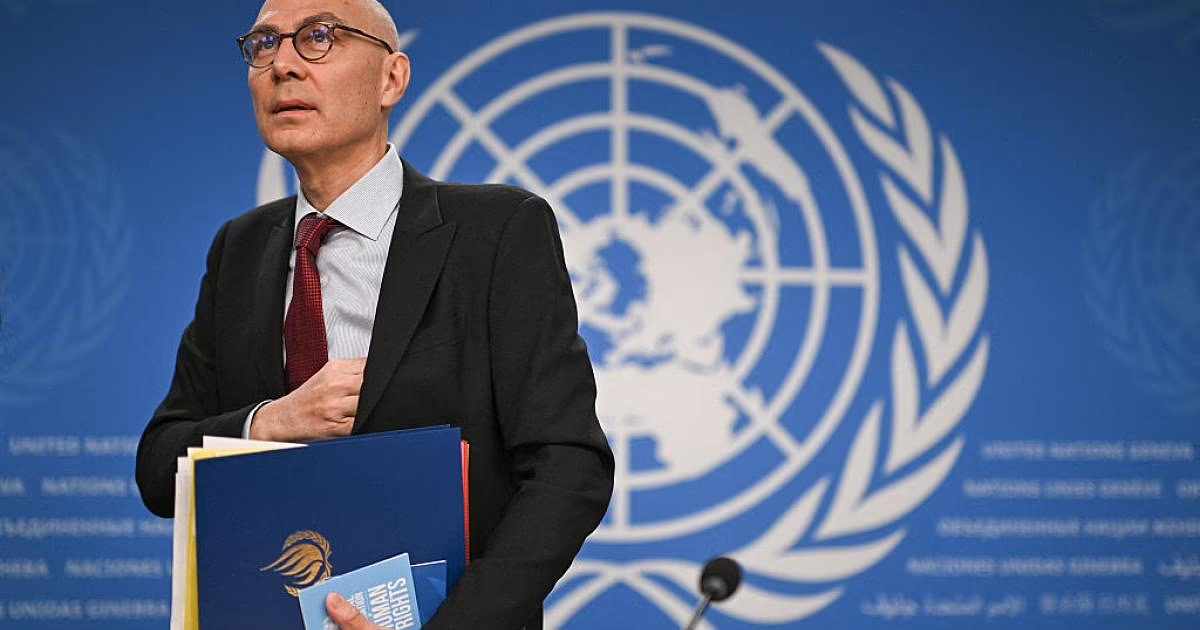
Israel's Inclusion in the UN's 'List of Shame': Legal Dimensions and a Political Blow to the Occupation

The term 'blacklist' historically dates back to the second decade of the 17th century, where it was used as a tool to denote individuals accused or suspected of treason. In the context of the United Nations, this classification represents an international tool to expose parties and states involved in grave violations of international law and human rights through official periodic reports.

In a significant diplomatic development, on May 28, 2026, the international organization once again included the Israeli occupation authorities on the 'blacklist' of states and organizations involved in violence in conflict zones. This decision reflects the extent of human rights deterioration in the occupied territories and the continuation of aggressive policies against Palestinian civilians.

Explicitly included in the seventeenth annual UN report on violence in conflicts were both the Israeli army and the prison service, in addition to the police's counter-terrorism unit known as 'Yamam'. The inclusion was based on reliable information indicating continuous patterns of physical assaults and horrific violations that lack any ethical standards.

The UN Human Rights Office revealed shocking statistics, indicating that nearly a third of Palestinians who were martyred since the October 2025 truce came into effect, fell in areas near the truce line. These figures reinforce international concerns about the occupation forces deliberately firing on civilians merely for approaching border areas without posing any threat.

For his part, UN Secretary-General António Guterres directed sharp criticism at the Israeli authorities, accusing them of deliberate dereliction in conducting transparent investigations to hold those responsible for violations accountable. Guterres affirmed that closing investigation files on soldiers involved in crimes at the 'Sidi Teiman' camp contributes to fostering an environment of impunity.

It is worth noting that this inclusion is not the first of its kind; the United Nations had previously placed Israel on the annual list of parties committing grave violations against children in June 2024. That decision came after eight months of comprehensive war on the Gaza Strip, which witnessed systematic targeting of infrastructure, educational, and health facilities.

The latest UN decision represents a painful legal, political, and diplomatic blow to the Zionist entity, and also serves as moral support for the Palestinian people's struggle in international forums. Observers believe that this classification reinforces the international community's conviction of the brutality of Israeli practices in dealing with unarmed civilians and attacking them with barbaric means.

The importance of this decision lies in its refutation of continuous Israeli claims of respecting human rights and democratic values before the world. By shedding light on the humanitarian tragedy in Gaza and the West Bank, these reports become crucial legal tools that the International Criminal Court and the International Court of Justice can rely on in prosecuting responsible leaders.

This report is expected to support the positions of countries that have joined the lawsuit filed before the International Court of Justice, primarily South Africa and Spain. UN pressure may contribute to accelerating the issuance of international arrest warrants against occupation leaders, thereby tightening the noose around them and limiting their ability to move internationally.

These legal moves force occupation leaders to review their field policies, fearing continuous prosecution. Documenting military terrorism, settler terrorism, and forced displacement puts Israel in direct confrontation with international laws that it has long tried to circumvent with the support of major powers.

The policy of deliberate destruction of all elements of life in the Palestinian territories reflects the spirit of revenge and hatred adopted by successive governments in Tel Aviv. This behavior represents the height of disregard for the international system, which led the UN organization to ignore the occupation ambassador's attempts to evade responsibility or justify the crimes committed.

In conclusion, the UN decision opens the door wide for international investigative committees to work more freely and document field crimes more accurately. This diplomatic achievement is the fruit of the steadfastness of the Palestinian people in the face of the war machine, which has turned the 'blacklist' into a 'list of shame' that pursues the occupation in every forum.

Israel dropping charges against soldiers involved in serious assaults in the Sidi Teiman camp perpetuates a climate of impunity for violence.

OPINIONS

Sat 06 Jun 2026 10:02 am - Jerusalem Time

Escalating Controversy Over Islamophobia in Washington After Targeting of Tlaib and Hamoui

Washington Message

Washington - Said Arikat - 6/6/2026

News Analysis

Democratic Congresswoman Summer Lee of Pennsylvania warned of the growing anti-Muslim rhetoric within American political life, considering that the recent attacks targeting Palestinian-American Congresswoman Rashida Tlaib and Egyptian-American Democratic candidate for New Jersey, Adam Hamoui, reflect a disturbing trend that goes beyond traditional political disagreement to questioning the legitimacy of Muslim and Arab participation in the public sphere.

Lee's statements came at a time when Washington is witnessing heated debates about the Israeli war on Lebanon and its political repercussions within Congress, where discussions related to foreign policy have turned into an arena for debate about identity, belonging, and political loyalty.

The House of Representatives had rejected a resolution proposed by Rashida Tlaib calling for preventing the participation of American forces in the Israeli war on Lebanon, after more than one hundred Democratic representatives, including Democratic Minority Leader Hakeem Jeffries, joined Republicans in voting against it.

However, the real controversy erupted during the discussions preceding the vote, when Republican Congressman Max Miller accused Tlaib of "defending terrorists daily," while Republican Congressman Brian Mast described supporters of the resolution as "agents of Hezbollah." Tlaib responded by demanding that these statements be expunged from the official record of the House of Representatives, considering them a direct attack on her character and political positions.

Commenting on what happened, Summer Lee believed that the issue is not merely a disagreement over foreign policy, but rather an extension of a recurring pattern of political targeting of Muslims and Arabs. She said that two Republican representatives treated Tlaib as if she were a terrorist "just because she is Palestinian, Muslim, and a woman," considering that such accusations reveal preconceived notions that are still present in American political discourse.

She added that what is alarming is not only the issuance of these accusations from political opponents, but their gradual transformation into part of the prevailing discourse when dealing with Muslim or Arab figures who adopt positions contrary to the traditional political consensus in Washington, especially on issues related to the Middle East.

These debates come at a time when Israel has continued its military operations in Lebanon since last March, operations that have resulted in thousands of casualties and the displacement of large numbers of civilians, making the war a major subject of disagreements within Congress and among the wings of the Democratic Party itself.

Lee's observations were not limited to Tlaib's case. She linked what the Palestinian congresswoman was subjected to with the controversy that followed the victory of Adam Hamoui, a retired military surgeon and the winning Democratic candidate in the primary elections for the twelfth district in New Jersey.

After his electoral victory, Hamoui faced criticism focused on a previous acquaintance he had with Egyptian cleric Omar Abdel Rahman during social activities related to the Egyptian-American community in New Jersey many years ago. Hamoui clarified that this relationship did not go beyond social acquaintance within community circles, and that attempts to link him to it politically ignore his long professional and military career.

Despite this, the issue sparked widespread political and media reactions. Some Democrats, including Congressman Jared Moskowitz, considered that Hamoui does not align with the party's values, while some media coverage focused on that old relationship more than on his military record or political program.

Lee believes that what unites the two cases is the tendency to subject Muslim politicians to loyalty tests not usually imposed on others, warning that the continuation of this approach could harm the image of the Democratic Party, which champions slogans of justice, equality, and pluralism.

She stressed that the problem is not limited to Republicans alone, noting that she has heard Democrats use some of the harshest stereotypes against their Muslim colleagues. She added that the party that presents itself as a protector of civil rights is required to show the same degree of sensitivity when it comes to Muslims and Arabs, otherwise it risks undermining its credibility among important segments of its voters.

Lee's statements were welcomed by activists and progressives who saw them as one of the clearest positions within the Democratic Party regarding what they consider an escalation of Islamophobia in American political and media circles.

The Democratic congresswoman concluded her stance by emphasizing that no targeted group should be left alone in the face of defamation and hate campaigns, calling for dealing with anti-Muslim hostility with the same seriousness with which other forms of discrimination are addressed. She stressed that the defense of rights and freedoms cannot be selective, and that protecting any minority from political targeting ultimately represents a defense of democratic values themselves.

Attacks on Rashida Tlaib and Adam Hamoui reflect a new reality in American politics. Muslims and Arabs are no longer just electoral pressure groups seeking to influence politicians' decisions, but have become producers of leaders, candidates, and decision-makers. With each new electoral success, the sensitivity of some political circles to this growing presence increases. Therefore, the recent accusations appear to be part of a broader struggle over the redistribution of influence within American institutions, more than just disagreements over foreign policy issues or positions related to the Middle East. The importance of this phenomenon increases with the entry of growing numbers of Arab and Muslim candidates into electoral races during the 2026 cycle.

This issue reveals a growing challenge for the Democratic Party. The party, which presents itself as the primary defender of pluralism and minority rights, finds itself facing increasing criticism from within its Arab and Muslim bases. Many feel that the defense of diversity recedes when it comes to the Palestinian issue or Muslim candidates. If the party cannot seriously address these concerns, it may face difficulty in maintaining the cohesion of the diverse electoral coalition that has been one of its most important strengths over the past two decades. Ignoring these objections may also open the door to further tension between party leaders and young voters involved in human rights issues.

In recent years, discussions about Islamophobia have mostly focused on hate crimes and social discrimination. Today, however, the issue has moved to the heart of the political struggle in Washington. As the number of elected officials of Arab and Muslim descent increases, the debate revolves around who has the right to participate in decision-making and determine the priorities of American policy. This is why the recent confrontations are particularly important, as they do not merely reflect ideological differences, but indicate a gradual redrawing of the balance of power within American political life. The 2026 elections may represent a pivotal moment in this transformation, which has become clearer than ever before.

ARAB AND WORLD

Sat 06 Jun 2026 10:01 am - Jerusalem Time

Diplomatic Spat Between Beirut and Tehran.. Araqchi Responds to Aoun, Israeli Raids Target Bekaa and South

The diplomatic arena witnessed a remarkable tension between Beirut and Tehran, as Iranian Foreign Minister Abbas Araqchi sharply responded to statements made by Lebanese President Joseph Aoun. Araqchi considered claims that Lebanon represents a bargaining chip in Iran's hand as unrealistic, pointing out that his country does not control Lebanese decision-making as some promote.

In a post on the 'X' platform, the Iranian minister mocked the logic of the Lebanese presidential statements, considering that whoever hears them might think that Iran is the one occupying Lebanese territories and displacing its residents. Araqchi called on President Aoun to focus on what he described as the 'real enemy,' represented by the Israeli occupation that launches daily raids on the country.

Lebanese President Joseph Aoun had launched an unprecedented attack on Iranian policies during an interview with 'CNN' news network. Aoun affirmed in his statements that Tehran uses the Lebanese arena as a tool to improve its negotiation terms with the United States of America, which he considered utterly rejected by the Lebanese state.

Aoun, in his address to Iranian officials, emphasized Lebanon's sovereignty, stating that this country belongs to its people and is not an arena for foreign interventions. He demanded the necessity of regional powers withdrawing their hands from Lebanese internal affairs, especially given the current circumstances plaguing the country as a result of ongoing military confrontations.

Regarding the internal front, the Lebanese President sent a clear message to Hezbollah, emphasizing that the diplomatic path is the only remaining way to save what can be saved. Aoun believed that sitting at the negotiating table has become an urgent necessity to resolve the current crisis, away from the language of weapons that has drained the state's capabilities.

These political developments come at a time when sources announced that the United States, Lebanon, and Israel have reached a declaration of intent to implement a ceasefire. This announcement followed a fourth round of intensive negotiations in Washington, aimed at ending the military operations that have been ongoing for months.

Despite this diplomatic progress, Hezbollah Secretary-General Naim Qassem expressed categorical rejection of the outcomes of these understandings. Qassem considered that the proposed conditions are not accepted by wide segments of Lebanese, which places serious obstacles in the way of implementing any imminent ceasefire agreement on the ground.

On the ground, the Israeli military machine did not stop targeting Lebanese areas, as warplanes launched violent raids at dawn today on the town of Sahmar in Western Bekaa. Local sources reported that the shelling caused extensive material damage, with no human casualties recorded until the time of preparing this report.

In the South, occupation drones targeted the Al-Khalleh area in the town of Jouya in the Tyre district, coinciding with a night raid on Wadi Jarnaya in the Jezzine region. These attacks come as part of a continuous escalation affecting various Lebanese regions, further complicating the political and humanitarian scene in the country.

If Lebanon were a bargaining chip for Iran, we would have reached an agreement a long time ago.

PALESTINE

Sat 06 Jun 2026 10:01 am - Jerusalem Time

On the anniversary of the 1967 war.. the conflict deepens amid fears of regional reality reshaping

Dr. Suhail Diab: The conflict in the region is no longer viewed as a temporary occupation amenable to settlement, but has transformed into a long-term struggle over land, borders, and resources..

Sari Sammour: The 1967 war paved the way for a series of major political transformations in the region, including the peace agreements Israel concluded with a number of Arab countries..

Dr. Reham Odeh: Israel is effectively proceeding with the implementation of its regional project by focusing on establishing buffer zones and security belts within bordering Arab territories..

Maged Hudeib: The most dangerous aspect of this expansion is the reshaping of the region according to the Israeli vision by imposing new balances based on military power and facts on the ground..

Dr. Aql Salah: The region is experiencing a "second setback" and the Israeli expansionist project faces challenges that prevent its completion, most notably the steadfastness of Palestinians and Lebanese..

Hani Abu Al-Siba': Despite signing the peace agreement with Egypt, Israel continued its expansionist policies, and the statements of its leaders currently clearly reflect the "Greater Israel" project..

Ramallah - Exclusive to "Al-Quds" - On the fifty-ninth anniversary of the June 1967 war, discussions are renewed about the repercussions of the war that still cast a shadow over the Palestinian and regional scene, in light of the expansion of Israeli military operations, the growth of settlements, and field movements in the occupied Palestinian territories and neighboring Arab areas, amid warnings of attempts to impose new facts on the ground that may affect the future of the conflict and its political settlements.

Writers, political analysts, specialists, and university professors, in separate interviews with "Al-Quds", believe that the developments witnessed in the region, especially since October 7, 2023, until now, reflect the transition of the conflict from the framework of temporary occupation to a long-term struggle over land, borders, and resources, with increasing talk about security belts and buffer zones and declining chances of reaching a political settlement based on the two-state solution, in light of continued settlement expansion and changing balances of field control.

They agree that the results of the 1967 war still constitute a fundamental reference for understanding the current reality, whether through the continuation of the conflict over Jerusalem, borders, and settlements, or through regional transformations that have raised questions about the future of the regional system, and the possibility of reshaping the balance of power in the Middle East in light of accelerating military and political changes.
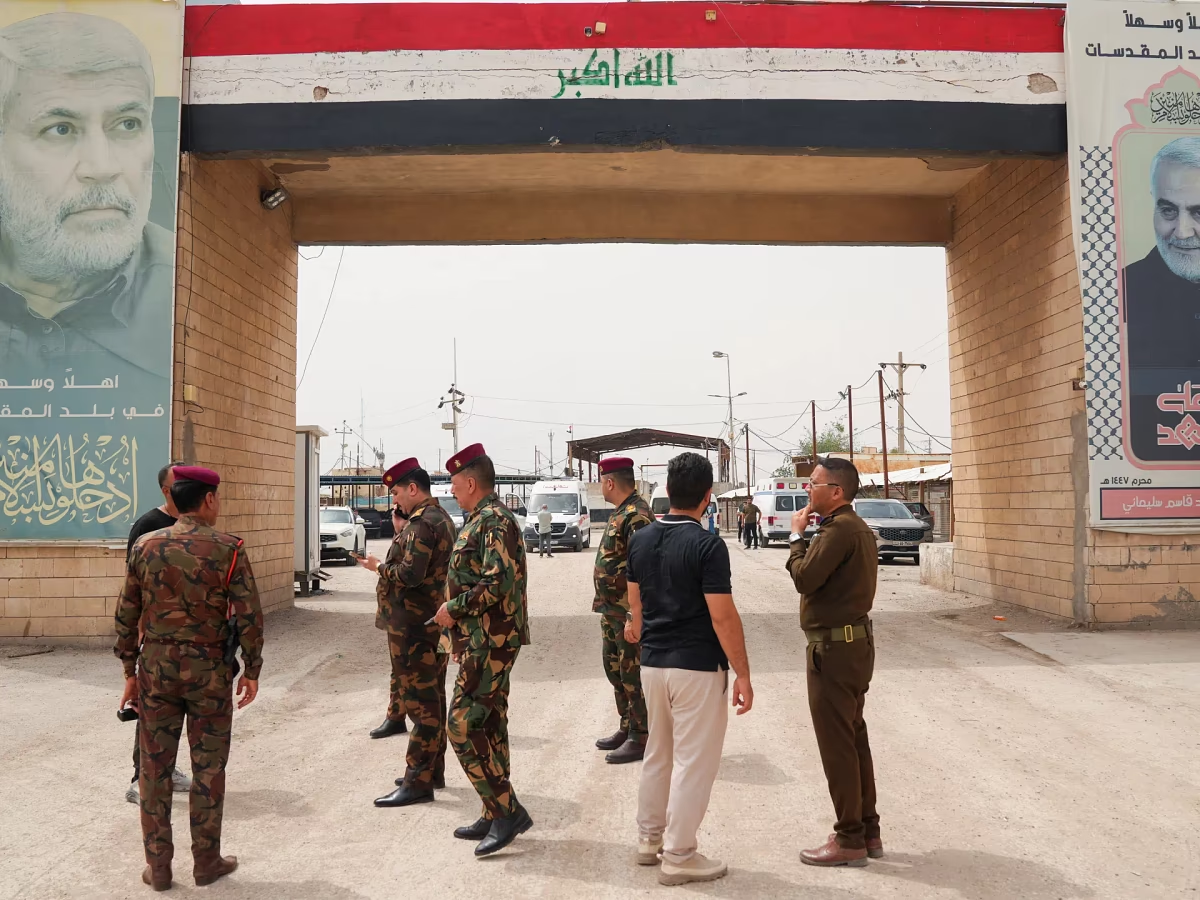
Long-term conflict over land, borders, and resources

Dr. Suhail Diab, a professor of political science and specialist in Israeli affairs, believes that the current scene on the fifty-ninth anniversary of the June 1967 war confirms that the conflict in the region is no longer viewed as a temporary occupation amenable to settlement, but has transformed into a long-term struggle over land, borders, and resources, in light of the expanding scope of Israeli influence and military control in more than one regional arena, including the Gaza Strip, the West Bank, southern Lebanon, and border areas within Syria.

Diab explains that the 1967 war still casts its shadow over various fundamental issues in the Arab-Israeli conflict, as the issues of Jerusalem, settlements, borders, the Golan, and the Palestinian state have their direct roots in the results of that war, which led a number of researchers and analysts to consider that the war has not ended politically despite the cessation of military operations decades ago, and that its repercussions are still unfolding today.

Consolidating permanent facts

Diab points out that over the past decades, Israel has moved from a model of direct military occupation to more complex forms of control, based on consolidating permanent facts through settlement expansion, infrastructure networks, and legal or de facto annexation, thereby strengthening its influence on the ground and making any future change more difficult.

Diab emphasizes that the developments following October 7, 2023, brought the demographic dimension of the conflict back to the forefront, after many years in which this factor had relatively declined, to return again as one of the central challenges in the relationship between Israelis and Palestinians.

Diab notes that the ongoing military operations in Gaza, Israeli movements on the Lebanese border, and military presence in some Syrian areas reflect a trend towards establishing security belts and buffer zones outside traditional borders.

According to Diab, while Israel justifies these measures on security grounds and to prevent threats, Palestinian and Arab parties, along with international bodies, view them as a form of expanding control and imposing new geographical realities on the ground.

Crisis facing the two-state solution

Diab stresses that one of the most prominent repercussions of these policies is the deepening crisis facing the two-state solution, as continuous settlement expansion in the West Bank makes the establishment of a geographically contiguous Palestinian state more complex over time, and reduces the chances of reaching a sustainable political settlement.

1967.. The beginning of profound transformations

In his assessment of the conflict's trajectory since 1967, Diab believes that this war represented the peak of Israeli military achievement, but at the same time, it marked the beginning of profound transformations that carried within them factors for the long-term decline of the Zionist project.

Diab points out that the transition from controlling territories under the pretext of security to a settlement project with a replacement and colonial character contributed to the emergence of accumulated internal and external crises, and produced manifestations of international isolation and increasing criticism of Israeli policies.

Reshaping the regional environment

Regarding the escalating talk about the "New Middle East," Diab calls for distinguishing between two different concepts; the first relates to reshaping the regional environment to ensure Israeli security, economic, and military superiority, and the second is related to ideological propositions that speak of "Greater Israel" and clear expansionist borders. Diab explains that, according to academic standards, there is no official declared Israeli plan that defines new future borders for the state, but there is a clear project to reshape the regional environment to serve Israeli interests.

Diab stresses that the future of these perceptions is still linked to a number of crucial variables, including the outcomes of the current war, the development of hot international issues, the nature of the Israeli political system in the coming period, and the trends of American public opinion.

Stage of fluid events

Diab believes that the region is still experiencing a very fluid stage of events, and that talk of a new Middle East remains subject to shifting regional and international balances, emphasizing that any future regional system will not be shaped according to the Israeli or American vision alone, but within a more pluralistic and complex international and regional reality.

1967.. Repercussions still present

Writer and political analyst Sari Sammour confirms that the June 1967 war constituted a pivotal turning point in the history of the Arab-Israeli conflict, not only at the level of geographical control, but also in the nature of conflict management and its political objectives, noting that the repercussions of that war are still present today and affect the regional scene in its various dimensions.

Sammour explains that the war brought about a radical shift in the Arab perception of Israel, as Arab political discourse, after the defeat, shifted from talking about the complete liberation of Palestine and ending Israel's existence to focusing on restoring the territories occupied in 1967 and demanding the implementation of relevant international resolutions, foremost among them Security Council Resolutions 242 and 338. Sammour believes that this shift granted Israel political and strategic gains in addition to the military gains it achieved on the ground.

Sammour points out that the results of the war enabled Israel to expand its regional control by occupying the West Bank, including East Jerusalem, which includes Al-Aqsa Mosque, in addition to occupying the Syrian Golan Heights.

Sammour notes that these developments strengthened Israel's confidence in its ability to impose new realities, leading to the declaration of Jerusalem as its capital, in light of the international community's inability to bring about a fundamental change in this reality.

Paving the way for major political transformations

Sammour believes that the 1967 war paved the way for a series of major political transformations in the region, including the peace agreements Israel concluded with a number of Arab countries, stressing that without the results of that war, the region would not have witnessed agreements such as Camp David, Wadi Araba, and Oslo in the form they later became known.

Sammour points out that expansion represents a fundamental pillar of the Israeli project, which is based on geographical expansion, demographic replacement, and the reshaping of demographic reality in the areas it controls.

Sammour notes that current Israeli policies in the Gaza Strip and the West Bank, in addition to military movements in Lebanon and Syria, reflect the continuation of this vision and an attempt to impose new equations on the ground.

Shifting negotiation lines to a new reality by force

Sammour stresses that Israel constantly seeks to shift negotiation lines to a new reality imposed by force, so that negotiations shift from discussing ending the occupation or removing settlements to discussing the limits of withdrawal from newly occupied areas.

Sammour believes that what is happening in Syria and Lebanon reflects this approach, where demands have focused on returning to previous lines and agreements instead of addressing the roots of the occupation, which reflects the continued impact of the 1967 war results on the course of the conflict to this day.

Fragmenting Palestinian geography

Writer and political analyst Dr. Reham Odeh, in her commentary on the anniversary of the June 1967 war, believes that the continuous Israeli expansion in the occupied Palestinian territories, along with military movements in both Lebanon and Syria, reflects a growing Israeli trend to reshape the geographical and security reality in the region in a way that serves its strategic interests and limits the chances of an independent Palestinian state.

According to Odeh, the settlement expansion and accelerating field measures witnessed in the West Bank, in parallel with Israeli control over key joints in the Gaza Strip, fall within a policy aimed at fragmenting Palestinian geography and preventing geographical contiguity between parts of the future Palestinian state, thereby practically undermining the possibility of establishing an independent state on the 1967 borders.

Imposing a new reality in the Middle East

Odeh stresses that Israeli movements in Lebanon and Syria go beyond immediate security considerations, as Israel seeks to impose a new political and security reality in the Middle East by utilizing its military superiority to force regional countries to deal with it as a dominant regional power that must be accommodated and whose influence must be adapted to.

Odeh points out that targeting forces supporting the Palestinian resistance and attempts to impose control over border areas in southern Lebanon and southern Syria fall within a broader strategy to redraw regional power balances.

Odeh believes that Israel is effectively proceeding with the implementation of its regional project by focusing on establishing buffer zones and security belts within bordering Arab territories, under the pretext of protecting its national security.

Buffer zones as political and security leverage

Odeh believes that these areas may in the future turn into political and security leverage that Israel uses to influence the decisions of regional countries and push them towards security arrangements or normalization agreements, thereby consolidating a new regional reality that gives it a wider margin for military and political maneuver in the Middle East.

Attempt to reshape regional reality

Writer and political analyst Maged Hudeib believes that the expanding scope of Israeli operations and control in the occupied Palestinian territories, along with military movements in Lebanon and Syria, carries a set of political, security, and strategic implications that go beyond the limits of direct military confrontations, to fall within the framework of an attempt to reshape regional reality and impose new equations that affect the future of the region and its political settlements.

Hudeib explains that one of the most prominent implications of this expansion is Israel's ability to impose new field realities by controlling additional areas and redrawing the security geography in more than one arena, which gives it additional leverage in any future negotiations or political settlements.

Israel and investing in war outcomes

Hudeib points out that Israel has historically invested in the results of wars and military operations to transform field gains into political facts that affect the form of future solutions, which is what happened in the June 1967 war.

Hudeib notes that the security dimension represents one of the main drivers of this expansion, as Israel, according to its vision, seeks to establish buffer zones, security belts, and field enclaves that it considers advanced defense lines that prevent the emergence of future threats to its security.

Hudeib believes that this policy is not new, but has been repeated at more than one historical juncture with the aim of strengthening field control and creating facts that are difficult to overcome in any subsequent political arrangements.

Israel's attempt to impose political projects and solutions

Sammour believes that what is happening in Syria and Lebanon reflects this approach, where demands have focused on returning to previous lines and agreements instead of addressing the roots of the occupation, which reflects the continued impact of the 1967 war results on the course of the conflict to this day.

According to Hudeib, these combined factors have contributed to strengthening Israeli influence and bringing about tangible shifts in the regional balance of power recently.

Hudeib stresses that the most dangerous aspect of this expansion is the trend towards reshaping the region according to the Israeli vision, by imposing new political and security balances based on military power and the field realities produced by recent wars.

Hudeib warns that these transformations increase the complexity of fundamental issues related to the Palestinian cause, foremost among them issues of borders, sovereignty, security, and the future of the independent Palestinian state, which places additional obstacles in the way of any political efforts for settlement.

Betting on Arab positions

Hudeib stresses that Israeli military successes, despite their field impact, are not sufficient alone to achieve a comprehensive regional political project or impose what is known as the "New Middle East" project.

Hudeib explains that the success of any such project remains contingent on the approval of regional countries and reaching a just and comprehensive political settlement that addresses the roots of the Arab-Israeli conflict.

Hudeib points out that the continued Israeli occupation of Palestinian territories and territories in Syria and Lebanon, and the continuation of the conflict without a clear political horizon, constitute a fundamental obstacle to achieving regional stability.

Hudeib notes that Arab and international positions rejecting the policy of imposing facts by force make it difficult to transform military gains into a permanent political project.

Hudeib points out that peace and stability in the region cannot be achieved through wars or military dominance, but rather through agreements based on justice, ending the occupation, and establishing a Palestinian state in accordance with international legitimacy resolutions, considering this the true gateway to any stable and sustainable regional arrangements.

Stage of geographically and demographically resolving the conflict

Writer, political researcher, and professor of comparative political systems, Dr. Aql Salah, believes that the region is currently witnessing a "second setback" whose effects and repercussions exceed those of the 1967 setback, both in terms of the affected geographical area and the magnitude of political and strategic transformations witnessed in the Palestinian territories and a number of Arab countries.

Salah explains that Israel has moved from the stage of managing the conflict to the stage of resolving it geographically and demographically, benefiting from the realities imposed by the ongoing war since October 7, 2023, and from the structure produced by the Oslo Agreement, which was supposed to lead to ending the occupation, but provided cover for consolidating Israeli control over most of the West Bank territories, especially in areas classified (B) and (C), with the expansion of land confiscation to include areas within classification (A).

Salah points out that the current scene reflects an unprecedented expansion of Israeli control, whether in the Gaza Strip, where Israel now effectively controls about 70% of its area, or in southern Lebanon, in addition to vast areas within Syrian territories, including strategic locations such as Mount Hermon, in parallel with accelerating settlement in the West Bank in all its forms; settlement, pastoral, agricultural, archaeological, and military, leading to the fragmentation of the West Bank and confining Palestinian communities within narrow urban areas.

Exceeding previous border agreements

Salah believes that these developments carry deep strategic implications, most notably the imposition of a new geographical reality through the establishment of buffer zones and permanent control axes, and exceeding previous border agreements and understandings to impose new arrangements by military force, as well as accelerating the de facto annexation of West Bank lands and undermining the chances of establishing an independent and geographically contiguous Palestinian state with Jerusalem as its capital.

Salah stresses that the Israeli military expansion in Gaza, Lebanon, Syria, and the West Bank has led to widespread displacement waves and escalating humanitarian crises, and also reflects an increasing violation of state sovereignty in the absence of international deterrence.

International impotence met by Palestinian and Lebanese steadfastness

Salah believes that what is happening reveals the impotence of the international system and its institutions, including the Security Council and the International Court of Justice, to enforce their decisions or provide protection for civilians, which has strengthened Israel's feeling of having international cover for its continued policies.

Salah believes that the Israeli expansionist project faces a number of challenges that prevent its completion, foremost among them the steadfastness of Palestinians and Lebanese and their adherence to their land despite war and destruction, in addition to regional and international positions rejecting displacement policies.

Salah points to growing international criticism of Israel and its increasing political and moral isolation, in addition to the continuation of forms of resistance and defiance in more than one arena, considering that these combined factors constitute fundamental obstacles to any attempt to impose final facts on the ground or redraw the region according to the Israeli vision.

October 7 reveals the Israeli expansionist approach

Writer, political analyst, and specialist in Israeli affairs, Hani Abu Al-Siba', confirms that the events extending between the June 1967 war and October 7, 2023, reveal the continuation of the Israeli expansionist approach and the absence of any fundamental change in Israeli strategy towards Arab territories, despite the peace agreements and political understandings witnessed in the region over the past decades.

Abu Al-Siba' explains that Israel, despite signing the peace agreement with Egypt in 1979 and the declaration by former Israeli Prime Minister Menachem Begin at the time of the end of the era of wars with Egypt and the Arabs, continued its expansionist policies in various forms, considering that the statements and practices of the current Israeli government leaders clearly reflect the "Greater Israel" project.

Abu Al-Siba' cites in this context a map published by Israeli Finance Minister Bezalel Smotrich that showed Jordan within Israel's borders, in addition to Prime Minister Benjamin Netanyahu's statements about continuing control over large areas of the Gaza Strip.

Abu Al-Siba' points out that Israeli expansion was not limited to Palestinian territories, but extended to the Syrian and Lebanese arenas, explaining that the Israeli army expanded its control in southern Syria after the collapse of Bashar al-Assad's regime, and also continued its military operations in southern Lebanon up to areas near the Litani River, after years of Israeli withdrawal from those areas.

Displacing residents and forcing them to leave

Abu Al-Siba' notes that the recurring pattern in various areas controlled by Israel is the displacement of residents and forcing them to leave, considering that what happened in the Syrian Golan after 1967 is being repeated today in the Gaza Strip and southern Lebanon through policies of destruction and pressure on civilians.

Abu Al-Siba' explains that the current Israeli government adopts a vision based on expanding Israeli influence in the region, either through direct military intervention or by weakening Arab countries and fragmenting their military and security capabilities.

Abu Al-Siba' indicates that Israel exploited the repercussions of October 7, 2023, to accelerate settlement projects in the West Bank, pointing to the establishment of more than 200 new settlement outposts, in addition to the expansion of what is known as pastoral settlement with the aim of controlling vast areas of Palestinian land, especially in areas classified (C).

Abu Al-Siba' points to increasing attempts to control Palestinian historical and archaeological sites, citing settlement activities in the Solomon's Pools area south of Bethlehem.

Importance of international political and legal action

Abu Al-Siba' calls on the Palestinian leadership to intensify its political and legal action on the international stage to confront the accelerating changes imposed by the occupation on the ground, warning that the continued absence of effective international pressure will give Israel a wider opportunity to consolidate new facts that threaten Palestinian rights and affect the future of the entire region.

PALESTINE

Sat 06 Jun 2026 10:01 am - Jerusalem Time

Martyr in a bombing of a displaced persons' tent in Khan Yunis and accusations against the occupation of politically exploiting genocide

Field sources reported the martyrdom of a Palestinian citizen and the injury of two others with varying degrees of wounds, as a result of an aerial raid carried out by Israeli occupation aircraft this Saturday morning. The bombing directly targeted a tent sheltering displaced families in the city of Khan Yunis, south of the Gaza Strip, leading to its destruction and catching fire amidst a state of panic among civilians.

The attack coincided with a wide-ranging military escalation, as Israeli artillery launched intense shelling targeting the eastern areas of Khan Yunis city and areas controlled by occupation forces. Drone aircraft of the 'quadcopter' type also heavily fired their machine guns towards the southern neighborhoods of the city, hindering the movement of citizens and ambulance crews in the area.

In a related context, the occupation army launched flare bombs into the sky of Bani Suhaila town, east of Khan Yunis, coinciding with artillery shelling that targeted the outskirts of Al-Bureij refugee camp in the central Strip. These field developments come as part of a series of continuous violations of the ceasefire agreement, as Israeli forces continue systematic incursions and shelling in various governorates.

According to the latest medical updates, the death toll from the ongoing Israeli aggression since October 7, 2023, has risen to 72,956 martyrs, in addition to 173,043 injured. These figures show the unprecedented humanitarian catastrophe experienced by the residents of the Strip amidst the continuation of military operations and the targeting of civilian facilities.

For its part, the Gaza Center for Human Rights revealed in a recent statement shocking statistics related to the first five months of 2026, confirming the documentation of 534 martyrs. The center explained that these data mean the fall of approximately one martyr every 6 hours, which reflects a systematic genocidal strategy that does not distinguish between military targets and unarmed civilians.

The human rights report indicated that the period from early January to early June witnessed the injury of 1782 Palestinians, with a daily average of 12 injured. The center mentioned that among the most prominent recent massacres was the targeting of four residential apartments last Thursday dawn, which resulted in the martyrdom of 10 people, including women and children, in a direct attack on populated residential gatherings.

The center concluded its statement by warning that this escalation precedes anticipated rounds of negotiations aimed at stabilizing the faltering truce since last October. It considered that the occupation authorities are using the blood of civilians as a means of political pressure to extract negotiating gains, calling on the international community to impose independent oversight and hold accountable the leaders responsible for these blatant violations of international law.

Israel employs the killing machine and the increase in civilian casualties as a tool for political blackmail to extract concessions at the negotiating table.

PALESTINE

Sat 06 Jun 2026 10:01 am - Jerusalem Time

'You Must Live' Anthology: The Cry of Palestinian Poets in the Face of Genocide and Erasure

Amidst the major wars ravaging the Palestinian existence, poetry is no longer merely a literary luxury or a means to record pain, but has transformed into a vital tool for survival and symbolic resistance. This truth is clearly evident in the new poetic anthology titled 'You Must Live: New Poetry from Palestine,' edited by the esteemed American poet Jorie Graham.

These selections include young and veteran poetic voices from the Gaza Strip and the West Bank, who documented their experiences amidst one of the bloodiest periods in contemporary Palestinian history. These texts do not merely present a literary image of reality, but raise fundamental questions about the efficacy of the word and its ability to withstand the bombing and destruction machine that attempts to erase identity.

Palestinian literature has long been associated with the idea of testimony and national commitment since the generation of Mahmoud Darwish and Samih al-Qasim, yet this publication reveals a qualitative shift in the writing of the new generation. These poets, who grew up under digital siege and repeated wars, now write from the heart of concrete human experience, far from classical rhetorical slogans.

The poems in the anthology are concerned with the small details that form the essence of life under occupation, such as home, mother, the road, and feelings of fear and love. It is writing that starts from daily concerns to reach universal human horizons, where preserving personal memory becomes a political act par excellence in the face of attempts at cancellation and exile.

One of the most prominent features of these selections is the breaking of the stereotypical image of the Palestinian poet as a strict political voice, as the texts highlight aspects of human fragility and weakness. The Palestinian human appears here as an ordinary being trying to survive and preserve their dreams amidst a collapsing world, which brings the issue from the realm of political abstraction to the realm of concrete human experience.

Death is present in the anthology's texts in a direct and daily manner, but it lacks the romanticism or celebratory tone that characterized previous war literature. Death here seems 'banal' due to its frequent repetition, which prompts poets to focus on its profound impact on the living and on places that suddenly turn into desolate voids requiring lamentation and documentation.

Despite the intense presence of loss, the title 'You Must Live' represents a philosophical and ethical declaration that challenges the logic of genocide. Life in these poems is not merely a biological state, but a continuous act of resistance that requires a strong will to extract meaning from the heart of the destruction and devastation surrounding the Palestinian human being.

Dark humor emerges in the selections as a psychological and aesthetic defense mechanism resorted to by poets to understand the absurdity around them. When reality exceeds the bounds of imagination in its cruelty, sarcasm becomes a means of maintaining psychological balance, where poetic images merge tragedy and shocking humor to reveal humanity's capacity for resilience.

The anthology also indicates profound transformations in the structure of Palestinian poetry, moving away from traditional rhythm and direct language towards more free and deconstructed forms. Diaries, narratives, and philosophical reflections intertwine in these texts, reflecting an influence from global poetic schools while maintaining national specificity and identity.

The great value of this work lies in its being a human archive that protects memory and narrative from the systematic erasure practiced by the occupation. Writing here is a form of cultural resistance that refuses to turn victims into mere numbers in news bulletins, and affirms their right to be seen and heard as creative human beings.

The editor, Jorie Graham, a Pulitzer Prize winner, is considered one of the most important poetic voices in the United States, known for her interest in major existential and ethical issues. Her involvement in editing this book reflects her vision of poetry as a tool for ethical testimony that is inseparable from issues of human justice and global political changes.
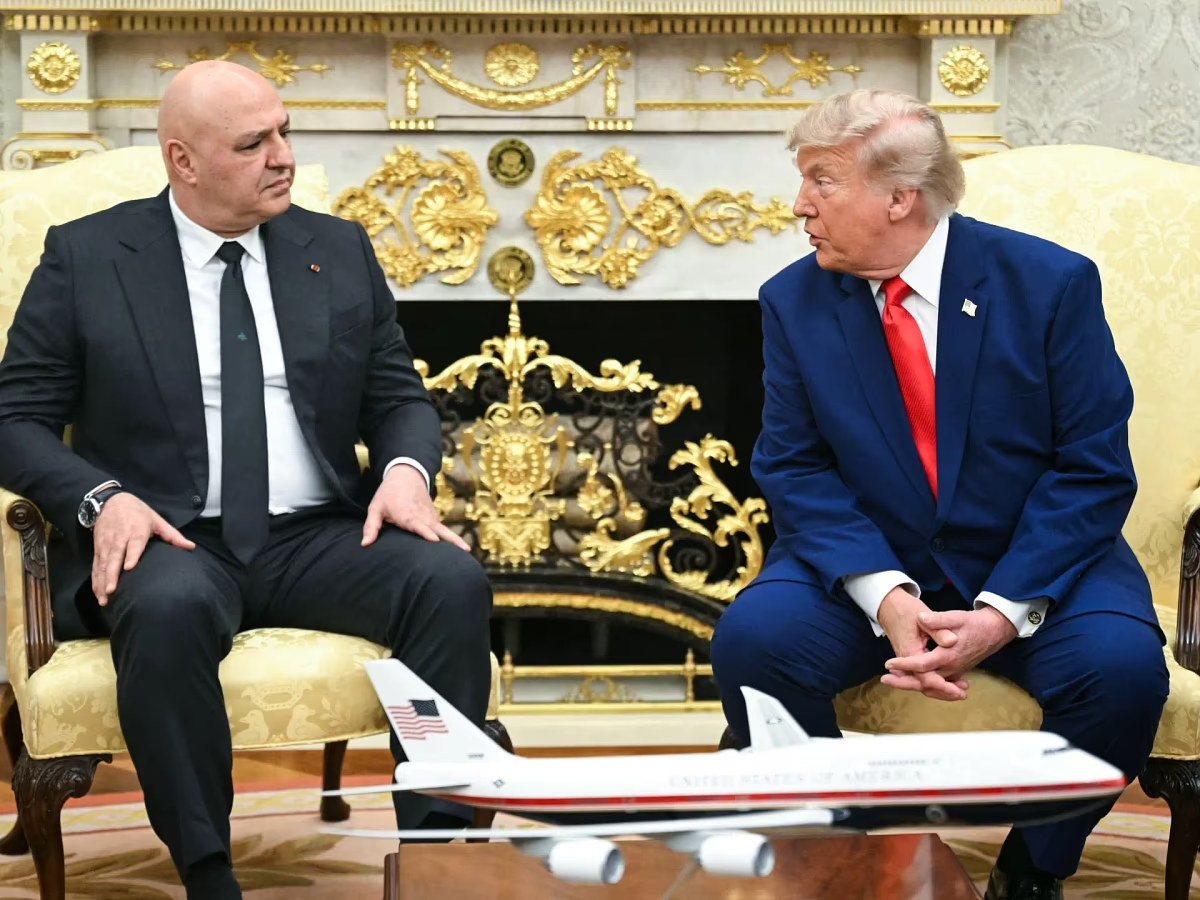
Graham was never a political activist in the traditional sense, but her stance on Palestine stemmed from a deep belief in the necessity of conveying the voices of creators living in exceptional circumstances. Through this project, she sought to bring Palestinian poetry into the heart of the global literary scene, considering it a living literature with independent aesthetic value.

Graham emphasizes in her introduction to the selections that Palestinian poems represent a desperate defense of human dignity in the face of excessive violence. She believes that the primary task of literature is to protect human experience from reduction, and to give voice to those whom major powers try to silence or marginalize their deep existential experiences.

Ultimately, the book 'You Must Live' represents a cultural bridge connecting the tragedy of Gaza and the West Bank with the global reader in a refined human language. It is a constant reminder that behind every political news story there are people who continue to love, dream, and write, and that poetry remains the last fortress of memory in the face of oblivion and erasure.

Life here is not a natural given, but a daily act of resistance embodied in the word and the poem.

ARAB AND WORLD

Sat 06 Jun 2026 10:01 am - Jerusalem Time

Widespread Military Escalation in the Strait of Hormuz: Exchange of Airstrikes Between Iran and the United States and Attacks Targeting Gulf States

The Iranian Revolutionary Guard announced, this Saturday morning, the execution of missile bombardments targeting military bases belonging to the United States in the region. The Revolutionary Guard clarified that this move comes as a direct response to what it described as American aggression that targeted the islands of Sirik and Qeshm earlier.

For its part, the US Army confirmed the execution of focused airstrikes targeting Iranian radar sites designated for coastal monitoring in the areas of Jask and Qeshm Island. US military officials described these strikes as a necessary defensive action to protect international navigation in the strategic Strait of Hormuz.

In a related context, military sources reported that US forces managed to intercept and shoot down four offensive drones launched by Iran towards the Strait. The sources indicated that these drones posed an imminent and direct threat to the movement of commercial ships and tankers in the vital region.

On the regional fronts, the Kuwaiti army announced that its air defense systems confronted hostile missile and drone attacks in its airspace. These developments come amidst a state of maximum military alert witnessed by the armed forces in the region's countries to confront increasing threats.

In the Kingdom of Bahrain, the Ministry of Interior sounded sirens across the country as a precautionary measure to alert citizens and residents. Bahraini authorities called on everyone to remain calm and head to the nearest safe places, with the necessity of following official updates issued by government channels.

US Central Command issued a statement confirming the interception of a group of ballistic missiles and drones launched from Iranian territory. The statement clarified that the Iranian attacks were not limited to American military targets but also affected neighboring Gulf states near the Strait of Hormuz.

Central Command revealed that Iran launched at least seven missiles towards Kuwaiti and Bahraini territories in recent hours. This missile escalation came shortly after the thwarting of an aerial attack targeting maritime navigation in Gulf waters.

The roots of the current confrontation date back to February 28th, when a widespread war began, which has so far resulted in more than three thousand deaths. This period has witnessed a continuous exchange of strikes between Tehran and Tel Aviv, in addition to targeting American interests in several Arab countries.

Since mid-April, the United States has imposed a strict blockade on Iranian ports, exacerbating the economic and political crisis. This blockade has included all vital maritime access points on the Strait of Hormuz, which Tehran considers economic strangulation necessitating a military response.

Iranian authorities responded to the blockade measures by imposing strict restrictions on traffic in the Strait of Hormuz, requiring prior coordination with its naval forces. This measure has led to an increase in tensions with international powers that rely on the Strait to secure global energy supplies.

There are widespread international fears of the potential collapse of the fragile truce that began on April 8th if a comprehensive agreement is not reached. Observers believe that the continuation of military operations could lead to unprecedented jumps in global energy prices and increased inflation rates.

Amidst the stalled negotiations that recently took place in Pakistan, it appears that diplomatic solution options are shrinking in favor of field escalation. Major capitals are closely monitoring developments in the coming hours, amidst international calls for restraint and avoiding a slide towards a comprehensive regional war.

Iran launched 7 missiles towards Kuwait and Bahrain hours after our forces shot down Iranian drones that posed a threat to navigation.

PALESTINE

Fri 05 Jun 2026 8:15 pm - Jerusalem Time

The "Diaspora" Strategy: Will Israel Succeed in Dismantling the Popular Support Base for the Resistance in Lebanon?

Israeli military operations in South Lebanon are escalating, moving beyond direct military objectives towards a broader strategy that observers describe as "diaspora." This policy aims to dismantle the resistance's supportive environment by turning villages and towns into uninhabitable areas, forcing residents into permanent displacement away from their borders.

Sources reported that the Israeli army has moved from targeting military infrastructure to a phase of "urban annihilation." This strategy relies on encroaching on land and destroying vital centers in major cities like Tyre and Nabatieh, to impose a new geographical reality that prevents the return of normal life to those areas in the foreseeable future.

Data indicates that forced displacement has reached approximately 1.2 million people, amid continued intensive raids that have left thousands dead and wounded. Military experts believe that Israel is implementing a "scorched earth" policy extending from south of the Litani River to areas north of Zahrani, to secure a wide buffer zone.

Israeli evacuation warnings include vast areas, reaching one-fifth of Lebanon's total area, reflecting a desire to create long-term demographic change. This measure aims to reduce civilian population density, giving the Israeli army greater freedom in military operations without international political or media restrictions.

Political analysts believe that the goal of displacing southern residents is to create sectarian tensions and imbalances in Lebanon's fragile demographic structure. The displacement of large numbers from a specific social component to other areas could ignite internal conflicts over resources and infrastructure, which Israel is banking on to turn public opinion against the resistance.

In contrast, the resistance is adopting a counter-plan based on social and material support to maintain the cohesion of its supportive environment. Relief and compensation networks are working to strengthen the resilience of the displaced and prevent temporary displacement from turning into a permanent break with the land, considering that staying and returning represent a form of civil resistance.

On the ground, military sources confirm that the displacement has not led to the collapse of the resistance's organizational structure, but rather has increased the fighters' determination to wage a war of attrition. The resistance is currently using advanced technologies, including fiber-optic suicide drones, to thwart Israeli attempts at entrenchment in border villages.

Concerns are growing that Israel is seeking to establish a permanent buffer zone, similar to previous experiences in Gaza and Syria. This trend could turn South Lebanon into a continuous conflict zone, as local residents refuse to give up their right to return to their homes despite the massive destruction that has affected thousands of housing units.

Recent studies have shown that popular support for the resistance in the Shiite community remains strong despite immense economic and psychological pressures. Local opinion polls have shown general rejection of any proposals related to disarmament or surrender to Israeli projects that target the demographic existence of Lebanese components.

Observers believe that Israel is banking on the "rubble doctrine" to make civilians pay a heavy price for their support of the resistance. By destroying the southern suburbs and large parts of the Beqaa, Tel Aviv is trying to send a message that the cost of popular support for the resistance will be the loss of shelter and permanent stability.

On the other hand, experts believe that the decisive factor in this conflict is the Lebanese society's ability to adapt to successive crises. Historical experiences since 1982 prove that military force alone is not enough to break the will of peoples if the social environment maintains its basic cohesion and its ability to rebuild.

There is a real fear in Lebanese political circles that the continuation of the war will change Lebanon's sectarian and political landscape. The absence of a unifying national project to confront these dangers makes the country vulnerable to external interventions that may exploit the refugee crisis to impose specific political agendas that serve Israeli interests.

Informed sources confirm that the resistance has succeeded over the past four decades in building closed communities that are difficult to penetrate militarily or politically. This strong organizational structure is what prevents the success of the Israeli diaspora strategy in achieving its ultimate goals of dismantling the party from within through popular pressure.

Ultimately, the Lebanese scene remains open to all possibilities in light of a major war that transcends regional borders. While Israel is banking on time and military pressure, the resistance is banking on exhausting the enemy on the ground and the steadfastness of its popular base to thwart the project of displacement and permanent occupation.

Israel seeks to create a demographic vacuum that helps it target any human movement and restrict the movement of resistance fighters.

OPINIONS

Fri 05 Jun 2026 8:15 pm - Jerusalem Time

When the World Sleep: A Moral Witness Against Silence


By: Said Arikat


June 5, 2026


Washington, D.C- Francesca Albanese’s ‘When the World Sleeps’ is not simply a political book about Palestine; it is an attempt to rescue human experience from the deadening language of geopolitics. Written during one of the bleakest and most violent periods in recent Middle Eastern history, the book combines memoir, legal reflection, moral philosophy, and testimonial storytelling into a deeply humane work that asks a difficult question: what happens to the world’s conscience when suffering becomes normalized?


The answer Albanese offers is unsparing, but profoundly compassionate.


At the center of the book are ten lives — Palestinians, Jewish intellectuals, activists, and ordinary individuals whose experiences shaped Albanese’s political and moral imagination. Through these portraits, she builds a narrative that is less concerned with abstract diplomacy than with the emotional and ethical consequences of prolonged dispossession, occupation, and war. Rather than treating Palestine as a “conflict” to be managed, Albanese insists on seeing it as a lived human reality endured daily by millions.


This insistence on humanity is what gives the book its unusual emotional power.


Too much writing on Palestine collapses into sterile policy debate or ideological slogan. Albanese avoids both traps. She writes with the clarity of a legal scholar, but also with the emotional intelligence of someone who has spent years listening carefully to people whose stories are routinely ignored, dismissed, or politicized. Her prose is accessible without being simplistic, passionate without losing intellectual rigor. The result is a work that feels urgent but also deeply reflective.


The title itself — When the World Sleeps — captures the book’s central moral argument. Albanese contends that the greatest tragedy is not only the suffering itself, but the gradual normalization of that suffering by governments, institutions, and even public opinion. She argues that Palestinians have become victims not merely of occupation and violence, but of global indifference. The world, in her telling, has not entirely failed to see; it has chosen not to act.


One of the book’s greatest strengths is its ability to bridge law and morality. Albanese is a specialist in international law, and throughout the text she draws upon concepts such as occupation, apartheid, forced displacement, collective punishment, and genocide. But unlike many legal writers, she never allows terminology to become emotionally detached from human consequence. Legal frameworks are constantly tethered to individual stories — children killed in Gaza, families displaced from their homes, prisoners detained indefinitely, parents navigating humiliation at checkpoints.


The book therefore succeeds in translating international law into human language.


Particularly moving are the passages devoted to children in Gaza. Albanese writes about them not as symbols or statistics, but as fully realized individuals whose dreams, fears, and personalities matter. The account of Hind Rajab, the young girl killed after pleading for rescue while trapped in a car surrounded by dead relatives, becomes emblematic of the book’s larger argument: that the modern world has developed an extraordinary capacity to witness unbearable suffering without meaningful intervention.


Yet despite its grief, When the World Sleeps is not nihilistic. Running through the book is a stubborn belief in solidarity, ethical responsibility, and the possibility of moral awakening. Albanese repeatedly highlights Jewish scholars, activists, Holocaust survivors, and dissidents who refused to allow historical trauma to justify oppression. These sections are especially important because they complicate simplistic attempts to portray the book as anti-Jewish or ideologically rigid. Albanese clearly distinguishes between criticism of state policy and hostility toward Jewish identity. Indeed, some of the book’s most admired moral voices are Jewish thinkers committed to universal human rights.


This nuance matters because Albanese writes in a political environment saturated with accusation and polarization. Rather than retreating into defensive caution, she confronts these tensions directly. She acknowledges the immense historical trauma carried by Jewish communities while simultaneously arguing that trauma cannot become a permanent exemption from international law or moral scrutiny. Whether readers agree with every aspect of her argument or not, the seriousness with which she engages these questions gives the book intellectual credibility and ethical depth.


Another striking quality of the book is Albanese’s personal honesty. She does not present herself as an infallible authority speaking from above. Instead, she writes openly about the emotional burden of witnessing violence, the frustrations of institutional paralysis, and the personal cost of speaking publicly about Palestine in increasingly hostile political climates. This vulnerability humanizes the narrative and prevents it from becoming doctrinaire. Readers sense throughout that Albanese is wrestling not only with politics, but with conscience itself.


Stylistically, the book is elegant and often lyrical. Albanese has a gift for moving between intimate scenes and broader political analysis without losing narrative momentum. Some passages read almost like meditations on grief, memory, and moral responsibility. Others carry the sharp precision of legal indictment. This blend of emotional and analytical writing gives the book unusual range.


Importantly, When the World Sleeps arrives at a historical moment when public discourse on Palestine is undergoing profound transformation. Around the world, especially among younger generations, there is growing skepticism toward traditional narratives that frame Palestinian suffering as unfortunate but inevitable. Albanese’s book speaks directly to this emerging moral consciousness. It articulates the frustration many feel toward international institutions that proclaim universal values while appearing selective in their enforcement.


The book’s power ultimately lies in its refusal to let readers remain emotionally distant. Albanese does not want passive sympathy; she wants moral engagement. She challenges readers to examine what it means to live in a world where atrocities can unfold in real time before global audiences that continue, nonetheless, with ordinary life. In doing so, she transforms the Palestinian question from a regional political issue into a broader meditation on international ethics, collective responsibility, and the fragility of human solidarity.


For readers like myself who find themselves deeply aligned with both Albanese’s moral vision and her political argument, When the World Sleeps stands as an important and courageous work of witness — even if others may strongly disagree with its conclusions. I found the book eloquent, deeply compassionate, intellectually serious, and morally urgent precisely because it speaks to something profoundly human beneath the politics: the insistence that Palestinian lives deserve not only humanitarian concern, but full recognition, dignity, justice, and historical acknowledgment. Albanese writes with a clarity and empathy that made the book resonate with me not simply as political analysis, but as a deeply moving appeal to conscience.


In an era saturated with noise, propaganda, and ideological exhaustion, Albanese offers something increasingly rare: a voice animated by moral clarity and genuine human empathy. Whether embraced or contested, When the World Sleeps is likely to remain an important contribution to the growing body of literature documenting both Palestinian suffering and the international community’s failure to confront it honestly. It is a book that refuses indifference — and asks its readers to do the same

PALESTINE

Fri 05 Jun 2026 8:14 pm - Jerusalem Time

Certificates Held Hostage by Fees.. Financial Crisis Besieges 27,000 Graduates in Gaza

The joy of thousands of graduates in the Gaza Strip upon completing their academic journey was incomplete, as they found themselves facing a solid financial wall preventing them from obtaining their university degrees. After years of study and diligence under harsh conditions, accumulated tuition fees have become an obstacle preventing them from entering the job market or applying for scholarships.

Field data indicates that the financial crisis has worsened unprecedentedly due to the ongoing war of annihilation, which has deprived families of their sources of income and shifted living priorities towards securing food and clothing. This reality has made paying university dues an act beyond the financial capacity of most Palestinian families in the besieged Strip.

At the Islamic University of Gaza, statistics show that 5,808 graduates have been unable to receive their certificates due to debts amounting to approximately $5.7 million. These graduates find themselves in a vicious cycle, where they need the certificate to get a job, and they need a job to pay for the certificate.

Al-Azhar University, on the other hand, is suffering from a deeper crisis, with the number of stranded graduates reaching 5,588, with total outstanding fees exceeding $10.8 million. These huge figures reflect the extent of the economic collapse that has affected the middle class and students who relied on their families' savings.

Al-Aqsa University leads the scene in terms of the number of affected individuals, with an estimated 12,000 graduates who have not received their documents. The total value of accumulated fees at this public university is approximately $9.9 million, which places the university administration before major operational challenges.
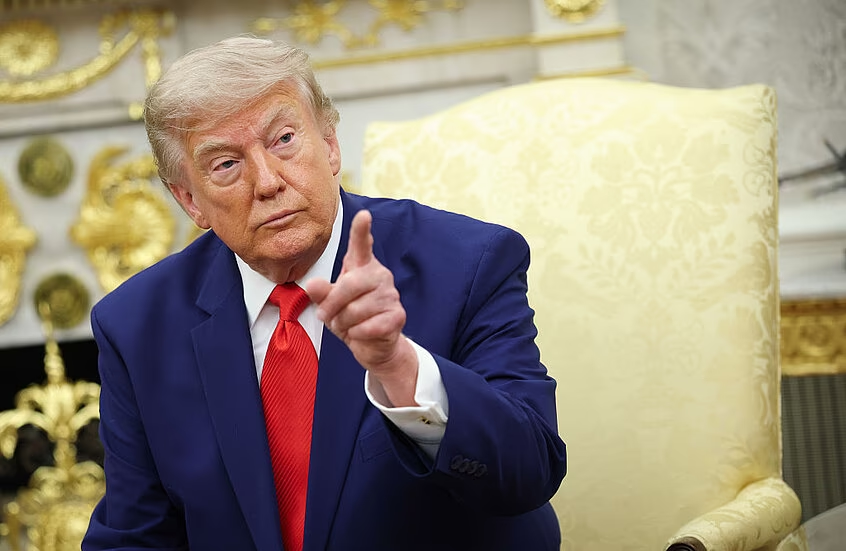
At the University College of Applied Sciences, 4,127 graduates have not completed their official graduation procedures due to financial dues amounting to $1.7 million. Added to these amounts are other obligations related to higher education loans that pursue graduates and increase their psychological and financial burdens.

Academic sources reported that Palestinian universities in Gaza are themselves experiencing an existential crisis, as their buildings and facilities have suffered widespread destruction during the war. These institutions primarily rely on student fees to cover staff salaries and essential operating expenses necessary for the continuation of the educational process.

Mahmoud Atallah, Director of Student Affairs at Al-Aqsa University, explained that the university is trying to alleviate the burden on students by providing grants and exemptions that have benefited thousands of students. He pointed out that the university allowed students to register for credit hours without immediate payment to help them continue their education despite the lack of income.

For his part, Dr. Mohammed Hamdan from Al-Aqsa University affirmed that the university is making efforts to attract funding projects to release certificates in cooperation with international institutions. However, these initiatives remain limited and cover only a small percentage of graduates due to the strict conditions set by funders.

Khulood Al-Othmani spoke about the suffering of her son, Firas, an information technology graduate, whose certificate has become hostage to a sum of money that the family cannot afford. She explained that her husband's loss of his job as a tailor due to the war made securing a livelihood the top priority, which led to the freezing of her son's professional dreams.

Specialists believe that the continued withholding of certificates contributes to increasing unemployment rates among youth and deprives society of idle scientific competencies. Many job opportunities and external scholarships require the presentation of original documents, which thousands of graduates currently lack.

Sources at the University College of Applied Sciences indicated that the war led to a sharp increase in the number of financially struggling students compared to previous years. They confirmed that the gap between students' financial needs and the ability of relief organizations to intervene is widening alarmingly daily.

The universities find themselves in a difficult equation between preserving the student's right to obtain their certificate and their need for money to ensure their survival as educational institutions. This financial struggle reflects one aspect of the silent suffering experienced by the higher education sector in Gaza under the weight of aggression.

Thousands of graduates in Gaza remain waiting for a radical solution to end the 'hostage certificates' crisis, whether through governmental interventions or widespread international donations. Without the release of these documents, the dreams of an entire generation of Palestinian youth will remain suspended behind the walls of debt-ridden universities.

The certificate has become trapped in university drawers, awaiting payment of fees that my family cannot afford under the suffocating economic conditions.

PALESTINE

Fri 05 Jun 2026 8:14 pm - Jerusalem Time

The Dialectic of Nostalgia in Algeria: Why Does the 'Good Old Days' Haunt the Memory of Generations?

In Algerian gatherings, a tone of nostalgia for what is known as the 'good old days' is escalating, especially among generations who lived through the pre-independence era or the early years of state-building. The phrase 'Where are those times?' is repeated with striking regret, reflecting a desire to restore the values of discipline and order that many believe were the dominant features of daily life in that period.

Old black and white photographs transform into emotional documents that transcend mere personal memory to become a window into a seemingly more stable world. Proponents of this view believe that schools and public squares witnessed moral and educational discipline that is lacking in the present, where the prestige of the teacher and the educational institution formed the cornerstone of national character building.

Analysts believe that this nostalgia does not target the colonial era itself, but rather aspires to the system of values that governed social relations at the time. The issue concerns the appreciation of work and respect for appointments, and a general feeling that every individual in society knew their role and place precisely, away from the hustle and bustle of modern life and its increasing complexities.

In contrast, a current emerges that sees linking beauty to the past as a fallacy resulting from the decline of knowledge in the face of the culture of display in the current era. The Arab and Algerian citizen may yearn for their youth and the clarity of vision in their old society, where long effort was appreciated, before the values of quick profit and social opportunism overshadowed the general scene.

The gap deepens when moving to public affairs, where part of the current frustration is attributed to decades of centralized administration and fluctuating government policies. Critics believe that the distance between official discourse and the actual needs of society has contributed to reinforcing the image of the past as a safe haven from the anxiety of the present and its accelerating economic challenges.
Observers point out that the management style that restricts decision-making to narrow circles has slowed down the process of openness to new ideas and global transformations. At a time when the world is moving towards innovation and scientific research, a segment of Algerians feels that these areas have not yet received the place they deserve in the national priorities.
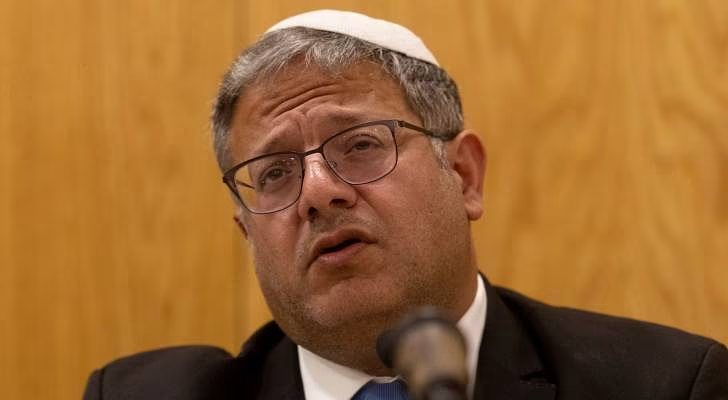
Social crises and rising prices appear as immediate catalysts for evoking comparisons between yesterday and today in popular discussions. The image of the disciplined student in old classrooms becomes a symbol of an entire generation that had hope, and the school transforms from a mere building into an idea embodying the order and belonging that people seek in their contemporary reality.
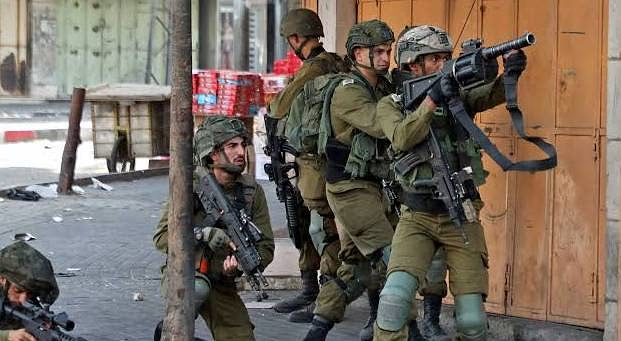
It is necessary to read this phenomenon emotionally, not just historically, for nostalgia often expresses what a person feels more than it expresses the reality of a bitter truth. History reminds us that the past was not without difficulties, class disparities, and harsh restrictions, but human memory naturally tends to filter out pains and retain bright moments.

The Algerian case is characterized by a specificity stemming from the profound and rapid transformations the country has undergone, from colonialism to independence and then the building of the national state. Each of these stages left different imprints on the memory of generations, creating a divergence in views on which periods were the most prosperous and stable for the citizen.

Historical sources confirm that the 'good old days' that some praise carried great suffering, as school enrollment rates among Algerians during the colonial era were very low. Moreover, the educational and university infrastructure was very limited and served only a small segment, making the comparison with the achievements of the independent state numerically unequal.

The fundamental question remains whether the past was beautiful for its own sake, or because we look at it from a safe temporal distance that makes us forget its arduous details. Excessive preoccupation with contemplating images of yesterday may hinder the ability to read the future and its challenges, for nations do not live on memories alone, no matter how beautiful or deeply impactful they may be.

Building the future requires transforming the lessons of the past into a driving force for work, knowledge, and innovation, instead of drowning in a sea of nostalgia. The future is the only page that has not yet been photographed, and its creation requires boldness in imagination and the ability to bravely face the open possibilities of the present.

The future is not made by nostalgia, but by knowledge, work, and imagination that dares to see what has not yet appeared in any album.

PALESTINE

Fri 05 Jun 2026 8:14 pm - Jerusalem Time

Hamas Demands Immediate Arab and Islamic Action to Stop Israeli Massacres in Gaza

The Islamic Resistance Movement (Hamas) issued an urgent appeal to all Arab and Islamic parties, stressing the necessity of immediate action to pressure the Israeli occupation to stop the ongoing massacres in the Gaza Strip. The movement affirmed that international silence gives a green light for the continuation of the slaughter targeting unarmed civilians, emphasizing that this moment places everyone before their moral and historical responsibilities.

The movement's spokesperson, Hazem Qassem, stated in a press release that the occupation continues to commit horrific crimes against the residents of the Strip amid a clear inability of guarantor states and international mediators. Qassem pointed out that the so-called Peace Council and international institutions have failed even to issue condemnations commensurate with the scale of the crimes committed, which has encouraged the occupation to persist in its aggression.

The movement called on mediators and international guarantor bodies to exert real and direct pressure on the occupation authorities, which have completely reneged on all previous understandings and agreements. Hamas considered Israel's disregard for efforts to stop the violations as reflecting a premeditated intention to continue the war of extermination and destroy the foundations of life in Gaza.

In a related context, Hamas stressed that the Arab League and the Organization of Islamic Cooperation are required today more than ever to take firm stances that go beyond mere statements. It affirmed that the bloody scenes broadcast live impose on both Arab and Islamic systems the need for field and political action to stop the bleeding of Palestinian blood.

These calls come at a time when Gaza is witnessing a bloody escalation despite a declared ceasefire agreement since October 10, 2025. According to Ministry of Health data, 947 martyrs have fallen and approximately 2,935 others have been injured as a result of continuous Israeli shelling since the agreement came into effect, indicating widespread and grave violations by the occupation army.

It is worth noting that the Gaza Strip is suffering from the repercussions of a comprehensive war of extermination that began in October 2023, resulting in the martyrdom of more than 73,000 Palestinians and the injury of over 173,000 others within two years. The American-backed military operations have also caused the destruction of about 90% of the civilian infrastructure, making the Strip a disaster area lacking the most basic necessities of life.

The continuation of this massacre live on air places all parties, especially the Arab League and the Organization of Islamic Cooperation, before a historical and moral responsibility to act immediately.

PALESTINE

Fri 05 Jun 2026 8:14 pm - Jerusalem Time

Netanyahu's Strategy in Gaza: Expanding Occupation and Violating Truce to Escape 2026 Deadlines

The field situation in the Gaza Strip has witnessed a remarkable Israeli escalation in recent days, as occupation forces have intensified their military operations, resulting in an increasing number of martyrs and widespread destruction of infrastructure. These developments coincide with the announcement by the head of the occupation government, Benjamin Netanyahu, to expand the so-called 'Yellow Zone' to include 60% of the Strip's area instead of 52%, with directives issued to reach 70%.

Field data indicates that Netanyahu's current strategy is based on military subjugation of the Strip despite the existence of a declared truce agreement since October 10, 2025. The occupation government treats this situation as an acquired right, exploiting the political and military cover provided by the United States, which has led to the commitment to a ceasefire becoming one-sided, only on the Palestinian side.

Field reports have documented the occupation army committing more than 2,200 violations of the truce agreement since its announcement. These violations have led to the martyrdom of 945 people and the injury of nearly three thousand citizens with varying degrees of wounds. These figures reveal the extent of Israeli disregard for international guarantees and concluded agreements, amidst a complete international silence regarding these continuous violations.

Through this escalation, the occupation authorities seek to create new geographical and demographic realities on the ground, by attempting to seize more of the Strip's land and annex it to the occupied territories. Netanyahu's government does not rule out the possibility of completing the full occupation of the Strip in a blatant violation of all understandings, which places the region before open scenarios of confrontation.

In addition to military pressure, the occupation practices a policy of political and economic blackmail against the residents of Gaza, with the aim of subjugating the popular base and forcing the resistance to surrender its weapons. This policy includes the continuation of the suffocating blockade and preventing the entry of more than half of the agreed-upon quantities of humanitarian aid and basic necessities for the besieged population.

In a related context, the occupation government obstructs the entry of the technocrat committee that was supposed to manage civil affairs in the Strip, and also prevents the start of any real reconstruction operations. These measures aim to keep Gaza in a state of administrative and service paralysis, exacerbating humanitarian suffering and increasing the complexity of the living situation.

Israeli strategy also relies on keeping the Gaza Strip in a state of permanent tension and continuous attrition, to facilitate the transition to an all-out war at any moment Netanyahu deems appropriate. This approach aims to exhaust the vital forces in Palestinian society and prevent the stabilization of security or living conditions, making the Strip an environment that repels its residents.

Informed sources indicate that the occupation seeks to create a very harsh living environment to push residents towards options of forced or voluntary displacement under the weight of hunger and destruction. The occupation also works to support local groups and provide them with logistical support to try to strike the Palestinian social fabric and create internal conflicts that weaken the resistance front.

Observers believe that Netanyahu, through these brutal practices, is trying to achieve a 'military achievement' to present to the Israeli voter as the Knesset elections approach in October 2026. Current opinion polls show a significant decline in the popularity of the ruling coalition, which pushes Netanyahu to escape towards military escalation to save his political future.

Despite the machine of killing and destruction, Netanyahu faces a 'complex' represented by the failure to achieve major strategic goals, foremost among them disarming the resistance or breaking its will. This field failure in Gaza is accompanied by similar failures on the Lebanese front and in confronting the escalating Iranian influence in the region, which increases pressure on the extremist government.

Political circles in Tel Aviv fear that Washington will reach an agreement with Tehran before Netanyahu's government can impose its military reality, and therefore the latter resorts to escalating the situation to keep the conflict open. This behavior reflects a desire to escape an internal 'reckoning' that will inevitably show the failure of military operations to achieve the promised security for settlers.

On the international level, the massacres and the starvation policy have caused an unprecedented isolation of the Israeli entity, as it has become, in the eyes of many countries and human rights organizations, a pariah entity. Israel currently faces a more hostile regional environment and sustained security concerns, despite all attempts at military decisive action that have only deepened the crises.

Netanyahu is expected to continue his escalatory approach at least until the next elections, betting on the time factor to achieve some breakthrough in the wall of resistance. However, elements of reverse pressure have begun to appear clearly, especially with the gradual decline in absolute American cover and the escalation of popular and political pressures in Western capitals.

In conclusion, these Israeli strategies suffer from a clear state of exhaustion within the army ranks, in addition to the disruption of regional normalization paths that Tel Aviv was counting on. This means that these policies may be subject to adjustment or collapse in the face of the steadfastness of the resistance and the field and political developments that may impose themselves in the next stage.

Netanyahu's complex lies not in his ability to kill and destroy, but in his inability to subjugate the resistance and disarm it.

PALESTINE

Fri 05 Jun 2026 8:14 pm - Jerusalem Time

Putin: Regional stability hinges on establishing a Palestinian state with East Jerusalem as its capital

Russian President Vladimir Putin reiterated his country's supportive stance on Palestinian national rights, emphasizing that Moscow fully backs the implementation of relevant United Nations resolutions. Putin clarified that stability in the region can only be achieved through a political process leading to the establishment of an independent and fully sovereign Palestinian state.

During his participation in the plenary session of the Russian Energy Week International Forum, the Russian President stated that the core of the conflict lies in the failure to implement historical international promises. He pointed out that the original vision was based on a two-state solution, yet the Palestinian state has not come into existence despite decades passing since those resolutions.

In the context of discussing the situation on the ground, Putin described the military escalation in the Gaza Strip as 'horrific' and tragic on a humanitarian level. He called on the international community to work diligently to reduce the scale of human suffering and protect civilians, stressing the need to minimize innocent casualties.

The Russian President also addressed the continued Israeli control over Palestinian territories, noting that the retention of large parts of these lands under occupation fuels ongoing tension. He affirmed that the absence of political justice is the primary driver of the successive crises plaguing the Middle East, necessitating a radical and comprehensive solution.

Putin concluded his remarks by emphasizing that East Jerusalem must be the capital of the desired Palestinian state in accordance with international legitimacy. He considered that any attempts to bypass this political entitlement would only complicate the scene, indicating that Russia will continue to press in international forums to achieve the aspirations of the Palestinian people for self-determination.

It is impossible to resolve the current problem without the establishment of a Palestinian state with East Jerusalem as its capital.

PALESTINE

Fri 05 Jun 2026 8:13 pm - Jerusalem Time

Hamas leadership delegation arrives in Cairo to complete ceasefire negotiations

A high-level delegation from the leadership of the Hamas movement arrived in the Egyptian capital, Cairo, on Friday evening, on an official mission aimed at launching a new round of discussions related to the ceasefire in the Gaza Strip. The delegation is headed by Khalil al-Hayya, head of the movement in the Strip, with the participation of prominent leaders including Zaher Jabarin, Hussam Badran, and Ghazi Hamad, where the meetings are scheduled to extend for several consecutive days.

Sources reported that the delegation's agenda focuses on discussing with Egyptian officials and international mediators to ensure the completion of the first phase of the existing agreement, and to work on stopping the continuous Israeli violations and aggressions. The movement also seeks through this round to develop clear and appropriate mechanisms that ensure a smooth transition to the second phase of the comprehensive truce agreement.

In a related context, the movement's delegation will hold a series of meetings with representatives of Palestinian forces and factions present in Cairo. These meetings aim to formulate a unified national position on the current challenges facing the Palestinian cause, and to agree on a common vision for dealing with field and political developments in a way that serves the supreme interests of the Palestinian people.

The goal is to complete the implementation of the first phase of the ceasefire agreement, stop repeated Israeli aggressions, and find mechanisms to enter the second phase.

PALESTINE

Fri 05 Jun 2026 8:13 pm - Jerusalem Time

Ireland bans Ben Gvir and Smotrich from entering its territory and calls for European sanctions

The Irish government has taken a strict measure by banning the entry of Israeli National Security and Finance Ministers, Itamar Ben Gvir and Bezalel Smotrich, into its territory. This decision comes amid escalating international criticism of the policies pursued by the two far-right ministers regarding the ongoing war in the Gaza Strip.

Irish Justice Minister, Jim O'Callaghan, issued direct and clear instructions to immigration officers at all border crossings to prevent the entry of the two ministers should they attempt to reach the country. This official move reflects the extent of diplomatic tension between Dublin and Tel Aviv in light of the violations in the Palestinian territories.

For his part, Irish Prime Minister, Micheál Martin, confirmed the enforcement of the travel ban, indicating that the instructions were issued definitively to prevent any attempt by Israeli officials to travel to Ireland. Martin clarified that this step comes as a necessary response to confront the continuous incitement to violence and displacement.

The timing of the decision was linked to the publication of a video by Minister Itamar Ben Gvir showing the abuse of international activists who were arrested during their participation in the 'Fleet of Resilience'. The fleet aimed to break the naval blockade and deliver vital humanitarian aid to the residents of the Gaza Strip last month.

The Irish Prime Minister, during statements made at a summit in Montenegro, stressed that the behavior of the two ministers is not limited to the fleet incident, but extends to their systematic statements. He considered that these positions clearly express a genuine desire to displace the Palestinian people from their homeland and liquidate their cause.

Dublin did not stop at the national measure, but Micheál Martin called for expanding these measures to include the entire European Union. He believed that imposing collective sanctions at the continental level has become justified given the extremist behavior that threatens stability in the region.

The Irish move comes in the context of increasing international isolation for the two ministers, as France had previously prevented Ben Gvir from entering its territory last month. Britain also took a similar decision in June 2025, followed by other European countries such as Spain and Slovenia, indicating a growing European consensus against the far-right.

Ireland is one of the most prominent European voices advocating for Palestinian rights and condemning Israeli aggression since October 2023. Its positions culminated in the official recognition of the State of Palestine in 2024, a step that sparked widespread anger in Israeli political circles.

In response to Ireland's advanced positions, Israeli Foreign Minister, Gideon Sa'ar, had earlier ordered the closure of his country's embassy in Dublin. This closure reflects the depth of the diplomatic rift and the relations between the two parties reaching their lowest historical levels due to the sharp divergence in positions.

It is worth noting that Ben Gvir and Smotrich represent the main pillar of the government coalition led by Benjamin Netanyahu since the end of 2022. Their policies in the West Bank and Gaza Strip raise widespread international concern, especially regarding settlement expansion and plans for annexation and forced displacement.

The consistent statements of the two ministers essentially amount to a desire to remove Palestinians from their land, which justifies imposing comprehensive sanctions.

PALESTINE

Fri 05 Jun 2026 8:13 pm - Jerusalem Time

Trump's Fragile Truce: Mutual Bombardment in Gaza, Lebanon, and Iran Despite Ceasefire Agreements

The Middle East region has witnessed a widespread military escalation encompassing the Gaza Strip, southern Lebanon, northern Israel, and extending to Kuwait, despite a series of ceasefire agreements brokered by the United States. Field sources reported that Israeli airstrikes on Gaza and Lebanon have not ceased, while Israeli forces continued their active deployment in border areas and the Strip, putting the effectiveness of American diplomacy to the test.

In a notable comment on these developments, US President Donald Trump acknowledged that what is currently happening is 'more moderate firing' rather than a comprehensive cessation of hostilities as planned. Although three truces negotiated by his administration aimed to end the raging wars, the reality on the ground indicates continued shelling and casualties, even if the intensity of confrontations has relatively decreased compared to previous periods.

Regarding the situation in the Gaza Strip, Washington had mediated an agreement signed on October 10, 2025, which stipulated an end to hostilities and an exchange of prisoners. Despite the implementation of the clause for the release of Israeli detainees, disputes remain intense over the volume of humanitarian aid allowed in, and Hamas's categorical rejection of demands for its disarmament included in Trump's plan to strengthen the truce.

Statistics indicate that more than 900 Palestinians have been martyred in Gaza since the announcement of the truce, including nine martyrs who fell in raids carried out last Thursday. In contrast, scattered attacks by Palestinian factions resulted in the killing of four Israeli soldiers inside the Strip, reflecting the fragility of field commitment to the signed agreements in the absence of a clear political horizon.

On the Lebanese front, the 10-day ceasefire announced by Trump on April 16 failed to curb the violent confrontations in the south. Although Israel refrained from directly targeting the capital Beirut during this period, aerial bombardments and mutual artillery shelling with Hezbollah continued at a high pace, leading to hundreds of new casualties.

Lebanese authorities confirm that the total number of martyrs since early March has exceeded 3,500 people, while Israel announced the killing of 26 soldiers and four civilians in attacks carried out by Hezbollah. Israel insists on retaining its right to launch military operations 'to thwart threats' even under the truce, which is rejected by the Lebanese group that continues its rocket operations.

File on Lebanon is closely linked to the direct conflict between Washington and Tehran, as Iran stipulates that any calm in Lebanon must be part of a comprehensive agreement ending its war with the United States and Israel. Tehran demands the reopening of the Strait of Hormuz and the lifting of the blockade on its ports as a fundamental condition for de-escalating regional tensions, which has not yet been achieved despite indirect negotiation rounds.

Direct confrontation erupted last February when US and Israeli forces attacked Iranian nuclear and missile facilities in an attempt to undermine Tehran's military capabilities. Despite the painful blows received by the Iranian military leadership, Tehran proved its ability to influence the global economy by closing the Strait of Hormuz and disrupting international energy supplies.

In an attempt to contain the situation, Washington announced a ceasefire with Iran in early April, paving the way for Qatari and Pakistani-mediated talks. However, these talks did not result in a permanent agreement, as the exchange of rocket fire continued, and Iranian attacks reached Kuwait International Airport this week, further complicating the diplomatic scene.

Political analysts believe that the failure of these agreements is due to the unwillingness of the warring parties to make the fundamental concessions required in the early stages of the truces. Instead of moving towards sustainable settlements, parties resort to military action to test the limits of agreements or to achieve field gains they failed to extract at the negotiating table.

Urban Cunningham, a researcher at the Royal United Services Institute, points out that the absence of real incentives to adhere to truces makes it difficult to maintain them for long periods. With the political horizon closing, regional powers find themselves driven to continue fighting to impose their conditions, especially given the declining role of international organizations and their ability to enforce oversight.

In Gaza, Israel continues to expand the area of land it militarily controls, undermining reconstruction opportunities that were part of the US administration's promises. This field expansion is met with insistence from Palestinian factions to continue resistance, making 'Trump's truce' merely a political designation that does not change the reality of the bloody war.

As for Kuwait, the targeting of its international airport raised widespread regional concern, as monitoring sources considered it a clear Iranian message of its ability to transfer the conflict to Gulf states. These developments come at a time when Washington is trying to convince its allies that the diplomatic path is still possible, despite field indicators suggesting the exact opposite.

In conclusion, the Middle East remains an open arena for all possibilities, where the files of Gaza, Lebanon, and Iran intertwine in a single knot difficult to untangle with temporary truces. With daily casualties continuing, the question remains about the US administration's ability to transform 'moderate firing' into a real peace that ends the suffering of millions in the region.

The ceasefire in the Middle East has turned into 'more moderate firing' rather than a complete cessation of fighting.