OPINIONS

Thu 05 Mar 2026 5:04 am - Jerusalem Time

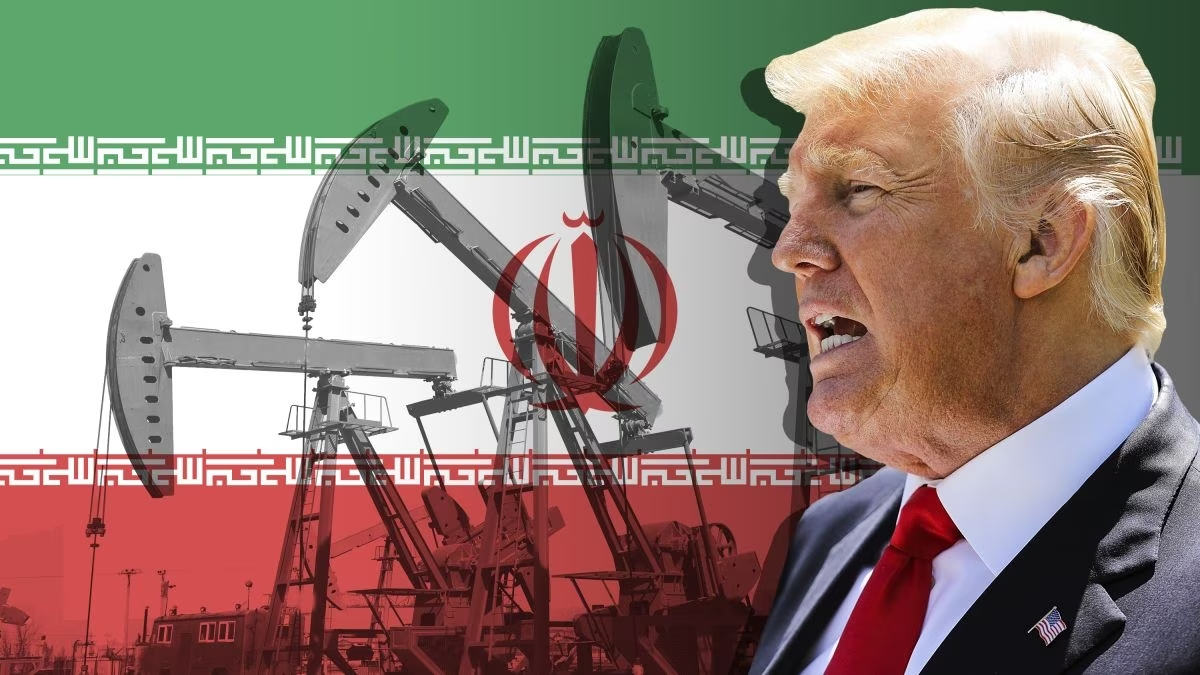
War, Oil, and Illusion: The Strategic Gamble Behind Trump’s War on Iran

March 5, 2026

News Analysis

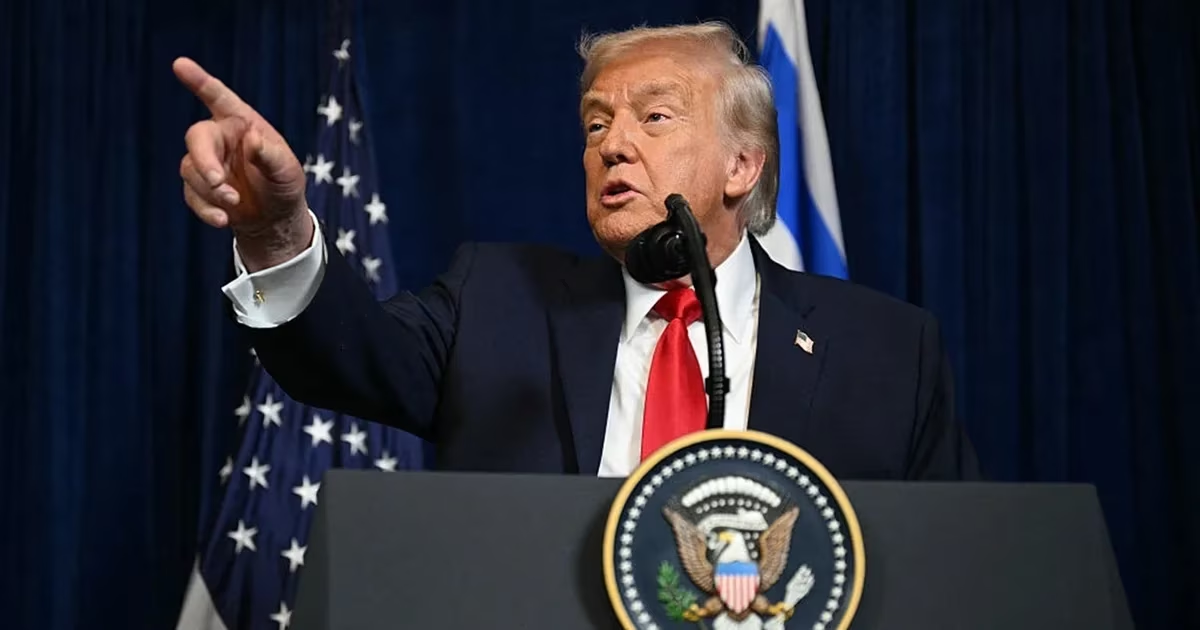
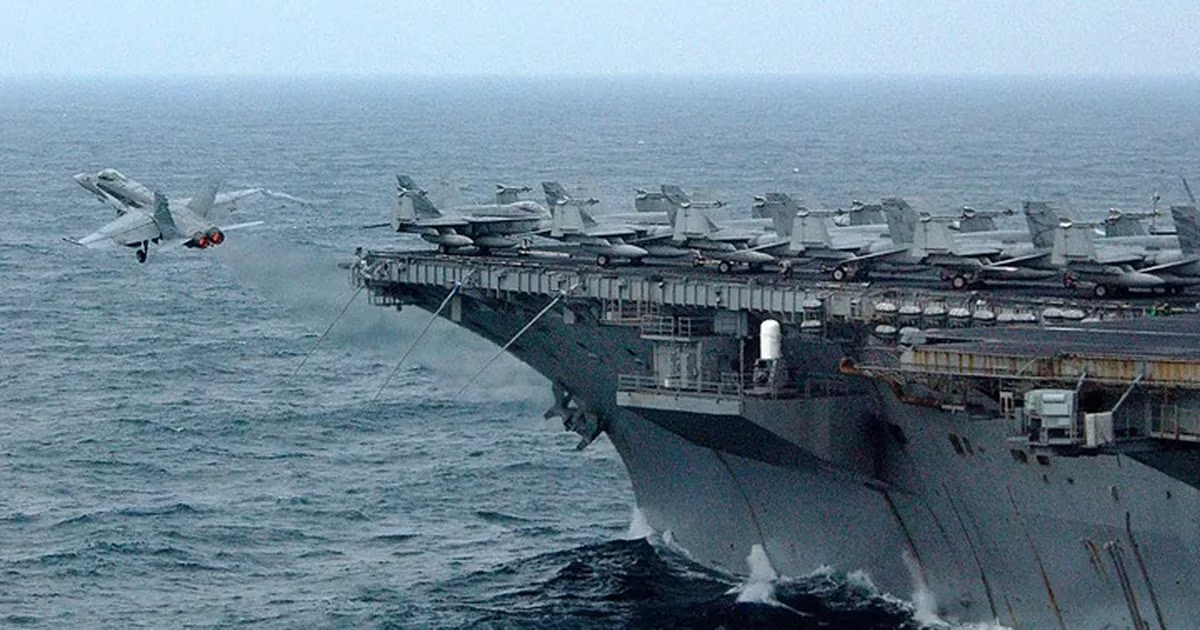
Washington, D.C- The outcome of President Donald Trump’s war against Iran is uncertain. The ambitions behind it are not. Beneath the language of deterrence lies a broader project: to reshape energy geopolitics, curb China’s access to Iranian oil, and cement a Middle East order anchored in Washington, Israel, and the GCC countries—an alignment formalized under the Abraham Accords.


This is more than a military campaign. It is an attempt to redraw the global energy map.


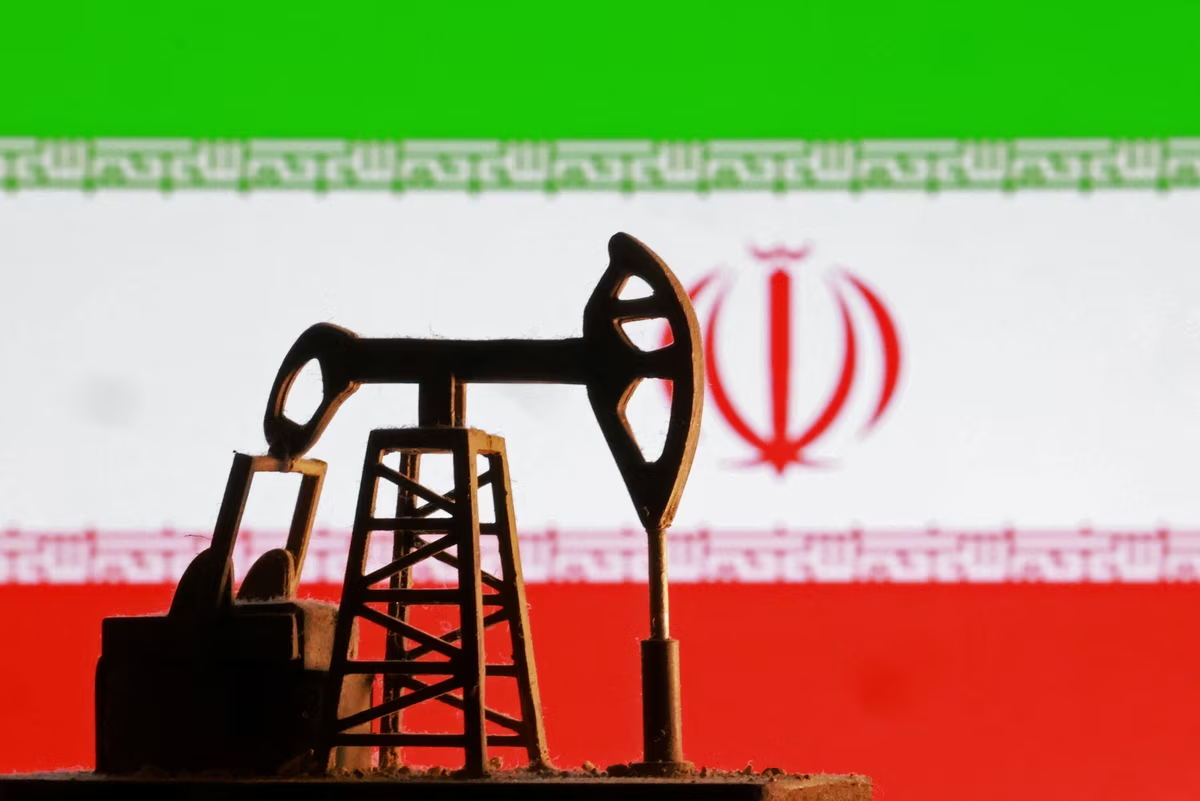
Markets have registered the risk. Recent corrections in equities and commodities—sharp but contained—signal concern that the conflict could unleash a major oil and gas shock. Iran holds the world’s third-largest proven oil reserves and second-largest natural gas reserves. Sanctions have long kept much of that supply constrained. A transformed or compliant Iran would represent a strategic windfall: vast reserves reentering global markets under conditions aligned with Western capital and oversight.


Yet that ambition collides with immediate vulnerabilities. The Strait of Hormuz remains the world’s most sensitive energy artery. Roughly one-fifth of global oil passes through its narrow corridor, along with significant volumes of liquefied natural gas. Even credible threats to its security unsettle markets. A sustained disruption would be economically explosive—insurance costs soaring, shipping disrupted, supply chains strained.


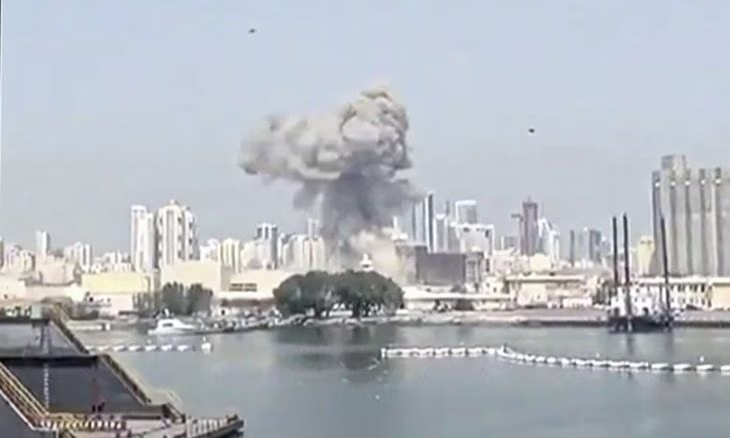
Recent events exposed that fragility. After Iranian strikes on Gulf energy infrastructure, Qatar temporarily suspended LNG production, sending gas prices up nearly 70 percent within 48 hours. Europe and much of Asia—having shifted away from Russian gas after the Ukraine war—were thrust into another energy scare. What was framed as diversification proved instead to be a transfer of dependency from Moscow to the Gulf.


The asymmetry between the United States and its allies is stark. Europe and Asia face inflation spikes and recession risks if disruptions persist. The European Central Bank could be forced into painful rate hikes, deepening stagnation. By contrast, the United States—buoyed by shale production—is more insulated from external supply shocks than at any time in decades. The Federal Reserve faces less immediate pressure.


That imbalance raises a critical question: who bears the cost?


If Washington’s calculus assumes the United States can absorb volatility better than partners—or rivals—then this war is not solely about Iran. It is about leverage across three fronts.


First, energy dominance. Subduing Iran—through regime change or prolonged economic attrition—would open one of the world’s largest untapped hydrocarbon basins to restructuring. A weakened Tehran could be drawn into a Western-aligned production framework, stabilizing output under political conditions favorable to U.S. interests. But this presumes post-conflict control that history rarely grants.


Second, China. Beijing has relied heavily on discounted Iranian crude, often skirting sanctions. Curtailing that flow would raise China’s energy costs and complicate industrial planning. In an era of intensifying U.S.–China rivalry, energy denial becomes a tool of containment. Weakening Tehran reverberates far beyond the Gulf; it touches the architecture of great-power competition.


Third, regional re-engineering. The Abraham Accords envisioned more than normalization between Israel and Arab states. They outlined an economic corridor linking Israeli technology, Gulf capital, and American security guarantees. Iran remains the principal spoiler to that vision. A diminished Tehran could, in theory, clear the path toward a Middle East defined less by proxy war and more by integrated markets.


But the theory rests on fragile assumptions.


Iran’s response—direct strikes against Gulf energy facilities—signals escalation, not capitulation. By widening the theater and targeting infrastructure, Tehran exploits its asymmetric advantage: disruption. The objective is not conventional victory but raising the economic and political costs of confrontation to intolerable levels.


If that strategy endures, the consequences could be systemic. Oil prices would surge. Inflation across Europe and Asia would reaccelerate. Political unrest could follow economic strain. The specter of stagflation—long dormant in advanced economies—would return. The global economy, already burdened by debt and geopolitical fragmentation, may not withstand another prolonged energy shock without structural damage.


Here lies the paradox. A war partly intended to secure influence over energy markets may instead destabilize them. An effort to consolidate regional order could fracture global stability. A strategy designed to weaken adversaries could impose disproportionate pain on allies.


The belief that the United States can remain insulated—protected by shale output and dollar dominance—may prove overly confident. Energy shocks do not respect borders. Financial contagion, currency volatility, and capital flight can erode even resilient economies. Moreover, the perception that Washington engineered global disruption could carry long-term diplomatic costs, straining alliances already tested by previous conflicts.


At its core, this war is a high-risk wager: that coercion can reorder energy geopolitics without triggering uncontrollable escalation; that Iran can be subdued without igniting systemic crisis; that China can be weakened without hardening rival blocs; and that the Middle East can be reshaped through force into a platform for prosperity.


History offers caution. Grand designs often falter against the realities of nationalism, retaliation, and unintended consequences. The Middle East has repeatedly demonstrated that external attempts at structural transformation can unleash forces beyond the architects’ control.


If the gamble fails, the damage will not be confined to Tehran or the Gulf. It will be felt in European factories facing energy shortages, in Asian ports slowed by rising costs, and in American households confronting higher fuel and food prices.


The question, then, is not simply whether the war can be won militarily. It is whether the strategic architecture underpinning it was ever stable enough to justify the risk

OPINIONS

Thu 05 Mar 2026 12:25 am - Jerusalem Time

"Palestine: The Heart of Gravity in the International System"

Palestine is not a local issue to be read within geographical boundaries, nor a fleeting conflict to be added to the archive of international crises. It is a knot in a global narrative where the maps of politics, the memory of colonialism, the rise of nationalisms, and the transformations of the digital economy intersect. What happens in the world is immediately reflected in it, and what happens within it reshapes the world's stances, alliances, and moral discourse. It is as if it is a grand mirror, in which every nation sees its image as it wishes to be—or as it fears to be revealed.

Palestine is not merely a land disputed by maps, but rather a center of political and moral gravity, akin to a black hole in the world's space; every event that passes near it bends in its trajectory, and every international discourse that approaches it changes its form. The power of attraction here is not in its area, but in its meaning.

Palestine is not the largest of geographies, but it is the most capable of reordering priorities. Whenever the world tried to bypass it, it returned to it. And whenever it thought it had become a secondary file, it regained its position at the center of the discussion. It is as if it is a dense mass of history, memory, and symbolism, pressing on the conscience of politics until words bend around it.

Since the formation of the modern international system, it has been more than a geography; it has been a test of the very idea of justice. With the decline of unipolarity and the rise of multipolarity, calculations have changed, but the center of gravity has not. The intensification of competition between major powers sometimes made it a card in the game of influence, invested in the discourse of international legitimacy at times, and marginalized when the priorities of energy or containing other crises advanced. Nevertheless, whenever the world thought it had bypassed it, it returned to it. It is as if it is a center that does not allow escape from its orbit.

In physics, a black hole is not seen directly, but is known by its effect on what surrounds it: by the bending of light, the disturbance of orbits, and the acceleration of objects. So too is Palestine; it is not measured only by what happens within its borders, but by what it causes outside them. It changes the discourse of nations, reshapes alliances, provokes protests, and awakens questions about justice, law, and meaning.

The policies of major powers remain influential in the balance of power, between direct support or conditional mediation, while discourse oscillates between the language of rights and the imperatives of interests. This gap between declared values and actual tools of influence has made Palestine a living laboratory for the effectiveness of international law: do texts remain a binding reference, or do they transform into a moral discourse without teeth? In every round of escalation, questions of sovereignty, occupation, and civilian protection are re-raised, and the consistency of the international system is measured by its ability to apply its principles without selectivity.

It is an attractive land because it contains a rare condensation of history: religions, civilizations, colonialism, resistance, and unfulfilled promises. Every major power that passed through here left its mark, and every international system that formed found itself compelled to take a stance on it. It is as if approaching it is a test of consistency: are principles fixed or relative? Is man the end of politics or its means?

In the region, economic and security priorities have rearranged its position on official agendas, but in the popular consciousness, it has remained a symbolic criterion for legitimacy. As for the global economy, with its successive crises, it has narrowed the margins for humanitarian and political maneuver; nevertheless, any disturbance within it reverberates in distant markets and broader alliances.

Then came the digital age to break the monopoly of the narrative. A single image crosses continents in seconds, awakening cross-border public opinion. Here, Palestine is affected by algorithms of dissemination, but it also influences the formation of a new awareness of issues of justice and human rights. It is no longer an external news item, but an internal discussion in capitals thousands of kilometers away.

But the analogy of the black hole is not an invitation to darkness, but to understanding. For black holes, despite their awe, reveal to us the laws and limits of the universe. And Palestine, despite its tragedy, reveals the limits of the international system, and exposes the contradiction between discourse and practice. It is a magnifying mirror, everything said in it is amplified, and every silence about it echoes further than expected.

Crises around it may be managed, and they may be frozen, but gravity does not disappear. If its roots are not addressed, it continues to pull the world towards it, just as the center pulls its extremities. The future is open to overlapping paths: managed freezing that accumulates postponement, or a political breakthrough that requires sincere international will, or regional expansion that doubles the cost for everyone. However, the only constant is that bypassing it is an illusion; because bypassing it means leaving a void in the conscience.

Palestine is not a hole that swallows the world, but a compass that reorients it. Whoever approaches it sees the fragility of power if it is separated from justice, and sees that peace is not an administrative decision but a deep moral transformation.

And just as the universe does not stabilize without understanding its hidden laws, the world will not know its complete tranquility as long as this attractive center is open to pain. It is not just a small piece of land; it is an idea destined to remain alive and influence the course of events. It is as if the world is destined to revolve around it, because it tests its honesty with itself.

It is the land that cannot be bypassed, because it is not just a land—but a dense meaning around which the world revolves, whether it wants to or not.

PALESTINE

Thu 05 Mar 2026 12:25 am - Jerusalem Time

Ideological Dimensions of War: US Military Leaders Link Attack on Iran to 'Apocalyptic Prophecies'

Human rights and military sources have revealed a rising religious tone within the ranks of the US military leadership in the Middle East, where soldiers and officers are receiving instructions linking ongoing combat operations against Iran to 'end of the world' prophecies. These developments come amid an unprecedented military escalation involving the United States alongside Israel, raising widespread concerns about the discipline and religious neutrality of the US military.

The Military Religious Freedom Foundation (MRFF) reported being inundated with complaints since the start of the widespread attacks, having received over 200 messages from 50 different military units. Officers, in their complaints, explained that their immediate commanders used combat readiness briefings to promote the idea that the war is a 'divine plan' derived from the texts of the Book of Revelation in the Bible, which legal experts considered a dangerous overstep of the separation of church and state.

In a shocking testimony, a US officer stated that his commander described President Donald Trump as 'anointed by Christ' to be the instrument that ignites the events in Iran in preparation for the Apocalypse. The officer added that these statements were met with astonishment by the soldiers, especially since the unit includes members from diverse religious backgrounds, including Muslims and Jews, who felt marginalized and threatened by this extremist rhetoric.

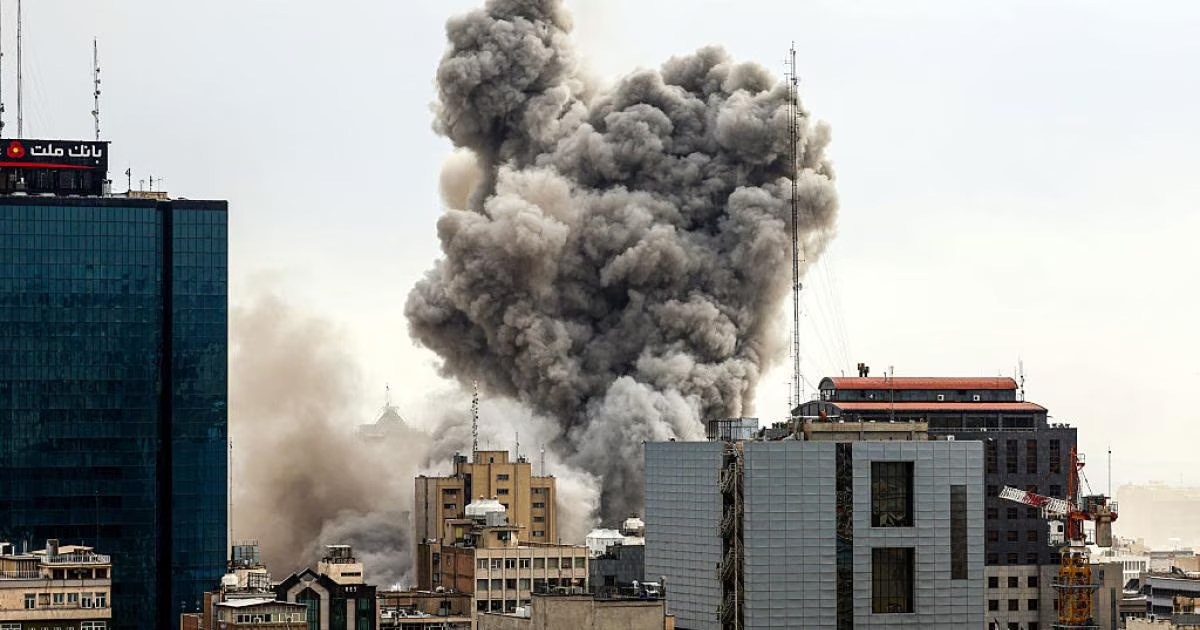
On the ground, military operations that began last Saturday morning are continuing, with US and Israeli airstrikes targeting nearly 2,000 targets inside Iranian territory. These attacks, in their initial hours, resulted in the killing of Iranian Supreme Leader Ali Khamenei and a number of prominent security commanders, plunging the region into a dark tunnel of direct and unprecedented confrontations.

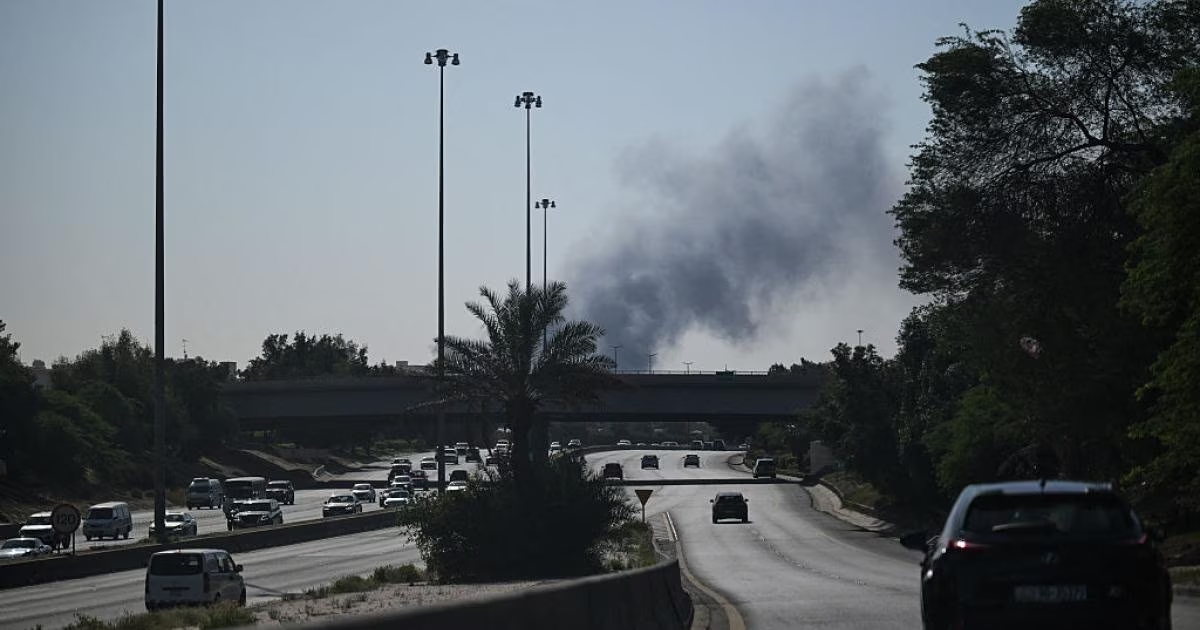
For its part, Tehran responded with a barrage of fire, including the launch of over 500 ballistic missiles and 2,000 drones targeting strategic sites and military gatherings. Field sources confirmed the killing of 6 US soldiers at a base in Kuwait in early March due to a suicide drone attack, while the US Central Command announced the destruction of a large part of the Iranian naval fleet and the paralysis of navigation in the Gulf.

Politically, President Trump's statements regarding the ultimate goals of this war have fluctuated; while he told media that the goal is to 'bring freedom' to the Iranian people, on-the-ground movements indicate an attempt to completely change the regime. The official mission currently is to eliminate Iran's conventional missile capabilities, end the influence of Tehran's proxies in the region, and ensure its disarmament of any nuclear ambitions.

The religious discourse was not limited to the American side but extended to the Israeli leadership, where Prime Minister Benjamin Netanyahu cited biblical texts comparing the Iranian regime to 'Amalek'. Observers considered that the use of these historical and religious symbols aims to rally popular and military support for widespread destructive operations, which further complicates the international political and diplomatic landscape.

In Washington, accusations were leveled against Secretary of Defense Pete Hegseth for facilitating the infiltration of extremist Christian groups into the Pentagon since he took office. Mikey Weinstein, president of the MRFF, pointed out that the Secretary introduced monthly religious practices that saw the attendance of figures advocating for the transformation of the United States into a theocracy, posing a direct threat to national security and military cohesion.

Economically, the war led to severe disruptions in global markets, with oil prices jumping by 6% immediately after the outbreak of confrontations. In contrast, shares of American defense industry companies saw record jumps, with 'RTX' recording sales growth of up to $88.6 billion, benefiting from the massive demand for ammunition and defense systems on the battlefronts.

Despite repeated attempts to obtain official comment from the Pentagon regarding complaints about religious rhetoric, the Department of Defense remained silent. Military experts believe that the continuation of this approach could lead to silent rebellion within military units that refuse to turn geopolitical conflicts into 'crusades' or ideological confrontations serving narrow agendas.

In a related context, Israel is seeking to exploit the military momentum to form a new regional and international alliance including countries from Europe, Africa, and Asia to confront what it describes as an 'existential threat'. Turkey's name stands out in this context, with some Israeli circles describing it as the 'new Iran', despite Ankara's membership in NATO and its possession of the second-largest military force within it, which portends an expansion of the conflict.

Reports indicate that the volume of airstrikes carried out in the first 24 hours of the war exceeded double what Iraq witnessed on 'Shock and Awe' day in 2003. This intensity of fire aims, according to sources, to paralyze the Iranian state's ability to respond quickly and enable the internal opposition to act, amid Israeli threats to assassinate any potential successor to the Supreme Leader.

The Palestinian issue remains present in the background, with the official Turkish position adhering to the two-state solution as the only strategic option for achieving stability. In contrast, right-wing statements in Israel are escalating regarding the 'Greater Israel' project, exploiting international preoccupation with the direct war with Iran to redraw maps of influence in the region.

In conclusion, the US military faces an internal challenge of maintaining its professionalism away from the religious polarization that has begun to surface openly. With the continued influx of complaints from soldiers, it appears that the military establishment is facing a real test of its constitutional principles under a political and military administration that adopts a discourse blending military power with mystical prophecies.

Our commander urged us to tell our troops that everything happening is part of God's divine plan, pointing to the imminent return of Jesus Christ.

ANALYSIS

Wed 04 Mar 2026 8:04 pm - Jerusalem Time

Between Oil and Influence: Trump's War on Iran and the Risks of a Global Economic Earthquake

Said Erikat

Opinion Writer

Washington – Said Arikat – 3/4/2026

News Analysis

The American-Israeli war on Iran is no longer just a fleeting military development in the record of chronic tensions between Washington and Tehran; it has transformed into a comprehensive test of American power's ability to reshape the geopolitical landscape of energy through coercion. US President Donald Trump is not fighting a traditional confrontation that can be measured by the number of strikes or the extent of losses, but rather is gambling on a broader wager: subjugating one of the world's largest hydrocarbon reserves to a new political will, and redrawing regional and international balances that extend beyond the Gulf.

At its core, the war transcends the rhetoric of deterrence and security to the question of resource control. Iran is not just a military adversary, but a massive energy reservoir that has remained outside the Western system for decades due to sanctions. Integrating this wealth into global markets on terms favorable to Washington would constitute a highly impactful strategic shift. However, this ambition assumes an ability to control the outcomes post-conflict, an ability whose limitations history has often proven. Reshaping a country the size of Iran is not an engineering process whose results can be predetermined, but a complex process where national identity, deterrence balances, and calculations of political dignity are intertwined.

However, Tehran, in turn, recognizes its point of strength. Instead of seeking a traditional decisive victory, it is betting on the weapon of disruption. One only needs to look at the sensitivity of the "Strait of Hormuz" to understand the magnitude of the risks. Approximately one-fifth of global oil exports pass through this narrow passage, in addition to huge quantities of liquefied natural gas. Merely hinting at a threat to navigation there raises insurance premiums and overturns market calculations, so what if the threat turns into actual disruption? Here, the global economy becomes hostage to an equation that is not decided by planes or missiles as much as it is decided by market confidence and tanker behavior.

Repercussions quickly appeared in Europe and Asia. The European continent, which sought to reduce its dependence on Russian gas after the war in Ukraine, found itself having replaced one dependency with another. The increasing reliance on Gulf liquefied natural gas seemed a rational choice at a certain political moment, but it revealed its fragility at the first security test. The sharp rise in prices brought back the specter of inflation, posing a difficult dilemma for governments and central banks: should they sacrifice growth to curb prices, or endure a new wave of high prices with significant social and political costs? Thus, a war in which Europe is not militarily involved turns into a direct economic burden on its industries and consumers.

As for Asia, where imported energy is the lifeblood of its industrial growth, any long-term disruption is seen as a threat to its competitiveness. At the heart of this scene stands China, which has benefited in recent years from discounted Iranian oil. Reducing this flow not only pressures Tehran but also raises energy costs for Beijing and complicates its industrial calculations. If part of the American gamble is to use energy as a containment tool in the context of competition with China, the result may not necessarily be to weaken the adversary, but rather to push it to accelerate the building of parallel systems and deepen alternative partnerships, thereby reinforcing the division of the global economy into competing blocs.

In contrast, the United States appears relatively less fragile thanks to the shale oil boom that reduced its reliance on imports. The dollar's position in the global financial system also gives it the ability to absorb shocks in the short term. But this immunity is not absolute. High global energy prices quickly seep into the American domestic market through supply chains and financial markets. More importantly, Washington's image as the architect of widespread disruption may cost it diplomatic capital it needs to manage its alliances.

All of this intersects with a broader regional project that emerged since the signing of the "Abraham Accords," which envisioned a more economically integrated Middle East between Israel and Arab countries under an American security umbrella. In this vision, Iran represents the biggest obstacle to a stable regional order favorable to Washington. Weakening it may open the door to accelerating economic and investment connectivity projects. But the assumption that removing an adversary automatically leads to stability ignores the complexities of the regional environment, where vacuums often generate new conflicts instead of closing old ones.

The great irony is that a war fought partly to secure energy resources may lead to the destabilization of those very markets. Tehran's "cost-raising" strategy, by expanding the scope of the threat and disrupting flows, makes any potential military gain economically costly at the global systemic level. With rising prices, the specter of stagflation looms, a scenario from which advanced economies did not easily recover in the 1970s.

Ultimately, the crucial question is not whether the United States can achieve military superiority, but whether the strategic framework underlying the war is sustainable. The gamble assumes that coercion can rearrange energy geography without widespread unraveling, that Iran can be subdued without igniting a systemic crisis, and that pressure on China will not accelerate the world's division into warring economic camps. However, history tends to punish perceptions that overestimate their ability to control outcomes.

Thus, the war appears to be a major gamble on fragile stability. If the calculations fail, the cost will not be limited to Tehran or the Gulf, but will extend to the factories of Europe, the ports of Asia, and the homes of Americans themselves. In such an interconnected world, the most dangerous consequences of war may be those that were not originally included in the planners' tables.

PALESTINE

Wed 04 Mar 2026 8:04 pm - Jerusalem Time

Entry of more than 100 relief aid trucks into the Gaza Strip via the Rafah crossing

Field sources at the Rafah border crossing and the Egyptian Red Crescent reported the entry of more than 100 humanitarian aid trucks into the Gaza Strip last Tuesday. This convoy comes in coordination between United Nations organizations, primarily UNICEF, in cooperation with Egyptian relief agencies to meet the urgent needs of the besieged population.

Responsible sources confirmed that the trucks followed their usual route through the Rafah land crossing to the Kerem Shalom crossing, which is under Israeli occupation control, to complete inspection procedures. The entry of these large quantities of aid has been observed amidst extremely complex humanitarian conditions that the Strip has been experiencing for many months.

In a related context, a source from the Egyptian Red Crescent in the Sinai Peninsula clarified that all trucks sent on Tuesday had already crossed into the Palestinian side. The source indicated that an additional convoy was prepared and sent on Wednesday, and is currently awaiting the necessary permits to cross.

According to official data issued by the Red Crescent, the latest convoy was characterized by the diversity of its cargo, including 300 tons of flour and 470 tons of various relief supplies. The shipments also included about 925 tons of petroleum products and fuel designated for operating power generators in hospitals and vital facilities suffering from severe shortages.

Regarding the movement of individuals, officials at the crossing denied the crossing of any wounded or injured in either direction during the reopening of the crossing on Tuesday. Movement was primarily limited to the entry of relief trucks, essential goods, tents, blankets, and clothing designated for displaced persons in camps.

For its part, the Israeli occupation army announced the reopening of the Kerem Shalom crossing after a closure that lasted since last Saturday. The previous closure decision coincided with a military escalation that included mutual attacks, before the occupation authorities decided to reopen it based on what they described as a new 'security assessment'.

Kerem Shalom crossing, located at the intersection of the borders between Gaza, Egypt, and the occupation, is considered the only remaining lifeline for the entry of commercial and humanitarian goods and aid. Frequent closures of this crossing exacerbate already deteriorating living conditions, increasing the suffering of millions within the Strip.

Humanitarian reports indicate that about 1.9 million Palestinians out of 2.4 million people have become displaced, living in dilapidated tents lacking the most basic necessities for a dignified life. The ongoing war has caused widespread destruction to most residential units, making reliance on external aid inevitable for survival.

It is worth noting that the Gaza Strip has been subjected to a genocide war since October 2023, resulting in the martyrdom of more than 72,000 citizens and the injury of over 171,000 others. Systematic military operations have also led to the destruction of about 90% of civilian infrastructure, turning the Strip into a disaster area requiring urgent international intervention.

The convoy included 300 tons of flour, about 470 tons of relief supplies, and about 925 tons of petroleum products to operate vital facilities.

PALESTINE

Wed 04 Mar 2026 8:04 pm - Jerusalem Time

Unprecedented Field Development: Simultaneous Missile Attacks from Iran and Lebanon Target Central Israel

The past few hours have witnessed a remarkable military development in the regional confrontation, as Israel was subjected to two simultaneous missile attacks launched from Iranian and Lebanese territories. This operation is the first of its kind in which missile barrages have been coordinated in this manner since the outbreak of the current war, putting Israeli air defense systems on high alert.

Police sources stated in an official statement that reports were received of interceptor missile fragments falling in various areas of greater Tel Aviv, confirming no human casualties so far. For its part, the Israeli army announced the detection of a new Iranian missile barrage launched towards the center, described as the fifth since the beginning of the day, as part of ongoing responses to the military escalation.

Hebrew media sources reported that sirens were not activated in some areas of central Israel after an Iranian missile was intercepted outside its airspace, which was confirmed by Hebrew Channel 12. Simultaneously with the Iranian threat, radars detected the launch of 5 missiles from southern Lebanon targeting the same geographical area, leading to loud explosions resulting from interception attempts.

In a brief statement, the Israeli army confirmed the interception of several missile projectiles coming from Lebanon after alarms were activated in wide areas of the country's center. In a related context, the Yedioth Ahronoth newspaper quoted military sources claiming that air defenses successfully countered all missile threats launched simultaneously from the eastern and northern fronts.

On the Lebanese side, Hezbollah announced the execution of 11 qualitative military operations against Israeli army positions and gatherings since dawn on Tuesday, in response to targeting civilians in southern Lebanon and the southern suburbs of Beirut. These field movements come amidst escalating tension following the assassination of Iranian Supreme Leader Ali Khamenei during the widespread aggression that targeted nearly 2000 targets inside Iran.

Reports indicate that the direct confrontation between Iran and Israel has entered a bone-breaking phase, as Tehran had previously launched about 500 ballistic missiles and 2000 drones in previous rounds. This escalation has cast a shadow over the global economy, with oil prices jumping by 6%, while shares of major American arms companies such as Lockheed Martin and RTX recorded record increases.

Amidst this complex scene, Israeli political moves emerge, through which Benjamin Netanyahu seeks to form a six-party alliance including regional and international powers to confront Iranian influence. In contrast, regional parties such as Turkey continue to adhere to the two-state solution as a strategic necessity, despite the tensions in its relations with some international parties due to its positions on the ongoing war.

We received reports of fragments falling in the greater Tel Aviv area, and no human casualties have been recorded so far as a result of the recent barrages.

PALESTINE

Wed 04 Mar 2026 8:04 pm - Jerusalem Time

The Region on the Brink of a Volcano: Repercussions of Khamenei's Assassination and Scenarios of Comprehensive Confrontation

The assassination of the Supreme Leader of the Islamic Republic of Iran, Ali Khamenei, carried out by Israeli forces with American support, has plunged the region and the world into a dark tunnel of military and political escalation. This incident, which also targeted a number of senior Iranian commanders, has put the international system to a harsh test, as the prospects of this dangerous phase and its repercussions on the stability of the Middle East cannot be predicted.

The features of the Iranian response quickly began to crystallize through the transformation of the confrontation into an open regional war, as sources reported that Tehran began targeting Israeli interests and American bases in the surrounding countries. The Iranian authorities also took a strategic step by closing the Strait of Hormuz, which threatens global energy supplies and pushes the international economy to the brink of collapse.

On the Lebanese front, Hezbollah and the Islamic Resistance engaged in a direct and widespread confrontation in response to the assassination, which led to a violent and comprehensive Israeli aggression on Lebanese territory. Fears are growing of the conflict expanding to include additional fronts with the possibility of the Yemeni Ansar Allah movement and Iraqi factions entering the direct confrontation line against American and Israeli targets.

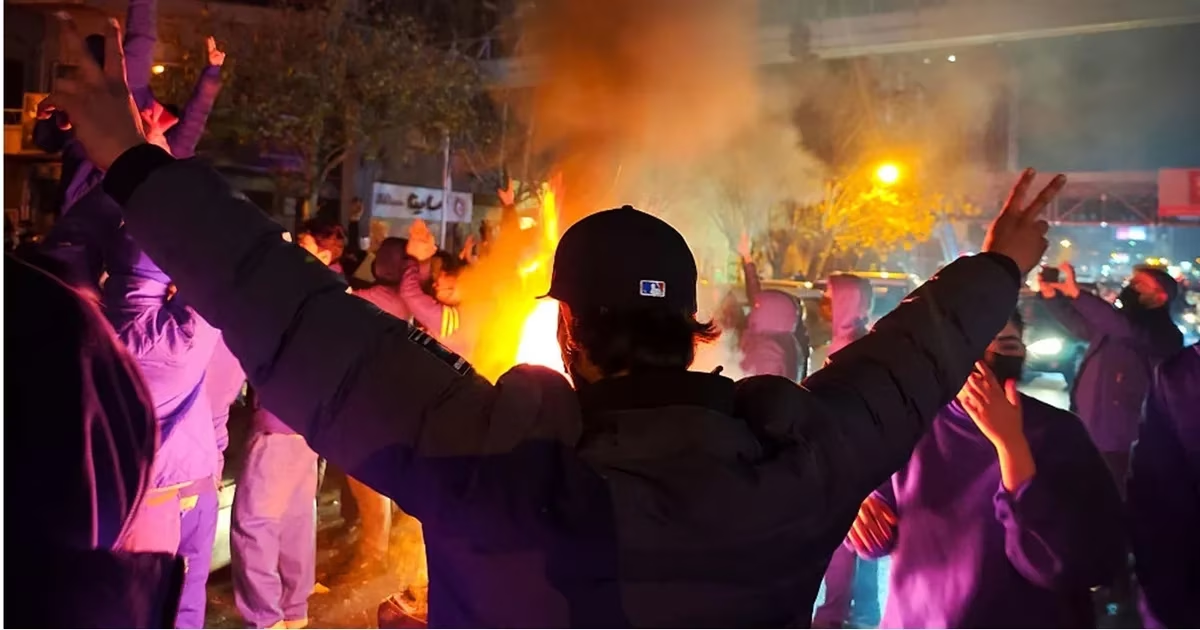
Global capitals witnessed a wave of popular anger, as massive demonstrations took place in front of American embassies in Pakistan, India, and Turkey condemning the assassination. These movements reflect the extent of international tension and popular rejection of American policies, which demonstrators considered a key partner in pushing the region towards a comprehensive war that may not end soon.

Observers believe that the current phase is similar in its pivotal nature to the events of 1979, which witnessed the fall of the Shah and the victory of the Islamic Revolution, but with fundamental differences in the international balance of power. The scenarios presented today range from the fall of the existing regime to its steadfastness, and each scenario has radical implications for the map of alliances in the region and the future of forces allied with Tehran.

The first scenario assumes the success of Washington and Tel Aviv in undermining the current Iranian regime and replacing it with a loyal authority, which would mean a devastating blow to Iran's allies in Lebanon, Yemen, and Palestine. This path could lead to complete Israeli hegemony over the region, weakening Islamic movements and dramatically changing the face of the Palestinian issue in favor of the 'Greater Israel' project.

The second scenario is the transformation of the conflict into an open war of attrition without a clear military resolution from any side, plunging the region into widespread security and economic chaos. In this case, international parties may be forced to move towards a major settlement agreement that stops the aggression, but its terms will depend entirely on Iran's field steadfastness and its ability to impose a new political reality.

The third possibility, which is the most difficult, is the success of Iran and its allies in achieving a limited victory or steadfastness in the face of aggression, especially if they receive support from regional and international powers competing with Washington. This success could force the United States to conduct a comprehensive review of its strategies in the Middle East, and establish a new international system that ends the era of unipolarity and direct military interventions.

Inside Lebanon, developments took a complex internal turn, as the Lebanese government issued decisions prohibiting Hezbollah's military action and asked the army to implement a disarmament plan. These decisions come at a time when Lebanon faces the threat of a widespread Israeli ground invasion, putting the country in a scenario similar to the 1982 invasion, and making the fate of the resistance's weapons a subject of intense political debate.

Field data confirm that the current battle has gone beyond traditional issues such as the nuclear program or ballistic missiles, to become an existential battle related to the identity of the entire region. Khamenei's assassination was not just a targeting of a leading figure, but a spark for redrawing the boundaries of influence and power in the Arab and Islamic world, amidst an unprecedented international struggle of wills.

The rapid developments on the ground indicate that the confrontation is intensifying on all fronts, with the possibility of Gulf states joining the response to Iranian moves, complicating the diplomatic scene. This overlap of interests and threats makes it difficult for any analyst to estimate the final outcomes, as all possibilities remain open to field surprises that could change the course of modern history.

The Palestinian issue finds itself today at the heart of this hurricane, as its fate is closely linked to the results of the major confrontation between Tehran and Tel Aviv. The weakening of the axis supporting the Palestinian resistance could open the door to the liquidation of the issue, while the steadfastness of this axis could restore momentum to the Palestinian national project and impose new deterrence equations that protect historical rights.

The current scene requires a deep strategic reading that transcends narrow sectarian or national differences, given the magnitude of the threat that affects everyone without exception. The battle is no longer confined to specific geographical boundaries, but has extended to include global energy security and the stability of the international system, which has begun to crack under the weight of mutual strikes in the Middle East.

In conclusion, the coming days will be decisive in determining the region's direction for the coming decades, either towards a comprehensive settlement that preserves the balance of power, or a slide towards a third world war that starts from Tehran and Beirut. The responsibility of regional powers lies in preventing complete collapse, although the language of weapons currently seems to dominate the negotiating table and politics.

The battle today is no longer about the nuclear file or missiles, but it is a battle for the destiny of Iran, the Arab and Islamic world, and the Palestinian issue.

ARAB AND WORLD

Wed 04 Mar 2026 7:36 pm - Jerusalem Time

Larijani attacks Trump as Washington announces sinking of Iranian frigate and pledges military reinforcements

The Secretary of Iran's Supreme National Security Council, Ali Larijani, sharply criticized US President Donald Trump, considering that he has dragged his country into an unjust military conflict against Tehran. Larijani indicated that this war came as a result of the impulses and actions of Israeli Prime Minister Benjamin Netanyahu, which he described as farcical, warning of the repercussions of continuing on this path.

The Iranian official, in a direct message to Trump, questioned the usefulness of the slogan 'America First' in light of the increasing human losses among American forces. Larijani stressed that the killing of more than 500 American soldiers in a few days necessitates a real review of whether Israeli interests have overshadowed American national priorities.

On the ground, Tehran announced that the death toll among American forces has exceeded 500 since the start of current military operations. In a related context, a commander in the naval forces of the Revolutionary Guard revealed that his forces succeeded in targeting more than 10 ships and oil tankers, as part of the Iranian response to the joint attacks.

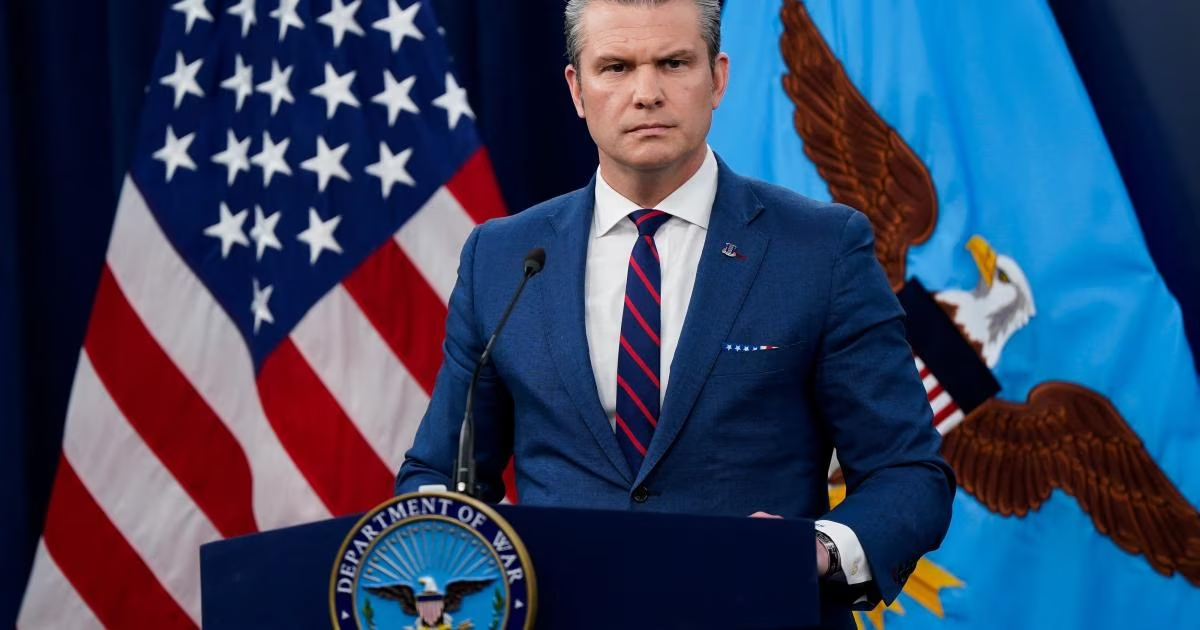
For his part, US Secretary of Defense, Pete Hegseth, described the results of his country's military operations against Iran as 'historic' and unprecedented. Hegseth affirmed in a press conference held at the Pentagon that the ultimate goal is to completely destroy the enemy's military capabilities, stressing that more forces are on their way to the region soon.

The US Secretary expected that in the coming days, American and Israeli air forces would achieve absolute air superiority over all Iranian airspace. He explained that by the seventh day of the war, the joint forces would be able to neutralize missile threats and prevent Tehran from making any progress in its nuclear file by destroying vital facilities.

Hegseth stressed that the air power currently sweeping Iran's skies is the largest in the world, which has significantly reduced Iranian defensive capabilities. He considered that the joining of the Israeli air force to the operations made the attacks more destructive and impactful on Iranian military infrastructure, vowing to use an unlimited stock of precision bombs.

In a prominent field development, the US Secretary of Defense revealed that a US Navy submarine sank the Iranian frigate 'Iris Dina' in the waters of the Indian Ocean. This announcement came after reports from the Sri Lankan Navy confirmed the sinking of the warship near its coasts, while Hegseth described the operation as a 'silent death' and qualitative.

The Pentagon indicated that the sinking of the Iranian ship by a torpedo is the first of its kind against an enemy ship since the end of World War II. Hegseth affirmed that American forces are fighting with a doctrine aimed at achieving complete victory, just as they did in previous major conflicts fought by the United States.

These developments come amid a wide-ranging military aggression launched by Israel and the United States since last Saturday morning, targeting sensitive command centers in Iran. These attacks resulted in the deaths of hundreds of people, including Supreme Leader Ali Khamenei and a number of senior security and military officials in the country.

In contrast, Tehran continues its military response by launching intensive barrages of ballistic missiles and drones towards Israeli targets and American bases in the region. Sources reported that some of these attacks resulted in casualties and injuries, in addition to causing material damage to civilian facilities in some neighboring countries.

Trump should hold himself accountable today if the slogan is still 'America First', or if it has become 'Israel First' after hundreds of his soldiers have been killed.

PALESTINE

Wed 04 Mar 2026 7:36 pm - Jerusalem Time

Indonesia freezes its participation in the 'Peace Council' and threatens to withdraw in response to escalation against Iran

Indonesian Foreign Minister, Sugiono, announced his country's decision to freeze all talks related to the international 'Peace Council', in which Jakarta aspired to play a leading role. This announcement came in the wake of escalating military tensions in the Middle East, confirming that global and regional diplomatic attention has completely shifted towards the rapid developments in Iran.

Sugiono clarified, in press statements after an official event with President Prabowo Subianto, that Indonesia intends to hold intensive consultations with its allies in the Arabian Gulf region. He indicated that these countries face direct threats, emphasizing Jakarta's readiness to play a mediating role in the Iranian conflict with the aim of de-escalating the situation and preventing the region from sliding into a comprehensive confrontation.

For his part, the Speaker of the Indonesian People's Consultative Assembly, Ahmad Mazani, revealed the possibility of his country's final withdrawal from the Council concerned with the Gaza Strip. Mazani confirmed that this direction came after high-level consultations at the presidential palace in Jakarta, where the feasibility of remaining in this alliance has become a major question for the political leadership.

Mazani explained that Indonesia's joining the Council was based on the conviction of this institution's ability to accelerate the establishment of an independent Palestinian state. However, the attacks launched by the United States and Israel - both parties to the alliance - against Iran, prompted Jakarta to fundamentally re-evaluate its role, considering that these actions contradict the declared goals of peace.

The Indonesian government faces increasing internal pressure from Islamic groups and political experts who believe that participation in the Council harms Indonesia's standing as the largest Muslim country supporting Palestine. The Indonesian Ulema Council explicitly called for withdrawal, describing Trump's initiative as ineffective in light of the continuous aggressions against the countries of the region.

Indonesia had prepared an ambitious military plan to send 1,000 soldiers to the Gaza Strip early next April. These forces were scheduled to be part of an international stabilization force mandated by the United Nations, where Jakarta was granted the position of deputy commander of the force, which is now threatened with cancellation as a result of the freezing of the political process.

It is worth noting that the 'Peace Council' is a proposal put forward by former US President Donald Trump to end the war in Gaza, before its powers were expanded to include other international conflicts. Observers believe that the Indonesian shift represents a strong blow to the legitimacy of this Council, especially with accusations against Jakarta that the alliance is trying to usurp the traditional powers of the United Nations in managing international crises.

All discussions of the Peace Council have been suspended as all attention has shifted to the situation in Iran, and we will consult with our partners in the Gulf as they are also under attack.

PALESTINE

Wed 04 Mar 2026 7:35 pm - Jerusalem Time

Widespread Field Escalation: Hezbollah Shells Israeli Depth and Occupation Advances into Khiam

Hezbollah carried out a series of large-scale attacks today, Wednesday, including more than 11 operations using drones and advanced missiles. These attacks targeted strategic sites and military command headquarters in central and northern areas, reflecting an escalation in the pace of field operations.

In official statements, the party announced that it targeted vital air and naval bases, including 'Ramat David' base and 'Haifa' naval base. The strikes also hit 'Tel Hashomer' base, located 120 kilometers from the Lebanese border, and 'Ein Shemer' air defense base east of Hadera.

In a significant development, kamikaze drones were used to strike Iron Dome radars at the 'Kiryat Eliezer' site in occupied Haifa. The party also announced targeting the headquarters of the Israel Aerospace Industries (IAI) company in central occupied Palestine, confirming accurate hits on the targeted sites.

On the ground, the attacks targeted Israeli military vehicles in the village of Houla, where a 'Merkava' tank and an armored personnel carrier were targeted with appropriate weapons. The operations also included 'Geva' drone control base and 'Dado' base, which serves as the northern command headquarters of the occupation army.

For its part, Hebrew media sources revealed Hezbollah's use of a cluster missile for the first time since the start of the current confrontations. Reports indicated that the missile fell in the Metula area near the border, causing extensive material damage to the targeted site.

In the context of ground confrontations, the occupation army admitted that two of its soldiers were moderately wounded after their forces were exposed to anti-tank fire in southern Lebanon. The military statement confirmed that the injured were evacuated by helicopters to hospitals for necessary treatment under tight security.

Regarding ground movements, international sources confirmed the incursion of Israeli forces into several towns and villages within the scope of UNIFIL operations. The incursion included the towns of Houla, Kafr Kila, Kafr Shuba, and Yaroun, reaching the town of Khiam, which is about six kilometers from the border line.

Local sources reported that the occupation army began establishing new strongholds, placing a military post in front of the Khiam municipality building. This move coincided with a redeployment of the Lebanese army in some border locations to keep pace with the rapid field developments in the southern region.

These movements come in implementation of instructions from Israeli Security Minister Yisrael Katz, who ordered his forces to advance and seize new positions. The occupation aims through these operations to try to impose a buffer zone in southern Lebanon, despite the fierce resistance it faces in the border villages.

Specifically, the town of Khiam is witnessing the most prominent confrontations, as Israeli forces try to control it after previous failed attempts last September. Field sources stated that the occupation advanced from Hamamis Hill towards the center of the town under heavy fire cover and concentrated artillery and aerial bombardment.

In the Kafr Shuba axis, sources recorded an incursion of military vehicles and bulldozers belonging to the occupation into the southern part of the town within the Arqoub area. Israeli forces positioned themselves at strategic points after extensive bulldozing operations of green areas and properties in the targeted area.

In parallel with ground operations, Israeli warplanes continued to launch intense raids targeting dozens of villages and towns deep in the south. The bombardment also extended to the southern suburb of Beirut, resulting in widespread destruction of residential buildings and infrastructure amid the ongoing military escalation.

Sources reported that Israeli forces are present today in a number of villages and towns, including Houla, Kafr Kila, Kafr Shuba, Yaroun, and Khiam, about six kilometers from the border.

PALESTINE

Wed 04 Mar 2026 7:35 pm - Jerusalem Time

After striking Iran... Will Turkey become the next target of the Israeli occupation?

Recently, a wave of strategic analyses and speculations has been escalating regarding the next destination of Israeli aggression, especially after the violent strikes that targeted the Iranian heartland. Political readings indicate that decision-making circles in Tel Aviv have begun to include Turkey and Egypt within the scope of future targeting, driven by fears of the growing regional influence of these countries.

These speculations are fueled by public statements from Israeli officials, with former Prime Minister Naftali Bennett describing the Turkish state as the 'new Iran'. Bennett considered President Recep Tayyip Erdogan to be a 'cunning and dangerous adversary', reflecting the extent of Israeli concern over Turkey's growing role in sensitive regional issues.

Observers believe that promoting the idea of targeting Turkey sometimes aims to push Ankara towards forced alliances or to pressure the Turkish people to change their government's direction. However, the expansionist ambitions of the Zionist entity and its desire to reshape the Middle East map according to its interests remain a reality that cannot be ignored, given the repeated statements about the 'Greater Israel' project.

Despite the harshness of Israeli rhetoric, the military balance of power imposes a different reality when it comes to a direct confrontation with Turkey. The Turkish state possesses the second-largest army in NATO, and has offensive land, sea, and air capabilities that far exceed what other parties to the conflict in the region possessed.

Ankara relies on advanced national systems in its defensive strategy, in addition to Russian 'S-400' missiles, making any military adventure against it fraught with risks. Informed sources realize that the Turkish army is capable of reaching the occupied territories not only via missiles but also through modern warships and fighter jets.

Politically, the Turkish approach differs fundamentally from the Iranian one, as Ankara adopts the 'two-state solution' option, which enjoys broad international consensus. This diplomatic stance makes it difficult for Israel to convince its Western allies of the necessity of targeting Turkey under the pretext of threatening global security, especially with ongoing diplomatic relations.

Geopolitics plays a crucial role in protecting Turkey, as it is located at the heart of the interface between East and West, and European capitals consider it a safety valve for the continent's stability. The European need for a strong and stable Turkey is increasing in light of the ongoing Russian-Ukrainian war, and to prevent waves of displacement and illegal migration that threaten Europe's security.

In a related context, the recent war on Iran led to an earthquake in global energy markets, with oil prices jumping by more than 6%. Stock exchanges saw a significant recovery, with shares of companies such as 'Lockheed Martin' and 'Northrop Grumman' rising by record percentages, reflecting the military-industrial complex's benefit from regional tensions.

Reports indicate that RTX achieved massive sales of $88.6 billion during 2025, driven by increasing demand for defensive systems. This economic recovery for arms companies coincides with Israeli plans to form new alliances including India, Greece, and Cyprus to confront what it calls rising 'regional axes'.

Benjamin Netanyahu, who seeks to weaken his opponents and empower loyal forces in the region, is watching with concern the noticeable improvement in Turkish-Saudi and Turkish-Egyptian relations. This Arab-Turkish rapprochement represents an obstacle to Israeli ambitions to unilaterally determine the fate of the region and reshape its security alliances away from national constants.

Ankara is well aware of the extent of Israeli discomfort with its supportive stance on the Palestinian cause and the Hamas movement, and takes Zionist threats seriously. Accordingly, the Turkish leadership is working to close any potential security gaps, benefiting from the harsh lessons learned from the recent military confrontation between Israel and Iran.

Turkish policy, which moves away from the idea of 'exporting revolution' and relies on building partnerships with existing regimes, gives it greater flexibility in international maneuvering. Instead of cultivating militias, Turkey focuses on official economic and military cooperation, which enhances the legitimacy of its regional role and makes it difficult to isolate or target it.

Ultimately, the question of 'whose turn is next?' remains dependent on the ability of regional powers to coalesce in the face of expansionist projects. While Israel is busy trying to dismantle fronts one by one, Turkey appears to be in a military and political position that qualifies it to deter any attempt to cross the red lines affecting its national sovereignty.

The stability of the region largely depends on the balance of power, and any Israeli attempt to harm Turkey could lead to a comprehensive explosion whose consequences Washington or Europe cannot bear. Hence, the importance of Turkish strategic awareness in dealing with threats emerges, while continuing to strengthen self-defense capabilities as the only guarantee in a world that recognizes only power.

Turkey has become the 'new Iran', and Erdogan is a cunning and dangerous adversary who must be wary of.

PALESTINE

Wed 04 Mar 2026 7:35 pm - Jerusalem Time

The 'Relativity and Atom' Conflict: Dimensions of the Comprehensive US-Israeli Confrontation Against Iran and its Regional Repercussions

The Arab region is witnessing a dramatic transformation with the outbreak of direct military confrontation between the US-Israeli alliance and Iran, a war that observers see as the embodiment of a long-standing struggle for hegemony. This confrontation is not merely a product of the moment, but rather reflects an Israeli desire, supported by Washington, to prevent the emergence of any regional power capable of competing with the Zionist presence or threatening its stability in occupied Palestine.

These developments come at a time when news is circulating about the death of Iranian Supreme Leader Ali Khamenei and a number of high-ranking security officials following intense airstrikes that began last Saturday morning. Military sources described the scale of the strikes on their first day as exceeding twice what was witnessed during the 'Shock and Awe' operation during the invasion of Iraq in 2003, indicating an intention for a swift military resolution.

On the ground, the US Central Command (CENTCOM) announced the destruction of 17 Iranian warships and a submarine, leading to a complete paralysis of Iranian military navigation in the Strait of Hormuz and the Arabian Gulf. In response, Tehran launched hundreds of ballistic missiles and thousands of drones targeting various locations, resulting in the deaths of American soldiers at a base in Kuwait.

This war raises deep questions about the 'Arab intellectual crisis' in dealing with the conflict of major powers, where many are content with observation without possessing the tools for civilized action. The American-Israeli agreement to reshape the region seems clear through renewed statements about the 'Greater Israel' project, which seeks to exploit the current state of Arab weakness.

Within Israel, opinions vary on the strategic utility of this war, with analysts warning of the absence of a clear plan for after the fall of the regime. While some call for encouraging ethnic minorities like the Kurds to armed rebellion, former generals rule out the easy fall of the regime given its possession of an ideological army comprising hundreds of thousands of soldiers.

US President Donald Trump, who is leading this phase with sharp pragmatism, faces criticism for his fluctuating positions and contradictory stated war objectives. Press sources confirm that Trump is consulting with a narrow circle to end the conflict in a way that guarantees American economic interests, especially concerning securing energy sources that no longer have the same priority as in the 1990s.

On the Lebanese front, the escalation did not stop at the Iranian borders but extended to include harsh strikes by the occupation army against Hezbollah from Tyre to Beirut. The past hours witnessed the launching of missiles towards Israeli depth, prompting the cabinet to consider strengthening defensive systems in the region to counter cross-border missile threats.

Invoking the phrase 'relativity and the atom' in this political context reflects the irony of fate in a reality where Arabs lack weapons, medicine, and food. Countries that do not possess economic independence are forced to sell their political decisions, making them mere arenas for settling scores between major powers vying for influence and resources.

Israeli Security Minister Katz went further in his threats, asserting that any successor to Supreme Leader Khamenei would be a legitimate target for assassination, in an attempt to block any stability for the regime. This escalatory approach aims, according to Netanyahu's vision, to completely weaken Iran to pave the way for a new regional normalization process involving major Arab countries after the war ends.

The current war raises a moral question about the fate of oppressed peoples, not only in Iran and Palestine but in every place suffering from the arrogance of material power. Relying on 'American protection' has historically proven to be a losing bet, as happened in previous experiences in Iraq, where countries are left to chaos once Washington's vital interests end.

Arab inability to take civilized action is evident in their contentment with writing and theorizing while the region's maps are being redrawn with iron and fire. While international powers are busy developing their military arsenals, the Arab side remains mired in its internal conflicts, facilitating the task of colonial powers in devouring regimes one after another.

Expectations indicate that Trump, after finishing the Iranian file, may turn to escalating pressure on other regional and international powers such as China, Turkey, and Pakistan. This sequence of targeting confirms that the conflict is not merely a reaction to Tehran's policies, but rather part of a comprehensive strategy to impose absolute American hegemony on the new world order.

Ultimately, the Arab world finds itself facing a bitter truth: power is the only recognized language in the 'war of relativity.' Without possessing the tools of real power, Arab peoples will continue to pay the price for reckless decisions or prolonged silence, while the Zionist entity continues to seize land and expand its influence under the American umbrella.

This historical moment requires an awareness that transcends emotions, and a deep understanding of the mechanisms of buying and selling power in the international arena. The ongoing war is not just a military confrontation, but a final test of the region's ability to survive or transform into mere appendages in the 'Greater Israel' project, whose features are clearly beginning to take shape amidst the smoke of explosions.

We are facing a war of 'relativity and the atom,' laden with all the sins of the West and our Arab inability to take civilized action that changes reality.

ARAB AND WORLD

Wed 04 Mar 2026 7:35 pm - Jerusalem Time

Tehran Vows Long War, Tel Aviv Expects Two Weeks of Intense Raids

Iranian Foreign Minister, Abbas Araghchi, launched a scathing attack on US President Donald Trump, accusing him of betraying diplomatic principles and the voters who entrusted him. Araghchi explained that the American approach to the nuclear file was characterized by stubbornness and dealing with international issues as if they were real estate deals, which ultimately led to the destruction of the negotiation table.

In a related context, Mohammad Mokhber, advisor to the Iranian Supreme Leader, stressed that Tehran finds no basis for trust in the American side or for entering into new negotiations with it at present. Mokhber affirmed in official statements that his country possesses long-term resilience and the ability to continue the current military confrontation for any duration imposed by field conditions.

On the ground, the Israeli army admitted that intense air attacks have not yet succeeded in fully neutralizing the Iranian missile threat. Military spokesman Avi Defrin indicated that Tehran still maintains a huge arsenal capable of targeting Israeli depth, warning that air defense systems may not provide absolute protection against dense barrages.

Military sources reported that Israeli air operations in recent hours focused on destroying ballistic missile infrastructure, including manufacturing facilities in Isfahan. The army claimed it managed to strike sites designated for the production of 'Ghadr' type missiles, which are considered a cornerstone of Iran's long-range deterrence weapon.

For its part, Hebrew media reports revealed security assessments indicating that military operations against Iranian targets will continue for at least two additional weeks. Sources quoted staff officers as saying that the timeline for the attacks is subject to extension based on an assessment of the damage inflicted on Tehran's offensive and defensive capabilities.

Statistics issued by the occupation army indicate the use of massive firepower during the past few days, with about 2,500 rockets and shells launched at various sites. These sources claimed that the raids targeted more than 600 vital infrastructures, in an attempt to reduce the pace of firing and prevent threats from reaching the home front.

In details of the recent operations, the military statement announced the interception and destruction of 150 Iranian ballistic missiles in the first moments of their launch from their platforms. Declared targets also included about 200 air defense systems and radars, in a clear Israeli endeavor to achieve complete air superiority in Iranian airspace and facilitate fighter jet missions.

Despite these figures, doubts remain about the accuracy of Israeli reports amid Iranian secrecy regarding the true extent of losses. Informed sources confirm that Tehran adopts a strategy of distributing mobile depots and platforms, making it difficult to eliminate its missile capabilities through air strikes alone without ground intervention or complex intelligence operations.

Military circles compare the current confrontation with previous wars, noting a significant escalation in the volume of munitions used and the intensity of air raids. While Israel consumed about two thousand rockets in previous rounds over 12 days, in the current round it exceeded this number in less than three days, reflecting a desire to quickly resolve the battle.

In conclusion, the scene remains open to all possibilities in the absence of any horizon for diplomatic solutions and the insistence of both parties on the language of force. While Israel bets on exhausting Iranian military capabilities from the air, Tehran brandishes its ability to withstand and wage a long war of attrition that may change the balance of power in the region.

The Iranian regime still possesses significant capability, and I would like to remind you that our defenses are not completely impenetrable.

ISRAELI AFFAIRS

Wed 04 Mar 2026 7:35 pm - Jerusalem Time

Former Israeli National Security Advisor Calls for Inciting Iranian Army and Kurds to Overthrow the Regime

Media sources reported that decision-making and analysis circles in Israel have begun promoting a new strategy aimed at moving beyond the stage of air strikes against Iran and achieving the goal of 'regime change.' This vision is based on the necessity of exploiting popular anger and supporting the internal opposition by transforming it into an armed force capable of field confrontation.

In this context, Giora Eiland, former head of the National Security Council, affirmed that the current results of American and Israeli air attacks may damage military capabilities, but they will not fundamentally end the threat. Eiland considered that the Iranian regime remaining in power after these military rounds would be considered a victory for it, regardless of the extent of material losses it might incur.

Eiland explained in a strategic analysis that the current war must be fought with an 'all or nothing' mentality, noting that public statements from Washington and Tel Aviv link military success to the ability of the internal opposition to emerge at the appropriate time. He believes that this shift requires action that goes beyond aerial bombardment to include ground operations launched from within Iranian territory or along its borders.

The former Israeli official touched upon the role of Kurdish militias stationed in Iraq, describing them as having high combat motivation and field capabilities that can be utilized. He considered these militias to be one of the contributing factors in igniting a ground confrontation against the central authorities in Tehran, especially in the rugged border areas.

The most important factor in Eiland's plan is the regular Iranian army, which he distinguished from the Revolutionary Guard, which owes absolute loyalty to the political leadership. He pointed out that the regular army, which has historically suffered from marginalization since the Iran-Iraq War, possesses a huge arsenal of tanks and artillery that could change the balance of power if it sided with the opposition.

Eiland believes that the joining of parts of the regular army to the popular movement, coinciding with external attacks, will create a 'critical mass' that genuinely threatens the regime's survival. He stressed that the presence of tens of thousands of armed soldiers in the ranks of the opposition would provide the necessary momentum to transform protests into a comprehensive armed uprising.

To achieve this goal, Eiland called for a high level of operational coordination between these forces and the United States, emphasizing that this coordination must precede any field movement by months. He explained that military unit commanders in the Iranian army need guarantees of effective real-time American air support before taking any risks.

Eiland gave an example of an armored brigade from the regular army potentially seizing a city or vital facility, considering that one such military success could be enough to rally the hesitant. He added that such qualitative operations usually lead to the spread of rebellion among other armed forces and society like wildfire.

The analysis indicated that Israeli circles are anticipating secret American efforts to recruit internal elements with military capabilities, benefiting from Washington's long experience in this field. Despite acknowledging the failure of some previous attempts, he believes that the current circumstances may be conducive to achieving a breakthrough within the Iranian military structure.

Eiland warned that relying solely on air raids and waiting for the masses to spontaneously take to the streets will not achieve the desired goals of overthrowing the authority. He stressed that popular pressure needs 'military fangs' provided by armed militias and defecting forces to break the prestige of the regime's security apparatuses.

The article also highlighted the importance of coordination with neighboring countries to Iran, such as Azerbaijan and Iraq, to facilitate the movement of opposition forces and provide them with logistical support. He considered that encircling Iran with a belt of armed forces loyal to Western and Israeli orientations is the only way to ensure that the regime does not recover from the current strikes.

In conclusion of his vision, Eiland affirmed that the current battle differs from previous confrontations, as it requires unprecedented intelligence and operational coordination between external and internal forces. He considered that failure to militarily mobilize the Iranian interior would mean losing a strategic opportunity that might not be repeated to reshape the political map in the region.

These statements reflect the extent of Israeli ambitions to exploit regional tensions to impose a new reality in Tehran, beyond merely destroying nuclear or military facilities. They show a desire to transform the conflict from a confrontation between states into a war of internal attrition that undermines the foundations of the Iranian state from within.

It is worth noting that these calls come at a time when the region is witnessing unprecedented escalation, as political sources in Washington seek to evaluate all available options for dealing with Iranian influence. The hypothesis of a regular army defection or minority movements remains a subject of wide debate among strategic analysts regarding its realism and its ability to withstand the grip of the Revolutionary Guard.

Complete success in the war must include regime change, and the joining of armed militias alone will increase the strength of Iran's internal opposition.

OPINIONS

Wed 04 Mar 2026 12:50 pm - Jerusalem Time

Will this war on Iran be completed?

The current Israeli-American war on Iran comes to complete the short war launched against it last summer, which I then described as an example of an incomplete war ("Al-Ayyam" 25-5-2025). The sought-after goal was and still is to overthrow the regime in Iran and replace it with a domesticated one that meets all Israeli-American conditions. It is clear that Netanyahu has been trying for years to drag Washington into doing the job on behalf of Tel Aviv, to achieve Israel's goal of fully domesticating and dominating the entire region, which will not be achieved with the continued existence of a strong regional power hostile to Israel, curbing its absolute control over the entire region. For this purpose, Israel exaggerated Iran's military capabilities and magnified the dangers of its nuclear program, to instill fear in many, inside and outside the region. It is worth noting that Iran's policies and evasions gave Israel comfortable space to do so. As for the Trump administration's involvement in the two successive wars on Iran, although it seems like a drag that aligns only with the Israeli purpose, it is worth noting that Washington, panicked by the continuous decline of its absolute dominance over the international system, due to the accelerating rise of China, on the one hand, and Russia regaining some of its lost status after the collapse of the Soviet Union, on the other hand, means that America also has its own goals it wants to achieve. American goals do not contradict the Israeli goal, but rather intersect with it, as the control of the trusted organic ally in the region secures American interests in the long run. In addition, Washington, in its quest to secure the continuation of its global dominance, aims to specifically contain China's rise, by absolute control over the widest oil-producing regions in the world, as it is the artery feeding the prosperity of the Chinese economy. By controlling Venezuelan oil, on the one hand, and tightening the control loop over "Middle East" oil, on the other hand, the artery supplying China with what it needs of this essential and vital material becomes subject to American control. For these intersecting, but aligned, reasons, getting rid of the Iranian regime becomes a vital priority for Israel and America. But since Israel alone cannot overthrow this regime, it has always needed American support to do the job for it. However, America, which also wants to overthrow the Iranian regime, had a self-restraint as a result of its experience in two bitter wars in Afghanistan and Iraq, which is its unwillingness to engage in a new military "adventure" that would involve it in a new open war. Therefore, its means of achieving the overthrow of the regime in the first short war on Iran, and the current war as well so far, has been limited to launching a "remote war" on it, with attacks from the air and sea, without a ground invasion it is trying hard to avoid. However, it is known from historical experiences that overthrowing a well-established regime by external military intervention is difficult to achieve through launching "remote attacks," and ultimately requires ground intervention to achieve the purpose. So, will Washington be content with limiting its war on Iran to remote strikes, or will it get involved in a long and costly war that does not have the support of American public opinion? *** There are three possibilities (scenarios) for overthrowing the Iranian regime by launching an American-Israeli "remote war": First, continuing to carry out continuous attacks from the air and sea on Iran with the aim of striking the regime's capabilities and undermining its ability to maintain cohesion and control, which allows organized opposition forces to seize it from within, or allows allied forces from outside to do the job. However, this possibility remains weak, as the organized opposition represented by the "Mujahedin-e Khalq" movement does not have a vital presence inside Iran, and because employing allied forces to do the job by infiltration from outside requires the existence of such forces capable of carrying out the mission, and their acceptance of doing so, which is not currently available or guaranteed. Second, relying on an uprising of angry popular groups against the regime, who wish for its demise, by having American and Israeli attacks weaken the regime's control over internal affairs, which allows these groups to take to the streets in large numbers sufficient to eliminate the existing regime and hand it over to a new leadership loyal to America and Israel. At the beginning of this war, the American president expressed his reliance on this scenario, and stated that what America is currently doing is preparing the appropriate ground for this possibility to occur. However, this possibility remains weak currently because the Iranian regime is an ideological regime based primarily on the support of a guaranteed loyal popular base on ideological grounds, and because other groups are expected to unite with it during an external aggression against the country, and because the regime itself is expected to fight fiercely in its defense when it is subjected to external aggression aimed at removing it, which means it will not allow any unorganized "popular" opposition to exploit the opportunity to overthrow it. Third, that America and Israel rely on bringing about change in the Iranian regime from within, by a "soft coup" that brings forth a new leadership that is conducive to reaching "understandings" that achieve American and Israeli conditions, and gradually turns Iranian affairs in the desired direction by Washington and Tel Aviv. For this, the first strike targeted the Supreme Leader himself and a large group of first-tier leaders, especially military ones, which opens the way for a new leadership movement. The American president also expressed Washington's reliance on this option by stating the possibility of three personalities, who appear to be current regime leaders, taking over the leadership of Iran in the next stage. This possibility remains the most important and probable of the previous two possibilities, but it opens the door to questioning whether a deal has been struck with parties from the current Iranian regime for a "soft coup" against it when military attacks take effect by exhausting it. Although this possibility is plausible and brings to mind what happened in Venezuela, the structure of the Iranian regime is more complex and includes the presence of many safety valves protecting the regime, especially the "Revolutionary Guard" which, if not infiltrated, will not only be the defender of the regime's continuity, but also of ensuring the continuity of its ideological direction. *** Driven by Israel, but also to achieve American goals, it is clear that the Trump administration has started a war to complete the previous war to change the Iranian regime. It is also clear that it started this war without a clear plan for how to achieve this goal, as the available possibilities to achieve it through launching a "remote war" are weak and uncertain. If one of these three possibilities mentioned above is not achieved soon, Trump may find himself involved in a long, exhausting, and uncertain ground war that the majority of the American people, and even he himself, do not want or support. If that happens, Netanyahu will have dragged the American president into a muddy confrontation that will disrupt the remainder of his term. A side note: Contrary to Trump's goal of this war being swift, the Iranian regime's goal currently may be to expand its scope and prolong its duration, as this exhausts those with short breath, and Trump is at the top of the list. Another note on the subject: This war, if it does not achieve American-Israeli goals quickly and decisively, will be another important nail in the coffin of the organic American-Israeli relationship. There is a lot of change happening within the American arena in this direction, and this war will reveal this ongoing transformation.

ANALYSIS

Wed 04 Mar 2026 12:26 pm - Jerusalem Time

The Future of the Region in 2026: Implications of Weakening Iran and Risks of Israeli Hegemony

This analytical reading comes amidst complex regional circumstances, with Iran at the heart of its storms, amid a surge in American and Israeli military power characterized by a high degree of military arrogance. This perspective focuses on the repercussions of any major confrontation on Arab national security and regional stability in general.

The hypothesis of Iran's defeat in any upcoming conflict will have severe negative consequences for regional balance, as it will pave the way for the Israeli occupation to extend its absolute hegemony. This arrogance of power will necessarily lead to a state of popular and political unrest as a result of unprecedented Israeli encroachment on Arab affairs.

Hamas and Hezbollah are at the forefront of the forces that will be directly and fatefully affected in the event of the absence or weakening of Iranian support. If Hamas's capabilities decline, this could push the occupation forces to tighten their grip, reigniting resistance in the Gaza Strip and leading the situation towards a bloody unknown.

In the Lebanese arena, weakening Hezbollah could open the door for the Lebanese government to attempt to subdue it militarily or politically. This scenario could bring back memories of the painful civil war that plagued the country for decades, especially in light of the economic collapse currently paralyzing the state.

Hezbollah is expected to reject any attempt to disarm it, which could lead to an internal armed conflict that sets Lebanon back decades. In this context, concerns arise about direct external interventions by the United States or the occupation to support parties hostile to Hezbollah, which would further complicate the scene and destroy what remains of institutions.

Another scenario is the possibility of Hezbollah carrying out a military coup in cooperation with elements of the Lebanese army to impose control over the country. Such a move could be used by Israel as a pretext to destroy Beirut and other major cities under the guise of fighting terrorist organizations, exacerbating poverty and chaos.

Moving to Yemen, Ansar Allah will find themselves in a state of internal retreat to maintain their influence in Sana'a and the northern regions. With the قطع of Iranian supplies, the region may be subjected to American and Israeli aerial or ground interventions aimed at forcibly subjugating the Yemeni capital and ending the Houthi presence.

In Iraq, the task seems more complex for those seeking to dismantle armed militias due to their deep penetration into the social and political fabric. Any governmental attempt to subdue these factions by force could drag the country into a devastating civil war or a military coup that would destroy the capabilities of the Iraqi state.

Washington and Tel Aviv's success in neutralizing Iran's role will radically change the geopolitical map of the region, as Zionist influence will reach distant Arab and Islamic capitals. Israeli leaders no longer hide their expansionist ambitions that extend beyond the borders of Palestine to include neighboring countries under alleged historical slogans.

While the American administration tries to control the pace of the conflict to prevent it from turning into a comprehensive regional war that raises energy prices and affects global economic stability, the occupation is working to tear the region apart. The clear Israeli goal is to humiliate the Arab peoples and ensure absolute hegemony by fragmenting the major powers in the region.

The fall of the regime in Tehran could open the gates of hell through internal ethnic and sectarian conflicts in Iran, which will extend its impact to the Iraqi and Arab borders. The security and political vacuum that this fall will leave will be difficult to control, directly and unprecedentedly threatening Arab national security.

Despite these pessimistic scenarios, the most likely outcome remains the survival of the Iranian regime, albeit with severe economic and political weakening that will require years of recovery. These facts may change in the event of changes in the American administration, which could open the door for new international agreements that redefine the relationship with Tehran.

In the event of a decline in Iranian pressure, some Arab countries such as Saudi Arabia may find an opportunity to focus on their development and internal projects. However, caution remains necessary against Israeli ambitions that will not allow the region to stabilize, as the occupation's eye remains on the region's wealth, lands, and airspace.

In conclusion, Arab decision-makers must realize that weakening Iran is not necessarily a strategic gain for Arabs if the alternative is Israeli unilateralism. Higher political interests require a realistic outlook that transcends sectarian differences or the desire for revenge, to ensure that the Arab arena is not left vulnerable to expansionist projects.

The fall or weakening of Iran is not in the interest of Arabs, because it will leave the arena wide open for the occupying entity to tamper with as it pleases.

PALESTINE

Wed 04 Mar 2026 12:23 pm - Jerusalem Time

Hezbollah's Entry into the Battle... Escalating Internal and Regional Repercussions

Dr. Osama Abdullah: Iranian axis forces may escalate indirectly to expand the pressure theater without a comprehensive regional war. Nizar Nazzal: Hezbollah's entry was expected given the nature of the ongoing conflict, and what is happening reflects a radical shift in the objectives of the confrontation. Dr. Aql Salah: Hezbollah may seek to drag Israel into a war of attrition that prolongs the confrontation and depletes its capabilities, despite the high cost to Lebanon. Sari Sammour: The actual implementation of the Lebanese government's decision to ban Hezbollah's military activities may open the door to internal conflict. Dr. Reham Odeh: The Israeli escalation may develop into a limited ground incursion into South Lebanon with the aim of creating a buffer zone. Labib Taha: The most likely scenario is unprecedented Israeli destruction of Lebanon in parallel with a sharp escalation in internal polarization. Ramallah – Exclusive to "Al-Quds" – Against the backdrop of the American-Israeli war on Iran and its repercussions, Lebanese Hezbollah joined the war, amidst warnings of a major military escalation against Lebanon, in parallel with internal Lebanese alignments and placing the region before unprecedented escalation possibilities, in which other armed factions may become involved. Writers, political analysts, specialists, and university professors, in separate interviews with "Al-Quds", believe that any expansion of the scope of military operations between Israel and Hezbollah will increase internal divisions and deepen the fragility of the Lebanese state, given the difficulty of controlling the pace in the face of escalating regional tensions. They point out that the party's intervention opens the door to potential Israeli responses, including intensive shelling of party and civilian sites, with the possibility of a limited ground incursion into South Lebanon, with the aim of establishing buffer zones, which places Lebanon before a direct cost in terms of infrastructure and human losses, and the erosion of trust in the state, making the country face an unprecedented critical stage in its modern history. Regionally, writers, analysts, specialists, and university professors expect Hezbollah's involvement to lead to an expansion of the indirect engagement, including targeting American and Israeli interests in multiple arenas, from Iraq to the Red Sea. Reshaping the Internal Lebanese Equation The political researcher and academic presents three main scenarios after Hezbollah's involvement in the confrontation within the context of the American-Israeli war with Iran, warning that any military expansion will not be limited to the field, but will extend to reshaping the Lebanese equation internally. Limited Involvement Abdullah explains that the first scenario is "limited involvement" or within controlled fiery messages, where the party may be content with expanding the margin of calculated engagement on the borders with the aim of relieving pressure on Iran, without going to a comprehensive war. Abdullah clarifies that this path keeps the escalation below a calculated ceiling, but it places Lebanon in a state of continuous security and economic attrition, and deepens the fragility of the state, especially in light of an official Lebanese position expressed by the Lebanese government, leading to the banning of Hezbollah's military activities. The Scene of the 2006 War As for the second scenario, according to Abdullah, it is "comprehensive war," if mutual strikes expand significantly, which may bring back the scene of the 2006 war but with much greater destructive capabilities. Abdullah points out that Lebanese infrastructure will be a direct target in this path, which will push the already exhausted economy towards a deeper collapse, with possibilities of widespread internal displacement and increasing institutional disintegration, considering that this scenario is consistent with what the occupation government and its prime minister, Benjamin Netanyahu, specifically want. Mutual Deterrence Abdullah indicates that the third scenario is "mutual deterrence," where the threat of intervention is used as a political pressure card to enhance regional negotiation terms without extensive military implementation, and in this case, Lebanon remains hostage to a sustained state of tension, without a comprehensive explosion, but with continued risks. Sharper Internal Political Division Internally, Abdullah warns that any military expansion will lead to a sharper political division over the decision of war and peace, immense pressure on the lira and the banking sector, and increased probabilities of social tension, in addition to the erosion of what remains of trust in the central state. Abdullah believes that widespread intervention does not mean merely a military confrontation, but rather plunging the country into a phase of long-term instability. Indirect Involvement of Iranian Axis Factions Regionally, Abdullah links the scene to what is known as the Iranian influence axis, which includes armed actors in Yemen through Ansar Allah, and in Iraq through factions affiliated with the Popular Mobilization Forces. Abdullah believes that the likely scenario for the intervention of armed forces from the Iranian axis is indirect escalation, through missile or drone attacks targeting American interests or Israeli-linked targets, with the aim of expanding the pressure theater without providing a justification for a comprehensive regional war. Abdullah points out that the widespread intervention of Iranian axis forces remains dependent on two main factors: the extent of direct targeting of Iran, and Tehran's decision to turn the confrontation into a multi-front war. Abdullah emphasizes that Iranian strategy historically tends towards "managing escalation" rather than "comprehensive explosion," but the region is entering a phase of "dangerous strategic fluidity," where a small tactical error could lead to a wide regional transformation that transcends current rules of engagement. A Network of Iranian Proxies in Anticipation of an Existential War Nizar Nazzal, a researcher specializing in Israeli affairs and conflict issues, believes that Hezbollah's entry into the confrontation was expected given the nature of the ongoing conflict, emphasizing that what is happening is not related to a limited security operation or the assassination of a specific person, but rather reflects a radical shift in the objectives of the confrontation. Nazzal explains that the current escalation is related to targeting the Shiite community more broadly, within the framework of American strategic objectives with which Israel is fully aligned. Nazzal points out that the past period witnessed investment in the state of tension with Iran with the aim of reaching a settlement with Washington regarding its nuclear file, including zeroing enrichment and handing over quantities of enriched uranium, noting that things were moving towards a possible understanding before US President Donald Trump was convinced by the viewpoint of the Israeli Prime Minister, which led to a shift towards the option of war, with the central goal shifting to overthrowing the Iranian regime. Nazzal believes that Iran has worked throughout the past years to build a network of arms and proxies in anticipation of an existential war. The High Cost to Lebanon Nazzal emphasizes that Hezbollah's entry will cost Lebanon dearly, especially given the Israeli army's move to enter the entire South Lebanon and regain control of the areas from which it withdrew in September 2000, as Israel is waiting for the right moment or justification to reoccupy every inch it withdrew from. Regarding the Lebanese government's decision to outlaw Hezbollah, Nazzal questions the effectiveness of these measures, emphasizing that Israel now has the pretext to act, at a time when the party realizes that the Lebanese state is unable to stop the coming "storm." Potential Qualitative Entry of the Houthis Nazzal speaks of the expansion of the confrontation regionally, noting that Iraqi factions targeted American bases with drones, with expectations of continued targeting in Erbil and Syria. He points to a decision issued by Tehran calling on all its allies to engage in the battle. Nazzal believes that the potential entry of the Houthis could be qualitative and surprising, whether through targeting American naval vessels or carrying out large operations. Nazzal believes that the region is heading towards a regional war of an existential nature, transcending the logic of military pressure towards negotiation to an attempt to overthrow the state entirely. Hezbollah's Entry After Thousands of Breaches Aql Salah, a writer, political analyst, and professor of comparative political systems, believes that Hezbollah's entry into the war after the escalation with Iran came in the context of a long process of attrition, explaining that for about 15 months since the ceasefire between Israel and Lebanon, the Lebanese arena witnessed thousands of Israeli violations, including assassinations, shelling, and arrests within Lebanese territory, resulting in hundreds of casualties and widespread destruction. Preemptive Israeli Strike Salah indicates that the party had been warning and demanding the Lebanese government to pressure for an end to these violations, without success, which reinforced its conviction that its turn would come after Iran, but the Lebanese government's announcement of banning the party's military activities may exacerbate the internal crisis. Salah points out that repeated Israeli statements preceding the war on Iran confirmed the intention to carry out a wide operation to disarm the party by force, explaining that Tel Aviv's policy in recent months was based on exhausting and besieging the party in preparation for settling accounts with it. Crossing Red Lines Salah believes that targeting Iran, as the central supporter of the party, constituted a qualitative shift, especially with Israel and the United States going too far in killing Supreme Leader Ali Khamenei, which the party considered a crossing of red lines and an assault on its religious and ideological authority, thus imposing on it the duty of support and defense. Salah explains that not participating in an ongoing war against the party for more than a year would have been a blow to its ideological connection, which made it face the option of engaging in combat to impose the "non-aggression" equation that existed before October 7, 2023, and which is based on returning a blow with a blow. Opportunity to Rebuild Internal and External Understandings Salah points out that internal Lebanese governmental pressures, towards adopting American-Israeli policies to besiege and disarm the party, pushed the party to consider the confrontation an opportunity to rebuild internal and external understandings. Regarding the expected scenarios for Lebanon, Salah predicts a long war interspersed with mutual military operations, including Israeli shelling of party and other Lebanese civilian and military sites, in exchange for missile responses from the party, with the possibility of an Israeli incursion from several axes in the south. Salah believes that the party may seek to drag Israel into a war of attrition that prolongs the confrontation and depletes its capabilities, despite the high cost to Lebanon as well. Salah believes that Netanyahu is treating the battle as decisive for redrawing the Middle East under American cover, thus cementing Israel's regional superiority. Salah explains that the outcomes of the conflict are linked to the resilience of Iran and Lebanon; if Washington and Tel Aviv fail to change the regime in Tehran, they may be pushed towards a major settlement. Salah rules out the chances of a diplomatic settlement given the "Trumpian" mentality supporting Israel, pointing to Netanyahu's internal calculations and his political ambitions until 2030, and his endeavor to exploit the atmosphere of war to overcome his judicial crises. Salah warns of severe humanitarian and economic repercussions for Lebanon, including the destruction of villages and the southern suburbs, widespread displacement, and the exacerbation of internal division, in light of a fragile economy. Ideological Ties and Not Standing By Regionally, Salah expects the Houthis to announce their strong entry into the war in support of Iran and Hezbollah, considering that ideological ties make them uninterested in standing by. Salah points out that the Popular Mobilization Forces in Iraq have been involved since the announcement of the assassination of the Supreme Leader of the Iranian Revolution, Ali Khamenei, predicting an expansion of targeting American interests in Iraq and the region. Salah confirms that the scene is heading towards an open "bone-breaking" conflict with wide regional possibilities. Fears of Internal Lebanese Collision Sari Sammour, a writer and political analyst, explains that Hezbollah's intervention in the ongoing confrontation after the war on Iran "was expected and unexpected at the same time," noting that the sensitivity of the internal situation in Lebanon makes any military involvement of the party a highly influential factor on political and sectarian balances. Sammour points out that the Lebanese government quickly banned the party's military activities, considering that if this decision is actually implemented and does not remain within the framework of a media announcement, it may open the door to an internal conflict that may take on a sectarian or political dimension, especially since the party represents a fundamental segment of the Shiite community in the country. Sammour believes that Israel "will not pay attention to internal Lebanese considerations" and will continue its military operations, which reinforces the action-reaction equation, and leaves the door open to the possibility of the confrontation shifting from an exchange of shelling to ground clashes. Internal Lebanese Alignments Sammour points out that the Lebanese arena has been witnessing sharp alignments for some time that may deepen further in light of developments, describing the Lebanese government's decision as hasty, because Israel has not shown willingness to stop its operations, but rather has made a clear decision to "crush the party permanently." Regarding the expansion of regional intervention, Sammour explains that the Houthi group announced that it may intervene at "a certain moment" according to specific data, although Iran is a strong country that does not need immediate assistance, noting that parties in Iraq have already entered the confrontation, expecting this intervention to expand. The Scene Towards an "Oil Slick" Sammour believes that the scene is heading towards something like an "oil slick" spreading from northern Iraq through the Gulf states and Jordan to Palestine, with escalating tension along what is known as the Fertile Crescent region. Sammour believes that the possibility of containing the escalation still exists "with conditions," but things have become more complicated, especially given Iran's adherence to its nuclear program and its rejection of American and Israeli conditions. Sammour stresses that the region has entered a phase of "bone-breaking war and redrawing maps," and that returning to before October 7, 2023, has become unrealistic. Israeli Ground Incursion into South Lebanon Dr. Reham Odeh, a writer and political analyst, explains that Hezbollah's continued involvement in the war, through launching missiles towards Israeli targets, makes the most likely scenario Israel's continued shelling operations against party targets inside Lebanon, in parallel with intensified attempts to assassinate leaders and active members of the party. Odeh indicates that this path, with Hezbollah's entry into the war and the Israeli escalation, may develop into a limited Israeli ground incursion into South Lebanon, with the aim of creating a security buffer zone along the border. The Regional Scene is Prone to Further Expansion Odeh believes that the regional scene is prone to further expansion, as Israeli air attacks may extend to include Iranian military sites and Revolutionary Guard headquarters, with the possibility of additional assassinations of Iranian leaders within a period ranging from two weeks to a month. In the event of a failure to reach a ceasefire agreement, Odeh expects Israeli air operations against Iran to continue during 2026, but within combat phases interspersed with short truces. Odeh points out that Iran's continued launching of missiles towards Arab Gulf states, without a prospect for a ceasefire, especially if these missiles hit vital facilities such as oil sites, may push some Gulf states to modify their strategy from merely defending to adopting an offensive option aimed at stopping the pace of Iranian attacks. Odeh notes that the repercussions of these missiles have already affected international air traffic and economic activity in those countries. Iran and the Exclusion of Concessions Regarding the Iranian position, Odeh rules out that the current leadership will make strategic concessions related to the nuclear program or ballistic missiles in exchange for a ceasefire. However, she does not rule out, if the war extends for more than a month, the emergence of a new military leadership within the Iranian army that tends to negotiate on American-Israeli terms, while showing some flexibility with the aim of saving the country from security chaos and protecting state institutions from collapse. At the level of regional actors within the Iranian axis, Odeh explains that a number of Iraqi factions loyal to Iran have already announced their entry into the confrontation in support of Tehran, predicting that this intervention will materialize through the launching of drones targeting American sites in the Kurdistan Region of Iraq, such as the American consulate in Erbil or the military base there. Odeh expects the possibility of Houthi intervention in Yemen through launching drones targeting American or Israeli ships in the Red Sea, which expands the scope of maritime tension and deepens the regional nature of the conflict. Fears of Unprecedented Israeli Destruction of Lebanon Labib Taha, a researcher and political analyst, believes that Hezbollah's intervention in the ongoing confrontation opens the door to extremely harsh scenarios for Lebanon, considering that Israel will deal with developments as an "opportunity" to launch widespread strikes, using the maximum firepower it possesses. Taha explains that Israel only deals with the language of shelling and destruction, without any regard for the human cost, as it sees no problem in comprehensive destruction leading to dozens or hundreds of casualties. Taha indicates that the most likely scenario after Hezbollah's intervention is unprecedented Israeli destruction of Lebanon, in parallel with a sharp escalation in internal polarization. The Party Facing Complex Pressures Taha points out that the Lebanese scene after the 2024 war between Hezbollah and Israel showed the party in a state of semi-internal isolation, with governmental and presidential positions taking an anti-resistance path, which places the party in the face of complex pressures from within and without. Taha believes that Hezbollah is relatively weaker compared to previous stages, which makes it vulnerable to multilateral pressures, both on the Lebanese arena and at the level of the Arab region, where pro-Israel and US forces will stand against it. Nevertheless, Taha believes that the party will head towards confrontation, not out of "heroism or showmanship," but because the nature of the threat makes it face a battle it considers existential, and in which it sees no wide margin for choice or retreat. Entry of Iraqi Factions Regarding the expansion of the conflict, Taha explains that some forces and parties in Iraq have already entered the confrontation, pointing to the emergence of names of factions that were not widely known previously, while the Popular Mobilization Forces' situation is more complex by virtue of being part of the official Iraqi institution, which may push it - if intervention occurs - to follow indirect methods, such as logistical or armament support, instead of overt involvement. Regarding Yemen, Taha indicates that the intervention of parties there remains a possibility within a broader regional context. The Region is Heading Towards a "Dark Tunnel" Taha believes that the entire region is heading towards a highly ambiguous phase, which can be likened to a "dark tunnel," where it is difficult to accurately predict its outcomes, despite the possibility of anticipating some scenarios, emphasizing that future developments may exceed all traditional calculations.


ISRAELI AFFAIRS

Wed 04 Mar 2026 12:23 pm - Jerusalem Time

Strategic Confusion in Israel: Do Washington and Tel Aviv Have a Clear Plan for the War on Iran?

A state of anxiety is escalating within political and media circles in Israel regarding the absence of a clear strategic plan for the ongoing war against Iran. Observers indicate that the American-Israeli alliance appears to be moving without a long-term vision, raising questions about the ultimate goals of this extensive military confrontation.

Hebrew press sources revealed that US President Donald Trump has begun consulting with close media figures to find ways to end the war, a step that reflects wavering positions. Analysts believe that Trump tends to change his declared goals daily, having shifted from talking about regime change to proposing contradictory political and military objectives.

In an analysis published by Haaretz, experts warned that the American leadership is fighting the war without a pre-planned strategy, relying on instantaneous reactions instead of established strategies. This behavior places Israel in a complex position, especially with the discovery that direct confrontation with Tehran is more complicated than previously expected.

Military analyst Avi Sakharov, for his part, warned that Tehran seeks to emerge from this war capable of standing, drawing inspiration from the attrition tactics of its allies in the region. He explained that the Iranian strategy relies on pressuring Washington by targeting its interests and the Gulf states, which requires Israeli caution against promises of quick victory.

On the ground operations front, there appears to be a trend towards sowing chaos within Iran by targeting government and civilian institutions, including the Tehran municipality and leadership centers in Qom. These strikes aim to incite the Iranian street to revolt against the regime, coinciding with Israeli threats to assassinate any alternative leadership that emerges in the future.

In a related context, former ministers in the occupation government called for the necessity of escalating military targeting to encourage ethnic minorities within Iran to engage in armed rebellion. They believe that Israel may miss a historic opportunity if it fails to overthrow the current regime during this direct and unprecedented confrontation.

However, reserve generals downplayed the realism of betting on a minority revolution, emphasizing that the Iranian regime still possesses hundreds of thousands of loyal soldiers capable of protecting it. They cited the historical failure to change regimes in Gaza and Lebanon, warning against being drawn into illusions not supported by facts on the ground.

Former military leaders suggested the necessity of deepening air strikes to cripple Iran's capabilities for many years, instead of betting on immediate regime collapse. They stressed the importance of keeping channels for negotiation with any remaining leadership, warning that alternatives could sometimes be more dangerous and hostile towards Israel.

Regarding Israeli Prime Minister Benjamin Netanyahu's position, he appears more cautious in his public statements compared to Trump, focusing on slogans of 'empowering the Iranian people.' Netanyahu tries to distance himself from accusations of luring the United States into a regional war, while focusing on post-war gains such as normalization with Saudi Arabia.

Hebrew newspaper editorials warned against the illusion of achieving regional peace without resolving the Palestinian issue, emphasizing that removing the Iranian threat must be followed by steps to end the occupation. They considered that the cost of continuing the conflict has become too high, and that the time has come to move from the logic of regional wars to building a comprehensive and real peace.

On the defensive level, sources revealed that the Israeli cabinet is studying the possibility of providing technical and military support to American defense systems located in the Arabian Gulf region. This step comes within the framework of protecting common interests and confronting any Iranian attacks that may target neighboring Arab countries.

As for the northern front, the past hours witnessed a significant escalation with rockets and drones launched from Lebanon towards central Israel. Despite the decrease in the intensity of direct Iranian rocket barrages, the Lebanese front is still ablaze amidst Israeli demands for a ground operation to eliminate Hezbollah's capabilities.

A discussion is underway within the security establishment on how to deal with the Lebanese government and the Lebanese army in light of the confrontation with Hezbollah. While some call for striking infrastructure, others see the need to pressure the Lebanese government while avoiding the occupation of a permanent security strip in the south to avoid getting bogged down in the Lebanese quagmire again.

In conclusion of the developments, the commander of the Northern Command in the occupation army sent strongly worded threats, considering that Hezbollah committed a strategic mistake by joining the battle. The military official vowed to continue harsh strikes that will affect all Lebanese areas from Tyre to Beirut, emphasizing that operations will not stop until military objectives are achieved.

We must approach promises of 'absolute victory' with skepticism this time too in confronting Tehran.

ARAB AND WORLD

Wed 04 Mar 2026 12:23 pm - Jerusalem Time

Contradictory Justifications for the American War on Iran: Can Trump Resolve a Conflict Without Defined Objectives?

The wide disparity in justifications provided by the administration of US President Donald Trump for the war on Iran has raised deep questions about the clarity of military objectives. Justifications ranged from regime change and halting the nuclear program to ensuring regional security, revealing a contradiction in the strategic vision for the operation.

Press reports indicated that the declared explanations for the war appeared unclear and highly contradictory, despite the multiple objectives put forth by the White House. These objectives included supporting what Trump described as 'oppressed peoples' and stripping Tehran of its ability to extend its regional influence.

During the initial days of military operations, the US administration presented a wide range of disparate pretexts, including responding to previous attacks and taking preemptive measures. Some statements also focused on preventing the development of ballistic missiles capable of directly targeting American territory.

Observers considered this ambiguity to raise a central question about one of the most dramatic military operations in decades. The inability to define a specific meaning of victory could complicate the United States' field and political position in the region.

President Trump had appeared in a video warning of 'imminent threats,' reiterating his accusations against Iran of sponsoring terrorism. In his speech, he called on Iranians to overthrow what he described as an 'extremist dictatorship,' declaring that the hour of freedom had come for the Iranian people.

In subsequent interviews, Trump presented a different vision of victory, likening the optimal scenario to what had previously happened in Venezuela. He hinted that he might personally decide who runs the country, while simultaneously dismissing the right of Iranians to independently choose their leaders.

For his part, Defense Secretary Pete Hegseth announced that the goal of 'Operation Epic Rage' was to destroy the Iranian navy and nuclear capabilities. Hegseth affirmed that the regime had already changed after the Supreme Leader's death in the initial strikes, despite government structures remaining in place.

In a related context, Secretary of State Marco Rubio clarified that the operation's focus was on destroying Tehran's ballistic missile capabilities. Rubio described regime change as a 'hope' that Washington seeks, rather than a direct military objective of the current operation.

Trump did not address the economic consequences of the war in his last public appearance, such as the sharp rise in global oil prices. He also ignored the possibilities of reactions within the United States or the expansion of the conflict to include multiple regional fronts.

The region had already witnessed Iranian strikes targeting facilities and bases in several countries, including Bahrain, Jordan, Kuwait, Iraq, and Israel. Despite this escalation, the White House did not provide concrete evidence that Iran posed an intolerable threat before the attack began.

Trump affirmed his commitment to continuing the war, no matter how long it takes, indicating his readiness to remain in the confrontation for more than five weeks. His rapid shift from talking about military operations to secondary details related to renovations within the White House was notable.

Experts at the Washington Institute for Near East Policy believe that the multiplicity of objectives allows Trump to declare victory under any circumstances. By presenting a long list of possibilities, the US administration can choose any successful outcome and consider it the original goal of the operation.

Trump's current team differs from his advisors in his first term, who tended to be cautious and avoid direct confrontation. The new team includes carefully selected officials to support the President's escalatory decisions in a changing regional reality after the events of October 2023.

It appears that the most prominent motive for this war is to exploit Iran's current state of weakness to solidify a historical legacy for Trump. The President saw the overthrow of the Iranian regime as a historic opportunity that successive American presidents since 1979 had failed to achieve.

Can the United States win a war it chose to fight, at a time when it is unable to explain its reason or define the meaning of victory within it?

ARAB AND WORLD

Wed 04 Mar 2026 12:23 pm - Jerusalem Time

Child Dies in Kuwait, Missiles and Drones Intercepted Over Saudi Arabia Amid Rising Regional Tensions

Kuwait witnessed a tragic incident early Wednesday morning, resulting in the death of an 11-year-old girl due to shrapnel falling from aerial interceptions over a residential area in the Capital Governorate. The Ministry of Health stated that the girl passed away despite intensive resuscitation attempts that lasted for about half an hour from the moment she was transported in an ambulance until her arrival at Al-Amiri Hospital.

In a related context, medical reports indicated that four members of the deceased girl's family are currently undergoing careful medical evaluation and observation at the hospital to monitor their health condition. The Kuwaiti Ministry of Defense confirmed that air defenses dealt with hostile targets that entered the country's airspace, leading to scattered shrapnel that caused material damage and human injuries in a residential home.

On the Saudi side, the Ministry of Defense announced the success of its forces in intercepting and destroying two 'Cruise' missiles that were targeting the city of Al-Kharj, located southeast of the capital Riyadh. This coincided with other interception operations, including the destruction of a drone in the Eastern Province, in addition to shooting down 9 suicidal drones immediately after they attempted to penetrate the Kingdom's airspace.

These rapid military developments come amidst a wave of attacks targeting several Arab countries, including Qatar, the UAE, Bahrain, Jordan, Iraq, and Oman. Informed sources link these attacks to the ongoing military escalation between Iran on one hand, and Israel and the United States on the other, with Tehran describing these operations as targeting American interests.

The Gulf Cooperation Council (GCC) countries expressed their strong condemnation of these aggressions against civilian objects and residential areas, demanding an immediate halt to these attacks that threaten the security and stability of the region. The region has been in a state of high alert since the start of the Israeli and American military aggression on Iranian territory last Saturday morning.

Field data indicates that the pace of aerial attacks has significantly escalated in recent hours, leading to civilian casualties and damage to non-military installations. Technical and defense teams in the affected countries continue to monitor the airspace and deal with ongoing threats, amidst international calls for de-escalation and avoiding the region's slide into a comprehensive conflict.
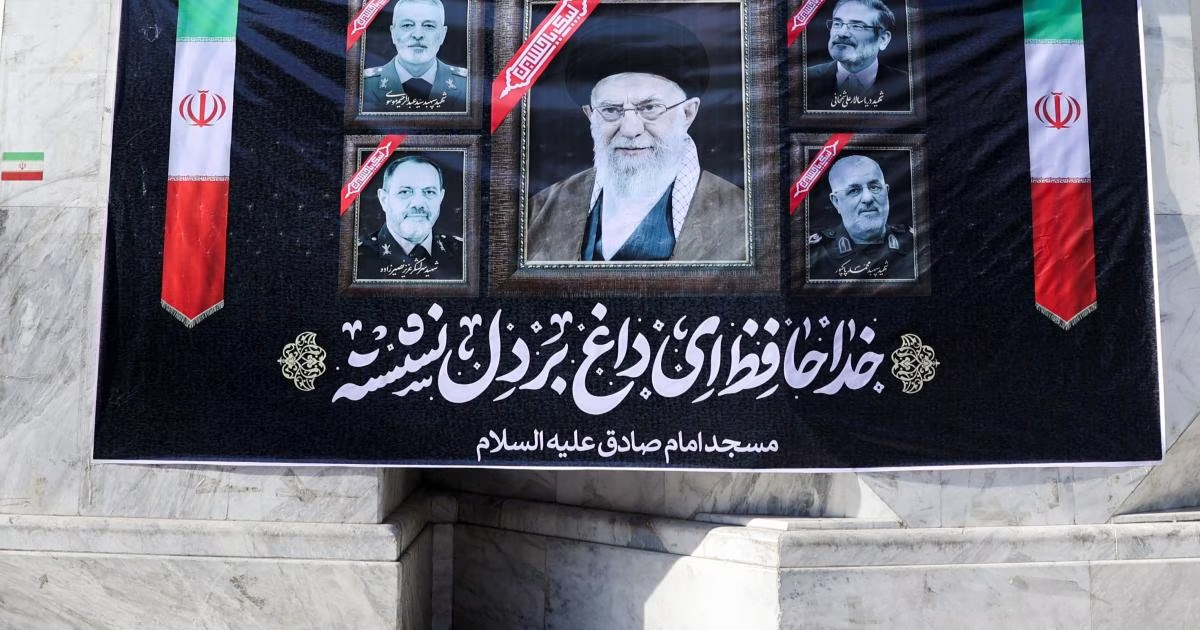
The Kuwaiti Ministry of Defense announced human injuries and material losses following the fall of shrapnel on a house after hostile aerial targets were intercepted within the country's airspace.

ARAB AND WORLD

Wed 04 Mar 2026 12:22 pm - Jerusalem Time

Iran begins Khamenei's funeral rites, Israel threatens his successor with assassination

Iranian authorities announced the start of the funeral rites for the Supreme Leader of the Islamic Republic, Ali Khamenei, this Wednesday evening, following his assassination in a joint aerial attack carried out by Israeli and American forces last Saturday. An official statement issued by the Islamic Council for Development Coordination stated that the body would be transferred to the Grand Imam Khomeini Mosque in Tehran to allow citizens to pay their last respects, before completing the burial procedures, which will take three days.

Khamenei's body is scheduled to be laid to rest in his hometown of Mashhad, in the northeast of the country, specifically next to the shrine of Imam Ali ibn Musa al-Ridha, a site that also houses the remains of his father. Mashhad is considered the second spiritual capital of Iran, holding great religious and historical symbolism for Shiites, making its selection as a burial place an affirmation of the status the late leader enjoyed throughout his thirty-six-year rule.

In contrast, Israel escalated its hostile rhetoric, with Security Minister Israel Katz threatening to assassinate any figure chosen to succeed Khamenei if they continue the hostile approach towards Tel Aviv. Katz affirmed in official statements that any new leader who adopts plans to destroy Israel or threatens international interests would be a legitimate target for liquidation operations, emphasizing that security agencies would pursue new leaders wherever they hide.

On the internal Iranian front, informed sources revealed the formation of a temporary leadership council consisting of three prominent officials to steer the government and ensure the stability of institutions following the sudden vacancy in the leader's position. Ali Larijani, Secretary-General of the Supreme National Security Council, confirmed that this measure aims to manage the country's affairs pending the convening of the Assembly of Experts to elect a permanent successor, amid estimates indicating a potential conflict between the hardline revolutionary current and currents seeking political realism.

These developments come after the revelation of details of the military operation that led to Khamenei's death, in which about 200 fighter jets participated in a third wave of attacks described as the largest in decades. The attacking forces used advanced 'Black Sparrow' missiles to ensure penetration of fortifications in the official complex in Tehran, in an operation closely coordinated between Tel Aviv and Washington and included a precise distribution of strategic targets in the region.

Any leader chosen by the Iranian terrorist regime to continue the plan to destroy Israel will be a confirmed target for assassination, no matter their name or where they hide.

ANALYSIS

Wed 04 Mar 2026 12:21 pm - Jerusalem Time

Analysis: Do the attacks against Iran reflect the floundering of 'dying empires'?

In a deep analytical reading, writer Richard Esko believes that the recent military attacks carried out by the United States and Israel against Iranian targets do not express an excess of power, but rather a behavior similar to 'dying animals' that become more ferocious in their final moments. The analysis indicates that the recent massacres, especially the targeting of educational facilities, reflect a state of strategic despair and a loss of moral and political compass.

The article touched upon the deadly airstrikes that occurred on February 28, 2026, where shells hit Iranian schools and resulted in the death of dozens of children. Esko considered these incidents not merely technical errors, but rather the product of 'tactical indifference' that is very similar to the ongoing genocide in the Gaza Strip, where the masks of shame from targeting civilians have fallen.

Regarding the internal situation in Iran, the analyst believes that the American and Israeli focus on assassinating leading figures, including news about the death of Ayatollah Ali Khamenei, stems from a superficial understanding of history and political reality. Power in Tehran is not linked to a single individual, but is rather the result of historical accumulations and resistance to Western interventions that began with the externally supported coup in 1953.

The analysis warned that turning leaders into 'martyrs' might grant the Iranian regime symbolic power that exceeds their influence while alive, complicating the task of protest movements and those demanding democracy internally. These groups now find themselves in an unenviable position, trapped between the pressures of the local regime and the bombs and missiles launched by international powers under the pretext of liberation.

On the Israeli leadership front, the article painted a bleak picture of Benjamin Netanyahu's future, emphasizing that global public opinion, especially among younger generations in the West, has begun to radically change its view of Israel. It is increasingly described as an 'apartheid state,' making the continuation of the 'Land of Israel' project in its current form unsustainable in light of current geopolitical shifts.

As for the American side, Donald Trump emerges as a representative of a political elite dominated by an existential panic over the loss of global hegemony that has lasted for decades. This elite attempts to compensate for its declining influence by increasing military spending to astronomical levels and adopting repressive policies, in a desperate attempt to stop the wheel of history that points to the rise of new powers and multipolarity.

The writer cited the philosopher Antonio Gramsci's quote about the 'twilight' phase the world is going through, where the old order dies while the new order struggles to be born. In this transitional phase, violent pathological symptoms appear, manifested in absurd wars and military aggressions that do not aim to achieve political victory as much as they aim to delay the inevitable fall.

The article described the United States as having transformed into a 'violent and miserable giant,' directing its people's wealth towards killing and destruction machines while the interior suffers from sharp class disparities and escalating social crises. The attack on Iran, according to Esko, is not a sign of imperial power, but rather a floundering similar to what great empires throughout history experienced before their final collapse.

The analysis concluded that 'time is running out' for leaders who feed on wars and perpetual conflicts to stay in power, whether in Washington or Tel Aviv. The brutality of the current attacks is the last price paid by innocents in a newly forming international reality, where geopolitics will not return to its former state no matter how intense the bombing.

In concluding his reading, Esko sent a message of solidarity with the victims in Palestine, Yemen, and Iran, emphasizing that the will of peoples and major historical transformations are stronger than war machines. He considered the current conflict to be the final throes of an old world order that refuses to acknowledge its end, making it more dangerous and deadly in its final days.

This is how dying animals behave; they do not intentionally seek out children to kill them, but rather strike indiscriminately in a desperate struggle against the inevitable.

ARAB AND WORLD

Wed 04 Mar 2026 12:21 pm - Jerusalem Time

Confusion in Washington: Trump Administration Faces 'Missing Alternative' Dilemma in Iran After Khamenei's Absence

The administration of US President Donald Trump is facing increasing challenges in formulating a clear strategy for Iran's future, in the absence of a precise vision for the post-Supreme Leader era. Reports indicate that the structure of the Iranian regime remains cohesive, hindering Washington's ambitions for rapid and smooth political change.

Journalistic sources stated that Trump's comparison between Iran and Venezuela lacks political and on-the-ground realism. While the administration previously succeeded in establishing communication channels with parties in Caracas, the Iranian scene appears devoid of any organized or dissident opposition that could be relied upon to lead a transitional phase.

Leaked information revealed a joint US-Israeli operation targeting Supreme Leader Ali Khamenei and an elite group of military and political leaders. Despite the intelligence success in identifying targets, the on-the-ground results led to a leadership vacuum that Washington was unprepared to deal with or fill with loyal figures.

President Trump admitted in media statements that the intensive missile strikes eliminated the figures the United States had considered to take the reins. He explained that even the leaders classified in the second or third tier had died, complicating the calculations for a 'ready alternative'.

For its part, the US Central Intelligence Agency worked on attempts to infiltrate the ranks of the Iranian Revolutionary Guard to gather vital information. Despite the intelligence penetration, the administration remains unsure of the identity of the entity actually capable of controlling the ground and cooperating with the international community.

Observers in Washington describe the internal thinking of the national security team regarding the Iranian crisis as 'highly fragmented'. While Trump aspires to repeat the Venezuela scenario, which led to rapid political arrangements, this desire clashes with the nature of the deeply entrenched religious state in Tehran for decades.

The institutional structure in Iran differs fundamentally from traditional authoritarian regimes, as the system relies on a complex overlap between religious, military, and elected authorities. This complexity was specifically designed to ensure the continuity of institutions even in the absence of major leading figures, making the task of overthrowing the regime from abroad difficult.

In an attempt to justify the military operations, Trump's aides claimed that Iranian missiles posed an imminent and direct threat to American territory. However, these claims continue to spark widespread debate in political circles due to their lack of conclusive evidence publicly presented.

The White House outlined a set of strict military objectives, including the complete destruction of Iran's missile arsenal and the neutralization of its naval power. Washington also seeks to ensure Tehran is stripped of any future nuclear capabilities and to cut off supply lines to its allied groups in the region.

Strategic experts, including former advisors, warned that the collapse of the Iranian regime without an alternative could plunge the region into widespread chaos. They stressed that regime change from the air without ground forces or strong local allies is a risky gamble with uncertain outcomes.

On the diplomatic front, Secretary of State Marco Rubio acknowledged the difficulty of the situation, noting that political transition in Iran would be more complex than any previous experience. He explained that the administration is looking for paths that ensure stability and prevent the country from turning into an arena for armed civil conflicts.

Domestically, opinion polls showed widespread American public opposition to the military operation, with a majority of participants expressing concern about the absence of a plan. 60% of Americans believe that the President lacks a clear vision for how to end the conflict or deal with its long-term repercussions.

US allies abroad are awaiting more precise clarifications about the ultimate goals of the ongoing military operation. Diplomatic sources reported that Washington has not yet briefed its partners on a comprehensive plan to restore stability to the region after the major combat operations conclude.

Given these facts, it appears that the US administration has begun to scale back its ambitions from 'regime change' to 'capacity reduction'. This shift indicates a belated realization of the difficulty of dismantling the structure of the Iranian state and transforming it into a political model consistent with the American vision at present.

No one we were thinking of will be able to govern, because they all died in the missile strikes.

OPINIONS

Wed 04 Mar 2026 12:21 pm - Jerusalem Time

The Firefighter... The Arsonist!

Dr. Ibrahim Melhem

Editor-in-Chief

The least that can be said is that he doesn't stop saying one thing and its opposite, nor does he stop exaggerating the losses of his enemies, and constantly slandering his opponents who concluded an agreement with Iran that almost led it to produce "11" nuclear bombs within days, as "Witkoff" stated in his justification for rushing into war.He said it, and the Americans believed him; when he announced the destruction of the Iranian nuclear reactor in his surprise attack in the "Twelve-Day War," only for us to discover eight months later the opposite of what he said. But he always relies on the goldfish memory of his audience, who have grown weary of his fluctuations and lies.Today, he claims to have eliminated ballistic missiles and the naval force, yet he continues his strikes, and promises more, setting deadlines for the finish line that fluctuate between one and five weeks, and perhaps less or more!"This is not your war," said Omani Foreign Minister "Badr Al Busaidi," the diligent mediator, to "Witkoff," in a scathing critique that implies the truth that Washington prioritized Israel's interests over its own, and was dragged into an "entrapment war" in which Netanyahu fired the first shot, with Trump joining him in his madness instead of curbing his impulsiveness and reining in his rush, which relies on a biblical doctrine dominated by the desire for expansion in "liquid maps."It is Israel's war then, according to what the American journalist "Tucker Carlson" revealed about the apprehension of "Mossad" elements in Doha and Riyadh, who attempted to carry out bombings in Gulf countries to pin them on Iran to fuel the flames.The firefighter aspiring for a Nobel Prize ignites fires to extinguish them, so that he can accumulate his achievements, multiply his good deeds, and earn the right to receive the prize he obsesses over in his travels and stays, in his sleep and in his wakefulness. You see him constantly filling his veins with gasoline, to spew it on the matches he plays with over gas fields, and he goes about his hobby of extinguishing fire with gasoline.The Nobel Committee would do well to award him the prize before its due date, content with what he has "extinguished" so far from fires and what "peace he has achieved"!

PALESTINE

Wed 04 Mar 2026 12:20 pm - Jerusalem Time

How did Trump decide to wage war on Iran?

- "New York Times": It was not surprising, but rather the result of secret consultations, military planning, and political pressure. Washington - "Al-Quds" dot com - Said Arikat - According to a report in the "New York Times" published on Monday, the decision by US President Donald Trump to wage war against Iran was not a surprising step, but rather the result of a long process of secret consultations, military planning, and political pressure, especially from the Israeli leadership, in addition to a decline in confidence within the US administration in the possibility of reaching a diplomatic solution with Tehran. The report indicates that the main turning point came during a lengthy meeting at the White House on February 11, where Trump and Israeli Prime Minister Benjamin Netanyahu discussed the possibilities of war and the potential timing of any attack. At that time, the United States was conducting indirect negotiations with Iran regarding its nuclear program, but Israel feared that these diplomatic efforts would disrupt the military plans that were secretly being discussed between the two sides. Days after the meeting, Trump began to openly express his skepticism about the feasibility of negotiating with Iran, considering that years of previous dialogue had not yielded results. He also hinted that changing the Iranian regime might be the best option. Just two weeks later, he authorized a large-scale military operation in coordination with Israel, which included intensive strikes targeting military and nuclear sites and centers within the country, resulting in the death of the Iranian Supreme Leader and the country entering a state of chaos, in addition to the outbreak of a wave of regional violence that led to American and Iranian casualties. Although the US President's public discourse seemed hesitant between seeking a diplomatic agreement and threatening military force, the report confirms that the move towards war was steadily progressing behind the scenes. Israel played a pivotal role in pushing Washington towards delivering a decisive blow, based on an assessment that the Iranian regime was in a weak position. Trump was also influenced by his growing confidence after a successful American operation that overthrew the leadership in Venezuela weeks earlier. The report indicates that opposition within the President's inner circle was very limited. Even figures previously known for their reservations about military interventions supported the idea of delivering a broad and swift blow if an attack was decided upon. In contrast, military leaders warned of significant risks, including the possibility of heavy American casualties, destabilization of the region, and depletion of American military stockpiles. However, these warnings were not fully reflected in public statements, as the operation was portrayed as easily decisive. The report also clarifies that US officials did not fully disclose to members of Congress that regime change was among the military plans, despite security briefings being held to discuss Iranian threats and the timing of potential strikes. At the same time, nuclear negotiations with Iran continued, but the report believes that they practically provided a time cover for strengthening the American military presence in the Middle East. At the beginning of the year, American forces were not ready for a long war, as no aircraft carriers were present in the region and air defenses were limited. Over the weeks, two aircraft carriers and a large number of fighter jets, bombers, and defense systems were sent, allowing for an extended military campaign. During the negotiations, Washington insisted on the "zero enrichment" demand, meaning completely ending Iran's ability to produce nuclear fuel, a condition that Tehran consistently rejected. With increasing doubts within the US administration, official statements began to reflect a growing conviction that reaching an agreement was almost impossible due to the ideological nature of the Iranian regime. Within National Security Council meetings, the discussion focused on the size of the military operation, not on the principle of its execution. Multiple options were presented, ranging from limited strikes aimed at negotiating pressure, to a broad campaign aimed at overthrowing the Iranian leadership. Intelligence agencies presented different scenarios for what might happen in the event of the Supreme Leader's death, including the possibility of a more hardline leadership rising, internal unrest erupting, or a more pragmatic wing of the Revolutionary Guard coming to power. Some officials adopted the latter scenario, believing that a pragmatic military leadership might be more willing to understand with the United States and abandon the nuclear program or reduce regional confrontation, although these expectations remained uncertain. The only prominent opposition came from conservative media personality Tucker Carlson, who warned of the risks of war to American forces, energy prices, and relations with Arab allies, considering that Washington might be drawn into the conflict due to Israel's security priorities. However, Trump informed him that he believed the United States would be involved in the fighting anyway if Israel started the attack alone. On the domestic political front, the administration did not seek clear authorization from Congress before commencing operations, which drew criticism from some lawmakers who saw the logic used to justify the war as circular, as it was considered that the military buildup itself might provoke Iran to retaliate, thus making an American attack inevitable. A final round of negotiations was held in Geneva days before the strike, where Iran presented a proposal allowing certain levels of enrichment to continue, which American negotiators rejected. After the talks ended, the negotiating team informed the President that the chances of reaching an agreement were very slim. Meanwhile, the United States and Israel were already discussing the timing of the attack, until an intelligence breakthrough led to the identification of a meeting of senior Iranian leadership in Tehran, and the decision was made to carry out a strike directly targeting the leadership, thus effectively starting the war. The course of events, as presented in the report, indicates that the diplomatic path was not necessarily a genuine attempt to avoid war, but perhaps served as a political tool to manage military timing. The continuation of negotiations coincided with the largest American military buildup in the region in years, reinforcing the impression that dialogue was providing a time cover to complete operational preparations more than it was a viable path to success. American demands, especially the "zero enrichment" condition, were known beforehand to be unacceptable to Iran, which made reaching an agreement almost impossible from the outset. In the same context, the announcement of the visit of US Secretary of State Marco Rubio, which was scheduled to take place on Monday, March 3, takes on additional political significance. The announcement of the visit seemed like a continuation of the diplomatic facade and an indication of normal political engagement, at a time when military decisions had practically been made. From this perspective, the late diplomatic moves can be understood as part of managing the international scene and preparing public opinion, not as a realistic last attempt to prevent escalation, which reflects a recurring pattern in international crises where negotiating channels are sometimes used to secure political legitimacy before moving to war.

OPINIONS

Wed 04 Mar 2026 12:20 pm - Jerusalem Time

Do not let the war swallow Jerusalem and the West Bank

Amidst this insane escalation of war in the region, and after all that our Palestinian people have witnessed of genocide, starvation, and displacement, especially in the Gaza Strip, and the open aggression that has affected all of Palestine, the current moment appears too dangerous to be read as merely another chapter in the series of bloodshed. It is a pivotal moment intended to be a thick curtain for the completion of a broader project, extending beyond Gaza to Jerusalem and the West Bank, by imposing new realities that are difficult to reverse.Historical experience has proven that major wars are not only managed militarily but are also exploited politically to the fullest extent. And every time the world is preoccupied with the flames of war, the pace of Judaization accelerates, the rate of settlement doubles, and geography and demography are reshaped in a way that serves the creeping annexation project. What is happening today cannot be separated from this context: exhausting Palestinian society, weakening its economic structures, deepening isolation between its cities and villages, and transforming population centers into fragmented islands that are easy to control securely.Missing the opportunity for the occupation at this moment is not by merely condemning or waiting, but by realizing the nature and danger of the stage. The danger lies not only in direct destruction but in the attempt to enshrine the results of force as permanent political facts. Hence, the protection of Jerusalem and the West Bank begins with fortifying the Palestinian internal front, ending the division, and rebuilding the national project on the basis of full partnership. The division has been, and still is, the most dangerous loophole through which the settlement project penetrates to establish its realities.Jerusalem is not just a spiritual symbol or an emotional title; it is the core and center of the conflict. Any legal or demographic change in it is intended to be settled as a fait accompli. The same applies to the West Bank, which is subjected to systematic fragmentation through settlement expansion, bypass road networks, and military checkpoints that stifle movement and life. The continuation of this path practically means undermining any possibility of establishing a sovereign Palestinian state and transforming the desired entity into scattered cantons without a real political horizon.At the Arab and regional levels, these developments impose a double responsibility. The widespread military escalation may be used to reorder the region's priorities, but the Palestinian issue must not become a marginal item in influence deals or bargaining chips. What is required is a clear stance that links any regional arrangements to stopping the aggression, stopping settlement, ensuring the protection of civilians, and serious commitment to international legitimacy resolutions.Internationally, the continued reliance on statements of concern perpetuates the logic of impunity. International humanitarian law is not a selective political option but a binding system. Any leniency in its application not only threatens Palestinians but also undermines the credibility of the entire international system and opens the door to the law of the jungle in conflict management.Missing the opportunity for the occupation also comes through strengthening the steadfastness of the people on their land. The battle is not only military but a battle of existence and survival. Supporting Jerusalemites in confronting policies of expulsion and identity revocation, protecting villages threatened with confiscation, and empowering the local economy in the West Bank are all forms of daily resistance that thwart plans of emptying and uprooting. The land protected by its people remains impervious to erasure, no matter how intense the aggression.The current moment, with all its tragedies, requires a transition from reaction to proactive action: a solid national unity, a clear political vision, active legal and diplomatic movement, and a serious Arab incubator that will not allow Jerusalem and the West Bank to be swallowed in the shadows of a raging war. Only this path can close the window that is intended to be opened to complete the project of annexation and liquidation.The scene may seem bleak, but history teaches us that projects based solely on force, no matter how long they last, remain fragile in the face of the will of peoples. As long as the Palestinian is rooted in his land, adhering to his rights, every attempt to impose a fait accompli will remain temporary, no matter how absolute it may seem at the moment.

OPINIONS

Wed 04 Mar 2026 12:20 pm - Jerusalem Time

From “America First” to “Israel First”

At the beginning of his last election campaign, Donald Trump delivered a speech that, on the surface, seemed to be a reversal of traditional American politics. He raised the slogan “America First” and pledged not to involve the United States in foreign wars, presenting himself as a candidate who would save Americans from the drain of blood and money in military adventures that brought them no benefit. However, this rhetoric quickly collided with a completely different reality, a reality that revealed that “America First” was merely an electoral slogan, while the actual policy placed Israel at the forefront of priorities, even at the expense of everything Trump claimed he sought to protect.What the region witnessed in successive explosions, and what it is witnessing today in increasing American involvement behind Israel, proves that the American administration has not moved away from the logic of wars, but rather has reproduced it in a more blatant way, where American interests have been organically linked to Israel's agenda, and Washington has been transformed into an open political and military umbrella for its wars, without any regard for regional repercussions or the cost that Americans themselves pay from their money, security, and stability.Under Trump, the United States transformed from a power claiming to manage conflicts into a direct party in fueling them, and from a country talking about withdrawal to a player pushing to expand the scope of fire, not in defense of its national security, but in defense of the Israeli project, until it became clear that American blood, like the blood of the peoples of the region, could be sacrificed if it served to keep Israel superior and protected from any accountability or pressure.This absolute bias revealed the falsity of the claim that Trump represented a break with the traditional establishment in Washington, as it quickly became clear that he had reproduced the essence of American policy itself, based on presenting Israel as an indisputable strategic priority, and on justifying all its aggressive policies, no matter their human and political cost, and no matter how much they destabilized the Middle East and pushed it towards open wars with no horizon.The most dangerous aspect of this path is that Trump did not hesitate to gamble with American interests themselves, whether by endangering American soldiers, or by draining the public treasury, or by deepening hatred towards the United States in the region and the world, all in order to maintain the image of “the ally who does not abandon Israel,” even if the price was burning the entire Middle East, and turning it into a permanent conflict zone that serves only one project.Trump's foreign policy was not an exception to the rule, but rather a more explicit expression of it, as the mask quickly fell, and it became clear that “America First” was nothing but an empty slogan, while the constant truth, confirmed by the facts, is that Israel has remained and will remain first and foremost among American priorities, even if that contradicts the interests of Americans themselves, and even if the whole world pays the price for this blind bias.In contrast, the Gaza war created a deep rift within American consciousness itself, where the official narrative no longer enjoyed the consensus it had for decades. Instead, American public opinion, especially among young people and economically disadvantaged classes, began to raise fundamental questions about the utility of this absolute bias. With the escalating scenes of destruction and killing in the Gaza Strip, a new internal discourse emerged, clearly speaking about American tax money that citizens need for health, education, and social security, but which is being diverted to support Israel and its open wars, at a time when millions of Americans are suffering from suffocating living crises.This shift is no longer marginal or isolated, but has become part of a broad public debate that questions the role played by American politicians, and with them a large number of former presidents, in dragging the United States into wars that do not serve its national interests or its internal security, but rather serve Israel's agenda and its regional superiority. As this awareness expands, the ability of traditional discourse to market wars as a defense of “values” or “national security” is diminishing, to be replaced by a simple but dangerous question: Why do Americans pay the price for wars that do not concern them, and why are Israel's interests always prioritized over the needs of American society itself? This question is likely to reshape American policy in the future, and to put this historical bias to an unprecedented test.

ISRAELI AFFAIRS

Wed 04 Mar 2026 12:20 pm - Jerusalem Time

Tel Aviv Considers Involvement in Protecting US Interests in the Gulf Amid Military Escalation with Iran

Hebrew media sources revealed on Tuesday evening intensive diplomatic and security movements in Tel Aviv to discuss the possibility of engaging in the protection of American interests in the Arabian Gulf region. These movements come amid unprecedented military tensions in the region following the outbreak of direct confrontations involving several regional and international parties.

Official sources quoted an unnamed Israeli official as saying that serious deliberations are currently underway regarding mechanisms for providing protection to vital US facilities and interests. The source indicated that these discussions aim to enhance joint American defensive efforts to confront the increasing security challenges imposed by the new field reality.

Reports clarified that what is known as the 'Joint Coalition of Regional States' is currently studying practical steps to provide a protective umbrella for Gulf states that have been subjected to a series of attacks. This move aims to repel threats attributed to Iran, which have targeted strategic territories and interests in the GCC countries over the past few days.

In a related context, the Israeli official noted that defensive cooperation with Washington might take on a reciprocal nature, as Tel Aviv seeks to return the favor to the United States, which actively contributes to protecting its security. These statements reflect the depth of military coordination between the two sides in confronting missile strikes launched from Iranian territory.

On the ground, the region has been in a state of turmoil since dawn last Saturday, following the start of a wide-ranging military aggression launched by Tel Aviv and Washington against targets inside the Islamic Republic of Iran. This escalation has resulted in a wave of Iranian military responses that have affected several countries, including Jordan and Iraq, in addition to the six GCC countries.

Tehran, for its part, asserts that it directly targets what it describes as 'American interests' in response to the attacks it is subjected to, although some of these strikes have resulted in civilian casualties. These aggressions have drawn widespread condemnation from GCC countries, which called for an end to the escalation, respect for national sovereignty, and the protection of civilian assets.

In parallel with the attacks in the Gulf, Tehran continues to launch intensive barrages of ballistic missiles and drones towards military and strategic sites inside Israel. According to field reports, these barrages have resulted in deaths and injuries, as part of what Iran describes as a legitimate response to targeting its leaders and vital facilities.

Incoming information indicates that the ongoing Israeli and American attacks have caused heavy human losses among Iranians, with hundreds killed and wounded. Among the most serious news circulating is the alleged death of Supreme Leader Ali Khamenei due to an airstrike, which has not yet been officially confirmed by all parties.

This sudden military explosion comes despite previous indications of progress in nuclear negotiations between Washington and Tehran mediated by the Sultanate of Oman. Observers believe that this escalation represents a second reversal by Tel Aviv of the diplomatic negotiation path, repeating previous scenarios that led to major confrontations in the region.

Iran maintains its stated position that its nuclear program is for peaceful purposes only, denying its pursuit of weapons of mass destruction or the production of nuclear warheads. In contrast, Washington and Tel Aviv continue to accuse Tehran of developing missile and nuclear programs that pose an existential threat to regional security and US allies.

Amidst this raging conflict, international contradictions regarding nuclear armament emerge, with Israel remaining the only country in the Middle East that possesses an uncontrolled nuclear arsenal. This military power coincides with the continued Israeli occupation of Palestinian territories and parts of Syria and Lebanon, and the rejection of all initiatives aimed at establishing a Palestinian state.

The regional scene remains open to all possibilities, with continued military buildups and mutual threats between all parties involved in the conflict. Global capitals are awaiting what the coming days will bring, amid fears that these confrontations will turn into a comprehensive regional war that will destroy everything in the Middle East.

Perhaps we can assist the Americans in their defensive efforts, just as they assist us in the face of current threats in the region.

ARAB AND WORLD

Wed 04 Mar 2026 12:19 pm - Jerusalem Time

Mosaic Defense: How Does Iran Counter Attacks Through Military Decentralization?

Amidst escalating direct military confrontation, Tehran has begun activating a complex defensive strategy known as 'Mosaic Defense,' a long-term plan aimed at protecting the army's structure from complete collapse. This move comes in the wake of airstrikes targeting the Iranian capital and high-ranking military leaders, which prompted the military establishment to activate a self-governing system for the provinces.

This combat doctrine relies on dividing the country into 31 independent regional units, corresponding to Iran's administrative provincial divisions. Each unit possesses the authority to make tactical and field decisions without referring to central command. This shift towards decentralization aims to grant forces high flexibility and speed in responding to direct field threats, especially in cases of communication breakdown with the center.

Developing this defensive system took approximately two decades, during which Iranian military experts intensively studied American military experiences in Iraq and Afghanistan. These studies concluded that technologically superior major powers face real dilemmas against decentralized resistance that does not rely on a single hierarchical head that can be targeted to completely paralyze movement.

The Mosaic Defense strategy allows Iranian forces to continue carrying out simultaneous offensive and defensive operations, including targeting military bases in the surrounding region. These units also gain the ability to influence vital waterways, most notably the Strait of Hormuz, placing international navigation within Iran's strategic pressure sphere.

Tactically, this approach falls within the framework of 'decentralized guerrilla warfare,' which integrates traditional methods with irregular operations to exhaust the adversary in the long run. This combination aims to execute surprise and precise attacks that prevent enemy forces from achieving field stability, while maintaining the units' ability to reintegrate into larger formations when necessary.

In this context, Iranian Foreign Minister Abbas Araghchi affirmed that strikes targeting command and control centers will not succeed in disrupting the Iranian military machine. He clarified that the adopted strategy allows Tehran to independently determine the timing and method of military response, emphasizing that the flexibility enjoyed by regional units ensures the continuity of operations under the harshest conditions.
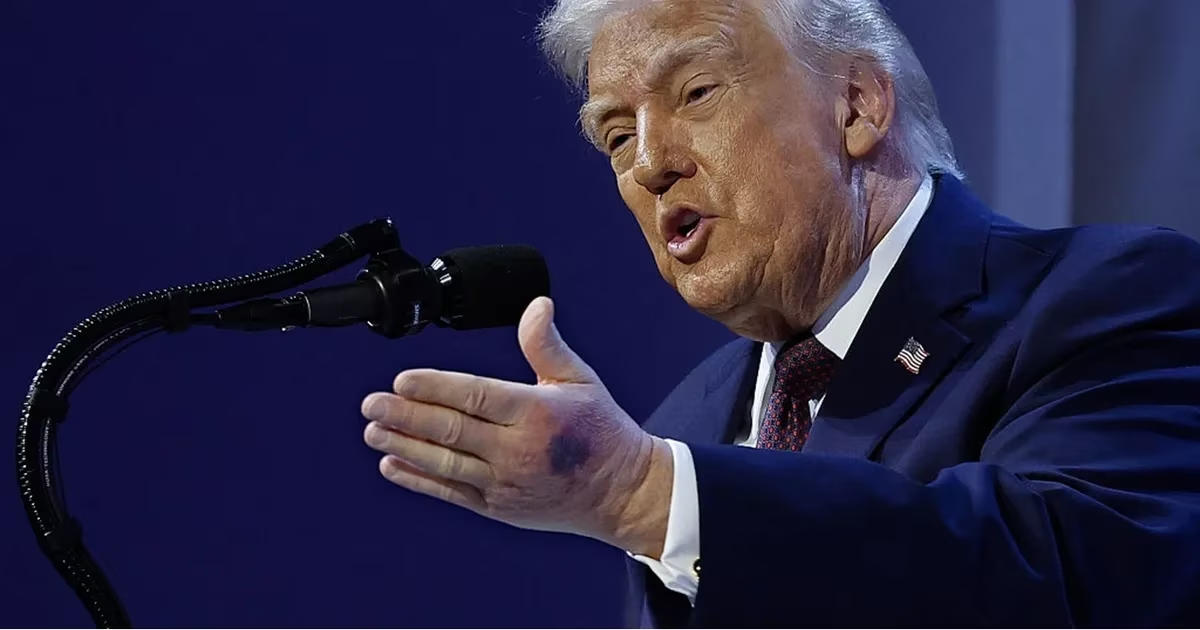
Current field developments reflect the effectiveness of this defensive model, which blends flexible tactics with long-range strategic response, representing a qualitative shift in managing regional conflicts. This strategy demonstrates the ability of local units to continue targeting enemy interests despite losing communication with the supreme command, thereby strengthening the military resilience of the internal front.

Air attacks and direct targeting of command centers do not affect Iran's ability to wage war, thanks to the independent regional units.

PALESTINE

Wed 04 Mar 2026 12:19 pm - Jerusalem Time

Official Israeli Documents Bolster Palestinian Narrative on Nakba Massacres and Forced Displacement

Journalistic sources reported that recently revealed Israeli documents included additional details about the events of the 1948 Nakba, with these documents confirming the accuracy of the Palestinian narrative regarding forced displacement and the massacres committed. Analytical readings considered that these documents do not present unknown facts as much as they officially document what Palestinians have conveyed through their successive generations of living and realistic testimonies.

Israeli writer Amira Hass criticized attempts to portray these documents as a 'sudden discovery' of the truth, noting that Palestinians did not wait for Israeli archives to be opened to see their tragedy. Hass explained in an article that the testimonies of survivors and displaced persons were sufficient to formulate a coherent narrative about the ethnic cleansing practiced against them from the first moments of the conflict.

The sources indicated that historians who reviewed these documents, including Adam Raz, based their research on the works of prominent Palestinian historians such as Saleh Abdel Jawad and Adel Manna. These researchers, in turn, relied on the accurate oral memory of the residents of the displaced villages and cities, proving that Palestinian knowledge of the event preceded Hebrew academic documentation.

Reports touched upon the issue of information withholding, revealing that Israeli archives contain about 17 million files, more than 16 million of which remain closed to the public and researchers. Observers believe that the continued concealment of these documents raises serious questions about the nature of the crimes documented within them, which, if they denied the Palestinian narrative, authorities would have rushed to publish.

Analyses also pointed to the existence of a 'hierarchy of truth' in Israeli circles, where credibility is given to leaked official documents while the testimonies of Palestinian victims are marginalized. However, historical experiences have proven that official documents often later confirm the accuracy of what Palestinians said about the occupation's practices on the ground.

The writer gave examples of this from recent history, such as the use of white phosphorus against civilians in the Gaza Strip and the direct targeting of families during successive wars. These facts, initially denied by the Israeli military establishment, were later proven by official documents and investigations to have occurred exactly as narrated by Palestinian eyewitnesses.

In conclusion, the analytical reading emphasized that the essence of the Palestinian issue and displacement was never ambiguous or in need of testimony from the perpetrator to be a reality. The Palestinian narrative remained alive in the memory of the 'present absentees' and in the narratives of resistance, and the new documents are merely technical details added to a well-established historical truth, baptized with blood and refuge.

Israeli documents do not create truth out of nothing, but rather add precise details to a Palestinian narrative that has existed and been documented by survivor testimonies since the first moment of the Nakba.