PALESTINE

Thu 05 Mar 2026 1:40 pm - Jerusalem Time

Repercussions of Strikes Against Tehran: Is the Era of Houthi Influence in Yemen Nearing Its End?

The intense military strikes targeting Iranian territory by the United States and Israel represent a dramatic shift in regional power dynamics. The repercussions of these attacks are not limited to Iran's internal affairs but also extend to cast a shadow over Tehran's allies in the region, foremost among them the Houthi group in Yemen, which organically relies on Iranian support.

The recent military operations have resulted in the killing of pivotal figures in the Iranian power hierarchy, most notably the Supreme Leader, which weakens the command and control center of the Iranian regional project. In contrast, Iran's indiscriminate missile and drone responses have caused damage to Arab countries, further intensifying international and regional condemnations against the Tehran regime and its allies.

Observers believe that weakening Iran will inevitably lead to the erosion of the Houthis' ability to maneuver in Yemen, especially since the group has controlled the capital Sana'a and vast areas for over a decade. The group's fate is linked to the continuity of financial and military support that reached it through Iranian Revolutionary Guard channels, which are now under direct targeting scrutiny.

On the ground, the group had previously suffered painful blows, including the killing of its prime minister, Ahmed Al-Rahawi, and several of his ministers in Israeli raids. Despite the group's leader Abdul-Malik al-Houthi's assurances of combat readiness, the deteriorating economic reality in their controlled areas limits their ability to engage in a broad and long-term regional confrontation.

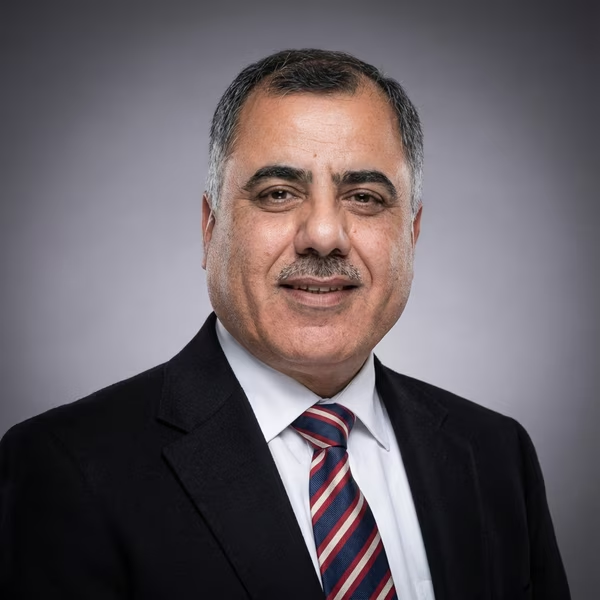
Researcher Dr. Adel Dashila indicates that the repercussions will be significant for all parties loyal to Tehran in Iraq, Lebanon, and Yemen alike. He believes that a direct expansion of the war might push the Houthis to intervene to complicate matters, but this would make the military option to remove them from the scene an urgent regional and international demand, supported by lurking local forces.

If the group chooses not to escalate militarily directly and contents itself with political stances, it will find itself in a very weak negotiating position in any upcoming political process. The outcomes of the current conflict, according to political readings, will not allow the Iranian project to expand again, meaning that the Houthis will lose their ability to impose the conditions they were accustomed to previously.

For his part, Adnan Al-Jabri, a journalist specializing in military affairs, links the extent of the impact to the degree of damage that will be inflicted specifically on the structure of the Iranian Revolutionary Guard. The Houthis rely entirely on Tehran in complex military technology fields and the transfer of technical expertise necessary to operate and develop long-range missile and drone systems.

The cessation of arms smuggling operations or a decline in direct financial support will quickly deplete the group's armament stockpile. Although they possess the ability for self-fighting in internal wars, their regional ambitions will clash with the absence of logistical and technical support provided by Iranian experts present in operations rooms.

Attention is now turning to the new Iranian leadership and the extent of its conviction in the feasibility of continuing to fund regional proxies after the severe blows it has received. If Tehran becomes preoccupied with its internal crises and attempts to preserve the regime's survival, the Houthis will find themselves politically and militarily isolated in the face of increasing international and local pressures.

At the level of the Yemeni street, there is concern about the country being dragged into a new regional conflict that will exacerbate the suffering of citizens, which has continued for 11 years. Yemenis aspire to restore security and stability away from axis politics and believe that the country's interest lies in neutralizing it from tug-of-wars that serve external agendas at the expense of national sovereignty.

Citizens in Sana'a believe that any new Houthi adventure to support Iran would be political and military suicide for the group in light of widespread international rejection. Popular priority is focused on improving deteriorating living conditions, not entering proxy wars that increase Yemen's isolation and destroy what remains of its dilapidated infrastructure.

The close link between the Houthis and Tehran has made the group's future hostage to the major geopolitical shifts currently sweeping the region. The more the power of the center in Tehran declines, the more its affiliated parties lose their ability to influence, opening the door to new scenarios that could radically reshape the political map in Yemen.

Ultimately, it seems the group faces two bitter choices: either escalation and risking an all-out military confrontation that could end their existence, or political retreat and accepting a settlement that does not grant them the 'lion's share.' Both paths ultimately lead to the weakening of their influence, which they derived for years from the Iranian momentum in the region.

Sources confirm that the next phase will be decisive in determining the identity of the future Yemeni state, as the weakening of the Iranian axis will reduce the Houthis' recklessness. The group will have to adapt to international changes that do not accept the presence of armed entities threatening international navigation or neighborhood security, which puts their project to the real test of survival.

The future of the Houthi group is linked to the outcomes of this war, which will not be in favor of the Iranian project, meaning their removal from power, peacefully or by war.

ARAB AND WORLD

Thu 05 Mar 2026 1:40 pm - Jerusalem Time

Lebanon Under Fire: Children Sleep on Roadsides, Displacement Convoys Fill Streets

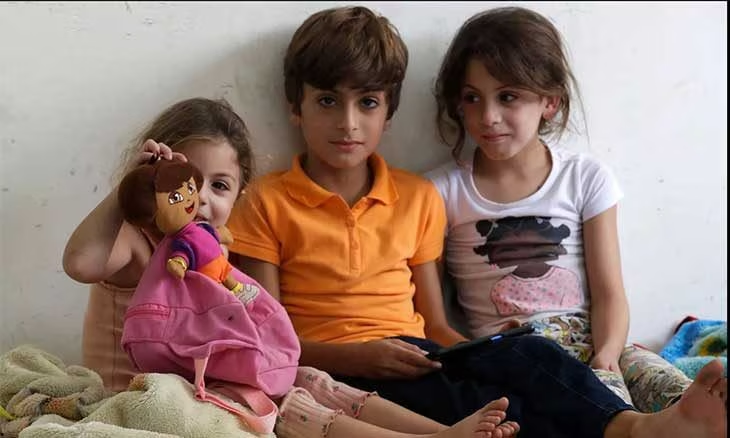
Lebanese regions in the South, Bekaa, and the southern suburbs of Beirut are experiencing a state of paralysis and destruction due to intense airstrikes, which have turned peaceful villages into walls open to the wind. Field sources reported that thousands of families hastily left their homes without carrying their belongings, forming long human convoys on the roads leading to safer areas, a scene that brings back the harshest memories of previous wars.

Amid severe overcrowding, hundreds of displaced people, including children and the elderly, were forced to sleep on sidewalks, public squares, and schools that could no longer accommodate the increasing numbers. The humanitarian suffering is exacerbated by the cold weather and the inability of many families to secure the basic necessities of life, amidst bitter questions about the fate of civilians who always find themselves on the front lines, paying the price for conflicts they have no will in.

The crisis was not limited to Lebanese citizens but extended to migrant workers under the sponsorship system, who face double marginalization and a lack of legal protection or social safety nets. Humanitarian reports documented cases of migrant women who walked long distances exceeding 11 hours in search of shelter, amid the depletion of the capabilities of NGOs that are striving to distribute limited food and medical aid.

This military escalation comes at a time when Lebanon is reeling under the weight of one of the worst economic crises globally, which weakens the state's and society's ability to withstand. As rockets continue to fall, political discussions recede, and the fundamental issue becomes the human right to survival, amidst an uncertain future enveloping a country that has become an open arena for regional score-settling.

Why do Lebanese always pay the price for decisions they did not make? And how does an entire nation turn into an open arena for the wars of others?

ISRAELI AFFAIRS

Thu 05 Mar 2026 1:39 pm - Jerusalem Time

Severe Financial Bleeding.. The Occupation Loses $2.9 Billion Weekly Due to Escalation with Iran

The Ministry of Finance in the occupation government revealed shocking data regarding the extent of economic drain due to the direct military confrontation with Iran, estimating losses at approximately 9.4 billion shekels, equivalent to 2.9 billion US dollars each week. These figures come amidst the imposition of the highest state of emergency, known as the 'Red Level,' which caused near-complete paralysis in production sectors due to strict restrictions on worker movement and the closure of educational institutions.

Informed sources stated that the ministry is strenuously trying to alleviate the financial burden by demanding a reduction in the alert level to the 'Orange Degree,' a step aimed at reactivating workplaces and reducing weekly losses to about 4.3 billion shekels. These moves coincide with the ongoing aerial bombardment campaigns launched by the occupation in cooperation with the United States since last Saturday, which were met with widespread Iranian responses including the launch of missiles and drones targeting vital sites.

On the ground, officials confirmed that military operations could extend for several additional weeks, meaning continued disruption of public life, prohibition of gatherings, and complete reliance on remote work in most non-essential sectors. The escalation also caused severe disturbances in global energy markets, especially with the disruption of oil export flows from the Gulf region, which adds increasing international and local pressure on decision-makers in Tel Aviv.

For his part, Israeli Finance Minister Bezalel Smotrich warned that the total cost of this war is likely to rise unprecedentedly, pointing to the difficulty of accommodating these emergency expenditures within next year's budget. Smotrich explained that the general financial deficit now threatens to exceed the 3.9% ceiling, which surpasses all estimates and financial plans previously set before the outbreak of the current confrontation with Tehran.

In a related context, economic reports revealed the allocation of huge additional sums to the Ministry of Defense amounting to 9 billion shekels, to be added to the previously approved budget for 2026 of 112 billion shekels. With this increase, the security budget will reach a record level of no less than 121 billion shekels, in an attempt to cover the costs of ammunition, the call-up of reserve forces, and securing the home front which faces continuous missile threats.

The biggest challenge lies in integrating immediate war spending into the 2026 budget, amidst political and legal sensitivities related to its approval date.

ISRAELI AFFAIRS

Thu 05 Mar 2026 1:39 pm - Jerusalem Time

Occupation Losses in Confrontation with Iran: 12 Dead, Hundreds Wounded, and Billions of Shekels in Costs

Field sources in Tel Aviv reported that the number of Israeli fatalities due to direct Iranian shelling has reached 12 since the first day of the military confrontations. The largest human losses were concentrated in the Beit Shemesh area, west of Jerusalem, where a single rocket strike instantly killed nine people.

In addition to those killed by direct shelling, medical authorities recorded two additional indirect deaths that occurred while attempting to take shelter from the attacks. Sources explained that these two deaths resulted from health emergencies experienced by the individuals while heading to fortified shelters after air raid sirens sounded.

Regarding the number of injured, data from the Israeli Ministry of Health revealed 1,473 injuries of varying severity since the start of military operations against Iran. Approximately 145 injured individuals are still receiving intensive medical care in emergency departments across various hospitals, awaiting stabilization of their health condition.

Observers believe that the low number of casualties compared to the intensity of the shelling is due to the network of fortified shelters and defensive systems employed on the home front. Authorities impose strict civil protection measures aimed at reducing human losses among settlers during periods of intense rocket barrages.

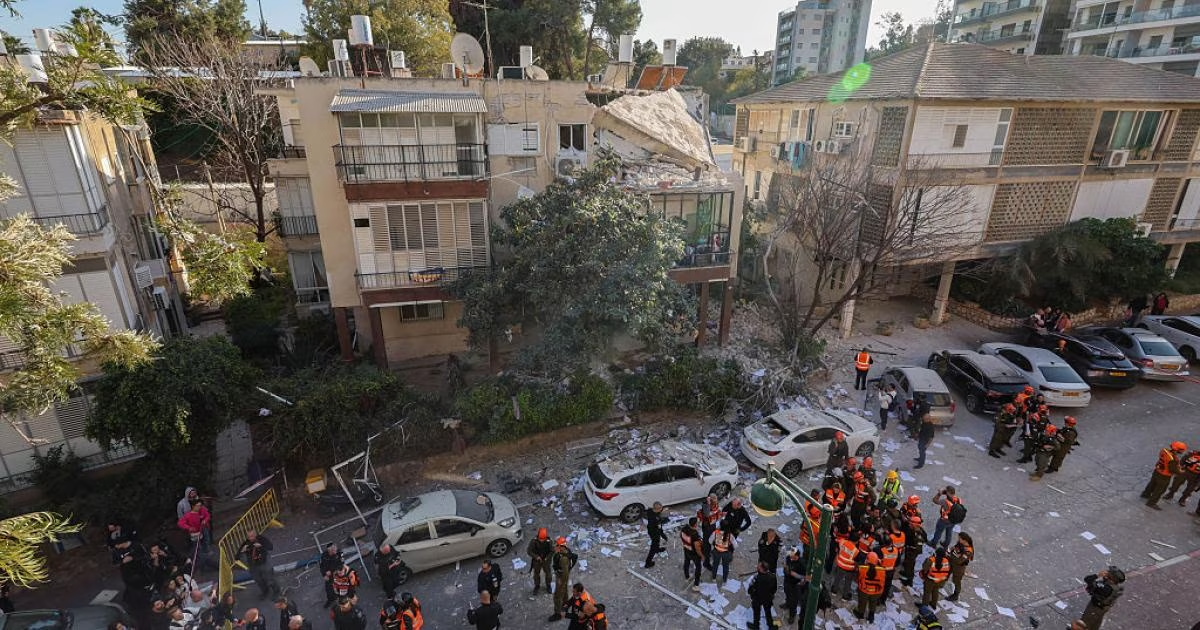
On the material front, official bodies face extreme difficulty in comprehensively assessing the damage to homes and vital facilities amidst ongoing hostilities. Shrapnel from interceptor missiles and those that fell in populated areas caused partial and complete destruction to a large number of residential buildings and public facilities.

Reports indicate that the largest bill for this war is concentrated in the offensive operations launched by the Israeli Air Force against targets within Iranian territory. These costs include the prices of smart munitions and bombs used, in addition to the exorbitant cost of warplane flight hours, fuel consumption, and logistical effort.

Also prominent in the war budget are items related to intelligence and covert operations, including what is circulated about funding and training groups of the Iranian opposition. Reports claim that these groups infiltrated Iranian territory to carry out specific missions, which necessitated allocating huge budgets for accompanying technological and logistical operations.

In the context of economic comparisons, a significant gap emerges in cost estimates between different Israeli ministries, which was evident in previous budget conflicts. While the Ministry of Defense estimated the cost of a previous confrontation at approximately 60 billion shekels, the Ministry of Finance almost halved this figure based on different accounting criteria.

This discrepancy is due to the Ministry of Finance only calculating the direct costs of combat, while the security establishment insists on including strategic paths and indirect operations. The Ministry of Defense considers long-term preparations and preemptive operations to be an integral part of the overall war bill.

Based on current data, economic experts expect the cost of the current confrontation with Iran to reach tens of billions of shekels if it continues. The final figures are likely to rise with increasing reliance on advanced military technology and the call-up of reserve forces for long periods.

Much of the war's greatest cost is attributed to the offensive operations carried out by Israel against Iran, including the cost of munitions and aircraft flight hours.

PALESTINE

Thu 05 Mar 2026 1:39 pm - Jerusalem Time

Boycott campaign targets Egyptian company 'Breadfast' due to funding ties with the occupation

Widespread calls have recently escalated on social media platforms in Egypt to boycott 'Breadfast', a company specializing in delivering food products and consumer goods. These movements come against the backdrop of accusations by activists that the company received funding from international investment entities closely linked to the Israeli occupation, which sparked a wide debate about national investment standards.

The crisis began after highlighting the results of the funding round announced by the company last February, during which it successfully raised massive investments worth $50 million. Reports revealed that the list of new investors included companies that raise questions about the nature of their activities and their relationship with the security and economic system of the Israeli occupation.

Among the most prominent companies that angered boycotters is the Japanese company 'SBI', specializing in cybersecurity technologies, which boasts on its official website of owning investments in six Israeli companies. Reports also indicate that the Japanese company employs an elite group of retirees from the intelligence and cybersecurity units of the occupation army, making it a direct target for criticism.

The list of investors also included the Emirati company 'Mubadala', affiliated with the Abu Dhabi government, which played a pivotal role in strengthening economic and commercial relations with the occupation after the signing of normalization agreements in 2020. Boycott advocates believe that the entry of such entities into the ownership structure of an Egyptian company represents a violation of popular principles rejecting economic normalization.

In a swift reaction to these accusations, Mohamed Habib, one of the founders of 'Breadfast', came out to clarify the management's position, considering that obtaining major international funding is a necessity imposed by economic growth and difficult to avoid in the global funding market. Habib pointed out that the company sets strict national standards in its dealings, but at the same time seeks to strengthen the resilience of the Egyptian economy.

Habib defended his company's position, stressing that the priority in boycott campaigns should be directed towards companies that directly support the occupation's military operations or those that own factories within illegal settlements. He considered that targeting successful Egyptian companies could harm the local investment environment and reduce job opportunities provided by these entities for Egyptian youth.

The company's founder revealed that 'Breadfast' had previously rejected tempting funding offers from investment funds directly linked to the Zionist entity, despite going through severe financial crises in previous periods. He affirmed that the primary goal of attracting foreign investments is to localize modern technology and build Egyptian economic entities capable of competing in global markets.

For its part, 'Breadfast' issued an official statement confirming that it is a 100% Egyptian company, and that all its administrative and operational decisions stem from a pure national vision. The company stressed in its statement that there are no direct or indirect relations with any Israeli parties, whether at the shareholder or supplier level.

The company clarified that its current investment structure is completely free of any shareholders holding the nationality of the occupying state, noting that its success in attracting international institutions managing billions of dollars in assets is a testament to the strength of the Egyptian market. It considered that these financial flows contribute to supporting the local entrepreneurship system instead of heading to other regional markets.

The management stressed that its position on the Palestinian issue is firm and non-negotiable, considering it an integral part of the company's identity and institutional values. It added that building a strong Egyptian economy is one form of indirect support for Arab issues, by creating economic independence and providing strong local alternatives to foreign products.

Despite the company's clarifications, boycott campaigns continue on social media platforms, with activists demanding more transparency about the identity of investors and their impact on the company's future policies. Observers believe that this crisis reflects the extreme sensitivity of the Egyptian public towards any economic activity that may intersect, even indirectly, with the interests of the occupation.

Finally, informed sources confirmed that the company is closely monitoring public reactions and is working to enhance its communication with consumers to clarify the facts. 'Breadfast' hopes to succeed in overcoming this crisis by emphasizing its role in supporting the national economy and its commitment to the national constants agreed upon by all segments of the Egyptian people.

Whoever wants to boycott, should boycott companies that operate within the occupation army bases and provide facial recognition technology at military checkpoints.

OPINIONS

Thu 05 Mar 2026 1:39 pm - Jerusalem Time

The Invasion!

Dr. Ibrahim Melhem

Editor-in-Chief

The least that can be saidIt seems that "The Article Title" will remain the title of the next phase, in which Netanyahu and his partner's appetite for implementing plans that are now emerging from their files, to settle scores with entities, cities, leaders, and turbans whose time has come.Blindfolded, wearing the victim's cloak, the "Likud wolf" proceeds with what he had previously announced publicly, and from the platform of the international body, threatening to rebuild the new Middle East, taking advantage of the presence of a narcissistic man in the White House; a slanderer and tale-bearer, easy to incite, mobilize, and mislead, to run after him and go along with his desires, to achieve his dreams, and implement his plans, which no American president has agreed to as much as Trump.The Lebanese villages and towns south of the Litani have become the scene of the next invasion, to establish full Israeli control over them after displacing their residents, and to work on establishing settlements on their ruins.With this invasion, the "Likud wolf" seeks retroactive revenge on geography before demography, as the plans emerging today from their files aim to transform southern Lebanon into a "second West Bank," where international laws fall before dreams of expansion, desires for control, and "peace of power."The wolf will not stop fabricating pretexts to continue his hobby of leaping between heaps of rubble and under columns of smoke, as long as he can.

OPINIONS

Thu 05 Mar 2026 1:39 pm - Jerusalem Time

After the War: The Region on the Brink of Reshaping

The confrontation between America and Israel on one side, and Iran and its proxies on the other, is no longer a theoretical possibility or a shadow war managed through messages and limited strikes. What is happening today is a direct clash that is escalating militarily and expanding geographically, placing the region at a pivotal moment that may reshape its balances for many years to come. The question is no longer: Will war happen? But rather: Where is it heading, and what will emerge from its womb? The reciprocal strikes deep within Iran, the missile and drone responses, and the targeting of sites and bases in more than one arena confirm that we are facing an open-ended confrontation. Operations are no longer confined to a controlled mutual deterrence, but have entered a phase of breaking wills. Each party seeks to strategically weaken the other, not just to send a tactical message. However, the nature of the conflict itself makes a complete military resolution a difficult goal to achieve; Iran does not fight on a single front, but through an extended network of influence, while the United States and Israel manage their battle within calculations that intertwine domestic politics and international commitments. The expansion of the conflict to multiple arenas makes the war multi-layered. Here, progress is not measured by the number of targeted sites, but by each party's ability to withstand and endure. This type of war tends towards attrition, where military power becomes a long-term pressure tool, not a quick decisive instrument. And with each additional day, the human and economic costs increase, and "after the war" becomes more complex than its beginning. Economically, repercussions have quickly begun to appear in energy, insurance, and shipping markets. Any threat to vital corridors immediately reflects on prices, disrupting major economies before the region's own countries. And here the international factor strongly enters; European and Asian countries, dependent on stable energy supplies, find themselves compelled to push for containing the escalation, even if they are not direct parties to it. However, international pressures, no matter how intense, often seek a ceasefire, not a solution to the roots of the crisis. Internally, the warring capitals face a delicate equation. In Iran, the escalation reinforces the discourse of sovereignty and confrontation, but at the same time, it doubles the economic burdens on a society already suffering from sanctions and living pressures. In Israel, debate escalates over the cost and consequences of the war, especially if it is prolonged and its fronts expand. As for the United States, electoral calculations and public opinion play an influential role in defining the limits of involvement and the duration of engagement. The Palestinian factor remains present in the background of the scene, not as a detail but as the essence of the regional conflict. What is happening in the Gaza Strip and the West Bank intersects with this major confrontation, whether through Israeli calculations or through the discourse of Palestinian steadfastness and the Arab stance supporting Palestinian national rights. And if the war continues without a political horizon that addresses the roots of the Palestinian issue, the region will remain captive to an open cycle of violence, its titles changing but its causes remaining. As for the outcomes of the war, they can be read within several interconnected probabilities. The first is the possibility of continued fighting at an escalating pace for a longer period, with reciprocal strikes deep within and attempts by each party to impose a new deterrence equation. The second is the possibility of the conflict expanding to include additional parties directly, which would transform the confrontation from a limited regional war into a broader conflict with international dimensions. The third is the possibility of intensive international intervention imposing a ceasefire, freezing the front lines without ending their causes. In all these probabilities, the region does not seem to be heading for rapid stability, but rather for a turbulent transitional phase. In conclusion, the war raging today is not a separate military event, but an expression of a deep imbalance in the structure of the regional system. Its outcome will not only be determined by the results of the battles, but by the ability of the parties to transform military power into a realistic political path. If it stops at the limits of managing the balance of power, then "after the war" will be merely a truce between two waves of escalation. However, if it is realized that security is inseparable from political justice, this confrontation – with all its costs – may open the door to a comprehensive review that reorders the region's priorities from the logic of dominance to the logic of legal and sustainable settlements. Until this direction becomes clear, the region remains suspended between a burning fire and maps yet to be drawn.

PALESTINE

Thu 05 Mar 2026 1:38 pm - Jerusalem Time

Assassination of a Hamas leader and his wife in an Israeli raid in northern Lebanon

Lebanese official sources reported the martyrdom of the leader in the Islamic Resistance Movement (Hamas), Wassim Attallah Al-Ali, along with his wife, at dawn today, Thursday, as a result of an airstrike carried out by the Israeli occupation in the north of the country. The sources explained that a drone targeted a residential apartment located near Khalil Al-Rahman Mosque inside the Beddawi camp in the city of Tripoli, causing a massive fire to break out at the scene and resulting in casualties.

The missile attack immediately resulted in the martyrdom of leader Al-Ali and his wife, while one of their daughters sustained varying injuries and was transferred to the hospital for necessary treatment. Al-Ali is known as one of the active organizational and political cadres within the ranks of the Hamas movement in the northern Lebanese camps, where he was responsible for coordination and following up on the affairs of Palestinian refugees in those areas.

This assassination comes in the context of an intense Israeli military escalation witnessed in the Lebanese arena, where occupation aircraft launched a series of simultaneous raids targeting the vicinity of Beirut International Airport and the Choueifat area. Field reports stated that the shelling on the airport road led to the martyrdom of three and the injury of six others, at a time when the occupation army claims to be targeting military leaders affiliated with Hezbollah in the capital.

In other field developments, Israeli aggressions included shelling missile launch platforms and drone manufacturing facilities in areas south of the Litani River. Despite the announcement of a ceasefire agreement last November, Israeli violations have not stopped, with medical sources recording hundreds of casualties in recent weeks as a result of continued airstrikes and concentrated military operations.

On the other hand, the resistance responded by launching rocket barrages targeting the Upper Galilee, where sources monitored the launch of at least eight rockets from southern Lebanon. Hezbollah also announced targeting gatherings of occupation forces in Khalleh Wadi Al-Asafeer in the city of Khiam, with its Secretary-General Naim Qassem affirming the continuation of the confrontation option and refusing to surrender, no matter the field sacrifices.

Official statistics indicate that the Israeli aggression on Lebanon since October 2023 has resulted in more than 4,000 martyrs and about 17,000 injured, with the confrontation escalating into a full-scale war in September 2024. International concerns are growing about the expansion of the conflict in the region, especially with the intertwining of fronts and the continued direct targeting of political figures and civilians deep within Lebanese territory.

Wassim Al-Ali is considered one of the most prominent organizational and political figures in the Hamas movement in the Beddawi camp, and was responsible for communicating with grassroots in the Palestinian camps.

PALESTINE

Thu 05 Mar 2026 1:38 pm - Jerusalem Time

Ground Invasion: Scenarios That May Exceed Traditional War Calculations

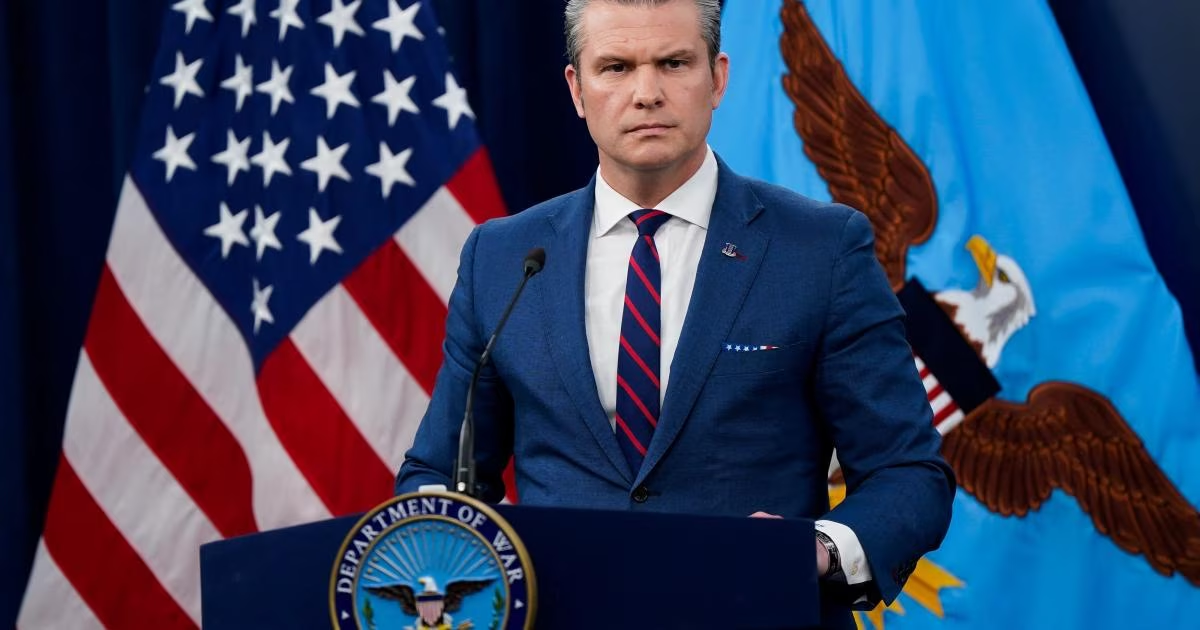
Dr. Refaat Sayed Ahmed: Washington will not enter terrestrially in the traditional sense because it understands the lessons of previous experiences, foremost among them the Afghanistan experience. Dr. Kholoud Al-Obaidi: The war is heading towards decisive options, which necessitates considering ground intervention, even if it seems unrealistic. Dr. Jamal Al-Shalabi: The idea of ground war is merely media rhetoric or a random decision that may not be implemented and perhaps falls within the framework of psychological warfare. Dr. Bilal Al-Shoubaki: The war in its current form can be ended while maintaining a state of tension within Iran without expanding the scope of confrontation outside it. Dr. Amjad Shehab: The scenario of a ground occupation of Iran is extremely difficult given the current data, and there are several factors that make this possibility unlikely. Amir Makhoul: All possibilities are open, and ground entry at this stage is unlikely because the Iranian army is still cohesive, as is the regime. Exclusive to Al-Quds - Amidst the escalating war between America and Israel, on one hand, and Iran, on the other, talk of potential ground intervention emerges after statements by US President Donald Trump in an interview with the "New York Post" on Monday, in which he said he would not rule out "putting boots on the ground," referring to ground forces, adding that "we probably won't need them," which raised questions about the limits of this option and the possibility of its implementation. Analysts and writers for "Al-Quds" suggested that a traditional ground invasion of Iran is unlikely, due to considerations related to the complex geopolitical situation of the region, in addition to the vast areas, rugged terrain, and population density that make ground warfare difficult, exhausting the United States and Israel, and giving Iran wide room for maneuver and a clear defensive advantage. However, at the same time, they warned that this war is heading towards decisive options in an attempt to restore regional balance in favor of Israel, which necessitates taking all scenarios into account. Multiple Scenarios The Egyptian strategic expert, Dr. Refaat Sayed Ahmed, believes that the United States will not enter terrestrially in this war because it understands the lessons of previous experiences, foremost among them the Afghanistan experience, where ground entry often meant a costly and problematic exit. He adds: Washington will not enter terrestrially in the traditional sense, i.e., by sending large forces to invade the country and overthrow the regime, because such an option requires extensive military operations, especially since regimes do not fall by air strikes or missiles alone, which may necessitate a massive ground intervention, something the United States is not believed to be willing to do at this stage. Sayed Ahmed points out that another possible scenario could be a limited ground entry from other directions, such as Azerbaijan, and not from the Gulf, through special forces and extended logistical operations, with the aim of seizing quantities of enriched uranium, estimated at about 460 kilograms, and stored, according to estimates, in areas far from the Gulf. Limited and Focused Operation He explains that this type of intervention, if it occurs, will be a limited and focused operation aimed at controlling nuclear materials rather than destroying them, noting that this quantity could theoretically be sufficient to produce a number of nuclear bombs if enriched to higher levels. Sayed Ahmed estimates that "the United States has been tracking the storage locations of these materials for some time through accurate intelligence efforts," considering this to be the likely scenario for any potential ground movement, rather than a full-scale invasion. In contrast, the Egyptian expert stresses that traditional ground entry remains unlikely, because Iran is a large, sprawling country capable of inflicting significant damage on attacking forces, especially in the medium term, by exhausting them and disrupting their supply lines. Sayed Ahmed adds: A complete or decisive American victory is not easily achieved in such a conflict, explaining that air strikes do not necessarily mean achieving a strategic victory, and ultimately suggests reaching a political deal that keeps the Iranian regime in place, given the difficulty of overthrowing it militarily without a large-scale ground invasion, which does not seem to be an available option. Sayed Ahmed points out that the most dangerous pressure tools Iran might resort to are raising the cost of war for the United States and its allies, such as threatening to close the Strait of Hormuz, which could lead in a short period to a sharp rise in global energy prices and inflict economic damage on Gulf countries, with the aim of exerting double pressure on Washington to stop the war. Sayed Ahmed warns of an extremely dangerous scenario involving a missile veering off course towards sensitive targets, such as the Dimona reactor, and considers that such a development could open the door to a wide confrontation with catastrophic dimensions, exceeding traditional war calculations and entering the region into an unprecedented phase of escalation. The War Against Iran is Different Dr. Kholoud Al-Obaidi, a specialist in political science and international law, says: "Israel and the United States have accustomed us to waging wars in the region. It is as if our destiny is to live a new war. The motive for the wars in the region is one: to eliminate any rise or power of the region's countries, so that Israel remains in control of the peoples of this region, and this is an equation that cannot last." She points out that "Israel was established by the great powers to be their tool for imposing their hegemony on the region. So, these wars are exhausting the United States, and indeed, they are among the most important reasons for the deterioration of the United States' position as an international power." Al-Obaidi believes that "America's wars, including the experience of the war against Iraq, were harsh and costly. It was a big mistake that destroyed the United States as much as it destroyed the countries of the region. The current American president was one of the first voices to criticize the war against Iraq and Afghanistan. And here he is waging a new war, this time against Iran." Al-Obaidi adds: Reports initially indicated that the war against Iran would be different. The most important difference was that it would not be a ground war like the Iraqi war and the Afghanistan war because the two previous experiences were costly and ineffective. Al-Obaidi explains that in the American war against Iraq, the United States mobilized more than 30 countries and could not end its military operations until after more than a month. She points out that the United States faced resistance and could not impose its control due to the presence of resistance that continued thereafter and inflicted heavy losses on the Americans. Al-Obaidi clarifies that Iran's area is six times the area of Iraq, Iran's terrain is mountainous and rugged, and Iran's population is more than 80 million, while Iraq's population was twenty million, which indicates that ground warfare is impossible and unfeasible. Last Monday, US President Donald Trump said that "sending ground troops would be unnecessary." Al-Obaidi confirms that since the beginning of the war in the past three days, statements by President Trump and officials in the American administration have begun to talk about a ground war. President Trump reiterates that he may send ground troops to participate in the war. Trump's statements came a few hours after Secretary of State Marco Rubio said that the Trump administration believes its goals against Iran can be achieved without ground forces." Rubio told reporters on Capitol Hill: "Our focus is on destroying Iran's ballistic missile launch platforms, their ballistic missile stockpiles, their ability to manufacture ballistic missiles, as well as their attack drones and their navy." Adjusting War Plans Al-Obaidi says: With the escalation of the situation, we find that there is an adjustment to war plans, as Trump stated to CNN that he does not rule out sending American ground troops to Iran if needed. He said he is not hesitant about sending troops... "We probably won't need them, but if necessary, I won't refuse," he said. Al-Obaidi notes that these statements began to appear with the escalation of the situation during the strikes directed by Iran against the Arab Gulf states. The New York Post also quoted President Trump as saying that he does not rule out sending American ground troops to Iran if necessary. Al-Obaidi points out that the issue of ground presence was also confirmed by US Secretary of War Peter Hegseth, who said, "We have no presence on the ground in Iran, but we are ready to go as far as we need to achieve victory." Al-Obaidi explains that "some have begun to think about a ground invasion, and this is due to the Iranian response targeting military bases and Arab Gulf states." In her opinion, this development is due to Iran's regional expansion in the war due to its attacks on Arab Gulf states and the closure of the Strait of Hormuz, noting that "there are also statements about the possibilities of a ground war in which Iran occupies parts such as Kuwait and other Arab emirates. These scenarios, although they seem unrealistic, must be taken seriously." Al-Obaidi says: President Trump expects the war to last from four to five weeks to achieve its goals and affirmed that the United States will continue its attacks on Iran until all forms of threat are eliminated, noting that it may last for more than five weeks if necessary. She adds: The confirmation that has come more than once, therefore, must be taken seriously, and despite the difficulty of imagining its realization, this war is heading towards decisive options. Therefore, we must take ground warfare into account. Analysts ruled out the idea of a comprehensive ground war to occupy Iran, and suggested that ground warfare might mean deploying special forces in specific cases, such as assisting separatist movements or political groups in the event of regime change. Al-Obaidi believes that the current war is a war to restore regional balance in favor of Israel, which does not hide its intentions and projects. The solution is for us to stand united, like many countries in the world now, Spain and Italy, against the war and condemn the Israeli-American aggression. A Hasty and Perhaps Ill-Considered Idea Dr. Jamal Al-Shalabi, Professor of Political Science at Hashemite University in Amman, says that this idea was put forward by US President Donald Trump, amidst a difficult, expanding, and dangerous war for the Middle East as a whole, noting that putting it forward just four days after the start of the confrontation and attack on Iran opens the door to many questions and scenarios. Al-Shalabi explains that the most prominent of these questions are: Does the United States want to wage a long-term war? Is it seeking to recall its experience of intervention and invasion of Afghanistan? Does this proposal reflect an inability to achieve goals through air power alone? He adds: These questions reinforce the impression that the idea is hasty and perhaps ill-considered, and no less dangerous than the decision of war itself, which has not been sufficiently analyzed in light of the nature of the region and its religious, political, military, and economic complexities. The War Will Affect the Pace of the Global Economy Al-Shalabi emphasizes that the region does not only represent its existing political entities, such as the Gulf states, Iran, Israel, and the United States, but also represents the arteries of global trade, including the Strait of Hormuz, the Red Sea, and others, which means that the course of the war will affect the pace and trends of the global economy. Al-Shalabi suggests that the idea of ground war is merely rhetoric or a random decision that may not be implemented, and perhaps falls within the framework of psychological warfare in which Trump excelled, in an attempt to win the confrontation morally against the Iranians. He wonders about the possible scenarios, including: Can the regime be overthrown after weeks of bombing through an American ground intervention? He expresses his doubts about this. He also points to the possibility of using mercenaries from different countries, but he considered this option complex and difficult to implement, given what it requires in terms of organization, training, and long operational planning. Al-Shalabi puts forward a third possibility, which is to persuade some Arab countries affected by Iranian strikes to participate in the war by sending troops, supported by American forces from behind. However, he believes that this scenario is also not easy to achieve, although it remains a possibility if the war drags on. As for the fourth possibility, Al-Shalabi considers it closer to a political maneuver or media rhetoric from a president who views the world with a deal-making and quick-decision mentality, and points out that losses in this region are not only financial, but also affect values, role, influence, and strategic image. He personally rules out that the United States will implement this idea on the ground or include it in an actual strategy to overthrow the regime, and notes that any ground intervention will give Iran a greater incentive to defend its territory, and will make it more fierce in the confrontation, which means a high human cost for the American side. Al-Shalabi points out that Iran is a large country with an area exceeding two million six hundred thousand square kilometers, which raises practical questions about the paths and limits of ground entry. He adds: Reaching Tehran requires crossing long distances, and overthrowing any central regime is linked to controlling the capital, which is extremely complex given the presence of large military forces including the army, the Revolutionary Guard, and other forces, which makes the idea of ground war incorrect or applicable in reality. Implementation of the Ground Entry Scenario is Still Premature Dr. Bilal Al-Shoubaki, Head of the Political Science Department at Hebron University, confirms that the implementation of a ground entry scenario into Iran is still premature, although it has been raised in the media and by some American officials. Al-Shoubaki points out that this proposal brings us back to a very important question related to the extent to which the entire region, including the Gulf states, is prepared to live in a long state of anticipation and security tension; as talking about the entry of ground forces practically means operations that may extend for months at least. He adds that if this scenario is actually on the table, it is linked to the goal of removing the regime, because overthrowing any political system cannot be achieved through missiles, planes, or assassinations alone, but requires a force on the ground. Al-Shoubaki explains that this force may not necessarily be an external military force, but perhaps an influential internal force that has a popular base capable of leading a comprehensive political change process, which so far seems difficult. He says: If the goal of removing the regime is seriously on the table for American or Israeli decision-makers, then theoretically, ground forces would be required to carry out this mission. However, he points out that there is another different scenario, based on not needing ground intervention, and not insisting on completely changing the regime, but rather keeping it in a state of weakness and fragility, while keeping it under constant internal pressure, and exposed to American and Israeli air superiority. According to this perception, Al-Shoubaki adds that the war in its current form can be ended while maintaining a state of tension within Iran, without expanding the scope of confrontation outside it, with the continued American role in the region as a protective element, under a remaining Iranian regime, but with fewer capabilities and weaker influence. Al-Shoubaki believes that this vision may be the closest to the thinking of a number of decision-makers in the United States, although the issue of regime removal has been publicly raised in Israel and America. He stresses the need to look at the issue from the perspective of calculating gains and losses: What will the United States and Israel gain from the survival of a weak regime? And what will they gain if they engage in a long-term war aimed at overthrowing it? Al-Shoubaki concludes that if regime change is possible at a lower cost and within a short timeframe, it may be an option for some parties. However, if it requires an extended war and a large-scale ground intervention, with the accompanying introduction of the region into a long period of instability, and giving Iran an opportunity to disrupt the region even with limited capabilities, then this option may not be acceptable. Factors Making Ground Entry Unlikely Political analyst Dr. Amjad Shehab confirms that the scenario of a ground occupation of Iran is an extremely difficult option given the current data, pointing to a number of factors that make this possibility unlikely, foremost among them the very high material, political, military, and human costs. Shehab explains that the United States has sought for decades to avoid engaging in a direct ground confrontation with Iran, considering that any move towards a ground occupation would be interpreted as a radical shift in American strategy, which until now has been limited to air strikes, assassinations, precise intelligence operations, and cruise missile attacks. Shehab points out that Washington has harsh experiences in ground interventions, including the Vietnam War, the war in Iraq, and Afghanistan, experiences that left deep military repercussions and human and psychological and political losses. He adds: The current American administration lacks, at this stage, sufficient internal support to adopt an option of this magnitude, and the risk, especially in light of political division and economic challenges. Any Ground Operation is Subject to Long-Term Attrition Shehab explained that Iran's vast area, exceeding 1.65 million square kilometers, along with its population density of nearly 90 million people, as well as its complex terrain, especially mountain ranges, the spread of religious ideology advocating resistance to any occupation, and its defensive capabilities, all make any ground operation subject to long-term attrition. Shehab emphasizes that the Iranian military mindset is skilled at managing wars of attrition, noting that even if the regime is overthrown or the army is dissolved, similar to the Iraqi model, invading forces will face urban warfare, given the difficulty of ground movement and control of major urban centers, making foreign forces visible targets and vulnerable to attacks. Shehab points out that any ground intervention will face complex strategic challenges related to terrain, popular resistance with an ideological dimension, as well as the fragility of supply lines that will remain vulnerable to targeting at any moment, which multiplies the cost of human and material attrition. The Option of a Quick End Remains Possible Amir Makhoul, a specialist in Israeli affairs at the Progress Center for Policies, estimates that all possibilities are actually open, and asks: Does this mean a ground entry, or a quick withdrawal and an urgent end to the war? He believes that the option of a quick end also remains possible due to regional pressures and the effects of the war on global energy markets and others, and emphasizes that the issue goes beyond the direct military dimension. Makhoul points out that the United States' entry at this stage seems unlikely, because the Iranian army is still cohesive, as is the political system, and there are no indications of a real ability to mobilize the Iranian interior in a different direction. Even if there is an attempt to mobilize the Kurds or other ethnic groups to take a separatist stance, this scenario is unlikely, given the existence of regional factors that prevent it, foremost among them Turkey, which does not accept the establishment of a separate Kurdish entity on its borders, or the influx of new waves of refugees into it. Matters Are Too Complex to Be Easily Resolved Makhoul emphasizes that matters are too complex to be easily resolved by Israel or the United States, because any widespread escalation could destabilize the entire region, not just implement a limited military operation. He adds that ground entry does not guarantee decisive results at this stage, as the primary strength of the United States and Israel lies in air, technological, and intelligence superiority, not in ground operations, which represent a major gamble. Also, the US President cannot engage in a widespread war of this type without congressional approval, which makes this option more complex. Makhoul points out that there are Israeli intentions to introduce commando forces or carry out special operations, which may also be a US possibility, but such operations, if they occur, will be limited in nature, such as carrying out a specific mission or kidnapping a specific person, and will not fundamentally change the course of the war. Makhoul warns of another more complex scenario, which is the success of the US President in overcoming the obstacle of Congress or obtaining a majority in favor of the war, even if small, which may push him to expand his goals beyond the nuclear and missile file. He believes that American and Israeli goals are not completely identical, but they are witnessing a kind of synchronization in managing the battle according to the strengths of each party. America Views the Conflict in a Broader Framework Makhoul believes that the United States views the conflict in a broader framework related to international competition for energy and global trade routes, and that weakening Iran may reflect on competing international projects. He says: If successful, a deeper military partnership between Washington and Tel Aviv may be established, going beyond mere traditional support. However, if it fails, it may negatively affect US priorities and Israel's position, and perhaps the US President's political standing domestically. Makhoul points out that Israel itself is not inclined to engage in a widespread ground war, because that would exhaust its army and capabilities, in the absence of full public consensus on this war, despite political agreement between the government and the opposition. Makhoul suggests that if the missile escalation continues, the chances of reaching an end to the war may increase instead of moving towards a ground entry, especially since its cost will be exorbitant and its results are not guaranteed, and that the qualitative American-Israeli superiority may decline if they engage in a long ground confrontation. Makhoul emphasizes that despite all options remaining theoretically on the table, the possibility of a comprehensive ground entry remains weak in the foreseeable future.


ARAB AND WORLD

Thu 05 Mar 2026 1:37 pm - Jerusalem Time

US Senate Rejects Restricting Military Strikes Against Iran Amidst Partisan Divide

The US Senate failed to pass a bipartisan resolution aimed at activating 'war powers' and halting ongoing military strikes against Iran, with 53 members voting against the resolution compared to 47 in favor. This vote came at a time when Washington is experiencing a sharp division over the utility of continuing military operations without a clear exit strategy or defined end goals for a conflict that is expanding at an alarming rate.

The session saw differing stances within both camps, with Senator Rand Paul being the only Republican to join Democrats in supporting a halt to the war, arguing that the current administration had abandoned its electoral promises to end foreign wars. In contrast, Democratic Senator John Fetterman deviated from his party's position and voted in favor of continuing operations, while Democratic leader Chuck Schumer warned of the dangers of sliding into a full-scale regional war with an unpredictable end.

Republican leaders fiercely defended President Donald Trump's powers as Commander-in-Chief, with Senator Lindsey Graham describing any attempt to restrict his actions as unconstitutional and weakening the American position. Majority Leader John Thune emphasized the need to provide full support to troops in the field, considering that passing such resolutions sends messages of weakness to Tehran and undermines the military deterrence Washington seeks to establish.

On the ground, reports indicate that the military confrontation peaked with the bombing of over 2000 targets inside Iranian territory, resulting in the death of Supreme Leader Ali Khamenei, which prompted Tehran to respond by launching hundreds of ballistic missiles and thousands of drones. These developments led to severe disruptions in global markets, with oil prices jumping by 6%, while American defense industry companies such as 'Lockheed Martin' and 'RTX' recorded record profits and significant growth in their annual sales.

In the context of regional alliances, Israeli Prime Minister Benjamin Netanyahu is seeking to form a six-party alliance comprising international and regional powers to confront Iranian influence, at a time when fears are emerging of Turkey transforming into a 'new Iran' according to statements by Naftali Bennett. Despite improved Turkish-American relations, Ankara's possession of Russian S-400 systems and its military strength within NATO makes it a complex player in the calculations of the ongoing conflict, especially with its adherence to the two-state solution in Palestine.

American public opinion polls reflect a significant gap between voter sentiments and congressional decisions, with a recent poll showing that only 27% of Americans support continued military strikes. Observers warn that the absence of a 'clear end' to the war could turn the conflict into a long-term attrition, similar to the Afghan scenario, placing immense political and economic pressure on the US administration amidst geopolitical shifts towards global multipolarity.

No one knows how long this fighting will continue, and we fear a repeat of the long-running Afghanistan scenario.

ARAB AND WORLD

Thu 05 Mar 2026 5:15 am - Jerusalem Time

Field Escalation: Kurdish Ground Incursion into Iran and Intense Missile Barrage Targeting Erbil and Baghdad

International media sources and American officials have revealed a significant field development in the regional confrontation, as armed Kurdish groups launched a ground attack and incursion into areas of northwestern Iran. Reports clarified that these groups launched from their bases in the Iraqi Kurdistan region, representing a shift in the nature of military operations directed against the Iranian regime.

In an immediate reaction, the Iranian Revolutionary Guard announced that it had carried out missile strikes targeting headquarters of the opposing Kurdish 'Komala' factions inside Iraqi territory. The Iranian statement confirmed that the shelling was carried out using three missiles that accurately hit their targets at exactly 11:00 AM local time, in response to the recent armed movements.

For his part, the Governor of Erbil announced that the city had been subjected to a violent wave of attacks, reaching about 100 strikes over the past five days, with a large portion claimed by armed Iraqi factions. The Governor indicated that the shelling targeted vital facilities and American military bases, including Erbil Airport, Harir Base, and the American Consulate in the city.

Officials in the Kurdistan Region described the current situation as one of extreme caution and fear, affirming that the region is paying the price for regional conflicts in which it has no stake. Local authorities called for urgent international intervention to stop these targeting operations that have affected residential neighborhoods and civilian facilities, emphasizing the need to neutralize civilians from the armed conflict.

On the ground, sources reported that drones fell on a residential building in the 'Pope Francis' complex in the Ain Kawa neighborhood within Erbil, resulting in injuries among civilians. Sources explained that air defenses attempted to intercept the drones that were targeting the airport vicinity, but their shrapnel or stray drones fell in populated areas.

This is the first time that residential buildings have been directly damaged within Erbil, as previous attacks focused on open areas surrounding military bases. The latest attack caused extensive material damage to cars and buildings, increasing the state of terror among local residents in the Ain Kawa neighborhood.

In a related context, a group calling itself 'Guardians of Blood' claimed responsibility for the recent attack on Erbil Airport, confirming the use of a swarm of drones in the operation. This attack comes just hours after the targeting of a headquarters belonging to the Kurdistan Democratic Party, which resulted in at least one casualty among the party's ranks.

The attacks were not limited to the Kurdistan Region but extended to the capital Baghdad, where the logistical support headquarters of the American Embassy near the airport was subjected to three consecutive attacks. Security sources confirmed that the shelling also targeted sites belonging to the Popular Mobilization Forces in various areas, including eastern Mosul, northern Babil, and western Anbar.

These developments come amid a widespread military aggression launched by Israel and the United States against Iran since last Saturday, which has resulted in the deaths of hundreds of people. Among the most prominent victims of this aggression were Iranian Supreme Leader Ali Khamenei and a number of senior security officials, which has plunged the region into a dark tunnel of direct confrontation.

Tehran responded to these attacks by launching massive missile barrages, including 500 ballistic missiles and approximately 2000 drones, targeting Israeli depths and American bases in the region. These barrages resulted in deaths and injuries in several countries, as well as causing severe damage to infrastructure and civilian assets in neighboring countries.

Economically, the raging war caused a significant jump in global oil prices by more than 6%, amid fears of energy supply disruptions. In contrast, shares of major American arms companies such as 'Lockheed Martin' and 'RTX' saw record increases, with the latter's sales reaching approximately $88.6 billion last year.

Amid this conflict, varying regional positions emerge, with Naftali Bennett describing Turkey as 'the new Iran,' while Ankara continues to adhere to its official position calling for a two-state solution. At the same time, Israel seeks to form a six-party alliance comprising international and regional powers to confront Iran's growing influence in the region.

The scene in Iraq and Kurdistan remains open to all possibilities, with continued mutual attacks and an escalating pace of ground incursions on the Iranian border. International powers are cautiously monitoring the outcomes of this escalation, which could lead to a comprehensive change in the geopolitical map of the Middle East if direct confrontation continues.

The Kurdistan Region is not a party to the ongoing war, but it is paying the price for a conflict it has no connection to, amidst a state of official and popular concern.

ARAB AND WORLD

Thu 05 Mar 2026 5:15 am - Jerusalem Time

3 dead in Israeli Raids Targeting Cars and Facilities in Beirut and its Suburbs

The Lebanese Ministry of Health announced on Wednesday evening that three martyrs had fallen and six others were injured with varying degrees of wounds, as a result of a series of aerial raids carried out by Israeli aircraft targeting the vicinity of the airport road in the capital, Beirut. Field sources clarified that the bombing directly hit two cars as they passed through the vital area, leading to casualties and damage to citizens' property in the location.

For its part, the Israeli army confirmed in a brief statement that it had carried out a targeting operation against a Hezbollah element in Beirut, without revealing the identity of the target or his military rank within the party. Later, Israeli media outlets quoted military sources as suggesting that the operation aimed to assassinate the party's firepower commander, as part of an escalation of qualitative operations against field leaders.

The raids were not limited to the airport road, as Israeli warplanes raided the Choueifat area, located south of the capital Beirut, specifically near the Gandour factory. The National News Agency reported that the bombing caused a state of panic among local residents, while columns of smoke rose from the targeted sites, which the occupation claimed contained military infrastructure.

In a second field update, the spokesperson for the occupation army announced another airstrike in Beirut targeting a second Hezbollah element, less than an hour after the first raid. These successive attacks come within an Israeli strategy aimed at intensifying pressure on the Lebanese capital and its southern suburbs to disrupt the operational capabilities of the resistance.

On the southern front, the occupation army announced that it had attacked what it described as several missile launch platforms located in areas south of the Litani River, in addition to targeting a facility dedicated to manufacturing drones. The occupation claimed that these preemptive strikes aim to reduce Hezbollah's ability to carry out missile or aerial attacks towards the northern settlements.

In response, the Lebanese resistance retaliated by launching intensive missile barrages, with sources reporting the observation of at least 8 missiles launched from southern Lebanon towards the occupied territories. Sirens sounded in wide areas of the Upper Galilee near the Lebanese border, amidst warnings of the possibility of suicide drones infiltrating Israeli airspace.

Hezbollah announced in an official statement that it had targeted gatherings of Israeli occupation forces in the Khalleh Wadi Al-Asafir area in the city of Khiam, southern Lebanon. The party confirmed that the operation was carried out using a precise missile barrage, emphasizing that these strikes come within the framework of defending Lebanese territories and responding to continuous aggressions against civilians.

Politically, Hezbollah Secretary-General, Naim Qassem, stressed in a speech that the party would confront the Israeli occupation to the furthest extent and with all its might. Qassem affirmed that the option of surrender is absolutely not on the table, and that the resistance will continue to defend Lebanon no matter the human and material sacrifices, considering that the continuation of the resistance is a legitimate right to thwart the goals of aggression.

Qassem pointed out that the primary goal at this stage is to thwart the joint Israeli and American plans in the region, and to ensure that the horizon remains open for liberation. These statements come at a time when the front is witnessing an unprecedented escalation, with the occupation army calling on its soldiers and northern residents to prepare for long days of fierce fighting.

It is worth noting that this field escalation comes after a series of qualitative operations carried out by Hezbollah, including targeting military sites in northern Israel with missiles and drones. The region is experiencing a state of extreme tension amid the continuation of Israeli airstrikes on the southern suburbs and the Beqaa and southern regions, which portends an expansion of the comprehensive confrontation.

We are concerned to continue defending and thwarting the goals of the Israeli-American enemy so that history records that we did not surrender and kept the horizon open.

ARAB AND WORLD

Thu 05 Mar 2026 5:14 am - Jerusalem Time

Newsom Describes Israel as an "Apartheid State" and Calls for Reconsidering US Military Aid

Said Erikat

Opinion Writer

Washington – Said Arikat – 3/5/2026

Los Angeles — In a striking stance that reflects a rapidly accelerating shift in political discourse within the United States, California Governor Gavin Newsom likened Israel to an "apartheid state," considering that its current leadership is pushing Washington towards an inevitable moment of reviewing its military support for its primary ally in the Middle East.

Newsom's statements came during his participation in an event in Los Angeles to promote his new memoirs, when Jon Favreau, host of "Pod Save America," asked him whether the United States should reconsider its military support for Israel in the future. The Democratic governor replied: "It pains me to say it, but the current leadership in Israel is leading us down a path where I don't think we have a choice but to seriously consider this issue."

Newsom's position carries implications beyond the media moment. Newsom, widely seen as a potential candidate for the 2028 presidential election, had visited Israel after the October 7, 2023, attacks carried out by Hamas, and at the time affirmed his solidarity with Israelis. But today he takes a clear critical distance from Prime Minister Benjamin Netanyahu's government, pointing to what he described as Netanyahu's internal crises, from judicial battles to pressing electoral calculations, in addition to pressures from hardline right-wing currents pushing for the annexation of the West Bank.

Newsom said that some observers "talk about Israel as an apartheid state," referring to policies that critics consider to be an entrenchment of a long-standing discriminatory system. He also sharply criticized the military operations against Iran, which the Donald Trump administration recently supported, asking: "Are we talking about regime change? After two years, even the Hamas file has not been resolved."

The timing of the statements is not incidental. The United States is witnessing escalating internal debate about the limits of unconditional support for Israel, especially among the Democratic Party. During the 2024 presidential election, sharp divisions emerged between the progressive wing and the traditional leadership of the party over the war in Gaza and Israeli policies in the Palestinian territories. Newsom, who previously made sure to emphasize that he had not received donations from the American Israel Public Affairs Committee (AIPAC), tried to balance highlighting the "deep ties" between California and Israel with addressing a party base that is moving towards more critical positions.

It is noteworthy that the description "apartheid" is no longer exclusive to human rights activists or marginal progressive voices; rather, it is being echoed in key political circles. Although Newsom did not explicitly call for an end to military support, his reference to "no choice" but to reconsider it represents a significant shift in the discourse of one of the most prominent rising Democratic figures, especially since 60% of Americans oppose the war launched by Trump on Iran on February 28, according to a new CNN poll published on Tuesday, March 3, 2026.

Politically, Newsom is trying to walk a tightrope: on the one hand, he does not want to break with a decades-old strategic alliance, and on the other hand, he realizes that public sentiment, especially among youth and progressive Democrats, has become less tolerant of Israel's policies in Gaza and the West Bank, and more willing to link military aid to political and human rights conditions.

Ultimately, the California governor's statements do not only reflect an individual position, but embody a broader shift in the American debate about the nature of the relationship with Israel, its limits, and its moral and political cost.

American sentiment towards Israel is undergoing a clear negative shift. While older generations have viewed Israel from the perspective of a solid strategic alliance and shared values, young people — especially within the Democratic Party — tend to evaluate the relationship from the perspective of human rights and international law. This shift does not necessarily mean hostility towards Israel, but it reflects a growing willingness to openly criticize its policies and link American support to clear conditions, a precedent that was not common just a decade ago.

Social media has played a pivotal role in reshaping the narrative within the United States. Images of war and destruction spread instantly, bypassing traditional media channels, which has weakened governments' ability to monopolize the narrative. This constant exposure has created popular pressure on politicians, pushing figures like Newsom to adopt more explicit language. Evasive diplomatic discourse is no longer sufficient to contain the anger of electoral bases that see silence as complicity.

The shift in sentiment is not separate from internal political calculations. With rising polarization, Israel has become part of an identity battle within the Democratic Party itself. A broad current believes that unconditional support harms American interests and undermines Washington's credibility in defending democracy globally. In contrast, others fear that any sharp retreat would weaken a traditional strategic alliance. This tension is likely to escalate as the 2028 presidential race approaches.

ISRAELI AFFAIRS

Thu 05 Mar 2026 5:14 am - Jerusalem Time

Hebrew Analysis: Israel Faces a 'Bitter Victory'.. Military Success in Iran and Strategic Erosion in Washington

Israel has recently been experiencing a state of existential contradiction that places it at the most complex turning point since 1948. While the military and intelligence establishment records 'stunning' successes in undermining the pillars of the Iranian regime, a parallel path emerges that threatens the collapse of the fundamental pillar of Israeli national security: the strategic alliance with the United States of America.

On the ground, the strikes targeting Iranian nuclear facilities and the infrastructure of the Revolutionary Guard are no longer mere tactical operations; they have transformed into an earthquake shaking the foundations of governance in Tehran. Intelligence estimates indicate that the scenario of regime collapse is no longer just a wish for the opposition but has become a realistic plan of action, which could remove the direct existential threat to Israel and change the face of the entire region.

In contrast, alarming voices are emerging from the heart of the American mainstream, specifically from the conservative right wing, which has historically been considered Israel's strongest ally. Conservative influencer Tucker Carlson is leading a discourse described by observers as 'toxic,' promoting the idea that the current war is a private Israeli affair that drains American interests, which reinforces isolationist tendencies within the Republican Party under the slogan 'America First.'

This erosion of bipartisan support within Washington presents the Israeli leadership with the dilemma of 'a victory that costs survival.' Achieving decisive military superiority in the East may mean nothing if it is accompanied by the loss of Western public opinion and the cutting off of arms supplies and diplomatic cover in the Security Council, which necessitates realizing that the battle for American consciousness is no less important than the squadrons of planes heading towards Tehran.

The intertwining of military and diplomatic paths leads us to a dangerous strategic scenario: a victory akin to defeat.

ARAB AND WORLD

Thu 05 Mar 2026 5:14 am - Jerusalem Time

Widespread Military Escalation: Iranian Missiles Target Tel Aviv, Explosions Rock East Tehran

The Israeli army announced, early Thursday morning, the detection of waves of missiles launched from Iranian territory towards vital targets in Jerusalem and Tel Aviv. This announcement came as sirens blared across wide areas of greater Tel Aviv, prompting military authorities to urge residents to immediately head to fortified shelters.

In the Iranian capital, Tehran, local sources reported hearing violent explosions that rocked the eastern suburbs of the city in recent hours. These explosions coincided with the intensive activation of Iranian air defense systems, which intercepted flying objects in the skies above the region, amidst reports of aerial penetration attempts by drones.

This field escalation comes in the context of the widespread military aggression launched by Israel, with US support, against Iran since late February. This ongoing aggression has resulted in hundreds of casualties, including Supreme Leader Ali Khamenei and a number of senior security and military commanders in the country.

For its part, Tehran continues to respond to these attacks by launching missile volleys and drones targeting Israeli territory and American interests in the region. Sources confirm that Iranian attacks have targeted civilian and military facilities, including ports and residential buildings, in response to what it describes as brutal aggression against its sovereignty.

Media sources explained that the cautious calm that had prevailed over Tehran for a few hours was broken by the return of air and missile exchanges between the two sides. Reports indicated that the explosions were concentrated in mountainous areas east of the capital, which include highly important military and security installations and universities affiliated with the Ministry of Defense.

Field data indicates that the Israeli occupation seeks, through its raids, to target sensitive research and military centers deep within Iran. Iranian military universities have previously been subjected to similar attacks during previous rounds of escalation, amidst an official media blackout by Iranian authorities regarding the extent of the losses.

In occupied Jerusalem, journalistic sources confirmed hearing explosions in the city's sky resulting from attempts to intercept missiles coming from the east. These missile volleys led to a state of full alert among Israeli air defenses, which attempted to intercept targets in the skies of Tel Aviv and Jerusalem.

On the Israeli domestic front, the Home Front Command announced new measures to regulate public life amid the ongoing military confrontation. Authorities decided to ease some restrictions imposed since the beginning of joint operations with Washington, while maintaining maximum alert in areas close to shelters.

According to the statement issued by the Home Front Command, work will be allowed to resume and limited gatherings of no more than 50 people will be permitted starting Thursday afternoon. Authorities stipulated that these gatherings must be in places that allow quick access to shelters, in an attempt to reduce economic losses resulting from the shutdown.

Despite this partial easing, the Israeli security establishment decided to keep the suspension of studies in all educational institutions until further notice. This decision comes amid continuous threats of missile strikes, and out of concern for the safety of students given the instability of the security and field situation.

Israel faces increasing economic pressures due to the continuation of this prolonged confrontation, with large sectors of production and education disrupted. In contrast, public anger is intensifying in some international and American circles over the continued direct military involvement in this escalating regional war.

Field sources reported hearing explosions in areas east of Tehran coinciding with the launch of anti-aircraft fire, indicating attempts to penetrate sensitive centers from the air.

PALESTINE

Thu 05 Mar 2026 5:14 am - Jerusalem Time

Widespread Israeli escalation targets northern Lebanon and Dahiyeh, Hezbollah responds by striking military complexes

The past few hours have witnessed a dangerous Israeli military escalation targeting Lebanese areas far from traditional battlefronts, as an airstrike targeted an apartment inside the Beddawi refugee camp in the city of Tripoli, northern Lebanon. The attack resulted in a number of martyrs and wounded, in the absence of any prior warnings from the occupation army, which reinforces the hypothesis of an assassination operation targeting a leading figure whose identity has not yet been revealed.

In the capital Beirut, occupation aircraft continued to target the southern Dahiyeh with a series of violent raids, with shelling hitting a building within the Ghobeiry municipality. This targeting is the eighth of its kind to hit Dahiyeh in the past twenty-four hours, indicating an intensification of military pressure on Hezbollah's main stronghold.

Field sources also reported another Israeli raid targeting a residential apartment in the densely populated Haret Hreik area, without any evacuation orders issued for residents. This coincided with a direct targeting of two cars on the road leading to Beirut International Airport, a qualitative development in the course of Israeli military operations that had not previously targeted this vital road.

Lebanese Ministry of Health announced that the shelling targeting cars on the airport road led to the martyrdom of three people and the injury of six others with varying degrees of wounds. These attacks come as part of the occupation army's attempts to pursue those it describes as Hezbollah cadres, with Israeli military sources suggesting that the target is the party's fire power commander.

Mount Lebanon Governorate was not spared from the aggression, as it was subjected to three concentrated airstrikes, one of which targeted a residential apartment in the Choueifat area near the Gandour factory. These raids caused widespread destruction of property and a state of panic among civilians in the areas surrounding the capital Beirut.

On the other hand, Lebanese Hezbollah responded with a series of qualitative military operations, announcing that it had targeted the military industries complex belonging to 'Rafael' company south of Acre using swarms of kamikaze drones. The party confirmed in its statement that the operation achieved its objectives accurately as a response to Israeli massacres against civilians.

In the ground field, Hezbollah fighters engaged in fierce clashes with an Israeli force that attempted to infiltrate and advance towards the border town of Dhayra. Resistance sources confirmed confirmed casualties among the infiltrating force, which forced it to retreat under heavy fire cover, coinciding with the targeting of occupation gatherings in Khallat Wadi al-Asafir in the city of Khiam.

Sirens blared intensely in wide areas of the Upper Galilee, extending to the northern occupied Syrian Golan and the Western Galilee. This alert came out of fear of rockets and drones launched from southern Lebanon, which prompted the Israeli home front to issue strict instructions to residents to remain inside shelters and fortified areas.

Israeli media reports indicated that the recent rocket barrages launched from Lebanon were intense, with the army monitoring the launch of at least 8 rockets towards the Upper Galilee in a short time. Hezbollah also targeted occupation forces stationed around the city of Khiam with qualitative rocket barrages to impede attempts at ground infiltration.

In the context of political and military stances, Sheikh Naim Qassem affirmed the party's continuation of the open confrontation and its refusal to surrender to Israeli military pressures, no matter the sacrifices. These statements come at a time when the occupation army continues to attack rocket platforms and drone manufacturing facilities in areas south of the Litani River.

The targeting on the airport road is the first of its kind, as civilian cars on this vital route have not been shelled since the beginning of the current escalation.

ARAB AND WORLD

Thu 05 Mar 2026 5:14 am - Jerusalem Time

UN warnings of regional conflict spiraling out of control and emphasis on civilians paying the highest price

Stéphane Dujarric, the Spokesperson for the UN Secretary-General, expressed deep concerns about the Middle East sliding into a comprehensive conflict that transcends current borders. Dujarric stressed the need for all parties involved in the confrontations to cease military escalation and immediately resort to dialogue to end the escalating crisis.

These warnings come amidst a military aggression launched by Israel and the United States on Iranian territories since late February, which has resulted in heavy human losses. The attacks targeted high-ranking officials in the Iranian state, led by Supreme Leader Ali Khamenei and a number of prominent security officials, which has complicated the field situation unprecedentedly.

In response, Tehran continues its military responses by launching barrages of missiles and drones towards Israeli targets, in addition to targeting what it describes as American interests in several Arab countries. These mutual attacks have caused civilian casualties and severe damage to infrastructure, including ports and residential areas.

In statements to Arab media from New York, Dujarric affirmed that the civilian population bears the brunt of this bloody conflict. He pointed out that the continuation of military operations increases the suffering of citizens who find themselves caught in the crossfire of a conflict they did not choose, warning that the humanitarian impact has begun to extend to global levels.

UN Secretary-General António Guterres had strongly condemned these military actions during his speech to the Security Council last Saturday. Guterres described these actions as hostile to the principles and charter of the international organization, emphasizing that the use of force in international relations is a blatant violation of regulating laws.

The UN spokesperson recalled the content of Article Two of the United Nations Charter, which prohibits the threat or use of force against the territorial integrity or political independence of any state. Dujarric criticized the mutual attacks that targeted countries not party to the initial conflict, considering it a dangerous expansion that threatens regional and international stability.

In the context of diplomatic efforts, Dujarric revealed extensive contacts made by Guterres in the past few days with active parties, including representatives of the Gulf Cooperation Council. The Secretary-General also held meetings with Iranian officials in a serious attempt to de-escalate and open channels for direct communication between the conflicting parties.

UN efforts were not limited to the regional aspect but also included direct and clear communication with the US administration, where Guterres met with National Security Advisor Michael Waltz and the US Ambassador to the United Nations. These meetings aim to pressure for a cessation of hostilities and to warn against the consequences of continued violence that fuels hatred in the region.

Dujarric clarified that the UN Secretary-General does not possess magical tools to compel states to negotiate, but he does possess the will and ability to exert all possible diplomatic efforts. He affirmed that the choice now rests with the leaders: either to proceed with a destructive conflict or to return to the path of negotiations that ensures the protection of lives and property.

The spokesperson for the Secretary-General stressed that any military conflict must be followed by a phase of legal and moral accountability immediately upon its conclusion. He called for the necessity of respecting the sovereignty of states towards each other and stopping the bloodshed that drains the region's resources and destroys future development opportunities for its peoples.

Dujarric concluded his remarks by indicating that every day the peaceful solution is delayed means more death and destruction of vital facilities and private property. He warned that rebuilding what the war has destroyed will require many years and vast sums of money, at a time when the region is already suffering from immense humanitarian needs and accumulated economic challenges.

Civilians in this conflict are the most affected and pay the highest price, similar to other conflicts, and what we want to see is a cessation of these activities and a return to negotiations.

ISRAELI AFFAIRS

Thu 05 Mar 2026 5:14 am - Jerusalem Time

Revolutionary Guard Tightens Grip on Decision-Making in Iran, Activates 'Decentralized Command' Strategy

High-level sources reported that the Iranian Revolutionary Guard Corps (IRGC) has fully tightened its grip on the decision-making process in the Islamic Republic, following a series of strikes targeting its senior leaders. The military establishment is currently pushing for a hardline strategy based on intensifying drone and missile attacks across the region, in response to increasing military pressure.
Anticipating any leadership vacuum, the Revolutionary Guard delegated extensive powers to lower ranks within the military before the recent attacks. This strategy aims to enhance the regime's resilience, despite the risks of battlefield miscalculation or the expansion of a comprehensive confrontation in the region.

In a notable field development, Iranian forces launched a ballistic missile towards Turkish territory, a NATO member, indicating an unprecedented escalation in military operations. This move comes at a time of growing international concerns that the conflict could spiral out of control as mid-ranking officers are granted powers to launch direct attacks.

Domestically, observers believe that the pivotal role the Revolutionary Guard now plays at all levels of the regime will reinforce the repressive security approach. This absolute control is likely to undermine any potential for popular protests, making it difficult for external powers betting on an internal uprising to change the regime.

Research reports indicate that the selection of the next Supreme Leader, following the death of Ayatollah Ali Khamenei, will unprecedentedly enhance the Revolutionary Guard's influence. Mojtaba Khamenei's name stands out as a strong candidate for succession, given his close ties with military leaders and widespread support from the more hardline lower ranks within the institution.

Regional sources confirmed that the Revolutionary Guard is now involved in all major sovereign decisions, bypassing traditional political structures. The sources explained that Ahmad Vahidi, who recently assumed leadership of the Guard, attends all high-level meetings to ensure the regime's survival and achieve its strategic objectives under current circumstances.

For his part, Reza Talaeinik, Deputy Minister of Defense, revealed details of the 'Successors' plan, which ensures leadership continuity even if the first tier is eliminated. He explained that every leadership position in the military structure has three ready replacements to immediately take over duties, preventing any confusion in managing combat operations.

The roots of the decentralization strategy currently pursued by the Guard date back about two decades, developed after lessons learned from the collapse of Iraqi forces in 2003. The plan aims to ensure that every Iranian province can defend itself independently if communication with the central command in Tehran is cut off.

This military system acts as a dual enforcement body: it is the spearhead in responding to external attacks and the primary tool for enforcing internal security. Despite losses among intelligence and aviation unit commanders, the institution attempts to demonstrate strategic cohesion in the face of continuous threats targeting its various ranks.

Sources indicate that the Revolutionary Guard, despite occasional internal rivalries, shows exceptional unity when the country faces existential threats. Slight signs of deterioration in the command structure have begun to appear through an increase in attacks on civilian targets in the Gulf region, which may be a deliberate strategy to demonstrate the cost of attacking Iran.

In official statements, Iranian Foreign Minister Abbas Araqchi confirmed that military responses were planned in advance with high precision. He explained that field units operate based on general and pre-prepared instructions, and do not await direct and immediate orders from the political leadership, which gives them flexibility and speed in execution.

The Revolutionary Guard possesses a vast economic and political empire that makes it a 'state within a state' since its establishment after the 1979 revolution. Its construction arms, such as the 'Khatam al-Anbiya' group, manage huge contracts in the energy sector, providing the military institution with financial independence and the ability to fund its operations away from the general budget.

The regime currently relies on a political leadership comprising figures with strong military backgrounds in the Revolutionary Guard, such as President Masoud Pezeshkian and Parliament Speaker Mohammad Bagher Ghalibaf. These leaders, forged by years of war with Iraq, adopt the military institution's vision in managing the current crisis with the West and Israel.

In conclusion, the Revolutionary Guard remains the primary guarantor of the Iranian regime's survival, using 'Basij' forces to suppress any internal unrest, and its network of proxies in the region to threaten external interests. With the escalation of confrontation, it appears that the military institution has made its choice to move towards a comprehensive confrontation to protect the achievements of the revolution.

The entire idea lies in decentralization so that if a particular province is attacked, it can defend itself and maintain the authority and rule of the regime.

ARAB AND WORLD

Thu 05 Mar 2026 5:13 am - Jerusalem Time

Washington's Attrition in the Gulf: How Russia and China Capitalize on the 'Iranian Predicament'?

The United States today faces a growing strategic dilemma as the region slides towards a comprehensive confrontation with Iran, with observers suggesting that Washington may find itself trapped in a long-term war of attrition. This scenario brings to mind the Russian experience in Ukraine, where a swift operation turned into an exhausting conflict that drained Moscow's military and economic capabilities and plunged Europe into spirals of inflation and severe energy crises.

The geopolitical nature of the Middle East makes any clash with Tehran an unconventional front whose boundaries are difficult to control, as the repercussions automatically extend to Lebanon, the Gulf, and vital maritime passages. Instead of a swift military resolution, the features of a conflict based on mutual strikes and constant deployment emerge, consuming American resources monthly without a clear end in sight.

Given these facts, a 'golden opportunity' arises for both Russia and China, who are observing the scene with cold blood, seeking to turn American involvement into a strategic burden that disrupts Washington's international focus. This intervention does not require armies on the ground but relies on what can be called 'soft intervention' aimed at keeping tensions alive without reaching a stage of full explosion or complete extinction.

Political and diplomatic support represents the first pillar of this intervention, as Moscow and Beijing use international platforms to undermine Western consensus against Tehran and obstruct pressing decisions in the Security Council. This path grants the Iranian regime room for political maneuvering and breaks the international isolation that Washington is trying to impose, thus prolonging Iranian resilience in the face of military pressures.

Economically, Eastern powers are working to expand trade channels and circumvent Western sanctions by providing alternative markets for Iranian energy and technology. The goal here is not to save the Iranian economy entirely, but to prevent its sudden collapse, which might impose a swift military or political resolution that does not serve the long-term attrition interests sought by Washington's rival powers.

Indirect technical and military cooperation constitutes a dangerous dimension in this equation, through the transfer of dual-use technology and support for air defense systems and cyber warfare. Satellite services also play a pivotal role in monitoring American naval and air movements, which raises the cost of confrontation and makes the field more complex for American military planning.

The battle is not limited to the military field but extends to the international narrative through digital networks and media to shape a discourse that holds Washington responsible for global escalation. This type of psychological warfare aims to weaken the cohesion of Western public opinion towards long military involvement and turn the external conflict into an internal political burden that pressures Washington's allied governments.

On the ground, sources revealed that the volume of airstrikes in the first hours of the confrontation was double what was carried out on the day of 'shock and awe' in Iraq in 2003, targeting nearly 2,000 Iranian targets. Despite this military momentum and the killing of major leading figures, the Iranian response with hundreds of missiles and drones proved Tehran's ability to inflict losses on American bases in the region.

The effects of the war quickly began to appear on the global economy, with oil prices rising by 6% immediately after the operations began, threatening a return of global inflation waves. In contrast, shares of major American arms companies such as 'Lockheed Martin' and 'RTX' rebounded, reflecting the contradiction between the economic interests of the military-industrial sector and the burdens borne by the state budget.

American attrition in the Middle East gives Moscow an opportunity to consolidate its positions in Ukraine away from intense Western military pressure, and allows Beijing to expand its influence in Asia and Africa. This strategic distraction of Washington is the ultimate goal of rising powers who see the United States' entanglement in the 'sands of the Gulf' as a means to reshape the multipolar world order.

Domestically in Israel, Prime Minister Benjamin Netanyahu seeks to exploit this moment to dismantle the Iranian regime and empower the opposition, with ambitions to expand regional alliances to include India and Greece. However, renewed statements about the 'Greater Israel' project raise concerns among regional allies and further complicate the political landscape surrounding the ongoing military operations.

The Turkish position adds another layer of complexity, with some Israeli circles describing Ankara as the 'new Iran' despite its NATO membership, indicating a crack in the allied front. Turkey, which possesses the second-largest military force in the alliance and advanced defense systems, insists on a two-state solution as a strategic option, putting it at odds with Israeli expansionist ambitions.

The killing of American soldiers in Kuwait and the complete halt of navigation in the Gulf puts the American administration to a difficult test of endurance and response without sliding into an endless comprehensive war. Attrition here does not mean direct military defeat, but rather the inability to resolve and entering a costly spiral that affects the American interior, allies, and the global economy alike.

Ultimately, the question is no longer who possesses the greater military power, but who has the ability to endure over time and resource erosion. If the confrontation continues in this pattern, Washington may find itself in the same predicament that Moscow faced; a war that is never fully lost but never won, while competitors reap the benefits of this slow erosion.

Modern wars are not always decided by a knockout blow, but by the slow erosion of will, economy, and the ability to manage more than one crisis at a time.

ARAB AND WORLD

Thu 05 Mar 2026 5:13 am - Jerusalem Time

Trump: Striking Iran prevented it from acquiring nuclear weapons within two weeks, and the destruction of missile platforms continues

US President Donald Trump announced that the United States is in a very strong strategic position regarding the Iranian issue, describing the field developments less than a week after the outbreak of military confrontation as a huge advance. Trump clarified in his statements that US forces are continuing their operations effectively, noting that the primary goal of the military action was to undermine Tehran's nuclear ambitions, which were on the verge of being realized.

The US President claimed that direct military aggression was the only remaining step to prevent Iran from acquiring nuclear weapons, asserting that without these strikes, the regime would have been able to possess nuclear power within just two weeks. He added that current operations focus on the comprehensive destruction of Iranian missile systems and launch platforms, to ensure the neutralization of any capability for long-range retaliatory response.

In a related context, Trump threatened Iranian leaders in harsh language, stating that anyone who seeks to assume a leadership position in the current regime faces an inevitable fate of being killed. These statements come at a time when military sources confirmed that the Israeli army carried out extensive airstrikes targeting strategic and sensitive sites belonging to the regime in areas west and central of the capital, Tehran.

For her part, White House spokeswoman Caroline Leavitt revealed that the US administration has already begun studying potential scenarios for after the end of the military campaign. Leavitt indicated that Trump is holding intensive meetings with national security advisors to discuss the role Washington will play in shaping Iran's political future after undermining the pillars of the current regime and destroying its military capabilities.

The spokeswoman affirmed that US intelligence agencies are closely monitoring reports regarding the identity of the potential successor to the late Supreme Leader Ali Khamenei, with the name of his son Mojtaba Khamenei emerging as one of the most prominent candidates. She explained that Washington is conducting its own investigations to verify this information, emphasizing that the current focus remains on ensuring the complete success of joint aerial military operations.

The US administration defended the legitimacy of the air war it is waging in cooperation with Israel, despite internal and international criticism that demanded concrete evidence of a direct and imminent Iranian threat. Leavitt said that the decision to launch the operation was based on the accumulation of continuous Iranian threats to US interests, considering that the American people support these military actions aimed at ending the threat from Tehran.

Intelligence reports indicate that the initial spark for this escalation was a crucial phone call between Netanyahu and Trump on February 23, where the Israeli side informed Washington of an upcoming meeting of the Iranian leadership in one location. Based on this information, Trump issued his final order to begin the attack, which later resulted in the assassination of Supreme Leader Ali Khamenei and the outbreak of a comprehensive confrontation.

On the ground, the past few days witnessed a widespread Iranian response, including the launch of approximately 500 ballistic missiles and more than 2000 suicide drones, in an attempt to repel the attack that targeted more than 2000 targets within Iranian territory. This escalation has led to global economic disruptions, with oil prices jumping by 6%, while shares of American arms companies recorded significant growth.

Trump rejected accusations made by his Democratic opponents and some supporters of waging an 'unnecessary war' or being drawn into Israeli desires, asserting that his decisions stem from a strategic vision to protect national security. Amidst these developments, international political circles are awaiting the outcomes of the conflict in light of the accelerating collapse of diplomatic negotiations that were taking place in Geneva before the aggression began.

If we had not struck Iran, they would have had nuclear power within two weeks, and anyone who wanted to become a leader there ends up dead.

OPINIONS

Thu 05 Mar 2026 5:04 am - Jerusalem Time

War, Oil, and Illusion: The Strategic Gamble Behind Trump’s War on Iran

March 5, 2026

News Analysis

Washington, D.C- The outcome of President Donald Trump’s war against Iran is uncertain. The ambitions behind it are not. Beneath the language of deterrence lies a broader project: to reshape energy geopolitics, curb China’s access to Iranian oil, and cement a Middle East order anchored in Washington, Israel, and the GCC countries—an alignment formalized under the Abraham Accords.


This is more than a military campaign. It is an attempt to redraw the global energy map.


Markets have registered the risk. Recent corrections in equities and commodities—sharp but contained—signal concern that the conflict could unleash a major oil and gas shock. Iran holds the world’s third-largest proven oil reserves and second-largest natural gas reserves. Sanctions have long kept much of that supply constrained. A transformed or compliant Iran would represent a strategic windfall: vast reserves reentering global markets under conditions aligned with Western capital and oversight.


Yet that ambition collides with immediate vulnerabilities. The Strait of Hormuz remains the world’s most sensitive energy artery. Roughly one-fifth of global oil passes through its narrow corridor, along with significant volumes of liquefied natural gas. Even credible threats to its security unsettle markets. A sustained disruption would be economically explosive—insurance costs soaring, shipping disrupted, supply chains strained.


Recent events exposed that fragility. After Iranian strikes on Gulf energy infrastructure, Qatar temporarily suspended LNG production, sending gas prices up nearly 70 percent within 48 hours. Europe and much of Asia—having shifted away from Russian gas after the Ukraine war—were thrust into another energy scare. What was framed as diversification proved instead to be a transfer of dependency from Moscow to the Gulf.


The asymmetry between the United States and its allies is stark. Europe and Asia face inflation spikes and recession risks if disruptions persist. The European Central Bank could be forced into painful rate hikes, deepening stagnation. By contrast, the United States—buoyed by shale production—is more insulated from external supply shocks than at any time in decades. The Federal Reserve faces less immediate pressure.


That imbalance raises a critical question: who bears the cost?


If Washington’s calculus assumes the United States can absorb volatility better than partners—or rivals—then this war is not solely about Iran. It is about leverage across three fronts.


First, energy dominance. Subduing Iran—through regime change or prolonged economic attrition—would open one of the world’s largest untapped hydrocarbon basins to restructuring. A weakened Tehran could be drawn into a Western-aligned production framework, stabilizing output under political conditions favorable to U.S. interests. But this presumes post-conflict control that history rarely grants.


Second, China. Beijing has relied heavily on discounted Iranian crude, often skirting sanctions. Curtailing that flow would raise China’s energy costs and complicate industrial planning. In an era of intensifying U.S.–China rivalry, energy denial becomes a tool of containment. Weakening Tehran reverberates far beyond the Gulf; it touches the architecture of great-power competition.


Third, regional re-engineering. The Abraham Accords envisioned more than normalization between Israel and Arab states. They outlined an economic corridor linking Israeli technology, Gulf capital, and American security guarantees. Iran remains the principal spoiler to that vision. A diminished Tehran could, in theory, clear the path toward a Middle East defined less by proxy war and more by integrated markets.


But the theory rests on fragile assumptions.


Iran’s response—direct strikes against Gulf energy facilities—signals escalation, not capitulation. By widening the theater and targeting infrastructure, Tehran exploits its asymmetric advantage: disruption. The objective is not conventional victory but raising the economic and political costs of confrontation to intolerable levels.


If that strategy endures, the consequences could be systemic. Oil prices would surge. Inflation across Europe and Asia would reaccelerate. Political unrest could follow economic strain. The specter of stagflation—long dormant in advanced economies—would return. The global economy, already burdened by debt and geopolitical fragmentation, may not withstand another prolonged energy shock without structural damage.


Here lies the paradox. A war partly intended to secure influence over energy markets may instead destabilize them. An effort to consolidate regional order could fracture global stability. A strategy designed to weaken adversaries could impose disproportionate pain on allies.


The belief that the United States can remain insulated—protected by shale output and dollar dominance—may prove overly confident. Energy shocks do not respect borders. Financial contagion, currency volatility, and capital flight can erode even resilient economies. Moreover, the perception that Washington engineered global disruption could carry long-term diplomatic costs, straining alliances already tested by previous conflicts.


At its core, this war is a high-risk wager: that coercion can reorder energy geopolitics without triggering uncontrollable escalation; that Iran can be subdued without igniting systemic crisis; that China can be weakened without hardening rival blocs; and that the Middle East can be reshaped through force into a platform for prosperity.


History offers caution. Grand designs often falter against the realities of nationalism, retaliation, and unintended consequences. The Middle East has repeatedly demonstrated that external attempts at structural transformation can unleash forces beyond the architects’ control.


If the gamble fails, the damage will not be confined to Tehran or the Gulf. It will be felt in European factories facing energy shortages, in Asian ports slowed by rising costs, and in American households confronting higher fuel and food prices.


The question, then, is not simply whether the war can be won militarily. It is whether the strategic architecture underpinning it was ever stable enough to justify the risk

OPINIONS

Thu 05 Mar 2026 12:25 am - Jerusalem Time

"Palestine: The Heart of Gravity in the International System"

Palestine is not a local issue to be read within geographical boundaries, nor a fleeting conflict to be added to the archive of international crises. It is a knot in a global narrative where the maps of politics, the memory of colonialism, the rise of nationalisms, and the transformations of the digital economy intersect. What happens in the world is immediately reflected in it, and what happens within it reshapes the world's stances, alliances, and moral discourse. It is as if it is a grand mirror, in which every nation sees its image as it wishes to be—or as it fears to be revealed.

Palestine is not merely a land disputed by maps, but rather a center of political and moral gravity, akin to a black hole in the world's space; every event that passes near it bends in its trajectory, and every international discourse that approaches it changes its form. The power of attraction here is not in its area, but in its meaning.

Palestine is not the largest of geographies, but it is the most capable of reordering priorities. Whenever the world tried to bypass it, it returned to it. And whenever it thought it had become a secondary file, it regained its position at the center of the discussion. It is as if it is a dense mass of history, memory, and symbolism, pressing on the conscience of politics until words bend around it.

Since the formation of the modern international system, it has been more than a geography; it has been a test of the very idea of justice. With the decline of unipolarity and the rise of multipolarity, calculations have changed, but the center of gravity has not. The intensification of competition between major powers sometimes made it a card in the game of influence, invested in the discourse of international legitimacy at times, and marginalized when the priorities of energy or containing other crises advanced. Nevertheless, whenever the world thought it had bypassed it, it returned to it. It is as if it is a center that does not allow escape from its orbit.

In physics, a black hole is not seen directly, but is known by its effect on what surrounds it: by the bending of light, the disturbance of orbits, and the acceleration of objects. So too is Palestine; it is not measured only by what happens within its borders, but by what it causes outside them. It changes the discourse of nations, reshapes alliances, provokes protests, and awakens questions about justice, law, and meaning.

The policies of major powers remain influential in the balance of power, between direct support or conditional mediation, while discourse oscillates between the language of rights and the imperatives of interests. This gap between declared values and actual tools of influence has made Palestine a living laboratory for the effectiveness of international law: do texts remain a binding reference, or do they transform into a moral discourse without teeth? In every round of escalation, questions of sovereignty, occupation, and civilian protection are re-raised, and the consistency of the international system is measured by its ability to apply its principles without selectivity.

It is an attractive land because it contains a rare condensation of history: religions, civilizations, colonialism, resistance, and unfulfilled promises. Every major power that passed through here left its mark, and every international system that formed found itself compelled to take a stance on it. It is as if approaching it is a test of consistency: are principles fixed or relative? Is man the end of politics or its means?

In the region, economic and security priorities have rearranged its position on official agendas, but in the popular consciousness, it has remained a symbolic criterion for legitimacy. As for the global economy, with its successive crises, it has narrowed the margins for humanitarian and political maneuver; nevertheless, any disturbance within it reverberates in distant markets and broader alliances.

Then came the digital age to break the monopoly of the narrative. A single image crosses continents in seconds, awakening cross-border public opinion. Here, Palestine is affected by algorithms of dissemination, but it also influences the formation of a new awareness of issues of justice and human rights. It is no longer an external news item, but an internal discussion in capitals thousands of kilometers away.

But the analogy of the black hole is not an invitation to darkness, but to understanding. For black holes, despite their awe, reveal to us the laws and limits of the universe. And Palestine, despite its tragedy, reveals the limits of the international system, and exposes the contradiction between discourse and practice. It is a magnifying mirror, everything said in it is amplified, and every silence about it echoes further than expected.

Crises around it may be managed, and they may be frozen, but gravity does not disappear. If its roots are not addressed, it continues to pull the world towards it, just as the center pulls its extremities. The future is open to overlapping paths: managed freezing that accumulates postponement, or a political breakthrough that requires sincere international will, or regional expansion that doubles the cost for everyone. However, the only constant is that bypassing it is an illusion; because bypassing it means leaving a void in the conscience.

Palestine is not a hole that swallows the world, but a compass that reorients it. Whoever approaches it sees the fragility of power if it is separated from justice, and sees that peace is not an administrative decision but a deep moral transformation.

And just as the universe does not stabilize without understanding its hidden laws, the world will not know its complete tranquility as long as this attractive center is open to pain. It is not just a small piece of land; it is an idea destined to remain alive and influence the course of events. It is as if the world is destined to revolve around it, because it tests its honesty with itself.

It is the land that cannot be bypassed, because it is not just a land—but a dense meaning around which the world revolves, whether it wants to or not.

PALESTINE

Thu 05 Mar 2026 12:25 am - Jerusalem Time

Ideological Dimensions of War: US Military Leaders Link Attack on Iran to 'Apocalyptic Prophecies'

Human rights and military sources have revealed a rising religious tone within the ranks of the US military leadership in the Middle East, where soldiers and officers are receiving instructions linking ongoing combat operations against Iran to 'end of the world' prophecies. These developments come amid an unprecedented military escalation involving the United States alongside Israel, raising widespread concerns about the discipline and religious neutrality of the US military.

The Military Religious Freedom Foundation (MRFF) reported being inundated with complaints since the start of the widespread attacks, having received over 200 messages from 50 different military units. Officers, in their complaints, explained that their immediate commanders used combat readiness briefings to promote the idea that the war is a 'divine plan' derived from the texts of the Book of Revelation in the Bible, which legal experts considered a dangerous overstep of the separation of church and state.

In a shocking testimony, a US officer stated that his commander described President Donald Trump as 'anointed by Christ' to be the instrument that ignites the events in Iran in preparation for the Apocalypse. The officer added that these statements were met with astonishment by the soldiers, especially since the unit includes members from diverse religious backgrounds, including Muslims and Jews, who felt marginalized and threatened by this extremist rhetoric.

On the ground, military operations that began last Saturday morning are continuing, with US and Israeli airstrikes targeting nearly 2,000 targets inside Iranian territory. These attacks, in their initial hours, resulted in the killing of Iranian Supreme Leader Ali Khamenei and a number of prominent security commanders, plunging the region into a dark tunnel of direct and unprecedented confrontations.

For its part, Tehran responded with a barrage of fire, including the launch of over 500 ballistic missiles and 2,000 drones targeting strategic sites and military gatherings. Field sources confirmed the killing of 6 US soldiers at a base in Kuwait in early March due to a suicide drone attack, while the US Central Command announced the destruction of a large part of the Iranian naval fleet and the paralysis of navigation in the Gulf.

Politically, President Trump's statements regarding the ultimate goals of this war have fluctuated; while he told media that the goal is to 'bring freedom' to the Iranian people, on-the-ground movements indicate an attempt to completely change the regime. The official mission currently is to eliminate Iran's conventional missile capabilities, end the influence of Tehran's proxies in the region, and ensure its disarmament of any nuclear ambitions.

The religious discourse was not limited to the American side but extended to the Israeli leadership, where Prime Minister Benjamin Netanyahu cited biblical texts comparing the Iranian regime to 'Amalek'. Observers considered that the use of these historical and religious symbols aims to rally popular and military support for widespread destructive operations, which further complicates the international political and diplomatic landscape.

In Washington, accusations were leveled against Secretary of Defense Pete Hegseth for facilitating the infiltration of extremist Christian groups into the Pentagon since he took office. Mikey Weinstein, president of the MRFF, pointed out that the Secretary introduced monthly religious practices that saw the attendance of figures advocating for the transformation of the United States into a theocracy, posing a direct threat to national security and military cohesion.

Economically, the war led to severe disruptions in global markets, with oil prices jumping by 6% immediately after the outbreak of confrontations. In contrast, shares of American defense industry companies saw record jumps, with 'RTX' recording sales growth of up to $88.6 billion, benefiting from the massive demand for ammunition and defense systems on the battlefronts.

Despite repeated attempts to obtain official comment from the Pentagon regarding complaints about religious rhetoric, the Department of Defense remained silent. Military experts believe that the continuation of this approach could lead to silent rebellion within military units that refuse to turn geopolitical conflicts into 'crusades' or ideological confrontations serving narrow agendas.

In a related context, Israel is seeking to exploit the military momentum to form a new regional and international alliance including countries from Europe, Africa, and Asia to confront what it describes as an 'existential threat'. Turkey's name stands out in this context, with some Israeli circles describing it as the 'new Iran', despite Ankara's membership in NATO and its possession of the second-largest military force within it, which portends an expansion of the conflict.

Reports indicate that the volume of airstrikes carried out in the first 24 hours of the war exceeded double what Iraq witnessed on 'Shock and Awe' day in 2003. This intensity of fire aims, according to sources, to paralyze the Iranian state's ability to respond quickly and enable the internal opposition to act, amid Israeli threats to assassinate any potential successor to the Supreme Leader.

The Palestinian issue remains present in the background, with the official Turkish position adhering to the two-state solution as the only strategic option for achieving stability. In contrast, right-wing statements in Israel are escalating regarding the 'Greater Israel' project, exploiting international preoccupation with the direct war with Iran to redraw maps of influence in the region.

In conclusion, the US military faces an internal challenge of maintaining its professionalism away from the religious polarization that has begun to surface openly. With the continued influx of complaints from soldiers, it appears that the military establishment is facing a real test of its constitutional principles under a political and military administration that adopts a discourse blending military power with mystical prophecies.

Our commander urged us to tell our troops that everything happening is part of God's divine plan, pointing to the imminent return of Jesus Christ.

ANALYSIS

Wed 04 Mar 2026 8:04 pm - Jerusalem Time

Between Oil and Influence: Trump's War on Iran and the Risks of a Global Economic Earthquake

Said Erikat

Opinion Writer

Washington – Said Arikat – 3/4/2026

News Analysis

The American-Israeli war on Iran is no longer just a fleeting military development in the record of chronic tensions between Washington and Tehran; it has transformed into a comprehensive test of American power's ability to reshape the geopolitical landscape of energy through coercion. US President Donald Trump is not fighting a traditional confrontation that can be measured by the number of strikes or the extent of losses, but rather is gambling on a broader wager: subjugating one of the world's largest hydrocarbon reserves to a new political will, and redrawing regional and international balances that extend beyond the Gulf.

At its core, the war transcends the rhetoric of deterrence and security to the question of resource control. Iran is not just a military adversary, but a massive energy reservoir that has remained outside the Western system for decades due to sanctions. Integrating this wealth into global markets on terms favorable to Washington would constitute a highly impactful strategic shift. However, this ambition assumes an ability to control the outcomes post-conflict, an ability whose limitations history has often proven. Reshaping a country the size of Iran is not an engineering process whose results can be predetermined, but a complex process where national identity, deterrence balances, and calculations of political dignity are intertwined.

However, Tehran, in turn, recognizes its point of strength. Instead of seeking a traditional decisive victory, it is betting on the weapon of disruption. One only needs to look at the sensitivity of the "Strait of Hormuz" to understand the magnitude of the risks. Approximately one-fifth of global oil exports pass through this narrow passage, in addition to huge quantities of liquefied natural gas. Merely hinting at a threat to navigation there raises insurance premiums and overturns market calculations, so what if the threat turns into actual disruption? Here, the global economy becomes hostage to an equation that is not decided by planes or missiles as much as it is decided by market confidence and tanker behavior.

Repercussions quickly appeared in Europe and Asia. The European continent, which sought to reduce its dependence on Russian gas after the war in Ukraine, found itself having replaced one dependency with another. The increasing reliance on Gulf liquefied natural gas seemed a rational choice at a certain political moment, but it revealed its fragility at the first security test. The sharp rise in prices brought back the specter of inflation, posing a difficult dilemma for governments and central banks: should they sacrifice growth to curb prices, or endure a new wave of high prices with significant social and political costs? Thus, a war in which Europe is not militarily involved turns into a direct economic burden on its industries and consumers.

As for Asia, where imported energy is the lifeblood of its industrial growth, any long-term disruption is seen as a threat to its competitiveness. At the heart of this scene stands China, which has benefited in recent years from discounted Iranian oil. Reducing this flow not only pressures Tehran but also raises energy costs for Beijing and complicates its industrial calculations. If part of the American gamble is to use energy as a containment tool in the context of competition with China, the result may not necessarily be to weaken the adversary, but rather to push it to accelerate the building of parallel systems and deepen alternative partnerships, thereby reinforcing the division of the global economy into competing blocs.

In contrast, the United States appears relatively less fragile thanks to the shale oil boom that reduced its reliance on imports. The dollar's position in the global financial system also gives it the ability to absorb shocks in the short term. But this immunity is not absolute. High global energy prices quickly seep into the American domestic market through supply chains and financial markets. More importantly, Washington's image as the architect of widespread disruption may cost it diplomatic capital it needs to manage its alliances.

All of this intersects with a broader regional project that emerged since the signing of the "Abraham Accords," which envisioned a more economically integrated Middle East between Israel and Arab countries under an American security umbrella. In this vision, Iran represents the biggest obstacle to a stable regional order favorable to Washington. Weakening it may open the door to accelerating economic and investment connectivity projects. But the assumption that removing an adversary automatically leads to stability ignores the complexities of the regional environment, where vacuums often generate new conflicts instead of closing old ones.

The great irony is that a war fought partly to secure energy resources may lead to the destabilization of those very markets. Tehran's "cost-raising" strategy, by expanding the scope of the threat and disrupting flows, makes any potential military gain economically costly at the global systemic level. With rising prices, the specter of stagflation looms, a scenario from which advanced economies did not easily recover in the 1970s.

Ultimately, the crucial question is not whether the United States can achieve military superiority, but whether the strategic framework underlying the war is sustainable. The gamble assumes that coercion can rearrange energy geography without widespread unraveling, that Iran can be subdued without igniting a systemic crisis, and that pressure on China will not accelerate the world's division into warring economic camps. However, history tends to punish perceptions that overestimate their ability to control outcomes.

Thus, the war appears to be a major gamble on fragile stability. If the calculations fail, the cost will not be limited to Tehran or the Gulf, but will extend to the factories of Europe, the ports of Asia, and the homes of Americans themselves. In such an interconnected world, the most dangerous consequences of war may be those that were not originally included in the planners' tables.

PALESTINE

Wed 04 Mar 2026 8:04 pm - Jerusalem Time

Entry of more than 100 relief aid trucks into the Gaza Strip via the Rafah crossing

Field sources at the Rafah border crossing and the Egyptian Red Crescent reported the entry of more than 100 humanitarian aid trucks into the Gaza Strip last Tuesday. This convoy comes in coordination between United Nations organizations, primarily UNICEF, in cooperation with Egyptian relief agencies to meet the urgent needs of the besieged population.

Responsible sources confirmed that the trucks followed their usual route through the Rafah land crossing to the Kerem Shalom crossing, which is under Israeli occupation control, to complete inspection procedures. The entry of these large quantities of aid has been observed amidst extremely complex humanitarian conditions that the Strip has been experiencing for many months.

In a related context, a source from the Egyptian Red Crescent in the Sinai Peninsula clarified that all trucks sent on Tuesday had already crossed into the Palestinian side. The source indicated that an additional convoy was prepared and sent on Wednesday, and is currently awaiting the necessary permits to cross.

According to official data issued by the Red Crescent, the latest convoy was characterized by the diversity of its cargo, including 300 tons of flour and 470 tons of various relief supplies. The shipments also included about 925 tons of petroleum products and fuel designated for operating power generators in hospitals and vital facilities suffering from severe shortages.

Regarding the movement of individuals, officials at the crossing denied the crossing of any wounded or injured in either direction during the reopening of the crossing on Tuesday. Movement was primarily limited to the entry of relief trucks, essential goods, tents, blankets, and clothing designated for displaced persons in camps.

For its part, the Israeli occupation army announced the reopening of the Kerem Shalom crossing after a closure that lasted since last Saturday. The previous closure decision coincided with a military escalation that included mutual attacks, before the occupation authorities decided to reopen it based on what they described as a new 'security assessment'.

Kerem Shalom crossing, located at the intersection of the borders between Gaza, Egypt, and the occupation, is considered the only remaining lifeline for the entry of commercial and humanitarian goods and aid. Frequent closures of this crossing exacerbate already deteriorating living conditions, increasing the suffering of millions within the Strip.

Humanitarian reports indicate that about 1.9 million Palestinians out of 2.4 million people have become displaced, living in dilapidated tents lacking the most basic necessities for a dignified life. The ongoing war has caused widespread destruction to most residential units, making reliance on external aid inevitable for survival.

It is worth noting that the Gaza Strip has been subjected to a genocide war since October 2023, resulting in the martyrdom of more than 72,000 citizens and the injury of over 171,000 others. Systematic military operations have also led to the destruction of about 90% of civilian infrastructure, turning the Strip into a disaster area requiring urgent international intervention.

The convoy included 300 tons of flour, about 470 tons of relief supplies, and about 925 tons of petroleum products to operate vital facilities.

PALESTINE

Wed 04 Mar 2026 8:04 pm - Jerusalem Time

Unprecedented Field Development: Simultaneous Missile Attacks from Iran and Lebanon Target Central Israel

The past few hours have witnessed a remarkable military development in the regional confrontation, as Israel was subjected to two simultaneous missile attacks launched from Iranian and Lebanese territories. This operation is the first of its kind in which missile barrages have been coordinated in this manner since the outbreak of the current war, putting Israeli air defense systems on high alert.

Police sources stated in an official statement that reports were received of interceptor missile fragments falling in various areas of greater Tel Aviv, confirming no human casualties so far. For its part, the Israeli army announced the detection of a new Iranian missile barrage launched towards the center, described as the fifth since the beginning of the day, as part of ongoing responses to the military escalation.

Hebrew media sources reported that sirens were not activated in some areas of central Israel after an Iranian missile was intercepted outside its airspace, which was confirmed by Hebrew Channel 12. Simultaneously with the Iranian threat, radars detected the launch of 5 missiles from southern Lebanon targeting the same geographical area, leading to loud explosions resulting from interception attempts.

In a brief statement, the Israeli army confirmed the interception of several missile projectiles coming from Lebanon after alarms were activated in wide areas of the country's center. In a related context, the Yedioth Ahronoth newspaper quoted military sources claiming that air defenses successfully countered all missile threats launched simultaneously from the eastern and northern fronts.

On the Lebanese side, Hezbollah announced the execution of 11 qualitative military operations against Israeli army positions and gatherings since dawn on Tuesday, in response to targeting civilians in southern Lebanon and the southern suburbs of Beirut. These field movements come amidst escalating tension following the assassination of Iranian Supreme Leader Ali Khamenei during the widespread aggression that targeted nearly 2000 targets inside Iran.

Reports indicate that the direct confrontation between Iran and Israel has entered a bone-breaking phase, as Tehran had previously launched about 500 ballistic missiles and 2000 drones in previous rounds. This escalation has cast a shadow over the global economy, with oil prices jumping by 6%, while shares of major American arms companies such as Lockheed Martin and RTX recorded record increases.

Amidst this complex scene, Israeli political moves emerge, through which Benjamin Netanyahu seeks to form a six-party alliance including regional and international powers to confront Iranian influence. In contrast, regional parties such as Turkey continue to adhere to the two-state solution as a strategic necessity, despite the tensions in its relations with some international parties due to its positions on the ongoing war.

We received reports of fragments falling in the greater Tel Aviv area, and no human casualties have been recorded so far as a result of the recent barrages.

PALESTINE

Wed 04 Mar 2026 8:04 pm - Jerusalem Time

The Region on the Brink of a Volcano: Repercussions of Khamenei's Assassination and Scenarios of Comprehensive Confrontation

The assassination of the Supreme Leader of the Islamic Republic of Iran, Ali Khamenei, carried out by Israeli forces with American support, has plunged the region and the world into a dark tunnel of military and political escalation. This incident, which also targeted a number of senior Iranian commanders, has put the international system to a harsh test, as the prospects of this dangerous phase and its repercussions on the stability of the Middle East cannot be predicted.

The features of the Iranian response quickly began to crystallize through the transformation of the confrontation into an open regional war, as sources reported that Tehran began targeting Israeli interests and American bases in the surrounding countries. The Iranian authorities also took a strategic step by closing the Strait of Hormuz, which threatens global energy supplies and pushes the international economy to the brink of collapse.

On the Lebanese front, Hezbollah and the Islamic Resistance engaged in a direct and widespread confrontation in response to the assassination, which led to a violent and comprehensive Israeli aggression on Lebanese territory. Fears are growing of the conflict expanding to include additional fronts with the possibility of the Yemeni Ansar Allah movement and Iraqi factions entering the direct confrontation line against American and Israeli targets.

Global capitals witnessed a wave of popular anger, as massive demonstrations took place in front of American embassies in Pakistan, India, and Turkey condemning the assassination. These movements reflect the extent of international tension and popular rejection of American policies, which demonstrators considered a key partner in pushing the region towards a comprehensive war that may not end soon.

Observers believe that the current phase is similar in its pivotal nature to the events of 1979, which witnessed the fall of the Shah and the victory of the Islamic Revolution, but with fundamental differences in the international balance of power. The scenarios presented today range from the fall of the existing regime to its steadfastness, and each scenario has radical implications for the map of alliances in the region and the future of forces allied with Tehran.

The first scenario assumes the success of Washington and Tel Aviv in undermining the current Iranian regime and replacing it with a loyal authority, which would mean a devastating blow to Iran's allies in Lebanon, Yemen, and Palestine. This path could lead to complete Israeli hegemony over the region, weakening Islamic movements and dramatically changing the face of the Palestinian issue in favor of the 'Greater Israel' project.

The second scenario is the transformation of the conflict into an open war of attrition without a clear military resolution from any side, plunging the region into widespread security and economic chaos. In this case, international parties may be forced to move towards a major settlement agreement that stops the aggression, but its terms will depend entirely on Iran's field steadfastness and its ability to impose a new political reality.

The third possibility, which is the most difficult, is the success of Iran and its allies in achieving a limited victory or steadfastness in the face of aggression, especially if they receive support from regional and international powers competing with Washington. This success could force the United States to conduct a comprehensive review of its strategies in the Middle East, and establish a new international system that ends the era of unipolarity and direct military interventions.

Inside Lebanon, developments took a complex internal turn, as the Lebanese government issued decisions prohibiting Hezbollah's military action and asked the army to implement a disarmament plan. These decisions come at a time when Lebanon faces the threat of a widespread Israeli ground invasion, putting the country in a scenario similar to the 1982 invasion, and making the fate of the resistance's weapons a subject of intense political debate.

Field data confirm that the current battle has gone beyond traditional issues such as the nuclear program or ballistic missiles, to become an existential battle related to the identity of the entire region. Khamenei's assassination was not just a targeting of a leading figure, but a spark for redrawing the boundaries of influence and power in the Arab and Islamic world, amidst an unprecedented international struggle of wills.

The rapid developments on the ground indicate that the confrontation is intensifying on all fronts, with the possibility of Gulf states joining the response to Iranian moves, complicating the diplomatic scene. This overlap of interests and threats makes it difficult for any analyst to estimate the final outcomes, as all possibilities remain open to field surprises that could change the course of modern history.

The Palestinian issue finds itself today at the heart of this hurricane, as its fate is closely linked to the results of the major confrontation between Tehran and Tel Aviv. The weakening of the axis supporting the Palestinian resistance could open the door to the liquidation of the issue, while the steadfastness of this axis could restore momentum to the Palestinian national project and impose new deterrence equations that protect historical rights.

The current scene requires a deep strategic reading that transcends narrow sectarian or national differences, given the magnitude of the threat that affects everyone without exception. The battle is no longer confined to specific geographical boundaries, but has extended to include global energy security and the stability of the international system, which has begun to crack under the weight of mutual strikes in the Middle East.

In conclusion, the coming days will be decisive in determining the region's direction for the coming decades, either towards a comprehensive settlement that preserves the balance of power, or a slide towards a third world war that starts from Tehran and Beirut. The responsibility of regional powers lies in preventing complete collapse, although the language of weapons currently seems to dominate the negotiating table and politics.

The battle today is no longer about the nuclear file or missiles, but it is a battle for the destiny of Iran, the Arab and Islamic world, and the Palestinian issue.

ARAB AND WORLD

Wed 04 Mar 2026 7:36 pm - Jerusalem Time

Larijani attacks Trump as Washington announces sinking of Iranian frigate and pledges military reinforcements

The Secretary of Iran's Supreme National Security Council, Ali Larijani, sharply criticized US President Donald Trump, considering that he has dragged his country into an unjust military conflict against Tehran. Larijani indicated that this war came as a result of the impulses and actions of Israeli Prime Minister Benjamin Netanyahu, which he described as farcical, warning of the repercussions of continuing on this path.

The Iranian official, in a direct message to Trump, questioned the usefulness of the slogan 'America First' in light of the increasing human losses among American forces. Larijani stressed that the killing of more than 500 American soldiers in a few days necessitates a real review of whether Israeli interests have overshadowed American national priorities.

On the ground, Tehran announced that the death toll among American forces has exceeded 500 since the start of current military operations. In a related context, a commander in the naval forces of the Revolutionary Guard revealed that his forces succeeded in targeting more than 10 ships and oil tankers, as part of the Iranian response to the joint attacks.

For his part, US Secretary of Defense, Pete Hegseth, described the results of his country's military operations against Iran as 'historic' and unprecedented. Hegseth affirmed in a press conference held at the Pentagon that the ultimate goal is to completely destroy the enemy's military capabilities, stressing that more forces are on their way to the region soon.

The US Secretary expected that in the coming days, American and Israeli air forces would achieve absolute air superiority over all Iranian airspace. He explained that by the seventh day of the war, the joint forces would be able to neutralize missile threats and prevent Tehran from making any progress in its nuclear file by destroying vital facilities.

Hegseth stressed that the air power currently sweeping Iran's skies is the largest in the world, which has significantly reduced Iranian defensive capabilities. He considered that the joining of the Israeli air force to the operations made the attacks more destructive and impactful on Iranian military infrastructure, vowing to use an unlimited stock of precision bombs.

In a prominent field development, the US Secretary of Defense revealed that a US Navy submarine sank the Iranian frigate 'Iris Dina' in the waters of the Indian Ocean. This announcement came after reports from the Sri Lankan Navy confirmed the sinking of the warship near its coasts, while Hegseth described the operation as a 'silent death' and qualitative.

The Pentagon indicated that the sinking of the Iranian ship by a torpedo is the first of its kind against an enemy ship since the end of World War II. Hegseth affirmed that American forces are fighting with a doctrine aimed at achieving complete victory, just as they did in previous major conflicts fought by the United States.

These developments come amid a wide-ranging military aggression launched by Israel and the United States since last Saturday morning, targeting sensitive command centers in Iran. These attacks resulted in the deaths of hundreds of people, including Supreme Leader Ali Khamenei and a number of senior security and military officials in the country.

In contrast, Tehran continues its military response by launching intensive barrages of ballistic missiles and drones towards Israeli targets and American bases in the region. Sources reported that some of these attacks resulted in casualties and injuries, in addition to causing material damage to civilian facilities in some neighboring countries.

Trump should hold himself accountable today if the slogan is still 'America First', or if it has become 'Israel First' after hundreds of his soldiers have been killed.

PALESTINE

Wed 04 Mar 2026 7:36 pm - Jerusalem Time

Indonesia freezes its participation in the 'Peace Council' and threatens to withdraw in response to escalation against Iran

Indonesian Foreign Minister, Sugiono, announced his country's decision to freeze all talks related to the international 'Peace Council', in which Jakarta aspired to play a leading role. This announcement came in the wake of escalating military tensions in the Middle East, confirming that global and regional diplomatic attention has completely shifted towards the rapid developments in Iran.

Sugiono clarified, in press statements after an official event with President Prabowo Subianto, that Indonesia intends to hold intensive consultations with its allies in the Arabian Gulf region. He indicated that these countries face direct threats, emphasizing Jakarta's readiness to play a mediating role in the Iranian conflict with the aim of de-escalating the situation and preventing the region from sliding into a comprehensive confrontation.

For his part, the Speaker of the Indonesian People's Consultative Assembly, Ahmad Mazani, revealed the possibility of his country's final withdrawal from the Council concerned with the Gaza Strip. Mazani confirmed that this direction came after high-level consultations at the presidential palace in Jakarta, where the feasibility of remaining in this alliance has become a major question for the political leadership.

Mazani explained that Indonesia's joining the Council was based on the conviction of this institution's ability to accelerate the establishment of an independent Palestinian state. However, the attacks launched by the United States and Israel - both parties to the alliance - against Iran, prompted Jakarta to fundamentally re-evaluate its role, considering that these actions contradict the declared goals of peace.

The Indonesian government faces increasing internal pressure from Islamic groups and political experts who believe that participation in the Council harms Indonesia's standing as the largest Muslim country supporting Palestine. The Indonesian Ulema Council explicitly called for withdrawal, describing Trump's initiative as ineffective in light of the continuous aggressions against the countries of the region.

Indonesia had prepared an ambitious military plan to send 1,000 soldiers to the Gaza Strip early next April. These forces were scheduled to be part of an international stabilization force mandated by the United Nations, where Jakarta was granted the position of deputy commander of the force, which is now threatened with cancellation as a result of the freezing of the political process.

It is worth noting that the 'Peace Council' is a proposal put forward by former US President Donald Trump to end the war in Gaza, before its powers were expanded to include other international conflicts. Observers believe that the Indonesian shift represents a strong blow to the legitimacy of this Council, especially with accusations against Jakarta that the alliance is trying to usurp the traditional powers of the United Nations in managing international crises.

All discussions of the Peace Council have been suspended as all attention has shifted to the situation in Iran, and we will consult with our partners in the Gulf as they are also under attack.

PALESTINE

Wed 04 Mar 2026 7:35 pm - Jerusalem Time

Widespread Field Escalation: Hezbollah Shells Israeli Depth and Occupation Advances into Khiam

Hezbollah carried out a series of large-scale attacks today, Wednesday, including more than 11 operations using drones and advanced missiles. These attacks targeted strategic sites and military command headquarters in central and northern areas, reflecting an escalation in the pace of field operations.

In official statements, the party announced that it targeted vital air and naval bases, including 'Ramat David' base and 'Haifa' naval base. The strikes also hit 'Tel Hashomer' base, located 120 kilometers from the Lebanese border, and 'Ein Shemer' air defense base east of Hadera.

In a significant development, kamikaze drones were used to strike Iron Dome radars at the 'Kiryat Eliezer' site in occupied Haifa. The party also announced targeting the headquarters of the Israel Aerospace Industries (IAI) company in central occupied Palestine, confirming accurate hits on the targeted sites.

On the ground, the attacks targeted Israeli military vehicles in the village of Houla, where a 'Merkava' tank and an armored personnel carrier were targeted with appropriate weapons. The operations also included 'Geva' drone control base and 'Dado' base, which serves as the northern command headquarters of the occupation army.

For its part, Hebrew media sources revealed Hezbollah's use of a cluster missile for the first time since the start of the current confrontations. Reports indicated that the missile fell in the Metula area near the border, causing extensive material damage to the targeted site.

In the context of ground confrontations, the occupation army admitted that two of its soldiers were moderately wounded after their forces were exposed to anti-tank fire in southern Lebanon. The military statement confirmed that the injured were evacuated by helicopters to hospitals for necessary treatment under tight security.

Regarding ground movements, international sources confirmed the incursion of Israeli forces into several towns and villages within the scope of UNIFIL operations. The incursion included the towns of Houla, Kafr Kila, Kafr Shuba, and Yaroun, reaching the town of Khiam, which is about six kilometers from the border line.

Local sources reported that the occupation army began establishing new strongholds, placing a military post in front of the Khiam municipality building. This move coincided with a redeployment of the Lebanese army in some border locations to keep pace with the rapid field developments in the southern region.

These movements come in implementation of instructions from Israeli Security Minister Yisrael Katz, who ordered his forces to advance and seize new positions. The occupation aims through these operations to try to impose a buffer zone in southern Lebanon, despite the fierce resistance it faces in the border villages.

Specifically, the town of Khiam is witnessing the most prominent confrontations, as Israeli forces try to control it after previous failed attempts last September. Field sources stated that the occupation advanced from Hamamis Hill towards the center of the town under heavy fire cover and concentrated artillery and aerial bombardment.

In the Kafr Shuba axis, sources recorded an incursion of military vehicles and bulldozers belonging to the occupation into the southern part of the town within the Arqoub area. Israeli forces positioned themselves at strategic points after extensive bulldozing operations of green areas and properties in the targeted area.

In parallel with ground operations, Israeli warplanes continued to launch intense raids targeting dozens of villages and towns deep in the south. The bombardment also extended to the southern suburb of Beirut, resulting in widespread destruction of residential buildings and infrastructure amid the ongoing military escalation.

Sources reported that Israeli forces are present today in a number of villages and towns, including Houla, Kafr Kila, Kafr Shuba, Yaroun, and Khiam, about six kilometers from the border.