







Washington – Said Arikat – 3/4/2026
News Analysis
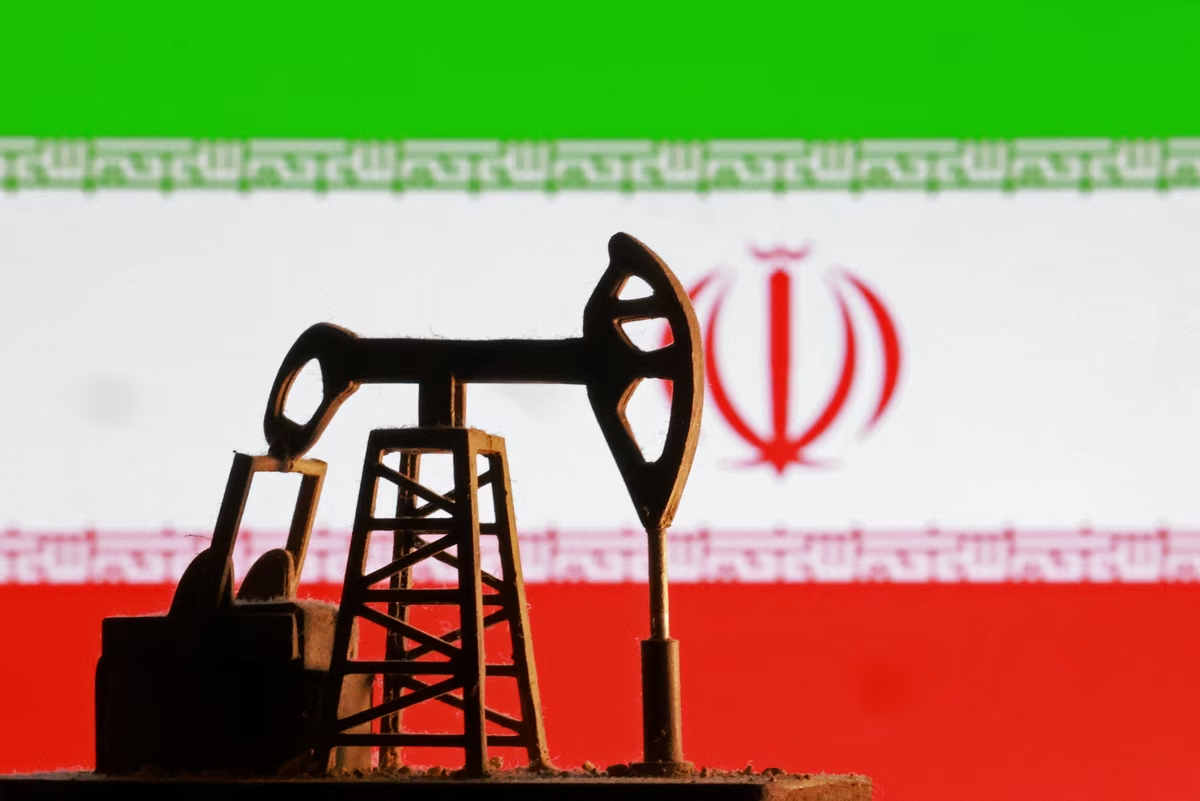
The American-Israeli war on Iran is no longer just a fleeting military development in the record of chronic tensions between Washington and Tehran; it has transformed into a comprehensive test of American power's ability to reshape the geopolitical landscape of energy through coercion. US President Donald Trump is not fighting a traditional confrontation that can be measured by the number of strikes or the extent of losses, but rather is gambling on a broader wager: subjugating one of the world's largest hydrocarbon reserves to a new political will, and redrawing regional and international balances that extend beyond the Gulf.
At its core, the war transcends the rhetoric of deterrence and security to the question of resource control. Iran is not just a military adversary, but a massive energy reservoir that has remained outside the Western system for decades due to sanctions. Integrating this wealth into global markets on terms favorable to Washington would constitute a highly impactful strategic shift. However, this ambition assumes an ability to control the outcomes post-conflict, an ability whose limitations history has often proven. Reshaping a country the size of Iran is not an engineering process whose results can be predetermined, but a complex process where national identity, deterrence balances, and calculations of political dignity are intertwined.
However, Tehran, in turn, recognizes its point of strength. Instead of seeking a traditional decisive victory, it is betting on the weapon of disruption. One only needs to look at the sensitivity of the "Strait of Hormuz" to understand the magnitude of the risks. Approximately one-fifth of global oil exports pass through this narrow passage, in addition to huge quantities of liquefied natural gas. Merely hinting at a threat to navigation there raises insurance premiums and overturns market calculations, so what if the threat turns into actual disruption? Here, the global economy becomes hostage to an equation that is not decided by planes or missiles as much as it is decided by market confidence and tanker behavior.
Repercussions quickly appeared in Europe and Asia. The European continent, which sought to reduce its dependence on Russian gas after the war in Ukraine, found itself having replaced one dependency with another. The increasing reliance on Gulf liquefied natural gas seemed a rational choice at a certain political moment, but it revealed its fragility at the first security test. The sharp rise in prices brought back the specter of inflation, posing a difficult dilemma for governments and central banks: should they sacrifice growth to curb prices, or endure a new wave of high prices with significant social and political costs? Thus, a war in which Europe is not militarily involved turns into a direct economic burden on its industries and consumers.
As for Asia, where imported energy is the lifeblood of its industrial growth, any long-term disruption is seen as a threat to its competitiveness. At the heart of this scene stands China, which has benefited in recent years from discounted Iranian oil. Reducing this flow not only pressures Tehran but also raises energy costs for Beijing and complicates its industrial calculations. If part of the American gamble is to use energy as a containment tool in the context of competition with China, the result may not necessarily be to weaken the adversary, but rather to push it to accelerate the building of parallel systems and deepen alternative partnerships, thereby reinforcing the division of the global economy into competing blocs.
In contrast, the United States appears relatively less fragile thanks to the shale oil boom that reduced its reliance on imports. The dollar's position in the global financial system also gives it the ability to absorb shocks in the short term. But this immunity is not absolute. High global energy prices quickly seep into the American domestic market through supply chains and financial markets. More importantly, Washington's image as the architect of widespread disruption may cost it diplomatic capital it needs to manage its alliances.
All of this intersects with a broader regional project that emerged since the signing of the "Abraham Accords," which envisioned a more economically integrated Middle East between Israel and Arab countries under an American security umbrella. In this vision, Iran represents the biggest obstacle to a stable regional order favorable to Washington. Weakening it may open the door to accelerating economic and investment connectivity projects. But the assumption that removing an adversary automatically leads to stability ignores the complexities of the regional environment, where vacuums often generate new conflicts instead of closing old ones.
The great irony is that a war fought partly to secure energy resources may lead to the destabilization of those very markets. Tehran's "cost-raising" strategy, by expanding the scope of the threat and disrupting flows, makes any potential military gain economically costly at the global systemic level. With rising prices, the specter of stagflation looms, a scenario from which advanced economies did not easily recover in the 1970s.
Ultimately, the crucial question is not whether the United States can achieve military superiority, but whether the strategic framework underlying the war is sustainable. The gamble assumes that coercion can rearrange energy geography without widespread unraveling, that Iran can be subdued without igniting a systemic crisis, and that pressure on China will not accelerate the world's division into warring economic camps. However, history tends to punish perceptions that overestimate their ability to control outcomes.
Thus, the war appears to be a major gamble on fragile stability. If the calculations fail, the cost will not be limited to Tehran or the Gulf, but will extend to the factories of Europe, the ports of Asia, and the homes of Americans themselves. In such an interconnected world, the most dangerous consequences of war may be those that were not originally included in the planners' tables.

Share your opinion
Between Oil and Influence: Trump's War on Iran and the Risks of a Global Economic Earthquake