OPINIONS

Date unavailable - Jerusalem Time

America, Iran, and Controlled Madness: Calculations of a War That Won't Happen

Despite the escalation in rhetoric, the unprecedented military buildup of American capabilities in the region, and President Donald Trump's "brinkmanship" policy, contrasted with Iranian Supreme Leader Ali Khamenei's statements reflecting a tone of defiance and insistence on responding to American and Israeli threats; the pressing question is: Are we on the verge of an imminent military confrontation between Washington and Tehran? What are the chances of the United States succeeding in changing the political regime in Iran? Conversely, what are the limits of Iran's military response capability? Can Iran target aircraft carriers and American bases in the region? And finally, what are the repercussions of all this on the security and stability of the region and the world?

Anyone who reads the scene with a cool eye, away from media sensationalism, will realize that what is happening is closer to "controlled madness" than to a blind rush towards war. The United States fully understands that any comprehensive war with Iran will not be a quick military picnic, nor will it end with a limited surgical strike. Instead, it could open the doors of the region to strategic chaos extending from the Gulf to the Eastern Mediterranean. The experiences of Iraq and Afghanistan are still fresh in American memory, with the costs in money, reputation, and lives.

As for talk of regime change in Iran, it is a slogan that has been repeated in the corridors of American politics for decades, but it has never turned into an executable strategy. The Iranian regime, despite its internal crises and suffocating sanctions, has proven an extraordinary ability to adapt and endure, relying on a cohesive institutional security and military structure, and an impressive network of regional and international alliances.

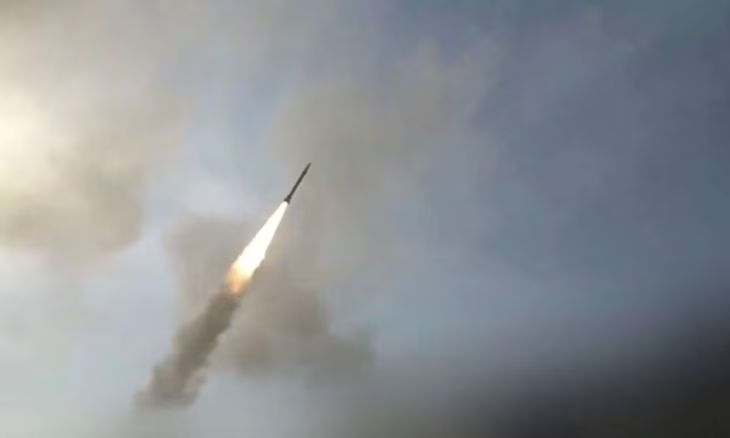
Conversely, Iran's capabilities cannot be underestimated. Over the past years, Tehran has developed an advanced missile system and has demonstrated its ability to operate in multiple theaters through its regional allies. While targeting American aircraft carriers or major bases would remain a high-cost and extremely risky option, it is not impossible should an open confrontation erupt. Any direct hit on strategic American interests would certainly mean the region entering a spiral of escalation whose outcomes cannot be controlled.

This is precisely where the danger of the situation lies: if war breaks out, it will not remain bilateral between Washington and Tehran, but will affect Gulf security, threaten the stability of Iraq, Syria, and Lebanon, and perhaps extend its effects to global energy markets, threatening the international economy with a new crisis. Therefore, the precise cost-benefit calculations of both parties make the option of a comprehensive war more likely to be brandished than actually implemented.

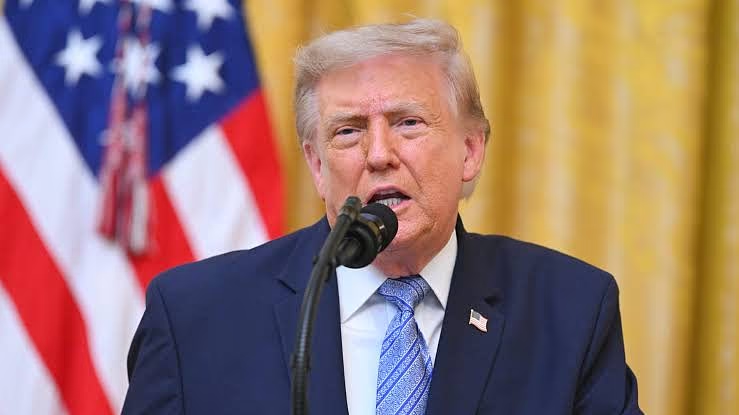
In my estimation, Trump will continue to mobilize, threaten, and warn, but he will not launch a military strike that leads to a wide regional war. The man realizes that any major slip could turn the tables on him domestically, especially in light of the political crises and scandals pursuing him, and the unrest and decline in support within his party. Despite the image he tries to project of himself as a president who does not hesitate to use force, he is not at all interested in the "Samson option" that would bring down the temple on himself and his adversaries at home and abroad.

It is more likely that this round of escalation will end in negotiated outcomes related to the Iranian nuclear program, which will be marketed domestically in Washington as a political and security achievement. If this happens, Israeli Prime Minister Benjamin Netanyahu will not dare to go it alone into a military confrontation with Iran, because any open war could mean the end of his political future, and perhaps plunge the Hebrew state into an existential dilemma, especially given its escalating international isolation after the Gaza war and the growing global calls for a just solution to the Palestinian issue.

As for Iran, it will not initiate a preemptive strike, nor will it seek to ignite a war it does not need at this stage. However, at the same time, it will not stand idly by in the face of what it considers existential threats. It will continue to develop its deterrent capabilities and strengthen its relations with Russia and China, thereby solidifying its position as a significant regional power within an international system that is gradually leaning towards multipolarity.

Iran, in historical memory, is not an emergent state, but the heir to the Persian Empire that once extended its influence over vast areas of the world. It understands that bowing under American pressure would mean undermining its regional project and international standing. Therefore, it will maneuver, negotiate, and accumulate power assets, without rushing into a comprehensive confrontation.

In conclusion: We are facing a calculated escalation, and fiery rhetoric that serves deterrence calculations more than it paves the way for war. A comprehensive military confrontation will not occur, because its exorbitant cost exceeds the capacity of both parties to bear. The Iranian regime will likely emerge with a greater presence and influence, while Washington seeks to save face through a new agreement or understanding. These are precise calculations for a war that is intended to be threatened, not to happen.
ARAB AND WORLD

Tue 21 Jul 2026 2:05 pm - Jerusalem Time

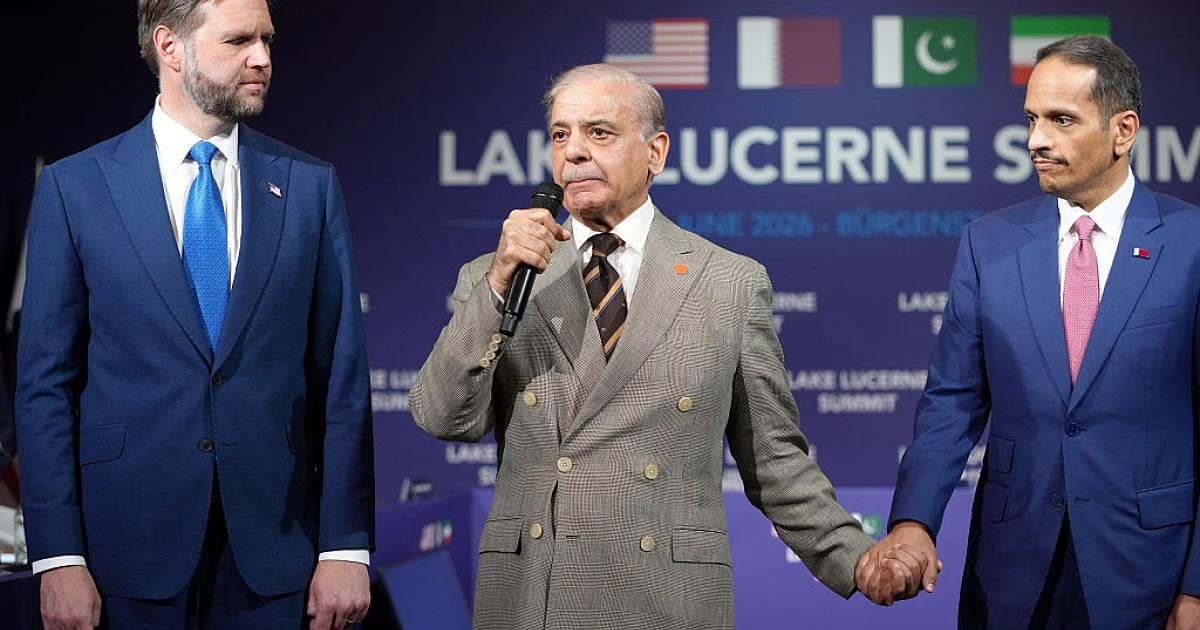
Qatari-Pakistani Mediation to End War Between Washington and Tehran: A Proposal for a 10-Day Truce

Informed government sources have revealed a diplomatic initiative led by the State of Qatar and the Republic of Pakistan aimed at defusing the escalating crisis between the United States and Iran. The new proposal includes a comprehensive plan to return to the negotiating table and end the recent hostilities, in an attempt to salvage previous understandings that collapsed earlier this month.

Regional sources reported that the US administration is currently studying the terms of the proposal, which calls for an immediate ten-day ceasefire as a test of intentions. This temporary halt aims to provide a safe environment for reopening international shipping lanes in the Strait of Hormuz, which have been directly affected by the mutual military escalation between the two parties.

Reports from Tehran indicate that the proposal is receiving attention from decision-making circles, as it is based on the principle of returning to the field and political situation that prevailed before July 9. The mediating parties consider this return to be the cornerstone for rebuilding trust and resuming meaningful dialogue to end the current state of war.

Should the proposal receive approval from both parties, an immediate round of negotiations is expected to commence, extending beyond the bilateral file to include thorny regional issues. Sources confirm that the ceasefire in southern Lebanon will be strongly present on the agenda, given its close link to the overall stability in the region.

The mediators express cautious optimism about the possibility of receiving positive responses from Washington and Tehran very soon, especially with the increasing economic and military cost of the conflict. The proposal includes precise technical conditions related to the cessation of hostilities and ensuring freedom of global navigation through the strategic Strait of Hormuz.

The proposed vision stipulates a division of tasks in the Strait, whereby the Iranian side commits to stopping any attacks in the southern passage located within Omani waters. In return, the United States commits to lifting the naval blockade on the northern passage through Iranian waters, ensuring a safe flow of global energy supplies.

The proposal also addresses the financial and administrative aspects of navigation, where the option of allowing Iran to collect service fees for providing maritime protection and environmental services is being discussed. This model is similar to what is practiced in the Strait of Malacca, where riparian states charge fees for specific services they provide to passing vessels.

There is an alternative option being circulated that stipulates depositing all collected fees into a joint financial fund under the supervision of the International Maritime Organization. This measure aims to ensure transparency in the management of the Strait's financial resources and avoid their use as a tool in the political conflict between major powers.

For its part, sources in the US administration confirmed that President Donald Trump is studying the proposal, while sending messages to allies about the need for restraint. Washington urged the Israeli side to avoid taking any unilateral military steps that could close the doors to the ongoing diplomatic efforts.

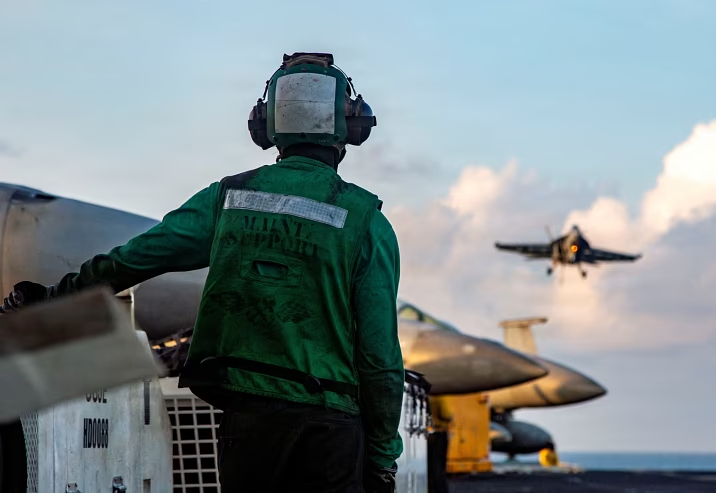
Despite the diplomatic moves, the US military continues to strengthen its capabilities in the region as a precautionary measure in case the mediation fails. Dozens of fighter jets and refueling platforms have arrived at nearby bases, a clear indication of readiness for a large-scale military escalation if necessary.

In the same context, Israeli forces have raised their alert level to the highest degree in preparation for all possible scenarios in the coming days. Military estimates indicate the possibility of limited confrontations turning into a comprehensive and coordinated military campaign, further complicating the field and political landscape.

This diplomatic activity comes at a time when the region is witnessing successive American strikes against targets within Iranian territory, met by responses from Tehran targeting American facilities and bases. The crisis escalated after Washington announced the expiration of the memorandum of understanding signed last June, following accusations against Iran of targeting commercial vessels.

The proposal aims for Washington and Tehran to return to the situation that existed before July 9 as a first step towards resuming comprehensive negotiations.

OPINIONS

Tue 21 Jul 2026 2:05 pm - Jerusalem Time

The Palestinian Authority: A State Project Halted Mid-Way

Dr. Ibrahim Nairat

Opinion Writer

The Palestinian dilemma has never been about the absence of the ability to establish institutions, but rather about the absence of an environment that allows these institutions to transform into a state. Since the establishment of the Palestinian Authority, a political entity with governing responsibilities emerged, but it remained deprived of the full prerequisites of governance. Here lies the great paradox: an authority required to act as a state, yet operating within a reality that prevents it from possessing the conditions of statehood.

After more than three decades of Palestinian governance, the question is no longer just why the Palestinian Authority faltered, but why it remained stuck in a gray area that allows neither its complete collapse nor its transformation into a fully-fledged state. The problem did not begin with a weak institution here or a financial crisis there; rather, it started from the very nature of the phase in which the Authority itself emerged: a transitional phase that never reached its end, and a political reality that did not allow for the transition from temporary administration to sovereignty.

To understand the experience of the Palestinian Authority, one must go beyond simplistic readings that reduce its trajectory to a single factor. The Authority did not operate under normal state conditions, nor was it merely a victim of external factors. Since its inception, it has faced a complex web of intertwined challenges: continued occupation, limited powers, economic restrictions, internal political divisions, security challenges, and increasing social pressures. These combined dimensions shaped the nature of the Palestinian experience and made the process of state-building more complex than merely establishing official institutions.

It was assumed that the Oslo phase would be a bridge gradually leading towards the building of a Palestinian state. That phase carried an opportunity to establish modern institutions, build an economy capable of growth, and develop a more stable political system. A real shift in the political relationship could have opened the way for a different experience, whereby Palestinian institutions would become the foundation for an emerging state, not just apparatuses for managing the affairs of the population.

However, the transitional phase turned into a permanent state. The Authority remained in its intermediate position; it has ministries, agencies, and institutions, but it does not possess full control over land, resources, borders, or many elements of political decision-making. Here lies one of the biggest paradoxes of the Palestinian experience: the existence of institutions that perform state functions, without possessing the tools that make statehood possible.

Statehood is not built merely by establishing administrative structures, but by the actual ability to make decisions, implement policies, and protect national interests. When institutions operate within a limited space due to external control, they become vulnerable to transforming from tools for building the future into tools for managing the existing reality.

The Palestinian Authority found itself facing an extremely complex equation; it is required to provide services, manage education and health, maintain public order, and address economic and social crises, yet it does not have full control over borders, resources, or economic movement. This contradiction created a gap between the scope of responsibilities and the scope of powers, leading citizens to hold the Authority responsible for crises that exceed its actual capacity to resolve.

But this challenge was not only political; it was also institutional. The Authority was forced to build governing institutions at the same time it was trying to manage a society undergoing a historical transformation. It had to balance the requirements of establishing public order, providing services, building political legitimacy, and responding to high popular expectations, all amidst limited resources and an unstable environment. This equation made the process of institution-building more difficult, as it was not a process of gradual development under stable conditions, but rather a process of building under constant pressure.

Over time, the nature of government work changed. In stable countries, governments are preoccupied with development and planning for the future, but in the Palestinian case, successive crises consumed a large part of the institutions' energy. Priorities became linked to securing salaries, addressing financial deficits, maintaining the continuity of government work, and dealing with emergency situations, instead of building a productive economy or developing long-term strategic projects.

Thus, the Authority gradually transformed from a project supposed to lead towards statehood into an apparatus that manages a continuous crisis. The issue was no longer just how to build institutions, but how to maintain them in a political and economic environment where stability itself is a daily achievement.

This crisis cannot be separated from the economic situation. A state that lacks sufficient economic capacity finds its political options limited. The Palestinian economy has operated for decades under conditions that restricted investment, weakened production, and affected the private sector's ability to grow. With limited economic opportunities, the public sector became one of the most important sources of social stability, which in turn led to increased financial burdens on the Authority and an inflated administrative apparatus.

However, reducing the Authority's crisis to the occupation alone would be an incomplete reading. There is a real Palestinian responsibility to reform institutions, enhance transparency and accountability, improve administrative efficiency, and rationalize spending. Institutions operating under difficult conditions need the trust of society more than others, and this trust is built only through good governance and the rule of law.

However, internal reform cannot be a substitute for addressing the root of the problem. Even the best management systems need a political environment that enables them to function. No institution, no matter how efficient, can fully achieve its goals if it is deprived of essential tools that enable it to implement its policies.

Building strong Palestinian institutions has never been merely an administrative project. Strong institutions give society a greater ability to organize, make decisions, and protect its interests. Therefore, the development of Palestinian institutions carries a political meaning that goes beyond the limits of daily administration. A society that possesses effective institutions is more capable of determining its future and more prepared to exercise its sovereignty when its conditions are met.

After many years of Palestinian governance, the truth appears clearer: the Authority's crisis is not merely a performance crisis, nor is it the result of only one factor. It is the result of an interaction between constraints imposed by the reality of occupation, internal challenges related to the nature of institution-building, and a continuous need for reform and development.

But the central question remains: Can a state be built without possessing the conditions of statehood? And can an institution be asked to succeed in achieving major national goals while operating within limits that prevent it from possessing all the tools for success?

The Palestinian project has remained stuck between two intertwined demands: internal reform and changing the political environment that prevents this reform from achieving its results. A state is not just government buildings, budgets, or administrative apparatuses, but rather the ability to make decisions and implement political will.

Unless Palestinian governance transforms from managing an imposed reality to an actual exercise of political power, the dilemma will persist: an authority that bears the responsibilities of a state, while the state itself remains a postponed project awaiting conditions that have not yet been met.

OPINIONS

Tue 21 Jul 2026 2:04 pm - Jerusalem Time

"Palestine should be run by Palestinians"... So why does Britain refuse to confront its legacy?

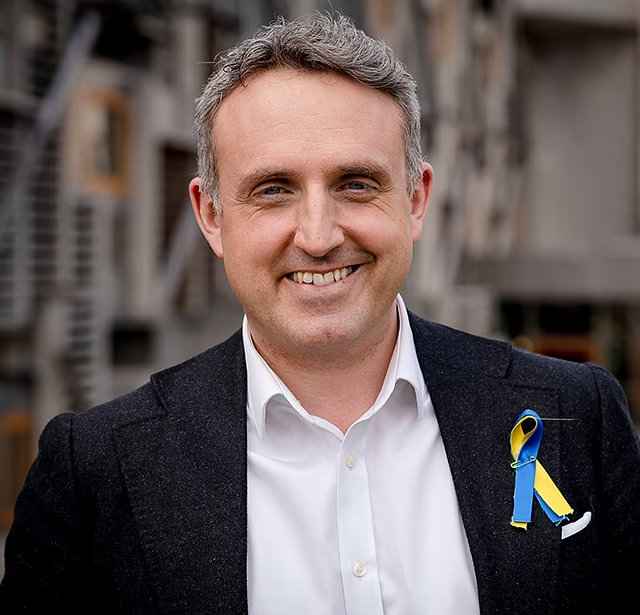
By: Alex Cole-Hamilton, Member of the Scottish Parliament and Leader of the Scottish Liberal Democrats

Over the past year, Britain has recognized the Palestinian state, imposed sanctions on extremist settlers and hardline ministers in the Netanyahu government, and committed £10 million to support essential services provided by the Palestinian Authority to citizens.

However, one sentence in Foreign Secretary Yvette Cooper's recent statement caught my attention. Speaking about Palestinian governance, she simply said: "Palestine should be run by Palestinians." She is right, but the problem is that Britain spent three decades working to prevent that from happening. When Britain controlled Palestine between 1917 and 1948, the rights of Palestinians were not neglected by mistake, but deliberately pushed aside. Britain has never acknowledged that suffering, nor even the role played by its methods of control and coercion in entrenching many of the practices we see today.

This is the central question posed by the "Britain Owes Palestine" campaign to the government in a 400-page legal petition, prepared by a number of senior lawyers and historians.

The petition reviews a disturbing history largely absent from public awareness. In 1917, Britain, through the Balfour Declaration, committed to supporting the establishment of a national home for Jews in a land where over 90% of the population was Arab, without obtaining the consent of the landowners living there. In the decades that followed, Britain deprived the Palestinian majority of any real and effective democratic participation. When the formation of a legislative council with an Arab majority was proposed, the British Parliament voted to reject the proposal.

The United Kingdom's failure to create the necessary conditions for a two-state solution before the end of the Mandate established a long era of violence and conflict.

Today, if we are serious about finding a long-term solution where Arabs and Jews live side-by-side in peace, we must be clear and firm in supporting free and fair legislative and presidential elections in all occupied territories, elections that President Mahmoud Abbas confirmed would be held in November 2026 and early 2027. These elections represent an opportunity to regain control of the Gaza Strip from Hamas, and pave the way for achieving peace and security for both sides.

We must also empower moderate forces in Israeli and Palestinian societies, and withdraw influence from extremist currents, including through advancing multilateral plans to disarm Hamas, and ensuring the imposition and application of sanctions on Benjamin Netanyahu and the extremist ministers in his government.

Britain should also prohibit all forms of trade in goods and services with illegal settlements in the occupied territories, recognizing that these settlements represent one of the biggest obstacles to achieving a two-state solution. As long as Israeli settlers are able to seize and control more land, supported by the military force of the Israeli army, there will be no real peace in the region. This also makes the establishment of a stable Palestinian state more difficult, by depriving it of water resources and agricultural land.

But any viable solution also requires Britain to confront its historical failures.

When the Palestinian Arab Revolt broke out between 1936 and 1939, Britain responded with policies of collective punishment, military courts, and methods that the British Colonial Secretary secretly admitted to the Cabinet included "atrocities" committed by the police and deliberately concealed from Parliament. At least 5,000 Palestinians were killed and 15,000 others injured during that period.

When Britain withdrew from Palestine, about 750,000 Palestinians were displaced during the subsequent war, which the petition describes as foreseeable and avoidable, and linked to Britain's abandonment of its responsibilities. Subsequently, the British Parliament passed legislation that retroactively granted immunity to all British officials from legal prosecution for actions they committed during the Mandate period.

Britain bears responsibility for what it did, and also for the effects of those actions that are still present today. Look at Palestine today, and you will find that the use of military courts, collective punishment, and property demolition are practices that characterized the British Mandate period, and are still used by Israeli authorities. A state that today claims to defend the rights of Palestinians, while at the same time refusing to deal with a legal petition concerning the acts of oppression it itself practiced, is not applying its principles consistently. No party can be an honest broker in an issue it contributed to destroying without first acknowledging what it committed.

Last September, I stood in the Scottish Parliament chamber in Holyrood and said that recognizing the Palestinian state is a fundamental step towards peace, and that the Liberal Democrats have no doubt that the actions of the Israeli government and the Israeli army constitute a violation of international law, and that the British government must take additional steps by imposing a comprehensive ban on arms exports and specific sanctions on the Netanyahu government. The Scottish Parliament voted 65 to 24 in favor of that position. Scotland has expressed its position on the current crisis, but the accountability of the British Parliament must also include confronting the historical question.

While the Scottish Parliament cannot bind the British Parliament on issues within its jurisdiction, Scotland has always been willing to use its voice to speak on issues beyond its local powers. The cross-party consensus in the Scottish Parliament on recognizing the Palestinian state, restrictions on arms exports, and respect for international law reflects a broad trend in Scottish society. This consensus should now push for an additional step: demanding that Britain honestly confront its history, a history that contributed to creating the conditions we are trying to address today.

Despite nine months having passed since the petition was delivered to the British government, and a parliamentary group comprising 45 MPs and Lords from various parties having written to the Prime Minister demanding a response, no response has been issued yet. The main petitioner, Munib al-Masri, who was shot by British soldiers as a teenager, along with thirteen other Palestinians whose families were directly affected by the policies of the British Mandate period, are still awaiting an answer.

Britain should not only ask what it can do today to achieve more peace and justice for Palestinians and Israelis, but it must also ask itself about its role in creating the current crisis.

Therefore, I call on members of the Scottish Parliament, from all parties, to join me in demanding that the British government finally respond to this petition. I also call on it to honestly confront its record during the Mandate period, and to realize that peace built on selective memory is not a sustainable peace.

ANALYSIS

Tue 21 Jul 2026 11:23 am - Jerusalem Time

Trump Vows Harsh Punishment for Iran After US Soldiers Killed, Military Escalation Threatens Wide Regional Confrontation

Said Erikat

Opinion Writer

Washington Message

Washington – Said Erikat – 21/7/2026

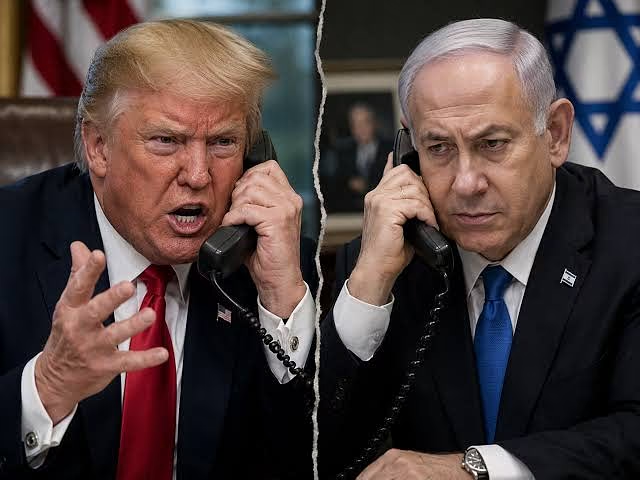
The confrontation between the United States and Iran has entered a more dangerous phase after US President Donald Trump vowed to punish Tehran for the killing of American soldiers, emphasizing that Iran "will pay a price many times over," indicating that Washington is preparing to expand its military operations, while Tehran continues to respond by targeting American sites, bases, and interests in the region, amid the collapse of the fragile truce and the failure of diplomatic efforts.

Trump's statements came hours after he confirmed that the recent American strikes, carried out for the ninth consecutive night, were in honor of three American soldiers recently killed, two in Jordan and the third in Iraq, a development that represents a significant turning point in the nature of the confrontation, as the death of American casualties has become a pressure factor on the US administration to adopt a stronger response.

The US Central Command (CENTCOM) announced that the strikes targeted military sites and communication facilities inside Iran, as part of a campaign aimed at reducing Tehran's ability to carry out attacks against ships transiting the Strait of Hormuz, which is one of the most important maritime passages for oil and gas transportation in the world.

In contrast, Iran announced that it targeted sites in Bahrain and Syria, and also attacked American aircraft in Jordan, while Iranian President Masoud Pezeshkian affirmed that his country is engaged in a "total war" with the United States, a description that reflects the transition of the conflict from a phase of limited mutual strikes to an open, multi-front confrontation.

Despite the military escalation, Tehran revealed that diplomatic communications have not been completely cut off, and messages are still being exchanged through regional and international mediators, in an attempt to maintain a narrow window for dialogue, despite the collapse of the ceasefire agreement initially concluded in mid-June, and the halt of negotiations aimed at establishing a permanent settlement.

The scope of the confrontation expanded to include a number of neighboring countries, as the Jordanian army announced the interception of three Iranian missiles heading towards the kingdom's territory, while sirens blared in different areas warning of imminent attacks.

In Kuwait, the armed forces announced the interception of Iranian drones, while Bahrain confirmed that its air navigation systems were subjected to a drone attack, noting that air traffic was not directly affected.

Inside Iran, local media reported that several cities, including Tabriz, Chabahar, Konarak, Bandar Mahshahr, and Bandar Imam Khomeini, were subjected to American strikes, while official reports spoke of the explosion of two oil tankers while transiting the Strait of Hormuz.

The Iranian Revolutionary Guard announced that the two tankers were crossing what it described as the "unsafe southern route" of the strait, confirming that they exploded and stopped moving, while the US Central Command denied the validity of this account.

The Revolutionary Guard warned that the Strait of Hormuz "will not be safe for the passage of petrochemical products or oil and gas" as long as American strikes continue, vowing to carry out a "punitive operation" against the United States, a threat that raises global market fears of widespread disruptions in energy supplies.

The US Department of Defense had confirmed over the weekend the death of an American soldier in an Iranian attack in northern Iraq, after previously announcing the death of two other soldiers in an attack targeting a US base in Jordan. The department identified the deceased as Private Isabella Gonzalez, 19, and Lieutenant Tyler James Feehan, 25, while the search for a third soldier lost during the attack is still ongoing, after human remains that have not yet been identified were found.

Despite the ongoing military operations, US Secretary of State Marco Rubio affirmed that the United States remains open to a diplomatic solution, but at the same time stressed that the international community is required to decide its position on allowing Iran to control one of the most important international waterways, considering that Tehran uses the Strait of Hormuz as a political and military pressure tool to achieve strategic gains.

These developments come after the initial agreement that had temporarily halted fighting in mid-June collapsed, at a time when Trump announced on July 8 that the agreement was "over," leading to the failure of peace negotiations and the return of both parties to a policy of mutual military escalation.

Observers fear that the continuation of strikes and Iranian responses will expand the circle of conflict to include more countries in the region, especially with Jordan, Bahrain, and Kuwait directly entering the theater of defensive operations, which raises the probability of a regional confrontation whose repercussions will be difficult to contain.

The killing of American soldiers constitutes a strategic turning point in the conflict, because US administrations, regardless of their political orientations, face immense internal pressure to respond when American military personnel fall on the battlefields. This reality gives Trump a political justification to expand military operations, but in return, it raises the risks of sliding into a wide regional war that is difficult to control. Every larger American strike will likely be met with stronger Iranian responses, creating a cycle of mutual escalation that may go beyond deterrence goals to an open confrontation that exhausts both parties and increases instability in the Middle East.

The return of the Strait of Hormuz to the forefront of the confrontation confirms that the conflict is no longer only about Iran's nuclear program or the American military presence, but has become about global energy security. The strait represents a vital artery for oil and gas trade, and any prolonged disruption in it will have direct repercussions on global prices, markets, and supply chains. Hence, Washington seeks to prevent Iran from turning the strait into a strategic bargaining chip, while Tehran sees threatening navigation as providing it with an effective deterrent in the face of American military superiority.

Despite the mutual escalatory language, the continued exchange of messages through mediators reveals that both parties have not cut off the last threads of political communication. The United States realizes that a complete military decisive victory against Iran carries a high strategic and economic cost, while Tehran knows that the continuation of the war threatens its economy and internal stability. Therefore, military operations may continue in parallel with undeclared negotiations, in a model that combines field pressure and political bargaining, awaiting a moment that allows for the relaunch of a new negotiation path if appropriate regional and international conditions are available.

OPINIONS

Tue 21 Jul 2026 11:23 am - Jerusalem Time

Marwan Barghouti: Key to Unity and Settlement","seo_title":"Marwan Barghouti: Key to Unity and Settlement

Marwan Barghouti is not merely a Palestinian prisoner who has spent nearly three decades behind bars, nor just a prominent leader in the Fatah movement. Rather, he is one of the most prominent leaders who embodies an entire trajectory of the development of the Palestinian national movement, with all its sacrifices and transformations, and its transition from popular resistance to the pursuit of a just political settlement based on international legitimacy, without abandoning immutable national rights.Perhaps his recurring return to the forefront of attention is explained not only by his standing within Palestinian society, but also by his position in regional and international political calculations. Whenever the need arises to rebuild the Palestinian political system, restore its unity, or search for a leadership that enjoys broad national legitimacy, the name Marwan Barghouti reappears as one of the few names whose presence transcends organizational and factional boundaries, touching upon the idea of inclusive national leadership.The issue is not just about a person, but about what he represents as a possibility for the convergence of three elements rarely found in a single political figure: militant legitimacy, popular presence, and the ability to address the political future away from the logic of endless conflict management.Barghouti rose through the ranks of the national movement from his early youth, and was one of the most prominent leaders of the student and national movement in the West Bank during the 1970s and 1980s. Along with a whole generation of field, trade union, and popular leaders, he contributed to creating the organizational, political, and popular environment that paved the way for the outbreak of the Great Palestinian Intifada in 1987.Despite his expulsion from the homeland before its outbreak, from his position abroad, he became one of the most prominent leaders supporting the Intifada politically and organizationally, alongside the martyr Khalil al-Wazir (Abu Jihad), who was one of the most prominent leaders who supported the Intifada and its unified national leadership. After his assassination in 1988, Barghouti continued this role within the framework of working with President Yasser Arafat, before returning to the homeland in April 1994.This path was not merely a transition between organizational positions, but an expression of his belonging to a national school that believed that political and popular struggle does not contradict the search for a historical solution that ends the occupation and achieves freedom, independence, and return. This school understood that the strength of any Palestinian leadership is measured not only by its ability to endure, but also by its ability to transform sacrifices into a viable political project.Marwan Barghouti was not a proponent of peace at any cost, nor was he an advocate of managing the conflict as an eternal fate. He started from a clear political conviction that the Palestinian-Israeli conflict can only end with the end of the occupation, the embodiment of the Palestinian people's right to self-determination, and the establishment of their independent state based on international legitimacy resolutions and international law.Peace does not mean abandoning rights, but rather that both parties realize that a historical settlement, if based on mutual recognition and a minimum of justice, is the only way out of the cycle of open conflict. Therefore, leaders capable of making peace are not necessarily the most accepted in moments of confrontation, but rather the most capable of convincing their people that possible peace is better than endless war.This is what national leaders in various conflicts have realized throughout history. The strength needed for peace is not only the strength of weapons, but the strength of legitimacy and the ability to bear the responsibility of historical decisions. Only leaders who possess the trust of their people can move from the stage of conflict to the stage of settlement without losing their national legitimacy.This understanding intersected with the vision of a number of Palestinian national leaders, and perhaps with some Israeli leaders who experienced the cost of the bloody conflict, but lacked the political will and courage necessary to move towards a historical settlement whose essence is the recognition of the rights of the Palestinian people as defined by international legitimacy, and not a settlement between masters and slaves as most successive Israeli governments have tried to impose, especially the current government.Segments of the Israeli right have gambled on the possibility of weakening the Palestinian leadership or producing a leadership that accepts less than what the Palestinian people can accept, instead of confronting the essence of the conflict and addressing its historical and political causes. The result was a tragic path represented by the assassination of Yasser Arafat, the arrest of Marwan Barghouti, and then the continued targeting of political paths and figures associated with more pragmatic options within the Palestinian arena, which, along with other Palestinian, regional, and international factors, contributed to paving the way for the rise of the extreme Israeli right, the Daesh-like national religious right, and racist currents that see the continuation of the conflict as a tool to preserve their political project.Marwan Barghouti's importance does not come from being a copy of Yasser Arafat, for each has his own historical context and personal and political characteristics, but the comparison between them imposes itself when discussing the nature of Palestinian leadership capable of dealing with major moments of transformation.Yasser Arafat was the leader of the contemporary political founding phase of the Palestine Liberation Organization, and the man who succeeded, through decades of national work, in transforming the Palestinian issue from a refugee issue to an issue of a people with internationally recognized political rights. He possessed an exceptional ability to build the Palestinian national movement and maintain its presence despite complex regional and international circumstances, and then made the historical decision to move from the logic of revolution to the logic of state and political settlement.As for Marwan Barghouti, his personality was shaped in a different generation; the generation of the First Palestinian Intifada, which grew up under direct occupation, and experienced the Palestinian people's ability for mass action and popular organization within the homeland. Therefore, his presence gained from the position of a field and political leader who combined organizational work and popular presence, before becoming one of the most prominent Palestinian figures who linked national struggle with the need for a serious political horizon to end the conflict.The most important similarity between the two men lies not only in belonging to a single political and national school, but in the nature of the legitimacy they relied on, which is a legitimacy stemming from direct national experience, and from the ability to address the people, not from an imposed position or external legitimacy. Both understood that any Palestinian leadership capable of making historical decisions first needs the trust of its people and national institutions based on popular participation.However, the difference between them is no less important than the similarity. Arafat led the PLO at a time when the Palestinian national movement was fighting a battle to establish the political existence of the Palestinian issue at the international level, and then went through the experience of governance with all its complexities and contradictions after the establishment of the National Authority. Barghouti, on the other hand, remained away from exercising executive power, which kept him out of many of the burdens of the daily experience of governance, but at the same time deprived him of the opportunity to test his political and institutional vision in managing practical reality.Nevertheless, the most prominent common factor remains the same historical question: how can a people under occupation preserve their national rights, and at the same time have a leadership capable of making difficult decisions when a real opportunity arises?Arafat ultimately realized that peace requires an Israeli partner capable of making painful decisions, just as it requires a Palestinian leadership that possesses the legitimacy to bear the responsibility for those decisions. Perhaps Barghouti's importance, for those who see him as a figure capable of playing a historical role, lies in his possession of some of the components of this equation: a militant history that grants him legitimacy, a political vision that opens the door to settlement, and a potential ability to address a wide Palestinian public.However, any historical role for Marwan Barghouti, as for any other Palestinian leader, cannot succeed outside the framework of rebuilding democratic national institutions, ending the division, and restoring the unity of Palestinian decision-making. Symbols may open doors, but they alone cannot build the future. Only strong institutions and popular legitimacy are capable of transforming historical moments into a sustainable national project.Ultimately, the issue is not Marwan Barghouti as a person, nor about transforming any leader into a substitute for the people or for national institutions. Peoples do not build their future with symbols alone, no matter their historical standing, but with democratic institutions, popular legitimacy, and the ability to transform sacrifices and aspirations into a viable political project.But history also teaches us that some personalities, in moments of great transformation, become more than just individuals. They embody the experiences of generations, and carry in their presence the possibility of overcoming divisions and opening new paths. Hence comes the importance of Marwan Barghouti, not as the only solution, but as one of the most prominent potential keys to rebuilding an inclusive Palestinian national center, capable of combining internal unity and realistic political vision.Therefore, the first step that cannot be bypassed by Palestinians is to restore internal legitimacy through presidential elections followed by free legislative elections, which rebuild the relationship between the people and their leadership, and pave the way for renewing national institutions on the basis of participation, accountability, and ending the division.Elections are not just an internal Palestinian matter, but are part of the conflict equation itself. For a people cannot enter a new historical stage without a leadership based on a clear popular mandate, nor can any international or regional party deal seriously with a Palestinian partner unless this partner stems from the will of its people and its institutions.In contrast, Israel also faces a historical imperative that cannot be escaped. Experience has proven that military force, no matter how great, cannot produce lasting peace or security. Israel must learn lessons from the history of the conflict, and realize that its future cannot be built on genocide and the continuation of occupation or annexation or conflict management, but on the recognition that true security is linked to ending the causes of the conflict.It is noteworthy that Marwan Barghouti's name is no longer present only in Palestinian and Israeli discussions, but has also appeared in international political calculations. US President Donald Trump referred to him by name during discussions related to the prisoner exchange deal and stopping the "war" in Gaza, reflecting an understanding that the issue of Palestinian leadership must be part of any long-term political arrangements. This puts Trump to a real test that is consistent with his political pragmatism. Will he be content with managing crises and making temporary deals, or will he realize that Israel's own interest does not lie in open wars, but in a historical settlement that ends the conflict?Despite Trump's known biases towards Israel, any realistic reading of the future of the region should lead him to realize a fundamental truth: that the Israeli people's need for peace is no less than the Palestinians' need for this peace to be just, because the continuation of the conflict threatens to turn Israel's military power into a permanent strategic burden.However, this peace cannot be born from policies driven by the logic of annexation, liquidation, and absolute force. The path taken by successive Israeli governments, from the acceleration of annexation projects, the expansion of settlements, and attempts to politically liquidate the Palestinian issue, all the way to the war of genocide in the Gaza Strip, as described by many experts and international human rights organizations, reveals the depth of the crisis facing the future of the region.Peace is not built on the ruins of a people, nor on an attempt to erase a deeply rooted national identity, nor on imposing a permanent reality by force. Attempts to subjugate the Palestinian people or bypass their national rights will not end the issue, but will reproduce the conflict in more dangerous forms. Therefore, any real opportunity to exit this path requires effective international intervention, not limited to crisis management or temporary ceasefires, but working within the framework of international law and international legitimacy resolutions.What is required is not just a new agreement, but a change in the rules of the game; Palestinian internally through restoring legitimacy and unity and building institutions, Israeli through moving from the logic of control to the logic of recognizing Palestinian national rights, and internationally through taking responsibility for ending a conflict that has lasted longer than it should.In this equation, Marwan Barghouti remains a symbol of a question larger than himself: Can Palestinians and Israelis transform decades of conflict into the beginning of a new path, or will everyone remain prisoners of the logic of war that has produced nothing but more blood and losses?Peace between enemies is possible, but it requires leaders who possess legitimacy and courage, and an international community that possesses the will to prioritize the logic of law over the logic of force.

OPINIONS

Tue 21 Jul 2026 11:23 am - Jerusalem Time

Eisenkot Moves "Second Israel" from the Margins to the Center: A Palestinian Reading of Structural Transformations in Israeli Society

The current Israeli elections transcend the traditional competition between right and left, bringing to the forefront one of the deepest divisions in the Israeli social and political structure: the division between what is known as "First Israel," representing the Ashkenazi elites who founded the state, and "Second Israel," which primarily includes Eastern Jews (Mizrahim), who for decades constituted a broad social base without receiving representation commensurate with their demographic weight. In this context, former Chief of Staff Gadi Eisenkot emerges as a figure different from previous Eastern experiences. The man is not fighting his battle from a position of protesting marginalization, but from a position of seeking to lead the state itself. From a Palestinian perspective, this transformation cannot be read as merely a redistribution of power centers within the Israeli political system, but rather as an indicator of deeper changes affecting the social structure of the state and the limits of its ability to contain its historical contradictions. It is difficult to understand Eisenkot's rise without returning to the experience of Jews who came from Arab and Islamic countries during the first decades of Israel's establishment. The waves of Eastern immigration were absorbed into the nascent state's project, but the absorption process was not equitable with that enjoyed by those who came from Europe. Tens of thousands were housed in transit camps (Ma'abarot), then many were moved to development towns in the periphery, where they took on security and economic roles far from centers of political and economic influence. Eastern culture was also subjected to continuous pressure within the framework of the "melting pot" policy, which aimed to produce a new Israeli identity dominated by a European character, which was reflected in educational opportunities, political representation, and the social status of the children of this group. Despite the gradual improvement in the conditions of the Mizrahim in subsequent decades, Israeli studies and reports issued by research and official institutions, including the Israel Democracy Institute and the Central Bureau of Statistics, still indicate the persistence of gaps in income levels, education, and representation within a number of state institutions, although these gaps have narrowed compared to the first decades of Israel's establishment. Israeli political history has witnessed several attempts to represent the Mizrahim politically, but most of them remained confined to sectarian demands or failed to penetrate the highest decision-making centers. Aharon Abuhatzira, through the "Tami" movement, tried to transform social grievances into a political project, but its impact remained limited. As for David Levy, despite his widespread popularity within the Likud, he was still seen as a representative of marginalized classes rather than a natural candidate to lead the state. Even Shaul Mofaz, who reached the highest military positions, could not transform his security status into a unifying political leadership. These experiences revealed that access to the military establishment does not necessarily mean access to the top of the political pyramid, and that the "glass ceiling" faced by Eastern politicians remained present, albeit to varying degrees, in the structure of the Israeli political system. Gadi Eisenkot represents a qualitative development in this path. He does not present himself as a representative of a sect or ethnic group, nor does he rely on a discourse of grievance, but rather seeks to present himself as a statesman with security and institutional experience that qualifies him to lead Israel in a stage characterized by complex internal and external crises. His descent from a Moroccan family, and his ascent to the head of the General Staff and then to the forefront of the political scene, give his candidacy a symbolic dimension that transcends his person, as it reflects a gradual transformation in the position of "Second Israel" within the state structure. This path also reflects an increasing maturity in the integration of Mizrahi elites within state institutions, so that Eastern affiliation is no longer seen as a structural impediment to reaching the highest leadership positions as it was in previous decades. This model differs from the experience of the "Shas" movement, which built its influence on the religious identity of the Mizrahim. Eisenkot seeks to address the entire Israeli society, not a specific Eastern audience, which gives him a greater ability to penetrate traditional barriers between different social components. The importance of Eisenkot's rise, from a Palestinian perspective, lies not so much in his person as in what it reveals about the nature of transformations within Israeli society. The gradual transition of Eastern Jews from the margins of the political system to its center reflects a change in the balance of social forces, but at the same time it reproduces questions of identity, elite, and the nature of the state. The continued debate about the relationship between Ashkenazi and Eastern elites indicates that the "melting pot" project did not fully succeed in overcoming the cultural and social differences that accompanied the establishment of the state. At the same time, these transformations intersect with other divisions related to religion and secularism, and to the relationship between the center and the periphery, and between the judiciary and the executive authority, which makes the Israeli scene more complex than traditional party competition suggests. Analysis of the numbers: What do opinion polls say? Gadi Eisenkot's rise is not limited to his symbolism as one of the most prominent sons of "Second Israel," but has begun to be tangibly reflected in Israeli opinion polls. Polls published in July 2026 showed that the party he leads is competing with the Likud party for the top of the political scene, with its representation ranging between 21 and 24 seats, compared to 21 to 23 seats for Likud, with results varying between polling institutions. Some polls also showed Eisenkot ahead of Benjamin Netanyahu in the question of "the most suitable person to head the government," an indicator that reflects a shift in the general mood among a segment of Israeli voters in light of the repercussions of the war and the ongoing political crisis. However, these results do not necessarily mean that the path to the premiership has become paved for Eisenkot; the nature of the Israeli parliamentary system makes the formation of a government dependent on the ability of any candidate to build a coalition that enjoys the support of at least 61 members of the Knesset. Therefore, the real challenge for him may remain in engineering political alliances more than winning a number of seats. From this perspective, the polls acquire importance that transcends their electoral dimension, as they suggest that an increasing part of Israeli society is more willing to accept a personality belonging to "Second Israel" in a position of state leadership, a transformation that carries social and political implications that go beyond the immediate party competition. Conclusion Gadi Eisenkot's rise is not merely a fleeting electoral event, but reflects a transformation in the structure of Israeli society and its internal balances. If his potential success expresses the progress of "Second Israel" towards the center of decision-making, it also reveals the continuation of the structural tensions that have accompanied the Zionist project since its inception, and which the policies of integration and assimilation could not fully end. From a Palestinian perspective, the importance of these transformations lies not only in changing faces within the Israeli leadership, but in understanding how elites and power balances within the state are reconfigured, and its reflection on decision-making in conflict, security, and foreign policy issues. Therefore, monitoring these transformations represents an analytical necessity for understanding Israeli society and its future trends, more than it is a monitoring of a fleeting electoral competition.

PALESTINE

Tue 21 Jul 2026 11:23 am - Jerusalem Time

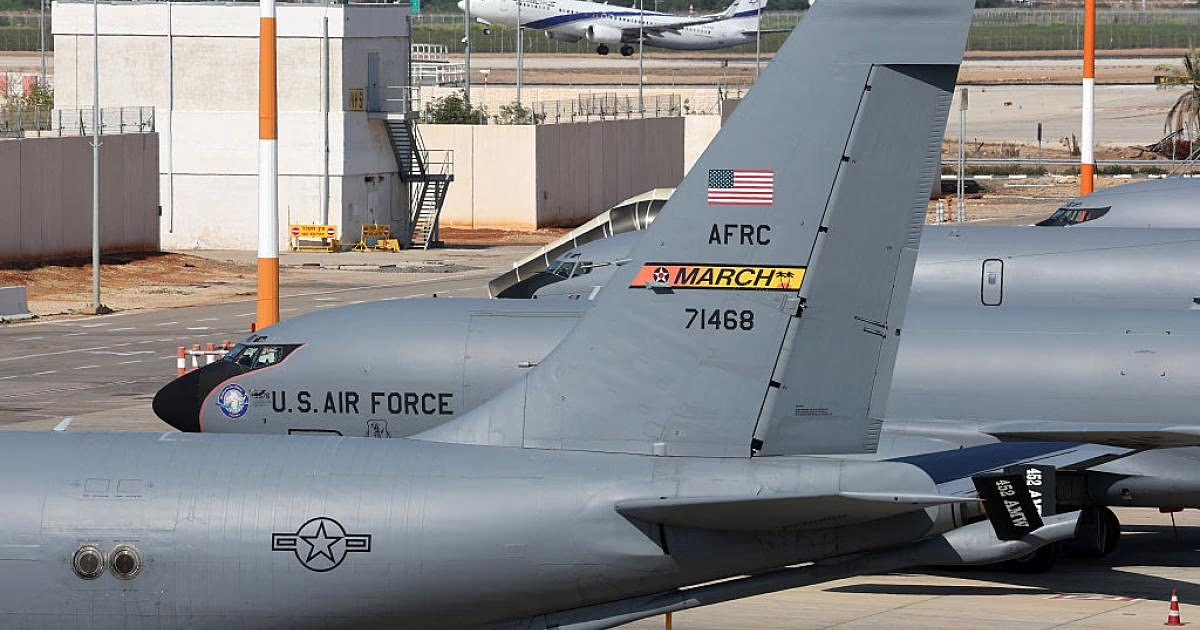
US refueling planes disrupt Ben Gurion Airport, thousands of tickets expected to be canceled daily

Hebrew media sources revealed a severe operational crisis facing Ben Gurion International Airport near Tel Aviv, as a result of allocating large areas to accommodate refueling aircraft belonging to the US Air Force. The sources explained that these measures come within the framework of strengthening the US military presence in the region to confront increasing Iranian threats.

Estimates discussed during the airport's emergency plan indicated that accommodating 7 American refueling aircraft would necessarily lead to the cancellation of about 5,000 travel tickets daily. Airport authorities fear that this military congestion could lead to partial paralysis in civilian air traffic and incur huge financial losses.

In a related context, informed sources stated that the US administration informed the Israeli side of its intention to escalate military operations against Iranian targets in the coming days. The notification included coordination for the transfer of additional military equipment and ammunition to support US fighter jet squadrons deployed in regional bases.

More than 10 refueling aircraft have already arrived in the occupied territories, as part of Washington's preparations to respond to any attacks that may target its interests in the Middle East. These intensive aerial movements aim to ensure the ability of fighter jets to remain in the air for longer periods during potential combat missions.

Reports quoted sources in the Israeli Air Force as saying that the US plan includes deploying about 100 refueling aircraft in various military bases, including Ramon Airport in the south. The sources confirmed that the widening scope of confrontation with Tehran may necessitate diverting more of these aircraft to Ben Gurion Airport despite civilian pressure.

Last weekend witnessed the arrival of 14 additional US aircraft of types designated for aerial supply, reflecting the seriousness of the ongoing military preparations. These aircraft serve as a fundamental pillar in any long-range aerial warfare effort that requires reaching deep into Iranian territory.

Washington had pressured Israeli authorities to lift previous restrictions on military aircraft landing at civilian airports. These pressures resulted in the full opening of Ben Gurion Airport runways to US military traffic, overcoming technical and logistical objections.

The roots of the current crisis go back to the freezing of previous plans aimed at clearing space for military aircraft during the busy summer travel season. With the development of events on the ground, security and military necessities outweighed the commercial interests of airlines and civilian passengers.

It is worth noting that the region has been experiencing a state of severe tension since February 2026, when the United States and Israel launched widespread attacks on Iran that left thousands dead. Despite intermittent periods of calm, US President Donald Trump's announcement of the end of the ceasefire this July reignited the confrontation.

Tehran, for its part, insists on imposing new mechanisms for regulating navigation in the Strait of Hormuz, which Washington considers a threat to the freedom of international trade. With the continued military buildup at Ben Gurion Airport and other bases, it appears that the region is heading towards a new round of direct conflict.

Allocating additional sites for US military aircraft at Ben Gurion Airport will lead to severe financial and operational losses and the cancellation of thousands of civilian flights.

PALESTINE

Tue 21 Jul 2026 11:21 am - Jerusalem Time

Gaza Health: The number of martyrs rises to 73,283 since the start of the aggression

The Ministry of Health in the Gaza Strip has issued a new statistical report revealing the immense human losses since the outbreak of the aggression on October 7, 2023. The ministry confirmed that the cumulative toll of martyrs has risen to 73,283 martyrs, whose data has been officially documented in the records of medical facilities. The data also indicated that the number of injured and wounded reached 173,864 injuries, with varying degrees of severity between critical and moderate cases.

Regarding field developments in recent hours, medical sources reported the arrival of 3 martyrs and 22 injuries to hospitals in the past 24 hours. These cases were registered immediately upon their arrival at emergency departments in various governorates of the Strip, where medical teams began providing necessary care to the injured and following up on burial procedures for the new martyrs according to established protocols.

The ministerial report addressed the period following the announcement of the ceasefire on October 11, where statistics recorded a continued fall of victims. The number of documented martyrs in this specific period reached 1,158 martyrs, while the number of recorded injuries since that date rose to 3,756 injuries, reflecting the ongoing health and field challenges in the Strip.

Regarding search and rescue operations, the ministry clarified that its specialized teams have managed to carry out 802 cases of retrieving victims from under the rubble or from border areas since October 11. These operations take place under complex logistical conditions and a severe shortage of heavy equipment, yet official documentation continued to ensure the preservation of victims' rights and the verification of their identities in national records.

The Ministry of Health stressed that all announced figures, whether cumulative, which reached 73,283 martyrs, or daily, are subject to a strict auditing mechanism through epidemiological and informational monitoring departments. Data is collected from all governmental and private hospitals and field health centers to ensure the accuracy of the final toll presented to the public and relevant international human rights bodies.

Hospitals in the Gaza Strip face immense pressure amid the continuous influx of wounded, as emergency departments recorded the distribution of the three martyrs and the last 22 injuries within the daily estimates submitted to the Ministry's office. Sources confirm that these numbers represent only what medical teams were able to reach and document within the health system, while there are still numbers under the rubble.

In conclusion, the ministry affirmed its continued updating of this data periodically to reflect the reality of human suffering in the Strip. This statistic, which indicates that injuries have reached 173,864 cases, is evidence of the extent of direct targeting of civilians and infrastructure, requiring urgent international intervention to provide essential medical supplies to exhausted hospitals.

The cumulative number of martyrs since the beginning of the aggression on October 7, 2023, reached 73,283 martyrs, while injuries reached 173,864 cases.

ARAB AND WORLD

Tue 21 Jul 2026 11:21 am - Jerusalem Time

New British Prime Minister Pledges Urgent Measures to Tackle Cost of Living Crisis

The new British Prime Minister, Andy Burnham, launched his first political and economic pledges from outside 10 Downing Street, emphasizing his commitment to implementing immediate measures to address the escalating cost of living crisis that is troubling citizens. Burnham clarified that these measures would come into effect this week, as a preliminary step before unveiling a comprehensive ten-year national plan aimed at reshaping the country's economic and social future.

In his inaugural speech, Burnham stressed the need to restore lost stability in the United Kingdom, considering that the government's performance in the past period did not meet the aspirations of the British people. He indicated that his government would operate with absolute transparency, explaining to the public how the new measures would be funded to ensure financial credibility and adherence to the strict economic rules adopted by the state.

Regarding youth, the new Prime Minister pledged to revolutionize the education system to link it more effectively with the labor market, with a focus on providing intensive psychological support for young people. His vision also included expanding the construction of low-rent housing, considering that providing adequate housing is the cornerstone of reducing social welfare expenses and achieving sustainable justice.

Burnham acknowledged the significant challenges facing his position, being the seventh leader to head the country in just over ten years, which reflects a state of political instability. Nevertheless, he put forward an ambitious vision aimed at building a new political and economic institution that ends extreme centralization and grants broader powers to regions to manage their affairs and develop their local economies.

The Prime Minister pledged to end the phenomenon of homeless people sleeping on the streets, describing it as a stigma that must be addressed through radical solutions to the public system that has deviated from its course for decades. Burnham criticized the privatization policies that began in the 1980s, emphasizing that his government would seek to return essential services to stronger public control to ensure their accessibility to all citizens at affordable prices.

On the domestic policy front, Burnham called for adopting a 'cooperative politics' approach that focuses on solving national problems rather than engaging in partisan squabbles and political point-scoring. He affirmed that transferring power from the capital London to various regions of the country would contribute to building a new economy that restores the essentials of life to citizens and makes them accessible to everyone once again.

Burnham, 56, takes office after a successful career as Mayor of Greater Manchester, where he built a strong popular base in northern England. Burnham succeeds Keir Starmer as Prime Minister, who resigned in June after a short period following the Labour Party's landslide victory in the July 2024 elections.

Media sources reported that the new government might greenlight the development of oil and gas fields in the North Sea, in a move aimed at enhancing national energy security and alleviating financial burdens. This approach received early praise from former US President Donald Trump, who believed that investing in these resources would transform Britain into one of the wealthiest countries in the world.

Keir Starmer had announced his resignation as Prime Minister after a sharp decline in his popularity and an escalation of internal opposition within the Labour Party due to decisions described as controversial. Despite his resignation, Starmer defended his political legacy, asserting in his farewell speech that the United Kingdom had become fairer and stronger during his two years in power.

Burnham's government faces a real test in balancing defense commitments to international partners with increasing domestic economic pressures. Observers believe that Burnham's success depends primarily on his ability to deliver on his urgent promises regarding the cost of living while maintaining the unity of the Labour Party, which has experienced sharp divisions recently.

The new Prime Minister concluded his speech by emphasizing that Britain is entering a new phase of hard work, where the priority will be tangible results that citizens feel in their daily lives. He indicated that adherence to financial rules would not be an obstacle to achieving prosperity, but rather a means to ensure the sustainability of public services for future generations.

Britain must prove to the world that we can regain our stability once again; we were not up to the required standard, and we must be better.

PALESTINE

Tue 21 Jul 2026 11:21 am - Jerusalem Time

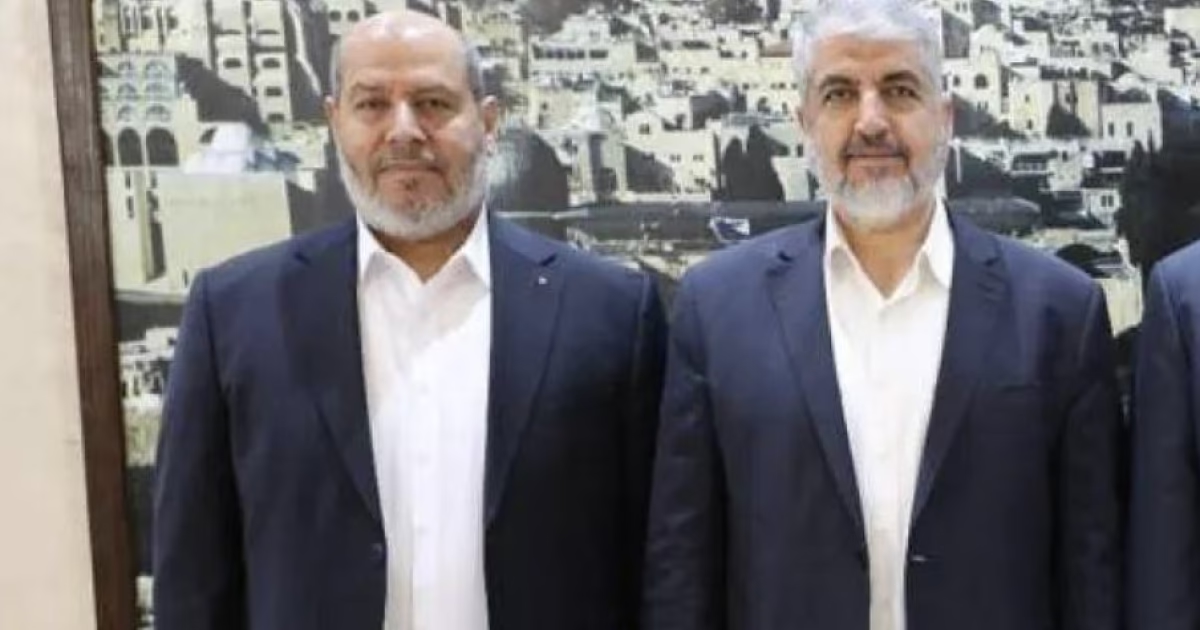
Behind the Scenes of Khalil al-Hayya's Election as Hamas Head: Voting Details and Khaled Meshaal's Stance

The Islamic Resistance Movement (Hamas) announced the selection of Khalil al-Hayya as the new head of its political bureau, filling the position that had been vacant since the assassination of the former leader Yahya Sinwar during the Israeli aggression on the Gaza Strip in October 2024. This announcement ended a period of anticipation regarding the identity of the movement's next leadership amidst complex field and political conditions facing the Palestinian cause.

Informed sources revealed that the electoral process witnessed fierce competition, reflecting the vitality of the consultative institution within the movement, where Khalil al-Hayya received 35 votes, while Khaled Meshaal received 34 votes. This narrow margin of votes was considered by observers and leaders in the movement as evidence of integrity and adherence to the internal regulations governing the work of Hamas's leadership institutions.

Commenting on these results, Hamas leader Mahmoud al-Mardawi affirmed that the election being decided by a single vote sends a strong message about the nature of the consultative system adopted by Hamas. Al-Mardawi explained that the movement adheres to the limits of powers and tasks granted to its members, emphasizing that the result expresses a genuine will within the leadership ranks.

Al-Mardawi pointed out that this step comes within the movement's efforts to inject new blood into its various organizational levels, and is not limited to the head of the political bureau. These changes come to compensate for the vacuum left by the martyrdom of a number of leaders in the executive office, the Shura Council, and those with specialized tasks during the 'Al-Aqsa Flood' battle.

Movement leaders stressed that adherence to internal regulations and holding elections in these difficult circumstances is an extension of the Palestinian people's legacy in democratic practice. Sources explained that Hamas has historically been keen on holding its elections regularly, whether inside occupation prisons or in external arenas, to ensure the legitimacy of the leadership and the continuity of institutional work.

Following the announcement of the results, Khaled Meshaal immediately called on all cadres and members of the movement to rally behind Khalil al-Hayya, emphasizing internal unity. Meshaal considered the leadership of the movement to be a mandate and a great responsibility before the Palestinian people and the movement's institutions, and not merely an honorary position, which reflects the spirit of collective responsibility.

Regarding reports of differences in vision between al-Hayya and Meshaal, al-Mardawi clarified that Hamas is an institutional movement par excellence, and any differences that appear are only within the framework of procedural details. He affirmed that the strategic issues and fundamental principles of the movement enjoy complete consensus, and that everyone adheres to the final decision taken by the consultative institution.

Regarding major issues such as the resistance's weapons and regional relations, al-Mardawi stressed that the decision within Hamas is a purely Palestinian decision stemming from national interests. He added that the movement listens to the advice of friends and allies in the region, but its final decisions are subject to Palestinian considerations and specificity without any external interference.

Al-Mardawi concluded by indicating that the next phase requires intensive coordination with various countries, emphasizing that continuous Israeli pressures have not succeeded in undermining the movement's unity. He affirmed that Hamas is moving forward with its national project under the leadership of Khalil al-Hayya, while maintaining the cohesion of its consultative institutions and its ability to make decisions in the most difficult circumstances.

The position of head of the movement is not an honor but a mandate, and its holder is responsible before the movement's institutions and the Palestinian people.

PALESTINE

Tue 21 Jul 2026 11:20 am - Jerusalem Time

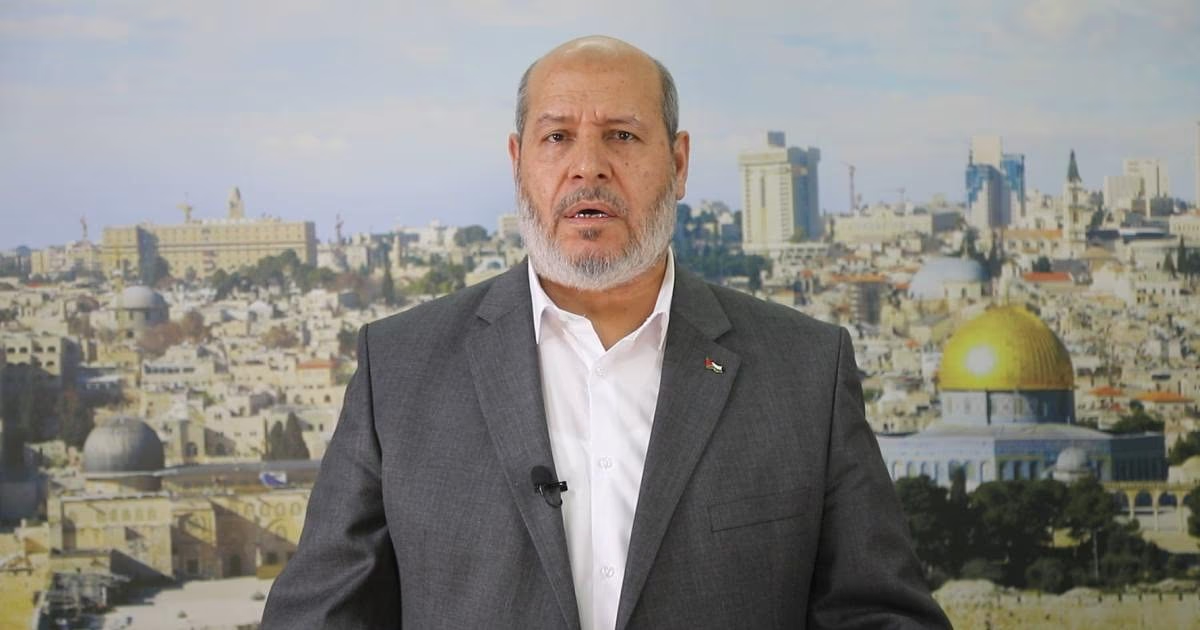
Khalil al-Hayya as Head of Hamas Political Bureau: Implications of the Choice and Challenges of the Post-Sinwar Era

The Islamic Resistance Movement (Hamas) announced the election of Khalil al-Hayya as the head of its new political bureau, succeeding the late leader Yahya Sinwar. This decision comes at a highly sensitive time, as the Palestinian territories, particularly the Gaza Strip, are experiencing a state of anticipation amidst a fragile ceasefire and unprecedented field and political challenges.

Completing the electoral process in this exceptional circumstance reflects the movement's insistence on demonstrating the cohesion of its internal institutions and its ability to restore leadership structures. Sources within the movement confirmed that al-Hayya's selection reinforces the principle of Shura (consultation) and institutionalism that Hamas is keen to highlight as a fundamental pillar of its organizational work, despite repeated Israeli targeting.

Khalil al-Hayya, known by the nickname 'Abu Osama,' is not a new face on the political scene; rather, he is one of the most prominent leaders who witnessed the movement's founding in 1987. Al-Hayya was born in the Shuja'iyya neighborhood of Gaza City in 1960 and rose through organizational and political ranks until he became a member of the political bureau and responsible for major strategic files.

Al-Hayya's personal biography carries deep symbolic dimensions for the movement's supporters, given the great sacrifices his family has made during years of conflict. Al-Hayya lost several of his children and grandchildren in Israeli raids that targeted their homes, the latest of which was during the ongoing war, which gives him a special status as a leader who emerged from the heart of field suffering in Gaza.

Politically, al-Hayya is seen as the architect of indirect negotiations, having led the movement's delegations in complex rounds in Doha and Cairo. His role was pivotal in reaching the October 2025 understandings, reflecting his ability to combine adherence to principles with the political flexibility required in managing international crises.

Under al-Hayya's leadership, the new leadership faces a heavy legacy of managing the devastated Gaza Strip and dealing with the thorny prisoner file. The issue of reconstruction and consolidating the ceasefire also emerges as top priorities requiring high coordination with regional and international mediators amidst a severe financial and political blockade imposed by the occupation.

For its part, the Israeli occupation authorities appear preoccupied with monitoring developments within Hamas, despite their claims of indifference to the identity of individuals. Reports indicate that the Israeli discourse has shifted from 'absolute elimination' to focusing on reducing military capabilities and preventing the movement from regaining its administrative and security influence in the Strip.

Observers believe that al-Hayya's election represents a bridge between internal and external leadership, given his extensive relations with regional powers and his strong presence within Gaza. Al-Hayya previously succeeded in complex files, including restoring relations with the Syrian regime in 2022, which indicates a strategic vision for expanding the movement's alliances.

The biggest challenge for al-Hayya is how to balance the demands of armed resistance with the urgent humanitarian needs of the Strip's residents. The movement is now required to provide realistic solutions to the tragedy of displacement and hunger, amidst terrifying statistics indicating more than 73,000 martyrs since the outbreak of confrontation in October 2023.

In an analysis by political analysts, al-Hayya's rise does not necessarily mean a radical shift in the movement's ideology, but rather a continuation of the approach of previous leaders who emerged from Gaza. Al-Hayya, like Haniyeh and Sinwar, represents a current that sees Gaza as the primary center of gravity for the Palestinian national project, while preserving the national and Islamic dimension of the cause.

Sources indicate that al-Hayya survived a mysterious assassination attempt in the Qatari capital, Doha, last September, which confirms the continued security threats facing first-tier leaders. These risks impose a complex security pattern on the new leadership in movement and managing communication with organizational bases and mediators.

Hamas's success in conducting its internal elections amidst the rubble sends a clear message of defiance to the Israeli occupation that 'the idea does not die.' Researchers believe that this step enhances the legitimacy of the new leadership before the international community as a party that cannot be bypassed in any future arrangements related to the Palestinian issue.

The next phase will be a real test of al-Hayya's political maneuvering ability, especially in light of American and regional pressures to redraw the governance map in Gaza. The 'day after the war' file will be the table that tests the new leadership's skill in preserving field gains and transforming them into political achievements.

In conclusion, Khalil al-Hayya enters the movement's presidency office carrying a mandate from its consultative institutions to face the most difficult circumstances in its history. The bet remains on his ability to unite the internal Palestinian ranks and manage the conflict with the occupation with a mindset that combines field resilience and diplomatic shrewdness in a region teeming with transformations.

Khalil al-Hayya's election represents a message that the movement's organizational structure is still capable of producing new leadership despite significant losses.

PALESTINE

Tue 21 Jul 2026 11:20 am - Jerusalem Time

Massacre in Gaza: Mother and Her Four Children Martyred, 'Doctors Without Borders' Condemns Arrest of Medical Staff

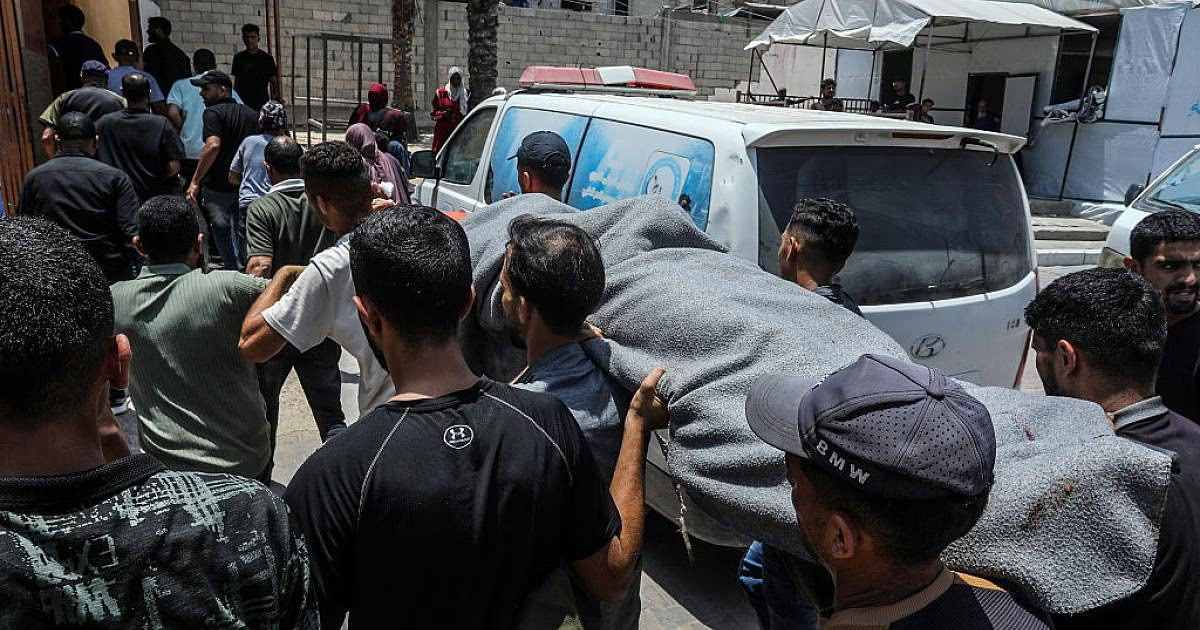
The Israeli occupation army committed a horrific massacre this morning in the Gaza Strip, resulting in the martyrdom of a mother and her four children while they were asleep inside their home. Field sources confirmed that the bombing targeted a residential building in the Al-Samir area, south of Gaza City, completely destroying it over its inhabitants.

Civil Defense announced that its teams were able to recover the bodies of the five martyrs from under the rubble after strenuous efforts. The martyrs were transferred to Al-Shifa Hospital in western Gaza City, amidst a state of sorrow and popular anger due to the continued targeting of unarmed civilians in their homes.

Firefighting teams, supported by teams from the Gaza municipality, made great efforts to control a massive fire that broke out in the targeted house as a result of the bombing. The teams succeeded in preventing the flames from spreading to neighboring densely populated homes, thus averting a larger catastrophe in the targeted area.

Sources reported that the Israeli targeting occurred late at night while the family members were in their beds, which raises the toll of civilian victims. This crime comes amidst daily and continuous violations of the supposed ceasefire agreement in the Gaza Strip.

Various areas of the Strip are witnessing repeated Israeli aggressions, including targeting civilian vehicles and inhabited residential apartments. The occupation forces also continue their policy of completely destroying residential blocks after forcing citizens into forced displacement under threat of weapons and bombing.

In a related context of violations against the health system, 'Doctors Without Borders' demanded the immediate and unconditional release of all Palestinian health workers. In an official statement, the organization described the detention operations carried out by Israel as 'arbitrary' and lacking any legal justification.

The international organization expressed its strong anger at the humiliating treatment received by doctors and nurses in Israeli detention centers. It indicated that most detainees face miserable and harsh conditions aimed at breaking the morale of the staff who serve the wounded and injured.

The organization renewed its call for the release of Dr. Hussam Abu Safiya, director of Kamal Adwan Hospital, who has been detained since December 2024. It considered that targeting a medical figure like Abu Safiya falls within a systematic plan to undermine medical work in the northern Gaza Strip and destroy what remains of hospitals.

The organization also highlighted the case of orthopedic surgeon Mohammed Obaid, who works with its teams and has been detained for more than 600 days. It explained that Dr. Obaid is living in extremely difficult detention conditions without any contact with his family since his arrest from inside Kamal Adwan Hospital.

In the French capital, Paris, a protest was held in front of the Ministry of Foreign Affairs to demand pressure on Israel to release medical staff. About 50 doctors, trade unionists, and activists participated in the protest, condemning the international community's silence regarding these ongoing crimes.

'Doctors Without Borders' criticized the failure of world leaders to condemn Israeli practices against the health sector in Palestine. It affirmed that the failure to take a firm stance encouraged the occupation to continue its policy of torture and systematic aggression against medical and humanitarian teams.

The organization concluded its statement by recalling the heavy price paid by its teams, as 15 of its workers have been martyred since the start of the aggression in October 2023. It stressed the need for immediate international protection for health facilities and their workers to ensure the continued provision of medical care to civilians.

The detention of medical staff comes within the framework of the disgraceful behavior adopted by the Israeli authorities in targeting the health sector throughout Palestine.

PALESTINE

Tue 21 Jul 2026 11:20 am - Jerusalem Time

Doctors Without Borders Demands Immediate Release of Palestinian Medical Staff by Israel

Doctors Without Borders (MSF) has issued an urgent appeal demanding the immediate and unconditional release of all Palestinian healthcare workers detained by Israeli authorities. In an official statement, the international organization expressed its strong condemnation of the humiliating treatment endured by doctors and nurses, noting that most are held in detention centers lacking the most basic human necessities, without clear charges or legal justification.

MSF specifically highlighted the case of Dr. Hussam Abu Safiya, director of Kamal Adwan Hospital in the northern Gaza Strip, who was arrested by Israeli forces in December 2024. The organization emphasized the need to respond to escalating international calls to end his detention, describing the targeting of medical personnel as a systematic and disgraceful behavior aimed at undermining the healthcare system in Palestine.

In contrast, Israeli authorities maintain their position, claiming that Dr. Abu Safiya's detention is based on legal grounds, while simultaneously denying medical reports indicating a deterioration of his health to a critical stage. This Israeli intransigence comes despite strong warnings issued by UN human rights experts and a UN investigation team who expressed grave concern over the fate of the Palestinian doctor.

On the ground, the French capital, Paris, witnessed a solidarity movement in front of the Ministry of Foreign Affairs, where dozens of doctors, activists, and trade unionists gathered to demand pressure on Israel to release Abu Safiya. Participants raised slogans condemning the targeting of medical facilities and their staff, affirming that the protection of medical teams is an international obligation that should not be subject to political or military calculations.

Doctors Without Borders also shed light on the suffering of orthopedic surgeon Mohammed Obeid, one of its staff members who has been in detention for over 600 days under what it described as extremely harsh conditions. Sources clarified that Obeid was abducted by Israeli forces while performing his professional duties inside Kamal Adwan Hospital in October 2024, and since then, all means of communication between him and his family have been cut off.

The non-governmental organization reiterated its categorical rejection of arbitrary detention policies, torture, and physical and psychological assaults against Palestinian medical personnel. The organization strongly criticized the international community's silence, considering that the failure of world leaders to condemn these blatant violations has contributed to the occupying authorities' persistence in their practices against the healthcare sector.

In a related context, the organization revealed the extent of human losses it has suffered since the outbreak of the aggression on the Gaza Strip in October 2023, with 15 of its staff members killed during ongoing military operations. It affirmed that the continued targeting of humanitarian and medical workers seriously impedes the ability of international organizations to provide vital aid to the besieged population.

Doctors Without Borders concluded its statement by emphasizing the necessity of providing adequate medical care to all detainees and ensuring detention conditions that preserve their human dignity until their release. It stressed that the protection of hospitals and their staff is not an option, but a necessity imposed by international humanitarian law, which appears to be facing a real test in the Palestinian territories.

We demand the immediate release of all arbitrarily detained medical personnel, who must be provided with adequate medical care and detention conditions that ensure their dignity.

OPINIONS

Tue 21 Jul 2026 11:19 am - Jerusalem Time

To the proponents of the philosophy and policy of closing and withdrawing pretexts

The conference held by the "Temple Mount Administration" organization last Wednesday, 15/7/2026, under the title "A Decade of Positive Transformation on the Temple Mount," and the caliber of political leaders who attended this conference, from Netanyahu to Energy Minister Eli Cohen, and Deputy Knesset Speaker Nissim Vaturi, carried a clear political message that cannot be confronted by either closing or withdrawing pretexts. Change in the status of Al-Aqsa is coming, with the withdrawal of administrative powers from the Waqf over Al-Aqsa and the termination of Jordanian custodianship. There is a field change in the status of Al-Aqsa, known as silent dismantling, which is deeper and more dangerous in its implications for Al-Aqsa, as its religious, legal, historical, and international status is being dismantled by moving from conflict management to resolving this conflict using security and legal tools, thereby reshaping religious and symbolic sovereignty over it. And when Nissim Vaturi says that Muslims should be prevented from accessing Al-Aqsa unless Jews can access Al-Aqsa and perform their Talmudic and Torah rituals and prayers freely on the "Temple Mount," this tells those who want to understand and comprehend, and not continue to cover and bury their heads in the sand, that major changes are coming to the status of Al-Aqsa, as it is being rapidly transitioned from an Islamic era to a shared Islamic-Jewish era initially, leading to the establishment of what is known as the Third Temple in place of the Dome of the Rock Mosque. The recent developments in Al-Aqsa, where the occupation closed Al-Aqsa for its army to conduct military training inside Al-Aqsa, which are like "rehearsals" for what is to come, and also the occupation army and police removed worshipers from the Bab Al-Rahma prayer hall, photographed them, and recorded their ID numbers, to take security measures against them, ranging from expulsion from Al-Aqsa to investigation and perhaps arrest for some of them. Also, when the Waqf department is prevented from accessing four carefully distributed locations on the geography of Al-Aqsa: the Qubbat al-Ghazali above the roof of the Bab Al-Rahma prayer hall, Qubbat Musa in the southwestern area, Qubbat Sulayman in the northeastern area, Dar al-Hadith, and Dar Tahfiz al-Quran, whose locks were broken, and the Waqf department was prevented from placing new locks and left them open, this carries the political message conveyed by the threat of Deputy Knesset Speaker Nissim Vaturi at the "Temple Mount Administration" organization's conference under the title "A Decade of Positive Transformation in the Status of the Temple," that Muslims will be prevented from accessing Al-Aqsa unless Jews can access the "Temple Mount" freely and perform their prayers and Talmudic and Torah rituals fully. Politics, O proponents of the policy of closing and withdrawing pretexts, is not read from headlines, but through the arrangement of messages, and politics is algebra, not arithmetic, and positions should not be based on emotions and emotional agitation and flowery phrases and resonant and bombastic speeches like "the House has a Lord to protect it," and no matter how much they change and alter Al-Aqsa, it will remain Islamic, for the lesson is in what is translated on the ground, not through what is issued in words and empty "nonsense," and these people translate their words into actions, and the policy of closing and withdrawing pretexts, which you cling to, falls from their calculations, given their knowledge of the weak and collapsed Arab and Islamic situation, and their firm belief in what their Prime Minister Golda Meir said in the late sixties, when an Australian-born Zionist named "Michael Dennis Rohan" set fire to Al-Aqsa, including the Minbar of Salah al-Din al-Ayyubi on 21/August/1969, that she cried all night over the fate of "her state" for fear that Arab and Islamic armies would march on it to avenge Al-Aqsa, and when dawn broke and nothing happened, she said, "Now we can do anything, without a reaction, for this nation is nothing more than a vocal phenomenon." So how now, with the miserable Arab and Islamic situation, and there are those who have not only coordinated with Israel, but there is an alliance and security and military cooperation with it by some Arabs, and there are those who call for turning Al-Aqsa into a place for the Abrahamic religion, where the adherents of the three religions practice their worship, and the American administration has expressed a position in this direction, to turn Al-Aqsa into a tourist and multi-religious center, where sovereignty would be for Israel, and the termination of the administrative authority of the Waqf over it and the cancellation of Jordanian custodianship, while granting powers with periodic Arab supervision, and that Israel would have the right to appoint imams, mosque preachers, and key employees, and to intervene in who will deliver the sermon and its quality. The upcoming developments regarding Al-Aqsa are significant and dangerous, in light of a right-wing and extremist government seeking to resolve sovereignty and control over Jerusalem, including Al-Aqsa, and there are calls from the Temple Mount groups to carry out widespread incursions into Al-Aqsa on the anniversary of what is known as the destruction of the Temple next Thursday, to support the idea and theory of Deputy Knesset Speaker Nissim Vaturi, the right of Jews to practice their prayers and Talmudic and Torah rituals with complete freedom in Al-Aqsa. So, will the proponents of the policy of closing and withdrawing pretexts awaken from their political coma, or will they continue to practice the ostrich policy, burying their heads in the sand, and the House has a Lord to protect it?

OPINIONS

Tue 21 Jul 2026 11:15 am - Jerusalem Time

Launch of experimental zones in southern Lebanon opens a new phase of security arrangements on the eve of Aoun's visit to Washington

Washington Message

Washington – Said Arikat -

The US State Department announced on Monday the start of work on what it described as "experimental zones" in the southern Lebanese villages of Froun, Srifa, and Zawtar Al-Gharbiya, a step it said comes "within the tripartite framework and under the auspices of the special military coordination group for Lebanon," stressing that this step represents a direct outcome of the discussions that brought together Lebanese and Israeli officials in Rome last week.

The ministry added in its statement that the United States will continue to work closely with both the Lebanese and Israeli sides to ensure the implementation of this framework until a "successful conclusion" is reached, a reference that reflects the continued American role as a key sponsor of the ongoing security negotiations between the two parties, after months of military escalation on the southern border.

The American announcement is the first official confirmation that the security understandings have entered the phase of field implementation, after negotiations had revolved around undeclared political and military contacts in recent months. The selection of three southern villages as a prototype indicates the adoption of a gradual approach aimed at testing implementation mechanisms before expanding them to include other areas along the Blue Line.

This step comes at a time when Washington is intensifying its efforts to consolidate the ceasefire and prevent the return of military confrontation between Israel and Hezbollah, amid continued fears of the collapse of the fragile calm achieved after months of widespread clashes that almost escalated into a comprehensive regional war.

Observers believe that the concept of "experimental zones" goes beyond mere local security arrangements, as it includes reorganizing military presence, enhancing the deployment of the Lebanese army, and activating the role of UN forces operating in southern Lebanon (UNIFIL), in line with the American vision for a stricter and more effective implementation of Resolution 1701.

The American statement also reflects the continued reliance on what is known as the "tripartite framework," which includes Lebanon and Israel under American patronage, as the primary mechanism for managing security and border issues, away from any direct political paths between the two countries, which allows both parties to maintain their traditional political positions, while proceeding with practical field understandings.

The American announcement gains additional importance because it comes before the anticipated visit of Lebanese President Joseph Aoun to Washington, a visit seen as a pivotal station in Lebanese-American relations, where it is expected that the issues of the South, the implementation of Resolution 1701, the future of military aid to the Lebanese army, and reconstruction will top the agenda of talks with senior American officials.

Diplomatic circles indicate that the American administration wishes for President Aoun to arrive in Washington carrying concrete indicators of the success of the security arrangements in the South, which would give the talks additional momentum, and allow the American administration to present what it considers a diplomatic success in containing one of the most dangerous hotspots in the Middle East.

In return, Lebanon seeks to leverage this American involvement to obtain guarantees regarding the Israeli withdrawal from positions it still occupies within Lebanese territory, the cessation of aerial violations, and the securing of economic and military support that enables the Lebanese state to strengthen its presence in the South, thereby limiting the possibilities of renewed confrontation.

Despite the positive atmosphere that the American statement tries to portray, the success of this experiment is considered weak and will remain linked to the ability of all parties to adhere to their field commitments, especially in light of the accumulated distrust between Lebanon and Israel, and the continued contentious issues related to land borders and disputed points, as well as the future of Hezbollah's weapons and its role in the Lebanese security equation.

In this context, Washington appears keen to transform limited security successes into a long-term political and security path that consolidates stability on the borders and prevents the region from sliding back into a widespread confrontation. However, achieving this goal will remain contingent on regional developments and the extent to which all parties are willing to make mutual concessions that go beyond narrow military calculations.

The launch of "experimental zones" reflects the transition of American mediation from a crisis management phase to a phase of engineering a new security reality in southern Lebanon. The United States is no longer content with merely de-escalating, but seeks to build a gradual model that redefines the rules of military deployment and grants the Lebanese army a greater role on the ground. However, the success of this approach requires a delicate balance between Israeli security demands and Lebanese sovereignty requirements, because any impression that arrangements are being imposed from outside may provoke internal objections and undermine the chances of sustaining the understandings that Washington is working to consolidate.

President Joseph Aoun's visit to Washington gains exceptional importance because it comes at a moment when the American administration is trying to link political and economic support for Lebanon to the success of implementing security arrangements in the South. Washington is likely to offer a package of incentives, including enhanced support for the Lebanese army and assistance in reconstruction, in exchange for continued implementation of security commitments. However, the Lebanese leadership will face the challenge of achieving these gains without giving an internal impression that Lebanese decision-making has become contingent on American or Israeli conditions.

The American initiative also reveals that southern Lebanon has become part of a broader strategy to reshape regional balances after years of escalation. The stability of the Lebanese border is not seen as merely a local goal, but as an entry point to reduce the likelihood of a regional war that could extend to more than one arena. However, any success will remain fragile unless it is accompanied by addressing the political causes of the conflict, foremost among them the continued Israeli occupation of some Lebanese territories, repeated violations of sovereignty, and the absence of a comprehensive settlement that guarantees mutual security and lasting stability.

OPINIONS

Tue 21 Jul 2026 11:01 am - Jerusalem Time

From Gaza to Iran: The Cost of America’s Failure to Say No to Israel


By Said Arikat

July 21, 2026

News analysis

Washington, D.C. — Wars rarely begin with a single decision. More often, they emerge from a succession of choices not made, warnings ignored, and opportunities deliberately squandered. David Kirkpatrick’s remarkable investigation in The New Yorker, published on July 20, offers perhaps the clearest account yet of how the United States failed to restrain Israel’s war in Gaza—and how that failure helped lead Washington into today’s war with Iran. Drawing on confidential documents and interviews with senior officials, Kirkpatrick dismantles the comforting fiction that the Biden administration lacked leverage. The evidence points to the opposite conclusion: it possessed extraordinary influence but repeatedly chose not to use it.

The defining document in Kirkpatrick’s investigation is a confidential letter delivered to President Joe Biden on March 5, 2024, by Mirjana Spoljaric, president of the International Committee of the Red Cross. The ICRC, guardian of the Geneva Conventions, rarely appeals directly to heads of state in such stark terms. Spoljaric warned that Israel’s conduct had become “incompatible” with the laws of armed conflict, condemned the denial of Red Cross access to Palestinian detainees, and noted that suspending legal dialogue placed Israel alongside North Korea and Eritrea. Most importantly, she urged Biden to halt the transfer of weapons unsuitable for densely populated areas, warning that abandoning “minimum standards of humanity” would become a moral failure history would not forgive.

That appeal arrived when the administration possessed ample legal authority to act. Biden had already issued a policy barring U.S. weapons transfers if they were “more likely than not” to facilitate war crimes. The Leahy Law prohibited assistance to military units credibly implicated in gross human rights violations. National Security Memorandum 20 required Secretary of State Antony Blinken to certify Israel’s compliance with international humanitarian law or risk suspending military assistance. The legal framework existed. According to Kirkpatrick, what followed was a systematic effort not to enforce those safeguards but to circumvent them whenever they threatened Washington’s political commitment to Israel.

Years later, senior officials openly acknowledge that the administration repeatedly allowed itself to be manipulated. Former National Security Adviser Jake Sullivan admits, “We should have put more pressure on Israel to take a different approach.” Defense Secretary Lloyd Austin compared Prime Minister Benjamin Netanyahu to a gambler “playing with house money.” Israeli officials repeatedly assured Washington the war would end within “two more weeks,” a prediction that became an internal joke after Ron Dermer jokingly substituted “fortnight.” Each promise delayed confrontation while casualties mounted. Even Biden’s widely publicized decision to suspend deliveries of 2,000-pound bombs proved largely symbolic. Kirkpatrick reports that the administration quietly continued shipping 500-pound bombs separately, diluting the intended message.

The consequences extended far beyond Gaza itself. More than 70,000 Palestinians (mostly civilians) were killed, much of the enclave was devastated, and the overwhelming majority of its population was displaced. Yet Kirkpatrick demonstrates that the administration’s strategy also accelerated a broader regional conflict. Fearing that visible disagreement with Israel would embolden Iran and Hezbollah, the White House maintained near-unconditional public support even as Netanyahu repeatedly expanded the confrontation through operations in Damascus, Tehran, and Beirut. Deputy National Security Adviser Jon Finer warned internally that this created a classic moral hazard: unconditional American backing encouraged the very escalation Washington claimed to oppose. Philip Gordon, then Vice President Kamala Harris’s national security adviser, summarized the problem bluntly: Israeli leaders understood that “we were going to defend them.”

That expectation proved decisive. Twice, American forces helped intercept large-scale Iranian attacks on Israel, minimizing Israeli losses while reinforcing confidence that Washington would ultimately absorb the costs of escalation. According to Kirkpatrick, Biden’s advisers warned the incoming Trump administration that Iran had become strategically vulnerable and that Israel would almost certainly seek to exploit the opportunity. Those warnings became prophecy. When President Donald Trump later ordered American participation in strikes against Iranian nuclear facilities, followed months later by a joint surprise assault on Iran, the decisions reflected years of accumulated precedent. Secretary of State Marco Rubio’s explanation—that Washington acted because Israeli operations would inevitably draw the United States into the conflict anyway—captures the logic of successive administrations that chose following Israeli strategy over shaping it.

Perhaps the investigation’s most disturbing conclusion is not the exposure of hidden misconduct but the normalization of self-deception. The State Department’s NSM-20 assessment became what one official called “a complete whitewash,” while another described it as an exercise in bad faith. Internal legal concerns were acknowledged, softened, and ultimately neutralized through carefully crafted language. Likewise, an effort under the Leahy Law to suspend assistance to an Israeli base accused of abusing Palestinian detainees stalled because Blinken believed a ceasefire was imminent. The ceasefire never materialized. The recommendation remained unsigned, and months later Israeli authorities dismissed the case entirely.

Kirkpatrick’s reporting is ultimately less about Israel than about American statecraft. It exposes a foreign policy establishment that mistook access for influence, loyalty for strategy, and restraint for weakness. Again and again, Washington deferred difficult decisions in the hope that tomorrow would solve the problems it refused to confront today. Instead, each postponement deepened the humanitarian catastrophe in Gaza while narrowing America’s own strategic options. By the time successive administrations confronted Iran directly, they were no longer shaping events—they were reacting to them.

History will judge this episode not simply by the devastation left behind in Gaza or by the widening war now consuming the region, but by the squandered opportunities that made both possible. The United States possessed the leverage to alter the course of events and repeatedly chose not to exercise it. That was not merely a policy failure. It was a moral failure with strategic consequences. The greatest lesson of Kirkpatrick’s investigation is that blank-check support does not prevent wider wars; it makes them more likely. When a superpower refuses to use its influence in the service of accountability, it eventually forfeits both its credibility and its ability to shape history.

PALESTINE

Mon 20 Jul 2026 11:15 am - Jerusalem Time

Palestine Bids Farewell to a Football Talent: The Martyrdom of Youth National Team Player Fadi Al-Naasan, Succumbing to Injuries from Occupation Bullets

The sports community and Palestinian public in Ramallah and Al-Bireh governorate bid farewell to the body of the young martyr Fadi Al-Naasan, a player for Al-Mughayyir Club and the national youth team, who passed away due to severe injuries he sustained days ago. The solemn funeral procession set off from Palestine Medical Complex, where the deceased's body was wrapped in the Palestinian flag amidst shouts of anger and condemnation of the ongoing crimes of the occupation and settlers.

The deceased Al-Naasan, 17 years old, was hit by an explosive bullet in the thigh area fired by Israeli occupation forces during their raid on Al-Mughayyir village on July 11th. This severe injury led to the amputation of his leg and his entry into a critical health condition, before his official martyrdom was announced after medical attempts to save his life failed.

The Palestinian Football Association directly accused the occupation forces of shooting the young player, noting that the targeting occurred while providing protection to settlers who launched a violent attack on the village. The association affirmed in a statement that targeting Palestinian athletes has become a systematic policy aimed at undermining the sports movement and killing the dreams of creative youth.

Hamdallah Al-Naasan, the martyr's father, recounted the last moments of his son's life, noting that Fadi loved football and aspired to represent his country in international forums. The grieving father explained that his son did not hesitate to go towards the attack site when he heard cries for help from women and girls in the village, to be among the first defenders before he was assassinated by occupation bullets.

For her part, the martyr's mother, Hanan Al-Naasan, mourned her son with touching words, describing him as an outstanding student and a well-mannered athlete who enjoyed the love and respect of everyone in his school and club. She said that Fadi combined academic excellence with athletic passion, praying to God to accept him among the martyrs and righteous, affirming her pride in his heroism and sacrifice for his village.

Local sources reported that the attack that led to Al-Naasan's injury was not the only one; the village witnessed violent confrontations during which occupation forces extensively fired rubber bullets, sound bombs, and tear gas. These confrontations resulted in a child under the age of ten being directly hit in the head by a sound bomb, in addition to other injuries among unarmed citizens.

Medical reports indicate that the explosive bullets used by occupation soldiers caused extensive damage to the tissues and arteries of the martyr Al-Naasan, making the process of saving his limb or life extremely difficult. This incident reflects the extent of violence used against Palestinian civilians in villages and towns that are subjected to repeated attacks by settlers under army protection.

This crime comes in the context of an ongoing escalation in the West Bank, where statistics indicate that at least 1088 Palestinians have been killed since October 2023 due to occupation and settler attacks. In contrast, about 46 Israelis were killed in various operations and confrontations witnessed in the West Bank during the same period, reflecting the escalating security tension in the region.

No official comment has been issued by the Israeli occupation army so far regarding the circumstances of the shooting of player Al-Naasan, despite official requests for comment on the incident. Palestinian human rights and sports organizations continue to call on the international community and global sports federations to intervene to stop the targeting of players and sports facilities in the occupied territories.

Deep sorrow cast a shadow over Al-Mughayyir Club and the Palestinian sports community with the passing of one of the promising talents who represented the hope of Palestinian football in the future. The martyr's teammates in the national team affirmed that Fadi will remain present in their hearts, and his memory will be a motivation for them to continue their sports journey despite the difficulties and challenges imposed by the reality under occupation.

When the settlers attacked, he heard the cries of girls and women, so he went to the attack site and was killed defending his family and village.

PALESTINE

Mon 20 Jul 2026 11:15 am - Jerusalem Time

Why have US bases in Jordan become a primary target for Iranian attacks?

International press reports have revealed a strategic shift in retaliatory Iranian attacks, with Tehran intensively focusing its strikes on US bases located in Jordan. According to informed sources, US forces were subjected to four consecutive attacks in just five days, the most violent of which was Friday's attack, which resulted in the death of two soldiers and the loss of a third, in an unprecedented escalation on the ground.

Responsible sources clarified that this series of attacks not only caused human casualties but also led to the injury of dozens of soldiers and significant material damage to a number of military helicopters. These developments indicate that Iranian forces still possess a huge missile arsenal, with a remarkable development in their ability to maneuver and bypass advanced American air defense systems.

Jordan's strategic importance as a center for US operations in the region has increased, especially after the Pentagon transferred large numbers of its forces from Bahrain, the UAE, and Qatar to locations previously considered safer in Jordan. These moves came amid restrictions imposed by other regional allies on US military air traffic and the deployment of forces over their territories.

Iran began expanding the scope of its military operations to include Jordanian territory for the first time since the signing of the last ceasefire agreement between Tehran and Washington last June. This shift represents a breach of previous rules of engagement, as the Iranian side seeks to pressure the US military presence at its new and vital strongholds.

American sources detailed the five attacks that the Pentagon did not announce in detail at the time, as the targeting began with striking a residential complex at King Faisal Air Base. This initial shelling resulted in the injury of five American servicemen, giving an early indication of Iran's intention to escalate the situation in the Jordanian arena.

The second attack was more specialized, targeting a base in eastern Jordan dedicated to operating the famous American 'Black Hawk' helicopters. Direct strikes caused severe damage to a large number of these helicopters, temporarily affecting the logistical and operational capabilities of the forces stationed there.

Two days before the deadly Friday attack, Muwaffaq Salti Air Base in the Azraq area was subjected to intense Iranian missile shelling. This attack caused injuries to about 20 American soldiers, but the incident did not result in any deaths at that time due to personnel taking refuge in fortified shelters immediately after the sirens sounded.

The scene was repeated on Friday at the same base in Azraq, but the results were tragic this time with the killing of two soldiers and the injury of four others with varying degrees of wounds. Although the rest of the base's personnel underwent medical examinations and returned to duty, the attack caused a shock in American military circles due to the accuracy of the hit and its timing.

For its part, the Iranian army officially announced its responsibility for carrying out drone attacks that directly targeted fuel tanks at the Azraq base. The Revolutionary Guard also confirmed, through its media outlets, the use of a mixture of missiles and suicide drones to strike aircraft shelters, in an attempt to neutralize American air power.

Military experts, including retired US Air Force generals, believe that Jordan's geographical location gives Washington a major advantage for carrying out effective air operations in Syria and Iraq. Therefore, the Iranian targeting primarily aims to undermine this regional alliance and politically and security-wise embarrass the host countries of US forces.

In response to these attacks, the US military announced retaliatory strikes targeting sites belonging to the Iranian Revolutionary Guard, with the aim of reducing threats to navigation in the Strait of Hormuz. Washington considered these moves a clear punitive message to those responsible for planning and carrying out the attacks that targeted soldiers in Jordan.

In a related context, President Trump hinted at a larger military escalation in the coming days, indicating his administration's intention to target vital infrastructure inside Iran. Potential targets include bridges, power generation stations, and distribution networks, in an attempt to impose new deterrence that prevents the recurrence of targeting US bases in the region.

Friday's attack was not just an attack on a base, but an attempt to make the political cost of hosting US forces outweigh the security benefit.

ARAB AND WORLD

Mon 20 Jul 2026 11:14 am - Jerusalem Time

IAEA verifies attack on Iranian nuclear facility under construction

The International Atomic Energy Agency (IAEA) announced today, Sunday, that it is monitoring and verifying field reports of a military attack targeting the construction site of the Darkhovin nuclear power plant in Iran during the night hours. The agency clarified in a brief statement that its technical teams are working to assess the situation at the facility, which is still in its early construction phases.

International sources confirmed that the targeted site did not contain any nuclear materials or radioactive fuel at the time of the incident, based on the results of the agency's last inspection tour of the site. This international move comes at a sensitive time when the region is witnessing escalating security tensions surrounding Iran's nuclear program.

For its part, the Atomic Energy Organization of Iran directly accused the United States of being behind the attack, describing the operation as a clear violation of international laws and an assault on a civilian facility under development. Local Iranian media had circulated news of the strike earlier, indicating material damage to the site's infrastructure.

The facility was in very early stages of construction and did not contain any nuclear materials at the time of its last inspection.

LATEST NEWS

Mon 20 Jul 2026 11:14 am - Jerusalem Time

Portents of an Open War: American Casualties in Direct Confrontations with Iran and Escalation Affecting Regional Countries

The Middle East region faces the specter of a comprehensive military confrontation following the first human casualties among American forces from direct Iranian fire. Sources reported that a missile attack targeting a military base in the region led to the death of two American soldiers, while the search is still ongoing for a third soldier who went missing after the shelling.

In an immediate reaction, the US Central Command launched a wave of what it described as preliminary air attacks, targeting vital facilities belonging to the Iranian military. The American target bank included coastal observation points and air defense systems, in addition to storage sites for drones and missiles used by Tehran in its regional operations.

Field escalation did not stop at the limits of direct confrontation but extended to neighboring countries, where facilities in Kuwait and Bahrain were subjected to attacks by Iranian drones and missiles. Field reports confirmed that the Jordanian city of Aqaba and the Sulaymaniyah region in Iraq were not spared from the shrapnel of this exploding conflict, reflecting the widening scope of Iranian targeting.

For its part, Tehran officially announced the targeting of Al-Adeeri camp and Ali Al-Salem Air Base in Kuwait using suicide drones. This announcement came in the context of an Iranian response to what it described as continuous American aggression against its infrastructure and civilian bridges during the past eight days of continuous shelling.

Politically, Iranian authorities announced the suspension of the memorandum of understanding signed with Washington last month, considering that the understandings were no longer valid. Iranian Supreme Leader Mojtaba Khamenei accused the American administration of breaking promises, indicating that Washington has once again proven to be an unreliable party in any diplomatic path.

In contrast, US President Trump showed a tough stance on political developments, emphasizing that he no longer cared about Iran's decision to withdraw from the memorandum of understanding. The White House clarified that military options have become the primary tool to force Tehran to comply with American conditions and stop its threats to international navigation.

Israel entered the crisis by declaring a state of maximum alert among its forces, in anticipation of any escalation of the conflict towards a major regional war. Media sources reported that the Israeli security establishment is closely monitoring Iranian movements, amidst fears of opening multiple fronts simultaneously if the current escalation continues.

US Central Command stressed that its operations primarily aim to undermine the capabilities of the Iranian Revolutionary Guard to threaten navigation in the Strait of Hormuz. Military sources indicated that Washington's punitive messages have shifted from targeting proxies and agents to striking deep into Iran and directly targeting military infrastructure.

Observers believe that the death of American soldiers represents a strategic turning point that could end the era of limited confrontations and push towards an 'open war.' The Pentagon has already begun mobilizing stealth fighters and strengthening its naval presence in the region, indicating preparations for broader and more lethal military operations.

Iran, for its part, justified its attacks on neighboring countries by stating that they are in response to the facilities granted to American forces operating from those bases. Tehran accuses some regional countries of participating in the 'military blockade' imposed on it, which explains its targeting of civilian and military facilities in Kuwait and Jordan.

In the context of Arab reactions, Kuwait condemned the targeting of its civilian facilities, affirming its full right to defend its sovereignty and territories by all available means. Popular fears are growing in Gulf countries that their territories will become a battleground for settling scores between the two major powers in the absence of a political solution.

Reports from Washington indicate that the decision to launch a 'major war' is now on the table for discussion in the closed rooms of the Pentagon. Military experts confirm that the type of weapons used in recent days, by both sides, reflects a desire to break the traditional rules of engagement that have prevailed for years.

Despite international calls for restraint, the language of threat remains dominant in the statements of officials from both sides. While Washington insists on protecting its interests and navigation, Tehran asserts that it will not back down in the face of what it describes as 'American arrogance,' even if it leads to a comprehensive confrontation.

The lingering question in political circles is about the ability of international parties to contain this explosion before it is too late. Field indicators, from casualties and military mobilization to the suspension of agreements, all suggest that the countdown to a major confrontation has already begun.

American strikes reflect the widening scope of military objectives by targeting infrastructure that supports Tehran's operations deep within the country.

ARAB AND WORLD

Mon 20 Jul 2026 11:14 am - Jerusalem Time

Egypt Condemns Iranian Attack on Vital Facilities in Kuwait and Affirms Full Solidarity

The Egyptian Ministry of Foreign Affairs, in an official statement issued today, Sunday, expressed its strongest condemnation of the Iranian aggression that targeted a power generation and desalination plant in the State of Kuwait. Cairo described the attack as a heinous act targeting vital and civilian facilities in a sisterly country, affirming its categorical rejection of this infringement on the security of the Arab Gulf states.

The Egyptian Ministry of Foreign Affairs stressed Egypt's full solidarity with the Kuwaiti leadership and people in confronting these threats. It also affirmed its absolute support for all measures and actions taken by the State of Kuwait to maintain its stability and protect its citizens and strategic facilities from any external aggression.

For its part, the State of Kuwait condemned in the strongest terms the Iranian aggression that occurred this morning, noting that it once again targeted a vital energy and water desalination facility. Official sources clarified that this aggression represents a blatant violation of international laws that protect civilian objects from military operations.

The Kuwaiti Ministry of Foreign Affairs affirmed that the repeated targeting of infrastructure reflects a systematic aggressive approach by Tehran, aimed at destabilizing regional security. The ministry warned that this escalation poses a grave threat to the safety of civilians, holding the Iranian side fully legal and moral responsibility for the consequences of these attacks.

In a related context, Kuwait announced that the Kingdom of Bahrain and the Hashemite Kingdom of Jordan were subjected to similar Iranian attacks on the same day. Kuwait expressed its strong condemnation of these violations that affected the sovereignty of two Arab countries, affirming its stand with them in all measures they take to protect their territories.

On the ground, the Kuwaiti Ministry of Electricity, Water, and Renewable Energy revealed details of the attack, explaining that it led to a fire breaking out in the targeted plant's facilities. The ministry indicated that this attack is the second of its kind in just 48 hours, causing a number of generation units to temporarily go out of service.

Immediately after the incident, Kuwaiti authorities activated maximum emergency plans to deal with the fire and limit the repercussions of potential power outages. Technical sources confirmed that engineering teams are working around the clock to maintain the stability of the electrical system and ensure the continuous flow of water to citizens.

These developments come amidst an unprecedented wave of escalation, as Kuwait announced in recent days its success in confronting several Iranian missiles and drones. Some of these attacks resulted in human casualties and varying material losses in different parts of the country.

Observers link these attacks to the escalating tension between Tehran and Washington in the region, especially after the recent killing of two American soldiers in Jordan. The United States responded with a series of intensive airstrikes targeting military sites within Iranian territory.

In a notable political development, Iranian Supreme Leader Mojtaba Khamenei announced the cessation of his country's commitment to the memorandum of understanding signed with the American administration. Khamenei described previous pledges as having become worthless, in a clear indication of the collapse of diplomatic efforts that began last June.

Iran and the United States had signed a memorandum of understanding about a month ago with the aim of reaching a final agreement to end the state of hostility, but the field witnessed a counter-escalation. Despite a ceasefire agreement since last April, the exchange of strikes has not effectively stopped between the two parties.

Reports indicate that Tehran has begun targeting bases and facilities in Gulf countries as a form of retaliation for direct American strikes. The international community fears that these mutual attacks could lead to the region sliding into an all-out war that gets out of control.

In Cairo, Egyptian officials are closely monitoring the situation with their counterparts in the Gulf states and Jordan to coordinate political positions. Egypt stresses in all its communications the necessity of respecting the sovereignty of Arab states and stopping external interventions that fuel armed conflicts.

Kuwait's Ministry of Foreign Affairs concluded its statement by affirming that the state reserves its full right to respond and take all necessary measures to defend its security. The regional situation remains subject to future field developments and the ability of international parties to curb the accelerating military escalation.

We hold Iran fully legally and morally responsible for these dangerous aggressions and their resulting repercussions and consequences.

LATEST NEWS

Mon 20 Jul 2026 11:14 am - Jerusalem Time

Intensive Qatari moves with Saudi Arabia and Oman to de-escalate regional tension and secure the Strait of Hormuz

Sheikh Mohammed bin Abdulrahman Al Thani, the Qatari Foreign Minister, conducted a series of intensive diplomatic contacts on Sunday, including with his counterparts in the Kingdom of Saudi Arabia and the Sultanate of Oman. These discussions focused on coordinating joint efforts to reduce the escalating tension in the region and working to strengthen the pillars of regional security and stability under the current circumstances.

Official sources clarified that the two separate calls with Prince Faisal bin Farhan and Badr Al Busaidi focused on reviewing the latest political and security developments, in addition to enhancing bilateral cooperation. This Qatari move comes within the framework of broader regional endeavors aimed at containing the escalating confrontation between the United States and Iran, and preventing the region from sliding into an all-out conflict.

During the discussions, the Qatari Foreign Minister emphasized the utmost importance of adhering to diplomacy and dialogue as the sole means of resolving existing disputes. He called for the necessity of returning to implementing the provisions of the memorandum of understanding signed between Washington and Tehran, stressing that adherence to international agreements is the fundamental guarantee to avoid uncalculated military escalation.

Regarding the security of waterways, Sheikh Mohammed bin Abdulrahman affirmed the necessity of ensuring freedom of navigation in the Strait of Hormuz as a vital artery for global trade and energy supplies. He indicated that maintaining the security of this strategic passage is a top priority that requires concerted international and regional efforts, away from policies of threat and pressure.

During his communication with the Omani Foreign Minister, the Qatari Minister reiterated his country's affirmation of full respect for the sovereignty of the Sultanate of Oman over its territorial waters, praising Oman's balanced role in bridging viewpoints. He expressed Doha's support for all initiatives aimed at defusing the crisis and reaching a comprehensive settlement that ensures sustainable peace for all peoples of the region.

These diplomatic moves come at a time when the confrontation between Washington and Tehran has entered its second week of direct field escalation. US President Donald Trump announced on July 8th the termination of the ceasefire stipulated in a previous memorandum of understanding, which led to the exacerbation of the security crisis in the Gulf waters.

This security deterioration is linked to a series of incidents targeting commercial vessels in the Strait of Hormuz, where Washington accuses Tehran of being behind these attacks to impose a new reality in the shipping lane. In contrast, Iran insists on the necessity of finding a regional mechanism to regulate transit, which the United States rejects, demanding unconditional freedom of navigation.

This tension has directly affected civil aviation and global energy supplies, as the past days have witnessed intermittent closures of airspace in the region. International reports have warned of the risks of targeting vital facilities and economic interests, which has prompted Gulf capitals to intensify their diplomatic efforts to avoid catastrophic repercussions on the regional economy and security.

All parties must adhere to dialogue and diplomacy and implement previous agreements to ensure regional stability and freedom of navigation.

PALESTINE

Mon 20 Jul 2026 11:13 am - Jerusalem Time

Martyr in Ramallah and Escalating Settlement Targeting Salfit with 342 New Units

A Palestinian youth was martyred by Israeli occupation forces' bullets on Sunday evening, during clashes that erupted in the town of Deir Jarir, east of Ramallah city in the occupied West Bank. Field sources reported that the occupation forces fired live ammunition at the youth, causing fatal injuries from which he died, amidst an escalating pace of military incursions into Palestinian towns.

In the southern West Bank, an elderly Palestinian man sustained head injuries after a brutal attack by armed settlers on the town of Surif, northwest of Hebron. Local sources confirmed that a group of settlers, armed with sticks and batons, attacked citizens' homes in the Khallet Ghneim area, causing injuries among residents and damage to property.

Regarding settlement activities, the Wall and Settlement Resistance Commission revealed that the occupation authorities have begun implementing a plan to build 342 new settlement units on Salfit Governorate lands. The commission clarified that the so-called 'Israel Land Authority' issued a formal tender for the construction of multi-story buildings within the 'Ariel' settlement, which was forcibly established on citizens' lands.

Reports indicated that this settlement project had received final approval in May of last year, but the issuance of tenders at this time represents an actual transition to the construction phase. The period for receiving bids for this project is scheduled to continue until the end of next August, threatening to confiscate more geographical areas in the northern West Bank.

In the context of systematic attacks, settlers released herds of cows and sheep into Palestinian agricultural lands in the Yatta and Bethlehem areas. These practices caused damage to vast areas of fruit trees and seasonal crops, in an attempt to pressure Palestinian farmers and displace them from their pastoral lands.

Also in the field, occupation forces arrested four citizens during raids that included Masafer Yatta, south of Hebron, and a workshop in the village of Immatin, east of Qalqilya. These incursions involved thorough searches of homes and facilities, and intimidation of peaceful residents, as part of the ongoing arrest campaign that has affected thousands of Palestinians in recent months.

In Jenin Governorate, occupation authorities distributed military notices to stop work and construction in several Palestinian facilities located in the eastern part of the city. The notices did not specify the nature of these facilities, but they come within the framework of the policy of demolition and prevention of Palestinian urban expansion in areas classified as 'C' according to the Oslo Accords.

The towns of Sinjil and Deir Abu Da'if witnessed widespread military incursions, where occupation vehicles roamed the streets and alleys amidst the firing of sound bombs and tear gas. These synchronized military movements aim to strengthen the occupation's security grip on the main road axes connecting the various West Bank cities.

Official statistics indicate that the West Bank has been in a state of turmoil since October 2023, with attacks by the army and settlers resulting in the martyrdom of 1181 citizens. Medical teams also recorded injuries to nearly 13,000 Palestinians with varying degrees of severity, amidst ongoing military operations targeting infrastructure and refugee camps.

The 'Ariel' settlement, targeted for new expansion, is one of the largest settlement blocs that Israel seeks to connect to the Israeli interior geographically and demographically. Observers believe that strengthening construction in this settlement aims to cut off geographical communication between the northern West Bank governorates and undermine the chances of establishing a contiguous Palestinian state.

For its part, the Wall and Settlement Resistance Commission warned of the danger of the new tenders, considering them evidence of the Israeli government's insistence on imposing a new reality on the ground. The commission called on the international community to intervene immediately to stop these projects, which violate international law and lead to the exacerbation of already volatile field conditions.

These developments coincide with an escalation of settler attacks that have taken on an organized character under the protection of the occupation army, especially in rural and marginalized areas. Palestinians in these areas face daily challenges to preserve their lands and livelihoods amidst a policy of confiscation, demolition, and direct assault on individuals and property.

The new settlement project reflects the occupation government's transition from the stage of paper approval to actual implementation on the ground through the issuance of tenders.

ARAB AND WORLD

Mon 20 Jul 2026 11:13 am - Jerusalem Time

Ukraine accuses Russia of targeting Turkish grain ship and a massive missile attack hits Kyiv

Ukrainian authorities announced a humanitarian disaster in the Black Sea, following Russian missile targeting of a Turkish commercial ship loaded with grain shipments. Maritime sources confirmed that the ship 'Golden Leo', flying the flag of Guinea-Bissau, was hit by three cruise missiles while attempting to leave the combat operations area, resulting in heavy human losses.

Ukrainian Minister of Transport, Mykola Klachnyk, revealed details of the initial casualty toll, confirming the death of at least six sailors, while four others are still missing. Klachnyk explained that rescue teams managed to retrieve eight crew members, two of whom were transferred to hospitals for treatment due to injuries of varying severity.

For his part, Ukrainian Foreign Minister Andriy Sybiha stated that the crew of the ill-fated ship included nationals of various nationalities, including Syrians and Indians. Sybiha also confirmed the death of a Ukrainian maritime pilot who was on board the ship, describing the attack as a continuation of Moscow's policy of 'terrorism' against international shipping lanes.

In the capital Kyiv, Ukrainian President Volodymyr Zelensky described the missile attacks on the city on Saturday night and Sunday as the 'most intense' in a long time. Zelensky indicated that Russian forces launched more than 40 missiles, including 25 ballistic missiles that targeted residential areas and vital infrastructure.

Intense shelling on Kyiv resulted in the death of one person and injuries to 16 others, while field sources observed widespread destruction affecting residential buildings and civilian cars. Eyewitnesses in the capital spoke of successive, powerful explosions that shook the city, causing widespread panic among residents who sought refuge in shelters.

Russian escalation was not limited to the capital, as reports from local authorities indicated the death of seven additional people in scattered strikes. These attacks targeted the Kharkiv, Zaporizhzhia, and Dnipropetrovsk regions in the east, as well as the coastal city of Odesa, which is a major artery for Ukrainian trade.

In contrast, the Russian Ministry of Defense denied deliberately targeting civilians, claiming that its military operations focused on logistical facilities and command centers belonging to the Ukrainian army. Moscow claimed that the shelling in Odesa targeted port infrastructure used for military purposes, which Kyiv completely denies given the nature of the targeted ships.

On the other side of the border, the governor of Russia's Kursk region, Alexander Khinshtein, announced the death of a civilian due to a Ukrainian strike targeting the border region. These developments come amid Ukraine's intensification of drone and missile attacks deep inside Russian territory, in response to the ongoing aerial bombardment campaign on its cities.

Internally, the Ukrainian leadership faces increasing political challenges coinciding with the field escalation, as public disagreements have emerged among senior military commanders. Signs of division appeared after calls for the resignation of army commander Oleksandr Syrskyi, against the backdrop of differing views on strategies to counter Russian advances on the eastern fronts.

In response to these pressures, the commanders of the naval forces and air assault forces announced their full support for General Syrskyi, warning that internal divisions serve the enemy's interests. Military commanders stressed the need for unity at this critical time, considering that questioning the military institution weakens the home front against the invasion.

Ukrainian official Fedorov, 35, had sharply criticized Syrskyi, accusing him of bureaucracy and inflexibility in managing operations. Observers believe that this dispute reflects a state of tension within decision-making circles in Kyiv as the war enters its fifth year with no clear prospect for a solution.

In a related context, President Zelensky affirmed that his country's top priority currently is to secure advanced air defense systems capable of intercepting Russian ballistic missiles. Ukraine suffers from a severe shortage of ammunition for American 'Patriot' systems, which Russia is trying to exploit by intensifying its weekly air strikes.

Regarding energy, drones targeted a station belonging to the Caspian Pipeline Consortium near the Russian port of Novorossiysk, a vital corridor for Kazakh oil. Kazakhstan's Ministry of Foreign Affairs condemned this attack, considering it a direct threat to the stability of international trade and energy security in the region.

These successive developments indicate that the conflict is entering a new phase of qualitative escalation affecting commercial navigation and global energy supplies. With the continued civilian casualties, international pressure on the warring parties is increasing to avoid targeting non-military facilities and vital waterways in the Black Sea.

Providing protection against ballistic missiles is our utmost and constant priority at the moment, as we need interceptor missiles daily.

PALESTINE

Mon 20 Jul 2026 11:13 am - Jerusalem Time

Two martyrs and injuries in a settler attack on Deir Jarir village north of Ramallah

The Palestinian Ministry of Health announced the martyrdom of two citizens by Israeli settler bullets in Deir Jarir village, located north of Ramallah city in the occupied West Bank. The ministry clarified in an official statement that the two martyrs are Owda Abd al-Rahim Owda Farakhna, 53 years old, and Ahmed Adel Rashid Abu Makho, 26 years old, who succumbed to their direct injuries.

Medical sources reported that the attack launched by settlers on the town also resulted in three other citizens being seriously injured. Medical teams attempted to provide first aid to the injured amidst difficult and complex field conditions due to ongoing confrontations in the targeted area.

For its part, the Palestinian Red Crescent Society stated that its teams initially dealt with a critical abdominal injury resulting from a direct settler assault. The injured person was quickly transported to the hospital for necessary treatment, while the attacks continued around the village for several hours.

In a later development, the society confirmed that ambulance crews dealt with two additional cases, one of which was a 55-year-old citizen who was in cardiac and respiratory arrest. Paramedics made strenuous efforts to perform cardiopulmonary resuscitation on the injured during transport to the hospital due to the severity of his health condition.

Local sources indicated that the occupation forces not only provided protection to the settlers but also directly fired at a Palestinian ambulance. The ambulance was attempting to evacuate one of the injured from the attack site, which hindered the arrival of urgent medical aid and endangered the lives of the paramedics.

Sources quoted eyewitnesses as saying that groups of settlers stormed the old town area in Deir Jarir under heavy protection from the Israeli army and police. The intruders carried out provocative searches of homes and livestock pens, accompanied by physical assaults on residents and the theft of a number of sheep.

Village residents tried to confront the attack with their bare chests, leading to violent clashes in the village alleys and its surroundings. Occupation forces and settlers used live ammunition extensively against Palestinian youths who tried to protect their property and homes from vandalism and theft.

In a related context, armed settlers attacked citizens' homes in the Khallet Ghanim area of Surif town, using sticks and batons in their assault. The mayor of Surif confirmed that the attack resulted in an elderly man being injured in the head, in addition to a number of citizens suffering bruises and varying injuries.

The attacks did not stop there, as settlers released a herd of cows into lands planted with fruit trees in the Khallet al-Homs area south of Yatta and al-Maniya village east of Bethlehem. These practices resulted in the destruction of vast areas of agricultural crops and the sabotage of trees that support dozens of families.

In the northern West Bank, the occupation army stormed Immatin village east of Qalqilya, raiding a workshop at its main entrance and arresting three citizens. Local activists also reported the arrest of another citizen from the Masafer Yatta area south of Hebron after raiding his home and abusing his family.

Regarding urban restrictions, the Israeli army distributed notices to stop work and construction in Palestinian facilities in the eastern part of Jenin city. This step comes within the framework of a systematic policy aimed at preventing Palestinian urban expansion in exchange for unleashing illegal settlement projects.

West Bank governorates have witnessed an unprecedented escalation in the pace of attacks by both the occupation army and settlers since October 2023. According to official data, these violations have resulted in the martyrdom of 1181 Palestinians and the injury of nearly 13,000, in addition to the arrest of thousands in daily raid campaigns.

Settlers—under the protection of the Israeli army and police—stormed the old town area in the village, carrying out searches, assaults, and sheep theft.

PALESTINE

Mon 20 Jul 2026 11:13 am - Jerusalem Time

Thousands of Israelis demonstrate at Gaza border demanding re-settlement

The border area with the Gaza Strip witnessed extensive movements by thousands of Israelis, as settlers and activists from right-wing currents engaged in a massive march towards the security fence. Participants raised Israeli flags amidst slogans calling for the imposition of civilian control and the rebuilding of settlement communities that were previously evacuated.

Crowds gathered at points near the northern part of the Strip before advancing in large numbers towards areas overlooking the Palestinian territories devastated by the ongoing war. Demonstrators attempted to approach the separation fence, while security forces were heavily deployed to prevent any attempts to breach the border or cross closed military zones.

Participants in the march affirmed that their movement aims to send a clear message to the Israeli government and the international community about their alleged right to the Strip. Demonstrators considered that the current military control must be followed by practical steps to resettle Israelis in the areas they left nearly two decades ago.

In field statements, one of the participants, Daniel Selem, said that the purpose of the march is to emphasize that Gaza is part of the historical land of Israel, as he described it. Selem indicated that they seek to exert strong popular pressure on decision-makers to ensure a return and life in the Strip as soon as possible.

Demonstrators recalled the unilateral disengagement plan implemented by the Israeli government in 2005, which included the dismantling of all settlements in Gaza. These activists believe that this decision was a historical mistake that must be corrected now in light of the current military circumstances created by the war.

For his part, demonstrator Yehiel Greenblum described this event as merely a first step in a long-term campaign aimed at restoring the Jewish presence in the besieged Strip. Greenblum claimed that history grants them the right to return to the places where Jews lived for centuries, emphasizing that there are no obstacles preventing settlement in the north.

These movements come at a time when pressure from far-right parties within Benjamin Netanyahu's coalition is increasing to adopt explicit settlement policies in Gaza. These demands coincide with the massive destruction inflicted on Palestinian infrastructure as a result of military operations that began in October 2023.

Field data indicates that the Israeli army still controls more than 60 percent of the total area of the Gaza Strip. Despite talks of ceasefire understandings, settlement movements on the border reflect a rising right-wing trend to impose a new reality on the ground.

Observers believe that these marches are not just fleeting protests, but rather part of a systematic plan supported by political forces to impose settlement as a fait accompli. These movements raise widespread international concerns about complicating the political scene and thwarting any future opportunities for the establishment of a contiguous Palestinian state.

We are marching today to tell the government of Israel and show the whole world that this land belongs to us and Gaza belongs to us, and we want to return there.

OPINIONS

Mon 20 Jul 2026 11:13 am - Jerusalem Time

Jordan is not an arena for Tehran's settling of scores

The Iranian missiles and drones that targeted Jordan in recent days are no longer mere "military messages" directed at the United States, as Tehran tries to claim. Instead, they have become a direct military assault on the sovereignty of an Arab state, and a deliberate threat to the security of its people, its stability, and its vital installations. The Iranian attack on American forces in Jordan resulted in the death of American military personnel, the loss of another, and injuries to others, while the Jordanian Armed Forces were forced to intercept missiles and drones that entered the Kingdom's airspace and threatened its territories. Thus, the Iranian argument that the confrontation is confined between Tehran and Washington has fallen, because a missile that crosses the Jordanian border and targets a site within the Kingdom is, legally, politically, and militarily, an attack on Jordan, regardless of the nationality of those present within the targeted site. Iran cannot launch ballistic missiles and explosive drones towards Jordanian territory, and then ask Jordanians to deal with it as an Iranian-American matter that does not concern them; Jordan is an independent, sovereign state, and it has the right, like any other state, to determine its relations, alliances, and defensive arrangements, and to host foreign forces under official agreements concluded by its government. Some may politically disagree with the American military presence in the region, and may oppose Washington's policies or wars, but that does not give Iran the right to bomb Jordanian territory. If Tehran allows itself to punish every country that hosts American forces, it is not fighting a defensive war against the United States, but is practically declaring an open war on most countries in the region. The map of American military deployment in the Middle East reveals the extent of selectivity in the Iranian response; American bases and military installations are spread in the Gulf, and at much closer distances to Iranian territory than Jordan, and American aircraft carriers and destroyers move in the waters of the Gulf and the Arabian Sea, not far from the Iranian coasts and the Strait of Hormuz. Nevertheless, Tehran chooses to turn the territories of Arab countries into arenas for revenge and sending messages, because it assumes that attacking Jordan or the Gulf states is less costly than direct engagement with American warships and forces capable of responding forcefully. This is not military courage, but a deliberate distribution of the costs of war to countries and peoples who did not start it and did not participate in making its decision. Therefore, what is required of Jordan, according to Iranian logic, is to bear the missiles and drones, the closure of airspace, the disruption of air traffic, and the endangerment of residents and vital installations, while Tehran reserves for itself the right to determine the time, place, and size of the confrontation. More dangerously, ballistic missiles and drones do not recognize political narratives; a missile may deviate from its course, or its interception may fail, or its shrapnel may fall over a residential neighborhood, a school, or a hospital, and then the "calculated message" turns into a massacre, and Iranian statements of regret will not bring the victims back to their families, nor will the claim of targeting an American base be an acceptable justification to Jordanians. Tehran tries to portray itself as if it has always been outside the regional order that was established by American intervention, but history is more complex than the current Iranian discourse; it is true that Iran was not an official member of the coalition that invaded Iraq in 2003, and did not host American bases for that invasion, but it was the biggest strategic beneficiary of the overthrow of the regime of Iraqi President Saddam Hussein, Tehran's most dangerous regional enemy at the time. Also, Iraqi parties and forces closely linked to Iran entered the new political system that was established after the American occupation, and then Iranian influence expanded in Iraq unprecedentedly. Before that, Iran practically cooperated with the United States in Afghanistan after the September 11, 2001 attacks, and contributed to supporting the opponents of the Taliban movement and in the political arrangements that followed the fall of its regime; meaning that Tehran dealt pragmatically with American power when it removed two of its adversaries in Kabul and Baghdad and paved the way for the expansion of its regional influence. Therefore, the Iranian regime has no right today to grant itself the authority to punish Jordan because of its defensive relations with Washington, while it benefited from American power when it served its interests. Objecting to the Iranian aggression does not mean defending all American policies, but defending an uncompromising principle: no country should turn the territory of another country into a battlefield for its war or into a mailbox for sending its military messages. The Required Jordanian Response In the face of this aggression, verbal condemnation and summoning the ambassador for protest are no longer sufficient; what is required is for Amman to declare the Iranian ambassador persona non grata, and to request his departure from the country, and to recall its ambassador from Tehran and lower the level of diplomatic relations until Iran offers a formal apology and clear guarantees that the attacks will not be repeated. Some may see that keeping diplomatic channels open is necessary in times of war, which is true in principle, but embassies should not become a cover for normalizing aggressions or reducing their political cost, as necessary communications can be managed through a mediating country, without diplomatic representation continuing as if nothing had happened. Jordan should also request urgent meetings of the Arab League and the Organization of Islamic Cooperation, with the aim of condemning the Iranian aggression and establishing gradual diplomatic and economic measures to confront any repetition of it. Protecting Jordan is not just a Jordanian issue, but a test of Arab and Islamic will, and silence about the first missile does not prevent the second missile, but rather encourages its launcher, and it is time for Tehran to realize that Jordan is not an arena for settling its scores with Washington, and that aggression against its sovereignty must entail a real political and diplomatic price that Iran cannot evade behind slogans of "confrontation" and "resistance".

PALESTINE

Mon 20 Jul 2026 11:13 am - Jerusalem Time

Rubio praises Lebanon's efforts to disarm 'Hezbollah' and Aoun prepares to meet Trump

US Secretary of State Marco Rubio affirmed that the meeting he held with Lebanese President Joseph Aoun in Washington was extremely positive, noting that the US administration is closely following Lebanese steps towards achieving peace. These statements come after an intensive round of talks held in Rome, where the concerned parties are seeking to activate border security agreements.

During his meeting with the Lebanese President, Rubio praised what he described as the 'courage' shown by the Lebanese government in restoring the state's full sovereignty over its territories. The US Secretary stressed the need to move forward with dismantling Hezbollah's military infrastructure, considering it a fundamental pillar to ensure regional stability and secure the future of the Lebanese people.

President Joseph Aoun's current visit to the US capital, Washington, is a prominent diplomatic event, being the first visit by a Lebanese president since 2009. This visit is expected to culminate in a summit meeting between Aoun and US President Donald Trump at the White House on Tuesday, to discuss thorny issues related to security and borders.

In a related context, the US State Department clarified in a statement that Washington is committed to supporting the successful implementation of the recently concluded tripartite framework agreement. This support aims to assist Lebanese state institutions in their economic recovery efforts and establish lasting peace, away from the influence of illegal armed forces.

For his part, Lebanese President Joseph Aoun stressed during the discussions the need for alignment between Beirut and Washington regarding the mechanisms for implementing the tripartite framework. Aoun affirmed that the Lebanese priority lies in achieving the first tangible Israeli withdrawal from the 'first model area' defined by previous understandings.

The Lebanese President called on the American side to enhance military and logistical support for the Lebanese army and official security institutions, to enable them to carry out their sovereign duties. Aoun considered that dedicating American attention to Lebanon at this stage is a safety valve to prevent the country from sliding into further military escalation or institutional collapse.

On the ground, the parties agreed during the recent Rome talks to complete the structure of the experimental areas and begin their implementation within a few days. This plan aims to test the Lebanese army's ability to deploy in the southern regions and take over security tasks instead of armed factions.

Despite this optimistic atmosphere in Washington, the framework agreement still faces serious challenges, as it lacks a specific timetable for the withdrawal of Israeli forces. Tel Aviv insists, through its officials, that it will not withdraw from the 'security zone' which is ten kilometers deep, until Hezbollah is completely disarmed.

In contrast, Hezbollah announced its categorical rejection of surrendering its weapons or engaging in direct negotiations with the Israeli side, considering the outcomes of these meetings non-binding for it. The party relies in its rigid stance on continuous Iranian support, amid escalating regional tensions between Tehran and Washington over the past week.

Observers believe that the Lebanese state's ability to implement disarmament provisions remains highly questionable given the internal political division and field complexities. Nevertheless, the US administration is betting that diplomatic pressure and military support for the army may lead to a gradual change in the balance of power on the ground.

These diplomatic moves come amidst negotiations that began last April under US patronage, the first of their kind in decades between Lebanon and Israel. This negotiating path aims to end the official state of war and reach a comprehensive peace agreement that guarantees the security of shared borders.

On the Arab level, Saudi Crown Prince Mohammed bin Salman received a phone call from President Aoun to review the latest developments in the Lebanese arena. During the call, Aoun expressed his appreciation for Saudi Arabia's supportive stances for Lebanon's stability, emphasizing the importance of the Arab role in supporting international efforts to establish peace.

Sources reported that the call between the Saudi Crown Prince and the Lebanese President also discussed efforts to enhance regional security and spare the region the scourges of armed conflicts. Riyadh consistently emphasizes the need to confine weapons to the Lebanese state and its legitimate institutions to ensure the country's sovereignty and stability.

In conclusion, political circles are awaiting the outcome of tomorrow's White House meeting, where Lebanon is expected to request clear American guarantees regarding the Israeli withdrawal. At the same time, security circles are awaiting the start of the implementation of the 'experimental areas' in the south as a real test of the seriousness of the parties in implementing the framework agreement.

I commend the courage of the Lebanese government for its resolute efforts to restore its sovereignty and disarm Hezbollah and dismantle its infrastructure.

OPINIONS

Mon 20 Jul 2026 11:12 am - Jerusalem Time

Before the Lights Go Out!

Dr. Ibrahim Melhem

Editor-in-Chief

It visits us once every four years, captivating our minds, enchanting our hearts, and unleashing our hidden emotions, just as it reveals our deep-seated alignments and regional biases; even members of the same family find themselves divided by loyalties colored by the competing teams on the green field. However, these divisions quickly fade when Arab teams are present, behind whom hearts, flags, and slogans unite, and eyes overflow with tears at losses.We do not hide our feelings, prayers, or biases towards the "Spanish Matador" whose fans sided with our tragedy. As we bid farewell today to the global football carnival, we are not just bidding farewell to a football tournament that filled the world and occupied people over the past weeks, but rather we are bidding farewell to memories we lived through, with their sweetness and bitterness, their joy and clamor, just as we are bidding farewell to a part of our lives, asking Almighty God to grant us a long life to witness the next edition, and to add new stories and tales to our archive of emotions and museum of memories.Perhaps the iconic image of "King" Messi caressing the infant "Amin Yamal" or "Lamine Yamal" in a bathtub about twenty years ago carries many twists of fate. After the child slowly grew up and became strong, he now stands facing the "King," threatening to dethrone him!… Messi described the picture when asked about it by saying: "It's crazy," while the photographer described that moment as a "miracle."There are many lessons and insights that emerge after the lights go out, the gathering disperses, and the dust of football battles on the fields settles; perhaps foremost among them is the necessity of unifying international standards and imposing strict oversight on the "field judges" whose mistakes and biases shattered the dreams of teams that did not deserve defeat.As the curtain falls and the floodlights dim in the stadiums, we say: May every tournament bring you closer to achieving your hopes and dreams and ending your path of suffering, so that the sun of freedom and justice may shine on the land that has endured the pain of loss and the bitterness of waiting for a thousand days and more.Note: The article was written before the match began.