ARAB AND WORLD

Thu 16 Jul 2026 7:35 pm - Jerusalem Time

Foiling the Smuggling of a Shipment of Weapons and Advanced Missiles on the Syrian-Iraqi Border

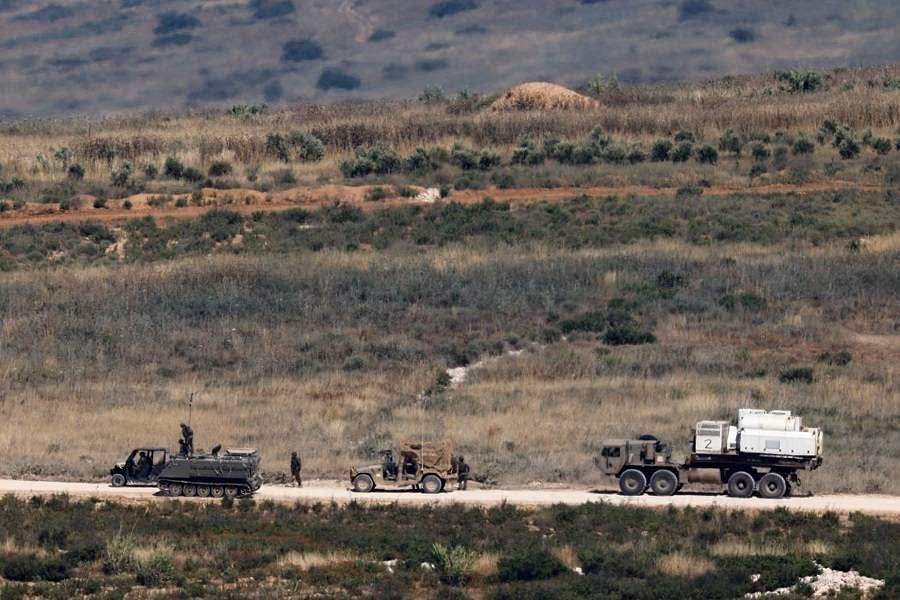
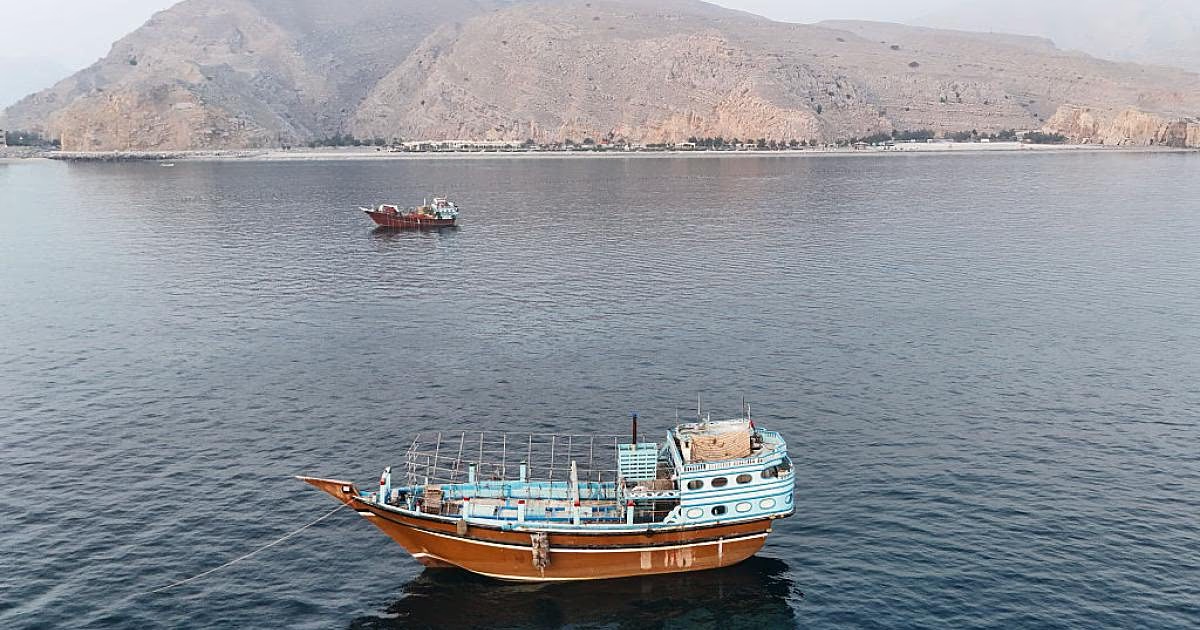
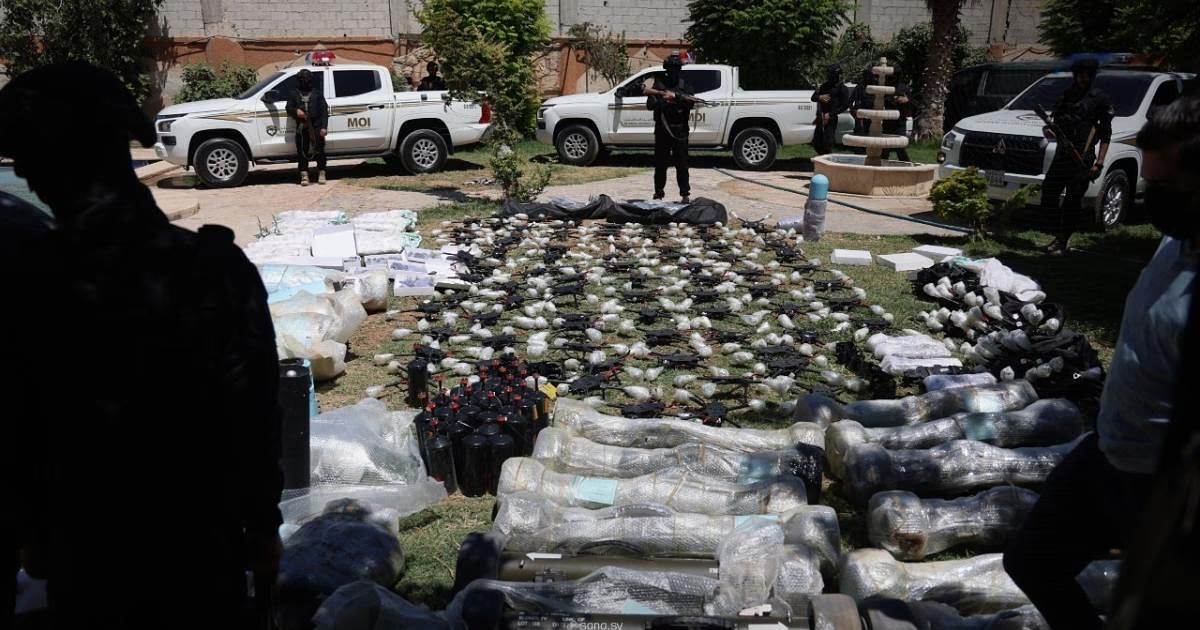
Official sources in the Syrian Ministry of Interior announced the success of the competent authorities in thwarting what they described as a dangerous attempt to smuggle a huge shipment of weapons and missiles across the Syrian-Iraqi border. The sources clarified that the operation came after precise monitoring and follow-up operations that resulted in the seizure of a car that was parked within the joint border area between the two countries.

For its part, Hezbollah quickly issued an official statement reiterating its denial of all allegations related to any military or logistical activity within Syrian territory. The party described these reports as mere baseless accusations, emphasizing its lack of connection to the shipment that Syrian authorities recently announced seizing.

Preliminary investigations conducted by Syrian security agencies revealed that the seized shipment was carefully prepared to cross through Syrian territory to Lebanese territory. Field data indicated that the final destination of these weapons was for Hezbollah, according to what official media sources quoted from the Ministry of Interior.

In the Iraqi capital, Baghdad, the armed forces announced the formation of a high-level investigation committee to ascertain the details of the security breach that allowed this shipment to pass. The Iraqi military command affirmed that it would fully coordinate with the Syrian side to uncover the circumstances of the operation and hold accountable any negligent parties proven to be involved in facilitating smuggling operations.

The confiscated shipment included a diverse arsenal of advanced weapons, including long-range missiles and anti-tank missiles, in addition to a large number of suicide drones. This seizure is considered one of the largest security operations on Syria's eastern border in recent months, given the quality of the equipment found.

Iraqi security sources reported that available information indicates the truck driver's confession of direct complicity with some employees at one of the land border crossings. This complicity facilitated the entry of the shipment into the border area before it was discovered by Syrian agencies that were monitoring suspicious movements in the area.

Observers believe that the timing of this incident raises significant concern in Iraqi political and economic circles, especially since Baghdad is seeking to secure alternative routes for exporting its oil. Iraq had recently agreed with Damascus to transport quantities of crude oil via tankers to the Syrian port of Baniyas, a route that may be affected by the expected security tightening.

Reports indicate that the actual seizure operation took place several days before its official announcement, as the Syrian side preferred to complete investigations and verify all details. The Iraqi side was not officially informed of the incident until after confirming all indicators linking the shipment to cross-border smuggling networks.

These developments come after a series of security operations carried out by Damascus earlier, most notably the dismantling of a cell last May that was said to be linked to illegal activities. These moves reflect Syria's desire to tighten border control and prevent its territory from being used as a corridor for unauthorized military supplies.

In light of these facts, it is expected that the coming days will witness tightened security measures on the movement of trucks and tankers between Iraq and Syria to prevent the recurrence of such breaches. Security coordination between Damascus and Baghdad remains the key to ensuring border stability and preventing it from becoming a hotbed for escalating regional tensions.

Preliminary investigations showed that the seized shipment was intended to cross through Syrian territory towards Lebanon for Hezbollah.
PALESTINE

Thu 16 Jul 2026 8:34 am - Jerusalem Time

Injuries and destruction of homes in Gaza.. The occupation continues to violate the truce and targets police stations

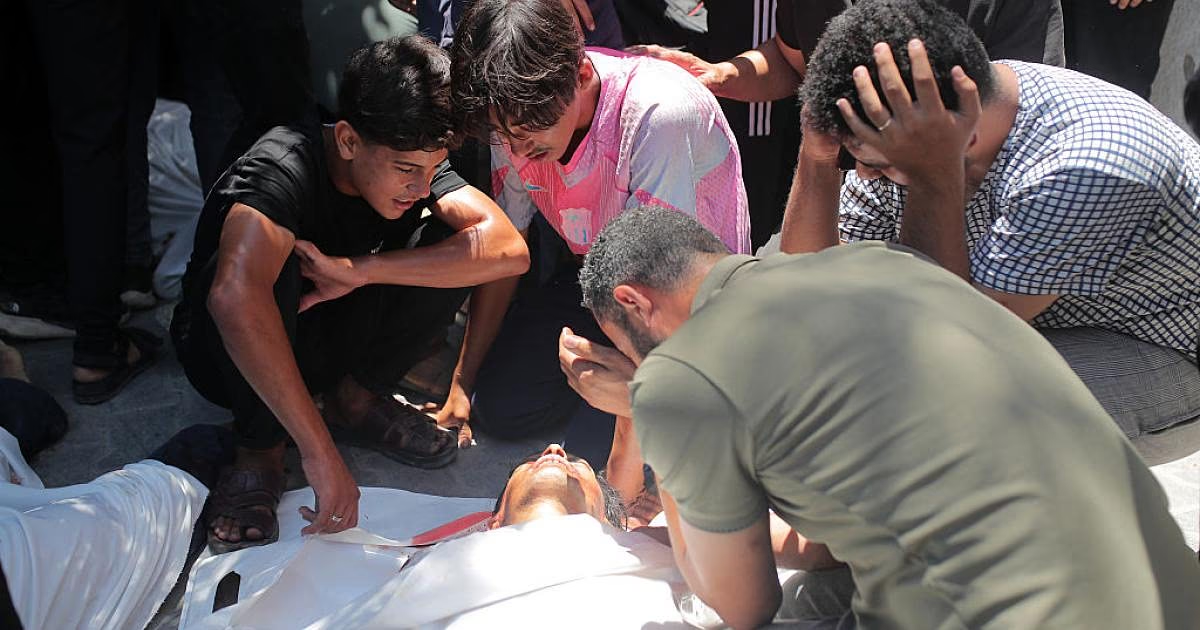
Medical and field sources reported today, Thursday, that five Palestinian citizens were injured as a result of shelling carried out by Israeli occupation forces on areas in the Al-Zaytoun neighborhood, south of Gaza City. This targeting came in the context of continuous military operations affecting populated areas, leading to the transfer of the wounded to hospitals for treatment amidst difficult humanitarian conditions.

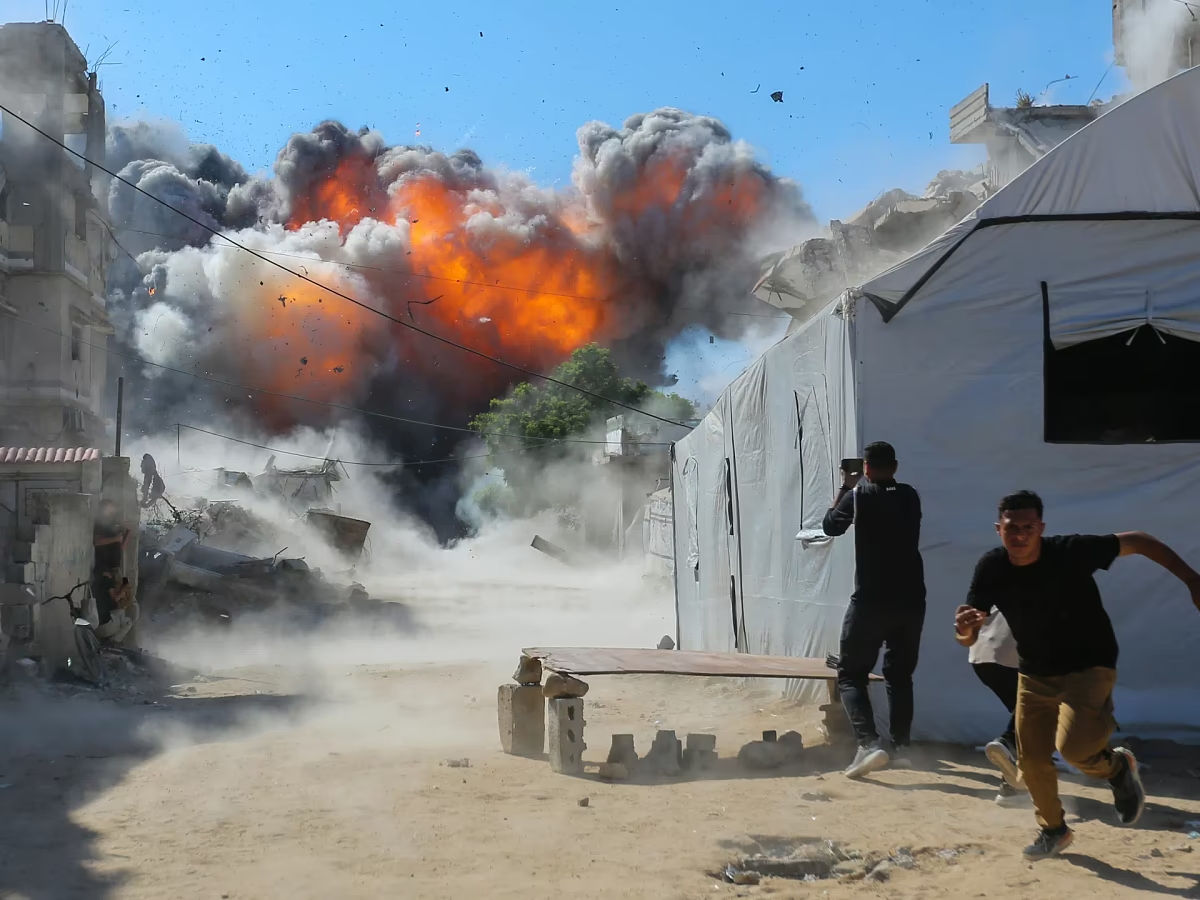
In the central Gaza Strip, Israeli warplanes launched a series of airstrikes that led to the complete destruction of three homes after prior warnings were issued to residents to evacuate them. The shelling caused severe damage to neighboring buildings and public property, increasing the suffering of displaced families and residents in those crowded areas.

Local sources confirmed that the raids targeted a home belonging to the Baraka family in Deir al-Balah, another belonging to the Nibrasi family in Al-Maghazi camp, in addition to a home belonging to the Matar family west of Nuseirat camp. A state of panic and terror prevailed among citizens after receiving calls from Israeli intelligence demanding them to evacuate entire residential blocks before the intense shelling began.

These field developments come amidst continued Israeli violations of the ceasefire agreement that came into effect on October 10, 2025. Despite international pledges for calm, military operations have not stopped, threatening the collapse of fragile understandings sponsored by international and regional parties.

Regarding human casualties, the Ministry of Health in the Gaza Strip announced the martyrdom of 13 Palestinians and the injury of 18 others during the past twenty-four hours. These figures reflect an escalation in the intensity of targeting civilians in various governorates of the Strip, despite a decrease in the intensity of direct confrontations in some axes.

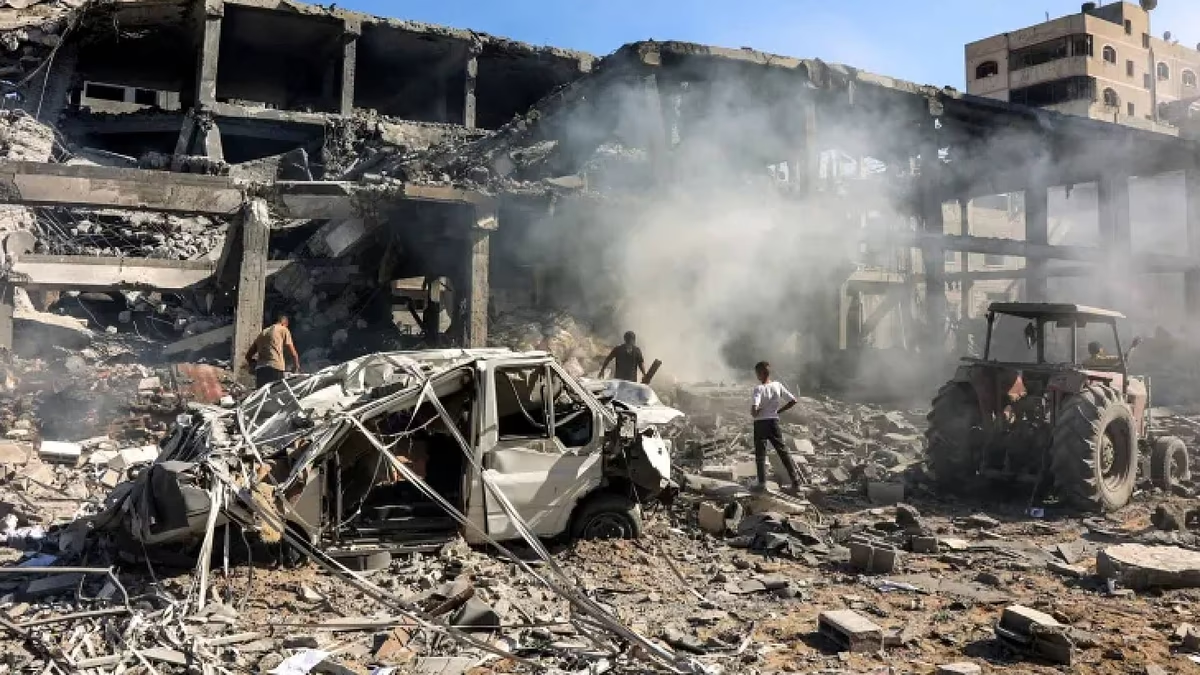
In a separate incident, occupation aircraft targeted a police station in the Al-Faluja area of Jabalia camp in the northern Strip, resulting in a massacre that claimed the lives of eight martyrs. Among the victims were the director of the station, Colonel Muhammad Marwan Salem, along with a number of officers and individuals who were carrying out their duties in maintaining security and serving citizens.

For their part, Palestinian factions condemned the targeting of police stations, considering it a continuation of targeting the administrative and service infrastructure of the Palestinian people. These forces called on international mediators and the US administration to take a firm stance against the crimes of the Israeli government, which disregards all signed agreements.

Official data issued by the Ministry of Health indicate that the number of victims of Israeli violations since the signing of the last truce agreement has exceeded 1123 martyrs. More than 3600 citizens have also been injured with varying degrees of severity, placing the exhausted health system before enormous challenges in light of the shortage of medical supplies and essential medicines.

Considering the total toll since the outbreak of the war in October 2023, statistics have recorded the martyrdom of more than 73,000 Palestinians and the injury of more than 173,000 others. Gaza suffers from massive destruction affecting about 90% of the civilian infrastructure, including schools, hospitals, and water and electricity networks.

The situation in the Gaza Strip remains susceptible to further escalation in the absence of real guarantees obliging the occupation to stop its repeated aggressions. Residents appeal to the international community to intervene immediately to stop the bloodshed and ensure the flow of humanitarian aid and reconstruction amidst these catastrophic conditions experienced by more than two million people.

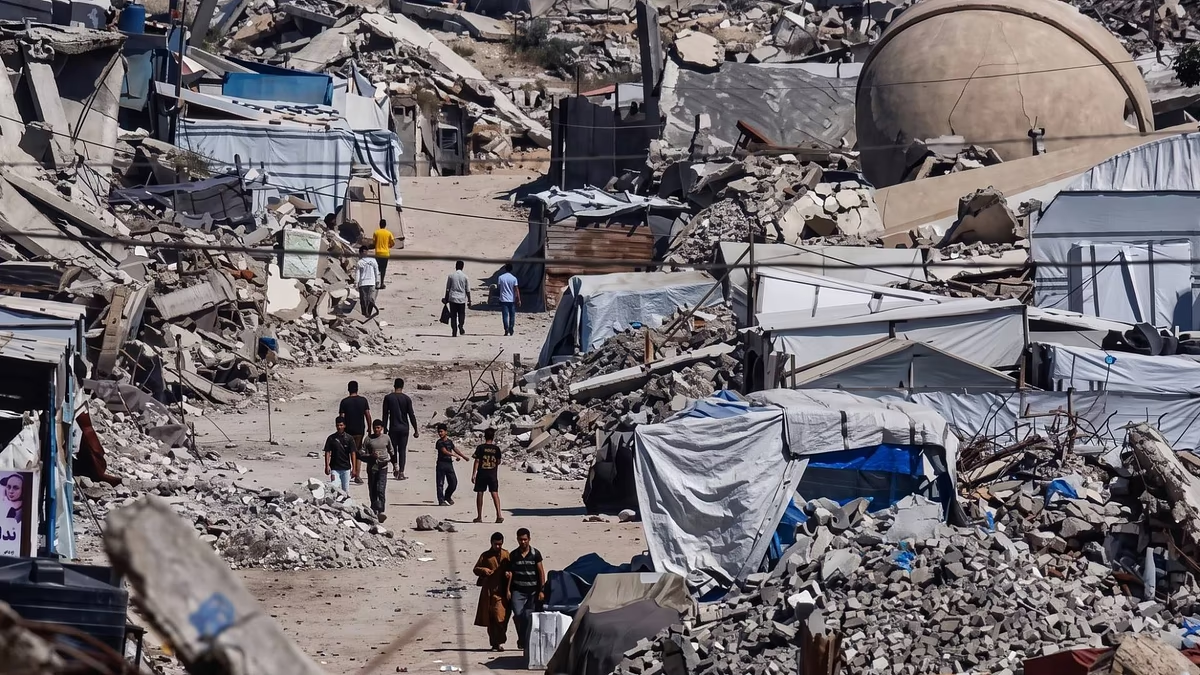
The occupation targeted a police station in the Al-Faluja area with an airstrike, leading to the martyrdom of the station director and a number of officers and individuals.

ARAB AND WORLD

Thu 16 Jul 2026 8:34 am - Jerusalem Time

Widespread Military Escalation: US Strikes Hit Deep Inside Iran, Tehran Retaliates by Targeting Bases in Kuwait and Jordan

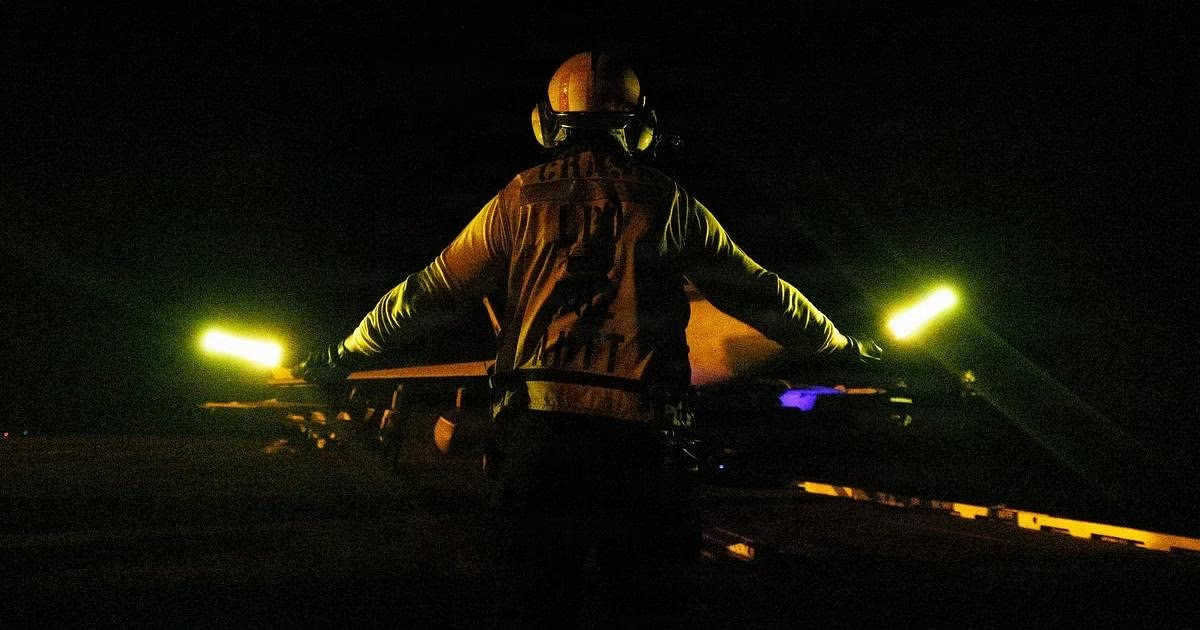
The US Central Command announced the completion of a new and intensive wave of air and missile strikes against military targets inside Iranian territory, in direct implementation of instructions from President Donald Trump. The military operations included concentrated bombing targeting air defense infrastructure and command and control facilities in multiple strategic areas.

Field sources reported violent explosions shaking the cities of Bandar Abbas, Bushehr, and Sirik, in addition to targeting Semnan Airport, located east of the capital Tehran, and sites in Lorestan province. Reports confirmed that the bombing also hit Qeshm Island, leading to columns of smoke rising from vital facilities belonging to the Iranian armed forces.

In an official statement, Central Command clarified that the attacks focused on neutralizing ballistic missile and drone capabilities, as well as destroying coastal surveillance facilities that threaten international navigation. The statement emphasized that US forces seek to reduce Tehran's ability to carry out hostile attacks in vital waterways.

In a related context, the offensive wave continued for 90 consecutive minutes, during which US fighters focused on destroying coastal defense positions and cruise missiles on Greater Tunb Island. This step, according to Washington, aims to prevent Iran from targeting commercial vessels and ensure freedom of navigation in the strategic Strait of Hormuz.

For its part, the Iranian army showed a firm stance regarding military pressure, with its spokesman stating that US operations will not succeed in imposing a new reality to open the Strait of Hormuz by force. Tehran affirmed that reopening the strait is exclusively contingent on Washington's application of Iranian regulations and full adherence to previously signed memorandums of understanding.

In response to the US escalation, the Iranian Revolutionary Guard announced retaliatory attacks targeting the US military presence in the region, specifically in Kuwait and Jordan. Iranian forces used a combination of guided missiles and suicide drones in their attack to precisely strike specific targets.

In Kuwait, Iranian shelling targeted the early warning radar system and gatherings of US soldiers at Ali Al Salem Air Base, leading to a widespread military alert. The Kuwaiti army announced that air defense systems were able to intercept and destroy a number of hostile drones that attempted to penetrate national airspace.

As for Jordan, the shelling hit military communication systems and fuel tanks belonging to US forces at Al Azraq Air Base, in response to the killing of 7 Iranian soldiers in Bampur city. The Jordanian Armed Forces confirmed their success in shooting down 8 Iranian missiles before they reached their targets, noting that no casualties occurred among civilians or military personnel.

Alert status extended to the Kingdom of Bahrain, where the Ministry of Interior activated sirens in various areas as a precautionary measure to alert residents. Bahraini authorities called on citizens and residents to maintain complete calm and immediately head to shelters and safe places in anticipation of any sudden military developments.

These rapid developments come amid a naval blockade reimposed by the United States on Iranian ports since the beginning of this week, which has intensified tensions. The region is experiencing a state of military turmoil with continued exchange of strikes, amid international fears of the situation escalating into a full-scale regional war spiraling out of control.

US hostile actions will not be able to open the Strait of Hormuz, and the only way is for Washington to adhere to Iranian regulations.

OPINIONS

Thu 16 Jul 2026 8:33 am - Jerusalem Time

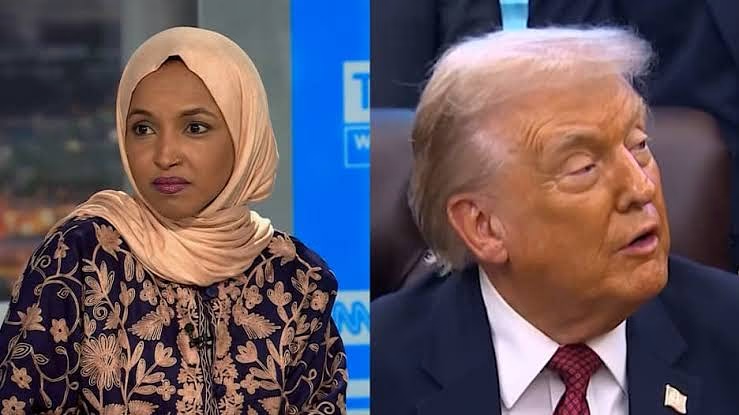
Amidst the Trump administration's attack on the International Criminal Court.. Ilhan Omar pushes for Washington to join it

Washington Message

Washington – Said Arikat – 16/7/2026

In a move reflecting the escalating division within the United States regarding its relationship with the International Criminal Court, Democratic Representative Ilhan Omar introduced a draft resolution calling on the United States to formally join the Court and ratify the Rome Statute, days after US Secretary of State Marco Rubio announced his intention to work on “dismantling” the Court and undermining its ability to carry out its duties.

Omar said that the International Criminal Court represents “an essential tool for achieving justice in places where victims find no other means of redress,” considering that if the United States truly believes in human rights and the rule of law, it should lead efforts to strengthen the international justice system, not weaken it. She added that “no one should be above the law, and the United States should set an example in respecting the standards it demands others adhere to.”

This draft resolution comes at a time when the relationship between President Donald Trump’s administration and the International Criminal Court is at its worst stage, after the US administration intensified its punitive measures against the Court due to its investigations related to Israeli officials, including Prime Minister Benjamin Netanyahu, in addition to previous investigations that addressed allegations of American individuals committing war crimes during the war in Afghanistan.

The US administration did not stop at imposing sanctions on a large number of senior court officials, but also expanded the scope of sanctions to include lawyers and human rights organizations that contributed to providing evidence or supporting the court’s investigations, which Washington opposes, in a move that drew widespread criticism from human rights organizations and defenders of the independence of international justice.

Reports indicate that the US administration demanded the court introduce amendments to the Rome Statute to prevent the prosecution of President Trump, members of his administration, or Israeli officials before the court, which observers considered an attempt to enshrine political and legal immunity that contradicts the principles on which the court was founded as a body competent to prosecute perpetrators of the most serious international crimes.

Rubio’s statements, in which he pledged to “dismantle” the International Criminal Court (on Monday, July 14), sparked a wide wave of condemnations. Amnesty International Secretary-General Agnes Callamard said that the US Secretary’s statements confirm, unintentionally, the importance of the court and its role in holding officials accountable when states are unable or unwilling to conduct genuine investigations.

Callamard added that the US administration’s positions suggest a fear of the possibility of American officials being held accountable in the future for actions that may amount to crimes under international law, pointing to allegations related to the deportation of individuals to places where they are subjected to torture, and extrajudicial killings in various regions.

In contrast, Representative Omar rejected the US administration’s claims that the court might prosecute American soldiers merely for their military service, stressing that the court intervenes only when states are unwilling or unable to conduct independent and credible investigations into war crimes, crimes against humanity, or genocide.

She said that the best way to avoid the court’s jurisdiction is not to commit those crimes in the first place, and when serious allegations arise, to conduct transparent investigations and hold those responsible accountable according to the law.

The new draft resolution is the third attempt by Omar since 2020 to push the United States towards joining the International Criminal Court, after she submitted two similar drafts in 2020 and 2022, but they did not reach the voting stage in the House of Representatives, despite the second initiative receiving support from a number of Democratic representatives.

The project also coincides with a lawsuit filed by two human rights organizations against President Trump and a number of senior officials in his administration, accusing them of violating the First Amendment of the US Constitution by imposing sanctions on human rights organizations that participated in demanding investigations into alleged war crimes committed by American and Israeli officials during the war on the Gaza Strip.

These developments highlight the widening gap within the United States between a current that views the International Criminal Court as a threat to American sovereignty, and another that considers it one of the most important international justice institutions that should be supported, especially in light of escalating international demands to hold accountable those responsible for grave violations of international humanitarian law.

The initiative led by Ilhan Omar reveals the widening scope of disagreement within the American political establishment regarding the United States’ position in the international legal system. While the Trump administration continues to treat the International Criminal Court as a direct threat to national sovereignty, a growing segment of Democrats believes that refusing to abide by the same rules that Washington demands others respect weakens the credibility of American discourse on human rights. This debate reflects a deeper struggle between the logic of power that has governed American foreign policy for decades, and the logic of legal accountability that is gaining increasing momentum on the international stage.

The current confrontation is of exceptional importance because it comes amidst escalating international pressures related to the war in Gaza, where the International Criminal Court has become a key player in legal accountability issues. Therefore, the Trump administration’s opposition to the court seems largely linked to its desire to protect Israeli officials, along with American officials, from any potential prosecutions. This approach would deepen tensions between Washington and its European allies, who consider the court one of the fundamental pillars of the international legal system after World War II.

Although the chances of passing the draft resolution in Congress appear limited given the current balance of power, its political value transcends the probabilities of it being voted on. It reopens the debate about the relationship between the United States and international institutions, and raises a fundamental question about Washington’s willingness to abide by the same legal standards it calls for globally. It also gives human rights organizations additional momentum in confronting policies aimed at reducing the court’s jurisdiction, and confirms that the battle for international justice has become part of the internal political division in the United States, and not just a disagreement with the international community.

OPINIONS

Thu 16 Jul 2026 8:24 am - Jerusalem Time

Mahmoud Khalil’s Lawsuit Is a Test of Whether the First Amendment Still Protects Dissent


By Said Arikat

July 15, 2026

News analysis

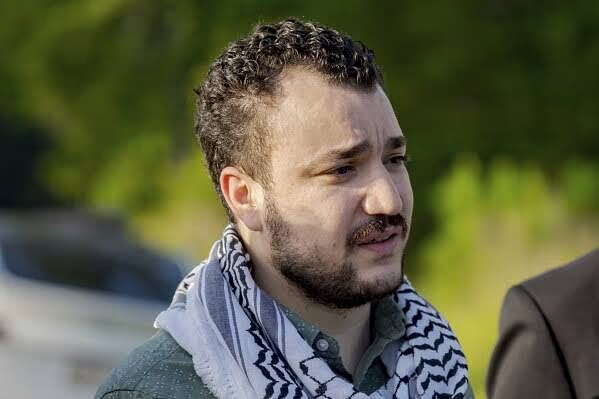
Washington, D.C- The most important free speech case in America today is not about a journalist, a publisher, or a social media platform. It is about Mahmoud Khalil, a Palestinian graduate of Columbia University who alleges that the United States government and a network of powerful pro-Israel organizations conspired to punish him for one reason alone: speaking out against Israel’s war in Gaza.

His lawsuit, filed under the Ku Klux Klan Act of 1871, reaches far beyond his own experience. It asks whether constitutional rights can survive when criticism of Israel collides with one of Washington’s most influential political lobbies. More fundamentally, it asks whether the American government may use its vast powers to silence political dissent by working, as the complaint alleges, with private organizations determined to marginalize critics of Israeli policy.

The irony is difficult to ignore.

Congress enacted the Ku Klux Klan Act after the Civil War to dismantle conspiracies that deprived Americans of their constitutional rights through coordinated action by public officials and private actors. More than 150 years later, Khalil argues that the same principle applies today: that government officials and private organizations worked in concert to strip him of rights guaranteed by the Constitution because of his political beliefs.

Whether the courts ultimately agree remains to be seen. But the allegations deserve to be examined with the seriousness that any claimed assault on the First Amendment demands.

Khalil was not accused of violence. He was not charged with terrorism. He was not prosecuted for espionage or any criminal offense. He was a lawful permanent resident who emerged as one of the most visible leaders of Columbia University’s pro-Palestinian protests against Israel’s devastating military campaign in Gaza.

For that, he became the target of immigration authorities.

His arrest by ICE transformed what should have been a straightforward question of constitutional liberty into an extraordinary demonstration of executive power. He spent 104 days in detention while the administration sought to deport him, depriving him of the chance to witness the birth of his first child. Whatever the legal outcome, no democracy should treat the peaceful exercise of political speech as grounds for separating a father from his family.

The administration insisted that Khalil’s activism conflicted with American foreign policy interests. That rationale should alarm anyone who values constitutional government. The First Amendment exists precisely to protect speech that challenges official policy. If the executive branch can redefine peaceful political advocacy as a foreign policy liability, constitutional freedoms become contingent upon political convenience.

That is a dangerous precedent.

Equally disturbing are the allegations concerning organizations such as Betar and Canary Mission, whose activities have become increasingly controversial as American campuses turned into battlegrounds over Gaza.

For years, these organizations have compiled detailed dossiers on students, professors and activists who criticize Israeli government policies or advocate for Palestinian rights. They maintain that they are exposing antisemitism and political extremism. Their critics argue that they have instead built sophisticated blacklisting operations designed to intimidate, stigmatize and professionally damage those who challenge Israel’s conduct.

The distinction is critical. Antisemitism is a genuine and growing threat that deserves unequivocal condemnation. But opposition to Israel’s occupation, condemnation of civilian casualties in Gaza or advocacy for Palestinian self-determination are political positions—not evidence of hatred toward Jews. Conflating the two not only weakens the fight against genuine antisemitism but also narrows the space for legitimate democratic debate.

Khalil’s lawsuit pushes the issue even further. It alleges that organizations dedicated to defending Israel did more than criticize his views—they helped facilitate government action against him. Those allegations remain to be tested in court. But if discovery demonstrates meaningful coordination between government officials and private advocacy groups to target protected political speech, the implications will extend far beyond this case.

The lawsuit also shines a harsh light on what the Gaza war has done to free expression in the United States.

Universities that once celebrated robust debate increasingly became places where students feared disciplinary proceedings, public blacklisting, or government scrutiny for expressing solidarity with Palestinians. Peaceful encampments were dismantled. Faculty members were investigated. International students worried that political activism might jeopardize their immigration status.

The message was unmistakable: criticizing Israel could carry consequences far beyond the marketplace of ideas.

That should concern Americans regardless of their views on the Middle East.

The issue is not whether one supports Israel or Palestine. Democracies survive disagreement. What they cannot survive is the selective application of constitutional protections based on political influence. No foreign ally should enjoy such extraordinary protection that criticism of its government invites state retaliation against those who voice it.

If the allegations in Khalil’s complaint prove true, the case will reveal something deeply unsettling about contemporary America: that private organizations with clear ideological agendas may have helped transform the machinery of government into an instrument for suppressing lawful political dissent.

History offers an uncomfortable parallel. During the McCarthy era, accusations of ideological disloyalty destroyed reputations, careers and lives. Courts eventually reaffirmed that constitutional liberties cannot depend upon political orthodoxy. Today’s controversy differs in its particulars, but the underlying principle is remarkably similar. A democracy begins to lose its character when governments punish citizens or lawful residents not for unlawful conduct but for expressing disfavored political opinions.

That is why Mahmoud Khalil’s lawsuit matters.

It is not simply about one activist, one administration or even one conflict overseas. It is about whether Americans remain free to criticize the actions of a foreign government without fearing detention, deportation or coordinated campaigns designed to silence them.

The First Amendment was never intended to protect only popular opinions. Its greatest purpose has always been to protect speech that powerful interests would rather not hear.

That principle is now on trial alongside Mahmoud Khalil. If America cannot defend it when the subject is Israel and Palestine, it risks proving that some political speech enjoys constitutional protection while other speech survives only at the pleasure of those who wield power.


ANALYSIS

Wed 15 Jul 2026 5:17 pm - Jerusalem Time

Mahmoud Khalil's Lawsuit Revives the "Ku Klux Klan Act"... A Legal Confrontation with the Trump Administration and Pro-Israel Groups

Said Erikat

Opinion Writer

Washington Message

Washington – Said Arikat – 7/15/2026

On Tuesday, July 14, Palestinian activist and Columbia University graduate Mahmoud Khalil opened a new chapter in his legal confrontation with the administration of US President Donald Trump, after filing a civil lawsuit in federal court against White House Deputy Chief of Staff Stephen Miller, the conservative Heritage Foundation, and an affiliate of Columbia University, along with a number of individuals and organizations, accusing them of conspiring to target him due to his pro-Palestinian rights activism, in a case that is poised to become an important judicial test of the limits of free speech in the United States.

The lawsuit is based on the "Ku Klux Klan Act" of 1871, one of the most prominent civil rights laws in American history, which was passed by Congress after the Civil War to confront acts of terrorism and violence perpetrated by the "Ku Klux Klan" organization against Black Americans and Reconstruction supporters. One of its most important provisions remains in force today, allowing for the prosecution of any individuals or entities proven to have conspired to deprive people of their constitutional rights or punish them for exercising freedoms guaranteed by the Constitution.

Khalil said, in a statement announcing the lawsuit, that he "will not stop fighting until everyone who deliberately contributed to depriving me of attending the birth of my son and taking 104 days of my life is held accountable," referring to his detention by US immigration authorities, adding that "this lawsuit is not only about what I personally experienced, but about a coordinated and ongoing conspiracy to punish, silence, and intimidate anyone who dares to advocate for the liberation of Palestine," confirming that other legal actions will follow soon.

Mahmoud Khalil, a Palestinian who held legal permanent residency in the United States, emerged as one of the most prominent leaders of the pro-Palestinian student movement at Columbia University during the widespread protests that swept American universities in objection to the Israeli war in the Gaza Strip. In March 2025, he was arrested by US immigration authorities after the Trump administration deemed his political activity to be contrary to US foreign policy interests and sought to deport him, a move that drew widespread criticism from civil rights organizations, which saw the administration as using immigration laws to punish peaceful political activity protected by the First Amendment of the US Constitution.

The lawsuit alleges that the targeting of Khalil was not a solitary administrative decision, but rather the result of coordination between government officials, think tanks, lobbying organizations, and pro-Israel activist groups, with the aim of silencing voices critical of the war on Gaza and sending a deterrent message to activists in American universities.

Among the entities included in the lawsuit are the organizations "Betar" and "Canary Mission," which operate as a front for Israeli propaganda, focusing their attention on collecting information about pro-Palestinian students and academics, publishing profiles about them, and pressuring universities and government authorities to take action against them. The two organizations have previously denied committing any legal violations, stating that their activity is limited to documenting what they consider to be antisemitism and extremism.

The lawsuit also accuses the "Heritage Foundation," one of the most influential conservative think tanks in Washington, of contributing to providing intellectual and political cover for the campaign that targeted pro-Palestinian activists, while Stephen Miller faces accusations of participating in drafting and implementing policies aimed at using state tools, including immigration laws, to punish opponents of US policy towards Israel.

Observers say that the case may transcend its personal boundaries to become a legal precedent regarding the relationship between the executive branch and private groups, and the extent of those groups' responsibility if it is proven that they coordinated with government officials to target individuals because of their political views. The case may also revive the use of a law dating back more than a century and a half in the context of a modern battle over freedom of expression, student activism, and the limits of influence exercised by lobbying groups within American state institutions.

Mahmoud Khalil's lawsuit comes at a time when the United States is witnessing a growing debate about whether the war in Gaza has redrawn the boundaries of free speech within American universities. University campuses have become the scene of an unprecedented political and legal confrontation between university administrations and the federal government on the one hand, and student movements that believe that criticizing Israeli policies is at the core of guaranteed constitutional rights. This case may make the American judiciary the arbiter in one of the most sensitive issues in decades.

The recourse to the "Ku Klux Klan Act" takes on special significance because it shifts the dispute from merely a disagreement over immigration decisions to an accusation of a widespread civil conspiracy to strip activists of their constitutional rights. If the plaintiffs can prove the existence of coordination between government officials and private organizations to target Khalil because of his political views, the case could open the door to similar lawsuits filed by other activists, thereby expanding the scope of legal accountability for campaigns to restrict freedom of expression.

This case once again highlights the controversial role played by the organizations "Betar" and "Canary Mission," which work to silence voices critical of Israel and its policies, especially the occupation and the devastating war on Gaza, which a growing number of experts and international organizations have described as potentially amounting to genocide. The two organizations have gone beyond claiming to combat antisemitism, adopting an approach based on defamation, blacklisting, and pursuing students and academics, thereby creating a climate of fear and self-censorship within American universities, undermining freedom of expression guaranteed by the US Constitution, and transforming the accusation of "antisemitism" into a political tool to silence anyone who dares to criticize the policies of the Israeli government, instead of confronting real antisemitism wherever it is found.

ANALYSIS

Wed 15 Jul 2026 4:34 pm - Jerusalem Time

Trump backs down from imposing fees on navigation in the Strait of Hormuz after Gulf and international pressure

Said Erikat

Opinion Writer

Urgent: Washington Message

Washington – Saeed Erikat - 14/7/2026

US President Donald Trump, on Tuesday, backed down from his controversial plan to impose a 20 percent fee on all commercial vessels transiting the Strait of Hormuz, in a swift reversal that reflects the extent of objections the initiative faced from Washington's allies, Gulf states, and even from within the Republican Party.

Trump announced, in a post on the "Truth Social" platform, that the strait would remain open to "all vessel traffic except Iran," stressing that the United States would impose a "complete blockade" limited to vessels bound for or coming from Iranian ports, or those carrying goods linked to Iran, instead of imposing comprehensive fees on international navigation.

The US President explained that the fees he had announced one day earlier would be replaced by economic and investment arrangements with Gulf countries, stating that these countries would inject "very huge" investments into the United States, considering this option more feasible than imposing transit fees on commercial vessels.

This retreat comes less than twenty-four hours after Trump announced his original plan, which sparked a wave of widespread criticism as it represented a precedent in dealing with one of the most important international maritime passages, through which a large percentage of global oil and gas exports pass, and which is legally subject to the principle of freedom of navigation in international waters.

Trump told reporters in the Oval Office that his decision came after calls with leaders of Gulf countries, who informed him that they preferred to address the issue by expanding investments in the American economy rather than imposing navigation fees. He added that the idea of fees was for him a "compensation" for the cost borne by the United States in protecting the security of the strait, but he now prefers a model based on mutual investment, which achieves an economic return for both parties.

Internal and external objections

Criticism was not limited to the Democratic Party, as a number of Republicans expressed reservations about the proposal. Republican Senator John Kennedy said that the Strait of Hormuz represents international waters, and no party should impose fees on transiting vessels, despite his general support for the administration's policy towards Iran.

Democrats, on the other hand, believed that the plan would lead to an expansion of the military confrontation. Senator Tim Kaine warned that the US declaring itself a "guardian" of the strait would not go unanswered, and could endanger more American troops, as well as raise the cost of war on the American economy.

Britain also joined the objectors, as the British Foreign Secretary affirmed that London's position is based on supporting freedom of navigation and rejecting the imposition of any fees on transit in the Strait of Hormuz, stressing that no country has the right to impose restrictions or fees on this vital maritime passage.

Hormuz remains the knot of conflict

This development comes as the Strait of Hormuz remains one of the most complex issues in the escalating confrontation between Washington and Tehran. Despite a temporary truce previously reached between the two sides, it did not include a clear agreement on the security arrangements of the strait or mechanisms to ensure freedom of navigation within it.

With Trump's announcement last week that the truce had ended, mutual military strikes between the United States and Iran resumed, bringing the strait back to the forefront of the conflict as a strategic bargaining chip used by the warring parties, either through threatening to close it or through seeking to impose new security arrangements on it.

While Trump's retreat reduces the chances of a global trade crisis resulting from imposing navigation fees, it does not change the fact that the future of the Strait of Hormuz is still linked to the course of political and military confrontation between Washington and Tehran, in the absence of a comprehensive understanding that addresses the roots of the crisis.

A retreat reflecting the limits of American power

President Trump's swift retreat reveals that American power to impose unilateral arrangements in one of the world's most important maritime passages is not absolute, even with American military superiority. The idea of fees clashed with widespread legal, political, and economic opposition, because the Strait of Hormuz does not represent an American passage, but a vital artery for international trade. The crisis also showed that Washington's partners in the Gulf, despite their reliance on the American security umbrella, do not want policies that could destabilize energy markets or turn the strait into a permanent source of economic and political tension.

The Gulf prefers economy over escalation

Trump's response to the request of Gulf leaders reflects a growing understanding that these countries now have a greater margin to influence American decisions, benefiting from their investment and financial weight. Instead of entering into security arrangements that could lead to further militarization of the strait, Gulf capitals preferred to use their economic influence to defend the stability of navigation. This indicates a gradual shift in the relationship with Washington, where investments and economic partnerships have become tools of pressure no less important than traditional military alliances.

The crisis is not over yet

Despite Trump's retreat from the idea of fees, the underlying crisis still exists, as the US-Iranian dispute continues over the future of the Strait of Hormuz and its role in any future political settlement. The blockade announced by Washington on vessels linked to Iran may push Tehran to take countermeasures, thereby re-threatening freedom of navigation in a different way. Therefore, removing the fees does not mean removing the causes of tension, but represents an adjustment in American pressure tools, while the strait remains one of the most dangerous hotspots of geopolitical engagement in the Middle East.

PALESTINE

Wed 15 Jul 2026 4:34 pm - Jerusalem Time

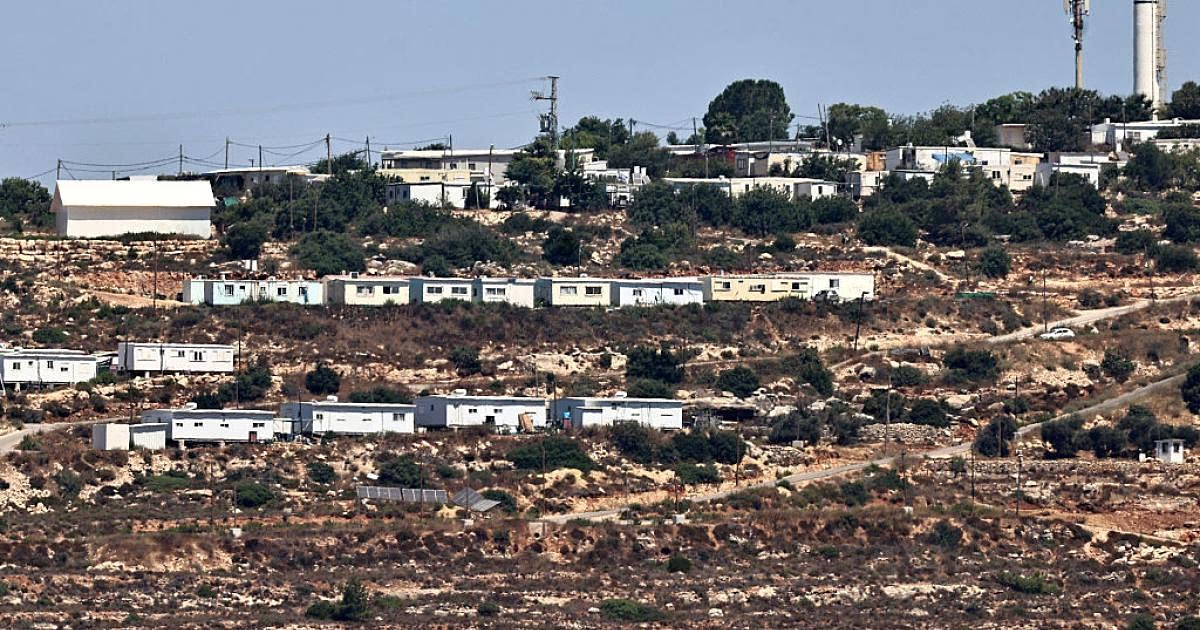
Secret $370 Million Budget: Israeli Plan to Boost Settlement in West Bank

Hebrew media sources have revealed that the Israeli Ministerial Committee for National Security Affairs (the Cabinet) has approved a massive budget to bolster the settlement project in the occupied West Bank. According to the leaked information, this budget amounted to approximately 1.3 billion shekels, equivalent to 370 million US dollars, allocated for establishing new settlement outposts and expanding existing ones.

Reports clarified that this decision was made about a month ago, but the Israeli government preferred to keep it under wraps and away from official media circulation. This secrecy comes in the context of Tel Aviv's attempts to avoid a diplomatic confrontation with the American administration and to prevent embarrassing Washington, which ostensibly opposes settlement expansion.

This step was based on a joint proposal submitted by Prime Minister Benjamin Netanyahu in cooperation with Finance Minister Bezalel Smotrich and Settlement Minister Orit Strock. This tripartite coordination reflects the current government's orientation, which is described as the most supportive of settlers since the occupation of the West Bank in 1967.

The new budget aims to fund the establishment of additional settlement neighborhoods in dozens of settlements that received prior ministerial approvals during the current government's term. The allocations also include developing the basic infrastructure necessary to begin actual construction work, in parallel with completing ongoing development projects in various areas of the West Bank.

Sources indicate that this decision represents a new link in a series of measures approved by the government in recent months to entrench the settlement presence. These measures included funding the construction of new bypass roads, undertaking extensive engineering planning, and enhancing security measures around emerging settlements.

Despite the disclosure of the budget's size, official bodies have not precisely identified the geographical locations where the new settlements will be established. This ambiguity raises Palestinian and international concerns about targeting strategic areas aimed at dissecting the West Bank and isolating its cities from each other.

Previous reports in April indicated that the Cabinet had secretly approved the legalization and establishment of 34 new settlements in various areas of the West Bank. The secrecy of those decisions was maintained at the time to avoid international pressure, especially given the political sensitivity related to the annexation of Palestinian territories.

Current statistics indicate the presence of approximately 750,000 Israeli settlers distributed among 141 official settlements and 224 illegal settlement outposts. About a quarter of a million of these settlers are concentrated in 15 major settlements built on the lands of occupied East Jerusalem, complicating any future political solutions.

These settlement movements coincide with ongoing field escalation by the Israeli army and settler groups against Palestinian citizens and their property. These attacks include house demolitions and destruction of facilities, sabotage of agricultural lands, and displacement of Bedouin communities, creating a bitter reality on the ground.

For its part, the Palestinian leadership warned that these systematic policies aim to impose the de facto annexation of the West Bank and undermine the two-state solution. It considered that Israel's continued encroachment on Palestinian lands disregards all international resolutions that deem settlement illegal and an obstacle to peace.

The decision to allocate the settlement budget was kept secret to avoid embarrassing the Americans and their political pressure.

PALESTINE

Wed 15 Jul 2026 4:34 pm - Jerusalem Time

13 Martyrs in Gaza: Occupation Assassinate Jabalia Police Director and Continues Targeting Civilian Institutions

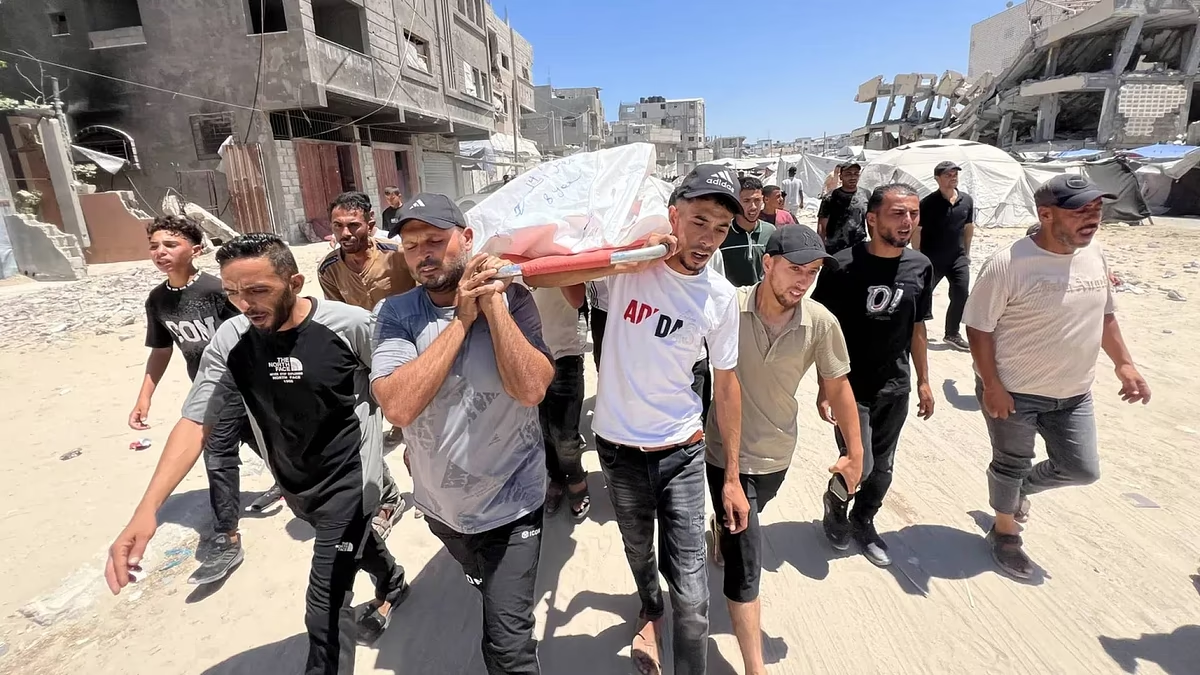
Israeli occupation forces escalated their bloody attacks on the Gaza Strip since Tuesday morning, resulting in the martyrdom of 13 people in various areas. The most violent of these attacks focused on the northern part of the Strip, where warplanes targeted headquarters and security centers belonging to the Palestinian police force.

In a new massacre targeting institutional work, Colonel Muhammad Marwan Salem, director of the Jabalia refugee camp police station, was martyred along with a number of police officers and personnel. The airstrike occurred west of the camp, where occupation aircraft launched four missiles at a security point, also leading to the martyrdom of a female civilian who was present at the scene.

For its part, the Israeli occupation army admitted to carrying out the assassination, claiming that Colonel Salem holds the position of head of military security in the central Jabalia battalion, which belongs to the military wing of the Hamas movement. These claims come in the context of the occupation's continuous attempts to justify targeting civilian and security personnel who manage the affairs of citizens in the Strip.

The Ministry of Interior and National Security in Gaza mourned the martyrs of duty from police officers and personnel, affirming that this targeting represents a full-fledged war crime. The ministry indicated that the occupation systematically seeks to undermine the security and civilian system to spread chaos and deprive residents of any legal or administrative protection.

The Ministry of Interior directed sharp criticism at the Deputy UN Coordinator for the Peace Process, accusing him of fabricating slanders against the police force hours before the targeting. The ministry considered that these statements provided political cover for the occupation to commit its crime, demanding that the UN Secretary-General open an urgent investigation into this blatant bias.

The raids were not limited to security centers but also targeted the tents of unarmed displaced persons in different areas of the besieged Strip. Two Palestinians were martyred in a shelling that targeted a tent near Sheikh Ajlin Mosque southwest of Gaza City, as part of the continued targeting of densely populated civilian gatherings.

In Khan Yunis city to the south, an Israeli drone launched a raid on a tent sheltering displaced persons in the vicinity of Taybeh Towers, leading to the martyrdom of one citizen and the injury of three others with varying degrees of wounds. Reconnaissance planes continue their intensive flights over displacement areas, creating a state of constant terror among displaced families.

In the Mawasi Rafah area, which the occupation claims are safe areas, the child Moataz Abu Shaar and the young man Bilal Abu Mousa were martyred by the bullets of the occupation army. These field incidents confirm that sniper bullets and artillery shelling spare no one, even in areas classified by the occupation as destinations for forced displacement.

The latest statistics from the Palestinian Ministry of Health indicate that the occupation's violations of the ceasefire agreement have led to a worsening humanitarian catastrophe. Since the signing of the agreement until Monday, 1108 martyrs have fallen and more than 3500 others have been injured, putting the agreement at risk in the face of Israeli intransigence.

Observers and officials in Gaza believe that targeting the joints of governmental and police work aims to completely end the entity and institutional presence of the Strip. Local sources confirmed that the occupation disregards all international norms and conventions that protect civilian employees and workers in humanitarian and security sectors.

Gaza's official bodies renewed their call to the mediators and guarantors of the truce agreement for immediate intervention to curb the aggression and stop targeting the police force. They also called on international human rights organizations to prosecute the leaders and soldiers of the occupation responsible for these brutal crimes that aim to undermine the foundations of life in Gaza.

Targeting police forces and governmental work joints in the Gaza Strip is an integral part of the program to end the institutional entity of the Strip.

PALESTINE

Wed 15 Jul 2026 4:33 pm - Jerusalem Time

3 martyrs and wounded in an airstrike targeting a house in Deir al-Balah city

The occupation army committed a new massacre in Deir al-Balah city, central Gaza Strip, where warplanes targeted a populated residential house, resulting in the martyrdom of three and a number of injuries among civilians.

Medical sources at Al-Aqsa Martyrs Hospital confirmed the arrival of the bodies of the martyrs and the wounded to the emergency departments, noting that the injuries range from moderate to serious, as a result of the direct bombing that targeted civilian properties in the central region.

This raid comes within the framework of the ongoing military escalation targeting residential neighborhoods in various areas of the Strip, which exacerbates the already deteriorating humanitarian and medical conditions, and increases the number of victims among Palestinian families safe in their homes.

A medical source at Al-Aqsa Martyrs Hospital reported the martyrdom of three Palestinian citizens and the injury of several others with varying degrees of wounds as a result of the bombing.

ARAB AND WORLD

Wed 15 Jul 2026 4:33 pm - Jerusalem Time

Trump threatens sanctions on Iran and "Hezbollah" and Rome talks discuss Israeli withdrawal

US President Donald Trump revealed new legislative directions within Congress aimed at expanding the scope of the sanctions bill targeting Russia to include both Iran and the Lebanese "Hezbollah." Trump affirmed from the White House that this step has a high chance of approval once the final details are drafted, noting that the inclusion of Tehran in this law is of paramount importance in the current US strategy.

In a related context, the first round of direct talks between delegations from Lebanon and Israel concluded in the Italian capital, Rome, under intense American patronage. Sources reported that the atmosphere was positive and fruitful, with discussions focusing on mechanisms for implementing the framework agreement reached last month to end the armed conflict in the border region.

During these talks, Tel Aviv showed initial readiness to proceed with plans for withdrawal from two experimental areas in southern Lebanon, which Israeli Foreign Minister Gideon Sa'ar considered a step forward. Sa'ar expressed his hope that the current Rome round would lead to a real breakthrough that would end the military tension that has persisted for months.

For its part, the Lebanese presidency stressed that the negotiating delegation carries clear directives on the necessity of an immediate withdrawal of Israeli forces from the agreed-upon areas before moving on to any other issues. The Lebanese side insists on the necessity of implementing the agreement in stages, starting with enabling the Lebanese army to successively take over border towns to ensure national sovereignty.

The framework agreement sponsored by Washington stipulates the complete cessation of hostilities and the disarmament of "Hezbollah" in the southern regions, in preparation for the deployment of Lebanese army units. However, the party still declares its categorical rejection of surrendering its weapons or entering into direct negotiations with the Israeli side, relying on Iranian support in the face of international pressure.

Diplomatic sources indicate a gap in the final objectives of the negotiation, as Israel seeks to reach a comprehensive peace agreement, while Lebanon focuses on concluding a security treaty that guarantees a cessation of aggressions. These sources believe that Israel is trying to capitalize on the results of recent military operations to impose its conditions in the negotiation rooms as the stronger party on the ground.

On the ground, military escalation has not completely stopped despite the negotiation atmosphere, as Israeli forces carried out a series of bombings and raids in the towns of Nabatieh al-Fawqa and Kafr Tebnit. These attacks resulted in casualties among civilians, at a time when "Hezbollah" has committed to not carrying out new offensive operations since mid-June, while warning against violating the ceasefire.

These developments coincide with a widespread regional escalation, as President Trump announced the re-imposition of a naval blockade on Iranian ports in the strategic Strait of Hormuz region. This step comes after American strikes targeted Iranian sites, further complicating the political scene and linking the Lebanese file to the direct conflict between Washington and Tehran.

Political observers believe that the chances of achieving a decisive breakthrough in the Rome negotiations may remain limited in the foreseeable future, unless Washington exerts real pressure on the Israeli side. Analysts suggest that any substantial progress on the withdrawal issue may be postponed until after the anticipated visit of the Lebanese President to Washington next week.

Reports indicate that the Lebanese army has completed its readiness to take over security tasks in the border areas immediately after the withdrawal of Israeli forces, as coordination meetings were held with a US military delegation for this purpose. This coordination aims to establish precise mechanisms to prevent any security vacuum that could lead to a renewal of armed confrontations.

Regarding the Iranian position, Tehran is trying to link the path of de-escalation in Lebanon with the comprehensive regional escalation file, which Washington and Tel Aviv reject as they seek to separate the two paths. Research circles warn that Iran may resort to reactivating the southern Lebanon front again if it feels an existential threat to its regime due to US sanctions and blockade.

The war that erupted last March left widespread destruction of Lebanese infrastructure and led to the death of more than 4,300 people, according to Ministry of Health data. Intensive raids and the Israeli ground incursion caused widespread displacement, putting additional pressure on the Lebanese government to reach a quick political solution.

The issue of Hezbollah's disarmament remains the most prominent sticking point in the negotiations, as Israel stipulates not withdrawing from the 10-kilometer deep security zone before this condition is met. Analysts doubt the ability of the Lebanese state to implement this clause given the current political and military balances within the country.

With the resumption of talks in Rome, the Lebanese street awaits tangible results that will alleviate the burden of the security and economic crisis, amid fears that the new US-Iranian escalation could undermine mediation efforts. The coming days remain crucial in determining the path of the framework agreement and the extent of the parties' commitment to implementing its provisions on the ground.

They will add Iran, and that is very important. They may also add Hezbollah to the sanctions bill.

OPINIONS

Wed 15 Jul 2026 4:32 pm - Jerusalem Time

Gaza Sleeping in the Eyelid of Doom!

Dr. Ibrahim Melhem

Editor-in-Chief

Gaza dies silently morning and evening, without a clamor that disturbs those whose consciences have slept, whose eyes have dried, whose hearts have hardened, whose stomachs have been gorged, and whose feelings have become numb, in a world that sees victims as mere numbers used to draft foolish statements that almost blame them for their deaths more than condemning those responsible for killing them, starving them, displacing them, and cramming them into the remaining third of their barren land.The news of daily death in Gaza almost disappears behind the breaking news ticker on screens open to broadcasting the speeches of the "Lord of the Universe," who ignites fires to extinguish them with gasoline, and closes straits to open them with the arrogance of power, imposing tribute in exchange for protection, and reviving the history of pirates and extreme thugs who impose tolls on passersby.The vast land shrinks for the people of the Strip, sleeping in the eyelid of doom, enduring the daily pains of losing their loved ones, and struggling against the famine that gnaws at their bodies, exhausted by a tragedy that has extended for a thousand days and more.Gaza's night has lengthened and stretched... will this night ever end?

OPINIONS

Wed 15 Jul 2026 4:32 pm - Jerusalem Time

Opinion Polls in Israel: Political Division and Netanyahu's Decline

Israel is experiencing a state of political and social tension in 2026 as the anticipated elections approach. Multiple opinion polls reveal a clear decline in the popularity of Prime Minister Benjamin Netanyahu and the Likud party, alongside a notable advance for the opposition. These polls also reflect a deep division within Israeli society regarding the war in Gaza, government formation, and various internal issues.According to a poll published by Israeli Channel (13) in July 2026, the Likud party led by Netanyahu would secure only 21 seats in the Knesset if elections were held today, a significant decline compared to previous elections. In contrast, a Maariv newspaper poll showed that opposition parties could obtain 61 seats, enough to form a government, compared to 49 seats for the ruling coalition. The poll also highlighted the potential influence of a united Arab list on the political balance of power. Other polls confirm that Likud's average representation ranges between 23 and 25 seats, with parties like "Yesh Atid" or potential alliances including prominent figures from the opposition camp making gains.Regarding the war in Gaza, numerous polls have shown a state of pessimism within Israeli society. In July 2026, only 25% of respondents believed Israel was achieving victory, compared to 15% who considered Hamas to be the victor, while 49% expressed hesitation or uncertainty. A large majority also supports the idea of ending the war, amid a growing feeling that its continuation has not clearly achieved its stated goals.At the same time, some polls revealed an increase in support for hardline rhetoric and positions towards Palestinians, reflecting a rise in right-wing and nationalist tendencies within segments of Israeli society. The results also showed that about half of Israelis prefer the formation of a broad national unity government after the elections, but disagreements over who would lead such a government remain deep, as many opposition supporters reject Netanyahu's continued presence in the political scene, while supporters of the ruling coalition are wary of prominent figures in the opposing camp.Regarding trust in leadership, recent polls indicate a decline in Netanyahu's standing both domestically and internationally, with increasing criticism directed at his political performance and management of the war. There is also growing concern within Israel about the widening scope and prolonged duration of the military confrontation, at a time when support for ceasefire agreements is increasing, despite lingering doubts about their chances of success and sustainability.These data reflect a state of political and societal exhaustion after years of security crises and internal divisions. It appears that a wide segment of the Israeli public is now more inclined towards change, especially given the ongoing trials of Netanyahu and the declining confidence in the current government's ability to address existing challenges. Nevertheless, the political landscape remains complex due to the influence of religious and far-right parties, in addition to the potential role of Arab parties in shaping any future government coalition.Ultimately, opinion polls remain important indicators of general public sentiment, but they are not a final judgment on election results, as they are quickly affected by political and security developments. Therefore, the Israeli scene remains open to multiple possibilities, amidst the deep polarization that Israel is experiencing today.

ARAB AND WORLD

Wed 15 Jul 2026 12:54 am - Jerusalem Time

Military escalation in Hormuz: Washington threatens ground invasion, Iran closes strait

The region is witnessing an unprecedented military escalation between the United States and Iran, as US forces launched a series of attacks targeting Iranian sites in response to what it described as targeting commercial ships in the Strait of Hormuz. In response, Tehran retaliated by bombing Washington's military installations in several Arab countries, threatening to slide the situation into a comprehensive confrontation.

Informed sources in Washington reported that there is a growing conviction among both Republican and Democratic parties that the Strait of Hormuz crisis can only be resolved through a partial ground operation. The US Central Command is currently working on implementing a plan aimed at gradually undermining Iranian military capabilities, in preparation for the possibility of storming strategic areas surrounding the international waterway.

In an escalatory move, US President Donald Trump sent an official notification to Congress confirming that the country has been in a state of open war with Iran since July 7. This legal measure grants the US administration broad powers to use striking force and military action without traditional restrictions, which reinforces the hypothesis of imminent military action.

The US administration intends to tighten the noose on Tehran by imposing a comprehensive naval blockade on its ports, with the aim of weakening it economically and militarily and preventing it from funding its operations. However, the Democratic wing expresses great concern that the ground operation may turn into an uncalculated adventure, which could inflict heavy human and material losses on the US army that cannot be remedied.

On the economic front, the Center for Strategic Studies in Washington warned of the catastrophic financial repercussions of this escalation, as the cost of the blockade and military presence was estimated at half a billion dollars daily. Observers believe that this financial drain will directly affect the standard of living of the American citizen, and may cast a shadow over the Republican Party's chances in the upcoming midterm elections.

For its part, the Iranian Revolutionary Guard announced the complete closure of the Strait of Hormuz until further notice, confirming the prevention of any ship from passing through this vital passage. This decision came in response to what Tehran described as continuous American interventions, noting that the recent targeting of one of the ships was a result of its taking an unapproved route within territorial waters.

In a related context, the Iranian Ministry of Foreign Affairs warned that Tehran will not abide by any previous memorandums of understanding if the United States continues to violate its international commitments. The spokesman for the Ministry of Foreign Affairs, Ismail Baqaei, explained that his country will adopt the principle of reciprocity in dealing with commitments, warning that the continuation of American pressure will lead to similar reactions.

Intelligence reports indicate that Tehran has a high capacity to absorb military strikes and economic pressures for long periods, which puts the US administration in a real dilemma. While Washington is betting on the blockade, experts fear that the prolonged war may drain billions from the US Treasury without achieving a decisive military victory.

The Strait of Hormuz will only be opened by a partial American ground invasion, and the Central Command is currently working to weaken Tehran's capabilities until zero hour.

PALESTINE

Wed 15 Jul 2026 12:54 am - Jerusalem Time

Katz boasts about Gaza's destruction and announces a plan to establish military outposts in the northern Strip

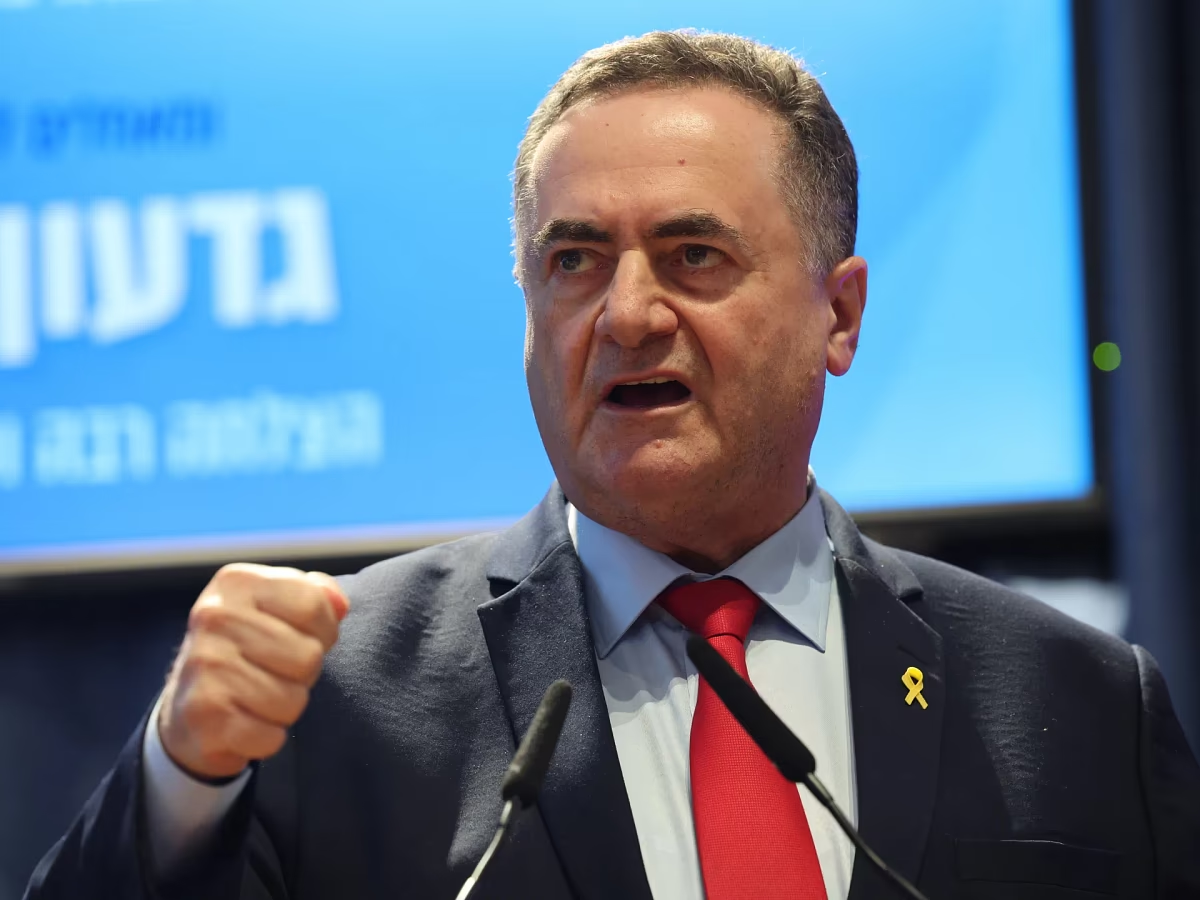
Israeli Defense Minister, Israel Katz, expressed his pride in the extensive destruction inflicted by military operations in the northern Gaza Strip, describing the scenes he witnessed during a field tour as giving him a sense of satisfaction. Katz affirmed in press statements that this devastation is not random, but rather the result of a systematic and deliberate policy aimed at fundamentally changing the security reality in the region.\n\nKatz revealed a new strategic direction involving the establishment of three military-style settlement outposts, known as 'Nahal cores,' in the locations that existed before the Israeli withdrawal from the Strip in 2005. This step, according to the minister, aims to enshrine a permanent Jewish presence in northern Gaza to ensure security control and prevent the return of military threats from those areas.\n\nIn response to questions about his feelings towards the rubble of Palestinian homes, Katz answered without hesitation that it brings a sense of relief, claiming that the destruction of residential blocks was necessary to remove what he described as 'saboteurs.' He explained that the Israeli army has shifted from a strategy of quick raids to permanent presence inside, considering the transformation of homes into rubble an essential part of this vision.\n\n'Nahal cores,' which Katz intends to plant in Gaza, are youth groups that combine military service with settlement work, and they are the historical tool Israel has used to establish settlements that later turn into civilian towns. The Defense Minister claimed that this step is necessary to enhance the defense of Israeli towns surrounding the Strip and provide new security depth for forces operating on the ground.\n\nThese statements come at a time when reports are increasing about the Israeli right's endeavor to impose a new settlement reality in Gaza, exploiting the current field conditions. Israeli media sources have described Katz's announcement as representing a strategic goal that goes beyond the declared objectives of the war, indicating a clear intention to re-occupy parts of the Strip permanently.\n\nOn the ground, data indicates the continuation of Israeli violations of the ceasefire agreement that came into effect on October 10, 2025. Medical sources reported that continuous breaches resulted in hundreds of casualties, including martyrs and wounded, amid the occupation's insistence on continuing its military operations and destroying the remaining infrastructure in the northern areas.\n\nAccording to the latest statistics issued by the Ministry of Health, the number of victims of Israeli breaches since the agreement came into effect has reached about 1108 martyrs, in addition to more than 3500 Palestinians injured to varying degrees. These figures, along with Katz's statements, reflect the extent of Israeli insistence on proceeding with the scorched-earth policy despite the declared international understandings.\n\n"Seeing this destruction gives me a good feeling, and it is the result of a deliberate policy aimed at completely removing threats."\n

PALESTINE

Wed 15 Jul 2026 12:53 am - Jerusalem Time

Director of Jabalia Police and Other Officers Martyred in Israeli Massacre North of Gaza

Field sources reported the martyrdom of Colonel Muhammad Marwan Salem, Director of Jabalia Camp Police Station, along with several officers and members of the Palestinian police, following an airstrike carried out by Israeli occupation aircraft. The raid targeted a security point located in the Faluja area, near the Shadia Abu Ghazaleh School, west of the camp in the northern Gaza Strip, leading to the destruction of the site and casualties among those present, including martyrs and wounded.

This new massacre resulted in the martyrdom of six people, including a woman who was in the vicinity of the targeted site, in addition to several citizens sustaining injuries of varying severity. This operation comes within the framework of the systematic targeting by the occupation of police and service personnel working to organize internal affairs in the northern sector, thus continuing its violation of all international conventions on the 277th day of the aggression.

In the southern sector, occupation forces continued to target displaced persons' gatherings, where the child Moataz Abu Shaar was martyred due to gunfire from occupation vehicles targeting the Mawasi Rafah area, which is crowded with tents. An Israeli drone also launched a raid targeting a displaced persons' tent near the Tiba Towers, west of Khan Yunis city, leading to the martyrdom of citizen Hussam Muhammad Ramadan Al-Shafei, 36 years old, and the injury of three others, including a woman and a child.

In a related context, medical sources announced the martyrdom of citizen Basem Mosaad Ermilat, who succumbed to severe injuries he sustained two days earlier as a result of an Israeli shelling that targeted Al-Qadisiyah camp. Medical teams face extreme difficulties in dealing with the increasing number of injured amidst a severe shortage of medical supplies and most hospitals in the targeted areas being completely or partially out of service.

As for the central region of the Gaza Strip, the occupation artillery renewed its intense shelling since the early morning hours, with the shelling focusing on the northeastern areas of Al-Bureij refugee camp. The artillery shells caused widespread destruction to infrastructure and citizens' properties, while successive explosions were heard resulting from the continuous shelling operations aimed at terrorizing the residents and forcing them into displacement.

The occupation aircraft committed a massacre by targeting a security point in the Faluja area, leading to the martyrdom of six people, including the director of Jabalia camp police station.

PALESTINE

Wed 15 Jul 2026 12:53 am - Jerusalem Time

Shilo: We call for the establishment of a “Friends of China Group Worldwide” to enhance media and intellectual cooperation and dialogue among civilizations

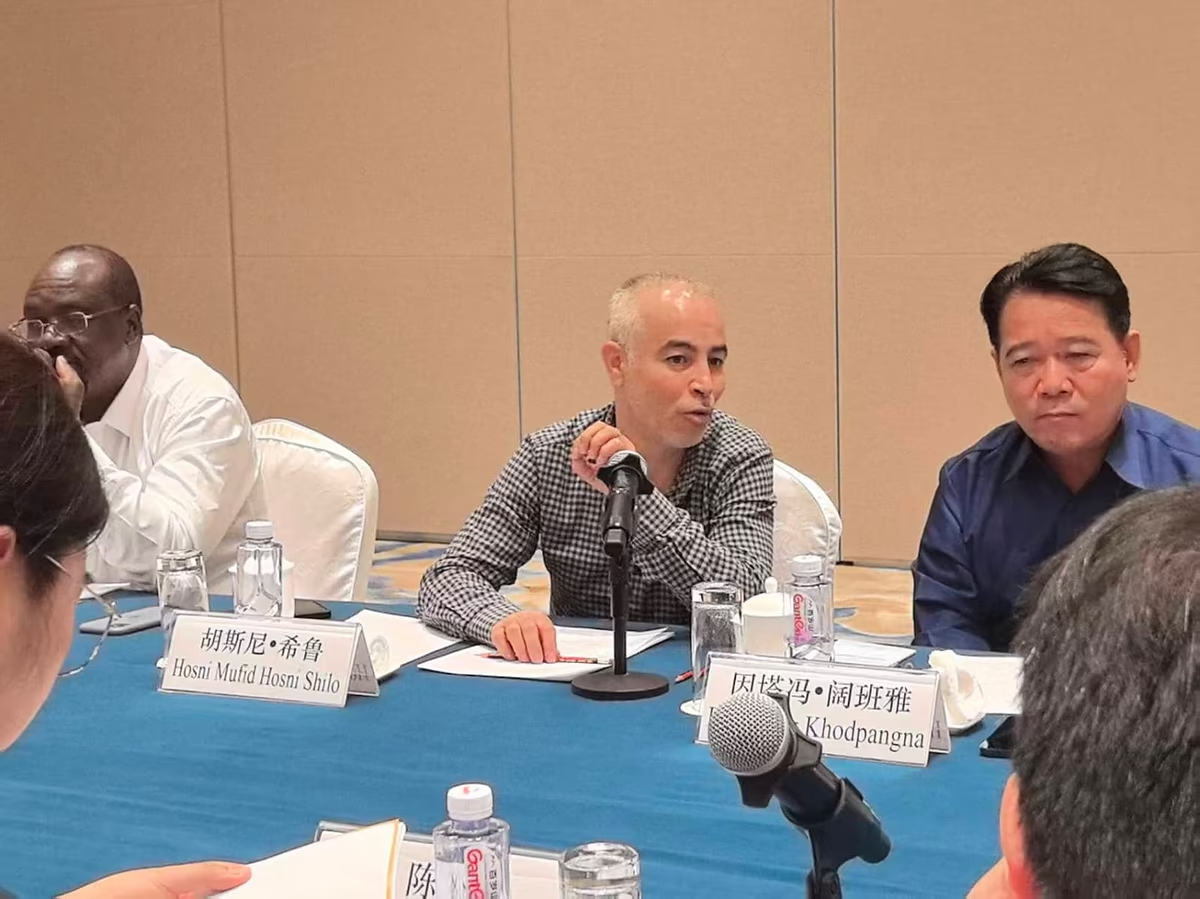
As part of a series of meetings held by the delegation of the Popular Front for the Liberation of Palestine during its visit to the People's Republic of China, at the invitation of the International Liaison Department of the Central Committee of the Communist Party of China, the delegation met with Xu Min, Head of the Information and Media Department of the Central Committee of the Communist Party of China. During the meeting, prospects for media and intellectual cooperation were discussed, as well as the role of media outlets and research centers in promoting dialogue among peoples.Husni Shilo, member of the Political Bureau of the Popular Front for the Liberation of Palestine, Secretary of the Central Information Department, and representative of the Palestine Center for Studies of the Global Civilization Initiative and Democratic Dialogue, emphasized that the digital revolution and rapid developments in media and communication technology necessitate building more effective media and intellectual partnerships based on the exchange of experiences and information, thereby enhancing understanding among peoples and serving issues of peace, development, and international cooperation.Shilo pointed out that confronting the challenges facing the media sector requires broader coordination among media institutions, think tanks, and universities, with a focus on preparing young media professionals, developing professional and technical capabilities, and utilizing modern technologies and artificial intelligence in knowledge production and enhancing civilizational communication.He also praised China's pioneering experience in poverty eradication and comprehensive development, affirming that China's achievements represent a human and developmental experience worthy of study and benefit, given its integrated development policies and long-term strategic vision.He added that the Communist Party of China has succeeded in presenting an outstanding model of integration between media, scientific research, and academic circles, which has contributed to knowledge production, policy formulation, and the promotion of intellectual dialogue, serving the path of development and modernization.At the end of the meeting, Shilo expressed his appreciation to the Communist Party of China and the International Liaison Department of the Central Committee for their warm reception and excellent organization, commending their efforts in strengthening communication with political forces, research centers, and research institutions around the world.He called for the establishment of a “Friends of China Group Worldwide,” comprising media professionals, researchers, academics, and research centers from various continents, to serve as a permanent platform for exchanging information and experiences, enhancing joint work, and launching media and intellectual initiatives that contribute to consolidating dialogue among civilizations, deepening understanding among peoples, and building partnerships that serve international peace, development, and justice.

ARAB AND WORLD

Wed 15 Jul 2026 12:52 am - Jerusalem Time

Wave of human rights and international criticism following the arrest of journalist Ali Lmrabet in Morocco

Moroccan authorities arrested prominent journalist Ali Lmrabet at Tangier International Airport immediately upon his arrival from Barcelona, Spain, last Sunday. Judicial sources confirmed that the Public Prosecution ordered his transfer to Casablanca to begin investigations into the content of podcast episodes he broadcasts on social media platforms.

Lmrabet is considered one of the historical figures of independent journalism in Morocco, having previously managed controversial media institutions such as the weekly 'Le Journal' and the magazines 'Demain'. Throughout his professional career, he faced a series of legal prosecutions, including imprisonment in 2003 and a ban from journalistic work for a full decade starting in 2005.

The news of the arrest sparked angry reactions from local human rights bodies, with the Moroccan Association for Support of Political Detainees demanding his immediate release. The National Center for Human Rights and Media affirmed that the timing of the arrest comes in a sensitive human rights context that requires broader guarantees for freedom of opinion and expression.

For its part, the Moroccan Association for Human Rights stressed the need to reveal the precise circumstances of this legal procedure, warning against turning publishing cases into criminal files. The association considered that prosecuting journalists for their opinions constitutes a dangerous regression from the democratic gains that Moroccan society aspires to.

On the international level, 'Reporters Without Borders' entered the crisis, expressing its deep concern about what it described as the use of the judicial apparatus to silence opponents. The organization called on the authorities to respect their international commitments related to protecting the right to access information and not criminalizing journalistic work under any pretext.

Spanish journalism was not absent from the scene, as 'El País' newspaper dedicated extensive space to the issue through an editorial and multiple analytical articles. The newspaper indicated that this step contradicts Morocco's ambitions to present a modern and tolerant image to the world in conjunction with preparations to host the 2030 World Cup.

The Spanish newspaper believed that the royal pardon issued two years ago for detained journalists heralded the turning of a page on restrictions, but Lmrabet's case brings back old concerns. It affirmed that criticizing political systems should not lead its author to exile or arrest in societies that seek pluralism and democracy.

In France, 'Le Monde' and 'Libération' newspapers covered the news with headlines highlighting the arrest of a prominent figure of independent journalism in the Kingdom. These reports considered that Lmrabet's prosecution reflects the continued tension between the executive authority and media voices that adopt a sharp critical line towards official institutions.

In a related context, informed sources explained that the investigations focus on accusations related to defamation and slander through digital media, charges that have been repeated in previous prosecutions of Moroccan journalists. Observers believe that the authorities seek to strictly apply the law in cases of digital content that they consider to cross red lines.

On the other hand, Lmrabet's defenders believe that his return to Morocco, despite knowing about ongoing legal proceedings, reflects his desire to directly confront the charges. They affirm that guaranteeing a fair and public trial is the true test of the judiciary's independence in dealing with public opinion cases.

Social media platforms are witnessing a sharp division between those in solidarity with the detained journalist and those defending security measures on the pretext of protecting citizens from defamation. The team defending the arrest argues that journalistic status does not grant immunity from legal accountability in the event of complaints from individuals or institutions.

However, international organizations insist that the general context of arrests in Morocco suggests a systematic pattern of restricting investigative journalism. International reports indicate a decline in Morocco's ranking in global press freedom indices in recent years, which puts diplomatic pressure on Rabat.

Political analysts link these developments to the 'diplomatic derby' ongoing in the Mediterranean basin, where some external parties exploit human rights issues to achieve political gains. Nevertheless, the fundamental human rights demand remains the separation of powers and ensuring that issues related to freedom of publication are not politicized.

Human rights circles await Ali Lmrabet's upcoming trial sessions, with hopes that the spirit of the law that protects public freedoms will prevail. The ongoing challenge remains balancing the prestige of institutions with the inherent right to journalistic criticism, which is a fundamental pillar in building a modern state.

Criminalizing the work of a journalist is not an application of the law, but rather an exploitation of justice to serve repression and silence critical voices.

OPINIONS

Tue 14 Jul 2026 10:12 am - Jerusalem Time

The Quran: Man's Mirror in the Divine Balance

The Quran: Man's Mirror in the Divine Balance

The Divine Revelation as the ultimate definition of man by his Creator

Ever since man began to be aware of his existence, he has faced the most profound question on his journey: Who am I?

This question was not a search for a name, identity, or external description, but rather a search for the underlying truth of his existence: What is his nature? What are his capabilities? What are his limits? And what is the purpose that gives his life meaning?

Man has been able to discover much about the world around him. He understood the laws of nature, explored the depths of matter, built civilizations, and developed tremendous tools that enabled him to influence his surroundings. Yet, despite all this progress, he remained before the most difficult question: Has man been able to know himself as he has known the things around him?

Man tries to know himself while being a part of this self. He studies his mind with his mind, and analyzes himself with tools that are themselves part of his composition, and therefore his knowledge of himself remains limited no matter how much progress he makes. He can know some of his manifestations, but he cannot encompass all his dimensions; because he is not merely a material existence, but a complex being that combines body, mind, soul, will, and meaning.

Hence arises the need for knowledge that comes from outside the boundaries of man, knowledge emanating from the One who created man and knows his reality.

And here comes the Holy Quran.

The Quran is not just a book that offers man a set of rulings or directives, but it is a divine discourse that reveals to man who he is. It is not a definition of man issued by man, but a definition issued by the Creator of man.

For Allah Almighty is the Knower of what He created:

"Does He who created not know? And He is the Subtle, the All-Aware."

Therefore, the Quran represents the highest definition of man by his Creator; because it is a definition not based on limited human observation, but on the all-encompassing divine knowledge of man's reality.

The Quran reveals to man his origin, his nature, his weakness, his capabilities, his responsibility, and his purpose. It does not see him as merely a being living in the world, but as a being with a status and a mission; a being created capable of knowledge, choice, purification, and bearing the trust.

From this perspective, the Quran can be seen as man's mirror in the divine balance.

When man stands before the Quran, he does not see the image he has drawn for himself, nor the image society has made of him, but he sees the image revealed to him by his Creator. He sees that he is honored, yet responsible. Capable, yet limited. Free, yet accountable. He possesses the ability to ascend, but also carries the potential to fall.

But this mirror not only reveals man, but also reveals the nature of the relationship between the Creator and the created.

The Quran is a divine discourse absolute in its source, but descended to a limited human being in terms of his capacity to receive. Therefore, one of the characteristics of this revelation is that it came commensurate with man.

And here the meaning must be understood precisely; it is not meant that the Quran is limited by human boundaries, for Allah Almighty and His speech are far removed from the limits of creatures, but rather that divine wisdom necessitated that the divine discourse reach man in a form that man can receive, understand, and interact with.

For the Creator, glorified be He, knows the nature of the creature He addresses. He knows his capacity for perception, the energy of his mind, the readiness of his heart, and the limits of his endurance. Therefore, the revelation came in a form that addresses man in his language, considers his experience, and opens horizons of knowledge for him without burdening him with what he cannot bear.

Hence, the level of revelation reveals the level of the addressed creature.

That man is addressed by the word of God, required to understand it, and invited to ponder over it, reveals his special status in the divine balance. Man is not merely a material creature, but a creature given the ability to receive and interact with the divine discourse.

And to the extent that Allah Almighty revealed to man through the Quran, the possible limits of human perception are determined. The Quran is the space where absolute divine knowledge met limited human capacity.

Indeed, Allah Almighty did not reveal everything to man, because man cannot bear everything, nor did He withhold from him what he needs, because the purpose of revelation is guidance and the building of man.

This meaning appears in the story of our Prophet Moses (peace be upon him) when he asked to see Allah Almighty:

"My Lord, show me [Yourself] that I may look at You. He said, 'You will not see Me, but look at the mountain; if it remains in its place, then you will see Me.' But when his Lord appeared to the mountain, He made it crumble to dust, and Moses fell unconscious."

So the issue is not the absence of divine power to reveal, but the limits of the creature's receptivity. The limited cannot encompass the absolute, and the creature cannot comprehend the reality of the Creator as it is.

Thus, the Quran reveals two things to man at once: it reveals to him his capacity for knowledge, and it reveals to him the limits of this knowledge.

It grants him the path of approach, but it always reminds him that he is a creature, not absolute.

Therefore, the Quran is the ultimate definition of man by his Creator; it is not all divine knowledge about man, because God's knowledge is limitless, but it is the maximum amount of definition given to man in a form he can receive.

The Quran defines man by his origin so that he does not become arrogant, defines him by his weakness so that he does not despair, defines him by his dignity so that he is not humiliated, and defines him by his responsibility so that he does not live without purpose.

From this, we understand the differences among people in understanding the Quran; the book is one, but the man who stands before it is different. And every person takes from this ocean according to his capacity. The more man ascends in his awareness and purification, the more capable he becomes of seeing himself in this divine mirror.

Indeed, the Quran not only reveals what God wants from man, but it reveals man as he is in God's knowledge.

Therefore, the Quran is not just a book sent to man, but it is the book of man as God knows him.

It is the mirror that the Creator placed before His creature to see his reality, his limits, his destiny, and his purpose in the divine balance.

Man is not complete when he only knows the world around him, but when he knows himself as his Creator has defined him.

OPINIONS

Tue 14 Jul 2026 10:10 am - Jerusalem Time

How Normalization Became a Structure, Not an Event?

If normalization was for decades reduced to the image of a handshake, a trade agreement, or a cultural meeting, then the aggression on Gaza and the accompanying crimes and expansion of settlements in the West Bank revealed that this definition is no longer sufficient to understand the transformations of the Palestinian issue. The question is no longer who shakes hands, but rather how the occupation transformed into a viable reality that reproduces itself? In this sense, normalization is no longer merely a political or cultural act, because that is its superficial or performative level. Rather, it is a process of taming and an integrated structure that reshapes consciousness, economy, and politics. It does not seek to improve the image of the occupier as much as it tries to transform its existence into an ordinary matter, shifting the discussion from ending the occupation to managing it, and from liberation to improving living conditions. Here lies the most dangerous function of normalization, because it makes remaining under occupation a “rational” choice. In this sense, too, there is the normalization of consumption through the creation of dependency and normalcy. The entry of Israeli products into the Palestinian market goes beyond selling goods to selling an idea, making the consumer an agent promoting the presence of the occupation in their home and surroundings. Buying a product becomes a political act that makes the occupier part of your economic life cycle, stripping you of your economic independence and making you a financier of its project. The Oslo process contributed to entrenching this transformation to varying degrees. The interim agreement did not end with a state, and over time it transformed into an administrative and economic system that manages the population more than it confronts the structure of the occupation. As a result, a large part of daily Palestinian life became linked to a system whose keys are controlled by the occupation, through movement, trade, and crossings, or resources, taxes, and the labor market. Therefore, if liberation means disengagement, then normalization has become a condition for survival. Thus, a relationship of dependency arose that made separation more costly over time, and we fell into the trap of rationality, which created an imaginary division between the “rational” Palestinian who accepts this reality and the “irrational” one who rejects it. The matter is not limited to economics or administration, but extends to the psychological and social spheres. A person living in a reality that lacks a political horizon rearranges their priorities in search of individual stability, even if it is at the expense of the national project. Over time, the language of rights transforms into the language of services, and the language of liberation into the language of crisis management, and maintaining a minimum daily life becomes an alternative goal to changing reality. This is not a result of an individual choice as much as it is a reflection of circumstances that produce what sociologists call adaptation to the dominant structure. The most dangerous levels of normalization is borrowing its security lexicon to interpret the Palestinian reality, and using the same terms internally, or adopting its definition of what is “dangerous” and “safe.” In doing so, you surrender to its sovereignty over your consciousness, and it succeeds when it makes its security obsession your daily concern, making you an involuntary guardian of its interests under the guise of maintaining public order. In contrast, the international community played an ambiguous role. Despite the widespread international criticism of the occupation’s policies and legal actions, its mechanisms are still unable to impose a political and legal cost commensurate with the scale of the violations. Instead of addressing the roots, its efforts are directed at containing its humanitarian consequences and preventing its explosion, which creates a paradox that prioritizes crisis management over resolution. Nevertheless, reading normalization as a structure does not mean that reality is an unchangeable fate. This structure can be dismantled if a national vision is available that gradually rebuilds elements of steadfastness, starting with strengthening the national economy and reducing dependency wherever possible, entrenching the Palestinian narrative in the cultural and media sphere, and investing in education and scientific research as long-term tools of resistance, and a critical review of the Palestinian experience away from accusations of treason and sanctification, because those who do not review their mistakes reproduce them.

PALESTINE

Tue 14 Jul 2026 10:10 am - Jerusalem Time

The Ninety-Minute Incident... "Zanuta" Exposes Settler Crimes and Fuels Sympathetic Narratives

Dr. Raed Abu Badawiya: The direct experience of an American official with settler violence gives the issue greater weight because it is a personal experience that is difficult to ignore or underestimate its implications.Daoud Kuttab: What happened with Ro Khanna, despite its importance, will not, at the current stage, curb settlers amidst the heated Israeli election atmosphere.Dr. Saad Nimer: Targeting an American political figure sends a message that settlers act with the conviction of their ability to impose their will even on Israel's closest allies.Dr. Saeed Shaheen: The incident is not the first of its kind but falls within a series of attacks that have affected foreign delegations, figures, and American citizens in various capacities.Talal Awkal: The experience of the American congressman may push him to adopt positions and policies less supportive of Israel and settlers and more understanding of the reality experienced by Palestinians.Dr. Fadi Jumaa: The discussion about settlements and settler violence now relies on direct observation by members of Congress, which may change the nature of the debate within Washington.Ramallah - Exclusive to "Al-Quds" - The detention of US Democratic Congressman and potential presidential candidate Ro Khanna by armed settlers during his visit to Zanuta village south of Hebron, marks a significant turning point that brings the issue of settler attacks in the West Bank back into the spotlight, as this time the incident involved a high-ranking American official.Writers, political analysts, specialists, and university professors, in separate interviews with "Al-Quds", confirm that the incident goes beyond being a fleeting field incident, as it reflects the growing audacity of settlers and the expanding scope of their attacks. It may also push for a broader discussion within the United States regarding the implications of settlements and violence in the West Bank on American interests and relations with Israel.While they expect the incident to add momentum to criticisms and calls for stricter measures against settlers, they believe that its practical impact will remain limited unless accompanied by political pressure and effective measures to stop the attacks and put an end to settlement expansion.An Indicator of Important ShiftsDr. Raed Abu Badawiya, Professor of International Law and International Relations at the Arab American University, confirms that what happened to the American congressman and potential Democratic presidential candidate for the 2028 elections, Ro Khanna, during his visit to Zanuta village south of Hebron, should not be treated as merely a friction between settlers and a foreign delegation, but rather as an indicator of the transformations that have occurred in the West Bank in the nature of the relationship between the Israeli state and the settlement movement.Abu Badawiya explains that the settlers' behavior in this incident reflects a high level of confidence, as they did not act as an outlaw entity, but rather as capable of imposing a fait accompli, given their confidence in official protection or tolerance, or their ability to override state authority in some cases.The Incident Involves a High-Ranking FigureAbu Badawiya points out that the political importance of the incident is not limited to its details, but is also linked to the identity of the person who was subjected to it, as the narrative comes from a US Congressman, not from a Palestinian or a human rights organization whose testimony can be questioned.Abu Badawiya emphasizes that the direct experience of an American official with settler violence gives the issue greater weight within the United States, because it moves it from the framework of reports and accusations to a personal experience that is difficult to ignore or underestimate its implications.Abu Badawiya believes that the incident also reveals that settler violence is no longer just a local issue related to the Palestinian-Israeli conflict, but has begun to affect the interests of Israel's allied countries, which may lead to expanding the circle of international attention to this phenomenon.A New Element in the Path of Pressure on SettlersRegarding the possibility that the incident could help curb settlers, Abu Badawiya explains that it may add a new element to the increasing pressure on the settlement movement, but it alone will not be enough to bring about a radical change, because policies do not change due to a single incident, but as a result of the accumulation of facts and their impact on the perception of decision-makers.Abu Badawiya believes that the incident may become an additional reference within Congress and the US administration to prove that settler violence no longer threatens only Palestinians, but has become a challenge to regional stability and may affect American interests, which may give momentum to calls for imposing sanctions on settlers involved in violence, and tightening oversight on the use of US military aid.Abu Badawiya stresses that the actual impact of the incident will remain linked to Washington's willingness to move from statements of concern to exercising real political pressure on the Israeli government, considering that its importance lies in adding new evidence that is difficult to ignore in the growing American debate about the limits of unconditional support for Israel and its responsibility to curb settler violence.Continuation of Extremist ApproachWriter and political analyst Daoud Kuttab explains that what happened to prominent US Congressman and potential presidential candidate for the Democratic Party, Ro Khanna, is of great importance, not because the incident is unprecedented, but because this time the target is a high-ranking American political figure, which gives the incident political dimensions that go beyond the usual attacks targeting Palestinians or foreign visitors.Kuttab believes that the incident reflects the continuation of the extremist approach practiced by groups of settlers, along with members of the occupation army, considering that targeting an American figure at this level may draw greater international attention to the nature of the settlement movement's practices in the West Bank.The Incident and the Israeli Election AtmosphereAccording to Kuttab, the incident, despite its importance, will not, at the current stage, curb settlers, amidst the heated Israeli election atmosphere, where political competition is fierce, and Israeli Prime Minister Benjamin Netanyahu continues to seek to remain in power and expand his base of supporters to avoid prosecution, which pushes him to attract various forces that support him, including pro-settlement currents.Kuttab believes that any serious attempts to limit the influence of settlers may be postponed until after the elections, when the composition of the new coalition government and the nature of the forces participating in it become clear.Settlers Do Not Distinguish Between Palestinian or ForeignerDr. Saad Nimer, Professor of Political Science at Birzeit University, confirms that the detention of US Congressman and potential Democratic presidential candidate Ro Khanna during his visit to the West Bank sheds unprecedented light on the nature of settler behavior, their ideas, and the practices they carry out against Palestinians.Nimer believes that targeting an American political figure sends a clear message that settlers do not distinguish between Palestinian or foreigner, and that they act out of conviction of their ability to impose their will even on Israel's closest allies.The Nature of the Ideology Governing the Settlement MovementNimer explains that the incident reveals a mentality based on the belief that settlers represent the "chosen people," and that everyone must submit to their will, including the United States, which is Israel's biggest supporter.Nimer points out that this incident reflects the nature of the ideology governing the settlement movement, noting that if this is the method used with an American congressman, then what Palestinians experience daily is even harsher.Nimer explains that this conviction is not new, citing previous statements by Israeli officials who called for disregarding the American position, considering that this is consistent with the mentality behind settler behavior in the West Bank.Direct Targets for SettlersNimer points to the attack on the CNN crew during their coverage in the West Bank, saying that settlers attacked the team with stones, sticks, and knives, despite their clear identity as American journalists, which reflects that anyone who tries to document what is happening in the West Bank may become a direct target of settler attacks, regardless of their nationality or status.Nimer believes that these incidents may expose settler policies to American and international public opinion, thereby strengthening popular criticism of Israel if they receive widespread media coverage within the United States, but he rules out that this will affect the official American position, given the continued political support provided by American administrations to Israel.Nimer stresses that American policy, especially during the era of US President Donald Trump, provided clear support for Israel by recognizing Jerusalem as its capital, moving the US embassy there, and recognizing Israel's sovereignty over the Golan, as well as statements calling for Israel's expansion, considering that these policies reflect continued official support for the settlement project.Official Israeli Policy Supporting SettlementNimer emphasizes that the problem is not limited to settler groups, but is linked to an official Israeli policy that supports and protects settlements, with the participation of state institutions and the army.Nimer believes that any measures limited to imposing sanctions on a limited number of settlers or some settlement organizations remain insufficient, stressing that responsibility lies with the Israeli government, which provides political and security cover for the continuation of settlements and attacks in the West Bank.Escalation of Encroachment Driven by Racist IdeologyDr. Saeed Shaheen, Professor of Political Communication at Hebron University, confirms that what happened to US Congressman and potential Democratic presidential candidate Ro Khanna, comes in the context of escalating Israeli encroachment driven by a racist ideology adopted by the Israeli government, with the aim of implementing its expansionist plans to seize Palestinian lands, create an environment that expels Palestinians, and prevent any voice that seeks to expose or confront the violations in the West Bank.He explains that the incident is not the first of its kind, but falls within a long series of attacks that have affected foreign delegations and figures, in addition to American citizens in various capacities, citing previous incidents that included American activist Rachel Corrie, journalist Shireen Abu Akleh, media crews including CNN, and foreign solidarity activists, leading up to the Ro Khanna incident.Shaheen stresses that these facts reflect the indifference of settlers and the occupation forces that provide them with protection to any foreign delegations or figures, pointing out that this occurs under policies and directives adopted by Israeli officials, and also criticizes the position of the US Ambassador to Israel, Mike Huckabee, considering that he does not provide sufficient protection even for American citizens.Continued International SilenceShaheen affirms that the continued international silence regarding serious violations in the West Bank, and the absence of accountability and punitive measures against perpetrators, contribute to the escalation of attacks, in the absence of the application of international humanitarian law.Regarding the repercussions of Ro Khanna's detention, Shaheen believes that the incident will not cause embarrassment or concern for the current Israeli government, because it feels it has political cover from the administration of US President Donald Trump.Shaheen points out that the crimes committed by settlers in the West Bank have reached unprecedented levels, yet they are not met with any effective international action to deter them, which encourages the continuation of attacks, even when targeting official or parliamentary figures or foreign delegations.Long History of Settler PracticesPolitical writer and analyst Talal Awkal believes that the incident of the detention of US Democratic Congressman and potential presidential candidate, Ro Khanna, by armed Israeli settlers with American-made rifles, during his visit to Zanuta village south of Hebron, before his release after the intervention of occupation forces and Israeli police, represents a remarkable development that may have political repercussions beyond the incident itself, especially at the level of American positions on settlements.Awkal explains that what happened to Khanna is not an isolated incident or the first of its kind, but rather comes within a long series of prohibitions, harassments, and insults practiced by settlers, often under the eyes of the occupation army, pointing out that these practices do not exclude anyone, whether a political official, diplomat, human rights activist, journalist, or foreign national.Lack of Immunity for Officials and Foreign VisitorsAwkal points out that previous facts confirm the absence of any effective immunity for foreign officials and visitors, citing the way Israeli authorities dealt with American journalist Tucker Carlson, as well as the incident of the occupation army firing at a European diplomatic delegation that tried to visit Jenin to see the field conditions.Awkal believes that the experience of the American congressman may push him to adopt positions and policies less supportive of Israel and settlers, and more understanding of the reality experienced by Palestinians.Awkal believes that the incident raises questions about whether international officials must be directly exposed to such violations in order to realize the extent of suffering experienced by Palestinians for decades.Awkal affirms that what happened will contribute to expanding and deepening the increasing shifts within the Democratic Party and American society towards the Palestinian issue, likely strengthening calls for stricter measures and sanctions against settlers, amidst increasing international criticism of the occupation and settler practices in the West Bank.Increasing Settler Confidence in Their CrimesDr. Fadi Jumaa, Professor of Political Science at the Arab American University, confirms that what happened to US Congressman and Democratic Representative Ro Khanna, his detention by armed settlers during his visit to the West Bank, cannot be read as a separate security incident, but rather comes in the context of a continuous scene witnessed in the West Bank for years, which escalated unprecedentedly after the events of October 7, 2023, with increasing settler violence and the expanding scope of their attacks against Palestinians.He explains that field developments in recent months have shown a significant increase in the level of settler confidence in what they do, which has pushed them to carry out more audacious practices, in parallel with the acceleration of settlement expansion and the displacement of Palestinians, especially in the areas south of Hebron, the Jordan Valley, and Masafer Yatta, pointing out that these manifestations have also begun to extend to other areas such as Jenin.Jumaa stresses that what gives the incident special importance is that the person who was detained is not a Palestinian activist, journalist, or member of a local delegation, but a US Congressman representing Israel's most prominent ally, considering that this reflects the level of confidence with which settler groups are operating, to the extent that they did not hesitate to intercept an American delegation while carrying weapons, in a scene resembling gang practices, but it occurs with a feeling of existing cover that allows such actions.A Significant Shift Within the American Democratic PartyJumaa emphasizes that the American congressman's narrative, in which he stated that the intervention of Israeli forces was not immediate, gives the incident an additional dimension, as the delayed intervention allowed settlers to continue detaining the delegation for 90 minutes, which reflects the nature of the field environment in which these groups operate.Jumaa believes that the incident may represent a significant shift within the American Democratic Party, explaining that the discussion about settlements and settler violence previously relied primarily on reports from human rights organizations and diplomatic documents, but today, members of Congress are witnessing these events directly, which may change the nature of the debate within Washington, because personal experience is more impactful than written reports.An Important Incident, But It Does Not Curb Their ViolenceIn his assessment of the likelihood that the incident will contribute to curbing settler violence, Jumaa believes that it may add new momentum to political pressure, but it alone will not be enough to bring about actual change.Jumaa points out that the United States and a number of European countries have recently imposed sanctions on some settlers, and issued reports addressing attacks and forced displacement in the West Bank, but these measures have not led to tangible results on the ground.Jumaa notes that what distinguishes this incident is that the affected party is a US Congressman, which may give it greater weight within decision-making circles in Washington, and may be used in discussions related to American political and economic support for Israel, but he rules out that this alone will curb settlers.Jumaa stresses that stopping settler attacks fundamentally requires an Israeli political decision, considering that the incident may constitute a turning point in the evolution of American discourse towards what is happening in the West Bank, but it will not be enough to change settler behavior unless there is political will within Israel, which is more complex than to be decided by a single incident, no matter its political and media importance.

OPINIONS

Tue 14 Jul 2026 10:09 am - Jerusalem Time

In Love with the Beautiful Game!

Dr. Ibrahim Melhem

Editor-in-Chief

With the completion of the semi-finalists in the exciting and controversial World Cup, boasting a record of seven historic titles, the competition intensifies, and the 'adrenaline' levels rise among fans in the stands and in living rooms open to screens; living rooms that have become an integral part of the stadiums, ablaze with their clamor, emotions, and expressions of astonishment and amazement on the faces of followers driven by the passion of the game, and those exhausted by undeserved losses, just as happened to the Egyptian national team against the Tango dancers. As the competitions approach their final chapters, I made sure to follow them with my family, where quick services and generous logistical supplies are provided by my beloved wife; she who has no interest in football, but is keen to monitor the reactions of her husband and children, especially the beloved daughters who have caught the passion for following the game by contagion, and in this beautiful 'gathering' that adds an atmosphere of joy and applause for goals, especially if they are scored by Arab feet. This scene takes me back to the 1986 World Cup, when I wrote an article titled 'My Mother and the World Cup'; she – may God have mercy on her – knew the names of the stars of that era as she knew the names of her children: Maradona, Zico, Socrates, and Platini. I remember she cried bitterly then for the Moroccans' loss to the Germans in the round of 16, and she also felt pain for the injury of the Algerian goalkeeper Nassereddine Drid during the fierce confrontation with the Spaniards. My mother preceded VAR technology by decades; she would vehemently protest against players' hidden fouls that escaped the referees' eyes, but she rejoiced at 'Maradona's divine hand' that scored a goal against the English net in the quarter-finals of the tournament, and she liked the opinion of the philosophical Brazilian coach 'Santana' in his call to abolish penalty shootouts and replace them with replaying matches... (to be continued).

OPINIONS

Tue 14 Jul 2026 10:09 am - Jerusalem Time

The Third Founding of Palestine: Confronting the Engineering of Disintegration

The Israeli war of extermination in Gaza has gone beyond merely being a war targeting land and people, or a mere military attempt to impose new realities through killing, destruction, starvation, and displacement, to a deeper and more dangerous level. This reveals a shift in the nature of Zionist strategy itself, from the concept of conflict management strategy that governed Israeli policy for decades, to an attempt to engineer Palestinian disintegration and reshape the Palestinian condition, serving goals that transcend the military moment, towards re-formulating the conditions of Palestinian political and social existence. This transformation cannot be understood in isolation from the accumulated contradictions facing the Zionist project; for the continuation of military superiority has not produced a historical resolution, just as the ability to control has not translated into an ability to end the presence of the Palestinian people or overcome their cause. After decades of occupation and settlement, and despite the military power and widespread political support Israel possessed, especially from Washington and its orbit, the Palestinian remained present as a national identity and a political and historical actor, just as the Palestinian cause remained present in global consciousness. Hence, the transition from an attempt at resolution to an attempt at disintegration to ensure resolution does not reflect an excess of power as much as it reveals a strategic dilemma for the Zionist project. When power fails to produce political surrender, the reliance shifts to exhausting the bearer of the cause itself; i.e., the Palestinian society, by weakening the conditions of its cohesion, undermining its institutions, distorting its collective consciousness, and deepening its internal contradictions and transforming them into an alternative to confrontation with the occupation and the colonial control system. Here, we must pause at the expansion of phenomena of exaggerating and igniting secondary differences and their transformation into a state of media infighting that fills the public space, especially in light of the decline of common ground and the absence of a leadership that possesses a unifying vision and mutual trust with its people and with society, to always keep the compass facing strategies of extermination and displacement. The concept of “engineering disintegration” does not merely mean benefiting from the reality of Palestinian division, but rather refers to an attempt to transform this division into a permanent path that reshapes Palestinian reality from within. What is required is not only to prevent political unity, but to weaken the ability to produce meaningful national unity, so that Palestinians become preoccupied with managing their internal crises more than their ability to confront the project that generated and invested in these crises. This strategy comes in the context of a broader dilemma facing the Zionist project itself. A number of researchers, including Israeli historian Ilan Pappé, have argued that the Zionist project faces a structural crisis that could threaten its continuation in its current form. This does not necessarily mean an imminent collapse, but rather indicates that the contradiction between the logic of permanent control and the impossibility of ending Palestinian existence poses deep historical questions about its future. From this perspective, policies of displacement, fragmentation, annexation, settlement, and prevention of reconstruction can be understood not only as tools for controlling the present, but as attempts to shape the future, by weakening the party that represents the most fundamental historical challenge to the Zionist project, which is the continued existence of a Palestinian people who possess a national identity, a collective memory, and an inalienable political right. The Palestinian division has become more than just a reality from which Israel benefits; it has become a functional element in a broader strategy. Israel realizes that the minimum level of Palestinian unity, politically, institutionally, and socially, is capable of re-presenting the Palestinian cause as the cause of a people struggling for freedom and self-determination, rather than as an internal conflict between competing Palestinian forces. However, the deeper danger lies not only in political division, but in the attempt to transfer it to the level of dismantling the national and social fabric. The Zionist project does not target institutions and leaders only, but targets the entire unifying national sphere; through displacement, geographical fragmentation, prevention of reconstruction, acceleration of settlement and annexation, and weakening the bonds that make Palestinians one people despite the multiplicity of their locations. Hence, one can understand the attempts to fuel regional, familial, and factional tensions, deepen the loss of trust among components of society, and push the Palestinian situation towards something more dangerous than division: towards internal erosion. For when partial identities take precedence over national identity, and when shared pain turns into an additional field for competition and division, the occupation will have achieved one of its most dangerous goals; not only controlling the land, but weakening the ability to produce a common meaning for the future. Societies are not only defeated when they are militarily defeated, but when they lose their collective sense of the unity of their destiny, their ability to overcome their differences, and their right to produce a unifying project. Therefore, disintegration is not just a fleeting political state, but a historical process that can reshape consciousness and social relations if not confronted. Confronting this strategy does not begin only with ending the division, nor is it sufficient to call for national unity as a mere moral slogan, but it begins with rebuilding the foundation that gives unity its meaning, which is the Palestinian national idea. For the national project, no matter how important it may be, is not the origin of the story; rather, it is the political and institutional expression of a deeper idea that preceded its emergence and gave it its legitimacy; the idea of one Palestinian people, with the right to self-determination, and capable of overcoming attempts to uproot and fragment it. It was the Palestinian national idea that prevented the Nakba from turning Palestinians into mere groups of refugees separated from their homeland and their cause, and this can be considered the first founding of this idea. The second founding was represented by the emergence of the contemporary national movement and its institutions and representative frameworks that restored the Palestinian people's presence as a historical actor, and which now seems to be exhausting its role. Today, the profound transformations imposed by the war of extermination necessitate a third founding of the Palestinian national idea; a founding that does not negate the previous experience, but rather draws its lessons and rebuilds the national sphere on more solid foundations; partnership instead of exclusion, democracy instead of monopoly, citizenship instead of tribalism, and popular legitimacy instead of de facto legitimacy. The real challenge is not only to rebuild the national project, but to protect the idea that gives it life and meaning. Political projects can falter or be reshaped, but if the unifying national idea erodes, the ability to rebuild becomes more difficult. The Zionist strategy has shifted from conflict management to engineering Palestinian disintegration, because ending the cause by force is no longer possible, and because the continued existence of a Palestinian people united in their identity, consciousness, and rights represents the deepest historical challenge to the project based on exclusion and domination. Therefore, the priorities of this stage are not limited to resisting the occupation or rebuilding the national project, but begin with re-founding the Palestinian national idea itself; the idea that makes Palestine the cause of a people, not just a disputed land, and unity a historical necessity, not a fleeting political option. The battle today is not only over Gaza or the West Bank, nor only over the form of the coming political system, but over the meaning of Palestine itself; will it remain the cause of one people carrying a historical project of liberation, or will it turn into a set of fragmented issues managed by the realities imposed by the occupation? And if the occupation seeks to engineer disintegration, the historical response must be to rebuild unity on a new basis; popular legitimacy, national partnership, inclusive citizenship, and a leadership entrusted with the great Palestinian pain and sacrifices, as well as with the national future and destiny. The national idea is what gave birth to the national project, and it alone is capable of renewing it and protecting it from erosion, and transforming Palestinian steadfastness from mere survival into a historical force capable of creating freedom, justice, and complete national independence.

OPINIONS

Tue 14 Jul 2026 10:09 am - Jerusalem Time

Palestinian Economy... Or Two Economies?

By: Dr. Said Sabri, International Economic and Financial Consultant – Member of the International Authority for Transformation and Digital Economy – General Secretariat At the beginning of 2026, the Palestine Monetary Authority and the Palestinian Central Bureau of Statistics projected the Palestinian economy to grow by 4.1% to 4.5%. However, just six months later, the same official data revealed a contraction of 8%, and a decline in per capita GDP to only $545. Between these two figures lies not just a statistical gap, but the story of an economy changing faster than forecasts can keep up. Forecast based on assumptions, not actual recovery The scenario on which this forecast was built was not a prediction of fundamental improvement, but an assumption of "the continuation of existing conditions without significant changes" — the persistence of movement and crossing restrictions, the continued limited activity in Gaza within the scope of humanitarian aid, with a large portion of the workforce being unable to access the Israeli labor market. In other words, it was a marginal growth calculated from a very low base after Gaza's contraction exceeded 80% in 2024. The problem is that even this modest forecast did not hold up against the first-quarter data, as the West Bank economy alone recorded an 8% decline, despite being the area least directly affected by the war. This means that the contraction is no longer confined to the most devastated sector, but has extended to the economy that was supposed to lead the recovery. Are we still talking about one Palestinian economy? Today, the Palestinian economy is no longer a single economy in the practical sense, but rather two economies that differ in activity structure, price levels, labor market, poverty rates, and even growth and contraction dynamics. The inflation rate in Palestine recorded sharp fluctuations over the past year, reaching an annual increase of 10.5% overall for 2025, but with a stark disparity between regions: near-complete stability in the West Bank (-0.11%), compared to a shocking increase in Gaza of 21.93% due to scarcity of goods and the collapse of supply chains. The same applies to the labor market: unemployment reached 28.7% in the West Bank at the end of 2025, compared to over 80% in Gaza, and to poverty: 11.5% in the West Bank compared to 63.6% in Gaza. This disparity means that talking about "one Palestinian economy" has become a misleading simplification; what happens in the West Bank does not necessarily reflect what happens in Gaza, which calls for a review of the statistical presentation methodology itself, so that data for the two regions are presented separately instead of being merged into a single national figure that may conceal more than it reveals. The Cause Gap: Why the Scenario Didn't Materialize? The difference between forecast and reality does not reflect an error in statistical methodology as much as it reflects a change in the variables themselves. While the report assumed relative stability in restrictions, the following months witnessed an escalation in the withholding of clearance funds, which constitute about 70% of public revenues, and the continuation of restrictions on their transfer for more than a year, in addition to the exacerbation of the banking liquidity crisis associated with the accumulation of the shekel. The industrial production index, a direct operational measure away from aid-funded consumption, also recorded an additional decline of 1.15% in May 2026, which documents that the contraction is a continuous trend, not a transient event in one quarter. This gap is referred to in economic literature as "economic forecast error," meaning the difference between expected and actual results, a gap that usually widens in economies exposed to repeated political and security shocks. The impact of the contraction is not limited to a decline in production, but extends to the private sector's reluctance to invest and a sharp decline in fixed capital formation amid political and security uncertainty. This is also reflected in the banking sector, where liquidity pressures increase, credit risks rise, and financing appetite declines, transforming the crisis from an economic slowdown into a mutually reinforcing financial and economic contraction cycle. This means that the effects of the crisis will not stop in 2026, but will extend to the productive capacity of the Palestinian economy for subsequent years, because deferred investment today turns into lost productive capacity tomorrow. A recurring pattern in fragile economies The gap between forecasts and results is not exceptional in fragile and conflict-affected economies, where growth forecasts are frequently revised as field conditions change. However, the specificity of the Palestinian case lies in the fact that political and financial variables change at a faster pace than traditional models can absorb, making forecasts susceptible to being overtaken within a few months. Why is this gap important for decision-makers and donors? The difference between an official forecast and actual reality may seem like a purely technical matter, but it carries a deeper meaning: official scenarios are used as a basis for public budget planning and designing international support programs. When the baseline forecast is higher than reality by a margin of nearly 12 percentage points, any planning based on it becomes susceptible to funding and implementation flaws from day one. When international funding plans are built on a scenario that assumes gradual recovery, while quarterly data reveal continued contraction, a funding gap becomes a natural consequence of this disparity, and not just a shortage in the amount of aid provided at conferences like the recent donor conference in Brussels. This gap is not only measured theoretically; the public debt, which exceeded $15.4 billion, reflects how an unmonitored funding gap has turned into accumulated borrowing borne by future generations. Conclusion: The importance of a critical reading of official figures This analysis does not question the professionalism of the Palestine Monetary Authority or the Palestinian Central Bureau of Statistics, as both operate within internationally recognized scientific methodologies, and economic forecasts are by nature probabilistic, based on assumptions that can change, especially in an economy operating under political constraints beyond its control. The Palestinian economy needs not only greater funding, but also an early economic warning system that updates forecasts quarterly, and provides decision-makers and donors with a picture closer to reality. When conditions change faster than measurement tools, data updating becomes part of crisis management, not just a routine statistical task. And in an economy that changes so rapidly, the flexibility of forecasts becomes part of good economic governance, not just a technical matter. The most dangerous gap is not between forecast and reality, but between policies built on figures that reality has already surpassed.

OPINIONS

Tue 14 Jul 2026 10:09 am - Jerusalem Time

The Muezzin Law in Confrontation with International Law

The draft law being discussed by the Israeli Knesset to restrict the call to prayer (adhan) via loudspeakers is stirring a wide wave of controversy, not only because it relates to a religious manifestation, but also because it raises a legal problem that transcends the boundaries of domestic legislation to the scope of international human rights law. The issue is not about a means of announcing the time for prayer, but rather about enacting legislation that affects one of the most prominent religious and cultural manifestations deeply rooted in Palestinian society, which necessitates its evaluation in light of the rules of international human rights law, international humanitarian law, and the rules for the protection of cultural heritage. The adhan is considered part of the historical identity of Palestine and has been linked to daily life in its cities and villages for centuries preceding the establishment of the State of Israel, to the extent that it has become an element of collective memory and the civilizational landscape that reflects the specificity of the place and its cultural and religious diversity. Therefore, targeting it with legislation that imposes restrictions on its raising not only sparks political controversy but also raises a legal question about the extent to which this legislation complies with Israel's international obligations. International human rights law includes many conventions that guarantee freedom of religion and belief, foremost among them the International Covenant on Civil and Political Rights of 1966, Article (18) of which states that everyone shall have the right to freedom of thought, conscience, and religion, including the freedom to manifest his religion and to perform his religious practices individually or collectively, publicly or privately. The Human Rights Committee, in its General Comment No. (22), affirmed that this right includes religious rituals, practices, and symbols, and that any restrictions imposed on it must be interpreted narrowly and must not affect the essence of the right or empty it of its content. Article (27) of the same Covenant also protects the right of religious groups to maintain their identity and practice their religious traditions without discrimination. International protection does not stop at the limits of international human rights law but extends to the rules of international humanitarian law. Articles (43) and (46) of the Hague Regulations of 1907 oblige the occupying power to respect public life, beliefs, and religious practices in the occupied territory, while Articles (27) and (58) of the Fourth Geneva Convention of 1949 affirm the need to respect the beliefs of the population and enable religious leaders to perform their mission. Occupation, no matter how extensive its powers, does not transfer sovereignty to the occupying power, nor does it grant it the authority to reshape the religious or cultural identity of the occupied territory or change its civilizational features. The International Court of Justice enshrined these principles in its advisory opinion on the legal consequences of the construction of a wall in the occupied Palestinian territory in 2004, when it affirmed the continued applicability of the International Covenant on Civil and Political Rights to the occupied Palestinian territories alongside the rules of international humanitarian law. The Court then returned, in its advisory opinion issued on July 19, 2024, regarding the legal consequences arising from Israel's policies and practices in the occupied Palestinian territory, to affirm that all legislation and measures taken by the occupying authority are subject to international law oversight, and may not affect the rights of the Palestinian population or change the legal, demographic, or cultural character of the occupied territory. Consequently, any legislation targeting a religious manifestation deeply rooted in Palestinian society raises suspicion of its inconsistency with the principles affirmed by the Court regarding the prohibition of changing the legal, demographic, or cultural character of the occupied Palestinian territory. In addition to its religious status, the adhan represents one of the elements of the intangible cultural heritage of the Palestinian people, as it has become, over hundreds of years, part of the identity of the place and its historical memory. The UNESCO Convention of 2003 for the Safeguarding of the Intangible Cultural Heritage emphasizes the importance of protecting practices and traditions that express the identity and continuity of communities, which enhances the cultural value of the adhan as an inherited historical legacy, and not merely a means of announcing the time for prayer. The seriousness of the draft law lies not only in its impact on the exercise of a religious right but also in its affecting one of the basic components of the religious and cultural identity of the Palestinian people, which raises a conflict with the rules of international human rights law, international humanitarian law, and international principles that protect cultural heritage. Therefore, the legitimacy of this legislation is not measured by its approval within the Knesset, but by the extent of its compliance with Israel's binding international obligations. National legislation, regardless of the authority that issues it, does not acquire its legitimacy in international law merely by being approved domestically, but by the extent of its compliance with the state's international obligations. Therefore, any law that targets a religious and cultural symbol that has been linked to the history and identity of Palestine for hundreds of years does not remain an internal legislative matter, but becomes a subject of accountability under the rules of international law, which oblige the occupying power to respect freedom of religion, preserve cultural identity, and refrain from taking any measures that would change the religious or civilizational character of the occupied territory. * Professor of Constitutional Law at the Faculty of Law, University of Jordan.

OPINIONS

Tue 14 Jul 2026 10:09 am - Jerusalem Time

Soft Settlement... An Occupation That Writes the Future Before It Arrives

Not all forms of occupation are imposed by tanks, nor are all maps drawn on negotiation tables. There is an occupation that advances with slow steps, almost unseen, yet it leaves a deeper impact than the clamor of wars. It is what has become known as "soft settlement," where the goal is not merely to control the land, but to reshape it politically, culturally, and historically, until the new reality becomes familiar, and objection to it becomes more difficult over time.This transformation is no longer just a political description, but has become a clear approach in managing the conflict. Alongside settlement expansion, there is an acceleration of road construction, infrastructure development, investment in archaeological sites, and the establishment of tourism projects in the occupied territories, within a policy that goes beyond the urban dimension to an attempt to solidify a political narrative on the ground. Recent reports reveal the expansion of this trend in the West Bank and Jerusalem, with its implications for the geographical and demographic reality.Jerusalem, naturally, is the most expressive place of this transformation. It is not just a city contested by politics, but a city that holds a religious and human memory difficult to separate from its present. Therefore, any change affecting its landmarks, holy sites, or demographic composition does not remain a local matter, but turns into an issue affecting human heritage and international law alike. The recent measures witnessed at Al-Aqsa Mosque, including restrictions imposed on some religious figures, come within a broader context that raises increasing concern about the city's future and identity.What distinguishes soft settlement is that it does not seek a quick victory, but rather to create a permanent reality. It relies on the factor of time, and on the ability of gradual change to transform temporary realities into facts that are difficult to reverse. This is the most dangerous paradox; as time itself becomes a tool of conflict, and getting used to the new scene becomes part of solidifying this reality.In contrast, the international community faces a test that has been repeated for decades. International law rejects settlement in occupied territories, and UN resolutions affirm its illegality, yet the gap between legal texts and the reality on the ground remains wide. The question that arises is not about the absence of positions, but about the absence of mechanisms capable of translating those positions into a tangible impact that preserves what remains of trust in the international legal system.Nevertheless, history is not written by force alone. The features of the land may change, but collective memory is not easily rephrased. National identity is not measured by the number of buildings or street names, but by the ability of its people to preserve their narrative, transmit it to generations, and defend it against attempts of obliteration and marginalization. Therefore, the preservation of Jerusalem does not begin with defending its stones, but begins with protecting its meaning, and with the belief that it does not belong to one generation, but is a human heritage shared by memory and history.The most dangerous aspect of soft settlement is that it does not impose itself all at once, but infiltrates the details of life until, after years, it appears to be the only possible reality. Therefore, confronting it is not with seasonal reactions, but with a long-term vision based on law, strengthening the steadfastness of the Palestinian people, preserving the historical narrative, and preventing time from becoming a partner in perpetuating injustice.Jerusalem, in the end, is not just a border issue, nor just a headline in the news. It is a constant question about justice, and about the world's ability to protect the values it has committed to. And between a reality imposed by force majeure, and a right supported by international legitimacy, the bet remains that history does not always favor the strongest, but may also favor those who continue to defend their right patiently, and cling to their identity despite all attempts to erase it.

OPINIONS

Tue 14 Jul 2026 10:09 am - Jerusalem Time

New Gaza... Reconstruction or Redefinition of the Palestinian Cause?

In wars, the last battle is not the one that ends with a ceasefire, but the one that begins after it! Today, as discussions accelerate regarding "the day after" arrangements in Gaza, the debate is no longer limited to reconstruction or aid management, but has extended to the political and legal references that will define the shape of the Palestinian cause in the next phase.In this context, an announcement published by the "Peace Council" on its X account in early July 2026, stating that "there is no place for UNRWA in New Gaza," sparked a wide debate that went beyond the future of an international agency to a deeper question related to the nature of the system intended to be built in Gaza after the war, and the references that will manage the Strip and the issue of Palestinian refugees.This coincided with media reports discussing meetings held in Cyprus to explore arrangements for civil administration, reconstruction, and governance in the post-war phase, which gave this discussion a political dimension beyond the humanitarian and service framework.The importance of this development lies not in the statement itself, but in its timing and context. Gaza is entering a phase where the relationship between administration and legitimacy, between relief and rights, and between humanitarian institutions and the political framework under which they operate, may be redrawn. Hence, the real question becomes: Is the search for more efficient tools to manage the Strip, or for a reformulation of the references associated with the Palestinian cause since the Nakba?In principle, there can be no objection to any discussion calling for the development of the performance of international institutions or the enhancement of transparency and oversight over them. UNRWA, like any international institution, is not above evaluation and review. But there is a big difference between reforming a UN institution and replacing or marginalizing it in a highly sensitive political context.UNRWA was established by United Nations General Assembly Resolution 302 (IV) of December 8, 1949, to provide relief and works services to Palestinian refugees until a just solution to their plight is reached. The General Assembly has renewed its mandate repeatedly, most recently until June 30, 2029. The agency has affirmed in its official statements that its mandate is based on a mandate issued by the General Assembly, and that any development of its work must be within this UN framework.Therefore, ending UNRWA's mandate is not a decision that any state or political initiative possesses, but rather remains within the purview of the United Nations General Assembly. However, the problem raised today is not about legally ending the mandate, but about the possibility of reducing the agency's role on the ground or replacing it with alternative arrangements. No new administrative arrangements entail the abrogation of the legal status of Palestinian refugees or the international obligations associated with them, unless a UN resolution is issued changing the existing legal framework.Supporters of establishing new structures to manage Gaza may believe that the next phase requires institutions more capable of leading reconstruction, and more connected to concepts of governance, development, and sustainability, and that the transition from relief management to development management represents a necessity imposed by the nature of the next phase.In contrast, opponents of this view believe that UNRWA's specificity lies not in the nature of the services it provides, but in its being one of the institutions whose existence is linked to an international resolution reflecting the continued recognition of the Palestinian refugee issue, and that any decline in its role may affect the political and legal dimension of the issue, even if its legal mandate remains in place.Hence, the discussion is no longer about a specific institution, but about the reference that will manage the "day after" phase. Will reconstruction be an extension of existing international legitimacy, or the beginning of building a new model that reallocates roles and competencies differently?These developments also reveal a shift in the nature of international discussion. In many conflict areas, the international community tends to reform existing institutions and enhance oversight over them, while the debate in the Palestinian case takes on an additional dimension related to the future of the institution itself. The positions of the United Nations and a number of donor countries also reveal that the international discussion is not only between maintaining UNRWA or abolishing it, but between reforming it and preserving its mandate on the one hand, and reviewing its working mechanisms on the other, to ensure the continued provision of services without prejudice to the legal framework on which it is based.The impact of these transformations does not stop at UNRWA, but extends to the structure of the Palestinian political system. If new administrative arrangements are established independently of existing Palestinian and international references, the discussion may shift from the reconstruction of Gaza to the redistribution of roles of legitimacy and representation, a development that will have repercussions extending beyond the Strip to the entire Palestinian cause.In contrast, preserving international legitimacy does not mean rejecting reform or freezing institutions. Rather, the real challenge lies in combining the development of humanitarian work tools with the preservation of the legal and political references that govern the Palestinian refugee issue.Hence, the Palestinian approach to "the day after" arrangements should not be limited to following the details of reconstruction or aid management, but must stem from an integrated political and legal vision that ensures the presence of national and international references in any future formula for managing Gaza. The issue is not about a specific institution, but about the framework that will govern the relationship between reconstruction and national rights, and the ability of the Palestinian political system to protect this framework, based on national constants and the role of the Palestine Liberation Organization as the legitimate and sole representative of the Palestinian people.Discussions in the next phase are likely to shift from the question of UNRWA's future itself to a broader question: Who will manage the refugee file? And what will be the political and legal reference on which Gaza's institutions will be based after the war? At that point, the discussion will not be about who provides services, but rather about who has the legitimacy to manage one of the most complex issues of the Israeli-Palestinian conflict.The real challenge is not choosing between maintaining UNRWA or replacing it, but ensuring that reconstruction does not become a path that redefines the Palestinian cause away from the foundations approved by international legitimacy, or that improving administration becomes an entry point for weakening political and legal rights that still enjoy international recognition.Therefore, the most important question in the next phase may not be: Who will manage Gaza after the war? But: Will reconstruction remain a means to strengthen Palestinian rights, or will it gradually transform into a framework that redefines the Palestinian cause itself? The answer to this question will not only determine the future of UNRWA, but may also shape the features of the next phase of the entire Palestinian cause, and determine whether the post-war phase will be an entry point for strengthening international legitimacy, or the beginning of a reformulation of the foundations on which the Palestinian cause has been based for more than seven decades.

OPINIONS

Tue 14 Jul 2026 10:09 am - Jerusalem Time

Israeli Settlements in the West Bank: Between Legal Reality and Geopolitical Impacts

The Israeli settlement project in the West Bank, known to Palestinians as the occupied West Bank, began after the June 1967 war, when Israel imposed its control over the area. Since then, successive Israeli governments have established hundreds of settlements and outposts as part of continuous expansionist policies that have received political, economic, and security support. Recent estimates indicate that the number of settlers in the West Bank, including East Jerusalem, ranges between 500,000 and 780,000 settlers, distributed among 150 to 192 official settlements, in addition to hundreds of outposts. Settlement has become one of the most complex and influential issues in the Palestinian-Israeli conflict, due to its connection to legal, demographic, economic, security, and political dimensions. The position that settlements are illegal enjoys broad international consensus, based on international humanitarian law, specifically Article (49) of the Fourth Geneva Convention of 1949, which prohibits the occupying power from transferring parts of its own civilian population into the territory it occupies. In this context, the International Court of Justice, in its advisory opinion issued in 2024, considered the continued Israeli occupation of Palestinian territories illegal and demanded that Israel cease and dismantle settlement activities. UN Security Council Resolution 2334 of 2016 also stipulated that Israeli settlements in the occupied Palestinian territories have no legal validity and constitute a flagrant violation of international law. In contrast, Israel rejects this legal description and considers the West Bank “disputed territory” rather than “occupied territory,” based on its own legal and political interpretations and internal reports, most notably the Levy Report issued in 2012. However, these positions are not recognized by the international community, which still considers settlement a fundamental obstacle to any political settlement based on the two-state solution. On the ground, settlement has brought about profound changes in the geographical and demographic map of the West Bank. Human rights reports indicate that settlements and their associated infrastructure directly or indirectly control vast areas of Palestinian land, especially in the Jordan Valley, the vicinity of Jerusalem, and major settlement blocs such as “Gush Etzion” and “Ma'ale Adumim.” Recent years, particularly between 2023 and 2026, have also witnessed a noticeable acceleration in settlement expansion through the construction of new housing units or through the legalization of outposts that were previously considered illegal even under Israeli law. Bypass roads and closed military zones have contributed to increasing the isolation of Palestinian communities, especially in Area (C), which constitutes about 60% of the West Bank's area and is under full Israeli control. This reality undermines Palestinian geographical contiguity, making the establishment of an independent and geographically contiguous Palestinian state more difficult and complex, and limiting the chances of success for any future political settlement. Economically and socially, settlement expansion has led to the confiscation of vast areas of agricultural land and water resources, which has limited Palestinian economic development opportunities. Palestinians also face severe restrictions on construction, movement, and access to their agricultural lands, while settler attacks on Palestinian villages and communities have escalated in recent years, in some cases leading to the displacement of entire families and communities from their homes. Settlement has also contributed to weakening Palestinian productive sectors, especially agriculture and industry, and increased levels of economic dependence on the Israeli economy. On the Israeli side, despite what supporters of settlement see as political and security gains, the settlement project imposes significant financial and security burdens. Protecting settlements and securing access roads requires allocating huge military and security resources, in addition to continuous government support for infrastructure, services, and housing. A number of experts believe that many settlements rely heavily on government subsidies, which makes their economic sustainability debatable if this support declines in the future. Supporters of settlement believe that the presence of settlements, especially in high and strategic areas, provides security depth for Israel and contributes to strengthening its defensive capabilities. However, a number of Israeli military experts, including retired generals, believe that the continuation of the occupation and settlement expansion contribute to fueling tension and violence, drain security and military resources, and complicate Israel's strategic environment. Politically, settlement is seen as one of the most prominent obstacles to any serious negotiation process. Every new settlement expansion reduces the chances of reaching a settlement based on the two-state solution, and pushes towards a more complex political reality that may move towards a one-state, binational model, or to patterns of separation and discrimination that some international human rights organizations have described as closer to an apartheid system. Settlement has gone beyond being an issue related to land or borders, to become a project that reshapes the demographic and political reality in the occupied Palestinian territories. Despite repeated international condemnations, its continuation reflects influential political and ideological balances within Israeli society and decision-making institutions. Therefore, achieving sustainable peace requires a radical solution to this issue, either through a genuine freeze of settlement, or through negotiated arrangements that guarantee Palestinian rights and preserve security for all parties. Settlement remains one of the most prominent challenges to international law and the prospects for peace in the region, as the continued settlement expansion threatens to erode the possibility of reaching a just political settlement, and increases the likelihood of escalation and instability. Therefore, any serious approach to the future must be based on respect for Palestinian national rights and international legal obligations, as only just political solutions can break the cycle of conflict that has lasted for decades.

ARAB AND WORLD

Tue 14 Jul 2026 6:37 am - Jerusalem Time

Military Escalation: Houthis Target Abha Airport in Response to Sanaa Airport Bombing

The Ansar Allah group (Houthis) announced this Monday evening the execution of a large-scale military operation targeting Abha International Airport, located in the south of the Kingdom of Saudi Arabia. The group clarified that this attack comes as a direct response to the airstrikes on Sanaa International Airport, holding Riyadh fully responsible for the consequences resulting from the continuation of aerial military operations.

For his part, the Houthi military spokesman, Yahya Saree, stated in a recorded statement that the missile force and drone air force targeted the airport with a mix of ballistic missiles and suicide drones. Saree issued a strong warning to civilian airlines, urging them to avoid flying in Saudi airspace, and linked the cessation of attacks to the lifting of the blockade imposed on the capital Sanaa airport.

In contrast, sources from the Saudi-led military coalition reported that air defenses were able to detect and engage hostile targets in the southern region of the Kingdom. The sources confirmed that the defense systems intercepted ballistic missiles launched from Yemeni territory towards civilian targets, noting the continued military vigilance to protect Saudi airspace from any cross-border threats.

In a related context, the internationally recognized Yemeni government revealed the motives behind the bombing of Sanaa Airport, where the Ministry of Defense confirmed in an official statement that targeting the runway was an emergency measure to prevent an Iranian plane from landing. The government accused the Houthi group of insisting on violating Yemeni sovereignty by allowing Iranian aviation to enter without prior coordination or adherence to established inspection procedures.

Concluding the field developments, informed sources mentioned that the Iranian plane, which was the focus of tension, later managed to land in Hodeidah port, which is under Houthi control. Reports indicated that the plane was carrying a number of wounded and stranded individuals, in addition to a Yemeni delegation that had participated in the funeral ceremonies of Iranian Supreme Leader Ali Khamenei in Tehran.

The Yemeni armed forces carried out a military operation targeting Abha International Airport with a number of ballistic missiles and drones in response to the criminal aggression.

PALESTINE

Tue 14 Jul 2026 6:37 am - Jerusalem Time

European Commission Launches $1 Billion Fund to Support Gaza Strip Recovery

The European Commission officially announced from Brussels, the Belgian capital, the launch of a massive initial funding package under the name 'Team Gaza Initiative,' valued at up to one billion US dollars (approximately 900 million euros). This step aims to strengthen the resilience of the Palestinian people and support early recovery efforts in the Strip, which is suffering from widespread destruction due to the ongoing war. The initiative is based on comprehensive damage assessments conducted in cooperation with the United Nations and the World Bank.

The new financial package focuses on addressing the severe collapse of essential services, with top priority given to projects for rehabilitating severely damaged water and sanitation networks. The initiative's implementation plans also include removing massive quantities of rubble and solid waste accumulated in residential areas, in addition to working on reactivating vital systems in the health, energy, and agriculture sectors to ensure the continuity of food and medical supplies for the population.

During the second donor group meeting, which included 65 countries and international organizations, the EU Commissioner for the Mediterranean, Dubravka Šuica, affirmed that the primary goal is to build a better future for Palestinians. Šuica stressed the necessity of suitable field and security conditions that ensure these aids and funds reach their beneficiaries within the Strip without obstacles, noting that this support represents a broad international message of solidarity.

Despite the importance of this fund, official sources acknowledged a huge funding gap, as the announced one billion dollars represents only a small fraction of the actual needs, which reports estimated at about 71 billion dollars over the next decade. Major financial institutions such as the World Bank and the European Investment Bank are participating in this international alliance, along with a long list of countries including Germany, France, Spain, Japan, and the United Kingdom, with Australia and Canada expected to join soon.

In a related context, additional contribution agreements worth 41.7 million euros were signed to support the Palestinian Authority's budget, raising the total provided by the European Union through the 'PEGASE' mechanism since 2008 to approximately 3.8 billion euros. These international movements are in line with Security Council Resolution 2803 and within the framework of a comprehensive Gaza peace plan that seeks to end humanitarian suffering and establish stability in the region.

Our goal is clear: to help build hope, resilience, and a better future for the Palestinian people, and we now need field conditions that allow support to reach the population.