






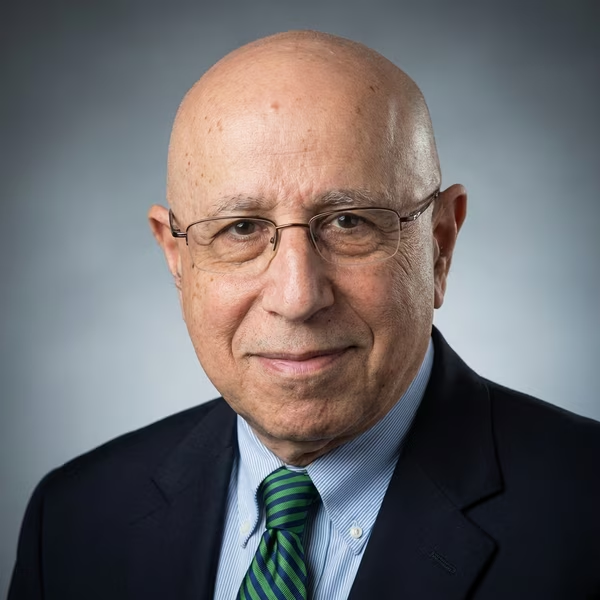
By Said Arikat
July 15, 2026
News analysis
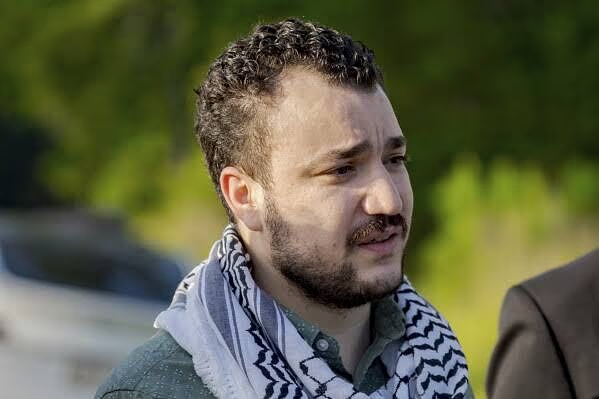
Washington, D.C- The most important free speech case in America today is not about a journalist, a publisher, or a social media platform. It is about Mahmoud Khalil, a Palestinian graduate of Columbia University who alleges that the United States government and a network of powerful pro-Israel organizations conspired to punish him for one reason alone: speaking out against Israel’s war in Gaza.
His lawsuit, filed under the Ku Klux Klan Act of 1871, reaches far beyond his own experience. It asks whether constitutional rights can survive when criticism of Israel collides with one of Washington’s most influential political lobbies. More fundamentally, it asks whether the American government may use its vast powers to silence political dissent by working, as the complaint alleges, with private organizations determined to marginalize critics of Israeli policy.
The irony is difficult to ignore.
Congress enacted the Ku Klux Klan Act after the Civil War to dismantle conspiracies that deprived Americans of their constitutional rights through coordinated action by public officials and private actors. More than 150 years later, Khalil argues that the same principle applies today: that government officials and private organizations worked in concert to strip him of rights guaranteed by the Constitution because of his political beliefs.
Whether the courts ultimately agree remains to be seen. But the allegations deserve to be examined with the seriousness that any claimed assault on the First Amendment demands.
Khalil was not accused of violence. He was not charged with terrorism. He was not prosecuted for espionage or any criminal offense. He was a lawful permanent resident who emerged as one of the most visible leaders of Columbia University’s pro-Palestinian protests against Israel’s devastating military campaign in Gaza.
For that, he became the target of immigration authorities.
His arrest by ICE transformed what should have been a straightforward question of constitutional liberty into an extraordinary demonstration of executive power. He spent 104 days in detention while the administration sought to deport him, depriving him of the chance to witness the birth of his first child. Whatever the legal outcome, no democracy should treat the peaceful exercise of political speech as grounds for separating a father from his family.
The administration insisted that Khalil’s activism conflicted with American foreign policy interests. That rationale should alarm anyone who values constitutional government. The First Amendment exists precisely to protect speech that challenges official policy. If the executive branch can redefine peaceful political advocacy as a foreign policy liability, constitutional freedoms become contingent upon political convenience.
That is a dangerous precedent.
Equally disturbing are the allegations concerning organizations such as Betar and Canary Mission, whose activities have become increasingly controversial as American campuses turned into battlegrounds over Gaza.
For years, these organizations have compiled detailed dossiers on students, professors and activists who criticize Israeli government policies or advocate for Palestinian rights. They maintain that they are exposing antisemitism and political extremism. Their critics argue that they have instead built sophisticated blacklisting operations designed to intimidate, stigmatize and professionally damage those who challenge Israel’s conduct.
The distinction is critical. Antisemitism is a genuine and growing threat that deserves unequivocal condemnation. But opposition to Israel’s occupation, condemnation of civilian casualties in Gaza or advocacy for Palestinian self-determination are political positions—not evidence of hatred toward Jews. Conflating the two not only weakens the fight against genuine antisemitism but also narrows the space for legitimate democratic debate.
Khalil’s lawsuit pushes the issue even further. It alleges that organizations dedicated to defending Israel did more than criticize his views—they helped facilitate government action against him. Those allegations remain to be tested in court. But if discovery demonstrates meaningful coordination between government officials and private advocacy groups to target protected political speech, the implications will extend far beyond this case.
The lawsuit also shines a harsh light on what the Gaza war has done to free expression in the United States.
Universities that once celebrated robust debate increasingly became places where students feared disciplinary proceedings, public blacklisting, or government scrutiny for expressing solidarity with Palestinians. Peaceful encampments were dismantled. Faculty members were investigated. International students worried that political activism might jeopardize their immigration status.
The message was unmistakable: criticizing Israel could carry consequences far beyond the marketplace of ideas.
That should concern Americans regardless of their views on the Middle East.
The issue is not whether one supports Israel or Palestine. Democracies survive disagreement. What they cannot survive is the selective application of constitutional protections based on political influence. No foreign ally should enjoy such extraordinary protection that criticism of its government invites state retaliation against those who voice it.
If the allegations in Khalil’s complaint prove true, the case will reveal something deeply unsettling about contemporary America: that private organizations with clear ideological agendas may have helped transform the machinery of government into an instrument for suppressing lawful political dissent.
History offers an uncomfortable parallel. During the McCarthy era, accusations of ideological disloyalty destroyed reputations, careers and lives. Courts eventually reaffirmed that constitutional liberties cannot depend upon political orthodoxy. Today’s controversy differs in its particulars, but the underlying principle is remarkably similar. A democracy begins to lose its character when governments punish citizens or lawful residents not for unlawful conduct but for expressing disfavored political opinions.
That is why Mahmoud Khalil’s lawsuit matters.
It is not simply about one activist, one administration or even one conflict overseas. It is about whether Americans remain free to criticize the actions of a foreign government without fearing detention, deportation or coordinated campaigns designed to silence them.
The First Amendment was never intended to protect only popular opinions. Its greatest purpose has always been to protect speech that powerful interests would rather not hear.
That principle is now on trial alongside Mahmoud Khalil. If America cannot defend it when the subject is Israel and Palestine, it risks proving that some political speech enjoys constitutional protection while other speech survives only at the pleasure of those who wield power.
Share your opinion
Mahmoud Khalil’s Lawsuit Is a Test of Whether the First Amendment Still Protects Dissent