ARAB AND WORLD

Sun 19 Jul 2026 1:51 pm - Jerusalem Time

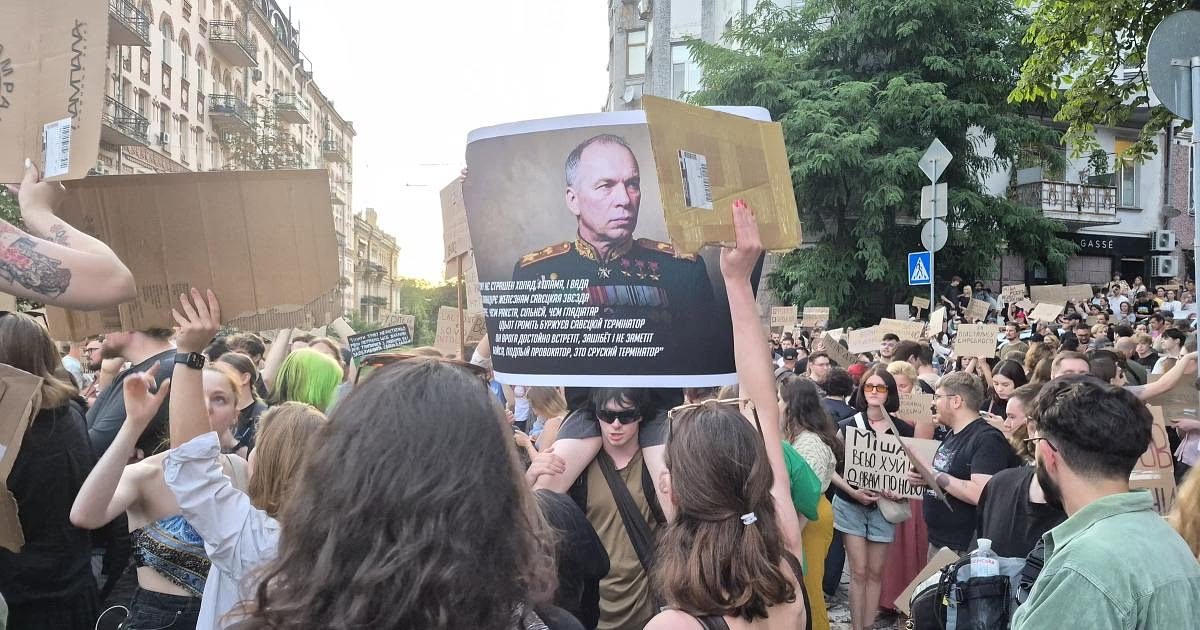
Zelensky hints at widespread military changes amid protests shaking Ukraine

Ukrainian President Volodymyr Zelensky hinted at the possibility of fundamental changes in the structure of the military establishment, amidst a rare wave of protests sweeping the country during wartime. These political moves come after the resignation of Defense Minister Mykhailo Fedorov, who led extensive efforts to modernize the army and utilize drones.

Kyiv and other Ukrainian cities witnessed massive demonstrations for the third consecutive day, where protesters expressed their categorical rejection of Fedorov's departure from office. Demonstrators held up signs condemning the decision, considering that the resigned minister represented the reform and digitalization current within the armed forces, which face major field challenges.

In his evening address to the nation, Zelensky affirmed that he had held intensive consultations over two days with senior military leaders and political officials. The President clarified that he is closely monitoring the public pulse and the demands of the protesters, emphasizing that decisive decisions regarding the future of the army's leadership will be formulated soon.

Field reports indicate that demonstrators in Kyiv's squares used cardboard signs that have become a symbol of opposition, chanting slogans demanding the departure of the current army commander, Oleksandr Syrsky. Protesters believe that recent ministerial changes may harm the modernization efforts that began since the start of Russia's full-scale invasion of the country.

For his part, the resigned minister Mykhailo Fedorov commented on the popular movements via the Telegram application, expressing his gratitude to the demonstrators for what he described as 'hope'. Fedorov indicated that there is ongoing dialogue with the political leadership, expressing optimism that things will move in the right direction to serve the national defense interest.

Tension escalated after informed sources revealed deep disagreements between Fedorov and army commander Syrsky over strategies to counter Russian attacks. The points of contention focused on the young minister's desire to accelerate the digitalization of military operations, which met with reservations from the traditional military leadership represented by Syrsky.

In an extraordinary press conference held after leaving office, Fedorov directly accused Syrsky of lacking the necessary flexibility to manage a modern war. The former minister openly questioned Ukraine's ability to achieve victory given the continued current leadership mentality, which he accused of causing internal divisions.

In contrast, army commander Oleksandr Syrsky, who has a significant military record since his defense of Kyiv in 2022, responded by calling on everyone to focus on the field. Syrsky considered that the utmost priority should be to implement an effective strategy that achieves tangible results on the burning fronts, away from political debates.

A state of anticipation prevails in Ukrainian political circles regarding the identity of Syrsky's potential replacement should Zelensky decide to oust him to absorb public anger. This internal crisis coincides with increasing military pressure exerted by Russian forces on several fronts, making any change in leadership a calculated risk.

Observers believe that Zelensky faces a difficult test to balance the public's demands for modernization with maintaining the stability of the military establishment at a critical time. It is expected that the coming days will see the announcement of the new military leadership that will manage the next phase of the conflict.

Decisions regarding the army will be formulated, and I hear very well what people are saying on the street.

OPINIONS

Sun 19 Jul 2026 1:51 pm - Jerusalem Time

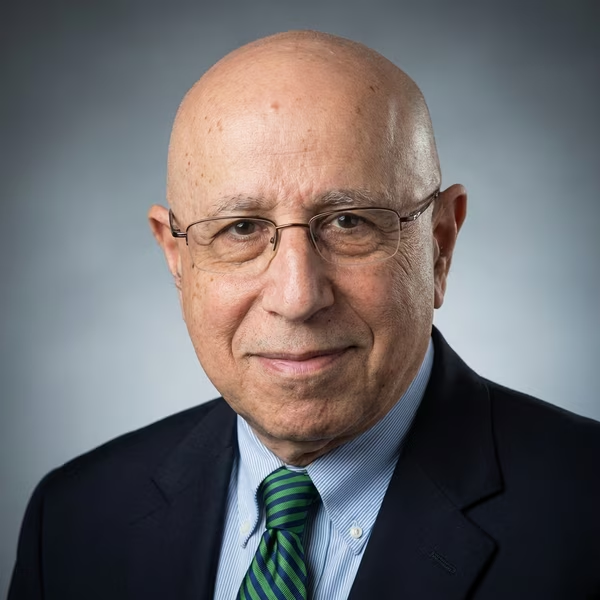
Mamdani threatens to arrest Netanyahu in New York, and the International Criminal Court's warrant pursues the Israeli Prime Minister to the United Nations

Washington Message

Mamdani threatens to arrest Netanyahu in New York, and the International Criminal Court's warrant pursues the Israeli Prime Minister to the United Nations

Washington – Said Arikat – 19/7/2026

New York City Mayor, Zohran Mamdani, reopened the legal accountability file for Israeli Prime Minister Benjamin Netanyahu, after announcing that he is holding legal consultations with relevant departments in the city to discuss the possibility of arresting him if he visits New York to participate in the United Nations General Assembly meetings next September, in a move that reflects the escalating political and legal pressures on the Israeli leadership in the wake of the devastating war in the Gaza Strip.

Mamdani said, in an interview with the New York Times, that Netanyahu "belongs in The Hague," referring to the arrest warrant issued against him by the International Criminal Court on charges related to committing war crimes and crimes against humanity in Gaza. He added that what Israel has committed in recent years, especially since the outbreak of the recent war, has made the demand for Netanyahu's accountability a position adopted by an increasing number of politicians and human rights activists around the world.

The New York Mayor clarified that he is holding "active discussions" with the city's legal department to determine the limits of his legal powers, stressing that any step will be taken within the framework of the law, saying: "We will do everything allowed by law in New York City, but we will not invent new laws to achieve that."

This stance comes months after Mamdani pledged, during his election campaign, to seek Netanyahu's arrest if he visited the city, a promise that sparked widespread debate about the extent of local authorities' ability to execute a warrant issued by the International Criminal Court, given that the United States is not a party to the Rome Statute establishing the court.

In contrast, Netanyahu tried to downplay the importance of these statements, considering that Mamdani "hates America deep down," and accusing him of siding with Hamas, in a repetition of a political approach repeatedly adopted by the Israeli government, which links any criticism of Israeli policies or calls for accountability of Israeli officials to supporting terrorism or anti-Semitism, a discourse that critics believe aims to avoid discussing the essence of the accusations related to violations of international law.

Israeli Ambassador to the United Nations, Danny Danon, also confirmed that Netanyahu will attend the United Nations General Assembly meetings in New York as scheduled, and will address the international community to defend what he described as "Israel's inherent right to defend its citizens," denying that calls for his arrest would pose any obstacle to his visit.

From a legal perspective, international law experts believe that Netanyahu's presence inside the United Nations headquarters grants him legal protection related to diplomatic immunities and agreements regulating the work of the international organization. However, his status outside the building, while moving within New York City, raises complex legal questions about the extent to which the International Criminal Court's warrant can be executed, even if the United States is not a party to the Rome Statute.

Although the execution of any arrest attempt seems unlikely given the legal and political complexities, the mere raising of this possibility reflects the shift in the political debate within the United States, where the demand for accountability of Israeli officials is no longer exclusive to human rights circles, but has found resonance within local leaders and elected officials in the Democratic Party.

Mamdani is considered one of the most prominent Democratic voices supporting Palestinian rights, and he condemned the attacks of October 7, 2023, but he has made criticism of the Israeli war on Gaza a central theme in his political discourse, considering that defending the rights of Palestinians represents one of the most pressing moral issues of his era.

This comes at a time when the American political scene is witnessing a remarkable shift in attitudes towards Israel, after nearly half of the Democratic members of the House of Representatives voted in favor of a bill calling for a halt to military aid to Israel, indicating a decline in the traditional consensus within the party regarding unconditional support for the Hebrew state.

Mamdani's statements reveal that the arrest warrant issued by the International Criminal Court is no longer just a legal document, but has become a political burden that pursues Netanyahu wherever he goes. Even if it cannot be practically executed, it imposes a new reality in which the Israeli Prime Minister is forced to confront questions about his international legitimacy, instead of merely marketing the traditional Israeli narrative. With the widening circle of demands for accountability, Israel faces an unprecedented challenge in the erosion of the political immunity it enjoyed for decades in Western capitals.

Netanyahu's response, based on accusing his critics of anti-Israel sentiment or sympathy with Hamas, also reflects a worsening political crisis more than a legal response to the accusations. Since the beginning of the war on Gaza, the Israeli government has adopted a discourse that mixes criticism of military policies with anti-Semitism, in an attempt to silence voices calling for accountability. However, the increasing scale of destruction and human losses, and the growing international human rights reports, have made this discourse less capable of containing the escalating criticism within the United States and Europe, where the demand for accountability has gained wider acceptance.

Perhaps the political importance of Mamdani's case does not lie in the possibility of Netanyahu's arrest, which is practically a remote possibility, as much as it lies in the significance it carries within the American political community. A few years ago, merely discussing the accountability of a high-ranking Israeli official was considered a political taboo, but today it has become part of the public debate within the Democratic Party, in parallel with the escalation of voices rejecting continued unconditional military support for Israel. This shift indicates that the war on Gaza has not only created a humanitarian crisis, but has also created a deep rift in Israel's image within American public opinion.

LATEST NEWS

Sun 19 Jul 2026 1:49 pm - Jerusalem Time

Controversy in Egypt after statements by an Israeli journalist about Sinai and a decision to ban a presenter from appearing

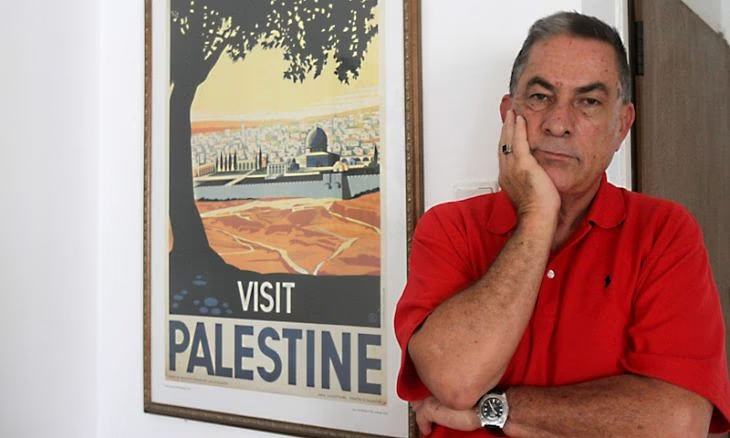
Media and political circles in Egypt witnessed widespread controversy after presenter Ihab Qassem hosted Israeli journalist Gideon Levy in a phone intervention. During the interview, which was broadcast on Al-Qahera Wal Nas channel, Levy made provocative statements regarding Egyptian sovereignty over the Sinai Peninsula, which sparked angry reactions at both popular and official levels.

The Israeli journalist claimed in his speech that the general view in Israel does not treat Sinai as a territory belonging to the Egyptian state, but rather views it as mere beach areas not subject to specific sovereignty. Levy indicated that this perception prevails among many who see it as a tourist destination without considering its political or geographical identity linked to Egypt.

In the context of his personal experiences, Levy revealed that he visited Egypt about 12 times, in addition to dozens of trips he made to Sinai over many years. However, he confirmed that he stopped these visits a long time ago, justifying this by the change in the general atmosphere that made the presence of Israelis in cities such as Cairo and Alexandria uncomfortable.

In response to these developments, the Egyptian Syndicate of Journalists issued an urgent decision to ban presenter Ihab Qassem from appearing on any media outlet until further notice. This punitive action came after monitoring serious violations of the media code of honor and the professional code of conduct that govern journalistic and broadcasting work in the country.

The Syndicate clarified in its official statement that the presenter allowed the Israeli guest to narrate egregious historical and political fallacies without showing any objection or professional review of those claims. The Syndicate considered that the management of the dialogue lacked national and professional responsibility, especially with regard to issues affecting Egyptian national sovereignty.

For its part, the Al-Qahera Wal Nas channel management quickly took precautionary measures by deleting the recorded segment with the Israeli journalist from all its digital platforms and its main screen. The channel confirmed that this decision comes in response to the observations it received and out of keenness to adhere to the professional standards adopted by the institution.

The channel stressed in an explanatory statement that a comprehensive review will be conducted of all aspects related to the preparation of this segment and its display mechanisms to ensure that such transgressions are not repeated. It indicated that its media message will always remain biased towards the conscience of Egyptian society and its deeply rooted national values, expressing its appreciation for the audience's interaction with the content provided.

This incident reflects the sensitivity of media dealings with Israeli figures within Egypt, especially in light of current regional tensions. It also highlights the role of professional syndicates in monitoring media performance and ensuring that national constants are not compromised under the pretext of freedom of expression or journalistic scoop.

Israelis do not view the Sinai Peninsula as part of Egypt, but merely beaches somewhere, as if it were land belonging to no one.

OPINIONS

Sun 19 Jul 2026 1:49 pm - Jerusalem Time

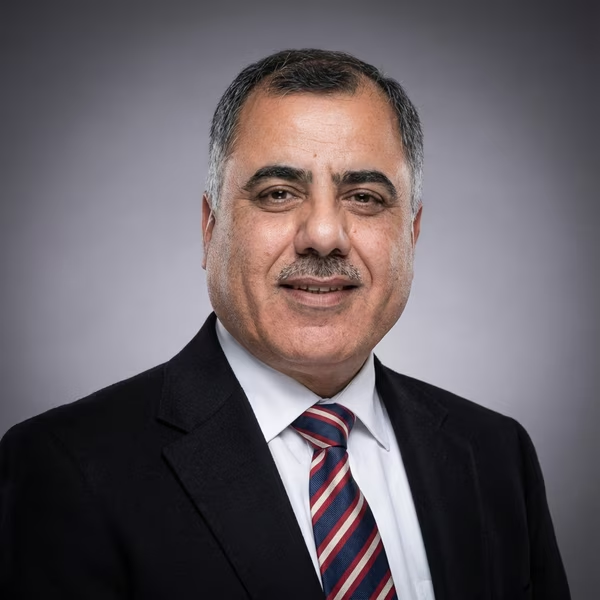
The Sole Survivor!

Dr. Ibrahim Melhem

Editor-in-Chief

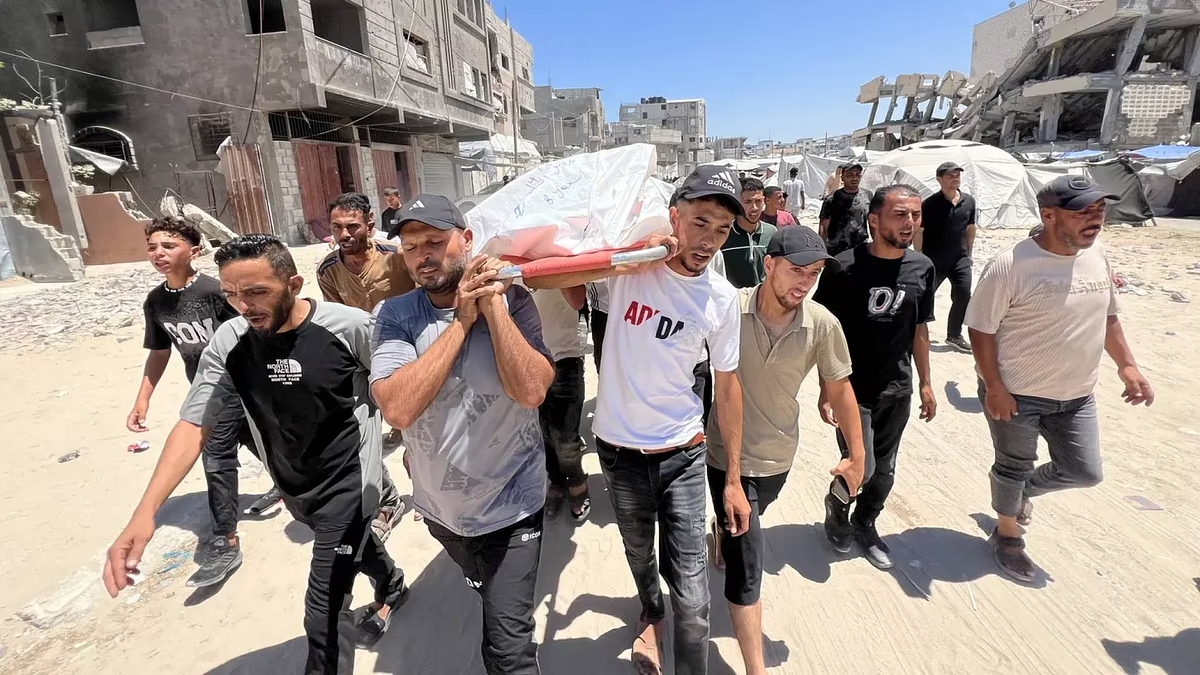
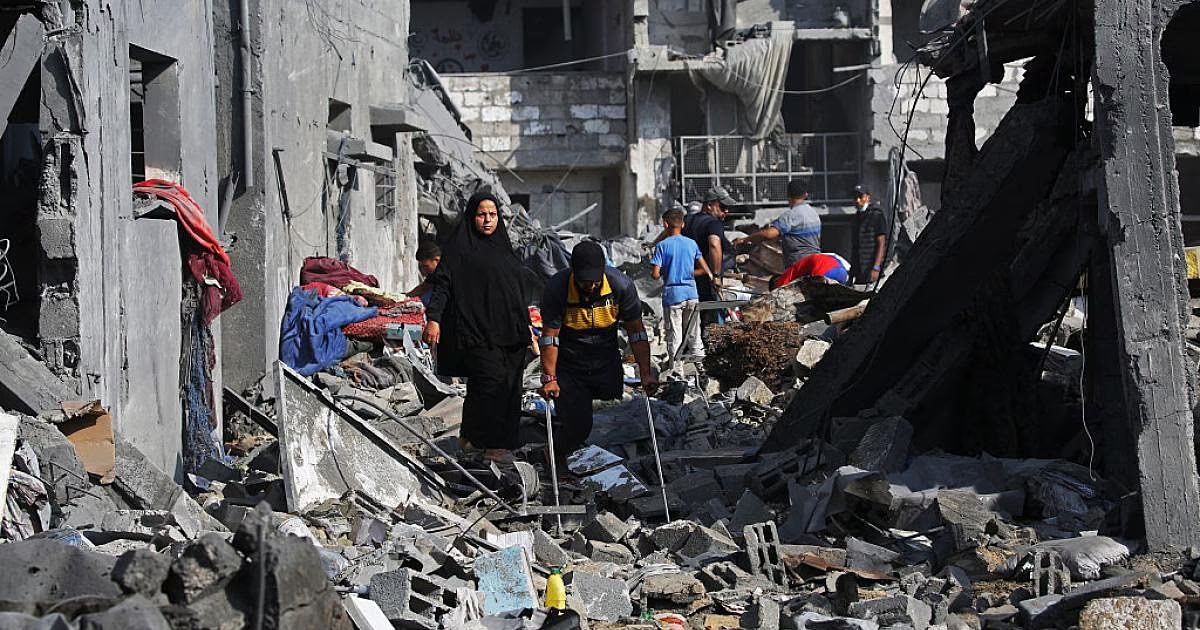
Words fail. "Sami" was not the first, nor will he be the last, on the "Sole Survivor" list; he joined it after a horrific massacre targeted his family's home in Deir al-Balah two days ago, costing him his father "Omar," his mother "Asmaa," and his sister "Habiba," who was two years older than him. With dazed, staring eyes and broken limbs wrapped in white, the orphaned child appeared carried in the arms of a relative, unaware of what had befallen his family, whose bodies are still trapped under the rubble of a home they sought shelter in, hoping for shade to protect them from the summer heat, in an area they thought was far from the daily targeting and crimes led by extremists whose hearts have hardened, like stones or even harder; they kill, burn, starve, dehydrate, besiege, uproot trees, demolish stones, and inflict severe torment on the unarmed without any conscience, sense of responsibility, or human feelings. Yesterday, ten-year-old Ayman joined that list, the sole survivor of the Nasman family: his father Adham, his mother Marwa, and his brothers Yahya and Ibrahim, who perished in a raid on the family home in central Gaza. In the approximation of pain and the agony of loss, it seems that "all who died miraculously escaped life," as our late poet Mahmoud Darwish said, while the survivors endure a pain that has settled in their hearts and will not leave them as long as they live.

PALESTINE

Sun 19 Jul 2026 1:49 pm - Jerusalem Time

Escalation in the Iranian Interior.. An American Attempt to Redraw the Rules of Engagement

Ahmed Rafiq Awad: The strikes aim to weaken Tehran, force it to sign a new memorandum of understanding, and demonstrate the United States' ability to undermine Iranian military capabilities.Nabhan Khraisha: Washington's bombing of the Iranian interior reveals the conflict's transition to a more dangerous and widespread phase, keeping the region on the brink of regional war.Dr. Suhail Diab: The closest estimates are for continued US military pressure against calculated Iranian responses to avoid an existential war, with undeclared negotiation channels remaining open.Hani Abu Al-Siba': The continuation of US military movements and operations reflects the need for more time and pressure to break Iran's will and push it to accept Washington's terms.Dr. Aql Salah: Washington may resort to escalating pressure through enhanced military deterrence and tightened economic and diplomatic sanctions, seeking to impose a broader agreement.Mohammed Al-Rajoub: The US escalation represents a clear shift in the nature of the conflict, reflecting Washington's transition to a phase aimed at raising the cost of the Iranian decision itself.Ramallah - Exclusive to "Al-Quds" - The American escalation in the Iranian interior enters a new phase of confrontation between Washington and Tehran, amidst the conflict's transition from indirect pressure politics to targeting sites within Iranian territory, a step that may reflect an American attempt to redraw the rules of engagement and impose new equations in the negotiation file related to the nuclear program, missiles, navigation security in the Strait of Hormuz, and the future of Iran's role in the region.Writers, political analysts, specialists, and university professors, in separate interviews with "Al-Quds," believe that the American strikes do not only aim to weaken Iranian military capabilities and infrastructure, but also carry multiple political messages, most notably strengthening American deterrence in front of allies, raising the cost of Iranian options, and improving Washington's negotiating position by using military force as a bargaining chip, at a time when neither the United States nor Iran appears willing to slide into an all-out war due to its high cost.While Washington bets on pushing Tehran to return to negotiations from a weaker position and accept new terms, writers, political analysts, specialists, and university professors believe that Iran is preparing for a long confrontation based on calculated responses and attrition, while maintaining a margin for undeclared negotiations, which leaves the region facing open scenarios ranging from continued limited escalation, through a long war of attrition, to the risk of regional expansion of the confrontation if things get out of control.Attempt to Impose an Interpretation of the Islamabad MemorandumPolitical writer and analyst Dr. Ahmed Rafiq Awad believes that the American strikes in the Iranian interior come in the context of Washington's attempt to impose its own interpretation of the memorandum of understanding signed in Islamabad, and to force Tehran to accept new terms after the American breach of previous understandings, whether related to the ceasefire in Lebanon, the release of frozen Iranian funds, or freedom of navigation in the Strait of Hormuz, noting that Iran responded to these violations by targeting maritime tankers.He explains that the United States seeks, by directing strikes into the Iranian interior, to weaken military capabilities and vital infrastructure, including electricity and water facilities and bridges, in addition to targeting nuclear facilities, with the aim of establishing a narrative that it has succeeded in completely ending the Iranian nuclear project, and at the same time pushing Tehran to return to negotiations according to new American terms, considering that these operations also serve an internal political goal of marketing a military achievement before the American midterm elections scheduled for next November.Awad points out that the strikes also aim to weaken the Iranian regime and force it to sign a new memorandum of understanding, and to show the United States as the party capable of undermining Iranian military capabilities, as well as creating conditions that may help internal opposition forces increase pressure against the regime.Iran Overcomes the Stage of Fear of CollapseIn his reading of the outcomes of the escalation, Awad believes that Iran has overcome the stage of fear of collapse and is ready to wage a long war, whether in the form of a war of attrition or - if imposed upon it - a wider confrontation, but at the same time it realizes that the United States does not wish to engage in a ground war, direct occupation, or open-ended attrition, because its calculations remain limited in time and politically.Awad indicates that the Iranian leadership is betting that steadfastness in the face of American military pressure will spare it collapse, destruction, or sliding into civil war, suggesting that developments will likely move towards one of two main scenarios: first, a long or low-intensity war of attrition, and second, a return to the negotiating table on new bases, noting that the door to negotiation remains open, as evidenced by Washington not asking Israel to engage in the confrontation, and Iran refraining from targeting Israel, reflecting both parties' desire to avoid an all-out war.Conflict Enters a More Dangerous and Widespread PhaseJournalist and writer Nabhan Khraisha believes that the continuous American bombing of targets within the Iranian interior does not only reflect deterrence power, but also reveals the conflict's transition to a more dangerous and widespread phase, based on expanding the target bank and raising the level of both political and military pressure on Tehran, considering that targeting sites within Iranian territory carries a message beyond weakening military capabilities, namely that the United States is capable of reaching any target it considers a threat to its interests and the interests of its allies, noting that between gradual escalation and a return to negotiation, the region remains on the brink of a regional war.Implicit Acknowledgment of Failure of Pressure RoundsKhraisha explains that this escalation also indicates an implicit acknowledgment that previous rounds of pressure did not fully achieve their strategic goals, for if previous military operations had succeeded in imposing American conditions, Washington would not have been forced to expand the scope of its operations and move to targeting the Iranian interior in this manner.Khraisha believes that a great power resorting to gradually escalating its operations reflects that the opposing party still retains the ability to withstand, maneuver, and respond, which pushes the United States to raise the level of military pressure in pursuit of its goals.Iran and Not Standing Idly ByKhraisha believes that Iran will most likely not engage in a comprehensive conventional confrontation with the United States, realizing the significant difference in military power balances, but at the same time, it will not stand idly by, suggesting that it will continue to adopt an attrition policy by expanding the circle of indirect responses, targeting American and regional interests, and increasing pressure on navigation and energy supplies, tools that have proven their ability to disrupt American and international calculations in recent months.Continued Gradual EscalationKhraisha points out that the most likely scenario is continued gradual escalation, which keeps the region in a state of low or medium-intensity war, but one that is open-ended and capable of exploding at any moment due to a miscalculation or the execution of a strike that crosses red lines.Khraisha proposes another scenario based on the success of military pressures, after a period of attrition, in pushing both parties to return to the negotiating table, but under different conditions than those previously proposed, considering that the United States often uses military force to improve its negotiating position more than to achieve a final military victory.Khraisha warns that the most dangerous scenario is the confrontation spiraling out of control and the war expanding to include additional countries in the region, threatening global energy security and leading to widespread economic and political turmoil, emphasizing that this possibility, although not desirable for the main parties, remains present with the continued rise in military escalation.A Process of Redrawing the Balance of PowerAccording to Khraisha, what is happening goes beyond being a confrontation related to Iran alone, to reflect a process of redrawing the balance of power in the Middle East, but historical experiences confirm that military force can change facts on the ground, but it rarely succeeds alone in achieving lasting political stability, which makes the real challenge finding a realistic political vision that ends the confrontation before it turns into an open regional conflict whose repercussions are difficult to contain.Stalemate and Limited Options for WashingtonPolitical science professor Dr. Suhail Diab believes that the American escalation in the Iranian interior came as an expression of a stalemate and limited options for Washington, explaining that the United States cannot resolve the confrontation with a quick and guaranteed military victory, and that making political concessions to Iran, especially regarding the Strait of Hormuz, would be interpreted as a political defeat for the United States.Diab explains that the objectives of the American escalation are linked to several considerations, foremost among them reassuring allies in the Middle East that Washington is still capable of defending their interests and protecting them, in addition to trying to calm internal tensions in the United States between political currents, especially between Republicans and Democrats, and among public opinion, with the approaching midterm elections.Neutralizing Israel from Direct Engagement in the ConfrontationDiab points out that indicators of these objectives have become clear, most notably neutralizing Israel from direct engagement in the confrontation based on demands from allies, in addition to the escalating disagreement within the American administration between the hawkish current represented by Marco Rubio, and the realistic current represented by J.D. Vance.Diab believes that the current escalation can be summarized as an attempt to "minimize damage" and buy time in the absence of clearer scenarios, considering that it reflects the depth of President Donald Trump's administration's crisis internally and externally.Mutual Containment ScenarioIn his reading of the potential scenarios, Diab favors the mutual containment scenario as the most likely, whereby limited strikes continue, and Iran responds in a calculated manner, with both parties keen to avoid an all-out war, in a pattern similar to the "controlled escalation" witnessed in previous crises.Long War of Attrition ScenarioThe second scenario, according to Diab, is a long war of attrition that includes continued airstrikes, cyberattacks, targeting American interests and bases, naval escalation, and mutual economic pressure, a confrontation that could last for months and affect energy markets and global trade without the need for a ground invasion.Possibility of Regional Conflict ExpansionDiab points to the possibility of the conflict expanding regionally to include Iraq, Syria, the Gulf, the Red Sea, and vital maritime passages, turning the confrontation into a multi-front war.The most dangerous and least likely scenario, according to Diab, is the outbreak of an all-out war if the Iranian leadership is subjected to widespread strategic strikes, or a major targeting of nuclear facilities, or a large number of American military personnel are killed in a direct attack.Diab believes that the closest estimates indicate continued US military pressure, against calculated Iranian responses to avoid an existential war, with undeclared negotiation channels continuing in parallel with the escalation.Forcing Tehran to Return to Negotiations from a Position of WeaknessPolitical writer and analyst Hani Abu Al-Siba' believes that the continuous American escalation against Iran primarily aims to force Tehran to return to the negotiating table from a position of weakness, allowing Washington to impose its political and security conditions.Abu Al-Siba' believes that raising the pace of military attacks is part of an attempt to improve negotiation terms, but field data indicates that Iran has prepared for a potentially long confrontation, and that it is capable of responding to escalation with similar escalation, by targeting American bases and interests as long as American attacks continue.Continued Escalation... But!Abu Al-Siba' explains that the continuation of American military operations, for the seventh consecutive day, coinciding with the movement of the naval fleet and strategic bombers towards the region, reflects a conviction in Washington that it needs more time and military pressure to break Iran's will and push it to accept American conditions.However, Abu Al-Siba' believes that field facts do not support this assessment, noting that Iran has intensified its missile attacks on American bases and expanded the scope of its response whenever American strikes increased, especially on the southern governorates overlooking the Gulf.He explains that the Iranian escalation included targeting American bases in the Gulf and Levant regions, resulting in injuries to American soldiers, in addition to reports of a cruise missile launch towards an aircraft carrier in the Pacific Ocean, considering that these developments warn of the expansion of the conflict, amidst a race against time for the American administration amid escalating internal criticism of the war, and fears of its economic repercussions on the United States and the global economy.Abu Al-Siba' points out that the continued American military buildup, and the sending of aircraft carriers and refueling aircraft to the region, may open the door to expanding operations to include additional targets, and perhaps ground operations targeting sites related to the Iranian nuclear program, noting at the same time that Israel continues its preparations for the possibility of engaging in the confrontation.Abu Al-Siba' believes that continued fighting will push the conflict towards a war of attrition, considering that historical experiences in Afghanistan, Vietnam, Iraq, Syria, Lebanon, and Somalia indicate the difficulty of the United States succeeding in this type of war.Possibility of Confrontation Expanding with Participation of Other PartiesAbu Al-Siba' warns of the possibility of the confrontation expanding through the participation of other parties, and the potential threat to navigation in the Straits of Hormuz and Bab al-Mandab and direct impacts on the global economy.Abu Al-Siba' suggests the existence of undeclared efforts led by mediators to contain the escalation and open a window for a political breakthrough, but he believes that significant American losses could push Washington to a greater escalation in pursuit of a military achievement, emphasizing that the continuation of the war, if prolonged, could negatively affect the American economy and influence the electoral mood within the United States.Redefining US-Iranian UnderstandingsPolitical writer and researcher and professor of comparative political systems Dr. Aql Salah believes that the American escalation in the Iranian interior aims to redefine US-Iranian understandings, especially regarding the Strait of Hormuz and its management mechanism, which, from Washington's perspective, would re-establish its prestige as the power capable of controlling global waterways, in addition to giving Israel a wider margin to continue targeting Iran whenever it wishes, similar to what is happening in the Gaza Strip and Lebanon, in an attempt to impose a "negotiation under fire" model, and subject Iran to new American and Israeli conditions.No Desire for All-Out WarSalah explains that the escalation does not necessarily reflect the desire of both parties to slide into an all-out war, as the United States seeks to strengthen its negotiating position through pressure, deterrence, and demonstrating power, while Iran has no choice but to resist and manage the conflict cautiously, preventing the confrontation from turning into a wide war, and refusing to accept negotiations that give Washington an advantage and achieve Israeli interests related to re-engineering the Middle East.He points out that the United States is keen not to collapse the dialogue process with Iran, but it is working to change its terms and nature, leveraging military escalation to raise its demands and extract greater concessions, by employing military force, assassinations, blockade, and sanctions as a bargaining chip, a policy previously used in Gaza and Lebanon to achieve political gains that military operations did not achieve.Salah believes that Washington may resort, if Iran rejects its conditions, to escalating pressure through enhanced military deterrence and tightened economic and diplomatic sanctions, seeking to impose a broader agreement that includes the nuclear program, ballistic missiles, Iran's regional role, and stricter monitoring mechanisms, which he considered fundamental Israeli demands.Five Key ImplicationsSalah points out that the American strikes carry five key implications: strengthening American deterrence, changing the rules of engagement by targeting the Iranian interior, increasing political pressure to push Tehran to make concessions, sending reassuring messages to US and Israeli allies in the region, in addition to testing the level of Iranian deterrence and capabilities, emphasizing that Iran adheres to rejecting negotiations under threat while maintaining the diplomatic path and strengthening the cohesion of its internal front.Salah suggests that a return to negotiations from a position of strength remains the most likely scenario, with the possibility of continued escalation remaining, while sliding into an all-out regional war remains the least likely scenario, despite continued tension between the two parties.Clear Shift in the Nature of the ConflictAcademic and researcher in public administration and political science Mohammed Al-Rajoub believes that the recent American escalation within the Iranian interior represents a clear shift in the nature of the conflict, reflecting Washington's transition to a phase aimed at raising the cost of the Iranian decision itself, after previously focusing on containing Iranian influence in the regional arenas.He explains that targeting facilities, infrastructure, and sites within Iranian territory carries a set of strategic messages, the first of which is the United States' endeavor to restore deterrence power after it saw Tehran crossing red lines by targeting international navigation and American bases and its allies in the region.Al-Rajoub points out that the second message is to confirm that any threat to American interests will be met with direct targeting of the Iranian interior, and not just striking the regional proxies linked to Iran.Al-Rajoub notes that the third message is to redraw the rules of engagement, as the confrontation has moved from the arenas of Iraq, Syria, Lebanon, Yemen, and the Red Sea to the heart of Iran, which is a qualitative shift that raises the level of risks and places the Iranian leadership before a more complex equation.As for the fourth message, according to Al-Rajoub, it is to exert economic and logistical pressure aimed at reducing Iranian logistical capabilities and weakening the ability of its armed forces to maneuver and manage operations.A New Phase Different from Previous RoundsIn his reading of the outcomes of the escalation, Al-Rajoub believes that the region has entered a new phase different from previous rounds of tension, but it does not necessarily mean that the decision for a comprehensive regional war has been taken.Al-Rajoub suggests that the scenario of continued mutual strikes between the United States and Iran remains the most likely, with calculated responses from both sides to maintain the deterrence equation in front of their domestic audiences, without bearing the cost of sliding into a wide confrontation.Errors That Could Lead to a Wide WarAl-Rajoub believes that the possibility of a wide regional war breaking out, although less likely, remains if a miscalculation leads to a major attack that causes widespread human casualties, which could lead to targeting American bases in the Gulf or expanding strikes against Iranian infrastructure.Al-Rajoub proposes the scenario of returning to negotiations from a position of strength, where each party seeks to improve its conditions before resuming dialogue, in addition to a long-term attrition scenario based on continued mutual strikes without military resolution, and the accompanying economic deterioration, rising energy prices, disruption of maritime navigation, and declining investments in the region.Al-Rajoub confirms that current indicators, despite escalating tension, do not indicate a final decision to wage an all-out war, as both parties are still using military force to redraw the balance of deterrence and improve their negotiating positions, with the risk of a strategic error that could turn the escalation into a wide regional conflict remaining.

PALESTINE

Sun 19 Jul 2026 1:49 pm - Jerusalem Time

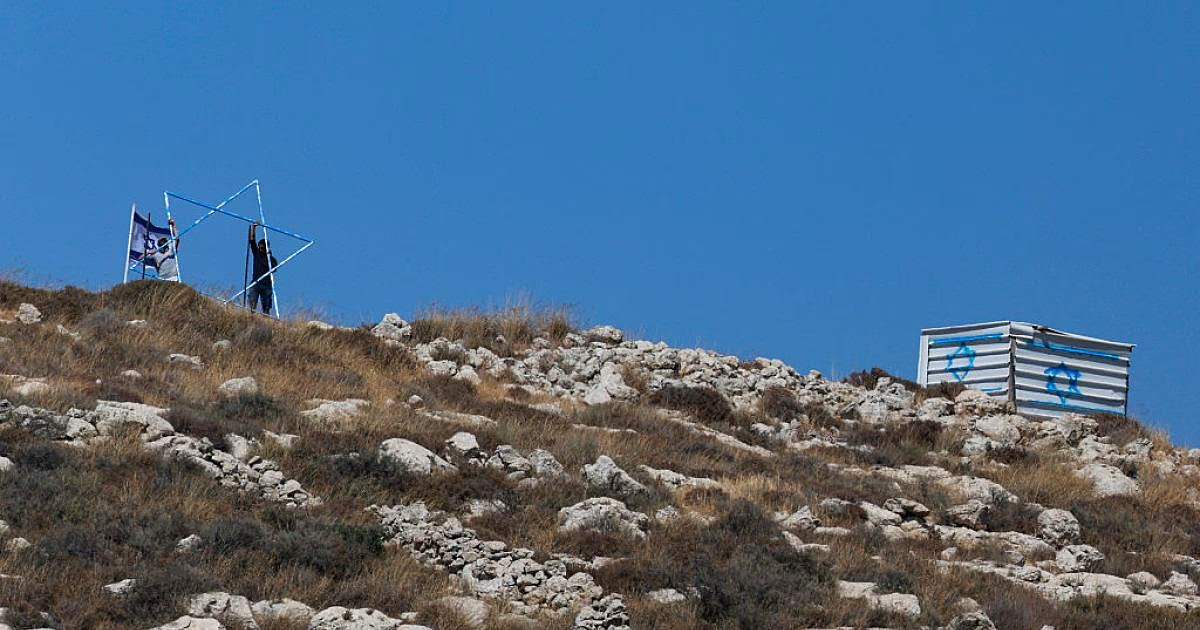
Settlers burn mosque and homes in a violent attack south of Hebron

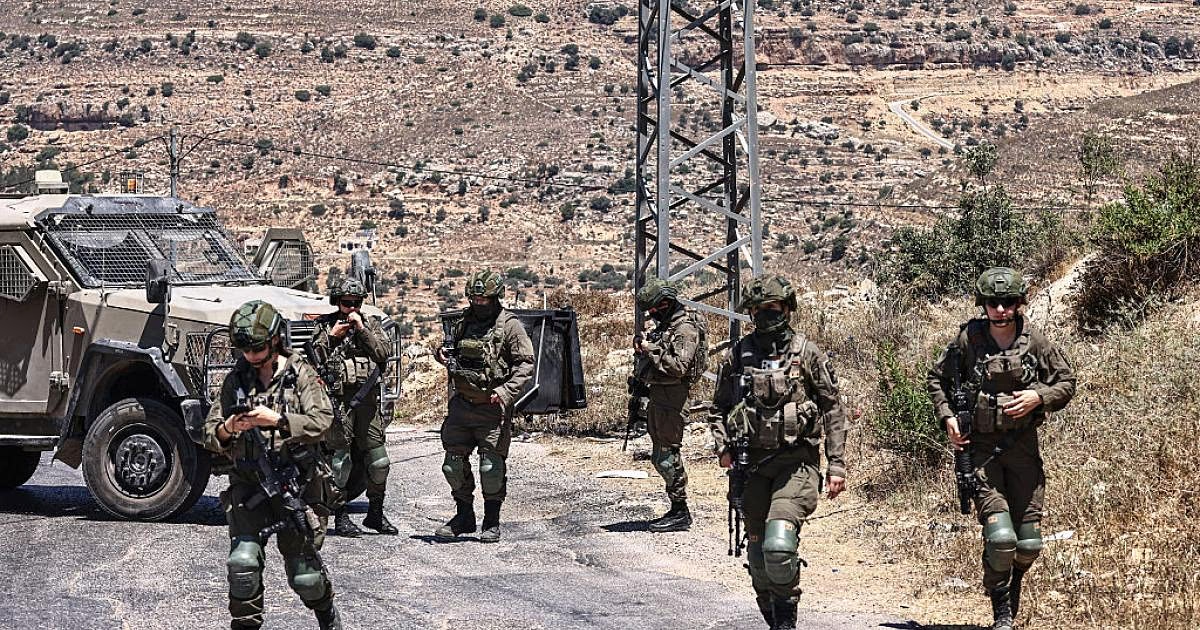
The village of Al-Tuwani, located in Masafer Yatta, south of Hebron city, witnessed a violent attack by extremist settlers this Sunday morning, resulting in severe material losses to Palestinian citizens' properties and places of worship.

Field sources reported that the attackers deliberately set fire to the village mosque, in addition to burning three residential homes and a private vehicle, in a new escalation targeting the Palestinian presence in Area C of the occupied West Bank.

These attacks come amidst an increasing pace of organized settler attacks against Palestinian villages and towns, especially in the Masafer Yatta areas, which face continuous displacement and restriction plans by Israeli authorities and settler groups.

Extremist settlers burned a mosque, 3 homes, and a vehicle during an attack they launched on the village of Al-Tuwani in Masafer Yatta.

ARAB AND WORLD

Sun 19 Jul 2026 9:25 am - Jerusalem Time

Killing and disappearance of American soldiers in Jordan due to Iranian strikes puts Trump administration under severe pressure

The US Central Command (CENTCOM) confirmed the killing of two of its personnel and the disappearance of a third soldier, after their positions in Jordan were subjected to intense Iranian strikes last Friday. Military sources clarified that the attack was carried out using a combination of ballistic missiles and suicide drones, in a new escalation of the direct confrontation between Washington and Tehran.

These human losses among US forces put President Donald Trump's administration in a deepening political and military predicament, especially with the continued exchange of attacks with no horizon for a solution. The current administration faces accusations of lacking a strategic vision to end the conflict, which has entered its fifth month without achieving tangible results on the ground.

Informed sources reported that the killing of the soldiers and the disappearance of another raises the level of tension in Washington, where opposing voices, particularly from the Democratic Party, have begun to criticize the method of protecting deployed forces. Observers believe that the increasing reliance on drones by adversaries has become the biggest challenge for American defense systems in the Middle East.

In the context of field operations, data indicates that the recent week-long military campaign failed to achieve its declared goal of securing the Strait of Hormuz. Despite previous official statements about controlling the waterway, commercial navigation traffic still faces serious threats preventing the safe passage of ships.

Ambiguity still surrounds the fate of the American soldier missing since the attacks of July 17, as the Department of Defense (the Pentagon) has not released precise details about the circumstances of his disappearance. This official silence raises widespread questions about whether the soldier fell during the engagement or was lost under other circumstances not yet disclosed.

Political circles in the American capital criticized the decline in the level of transparency in managing current military operations compared to previous administrations. The absence of regular press conferences provided by the Pentagon was noted, with only brief statements issued via social media platforms or unofficial media leaks.

Analysts believe that the loss of American soldiers' lives may push the administration to radically re-evaluate its military options in the region. However, the option of carrying out a large-scale ground operation inside Iranian territory seems unlikely at present due to the high risks and the lack of a clear strategic path for the campaign.

Reports indicate that US forces deployed in regional bases are on high alert in anticipation of further coordinated attacks. Bases in Jordan, Iraq, and Syria are considered potential targets for ongoing escalation operations in which Tehran uses advanced drone technology.

Domestically, the issue of the soldiers' deaths is expected to become a rich topic for electoral and political debate, as Trump's opponents will demand clarifications about the utility of military presence in conflict zones. Pressure is increasing on the White House to present an exit plan or a deterrence strategy that ensures the safety of thousands of American soldiers in the Middle East.

Regionally, allies and adversaries alike are watching the anticipated American reaction to the killing of its soldiers on Jordanian soil. Observers fear that any uncalculated military response could lead the region into a comprehensive war that goes beyond the current intermittent clashes.

In conclusion, the question remains about the Trump administration's ability to balance its promises to reduce foreign military interventions with the necessity of responding to the targeting of its soldiers. The absence of unified objectives and tangible results in the Strait of Hormuz and the Jordanian borders puts American military credibility to the test in one of the most complex international crises.

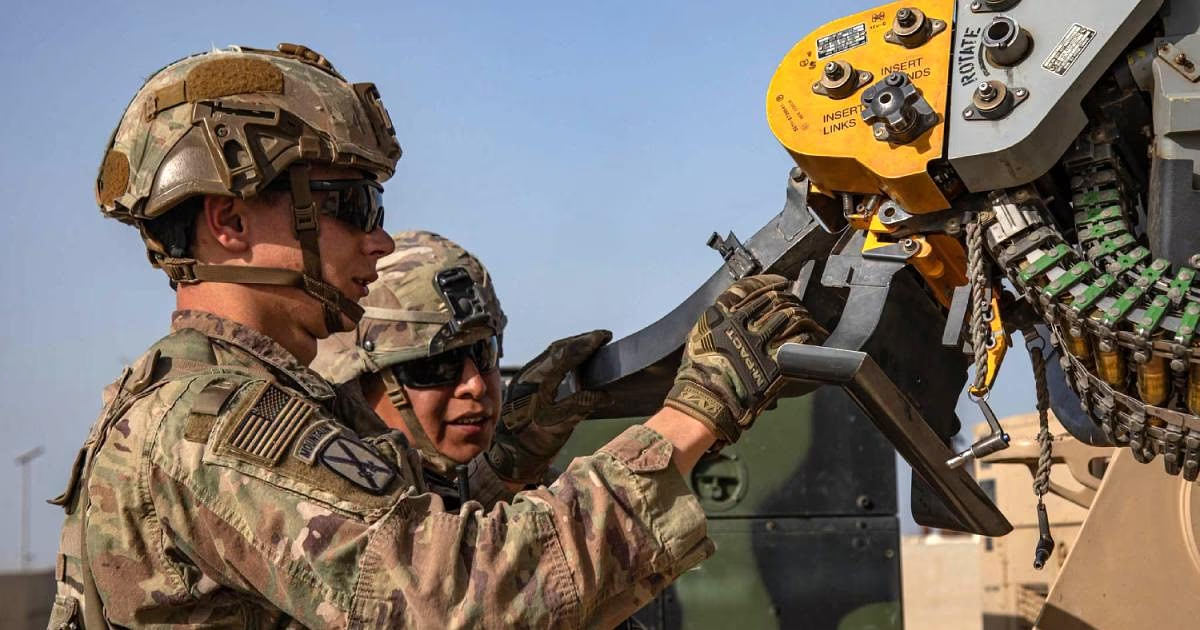
Two American service members were killed in Jordan while performing their duties as forces responded to attacks launched by Iran using ballistic missiles and drones.

ARAB AND WORLD

Sun 19 Jul 2026 9:24 am - Jerusalem Time

Lebanon: Soldier killed in southern explosion, Israeli violations escalate ahead of Washington summit

The Lebanese Army Command announced today, Saturday, the martyrdom of one of its members and the injury of an officer and another soldier with varying injuries, after a military vehicle was exposed to the explosion of a suspicious object in the town of Mansouri, located in the south of the country. The brief military statement clarified that the specialized agencies have initiated field investigations to uncover the circumstances of the incident and determine the nature of the explosive object.

This field incident comes amidst a noticeable escalation in the pace of Israeli violations of the ceasefire agreement and the security understandings recently concluded under international auspices. Field sources monitored the continuation of air raids and shelling on various areas in South Lebanon, leading to intensive drone flights over the capital Beirut and its southern suburbs.

Sources reported that an Israeli airstrike targeted the town of Mansouri, causing a number of civilian casualties, which further complicates the fragile security situation. A drone also launched another raid on the town of Nabatieh al-Fawqa, as part of a series of violations that affected border and deep villages and towns in the Lebanese interior.

In the Marjayoun plain area, a violent explosion was heard, which later turned out to be the result of an interceptor missile exploding in the air, coinciding with Hebrew reports about the activation of air defense systems in the Kiryat Shmona settlement in northern occupied Palestine. These developments reflect the fragility of the field situation despite diplomatic efforts to contain the escalation.

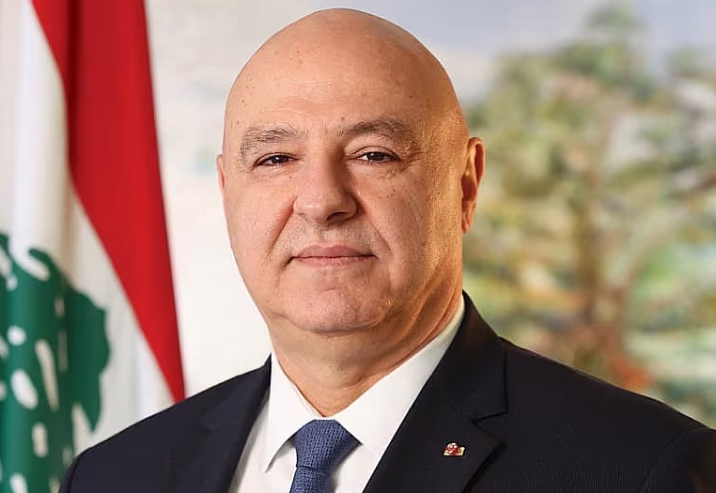
On the diplomatic front, Lebanese President Joseph Aoun left Beirut this morning heading to the US capital Washington on an official visit of exceptional importance. Aoun is scheduled to meet his American counterpart Donald Trump at the White House on July 21st to discuss thorny issues related to the future of stability in the region.

The Lebanese-American summit aims to discuss ways to permanently establish a ceasefire and ensure the withdrawal of Israeli forces from all Lebanese territories still under occupation. The meeting will also address the issue of extending the authority of the Lebanese state over its entire national territory and strengthening the capabilities of the Lebanese Army to carry out its security tasks.

Aoun's visit comes after an intensive round of negotiations held in the Italian capital Rome, where Lebanon seeks to obtain international guarantees to prevent the recurrence of Israeli violations. The President is accompanied by a high-level delegation to hold consultations with officials in the US administration regarding the military and economic support needed for the next phase.

In a related context, the US Embassy in Beirut issued a warning statement calling on its citizens to avoid traveling to Lebanon at the present time due to escalating security tensions. The embassy also asked its nationals in the region to reconsider their movements and exercise extreme caution due to the instability of the field conditions.

On the ground, reports indicated that the principles agreement signed between the two sides began to enter into actual implementation through the deployment of Lebanese Army units in what is known as the 'First Experimental Zone'. This deployment aims to affirm state sovereignty and implement relevant international resolutions, despite the challenges posed by continuous violations.

On the humanitarian front, the Higher Relief Council in Lebanon announced the arrival of the first batch of humanitarian aid provided by the United Arab Emirates. This aid comes as part of a wide relief campaign aimed at supporting those affected by the recent military operations and alleviating the suffering of displaced persons in various Lebanese regions.

In Beirut, European Union officials held meetings with their Lebanese counterparts to discuss ways to enhance cooperation in vital sectors such as transport, energy, and environment. The European side stressed the need to continue structural reforms in Lebanon to ensure the flow of international aid and contribute to the reconstruction of what the war destroyed.

Current data indicate that Lebanon is going through a critical transitional phase, where diplomatic efforts are racing against the deteriorating field situation on the ground. The bet remains on the results of the Washington talks to provide political cover that protects fragile agreements and prevents the region from sliding into a comprehensive and new confrontation.

The Lebanese street is cautiously monitoring the results of the investigations conducted by the army into the Mansouri incident, amidst fears of the presence of war remnants or devices targeting the armed forces. The military command stresses that the army will continue to carry out its national duty to protect borders and internal security, no matter the sacrifices.

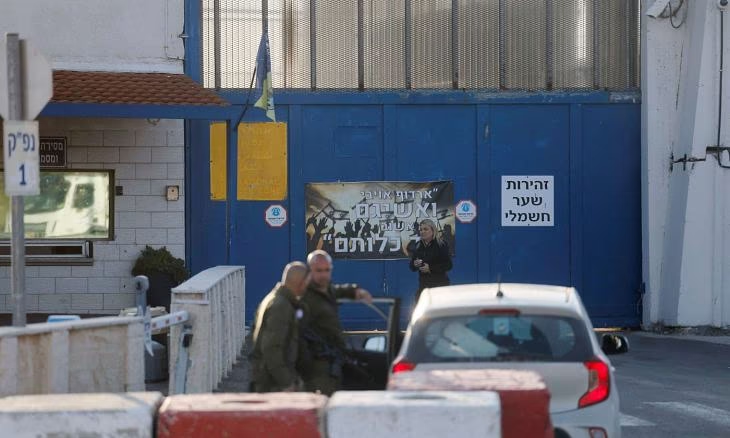
One soldier was martyred and an officer and a soldier were injured as a result of a suspicious object exploding in an army vehicle in the town of Mansouri in the city of Tyre.

PALESTINE

Sun 19 Jul 2026 9:24 am - Jerusalem Time

Gaza Health: 19 martyrs and 60 injured due to occupation attacks within two days

Medical sources in the Gaza Strip reported today, Saturday, the martyrdom of 19 Palestinian individuals and the injury of about 60 others with varying degrees of wounds, as a result of a series of Israeli attacks that occurred over the past forty-eight hours. The sources clarified that among the martyrs, one person succumbed to previous injuries, in addition to the retrieval of the bodies of two martyrs from areas subjected to shelling, reflecting the continued escalation on the ground despite existing understandings.

The Ministry of Health confirmed in its press statement that civil defense and ambulance crews face extreme difficulties in reaching a number of victims who are still trapped under the rubble of destroyed homes and in rugged roads. This obstruction comes as a result of direct and continuous targeting by the occupation forces of anyone attempting to approach these areas, which increases the likelihood of a rise in fatalities among the injured who have not received necessary medical care in a timely manner.

Regarding the toll of truce violations, the medical report issued by the Ministry revealed that the number of martyrs who have fallen since the signing of the ceasefire agreement on October 11, 2025, has reached 1144 martyrs. Medical records also registered 3703 injuries since that date, while specialized teams have managed to retrieve 802 bodies from under the rubble, amidst accusations against the occupation of systematically demolishing facilities and residential neighborhoods.

Concerning the comprehensive statistics since the start of the aggression on October 7, 2023, health authorities announced that the cumulative toll of martyrs has risen to 73,269 martyrs, including those who reached hospitals or whose data was documented. These figures reflect the unprecedented scale of the humanitarian catastrophe experienced by the Strip, where medical corridors are crowded with thousands of cases requiring urgent surgical interventions amid a severe shortage of essential medical supplies.

As for the number of wounded and injured, official records have documented 173,811 injuries arriving at various health facilities in the governorates of the Gaza Strip since the outbreak of the war. The occupation forces continue their grave violations of the active truce through artillery shelling and direct gunfire, placing the international community before its responsibilities to stop these transgressions and protect civilians and medical facilities that have not been spared from direct targeting.

A number of victims are still trapped under the rubble and in the streets, with ambulance crews unable to reach them due to occupation targeting.

PALESTINE

Sun 19 Jul 2026 9:24 am - Jerusalem Time

5 Martyrs, Including a Child, in Israeli Bombing Targeting a Residential Apartment in Al-Nasser Neighborhood in Gaza

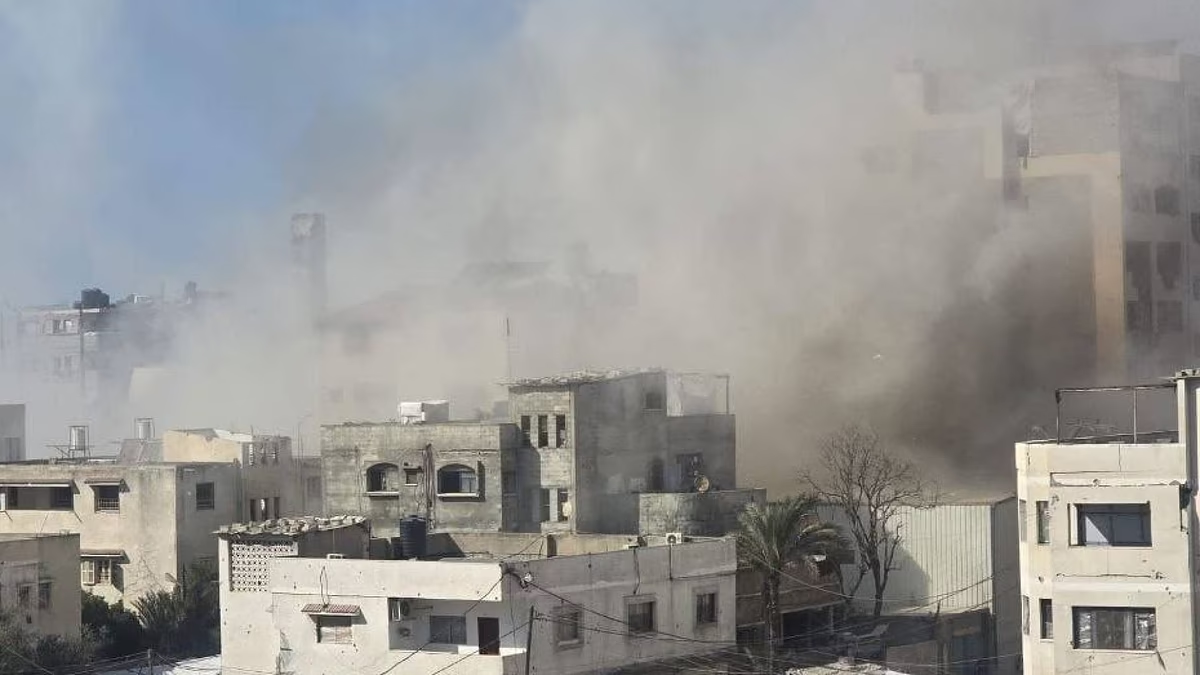
Field sources reported that Israeli occupation forces committed a new massacre against civilians in the Gaza Strip, after warplanes targeted a populated residential apartment in Al-Nasser neighborhood, located north of Gaza City. The violent attack led to widespread destruction in the targeted building and neighboring homes, causing a state of panic and terror among the safe residents in the area that was subjected to the sudden bombing.

The death toll from the Israeli aggression on Al-Nasser neighborhood rose to five martyrs, after initial estimates indicated that four citizens were killed in the first moments of the targeting. Medical sources confirmed that among the martyrs was a young girl who arrived at the medical complex in torn pieces, due to the force of the explosion that turned the residential apartment into rubble, in a scene reflecting the extent of the destructive power used against civilian targets.

Regarding the injuries, medical teams recorded the arrival of ten wounded to hospitals, whose injuries were described as varying in severity, with children making up the majority of the injured. Reports clarified that at least eight children are currently receiving the necessary medical care, under difficult health conditions suffered by the medical sector as a result of the continued siege and ongoing aggression on various areas of Gaza.

Search and rescue operations are still ongoing under the rubble of the targeted apartment, amidst serious fears of an increase in the number of martyrs and injured in the coming hours. This massacre comes in the context of an ongoing military escalation affecting densely populated residential areas, as Palestinian sources previously reported the martyrdom of three other people in a similar bombing that targeted the Al-Zaytoun neighborhood in Gaza City.

A martyred child arrived at the hospital in torn pieces as a result of the violence of the explosion caused by the Israeli bombing.

PALESTINE

Sun 19 Jul 2026 9:24 am - Jerusalem Time

Aoun in Washington to discuss consolidating the truce, and the Lebanese army begins deployment in 'experimental areas' in the south

Lebanese President General Joseph Aoun departed the capital Beirut on Saturday morning, heading to Washington for an official visit of great strategic importance. Aoun is scheduled to meet with his American counterpart, Donald Trump, at the White House on July 21, to discuss complex security and political issues related to the future of stability on the Lebanese-Israeli border.

This visit comes after an intensive round of negotiations recently concluded in the Italian capital, Rome, where the Lebanese presidency seeks through these diplomatic moves to consolidate the fragile ceasefire. The talks also aim to ensure the withdrawal of Israeli occupation forces from the territories they seized during recent military operations, and to fully extend the authority of the Lebanese state.

On the ground, the effects of the principles agreement signed between the two parties have begun to enter into actual implementation, as media sources reported the deployment of Lebanese Army units in the 'First Experimental Zone'. This deployment included the towns of Frun and Gandourieh in the Bint Jbeil district, areas where the occupation army had no direct military presence before this step.

These villages are considered of great strategic importance due to their location north of the 'Yellow Line' and near Wadi al-Salouqi and the Litani River, areas that have historically witnessed violent confrontations. The deployment of the Lebanese Army there represents a first step within an organized mechanism aimed at repositioning international and local forces according to specific timelines agreed upon in advance.

The framework agreement concluded on June 26 stipulates that the Lebanese Army will gradually assume full security responsibility in these newly established areas. These 'experimental areas' serve as a test of the Lebanese forces' ability to maintain security and prevent any breaches that could lead to the collapse of the truce, in preparation for taking over additional areas in later stages.

Behind the scenes of the negotiations held in Rome under American patronage, differences emerged regarding the party that would oversee security operations and disarmament. A proposal was put forward to deploy Italian soldiers to directly supervise the removal of armed manifestations and Hezbollah elements from the border area, as a compromise that satisfies international and local parties.

In contrast, a proposal to grant the United Nations Interim Force in Lebanon (UNIFIL) broader supervisory powers was met with outright rejection from both the Israeli and American sides. Israeli representatives stressed during the talks the necessity of strict security guarantees before withdrawing from the positions currently occupied by the Israeli army within the so-called 'buffer zone'.

For its part, the Lebanese side insisted during the technical meetings that security responsibility and inspection operations be exclusively in the hands of the Lebanese Army alone. Lebanon believes that strengthening the role of the military institution is the only way to impose national sovereignty and prevent external interference in the security affairs of the southern regions.

Despite the negotiation atmosphere, field tension remains dominant, as the Lebanese Army announced the martyrdom of one of its servicemen and the injury of an officer and two other soldiers. The incident occurred due to the explosion of a suspicious object targeting a military vehicle in the town of Mansouri, amid continued repeated Israeli violations of the ceasefire agreement.

In a related context, security sources stated that the Israeli occupation army continued its aggressions by launching airstrikes and artillery shelling that targeted the towns of Taybeh, Arnoun, and Nabatieh al-Fawqa. These operations resulted in casualties among civilians, while the Israeli side admitted that one of its officers was moderately wounded during a security activity in southern Lebanon.

Reports from the Israeli Broadcasting Corporation indicate that the imminent Israeli withdrawal may be limited in the current stage to the areas of Zawtar East and West. These cautious steps come at a time when Washington is warning its citizens against traveling to the region due to the possibility of unexpected military escalation that could undermine truce efforts.

The toll of the aggression since March 2026 reflects the scale of the humanitarian tragedy in Lebanon, with the number of martyrs reaching 4,324 people, in addition to more than 12,000 injured. Military operations have also caused the displacement of more than one million Lebanese from their villages and cities, placing immense pressure on the Lebanese government regarding shelter and reconstruction.

A technical military meeting was supposed to be held last Friday to complete the executive plans for the experimental areas, but it was postponed for logistical and security reasons. The Aoun-Trump summit in Washington is expected to provide new momentum to overcome the technical obstacles hindering the full implementation of the framework agreement.

Lebanon's bet remains on the ability of the international community, specifically the American administration, to pressure for a complete Israeli withdrawal from the 'buffer zone'. This strip extends 10 kilometers deep into Lebanese territory, where Tel Aviv insists on its retention as a protection zone for its residential communities in the north, which Lebanon rejects outright.

Aoun will hold meetings and consultations with a number of American officials to discuss ways to consolidate the ceasefire and Israel's withdrawal from the Lebanese territories it occupies.

PALESTINE

Sun 19 Jul 2026 9:24 am - Jerusalem Time

London: Massive March Demands Incoming British Prime Minister Sanction Occupation

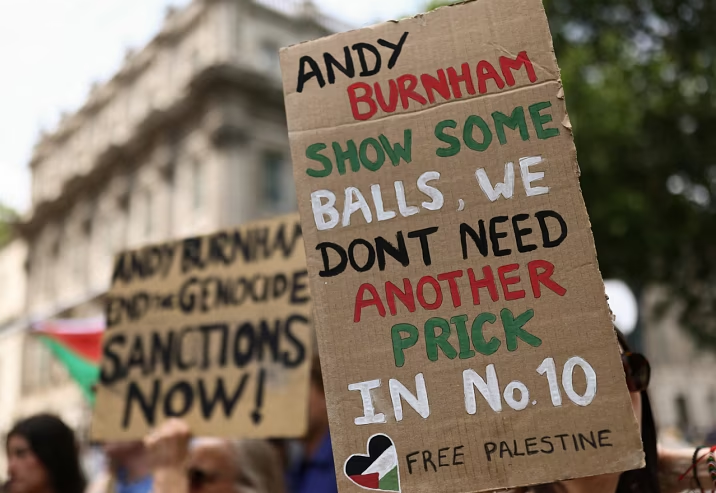
The streets of the British capital, London, hosted a massive demonstration today, Saturday, under the name "National March for Palestine," with thousands of supporters participating alongside the Palestinian Ambassador to the United Kingdom, Husam Zomlot. Participants raised banners demanding that the incoming British government end its policy of silence regarding what is happening in the Gaza Strip and take immediate action to stop the genocidal war waged by the Israeli occupation.

Demonstrators directed direct messages to Andy Burnham, who was elected leader of the Labour Party unopposed and is scheduled to officially assume the duties of Prime Minister next Monday. Protesters demanded that the new government adopt tougher stances, including imposing economic and political sanctions on Israel, in response to the continued violations and military practices in the occupied Palestinian territories.

For its part, the Metropolitan Police imposed strict security measures and specific conditions under the Public Order Act to ensure the march proceeded without serious disturbances. The event started from Russell Square, passing through vital areas such as Holborn and the Strand, reaching Whitehall, where a platform was set up for political speeches focusing on legitimate Palestinian rights.

This popular movement comes at a time when the Labour Party is undergoing a leadership change, with Burnham replacing Keir Starmer, amidst expectations of a shift in British foreign policy towards the Middle East. Burnham had previously stated that the party's response to the crisis in Gaza was insufficient and needed radical improvement, emphasizing that London was late in calling for a ceasefire.

In previous press statements, the prospective Prime Minister pledged to exert real pressure on Benjamin Netanyahu's government, including considering a ban on trade with illegal settlements in the West Bank. Burnham clearly criticized the continuous settlement expansion, considering that current Israeli policies deliberately aim to undermine any chance of implementing a two-state solution and make the establishment of a Palestinian state impossible.

Despite adopting tougher stances on Israeli practices, Burnham was keen to emphasize that criticizing the occupation's policies does not contradict combating antisemitism. He stressed in media interviews that his government would balance condemning violence with the moral and legal commitment to protect Palestinian civilians and ensure adequate humanitarian aid reaches the besieged Gaza Strip.

The march concluded its activities late Saturday evening, with organizers from the Palestinian Alliance and the Palestine Solidarity Campaign affirming the continuation of protest activities. Participants stressed that the British public would not stop pressuring until the promises of the new Labour leadership are translated into practical steps on the ground to end the suffering of the Palestinian people.

The Labour Party did not deal adequately with the war on Gaza at its beginning, and the United Kingdom was very late in calling for a ceasefire.

ARAB AND WORLD

Sun 19 Jul 2026 9:24 am - Jerusalem Time

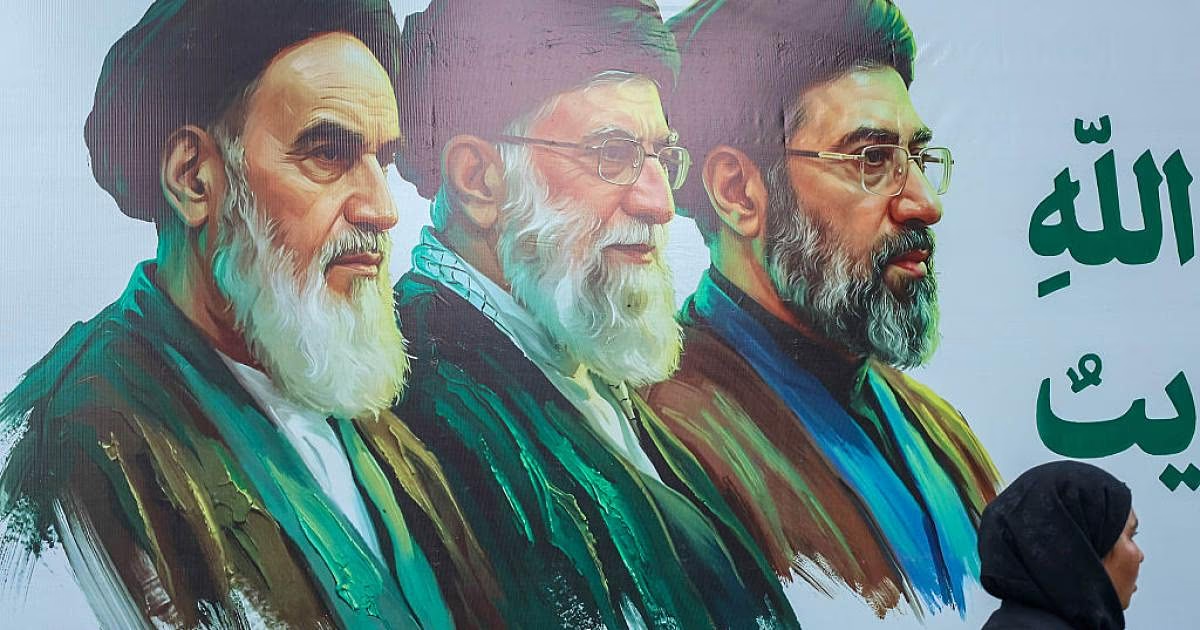
Khamenei Vows 'Unforgettable Lessons' to Washington, Calls Trump's Signature 'Worthless'

Iran's Supreme Leader on Saturday issued strong warnings to the United States, vowing that it would receive 'unforgettable lessons' as a result of its escalating policies in the region. In a written message broadcast through official channels, he affirmed that recent American actions reflect a clear desire to ignite war, emphasizing that Tehran and its allies in the 'Axis of Resistance' will not stand idly by in the face of these threats.

The Iranian leader considered the memorandum of understanding signed by US President Donald Trump to end the war in the Middle East to have completely lost its value. He explained that repeated violations of promises by Washington have proven that the American signature is devoid of any credibility, describing American behavior as a mixture of brutality and tyranny inherent in White House policies.

This verbal escalation comes in the wake of military attacks carried out by Iran, targeting US military sites in Kuwait, Jordan, and Bahrain. Sources reported that these strikes were a direct response to a series of American airstrikes that targeted Iranian territory during the past period, signaling the conflict's entry into a new phase of direct confrontation.

In an interpretation of the statement's implications, informed sources indicated that the Iranian leader attempted to balance the language of military threat with support for internal state institutions. He called on citizens to trust the performance of Iranian officials, including the heads of the three branches of government, amid increasing criticism directed at the negotiation process with international powers.

The statement affirmed that all Iranian state institutions are working in full coordination to protect national security and preserve the country's supreme interests. It also praised the role played by the armed forces in confronting American moves, considering that the military field goes hand in hand with political efforts to protect Iranian sovereignty.

Despite the sharp tone, observers noted that the statement did not include an official announcement of a final withdrawal from the memorandum of understanding with Washington. However, there is a conviction in Tehran that the agreement has become practically stalled, given what Iran describes as the American side's failure to adhere to the 'step-for-step' principle on which the understandings were based.

Tehran accuses the US administration of reneging on essential provisions related to securing navigation in the Strait of Hormuz and granting the necessary oil exemptions for the Iranian economy. The accusations also include obstructing the release of frozen Iranian funds abroad and failing to adhere to a ceasefire on the burning regional fronts, including the Lebanese arena.

For its part, the Iranian Ministry of Foreign Affairs, through its officials, affirmed that Tehran has effectively suspended the implementation of its obligations contained in the memorandum of understanding in response to 'American violations.' The Foreign Ministry spokesman stressed that the continuation of American military attacks makes it difficult to return to the negotiating table under current circumstances, holding Washington fully responsible for the deterioration of the situation.

In a related context, the Iranian discourse focused on the role of the 'Axis of Resistance' as an active element in the next phase of the conflict. The Leader indicated that coordination between Tehran and its allies in the region will escalate to confront what he described as American arrogance, emphasizing that Iranian military capabilities are capable of creating a real deterrent balance.

The statement concluded by affirming that the Iranian government continues to work on two tracks; the first is to confront external pressures militarily and politically, and the second is to ensure the stability of citizens' daily lives and provide essential services. This comes in an attempt to absorb popular anger resulting from the repercussions of sanctions and increasing military tensions in the region.

The American enemy seeks to ignite war, and it must realize that the Iranian nation and the Axis of Resistance have unforgettable lessons to teach it.

PALESTINE

Sun 19 Jul 2026 9:23 am - Jerusalem Time

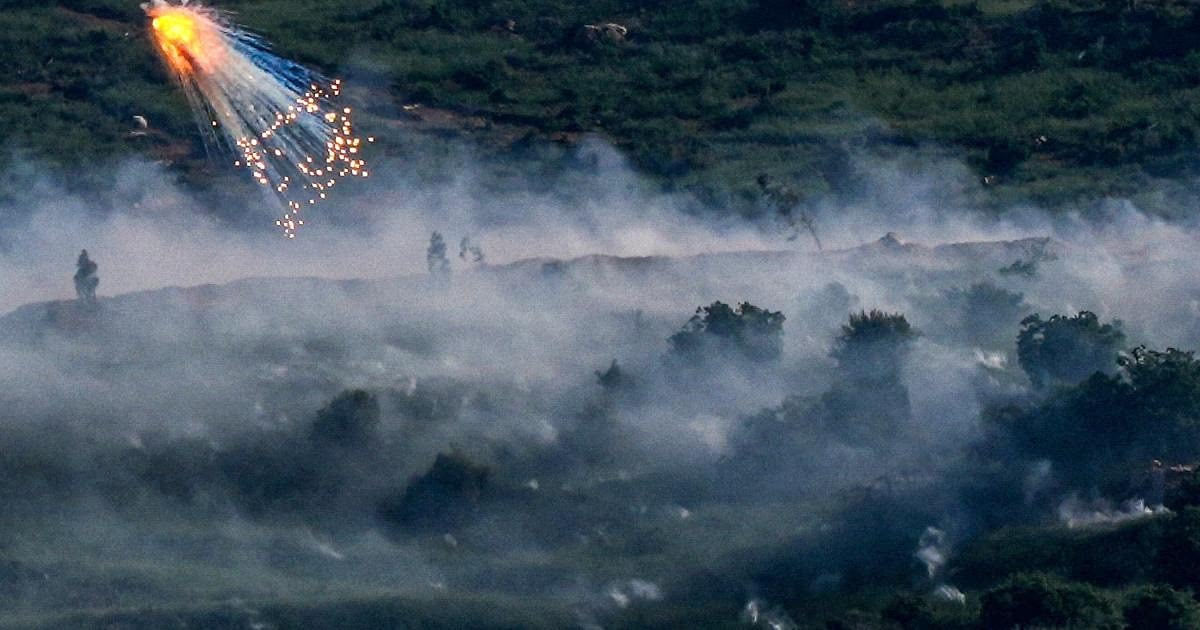
Field Tension in Southern Lebanon: Occupation Claims Foiling Drone Attack and Massive Funeral in Majdal Salam

The Israeli occupation army announced today, Saturday, that it carried out an airstrike targeting what it described as a Hezbollah cell in the vicinity of the Tibnin area in the central sector of southern Lebanon. Military sources claimed that their forces detected a drone flying in the area before launching a raid on a site where fighters operating those drones had taken shelter near Israeli troop positions.

The occupation army's statement considered this military activity a clear violation of the recently concluded ceasefire understandings between the two parties. These claims come at a time when border areas are experiencing a state of cautious anticipation, as the occupation seeks to impose new rules of engagement under the pretext of preventing drone threats targeting its soldiers' movements.

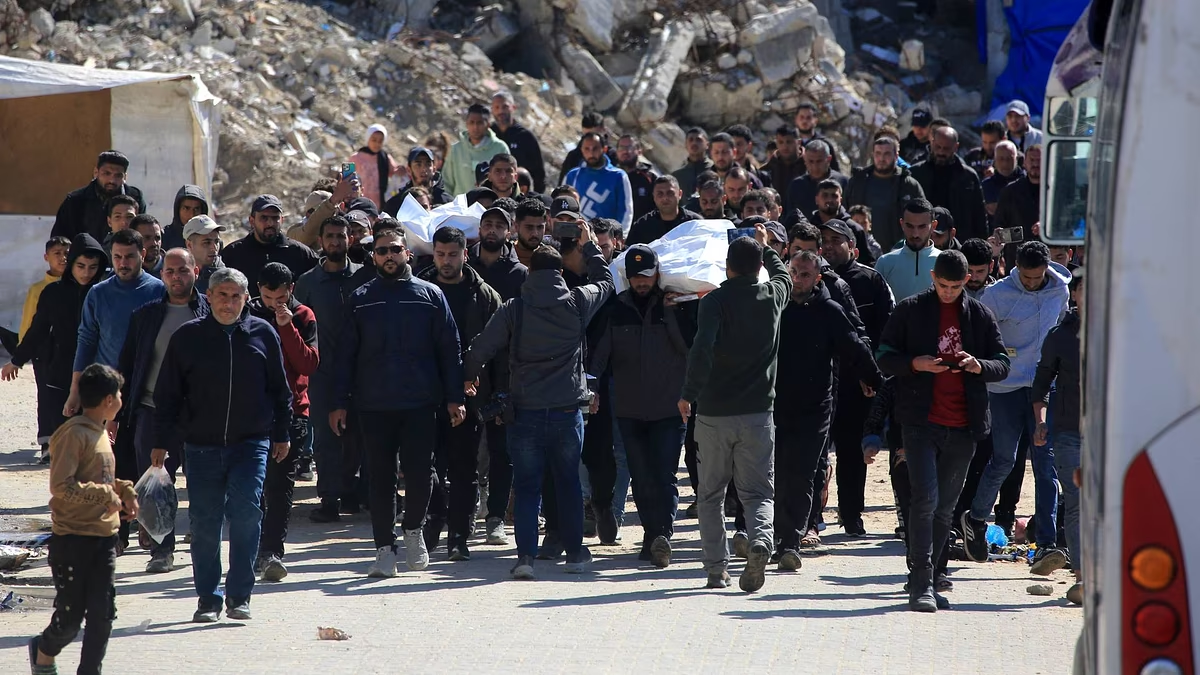
In a related context, the town of Majdal Salam in southern Lebanon witnessed a massive collective funeral for dozens of people who died during recent confrontations with occupation forces. The town's residents bid farewell to 44 martyrs, including 39 fighters who died in the field, in addition to four civilians who were martyred as a result of Israeli military operations, and one person who died of natural causes.

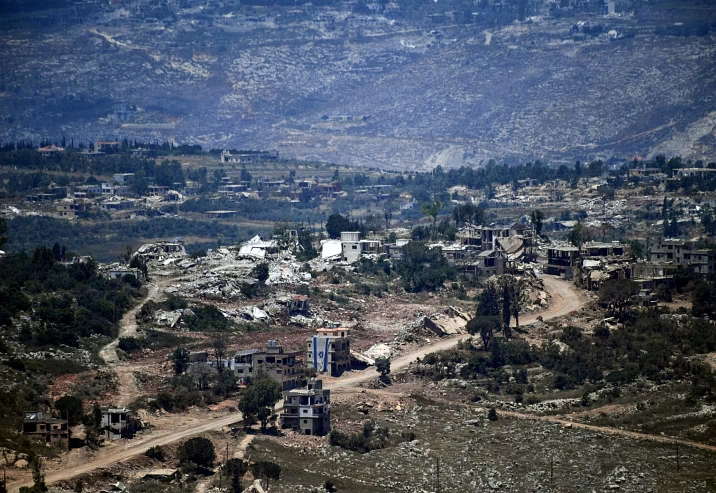
Field sources reported scenes of trucks carrying flag-draped coffins, amidst a wide popular presence of martyrs' families and citizens who raised pictures of their loved ones. The signs of destruction were evident in the town of Majdal Salam, which has been subjected to intensive targeting during past rounds of fighting, making the funeral ceremonies a national demonstration reflecting the extent of sacrifices in the South.

For its part, the municipality of Majdal Salam intervened to clarify the confusion regarding the number of martyrs, denying the accuracy of lists circulated on social media platforms that spoke of 129 deaths. The municipality confirmed in an official statement that the published figures are inaccurate, calling on media outlets to exercise caution and obtain information from official sources affiliated with the municipality and the party.

On the political front, Lebanese President Joseph Aoun departed Beirut for Washington on an official visit of great strategic importance. Aoun is scheduled to meet with his American counterpart Donald Trump on July 21 to discuss de-escalation files and ensure the stability of the southern borders in light of new international understandings.

These diplomatic moves follow a round of indirect negotiations hosted by the Italian capital, Rome, this week, bringing together representatives from both the Lebanese and Israeli sides. These US-sponsored meetings aim to solidify the framework agreement reached in late June to end the decades-long armed conflict.

The framework agreement signed on June 26 includes sensitive provisions related to the disarmament of Hezbollah in specific areas, in exchange for a gradual withdrawal of Israeli occupation forces from the territories they have infiltrated. The agreement also stipulates the beginning of the deployment of Lebanese army units in two pilot areas as a first step towards extending state sovereignty over the entire southern territory.

Observers link the current field escalation to the political pressures exerted on the Lebanese arena, especially after the signing of the memorandum of understanding between Iran and the United States in mid-June. Analysts believe that the occupation is trying to exploit any field movement to strengthen its negotiating position before the upcoming summit in Washington, while the Lebanese side insists on protecting its civilians.

Despite the relative calm imposed by the recent agreement, repeated Israeli violations put international understandings at risk. The biggest challenge facing the Lebanese government remains balancing international commitments with the complex field reality, amidst the ongoing funerals and the destruction left by the war in border villages and towns.

The numbers circulated by some media outlets and social media sites regarding the number of martyrs are inaccurate and unfounded.

ARAB AND WORLD

Sun 19 Jul 2026 9:23 am - Jerusalem Time

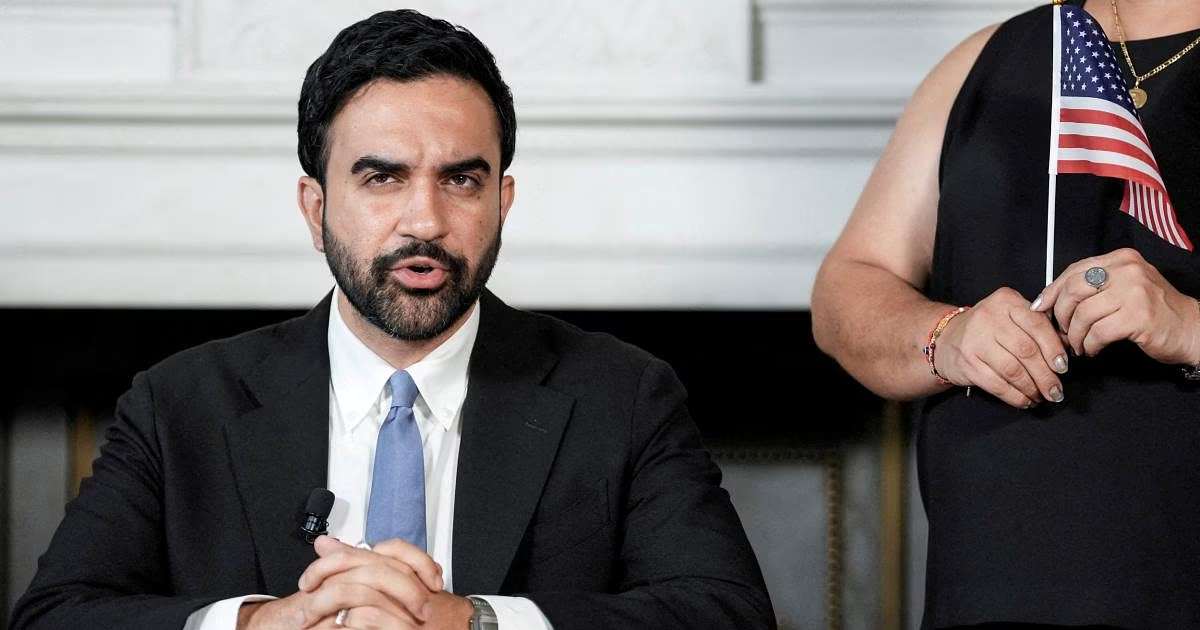
New York Mayor Explores Legality of Arresting Netanyahu During UN Visit

New York City Councilman Zohran Mamdani revealed that he has begun intensive legal consultations to explore the possibility of arresting Israeli Prime Minister Benjamin Netanyahu, coinciding with his anticipated participation in the United Nations General Assembly meetings. This step comes amid escalating international pressure and demands to hold accountable those responsible for crimes committed in the Gaza Strip.

Mamdani, known for his positions supporting Palestinian rights, affirmed that Netanyahu's natural place is in the dock at the International Criminal Court in The Hague, Netherlands. Mamdani described the Israeli official as a 'war criminal,' noting that this description is based on official arrest warrants issued by international justice.

In a recent press interview, the left-wing councilman explained that he is currently consulting with the New York City legal team to determine the extent of his executive powers. Mamdani seeks to know whether he can issue direct instructions to the city police to execute international arrest warrants against leaders facing prosecution.

Mamdani emphasized his commitment to acting in accordance with local and international law, asserting that his stance reflects a wide segment of the city's residents who reject apartheid policies. He added that the city will not be a safe haven for those accused of committing crimes against humanity or genocide.

For his part, Israel's Ambassador to the United Nations, Danny Danon, launched a scathing attack on Mamdani's statements, considering them an attempt to grab headlines at the expense of the city's fundamental issues. Danon claimed that these moves contribute to an increase in what he described as 'anti-Semitism' within New York society.

The Israeli ambassador defended Netanyahu's upcoming visit, affirming that he will deliver his speech before the UN General Assembly 'with pride' despite the legal threats. Danon went further by demanding Mamdani's own arrest instead of targeting the Israeli leadership, in a verbal escalation reflecting the intensity of the tension.

Earlier in 2024, the International Criminal Court issued official arrest warrants for Netanyahu and his former security minister, Yoav Gallant. The court based its decision on reasonable evidence proving their responsibility for war crimes and crimes against humanity during the ongoing aggression in Gaza.

New York City is eagerly anticipating the General Assembly meeting next September, where widespread protests against the Israeli delegation's visit are expected. Mamdani's statements place the New York Police Department in a sensitive position regarding its local obligations and international diplomatic protocols.

It is worth noting that Netanyahu had previously attacked Mamdani on earlier occasions, accusing him of bias towards Hamas and hatred of American values. These accusations come as part of the Israeli side's attempts to demonize American political voices that call for an end to military and political support for the occupation.

Observers believe that Mamdani's move, even if it faces legal obstacles related to diplomatic immunity, represents a radical shift in how American local administrations deal with Israeli leaders. This step reflects the growing human rights awareness within political institutions in major American cities regarding the Palestinian issue.

Prime Minister Netanyahu's place is The Hague, and we will do everything allowed by law in New York City to hold war criminals accountable.

PALESTINE

Sun 19 Jul 2026 9:23 am - Jerusalem Time

Hamas condemns Al-Nasr neighborhood massacre and calls on guarantors to curb occupation violations

The Hamas movement issued an official statement strongly condemning the Israeli occupation aircraft's targeting of a residential apartment in Al-Nasr neighborhood in Gaza City, which led to the martyrdom of five people, including a child. The movement considered this attack a deliberate war crime added to the series of crimes committed by the far-right government, noting that this escalation reflects complete disregard for the international system and humanitarian laws governing conflicts.

The movement affirmed in its statement that the field behavior of the occupation army reveals premeditated intentions to continue military escalation in the Gaza Strip, exploiting the fragile ceasefire agreement to carry out assassinations and target civilians. It stressed that this policy aims to undermine any opportunities for stability, holding the head of the occupation government, Benjamin Netanyahu, fully responsible for the repercussions of these continuous violations that affect innocent people in their homes.

Hamas directed harsh criticism at what it described as the unjustified international silence and impotence in the face of the Israeli war machine, considering that the absence of accountability encourages the occupation to continue its genocide war. The movement called on the international community and its human rights institutions to assume their legal and moral responsibilities, and to work seriously to prosecute the Israeli leaders responsible for these horrific events that violate the most basic human rights.

In conclusion of its statement, the movement called on the American administration and the guarantor states of the truce agreement to exert real and immediate pressure on the occupation government to stop its violations and abide by the concluded pledges. Sources explained that the movement sees this intervention as an urgent necessity to protect civilians and prevent the situation from sliding into a comprehensive confrontation, stressing that the continuation of shelling and assassinations puts the current agreement on the verge of collapse.

We call on the American administration and the guarantor states of the ceasefire agreement to intervene immediately to curb Netanyahu's government and stop these violations.

ARAB AND WORLD

Sun 19 Jul 2026 9:22 am - Jerusalem Time

Widespread Military Escalation: Intense US Airstrikes on Iran in Response to Soldiers' Deaths in Jordan

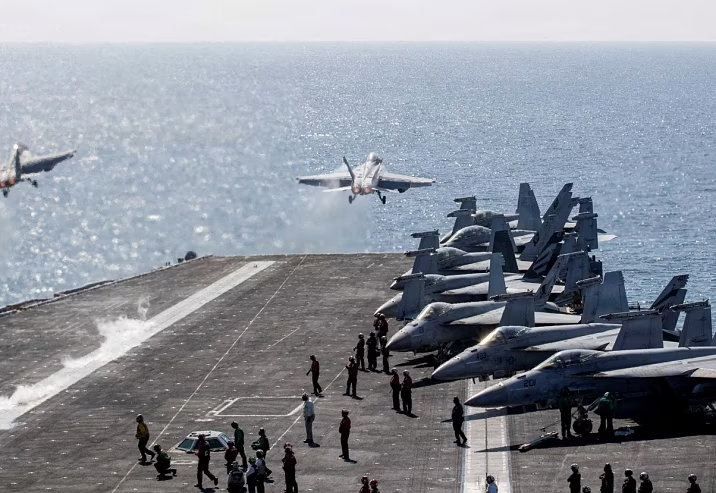
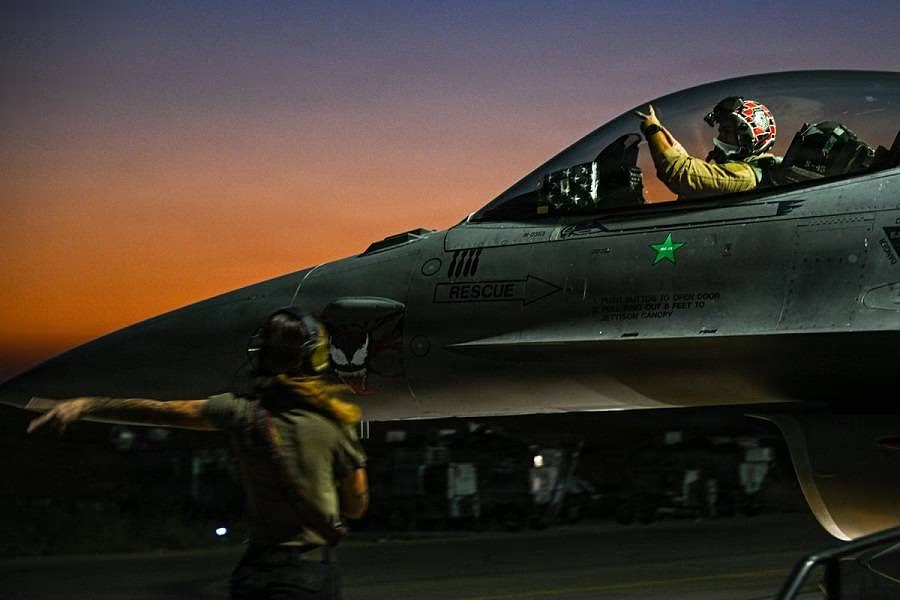
US forces announced on Sunday morning the execution of a series of intense airstrikes against targets within Iranian territory. This new wave of attacks comes as part of Washington's efforts to undermine Tehran's military capabilities, which have become a direct threat to international navigation in the strategic Strait of Hormuz region.

The US Central Command confirmed in an official statement that the air operations began with direct instructions from the Commander-in-Chief of the Armed Forces. The statement clarified that the military action aims to protect commercial waterways and ensure the flow of global trade, which is subject to continuous harassment by Iranian forces.

These field developments come as a swift retaliatory response to the killing of two American soldiers in Jordan in recent hours. Washington stressed that the attacks directly target centers of influence and power of the Iranian Revolutionary Guard, which is responsible for recent hostile operations against American interests in the region.

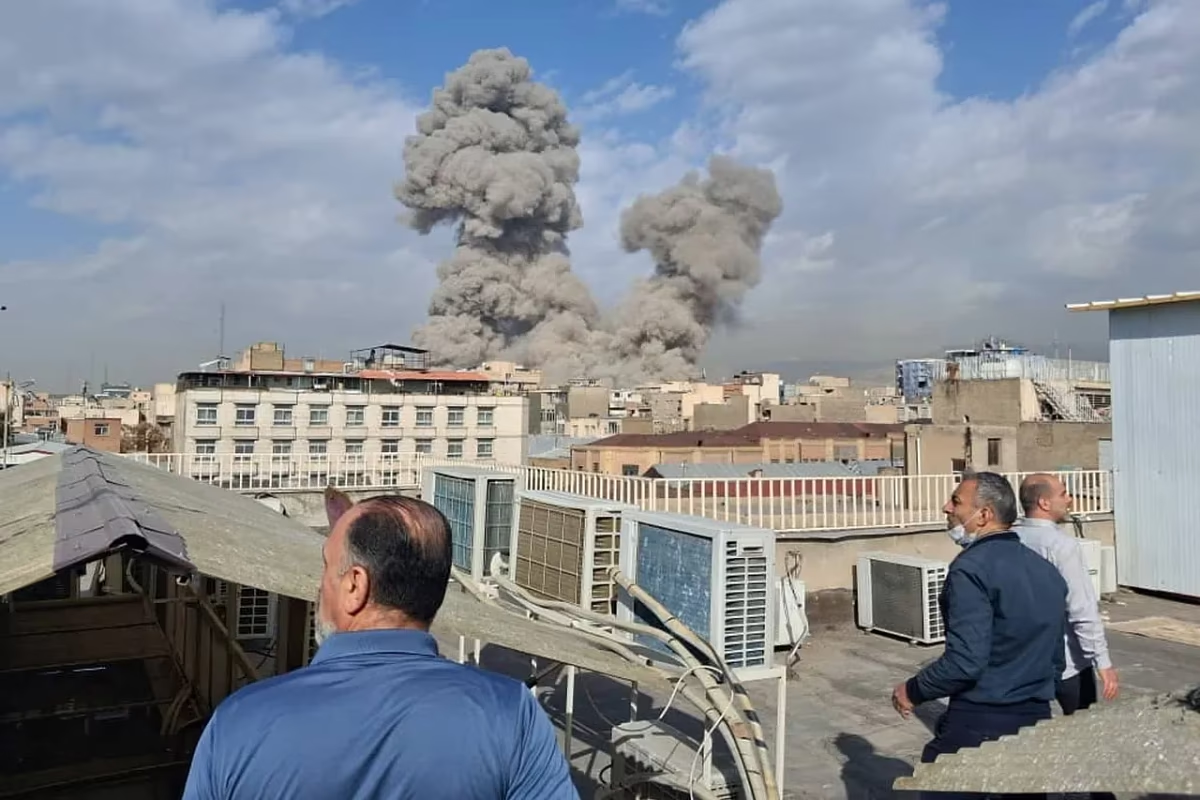
Regarding the details of the field attack, media sources reported that the American shelling hit vital sites near the coastal area of Sirik. Local reports also monitored explosions resulting from an aerial targeting of an area surrounding the city of Hajiabad, located deep within the country, indicating an expansion of the selected targets.

CENTCOM had previously revealed details of the attack that occurred in Jordan on July 17. It explained that US forces were involved in defensive operations against Iranian-made ballistic missiles and drones before their position was directly hit, leading to casualties.

The attack targeting forces in Jordan resulted in the death of two soldiers and the disappearance of a third soldier, who is still being searched for. Four other soldiers were evacuated to medical facilities within Jordanian territory for emergency treatment, while a number of those with minor injuries returned to their military duties.

Washington adhered to a policy of withholding the names of military casualties in compliance with established protocols to respect family privacy. Sources indicated that the official announcement of the identities of the deceased would be made after completing the notification procedures for their next of kin and after the legal period of 24 hours has passed.

In a related context, the city of Erbil in the Kurdistan Region of Iraq witnessed a parallel escalation in recent hours. Field sources reported that suicide drones targeted the US Consulate headquarters in the city, reflecting a state of comprehensive alert on various fronts where US forces are present.

Observers believe that this wave of strikes represents a qualitative shift in the rules of engagement between Washington and Tehran. It appears that the US administration has decided to move beyond limited responses and target Iranian depth to deter repeated attacks carried out by Iranian-backed factions in the region.

Economically, these military tensions have led to a state of turmoil in global markets, with the dollar stabilizing, supported by increased demand for it as a safe haven. Markets fear the impact on global energy supplies if military escalation continues near the Strait of Hormuz, which is considered the lifeline for oil trade.

A state of maximum alert continues at US bases deployed in the Middle East in anticipation of any potential Iranian reaction. International political circles are closely monitoring the repercussions of this direct confrontation, amidst calls for restraint to avoid the region sliding into a comprehensive regional war with dire consequences.

These strikes aim to undermine Iran's ability to threaten commercial navigation in the Strait of Hormuz, and to deliver a swift and harsh response after our military personnel were targeted.

PALESTINE

Sat 18 Jul 2026 2:12 pm - Jerusalem Time

Youth martyred in Ramallah, and the occupation prevents the call to prayer in Husan village amid widespread escalation in the West Bank

Medical and local sources announced, at dawn on Saturday, the martyrdom of the youth Fadi Hamdallah Al-Naasan (17 years old) due to critical injuries he sustained about a week ago. Al-Naasan was directly hit by an explosive bullet in the thigh area during his confrontation of an attack by occupation soldiers and settlers on his family's home in Al-Mughayyir village, northeast of Ramallah, where he remained in intensive care until his passing today.

In the context of field attacks, two Palestinian children sustained various injuries after an attack carried out by groups of settlers on the residents of Wadi Al-Sha'er area, north of the West Bank. Human rights sources reported that this attack comes within a series of systematic attacks targeting the Palestinian presence in mountainous and agricultural areas with the aim of intimidating and displacing residents.

In the central West Bank, a Palestinian citizen was subjected to a brutal assault by an Israeli military force in Kafr Ni'ma village, west of Ramallah. Sources explained that the soldiers abused the citizen and beat him with rifle butts, which led to him sustaining injuries and bruises throughout his body, requiring his transfer for treatment.

In Husan village, west of Bethlehem, a blatant violation of freedom of worship occurred when occupation forces stormed a mosque in the village just before the dawn prayer. Israeli forces prevented the muezzin from making the call to prayer and forced worshipers inside the mosque to leave at gunpoint, preventing the prayer from being held on time.

The occupation forces did not stop at evacuating the mosque in Husan; they also fired a barrage of sound bombs and toxic tear gas at citizens who gathered in the vicinity. These actions caused suffocation among worshipers, in a move described by the villagers as an attempt to impose a new reality targeting religious rituals.

In a recent report by the Ministry of Endowments and Religious Affairs, data revealed a significant escalation in targeting the Ibrahimi Mosque in Hebron, where the call to prayer was prevented 84 times during the current month. The report indicated that about 950 soldiers stormed the mosque's courtyards and facilities, as part of the ongoing policy of restriction on worshipers and visitors to the Noble Sanctuary.

Official Palestinian bodies warned that these violations represent a transgression of all red lines and international conventions that guarantee the protection of holy sites. The ministry called on the international community and human rights organizations to intervene immediately to stop these practices, emphasizing the need to provide international protection for Islamic and Christian holy sites that are under constant threat.

It is worth noting that the West Bank has been in a state of turmoil since October 2023, where attacks by the occupation and settlers have resulted in the martyrdom of 1181 Palestinians and the injury of thousands of others. These events coincide with widespread arrest campaigns that have targeted nearly 24,000 citizens, amid systematic destruction of infrastructure in various Palestinian camps and cities.

The violations witnessed by Islamic holy sites represent a dangerous escalation and a blatant violation of international laws and conventions that guarantee freedom of worship.

PALESTINE

Sat 18 Jul 2026 2:12 pm - Jerusalem Time

Martyrs in Gaza and the occupation moves the 'Yellow Line' to deepen its control east of Deir al-Balah

Three Palestinian citizens were martyred and others sustained various injuries this Saturday morning, as a result of an attack carried out by Israeli occupation drones targeting a gathering of civilians in Al-Zaytoun neighborhood in Gaza City. Medical sources reported that the bodies of the martyrs and the injured were transferred to Al-Ma'madani Hospital, after a 'quadcopter' drone targeted a group of citizens near Dawla intersection in the aforementioned neighborhood.

In a simultaneous field escalation, occupation forces continued their violations of the ceasefire agreement in effect in the Gaza Strip, as a drone targeted the Al-Zahraa school camp, which houses hundreds of displaced people in Al-Shuja'iyya neighborhood, east of the city. This direct targeting resulted in the injury of one citizen, amidst a state of panic among the displaced families who lack the most basic safety requirements.

The northern and central areas of the Strip were not spared from these attacks, as occupation vehicles stationed north of Beit Lahia town fired flares heavily into the sky of the area, raising fears of imminent ground movements. Vehicles stationed near the pharmaceutical factory at what is known as the 'Yellow Line' also opened fire with their machine guns towards agricultural lands and homes east of Deir al-Balah city.

The early hours of dawn witnessed a remarkable military movement, as the Israeli army expanded its occupation in the eastern areas of Deir al-Balah city in the central Gaza Strip. Several military vehicles, supported by a heavy bulldozer, advanced dozens of meters into the vicinity of 'Abu Miri' roundabout, under heavy artillery shelling and indiscriminate firing to secure the incursion.

Israeli bulldozers moved the concrete blocks that define the 'Yellow Line' for a distance of up to 100 meters westward, before the invading force withdrew to its previous positions. This field measure aims to seize more Palestinian lands and annex them to the buffer security zone imposed by the occupation along the eastern borders of the Strip.

Dozens of Palestinian families in the targeted area woke up to a new reality, finding that their homes were now located behind the new concrete blocks. This geographical change practically means that these homes fall under direct military occupation control, depriving their owners of access to them or free movement in their vicinity.

'The Yellow Line' is known as a security strip imposed by Israel deep inside the Gaza Strip, where it prevents Palestinians from approaching it or utilizing the lands within it. Reports indicate that the occupation exploited the period after the October 2025 agreement to increase the area of this strip, raising the percentage of lands under its control from 53% to about 70% of the total area of the Strip.

These developments come amidst the continued bloodshed, as the latest data from the Ministry of Health indicate that the continuous Israeli violations since the signing of the agreement have led to the martyrdom of 1127 people. These attacks have also resulted in the injury of 3643 Palestinians, amidst international silence regarding the systematic field expansion practiced by the Israeli army at the expense of citizens' lands.

Dozens of families were surprised that the concrete blocks had moved past their homes westward, meaning they were now within the Israeli army's control.

PALESTINE

Sat 18 Jul 2026 2:11 pm - Jerusalem Time

Under the hashtag "They Lied to You".. A Palestinian digital campaign exposes the falsehood of the truce and documents the continuation of massacres in Gaza

A group of Palestinian activists and journalists, with the participation of international solidarity activists, launched a wide-ranging digital media campaign under the hashtag #They_Lied_to_You, aiming to confront misleading narratives promoting the end of the war of annihilation in the Gaza Strip. This initiative seeks to draw the attention of the international community, which has begun to succumb to the illusion of 'truce,' emphasizing that global silence contributes to legitimizing ongoing crimes behind the curtain of complex political pathways.

The campaign based its discourse on shocking figures derived from field data, as sources revealed the documentation of approximately 3689 direct violations of the so-called ceasefire agreement since October 10, 2025. Reports clarified that these violations were not mere fleeting incidents, but rather systematic military operations that plunged the Strip back into a cycle of killing and widespread destruction that had not truly ceased.

These continuous violations led to the martyrdom of 1122 individuals and the injury of over 3500 citizens with varying degrees of wounds, the vast majority of whom were women and children who found themselves victims of relentless bombardment. The attacks also caused the erasure of entire Palestinian families from civil registries, bringing back memories of the genocidal nightmares that characterized the first months of the widespread aggression on the Strip.

On the humanitarian front, the campaign affirmed that the suffocating siege continues to tighten its grip on the residents of Gaza, as the occupation authorities have not allowed the entry of more than 35% of essential relief and medical needs. This severe shortage of supplies coincides with the continuation of forced displacement policies, where thousands of citizens are forced to repeatedly flee into the unknown in search of lost safety under the weight of intense bombardment.

The campaign reflects the popular exhaustion in Gaza after more than a thousand days of war, where the greatest wish of a Gazan citizen has become to spend one night without the sound of explosions or funerals. The campaign organizers send a final message to the world about the necessity of looking into the 'mirror of truth' and acknowledging that Gaza is still bleeding profusely, far from the clamor of political statements that find no resonance on the ground.

The aggression has not ended; it has only stopped making headlines.

OPINIONS

Sat 18 Jul 2026 2:10 pm - Jerusalem Time

Upcoming Israeli Elections and the West Bank

Writer: Munadhil Hanani.

There is no doubt that the Israeli Knesset (Parliament) elections will be held on October 27, 2026, which is the legally stipulated original date. The Knesset will dissolve itself on July 17, 2026. These are the first elections to be held on schedule since 1988, and the current Netanyahu government (the 37th) will be the first government to complete its full term since 1973. 

These elections are considered a referendum on the performance of Netanyahu and his far-right government, especially after the events of October 7, 2023, and the subsequent wars in Gaza, Lebanon, and Iran, and consequently amidst the escalating extremism in Israeli society, particularly towards the entire Palestinian presence. 

Therefore, current opinion polls in (July 2026)

• Gadi Eizenkot (former Chief of Staff, “Yashar” party) is strongly leading or competing with Likud, with 22-23 seats in most polls. 

• Likud (Netanyahu): approximately 21-25 seats.

• “Together” alliance (Bennett and Lapid): declining to 15-18 seats.

• Other parties: Yisrael Beiteinu and Democrats (Golan) approximately 10 seats each, Shas, United Torah Judaism, and Otzma Yehudit (Ben Gvir) approximately 8 each.

• Blocs: The Zionist opposition (without Arab parties) is approaching 57-60 seats, and the current coalition is around 49-53. Forming a government may require complex negotiations or limited Arab support. 

Netanyahu faces difficulty in forming a new coalition, but the opposition is not entirely unified.

The West Bank and Settlement Policies

The current government (especially Smotrich and Ben Gvir) is accelerating the de facto annexation of the West Bank before the elections, to create “facts on the ground” that are difficult to change:

• Unprecedented settlement expansion: establishment of dozens of settlement outposts (185 since 2023), legalization of hundreds of housing units, control over more than one million dunams (about 18% of the West Bank). 

• Cabinet decisions: facilitating land registration and purchase by settlers, transferring security and civil powers, abolishing restrictions on land sales to Jews, and establishing a “Tabu” (land registration) unit with a large budget. 

• Displacement and attacks: expulsion of Palestinian communities, settler attacks (thousands of documented cases), construction of bypass roads, and expansion of control over Area (C).

• Goal: geographically connecting settlements, fragmenting Palestinian lands, and making future evacuation legally and politically difficult.

These policies are described as a “settlement revolution” and weaken the prospects of a two-state solution.

The Expected Impact of the Elections on the West Bank

• Continuation of the Right (Netanyahu + extremists): continuation or acceleration of annexation and expansion.

• Opposition victory (Eizenkot/center-right): may slow the pace slightly, but most Zionist opposition parties do not support a full Palestinian state or significant withdrawal. Differences are often tactical rather than radically strategic, and Lapid, the opposition leader's statements, are the biggest proof of this when he said we would annex Area C and have autonomy in A and B, and there would be no Palestinian state. 

Consequently, the situation in the West Bank is characterized by escalating tension, with an Israeli focus on strengthening control and changing the demographic situation and expanding land confiscation before any potential government change in Israel.

OPINIONS

Sat 18 Jul 2026 1:55 pm - Jerusalem Time

Europe's indecision on Palestine is a decision


All 27 member states say Israel's settlements are illegal, yet ministers left Brussels empty-handed following the foreign affairs council, writes Lema Nazeeh.


The EU's own courts have held since 2010 that settlement goods are not Israeli goods entitled to preferential treatment, and since 2019 that they cannot be labelled “Made in Israel”, writes Lema Nazeeh. [GETTY]

Four announcements were made on Monday, 13 July. Read together, they are the European Union's Palestine policy, complete.

In Brussels, the Foreign Affairs Council — the first under Ireland's new presidency of the Council — spent its Middle East session on a two-page Commission “options paper”: an import licensing system, prohibitive tariffs, or a full or partial ban on trade with Israeli settlements in the occupied West Bank and Golan. It decided none of them.

“The option that got the most support was banning trade with illegal settlements,” EU foreign policy chief Kaja Kallas said afterwards. The file was handed down to the 27 ambassadors in COREPER, and ministers “will probably have an extraordinary meeting on this”. Probably. The next scheduled Foreign Affairs Council is on 12 October.

Settlement revolution

In the same hours, in the occupied West Bank, Israeli Finance Minister Bezalel Smotrich announced the first “roof agreement” with the Shomron Regional Council: approximately 12,000 new settlement housing units and more than 8 billion shekels for infrastructure and “settlement development”, scaling up the Karnei Shomron model signed in June.

“We are making history today,” Smotrich wrote — another instalment of the “settlement revolution” he declared on 6 July, three days after the security cabinet approved 13 new settlements designed, in its sponsors' own words, to make partition impossible. While Europe's ministers deliberated over whether deliberation should continue, the annexation was announced in units and shekels.

That same afternoon, back in Brussels, the Commission launched the Team Gaza Initiative — a nearly €900 million early-recovery package for Gaza assembled with sixty-five governments and organisations, the United Kingdom joining with £10 million. The aid is needed. Call it what it is, though: the EU itself, with the UN and the World Bank, assessed Gaza's recovery needs in April at $71.4 billion — $26.3 billion of it in the first eighteen months alone.

Monday's package is roughly 1% on every dollar of a bill Europe helped write, for destruction wrought with weapons Europe did not embargo, in a war Europe's leverage never seriously contested. Under the law of occupation, the occupying power bears responsibility for the territory it holds. When European taxpayers absorb that cost instead — for the third rebuilt Gaza in two decades — the donor is not softening the occupation but subsidising it. In a single day, Europe agreed to pay 1% of the consequences and postponed, again, the only measure on its table that touches the cause.

And in Tel Aviv, one of the Council's 27 chairs had, in effect, been left empty. Czech Foreign Minister Petr Macinka skipped the Brussels meeting to lead a two-day trade mission to Israel — more than 30 Czech companies, defence manufacturers among them — and to sign a joint declaration with Israeli Foreign Minister Gideon Sa'ar. He welcomed his “dear friend” on X while his guest's 26 colleagues debated the settlements. Sa'ar spent the evening declaring victory over them.

None of this was a surprise. EUobserver's preview of the meeting ran under the headline ‘Crystal ball: EU will do nothing about Israel on Monday’. When the outcome of a meeting of 27 foreign ministers can be accurately headlined in advance, the problem is not disagreement.

Diplomats from several capitals accused the Commission of “delay tactics” — the two-page paper was delivered so late that no decision was mathematically possible before the autumn.

Spain's José Manuel Albares said it in the open: “I am concerned that we are engaging in a delaying tactic, debating and debating without taking any action.” This is not gridlock. It is choreography.

Two years of process

Consider the sequence. On 19 July 2024 — two years ago this Sunday — the International Court of Justice found Israel's occupation of Palestinian territory unlawful in its entirety and put every state on notice of two duties: not to recognise the situation as lawful, and not to render aid or assistance in maintaining it. The UN General Assembly set a 12-month deadline for compliance; it expired in September 2025.

The EU's response has been a genre of its own. A review of the EU-Israel Association Agreement that found “indications” Israel was in breach of its human rights clause, then was shelved; a ten-option paper in July 2025 that produced no action; a proposal to suspend the trade pillar of the Association Agreement that “never materialised”; sanctions on a handful of violent settlers and their organisations that took until May 2026 — four entities and three individuals, after two years of documented pogroms.

Each round follows the same grammar: an atrocity, a review, a paper, a debate, a deferral. The output is never a measure. It is always another document. Monday added a new subgenre: the two-page options paper, referred to a committee, pending a meeting that will “probably” take place.

The fight inside the Council sounds technical. It is everything. If restricting settlement trade is a trade measure under Article 207 of the EU treaties, it passes by qualified majority — 15 states representing 65% of the EU's population — with the European Parliament involved. If it is a “sanction” under the Common Foreign and Security Policy, it requires unanimity, and any single capital can kill it.

On Monday, Kallas stopped hiding the lawyers' answer behind diplomatic paraphrase and put it on the record: “There is a legal opinion we can do this … with QMV, the Council legal services said that, and, of course, if there is will, we can move forward.”

To those manufacturing doubt, she offered a Brussels proverb: “You can always find different lawyers who come up with different ideas. So, two lawyers, three opinions.”

The Commission — backed by Germany — insists on treating the measure as a sanction anyway, and Euractiv reported the resulting “turf war” between Ursula von der Leyen's Commission and Kallas's diplomatic service bursting into the open.

German Foreign Minister Johann Wadephul made it clear that import restrictions “should only be adopted unanimously”, and Berlin prefers “talks with the Israeli government” to measures, even as he reiterated that settlement policy “is not in line with international law”.

German media also stated it plainly: ‘Germany blocks measures against settlement policy’. Yet Berlin's cover is eroding at home. On the morning of the FAC, Der Spiegel — no radical outlet — published a commentary arguing an import ban “must no longer be taboo”, and that Chancellor Friedrich Merz's description of West Bank violence as “unprecedented” is credible only if Germany stops blocking one.

Belgium's Maxime Prévot called the Commission's options “more a bone to gnaw on than a genuine desire to move forward”. And one EU diplomat put the institutional hypocrisy on the record: “In all other files, the Commission always tries to extend her competence and here suddenly it discovers unanimity? One could laugh if it weren’t so serious.”

The diplomat has the law on his side. The common commercial policy is an exclusive EU competence exercised by the majority as a matter of routine — to impose tariffs, to withdraw trade preferences from Cambodia and Myanmar over human rights violations, and, most recently, to legislate the phase-out of Russian fossil fuels as a trade measure precisely to avoid a veto.

Nor would a settlement measure even be a “sanction on Israel” in any legal sense. The EU's own courts have held since 2010 that settlement goods are not Israeli goods entitled to preferential treatment, and since 2019 that they cannot be labelled “Made in Israel”. Settlements are not Israel — that is the EU's established legal position, and on Monday Kallas herself framed the measure as fixing member states' existing customs obligations, which are being “inconsistently implemented”, rather than as a move “against Israel”.

A regulation excluding settlement produce from the single market is trade law catching up with the EU's own non-recognition doctrine, as a growing body of legal opinion and policy analysis has argued.

One precision matters, because Israel's defenders will exploit sloppiness here. France's Jean-Noël Barrot has compared the proposal to the EU's 2014 Crimea measures. The comparison is powerful, but for substance and speed rather than procedure. The Crimea import ban was adopted as a sanction, unanimously, within three months of the annexation. No options paper, no orientation debate, no two-year anniversary of an unimplemented court opinion.

The Crimea precedent proves the EU can ban every import from an occupied territory almost overnight when it wants to. Article 207 proves it does not need a consensus to do so here. The two arguments together close every exit, which is presumably why the Commission has chosen to litigate the voting rule rather than the principle.

The positions per capital, assembled from doorsteps, national media and public records, look like this. France and Sweden have spearheaded the push, backed by Belgium, Ireland — whose own settlement import ban passed the Dáil on 7 July and which now holds the Council presidency — the Netherlands (a national settlement trade ban since May), and Spain, with Denmark, Finland, Portugal, Malta and Luxembourg alongside, and as many as 20 member states having asked the Commission to detail the options in the first place.

Cautious or conditional: Germany, Italy — Antonio Tajani, the pivotal swing vote, says Rome is “ready to evaluate” measures on settlement products — Austria, Greece and Cyprus (anchored to Israel by their Eastern Mediterranean security triangle), Croatia, Romania, Poland (sympathetic under Radosław Sikorski, wary of the legal-base fight) and the Baltics. Openly blocking: Czechia, Slovakia, and — since Janez Janša returned to power in June and reversed every measure of the previous government, down to removing the Palestinian flag from the government building — Slovenia.

Czech public television reports Prague, Sofia and Ljubljana against the import restriction outright.

The Czech position deserves quotation in full because it is the blocking strategy stated as doctrine. Standing beside Sa'ar in Prague in May, Macinka declared that Czechia “will not permit any further trade sanctions against Israel” even if it were “the only EU state blocking them”. He added that Prague will “look for blocking minorities in agendas decided by qualified majority, so that no further aggressive steps against the State of Israel come from the EU”.

Read that twice: a member state announcing, in advance, that it will organise minorities to defeat majority decisions of its own Union — in defence of a third state's occupation. On Monday he did not even attend the Council at which that strategy was the question; he was in Tel Aviv executing it. If a government treated single-market rules this way, Brussels would call it sabotage.

And then there is Hungary — for years the all-purpose alibi. In May, Péter Magyar's new government dropped Viktor Orbán's veto and the settler sanctions passed within days, prompting predictions that the road to EU action was finally open.

Two months later, the outcome is unchanged: no trade measure, no timetable, a new set of procedural objections — the Commission's legal scruples, Berlin's unanimity doctrine, Prague's blocking minorities. When the famous veto falls and nothing moves, the veto was never the cause. The obstruction is distributed, and it rotates.

What Israel heard

Within hours of the meeting ending, Sa'ar declared victory: “The latest attempt by Kaja Kallas to impose sanctions on Israel failed once again... There was no consensus. There was no qualified majority. In fact, there was no majority at all.” The referral to COREPER, he added, was an attempt “to circumvent the rules”.

Set aside the factual duel — Kallas says “most” member states back a full ban; Sa'ar says there was no majority at all; both claims are unfalsifiable precisely because nothing was tabled and nothing was voted on, which is one more argument for tabling and voting.

Notice instead what is happening structurally: Israel's foreign minister now litigates the European Union's internal voting procedures in public, championing unanimity — Berlin's position — as “the rules”, and describing the treaties' own qualified-majority provisions as a trick. When a third state under legal scrutiny adopts your constitutional argument as its shield, the argument has stopped being neutral.

Every deferral is read in Jerusalem, correctly, as permission. Smotrich's 12,000 units were announced before the ministers had finished their working lunch.

The law does not come in options

Here is the deepest problem with Monday, and it is one Palestinians have been making for two years, joined by a widening circle of European jurists: the options paper misstates the question. The ICJ did not advise the EU that it may, if political conditions allow, consider whether to restrict settlement trade. It found that third states are under an obligation not to render aid or assistance in maintaining an unlawful situation — the same rule, codified in Article 41 of the Articles on State Responsibility, that the EU invokes verbatim when it demands the world isolate Russia's annexations.

And for the Union the duty is doubly binding, because it wrote it into its own constitution: Article 3(5) of the Treaty commits the EU to “the strict observance and the development of international law” in all external action. Palestinian human rights lawyers have stated the consequence for years with a precision Brussels has never rebutted.

“While the EU has been quite outspoken in condemning settlements and their expansion,” Al-Haq's general director Shawan Jabarin observed, “they continue to import produce from these same settlements and in doing so, help to sustain their very existence.” Buying the produce of the settlement economy is assistance. Compliance with international law is not a menu with three options and an October deadline.

Now measure what was actually on the table. Settler exports to the EU are worth an estimated €150–250 million a year — the Commission does not know the real figure, because member states do not report the data correctly, which is itself the failure of the “differentiation” policy the EU cites as proof of compliance. A full ban would touch some 45 settler firms, mostly food and wine, against €43.3 billion in overall EU-Israel trade in 2025, billions in Horizon research grants, and an Association Agreement untouched since a review found “indications” of human rights breaches.

The strongest option ministers declined to adopt on Monday is not the ceiling of the EU's leverage; it is the floor of its legal obligations — a rounding error, deferred. And while it is deferred, the UN's own count from last week's report: an average of six settler attacks a day, 187 Palestinian children injured this year, 16 killed by soldiers and settlers in 2026 — the latest, a 16-year-old boy, on 5 July, while the options paper was being circulated. That is the threshold Palestinians are told to applaud: two years after the World Court, Europe's most debated measure would inconvenience 45 wineries.


What seriousness would look like


None of this is unfixable, which is what makes Monday damning rather than tragic. Seriousness has a checklist. The Commission tables an Article 207 regulation — a ban on the import and marketing of settlement goods and services — and publishes the Council legal service's opinion instead of leaving it to be paraphrased at press conferences. The “probable” extraordinary ministers' meeting gets a date before 12 October, not after the Israeli elections.

The 20 governments that demanded options convert their doorsteps into a written request, as Prévot demands: “real proposals that member states can vote on, and soon.” Germany, whose population weight makes it the arithmetic kingmaker of any qualified majority, decides whether its Staatsräson really extends to financing, through trade, an enterprise its own foreign minister calls contrary to international law — and if Berlin cannot vote yes, it abstains: under majority voting, abstention does not block.

Member states keep legislating nationally, as Ireland and the Netherlands have, proving feasibility and raising the cost of Brussels' delay. And those who want Europe to matter go further, as Belgium, Ireland, the Netherlands and Spain propose, to the Association Agreement's trade preferences themselves — the first measure Israel's government would actually feel.

Kallas closed Monday's press conference with her standing maxim: when divided, “Europe is weak and can be pushed around”. But on settlements, Europe is not divided on the law — by its own chief diplomat's on-camera account, all 27 governments subscribe to the same characterisation of illegality. It is divided over whether the law binds when Israel is its subject.

That is not a division of opinion; it is a division of will. It is being noticed — in Moscow, across the Global South, and above all in the hills of the West Bank, where the distance between a European “option” and a Palestinian eviction is measured in days. On 13 July, Europe announced a fund, a deferral and an absence, and Israel announced 12,000 homes. One of those two actors will have changed the map by 12 October. It will not be Europe.

Lema Nazeeh is a policy analyst and international lawyer based in Brussels. A former diplomat at the Palestinian Mission to the European Union, where she was responsible for EU–Palestine relations, she served on the State of Palestine's legal teams in the ICJ advisory proceedings on Israel's occupation and on the ICC's Palestine file. She holds an LLM in International Criminal Law from Italy.


PALESTINE

Sat 18 Jul 2026 10:17 am - Jerusalem Time

Warnings of a new settlement plan targeting the West Bank with over a thousand housing units

The Wall and Settlement Resistance Commission issued strong warnings of a new settlement wave sweeping the occupied West Bank, confirming that the occupation seeks to establish 1024 additional housing units. The commission clarified that these plans aim to seize more than a thousand dunams of private and communal Palestinian lands, in a step intended to radically change the geographical and demographic reality.

Official sources reported that Israeli authorities are accelerating the pace of approving settlement projects to impose a policy of 'de facto annexation' on the ground. The commission stated in its report that the so-called 'Higher Planning Council' has discussed nine major settlement plans since the beginning of July, all of which have undergone deposit procedures and final approval.

The new units are distributed between 455 housing units that received final approval, and 569 other units that were deposited for the completion of necessary legal and technical procedures for their adoption. These figures confirm the Israeli government's insistence on expanding existing settlement blocs and increasing their urban density to accommodate larger numbers of settlers deep within the occupied territories.

According to the report issued by the commission, the occupation is currently focusing on horizontal expansion within existing settlements instead of building new outposts, in order to reduce international pressure. Israeli planning authorities use amendments to building maps and land uses as technical tools to legitimize the seizure of additional areas and consolidate the settlement presence.

In the northern West Bank, the occupation authorities approved the expansion of the 'Mevo Dotan' settlement, located on the lands of the town of Arraba, south of Jenin. This plan includes the addition of 455 new settlement units on an area estimated at about 539 dunams, threatening to confiscate more agricultural lands and tighten the noose on surrounding Palestinian communities.

As for the Hebron Governorate in the south, two plans were deposited to expand the 'Beit Hagai' and 'Asa'el' settlements, where 567 new settlement units are to be added. This step aims to connect the settlement blocs in the south with a network of roads and advanced infrastructure, isolating Palestinian villages and towns from each other and turning them into isolated enclaves.

In a significant political and administrative development, the commander of the Central Region in the occupation army signed an order to transform the 'Givat Ze'ev' settlement, located northwest of Jerusalem, into an official city. This transformation grants the settlement broad administrative powers and huge government budgets, facilitating rapid construction operations and attracting thousands of new settlers to the area.

Israeli Finance Minister Bezalel Smotrich commented on this decision, considering it a strategic step to strengthen the settlement project in the heart of the West Bank. Smotrich affirmed in statements reported by Hebrew media that the ultimate goal of these moves is to block any attempt to establish an independent Palestinian state in the future.

The Wall and Settlement Resistance Commission believes that this integrated planning system aims to reshape Palestinian geography to serve the security and political interests of the occupation. The commission warned that restricting Palestinian urban expansion in contrast to the settlement explosion leads to crowding Palestinians into narrow spaces and besieging their natural growth.

On the international level, the United Nations and the international community continue to affirm that all settlement activities in the territories occupied in 1967 are illegal and violate international law. These powers consider that the continued construction in settlements directly undermines the two-state solution and eliminates the chances of achieving a just and comprehensive peace in the region.

Data from the 'Peace Now' movement indicates that the number of settlers in the West Bank has reached about half a million people, in addition to a quarter of a million in East Jerusalem. These statistics confirm the magnitude of the challenge faced by Palestinians in light of a systematic policy aimed at seizing land and preventing geographical communication between the cities of the West Bank.

These projects do not represent ordinary urban expansions, but rather come within a systematic policy to strengthen settlement blocs and entrench de facto annexation.

PALESTINE

Sat 18 Jul 2026 10:16 am - Jerusalem Time

EU warns of massive Israeli funding to expand West Bank settlements

The European Union has expressed deep concern over the current Israeli government's intentions to allocate massive and unprecedented financial appropriations to support settlement expansion in the heart of the West Bank. The Union clarified in an official statement that these steps will inevitably lead to the entrenchment of the settlement presence in areas described as highly sensitive geopolitically, threatening any future opportunities for peace.

The occupation authorities had previously revealed the allocation of a budget of approximately $2.8 billion, aimed directly at building thousands of new housing units and developing settlement infrastructure. These moves come within a comprehensive framework agreement that seeks to change the demographic and geographical reality in the occupied Palestinian territories by adding 12,000 new settlement units.

In a related context, the European Union announced its categorical rejection of the decision to transform the 'Givat Ze'ev' settlement, established on Palestinian lands northwest of Jerusalem, into an official Israeli municipality. The Union reiterated its affirmation of not recognizing any Israeli sovereignty over the territories occupied in 1967, stressing that these measures violate UN Security Council resolutions and international law.

The commander of the Central Command in the occupation army had issued a military order to upgrade the status of 'Givat Ze'ev' from a local council to a city, an administrative step that grants the settlement broad powers and doubled government budgets. This step, according to statements by ministers in the Netanyahu government, aims to accelerate the pace of construction and attract more settlers to block the establishment of a Palestinian state.

For its part, the Wall and Settlement Resistance Commission warned of new settlement plans aimed at seizing more than a thousand dunams of Palestinian land to establish more than a thousand housing units. The commission indicated that the so-called 'Higher Planning Council' of the Civil Administration recently discussed several plans that have entered into actual implementation through approval and deposit procedures.

The Palestinian commission considered that this systematic policy reflects the occupation's insistence on imposing new realities on the ground using military and administrative planning tools. It affirmed that the intensification of settlement activity since the beginning of July represents a dangerous escalation aimed at fragmenting Palestinian geography and isolating population centers from each other.

The international community, led by the United Nations, stresses that all settlement activities in the West Bank and East Jerusalem are illegal and lack any legal basis. International powers believe that the continued confiscation of land, demolition operations, and forced evictions constitute a grave violation of the Geneva Conventions and undermine the pillars of stability in the entire region.

Field data indicate that the pace of settlement has seen record jumps since the current right-wing government took office in late 2022. This government adopts an overt agenda aimed at legitimizing random settlement outposts and transforming them into officially recognized settlements by the occupation authorities, while providing them with all basic services.

In this context, the 'Peace Now' movement estimates that the number of settlers in the West Bank has exceeded half a million people, in addition to about a quarter of a million settlers residing in occupied East Jerusalem. These figures confirm the magnitude of the challenges facing the two-state solution in light of the urban settlement expansion that devours vast areas of the desired Palestinian state's land.

The European Union concluded its statement by demanding that Israel refrain from taking any unilateral measures, including immediately halting demolition operations and land confiscation. It called for adherence to signed international agreements, considering that the continued settlement expansion sends negative messages about the seriousness of the occupation in reaching a comprehensive and just political settlement.

Unilateral Israeli measures aim to entrench settlements in highly sensitive areas and undermine the viability of the two-state solution.

ARAB AND WORLD

Sat 18 Jul 2026 10:16 am - Jerusalem Time

For the seventh night.. Washington intensifies its air strikes against military targets in Iran

The US Central Command (CENTCOM) announced a new round of air strikes against targets in Iran, marking the seventh consecutive night of intensified military operations. Military sources explained that the attacks, carried out under direct instructions from the high command, focused on undermining Iranian military logistical capabilities and included the destruction of underground weapons storage facilities, naval installations, and control centers.

On the ground, authorities in Hormuzgan province, located in southern Iran, confirmed the death of 3 people and the injury of 8 others as a result of the recent American bombing. Local sources reported hearing violent explosions in the city of Sirik and several southern areas, while the Iranian Revolutionary Guard indicated that it is closely monitoring American movements, considering that these operations are pushing the region towards a comprehensive confrontation or what it described as "zero hour."

In a related context of regional escalation, an Iranian Kurdish opposition faction announced the killing of 9 of its members inside Iraqi territory as a result of simultaneous Iranian shelling. This explosion in the military situation comes after the collapse of the ceasefire agreement that was previously signed with Qatari-Pakistani mediation, as the American side announced its termination on July 8 after Iran targeted commercial ships in the Strait of Hormuz.

The operations targeted surveillance sites, military logistics infrastructure, underground weapons storage facilities, and naval capabilities.

OPINIONS

Sat 18 Jul 2026 10:16 am - Jerusalem Time

Iranian Official Reveals Secret Message to JD Vance Accusing Kushner and Witkoff of Corrupting Negotiations

Said Erikat

Opinion Writer

Washington Message

Washington – Said Arikat – 18/7/2026

Drop Site revealed, in a report based on an exclusive interview with a senior Iranian official who requested anonymity because he was not authorized to speak to the media, that Tehran sent a secret message to US Vice President JD Vance during indirect negotiations with the United States in Lucerne, Switzerland, in late June. The message warned that the continued involvement of US Special Envoy Steve Witkoff and Jared Kushner in the negotiation process would undermine the chances of converting the understandings reached on June 17 into a permanent agreement.

According to the Iranian official, the message was conveyed to Vance through an intermediary and included direct accusations against Witkoff and Kushner, alleging that they were exploiting their access to confidential negotiation information to achieve financial gains in the markets, instead of focusing on the success of the diplomatic process. Tehran also expressed concern about what it described as repeated leaks reaching Israeli Prime Minister Benjamin Netanyahu, considering that these leaks harmed the progress of talks and weakened trust between the parties.

The report indicated that the Iranian official confirmed that his country had previously sent several messages to President Donald Trump's administration, through Pakistani intermediaries, warning of the "disruptive role" played by Witkoff in the negotiations. However, these messages did not achieve the desired result, which prompted the Iranian delegation to seek to convey its position directly to the US Vice President.

The official explained that Tehran deliberately addressed Vance alone because messages passing through traditional channels reach the entire American team, including Kushner, even though he holds no official position within the US administration. He added that the Iranians conveyed to Vance “data and assessments” through a private channel, emphasizing that Witkoff and Kushner “are misusing the diplomatic process and disrupting the negotiation atmosphere.”

Although Drop Site clarified that it could not independently verify whether the message reached Vance, the Iranian official affirmed that Tehran was confident that the Vice President had indeed received it.

In contrast, the US administration categorically denied this account. A US official stated that the Vice President and his team had not received any message with such content, describing the Iranian accusations as baseless. White House spokeswoman Anna Kelly also attacked Drop Site, considering that the report promoted what she called the Iranian narrative, and affirming that no such message had reached Washington.

However, a source close to Vance admitted, according to the report, that the Iranians had not hidden their objection to Witkoff and Kushner's participation in the talks, although he did not confirm receipt of the aforementioned message.

In another part of the Iranian narrative, the official said that his country had provided written documents to intermediaries in the weeks leading up to the signing of the memorandum of understanding, claiming to possess evidence that figures close to Trump exploited war developments and negotiations to influence financial markets and achieve huge profits.

He added that Tehran estimated the size of these profits at approximately nine billion dollars and formally demanded about half of it, approximately 4.5 billion dollars, considering that developments related to Iran were the direct cause of these financial gains, noting that all these correspondences would become part of the historical record of the negotiations.

The Iranian official also accused Witkoff of misrepresenting Tehran's positions to President Trump, especially regarding highly enriched uranium stockpiles, considering that the US envoy showed a lack of technical expertise in the nuclear file, and that the US delegation participated in some rounds without experts specialized in nuclear issues or Iranian affairs.

According to the Iranian narrative, the Iranian delegation had presented a detailed offer regarding its nuclear program during meetings in Oman and Switzerland, expressing great readiness to show flexibility in order to reach a historic agreement, but these positions were, according to the official, later distorted within Washington.

The official believed that Vance has a more realistic and professional outlook compared to the rest of the American team, stressing that sending the message to him came with the full approval of the Iranian negotiating team, with a willingness to expand the negotiating delegations and involve technical experts and specialists in the Iranian file.

In contrast, the report quoted an American source close to Vance as saying that the Vice President is indeed seeking to build broader communication channels with the Iranian side, considering that successful diplomacy relies on multiple channels of communication and not just one person.

The report also discussed the assessment of Robert Malley, the former chief US negotiator for the 2015 nuclear deal, who considered Tehran's attempt to open a direct channel with Vance a strategically logical step, but he doubted the Vice President's ability to provide guarantees independent of President Trump's positions, saying that the final word would remain with the US President, no matter how much influence his deputy had.

The report concludes by noting that the future of any agreement between Washington and Tehran remains uncertain, amidst continued military escalation and hawkish statements from President Trump, which Tehran believes undermine negotiation efforts and confirm that Washington is using diplomacy in parallel with military pressure, making the chances of reaching a stable settlement more complicated than ever before.

This narrative, regardless of its accuracy, reveals a deep crisis of trust within the negotiation process between Washington and Tehran. When one party believes that members of the opposing team are using sensitive information to achieve financial gains or to feed internal political agendas, negotiations become hostage to doubts rather than a forum for exchanging solutions. The Iranian accusations also reflect an understanding that decision-making centers within the US administration are not unified, and that the multiplicity of influence centers may be a factor no less dangerous than the fundamental disagreements over the nuclear file itself.

What is striking in the report is Iran's attempt to differentiate between JD Vance and President Donald Trump, suggesting that it is betting on the existence of a current within the US administration more inclined to solidify settlements than to continue escalation. However, past experiences in US-Iranian relations indicate that any negotiation ultimately remains subject to the US President's decision, no matter how wide the margin of maneuver for his aides. Therefore, relying on parallel channels may contribute to improving communication, but it does not necessarily guarantee the stability of any long-term agreement or protect it from political fluctuations.

Whether the accusations related to financial market manipulation are proven or remain within the realm of allegations, the mere raising of them reflects the transformation of wars and international crises into factors that directly affect global energy and investment markets. Political and military information has acquired immense economic value, which increases demands for stricter oversight of conflicts of interest among officials and decision-makers. This also highlights the growing interconnectedness between national security and the global economy, where any diplomatic or military development can immediately impact capital flows and energy prices.

OPINIONS

Sat 18 Jul 2026 10:07 am - Jerusalem Time

How Democratic Israelis Can Win The War


Last week I wrote that we are at war. Not the war of Israel against Iran or against Hezbollah or Hamas, but the war being waged inside Israel and in the occupied West Bank by religious right-wing extremists and their violent settler agents. Palestinians are the immediate victims, but the real target is Israel itself - democratic Israel.

They are defeating us because they know what they want, and we do not yet act as if we know what to defend.

They want a messianic, halachic kingdom of God. We want a democratic state: an Israel with a Jewish majority, rooted in Jewish history, Hebrew culture, and Jewish self-determination - but a state that belongs equally to all its citizens, as promised in the Declaration of Independence. They want Jewish supremacy. We want equality before the law. They want land without Palestinians. We want a state that protects every citizen and every person under its authority.

This is a struggle over whether Israel remains a democracy; whether the army serves the state or a messianic movement, whether the law protects everyone or only Jews, and whether Judaism in public life is moral responsibility or a weapon of domination.

It is time to wake up and to acknowledge that there is no democracy with occupation. A state cannot permanently rule over millions of people without equal rights and still call itself a democracy. The occupation corrupts the army, the law, our politics, and our moral language. It creates the space in which violent settlers become instruments of policy. Ending the occupation is not a concession to Palestinians. It is a necessity for saving Israel.

To win, democratic Israelis need moral clarity. Violent settlers are not “hilltop youths”. They are political actors using violence to achieve ideological goals. When ministers defend them, soldiers protect them, police fail to arrest them, and prosecutors fail to indict them, the state becomes a partner in the crime. Jewish terrorism is terrorism. A state that does not protect Palestinians under its control betrays itself, not only Palestinians.

We must defend Palestinians because that is how we defend Israel. The test of Israeli democracy is not how the state treats Jews in Tel Aviv. The test is how it treats Palestinians in Hebron, Masafer Yatta, the Jordan Valley, Huwara, Burin, and the South Hebron Hills. If the army controls their lives, the state is responsible for their safety. If the state permits settlers to terrorize them, democracy is already being destroyed.

We also need legal warfare. Every settler attack must be documented. Every failure of the army or police must be recorded. Every illegal outpost must be challenged in court. Every budget line funding criminality must be exposed. Every official who enables violence must be named. Legal teams, human rights organizations, former security officials, lawyers, journalists, and citizens must work together every day.

We need political organization. The extremists have parties, rabbis, youth movements, donors, media channels, yeshivas, ministers, and a clear ideology. Demonstrations are necessary, but not enough. Protest without organization fades. We need a democratic political front whose mission is to save Israel from messianic authoritarianism. Netanyahu is a major part of the danger, but not all of it. The deeper danger is the ideological movement seeking to replace democratic Israel with a religious-nationalist regime.

This front must be Jewish-Arab. There is no way to preserve Israeli democracy while excluding 20 percent of Israel’s citizens from political power. Arab citizens are not guests. They are citizens. Arab parties are Israeli parties. Arab votes are Israeli votes. Any democratic coalition that treats Arab citizens as outside the legitimate political camp is already accepting part of the extremists’ logic. The next democratic coalition must include real Jewish-Arab partnership as equal partners in a shared civic project.

Israeli citizens must go where the state is failing: accompany shepherds, help Palestinian farmers reach their land, bring cameras, lawyers, members of Knesset, rabbis, diplomats, and journalists, and stand between violent settlers and Palestinian families. Nonviolent presence matters. Witness matters. Protection matters.

We must take back Judaism from those who have turned it into a weapon. Judaism is not a license to dominate another people. Jewish history does not justify Jewish supremacy. Religious Israelis who believe in democracy and human dignity must speak louder. A state with a Jewish majority that loses its moral soul will not be saved by more flags, more settlements, more guns, or more biblical slogans.

The IDF belongs to the state, not to the settlers. Soldiers are not private guards for violent extremists. The army must protect every person under its control. Former chiefs of staff, Shin Bet heads, Mossad heads, generals, and police commanders must say publicly and repeatedly: settler violence is a strategic threat to Israel.

And we must defend free and fair elections. We must not allow Netanyahu or anyone else to postpone them, manipulate them, distort their results, or create a crisis designed to prevent the public from deciding. The next election on October 27 must be a referendum on whether Israel remains a democracy. Defending elections begins now: protecting the Central Elections Committee, resisting emergency measures abused for political survival, and exposing every attempt to delegitimize Arab voters, Arab parties, or the democratic opposition.  

But winning an election is not enough. The next government must be ready from day one to dismantle illegal outposts, remove violent settlers from areas where they terrorize Palestinians, restore the authority of the police and courts, investigate state funding to extremist networks, and return the Civil Administration to professional control before it is eventually dismantled. It must also put peace with all our neighbors, beginning with the Palestinians, at the top of the national agenda. Peace must become the organizing principle of Israeli policy, within a framework of regional security, economic development, normalization, mutual recognition, and partnership. Israel’s long-term security will not come from permanent control over another people. It will come from ending occupation and building a regional order in which Palestinians and Israelis can both live in freedom and security.

The final requirement is courage. Many Israelis know what is happening. They know that Smotrich and his allies are not merely another political faction. They know that the violent settler movement is changing the character of the state. But they are afraid - of internal conflict, of being called traitors, of admitting how deep the danger has become.

There is no unity with those who are destroying democracy from within. There is no peace with political violence. There is no democracy without confronting those who seek to end it.

We can win this war. The extremists are a minority. They are powerful because they are organized and because the majority has been passive. To win, democratic Israelis must become a movement, not a mood. We must defend the law and we must defend Palestinians under Israeli control. Jewish-Arab equality must be part of our national identity. The army must not be politiced. We must stand up for the courts, moral Judaism, and the Declaration of Independence as the foundation of our common civic life.

This is a struggle for the Israel we still believe can exist: democratic, equal, moral, secure, rooted in Jewish and Hebrew culture, belonging to all its citizens, honoring and respecting universal human rights, ending the occupation, and at peace with its neighbors.

The war is already here. The question is whether we finally decide to fight it - and win.


OPINIONS

Fri 17 Jul 2026 4:29 pm - Jerusalem Time

"The popular resistance on July 15th is a unique event in the history of global democracy"

One of the most brutal coup attempts in Turkish political history occurred ten years ago, on July 15, 2016. The aim of this attempt, carried out by a terrorist network that cunningly infiltrated state institutions, was to plunge Turkey into long-term chaos and subjugate the future of its people to its dominance. However, our proud people, who held fast to the independence of their homeland and the future of their nation, confronted the coup plotters with heroic resistance, declaring to the whole world that the national will in this land cannot be enslaved or confiscated. There is no doubt that what the Turkish people demonstrated on the night of July 15th in terms of wisdom, courage, and foresight is a unique event in the history of global democracy.

This treacherous attempt, carried out by the Gulenist Terrorist Organization (FETO), was more than a traditional military coup; it represented a comprehensive occupation attempt that threatened the independence and sovereignty of our country. The primary targets of the coup plotters were the Presidential Complex and the Grand National Assembly of Turkey, as they are the institutions that embody the national will and the independence of the Turkish people. In the statement I made on the night of July 15th, I emphasized that I never believed in a power greater than the power of the people. I said this with the conviction that the Turkish people would protect their free will. Indeed, on that night, our people took to the streets with firm faith and great self-confidence, refusing to submit to the dominance of the terrorist gang. Our people, in defense of their homeland's independence, their democratic gains, and their free will, waged a valiant resistance, sacrificing everything precious, until they were able to defeat the coup plotters, writing a national epic in safeguarding the popular will that will remain a source of pride passed down through generations.

Inspired by the courageous stance shown by our people, we were determined to act quickly to remove the negative effects left by this treacherous attempt. We promptly initiated structural reforms to ensure that any formations within state institutions were stripped of their ability to threaten the democratic process through extra-political means. Subsequently, we achieved decisive successes in the operations we carried out both domestically and abroad, as part of our strategy to eliminate other terrorist organizations we faced. Ultimately, we launched the 'Turkey Free of Terrorism' initiative, as a new chapter in our national unity and solidarity. This path is one of the fundamental pillars of the Turkish Centennial Vision, and by the grace of God, it is moving with confident steps towards achieving its goals, based on a comprehensive and inclusive approach, and on the efforts made by the competent security agencies, as well as the support provided by political institutions. I believe that the success of the 'Turkey Free of Terrorism' path will not only positively reflect on the security and stability of our country but will also contribute to strengthening peace and stability in our region.

We have taken firm steps towards building a more prosperous future through the projects we have launched in the energy, transportation, health, agriculture, technology, and defense sectors, as part of our struggle against the coup attempt that also targeted economic well-being and development in our country. Over the past ten years, we have achieved a qualitative leap in the defense, aviation, and space industries through the National Technology Initiative. We have also developed electric and smart transportation systems, and we have made significant investments in the health and agriculture sectors, striving to live up to the sacrifices made by our people. During this period, we also continued to develop products that have become widely recognized brands globally. Among the most prominent are the TOGG electric car, the KAAN national combat aircraft, national corvettes, and drones.
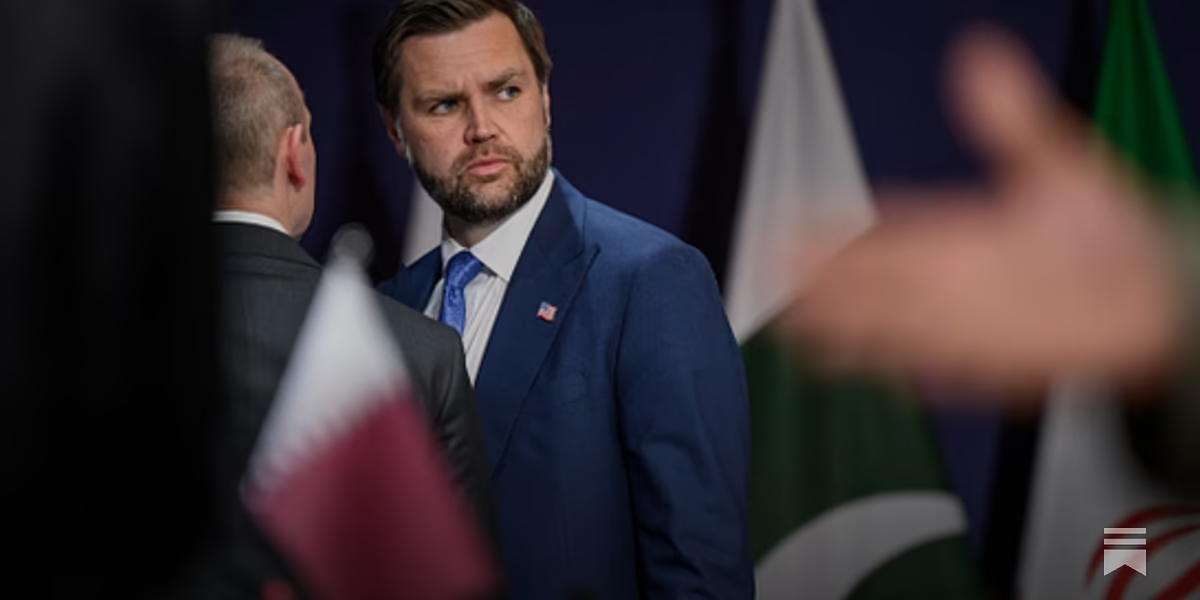
On the other hand, over the past ten years, Turkey, thanks to its proactive diplomacy approach, has emerged as an influential actor in finding solutions to crises and conflicts at both regional and international levels. We have not hesitated to assume our responsibilities to establish peace and stability, standing in all crisis areas with the oppressed and the rightful, not with the strongest. Whenever injustice or a violation of justice occurred, Turkey was a voice for international law, justice, and human conscience. If Turkey today is considered a country whose contributions to regional and international issues are relied upon, whose word is trusted, and whose opinions are taken into account, the credit for this achievement goes to the unwavering will of our proud people, who, sacrificing themselves, defended the independence of their homeland and the future of their nation on the night of July 15th.

The fight against terrorism, which requires international cooperation, remains at the forefront of our foreign policy agenda. As is known, over the past two years, the pace of internal disintegration in the external structure of the Gulenist Terrorist Organization (FETO) has accelerated. However, we are aware that some countries, albeit implicitly, continue to provide support to this organization and harbor its elements. On this occasion, I would like to emphasize the need for caution regarding the Gulenist Terrorist Organization (FETO), which does not hesitate to resort to any means to achieve its goals, disguises itself in various forms, and exploits concepts of democracy, freedom, human rights, and other values to achieve its ends. As a people who lost 253 of its children as martyrs at the hands of the coup plotters on the night of July 15th, our primary expectation from the international community is to support Turkey's legitimate struggle. As a people whose 253 children were martyred by the coup plotters on the night of July 15th, we look forward to the international community supporting Turkey's legitimate struggle. For the establishment of peace, security, and prosperity at the global level can only be achieved through a firm and uncompromising fight against terrorist organizations, without any discrimination, and based on sincere cooperation.

PALESTINE

Fri 17 Jul 2026 4:28 pm - Jerusalem Time

Death toll from Israeli drone strikes on Gaza rises to 3 martyrs and 17 injured

Medical sources in the Gaza Strip announced on Friday morning that the death toll from the ongoing aerial bombardment by occupation drones on various areas of the Strip has risen. The sources confirmed that 3 martyrs and 17 injured with varying degrees of severity arrived at hospitals, following a series of intense raids targeting civilian gatherings.

According to field data, occupation drones have focused their attacks since the early hours of dawn on residential areas and vital axes frequented by citizens in several governorates of the Strip. These raids have caused widespread destruction of property, leading to a state of panic among residents who are trying to survive direct and repeated targeting.

In a related context, civil defense and ambulance crews continue their strenuous efforts to evacuate the injured and retrieve the bodies of the martyrs from the targeted sites despite the surrounding security risks. These teams face significant challenges in reaching some areas due to the continued intensive flight of warplanes and drones in the Strip's airspace, which hinders the speed of response to emergency cases.

For their part, medical staff warned of the deteriorating health situation inside hospitals, which are now operating beyond their capacity and with very limited resources. The sources indicated that the severe shortage of essential medicines and medical consumables threatens the lives of the injured, amidst the continued influx of casualties resulting from the ongoing military escalation on all fronts.

Hospitals are operating under severe pressure and a critical shortage of essential medical supplies due to the ongoing aggression.

PALESTINE

Fri 17 Jul 2026 4:28 pm - Jerusalem Time

Israeli investigations into the deaths of 57 detainees from Gaza and Lebanon conclude without charges

Hebrew media sources revealed that the Israeli military establishment has opened 57 criminal investigations related to the deaths of detainees from the Gaza Strip and Lebanon during the ongoing war. Reports indicated that these investigations included the deaths of 56 Palestinians and one Lebanese who died while in military custody. However, none of these cases resulted in indictments against those responsible.


Data obtained under the Freedom of Information Act shows that seven of these investigations focused directly on shooting incidents that led to the immediate death of detainees. Despite the seriousness of these allegations, the occupation authorities continue to delay the completion of legal procedures. The army even claimed not to know the timing of two of these serious incidents.

According to available information, the vast majority of deaths subject to criminal investigation occurred within military detention facilities under strict security control. These locations are characterized by advanced surveillance camera systems and the availability of a large number of witnesses, both Israeli soldiers and other detainees present at the scene.

The Israeli army justified its failure to achieve concrete results in these investigations by what it described as "complexities of proof" resulting from field combat conditions. Military sources claimed that the inability to accurately identify suspects prevented these investigations from progressing to actual judicial proceedings, raising questions about the seriousness of these internal procedures.

These investigations were distributed chronologically over the months of the war, with 2024 seeing the largest number of them, coinciding with widespread arrest campaigns in the Gaza Strip. Records also show that 19 investigations were opened in the last quarter of 2023, in addition to three new investigations initiated at the beginning of 2025.

Informed sources reported that some detainees died upon arrival at detention facilities due to previous injuries that were not adequately treated medically. In these cases, an automatic military procedure is activated to investigate any death occurring within military facilities, but these often conclude without clear criminal responsibility being assigned.

In addition to direct injuries, reports noted that the lack of adequate medical care and the spread of diseases within overcrowded detention centers were a major cause of several deaths. Israel faces widespread international criticism over detention conditions, which human rights activists describe as lacking minimum international humanitarian and legal standards.

In a related context concerning soldier violations, sources revealed that investigations into the looting of civilian property in Gaza and Lebanon faced a similar fate in terms of lack of accountability. Despite direct instructions from the Chief of Staff to report thefts, most reports were closed without punitive measures being taken against those involved.

Military courts recorded only one indictment related to looting, where a soldier was convicted of stealing money from a house in Gaza after attempting to deposit it into his account. The irony in this case is that the conviction came after it was discovered that the banknotes the soldier had seized were counterfeit, which facilitated his exposure and prosecution.

Investigations also included other cases where soldiers smuggled motorcycles and electrical appliances from affected areas in the Gaza Strip into Israel. However, in most of these cases, the military leadership sufficed with simple disciplinary measures, avoiding the criminal path that could lead to actual prison sentences for the elements involved in these crimes.

In most criminal investigations, the Israeli army was unable to identify suspects, attributing this to the complexities of proof in combat conditions despite the presence of surveillance cameras.