





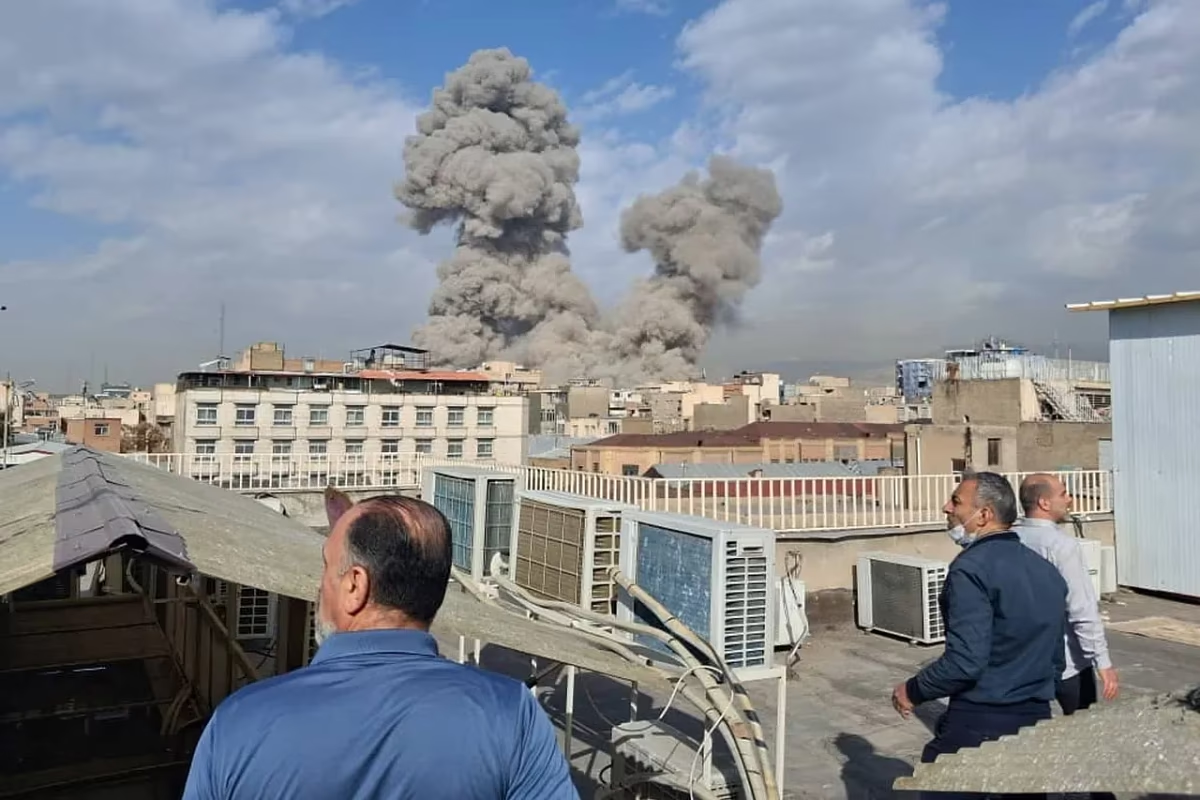
Ahmed Rafiq Awad: The strikes aim to weaken Tehran, force it to sign a new memorandum of understanding, and demonstrate the United States' ability to undermine Iranian military capabilities.Nabhan Khraisha: Washington's bombing of the Iranian interior reveals the conflict's transition to a more dangerous and widespread phase, keeping the region on the brink of regional war.Dr. Suhail Diab: The closest estimates are for continued US military pressure against calculated Iranian responses to avoid an existential war, with undeclared negotiation channels remaining open.Hani Abu Al-Siba': The continuation of US military movements and operations reflects the need for more time and pressure to break Iran's will and push it to accept Washington's terms.Dr. Aql Salah: Washington may resort to escalating pressure through enhanced military deterrence and tightened economic and diplomatic sanctions, seeking to impose a broader agreement.Mohammed Al-Rajoub: The US escalation represents a clear shift in the nature of the conflict, reflecting Washington's transition to a phase aimed at raising the cost of the Iranian decision itself.Ramallah - Exclusive to "Al-Quds" - The American escalation in the Iranian interior enters a new phase of confrontation between Washington and Tehran, amidst the conflict's transition from indirect pressure politics to targeting sites within Iranian territory, a step that may reflect an American attempt to redraw the rules of engagement and impose new equations in the negotiation file related to the nuclear program, missiles, navigation security in the Strait of Hormuz, and the future of Iran's role in the region.Writers, political analysts, specialists, and university professors, in separate interviews with "Al-Quds," believe that the American strikes do not only aim to weaken Iranian military capabilities and infrastructure, but also carry multiple political messages, most notably strengthening American deterrence in front of allies, raising the cost of Iranian options, and improving Washington's negotiating position by using military force as a bargaining chip, at a time when neither the United States nor Iran appears willing to slide into an all-out war due to its high cost.While Washington bets on pushing Tehran to return to negotiations from a weaker position and accept new terms, writers, political analysts, specialists, and university professors believe that Iran is preparing for a long confrontation based on calculated responses and attrition, while maintaining a margin for undeclared negotiations, which leaves the region facing open scenarios ranging from continued limited escalation, through a long war of attrition, to the risk of regional expansion of the confrontation if things get out of control.Attempt to Impose an Interpretation of the Islamabad MemorandumPolitical writer and analyst Dr. Ahmed Rafiq Awad believes that the American strikes in the Iranian interior come in the context of Washington's attempt to impose its own interpretation of the memorandum of understanding signed in Islamabad, and to force Tehran to accept new terms after the American breach of previous understandings, whether related to the ceasefire in Lebanon, the release of frozen Iranian funds, or freedom of navigation in the Strait of Hormuz, noting that Iran responded to these violations by targeting maritime tankers.He explains that the United States seeks, by directing strikes into the Iranian interior, to weaken military capabilities and vital infrastructure, including electricity and water facilities and bridges, in addition to targeting nuclear facilities, with the aim of establishing a narrative that it has succeeded in completely ending the Iranian nuclear project, and at the same time pushing Tehran to return to negotiations according to new American terms, considering that these operations also serve an internal political goal of marketing a military achievement before the American midterm elections scheduled for next November.Awad points out that the strikes also aim to weaken the Iranian regime and force it to sign a new memorandum of understanding, and to show the United States as the party capable of undermining Iranian military capabilities, as well as creating conditions that may help internal opposition forces increase pressure against the regime.Iran Overcomes the Stage of Fear of CollapseIn his reading of the outcomes of the escalation, Awad believes that Iran has overcome the stage of fear of collapse and is ready to wage a long war, whether in the form of a war of attrition or - if imposed upon it - a wider confrontation, but at the same time it realizes that the United States does not wish to engage in a ground war, direct occupation, or open-ended attrition, because its calculations remain limited in time and politically.Awad indicates that the Iranian leadership is betting that steadfastness in the face of American military pressure will spare it collapse, destruction, or sliding into civil war, suggesting that developments will likely move towards one of two main scenarios: first, a long or low-intensity war of attrition, and second, a return to the negotiating table on new bases, noting that the door to negotiation remains open, as evidenced by Washington not asking Israel to engage in the confrontation, and Iran refraining from targeting Israel, reflecting both parties' desire to avoid an all-out war.Conflict Enters a More Dangerous and Widespread PhaseJournalist and writer Nabhan Khraisha believes that the continuous American bombing of targets within the Iranian interior does not only reflect deterrence power, but also reveals the conflict's transition to a more dangerous and widespread phase, based on expanding the target bank and raising the level of both political and military pressure on Tehran, considering that targeting sites within Iranian territory carries a message beyond weakening military capabilities, namely that the United States is capable of reaching any target it considers a threat to its interests and the interests of its allies, noting that between gradual escalation and a return to negotiation, the region remains on the brink of a regional war.Implicit Acknowledgment of Failure of Pressure RoundsKhraisha explains that this escalation also indicates an implicit acknowledgment that previous rounds of pressure did not fully achieve their strategic goals, for if previous military operations had succeeded in imposing American conditions, Washington would not have been forced to expand the scope of its operations and move to targeting the Iranian interior in this manner.Khraisha believes that a great power resorting to gradually escalating its operations reflects that the opposing party still retains the ability to withstand, maneuver, and respond, which pushes the United States to raise the level of military pressure in pursuit of its goals.Iran and Not Standing Idly ByKhraisha believes that Iran will most likely not engage in a comprehensive conventional confrontation with the United States, realizing the significant difference in military power balances, but at the same time, it will not stand idly by, suggesting that it will continue to adopt an attrition policy by expanding the circle of indirect responses, targeting American and regional interests, and increasing pressure on navigation and energy supplies, tools that have proven their ability to disrupt American and international calculations in recent months.Continued Gradual EscalationKhraisha points out that the most likely scenario is continued gradual escalation, which keeps the region in a state of low or medium-intensity war, but one that is open-ended and capable of exploding at any moment due to a miscalculation or the execution of a strike that crosses red lines.Khraisha proposes another scenario based on the success of military pressures, after a period of attrition, in pushing both parties to return to the negotiating table, but under different conditions than those previously proposed, considering that the United States often uses military force to improve its negotiating position more than to achieve a final military victory.Khraisha warns that the most dangerous scenario is the confrontation spiraling out of control and the war expanding to include additional countries in the region, threatening global energy security and leading to widespread economic and political turmoil, emphasizing that this possibility, although not desirable for the main parties, remains present with the continued rise in military escalation.A Process of Redrawing the Balance of PowerAccording to Khraisha, what is happening goes beyond being a confrontation related to Iran alone, to reflect a process of redrawing the balance of power in the Middle East, but historical experiences confirm that military force can change facts on the ground, but it rarely succeeds alone in achieving lasting political stability, which makes the real challenge finding a realistic political vision that ends the confrontation before it turns into an open regional conflict whose repercussions are difficult to contain.Stalemate and Limited Options for WashingtonPolitical science professor Dr. Suhail Diab believes that the American escalation in the Iranian interior came as an expression of a stalemate and limited options for Washington, explaining that the United States cannot resolve the confrontation with a quick and guaranteed military victory, and that making political concessions to Iran, especially regarding the Strait of Hormuz, would be interpreted as a political defeat for the United States.Diab explains that the objectives of the American escalation are linked to several considerations, foremost among them reassuring allies in the Middle East that Washington is still capable of defending their interests and protecting them, in addition to trying to calm internal tensions in the United States between political currents, especially between Republicans and Democrats, and among public opinion, with the approaching midterm elections.Neutralizing Israel from Direct Engagement in the ConfrontationDiab points out that indicators of these objectives have become clear, most notably neutralizing Israel from direct engagement in the confrontation based on demands from allies, in addition to the escalating disagreement within the American administration between the hawkish current represented by Marco Rubio, and the realistic current represented by J.D. Vance.Diab believes that the current escalation can be summarized as an attempt to "minimize damage" and buy time in the absence of clearer scenarios, considering that it reflects the depth of President Donald Trump's administration's crisis internally and externally.Mutual Containment ScenarioIn his reading of the potential scenarios, Diab favors the mutual containment scenario as the most likely, whereby limited strikes continue, and Iran responds in a calculated manner, with both parties keen to avoid an all-out war, in a pattern similar to the "controlled escalation" witnessed in previous crises.Long War of Attrition ScenarioThe second scenario, according to Diab, is a long war of attrition that includes continued airstrikes, cyberattacks, targeting American interests and bases, naval escalation, and mutual economic pressure, a confrontation that could last for months and affect energy markets and global trade without the need for a ground invasion.Possibility of Regional Conflict ExpansionDiab points to the possibility of the conflict expanding regionally to include Iraq, Syria, the Gulf, the Red Sea, and vital maritime passages, turning the confrontation into a multi-front war.The most dangerous and least likely scenario, according to Diab, is the outbreak of an all-out war if the Iranian leadership is subjected to widespread strategic strikes, or a major targeting of nuclear facilities, or a large number of American military personnel are killed in a direct attack.Diab believes that the closest estimates indicate continued US military pressure, against calculated Iranian responses to avoid an existential war, with undeclared negotiation channels continuing in parallel with the escalation.Forcing Tehran to Return to Negotiations from a Position of WeaknessPolitical writer and analyst Hani Abu Al-Siba' believes that the continuous American escalation against Iran primarily aims to force Tehran to return to the negotiating table from a position of weakness, allowing Washington to impose its political and security conditions.Abu Al-Siba' believes that raising the pace of military attacks is part of an attempt to improve negotiation terms, but field data indicates that Iran has prepared for a potentially long confrontation, and that it is capable of responding to escalation with similar escalation, by targeting American bases and interests as long as American attacks continue.Continued Escalation... But!Abu Al-Siba' explains that the continuation of American military operations, for the seventh consecutive day, coinciding with the movement of the naval fleet and strategic bombers towards the region, reflects a conviction in Washington that it needs more time and military pressure to break Iran's will and push it to accept American conditions.However, Abu Al-Siba' believes that field facts do not support this assessment, noting that Iran has intensified its missile attacks on American bases and expanded the scope of its response whenever American strikes increased, especially on the southern governorates overlooking the Gulf.He explains that the Iranian escalation included targeting American bases in the Gulf and Levant regions, resulting in injuries to American soldiers, in addition to reports of a cruise missile launch towards an aircraft carrier in the Pacific Ocean, considering that these developments warn of the expansion of the conflict, amidst a race against time for the American administration amid escalating internal criticism of the war, and fears of its economic repercussions on the United States and the global economy.Abu Al-Siba' points out that the continued American military buildup, and the sending of aircraft carriers and refueling aircraft to the region, may open the door to expanding operations to include additional targets, and perhaps ground operations targeting sites related to the Iranian nuclear program, noting at the same time that Israel continues its preparations for the possibility of engaging in the confrontation.Abu Al-Siba' believes that continued fighting will push the conflict towards a war of attrition, considering that historical experiences in Afghanistan, Vietnam, Iraq, Syria, Lebanon, and Somalia indicate the difficulty of the United States succeeding in this type of war.Possibility of Confrontation Expanding with Participation of Other PartiesAbu Al-Siba' warns of the possibility of the confrontation expanding through the participation of other parties, and the potential threat to navigation in the Straits of Hormuz and Bab al-Mandab and direct impacts on the global economy.Abu Al-Siba' suggests the existence of undeclared efforts led by mediators to contain the escalation and open a window for a political breakthrough, but he believes that significant American losses could push Washington to a greater escalation in pursuit of a military achievement, emphasizing that the continuation of the war, if prolonged, could negatively affect the American economy and influence the electoral mood within the United States.Redefining US-Iranian UnderstandingsPolitical writer and researcher and professor of comparative political systems Dr. Aql Salah believes that the American escalation in the Iranian interior aims to redefine US-Iranian understandings, especially regarding the Strait of Hormuz and its management mechanism, which, from Washington's perspective, would re-establish its prestige as the power capable of controlling global waterways, in addition to giving Israel a wider margin to continue targeting Iran whenever it wishes, similar to what is happening in the Gaza Strip and Lebanon, in an attempt to impose a "negotiation under fire" model, and subject Iran to new American and Israeli conditions.No Desire for All-Out WarSalah explains that the escalation does not necessarily reflect the desire of both parties to slide into an all-out war, as the United States seeks to strengthen its negotiating position through pressure, deterrence, and demonstrating power, while Iran has no choice but to resist and manage the conflict cautiously, preventing the confrontation from turning into a wide war, and refusing to accept negotiations that give Washington an advantage and achieve Israeli interests related to re-engineering the Middle East.He points out that the United States is keen not to collapse the dialogue process with Iran, but it is working to change its terms and nature, leveraging military escalation to raise its demands and extract greater concessions, by employing military force, assassinations, blockade, and sanctions as a bargaining chip, a policy previously used in Gaza and Lebanon to achieve political gains that military operations did not achieve.Salah believes that Washington may resort, if Iran rejects its conditions, to escalating pressure through enhanced military deterrence and tightened economic and diplomatic sanctions, seeking to impose a broader agreement that includes the nuclear program, ballistic missiles, Iran's regional role, and stricter monitoring mechanisms, which he considered fundamental Israeli demands.Five Key ImplicationsSalah points out that the American strikes carry five key implications: strengthening American deterrence, changing the rules of engagement by targeting the Iranian interior, increasing political pressure to push Tehran to make concessions, sending reassuring messages to US and Israeli allies in the region, in addition to testing the level of Iranian deterrence and capabilities, emphasizing that Iran adheres to rejecting negotiations under threat while maintaining the diplomatic path and strengthening the cohesion of its internal front.Salah suggests that a return to negotiations from a position of strength remains the most likely scenario, with the possibility of continued escalation remaining, while sliding into an all-out regional war remains the least likely scenario, despite continued tension between the two parties.Clear Shift in the Nature of the ConflictAcademic and researcher in public administration and political science Mohammed Al-Rajoub believes that the recent American escalation within the Iranian interior represents a clear shift in the nature of the conflict, reflecting Washington's transition to a phase aimed at raising the cost of the Iranian decision itself, after previously focusing on containing Iranian influence in the regional arenas.He explains that targeting facilities, infrastructure, and sites within Iranian territory carries a set of strategic messages, the first of which is the United States' endeavor to restore deterrence power after it saw Tehran crossing red lines by targeting international navigation and American bases and its allies in the region.Al-Rajoub points out that the second message is to confirm that any threat to American interests will be met with direct targeting of the Iranian interior, and not just striking the regional proxies linked to Iran.Al-Rajoub notes that the third message is to redraw the rules of engagement, as the confrontation has moved from the arenas of Iraq, Syria, Lebanon, Yemen, and the Red Sea to the heart of Iran, which is a qualitative shift that raises the level of risks and places the Iranian leadership before a more complex equation.As for the fourth message, according to Al-Rajoub, it is to exert economic and logistical pressure aimed at reducing Iranian logistical capabilities and weakening the ability of its armed forces to maneuver and manage operations.A New Phase Different from Previous RoundsIn his reading of the outcomes of the escalation, Al-Rajoub believes that the region has entered a new phase different from previous rounds of tension, but it does not necessarily mean that the decision for a comprehensive regional war has been taken.Al-Rajoub suggests that the scenario of continued mutual strikes between the United States and Iran remains the most likely, with calculated responses from both sides to maintain the deterrence equation in front of their domestic audiences, without bearing the cost of sliding into a wide confrontation.Errors That Could Lead to a Wide WarAl-Rajoub believes that the possibility of a wide regional war breaking out, although less likely, remains if a miscalculation leads to a major attack that causes widespread human casualties, which could lead to targeting American bases in the Gulf or expanding strikes against Iranian infrastructure.Al-Rajoub proposes the scenario of returning to negotiations from a position of strength, where each party seeks to improve its conditions before resuming dialogue, in addition to a long-term attrition scenario based on continued mutual strikes without military resolution, and the accompanying economic deterioration, rising energy prices, disruption of maritime navigation, and declining investments in the region.Al-Rajoub confirms that current indicators, despite escalating tension, do not indicate a final decision to wage an all-out war, as both parties are still using military force to redraw the balance of deterrence and improve their negotiating positions, with the risk of a strategic error that could turn the escalation into a wide regional conflict remaining.

PALESTINE
Sun 19 Jul 2026 1:49 pm - Jerusalem Time
Escalation in the Iranian Interior.. An American Attempt to Redraw the Rules of Engagement
Tags
MORE FROM PALESTINE
Settlers burn mosque and homes in a violent attack south of Hebron
Gaza Health: 19 martyrs and 60 injured due to occupation attacks within two days
5 Martyrs, Including a Child, in Israeli Bombing Targeting a Residential Apartment in Al-Nasser Neighborhood in Gaza

Share your opinion
Escalation in the Iranian Interior.. An American Attempt to Redraw the Rules of Engagement