






Ukrainian President Volodymyr Zelensky hinted at the possibility of fundamental changes in the structure of the military establishment, amidst a rare wave of protests sweeping the country during wartime. These political moves come after the resignation of Defense Minister Mykhailo Fedorov, who led extensive efforts to modernize the army and utilize drones.
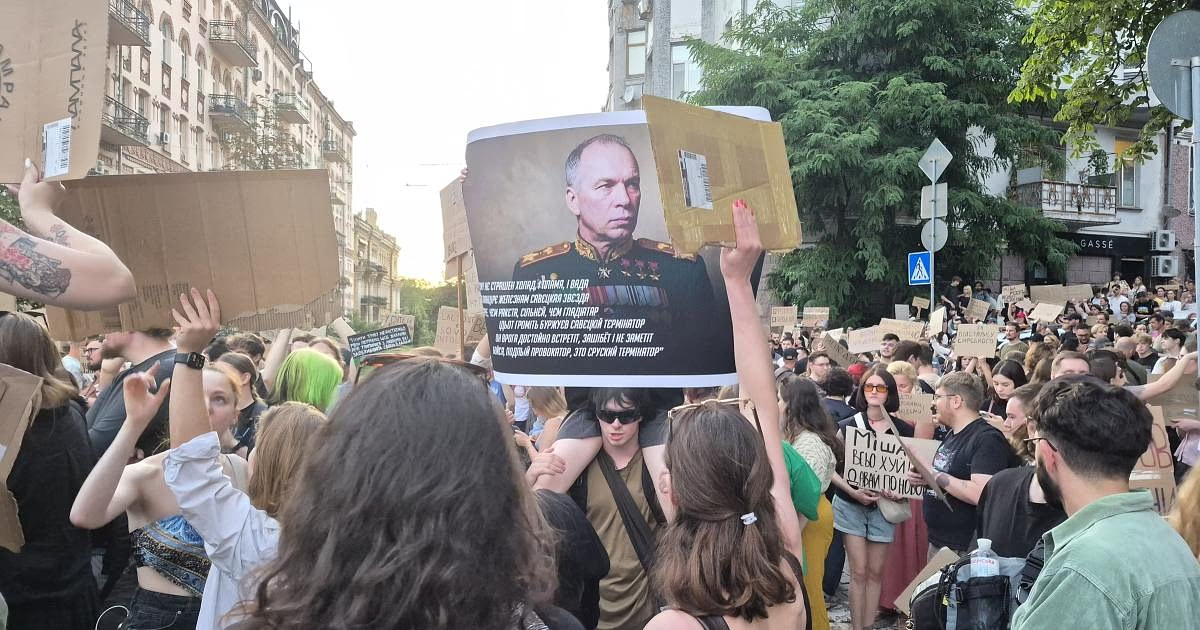
Kyiv and other Ukrainian cities witnessed massive demonstrations for the third consecutive day, where protesters expressed their categorical rejection of Fedorov's departure from office. Demonstrators held up signs condemning the decision, considering that the resigned minister represented the reform and digitalization current within the armed forces, which face major field challenges.
In his evening address to the nation, Zelensky affirmed that he had held intensive consultations over two days with senior military leaders and political officials. The President clarified that he is closely monitoring the public pulse and the demands of the protesters, emphasizing that decisive decisions regarding the future of the army's leadership will be formulated soon.
Field reports indicate that demonstrators in Kyiv's squares used cardboard signs that have become a symbol of opposition, chanting slogans demanding the departure of the current army commander, Oleksandr Syrsky. Protesters believe that recent ministerial changes may harm the modernization efforts that began since the start of Russia's full-scale invasion of the country.
For his part, the resigned minister Mykhailo Fedorov commented on the popular movements via the Telegram application, expressing his gratitude to the demonstrators for what he described as 'hope'. Fedorov indicated that there is ongoing dialogue with the political leadership, expressing optimism that things will move in the right direction to serve the national defense interest.
Tension escalated after informed sources revealed deep disagreements between Fedorov and army commander Syrsky over strategies to counter Russian attacks. The points of contention focused on the young minister's desire to accelerate the digitalization of military operations, which met with reservations from the traditional military leadership represented by Syrsky.
In an extraordinary press conference held after leaving office, Fedorov directly accused Syrsky of lacking the necessary flexibility to manage a modern war. The former minister openly questioned Ukraine's ability to achieve victory given the continued current leadership mentality, which he accused of causing internal divisions.
In contrast, army commander Oleksandr Syrsky, who has a significant military record since his defense of Kyiv in 2022, responded by calling on everyone to focus on the field. Syrsky considered that the utmost priority should be to implement an effective strategy that achieves tangible results on the burning fronts, away from political debates.
A state of anticipation prevails in Ukrainian political circles regarding the identity of Syrsky's potential replacement should Zelensky decide to oust him to absorb public anger. This internal crisis coincides with increasing military pressure exerted by Russian forces on several fronts, making any change in leadership a calculated risk.
Observers believe that Zelensky faces a difficult test to balance the public's demands for modernization with maintaining the stability of the military establishment at a critical time. It is expected that the coming days will see the announcement of the new military leadership that will manage the next phase of the conflict.
Decisions regarding the army will be formulated, and I hear very well what people are saying on the street.
Share your opinion
Zelensky hints at widespread military changes amid protests shaking Ukraine