







March 5, 2026
News Analysis
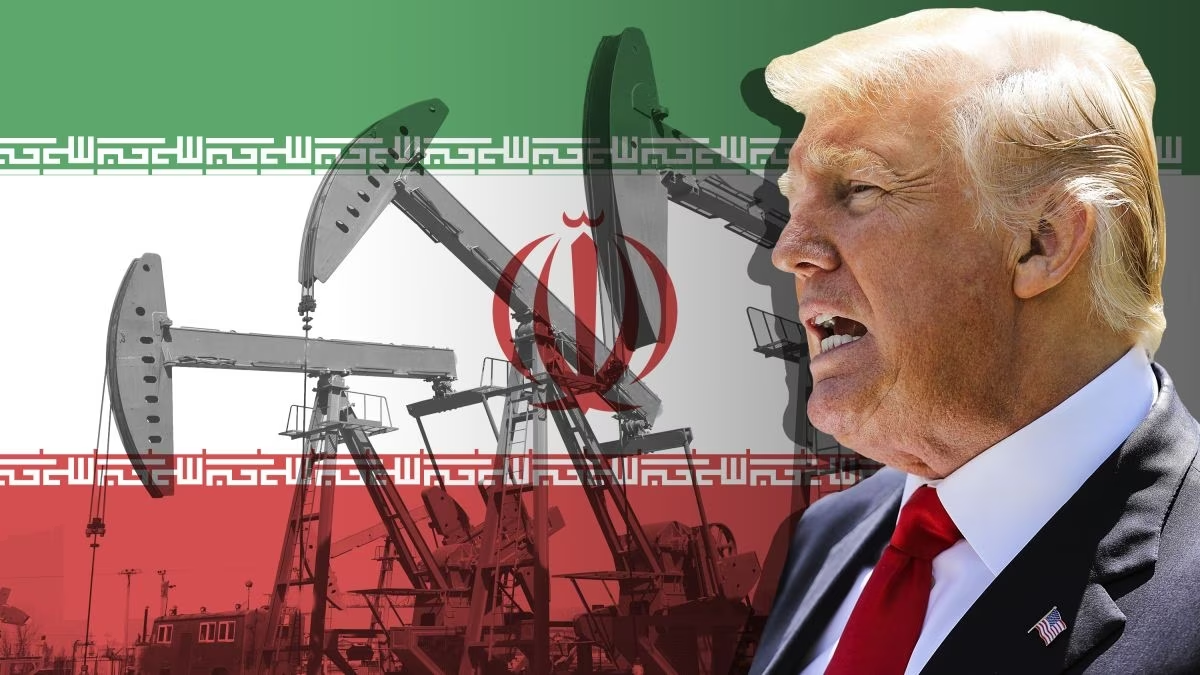
Washington, D.C- The outcome of President Donald Trump’s war against Iran is uncertain. The ambitions behind it are not. Beneath the language of deterrence lies a broader project: to reshape energy geopolitics, curb China’s access to Iranian oil, and cement a Middle East order anchored in Washington, Israel, and the GCC countries—an alignment formalized under the Abraham Accords.
This is more than a military campaign. It is an attempt to redraw the global energy map.
Markets have registered the risk. Recent corrections in equities and commodities—sharp but contained—signal concern that the conflict could unleash a major oil and gas shock. Iran holds the world’s third-largest proven oil reserves and second-largest natural gas reserves. Sanctions have long kept much of that supply constrained. A transformed or compliant Iran would represent a strategic windfall: vast reserves reentering global markets under conditions aligned with Western capital and oversight.
Yet that ambition collides with immediate vulnerabilities. The Strait of Hormuz remains the world’s most sensitive energy artery. Roughly one-fifth of global oil passes through its narrow corridor, along with significant volumes of liquefied natural gas. Even credible threats to its security unsettle markets. A sustained disruption would be economically explosive—insurance costs soaring, shipping disrupted, supply chains strained.
Recent events exposed that fragility. After Iranian strikes on Gulf energy infrastructure, Qatar temporarily suspended LNG production, sending gas prices up nearly 70 percent within 48 hours. Europe and much of Asia—having shifted away from Russian gas after the Ukraine war—were thrust into another energy scare. What was framed as diversification proved instead to be a transfer of dependency from Moscow to the Gulf.
The asymmetry between the United States and its allies is stark. Europe and Asia face inflation spikes and recession risks if disruptions persist. The European Central Bank could be forced into painful rate hikes, deepening stagnation. By contrast, the United States—buoyed by shale production—is more insulated from external supply shocks than at any time in decades. The Federal Reserve faces less immediate pressure.
That imbalance raises a critical question: who bears the cost?
If Washington’s calculus assumes the United States can absorb volatility better than partners—or rivals—then this war is not solely about Iran. It is about leverage across three fronts.
First, energy dominance. Subduing Iran—through regime change or prolonged economic attrition—would open one of the world’s largest untapped hydrocarbon basins to restructuring. A weakened Tehran could be drawn into a Western-aligned production framework, stabilizing output under political conditions favorable to U.S. interests. But this presumes post-conflict control that history rarely grants.
Second, China. Beijing has relied heavily on discounted Iranian crude, often skirting sanctions. Curtailing that flow would raise China’s energy costs and complicate industrial planning. In an era of intensifying U.S.–China rivalry, energy denial becomes a tool of containment. Weakening Tehran reverberates far beyond the Gulf; it touches the architecture of great-power competition.
Third, regional re-engineering. The Abraham Accords envisioned more than normalization between Israel and Arab states. They outlined an economic corridor linking Israeli technology, Gulf capital, and American security guarantees. Iran remains the principal spoiler to that vision. A diminished Tehran could, in theory, clear the path toward a Middle East defined less by proxy war and more by integrated markets.
But the theory rests on fragile assumptions.
Iran’s response—direct strikes against Gulf energy facilities—signals escalation, not capitulation. By widening the theater and targeting infrastructure, Tehran exploits its asymmetric advantage: disruption. The objective is not conventional victory but raising the economic and political costs of confrontation to intolerable levels.
If that strategy endures, the consequences could be systemic. Oil prices would surge. Inflation across Europe and Asia would reaccelerate. Political unrest could follow economic strain. The specter of stagflation—long dormant in advanced economies—would return. The global economy, already burdened by debt and geopolitical fragmentation, may not withstand another prolonged energy shock without structural damage.
Here lies the paradox. A war partly intended to secure influence over energy markets may instead destabilize them. An effort to consolidate regional order could fracture global stability. A strategy designed to weaken adversaries could impose disproportionate pain on allies.
The belief that the United States can remain insulated—protected by shale output and dollar dominance—may prove overly confident. Energy shocks do not respect borders. Financial contagion, currency volatility, and capital flight can erode even resilient economies. Moreover, the perception that Washington engineered global disruption could carry long-term diplomatic costs, straining alliances already tested by previous conflicts.
At its core, this war is a high-risk wager: that coercion can reorder energy geopolitics without triggering uncontrollable escalation; that Iran can be subdued without igniting systemic crisis; that China can be weakened without hardening rival blocs; and that the Middle East can be reshaped through force into a platform for prosperity.
History offers caution. Grand designs often falter against the realities of nationalism, retaliation, and unintended consequences. The Middle East has repeatedly demonstrated that external attempts at structural transformation can unleash forces beyond the architects’ control.
If the gamble fails, the damage will not be confined to Tehran or the Gulf. It will be felt in European factories facing energy shortages, in Asian ports slowed by rising costs, and in American households confronting higher fuel and food prices.
The question, then, is not simply whether the war can be won militarily. It is whether the strategic architecture underpinning it was ever stable enough to justify the risk
Share your opinion
War, Oil, and Illusion: The Strategic Gamble Behind Trump’s War on Iran