PALESTINE

Thu 12 Mar 2026 8:33 pm - Jerusalem Time

Gaza Health: One martyr and 9 injuries within hours, and the total toll exceeds 72,000 dead

The Ministry of Health in the Gaza Strip announced today, Thursday, a slight increase in the number of casualties who were able to reach medical facilities, as hospitals received one martyr and nine injuries in the past few hours. Medical sources clarified that these figures are limited only to evacuated cases, given the ongoing field challenges faced by rescue teams.

The ministry stressed in its field statement that the announced statistics do not represent the true extent of human losses in the Strip, due to the presence of hundreds of victims who are still missing under the rubble of destroyed buildings or lying in rugged roads. It indicated that civil defense and ambulance crews face extreme difficulties in reaching these areas due to continuous targeting or lack of necessary capabilities to recover bodies.

Regarding the statistics recorded since the eleventh of last October, official data revealed the registration of 651 martyrs and 1,741 others injured with varying degrees of wounds. During this period, specialized teams were also able to recover the bodies of 756 victims who fell in earlier times of the aggression, reflecting the scale of the ongoing tragedy in various governorates of the Strip.

As for the cumulative toll since the outbreak of the aggression on October 7, 2023, the Ministry of Health announced that the total number of martyrs has risen to 72,136 martyrs, while the number of wounded and injured reached 171,839 people. These shocking figures confirm the enormous human devastation left by the continuous military operations over many months of intensive bombing.

The humanitarian suffering continues in the Gaza Strip with the deterioration of the health system and the inability to provide necessary care for thousands of injured people who overcrowd medical corridors. Health authorities appeal to the international community for urgent intervention to provide safe corridors for rescue teams to recover the missing and provide emergency medical aid to hospitals operating beyond their capacity.

This statistic does not reflect the reality on the ground due to the large number of victims under the rubble and in the streets, where civil defense teams are unable to reach them.

OPINIONS

Thu 12 Mar 2026 8:32 pm - Jerusalem Time

United States Imposes Sanctions on Network of Associations Linked to Hamas

Said Erikat

Opinion Writer

Washington – Said Arikat – 12/3/2026

In a new step within its policy aimed at "drying up the funding sources of groups it designates as terrorist," the United States announced sanctions on four charitable organizations it said operate as a front for financing the Hamas movement, specifically its military wing known as "Izz ad-Din al-Qassam Brigades," according to a statement issued by the US State Department on Thursday. The US administration states that these organizations use humanitarian work as a cover to collect funds and transfer them to military activities in the Gaza Strip.

According to the official statement, a copy of which was received by Al-Quds newspaper, these measures come within the framework of US efforts to disrupt the funding channels on which the movement relies, and to expose what Washington described as "the exploitation of civil and charitable organizations" in supporting military activities. The US administration believes that these financial networks constitute one of the main pillars that allow Hamas to maintain its organizational and military capabilities inside and outside Gaza.

Washington affirmed that the sanctions target an "illicit financing network" and aim to cut off financial flows that could be used to support the movement's military operations. It also stressed that these measures fall within a broader strategy to combat terrorism financing, including monitoring financial institutions and associations suspected of involvement in transferring funds to armed groups.

According to the statement, "the US administration simultaneously affirms that it does not target humanitarian work per se, but rather seeks to ensure the delivery of humanitarian aid to Palestinian civilians" through "reliable and secure" organizations, away from any political or military exploitation. Washington emphasizes that it supports international efforts aimed at improving the humanitarian conditions of Palestinians, in parallel with working towards achieving lasting peace in the region.

These sanctions are based on Executive Order 13224 on combating terrorism, which was issued in the aftermath of the September 11, 2001 attacks, and grants the US government broad powers to freeze financial assets and impose restrictions on individuals or entities suspected of supporting terrorist activities. The US State Department had previously listed the Hamas movement as a terrorist organization under this executive order on October 31, 2001.

The United States also designates the movement as a "Foreign Terrorist Organization" under Section 219 of the Immigration and Nationality Act, a designation that allows for additional sanctions and makes providing any material support to the movement a crime punishable under US law.

The US Treasury Department states that the new measures come after extensive financial investigations, during which it observed what it considered a recurring pattern of using charitable institutions to collect donations and transfer them to channels linked to Hamas. It adds that the sanctions include freezing any assets that may be subject to US jurisdiction, in addition to prohibiting financial dealings with these entities.

Washington views this step as part of a broader policy aimed at tightening the noose on the movement's financial structure, not only within the Palestinian territories but also through support networks abroad.

This step reflects the continuation of the traditional US approach to dealing with the Hamas movement, which primarily focuses on financial and legal tools to undermine the movement's capabilities. Washington believes that Hamas's financial structure is no less important than its military structure, and that striking funding sources can weaken its ability to endure and organize. However, critics argue that this approach ignores the broader political context of the Palestinian-Israeli conflict, as financial pressure alone has not succeeded over the past decades in ending the movement's influence or reducing its popular presence in the Gaza Strip.

The targeting of charitable organizations always sparks wide debate in humanitarian and human rights circles, because the line between humanitarian work and political work in conflict zones is often fragile. In Gaza, large segments of the population rely on charitable institutions to provide food, healthcare, and education. Therefore, some observers fear that financial restrictions and sanctions could complicate the work of legitimate humanitarian organizations, or reduce the flow of international donations, which could directly affect civilians who are already living in difficult humanitarian conditions.

Politically, these sanctions come in a broader context of regional tensions and repeated military escalation in the region. Successive US administrations have used economic sanctions as a key tool in their Middle East policies, whether towards states or armed groups. However, experience shows that sanctions, despite their ability to weaken some financial networks, are rarely sufficient alone to bring about radical political change. Therefore, some analysts believe that such measures reflect conflict management more than they reflect a comprehensive strategy for resolving it.

ISRAELI AFFAIRS

Thu 12 Mar 2026 7:03 pm - Jerusalem Time

Defensive Failure Against Fragmented Warheads: 11 Iranian Cluster Missiles Penetrate Airspace and Cause Widespread Destruction

Hebrew media sources reported that the occupation's air defense systems faced unprecedented challenges in countering recent Iranian missile attacks. The sources confirmed that 11 missiles equipped with cluster warheads successfully penetrated the defensive shield and reached their targets, causing extensive material damage in various areas.

Military data indicates that this round witnessed a qualitative escalation compared to previous confrontations, as only 3 missiles of this type had previously succeeded in penetrating. Reports clarified that the wide dispersal area of these missiles complicates the processes of inventorying and dealing with the resulting damage in residential areas.

According to estimates, Iran has launched approximately 250 ballistic missiles since the beginning of the current round, with fragmented warhead missiles accounting for nearly half of this number. Despite continuous interception attempts, the record launch rate contributed to a number of submunitions reaching vital centers.

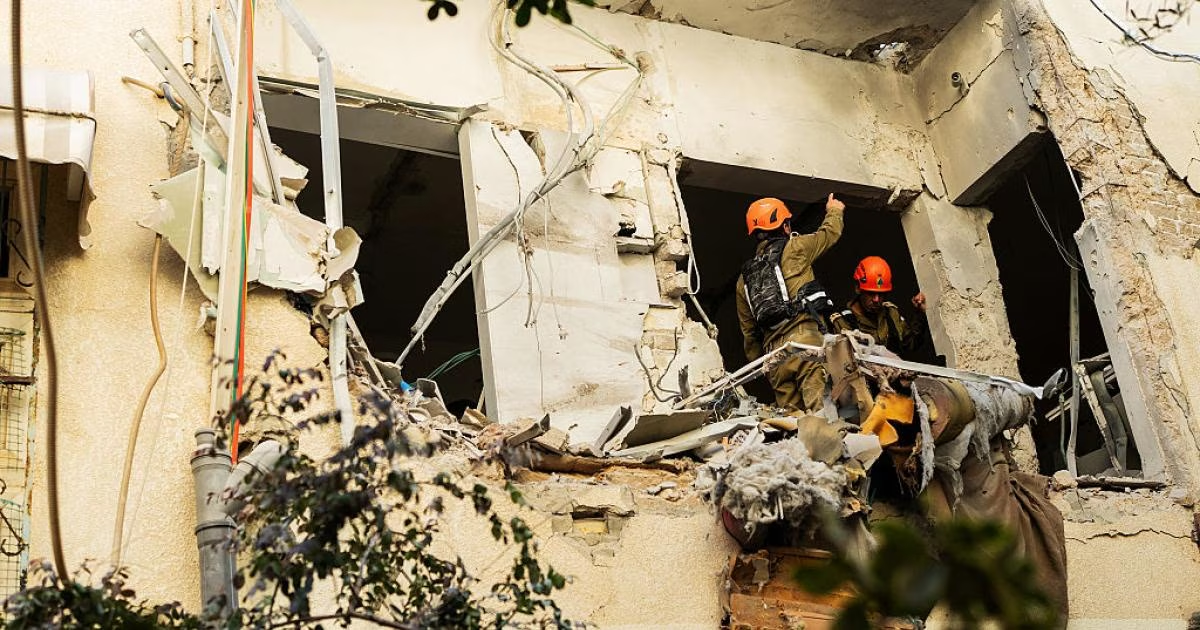
Sources observed one cluster missile hitting five different locations simultaneously, most notably in the Ramat Gan area where the submunitions created deep holes in house courtyards. Technical teams also recorded one submunition penetrating the roof of a fortified bunker, raising questions about the destructive capability of these munitions despite their small size.

Although the weight of a single fragmented submunition ranges from only 2 to 3 kilograms, its destructive impact is described as significant due to the high speed of the fragments. These explosions caused structural damage to old buildings over nine decades old, in addition to destroying private property and cars in the streets.

In a related context, sources confirmed the killing of ten settlers as a result of two conventional ballistic missiles falling on the Tel Aviv and Beit Shemesh areas. Conventional missiles are characterized by carrying warheads weighing hundreds of kilograms of explosives, leading to the complete collapse of buildings in the event of a direct hit.

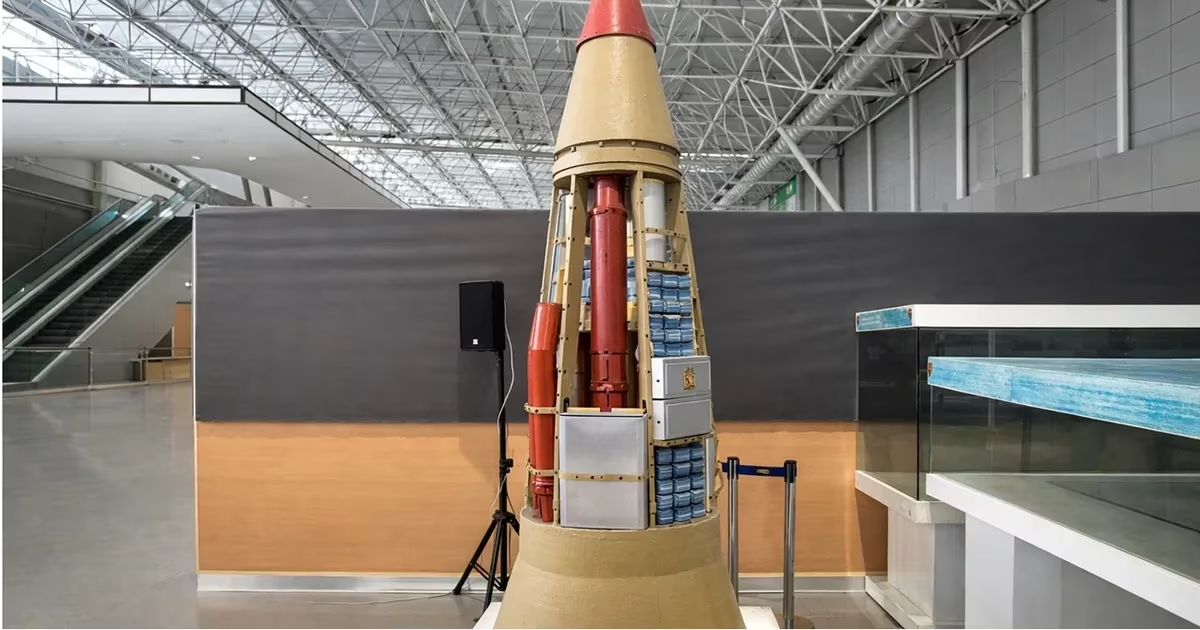
Technical reports explain the mechanism of Iranian cluster missiles, where the warhead opens at an altitude of up to 7 kilometers above ground level. This upper explosion leads to the dispersal of dozens of small munitions that cover wide areas, mimicking the effect of short-range missile barrages.

In the Gush Dan area, dozens of small craters resulting from the fall of these submunitions were observed, generating huge quantities of deadly fragments. In a remarkable incident in Tel Aviv, the force of the explosion from one of these submunitions completely dislodged a vehicle from its place and threw it a long distance.

Defense experts believe that the Iranian arsenal is increasingly relying on integrating cluster warheads into its long-range missiles directed towards the occupation. This list includes advanced 'Ghadr' and 'Emad' missiles, which possess high maneuverability and the ability to bypass defensive radars.

The danger of the 'Khorramshahr' missile stands out particularly, as reports indicate its ability to carry a warhead containing up to 80 submunitions. This qualitative development places the occupation's home front under a constant threat, making it difficult to predict where its fragments will fall or to limit their widespread destructive effects.

The cluster missile opens at an altitude of approximately 7 kilometers above ground level, causing smaller munitions to scatter and inflict widespread damage.

ARAB AND WORLD

Thu 12 Mar 2026 7:03 pm - Jerusalem Time

Financial Times: Trump faces the dilemma of difficult choices in his war against Iran

The 'Financial Times' affirmed in its editorial that US President Donald Trump faces real dilemmas in his attempt to find a way out of the war he has engaged in alongside Israel against Iran. The newspaper indicated that this conflict has put the Middle East in a state of severe turmoil, amidst the absence of a clear vision for the end.

Trump has shown striking contradictions in his statements in recent days, hinting at times at his desire to stop military operations, describing the conflict as 'completely over.' These words immediately reflected on energy markets, as the price of a barrel of oil fell below $90 after touching the $120 ceiling.

However, the calm did not last long. As soon as financial markets closed, the US President returned to adopting an aggressive and hardline rhetoric, asserting that the United States would not back down until achieving a 'complete and decisive defeat' of the enemy. Trump considered the victories achieved so far insufficient, reflecting a state of confusion in crisis management.

The newspaper believes that these fluctuations confirm the American administration's recklessness with a devastating war launched at the direct instigation of Israeli Prime Minister Benjamin Netanyahu. Trump's behavior since the beginning of the conflict has been characterized by aggression and boasting, without providing decisive answers on how to end this major military confrontation.

The White House failed to formulate a clear set of strategic objectives or to develop a post-war plan, despite talk of destroying Iran's nuclear program and ballistic arsenal. Trump also put forward ambitious goals such as changing the leadership in Tehran, similar to the Venezuelan model, and demanding unconditional surrender.

Despite continuous bombing and the assassination of Supreme Leader Ali Khamenei and an elite group of leaders on the first day, the Iranian regime showed no signs of imminent collapse. Instead, Tehran quickly appointed Mojtaba Khamenei as his father's successor, a clear indication of the regime's continuity and its ability to adapt to the blows.

Iran is currently fighting an existential battle through an asymmetric attrition strategy it had prepared for for many years, expanding the battlefronts to include Washington's allies. Iranian missiles and drones continue to target Israeli depth and vital interests in the Gulf region, leading to a partial paralysis of trade movement.

Navigation in the Strait of Hormuz has been significantly affected, forcing Gulf countries to reduce their oil and gas production to confront security threats. These countries are now bearing the brunt of the conflict, despite their prior warnings to Trump about the risks of sliding into an uncontrollable, comprehensive regional war.

On the internal Iranian front, the bet on a popular uprising to overthrow the regime during the war appears to be a losing one, as anxiety about personal safety dominates the Iranian street. The chances of a transition to a moderate government also seem very slim, as analysts predict that the disintegration of the regime would turn Iran into a failed and fragmented state.

Trump faces increasing political pressure as the midterm elections approach, with the escalating energy crisis threatening Republican chances of staying in power. Ultimately, any decision to stop the war will leave the Iranian regime weak but will give it an opportunity to claim steadfastness and a historic victory against American power.

Whatever path Trump chooses, others will pay the price for his folly towards Iran in a conflict with no happy ending.

PALESTINE

Thu 12 Mar 2026 7:03 pm - Jerusalem Time

Dead and injuries in Gaza as occupation violations of ceasefire agreement escalate

Field sources reported today, Thursday, the martyrdom of a Palestinian citizen as a result of direct gunfire by Israeli occupation forces in the town of Beit Lahia, located north of the Gaza Strip. This crime comes within a series of continuous violations of the ceasefire agreement that came into effect in October of last year, with the targeted area falling outside the temporary military control of the occupation.

Regarding the attacks in Beit Lahia, medical sources confirmed the injury of a five-year-old child with serious wounds, after being directly targeted by Israeli occupation army bullets. Hospitals also received two other injured individuals who suffered gunshot wounds to their lower extremities, with their health conditions classified as moderate as a result of this blatant assault.

Gaza City witnessed a military escalation at dawn today, represented by intense aerial and artillery bombardment targeting the eastern neighborhoods of the city, especially the areas of Al-Zaytoun, Al-Shuja'iyya, and Al-Tuffah. This bombardment coincided with intense helicopter overflights that fired their machine guns heavily towards citizens' homes, causing a state of panic among the residents who suffer the woes of the siege.

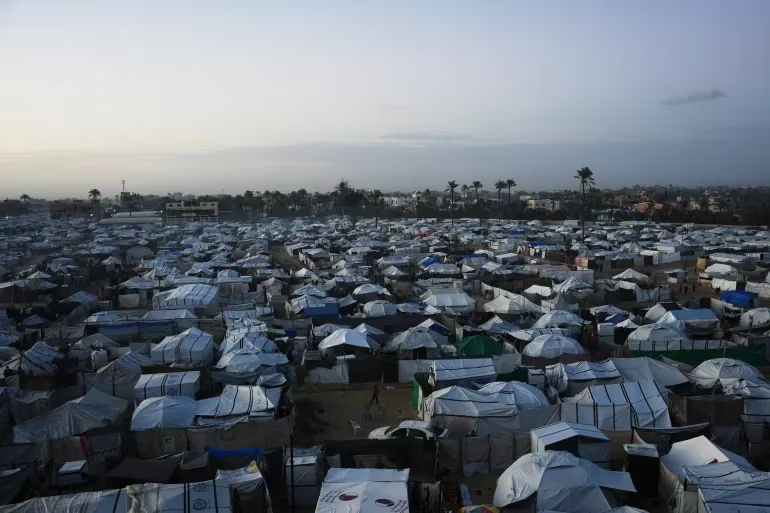
In the coastal areas, the tents of the displaced were not spared from targeting, as Israeli warships fired heavily near the coast of Al-Shati refugee camp and the fishermen's port. These systematic attacks target gatherings of displaced people who have sought refuge in tents after their homes were destroyed, exacerbating the humanitarian crisis in these overcrowded areas.

The central areas of the Strip were also subjected to concentrated artillery shelling, with several shells falling in the vicinity of Juhor ad-Dik area and northeast of Al-Bureij refugee camp. Occupation forces continue to target agricultural lands and border areas in an attempt to impose a new security reality that hinders the return of normal life for citizens in those areas.

In the southern part of the Strip, warplanes carried out two airstrikes targeting areas east of Khan Yunis city, while Al-Mawasi area northwest of Rafah was subjected to intense artillery shelling. Al-Mawasi area is considered one of the areas that shelters thousands of displaced people, making any military targeting of it a grave danger to the lives of unarmed civilians.

Official statistics indicate that the death toll from occupation violations of the ceasefire agreement since October 10, 2025, has risen to 651 martyrs and 1741 injured. These figures reflect the extent of Israeli disregard for international agreements and the continuation of the systematic killing policy against Palestinians despite the declared calm.

Regarding the total toll of the aggression that began in October 2023, relevant authorities have documented the martyrdom of 72,136 Palestinians and the injury of approximately 171,839 others with varying degrees of wounds. Civil defense and ambulance crews have also been able to recover the bodies of 756 martyrs from under the rubble and from areas of incursion since the last ceasefire agreement came into effect.

In a related context, two prisoners from the Gaza Strip were released through the Kerem Shalom crossing, while more than 9300 Palestinians remain in occupation prisons. Human rights reports confirm that prisoners face harsh conditions, including systematic torture and deliberate medical neglect, which puts their lives in real danger.

At the level of material destruction, United Nations estimates indicate that the cost of rebuilding what the occupation destroyed in the Gaza Strip exceeds 70 billion dollars. Widespread destruction has affected about 90% of civilian infrastructure, requiring immense international efforts and many years to restore life to the afflicted Strip.

The occupation army continues to commit daily violations of the ceasefire agreement, resulting in the martyrdom of 651 Palestinians since October 2025.

ISRAELI AFFAIRS

Thu 12 Mar 2026 7:02 pm - Jerusalem Time

Israeli Study Outlines Scenarios for 'Dismantling Hamas' Influence' in Gaza Through International Strategies

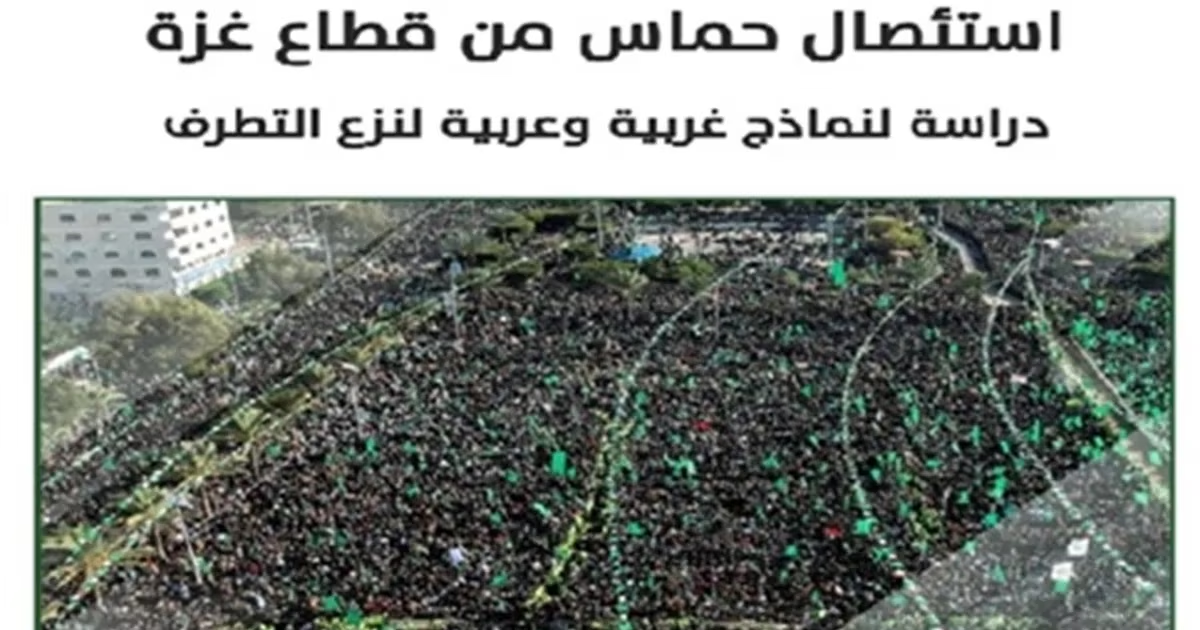
The Israeli Institute for National Security Studies (INSS) has published a new book that includes a comprehensive strategic approach to dealing with what it describes as the phenomenon of 'Hamasization' in the Gaza Strip. This study, prepared by researchers Ofer Guterman and Tara Feldman, is based on an in-depth analysis of international and Arab experiences in the fields of deradicalization and community rebuilding after armed conflicts.

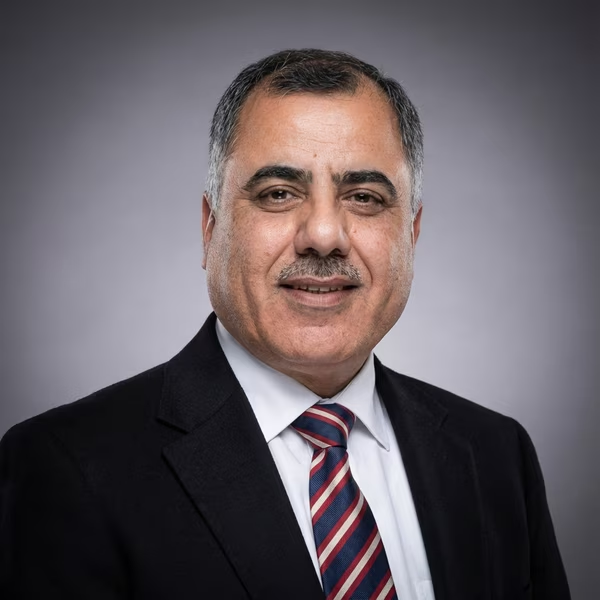
Research Note No. 253, issued in early 2026, focuses on the necessity of combining security, political, and social tools to undermine Hamas's influence. Al-Zaytouna Centre for Studies and Consultations reviewed this paper in an analytical reading presented by Dr. Nihal Al-Sheikh Khalil, clarifying the dimensions of the Israeli vision for the future of the Strip.

The study traces the roots of what it calls 'radicalism' in Gaza to historical accumulations that began with the Nakba of 1948 and developed during the period of Israeli administration after 1967. The paper considers Hamas's rise in the 2006 elections and the subsequent siege in 2007 as the most prominent stage in solidifying the movement's presence within the societal structure.

The Israeli reading emphasizes that Hamas's strength is not limited to the military aspect but extends to include a wide network of religious and charitable institutions. This social penetration makes any attempt to reduce the movement's influence a task closely linked to changing the overall economic and social environment of the Strip's residents.

The study proposes a three-level approach that begins at the individual level through intellectual and social rehabilitation programs for individuals involved in the movement's frameworks. This step aims to dismantle direct ideological ties and provide alternative paths for integration into society away from previous organizational frameworks.

At the community level, the study calls for involving families, religious leaders, and traditional social networks in formulating and disseminating an alternative discourse. Research sources believe that confronting extremist ideology requires a social incubator that rejects violence and adopts civil concepts consistent with the proposed vision for the future.

At the institutional level, the paper emphasizes the necessity of radical reforms in governance, education, and judicial systems to enhance the rule of law. This vision focuses on creating economic and political 'attraction factors' that convince residents of the viability of alternatives to the governance model provided by Hamas over the past two decades.

The study recalls historical models of deradicalization, citing the experiences of Germany and Japan after World War II as successful examples of dismantling totalitarian ideologies. It illustrates how educational and media institutions were rebuilt in those countries to ensure that old regimes would not return to power.

In contrast, the study warned against repeating the failures of other international experiences, as happened in Iraq, Afghanistan, and Bosnia and Herzegovina. The paper attributed these failures to the persistence of deep social divisions and the weakness of national institutions that were supposed to lead the process of democratic and intellectual transformation.

At the regional level, the researchers observed varying Arab approaches to dealing with Islamist movements, ranging from purely security measures to political containment. The study pointed to models in the UAE, Saudi Arabia, Egypt, and Morocco, where attempts at cultural transformation occurred through educational curriculum and religious institution reforms.

For any program in Gaza to succeed, researchers stipulate the availability of a complex political and institutional environment, starting with the formation of an interim Palestinian administration that enjoys broad regional and international support. This administration must oversee major reconstruction projects and improve the living prospects of the population to ensure their loyalty to the new system.

The study identifies four integrated pathways to ensure the sustainability of results: the security path, a clear political horizon, economic reconstruction, and social transformation. Sources believe that the absence of any of these pathways will necessarily lead to the failure of the comprehensive strategy and a return to previous conditions.

Despite the detailed proposal, the study's authors acknowledge the difficulty of implementing this strategy on the ground given the current political complexities. The institutional reality in Gaza and the field entanglements pose serious challenges that may hinder the application of the international models reviewed in the research paper.

The study concluded that the primary purpose of presenting these scenarios is to stimulate broader academic and political discussions about the 'day after' the war. These proposals remain contingent on international consensus and the ability to find a Palestinian partner capable of implementing these radical transformations in the structure of Gazan society.

Any program to reduce Hamas's influence in Gaza requires complex political and institutional conditions, including the formation of an interim Palestinian administration with regional and international support.

ARAB AND WORLD

Thu 12 Mar 2026 7:02 pm - Jerusalem Time

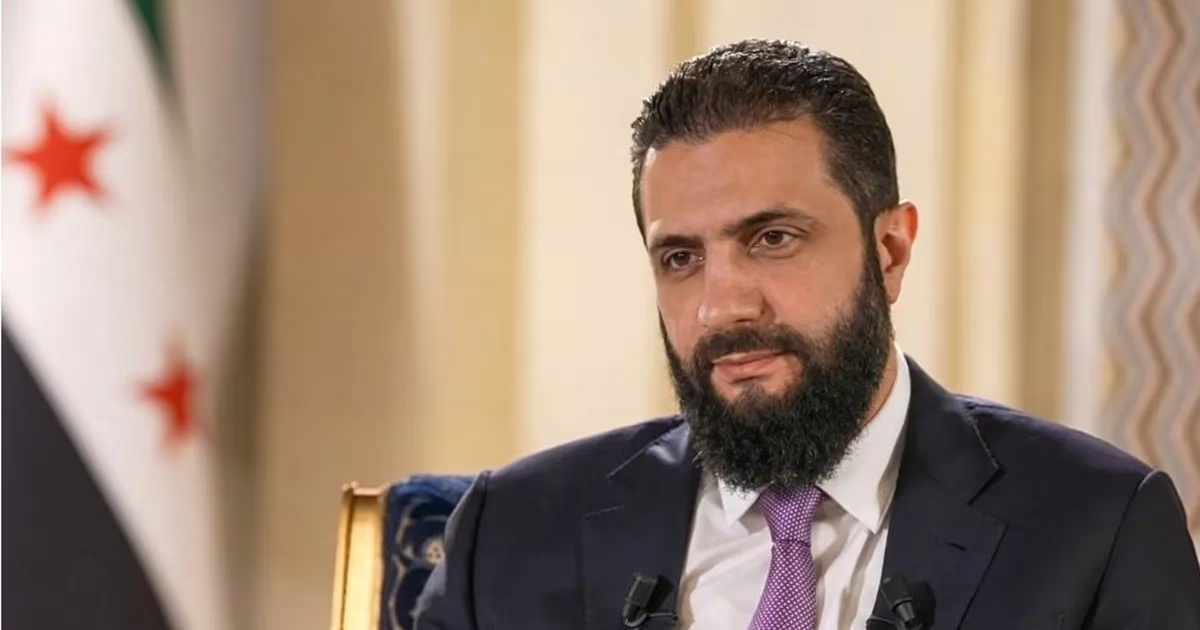
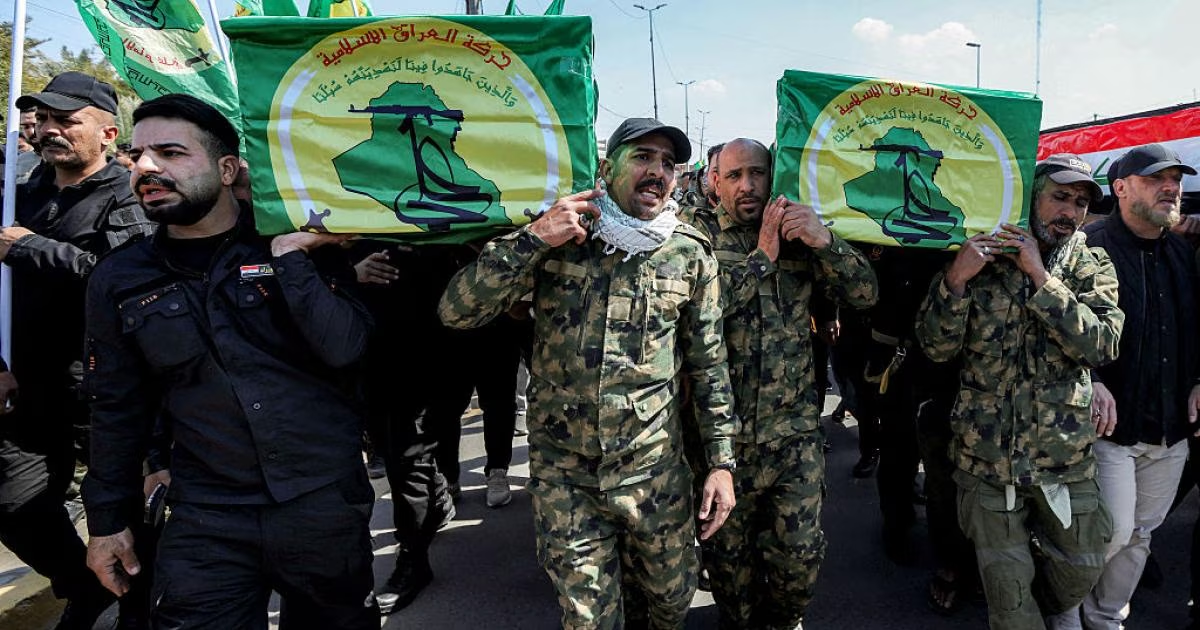
Iraqi Resistance warns Al-Sharaa against moving towards Lebanon, considers it a declaration of all-out war

The Coordination of the Islamic Resistance in Iraq, which includes an alliance of armed factions, issued a strongly worded statement addressed to Syrian President Ahmed Al-Sharaa. In its statement, the Coordination warned against any military movement targeting Lebanese territories, indicating that such a step would be met with a decisive and unprecedented response.

The Iraqi factions considered any Syrian military activity towards Lebanon as a clear declaration of war on all parties of what is known as the 'Axis of Resistance'. They stressed that this warning represents the final ultimatum to the Syrian leadership to avoid sliding into a direct confrontation that could ignite a widespread regional conflict that cannot be controlled.

The statement indicated that any hostile movement towards Lebanon, regardless of the justifications given, would be viewed as an act coordinated with international powers and the Israeli occupation. Sources confirmed that the Iraqi Resistance is closely monitoring field movements and will not hesitate to turn the region into an open battlefield if the red lines are crossed.

These developments come amid escalating regional tensions, as Iraqi factions with close ties to Iran are active within the strategy of unity of fronts. These forces have expressed their full readiness for direct military intervention if the scope of the confrontation expands to include new parties in the ongoing conflict in the region.

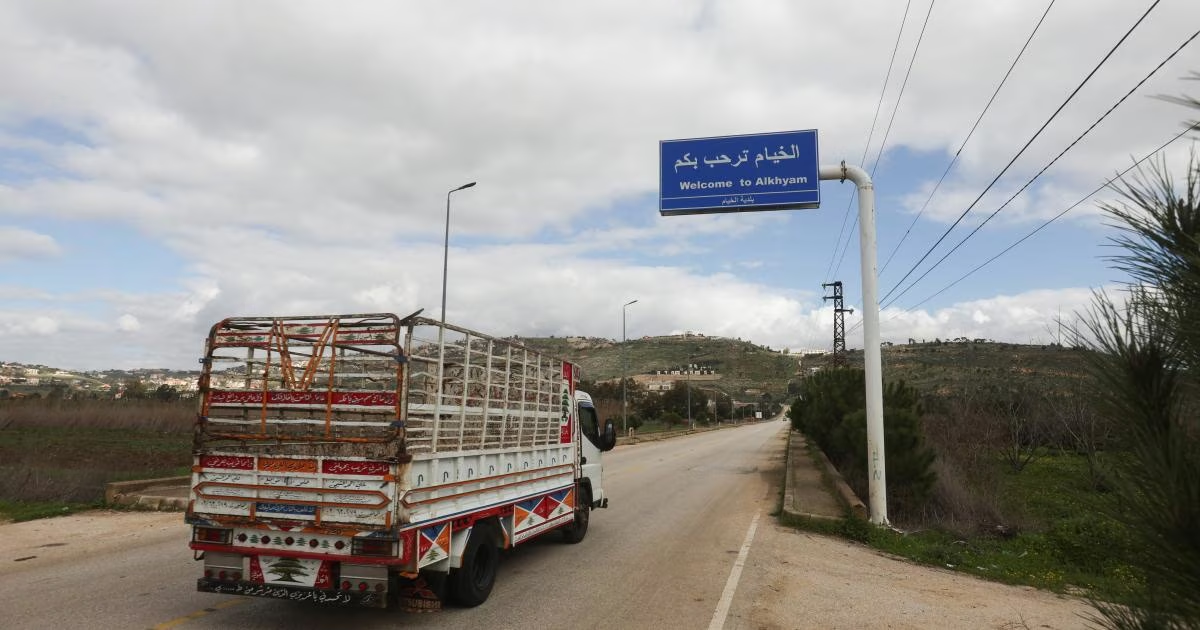
On the ground, Israeli military attacks continued in various areas of Lebanon, leading to significant human and material losses among civilians. According to data issued by the Lebanese Ministry of Health, recent raids caused a number of casualties, further complicating the security and humanitarian situation on the ground.

In a related context, the United Nations witnessed a prominent diplomatic move, as the Security Council approved a draft resolution condemning recent Iranian missile attacks. The resolution targeted condemnations related to strikes that hit Gulf countries hosting American military bases, considering them a threat to regional security and stability.

The draft resolution, submitted by the Kingdom of Bahrain on behalf of the Gulf Cooperation Council, was supported by 13 out of 15 Security Council members. In contrast, both Russia and China chose to abstain from voting, reflecting a divergence in international positions on how to deal with the recent Iranian escalation in the region.

Regional parties criticized the formula of the UN resolution, as it focused exclusively on Iranian attacks without addressing military operations carried out by the United States or Israel. Observers believed that this approach gives the resolution a unilateral character, as it ignores strikes that targeted Iranian depth and interests linked to Tehran in neighboring countries.

It is worth noting that the draft resolution received widespread support outside the Security Council, with more than 130 member states of the United Nations General Assembly endorsing it. The move came on behalf of the Gulf Cooperation Council countries, which include Saudi Arabia, the UAE, Qatar, Kuwait, and Oman, in addition to the Hashemite Kingdom of Jordan, reflecting a relative Arab and international consensus.

The region is in a state of maximum alert with the intertwining of military and political fronts, where the direct conflict between Iran and the Israeli occupation intersects with internal issues in countries such as Syria and Lebanon. International powers fear that any miscalculation on the ground could lead to a comprehensive explosion affecting energy sources and international shipping lanes.

Amid these threats, concerns arise about the transformation of Syrian territories into a launching pad for military operations that may target Lebanese depth or vice versa. Field reports confirm that armed factions in Iraq have already begun to strengthen their presence and operational coordination with their allies in the region to confront any emergency scenarios that political shifts in Damascus may impose.

For its part, the Syrian presidency did not issue an immediate official response to the threats of the Iraqi Resistance, but the political atmosphere indicates a state of cautious anticipation. The Syrian government faces increasing pressure to balance its regional and international relations in light of the rapid changes that followed recent developments in the power structure in Damascus.

On the humanitarian front, international organizations warned that the expansion of the war to directly include Iraq, Syria, and Lebanon would lead to an unprecedented catastrophe. International calls for restraint and recourse to diplomatic solutions continue, although the language of military threat has become dominant in the official discourse of conflicting factions and regional powers.

In conclusion, the scene remains open to all possibilities, awaiting what the coming days will bring in terms of movements on the ground or political initiatives behind the scenes. All eyes remain on the Lebanese-Syrian border, which has become a focal point in the escalating geopolitical conflict between major powers and their allies in the Middle East.

Any hostile movement towards Lebanese territories, whatever the pretexts, will be considered an all-out declaration of war that turns the region into an open battlefield.

ARAB AND WORLD

Thu 12 Mar 2026 7:02 pm - Jerusalem Time

Katz threatens to seize Lebanese territories, and the occupation launches deadly raids on Beirut and the South

Israeli Defense Minister, Israel Katz, announced today, Thursday, official directives to the army command to be fully prepared to expand the scope of military operations over Lebanese territories. These statements came in the context of a direct threat to seize geographical areas within Lebanon, under the pretext of stopping the rocket attacks carried out by Hezbollah towards northern settlements.

Katz confirmed in an official statement issued by him that, in coordination with Prime Minister Benjamin Netanyahu, the army has been put on alert to carry out broader ground operations aimed at what he described as 'restoring security' to the border areas. The minister indicated that Israel will not be content with defense, but will move to the stage of imposing field control if threats from across the border continue.

In the context of political warnings, Katz sent a strongly worded message to the Lebanese government, demanding it impose its sovereignty and prevent Hezbollah from launching rockets. He warned that if the Lebanese state is unable to control its territories, Israeli forces will take on this task themselves through direct incursion and field control.

For its part, Hebrew media sources revealed that Tel Aviv conveyed threats through Western diplomatic channels and American mediation, hinting at bombing Lebanese government infrastructure. These pressures come in an attempt to push the government in Beirut towards taking strict measures to curb the military operations led by Hezbollah against Israeli targets.

On the ground, the occupation army admitted to being subjected to one of the largest rocket barrages since the escalation began, with Hezbollah launching about 200 rockets during Wednesday night and Thursday dawn. Military sources described this batch as 'the largest,' reflecting a qualitative escalation in the open military confrontation between the two sides along the Blue Line.

Regarding human casualties, Lebanese medical sources reported the martyrdom of 17 people and the injury of at least 32 others as a result of a series of airstrikes that targeted various areas. The intense Israeli strikes focused on the capital Beirut and its southern suburbs, in addition to towns in the South and the Beqaa in the eastern part of the country.

Al-Ramleh Al-Baida area in the heart of the capital Beirut witnessed a horrific massacre, where an Israeli raid led to the martyrdom of 8 citizens and the injury of 31 others with varying degrees of wounds. The raids also targeted the town of Aramoun south of Beirut, resulting in the martyrdom of 3 people, including children, as part of the occupation's targeting of densely populated residential areas.

In southern Lebanon, an occupation drone targeted a civilian car in the town of Deir Antar in the Bint Jbeil district, which led to the immediate martyrdom of one of the passengers. The town of Barish in the Tyre district was also subjected to a violent airstrike that killed 3 people, while search operations continued for missing persons under the rubble in several targeted sites.

The airstrikes extended to include the Beqaa region in eastern Lebanon, where warplanes targeted the towns of Qasr Naba, Duris, and Ain Bourdai in the vicinity of Baalbek city. Despite the intensity of the bombing and the destruction of a number of facilities and homes, there were no immediate reports of casualties in those areas, amidst a state of widespread displacement of residents.

In the Bint Jbeil district, the occupation intensified its raids on the towns of Yater, Haris, and Kafra, where warplanes carried out successive raids targeting residential neighborhoods and agricultural lands. These developments come amidst a deteriorating humanitarian situation, with the Lebanese Ministry of Health continuing to update the numbers of victims falling due to the continuous shelling around the clock.

I instructed the Israeli army to prepare to expand operations in Lebanon and to restore calm and security to the northern communities, and we will take control of territories ourselves if the Lebanese government does not prevent Hezbollah's threats.

PALESTINE

Thu 12 Mar 2026 7:02 pm - Jerusalem Time

Injuries, including a child, in occupation attacks on Gaza and rising death toll

Medical and field sources reported that three Palestinian citizens, including a child not exceeding five years old, were injured as a result of direct gunfire by Israeli occupation forces in the town of Beit Lahia, north of the Gaza Strip. The sources clarified that the child's condition was described as serious, while the other two suffered gunshot wounds to their lower extremities and were transferred to the hospital for treatment amidst complex health conditions in the northern part of the Strip.

The early hours of Thursday witnessed an intense military escalation, as occupation aircraft and artillery carried out a series of raids targeting the eastern neighborhoods of Gaza City. The shelling focused on the Shuja'iyya, Zeitoun, and Tuffah areas, coinciding with intensive helicopter flights that fired their machine guns at citizens' homes and properties in those populated areas.

Offshore, Israeli warships continued to target the Palestinian coast, firing heavily near Al-Shati refugee camp and the fishermen's port. The shelling also hit the tents of displaced people scattered in the coastal area, causing panic among families who had sought refuge in those areas in search of safety lost since the beginning of the aggression.

The central areas of the Strip were not spared from targeting, as Israeli artillery shelled areas east of Juhor ad-Dik and northeast of Al-Bureij refugee camp with heavy shells. These military movements come amidst a temporary control by the occupation army over some axes under ceasefire understandings that have not prevented the continuation of field aggressions.

In the southern part of the Strip, warplanes launched airstrikes inside what is known as the 'Yellow Line' east of Khan Yunis city, coinciding with artillery shelling that targeted the Al-Mawasi area. The 'Yellow Line' is known as a hypothetical boundary to which the occupation army temporarily withdrew, separating its controlled areas from areas where Palestinians are allowed to be present, but it witnesses repeated violations.

On the statistical front, the Ministry of Health in the Gaza Strip announced a new update on the toll of victims of the ongoing genocide war since October 2023. The ministry stated in its statement that the number of martyrs has risen to 72,136, while the number of injured has reached 171,839, in one of the largest humanitarian disasters in modern history.

Medical reports indicated that hospitals received one martyr and nine injured during the past 24 hours due to the ongoing aggressions. With this update, the toll of victims of ceasefire violations, which has been in effect for months, rises to 651 martyrs and 1741 injured, posing significant field challenges to the agreement amidst continued targeting.

Furthermore, the Ministry of Health revealed that specialized teams have been able to recover the bodies of 756 martyrs from under the rubble and from various areas since the ceasefire came into effect. These figures reflect the massive destruction caused by military operations, as many bodies are still missing under the debris of destroyed homes that were previously inaccessible.

It is worth noting that this tragic reality comes two years after a comprehensive war launched by the occupying state with widespread American support, which led to the destruction of about 90% of the infrastructure in the Strip. UN reports estimate the cost of rebuilding what the occupation destroyed at about 70 billion dollars, amidst a suffocating humanitarian and economic crisis afflicting the residents of the besieged Strip.

The toll of victims of ceasefire violations has risen to 651 martyrs and 1741 injured since the agreement came into effect.

ARAB AND WORLD

Thu 12 Mar 2026 7:02 pm - Jerusalem Time

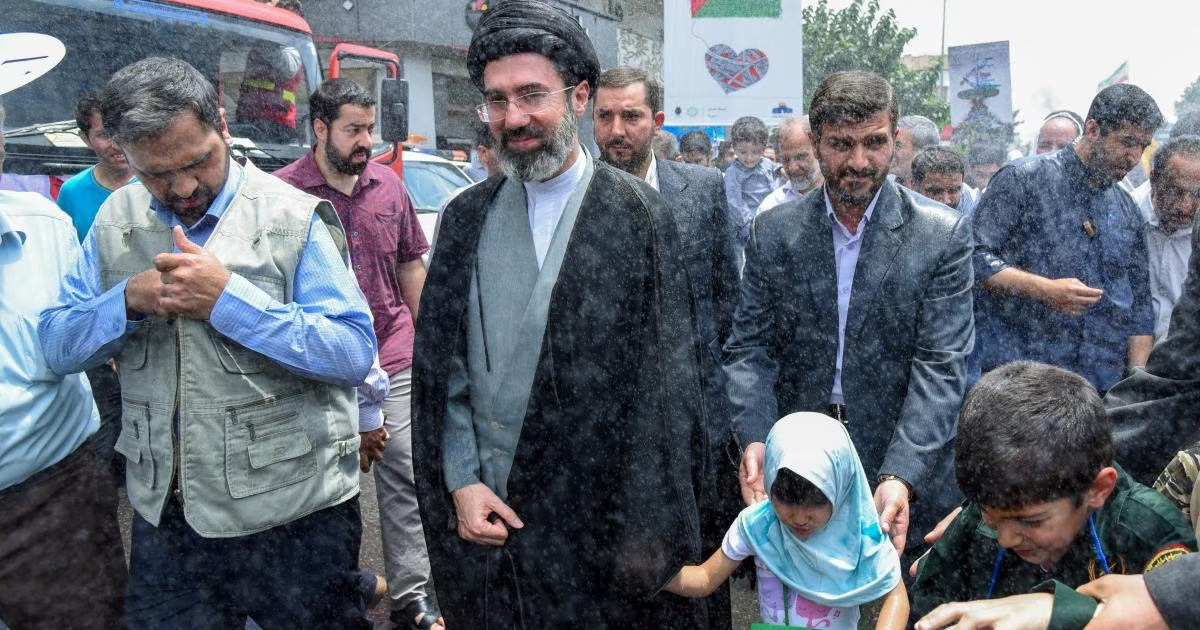
In his first speech... The new Iranian leader vows revenge and calls for the closure of the Strait of Hormuz

In his first official appearance after assuming his position, the new Iranian leader, Mojtaba Khamenei, delivered a firm message via state television, in which he stressed the cohesion of the Iranian state and its success in thwarting attempts at division that targeted the country, while at the same time calling on all segments of the people for national unity to face the current challenges.

On the military front, Khamenei affirmed that Tehran is committed to its right to respond to assassinations and targeting of its symbols, indicating that Iranian military operations will continue and will focus exclusively on military bases in the region. He also issued a direct warning about the necessity of the immediate dismantling of all American bases, considering their presence a legitimate target for attacks if they continue.

Regarding international navigation, the new leader put forward an escalatory vision by announcing the necessity of keeping the Strait of Hormuz closed, describing this step as a strategic and effective pressure card against adversaries. In parallel with these threats, Khamenei tried to reassure the regional environment by affirming that Tehran seeks to build friendly relations with neighboring countries and that it harbors no intentions to target its surrounding countries.

Iran will not refrain from avenging the blood of its martyrs, and the Strait of Hormuz will remain closed as a tool of pressure on the enemy.

ARAB AND WORLD

Thu 12 Mar 2026 7:02 pm - Jerusalem Time

Widespread Escalation: Israeli Raids Target Iranian Nuclear Facilities, Tel Aviv Announces Casualty Toll

The Israeli army announced today, Thursday, the launch of a large-scale military operation targeting various areas deep within Iran, as the direct confrontation entered its thirteenth day. Military sources confirmed that the raids primarily focused on what they described as infrastructure belonging to the Iranian regime, in a move aimed at undermining military capabilities and supply routes.

In a significant development, the military statement revealed the targeting of the 'Taleqan' site located within the Parchin military complex southeast of the capital Tehran, indicating that this site was used for developing technical capabilities related to the nuclear program. These strikes come in the context of Tel Aviv's declared attempts to disrupt any Iranian progress in the field of unconventional armament.

On the other hand, the Israeli Ministry of Health revealed updated data on the extent of casualties among Israelis since the outbreak of the current war. The ministry clarified that the total number of injured reached 2745 people, with 85 of them still receiving medical care in emergency departments and various hospitals as a result of the continuous rocket barrages.

According to the health report, the medical condition of the injured varies between serious and moderate, with 11 injured in critical condition and 10 others in moderate condition. Statistics also indicated that the past twenty-four hours alone saw 179 injured admitted to hospitals, including cases suffering from psychological trauma and panic due to the explosions.

Regarding human casualties, the Institute for National Security Studies at Tel Aviv University reported the killing of 14 Israelis since the start of the joint military escalation between Israel and the United States against Iran. Despite these figures, observers doubt their accuracy, suggesting that the actual numbers are higher given the strict military censorship imposed on the media.

For its part, Haaretz newspaper highlighted the effectiveness of the Iranian response, confirming that the rocket shelling resulted in warheads and cluster munitions falling in more than 60 different locations within the greater Tel Aviv area. These attacks caused extensive material damage in urban areas, raising questions about the efficiency of air defense systems in countering modern drones and missiles.

The roots of this round of conflict date back to February 28, when Israeli and American forces began a widespread aggression targeting security leaders and vital facilities in Iran. These initial attacks resulted in the deaths of hundreds, prompting Tehran to respond by launching successive waves of ballistic missiles and drones towards Israeli targets.

The Iranian response was not limited to inside Israel but also extended to targeting US sites and interests in several Arab countries in the region. These operations resulted in casualties and damage to civilian facilities, which was met with widespread condemnation from the countries that witnessed these attacks, demanding the necessity of stopping the escalation and sparing the region the ravages of a comprehensive war.

Field reports indicate that the Israeli army relies on accurate intelligence in its current raids to try to paralyze the movement of the Iranian Revolutionary Guard. However, the continued falling of rockets on vital centers in Israel puts the government under increasing internal pressure to provide protection for settlers and secure the home front, which is suffering from partial paralysis.

Amidst this complex scene, international parties continue their warnings of the region sliding into an uncontrollable regional conflict, especially with the targeting of facilities related to the nuclear program. The death and injury toll remains likely to rise with the continuation of mutual airstrikes and the absence of any prospect for diplomatic de-escalation at present.

The air force attacked an additional site within the Iranian nuclear program, the Taleqan site, which was used to develop vital capabilities in the field of nuclear weapons.

PALESTINE

Thu 12 Mar 2026 7:01 pm - Jerusalem Time

Three Palestinian Films on the Oscar Shortlist: Has the Cultural Siege in Hollywood Been Broken?

The Palestinian narrative has long faced immense challenges in reaching global screens, especially in Hollywood, which for decades remained a closed space for narratives from the Middle East. As the 98th Academy Awards ceremony approaches, the cinematic scene appears to be undergoing an unprecedented historical transformation with three Palestinian films making it to the awards shortlist at once.

This intense presence raises fundamental questions about the beginning of the breaking of the cultural siege that has surrounded the Palestinian cause in global cinema for many years. After a journey that began with the film 'Divine Intervention' in 2003, and continued with Hany Abu-Assad's nominations for 'Paradise Now' and 'Omar', leading to the win of 'No Other Land' in 2025, it seems that 2026 represents the peak of this creative accumulation.

Leading the scene is the film 'The Voice of Hind Rajab' by Tunisian director Kaouther Ben Hania, which is nominated for Best International Feature Film. The film is based on a real tragedy that shook global conscience in January 2024, documenting the last moments of the child Hind Rajab through real audio recordings of her calls with Palestinian Red Crescent crews.

Ben Hania managed to transform this painful memory into a universal cinematic testimony that condemns violence and champions humanity, which led the film to receive an exceptional reception at the Venice Film Festival. The audience stood applauding the work for 23 continuous minutes, one of the longest applause periods in the history of the prestigious festival, expressing deep emotional impact from the story.

The second film, 'Palestine 36' by director Annemarie Jacir, takes viewers back to a pivotal historical era: the Great Palestinian Revolt against the British Mandate. This work is considered one of the largest Palestinian cinematic productions, highlighting the roots of the conflict and the colonial role in shaping the contemporary reality of the region.

The production of 'Palestine 36' faced major on-the-ground challenges, as the crew had to move filming from the West Bank to Jordan due to the outbreak of war in October 2023. Despite these difficulties, the film succeeded in garnering widespread international acclaim, especially at the Toronto Film Festival, despite Israeli attempts to restrict it, which included raiding its screenings in occupied Jerusalem.

The third film in this race is 'The Remainder' by director Shireen Dabees, which presents a human epic spanning three generations of Palestinians. The work traces the journey of a Palestinian family from the Nakba of 1948 until the late 1980s, illustrating how collective memory and identity are transmitted across decades despite displacement and refuge.

As with the other films, Dabees had to move filming locations to Cyprus, Greece, and Jordan due to security conditions in Palestine. The director considered that the arrival of these films collectively to global awards platforms reflects a belated but necessary international recognition of the importance of Palestinian stories and their ability to touch the human conscience.

Beyond the artistic aspect, these films fought a fierce battle in the distribution corridors within the United States, where major Hollywood companies preferred to avoid these politically controversial works. This reluctance pushed filmmakers to collaborate with independent distribution companies such as 'Willla' and 'Watermelon Pictures' to ensure the narrative reached the American audience.

These distribution difficulties reflect the fragility of Palestinian cinema's presence on major digital platforms, especially after the incident of removing dozens of Palestinian films from the 'Netflix' platform in 2024. Nevertheless, the insistence on being present in independent cinemas and festivals has contributed to creating a new cinematic awareness towards the issue.

In the face of these challenges, widespread solidarity campaigns emerged from Hollywood's A-list stars, who decided to break the silence and openly support Palestinian cinema. The 'Talking Palestine 36' campaign saw the participation of prominent names such as Mark Ruffalo, Susan Sarandon, and Riz Ahmed, which gave additional momentum to these films among voters.

This support from international stars reflects a radical shift in the internal discussion in Hollywood, where talking about Palestinian rights has become more acceptable and common. Artists no longer fear expressing their humanitarian stances towards the Middle East, which has helped highlight the artistic and aesthetic value of these cinematic works.

Indeed, the numbers for the 2026 season speak of an unprecedented breakthrough; the presence of three films on the shortlist in one year is an achievement that surpasses everything achieved in the past two decades. This development indicates that the Palestinian narrative is no longer just a fleeting 'exception' at festivals, but has become an authentic and established voice at the heart of the industry.

In conclusion, the arrival of these films to the 'Dolby' stage in Hollywood remains a victory in itself, regardless of the final results of the awards distribution. The mere presentation of these stories on the highest global cinematic platform means that the cultural siege has begun to crumble before the power of art and its ability to convey human truth from the heart of suffering.

The Oscar nomination is not about me personally as much as it is about the child who has become a human symbol for the story the film tells.

ARAB AND WORLD

Thu 12 Mar 2026 7:01 pm - Jerusalem Time

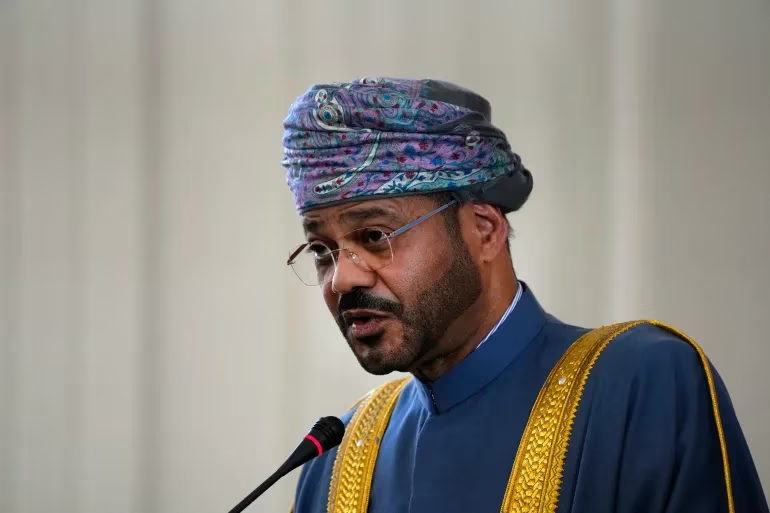
Sultanate of Oman: We will not normalize with Israel and will not join the "Peace Council"

Oman's Foreign Minister Badr Al Busaidi affirmed on Wednesday that his country will not normalize with Israel and will not join the "Peace Council," stressing that the current war's "goal is to weaken Iran, reshape the region, push for normalization, and prevent the establishment of a Palestinian state." He also predicted that the war would stop soon, but emphasized the "necessity of preparing for the worst-case scenarios."

During a meeting with editors-in-chief of local newspapers, Al Busaidi said that "the Sultanate of Oman will not join the Peace Council, and will not normalize with Israel," affirming that his country's stance on regional issues is firm, according to what was reported by Oman newspaper.

In his reading of the background of the American-Israeli war against Iran, Al Busaidi believed that its true goal "is not limited to the nuclear file but goes beyond that to weakening Iran, reshaping the region, pushing for normalization, in addition to preventing the establishment of a Palestinian state, and weakening everyone who supports the project."

Targeting the Region

The Omani minister pointed to "a broader scheme targeting the region," clarifying that Iran is not the only target in it, and that "many regional parties realize this, but they are betting that accommodating the United States may lead it to modify its decisions and orientations."

Al Busaidi believes that the United States "would not have obtained greater concessions from Iran through war than those achieved through negotiation." He noted that the recent negotiations reached advanced stages, which included "Iran's commitment not to possess nuclear material that could produce a bomb, with a commitment not to accumulate or store enriched materials, and to convert existing stockpiles into fuel that cannot be returned to its previous state."

The Omani minister explained that the American and Israeli attacks on Iran "threaten to harm the legal framework that has provided protection and stability to the countries of the region for decades."

He also stressed that the Sultanate of Oman "is firm on the principles of its foreign policy despite the dangerous transformations the region is witnessing," noting that Muscat "continues to work to stop the war and return to the path of diplomacy."}

OPINIONS

Thu 12 Mar 2026 7:01 pm - Jerusalem Time

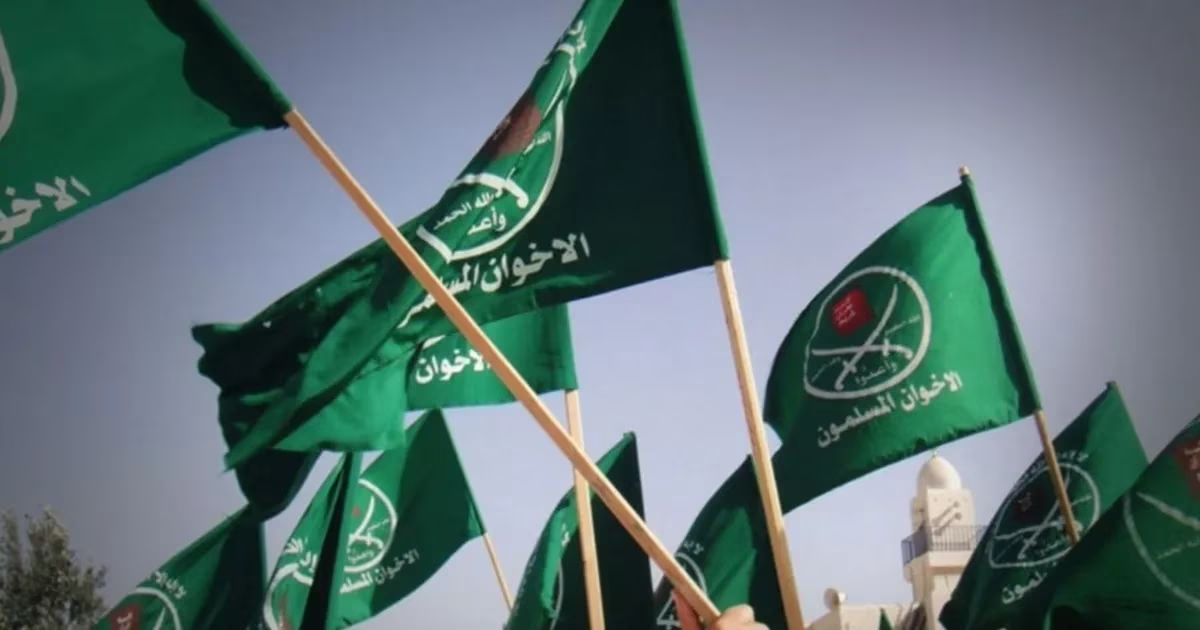
The Muslim Brotherhood and the Stalling of the Arab Renaissance: A Reading of Methodological Transformations Between Al-Banna, Qutb, and Al-Hudaybi

Ramallah - "Al-Quds" Dot Com

Ramallah - "Al-Quds" Dot Com

Opinion Writer

The Muslim Brotherhood was launched in 1928 as a project aimed at restoring the Islamic Caliphate, which had fallen four years prior. Its founder, Hassan al-Banna, established a methodology focused on building a comprehensive Muslim individual, combining spirit, mind, and body. This emergence coincided with a wide intellectual movement in the Islamic world that discussed the repercussions of the absence of religious political authority, and Muhammad Rashid Rida's book 'The Caliphate' was one of the most prominent pillars of this movement.

The group's relationship with the authorities during Al-Banna's era was characterized by flexibility and a demand for gradual reform. The Brotherhood engaged in educational and economic work and participated in parliamentary elections. At the same time, Al-Banna did not hesitate to send firm messages to heads of government, such as Mustafa El-Nahhas, demanding the abolition of usurious laws and the reform of the banking system in accordance with Islamic Sharia, warning of a 'Quranic revolution' if popular demands were ignored.

Al-Banna identified two strategic dangers facing the Egyptian state: the British military occupation and the Zionist project in Palestine. This prompted him to establish the 'Special Secret Apparatus' as a military arm to confront these challenges. The group succeeded in gaining a broad popular base that enabled it to compete with the venerable Wafd Party, and even force it to negotiate with them to form electoral alliances in several regions.

The Brotherhood played a pivotal role in confronting the currents of Westernization and Pharaonic tendencies led by intellectuals such as Taha Hussein and Abbas Mahmoud al-Aqqad. These intellectuals were later forced to appease the rising Islamic current by writing books about Islamic figures. This influence was further embodied in their field participation with fighting battalions during the 1948 Palestine War, which raised the group's political and popular standing to an unprecedented level.

The results of the 1948 war and the establishment of the occupation state led to a radical shift in the Egyptian government's dealings with the Brotherhood. Arrest and confiscation campaigns began, culminating in the assassination of Hassan al-Banna in 1949 and the banning of the group. With Hassan al-Hudaybi assuming the position of General Guide in 1951, he made decisive decisions to abolish the secret apparatus and emphasize that the group was a da'wah (preaching) and educational organization that rejected violence and secrecy in political work.

Egypt witnessed rapid events in the early 1950s, starting with the abrogation of the 1936 treaty and the outbreak of the Cairo Fire, leading to the July 1952 coup led by Gamal Abdel Nasser. Despite initial agreement, a major clash soon occurred after the assassination attempt on Abdel Nasser in 1954, which led to the imprisonment of Brotherhood leaders and the execution of some of them, and the emergence of a new ideology within the prisons led by the writer and thinker Sayyid Qutb.

Sayyid Qutb's writings, most notably 'In the Shade of the Quran,' came as a direct reaction to the Nasserist regime's tendencies, which sought to consolidate Arab nationalism, secularism, and Marxist socialism. Qutb considered these ideologies to represent 'modern jahiliyyah' (ignorance/paganism) that sought to distance religion from life, emphasizing that a Muslim's true identity is their creed, and that ruling by what Allah has revealed became an individual obligation to restore the nation's identity.

Qutb proposed the concept of the 'believing vanguard' that must emotionally isolate itself from the jahili society to build a solid base capable of change, which sparked widespread debate about the idea of 'excommunicating society.' Analysts believe that Qutb's soaring literary language contributed to the ambiguity of some of his concepts, opening the door to extremist interpretations by groups that later emerged from the Brotherhood's fold, such as 'Takfir wal-Hijra.'

In contrast, Guide Hassan al-Hudaybi countered these ideas through his famous book 'Preachers, Not Judges,' refuting the arguments for excommunication and setting strict jurisprudential conditions for judging individuals. Al-Hudaybi emphasized the need to distinguish between criticizing the political system and excommunicating society, stressing that the group's mission is da'wah and guidance, not issuing judicial rulings on people's faith.

This intellectual divergence between Qutb and Al-Hudaybi created a silent division within the group's ranks. Al-Hudaybi's attack on Qutb's writings limited their organizational benefit within the Brotherhood. Nevertheless, Qutb's ideas remained an inspiration for many jihadist movements outside the official framework of the group, which adopted the concepts of separation and jahiliyyah in a more radical and confrontational manner with the state and society.

The author believes that the stalling of the Brotherhood's renaissance project is due to the failure of the subsequent leadership to integrate the organizational structure established by Al-Banna with the precise political diagnosis of the Nasserist reality provided by Qutb. While Al-Hudaybi adhered to traditional da'wah work, the new reality required a development in the tools of intellectual and political confrontation with a system that adopted material socialism and secular nationalism.

Sayyid Qutb's use of the term 'jahili society' instead of 'umma' (nation) led him into linguistic and jurisprudential problems, as the umma in the Quranic concept is not excommunicated as a whole. The accusations of excommunication could have been avoided if the discourse had focused on 'jahiliyyah of governance' as a political and legislative system, instead of generalizing the term, which in the minds of some extended to peoples and individuals.

Sayyid Qutb succeeded in diagnosing the deviations that marred the Nasserist experience, especially in aspects of class struggle and fighting what was called 'religious reactionism.' However, this diagnosis did not find a disciplined activist path within the group due to fears of sliding into violence, leaving the field open for individual interpretations and sub-groups that adopted violence as a means of change.

In conclusion, the experience of the Muslim Brotherhood in Egypt remains a model for the major transformations that swept through Islamic movements in the twentieth century, between the ambitions of comprehensive establishment and the pressures of security persecution. The debate surrounding Sayyid Qutb's legacy and Hassan al-Hudaybi's methodology remains a fundamental axis for understanding the crisis of contemporary Islamic political thought and its ability to adapt to the modern nation-state.

The Muslim Brotherhood will declare a comprehensive Quranic revolution if governments do not accelerate the necessary reforms.

PALESTINE

Thu 12 Mar 2026 7:01 pm - Jerusalem Time

Settlers set fire to a mosque in Nablus, and the occupation launches a wide arrest campaign in the West Bank

Groups of extremist settlers attacked the village of Duma, south of Nablus city, at dawn today, Thursday, where they set fire to the entrance of the village mosque and spray-painted racist slogans in Hebrew on its outer walls. This crime comes in the context of a systematic escalation targeting Islamic holy sites in the occupied West Bank, coinciding with the holy month of Ramadan.

Local sources reported that the villagers, with the support of civil defense crews, were able to control the fire and prevent it from spreading to the main prayer hall inside the mosque. Despite the quick response, the fire caused clear material damage to the outer gate, and the dense smoke also damaged parts of the carpets and disfigured the interior facades.

For his part, anti-settlement activist Suleiman Dawabsheh confirmed that the settlers infiltrated under the cover of darkness to carry out their assault, leaving behind drawings of the Star of David and incitement slogans. He explained that this attack is not the first of its kind, but rather falls within a series of violations aimed at intimidating residents and pushing them to leave their lands for the sake of settlement expansion.

In an official reaction, the Palestinian Ministry of Endowments and Religious Affairs warned of the danger of the increasing attempts to burn mosques, considering them part of a strategic plan to undermine the Palestinian presence. The ministry linked these field attacks to the continued closure of Al-Aqsa Mosque by the occupation authorities and the restriction of worshippers since late last February, under the pretext of a state of emergency.

On the ground, Israeli occupation forces launched a wide raid campaign in several cities in the West Bank, resulting in the arrest of at least 19 citizens, including a child and a released prisoner. These operations focused on Nablus, Tulkarm, Qalqilya, and Hebron, where they included storming homes, vandalizing their contents, and conducting field investigations with dozens of young men before releasing some of them.

In the town of Beita, south of Nablus, army forces have been continuing a wide military operation since the early morning hours, which included converting a number of residential homes into military barracks and observation points. Field sources indicated that occupation soldiers subjected entire families to harsh interrogations, in a move described by human rights activists as falling within the policy of collective punishment practiced against Palestinian villages and towns.

Official statistics indicate a sharp escalation in the pace of violence since October 2023, where settler attacks alone have led to the martyrdom of 42 Palestinians. According to the Wall and Settlement Resistance Commission, the total number of victims of occupation and settler attacks in the West Bank has exceeded 1125 martyrs, while the number of arrests has reached record figures, close to 22,000 cases of arrest.

These attacks are part of a systematic plan by settlers to control Palestinian land by undermining the security and steadfastness of citizens.

ISRAELI AFFAIRS

Thu 12 Mar 2026 7:01 pm - Jerusalem Time

Israeli Writer Attacks Netanyahu and Trump's 'Obsession': They Are Dragging the Region into a Deranged War

Prominent Israeli journalist, Uri Misgav, launched a scathing attack on Israeli Prime Minister Benjamin Netanyahu and US President Donald Trump, considering them to be leading the region towards a comprehensive and insane confrontation. In an article published by 'Haaretz' newspaper, Misgav described the two leaders as narcissistic and burdened by deep political and judicial crises, which drives them to make decisions completely detached from the on-the-ground and strategic reality.

Misgav considered the current Israeli government to be the most fundamentalist and anti-democratic in the country's history, yet its leaders do not hesitate to lecture others on democracy. He pointed out that the current military leadership has transformed into an obedient technocratic tool that executes orders and uses excessive force without restraint, in the complete absence of any clear strategic horizon to end the continuous bleeding.

Even the new US Secretary of Defense, Pete Hegseth, did not escape the writer's criticism, who described him as a 'war minister' coming from the Fox News benches, referring to his controversial background and association with the far-right. Misgav believes that the presence of figures like Hegseth in Washington, and Israel Katz in Tel Aviv, reflects a deterioration in the standards of security and political competence in favor of narrow personal and partisan loyalties.

Misgav described the current military operations as a 'luxury war' managed from the sky through intense aerial bombardment in open corridors that face no real threats, but whose exorbitant price is paid by civilians. He affirmed that the bombing targeting vital facilities and schools in the region serves only the agenda of escalation, while the real 'cannon fodder' remains the residents of the region in Israel, Gulf states, Lebanon, and Iran.

Misgav criticized the contradiction in the political discourse of Netanyahu and Trump, who encourage the Iranian people to revolt against their regime, while at the same time raining bombs on their country targeting oil tanks and vital facilities. He believes that this contradiction reflects the absence of a real vision for what is called 'changing the face of the Middle East,' turning it into an empty slogan that covers up the failure to achieve tangible goals.

Regarding the management of the war, the article indicated that objectives change daily according to Trump's whims and improvised statements, while Netanyahu hides behind recorded messages and refuses to face real journalism. Promises have shifted from 'destroying the nuclear program' and 'eliminating Hezbollah' to merely 'postponing threats' or 'damaging capabilities,' formulas that reflect the inability to achieve 'absolute victory.'

Misgav warned against a repeat of the 'Lebanese quagmire' scenario, pointing out that the Israeli leadership sells illusions to the public about eliminating threats for generations, then returns to demand they stay in shelters for many months. He strongly criticized the pumping of billions of shekels from the budget deficit to the army, settlers, and Haredim, at the expense of the struggling economy and public services suffering from collapse.

Misgav concluded his article by expressing his exasperation with the 'lies of the Israeli leadership' that promotes the continuation of the war until upcoming holidays without a clear timeline. He stressed that this confrontation, which he calls 'the roar of the deranged,' aims only to serve the leaders' survival in their positions, warning that the price will be a new sinking into endless regional crises, and the loss of opportunities for normal life that society aspires to.

This war has one name for me: the roar of the deranged; a war into which Israel and the United States were plunged by two men detached from reality.

PALESTINE

Thu 12 Mar 2026 7:00 pm - Jerusalem Time

Indonesia links sending its forces to Gaza to the effectiveness of the 'Peace Council' and Palestinian interests

Indonesian Defense Minister, Shafrie Shamsuddin, affirmed that his country's participation in any international security force within the Gaza Strip is contingent on developments within the 'Peace Council'. The minister clarified in press statements that Jakarta has completed its logistical and human preparations to deploy approximately eight thousand soldiers, who will be deployed in specific time phases, noting that the commitments of other countries participating in the international force came with fewer numbers than the Indonesian contribution.

In a related context, the spokesperson for the Indonesian presidency, Prastiyo Hadi, revealed that a round of anticipated negotiations will take place before the completion of a payment of one billion US dollars, which is the amount required to obtain permanent membership in the Council. These diplomatic moves come at a time when Jakarta is seeking to ensure that its financial and military contribution has a real impact on regional stability and the support of legitimate Palestinian rights.

Indonesian President, Prabowo Subianto, had previously hinted at the possibility of a complete withdrawal from the 'Peace Council', established by the US administration, if it became clear that this entity does not provide tangible benefits to Palestinians. The government statement stressed that Jakarta's foreign policy places the interests of the Palestinian people and Indonesian national interests as a top priority that cannot be compromised for international membership.

The Indonesian government faces increasing internal pressure, as Islamic groups have expressed their opposition to the decision to join the Council and participate in peacekeeping forces under ceasefire agreements. President Subianto has sought to allay these concerns during his meetings with leaders of religious associations, emphasizing that the purpose of being in the Council is to strive for a lasting and comprehensive peace that ends the suffering of the Strip's residents.

For its part, the Indonesian Ulema Council, which is the highest religious authority in the country, entered the crisis by officially demanding that the government withdraw its membership from the international council. Observers believe that the Indonesian position is characterized by extreme caution, as the government tries to balance its role as an emerging regional power with its historical and religious commitment to the Palestinian cause, making the decision to deploy forces dependent on the extent to which international parties respond to Indonesian demands.

Indonesia is ready to deploy eight thousand soldiers in phases, but this decision will primarily depend on the current status of the Peace Council and its effectiveness.

ANALYSIS

Thu 12 Mar 2026 11:46 am - Jerusalem Time

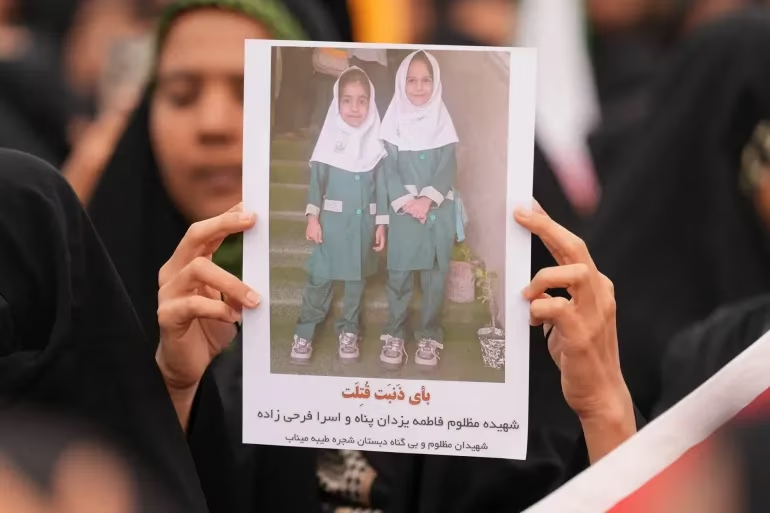
Minab School Massacre: When an American Strike Kills Over a Hundred Girls, Then the Narrative of Denial Begins

Said Erikat

Opinion Writer

Washington – Saeed Arikat - 12/3/2026

News Analysis

The strike that targeted an elementary school for girls in the city of Minab, southern Iran, in the early hours of the US-Israeli war against Iran on February 28, raises profound questions about the nature of war management and the limits of political and military responsibility in the use of force. According to a preliminary US military investigation and leaks reported by The New York Times, the United States appears to bear responsibility for bombing the school, an attack that resulted in the deaths of 175 people, most of them children.

Initial information indicates that the US Central Command relied on outdated intelligence data to identify the target. The building hit by the missiles was part of an Iranian Revolutionary Guard Corps facility in the past, but it was converted into a school between 2013 and 2016. This transformation apparently was not reflected in the intelligence database used during target identification.

The seriousness of this incident lies in its revelation of a structural flaw in the military decision-making mechanism, not just an isolated tactical error. Modern warfare increasingly relies on the integration of artificial intelligence and human intelligence analysis to identify targets. However, the preliminary investigation suggests that the strike was most likely the result of “human error,” despite the use of advanced systems to assist in target selection.

Satellite images reviewed by the newspaper showed clear changes at the site, such as the removal of old watchtowers, the opening of public entrances to the building, and the reconfiguration of courtyards into school playgrounds. These indicators were sufficient — in principle — to raise doubts about the military nature of the site, which raises a question about the level of scrutiny that preceded the strike.

The tragedy of the incident is compounded by reports of two separate strikes on the site. According to medical accounts reported by Middle East Eye, a number of children took refuge in the school's prayer hall after the first strike, but a second strike hit the same location, leading to a large number of casualties among those sheltering there.

Despite these reports, no official American confirmation of two strikes has been issued yet. However, the timing analysis published by the newspaper indicates that the nearby Revolutionary Guard base was targeted again about two hours after the first strike, leaving open the possibility of a second attack in the area.

Politically, the repercussions of the incident were no less significant than its humanitarian dimensions. From the first moments, US President Donald Trump tried to blame Iran for the explosion, even going so far as to claim that Tehran possessed “Tomahawk” missiles. But this claim was quickly met with widespread skepticism, and the president later had to admit that he did not have enough information to support this claim.

When later asked about The New York Times report, Trump said he was unaware of it, which in turn raised questions about the level of briefing the president receives regarding ongoing military operations. At the same time, US Secretary of War Pete Hegseth refrained from confirming or denying the US military's responsibility, merely stating that the incident was “under investigation.”

But Hegseth's previous statements during the military campaign add a troubling dimension to the scene. He affirmed that the US military operates “without ridiculous rules of engagement” and “without mercy,” a rhetoric that reflects a shift in the political language accompanying the war and raises concerns about the erosion of traditional constraints on the use of force.

When this incident is placed in a broader context, it becomes clear that it reveals a growing dilemma in modern warfare: the excessive reliance on outdated intelligence databases in a rapidly changing operational environment. The problem is not only the existence of outdated information but also the mechanism for verifying it before carrying out strikes. If a building has been converted into a civilian facility for nearly a decade, the military system's failure to detect this reflects an institutional flaw in the information gathering and analysis cycle. Such a flaw not only leads to tactical errors but also undermines the credibility of American discourse about so-called “precision strikes.”

The way the American leadership dealt with the incident after it occurred also raises sensitive political questions. Instead of opening a transparent investigation from the outset, official discourse first tended to try to shift responsibility to Iran. This pattern of crisis management reflects a priority of protecting the political narrative of the war at the expense of admitting error. However, such strategies seem short-lived in an era of open satellites and unprecedented information flow, where it becomes difficult to conceal facts for long without their political cost rebounding later.

On a broader strategic level, the Minab incident could become a turning point in the image of the war itself. Wars are not measured solely by their military outcomes but also by their ability to maintain a degree of moral legitimacy in the eyes of international public opinion. The killing of over a hundred children in a single strike — even if it was the result of an error — could change the nature of the global discussion about this war. In past conflict experiences, such incidents were enough to gradually shift political and diplomatic momentum against the force that carried them out, regardless of their original military objectives.

In a broader context, it is noted that the pattern of American justification that emerged in the Minab incident closely resembles the approach repeatedly used by Israel during its war on Gaza. In many cases, schools, hospitals, and health facilities were bombed, and thousands of Palestinian children were victims, while the strikes were justified by saying that these sites were used by Palestinian fighters or concealed military structures. Attempts to blame the Palestinians themselves were also repeated. The similarity of rhetoric and justification in both cases raises profound questions about the transfer of this model in war management and the interpretation of civilian losses.

PALESTINE

Thu 12 Mar 2026 11:46 am - Jerusalem Time

Palestinian Analyst: Outcomes of Regional War Determine Fate of 'International Polarity' and Palestinian Cause

Writer and political analyst Amir Makhoul believes that the results and repercussions of the ongoing military confrontation between the American-Israeli alliance and Iran will determine the features of the future international system. Makhoul explained that this war, which erupted on February 28, transcends its immediate geographical objectives to become a struggle to consolidate a unipolar system and prevent the rise of competing international powers.

Makhoul pointed out that the United States views Iran as a crucial geopolitical link that hinders its projects of hegemony over waterways and global energy supply routes. In this context, Israel emerges as an advanced striking force fully integrated into the American strategy, making the current war a direct rebound of the events of October 7 and an expansion of the conflict in Gaza to a comprehensive regional scale.

On the ground, the halt of navigation in the Strait of Hormuz entered its tenth day, leading to severe disruptions in oil prices, which ranged between $86 and $119 per barrel. These developments come amidst widespread Iranian responses, including the launch of more than 2,000 missiles and drones, resulting in human losses among Israeli and American forces, following the assassination of Supreme Leader Ali Khamenei.

Regarding regional security, Makhoul believes that the war exposed the falsehood of claims that American bases protect Gulf states, proving instead that they are a source of instability and direct targeting. He warned that the peoples of the region are being used as shields for these bases, which may push regional countries in the future to reconsider the presence of these military installations on their territories.

Concerning regional relations, Makhoul expected that this war would push Gulf states to mend fences with Tehran to protect their common commercial and oil interests in 'OPEC'. He affirmed that provocative Israeli actions have brought the 'Abraham Accords' into question and doubt, especially with Tel Aviv's attempts to drag the region into a conflict that does not serve its stability.

On the Palestinian front, Makhoul warned that the Palestinian cause is often the first victim of regional wars waged by Israel. Recent days have seen the killing of 6 Palestinians in the West Bank, five of them by settler gunfire, who have escalated their attacks to more than 109 since the start of the confrontation with Iran.

The political analyst stressed that Israel is exploiting regional preoccupation to undermine the foundations of life and political entity in the West Bank and occupied Jerusalem. This policy, according to Netanyahu's doctrine, aims to prevent geographical linkage between Palestinian territories and impose full sovereignty to ensure that a Palestinian state does not emerge in the future.

Despite the challenges, Makhoul called for adherence to the 'two-state solution' as it enjoys international legitimacy and UN resolutions that constitute a source of legal strength for Palestinian rights. He considered that the failure of military wars to achieve their political goals always brings the issue of Palestine back to the forefront as a fundamental condition for achieving any lasting stability in the Middle East.

Domestically in the United States, opinion polls showed increasing public opposition to military action, with 53% of Americans expressing their rejection of the war. Nevertheless, Washington continues to strengthen its military presence, recently requesting interceptor drones and experts from Ukraine to protect its bases in Jordan from ongoing missile attacks.

Makhoul concluded that Israeli policy based on security and military solutions does not end conflicts but rather increases their permanence and expands their scope. He affirmed that the strategic alliances Israel builds with powers outside the Arab and Islamic sphere aim to impose a regional encirclement, which requires a unified Palestinian and Arab strategy to confront these existential challenges.

The resolution of the Palestinian issue remains the basis for regional stability and security, and adherence to international legitimacy is the source of strength in the face of Israeli denial.

ARAB AND WORLD

Thu 12 Mar 2026 11:46 am - Jerusalem Time

Dozens killed and wounded in US airstrikes targeting Popular Mobilization Forces headquarters in Iraq

The Anbar province in western Iraq witnessed a bloody military escalation, as American warplanes launched a series of raids targeting three headquarters belonging to the Popular Mobilization Forces. Security sources reported that the attack resulted in the death of about 30 people and the injury of 50 others, in an initial toll that is likely to rise due to the severity of the injuries.

The airstrikes focused on the border district of Al-Qaim, where the targeted sites were completely destroyed due to the intense bombing. Ambulances rushed to the scenes of the explosions to retrieve the victims and transport the wounded to nearby hospitals, amidst a state of widespread security alert in the region.

In a simultaneous development, another Popular Mobilization Forces headquarters in the city of Kirkuk, northern Iraq, was subjected to an airstrike on Thursday morning. Field sources confirmed that the bombing led to the death of at least two elements and a massive fire at the site, while rescue teams continue search operations under the rubble.

The sources indicated that security forces imposed a tight cordon around the targeted site in Kirkuk, specifically in areas near the city's airport. These movements come amid fears of renewed attacks or an expansion of the scope of air targeting to include other military sites.

Reports indicate that this escalation comes in the context of increasing tensions that the region has witnessed since late last February. Several headquarters belonging to Iraqi factions have been subjected to scattered strikes in recent weeks, resulting in dozens of deaths and injuries among their ranks.

According to available data, the number of deaths among faction members since the start of the latest wave of escalation exceeded 22 elements before the last attack. These figures reflect the scale of the direct confrontation that the Iraqi arena has become a stage for between regional and international powers.

The Popular Mobilization Forces are an official part of the Iraqi military system since their integration by government decision, after their role in the battles against the Islamic State organization in 2014. However, some brigades within the authority maintain close ties with regional powers and operate within the framework of what is known as the Islamic Resistance.

These factions adopt periodic attacks using drones and missiles, targeting what they describe as enemy bases in the region. These movements put the Iraqi government in an awkward position, as it tries to balance its international obligations and its national sovereignty over its territories.

Iraq has been living for years in a state of political and military tug-of-war as a main arena for competition between Washington and Tehran. Baghdad is striving to maintain a delicate balance that spares the country from sliding into an open conflict whose results or repercussions it cannot control.

With the regional fronts ablaze, the Iraqi authorities found themselves at the heart of a wide-ranging conflict that transcends its geographical borders. Despite the extent of the destruction and casualties, the parties carrying out the strikes often maintain official silence, which further complicates the political and security landscape.

Medical sources in Anbar confirm that most of the injured in the recent attack suffer from severe wounds and severe burns. Medical staff are working at full capacity to deal with the influx of wounded, amid a shortage of capabilities in some border health centers that received the first cases.

The Iraqi street remains in anticipation, awaiting official reactions from the government and political forces. These attacks are expected to spark a new wave of demands to end the foreign military presence in the country, and to intensify efforts to protect national sovereignty from repeated violations.

The airstrikes caused extensive damage to the targeted headquarters, and rescue operations are still ongoing to save the injured, most of whom are described as being in critical condition.

OPINIONS

Thu 12 Mar 2026 11:46 am - Jerusalem Time

When Trump Decides!

Dr. Ibrahim Melhem

Editor-in-Chief

The war stops when Trump decides, and its fire subsides when the "Lord of the White House" decides to extinguish it. He who started the fire puts it out, and he who started the war ends it. Trump, "alone and without a partner in his government," is the one who decides the beginning and sets the finish line.This is how Trump's ministers and advisors stroke the President's ego, flatter his narcissism, and feed his inflated self with a flood of praise and compliments, even wearing shoes of a brand bearing his name to curry favor and avoid his wrath.Whoever does not flatter Trump is isolated. It has been said that the most crowded place with American employees is the cafeteria at the State Department, where senior diplomats and advisors whom Trump dismissed for refusing to compliment him and align with his narrative gather.Trump says that there are no targets left to bomb in Iran, and that the war is nearing its end. However, what is being said by his advisors, and the movement of warships in warm waters, and fighter jets that do not stop "nursing" on energy supplies in the skies crowded with smoke plumes over the Persian plateau, contradicts everything Trump propagates to ensure market stability, curb price inflation, and prevent stock market collapses. These factors will cause the man of finance and business to seek a way out to stop the war… The coming days are decisive.

PALESTINE

Thu 12 Mar 2026 11:45 am - Jerusalem Time

Talking about the approaching end of the war.. a speech to reassure markets and create a "narrative of victory"

Ahmed Rafiq Awad: Trump, through this speech, tried to calm financial and energy markets, especially after the significant decline in the prices of many stocks on the stock exchanges. Dr. Saeed Shaheen: The entry of international parties into mediation reflects the United States' readiness to negotiate, not from a position of victory, but from the principle of minimizing losses. Dr. Tamara Haddad: These statements can be understood in the context of pressure, as major powers use the rhetoric of "the approaching end of the war" to prepare the ground for potential negotiations. Dr. Osama Abdullah: Trump's statements are an attempt to declare an early victory, as the White House seeks to create a narrative of victory before military operations actually end. Dr. Aql Salah: The continuation of the war will strengthen Iran's military and political position and reduce the ability of the United States and Israel to talk about the achievements of the first strike. Dr. Reham Odeh: The reality on the ground does not match Trump's rhetoric, as the war is still in its early stages and has not yet achieved its declared goal of changing the Iranian regime. Ramallah – Exclusive to "Al-Quds" – US President Donald Trump's statements about the approaching end of the war on Iran raise controversy about their true objectives and timing, amid ongoing military operations and mutual escalation, even if these statements carry economic and political messages and the possibility of paving the way for potential negotiations. Writers, political analysts, specialists, and university professors, in separate interviews with "Al-Quds", believe that these statements cannot be read in isolation from the economic and political pressures facing the US administration internally and externally, in addition to the war's impact on energy markets and the global economy. They point out that these statements are seen as an attempt to calm financial markets and reassure investors, amid fears of the war's continuation and its impact on the American economy and international trade, especially with the threats related to the Strait of Hormuz and its repercussions on global shipping traffic. They believe that talking about the approaching end of the war may constitute a political prelude to finding a gradual way out of the conflict, especially after the initial bets on achieving rapid war goals, such as weakening the Iranian regime or pushing it to collapse, faltered. They note that the continuation of the war may lead to increasing political and economic losses for the United States and Israel, which pushes for the search for political settlements or potential negotiation paths, although the field data indicates the continuation of the confrontation and the absence of decisive indicators of its imminent end. Calming the American debate about the legitimacy of the war Political writer and analyst Dr. Ahmed Rafiq Awad believes that the most prominent objectives of US President Donald Trump's statements that the war is nearing its end are an attempt to calm the growing debate and objections within the American street regarding the legitimacy of the war, especially with voices considering it an Israeli war that does not serve the direct interests of the United States, and is not based on a direct Iranian threat to America. Awad explains that the statements also carry a clear economic dimension, as they came amid rising oil prices, which reached about $110 per barrel, which negatively affected global markets and the American economy. Awad confirms that Trump, through this speech, tried to calm financial and energy markets, especially after the significant decline in the prices of many stocks on the stock exchanges, noting that this step reflects a clear commercial mindset in Trump's handling of political and economic crises. Awad believes that the most important implication of these statements may be an attempt to pave the way for the US administration to exit the war, especially if it has become involved in an escalation it did not expect to reach this level. Justifying the declaration of victory Awad points out that Trump's talk about destroying Iranian missiles and capabilities and weakening the Iranian regime may be an attempt to justify declaring victory and beginning the search for a political settlement, allowing Washington to "climb down from the tree" gradually. Awad confirms that Trump's latest speech was characterized by a clear contradiction, as it combined talk about the approaching end of the war with a call for the surrender of the Iranian regime and the presentation of ideas related to its dismantling. Awad points out that Trump's statements are often characterized by volatility and sometimes differ from the positions of his ministers, which makes it difficult to deal with them as final positions or decisive indicators of the war's trajectory. Awad notes that the reality on the ground does not support these statements, amid ongoing military operations and American-Israeli coordination in managing the war, and Israeli Prime Minister Benjamin Netanyahu plays a pivotal role in pushing the war forward and pressing for its acceleration with the aim of weakening or dismantling the Iranian regime. Awad believes that Trump's statements should be dealt with with extreme caution, because they carry a propaganda, political, and perhaps economic character, and do not necessarily reflect an accurate assessment of the war's trajectory or a confirmed indicator of its imminent end. Failure to overthrow the Iranian regime Dr. Saeed Shaheen, Professor of Political Communication at Hebron University, believes that US President Donald Trump has come to the conviction that the war on Iran will not achieve its main goal of regime change, despite betting on the fifth column and pushing Iranian youth to overthrow the regime, similar to the models of Iraq under Saddam Hussein and Venezuela. Shaheen points out that the war, instead of accelerating the collapse of the Iranian regime, began to hit American interests, military bases, and its economy, with Hezbollah entering the confrontation, which confused Israeli and American calculations. Shaheen explains that American and Israeli intelligence estimates indicated the fall of the Iranian regime within the first four days, but reality later proved the difficulty of achieving this goal, while internal movement in the United States against the war escalated, with demands to stop it due to its high economic costs borne by American taxpayers. Strengthening the Iranian position through negotiation Shaheen points out that Iran insists on continuing the war to force the hostile party to negotiate, which strengthens its position to reach an agreement that guarantees its right to possess peaceful nuclear energy and missile defense, which the war confirmed is not negotiable. Shaheen notes that the continuation of the war for a longer period may create a new equation that affects domestic politics in the United States and Israel, including the decline in Trump's popularity, who resorted to propaganda methods to justify his policies, and the decline in the popularity of Israeli Prime Minister Benjamin Netanyahu due to the extent of losses and damages resulting from Iranian attacks and Hezbollah missiles that targeted Israeli depth, turning Israelis into hostages of extremist government policies. Shaheen believes that the entry of international parties into mediation reflects the United States' readiness to negotiate, not from a position of victory but from the principle of minimizing losses, given Trump's and Netanyahu's understanding that continuing the war will not be sustainable. Shaheen points out that the visit of Trump's son-in-law Jared Kushner and his senior advisor Steve Witkoff to Israel is a clear indication of Washington's desire to get Israel out of its predicament in coordination with Tehran to end the war while saving face for both sides. Shaheen believes that the current data confirms the war's failure to achieve its strategic goals, and that its continuation may lead to significant economic and geopolitical consequences, with the possibility of imposing a new political reality in the region that reorders American and Israeli priorities. An attempt to show American and Israeli superiority on the ground Political writer and researcher Dr. Tamara Haddad believes that US President Donald Trump's statements about the approaching end of the war are linked to a political narrative through which he seeks to show the superiority of the United States and Israel on the ground, especially after his talk about the decline of Iranian military capabilities, including naval and air capabilities and communication networks, which he presents as evidence that the war has reached its final stage after achieving its basic goals. Haddad points out that these statements also carry a direct pressure message to Iran, implying that American-Israeli military decisive action is imminent, with what resembles a veiled threat that the time has come to surrender and stop Tehran's interference in Middle East issues. A speech with an economic dimension According to Haddad, at the same time, these statements indicate that the speech has a clear economic dimension, as it came amid rising oil prices to about $100 per barrel, with fears of it reaching $200 if the war continues, which negatively affects the American citizen and the global economy through rising energy prices and inflation. Haddad points out that the price of oil declined after these statements to about $88 per barrel, indicating the impact of political messages on markets. Haddad confirms that Trump's statements carry a message to the American public that he is close to achieving victory, although the military reality does not clearly indicate that, especially amid statements talking about continued fighting and the pursuit of decisive action on the ground, with Iran relying on a strategy of managing time and prolonging the conflict with the aim of exhausting the United States, Israel, and even neighboring countries. Reassuring American and international public opinion Haddad notes that these statements also carry a psychological and media dimension aimed at reassuring American and international public opinion and showing that the conflict is under control and will not turn into a long regional war. These statements can also be understood, according to Haddad, in the context of political and negotiating pressure, as major powers often use the rhetoric of "the approaching end of the war" to prepare the ground for potential negotiations or political settlements. Despite this, Haddad points out that the field and political data do not provide decisive indicators of the imminent end of the war, especially with the continuation of military operations and statements by some military officials that the fighting is still in its early stages, which reflects a gap between political rhetoric and military assessment. Haddad points out that the war's objectives themselves are still not entirely clear. While Trump spoke of neutralizing Iran's nuclear program and missile capabilities, he also hinted at the possibility of seeking to change the Iranian regime, which is a larger and more complex goal that is difficult to achieve in a short war, especially given the complexities of conflicts in the Middle East and the multiplicity of parties involved. Words are not spoken in vain Political researcher and academic Dr. Osama Abdullah stresses that US President Donald Trump's statements that the war "is nearing its end" must be read in the context of American political discourse, as words are not spoken in vain, and are often used as part of a political battle and not merely a description of the military reality. Abdullah points out that Trump's statement that military operations are "very advanced on schedule" and "largely complete" does not reflect an actual end to the war, but aims at several political and strategic objectives. Narrative of victory before the end of military operations Abdullah explains that the first of these implications of Trump's statements is an attempt to declare an early victory, as the White House seeks to create a narrative of victory before military operations actually end. Abdullah points out that Trump confirmed that Iranian military capabilities, including naval, communications, and air force, were "largely destroyed," to solidify the image of achieving the military objective. Abdullah believes that the speech aims to prepare American public opinion for withdrawal or reduction of military operations, reflecting historical experience in using the phrase "nearing the end" as a political tool, especially amid increasing economic and political pressures on the US administration. A clear deterrent message to Iran Abdullah points out that Trump's statements carry a clear deterrent message to Iran, as he linked the end of the war to conditions such as not disrupting oil navigation in the Strait of Hormuz, threatening a "much harsher" response if the equation changes. Abdullah explains that Trump's statements have an economic dimension, as oil prices fell immediately after his speech, which clarifies that the speech is not only military but also a management of the economic and political narrative of the war. When comparing these statements with the reality on the ground, Abdullah confirms a significant discrepancy: the war continues with mutual strikes and drone and missile attacks, and Iran has not declared any readiness to surrender, while there is no political agreement or official truce indicating the end of the conflict. Trump's contradictory speech Abdullah notes that Trump's speech itself is contradictory, as it combines saying that the war is "close to the end" with emphasizing that it will not end before the "decisive defeat of the enemy," which reflects the nature of political discourse more than an accurate description of the military reality. Abdullah believes that Trump's statements should be dealt with cautiously, as they are a tool for managing the political and economic narrative, to calm markets and public opinion, and to send deterrent messages, and are not a real indicator of the approaching end of military operations. An Iranian message of resilience and confrontation Political writer, researcher, and professor of comparative political systems, Dr. Aql Salah, believes that the current war on Iran clearly differs from previous conflicts, including the June war last year, which lasted 12 days. Salah points out that the current war showed Iran's ability to withstand and overcome the initial shock of the American-Israeli strike, which aimed to assassinate Supreme Leader Ali Khamenei and a number of first-rank military leaders, which did not achieve the expected goal for US President Donald Trump and Israel of the collapse of the Iranian regime and rapid internal chaos. Salah explains that Iran was able to inflict strong and devastating blows on American bases in the Gulf and the Arab world, especially on radar systems, and also targeted the heart of Israel, including Tel Aviv, which constituted a political and military shock for the Israeli and American sides. Salah points out that the popular and political level in Iran united with the regime against the external threat, while the military leadership maintained its discipline and ability to continue, despite the assassination of leaders, and a new leader was elected quickly, which represents a strong message that Iran is capable of resilience and continuing the confrontation. Reducing American losses and paving the way for negotiations Salah confirms that Trump's statements that the war "is nearing its end" carry several political and strategic implications: the first is the military implication, as Trump seeks to portray that he destroyed Iranian military capabilities, including the naval fleet, aviation, and communication system, and that the Iranian leadership has been weakened. Salah points out that there is another strategic implication based on the concept of "quick victory" or a lightning strike, which is an attempt to end the war quickly as happened in previous conflicts to reduce American losses, and to pave the way for negotiations according to American conditions. Calming global markets Salah notes the economic dimension, as the statements aim to calm global markets, especially oil markets, and restore stability to stock exchanges, as the price of a barrel of oil fell from $110 to $80 after Trump's statement. Salah points out the contradiction in Trump's own speech, which combines saying that the war is nearing its end and emphasizing that the end will not be achieved before the "complete defeat of the enemy," which reflects the volatile nature of Trump's speech that mixes threat and psychological reassurance, while seeking to impose his conditions on Iran. Salah believes that the continuation of the war will strengthen Iran's military and political position, and reduce the ability of the United States and Israel to talk about the achievements of the first strike, which necessitates paving the way for a gradual cessation of the war, according to the policy of "climbing down from the tree," while preserving what Trump considers his previous achievements. Trump and facing internal pressures Political writer and analyst Dr. Reham Odeh explains that US President Donald Trump's statements about the approaching end of the war on Iran primarily reflect economic and commercial pressures, more than a field assessment of the military situation. Odeh points out that Trump faced increasing pressure from within the United States, especially from shipping and transportation companies that were affected by rising fuel prices and the high cost of shipping services, which negatively affected American citizens and businessmen. Odeh notes that the war also affected international trade due to Iranian threats to the Strait of Hormuz, which prompted Trump to use rhetoric to calm markets and the global economy, emphasizing that the war "is nearing its end," with the aim of easing tension in the oil sector and reassuring international shipping companies and American business owners, which contributed to a slight decrease in oil prices after his statements. Declaring the end of the war unilaterally is not possible However, Odeh confirms that the reality on the ground does not match Trump's rhetoric, as the war is still in its early stages and has not yet achieved its declared goal of changing the Iranian regime, and may continue until the end of March, until an agreement is reached between Washington and Tel Aviv regarding ending operations after claiming to have destroyed most of the military arsenal of the Revolutionary Guard and the Iranian army. Odeh explains that declaring the end of the war unilaterally is not possible, because there is a clear partnership between the United States and Israel in this military operation, which necessitates agreement between the two parties before any official announcement. Odeh points out that Trump's statements should be read in the context of managing international economic and political pressures and calming markets, and not as a real indicator of the end of the military conflict on the ground, as the field and political data indicate that the war is still ongoing and its end is linked to subsequent political and strategic developments.


OPINIONS

Thu 12 Mar 2026 11:45 am - Jerusalem Time

UNRWA Under Threat of Liquidation: The Battle for Refugee Rights and the Protection of the Right of Return

The United Nations Relief and Works Agency for Palestine Refugees in the Near East (UNRWA) is facing the most severe crisis in its history since its establishment after the 1948 Nakba. The crisis currently afflicting the agency is no longer merely a transient financial deficit or surmountable operational difficulties; rather, it has become part of a broader political battle targeting its role and legal symbolism, as the living international witness to the ongoing and unresolved issue of Palestinian refugees in accordance with international legitimacy resolutions.UNRWA was established by United Nations General Assembly Resolution 302 to provide relief and essential services to millions of Palestinian refugees until a just solution to their plight is found. Since then, the agency has become more than just a humanitarian institution, as its existence has been directly linked to international recognition of the refugee issue and the rights affirmed by international legitimacy, foremost among them the right of return and compensation as stipulated in United Nations General Assembly Resolution 194. Therefore, targeting UNRWA today cannot be separated from an attempt to undermine the legal and political basis of the refugee issue itself.What is happening against UNRWA comes in the context of a highly critical Palestinian moment, where the Palestinian issue as a whole is subjected to unprecedented pressures aimed at reshaping it in a way that bypasses the historical rights of the Palestinian people, and at its heart, the right of return. The attack on the agency coincides with a devastating war on the Gaza Strip, with escalating settlement policies in the West Bank, and with attempts to impose new political realities that seek to liquidate the essence of the Palestinian issue and transform it from a cause of a people uprooted from their land into merely a manageable or containable humanitarian crisis.In this context, the crisis facing UNRWA takes on a complex character. On the one hand, the agency suffers from a serious financial deficit due to the reduction or freezing of contributions from a number of donor countries under clear political pressure, which threatens the continuity of its vital services for millions of refugees who depend on it for education, healthcare, and food aid. On the other hand, incitement and questioning campaigns led by the Israeli occupation authorities, with the support of political circles in the United States, are escalating in a clear attempt to delegitimize the agency and undermine its UN mandate.This campaign has gone beyond political pressure to take on a direct field character, represented by the closure of UNRWA offices in Jerusalem and attempts to disrupt its work in the Gaza Strip, in a move that reflects an organized effort to end the agency's role or replace it with alternative arrangements that strip the refugee issue of its political and legal content. The very existence of UNRWA reminds the world that the refugee issue has not yet been resolved, and that millions of Palestinians still live in camps awaiting the implementation of their right to return to their homes from which they were displaced in 1948.The gravity of these developments is compounded by the unprecedented humanitarian catastrophe in the Gaza Strip as a result of the ongoing war, where UNRWA has become the backbone of relief and humanitarian work. At a time when the population's needs for food, medicine, shelter, and education are increasing, the agency itself is subjected to suffocating financial and administrative pressures, which have even affected its employees, with hundreds of workers being dismissed and a portion of their salaries deducted, threatening the agency's ability to continue performing its essential tasks.Weakening UNRWA or reducing its role will not be merely an administrative or financial measure, but will have profound repercussions on the lives and future of Palestinian refugees. Millions who depend on the agency's services may suddenly find themselves without schools, clinics, or food aid, threatening to exacerbate poverty and unemployment and to deteriorate social conditions within the camps in Gaza, the West Bank, Lebanon, and Syria.More dangerously, undermining UNRWA's role could be used as a political entry point to try to bypass the refugee issue itself, by proposing alternatives or formulas that seek to end the refugee status without addressing its political and legal roots. The absence or weakening of the agency could be interpreted as a decline in international recognition of Palestinian refugees and their rights affirmed by the United Nations.For this reason, the battle currently raging around UNRWA is not just a financial or administrative battle, but a battle over the political and legal memory of the Palestinian issue. The agency represents, in its essence, a continuous international recognition that the refugee issue has not yet been resolved, and that the international community still bears a moral and legal responsibility towards millions of Palestinians who were displaced from their land.Hence, the importance of broad political and diplomatic action to protect the agency and ensure the continuation of its work, including mobilizing international support to secure the necessary funding for it, and emphasizing adherence to its UN mandate until a just and comprehensive solution to the refugee issue is reached in accordance with international references. Popular and official efforts also gain special importance in defending UNRWA and rejecting any attempts to reduce its services or replace them with alternative mechanisms that diminish refugee rights.Defending UNRWA is, in essence, defending the cause of Palestinian refugees and their historical and legal right to return to their homes. The agency is not just a relief institution, but an international witness to one of the greatest tragedies of the twentieth century, whose chapters are still open today. Therefore, preserving its role and continuing its work are an essential part of the battle to protect Palestinian national rights and prevent the obliteration of the refugee issue or its transformation into merely a humanitarian matter that can be bypassed.Until a just solution based on the implementation of the right of return is achieved, UNRWA's existence will remain a political, legal, and humanitarian necessity, and an international witness that the Palestinian refugee issue has not and will not be forgotten by the passage of time.
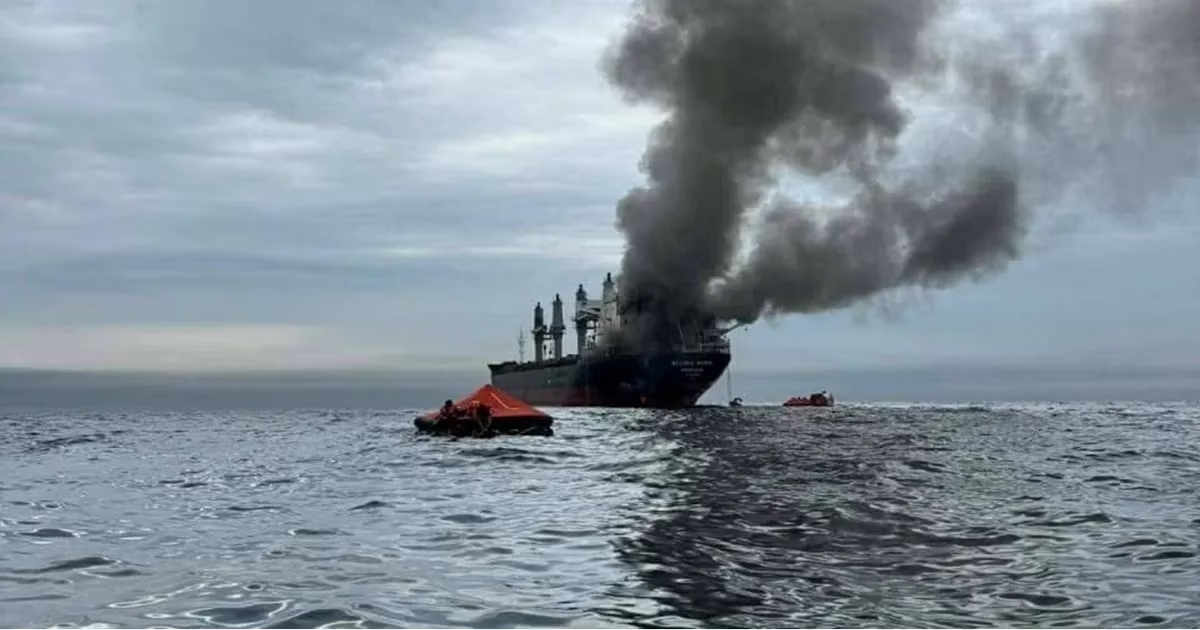
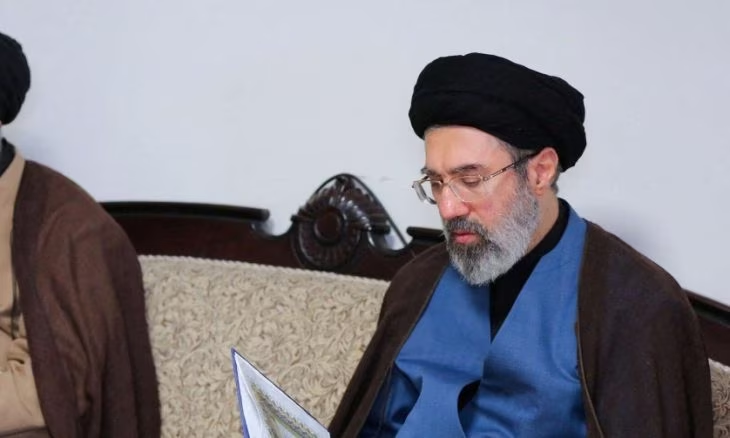
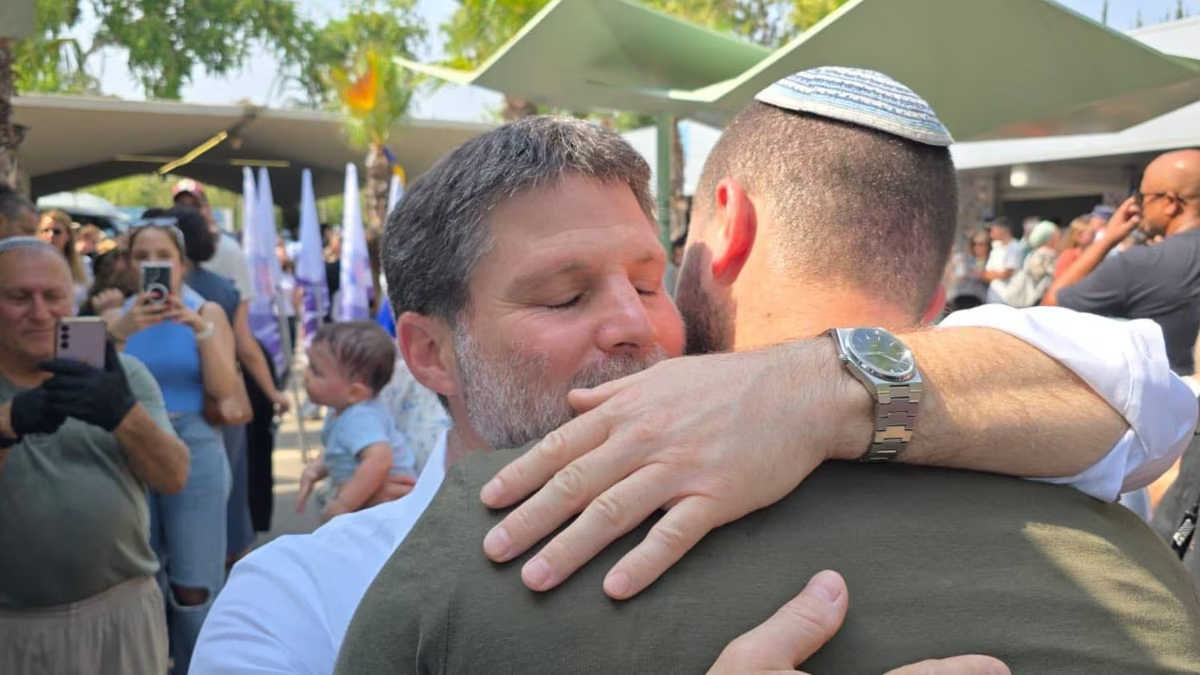
OPINIONS

Thu 12 Mar 2026 11:45 am - Jerusalem Time

The Middle East: A Continuous Conflict or a Delicate Balance?

It is not easy to directly interpret what is happening in the Middle East. The scene portrayed by major headlines – tension, threats, reciprocal strikes, and linguistic escalation that almost touches the brink of war – does not always present the full truth. For many decades, this region has ceased to be merely a geography of conflict; instead, it has become a complex space where balances are managed as much as confrontations are fought.As soon as one war ends, another ignites, as if the Middle East is condemned to a restless cycle. The region, from which the messages of prophets originated, has not known true tranquility for over a century, as the Arab world has lived with a heavy sense of defeat and humiliation, giving rise to tensions, conflicts, and various political and intellectual currents that reject this reality and contend over it. However, the essence of the conflict goes beyond the religious or ideological rhetoric sometimes invoked to inflame emotions; at its core, it is a struggle for influence, sovereignty, and world management in a region where strategic geography intersects with natural resources, transforming it into a constant arena of competition among major powers.When there is intense talk of a major confrontation between competing regional powers, the picture at first glance seems to be heading towards an explosive moment. However, a closer examination of the course of events often reveals a different pattern: a conflict that advances one step and retreats another, escalates in rhetoric then de-escalates in action, and ultimately remains governed by an unstated ceiling of control and containment.This pattern is not new in the history of international relations. Many major conflicts have not always moved towards resolution, but rather towards managing tension. In such cases, the conflict itself becomes a political tool; a tool that reshapes internal alignments, produces new legitimacies, and justifies security and economic policies that might be difficult to pass under normal circumstances.At the level of political discourse, the feeling of external danger plays a known role in uniting societies behind authority or major national narratives. The constant sense of threat also creates an environment that allows for increased military spending and the dedication of long-term security priorities. Conversely, this climate allows international powers to re-establish their strategic presence under the banners of protection, stability, or balance of power.In this sense, tension itself becomes part of the structure of the political landscape, not merely a fleeting outcome of it. Limited escalation, calculated strikes, and symbolic military messages are all tools sometimes used to manage the regional political sphere without sliding into an all-out confrontation.Perhaps what makes this equation possible is the realization by most actors that a major war in this region would be an event entirely different from anything that preceded it. Today's Middle East is not merely a theater for a bilateral or limited regional conflict; rather, it is a geopolitical nexus where energy routes, global trade, military alliances, and international balances intersect.Therefore, any widespread confrontation could quickly extend its effects to the global economy, energy markets, shipping lanes, and perhaps to the structure of the international system itself. For this reason, many military movements in the region seem to be treading a delicate edge: the edge of escalation without explosion.However, focusing solely on the balance of power may obscure a deeper question related to the nature of the place where these balances are managed. A striking observation in the region's modern history is that many major power struggles are conducted over its geography, while their final equations are formulated in other centers of the world.The region has, to varying degrees, become a testing ground for strategic power: regional powers seeking to expand their sphere of influence, other powers working to consolidate their military or political superiority, and international powers keen to maintain balance within limits that serve their broader interests.Amidst these complex equations, local communities – despite being the most affected – appear to have less presence in the regional decision-making process. Conflict is often managed in the language of security, power, and influence, while questions related to development, human stability, and cultural identities remain secondary.However, history teaches us that conflicts managed for too long without addressing their roots do not remain static forever. Equations that seem stable can be disrupted by small changes in the balance of power, internal transformations within states, or errors in estimating reactions.In such moments, conflict may shift from a phase of management to a phase of explosion, because delicate balances, however well-crafted, ultimately remain temporary balances. History, however, is less patient than long-term strategic calculations.Therefore, the real question remains: Will the Middle East remain merely an arena for managing international conflicts, or will it one day succeed in transforming into a space where its interests and balances are shaped autonomously, from within rather than from without?

ARAB AND WORLD

Thu 12 Mar 2026 11:45 am - Jerusalem Time

Cruz launches fierce attack on Carlson, accusing him of fueling 'antisemitism' in the American right

Republican Senator from Texas, Ted Cruz, sparked a wide wave of controversy in American political circles following his violent and unprecedented attack on prominent conservative broadcaster Tucker Carlson. Cruz accused Carlson of working to spread conspiracy theories and promote antisemitic rhetoric within the ranks of the right-wing movement in the United States, reflecting a deep division within party bases.

Cruz's statements came during a speech he delivered at a specialized conference to discuss the phenomenon of antisemitism, organized by 'National Review' magazine in cooperation with the Republican Jewish Coalition. The senator described the former broadcaster as 'the most dangerous demagogue in the country,' considering that his media influence has become a direct threat to the values embraced by conservatives.

Cruz, as reported by media sources, acknowledged that the past year and a half have witnessed a worrying escalation in the tone of hostility towards Jews within the political right. He indicated that he had not imagined, until recently, that the dialogue within the party would reach this level of deterioration, especially among the rising generations of conservatives.

The Republican senator affirmed that he made a decisive decision to confront Carlson openly and directly, refusing to remain silent about what he described as intellectual deviation. He strongly criticized Carlson for opening his media platform to those he described as 'sleeping professors' who are striving to reframe the events of World War II in a distorted manner.

Cruz explained that some of Carlson's guests went to shocking levels of claims, portraying the late British Prime Minister Winston Churchill as a 'real villain.' He also pointed to allegations promoted by that platform stating that the United States was supposed to side with Nazi Germany during World War II.

Cruz expressed disgust at the way Carlson deals with these guests, merely looking at them with admiration without playing any critical role. He considered that not questioning these illusory claims gives them false legitimacy before millions of followers from the conservative fan base.

Cruz's attack was not limited to Carlson alone, but also included the far-right activist Nick Fuentes, whom he explicitly described as a 'Nazi' and Holocaust denier. Cruz criticized the blatant contradiction in Fuentes' positions, who combines admiration for Adolf Hitler with celebrating the birthday of Soviet leader Joseph Stalin.

Cruz sarcastically asked the audience about the nature of a person who would celebrate Stalin's birthday, describing Fuentes as insane. He expressed his strong anger at Carlson hosting this activist, pointing out that the broadcaster did not object when Fuentes stated that his primary goal was to fight what he called 'global Jewry.'

The senator considered Carlson's silence or his mere nodding in agreement with those statements to be a major moral and professional lapse. He believed that this behavior contributes to legitimizing extremist discourse and making it an acceptable part of public political debate within the Republican camp.

Cruz touched upon a deeper crisis within the Republican Party, represented by the fear of some politicians to criticize Carlson for fear of their political future. He said that the willingness of some to condemn Fuentes while avoiding mentioning Tucker Carlson's name reveals much about the state of weakness and opportunism within the party's ranks.

Cruz warned that the fear of losing the support of Carlson's popular base could open the door wide for the permanent infiltration of hate speech. He stressed that confronting these phenomena requires political courage that goes beyond narrow electoral calculations to preserve the identity of the American right.

It is worth noting that this clash comes amid accumulated tensions between the two parties, as Carlson had previously criticized Cruz's support for Israeli military operations against Iran. This public debate reflects the extent of the division over foreign policy and strategic alliances, especially concerning the relationship with the Israeli occupation.

Tucker Carlson is the most dangerous demagogue in this country, and I have decided to confront him directly, face-to-face, because of his dissemination of conspiracy theories.

ISRAELI AFFAIRS

Thu 12 Mar 2026 11:45 am - Jerusalem Time

Between Netanyahu's Pressures and Trump's Calculations: The 'Dual Aggression' War at a Crossroads

The intensity of Israeli statements regarding the duration of the current military confrontation is escalating, with Security Minister Israel Katz affirming that there is no time limit for ongoing operations until declared objectives are achieved. These positions reflect a clear desire by Benjamin Netanyahu's government to leverage American involvement to the maximum extent possible, in an attempt to definitively resolve the conflict with Iran.

In contrast, a sense of caution emerges among other political circles, fearing fluctuations in the American stance, especially as President Trump approaches crucial decisions to end the war. Sources indicate that Netanyahu, who has pushed for this confrontation for decades, realizes that the keys to a ceasefire are now solely in the hands of the White House, which explains his frantic efforts to impose new realities on the ground.

The scope of the conflict has expanded to include approximately 15 countries in the region, in a confrontation described as the largest since World War II in terms of geopolitical impact. Despite assassinations and intense bombardment, observers believe that the war has not yet achieved its strategic goals, prompting the aggressors to resort to more violence to compensate for the failure to achieve tangible results.

The American administration finds itself facing two equally bitter choices: either to proceed with military escalation on the principle of 'what does not come by force comes by more of it,' or to declare victory and withdraw immediately. Trump appears to be gradually leaning towards the second option to avoid sliding into an 'endless war,' a slogan he has consistently raised in his election campaigns against his predecessors.

On the military front, extreme American proposals emerge, including the possibility of limited ground operations aimed at occupying the Iranian island of 'Kharg' in the Gulf. This island is the vital artery of the Iranian economy, as it exports about 90% of its oil, which some see as a final means of pressure to impose surrender terms on Tehran.

Domestically in the United States, opinion polls show widespread public opposition to continued military involvement, which puts additional pressure on Trump's advisors. The American administration fears catastrophic economic consequences, especially rising oil prices and their direct impact on global and domestic inflation rates, which motivates the search for a 'face-saving exit strategy.'

In Israel, the economic cost of the war appears unprecedentedly exhausting, with estimates indicating a drain of approximately 32 billion dollars per month from the state treasury. Economic experts warn that continued fighting at the current intensity could lead to financial collapse, emphasizing that the national interest requires ending operations as soon as possible to avoid an economic catastrophe.

Despite these pressures, the right-wing elites in Israel view the war as a 'historic and unrepeatable opportunity' to change the face of the Middle East and its balance of power. Terms with religious dimensions are circulated to describe the conflict, reinforcing the trend towards continuing the fight regardless of human and material costs, in an attempt to prevent any retreat in the American position.

For its part, Iran shows signs of readiness to accept understandings for a ceasefire, with Iranian military sources stating that Washington has already begun searching for mediators for de-escalation. Tehran considers the request for mediation as proof of the failure of the military objectives of the aggression, while simultaneously affirming its readiness to deal with all scenarios of escalation or negotiation.

Netanyahu's personal and political dimension remains a primary driver for continuation, as military achievements and assassinations have not translated into an increase in his electoral popularity according to recent polls. Through continuous escalation, Netanyahu seeks to achieve an absolute 'image of victory' that ensures his political survival and provides him with an exit from his legal pursuits, making the decision to end the war complex and linked to power calculations in Washington.

No time limits, and the war continues until goals are achieved and the battle is decided.

ISRAELI AFFAIRS

Thu 12 Mar 2026 3:59 am - Jerusalem Time

Iranian Confirmations of Mojtaba Khamenei's Minor Injuries Amidst Anticipation of His First Appearance

A knowledgeable Iranian official revealed today, Wednesday, that the new Supreme Leader of the Islamic Republic, Mojtaba Khamenei, sustained injuries described as minor. The official clarified that these injuries did not prevent him from continuing his official duties and managing state affairs, despite his noticeable absence from the media scene.

The Iranian side did not provide precise details about the timing or circumstances of the injuries sustained by Khamenei's son, and silence prevailed regarding the reasons for his failure to make any public statements since his inauguration as his father's successor. This ambiguity has opened the door to widespread speculation about the true health condition of the first man in Tehran.

In contrast, Israeli intelligence sources reported that security assessments clearly indicate that Mojtaba Khamenei was injured during joint aerial operations carried out by the United States and Israel. These sources considered the injury to be the direct reason for his disappearance from public view at this critical stage.

The Iranian Revolutionary Guard had played a crucial role in imposing the selection of Mojtaba Khamenei for the position of Supreme Leader, as he is viewed within conservative power circles as a more flexible version capable of protecting the Guard's interests. Observers believe that this appointment aims to ensure the continuity of the political approach while giving a youthful character to the leadership.

High-ranking Iranian sources, including a former official in the reformist movement, reported that Mojtaba's ascent to power might pave the way for the adoption of more aggressive foreign policies. These sources also warned of the possibility of tightening the security grip inside Iran to confront any challenges that might accompany the transition phase.

For his part, Israeli Defense Minister Yoav Gallant issued escalating statements, asserting that any figure assuming leadership in the current Iranian structure would be a legitimate target for elimination. These threats come in the context of an open war aimed at undermining decision-making centers in the Iranian capital.

As of now, no official speech has been issued by the new leader despite three days passing since his appointment, which has increased the state of anticipation among the Iranian public and international observers. Supporters and opponents alike are awaiting the determination of the political path Mojtaba will take amidst the volatile regional conditions.

Power centers in Tehran are experiencing a state of extreme caution, as parliamentary sources confirmed the absence of clear information about the date of the new leader's appearance. It seems that a state of ambiguity prevails even in legislative circles that do not have details about the leader's agenda or health status.

Mojtaba Khamenei had miraculously survived an explosion that targeted the heart of the capital Tehran about eleven days ago, an incident that resulted in painful human losses in his family circle. That attack resulted in the death of his wife, mother, and brother-in-law, placing the new leader under immense psychological and security pressures.

In a related context, international press reports, quoting officials in Tehran, indicated that Mojtaba's injury was concentrated in the leg area. Although this news has not been officially confirmed by government channels, it aligns with the narrative of minor injury that has been circulated recently.

These developments come after the assassination of the former leader Ali Khamenei in an Israeli airstrike that targeted Tehran on February 28th. This assassination dealt a devastating blow to the Iranian regime, necessitating swift action by the Revolutionary Guard to fill the leadership vacuum.

Analysts believe that Mojtaba Khamenei's silence may be a security tactic to avoid any additional assassination attempts amidst continuous Israeli threats. However, continued absence may erode confidence in the new leadership's ability to control the reins of power in the country.

The question remains about the nature of the anticipated Iranian response to the series of targeting that affected the top leadership and his family. All eyes are now on Mojtaba Khamenei's first speech, which is expected to define the features of the upcoming confrontation with international and regional powers.

Mojtaba Khamenei sustained minor injuries but continues his work, and no public statements have been issued since his selection as Supreme Leader.

ISRAELI AFFAIRS

Thu 12 Mar 2026 3:59 am - Jerusalem Time

Son of Minister Smotrich Injured in Rocket Attack on Lebanese Border

Medical and military sources affiliated with the occupation reported that the son of the extremist Finance Minister, Bezalel Smotrich, was injured by shrapnel from a mortar shell fired from southern Lebanon. The incident occurred during an attack on a military site in the Western Galilee region, where the minister's son was performing his military service within the elite forces that were subjected to the rocket attack.

Reports clarified that the attack carried out by Hezbollah last Friday, March 6, resulted in the injury of eight soldiers from the 'Givati' and 'Golani' brigades. Medical sources described the condition of five of these soldiers as serious, while the injuries of the other three ranged from minor to moderate, necessitating a wide-scale medical alert in the area.

Regarding the health condition of the minister's son, Benaya Habron, examinations revealed shrapnel penetration in the abdominal and back areas, leading to complex internal injuries. Sources indicated that one of the shrapnel pieces caused a direct tear in the liver, which required urgent surgical intervention to control the bleeding and ensure the stability of his health condition.

Evacuation operations were carried out by military helicopters that immediately transported the wounded to the Galilee Medical Center in the coastal settlement of Nahariya. Although the hospital announced that Smotrich's son's condition is currently stable, technical reports indicated that the injury was deeper than what was published in the early hours and requires close monitoring in the intensive care unit.

For his part, the occupation's Finance Minister, Bezalel Smotrich, issued a public statement confirming the details of the incident his son was exposed to on the northern border. Smotrich described his son's survival as a 'miracle,' explaining that the shrapnel that hit the liver stopped at the wall of a major blood vessel, which prevented a certain medical catastrophe that would have immediately claimed his life.

The extremist minister expressed his gratitude to the medical teams and the occupation army who supervised the rescue operation and aerial evacuation from the battlefield. He also emphasized in his speech that his son possesses strong determination and intends to return to the army to continue fighting once he has fully recovered from his injuries.

This incident comes amidst escalating military tensions on the northern front, where Hezbollah continues to target military sites and gatherings belonging to the occupation. The injury of a high-ranking official's son in the Israeli government highlights the extent of the risks faced by the occupation forces in the border areas, amid strict secrecy regarding some human and material losses.

By God's grace, one of the shrapnel pieces tore his liver and stopped at the wall of the largest blood vessel in the abdomen – had it been hit, the situation would have been much worse.

ISRAELI AFFAIRS

Thu 12 Mar 2026 3:59 am - Jerusalem Time

Revolutionary Guard imposes Mojtaba Khamenei as Iran's Supreme Leader amid reports of his injury

High-level Iranian sources reported that the Iranian Revolutionary Guard Corps (IRGC) has imposed the selection of Mojtaba Khamenei as the country's new Supreme Leader, considering him the most capable figure to support conservative power policies at the current stage. This move disregarded the concerns of pragmatic advocates and political figures who expressed doubts about the mechanism of succession.

The sources stated that the Revolutionary Guard, whose influence has significantly grown since the outbreak of recent military confrontations, quickly overcame the opposition of senior religious figures. This pressure led to a delay in the official announcement of the appointment for several hours until the situation was decided in favor of the late leader's son.

Adding to the ambiguity surrounding the transition process was the absence of any official statement until Tuesday evening, despite nearly 48 hours passing since the selection process. These developments come at a sensitive time for the country due to an ongoing war that has resulted in more than a thousand Iranian casualties so far.

Three sources, including a former reformist official, indicated that the Revolutionary Guard's orchestration of Mojtaba Khamenei's rise to power might pave the way for the adoption of more aggressive foreign policies. It is also expected that the domestic scene will witness a tightening of security control and broader suppression of political opposition.

The sources expressed fears that the military establishment's dominance over the levers of the system would transform the Islamic Republic into a military state par excellence. Observers believe that this shift could reduce the regime's remaining popular support base and weaken its ability to confront complex external threats.

Despite Mojtaba Khamenei's extensive behind-the-scenes influence during decades of managing his father's office, he remains an enigmatic figure for broad segments of Iranians. Strong reports circulate about the possibility of him being injured in the American-Israeli strikes that targeted his father in late February.

A state television announcer reinforced these rumors by describing the new leader with the title 'Janbaz' or wounded veteran, referring to his injury during what Tehran describes as the 'Ramadan War.' No precise official confirmations have been issued yet regarding his health condition or the nature of his injury.

Analysts believe that Mojtaba's complete silence since the Assembly of Experts announced his election may be due to strict security reasons or to him receiving treatment. The 88-member Assembly of Experts had held an emergency meeting in an unknown location after its hall in Qom was bombed.

The full extent of the Revolutionary Guard's control became evident when President Masoud Pezeshkian was forced to retract an apology he had offered to Gulf countries regarding previous attacks. Reports indicated that IRGC commanders expressed strong anger at the president's statements, forcing him to change his stance immediately.

A knowledgeable source explained that the late Leader Ali Khamenei had the ability to balance power between the Revolutionary Guard and the political and religious elites. In the new era, it appears that the final say in strategic and fateful decisions will be directly and unprecedentedly in the hands of military leaders.

In a related context, researchers in Iranian affairs confirmed that Mojtaba Khamenei will be entirely indebted to the Revolutionary Guard for his new position. This close association will necessarily mean his lack of the absolute and independent authority that his father enjoyed over the past three decades.

According to the Iranian constitution, the selection of the Supreme Leader falls exclusively within the prerogatives of the Assembly of Experts, but reality indicates the intervention of external pressure groups. While Rafsanjani was the 'kingmaker' in 1989, the Revolutionary Guard played this role in the last elections, and more explicitly so.

The Revolutionary Guard used the pretext of wartime conditions to impose a rapid election process and choose a candidate who adopts a hardline rhetoric against the United States. Members of the Assembly revealed that the legal quorum was barely met due to the inability of some members to attend because of the deteriorating security situation.

Leaked figures indicate that the decision did not receive the unanimity that the Revolutionary Guard had hoped for, as a number of clerics expressed their opposition to the principle of hereditary succession. This group feared that the inheritance of power would alienate the regime's popular support base and tarnish its religious legitimacy.

Mojtaba is indebted to the Revolutionary Guard for his position, and therefore will not have the same supreme authority that his father enjoyed.

PALESTINE

Thu 12 Mar 2026 3:59 am - Jerusalem Time

Trump's Dilemma in the Middle East: Limited Options to End the War and Catastrophic Consequences for Allies

US President Donald Trump finds himself today facing a major strategic dilemma, as international and domestic pressures mount to exit the spiral of war he ignited against Iran in cooperation with Israel. Despite the optimistic statements sometimes issued by the White House, the reality on the ground indicates that the available options to end the conflict have become extremely limited and complex.

Media sources reported that Trump attempted to calm global markets by suggesting the imminent end of military operations, which led to a temporary decline in oil prices to stabilize below $90 a barrel. However, the escalatory tone quickly returned to dominate his rhetoric, emphasizing that the United States would not back down until a complete and decisive defeat of what he described as 'the enemy' was achieved.

Reports confirm that the current US administration lacks a clear post-war plan, with its stated goals focusing on destroying Iranian nuclear and ballistic capabilities and imposing a radical change in leadership. This political confusion has turned the war, which was described as a 'short mission,' into the largest US military deployment in the region since the 2003 invasion of Iraq.

On the ground, despite the assassination of Supreme Leader Ali Khamenei and a number of prominent leaders in the first strike, the Iranian regime has shown no signs of imminent surrender. On the contrary, Tehran quickly appointed Mojtaba Khamenei as his father's successor, a clear indication of the ruling establishment's continuity and its ability to absorb major shocks.

The confrontation quickly escalated into an unequal war of attrition, with Iran using its arsenal of drones and missiles to strike vital targets in Israel and US bases. These attacks have resulted in the deaths of 14 Israelis and 7 US military personnel since the offensive began on February 28, increasing the human cost of the conflict.

Neighboring countries have been directly and severely affected by the military operations, as Iranian counter-attacks disrupted navigation through the strategic Strait of Hormuz. Gulf countries, which had previously warned of the risks of this conflict, were forced to reduce oil and gas production, threatening to plunge the global economy into an unprecedented energy crisis.

In a significant development, Ukraine entered the crisis at Washington's official request, with Kyiv sending experts and interceptor drones to protect US bases in Jordan. This move aims to leverage Ukraine's extensive experience in dealing with Iranian-made drones, which it has heavily encountered during the ongoing Russian war.

Statistics indicate that Russia has used over 57,000 Iranian-designed drones against Ukrainian targets, making Kyiv a technical reference for countries seeking to fortify their defenses. The Ukrainian government has so far received 11 requests from European and regional countries for technical support to counter this type of aerial threat.

Domestically in Iran, the American gamble on the collapse of the regime from within due to continuous bombardment has not yet materialized, as anxiety rather than protest dominates the Iranian street. Observers believe that any sudden disintegration of the regime could turn Iran into a failed and fragmented state, a scenario whose catastrophic consequences its neighbors would bear for many years.

On the other hand, the war has frozen sensitive regional issues, most notably the American peace council project in the Gaza Strip, which has completely stalled. Washington and Tel Aviv's military and political focus has shifted to the Iranian front, leaving the situation in the Palestinian territories in a state of stagnation and continuous tension.

Concerns are growing within the Republican Party that the continuation of the war and rising fuel prices could negatively affect their chances in the upcoming midterm elections. While Trump downplays these concerns, describing them as a 'minor problem,' economic experts believe that the repercussions of the conflict could spiral out of control and lead to a global recession.

Sources reported that Israel requested additional American support to cover the vast areas of Iranian military factories that are difficult to fully neutralize through air strikes alone. This request reflects the scale of the field challenge and the difficulty of achieving a quick and decisive military victory, as promoted by political circles in Tel Aviv and Washington.

The question remains as to how the United States can exit this dilemma without declaring defeat or leaving the region in a state of complete chaos. Retreating now would be interpreted as a victory for the exhausted Iranian regime, while continued escalation threatens a comprehensive regional war whose end or final cost cannot be predicted.

In conclusion, it appears that Trump's 'maximum pressure' policy has turned into a direct military confrontation, with civilians and the global economy paying the price. With the absence of effective diplomatic channels, the region remains hostage to contradictory decisions emanating from the White House, amidst international anticipation of what the coming days will bring in this bloody conflict.

Whatever path Trump chooses to end this conflict, others in the region and the world will pay the price for this folly towards Iran.