





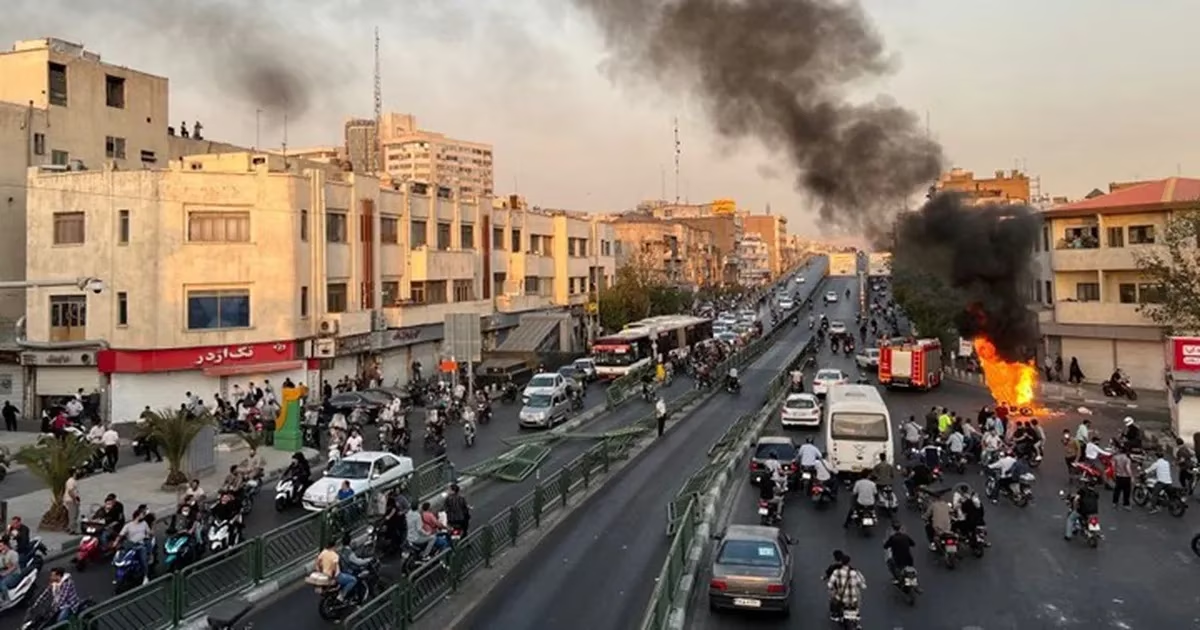
Ahmed Rafiq Awad: Trump, through this speech, tried to calm financial and energy markets, especially after the significant decline in the prices of many stocks on the stock exchanges. Dr. Saeed Shaheen: The entry of international parties into mediation reflects the United States' readiness to negotiate, not from a position of victory, but from the principle of minimizing losses. Dr. Tamara Haddad: These statements can be understood in the context of pressure, as major powers use the rhetoric of "the approaching end of the war" to prepare the ground for potential negotiations. Dr. Osama Abdullah: Trump's statements are an attempt to declare an early victory, as the White House seeks to create a narrative of victory before military operations actually end. Dr. Aql Salah: The continuation of the war will strengthen Iran's military and political position and reduce the ability of the United States and Israel to talk about the achievements of the first strike. Dr. Reham Odeh: The reality on the ground does not match Trump's rhetoric, as the war is still in its early stages and has not yet achieved its declared goal of changing the Iranian regime. Ramallah – Exclusive to "Al-Quds" – US President Donald Trump's statements about the approaching end of the war on Iran raise controversy about their true objectives and timing, amid ongoing military operations and mutual escalation, even if these statements carry economic and political messages and the possibility of paving the way for potential negotiations. Writers, political analysts, specialists, and university professors, in separate interviews with "Al-Quds", believe that these statements cannot be read in isolation from the economic and political pressures facing the US administration internally and externally, in addition to the war's impact on energy markets and the global economy. They point out that these statements are seen as an attempt to calm financial markets and reassure investors, amid fears of the war's continuation and its impact on the American economy and international trade, especially with the threats related to the Strait of Hormuz and its repercussions on global shipping traffic. They believe that talking about the approaching end of the war may constitute a political prelude to finding a gradual way out of the conflict, especially after the initial bets on achieving rapid war goals, such as weakening the Iranian regime or pushing it to collapse, faltered. They note that the continuation of the war may lead to increasing political and economic losses for the United States and Israel, which pushes for the search for political settlements or potential negotiation paths, although the field data indicates the continuation of the confrontation and the absence of decisive indicators of its imminent end. Calming the American debate about the legitimacy of the war Political writer and analyst Dr. Ahmed Rafiq Awad believes that the most prominent objectives of US President Donald Trump's statements that the war is nearing its end are an attempt to calm the growing debate and objections within the American street regarding the legitimacy of the war, especially with voices considering it an Israeli war that does not serve the direct interests of the United States, and is not based on a direct Iranian threat to America. Awad explains that the statements also carry a clear economic dimension, as they came amid rising oil prices, which reached about $110 per barrel, which negatively affected global markets and the American economy. Awad confirms that Trump, through this speech, tried to calm financial and energy markets, especially after the significant decline in the prices of many stocks on the stock exchanges, noting that this step reflects a clear commercial mindset in Trump's handling of political and economic crises. Awad believes that the most important implication of these statements may be an attempt to pave the way for the US administration to exit the war, especially if it has become involved in an escalation it did not expect to reach this level. Justifying the declaration of victory Awad points out that Trump's talk about destroying Iranian missiles and capabilities and weakening the Iranian regime may be an attempt to justify declaring victory and beginning the search for a political settlement, allowing Washington to "climb down from the tree" gradually. Awad confirms that Trump's latest speech was characterized by a clear contradiction, as it combined talk about the approaching end of the war with a call for the surrender of the Iranian regime and the presentation of ideas related to its dismantling. Awad points out that Trump's statements are often characterized by volatility and sometimes differ from the positions of his ministers, which makes it difficult to deal with them as final positions or decisive indicators of the war's trajectory. Awad notes that the reality on the ground does not support these statements, amid ongoing military operations and American-Israeli coordination in managing the war, and Israeli Prime Minister Benjamin Netanyahu plays a pivotal role in pushing the war forward and pressing for its acceleration with the aim of weakening or dismantling the Iranian regime. Awad believes that Trump's statements should be dealt with with extreme caution, because they carry a propaganda, political, and perhaps economic character, and do not necessarily reflect an accurate assessment of the war's trajectory or a confirmed indicator of its imminent end. Failure to overthrow the Iranian regime Dr. Saeed Shaheen, Professor of Political Communication at Hebron University, believes that US President Donald Trump has come to the conviction that the war on Iran will not achieve its main goal of regime change, despite betting on the fifth column and pushing Iranian youth to overthrow the regime, similar to the models of Iraq under Saddam Hussein and Venezuela. Shaheen points out that the war, instead of accelerating the collapse of the Iranian regime, began to hit American interests, military bases, and its economy, with Hezbollah entering the confrontation, which confused Israeli and American calculations. Shaheen explains that American and Israeli intelligence estimates indicated the fall of the Iranian regime within the first four days, but reality later proved the difficulty of achieving this goal, while internal movement in the United States against the war escalated, with demands to stop it due to its high economic costs borne by American taxpayers. Strengthening the Iranian position through negotiation Shaheen points out that Iran insists on continuing the war to force the hostile party to negotiate, which strengthens its position to reach an agreement that guarantees its right to possess peaceful nuclear energy and missile defense, which the war confirmed is not negotiable. Shaheen notes that the continuation of the war for a longer period may create a new equation that affects domestic politics in the United States and Israel, including the decline in Trump's popularity, who resorted to propaganda methods to justify his policies, and the decline in the popularity of Israeli Prime Minister Benjamin Netanyahu due to the extent of losses and damages resulting from Iranian attacks and Hezbollah missiles that targeted Israeli depth, turning Israelis into hostages of extremist government policies. Shaheen believes that the entry of international parties into mediation reflects the United States' readiness to negotiate, not from a position of victory but from the principle of minimizing losses, given Trump's and Netanyahu's understanding that continuing the war will not be sustainable. Shaheen points out that the visit of Trump's son-in-law Jared Kushner and his senior advisor Steve Witkoff to Israel is a clear indication of Washington's desire to get Israel out of its predicament in coordination with Tehran to end the war while saving face for both sides. Shaheen believes that the current data confirms the war's failure to achieve its strategic goals, and that its continuation may lead to significant economic and geopolitical consequences, with the possibility of imposing a new political reality in the region that reorders American and Israeli priorities. An attempt to show American and Israeli superiority on the ground Political writer and researcher Dr. Tamara Haddad believes that US President Donald Trump's statements about the approaching end of the war are linked to a political narrative through which he seeks to show the superiority of the United States and Israel on the ground, especially after his talk about the decline of Iranian military capabilities, including naval and air capabilities and communication networks, which he presents as evidence that the war has reached its final stage after achieving its basic goals. Haddad points out that these statements also carry a direct pressure message to Iran, implying that American-Israeli military decisive action is imminent, with what resembles a veiled threat that the time has come to surrender and stop Tehran's interference in Middle East issues. A speech with an economic dimension According to Haddad, at the same time, these statements indicate that the speech has a clear economic dimension, as it came amid rising oil prices to about $100 per barrel, with fears of it reaching $200 if the war continues, which negatively affects the American citizen and the global economy through rising energy prices and inflation. Haddad points out that the price of oil declined after these statements to about $88 per barrel, indicating the impact of political messages on markets. Haddad confirms that Trump's statements carry a message to the American public that he is close to achieving victory, although the military reality does not clearly indicate that, especially amid statements talking about continued fighting and the pursuit of decisive action on the ground, with Iran relying on a strategy of managing time and prolonging the conflict with the aim of exhausting the United States, Israel, and even neighboring countries. Reassuring American and international public opinion Haddad notes that these statements also carry a psychological and media dimension aimed at reassuring American and international public opinion and showing that the conflict is under control and will not turn into a long regional war. These statements can also be understood, according to Haddad, in the context of political and negotiating pressure, as major powers often use the rhetoric of "the approaching end of the war" to prepare the ground for potential negotiations or political settlements. Despite this, Haddad points out that the field and political data do not provide decisive indicators of the imminent end of the war, especially with the continuation of military operations and statements by some military officials that the fighting is still in its early stages, which reflects a gap between political rhetoric and military assessment. Haddad points out that the war's objectives themselves are still not entirely clear. While Trump spoke of neutralizing Iran's nuclear program and missile capabilities, he also hinted at the possibility of seeking to change the Iranian regime, which is a larger and more complex goal that is difficult to achieve in a short war, especially given the complexities of conflicts in the Middle East and the multiplicity of parties involved. Words are not spoken in vain Political researcher and academic Dr. Osama Abdullah stresses that US President Donald Trump's statements that the war "is nearing its end" must be read in the context of American political discourse, as words are not spoken in vain, and are often used as part of a political battle and not merely a description of the military reality. Abdullah points out that Trump's statement that military operations are "very advanced on schedule" and "largely complete" does not reflect an actual end to the war, but aims at several political and strategic objectives. Narrative of victory before the end of military operations Abdullah explains that the first of these implications of Trump's statements is an attempt to declare an early victory, as the White House seeks to create a narrative of victory before military operations actually end. Abdullah points out that Trump confirmed that Iranian military capabilities, including naval, communications, and air force, were "largely destroyed," to solidify the image of achieving the military objective. Abdullah believes that the speech aims to prepare American public opinion for withdrawal or reduction of military operations, reflecting historical experience in using the phrase "nearing the end" as a political tool, especially amid increasing economic and political pressures on the US administration. A clear deterrent message to Iran Abdullah points out that Trump's statements carry a clear deterrent message to Iran, as he linked the end of the war to conditions such as not disrupting oil navigation in the Strait of Hormuz, threatening a "much harsher" response if the equation changes. Abdullah explains that Trump's statements have an economic dimension, as oil prices fell immediately after his speech, which clarifies that the speech is not only military but also a management of the economic and political narrative of the war. When comparing these statements with the reality on the ground, Abdullah confirms a significant discrepancy: the war continues with mutual strikes and drone and missile attacks, and Iran has not declared any readiness to surrender, while there is no political agreement or official truce indicating the end of the conflict. Trump's contradictory speech Abdullah notes that Trump's speech itself is contradictory, as it combines saying that the war is "close to the end" with emphasizing that it will not end before the "decisive defeat of the enemy," which reflects the nature of political discourse more than an accurate description of the military reality. Abdullah believes that Trump's statements should be dealt with cautiously, as they are a tool for managing the political and economic narrative, to calm markets and public opinion, and to send deterrent messages, and are not a real indicator of the approaching end of military operations. An Iranian message of resilience and confrontation Political writer, researcher, and professor of comparative political systems, Dr. Aql Salah, believes that the current war on Iran clearly differs from previous conflicts, including the June war last year, which lasted 12 days. Salah points out that the current war showed Iran's ability to withstand and overcome the initial shock of the American-Israeli strike, which aimed to assassinate Supreme Leader Ali Khamenei and a number of first-rank military leaders, which did not achieve the expected goal for US President Donald Trump and Israel of the collapse of the Iranian regime and rapid internal chaos. Salah explains that Iran was able to inflict strong and devastating blows on American bases in the Gulf and the Arab world, especially on radar systems, and also targeted the heart of Israel, including Tel Aviv, which constituted a political and military shock for the Israeli and American sides. Salah points out that the popular and political level in Iran united with the regime against the external threat, while the military leadership maintained its discipline and ability to continue, despite the assassination of leaders, and a new leader was elected quickly, which represents a strong message that Iran is capable of resilience and continuing the confrontation. Reducing American losses and paving the way for negotiations Salah confirms that Trump's statements that the war "is nearing its end" carry several political and strategic implications: the first is the military implication, as Trump seeks to portray that he destroyed Iranian military capabilities, including the naval fleet, aviation, and communication system, and that the Iranian leadership has been weakened. Salah points out that there is another strategic implication based on the concept of "quick victory" or a lightning strike, which is an attempt to end the war quickly as happened in previous conflicts to reduce American losses, and to pave the way for negotiations according to American conditions. Calming global markets Salah notes the economic dimension, as the statements aim to calm global markets, especially oil markets, and restore stability to stock exchanges, as the price of a barrel of oil fell from $110 to $80 after Trump's statement. Salah points out the contradiction in Trump's own speech, which combines saying that the war is nearing its end and emphasizing that the end will not be achieved before the "complete defeat of the enemy," which reflects the volatile nature of Trump's speech that mixes threat and psychological reassurance, while seeking to impose his conditions on Iran. Salah believes that the continuation of the war will strengthen Iran's military and political position, and reduce the ability of the United States and Israel to talk about the achievements of the first strike, which necessitates paving the way for a gradual cessation of the war, according to the policy of "climbing down from the tree," while preserving what Trump considers his previous achievements. Trump and facing internal pressures Political writer and analyst Dr. Reham Odeh explains that US President Donald Trump's statements about the approaching end of the war on Iran primarily reflect economic and commercial pressures, more than a field assessment of the military situation. Odeh points out that Trump faced increasing pressure from within the United States, especially from shipping and transportation companies that were affected by rising fuel prices and the high cost of shipping services, which negatively affected American citizens and businessmen. Odeh notes that the war also affected international trade due to Iranian threats to the Strait of Hormuz, which prompted Trump to use rhetoric to calm markets and the global economy, emphasizing that the war "is nearing its end," with the aim of easing tension in the oil sector and reassuring international shipping companies and American business owners, which contributed to a slight decrease in oil prices after his statements. Declaring the end of the war unilaterally is not possible However, Odeh confirms that the reality on the ground does not match Trump's rhetoric, as the war is still in its early stages and has not yet achieved its declared goal of changing the Iranian regime, and may continue until the end of March, until an agreement is reached between Washington and Tel Aviv regarding ending operations after claiming to have destroyed most of the military arsenal of the Revolutionary Guard and the Iranian army. Odeh explains that declaring the end of the war unilaterally is not possible, because there is a clear partnership between the United States and Israel in this military operation, which necessitates agreement between the two parties before any official announcement. Odeh points out that Trump's statements should be read in the context of managing international economic and political pressures and calming markets, and not as a real indicator of the end of the military conflict on the ground, as the field and political data indicate that the war is still ongoing and its end is linked to subsequent political and strategic developments.

MORE FROM PALESTINE


Share your opinion
Talking about the approaching end of the war.. a speech to reassure markets and create a "narrative of victory"