






Israeli occupation forces arrested on Monday evening Qusai Ghaith, the son of Jerusalem Governor Adnan Ghaith, following a violent raid in the town of Silwan, south of the blessed Al-Aqsa Mosque. Local sources confirmed that occupation soldiers severely beat Ghaith before taking him to an interrogation center in the Holy City, a move that falls within the persecution of national figures and Jerusalemites.
In a related context, the Ramallah Governorate witnessed an attack by settlers on the outskirts of the village of Burqa, where they stormed the vicinity of citizens' homes with their flocks of sheep in an attempt to provoke residents. The settlers tried to seize livestock belonging to a farmer inside his pen, but the vigilance of the residents and their confrontation of the attackers prevented the thefts and forced them to retreat.
The settlers' attacks did not stop there, but extended to the village of Asira al-Qibliya, south of Nablus, where the attackers fired live ammunition at citizens' homes on the outskirts of the village. These attacks occur under the protection and heavy presence of occupation forces, which provide cover for settlers to carry out their repeated attacks on Palestinian villages and towns.
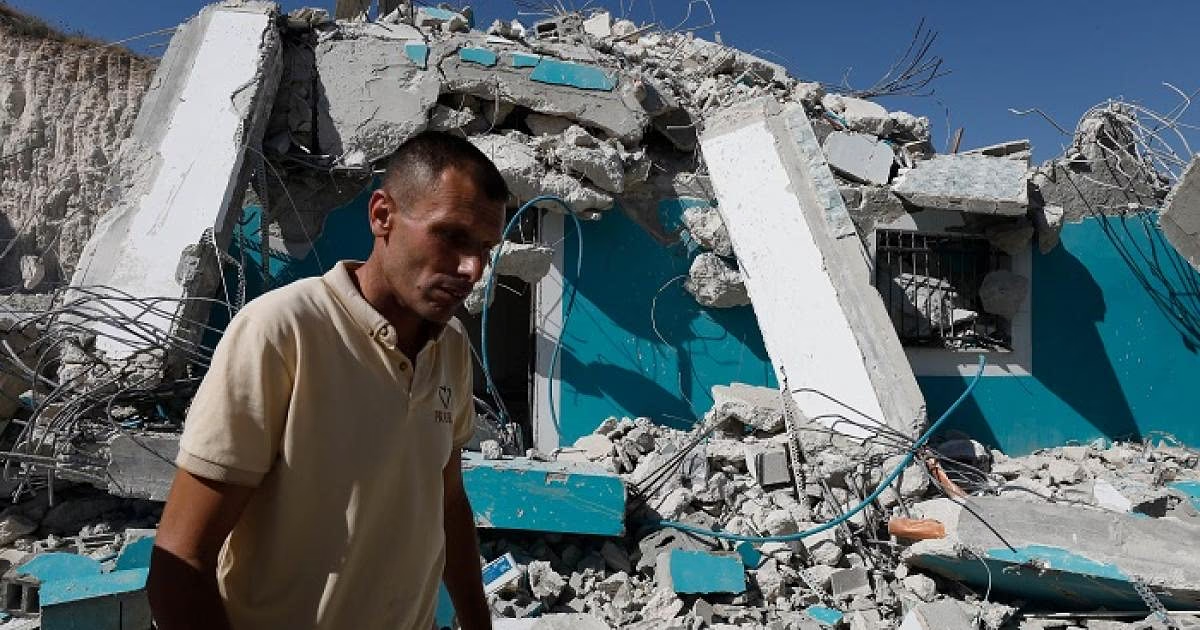
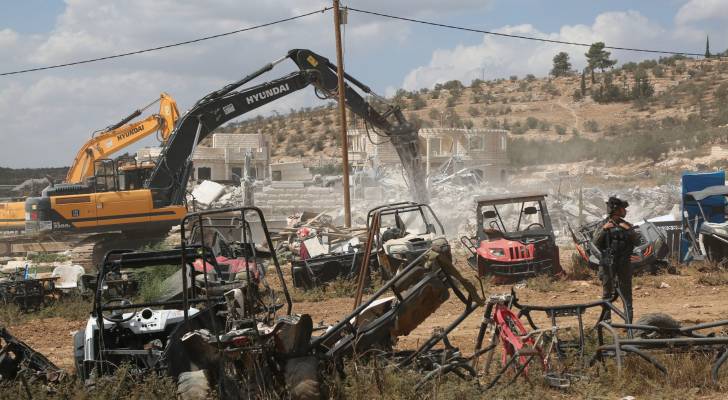
In the town of Nahalin, west of Bethlehem, occupation authorities issued notices to evacuate 14 homes and commercial establishments in preparation for their demolition, in a dangerous escalation targeting the Palestinian presence in the area. These notices were concentrated in the 'Qarnat al-Da'mas' area south of the town, where Israeli forces informed the owners of the structures of the need for immediate evacuation without specifying a timeframe for implementation.
This new wave of notices comes just days after occupation bulldozers demolished four homes and structures in the same town last week, under the pretext of building without a permit. Through this policy, the occupation seeks to empty the area of its original inhabitants in favor of settlement expansion that surrounds the town of Nahalin from several directions.
Ahmed Najajra, one of those affected by these decisions, was forced to start dismantling his home himself after receiving direct threats from occupation soldiers to shoot him if he did not leave the place. His brother Mahmoud explained that the family chose manual dismantling to reduce the heavy financial losses, especially since the house included a barn for livestock and poultry that supported the family.
According to the family's testimony, the cost of building the house targeted by the occupation exceeded 800,000 shekels, as Ahmed spent about four years constructing and equipping it to be a shelter for his wife and three daughters. This coercive measure reflects the extent of suffering experienced by Palestinians who are forced to demolish their dreams with their own hands to avoid paying exorbitant fines to the occupation.
In another part of Nahalin, demolition orders targeted an industrial facility specializing in ironworks owned by citizen Dheeb Ismail Shakarneh, an establishment that has been in operation for over 12 years. Shakarneh confirmed that this facility is not just a building, but the sole source of livelihood for four Palestinian families who depend entirely on its monthly income.
The owner of the facility explained that he received a final demolition order after exhausting all legal procedures in Israeli courts, which prompted him to dismantle equipment and goods and move them elsewhere. Despite the significant loss, Shakarneh emphasized his determination to rebuild his facility again, asserting that the demolition policy will not succeed in breaking the will to remain and work on the land.
Field reports indicate that the occupation has escalated the pace of distributing demolition notices in 'Area C' of the West Bank, exploiting current political circumstances to impose new realities on the ground. The town of Nahalin is considered one of the most affected areas due to its location between major settlement blocs that the occupation authorities seek to connect to each other at the expense of citizens' lands.
For their part, human rights organizations warned of the danger of these ongoing campaigns, which lead to the displacement of dozens of families, including children and women, in the absence of housing alternatives. These organizations considered that the demolition and forced displacement operations amount to war crimes that require urgent international intervention to stop them and hold those responsible accountable.
The scene in the West Bank and Jerusalem remains open to further escalation, amidst the intertwining of settler attacks with official military decisions targeting stone and people. Residents in Nahalin, Silwan, and Burqa affirm that their steadfastness on their land is the only possible response to continuous attempts to uproot them for decades.
We built this home with the family's effort and sweat, and we will remain steadfast on the land even if they demolish the walls over our heads.

Share your opinion
Escalation of Occupation in the West Bank and Jerusalem: Arrest of Jerusalem Governor's Son and Demolition Notices for 14 Structures in Nahalin