Dr. Raed Abu Badawiya: Israel may benefit from international preoccupation to reframe what is happening in Gaza within the regional conflict
Majed Hudeib: The continued freezing of the Peace Council will have direct repercussions on the internal situation in Gaza
Sari Sammour: Israel is trying to exploit the world's preoccupation with the war to intensify pressure on Gaza to impose new realities
Dr. Suhail Diab: If the war ends through an agreement in which Tehran seeks a regional approach, this may extend to include Lebanon and Gaza
Talal Awkal: Manifestations of obstructing entry into the second phase preceded the war on Iran, reflecting the failure of Trump's plan
Labib Taha: The absence of the Peace Council deepens the humanitarian and political crises in Gaza and reflects a clear denial of agreements
Ramallah - Exclusive to "Al-Quds" -
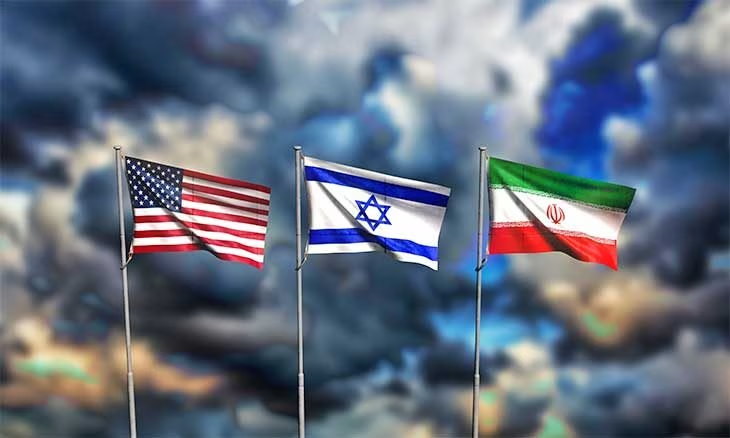
Amidst the Israeli war on Iran, the Gaza Strip's presence on the international agenda has receded, and the so-called Peace Council has been effectively frozen, as the attention of international powers and global media turned to the repercussions of the broader conflict in the region.
According to writers, political analysts, specialists, and university professors in separate interviews with "Al-Quds," this shift has led to a decline in political and diplomatic interest in the Palestinian issue, including initiatives proposed to address the situation in the Gaza Strip, most notably the "Peace Council," which was supposed to form a political and administrative framework for addressing the post-war phase.
They believe that the decline in international pressure has provided Israel with a wider margin for action in the Gaza Strip, amidst a lower level of political and media scrutiny of its field policies.
In contrast, the freezing of political initiatives and the decline in international interest directly impact the humanitarian and administrative reality in the Strip, which already suffers from severe living crises and a shortage of food, medicine, and basic services.
This continued stalemate also threatens to delay the reconstruction process and keep Gaza in a cycle of successive crises, awaiting the new balance of power that the regional war will bring, which may reshape the region's priorities and the future of the Palestinian issue.
Gaza and the Impact of Major Transformations
Dr. Raed Abu Badawiya, Professor of International Law and International Relations at the Arab American University, believes that the rapid regional developments, especially the ongoing war with Iran, have led to a significant decline in the presence of the Palestinian issue, particularly regarding the Gaza Strip, on the international political, media, and diplomatic agenda. This has been reflected in the initiatives proposed to address the situation in the Strip, including the "Gaza Peace Council."
Abu Badawiya explains that Gaza is not only affected by what happens within its narrow borders but is also greatly affected by major transformations in its surrounding regional and international environment. The Palestinian issue, despite its historical centrality in the Middle East, often recedes into the background during moments of major regional escalation, when the attention of international powers turns to conflicts considered more threatening to regional stability or the international order.
Abu Badawiya clarifies that the escalation of major crises, especially the war on Iran, pushes the international community to reorder its political and diplomatic priorities, as attention focuses on the repercussions of that confrontation and the possibilities of its expansion and its impact on regional stability, energy security, and the global economy. Similarly, international pressure related to Gaza declines, whether in terms of demanding a cessation of military operations or pushing for political and humanitarian solutions to address the crisis in the Strip.
Vacuum of International Attention
Abu Badawiya points out that this reality creates what can be described as a "vacuum of international attention," a vacuum that is practically reflected in the low level of international scrutiny and pressure on Israeli policies in Gaza, which gives Israel a wider margin to act and manage the conflict according to its own calculations, both militarily and politically.
Abu Badawiya notes that the nature of the regional system in the Middle East is based on the intertwining of crises and their competition for the agenda of international powers, as these crises are often dealt with according to a logic of prioritizing, even if the Gaza crisis has extremely dangerous humanitarian and political repercussions, making it a victim of this competition in regional crises.
Behind the Din of the War on Iran
Abu Badawiya explains that the disappearance of the Peace Council behind the din of the war on Iran reflects the preoccupation of the international environment that could support such initiatives with other more pressing priorities. When attention shifts to a broader regional conflict, the opportunities to push for initiatives aimed at calming the situation in the Strip or restarting political tracks related to it diminish.
Abu Badawiya indicates that Israel may benefit from the international community's preoccupation with other priorities by reframing what is happening in Gaza within the context of the broader regional conflict with Iran, a discourse that sometimes contributes to strengthening the acceptance of the Israeli narrative among some international powers.
Israel and the Opportunity to Establish Facts
According to Abu Badawiya, the decline in international scrutiny may also provide Israel with an opportunity to establish new field or political realities in the Strip, at a time when the level of diplomatic and media pressure related to developments in Gaza is decreasing.
Slow Humanitarian Response
On the humanitarian level, Abu Badawiya warns that the decline in international attention directly impacts the living conditions in the Strip, which already suffers from a severe shortage of basic necessities, including food, medicine, energy, and health services.
According to Abu Badawiya, the low level of political and media attention often leads to a slowdown in the international humanitarian response, given the significant role played by media coverage and political attention in mobilizing resources and directing aid.
Abu Badawiya points out that the absence of effective political initiatives perpetuates the stalemate related to the Gaza Strip, as the crisis continues to be dealt with within the framework of conflict management instead of seeking sustainable political solutions.
Abu Badawiya believes that the disappearance of the Peace Council behind the din of the war on Iran reveals the fragility of the political tracks related to the Strip and their great dependence on a supportive international environment.
Link to the Results of the War on Iran
Writer and political analyst Majed Hudeib confirms that the ongoing war on Iran has practically withdrawn the aspirations and hopes of Palestinians related to reconstruction and the restoration of normal life in the Gaza Strip, in addition to disrupting any political horizon that was proposed in the previous phase or activating the role of the Peace Council.
Hudeib explains that the freezing of the Peace Council's work is not only linked to the international parties' preoccupation with the war but is also connected to the broader context related to the project of reshaping the region in what is known as the "New Middle East," which Israel seeks to establish.
Hudeib notes that Israeli Prime Minister Benjamin Netanyahu's vision for the future of Gaza and the Palestinian issue in general is linked to the results of the war on Iran and the new regional balance of power it will produce.
Hudeib indicates that this war has resulted in a clear shift in the international community's priorities, as attention has moved from the Gaza file to the broader conflict in the region, which has been reflected in the decline in discussions about the Peace Council or attempts to create conditions for its work to begin.
Disputes Related to the Administration of the Gaza Strip
Hudeib points out that the political scene related to the administration of the Gaza Strip is still witnessing multiple disputes, both among Palestinian forces themselves and among the concerned international parties. There are ongoing disputes about the role of the Palestinian Authority, Hamas's position on future administrative arrangements for the Strip, in addition to differences between the United States and Israel regarding "the day after" arrangements for the war, especially concerning the security file and the party that will manage the Strip and grant political legitimacy.
On the security level, Hudeib believes that the war on Iran makes it difficult to implement any security arrangements related to the Peace Council, especially those related to deploying stabilization forces or transferring security powers in Gaza.
Hudeib explains that these forces are the backbone of the Council, but their work is linked to security agreements that have not yet been reached between the United States and Israel, or between the United States and other parties involved in the Council.
Hudeib indicates that Israel, in light of the regional war and the possibilities of its expansion, focuses its security priorities on the regional front, which makes it unwilling to withdraw from Gaza or transfer security control to another party, for fear of a security vacuum that parties Israel considers linked to Iran might exploit.
Hesitation in Funding
On the economic front, Hudeib confirms that the freezing of the Peace Council's work carries clear economic implications, because the Council was supposed to form a framework for managing international aid and reconstruction projects in coordination with donor countries. However, the war on Iran led to the hesitation of these countries and international institutions to inject funding, in the absence of stability and the unclear outcomes of the regional conflict.
According to Hudeib, this reality of freezing the Peace Council's work practically means the continuation of the Gaza Strip in a state of "relief economy" dependent on limited aid instead of moving to a phase of reconstruction and development, until the results of the war become clear and the features of the new balances in the region are determined.
Continued Administrative and Political Vacuum
Hudeib warns that the continued freezing of the Peace Council will have direct repercussions on the internal situation in Gaza, including the continuation of the administrative and political vacuum and the weakening of the ability to organize civilian life and public services, at a time when the Strip already suffers from a severe shortage of food, medicine, water, and fuel.
Hudeib indicates that this vacuum may allow Hamas to strengthen its security and administrative control within the Strip, including in the police, municipalities, and judiciary sectors, which may complicate "the day after" arrangements and lead to a re-raising of the issue of the movement's role in any future political equation related to the administration of Gaza.
According to Hudeib, the shift of international attention from managing the Gaza crisis to managing the broader regional conflict practically means postponing any political or economic project related to the Strip, which threatens to exacerbate the humanitarian and administrative crisis and delay the reconstruction and stabilization process in Gaza until the results of the war in the region become clear.
Overwhelming Nature of the Ongoing War with Iran
Writer and political analyst Sari Sammour explains that news from the Gaza Strip and the West Bank has clearly receded, due to the overwhelming nature of the ongoing war with Iran on the general scene, as the magnitude of the event and its strategic repercussions have made it a global focus, while other issues, including the Palestinian issue, have fallen into the background.
Sammour believes that this decline is not only linked to the momentum of the war but also to an attempt to reprogram the political scene in the region, including the Palestinian issue itself.
Israel and Exploiting War Outcomes
Sammour believes that some scenarios Israel aspires to are based on exploiting the results of the war if it ends with an American-Israeli victory over Iran, which could open the door to dangerous political and security steps affecting the Palestinian demographic reality.
Sammour explains that one of the most dangerous of these scenarios is the attempt to impose a large-scale displacement of Palestinians from the Gaza Strip towards Egypt, through political or regional pressure, in addition to pushing Jordan to receive large numbers of Palestinians from the West Bank.
Sammour notes that this vision, according to its planners, aims in the long run to reshape the reality in Gaza to return to what it was decades ago, while reducing the Palestinian population in the West Bank.
Sammour indicates that this scenario remains dependent on the results of the war, stressing that its end in a draw or without a clear resolution may limit the possibility of implementing such plans, and perhaps open different paths that may not necessarily be negative for the Gaza Strip, while any American-Israeli victory poses the most dangerous possibilities for the region and the Palestinian issue.
Major Strategic Repercussions
Sammour explains that the war with Iran carries major strategic repercussions, especially concerning energy and the global economy, which makes it a central issue for most countries in the world.
Sammour points out that the Gulf states themselves have been affected by the war, and a large part of the Arab media is Gulf-funded, at a time when the countries of the region are preoccupied with their arrangements and interests related to the war and its repercussions.
On the ground, Sammour notes that Israeli shelling of the Gaza Strip has relatively decreased compared to previous periods, but it has not stopped, while the siege and restrictions continue, exacerbating the suffering of the residents and affecting basic necessities of life.
Sammour believes that Israel is trying to exploit the world's preoccupation with the war on Iran to intensify pressure on the Strip and complicate humanitarian conditions, in order to impose new realities.
Sammour considers that the current phase is witnessing the introduction of new approaches in American and Israeli policy based on the principle of "peace through strength," meaning imposing realities by military force, and that the results of the confrontation with Iran will determine the shape of future policies in the region, including the future of the Palestinian issue and its political arrangements.
Netanyahu's Escape Forward
Dr. Suhail Diab, Professor of Political Science and specialist in Israeli affairs, believes that the ongoing war between the United States and Israel on one hand and Iran on the other has pushed the Gaza Strip file to a lower rank in regional and international priorities, without meaning the closure of the file or the end of its political path, but rather its temporary freezing pending the developments of the confrontation in the region.
Diab indicates that this shift was not merely a side effect of the war, but rather consistent with the political calculations of Israeli Prime Minister Benjamin Netanyahu, who sought to "escape forward" towards the Iranian file to avoid commitments related to the second phase of arrangements for the Gaza Strip, as well as understandings related to Lebanon and other regional files.
Diab points out that Netanyahu believed that engaging in a confrontation with Iran might strengthen his internal political position and restore his electoral popularity, especially since he had previously hinted at the possibility of bringing forward the election date before the outbreak of the war.
Gaza's Scene After the Current Confrontation
Regarding the impact of the war on the future of the Gaza Strip, Diab proposes two main scenarios for the current confrontation. The first is a limited ceasefire similar to what is described as the "Twelve-Day War," which is the option preferred by the United States. In this case, the Gaza file is expected to return to its pre-war status, with the possibility of some adjustments that would give Washington political gains that the American president could leverage domestically, especially in the context of the midterm elections, which might raise Israeli reservations.
The second scenario, according to Diab, concerns ending the war through a comprehensive agreement that addresses the roots of the conflict, which is the proposal Iran tends towards, fearing that a temporary ceasefire would lead to a renewed war within a few months.
In this context, Diab emphasizes that Tehran seeks a comprehensive regional approach to Middle East issues, so that the agreement is not limited to ending the war in Iran only, but also extends to include the situations in Lebanon and the Gaza Strip.
Diab notes the existence of understandings and contacts between Iran and a number of regional parties, including Egypt, Qatar, and Turkey, aimed at presenting the Gaza file as part of any potential comprehensive settlement. If this happens, the Palestinian issue – and especially the situation in Gaza – may benefit from a broader regional framework for settlement.
The Palestinian Crisis Towards the Peace Council
In contrast, Diab points to a growing crisis of confidence among the Palestinian public towards the so-called "Peace Council," led by the United States and including prominent figures such as US President Donald Trump and Israeli Prime Minister Benjamin Netanyahu, who are also leading the war on Iran at the same time they are talking about arrangements for Gaza, which creates a clear contradiction that weakens Palestinian trust in any future role for it.
Diab indicates that the Gaza file is currently in a state of freeze pending the outcomes of the war, warning that the continued disagreement between the option of "ceasefire" and the option of "ending the war" may open the door for Israel to make deep field changes in Gaza and Lebanon, which could reshuffle the cards in the region and leave additional negative repercussions on the Palestinian issue.
Continued Obstruction of Transition to the Second Phase
Writer and political analyst Talal Awkal explains that the passage of about five months since the implementation of US President Donald Trump's plan, along with weeks since the last ceremonial meeting of the so-called "Trump Peace Council," has not been reflected in any tangible change on the ground in the Gaza Strip. He points out that Israel continues to obstruct the transition to the second phase of the plan and continues to impose its policies on the ground without any actual movement from the Council or its members.
Awkal indicates that Israel, at the same time, continues its policy of assassinations, shelling, and complete control over crossings and entry and exit movements, in addition to managing the file of humanitarian aid and the requirements for improving life in the Strip according to its own calculations.
Awkal notes that the Council, despite its composition which includes international, Arab, and Islamic figures alongside international envoys, has not even been able to secure the entry of the technocrat committee that is supposed to undertake administrative tasks in Gaza.
Awkal confirms that the manifestations of obstructing entry into the second phase preceded the war on Iran by a long period, which reflects the failure of Trump's plan and the submission of the concerned parties to Israeli dictates, rather than the claim due to the ongoing war in the region.
Difficult Conditions in Gaza
Awkal indicates that the living reality in Gaza has not undergone a fundamental change, as the level of fear of shelling has relatively decreased, while some foodstuffs have become available in the markets but are sold at high prices, although lower than those that prevailed during the period of widespread war. Nevertheless, manifestations of hunger, poverty, unemployment, and the spread of diseases continue to burden the lives of the residents.
Awkal affirms that the people of Gaza, despite these harsh conditions, continue to stand firm on their land, stressing that surrendering to despair or abandoning the will to live is not an option for Gazans despite the severity of the suffering.
Decline in the Presence of the Palestinian File
Researcher and political analyst Labib Taha believes that the absence of the so-called "Peace Council," which primarily includes American figures close to the US administration, poses deep and negative political implications for the Palestinian issue, amidst international transformations and preoccupation with the ongoing war against Iran. This has led to a decline in international interest in what is happening in the Palestinian territories, especially in the Gaza Strip.
Taha indicates that this Council was supposed to play a role in advancing the settlement process or keeping the Palestinian issue within the priorities of international political discussion. However, its absence at this sensitive stage reflects a shift in international attention to other files, primarily the war with Iran, which has contributed to the decline in the presence of the Palestinian file on the international stage.
Taha notes that the world is almost forgetting what is happening in Gaza, as news related to the Strip has no longer topped the international scene in the last two weeks, with the exception of scattered reports addressing the continued killing, destruction, and the war that has not stopped, even if its pace has relatively decreased compared to previous periods. He explains that this media and political decline reflects a deep imbalance in the balance of international attention.
Taha affirms that the absence of the "Peace Council" inherently carries negative messages for Palestinians, as it reflects the reality that the Palestinian side is the weakest in the international political equation, and that history has often shown that the weak pay the highest price when interests take precedence over principles.
This absence also reflects – according to Taha – that power has taken precedence over right in the management of international relations, and that the strategic interests of the United States, Israel, and their allies take precedence over the suffering of the Palestinian people.
Prioritizing International Policy
Taha believes that one of the clear indicators in this context is the prioritization of international policy, where it appears that the Palestinian issue is no longer among the priorities of the US-led international system, while other issues receive greater attention in light of escalating regional and international conflicts.
Regarding the repercussions of this on the Palestinian reality, Taha explains that this absence deepens the humanitarian and political crisis in the Gaza Strip, pointing out that what the Strip is experiencing is no longer just a passing crisis or an emergency, but a prolonged catastrophe that has lasted for more than two years, reflecting a clear denial of the agreements concluded with the Palestinian side.
Taha affirms that these developments practically mean the continued deprivation of Palestinians of their most basic human rights, noting that the discussion here is not only about political rights but about the fundamental rights with which every human being is born.
Taha explains that these rights are absent in the reality of Palestinians, especially in the Gaza Strip, while the situation in the West Bank is not much different in essence, although it differs in terms of severity, as the overall reality remains characterized by harshness, suffering, and tragic dimensions.