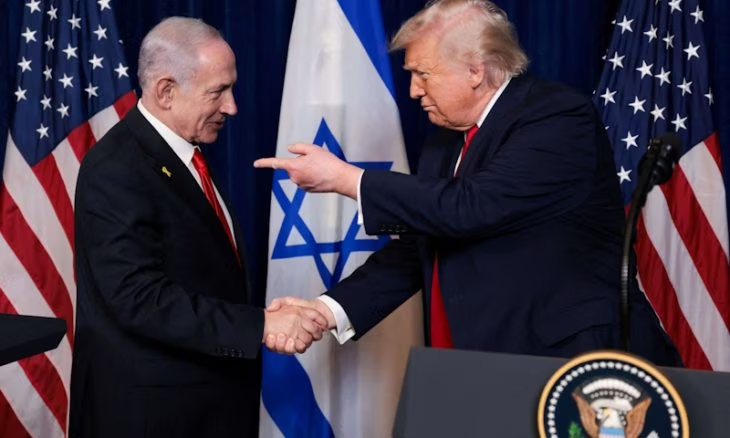







Official and security circles in Israel are showing increasing anxiety over the dramatic shifts in the stance of US President Donald Trump, who has openly declared his desire to reach an agreement with Iran. Estimates in Tel Aviv vary regarding the seriousness of this approach, especially after Trump's surprising statements that disrupted the calculations of the Israeli government, which had been banking on continued maximum military pressure.
Benjamin Netanyahu, the head of the occupation government, commented on these developments by indicating that he had held talks with the US President, explaining that the latter sees a golden opportunity to capitalize on what he described as the 'significant achievements' of the Israeli and American armies in the region. Netanyahu tried to reassure his audience that any future agreement must preserve Israel's vital security interests, despite clear gaps in visions between the two parties.
In the context of accelerated diplomatic moves, informed sources revealed that US Vice President, J.D. Vance, discussed details related to the initiation of negotiations with Tehran with Netanyahu in a phone call. The discussions covered potential clauses to end direct military confrontation, reflecting the Trump administration's desire to close this thorny file early in its term.
For its part, media reports indicated the existence of a 'secret message' sent by Iranian Foreign Minister, Abbas Araqchi, to US Special Envoy Steve Witkoff. The message included indications of the new Supreme Leader, Mojtaba Khamenei's, approval to quickly end the current crisis, provided that fundamental Iranian demands are met, suggesting a shift in Tehran's political stance.
Leaked information suggests that Araqchi made a phone call to Witkoff in the presence of the US President's son-in-law, Jared Kushner, to ensure the message reached Trump's inner circle. The Iranian side's objective with this move is to demonstrate a smooth and organized transfer of power in Tehran, contrary to Israeli expectations that had been banking on internal unrest hindering political decision-making.
On the ground, sources reported that Washington has already begun taking practical steps to set the stage for negotiations, with Trump directing the Department of Defense to postpone scheduled airstrikes on Iranian energy facilities. This five-day postponement aims to provide an opportunity for diplomatic efforts, coinciding with news of a round of negotiations starting in Pakistan later this week.
In an attempt to minimize damage and ensure that red lines are not crossed, Netanyahu dispatched Minister Ron Dermer to Washington to clearly present Israeli demands to the US administration. Through this visit, Israel seeks to emphasize the necessity for any agreement to include a complete dismantling of the nuclear program and prevent Iran from acquiring any future enrichment capabilities.
Israeli newspapers, including 'Haaretz,' warned against the Netanyahu government obstructing the new negotiation process, as happened in previous experiences. The newspaper called for the US to be enabled to manage the diplomatic dialogue, noting that continuous military escalation may not achieve the long-term strategic goals desired by the international community.
There is confusion within the Israeli security establishment regarding Trump's true intentions, with former officials fearing the conclusion of a 'bad deal' that would grant Iran international legitimacy without fundamentally addressing the ballistic missile issue. These officials believe that merely reducing the range of missiles might avert danger from Europe but would keep Israel and the Gulf states under direct threat.
Military analysts in Tel Aviv indicate that Trump fears entanglement in a wide regional war that could drain American resources, and therefore prefers quick settlements. This approach puts Netanyahu in a political dilemma, as his desire to continue the war to achieve 'absolute victory' conflicts with his biggest ally's desire in Washington to end armed conflicts.
Observers believe that Netanyahu, who strongly pushed for Washington's withdrawal from the nuclear agreement in 2018, now finds himself facing a complex reality after the acceleration of Iranian enrichment. Voices are rising within Israel demanding a review of the effectiveness of previous policies that led Iran to the brink of nuclear capability, considering diplomacy as the only remaining way out.
Amidst this atmosphere, Israel continues its military operations in Lebanon and against Iranian targets, in an attempt to impose facts on the ground before any political agreement matures. Israeli officials publicly assert that military pressure is what pushed Tehran to the negotiating table, in an attempt to save face before the domestic public.
In conclusion, anticipation remains the dominant sentiment in the region, awaiting the outcome of upcoming meetings in Pakistan or Washington. While Trump aims for a quick diplomatic achievement, Israel remains apprehensive that this achievement might come at the expense of its national security, potentially opening the door to a silent confrontation between the allies on how to deal with Iranian ambitions.
Trump believes there is an opportunity to reach an agreement with Iran, leveraging military achievements, but we will work to ensure Israel's vital interests.
شارك برأيك
Anxiety in Tel Aviv over Trump's intentions to quickly reach an agreement with Tehran