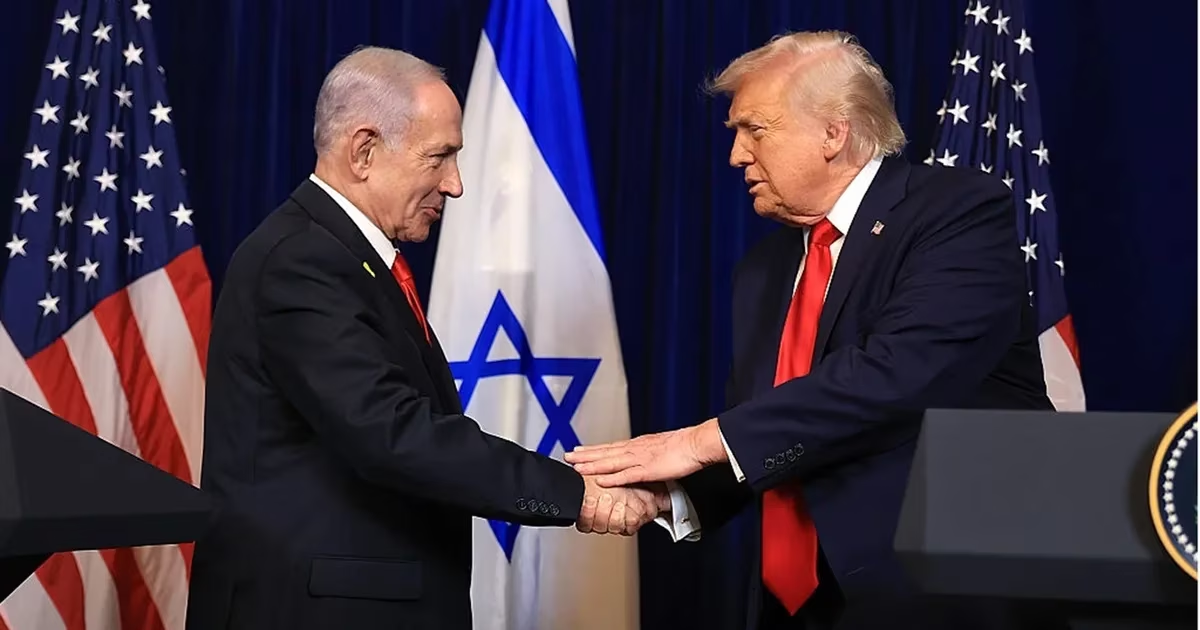







The office of Israeli Prime Minister Benjamin Netanyahu announced his departure for the American capital, Washington, next Wednesday for an official meeting with US President Donald Trump. This meeting comes at a sensitive time to discuss the ongoing negotiations regarding the Iranian nuclear file, which have recently seen developments in the Omani capital, Muscat.
This meeting marks the 15th in the history of the official relationship between the two leaders, as President Trump's second term witnessed an unprecedented intensification in the pace of direct communications. These successive meetings reflect the high level of strategic coordination between the current US administration and the occupation government in confronting regional challenges.
Official records indicate that Trump's first term saw 7 key meetings, which served as a platform for announcing historical decisions such as the recognition of Jerusalem as the capital of Israel and the normalization agreements. With Trump's return to the White House in January 2025, meetings accelerated to reach another 7 meetings in just one year, highlighting the depth of the current alliance.
The Iranian nuclear agenda tops the discussion table, as Netanyahu seeks to impose a "high ceiling" of Israeli conditions on any potential agreement between Washington and Tehran. These demands include the complete dismantling of Iran's nuclear infrastructure and the transfer of enriched uranium stockpiles outside Iranian territory to ensure no return to manufacturing.
In addition to the nuclear file, the ballistic missile file stands out as one of the fundamental points of contention that Netanyahu will raise, as he demands strict restrictions on Iran's missile range. Tel Aviv insists that the range of Iranian missiles should not exceed 300 kilometers, a demand that Tehran categorically rejects and considers an infringement on its defensive sovereignty.
Netanyahu is accompanied on his trip to Washington by the commander of the Israeli Air Force, in a move described by sources as unconventional and carrying clear military messages. This military presence aims to provide a detailed technical presentation to President Trump on available military options and the second round of potential airstrikes should diplomatic efforts fail.
On the Palestinian front, the two leaders will discuss the completion of the Gaza peace plan announced last September. Discussions will focus on mechanisms for the complete disarmament of the Hamas movement and the demilitarization of the Strip as a fundamental condition set by Israel before commencing any extensive reconstruction operations.
Discussions also touch upon the second phase of the Gaza plan, which includes the formation of an international administration under the name "Peace Council" to manage the affairs of the Strip. Both parties seek to ensure that the new administration is consistent with the shared Israeli-American security vision, thereby preventing the return of armed Palestinian factions to power.
Returning to the history of meetings in 2025, Netanyahu inaugurated Trump's second term with a visit on February 4, followed by meetings in April and July to discuss military operations against Iran. Meetings continued in September and October, where Trump visited occupied Jerusalem and delivered a speech in the Knesset, leading up to the Mar-a-Lago meeting last December.
Informed sources confirm that Netanyahu aims through this intensive activity to ensure that the US administration does not make any substantial concessions to Iran in the Muscat negotiations. The Israeli Prime Minister believes that maximum pressure is the only way to undermine the influence of the so-called "axis of resistance" in the region and reduce Iranian support for its allies.
The relationship between Trump and Netanyahu at this stage is characterized by great harmony, surpassing what it was in the first term, especially after overcoming the period of estrangement that preceded the US elections. This harmony is evident in the speed of decision-making related to joint military operations and high-level security coordination on regional issues.
The Wednesday meeting is expected to result in the formulation of joint "red lines" regarding Iranian ambitions, which could directly affect the course of international negotiations. Political circles are awaiting whether Trump will fully adopt the hardline Israeli demands regarding the Iranian missile and nuclear program.
In a related context, reports indicate that discussions will also address the expansion of regional normalization, complementing the "Abraham Accords" that began in the first term. Both parties seek to integrate more Arab countries into the regional security system to confront common threats, linking this to the path of a political solution in the Gaza Strip.
In conclusion, the 15th meeting between the two leaders represents the pinnacle of political and military coordination, as Netanyahu seeks to obtain full American cover for his upcoming moves. Whether on the Iranian or Palestinian file, the shared vision between the White House and Tel Aviv in Trump's second term appears more resolute towards changing the geopolitical reality in the Middle East.
Netanyahu seeks to pressure Trump not to make concessions to Iran, with a focus on restricting ballistic missiles and halting support for the axis of resistance.
شارك برأيك
Anticipated Summit Between Trump and Netanyahu in Washington to Discuss Iranian Nuclear File and Future of Gaza