PALESTINE

Fri 03 Jul 2026 3:06 pm - Jerusalem Time

A Thousand Days of Aggression on Gaza: A Heavy Toll of Destruction and Hunger Queues Haunting the Displaced

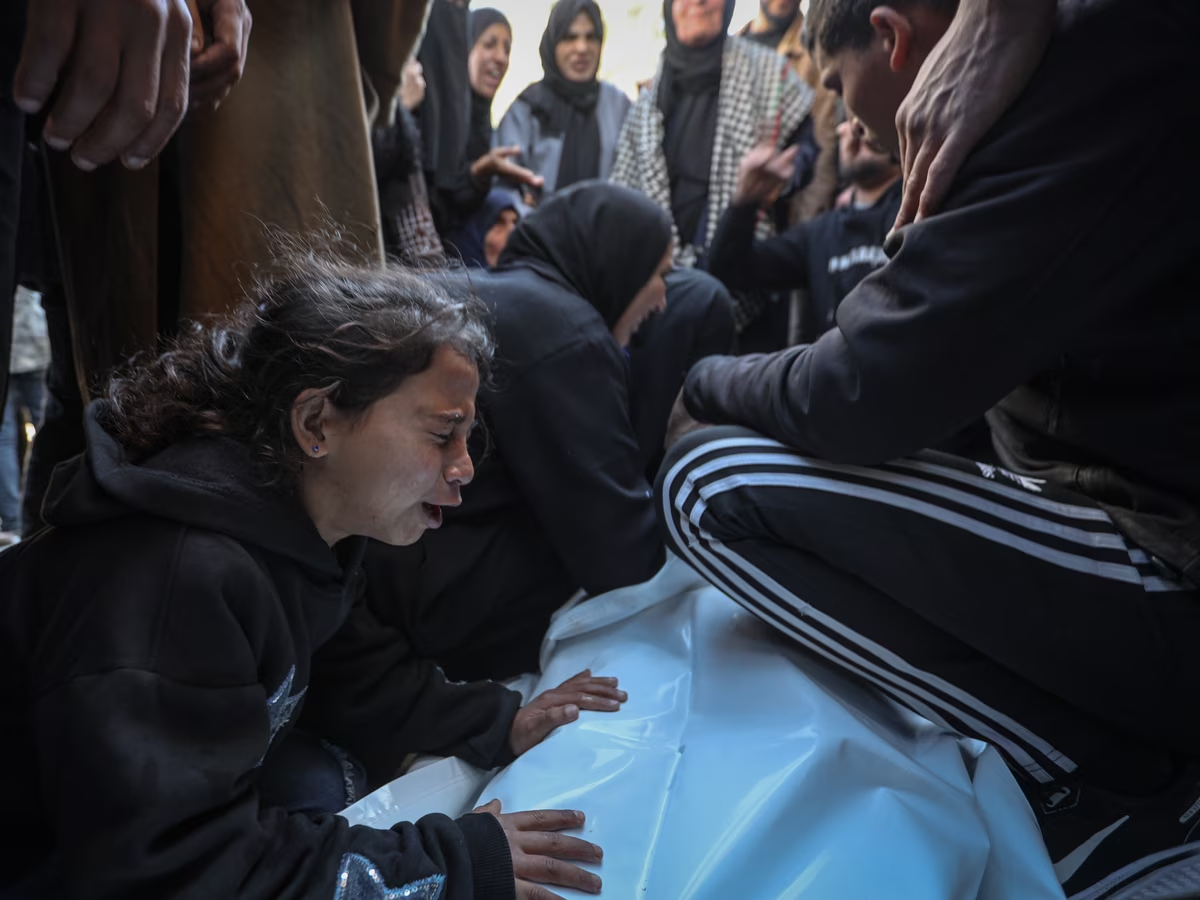
The Gaza Strip has completed its thousandth day under the weight of one of the most brutal wars in modern history, with no real signs of a breakthrough on the horizon to end the escalating humanitarian suffering. Despite eight months passing since the ceasefire agreement came into effect, the living reality continues to deteriorate amidst the closure of crossings and the complete halt of reconstruction projects.

Field sources in Khan Yunis camp and the displacement areas in Al-Mawasi have observed the continued features of widespread destruction and the absence of any actual steps to remove rubble or open closed roads. Residents there face a truce described as fragile, with repeated military violations making return to original areas a distant dream fraught with constant dangers.

In live testimonies from the heart of suffering, a displaced citizen confirmed that the hopes placed on the truce have faded with the continued absence of clean water and basic services, and even the arrival of shells at tent gatherings. This bitter reality has left residents in a state of constant anticipation and anxiety, amidst the lack of security that international understandings were supposed to provide.

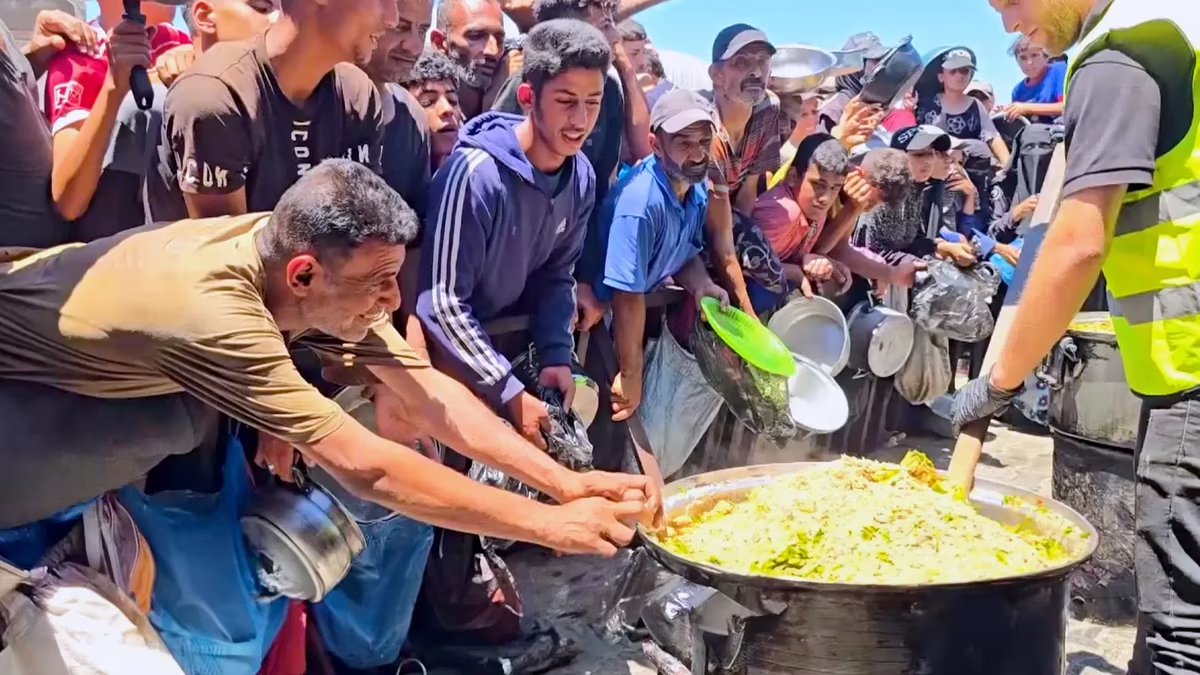
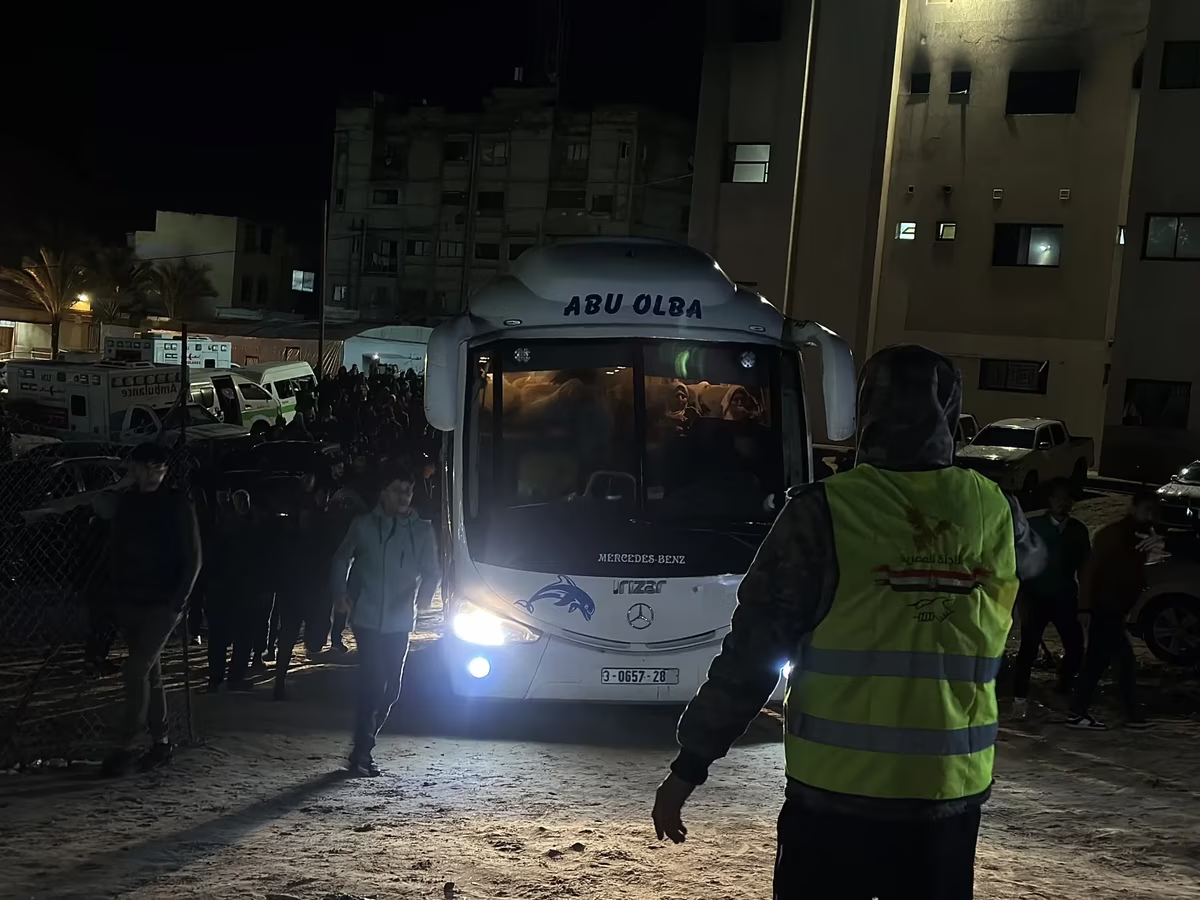
Regarding food security, "food kitchens" have become the only refuge for thousands of families suffering from a severe shortage of supplies due to restrictions imposed on crossings. Citizens, including children and women, queue for long hours under the scorching sun awaiting a meal that may not be enough for family members, and often quantities run out before their turn comes.

Citizens in aid queues reported that they are forced to wait from early morning hours to secure their only livelihood, as their tents are completely devoid of any basic foodstuffs. These scenes illustrate the scale of the humanitarian catastrophe experienced by nearly two million people whose fate is linked to what the Israeli authorities allow to enter through partially closed crossings.

According to official data issued by the Ministry of Health, the human toll has reached terrifying figures, with over 73,000 Palestinians martyred, the vast majority of whom are women and children. The number of injured has also risen to over 173,000 people, many of whom suffer from permanent disabilities amidst a dilapidated and besieged health system.

The issue of missing persons continues to break the hearts of Gazan families, as estimates indicate that there are about 11,000 people under the rubble of destroyed homes without the ability to retrieve their bodies. Reports from international food security organizations confirm that 1.6 million people in the Strip, especially in the northern areas, face real hunger and a severe shortage of medicines and fuel.

As for infrastructure, the Union of Municipalities revealed an unprecedented scale of destruction affecting vital facilities, with over 4 million linear meters of main and secondary roads being bulldozed and destroyed. This systematic destruction has made movement between cities and camps a difficult and dangerous process, and has isolated entire population centers from their surroundings.

The water sector was not spared from targeting, as about one million linear meters of distribution networks went out of service, in addition to the destruction of one million linear meters of sewage networks. Military operations also targeted 725 water wells, leading to a severe water crisis and environmental pollution that threatens the spread of epidemics and diseases among the displaced.

Losses were not limited to infrastructure but also extended to human resources working in the field, with 300 employees and engineers from municipal staff martyred while performing their duties in an attempt to repair what the occupation destroyed. Municipalities also lost more than 500 heavy vehicles and bulldozers, paralyzing their ability to deal with waste accumulation or open vital roads.

Amidst this bleak scene, the coastal area of Al-Mawasi stands out as a major displacement center lacking the most basic infrastructure, where hundreds of thousands live in dilapidated tents on the sand. Health and environmental problems are exacerbated in these areas due to groundwater contamination and the absence of sewage networks, placing the international community before a historical responsibility to end this siege.

After 8 months of truce, we expected rubble to be removed and roads to be widened, but we find no clean drinking water, and shells still pursue our tents.

OPINIONS

Fri 03 Jul 2026 11:59 am - Jerusalem Time

El-Sayed garners first Senate candidate endorsement from anti-Zionist Jewish organization

Washington Message

Washington – Said Arikat – 7/3/2026

News Analysis

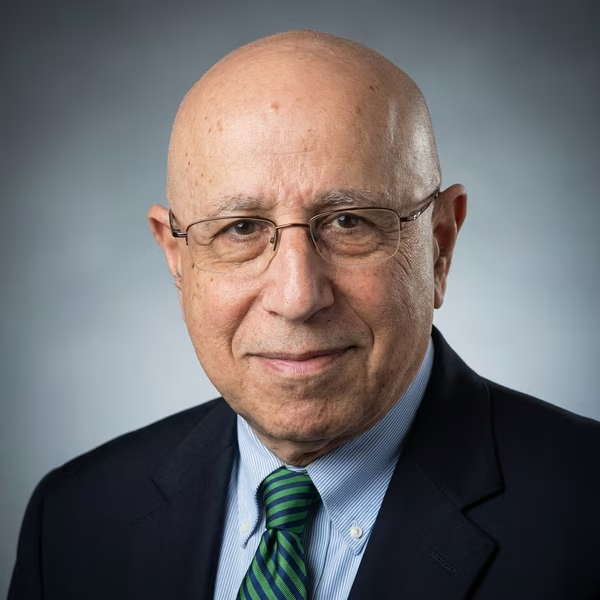
In a move with political implications extending beyond Michigan, the organization "Jewish Voice for Peace Action" announced its endorsement of Dr. Abdul Rahman El-Sayed in the Democratic Party's Senate primary race, making him the first candidate for this position to receive support from the anti-Zionist Jewish organization since the establishment of its political arm, according to the progressive website "The Intercept."

This endorsement comes at a time when the Democratic primaries are witnessing a remarkable rise of candidates who adopt more critical stances on Israeli policies and more supportive of Palestinian rights, reflecting increasing shifts within the Democratic Party's popular base, especially among youth and the progressive movement.

In a statement to the website, Beth Miller, the organization's political director, said that Abdul Rahman El-Sayed "has consistently and unapologetically advocated for Palestinian rights and freedom, and has shown a moral consistency that places justice and equality at the heart of his campaign," considering that his election would represent an opportunity to reshape American foreign policy to serve freedom and justice instead of supporting wars and discrimination.

Heated Three-Way Race

Abdul Rahman El-Sayed is facing a tough primary election on August 5th, against Representative Haley Stevens, who is supported by the Democratic establishment and pro-Israel lobbies, foremost among them the American Israel Public Affairs Committee (AIPAC), in addition to State Senator Mallory McMorrow, who presents herself as a progressive and enjoys the support of prominent figures, including Senator Elizabeth Warren.

In contrast, Abdul Rahman El-Sayed enjoys the endorsement of Senator Bernie Sanders and Senator Chris Van Hollen, along with a number of members of the progressive "Squad" in Congress, including Rashida Tlaib and Summer Lee, which has strengthened his position as the most left-leaning candidate among the contenders.

Gaza at the Heart of the Electoral Battle

Although economic issues, such as inflation, rising living costs, and healthcare, continue to top voters' concerns, the war in Gaza has become one of the most prominent issues defining candidates' positions, especially within progressive circles.

Abdul Rahman El-Sayed was among the first politicians to strongly criticize the Israeli war of extermination on Gaza and demanded an end to unconditional military support for Israel, a stance that earned him the support of pro-Palestinian movements, but at the same time exposed him to attacks from his political opponents.

"Jewish Voice for Peace" believes that defending Palestinian rights has become an integral part of the progressive agenda within the Democratic Party, and that voters are now refusing to separate social justice within the United States from the defense of human rights abroad, as stated in all the organization's statements.

Growing Role of Anti-Zionist Jewish Movements

The organization has emerged over the past two years as one of the most prominent drivers of protests against the war on Gaza, organizing sit-ins and demonstrations in universities, inside the Capitol building, and at major financial institutions, demanding an end to US military aid to Israel.

The organization is also one of the leading supporters of the "Stop the Bombs" bill, which seeks to prevent the supply of weapons used in military operations to Israel, a project that has become an important criterion for measuring the positions of progressive candidates.

Beth Miller (to The Intercept) affirmed that since the establishment of its political arm in 2019, the organization had not found any Senate candidate worthy of its endorsement until Abdul Rahman El-Sayed's campaign emerged, considering his positions to represent a qualitative shift in Democratic political discourse.

Criticism Campaigns and Political Pressure

Abdul Rahman El-Sayed's campaign was not without controversy, after he hosted political commentator Hassan Baker at electoral events at Michigan universities, which drew criticism from some moderate Democrats who considered the move inappropriate following an attack on a synagogue in the state.

His opponent, Mallory McMorrow, accused El-Sayed of not considering the feelings of the Jewish community, while he emphasized his explicit condemnation of the synagogue attack, asserting that combating antisemitism should not be used as a means to silence criticism of Israeli policies.

For her part, Beth Miller said that Abdul Rahman El-Sayed grew up in a Jewish community in Michigan and has close human relations with members of that community, adding that his campaign rejects exploiting the security of Jews or Palestinians for political gain.

Polls Give Him the Edge

Recent polls indicate that Abdul Rahman El-Sayed is narrowly ahead of his rivals in the primary elections, and the results of a poll conducted by "Zenith Research" and reviewed by Al-Quds newspaper's correspondent showed that he has better chances of winning the general election against the expected Republican candidate Mike Rogers.

The poll also revealed that 46 percent of Michigan voters support halting all US arms shipments to Israel, a position consistent with Abdul Rahman El-Sayed's political program, while McMorrow supports halting only some offensive weapons, and Stevens supports continued military aid without conditions.

In his first comment on the endorsement, Abdul Rahman El-Sayed said that "Jewish Voice for Peace" has proven that combating antisemitism and defending Palestinian lives and dignity stem from a single commitment to shared human values, expressing his pride in this support.

The endorsement of an anti-Zionist Jewish organization for a Senate candidate represents a striking political precedent, not only because of its symbolism but also because it reflects a gradual change within a segment of the American Jewish community, which is increasingly distinguishing between Jewish identity and unconditional support for the Israeli government. This shift, though still limited compared to the traditional influence of pro-Israel lobbies, indicates that the internal debate about Gaza is no longer confined to academic circles or student movements but has begun to find its way into political and electoral institutions, which may redraw alliances within the Democratic Party in the coming years.

The Michigan battle reveals that the Palestinian issue has transformed from a foreign policy matter into an issue that directly affects internal electoral calculations. Candidates are no longer competing only on the economy, healthcare, and immigration, but their stance on the war in Gaza and military aid to Israel has become an important factor in determining voter trends, especially among youth, Arab Americans, and progressives. If this dynamic continues in future elections, the Democratic establishment may find itself forced to reconsider its traditional rhetoric on Israel, in order to preserve the unity and cohesion of its electoral base.

Despite the momentum surrounding Abdul Rahman El-Sayed's campaign, the path to the Senate remains fraught with challenges. State elections differ fundamentally from local district elections, as they require building broad coalitions that extend beyond progressive bases. Furthermore, the financial resources and organizational influence enjoyed by pro-Israel lobbying groups will remain influential factors in the final stage of the race. Nevertheless, the mere fact that a candidate with these positions has reached the forefront of the competition reflects a political shift that is difficult to ignore and may be an indicator of a reshaping of the priorities of a significant portion of Democratic voters.

PALESTINE

Fri 03 Jul 2026 11:58 am - Jerusalem Time

Behind the Scenes of Israel's Attempts to Assassinate Araghchi and Ghalibaf During Peace Negotiations with Washington

American press sources revealed exciting details regarding Israel's attempts to assassinate senior Iranian negotiators, coinciding with Washington's sensitive talks with Tehran last spring. According to American officials, these Israeli moves were directly aimed at undermining efforts to reach a temporary peace agreement between the two parties.

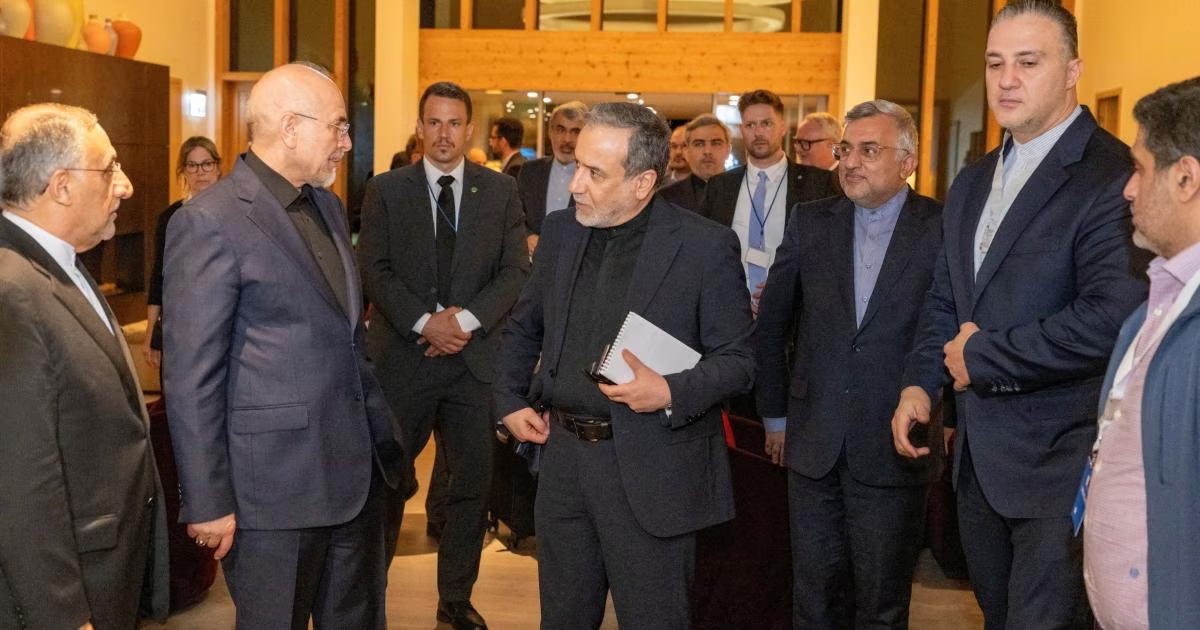
Reports indicated that American concerns significantly escalated regarding the targeting of Foreign Minister Abbas Araghchi and Parliament Speaker Mohammad Bagher Ghalibaf. These anxieties began with the launch of ceasefire negotiations last April, as Washington considered any harm to these two figures would mean the end of the diplomatic path.

Due to fears of derailing the negotiations, the United States resorted to unprecedented steps by asking regional countries to warn Tehran of the possibility of Israel targeting its officials. This step reflects the extent of the divergence in views between Washington and Tel Aviv, as the latter saw assassinations as a means to overthrow the Iranian government.

Officials in the American administration acknowledged that Araghchi and Ghalibaf were legitimate targets for Israel during the intense phases of the war, given their prominent positions. However, the American perspective changed with the start of serious negotiations, as preserving their lives became a necessity for the continuation of dialogue and to prevent the re-ignition of a full-scale military confrontation.

The roots of the current conflict trace back to the Israeli strike on February 28 that resulted in the death of Supreme Leader Ali Khamenei and other senior officials. While American operations focused on neutralizing naval and missile capabilities, Israel prioritized the elimination of political and military leadership as a strategic objective from the very beginning.

Israel's assassination list included figures described as pragmatic, with whom Washington had hoped to reach understandings to end the crisis. Prominent among these were Ali Larijani, a senior national security official, and Kamal Kharrazi, the former foreign minister, who were killed in airstrikes while engaged in communication channels with the United States.

These facts reveal the rapid divergence between the war objectives of the United States and Israel after a period of alignment. While Washington pushed for lasting peace, Israel expressed deep skepticism and tried to obstruct this path by targeting key figures in the negotiation process.

Ghalibaf and Araghchi are considered the main drivers of the negotiations that took place in several regional and international capitals with the aim of reaching a ceasefire. Informed sources confirmed that Israel had included the two men on its target list since last March, before being forced to temporarily remove them under direct American pressure.

Reports revealed that Mohammad Bagher Ghalibaf miraculously survived death on two previous occasions, one during the Twelve-Day War in 2025. The second time was this year when an Israeli airstrike targeted a secret fortified underground bunker where a meeting of senior Iranian officials was taking place.

According to testimonies from Iranian officials, Ghalibaf was pulled from under the rubble in both incidents, prompting Tehran to take extremely stringent security measures. These measures included changing movement and travel protocols, especially during foreign trips that require security coordination with host countries and intermediaries.

Last April, as Ghalibaf headed to Islamabad to meet with US Vice President JD Vance, Tehran requested strict security guarantees. Iran, through Qatari and Pakistani intermediaries, sought American assurances to prevent any secret Israeli operations targeting the Iranian delegation participating in the talks.

Fighter jets from the Pakistani Air Force escorted the Iranian plane carrying the 70-official delegation to secure it from any aerial interception. Despite these precautions, the delegation faced a serious security threat on the return journey, after movements of Israeli fighters were detected near Iran's western borders.

Security sources reported that Ghalibaf's plane was forced to make an emergency landing in the city of Mashhad, near the Pakistani border, to avoid the Israeli aerial threat. The Iranian delegation then had to complete its journey to the capital Tehran by land in a arduous eight-hour trip under heavy guard.

Despite these risks, the negotiation rounds continued, with Araghchi and Ghalibaf later traveling to Qatar and Switzerland to continue discussions with the American delegation. These events demonstrate the complexity surrounding the peace process in the region, amidst a clash of wills between the American desire for de-escalation and Israel's insistence on military resolution.

Any attempt to assassinate Iranian leaders would end the talks and reignite the fighting.

PALESTINE

Fri 03 Jul 2026 11:58 am - Jerusalem Time

US Judiciary Convicts 7 Activists Who Blocked 'Golden Gate' Bridge in Solidarity with Gaza

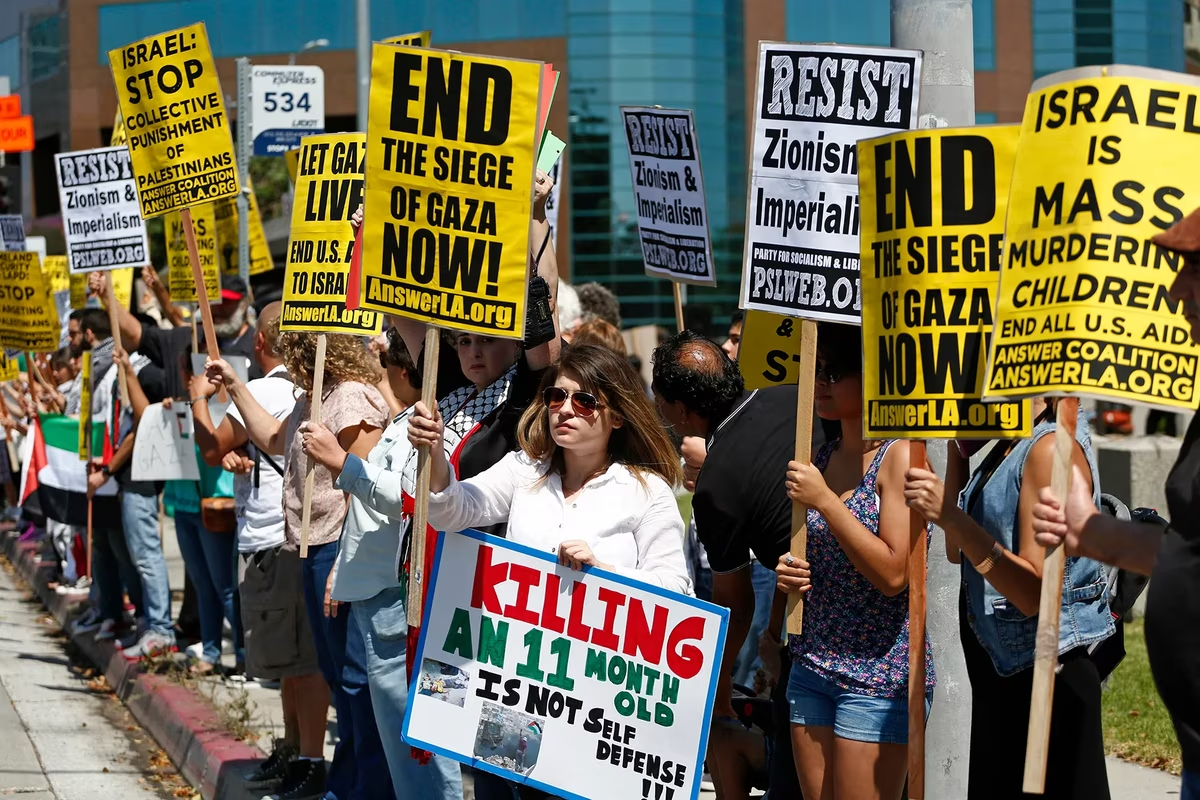
A jury in San Francisco, USA, has convicted seven pro-Palestinian activists for their involvement in blocking the famous 'Golden Gate' Bridge during a demonstration in 2024. These protests took place within a broader movement across the United States condemning the ongoing Israeli genocide in the Gaza Strip and demanding an end to the military and political support provided by Washington to Tel Aviv.

San Francisco District Attorney Brooke Jenkins stated in an official announcement that the seven demonstrators faced convictions on six different misdemeanor charges. These charges included obstructing traffic on the vital bridge, refusing to comply with security forces' orders to disperse the gathering, and participating in an unauthorized demonstration, which led to traffic paralysis in the area at the time.

Despite the convictions on the aforementioned misdemeanors, the jury failed to reach a final decision on the more serious charge of 'criminal conspiracy.' This charge is considered a grave offense, with potential penalties under US law reaching up to 15 years in prison, as it requires proof of a prior agreement between two or more individuals to commit a criminal act beyond mere peaceful protest.

For their part, the activists' lawyers defended their clients, asserting that the motives behind blocking the bridge were purely ethical and humanitarian, aimed at drawing attention to the devastation in Gaza. The defense team indicated that the demonstrators resorted to this escalatory tactic after exhausting all traditional means of expressing their views, including writing to members of Congress and organizing protests that did not lead to a change in US policy.

This trial reflects the legal and political tension within the US regarding pro-Palestinian activities, especially those targeting public facilities or universities. Protesters continuously demand that educational institutions and American companies disassociate themselves from the Israeli military system, considering that silence on what is happening in Gaza constitutes participation in the crimes committed against civilians.

The demonstrators acted out of what they considered a moral responsibility to oppose the destruction caused by the Israeli war in Gaza.

ARAB AND WORLD

Fri 03 Jul 2026 11:56 am - Jerusalem Time

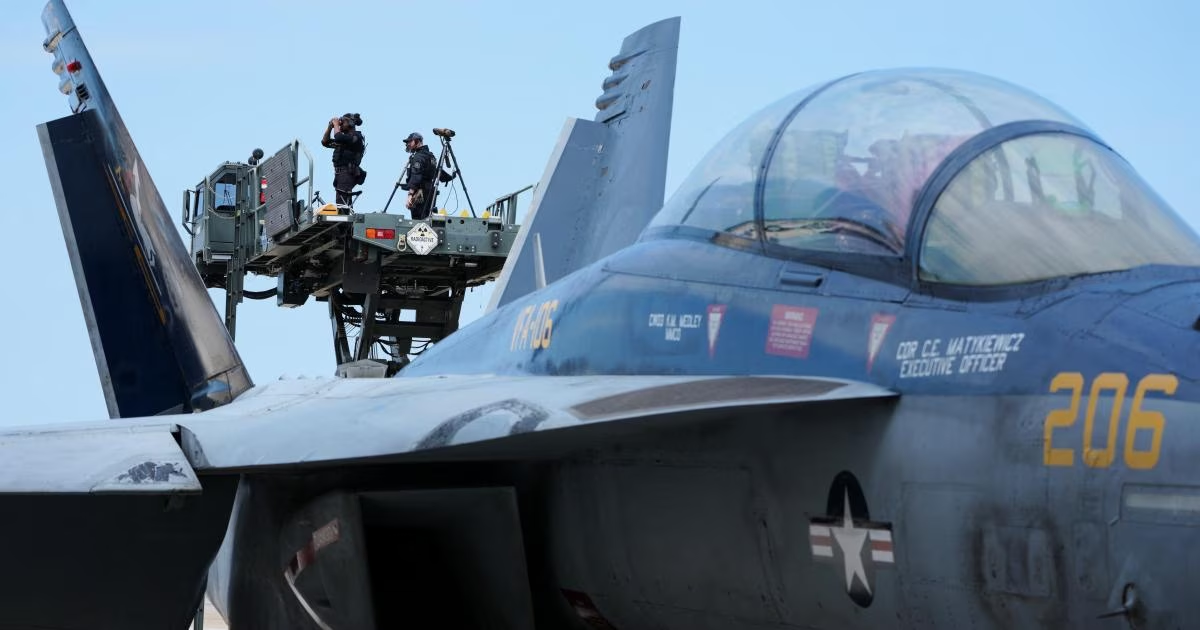
Shocking Estimates: US War on Iran Exceeds $200 Billion, Drains Half of Precision Missile Stock

Recent financial estimates have shown that the true cost of US military operations against Iran has far exceeded the figures previously announced by the US Department of Defense (Pentagon). While hostile operations ceased about two months ago, data has begun to emerge indicating a significant inflation in expenses related to field operations, equipment maintenance, and troop redeployment in the region, posing unprecedented challenges to the military budget.

According to expert sources and follow-ups by 'Fortune' magazine, the initial cost of the conflict has settled at the $200 billion mark, a figure that is seven times higher than the Pentagon's initial estimate of $29 billion. This massive increase is due to the inclusion of costs for deploying more than 5,000 additional troops, along with the heavy consumption of smart munitions and urgent repair operations required by military vehicles involved in the conflict.

Regarding armament, reports revealed a crisis in replenishing stocks, as the cost of replacing 'Tomahawk' missiles skyrocketed to between $3 and $6 million per missile, after previously ranging from $1 to $2 million. This increase in manufacturing costs places additional pressure on the US Navy, which relied heavily on these missiles during airstrikes.

In terms of military readiness, an analysis by the Center for Strategic and International Studies indicated that the first seven weeks of fighting witnessed a dangerous depletion of defensive and offensive capabilities. US forces consumed approximately 45% of their precision strike missile inventory, in addition to losing half of the stock of 'THAAD' and 'Patriot' air defense systems, raising questions about the ability to confront other simultaneous conflicts.

The losses were not limited to ammunition but extended to US military infrastructure in the Middle East, where approximately 230 facilities suffered varying degrees of damage. Estimates suggest that rehabilitation and repair operations for these bases and facilities will require a budget ranging from $200 to $300 billion, to be distributed over spending plans extending from three to five years.

This data confirms that the long-term financial burden of the war will continue to haunt the US economy and the Department of Defense for years, far from the political statements that attempted to downplay the extent of the losses. The scale of depletion in interceptor and offensive missiles puts Washington in a position where it must accelerate the pace of war production to compensate for the severe shortage that has affected the pillars of its air defense in the region.

The officially announced figure from the Pentagon does not reflect the true extent of military spending, which included a severe depletion of strategic munitions.

PALESTINE

Fri 03 Jul 2026 11:56 am - Jerusalem Time

A Thousand Days of Genocide.. Gaza Documents the Memory of Blood and Displacement Under the Weight of the Siege

The residents of the Gaza Strip commemorate the passage of a thousand days since one of the most violent bombing and destruction campaigns witnessed in modern history, as this period has turned into a daily narrative of pain and loss. The Strip, with an area of 365 square kilometers, has been subjected to intense military operations in which the occupation army used a deadly arsenal of weapons, leading to the almost complete destruction of infrastructure.

Gaza residents described these days as 'heavy as mountains,' where numbers are no longer just silent statistics, but have turned into living stories of displacement, hunger, and deprivation. This phase has reshaped the details of daily life for more than two million Palestinians, pushing them to harsh limits of resilience and brokenness simultaneously under the weight of the continuous siege.

On social media platforms, Palestinian accounts were flooded with a torrent of posts documenting this heavy phase, with comments ranging from shock to anger at the continued international silence. Many resorted to narrating their harsh daily lives under bombardment, in an attempt to document the crimes committed against them and ensure that the victims who perished during these long days are not forgotten.

Writer and political analyst Mustafa Ibrahim affirmed that the passage of a thousand days of the war of genocide reflects the continuation of systematic killing without any deterrent international action. Ibrahim pointed out that suffering has turned into a heavy daily routine, in light of an almost complete absence of personal and collective security for all residents of the besieged Strip.

For his part, activist Ahmed Hamdan considered that this period was not just fleeting time, but a thousand days of targeting children, women, medical and educational staff. He added that the occupation deliberately destroyed schools, hospitals, and residential neighborhoods, revealing the extent of the humanitarian tragedy experienced by the Strip in full view and hearing of the entire world.

In the same context, activist Mohammed Al-Jabour explained that the past thousand days are an extension of an endless series of thirst and living in dilapidated tents under the weight of repeated displacement. Al-Jabour affirmed that what Gaza is experiencing today represents an unprecedented tragedy in contemporary human history, where civilians face death at every moment.

Journalist Ibrahim Muslim described what is happening as a 'continuous brutal genocide' that is one of the most heinous crimes in modern times, noting that the news has not changed since day one. The scene still boils down to targeting unarmed civilians as they search for a sip of water or a loaf of bread to feed their children among the rubble of homes.

Activist Ibrahim Abu Zour pointed out that the passage of this huge number of days means nothing but the continuation of the crime without any clear horizon for its end or stopping the bleeding. Abu Zour believes that Gaza is still living in the heart of the storm, where bombardment renews and the scope of destruction expands with every new morning that passes over the residents.

Activists spoke about how the number '1000' falls like a stone on the Palestinian memory, summarizing a time of pain unlike any other time humanity has known. They added that seasons passed to the rhythm of bombardment, while winds pass over the rubble to whisper over the bodies of martyrs who perished without anyone in this world paying attention to them.

The scene in Gaza remains open to the same tragedy; renewed displacement and unextinguished fear, where every minute that passed left a broken heart or a demolished home. Homes have turned into rubble and tents into temporary graves, while children grew up to the sounds of warplanes instead of school anthems, and some were martyred before knowing the meaning of life.

Activists stressed that the fundamental question is no longer about when the genocide will stop, but about how the world has become accustomed to seeing these daily scenes without action. They considered that international silence was not just neutrality, but an actual partnership in the crime being committed against a people being annihilated in front of cameras for a thousand days.

Observers believe that Gaza's steadfastness throughout this period will be recorded in history as a moral test in which the international community, which boasts of human rights values, failed. Gaza was not alone because of its weakness, but because the world chose to be weaker than facing the bitter truth, and contented itself with watching while massacres against innocents continued.

Bloggers bitterly wondered if the world truly understands the meaning of spending a thousand days under constant bombardment, hunger, and deprivation of the most basic necessities of life. They added that the days passed as if they were a thousand years of pain, wondering if anyone still hears the moans of children and the cries of mothers in the alleys of the destroyed camps.

In conclusion, local sources confirmed that the continuation of the war throughout this period reveals the extent of complicity and abandonment suffered by the Palestinian people in the Gaza Strip. Despite thousands of victims and massive destruction, it seems that the blood of civilians no longer stirs the global conscience, leaving Gaza to face its fate alone in the face of the killing machine.

A thousand days are not just a period of time, but a thousand days of killing, displacement, hunger, and targeting all elements of life in Gaza.

PALESTINE

Fri 03 Jul 2026 11:56 am - Jerusalem Time

Tightening of Solitary Confinement Measures Against Leader Marwan Barghouti in Occupation Prisons

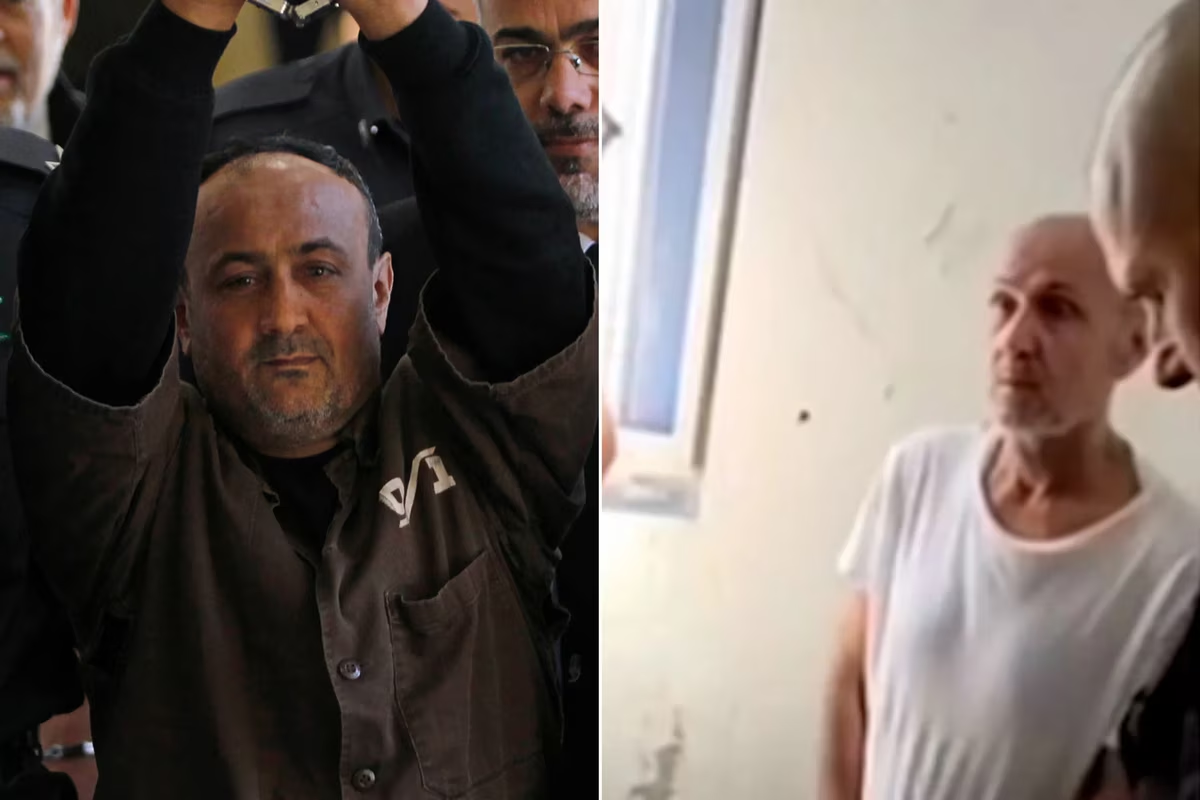
The office of the captive leader and Fatah Central Committee member, Marwan Barghouti, announced that the Israeli occupation authorities have escalated solitary confinement measures against him inside 'Janot' Prison, located in the Negev desert. Sources clarified that Barghouti, who has been isolated since November 2023, is being constantly transferred between solitary confinement cells in different prisons, a step aimed at increasing pressure on him and preventing his stability.

Informed sources reported that these measures come within the context of a systematic arbitrary policy, where prison administrations deliberately transfer him frequently to ensure his complete isolation from the outside world. These developments coincide with what Israeli Army Radio reported about imposing an additional two-week solitary confinement penalty on Barghouti, reflecting an escalating trend by the Israeli security system towards captive leaders.

On the legal front, Barghouti's lawyer filed an appeal with the Israeli judiciary after being prevented from meeting his client for a long period. However, the prison administration placed additional obstacles by setting next September as the earliest date for a visit. Human rights reports confirm that this prevention falls within a broader policy that includes restricting communication with families and lawyers, and depriving isolated prisoners of medical care and basic needs.

Barghouti has been behind bars since his arrest in April 2002, spending many years in solitary confinement away from other prisoners, and is currently serving five life sentences. These harassments come after the extremist National Security Minister Itamar Ben-Gvir stormed his cell last February and issued direct threats to him, raising serious concerns for his life and physical safety.

Field data indicates that targeting Barghouti comes amidst the widespread popularity he enjoys among the Palestinian public, and his symbolic status as one of the most prominent leaders of the national prisoner movement. Human rights organizations consider what he is subjected to as part of a comprehensive retaliatory campaign launched by prison administrations against Palestinian prisoners since last October, through intensifying policies of abuse, collective, and individual isolation.

Israeli authorities are taking systematic arbitrary measures against Barghouti by repeatedly transferring him between solitary confinement sections.

PALESTINE

Fri 03 Jul 2026 11:55 am - Jerusalem Time

From Silwan to Kafr Aqab: How the Occupation is Reshaping Jerusalem's Demography?

Jerusalem - WAFA - Bilal Ghayth Kiswani

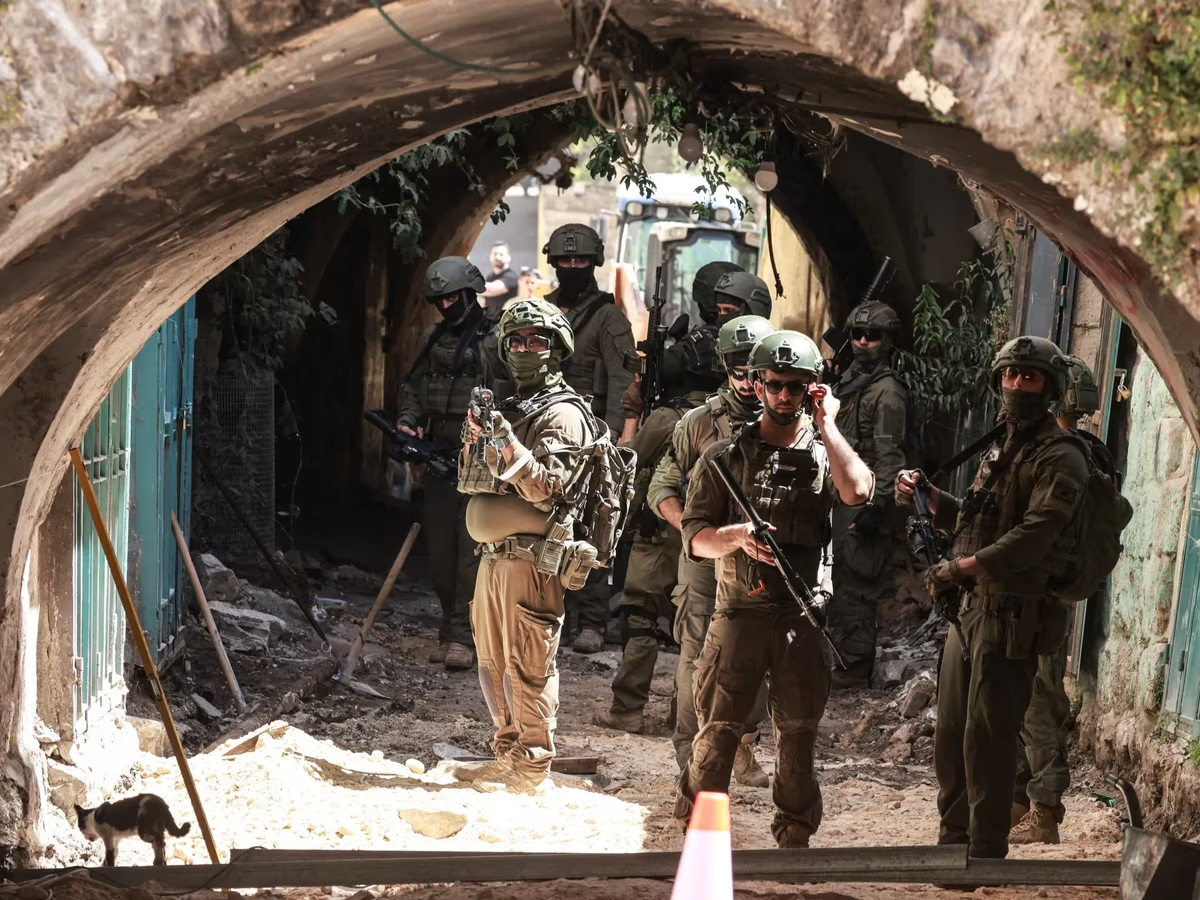
On the morning of March 25, 2026, the "Eyes" mural in the Batn al-Hawa neighborhood of Silwan silently observed the scene. Just about 300 meters from Al-Aqsa Mosque, Israeli occupation forces spread through the narrow alleys of the neighborhood, blocked its entrances, and prevented journalists and residents from entering. Within hours, occupation municipality trucks were emptying Palestinian homes of their contents, while furniture and personal belongings were scattered in the streets under the gaze of their owners.

For the families forced to leave that morning, it was not an ordinary property dispute or a singular judicial decision. It was the final chapter in a battle that lasted for years within Israeli courts, ending with the loss of homes they had lived in for decades.

From the beginning of 2026 until the end of April, the occupation authorities evicted 15 Palestinian families from their homes in Batn al-Hawa neighborhood, after the Israeli Supreme Court rejected appeals filed by 20 families, including the Rajabi and Basbous families.

At the same time, final and enforceable eviction orders included 22 housing units, while 33 other units face preliminary notices and legal proceedings that may end with the same fate. Thus, the number of housing units threatened with eviction in Batn al-Hawa rises to 55 housing units.

What is happening in Batn al-Hawa is not an isolated case. In Silwan alone, about 2,200 Palestinians face the risk of forced displacement, including about 1,500 people in Al-Bustan neighborhood and another 700 in Batn al-Hawa. But these numbers are only part of a larger picture, extending beyond Silwan to reveal a comprehensive system of legal, planning, and economic policies that have been reshaping the demographic landscape of East Jerusalem for decades.

This investigation reveals how evictions, home demolitions, urban planning policies, land registration, and exorbitant taxes intersect to create a new reality in the city, narrowing the space available to Palestinians and strengthening the settlement presence, in a process that experts and human rights organizations describe as a gradual demographic re-engineering of Jerusalem.

Batn al-Hawa... When courts become a tool of uprooting

On that same morning, Palestinian families were not fighting their first battle with the courts. For many years, they moved between the Israeli Magistrates', District, and Supreme Courts, presenting documents and evidence proving their ownership or right to housing, before the battle ended in favor of settlement organizations.

Yaacoub Rajabi, a member of the Batn al-Hawa Defense Committee and one of the homeowners affected by the eviction orders, says that the families spent many years in the Israeli judicial corridors, presenting their documents and evidence, but all these procedures did not prevent the evictions from being carried out.

He adds in a special interview with "WAFA" that what is happening cannot be understood as an ordinary property dispute, but rather as part of a policy aimed at emptying the neighborhood of its Palestinian residents and replacing them with settlers, by using historical narratives dating back more than 150 years to reopen ownership files that have been closed for decades.

Rajabi points out that many families initially did not realize the extent of the legal complexities surrounding these issues, until settlement organizations began using loopholes related to Ottoman land records to re-file old claims in court.

He says that hundreds of families are now threatened with losing their homes as a result of this process, while the pace of resolving cases is accelerating compared to previous years.

For his part, Nidal Rajabi, one of the homeowners affected by the eviction orders, believes that the issue has long since gone beyond the matter of proving ownership or legal rights. He says that the families possess official documents proving their rights, but the balance of power within the courts clearly favors settlement organizations, which makes the outcomes of the cases almost predetermined.

Rajabi recalls the moments following the execution of the eviction order, saying that the family was surprised by the forces entering the house without giving them enough time to remove their belongings, before the property was moved and parts of it were damaged and broken.

After that, the family was charged additional financial costs to retrieve the remaining furniture and stored belongings, in a process he says turned the eviction into a continuous series of pressures even after losing the home itself.

Zuhair Rajabi, also one of the homeowners affected by the eviction orders, goes further, describing what is happening as "theft under legal cover." According to him, the years following 2023 witnessed an unprecedented acceleration in the issuance of eviction orders, so much so that cases that used to take many years were now being decided in just a few months. He asserts that the courts ignored official documents proving Palestinians' purchase of land from Yemeni Jews who left the area decades ago, while accepting settler claims based on older historical narratives.

Raed Basbous, one of the homeowners affected by the eviction orders, says that what is happening today brings back memories of his family's first experience with displacement. The family, forced to leave their home in West Jerusalem during the 1948 Nakba, and later settled in Silwan after purchasing land with official documents during Jordanian rule, now finds itself facing a new displacement.

Basbous says that his family includes children, university students, and individuals who, after the eviction, were forced to disperse among relatives' homes, in the absence of any real housing alternative. He believes that what is happening is not limited to the loss of a home, but extends to deep social and psychological effects that will accompany the family for many years.

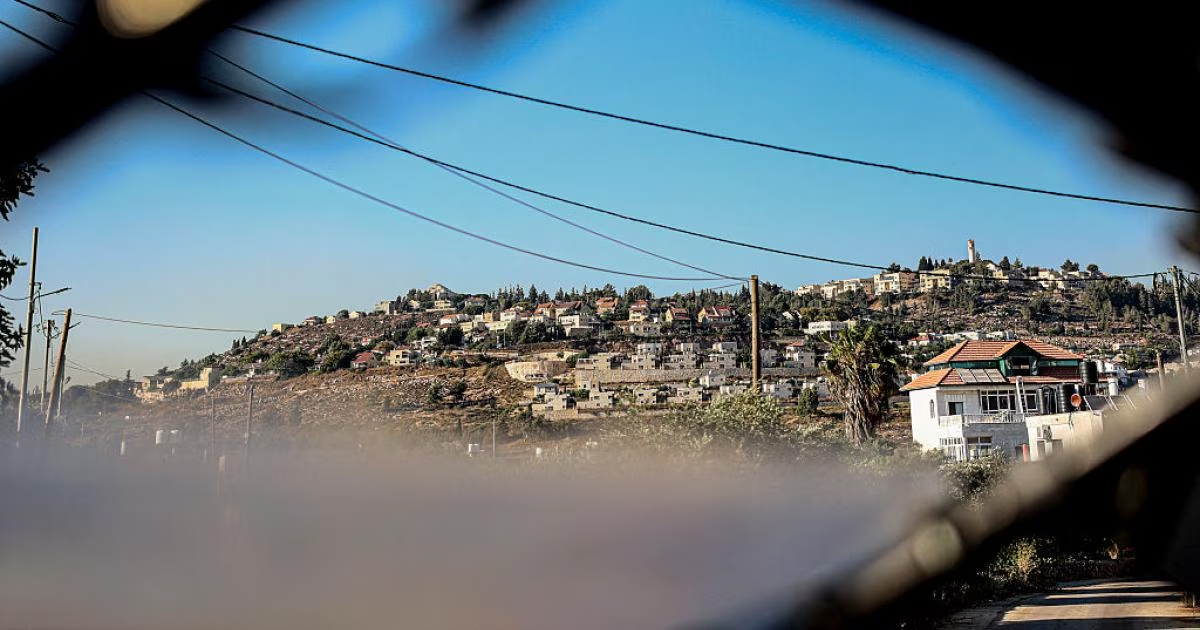
In the view of Fakhri Abu Diab, a researcher specializing in Jerusalem affairs, what is happening in Batn al-Hawa cannot be separated from the broader settlement project in Silwan. He says that the area represents an essential part of what is known as the "Holy Basin," a settlement project aimed at encircling the Old City with a continuous settlement belt, through a series of outposts and projects that aim to change the demographic character of the area.

Abu Diab points out that the policy of displacement does not rely solely on direct evictions, but also includes other tools, including home demolitions, refusal of building permits, imposition of fines, economic pressure, and raising real estate prices, making it more difficult for Palestinians to remain in the city. He adds that the neighboring Al-Bustan neighborhood, in turn, faces plans that could lead to the displacement of hundreds of families and the conversion of large parts of its lands into projects and facilities serving settlers.

In light of these developments, the European Union reiterated in its statements regarding the situation in Silwan its opposition to Israeli settlement policies in East Jerusalem, considering that forced evictions, demolitions, and confiscation of homes contradict international law, exacerbate the suffering of Palestinian residents, and increase tension in the city.

But Batn al-Hawa is only the beginning of the story. Behind every eviction operation lies a broader system of planning and urban policies that have made Palestinian expansion in Jerusalem more difficult than ever before, paving the way for one of the largest waves of home demolitions the city has witnessed in the last decade.

A city shrinking for its residents

For the families of Batn al-Hawa, the battle ended with an eviction order. But for thousands of other Palestinians in Jerusalem, the crisis begins years earlier, when they try to build a new home or expand an existing one to accommodate the natural increase in family members.

In a city where the Palestinian population is constantly increasing, the urban space available to them is continuously shrinking. While the scene of demolition or eviction appears most publicly, specialists say that the roots of the problem begin much earlier, within zoning and building maps and urban planning policies that determine where a Palestinian can build and where they cannot.

Munir Nusseibeh, an academic and professor of international law at Al-Quds University, believes that the planning of East Jerusalem represents one of the most prominent tools of discrimination used since the occupation of the city in 1967.

He says that Israeli authorities have seized vast areas of Palestinian land for the establishment of settlements and related infrastructure, while other areas have been declared "green areas" where construction is prohibited, and additional lands have been left without planning that allows for Palestinian urban development.

Nusseibeh points out that the ultimate result of these policies has been to confine Palestinian residential development to only about 13% of East Jerusalem's area, most of which were areas where Palestinians primarily resided before 1967. He adds that this limited space is no longer able to accommodate natural population growth, making it extremely difficult for most Jerusalemite families to obtain new building permits.

This reality has forced thousands of families to build without permits, not as a choice, but as the only available solution to provide housing. However, these homes later become direct targets for demolition orders and exorbitant fines, starting a new cycle of legal and economic pressures.

Nusseibeh emphasizes that the planning policy cannot be separated from the broader settlement project, explaining that recent years have witnessed an intensification of what is known as the policy of "settlement in the hearts," meaning the planting of settlement outposts within crowded Palestinian neighborhoods instead of merely relying on large settlements surrounding the city. He says that this policy aims to create a geographical and demographic reality that makes any future division of Jerusalem extremely difficult.

He cites the neighborhoods of Batn al-Hawa and Sheikh Jarrah as clear examples of this policy, where property laws, the Absentee Property Law, and real estate claims are used to seize Palestinian homes within existing neighborhoods, and convert them into small settlement outposts that enjoy permanent security protection, imposing a new reality within the Palestinian urban fabric.

For his part, Khalil Tafakji, a specialist in settlement affairs, believes that these policies are not the result of isolated decisions, but an extension of an Israeli strategy that began in the early years after the occupation of East Jerusalem.

He says that since the early 1970s, Israeli governments have set clear demographic goals based on reducing the proportion of Palestinians and increasing the Jewish majority in the city. To achieve this, a series of laws and procedures were used, most notably the seizure of land for public interest, planning and building laws, and control over Palestinian lands and properties.

According to Tafakji, the occupation government seized more than 35% of East Jerusalem's area after 1967, and expanded the city's boundaries from about 6.5 square kilometers to about 72 square kilometers, at the expense of the lands of more than 28 Palestinian villages and towns, over large parts of which 15 Israeli settlements were established.

He adds that urban planning policy imposed additional restrictions on Palestinian construction, either by limiting permitted building ratios or through lengthy and costly licensing procedures. He points out that the costs of obtaining building permits in past decades reached tens of thousands of dollars, while today they are much higher, which has made licensing an unattainable option for the majority of the population.

But the effects of these policies do not stop at construction. With the increasing Palestinian population against the limited available land, real estate prices have risen sharply, and the housing crisis has become one of the biggest challenges facing young Jerusalemite families.

Fakhri Abu Diab, a researcher specializing in Jerusalem affairs, says that Jerusalem needs thousands of new housing units annually to meet the needs of its residents, but the restrictions on construction make meeting these needs almost impossible. He adds that many families find themselves forced to move to areas outside the separation wall, or to West Bank cities, in search of more affordable and spacious housing.

For researchers in Jerusalem affairs, this outcome is not a side effect of existing policies, but part of their direct impact. When obtaining a licensed home becomes almost impossible, and when land and apartment prices rise to levels beyond the reach of most residents, moving outside the city transforms from an economic option into a demographic path that gradually changes the face of Jerusalem.

However, the cramped urban space represents only one stage of this system. Homes built without permits later become targets for demolition, and over the years, demolition numbers in East Jerusalem began to rise at an unprecedented rate, revealing another chapter in the reshaping of the city.

The Old City... Continuous displacement and systematic targeting of Palestinian presence

Since the occupation of East Jerusalem in 1967, Israeli occupation authorities have implemented systematic policies aimed at displacing Palestinians and seizing their properties in the Old City and its surroundings, as part of efforts to change the demographic composition and impose a new demographic reality that serves the settlement project. Between June 1967 and April 1968, more than 6,500 Palestinians were forcibly displaced from the Old City to make way for the expansion of the so-called "Jewish Quarter." The early days of the occupation also witnessed the complete demolition of the Moroccan Quarter, where about 1,000 Palestinians were forced to leave their homes overnight, while other estimates indicate that the number of displaced from the quarter reached about 6,000 Palestinians. Despite nearly six decades passing since the occupation of East Jerusalem, displacement policies have not stopped, as estimates by the "Ir Amim" organization indicate that about 100,000 Palestinians still reside in the "Old City Basin," the area most exposed to demolition, eviction, and settlement policies.

The occupation authorities and settlement organizations continue to target Palestinian neighborhoods within the Old City, particularly the Muslim and Christian quarters, through eviction orders and property seizures. In November 2025, four Jerusalemite families in the Aqabat al-Khalidiya area received orders to evacuate their homes in preparation for their demolition on the pretext that they were "unfit for habitation," while residents affirmed that the real goal was to control the neighborhood and establish settlement projects around Al-Aqsa Mosque. These measures escalated in May 2026 with the announcement of a new settlement plan described by the Jerusalem Governorate as a "dangerous colonial escalation targeting the heart of the Old City," which stipulates the eviction of residents from 50 buildings, including homes and shops, in the Bab al-Silsila area adjacent to Al-Aqsa Mosque, and their seizure for the benefit of settlers, in a move considered the largest of its kind within the Old City since its occupation in 1967.

Settlement organizations, primarily "Ateret Cohanim," lead efforts to seize Palestinian properties within the Old City, by purchasing properties through indirect means or controlling them through occupation courts, as part of a strategy aimed at creating settlement continuity within Palestinian neighborhoods. According to published data, the organization had managed to control 21 buildings on Al-Wad Street alone by 2018, while continuing to expand its influence in Muslim and Christian neighborhoods, thereby deepening the policy of forced displacement and threatening the historical Palestinian presence in the heart of Jerusalem.

Jerusalem forced to demolish itself

If the eviction orders in Batn al-Hawa represent the most visible face of the displacement policy, then home demolitions constitute its broader and more continuous face. Far from complex property disputes and courts, thousands of Jerusalemite families face a different battle that often begins with a notice posted on a house wall, and sometimes ends with a bulldozer demolishing the house or its owner demolishing it himself.

The data collected by "Ir Amim" organization, which monitored demolition operations in East Jerusalem for eight consecutive years between 2018 and 2025, reveals a dramatic escalation in the pace of demolitions, especially during the last two years. The total number of buildings demolished during this period exceeded 1,600, ranging from residential homes and commercial shops to various facilities and buildings under construction.

The numbers show a clear upward trend. In 2018, 193 buildings were demolished, and the number rose to 216 buildings in 2019, then decreased to 179 buildings in 2020, before rising again to 204 buildings in 2021. In 2022, 129 buildings were demolished, the lowest number in eight years, but the curve quickly rose again to 200 buildings in 2023, then to 249 buildings in 2024, reaching its peak in 2025 with the demolition of 284 buildings, the highest number recorded during the entire period.

But behind these general figures lies a harsher picture. Residential homes were the primary target of demolition operations. "Ir Amim" data indicates that 2024 was the harshest year for Jerusalemite families, as 181 residential homes were demolished during it, at an average of almost one home every two days. 2025 came in second with 148 residential homes demolished, while 2023 saw 131 homes demolished, and 2021 saw 125 homes demolished.

It's not just inhabited homes. Buildings under construction were also a frequent target of demolition operations. In 2021, 70 buildings under construction were demolished, the highest number in eight years, followed by 2023 with 64 buildings demolished, then 2020 with 62 buildings, and 2024 with 54 buildings. Human rights organizations consider that targeting buildings before their completion reflects a policy that is not limited to removing existing structures, but also aims to prevent any future Palestinian urban expansion within the city.

When a Jerusalemite demolishes his home with his own hands

However, the phenomenon most indicative of the pressures faced by Palestinians in Jerusalem is what is known as "self-demolition." Instead of waiting for bulldozers and paying the demolition costs imposed by the occupation municipality, homeowners are forced to demolish their own homes to avoid additional fines that can reach tens of thousands of shekels.

"Ir Amim" data shows that this phenomenon has become a constant part of the Jerusalem landscape in recent years. In 2021, the highest number of self-demolitions was recorded with 131 cases, preceded by 2020 with 122 cases, then 2024 with 118 cases, and 2025 with 113 cases. In other words, approximately one out of every four buildings demolished in Jerusalem in recent years has been demolished by its owner.

These numbers are not just statistics for the families experiencing them. Every self-demolition means that the homeowner was forced to destroy the place he built with his money and effort, often in front of his family members and children, to avoid greater losses that the authorities might impose on him later.

Silwan... The eye of the storm

When moving from general numbers to the map, Silwan emerges as the most targeted area for demolition in East Jerusalem.

In 2024 alone, 68 buildings were demolished in the town, including 50 residential homes. In 2025, another 66 buildings were demolished, including 56 residential homes, an unprecedented number in the town's history.

Demolition operations did not stop at inhabited homes, as Al-Bustan neighborhood alone witnessed the demolition of 46 buildings between 2023 and 2025, including 37 residential buildings, in the period immediately following the October 2023 war.

As for Jabal al-Mukaber, it has become what the data describes as the "capital of self-demolition" in Jerusalem. In 2020 alone, residents demolished 54 buildings with their own hands, the highest number recorded in any Jerusalem neighborhood during any year of monitoring. Self-demolition of 29 buildings was also recorded in 2023, 25 buildings in 2024, and 18 buildings in 2025. During the same period, the total number of demolished buildings in the neighborhood reached 75 in 2020, 42 in 2023, and 34 in 2024.

In Beit Hanina, which receives less media coverage compared to Silwan, 31 buildings were demolished in 2023, 38 in 2024, and 15 in 2025. More significantly, the neighborhood witnessed the demolition of 24 buildings under construction in 2023, and another 25 buildings in 2024, indicating a clear focus on preventing new urban expansion.

As for Al-Isawiya, 33 buildings were demolished in 2021, then 15 buildings in 2024, rising again to 27 buildings in 2025, while Shuafat witnessed one of the most intense waves of demolition when 43 buildings were demolished in August 2020 alone.

The association's data also indicates an expansion of the targeting scope in recent years, with new neighborhoods and areas entering the demolition map, including Bir Ayyub, Batn al-Hawa, Wadi al-Rababa, and Karam al-Sheikh, areas that were previously considered less exposed to such measures.

From eviction to demolition... a single pattern

For "Ir Amim" organization, what is happening in Silwan, whether in Batn al-Hawa or Al-Bustan neighborhood, cannot be viewed as separate events. The acceleration in eviction orders and the rising pace of demolitions constitute, according to the organization, part of an accelerating policy that directly affects the Palestinian presence in East Jerusalem, and limits the ability of residents to remain in their neighborhoods.

The organization warns that the continuation of current trends could lead, within a few years, to widespread changes in the demographic structure of some Palestinian neighborhoods, especially in the areas surrounding the Old City, where pressure on residents is accompanied by increasing expansion of settlement organizations' activities.

But demolition and eviction alone do not answer the bigger question: How can the ownership of the land itself be transferred? And how do properties that Palestinians have lived in for decades become properties subject to seizure or re-registration?

Here begins another battle, more complex and less visible than bulldozers... the battle of land registration and settlement.

Who owns Jerusalem?

If evictions threaten the resident, and demolition targets the home, then the issue of land settlement and property registration touches upon the most sensitive question: who will own Jerusalem in the future?

Over the past decades, a large part of East Jerusalem's land remained outside the final official registration system, due to historical and legal complexities dating back to the Ottoman era and Jordanian administration, and then to the occupation of the city in 1967. However, recent years have witnessed an acceleration in land settlement projects and property re-registration, a process that at first glance appears administrative and organizational, but has become one of the most controversial issues among Palestinians and legal experts.

Khaled Odeh Allah, an academic and researcher specializing in Jerusalem affairs, believes that what is happening cannot be separated from a broader system of reshaping the city. He says that the reactivation of land registration projects, after decades of freezing, came within what Israeli authorities call "enforcing sovereignty," but in reality, it opens the door to re-examining properties that Palestinians have lived on for decades, and redefining the rights holders in them.

He points out that the danger does not lie in the principle of registration itself, but in the legal environment in which the process takes place. Many Jerusalemite families rely on old documents, or sales and inheritance contracts dating back many decades, while modern registration procedures require detailed evidence and documents that may not be available to everyone, making thousands of dunams vulnerable to disputes or legal objections.

73% of land outside settlement

Data from the Israeli organization "Bimkom" reveals that the ownership picture in East Jerusalem is more complex than it appears.

According to the organization, about 73% of East Jerusalem's land was unsettled until 2018, while 16% of the land was in various stages of settlement, and fully registered and settled land did not exceed 11%. Since the resumption of settlement projects in 2018 until 2025, only about 2,300 dunams have been registered.

These figures mean that the majority of Palestinian lands are still subject to re-examination and registration procedures, which gives this process exceptional importance in determining the future of ownership within the city.

"Bimkom" data also shows that the distribution of ownership in East Jerusalem during the period between 2018 and 2025 was as follows: 46% government and institutional ownership, 36% Israeli neighborhoods and infrastructure, 9% undecided ownership, 4% private Palestinian ownership, 4% private and commercial Jewish ownership, 1% church ownership.

Experts believe that these figures reflect the extent of the transformations that have occurred in the ownership map since the occupation of East Jerusalem, especially in light of the seizure of vast areas of land for settlement projects.

From confiscation to control

Tafakji reiterates that Israel did not rely on a single tool to control land in Jerusalem, but on an accumulated set of laws and procedures.

After the occupation of East Jerusalem in 1967, the city's boundaries were expanded from about 6.5 square kilometers to 72 square kilometers, at the expense of the lands of more than 28 Palestinian villages and towns. In subsequent years, the occupation seized more than 35% of East Jerusalem's area under the pretext of "public interest," before large parts of it were converted into Israeli settlements and infrastructure.

Tafakji points out that control over land did not stop at direct confiscation ("seizure"), but extended to other laws such as the Absentee Property Law, the Jewish Property Law in East Jerusalem, and laws related to inheritance and ownership, all of which were used to reshape the ownership map in the city.

As for academic Munir Nusseibeh, he believes that the use of these legal tools has allowed the conflict in Jerusalem to be transformed from a clear political issue into complex real estate and legal disputes. He says that what appears to the international public as a dispute over ownership documents or land registration, in essence conceals a struggle for sovereignty and existence within the city.

Fragmentation of Palestinian neighborhoods

However, the issue of ownership is not only about who owns the plot of land, but also about how the surrounding urban space is reshaped.

Tafakji says that over the past decades, Israel has pursued a two-pronged policy: first, encircling Palestinian neighborhoods with settlements, and second, penetrating these neighborhoods by establishing settlement outposts within them.

According to him, the result has been the fragmentation of geographical contiguity between Palestinian neighborhoods, turning them into isolated enclaves surrounded by settlements, bypass roads, and Israeli infrastructure. He points out that this pattern is clearly visible in Silwan, Sheikh Jarrah, Beit Safafa, and other neighborhoods that have witnessed increasing settlement expansion in recent years.

He adds that control over land is not only achieved through laws, but also by creating facts on the ground that make the recovery or reorganization of these lands in the future more difficult, if not impossible.

Jerusalem Governorate: This year witnessed unprecedented demolitions and displacements

The Jerusalem Governorate, through its periodic reports, continues to document the policies of forced displacement, population transfer, and land seizure implemented by the occupation authorities in the city, and to monitor their effects on the demographic and urban reality in Jerusalem.

Ma'rouf Al-Rifai, advisor to the Governor of Jerusalem, confirms that the data documented by the Governorate during the first half of 2026 shows an unprecedented escalation in Israeli policies aimed at reshaping the demographic reality in the city, through an integrated system of legal, administrative, economic, and field tools, and not through separate measures or isolated events.

Al-Rifai explains that the Governorate's periodic report documented, during the first six months of 2026, the implementation of (288) demolition and razing operations, which is the highest rate recorded in the last six years, including (198) direct demolitions carried out by the occupation authorities and (66) cases of forced self-demolition where citizens were forced to demolish their homes to avoid exorbitant fines. The report also monitored the issuance of (762) deportation orders, (31) house arrest orders, and (10) travel ban orders, in addition to documenting (89) settlement plans and projects that included thousands of new settlement units, reflecting an escalation in the tools of control over land and population.

He adds that the Jerusalem Governorate does not view these indicators as isolated events, but rather as components of an integrated policy aimed at reducing the Palestinian presence in the city in exchange for expanding the settlement project. Demolition operations coincide with settlement expansion, and deportation orders are accompanied by restrictions on construction and residency, while municipal taxes, especially "Arnona," fines, and licensing policies, are used as economic pressure tools that drain the ability of Jerusalemites to resist and remain. Moreover, what is sometimes presented as "property disputes" cannot be separated from this context, as in many cases they turn into legal tools used to enforce eviction and redistribute control over properties to serve long-term demographic goals.

Regarding land seizure, Al-Rifai points out that the Jerusalem Governorate monitored, during the period from the first quarter of 2025 to mid-2026, the seizure of more than (1,398) dunams of the Governorate's lands, in addition to the approval of seven new settlement plans. It also documented the continued implementation of major settlement projects, most notably the "E1" plan, which threatens about (7,000) Palestinians in (22) communities in the Jerusalem wilderness with forced displacement, in addition to a settlement plan in the Bab al-Silsila area within the Old City that aims to evict (50) buildings, including homes and commercial shops, for the benefit of settlers, in a move described by Al-Rifai as a "dangerous colonial escalation targeting the heart of the Old City."

He noted that the occupation authorities also continue to carry out direct eviction operations, citing the eviction of four Jerusalemite families from the Aqabat al-Khalidiya area in the Old City during November 2025, as part of a systematic policy aimed at controlling the neighborhood and establishing settlement projects around Al-Aqsa Mosque.

Al-Rifai affirmed that reading the results of the first half of 2026 shows that the occupation authorities have moved to a more intensive stage in using their tools, where reliance is no longer limited to legal and administrative procedures, but is now used in parallel with demolition, land seizure, settlement expansion, and economic pressures, thereby imposing new realities on the ground and directly affecting the demographic structure of Jerusalem.

Seizure of 23,000 dunams

"Bimkom" data indicates that about 23,000 dunams of East Jerusalem's land were seized after 1967 for the establishment of settlement neighborhoods and Israeli infrastructure projects.

The organization explains that East Jerusalem has an area of about 72,000 dunams, and that Palestinian neighborhoods within it extended over an area of approximately 49,000 dunams when the city was annexed in 1967, and at that time about 69,000 Palestinians lived there, forming 26% of Jerusalem's population. However, what changed over the following decades was not only the shape of the land, but also the nature of control over it.

With every new registration process, every property claim, and every settlement project, the ownership map within Jerusalem is gradually rewritten. While this process appears legal and administrative on the surface, experts believe it constitutes one of the most important tools used to reshape the city in the long term.

However, control over land alone is not enough to change the demographic reality. Even the Palestinian who retains his home, identity, and ownership finds himself facing another daily battle: the battle for economic survival within a city where the cost of living rises year after year.

And here appears another tool, less noisy than bulldozers and courts, but no less impactful: the "Arnona tax."

Arnona (the tax)... Displacement by bills

In Jerusalem, the battle for survival doesn't always begin with a demolition order or an eviction notice. Sometimes it starts with a tax bill arriving in the mailbox.

For thousands of Palestinians in the city, the "Arnona" tax has, in recent years, transformed from a municipal fee into a growing economic burden, which human rights activists and specialists believe has become part of a broader system that gradually pushes residents to leave the city.

Haitham Khatib, director of the legal unit at "St. Yves" institution, which specializes in defending the rights of Palestinians in East Jerusalem, says that Arnona is no longer just an ordinary municipal tax, but has become one of the most prominent tools of economic pressure on Jerusalemite families.

He points out that Jerusalemites already face a suffocating housing crisis, where apartment rents in some areas reach about 8,000 shekels per month, in addition to high taxes and increasing living costs, at a time when municipal services provided to Palestinian neighborhoods remain much lower than those provided to Jewish neighborhoods.

He says that the natural result of this equation is to push more families to seek housing alternatives outside the city limits, or behind the separation wall, where the cost of living is relatively lower.

From 3,000 to 12,000 shekels

However, the most significant change appeared during 2025 and 2026. According to Khatib, the occupation municipality reclassified a number of Palestinian neighborhoods into the highest tax bracket "A," which led to a sharp increase in Arnona values in some areas.

He points out that some properties that used to pay about 3,000 shekels annually are now required to pay up to 12,000 shekels annually, while the tax value in some areas increased from 45 shekels per square meter to about 120 shekels per square meter. In some cases, these adjustments were applied retroactively, which accumulated significant additional debts on residents.

These changes included areas such as Kafr Aqab and Dahiyat al-Salam, two areas located behind the separation and racial expansion wall, and are considered among the most densely populated Palestinian areas in Jerusalem.

For residents, it's not just about a tax increase, but a sudden doubling of the cost of staying in the city.

Behind the wall... taxes without services

For many years, the occupation municipality refrained from regularly collecting Arnona from some areas located behind the wall, such as Kafr Aqab and Shuafat refugee camp.

However, in recent years, the municipality began to impose collection more broadly, and reclassified these areas into higher tax brackets, despite continued complaints about poor infrastructure and public services there.

Khatib says that the paradox lies in the fact that residents today pay higher taxes for services that are not commensurate with the amount they pay.

At a time when these areas suffer from chronic crises in roads, cleanliness, sanitation, and urban planning, residents find themselves required to pay increasing amounts year after year.

The tax that becomes a security file

But what makes Arnona different from other taxes is its direct link to the issue of residency in Jerusalem. In many cases, a Jerusalemite does not keep Arnona payment receipts merely as financial proof, but because they become a legal document used before the Israeli Ministry of Interior to prove that their "center of life" is still within Jerusalem's boundaries.

This means that receipts, electricity and water bills, and rental contracts become part of the battle to maintain residency.

If a Jerusalemite moves to live outside the city, or fails to prove that their center of life is within its municipal boundaries, they risk losing their right to residency.

Lawyer Midhat Deibeh says that the "center of life" policy has been one of the most influential tools on the demographic reality in Jerusalem over the past decades, leading to the revocation of identities and residencies of thousands of Palestinians who were forced to live outside the city due to economic conditions or the housing crisis.

He adds that a Palestinian who leaves Jerusalem in search of a cheaper home or a less costly life may find themselves years later facing the risk of losing their right to residency, turning a temporary move into a kind of permanent displacement.

Between home and identity

The effects of Arnona do not stop at the tax itself. In case of accumulated debts, the municipality has broad powers that include seizing bank accounts, property, or furniture, and in some cases, procedures may extend to seizing the property itself. High taxes in recent years have also led to the closure of hundreds of shops in the Old City and its surroundings, according to Jerusalemite human rights organizations.

For this reason, Khatib believes that Arnona has become part of an integrated system that uses economic, legal, and planning tools together to reshape the Palestinian presence within Jerusalem.

On the one hand, it raises the cost of staying in the city, and on the other hand, it becomes a condition for proving residency there. Between these two extremes, many Jerusalemites find themselves facing a harsh equation: staying means constantly paying increasing costs, and leaving may mean losing their legal right to the city.

But Arnona is only one tool within a broader system. When evictions, demolitions, urban planning, land registration, and taxes are viewed together, the features of the demographic transformation that Jerusalem has witnessed in recent decades become clearer.

In population figures, ownership maps, and demolitions, the full picture of the demographic engineering that is reshaping the city, house by house, and neighborhood by neighborhood, emerges.

Demographic engineering in numbers

Throughout this investigation, multiple tools appeared, seemingly separate at first glance: evictions in Silwan, home demolitions in Jabal al-Mukaber and Al-Isawiya, land settlement, escalating taxes in Kafr Aqab and Shuafat refugee camp, and increasing complexities in obtaining building permits. But when these files are brought together into a single picture, the features of the demographic transformation that Jerusalem has witnessed in recent decades become clearer.

Data from the United Nations Office for the Coordination of Humanitarian Affairs (OCHA) indicates that since January 2009 until April 28, 2026, the occupation authorities have demolished a total of 2,596 Palestinian structures in East Jerusalem, including homes, agricultural and commercial structures, and various facilities. As a result, 143,982 Palestinians were directly or indirectly affected.

The data also reveals an escalation in the phenomenon of self-demolition, which in recent years has become one of the most prominent manifestations of pressure on residents. Between 2010 and 2025, 762 structures were self-demolished, including 104 structures in 2025 alone.

The transformations are not limited to demolitions, but extend to geography, ownership, and housing. According to "Bimkom" data, East Jerusalem has an area of about 72,000 dunams, and after 1967, about 23,000 dunams were seized for the establishment of settlement neighborhoods and Israeli infrastructure projects. When East Jerusalem was annexed, the number of Palestinians there was approximately 69,000, constituting about 26% of the city's population, residing in about 12,000 housing units.

Today, the city's picture has changed significantly. About 391,400 Palestinians live in Jerusalem, constituting approximately 40% of the population, compared to 246,100 Israelis residing in East Jerusalem and 343,200 Israelis in the western part of the city.

However, the disparity appears more clearly when looking at the housing sector. In 2023, the number of housing units allocated to Israelis in East Jerusalem was 121,700 units, in addition to 62,250 units in West Jerusalem, while the number of Palestinian housing units was only 65,350 units. This means that Palestinians, who constitute about 40% of the city's population, own only about a quarter of the housing units.

When reading these figures alongside the files of eviction, demolition, planning, and taxes, experts believe that what is happening cannot be reduced to property disputes or separate municipal procedures, but constitutes an accumulated process that redefines the relationship between the residents, the land, and the city itself.

Eviction removes a family from its home, demolition prevents its expansion, taxes raise the cost of its survival, land settlement re-examines its ownership, while planning policies narrow the space available to it. Ultimately, these tools collectively produce a demographic reality different from that which existed decades ago.

The city slowly leaving its children

In Batn al-Hawa, where the story of this investigation began, the families evicted from their homes last March morning were not thinking about demographic theories, maps, or population ratios. They were thinking about something much simpler: Where would they sleep tonight?

But behind that individual moment lies the story of an entire city. A city where thousands of structures have been demolished, tens of thousands of dunams of land have been seized, the areas available for Palestinian construction have shrunk, and housing costs and taxes have risen to levels that push many to seek a life outside its borders.

This does not happen through a single decision or a sudden mass displacement. Rather, it happens through a long series of small, cumulative measures; a demolition order here, an eviction order there, a rising tax, a land being re-registered, a building permit not issued, and a neighborhood gradually shrinking for its residents.

While Israeli authorities describe these measures as law enforcement or city management, Palestinians who experience their daily results see a different picture: a city whose features are gradually changing, and where staying becomes more difficult year after year.

For the Rajabi and Basbous families and the residents of Al-Bustan, Kafr Aqab, Jabal al-Mukaber, and Al-Isawiya, demographic engineering does not seem like a political or academic term. It is a tangible reality measured by the number of homes lost, neighborhoods changed, and families forced to leave.

In Jerusalem, demographic change does not happen all at once. It happens house by house. And neighborhood by neighborhood. And year after year.


PALESTINE

Fri 03 Jul 2026 11:55 am - Jerusalem Time

Occupation announces end of Givati Brigade's mission in southern Lebanon amid widespread troop reduction

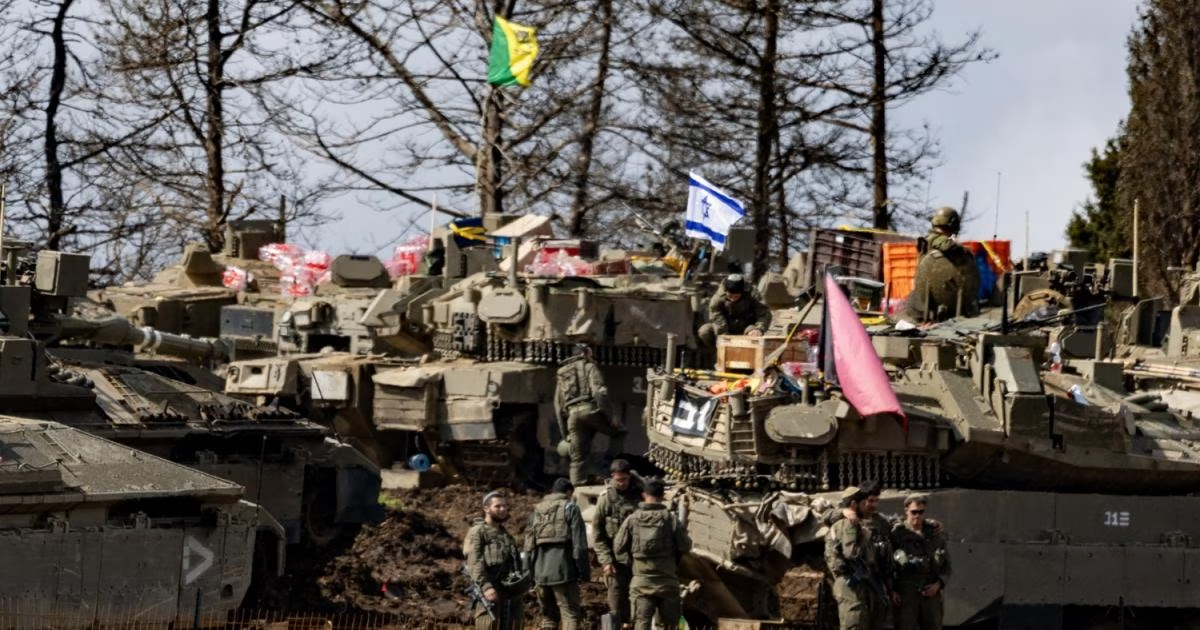
The Israeli occupation army officially announced the termination of the Givati Brigade's combat missions in southern Lebanon, after a period of approximately eight months. This step comes as the occupation continues to control border areas and carry out widespread attacks that have resulted in the martyrdom of 4,298 people since the escalation of operations last March.

The ceremony for ending the brigade's missions, which is considered one of the most prominent combat units in the infantry, took place at the "Vilon" camp in the northern region. The commander of the northern region in the occupation army, Rafi Milo, participated in these ceremonies, praising what he described as the field achievements made by the brigade during its presence in Lebanese territories.

The occupation army's statement claimed that the Givati Brigade's missions included carrying out intensive defensive operations along the border line, in addition to launching ground attacks deep into southern Lebanon. These operations included strategic areas such as the town of Khiam and Bint Jbeil, reaching areas located north of the Litani River, according to Israeli claims.

The occupation also claimed that the brigade's forces managed to destroy hundreds of Hezbollah's military infrastructure and eliminate hundreds of fighters during direct confrontations. The statement indicated that more than a thousand various weapons were found during the sweeping and raiding operations carried out by the forces in the Lebanese border villages.

The occupation army did not provide precise details about the reasons behind the withdrawal of the brigade at this time, and whether it was a routine rotation of forces. However, media sources linked this move to the framework agreement recently signed between Beirut and Tel Aviv under the auspices of the United States of America.

For its part, Hebrew press sources stated that this step falls within a broader plan for repositioning and partial withdrawal from specific villages in the south. Haaretz newspaper explained that these field arrangements are linked to the ongoing negotiations and the international monitoring mechanisms being discussed to ensure the stability of the border region.

In a related context, Yedioth Ahronoth newspaper considered that the withdrawal of the Givati Brigade reflects the extent of political and field pressures faced by the occupation on the northern front. The newspaper indicated that the goal of these movements might be to establish a buffer zone instead of maintaining a permanent and costly military presence in those areas.

The occupation army radio had previously revealed the start of a significant reduction in the size of ground forces present in southern Lebanon. Sources explained that the military command decided to reduce the number of military divisions from five full divisions to only two, indicating a change in the adopted field strategy.

It is worth noting that the framework agreement signed last Friday evening stipulates a sequential Israeli withdrawal from all Lebanese territories. This withdrawal is scheduled to begin from two experimental areas whose names have not yet been revealed, as a first step within a timeline aimed at ending the Israeli military presence in Lebanon.

The Givati Brigade's mission included defensive operations on the border and attacks within the areas of Khiam, Bint Jbeil, and north of the Litani River.

ARAB AND WORLD

Fri 03 Jul 2026 11:55 am - Jerusalem Time

Bahrain calls on Security Council to stop 'Iranian aggressions' and confirms targeting of civilian facilities

The UN Security Council in New York witnessed an emergency session, requested officially by the Kingdom of Bahrain, to discuss the serious repercussions of recent Iranian attacks that targeted the Kingdom's territories. During the session, Manama stressed the necessity of an immediate halt to what it described as 'repeated Iranian aggressions,' affirming that they targeted vital civilian sites far from military objectives.

Bahraini Foreign Minister Abdullatif Al Zayani attended the session, where he presented to the Council members details of the recent escalation on the ground. Al Zayani explained that these diplomatic moves stem from the Security Council's responsibility to maintain international peace and security, expressing his hope that the international community would not stand by idly in the face of this blatant challenge.

In his speech, the Bahraini minister affirmed that the attacks his country was subjected to are not merely fleeting or isolated incidents, but rather part of a series of aggressions that began in late February of this year. He pointed out that these operations continued provocatively even after international understandings aimed at de-escalating the situation in the region were reached.
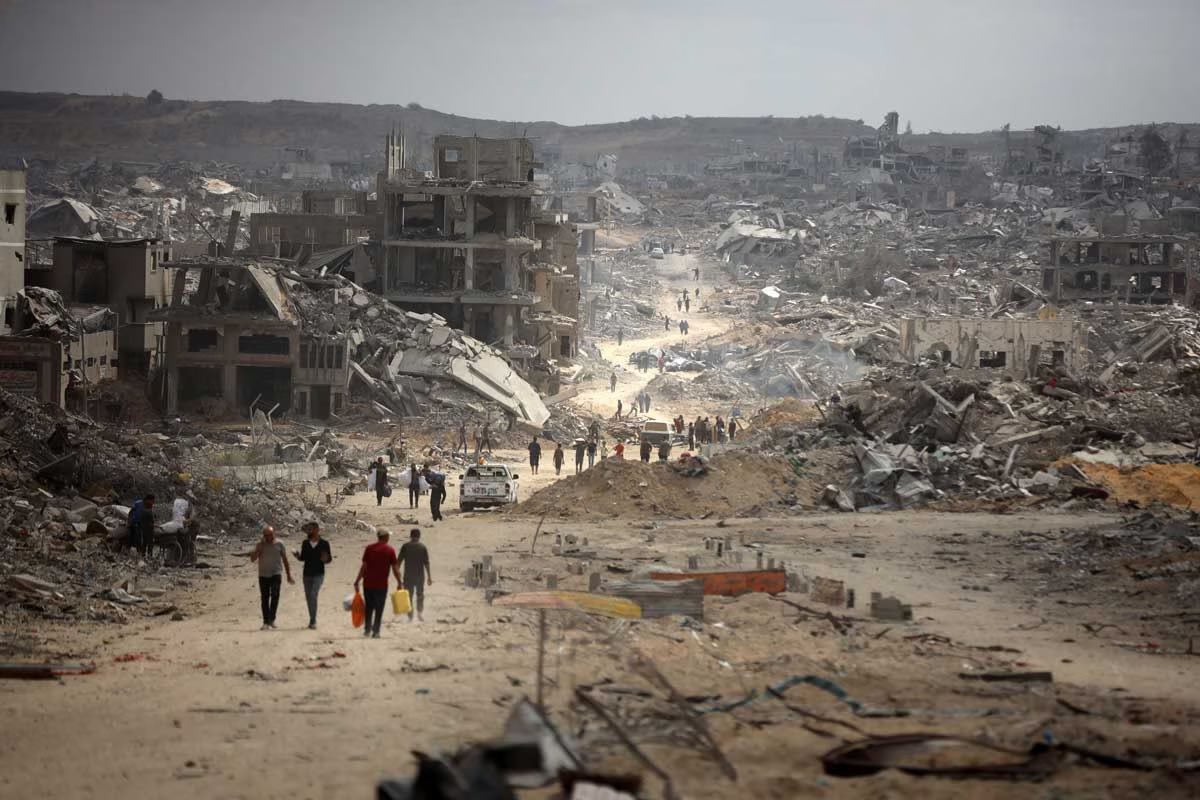
Al Zayani revealed a painful human toll as a result of these attacks, announcing the death of three people and the injury of about 465 others, including a large number of women and children. He explained that the precise nature of the chosen targets indicates prior planning to strike civilian infrastructure that residents rely on in their daily lives.

Bahrain's discourse refuted Iranian claims that attempted to justify the strikes by saying they targeted military sites, questioning the moral or legal justification for striking water desalination plants and populated residential areas. Al Zayani stressed that the facts on the ground refute the Iranian narrative and prove that the aggressions were systematic and directly targeted civilians.

The minister indicated that these attacks represent a clear violation of the memorandum of understanding signed between Tehran and Washington on June 18, which aimed to cease military operations. He considered that the continued missile and drone bombardment undermines all efforts aimed at achieving stability in the Arabian Gulf region.

In a related context, diplomatic sources noted that Bahrain provided technical evidence to the Security Council proving the involvement of regional parties in directing these strikes towards non-military targets. Manama affirmed that the silence of the international community could encourage further violations that threaten international shipping lanes and global energy supplies.

Bahrain had previously announced in June that it had been subjected to a wave of drone and missile attacks, holding Tehran fully responsible for these hostile acts. These developments come at a time when the region is witnessing complex political and military tensions despite diplomatic de-escalation attempts.

For its part, the Iranian Revolutionary Guard had previously claimed that its operations were in response to American strikes targeting sites inside Iran. However, the Bahraini side affirmed that involving its territories and civilian facilities in this conflict is an unjustified aggression against the sovereignty of an Arab state and a member of the United Nations.

The memorandum of understanding referred to by the Bahraini minister included provisions related to a ceasefire and the lifting of the naval blockade on Iran in exchange for reopening the Strait of Hormuz to international navigation. It appears that the continuation of the attacks puts these agreements at risk and threatens the collapse of the fragile understandings reached under international auspices.

In conclusion of his speech, Al Zayani called on the Security Council to take firm measures to deter the aggressor and protect member states from external threats targeting their national security. He considered that the credibility of the international organization is now at stake in testing its ability to enforce respect for international law and protect civilian assets from military targeting.

Political circles are awaiting the outcomes of the Security Council meeting, whether resolutions or final statements, amid international division on how to deal with the Iranian file. Bahrain insists that the solution begins with an immediate and comprehensive cessation of all hostile operations and ensuring that vital facilities are not targeted again in the future.

The credibility of the Security Council is measured by its ability to protect states and deter the aggressor, and we demand an immediate halt to these systematic attacks.

PALESTINE

Fri 03 Jul 2026 11:55 am - Jerusalem Time

Occupation Army Admits Authenticity of Documentation of Torture of Palestinian Prisoner in Gaza

The Israeli occupation army has officially admitted the authenticity of a widely circulated image documenting a Palestinian prisoner being subjected to brutal and inhumane torture inside the Gaza Strip. The leaked image shows the detainee lying on his stomach, blindfolded and with his hands tied with a metal wire, while an iron rod was fixed to his back in a humiliating manner that sparked widespread shock and human rights protests.

This admission came through statements reported by Israeli Army Radio from a military spokesperson, who confirmed that the scenes that spread over the past twenty-four hours are completely real. The spokesperson clarified that the incident did indeed occur within the Strip, while claiming at the same time that the military command had opened an investigation into the circumstances of the incident to ascertain the details and hold the implicated soldiers accountable according to the findings.

Israeli soldier 'Joseph Benamo' was the first to publish the image on his personal Instagram account, before quickly deleting it and closing his account after it spread. Sources reported that these practices are not isolated incidents, but rather reflect a recurring behavior of occupation soldiers who boast about publishing clips and photos documenting the abuse of Palestinians abducted from areas of incursion.

For its part, the Israeli organization 'Breaking the Silence' commented on the incident, affirming that these images represent official policy, and are not merely exceptional actions. The organization noted that the soldier who published the image accompanied it with the phrase 'Good morning' in Hebrew, which reflects the extent of disregard for human dignity and the enjoyment of the suffering of blindfolded and bound victims.

The human rights organization stressed that Israeli detention centers have effectively turned into 'torture camps' since the start of the aggression in October 2023, where detainees are systematically abused. Reports revealed that more than 100 Palestinians entered these centers alive and left them in body bags, as a result of severe torture and deliberate medical neglect inside secret and declared prisons.

In a related context, reports noted that the occupation authorities had previously returned soldiers accused of torturing prisoners to military service, despite conclusive evidence of their involvement. These documented injuries included punctured lungs and fractured ribs, which confirms that the investigations announced by the army are often superficial and do not lead to real accountability for the perpetrators.

Data from Palestinian prisoner institutions indicates that there are about 9,500 prisoners in occupation prisons, living in harsh conditions lacking the most basic human necessities. This number includes hundreds of children and women, in addition to thousands of administrative detainees who are held without clear charges or fair trials, under the pretext of secret security files imposed by Israeli intelligence.

International warnings are escalating regarding the continuation of these violations, especially with the classification of more than 1,300 detainees from Gaza as 'unlawful combatants' to deprive them of their legal rights. Sources confirm that this number does not include all detainees in field camps, raising serious concerns about the fate of thousands of missing persons whose whereabouts are unknown to date.

The footage published, showing a man from Gaza handcuffed and tied to a bed with a rod tied to his back, is real footage that occurred in the Gaza Strip.

OPINIONS

Fri 03 Jul 2026 11:55 am - Jerusalem Time

Huckabee... The Last Face of Christian Zionism in a Changing America

Mike Huckabee is one of the American figures most closely associated with the Zionist project. He combines religious, political, and media influence, and has dedicated his career to defending Israel and justifying its policies, becoming one of the most prominent symbols of the evangelical Zionist movement in the United States. He served as governor of Arkansas for years and ran in the Republican Party primaries before becoming one of President Donald Trump's closest political allies and one of the most influential figures among the Christian right supporting Israel.

Huckabee operates from a religious and ideological conviction that historical Palestine is the "Promised Land" granted by God to the Jews. Therefore, he rejects recognizing the national rights of the Palestinian people and unequivocally opposes the establishment of a Palestinian state or the implementation of a two-state solution. For him, there is no such thing as the West Bank; instead, he uses the biblical term "Judea and Samaria." He also rejects describing Israeli settlements as illegal, considering them "Jewish communities and cities" on land he views as a historical and religious right for Israel.

These roots of this stance trace back to the 1980s, when he used to organize religious trips for evangelical Christians to the occupied Palestinian territories. During these trips, he made sure to visit Israeli settlements and encourage their political and financial support, while avoiding visiting the city of Bethlehem, despite its central place in Christian doctrine, because it is a Palestinian-majority city.

In an interview in 2017, he clearly stated his rejection of the term "West Bank," asserting that he only recognizes the name "Judea and Samaria." He also denied the existence of occupation or illegal settlement. When later asked to clarify his statements denying the existence of the Palestinian people, he tried to soften their impact, denying that he called for the displacement of Palestinians. However, he then reaffirmed that his position is based on what he described as a "biblical mandate" that, according to his belief, dates back to the time of Prophet Abraham more than 3,500 years ago.

Huckabee played a prominent role in mobilizing conservative American public opinion to support the decision to move the U.S. embassy to Jerusalem. He was also one of the most prominent supporters of the Abraham Accords, considering them a path to strengthening Israel's regional position, away from any just solution to the Palestinian issue.

Huckabee has a close relationship with Donald Trump and is considered one of his most loyal Republican figures. During his confirmation hearings, he affirmed that he would implement the president's policies even if they conflicted with his personal convictions. Despite his support for the ceasefire in Gaza when the Trump administration adopted it, he simultaneously emphasized his absolute commitment to ensuring continued military and political support for Israel, including accelerating the provision of weapons, reflecting that his support for Tel Aviv is a fixed ideological and political constant that does not change with circumstances.

However, the American scene today is no longer what it was years ago. The Israeli war on Gaza, and the accompanying scenes of mass killing, destruction, starvation, and targeting of civilians, have brought about an unprecedented transformation within American society. For the first time in decades, the Israeli narrative no longer enjoys absolute dominance within universities, media, and public discourse. Instead, widespread voices have emerged speaking about occupation, settlement, and war crimes, and sympathy for Palestinians has expanded remarkably, especially among youth, students, academic circles, and even within segments of the Democratic Party and the American Jewish community.

This shift does not mean that the Zionist lobby has lost its influence, nor that Christian Zionism has retreated from its positions. However, it now faces a new battle it has not experienced before. After decades of relying on monopolizing the narrative and presenting Israel as the "eternal victim," the Gaza war has overturned this image for millions of Americans who followed, through social media, the extent of the human tragedy away from the official narrative.

Therefore, the appointment of figures like Huckabee at this time can be understood as an attempt to remobilize the conservative evangelical base and strengthen the influence of Christian Zionism within decision-making institutions, in the face of the increasing erosion of Israel's image in American public opinion. For Israel, the battle is no longer confined to the battlefronts in Gaza, Lebanon, or the West Bank, but has extended to American universities, the media, and global public opinion, where it is losing the battle for moral legitimacy day by day.

Israel has realized that the most dangerous outcome of the Gaza war is not just military losses or international pressure, but the collapse of the image it worked for decades to build as the "only democracy in the Middle East." With escalating accusations of war crimes and genocide, there is an urgent need for ideological figures like Huckabee who can use religious and evangelical discourse to reproduce the Zionist narrative within American society and rally the conservative base behind it.

However, the problem facing this project is that the ongoing transformations within the United States seem too profound to be addressed by a Zionist ambassador or the launch of a media campaign. A whole generation of Americans now views the conflict from the perspective of human rights and international law, not from the perspective of biblical narrative or geopolitical calculations. This transformation, while it will not change American policies overnight, presents Israel and its supporting lobby with a long-term strategic challenge: the loss of popular support that for decades has been one of its most important sources of strength and influence.

Hence, Mike Huckabee's presence does not reflect Israel's self-confidence as much as it reflects its anxiety about the future. When a state is forced to resort to the most extreme ideological voices to defend its policies, it means that its political, legal, and moral arguments are no longer sufficient to convince the world. As for the Palestinians, despite the magnitude of the tragedy they are experiencing, their steadfastness and sacrifices have succeeded in bringing about a historical shift in global consciousness, a shift that, in the long run, may be more impactful than many military battles, because it targets the cornerstone upon which Israel has relied since its inception: monopolizing the narrative and winning Western public opinion.

PALESTINE

Fri 03 Jul 2026 11:55 am - Jerusalem Time

Nablus' Thirst Under Threat: Settler Attacks Besiege Strategic Al-Masoudiya Well

Nablus Governorate, in the northern West Bank, faces an existential threat that impacts the very core of its daily life, as settler attacks escalate against the strategic 'Sabastiya-Al-Masoudiya' well. This well is considered one of the largest water sources in the Palestinian Authority territories, pumping between 350 and 400 cubic meters per hour to supply the city and neighboring villages.\n\nAccessing and operating the well is done amidst real security risks faced by workers daily, as settler groups monitor their movements in the rugged area. Local sources reported that any malfunction affecting this facility would immediately lead to a severe water crisis, forcing thousands of citizens to search for scarce and costly alternatives.\n\nThe area has witnessed a series of violent attacks that began with stone-throwing and escalated to the use of incendiary bottles targeting guard rooms. Nine daily-wage guards are stationed at the site to protect the pumps from deliberate sabotage attempts aimed at cutting off the lifeline to the area.\n\nAl-Masoudiya area holds significant historical and archaeological importance, as it was a main station for the Hijaz railway, making it a long-standing target for settlement projects. Despite the failure of attempts to control it in the 1970s, the current offensive appears more organized and fierce, supported by occupation forces.\n\nThe damage was not limited to the main well but also affected the treated wastewater irrigation project, which cost approximately 13 million euros to serve hundreds of farmers. Settlers destroyed fences, irrigation networks, and seedlings, causing severe losses to the agricultural sector in four surrounding villages.\n\nIn the neighboring town of Burqa, settlers seized the historic 'Ain Al-Dalbeh' spring, which provided about 30% of the residents' water needs. Occupation bulldozers destroyed the main water tank there and began laying alternative water lines for the benefit of 'Homesh' settlement and the outposts encroaching on citizens' lands.\n\nSince October 2023, the Al-Masoudiya area, spanning 12,000 dunams, has witnessed systematic tightening, including the establishment of new pastoral settlement outposts. These outposts expanded to penetrate areas classified as 'B' and 'A', which are administratively under the Palestinian Authority, in an attempt to impose a new geographical reality that prevents farmers from accessing their lands.\n\nResidents of the area, including 12 families in Al-Masoudiya, live under siege after settlers bulldozed the main paved road and turned it into a rugged dirt track. Residents were forced to fortify their homes with iron gates and barbed wire to confront night attacks launched by masked gunmen wearing black uniforms.\n\nCitizen Diab Hajji describes the daily suffering of transporting his children to schools and universities, where he is forced to accompany them for fear of being pursued by settlers using four-wheel-drive vehicles. Population movements have become completely restricted by the spread of settler groups that systematically abuse civilians.\n\nJust a few meters from the pastoral settlement outpost, Musa Da'is and his family live in daily 'hell' due to direct threats of burning and killing. Da'is confirmed that settlers cut the water pipes leading to his house, warning that targeting the main lines of the well would mean the end of Palestinian presence in that area.\n\nThe people of Al-Masoudiya have adopted a 'shift' system for sleeping to ensure constant guarding of homes against sudden incursions. Surveillance cameras document repeated attempts to break down doors and terrorize children, in the absence of any international or security protection for unarmed residents who face weapons with stones.\n\nFor its part, Nablus Municipality confirmed that accessing water wells now requires miniature security plans and precise coordination to ensure the safety of engineering teams. The municipality presidency stressed that the battle for water is an integral part of the battle for existence, and that targeting personnel and facilities aims to destabilize the entire governorate.\n\nRecent UN reports for 2026 indicate that settler attacks have led to the displacement of more than 2,200 Palestinians from their communities in the West Bank. International organizations also recorded the destruction of more than 190 water and sanitation facilities, which increased the suffering of vulnerable communities and their reliance on costly water tankers.\n\nResilience in the Al-Masoudiya area remains dependent on the ability to protect the water well and provide popular support for the besieged families. Activists fear the evolution of settler violence tools from sticks and stones to widespread use of live ammunition, which could lead to massacres against residents clinging to their land.\n\n"Get out of here... this land is ours. We will burn you, your children, and your homes if you do not leave.

PALESTINE

Thu 02 Jul 2026 7:33 pm - Jerusalem Time

Barriers of Death and Farewell.. How Does the Occupation Turn West Bank Cemeteries into Military Barracks?

Cemeteries in the West Bank are no longer havens of tranquility; instead, they have become open confrontation zones where the Israeli occupation imposes its authority even on the dead. Human rights sources and field testimonies have documented the transformation of Palestinian funerals into stringent security procedures requiring prior permits and subject to surveillance by drones and heavily armed soldiers, thus stripping farewell moments of their human and religious sanctity.

In the city of Hebron, specifically in October 2025, the family of citizen Murad Al-Natsha faced a harsh reality when occupation authorities refused to allow his father to be buried in the family plot in Al-Ras cemetery. The family was forced to carry out the burial secretly and within minutes, fearing clashes with soldiers who had surrounded the area. Al-Natsha described this scene as the 'fastest funeral' he had ever witnessed, devoid of proper prayers and farewells.

This policy is not accidental; rather, it is a system that has gradually formed over two decades and expanded with the construction of the apartheid wall, which isolated entire towns from their historical cemeteries. In the town of Sawahreh, access to Jabal Al-Mukaber cemetery is now conditional on passing through the 'Al-Shayah' military checkpoint, which has been dubbed the 'Last Resting Place Checkpoint' due to the humiliating procedures mourners are subjected to.

Data from the General Authority for Civil Affairs indicates that security coordination has become a necessary condition for burying the dead in contact areas and closed areas, at an average of 100 cases per month in Hebron alone. These conditions include identifying the deceased, limiting the number of mourners, sometimes to no more than ten people, and imposing a strict time limit for the burial process, not exceeding one hour.

With the outbreak of the war in October 2023, these restrictions extended to new villages and towns such as 'Umm Safa' northwest of Ramallah, where iron gates and earth mounds separated the village from its cemetery. Residents there are forced to carry bodies on their shoulders and walk through rugged and dangerous paths to reach their final resting place, amid repeated refusals to grant burial permits during normal times.

In the northern West Bank, specifically in Jenin and Tulkarm, these policies reached their peak in early 2025, where burials were completely prohibited in cemeteries within Jenin refugee camp. Military vehicles spread around alternative cemeteries, and local sources recorded dozens of cases that underwent strict security coordination, prompting families to search for alternatives far from their residential centers.

Suffering is not limited to the moment of burial but extends to depriving the living of visiting the graves of their loved ones, as cemeteries located behind the wall or near settlements have become closed military zones. Elderly people from Jerusalem and Hebron recount with anguish how years pass without them being able to recite Al-Fatiha at the graves of their wives or fathers, considering this 'an oppression beyond human endurance'.

Maintenance and restoration work in historical cemeteries have also not been spared from prohibition, as removing weeds or repairing gravestones requires complex security approvals that can take months. In Al-Khatib cemetery in Hebron, which dates back six centuries, entry is restricted to a very limited number of people and under close surveillance, which has left graves vulnerable to neglect and repeated settler attacks.

Drivers of hearses and gravediggers have become part of this security circle, as they are required to provide precise coordinates of the grave site on aerial maps before digging. In many cases, soldiers intervene to stop digging operations under the pretext of lack of coordination, leading to bodies being held in cars for long hours awaiting a 'green light' from occupation officers.

Human rights activists affirm that through these measures, the occupation seeks to impose its full control over Palestinian geography, including areas designated for the dead. Activist Issa Amro believes that turning grief into a process of coordination and security calculations strips the funeral of its human dimension and doubles the psychological suffering of bereaved families, transforming farewell into an experience of submission.

From a religious perspective, the Palestinian Ministry of Endowments considered these restrictions a blatant assault on freedom of worship and the sanctity of the dead guaranteed by divine laws. The ministry indicated that preventing prayers for the deceased and limiting the number of worshipers constitutes a deprivation of performing essential rituals, which contradicts the simplest values of human dignity that must be respected under all circumstances.

Legally, international law experts emphasize that Palestinians in the West Bank are 'protected persons' under the Fourth Geneva Convention of 1949. Dr. Rizq Shuqair clarified that any restrictions on burial not based on a genuine and direct security necessity are considered a grave violation of international humanitarian law, calling on international institutions to intervene to stop these violations.

Reports from the 'B'Tselem' human rights center confirmed that these practices are not isolated incidents but a systematic policy aimed at restricting Palestinians in all aspects of their lives and deaths. The center documented direct attacks with gas and sound bombs on mourners, sometimes leading to the dispersal of funerals and leaving bodies without completing legitimate burial rites.

Cemeteries in Palestine remain a testament to an unending conflict, where Palestinians insist on clinging to their land even as they leave it forever. With the continued absence of international accountability, the 'Last Resting Place Checkpoint' remains a symbol of a bitter reality faced by a people deprived even of the right to a peaceful farewell, and their graves remain hostage to military decisions and security permits stripped of will.

"We felt humiliated, as if we were stealing our mother's burial"; this is how one citizen described bidding farewell to his mother amidst the buzzing of bullets and the horns of military vehicles.

PALESTINE

Thu 02 Jul 2026 7:33 pm - Jerusalem Time

Shekel Accumulation Crisis.. A Real Threat of Further Economic Contraction

Dr. Moayad Afaneh: The size of the Palestinian economy has doubled since the signing of the Paris Protocol, and Israel still receives about 18 billion shekels annually, which is not commensurate with economic growth. Yassin Dweikat: The protests are to send an urgent message to the competent authorities about the necessity of intervention to alleviate the effects of the crisis before entering a more dangerous and unbearable stage. Khaled Sarahneh: The banks' refusal to accept shekel deposits practically means that station owners are unable to pay for fuel, which threatens the continuity of their activity. Dr. Thabet Abu Al-Rous: Traders are now facing difficulties in transferring the prices of goods to Israeli suppliers, which threatens supply chains and slows down economic growth with effects that may extend for years. Ayham Abu Ghosh: The crisis of shekel accumulation in bank vaults is not internal, and efforts must be directed to pressure the Israeli side to receive the surplus currency. Ikhlas Tamliyeh: The continuation of the crisis without radical solutions will lead to an increased reliance on informal cash transactions, thus expanding the unregulated economy. Ramallah – Exclusive to "Al-Quds" – Fears are growing about the exacerbation of the shekel accumulation crisis in banks operating in Palestine, amid increasing economic warnings about its repercussions on the banking sector, the private sector, and citizens, with a consensus that the roots of the crisis go beyond banking and technical aspects and are linked to Israeli restrictions imposed on receiving the surplus Israeli currency, which threatens to deepen the state of recession and pressures experienced by the Palestinian economy, while the protests recently witnessed in the West Bank by commercial and industrial chambers and gas station owners deepen the crisis. Union officials and economic experts explain, in separate interviews with "Al-Quds", that the volume of shekels accumulated in Palestinian banks has reached unprecedented levels, which has led to tightened procedures for deposits and issuing checkbooks, hindered trade and import financing, and increased storage, insurance, and financial exchange costs. It has also affected the ability of traders and companies to meet their obligations, pushing some to resort to more costly alternatives, at a time when the effects of the crisis have begun to extend to citizens and goods and services markets. They agree that addressing the crisis requires political and diplomatic action simultaneous with internal technical measures, including pressure on Israel to raise the ceiling for receiving surplus shekels and releasing clearance funds, in addition to accelerating the transition to electronic payment methods, reducing reliance on cash, and finding alternative banking channels, warning that the continuation of the crisis without radical solutions may lead to further economic contraction, the expansion of the unregulated economy, and threatening the stability of various economic sectors. A "recurrent old" crisis. Economic expert Dr. Moayad Afaneh confirms that the shekel accumulation crisis in banks operating in Palestine represents a "recurrent old" crisis, but it has reached more severe levels in recent months, as a result of the restrictions imposed by Israel on receiving the surplus shekel from the Palestinian economy, despite a clear text in the Paris Economic Protocol regulating this process, warning that the crisis will remain a constant source of pressure on the Palestinian economy unless its political and technical roots are addressed. Afaneh explains that the Paris Protocol, signed in 1994, regulates the financial relationship between the Palestinian Authority and Israel, but the size of the Palestinian economy has doubled since then, while Israel still receives only about 18 billion shekels annually through four installments, a figure that is not commensurate with economic growth, as the actual need is estimated to transfer at least 30 billion shekels annually to Israeli banks, which leads to a permanent accumulation of surplus Israeli currency within the Palestinian market. The shekel accumulation crisis doubles. Afaneh points out that the crisis reached a critical level at the end of the second quarter of the year, before the transfer of the quarterly installment of 4.5 billion shekels, noting that the volume of shekels accumulated in Palestinian banks currently amounts to about 18 billion shekels. Afaneh explains that this reality hinders the feeding of Palestinian bank accounts in Israeli banks, which are the accounts used to execute payments for trade between the two sides, and also imposes additional costs on banks, including storage, insurance, and transportation, loss of investment opportunities, and costs of financial swap operations, and weakens the role of the banking sector as a financial intermediary, thus opening the way for the growth of the black market and the informal economy. Afaneh expects that Israeli banks will begin receiving the quarterly installment this month, which will temporarily alleviate the severity of the crisis, but will not end it, expecting the pressures to return after a short period due to the continued existing imbalance. Extended repercussions. Afaneh confirms that the repercussions of the crisis extend to three main levels; banks incur losses resulting from the idle cash mass and the rising costs of managing it, while companies and traders face difficulties in depositing shekels and financing import and trade operations, which pushes them to more costly alternative solutions. As for the citizen, they are affected by their inability to deposit their money or obtain foreign currencies easily, which forces them to resort to exchange offices and bear additional differences in exchange rates, stressing that all these costs are ultimately reflected on the consumer, increasing the burdens under which the Palestinian economy has been suffering for more than 32 months. Two paths to address the crisis. Afaneh believes that addressing the crisis requires two parallel paths; the first is political, through Palestinian and international action to pressure Israel to receive the surplus shekel, through sister and friendly countries and international financial institutions, foremost among them the World Bank and the International Monetary Fund. The second path, according to Afaneh, is technical, and consists of activating the law to reduce cash transactions, accelerating digital transformation, and providing incentives and the necessary infrastructure to promote electronic payments, in addition to finding regional or international channels to dispose of the surplus shekel through banks that have banking relationships with Israel. Protests and delivering a message to official bodies. Yassin Dweikat, the rapporteur of the Tax Committee in the Federation of Chambers of Commerce, Industry, and Agriculture, and a member of the Board of Directors of the Nablus Chamber of Commerce and Industry and its official spokesperson, confirms that the shekel accumulation crisis and its resulting tightening of bank procedures regarding currency deposits and issuing checkbooks have caused widespread damage to the private sector and the Palestinian economy, explaining that the protests carried out by the Chambers of Commerce and Industry came to send an urgent message to official bodies and the banking sector about the necessity of intervention to alleviate the effects of the crisis before entering a more dangerous and unbearable stage. Dweikat explains that the crisis is not new, but has been discussed for about a year, but its repercussions have escalated unprecedentedly, which prompted the Federation of Chambers of Commerce to call for protest vigils in front of the chambers' headquarters in various governorates, after the crisis affected various components of the private sector, and directly impacted the economic cycle, the volume of commercial deals, and trade between traders. The crisis of rationing checkbook issuance. Dweikat points out that the rationing of checkbook issuance and the banks' refusal to accept shekel deposits prevented traders from being able to pay their financial obligations, whether related to the price of goods or other commercial obligations, which led to a clear decline in the volume of commercial transactions. Dweikat notes that the repercussions of the crisis were not limited to traders, but extended to employees, workers, and citizens, explaining that the Palestinian economy historically relies on checks as the main payment method, especially in purchasing expensive goods such as cars, furniture, electrical appliances, and residential apartments, where the sales system in these sectors is based on an initial cash payment followed by payment through post-dated checks. He confirms that reducing the issuance of checkbooks deprived a wide segment of citizens of purchasing in installments, and also deprived traders of one of the most important competitive tools in the market, because deferred sales supported by checks are the safest means for the seller and the most encouraging for sales. Dweikat explains that the crisis also reflected on public finances, as a large number of taxpayers became unable to pay their due taxes in the usual way through checks, which led to a decline in tax revenues and increased pressure on the Palestinian Authority's budget. Dweikat stresses that the Federation of Chambers of Commerce and Industry demanded the government, the Palestinian Monetary Authority, the Association of Banks, and bank managements to take practical steps to alleviate the effects of the crisis, foremost among them continuing to accept shekel deposits and facilitating the issuance of checkbooks, considering that banks are required to bear part of the responsibility alongside the private sector, although the main reason for the crisis is the Israeli side's refusal to receive the surplus shekel. The importance of international action to pressure Israel. Dweikat confirms that a radical solution requires international action to pressure Israel to resume receiving the surplus shekel and release clearance funds, considering that the continued detention of clearance funds and the refusal to receive Israeli currency have contributed to deepening the recession and economic contraction. Dweikat warns that the Palestinian economy has already entered a real crisis stage, reflected in a decrease in commercial deals, a decline in the ability of wholesale and retail traders to complete sales operations, in addition to increasing difficulties in obtaining dollars to finance imports, which pushes some traders to resort to the black market. Dweikat stresses that the continuation of the current situation without quick solutions may lead to a more dangerous stage whose repercussions the private sector, the Palestinian Authority, and Palestinian society will find difficult to bear. Exhausting several attempts to address the problem. Khaled Sarahneh, Secretary of the Union of Gas Station Owners, confirms that the shekel accumulation crisis has become one of the most serious challenges facing the Palestinian economy, pointing out that it is not a new crisis, but has been ongoing for about a year, while the recent protests came after exhausting many attempts to address the problem through dialogue with the Palestinian Monetary Authority and relevant parties, with the aim of shedding light on the crisis and contributing to finding solutions for it, and not to direct accusations at any party. Sarahneh explains that the Israeli occupation bears the primary responsibility for the exacerbation of the crisis, as it is the party that imposes restrictions on the transfer of surplus shekels, stressing that the Palestinian Monetary Authority has made efforts and held continuous meetings to try to find solutions, but its powers are limited in the face of these restrictions, which has made all parties go in a vicious circle; banks face a problem with the Palestinian Monetary Authority, and the Palestinian Monetary Authority faces the problem with the Israeli side, while commercial sectors directly bear the consequences. Protests are not internal. Sarahneh points out that the protest vigils organized by the Chambers of Commerce were not directed against the government or Palestinian institutions, but rather aimed to mobilize all partners to participate in addressing the crisis, stressing that the government, the Palestinian Monetary Authority, the Petroleum Authority, banks, and the private sector are "partners in the homeland, concern, and solution," and that cooperation is required to solve the problem, not to exchange accusations. Sarahneh stresses that the General Petroleum Authority has been and continues to make continuous efforts in cooperation with gas stations to find solutions to problems related to banks, and participated in many meetings with the Palestinian Monetary Authority and the Association of Banks, and also initiated granting an additional incentive (bonus) on electronic payment card sales, stressing that all parties are partners in the problem, just as they are partners in finding solutions. Direct impact on gas station operations. Sarahneh explains that the crisis has directly impacted gas station operations, as the banks' refusal to accept shekel deposits practically means that station owners are unable to pay for fuel, which threatens the continuity of their activity. Sarahneh explains that the condition of depositing in dinars or dollars forces station owners to buy foreign currencies from the market, which raises costs and incurs additional losses, stressing that banks are not adversaries, but partners facing a real crisis. He believes that banks transferring the burdens of their crisis to station owners and small traders increases the complexity of the economic scene, pointing out that banks have broader capabilities and banking relationships that help them manage their crises, while the station owner relies entirely on their daily commercial activity, which makes any disruption in banking operations a direct threat to the continuity of their activity. The crisis extends to various economic sectors. Sarahneh points out that the crisis is not limited to the fuel sector, but extends to various economic sectors, amid the financial distress suffered by the government, and the difficulties faced by the Petroleum Authority in its dealings with Israeli companies, stressing that all institutions are making efforts to address the crisis, but they need broader support and more effective measures. Threat to basic goods. Sarahneh calls for broad governmental and diplomatic action, including communication with the United States, the European Union, Arab countries, and the international community to pressure for addressing the crisis, warning that its continuation may threaten the ability of Palestinians to provide basic goods, including food, medicine, and fuel. Sarahneh expresses hope for political endeavors that may lead to solutions that are still undeclared, but he warns that if the crisis continues without a breakthrough, many traders may be unable to continue their businesses. Sarahneh points out that some institutions and commercial establishments have already closed and handed over their keys to the Chambers of Commerce, after accumulated losses exceeded their ability to continue. Systematic Israeli policy. Economic expert and analyst Dr. Thabet Abu Al-Rous believes that the shekel accumulation crisis in the Palestinian market does not represent a banking or technical crisis related to the Paris Economic Agreement, but rather reflects a systematic Israeli policy aimed at stifling the Palestinian economy and weakening its basic components. Abu Al-Rous warns that the continuation of the crisis will push economic conditions towards further deterioration, pointing to the development of the crisis with protests by gas stations and commercial chambers in the West Bank. According to Abu Al-Rous, Israel has announced more than once that it is waging an economic war against the Palestinian economy, considering that the shekel accumulation crisis comes in this context, especially since it affects the private sector, which constitutes the "last safety valve" for the Palestinian economy. Abu Al-Rous explains that the Palestinian economy still largely depends on the Israeli side, as the monthly trade exchange with it ranges between 57 and 63%, in addition to relying on Israel for electricity, gas, and fuel, as well as the passage of Palestinian imports through Israeli ports. Different procedures. Abu Al-Rous points out that what is happening now differs from what was in place before October 7, 2023, as the Paris Agreement allowed the transfer of about 18 billion shekels to the Israeli side, with the possibility of increasing this ceiling, while Israel is currently refraining from receiving even the agreed-upon amount, which confirms, in his opinion, that the motives are political and not economic. Abu Al-Rous warns that the continuation of the crisis will have wide repercussions, explaining that Palestinian banks are now refusing to receive more shekels, at a time when insurance documents no longer cover the accumulated cash liquidity, pointing out that the absorption capacity of the banking system ranges between six and seven billion shekels, while the current cash mass is about 17 billion shekels. Abu Al-Rous explains that traders are now facing difficulties in transferring the prices of goods to Israeli suppliers, which threatens supply chains and slows down economic growth, with effects that may extend for years. Abu Al-Rous confirms that the repercussions of the crisis extend from Palestinian Authority institutions to citizens, explaining that the cessation of Israeli banks' dealings with the Authority, according to Israeli statements in September next year, may threaten the transfer of clearance funds, and will also raise the cost of imports and hinder commercial and industrial sectors from obtaining production inputs, while the banks' weakened ability to meet market needs will negatively affect the banking sector and its profitability, and directly affect citizens. Abu Al-Rous calls for urgent Palestinian action at the political and diplomatic levels to raise the issue before international forums, in addition to gradually working to reduce reliance on the shekel by expanding the use of the Jordanian dinar and the dollar, and promoting electronic payment methods, digital wallets, and payment cards, in addition to finding temporary arrangements for financial exchanges between traders, which will alleviate the severity of the crisis until more sustainable solutions are found. An attempt to strike the Palestinian economy. Journalist specializing in economic affairs, Ayham Abu Ghosh, says: "The crisis of shekel accumulation in the vaults of banks operating in Palestine is ongoing and escalating, and the Israeli occupation is responsible for it, as it uses this issue as one of the various tools to strike the Palestinian economy alongside other tools such as threatening to cut banking relations, detaining clearance funds, or preventing workers from working inside the Green Line. Therefore, this problem pressures the Palestinian economy, whether commercial or economic sectors or even individuals, in addition to greatly pressuring banks operating in Palestine. All Palestinians are paying the price for this escalating crisis." Abu Ghosh confirms that the continuation of this problem will have serious repercussions on the Palestinian economy, as the funds accumulated in bank vaults in shekels become outside the banking system, meaning they cannot be invested, lent, or used to pay Israeli suppliers. Therefore, we find that banks tend to limit the ceiling of shekel deposits not out of desire, but because reality imposes it on them. Of course, the various economic and commercial sectors are right in their protests against the current situation, as interests are harmed, financial settlements are delayed, and the economic wheel is moving backward. According to Abu Ghosh, there is no way out of this crisis except by pressuring the Israeli side to solve the economic problems that reflect serious political dimensions, including this problem, by raising the ceiling of funds received by the Bank of Israel from approximately (18) billion shekels annually to approximately (30) billion shekels annually, in addition to Palestinian efforts to accelerate the implementation of the recently approved law to limit the use of (cash), in addition to strengthening financial oversight operations and combating money laundering. It is also possible to think outside the box, as official bodies have suggested, by having a third country with commercial relations with Israel absorb the surplus shekel currency, in exchange for transferring hard currency to the Palestinian side. Abu Ghosh points out that the crisis is related to the relationship with the Israeli side, and therefore any protests directed at the Palestinian banking sector are misplaced. Instead, efforts should be combined to pressure the Israeli side to absorb the surplus currency, as it is the issuing entity. A structural economic crisis. Economic researcher Ikhlas Tamliyeh confirms that the shekel accumulation crisis in banks operating in Palestine is no longer merely a banking problem, but has turned into a structural economic crisis that reflects the restrictions imposed on the Palestinian economy, especially Israeli restrictions on the financial and monetary sectors. Tamliyeh explains that the essence of the crisis lies in the continued restrictions imposed on the ceilings for shipping surplus shekels from Palestinian banks to the Israeli banks they contract with, which has led to the accumulation of large quantities of currency within the Palestinian banking system beyond its daily operational needs. A state of financial suffocation. Tamliyeh points out that this accumulation has created a state of financial suffocation, and has turned the surplus shekel into a real burden on banks, due to the difficulty of investing it or recycling it normally. At the same time, banks incur increasing financial losses due to the freezing of this liquidity, as well as the associated insurance and storage costs. Tamliyeh explains that the crisis has gone beyond the banking sector, after Palestinian banks exhausted their ability to carry out foreign currency exchange operations known as (Swap), which limited their ability to finance commercial operations and ensure the import of basic goods, which directly affects economic activity and the lives of citizens, especially with regard to providing food, fuel, and basic goods. Restricting local market movement. Tamliyeh notes that the seriousness of the crisis is exacerbated by the continued increase in the volume of accumulated shekels, which, according to the latest announcement, reached about 17 billion shekels, considering that this reality imposes great pressure on banks, traders, depositors, and importers, and leads to restricting the movement of the local market, and fuels the state of protest and pressure witnessed by the Palestinian economy. Tamliyeh warns that the continuation of the crisis without radical solutions will lead to greater tension in the markets, a decline in confidence in the banking system, and an increased reliance on cash transactions outside the official framework, thus expanding the unregulated economy and weakening the banking system's ability to perform its essential role in financing local economic activity. Political and economic roots of the crisis. Tamliyeh believes that addressing the crisis requires multi-level solutions, because its roots are political and economic, not just banking, calling for intensive diplomatic and political action involving the parties guaranteeing the Paris Economic Agreement and Protocol, with the aim of ensuring compliance with financial agreements, and allowing an increase in the ceilings for shipping surplus shekels regularly and without restrictions, with a guaranteeing party to implement these obligations. Necessary measures. Tamliyeh calls for unifying efforts between the Palestinian Monetary Authority, the government, and the private sector through a unified coordinating council to manage liquidity and the crisis more efficiently, ensuring the continued provision of banking services to traders and citizens without imposing additional burdens on them. Tamliyeh emphasizes the importance of expanding the use of electronic payment systems, and approving incentive policies that reduce reliance on paper cash, in addition to adopting a long-term strategic economic vision aimed at reducing the structural dependence of the Palestinian economy on the Israeli economy, and enhancing its independence and diversifying import channels outside the structure of Israeli crossings.

OPINIONS

Thu 02 Jul 2026 7:32 pm - Jerusalem Time

The "Emergency" Middle Class in Palestine

The middle class, in various modern societies, has always formed the backbone of political, social, and economic stability. It is the class that produces professional and cultural elites, upholds the values of education, work, and competence, and defends law and institutions, while also playing a pivotal role in protecting society from extremism and collapse. However, discussing the middle class in Palestine today raises a fundamental question: Does this class still play its natural historical role, or has it transformed into an emergency and artificial class, whose existence is reduced solely to income level and consumption?In natural experiences, the middle class is not created by a political or administrative decision, nor is it measured only by salary size or consumption capacity. Instead, it is historically built through a productive economy, quality education, social stability, equal opportunities, and relative independence from authority. This is why the traditional middle class has always been associated with values of public responsibility, conscious political participation, advocacy for reform, and the ability to produce a societal elite that believes in the idea of the state and law.However, the Palestinian case appears to be quite different. Due to the nature of the distorted economy, widespread reliance on external funding, the inflation of the bureaucratic sector, and the weakness of productive sectors, a broad segment has emerged that is socially classified as middle class, yet lacks the historical, ethical, and political characteristics that distinguished the traditional middle class. It is an emergency or artificial class; it appears to be a middle class in terms of income level or consumption patterns, but in essence, it is incapable of performing the social function that makes the middle class a pillar for building and protecting society.The fundamental difference between the traditional middle class and the emergency middle class lies not only in the source of income but also in the nature of their relationship with society, politics, and the state. The traditional middle class views itself as a partner in a long-term national and social project, and therefore tends to defend public institutions, demand reform, and engage in active and constructive political participation. By its nature, it is a critical class that is not afraid to hold authority accountable and seeks to achieve stability through justice and the rule of law.As for the emergency middle class, its political participation is often limited to social prestige, the pursuit of influence, or engaging in political and media "flattery" with the aim of protecting acquired privileges. The relationship here is not one of citizenship and rights, but a clientelistic relationship based on loyalty in exchange for gains. Therefore, politics, for this segment, transforms from a means of serving society into a tool for maintaining personal and social status.What exacerbates the danger of this phenomenon is that the emergency middle class realizes the fragility of its position. It did not achieve its status through productive economic accumulation or long-term professional stability, but through temporary political or bureaucratic circumstances or networks of interests. Therefore, it lives with the constant fear of falling and losing privileges. Unlike the traditional middle class, which can reproduce itself through education, work, and production, the emergency segment lacks this ability because it is not based on a solid economic or knowledge base. Hence, corruption, for some of these segments, becomes a means of self-defense rather than merely an ethical deviation. Nepotism, abuse of influence, exchange of interests, and semi-public corruption become tools to protect newly acquired social status. The greater the feeling of instability, the greater the need to employ power and personal connections to maintain privileges.The greatest danger arises when this emergency segment becomes the dominant segment within the so-called "middle class." In this case, the value system within society itself changes. The value of competence, work, and production declines in favor of values of display, consumption, and personal loyalty. Public office also transforms from a national responsibility into a source of privileges, and belief in the idea of the public good declines in favor of individualism and opportunism.Most dangerously, the rise of this emergency class often comes at the expense of the true traditional middle class; that is, segments of teachers, doctors, engineers, academics, small business owners, and intellectuals, who historically represented the social bearers of enlightenment and reform values. These segments today suffer from economic and social erosion, while new segments expand, relying more on influence and connections than on competence and production.The crisis of the middle class in Palestine is not merely an economic crisis related to declining income or rising living costs; rather, it is a structural crisis that affects the very nature of society. A society that loses its true middle class gradually loses its balance and stability, because the alternative is either a parasitic wealthy class linked to centers of influence, or broad marginalized and poor classes that have lost hope and confidence in the future.Therefore, rebuilding a true Palestinian middle class cannot be achieved merely by increasing salaries or expanding consumption, but by building a real productive economy, enhancing quality education, establishing the rule of law, and creating a political environment based on participation and accountability, not on "clientelism" and personal loyalty. The middle class is built through work, production, and independence, and cannot be manufactured by temporary decisions or fleeting privileges.Finally, I do not know if the term "emergency middle class" has been used before, but the emergence of this emergency segment within the middle class has resulted either from the absence of policies that prevent such a phenomenon, or from deliberate policies to produce that segment for use in political agendas that cannot be national, and the current Palestinian situation is proof of that. Therefore, the battle to restore the true middle class in Palestine is not just an economic issue, but a national and social issue related to the future of the Palestinian people and their cause. And because the true middle class is built and not manufactured, as we mentioned earlier, I regret to say that restoring that class and its role is not feasible or realistic in the foreseeable future. However, to attempt to begin reforming decades of destructive policies, and before it is too late, there is an urgent and crucial need to pressure the de facto authority to make credible, immediate, and comprehensive reform decisions and adopt policies.

PALESTINE

Thu 02 Jul 2026 7:32 pm - Jerusalem Time

The head of the occupation government signs a decision to ban Nasser Al-Hidmi from traveling for a month

Jerusalem – By Ahmed Jalajel – The Israeli occupation authorities handed Nasser Issa Jalal Al-Hidmi, head of the Jerusalemite Anti-Judaization Commission, a decision to ban him from leaving the country for a month, by order signed by the occupation Prime Minister Benjamin Netanyahu, on the pretext of “security reasons.” According to the decision issued on June 25, 2026, the ban order is valid until July 24, 2026, with the possibility of extending it for an additional six months, based on emergency regulations, after reviewing any objections Al-Hidmi may submit. The occupation authorities claimed in the decision that Al-Hidmi is a “senior activist in the Hamas movement,” and that there is “fear” that his travel abroad would be exploited to carry out activities that harm Israel’s security, claims that are repeated in administrative decisions targeting Jerusalemite figures. In his comment on the decision, Al-Hidmi affirmed to “Al-Quds” that this measure comes within the occupation’s continuous policy of pursuing national figures and Jerusalemite leaders, and trying to restrict them and prevent them from conveying the truth of what is happening in the city of Jerusalem to the world. Al-Hidmi told our correspondent: “The decision to ban me from traveling will not deter me from performing my national duty towards Jerusalem and Al-Aqsa Mosque, and the occupation will not succeed in silencing the voice of Jerusalemites or breaking their will. These arbitrary measures will not change the reality of the occupation, and will not prevent us from continuing to defend the rights of our people by all legitimate means.” Al-Hidmi added that the occupation uses travel bans, deportation, and administrative detention orders as punitive tools against Jerusalemite activists, in an attempt to isolate them from their Arab, Islamic, and international surroundings, stressing that these policies represent a clear violation of freedom of movement guaranteed by international laws and conventions. The decision grants Al-Hidmi 14 days from the date of receipt to submit a written objection through a lawyer to the legal department of the Israeli Population and Immigration Authority. Al-Hidmi is considered one of the most prominent Jerusalemite figures who have been subjected to repeated occupation measures in recent years, including travel bans and expulsion from Al-Aqsa Mosque, in addition to summonses and investigations, as part of a policy targeting activists and national institutions in occupied Jerusalem. It is worth noting that Al-Hidmi is banned from entering Al-Aqsa Mosque until the sixteenth of this month, as he has been banned more than once and the occupation forces automatically renew the ban decisions for him, with the ban period varying from 4-6 months. The occupation intelligence also filed an indictment against Al-Hidmi on charges of “incitement via Facebook and supporting terrorism,” where Al-Hidmi will appear before the Magistrate’s Court in Jerusalem on the eighth of next September, in addition to summonses, investigations, and financial persecution.

PALESTINE

Thu 02 Jul 2026 7:32 pm - Jerusalem Time

Occupation seizes property and gold from Palestinians returning to Gaza Strip via Rafah crossing

Complaints have escalated from Palestinian citizens returning to the Gaza Strip via the Rafah land crossing, due to their personal belongings being directly confiscated by Israeli occupation authorities. Returnees confirmed that the humiliating inspection procedures and strict restrictions imposed by occupation forces at the crossing have turned into a means of seizing valuable possessions, including modern mobile phones, gold jewelry, and personal luggage.

Field sources reported that testimonies from returnees revealed a systematic pattern of property seizure. One traveler recounted details of losing three suitcases and an iPhone, in addition to all the gold jewelry for his daughter's wedding. The traveler explained that the confiscations included five bracelets, a gold chain, and rings, causing significant material and psychological losses for his family upon their arrival in the Strip.

For their part, returning female travelers conveyed the extent of suffering women specifically faced during inspection operations, as their personal phones and jewelry in their possession were confiscated. One woman indicated that occupation soldiers confiscated the gold of more than ten women who were with her on the same trip, emphasizing that these possessions were private property they had traveled with previously and returned with, without any legal justification for their confiscation.

In a related context, other testimonies stressed that Israeli procedures were excessively strict and spared no travelers, including the elderly and children. The wife of one returnee mentioned that the occupation did not leave any mobile phone without confiscating it, and also seized a gold chain and rings from her daughter-in-law, despite their assertion that these items were personal and not for trade.

A child among the returnees expressed the state of confusion and shock that prevailed among female travelers when occupation soldiers suddenly informed them that gold was prohibited from entering. The child criticized the absence of prior announcement of such arbitrary decisions, noting that if they had known about these restrictions, they would have disposed of their belongings outside the Strip instead of having them stolen and confiscated at the crossing.

These violations come at a time when the occupation continues to shirk its obligations under the ceasefire understandings signed on October 10, 2025. It was supposed that this phase would see the full and smooth reopening of the Rafah crossing for the movement of individuals and goods without obstacles, but the reality on the ground shows the continued policy of tightening and strangling the residents of the Strip.

According to official data issued by the Palestinian Crossings Authority, travel movement, which resumed on February 2, 2026, recorded the departure of 3516 people until mid-June last year. In contrast, the number of citizens who were able to return to their homes in Gaza during the same period reached 2701 citizens, all of whom face the risk of losing their property due to current Israeli procedures.
They told us that gold is prohibited... We should have been informed of this decision in advance, and if we had known, we would have disposed of it there and not brought it back so that it would not be confiscated.

PALESTINE

Thu 02 Jul 2026 7:32 pm - Jerusalem Time

Widespread escalation in the West Bank: Home demolitions, arrests, and Israeli alert in the village of Mukhamas

Various areas of the occupied West Bank witnessed a new wave of Israeli escalation today, Thursday, in the form of demolitions, incursions, and arrests. Attention focused on the village of Mukhamas, northeast of occupied Jerusalem, where a state of widespread military alert prevailed following Israeli reports of losing contact with a group of settlers inside the village.

Sources reported that the occupation army imposed a strict military cordon on the village of Mukhamas, located southeast of Ramallah, and carried out extensive search operations for the settlers. The army later announced the end of the operation and the safe exit of the settlers without injuries, denying that any of them were kidnapped or physically harmed during their presence in the area.

In Bethlehem Governorate, occupation forces launched a raid campaign targeting the village of Al-Rashayda, east of the city, where a Palestinian citizen was arrested after his home was searched and its contents tampered with. Local sources indicated that the detainee had been subjected to a physical assault by settlers days earlier while herding sheep, causing him injuries and bruises before he was arrested today.

In Hebron city, the pace of violations escalated with the arrest of six citizens from various areas, accompanied by a brutal assault on one of the detainees and his field abuse. Occupation forces also prevented ambulance crews from reaching the injured person to provide him with necessary treatment, while another young man from Tulkarm city, north of the West Bank, was also arrested.

In the context of settler attacks, settler groups, under army protection, bulldozed large areas of land in the village of Kafr Ni'ma, west of Ramallah. Settlers also stormed the village of Burqa, east of the city, and carried out provocative tours among the homes of citizens, causing a state of severe tension among the unarmed residents.

Occupation forces reinforced their military restrictions by setting up sudden checkpoints at the entrances to the villages of Aboud and Yabroud in Ramallah Governorate, where citizens were subjected to thorough inspection and identity verification. In a dangerous development, dozens of settlers seized a Palestinian home in Khirbet Sarfin, affiliated with the town of Attara, and smashed its contents and brought in their own furniture to live in it.

Regarding demolition operations, occupation bulldozers began demolishing a two-story house in the Khirbet Al-Deir area in the town of Tuqu', southeast of Bethlehem. The house belongs to citizen Ali Mahmoud Suleiman, with each floor measuring 200 square meters, and the operation was carried out under the pretext of building without a license in areas classified as 'C'.

Tayseer Abu Muflah, director of the Tuqu' Municipal Council, confirmed that the occupation forces turned the area around the demolition site into a closed military barracks, preventing citizens and journalists from approaching. This operation comes as part of a systematic policy to restrict Palestinian urban expansion in the areas surrounding existing settlements in the region.

In Hebron Governorate, the occupation authorities delivered demolition notices for three inhabited homes in the village of Susiya, south of the city. These homes house more than 20 individuals from Palestinian families. The village of Susiya faces continuous threats of demolition and forced displacement in favor of settlement projects that surround the village from several directions.

Destruction operations did not stop at homes but also affected agricultural facilities in the town of Kafr ad-Dik in Salfit Governorate, where the occupation demolished two facilities with a total area of 600 square meters. During the demolition, Israeli forces detained five citizens for several hours, noting that settlers had previously forced the owners of these facilities to evacuate them.

These field developments come amid a continuous escalation of Israeli violations since October 8, 2023, with official statistics indicating the martyrdom of 1173 Palestinians in the West Bank. Medical and human rights sources also recorded injuries to more than 12,000 citizens, while the number of detainees exceeded 23,000 Palestinians in non-stop campaigns.

Occupation forces completely closed the area and prevented citizens from accessing the demolition site or moving around its vicinity during the operation.

OPINIONS

Thu 02 Jul 2026 7:31 pm - Jerusalem Time

The Vital Secret Behind the Success of the Communist Party of China

  This year, July 1st marks the 105th anniversary of the founding of the Communist Party of China. In the important speech delivered by His Excellency Mr. Xi Jinping, General Secretary of the Central Committee of the Communist Party of China, at the commemorative gathering, he reviewed the glorious journey of the Communist Party of China and looked forward to the bright prospects for the development of the Party's and the people's cause. He also urged the entire Party and the people of all nationalities to move forward with full confidence and determination towards the goal of comprehensively building a strong modern socialist country and achieving the great rejuvenation of the Chinese nation!

        Over 105 years of hardships and difficulties, and 105 years of continuous efforts, successive generations of Chinese communists have united with the people and led them to achieve great victories in revolution, construction, and reform, opening a new era of socialism with Chinese characteristics. The Chinese nation has achieved a great leap, rising from slumber, then prospering, and beginning to grow strong. The great rejuvenation of the Chinese nation has entered an irreversible historical trajectory. Therefore, more and more foreign friends are asking one question: Why does the Communist Party of China succeed?

        Looking back at the past and drawing historical experience from it, General Secretary Xi Jinping answered the question in his speech, stating that the Communist Party of China has achieved one accomplishment after another during its 105-year struggle, and that history and the people chose the Communist Party of China, primarily because the Communist Party of China possesses the following distinctive qualities:

        Firmly seeking truth and always maintaining the correct direction forward. The Party takes Marxism as a powerful ideological weapon to transform the subjective and objective world, adheres to the liberation of minds, starts from realistic conditions, keeps pace with the times, pursues truth and works hard, focuses on discovering and applying truth in the movement of social contradictions, excels at testing and developing truth in practice, and continuously leads new practice with new theory, to ensure the advancement of the Party's and the people's cause in the correct direction.

        Deeply rooted among the people, and always enjoying a solid foundation. The Party always remembers that the country is the people, and the people are the country, and adheres to establishing the Party for the public interest and governing for the benefit of the people. It consciously implements the fundamental purpose of serving the people wholeheartedly, stands firmly with the people, thinks with them, works with them, and possesses a solid foundation that no storm can shake.

        Courageously bearing the historical mission, and always maintaining strategic initiative. The Party embraces the great communist ideals and the ambition to accomplish the great cause of the Chinese nation, steadfastly bears the heavy responsibility entrusted to it by history and the people, and perseveres in unifying long-term goals with phased objectives. It identifies key tasks in response to changes in major social contradictions, to formulate and implement correct lines, policies, and guidelines, and ensure a firm grasp of the leadership and initiative in the development of our cause.

        Keeping pace with the development trend, and always advancing at the forefront of the era. The Party adopts a high historical consciousness and a broad global perspective, clearly understands China's national conditions and the themes of the era, actively responds to, adapts to, and initiates changes, boldly explores and pioneers, and drives the Party's work to embody the spirit of the times, grasp objective laws, and be rich in innovation. It leads the country and the nation to advance in the logic of historical progress and develop in the current of the era's evolution, making the Party a deserving vanguard of the era and the backbone of the nation.

        Daring and improving in struggle, and always maintaining confidence in victory. The Party adheres to and dedicates itself to the spirit of fearlessness in sacrifice and heroic struggle. For the people, the country, and the nation, and for ideals and beliefs, it blazes a trail through thorns and moves forward. No matter how strong the enemy, how rugged the path, or how harsh the challenges, it is never afraid and never retreats, inspiring and encouraging the people to continuously advance from victory to victory with an unwavering iron spirit, no matter how storms rage.

        Focusing on self-strengthening, and always maintaining vitality and dynamism. The Party clearly understands that to face external challenges, it must first strengthen itself. The Party excels at examining itself according to the requirements of the era's development, consciously alerting itself with a strong sense of risk, and improving itself with a spirit of self-revolution. It pays great attention to its self-building, resolutely eliminates all factors that harm the Party's vanguard nature and purity, and eradicates all viruses that erode the Party's healthy body, becoming stronger and more resilient through revolutionary tempering.

        Reviewing a century of stirring epic, we embark anew on a great cause. We are proud of the glorious 105-year history of the Communist Party of China, but we will not be arrogant or complacent. Instead, we have set the central task of building the People's Republic of China into a comprehensively strong modern socialist country by its centenary. On the other hand, international situations are becoming increasingly turbulent, geopolitical conflicts are escalating one after another, and the recovery of the global economy faces difficulties and hardships. In the face of new tasks and in accordance with new realities, the Communist Party of China will continuously dedicate its distinctive qualities, rely on the people of all nationalities, unite with them, and lead them on the new journey, achieving new brilliant accomplishments in the new era! The Communist Party of China will hold high the banner of peace, development, cooperation, and win-win outcomes, dedicate itself to the common values of humanity, promote the establishment of a new type of international relations, and drive the implementation of the Global Development Initiative, the Global Security Initiative, the Global Civilization Initiative, and the Global Governance Initiative, to inject more positive energy into the peaceful development of the world!           

PALESTINE

Thu 02 Jul 2026 7:31 pm - Jerusalem Time

Under tight protection and temporal facilities.. Dozens of settlers storm Al-Aqsa Mosque

Groups of settlers renewed their violations of the sanctity of the blessed Al-Aqsa Mosque in occupied Jerusalem this Thursday morning, carrying out provocative tours in its courtyards under tight military protection from the occupation police. Local sources in Jerusalem governorate reported that the intruders performed public Talmudic rituals in the courtyards, amidst strict security measures aimed at obstructing Palestinian worshippers' access to the mosque and securing the settlers' routes.

Field reports revealed that the occupation authorities granted unprecedented temporal facilities to settler groups, including a noticeable extension of the incursion periods during the morning and evening hours. These steps come within the framework of an overt Israeli endeavor to entrench the policy of temporal and spatial division of Islamic holy sites, and to impose a new reality that allows settlers permanent presence inside the mosque at the expense of the historical rights of Muslims.

In a development described as serious, institutions concerned with Jerusalem affairs observed a sharp decline in the number of Al-Aqsa Mosque guards on duty during the morning period, reaching only about 20 guards. This number represents the historical minimum for the guard force, as it does not exceed 39% of the official human force allocated to protect the mosque, which puts the security of prayer areas and courtyards at risk in the face of escalating attacks.

Statistical data indicate a systematic escalation in the pace of incursions, with more than 1072 settlers recorded in the last week of June alone. Monitoring records for the years between 2014 and 2025 show sharp jumps in the number of intruders, reaching thousands, reflecting a clear occupation strategy aimed at Judaizing the holy city and rapidly changing its Arab and Islamic identity.

For his part, the head of the International Jerusalem Foundation, Hassan Khatir, affirmed that the occupation authorities have crossed all red lines since October 7, 2023, through unprecedented arbitrary measures. Khatir explained that the aggression extended to include a suffocating economic blockade on the mosque and its endowments, in parallel with comprehensive security restrictions aimed at emptying Al-Aqsa of worshippers in favor of settlement projects and Judaization plans supported by the Israeli government.

The occupation, since October 7, has crossed all red lines in its arbitrary measures, extending its aggression to include economic blockade and security restrictions to isolate worshippers.

PALESTINE

Thu 02 Jul 2026 7:31 pm - Jerusalem Time

Discovery of a new outpost west of Ramallah: 'Ma'oz Tzur' devours 1450 dunams

Investigative journalistic sources have revealed the establishment of a new Israeli settlement outpost in a strategic and sensitive location west of Ramallah city in the occupied West Bank. This step comes in the context of escalating settlement expansion operations aimed at changing the geographical and demographic reality in the region, threatening the Palestinian presence in the surrounding communities.

The investigation, based on a precise analysis of satellite images and geographical data, reported that the occupation continues to plant settlement outposts in locations described as 'controlling points'. This policy aims to strengthen the connection between existing settlements and expand their scope of influence and field control at the expense of Palestinian lands.

The new outpost, named 'Ma'oz Tzur', is located in the northern West Bank, specifically on a hill overlooking several Palestinian towns west of Ramallah. This location gives settlers a significant geographical advantage in monitoring natural passages and highlands that connect Palestinian villages and cities to each other.

Geographical data indicates that 'Ma'oz Tzur' is situated on a ridge extending between the towns of Bil'in, Beit Ur al-Tahta, Beitunia, and Ein Arik, and is only about two kilometers from the 'Beit Horon' settlement. This positioning places it in direct confrontation with a settlement bloc that includes the 'Dolev' and 'Talmon' settlements, enhancing its strategic value.

The danger of this location stems from its ability to control the surrounding geographical area, allowing settlers to precisely monitor the movement of Palestinian citizens. It also contributes to creating an illegal geographical connection between scattered Israeli settlements west of Ramallah, leading to the strangulation of Arab population centers.

According to the tracking of construction phases, satellite images showed that settlement activity at this site actually began after June 29, 2025. The first phase began with extensive land leveling, the construction of dirt roads, and initial access paths to enable heavy machinery to enter the elevated area.

During the period between May and July 2025, sources observed significant changes in the site's topography, including the removal of large parts of the natural vegetation. Parts of the mountain hills were also leveled to prepare them for the establishment of facilities, coinciding with connecting the site to the main road network used by settlers.

By the end of 2025, work at the 'Ma'oz Tzur' outpost moved to a more advanced stage, including expanding the internal road network and establishing equipment collection areas. Engineering teams affiliated with the settlers began identifying buildable plots of land, giving a clear indication of the intention to transform it into a permanent community.

By early 2026, aerial images documented the appearance of ready-made residential units and integrated service infrastructure at the site, confirming the acceleration of construction. Road connections were intensified and leveled areas were expanded, in a step aimed at accommodating larger numbers of settlers in record time.

Field estimates indicate that the area of ongoing works within the outpost reached approximately 1.45 square kilometers, equivalent to nearly 1450 dunams of land. The security and vital perimeter of this outpost extends over an area exceeding 4 kilometers, meaning the confiscation of vast areas of citizens' lands.

This transformation from an emerging settlement point to a permanent residential outpost reflects the strategy of imposing a fait accompli adopted by the occupation authorities. Observers confirm that such projects primarily aim to dismember the West Bank and prevent the establishment of any contiguous Palestinian entity in the future.

In conclusion, the investigation shows that 'Ma'oz Tzur' is not just mobile homes, but part of a broader plan to consolidate control over the commanding heights in the West Bank. This outpost establishes new geographical realities that further complicate the field situation and impose severe challenges on the Palestinian residents in the Ramallah Governorate.

The project is not limited to establishing a new settlement community, but falls within broader efforts to enhance geographical connectivity between settlements and consolidate control over elevated locations.

PALESTINE

Thu 02 Jul 2026 7:31 pm - Jerusalem Time

Hamas warns against plans to liquidate 'UNRWA' and considers it a targeting of international legitimacy

The Islamic Resistance Movement (Hamas) strongly condemned the positions issued by the 'Peace Council' in the Gaza Strip and the American administration, which promote the exclusion of the United Nations Relief and Works Agency for Palestine Refugees (UNRWA) from the future of the Strip. The movement affirmed in a press statement that these trends are fully consistent with the Israeli agenda seeking to undermine the agency and end its historical role as a witness to the rights of Palestinians.

The movement stressed that UNRWA is not merely a relief institution, but rather an embodiment of the international community's legal and moral responsibility towards the ongoing Nakba of the Palestinian people for decades. It clarified that the agency's mandate derives its strength from the authorization of the United Nations General Assembly, and no single entity has the right to cancel this role, which is linked to inalienable political and historical rights.

Hamas considered that terms such as 'New Gaza' aim to create a political reality that fragments Palestinian geography and isolates the Strip from its national context. It warned that any attempt to replace the agency with alternative structures is a direct targeting of the right of return, and a blatant attempt to erase one of the most prominent international testimonies to the crimes committed against the Palestinian people in 1948.

In a related context, the movement warned against going along with calls to cut funding for the UN agency or reduce its powers in light of the catastrophic humanitarian conditions in the Gaza Strip. It indicated that the continued operation of UNRWA is an urgent necessity that cannot be dispensed with, especially with the exacerbation of living and health crises caused by the occupation during its ongoing aggression.

For its part, the Arab League entered the diplomatic confrontation, as the General Secretariat of the League denounced the statements of the 'Peace Council', describing them as lacking any legal basis. The League affirmed that UNRWA was established by a clear UN resolution, and that its role will remain essential and fundamentally linked to the refugee issue until a just and comprehensive settlement is reached that guarantees their rights.

The 'Peace Council', which is one of the tools of the American administration for the transitional phase in Gaza, had claimed in a post that there is no place for the agency in the future vision for the Strip. These moves come within the framework of a comprehensive plan proposed by US President Donald Trump in September 2025, which aims to reshape the administrative and developmental reality in Gaza away from traditional UN institutions.

In turn, the Palestinian Ministry of Foreign Affairs reiterated its affirmation that UNRWA represents the only lifeline for millions of refugees, rejecting any attempts to circumvent its role. The ministry clarified that the attack on the agency falls within a broader plan to displace Palestinians and liquidate their national cause by drying up the sources of humanitarian and legal support provided by the international organization.

UNRWA is currently facing unprecedented challenges, as Israeli political pressures combine with a severe funding crisis that threatens to halt education and health services. Despite the UN's continuous assurances of its staff's commitment to the principles of neutrality, the continuous incitement puts the future of millions of refugees in the five areas of operation at stake amidst a suspicious international silence.

UNRWA represents an international witness to the Nakba of the Palestinian people and an embodiment of international responsibility towards refugees, and any attempt to harm it is a targeting of international legitimacy.

PALESTINE

Thu 02 Jul 2026 7:31 pm - Jerusalem Time

Britain has the right to take action against illegal settlements, but it cannot ignore its responsibility for dispossessing Palestinians of their land

By Brian Leishman

Brian Leishman (born July 1982 in Scotland, United Kingdom) is a British politician belonging to the Labour Party, and serves as a Member of the British Parliament representing the Alloa and Grangemouth constituency. He is known for his activism and his supportive stances on human rights, and was among the MPs who signed letters calling on the British government to open an independent investigation into the Gaza war.
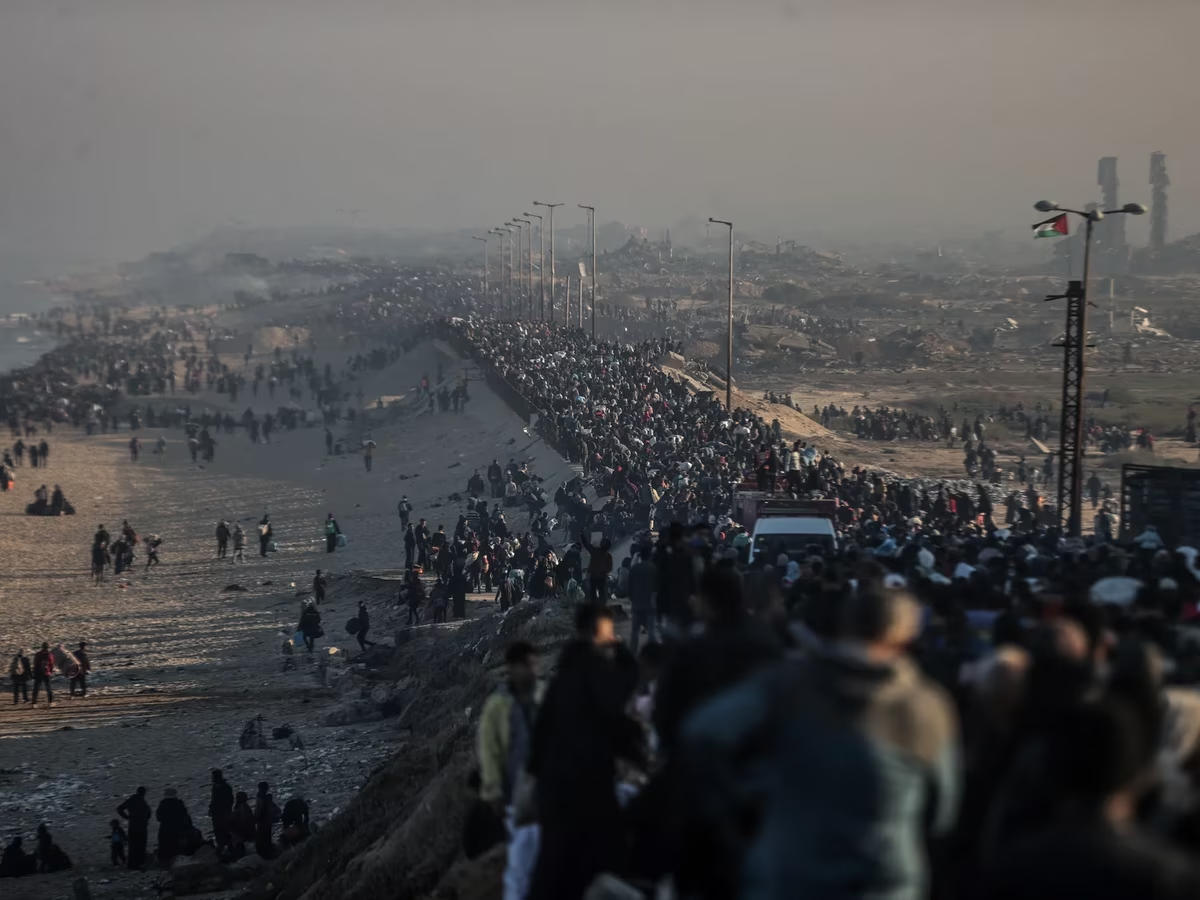
The British government recently imposed sanctions on companies involved in the Israeli E1 settlement project in the West Bank, a project which, if completed, would divide the West Bank into separate enclaves and make a two-state solution almost impossible. Last month, I joined 138 Labour MPs in a letter addressed to the Prime Minister, in which we demanded a complete ban on trade with illegal settlements.

While these two steps are welcome, they simultaneously raise an undeniable question about the role Britain played in creating the crisis it now seeks to address. What is Britain's responsibility for what has befallen the Palestinian people? And what does that demand of us today?

This question lies at the heart of the "Britain Owes Palestine" campaign, which submitted a 400-page legal petition to the British government, documenting Britain's practices during the Mandate period between 1917 and 1948.

In 1917, the Balfour Declaration committed Britain to supporting the establishment of a national home for the Jewish people in a land where more than 90% of the population was Arab, without the consent of its indigenous inhabitants, and in contravention of pledges the British government had previously made to Arab leaders. Over the next three decades, Britain established a system that granted privileges to one party, while denying the other any real political representation. When a project to create a legislative council in which Arabs would have a majority was proposed, the British Parliament rejected it, effectively closing all avenues for peaceful protest.

When the Great Arab Revolt broke out between 1936 and 1939, Britain confronted it with policies of collective punishment against entire villages, and the establishment of military courts where there was no right of appeal. It committed what the British Colonial Secretary himself, in private deliberations with the Cabinet, described as "atrocities" committed by the police, which he deliberately failed to mention in his statements to Parliament. In just three years, at least five thousand Palestinians were killed and about fifteen thousand were injured. Britain did not confine its oppressive colonial methods to Palestine; these policies later became a model inherited by Israel and entrenched within its institutions after 1948.

Upon Britain's withdrawal from Palestine, some 750,000 Palestinians had been displaced during the ensuing war, a displacement process that the petition describes as foreseeable, avoidable, and directly linked to Britain's abandonment of its responsibilities. During that period, the British Parliament passed legislation that retroactively granted immunity to all British officials from any legal prosecution for actions committed during the Mandate period. From this perspective, the E1 settlement project cannot be separated from a historical framework that Britain largely contributed to establishing. It is important to acknowledge this fact as we seek today to mitigate its effects.

In March, I joined a cross-party group of 45 MPs and members of the House of Lords who signed an open letter demanding that the Prime Minister officially respond to the petition. More than eight months later, the government still refrains from providing any response. Munib al-Masri, the main petitioner, was shot by British soldiers when he was a teenager, and he is one of 14 Palestinians whose families were directly affected by the events documented in the petition, and who are still awaiting this response today.

The campaign's demands are not exaggerated; they call for a public government response to the petition, a comprehensive review of any archives not yet released, official acknowledgment of Britain's wrongdoings during the Mandate period, and a formal apology in Parliament. Britain has always presented itself as a state that respects its international law obligations, yet this claim becomes less credible when it refuses to review its own actions.

Imposing sanctions on companies involved in the E1 project is a correct step, and recognizing the state of Palestine last year was also a step in the right direction. However, these measures are accompanied by the British government's continued refusal to confront its historical role in perpetuating the statelessness of Palestine. Britain cannot demand accountability from others while exempting itself from the same standards.

This petition has remained unanswered for many months. What the British government should do today is read it and respond to it, and have the courage to honestly ask a fundamental question about what Britain owes, instead of merely demanding what it can from others.

OPINIONS

Thu 02 Jul 2026 7:27 pm - Jerusalem Time

1,000 Days Since the Beginning of the Gaza Genocide: How the War Is Reshaping American Politics


By: Said Arikat


July 2, 2026


News Analysis


Washington, D.C- One thousand days have passed since the beginning of what many international legal experts, United Nations officials, and human rights organizations have described as a genocide in Gaza. During those one thousand days, Israel has continued its devastating military campaign against the Palestinian people while enjoying unprecedented diplomatic, military, and financial support from the United States. Despite repeated international appeals, mounting evidence of civilian suffering, and growing legal scrutiny before international courts, Washington has remained Israel’s indispensable ally.


Yet history often produces consequences that are neither anticipated nor intended. While successive American administrations sought to shield Israel from external pressure, the Gaza war has unleashed a political transformation within the United States itself—one that may ultimately reshape the Democratic Party and, over time, American foreign policy.


Gaza has ceased to be merely another Middle Eastern conflict. For millions of younger Americans, it has become a defining moral issue, comparable to apartheid in South Africa or the Vietnam War for previous generations. What once occupied the margins of American political debate has moved to its center, particularly within Democratic primaries, where candidates’ positions on Israel and Palestine increasingly influence electoral outcomes.


The latest evidence came in Colorado, where 29-year-old Melat Kiros stunned the Democratic establishment by defeating fifteen-term Representative Diana DeGette in the June 30 primary. Kiros’s political journey is emblematic of this new generation. She was dismissed from her law firm after refusing to remove a social media post calling for an end to what she described as genocide in Gaza. Rather than retreat, she entered politics, turning that experience into the foundation of her congressional campaign. Her victory demonstrated that what was once considered a political liability can now become an electoral asset among Democratic primary voters.


Only weeks earlier, New Jersey voters delivered another message by nominating Dr. Adam Hamawy, a decorated Army surgeon who had volunteered on a humanitarian medical mission to Gaza. Witnessing the destruction firsthand profoundly altered his political outlook. His campaign openly challenged Washington’s unconditional support for Israel, arguing that American values require consistency in defending human rights regardless of nationality. His victory suggested that firsthand testimony from Gaza now carries political weight with Democratic voters.

New York’s Democratic primaries on June 23 reinforced the same trend. Progressive candidates who openly advocated Palestinian rights, demanded conditions on military aid to Israel, and challenged the influence of powerful pro-Israel lobbying organizations performed strongly against establishment-backed rivals. Although every district has its own political dynamics, together these contests revealed a national pattern that is becoming increasingly difficult to dismiss.


Attention is now focused on Michigan, where Dr. Abdul El-Sayed is seeking the Democratic nomination for the United States Senate. His coalition of young voters, Arab Americans, Muslim Americans, organized labor, and progressive activists reflects the changing composition of the Democratic electorate. Should El-Sayed prevail in August, it would represent another milestone in a political movement whose momentum has been fueled in significant part by outrage over Gaza.


These races are not isolated events. They are symptoms of a much deeper realignment taking place within American politics.


The rise of New York mayoral nominee Zohran Mamdani has become another defining illustration of this transformation. Mamdani has consistently defended Palestinian rights despite intense criticism and well-funded opposition. His electoral success demonstrates that candidates no longer need to moderate their positions on Israel to remain politically viable within Democratic primaries. On the contrary, among younger voters, speaking openly about Palestinian rights increasingly signals authenticity rather than political risk.


This generational shift extends well beyond a handful of high-profile campaigns. Poll after poll has shown that younger Democrats view Israel’s conduct in Gaza far more critically than older generations. Many reject the assumption that support for Israel should remain unconditional. They increasingly frame Palestinian rights within the broader language of civil rights, racial justice, international law, and universal human dignity. Gaza has become part of the same political vocabulary that once mobilized movements for Black Lives Matter, climate justice, and immigrant rights.


Equally significant is the changing role of money in Democratic politics. For years, organizations such as AIPAC demonstrated an extraordinary ability to influence congressional elections through massive independent expenditures. Candidates often viewed confrontation with pro-Israel lobbying groups as politically fatal.


That assumption is beginning to erode.


Money still matters enormously in American elections, and AIPAC remains among the country’s most formidable political organizations. Yet recent primaries suggest that even enormous financial advantages cannot always overcome a motivated grassroots electorate driven by deeply held moral convictions. Where Gaza becomes the defining issue for voters, expensive negative advertising often proves less effective than it once did. Small-dollar fundraising, volunteer mobilization, and digital organizing are increasingly offsetting traditional advantages enjoyed by establishment candidates.


None of this means that American policy toward Israel will change overnight. Congressional leadership remains overwhelmingly supportive of Israel, bipartisan institutional commitments remain deeply entrenched, and the strategic relationship between Washington and Tel Aviv continues to enjoy powerful political backing. Foreign policy evolves far more slowly than electoral politics.


Nevertheless, politics ultimately follows generations.


The Democratic Party that emerges over the next decade will almost certainly be led by politicians whose formative political experience was not the Cold War, the September 11 attacks, or even the Iraq War. It will be shaped by leaders whose political awakening occurred while watching the destruction of Gaza unfold in real time on their phones, hour after hour, day after day, for nearly three years.


That reality may prove to be one of the most enduring legacies of this war.


The tragedy in Gaza has inflicted immeasurable suffering on Palestinians. Nothing can diminish that human cost. Yet history often reveals its deepest consequences in unexpected places. Ironically, while Israel has pursued military victory with steadfast American backing, the conflict may be transforming the politics of Israel’s closest ally in ways that neither government anticipated.


One thousand days after the war began, the bombs continue to fall. But another battle is unfolding inside the United States—not on the battlefield, but at the ballot box. There, a new generation of Americans is redefining the meaning of solidarity, accountability, and American leadership in the world. If current trends continue, the political legacy of Gaza may outlast the war itself, reshaping the Democratic Party and eventually forcing a fundamental reconsideration of America’s relationship with Israel.

OPINIONS

Thu 02 Jul 2026 9:26 am - Jerusalem Time

Democrats in Congress demand Trump administration reveal details of "Peace Council" and plans to deploy international force in Gaza

Washington Message

Washington – Said Arikat – 2/7/2026

A number of US Congress members, including Representatives Rashida Tlaib, Ilhan Omar, Ayanna Pressley, and Summer Lee, along with a group of Democratic representatives, sent an official letter to Secretary of State Marco Rubio on Tuesday, demanding that the US administration provide urgent clarifications regarding what is known as the “Peace Council,” warning that plans to deploy an “international stabilization force” in the Gaza Strip could have serious constitutional, legal, and humanitarian repercussions.

The representatives affirmed in their letter that deploying US-backed forces at a time when Israel continues to violate the ceasefire agreement, expand its military operations, and obstruct the entry of humanitarian aid, cannot be considered a stabilization mission. Instead, they described it as an American military activity on foreign soil conducted without congressional authorization, in an area that the International Court of Justice has deemed to be under illegal Israeli occupation. This could expose the United States and participating countries to international legal responsibilities related to complicity in grave human rights violations.

The signatories noted that Congress has not yet received clear answers regarding the legal basis for the establishment of the "Peace Council," which was founded without legislation or financial appropriations from Congress. They described its members as individuals accused of war crimes or representing authoritarian regimes, and noted that it operates outside traditional international frameworks.

The letter criticized the broad powers granted to President Donald Trump within the Council, as he holds the position of its lifetime president in his personal capacity, not as President of the United States, and enjoys an absolute veto over all decisions. The representatives considered that granting the Council the status of a “general international organization” and the accompanying privileges and immunities, despite being under the control of a single individual, raises deep constitutional and legal questions about the legitimacy of this step.

Congress members also expressed concern about the imposition of a one-billion-dollar membership fee for countries wishing to join the Council, considering that this grants wealthy or authoritarian governments influence over the future of Palestinians without their consent, and transforms the Council into an institution based on financial influence rather than its commitment to international law or alleviating civilian suffering.

The representatives accused the Council of failing to prove its independence or integrity, pointing to fears that it could become a platform for real estate deals and multi-billion dollar investments for the benefit of the Trump family and its allies, instead of focusing on the reconstruction of Gaza and achieving peace.

The letter addressed plans for deploying an international stabilization force in Gaza, considering that the US administration used a UN Security Council resolution to grant the Council legitimacy that is inconsistent with the original mandate, which was limited to a transitional administration for reconstruction and stabilization, while the Council's charter, adopted later, expanded to much broader powers.

The representatives referred to the Council's High Representative's statements regarding Gaza, in which he affirmed that the war has not ended for Palestinians, and that Israel is still violating the ceasefire, at a time when the Council intends to deploy its forces in areas not controlled by Hamas. They believed that any such operations would practically turn into military operations, not peacekeeping missions.

The letter also warned that President Trump's decision to consider the Council eligible for US weapons and defense services means that a US military commander could oversee foreign forces equipped with US weapons, which the representatives described as direct US military activity abroad conducted without congressional approval, and in contradiction with the US Constitution.

The signatories pointed out that Israel has shown no willingness to withdraw from the areas it controls within the Gaza Strip. Instead, Israeli Prime Minister Benjamin Netanyahu announced his intention to expand military control to cover about 70 percent of the Strip's area, which makes any international force operating in coordination with the Israeli army vulnerable to legal suspicions, especially in light of the International Court of Justice's opinion that the Israeli occupation of Palestinian territories is illegal, and its warnings of potential violations of the Genocide Convention.

The representatives affirmed that the continued transfer of US weapons to Israel, in parallel with any US involvement in these operations, could expose the United States and its partners to legal responsibilities under US and international law.

Congress members demanded that the State Department respond to seventeen detailed questions before July 15th, covering the legal basis of the Peace Council, its funding mechanisms, oversight of its funds, sources of donations, agreements signed with donor countries, plans for deploying the international force, the possibility of using private security companies, the fate of US weapons that may be delivered to these forces, in addition to the administration's position on the continued Israeli restrictions on the entry of humanitarian aid.

They also demanded that the administration disclose whether it has plans to divide the Gaza Strip or impose new geographical arrangements that restrict the freedom of movement of Palestinians, or control land within the Strip, as well as clarify its vision for transferring the administration of Gaza in the future to a legitimate Palestinian government responsible for both Gaza and the West Bank.

The representatives concluded their letter by emphasizing that Congress has not approved the establishment of the “Peace Council,” nor has it allocated any funding for it, and will not accept, in their words, that American resources be used or the international credibility of the United States be exposed to serve this entity without oversight or constitutional accountability.

The letter from Congress members is not limited to objecting to the Trump administration's policy in Gaza, but also reflects a broader constitutional struggle over the limits of executive authority in managing foreign conflicts. The representatives believe that establishing the “Peace Council” and granting it broad powers, with the possibility of deploying and arming US-backed forces, represents a clear overreach of Congress's role in approving spending and authorizing the use of military force. This dispute could open a political and judicial confrontation that may re-raise traditional questions about the balance of powers in the American political system.

The letter reflects a growing awareness within Congress of the legal risks associated with continued US support for Israeli policies in Gaza. Relying on the International Court of Justice's opinion regarding the illegality of the occupation and the possibility of violations of the Genocide Convention provides opponents of the administration with a legal basis to hold any US involvement in security arrangements within the Strip accountable. If Washington proceeds with these plans, it may face increasing pressure from human rights organizations and international courts, as well as a widening circle of criticism from European allies.

The letter also reveals that the real dispute is not about the mechanisms of Gaza's reconstruction, but about who will hold political and security authority there after the war. Opponents of the “Peace Council” fear that it will turn into a framework that entrenches a new political and security reality that serves the occupation more than it paves the way for an independent Palestinian administration. Therefore, the representatives focused on the need to define a clear plan for transferring power to a legitimate Palestinian government, warning that any transitional arrangements lacking Palestinian and international legitimacy will establish a new round of instability and conflict.

OPINIONS

Thu 02 Jul 2026 9:24 am - Jerusalem Time

Covert disagreements between Washington and Riyadh revealed by the Iran war Saudi Crown Prince halted a US military plan and forced the Trump administration to back down

Washington's Message

Washington – Said Arikat - 1/7/2026

The recent war on Iran revealed deep divergences between the United States and Saudi Arabia, after the administration of US President Donald Trump encountered a decisive Saudi refusal to allow the use of the Kingdom's airspace for a US military operation to protect navigation in the Strait of Hormuz. This forced Washington to cancel the operation less than 48 hours after its launch, a development reflecting fundamental shifts in the nature of the strategic relationship between the two countries, according to several American media outlets, most notably what was published by the Wall Street Journal and the New York Times on Wednesday.

According to American officials, the US Central Command launched a military operation in early May, named "Project Freedom," with the aim of escorting commercial vessels and securing their passage in the Strait of Hormuz, after Iran effectively took control of the strait during the war that erupted following the US-Israeli attack on Iran on February 28.

However, Saudi officials unexpectedly informed Washington that the Kingdom would not allow American aircraft to use its airspace to carry out the mission, considering that the American plan could reignite the war and expose Saudi Arabia to new Iranian attacks, according to reports.

The Saudi stance led to a series of urgent communications between the White House and Crown Prince Mohammed bin Salman, in which President Trump personally participated for three consecutive days, in addition to Vice President JD Vance, Special Envoy Steve Witkoff, Jared Kushner, and National Security Advisor Marco Rubio.

Despite intense American pressure, the Saudi Crown Prince maintained his position, which led the US administration to completely cancel the military operation.

Analysts believe that this development reflects a decline in Saudi confidence in Washington's ability to manage regional crises in a way that protects the security of its Gulf allies, especially after the Kingdom was previously subjected to Iranian attacks targeting Aramco facilities in 2019, when the Trump administration refrained from a military response to Tehran.

Since the outbreak of the recent war, Riyadh has pursued a delicate balancing policy, providing limited political and military support to the United States, but at the same time seeking to prevent the escalation of the confrontation and refusing to be drawn into an open confrontation with Iran.

The Kingdom also intensified its direct contacts with Tehran, benefiting from the rapprochement sponsored by China in 2023. Saudi officials are now directly discussing with the Iranians issues that Riyadh considers more pressing than the nuclear program, such as the security of the Strait of Hormuz, ballistic missiles, and support for armed groups in the region.

American sources indicate that Prince Mohammed bin Salman tried from the beginning of the crisis to persuade Trump to avoid war, before his calculations changed during the fighting phases. However, he later returned to push for a political settlement after it became clear that Iran still retained its basic military capabilities despite American and Israeli strikes.

In contrast, Saudi Arabia continued to diversify its international partnerships away from complete reliance on Washington, strengthening its cooperation with China, and expanding its coordination with Pakistan and other Asian countries, as part of a strategy aimed at reducing the risks arising from any future confrontation in the Gulf.

Despite continued military cooperation between Riyadh and Washington, including peaceful nuclear energy projects and massive arms deals, signs of tension have become more apparent, especially after US Secretary of State Marco Rubio ignored visiting Saudi Arabia during his recent Gulf tour, only visiting Bahrain, Kuwait, and the UAE.

Trump's sarcastic remarks about the Saudi Crown Prince during an investment event in Miami also caused resentment within Saudi circles, after the US President spoke in a manner considered demeaning to the personal relations that both sides had long promoted.

In contrast, the US administration affirms that relations with Riyadh remain strong, and that consultation between the two sides continues regarding the future of Gulf security, in addition to peaceful nuclear energy projects and plans to establish land corridors that reduce reliance on the Strait of Hormuz.

Despite the ceasefire agreement coming into effect, the most complex issues remain unresolved, as the agreement did not address Iran's missile program or Tehran's regional influence, and it granted Iran a role in managing the Strait of Hormuz in coordination with the Sultanate of Oman, which raises widespread concern among Gulf states.

The future of the new nuclear agreement also remains ambiguous, given the previous experience in which Trump withdrew in 2018 from the nuclear agreement concluded in 2015, which led to the acceleration of Iran's nuclear program and increased uranium enrichment levels.

While Riyadh declares its initial support for the US-Iranian understandings as a step towards stability, it deals with them with extreme caution and has not yet made any financial commitments to contribute to the reconstruction of Iran, awaiting clarification on the extent of all parties' commitment to the agreement, and whether it will indeed establish a new security system in the Gulf, or will merely be a temporary truce preceding a new round of conflict.

This crisis reveals that Saudi Arabia no longer views the alliance with Washington as an absolute security guarantee, but rather deals with it based on national interests first. Riyadh, which paid a heavy price in the Aramco attacks in 2019, realizes that engaging in any American military operation could make it the primary target of an Iranian response, while Washington might again hesitate to defend it. Therefore, it seems that the Saudi leadership is seeking to build a deterrence policy based on diversifying international partnerships, direct dialogue with adversaries, and not being fully dependent on the American security umbrella.

The recent war also showed a decline in the United States' ability to impose its agenda even on its closest allies in the Gulf. A few years ago, it would have been difficult to imagine Riyadh rejecting a US military request of this magnitude, but regional transformations, the rise of China, and the return of Saudi-Iranian diplomacy are all factors that have redrawn the balance of power. Gulf security is no longer managed exclusively from Washington, but has become the product of a complex network of regional and international understandings, giving Gulf capitals a wider margin to make independent decisions that sometimes conflict with American wishes.

The most important message generated by this crisis is that the post-war phase may be more complex than the war itself. The ceasefire did not address the roots of the conflict, nor did it resolve the future of Iran's nuclear program, the issue of ballistic missiles, or Tehran's regional influence. With Iran's continued ability to influence navigation through the Strait of Hormuz, Gulf states will remain facing a delicate equation: maintaining their relations with Washington, while avoiding being drawn into confrontations that could directly threaten their economic and security stability.

PALESTINE

Thu 02 Jul 2026 9:24 am - Jerusalem Time

Hamas Demands Emergency Arab Summit to Thwart Israeli Displacement Plans

The Islamic Resistance Movement (Hamas) issued an urgent appeal to the Arab League, demanding the necessity of holding an emergency Arab summit aimed at formulating a unified strategy to confront Israeli plans to displace the residents of the Gaza Strip. The movement affirmed that these actions require a stance that goes beyond verbal condemnation to effective diplomatic and political steps that ensure the protection of the Palestinian presence.

In an official statement issued by the movement's spokesperson, Hazem Qassem, the displacement project was described as an existential threat whose danger is not limited to Palestinians alone, but extends to affect the core of Arab national security. Qassem explained that these plans represent a blatant challenge to the will of Arab states, foremost among them the Arab Republic of Egypt, whose borders and security are directly linked to the stability of the Strip.

The spokesperson indicated that the Israeli occupation is practicing a scorched-earth policy by destroying all basic necessities of life within Gaza, in order to forcibly push residents to leave under the weight of impossible living conditions. He stressed that what is required is to compel the occupation to end its aggression and lift the comprehensive siege imposed on the population for many years.

On the Israeli side, Defense Minister Yoav Gallant affirmed the government's continuation in implementing plans aimed at encouraging Palestinians to leave the Strip, reflecting an official insistence on the policy of demographic change. These statements come at a time when international pressure rejecting any forced displacement under any name is increasing.

In an attempt to circumvent international criticism, media sources revealed that instructions were issued to the Israeli security establishment and the Mossad to stop using the term 'voluntary migration'. According to reports, this term has been replaced with the phrase 'freedom of movement plan' to avoid legal prosecution and international accusations of incitement to ethnic cleansing.

Press reports stated that the new Israeli National Security Council head, Shmuel Ben Ezra, led intensive meetings with security agency leaders to discuss mechanisms for implementing these plans. This change in terminology aims to facilitate convincing countries around the world to receive Palestinian migrants under a misleading humanitarian guise.

On the ground, the Gaza Strip continues to suffer from the effects of a devastating aggression that has resulted in the martyrdom of more than 73,000 Palestinians and the injury of approximately 173,000 others since October 2023. Despite the ceasefire agreement coming into effect on October 10, 2025, continuous Israeli violations further complicate the already deteriorating humanitarian situation.

In a related context concerning the administration of the Strip, the National Committee tasked with administering Gaza concluded a series of meetings in Cyprus that lasted for two days. These discussions focused on ways to improve living conditions and alleviate humanitarian suffering for the residents in the post-war phase, with the participation of international experts and consultants.

The committee clarified that it held constructive discussions with the 'Peace Council' teams and the office of the High Representative for Gaza, in addition to the Tony Blair Institute, to explore possible immediate interventions. The discussions included developing comprehensive visions for reconstruction operations and ensuring transparency in the management of financial and logistical resources that will be provided by international donors.

Participants in the Cyprus meetings also reviewed the necessary institutional arrangements to ensure governance and security within the Strip, while emphasizing commitment to a comprehensive plan that ensures the committee assumes its field responsibilities. It is expected that the upcoming executive steps of this committee will be announced soon in coordination with the relevant international parties.

It is worth noting that the 'Peace Council' was established last January as part of an American vision to end the conflict and transfer administrative powers in Gaza to a technocratic committee. However, Israel continues to oppose the entry of this committee into the Strip to carry out its duties, which hinders the start of the internationally agreed-upon transitional phase.

In a significant political development, US President Donald Trump announced mid-January the start of the second phase of the peace plan, which includes a broader withdrawal of the occupation army. This phase includes launching large-scale reconstruction operations, in parallel with discussions about future security arrangements in the region.

Sources reported that the American administration handed the Israeli side a document containing clear demands for the necessity of proceeding with reconstruction projects. The paradox in this document is that it does not stipulate the disarmament of the Hamas movement as a first step to begin construction operations, which represents a shift in the American approach to the crisis.

Despite all these political moves and Israeli plans, the residents of the Gaza Strip affirm their steadfastness in remaining on their land and their categorical rejection of any projects aimed at uprooting them. Popular and national activities emphasize that steadfastness is the only response to attempts to liquidate the Palestinian issue through forced displacement.

The displacement project does not target the Palestinian people alone, but represents a direct threat to the Arab national security system and a blatant challenge to the will of all states.

PALESTINE

Thu 02 Jul 2026 9:24 am - Jerusalem Time

Erdogan: Our historical record is clear, and Netanyahu's government is responsible for the blood of 73,000 martyrs

Turkish President Recep Tayyip Erdogan affirmed that his country categorically rejects all slanders issued by the Israeli occupation authorities, describing them as a 'criminal network' whose hands are stained with the blood of innocents in the Gaza Strip. Erdogan explained, in a speech delivered after chairing a government meeting in the capital Ankara, that these attempts to tarnish Turkey's image will not succeed in covering up the crimes committed against the Palestinian people.

The Turkish President emphasized his country's moral and historical legacy, pointing out that the Turkish nation has a history spanning thousands of years characterized by conscience and justice. He added that the Turkish record is completely free of any practices related to genocide or colonialism; rather, it has always been a beacon for helping the oppressed and providing relief to them regardless of their religious or ethnic affiliations, which represents the essence of Turkish policy throughout the ages.

In the context of his discussion of the ongoing aggression against the Gaza Strip, Erdogan stated that the occupation leaders resort to spreading lies against Ankara to divert attention from their brutality, which has led to the martyrdom of more than 73,000 Palestinians. He noted that the majority of the victims are women and children, reflecting the scale of the humanitarian tragedy caused by the entity in the occupied territories amidst suspicious international silence.

On the international front, the Turkish President touched upon his country's relief efforts towards Venezuela following the devastating double earthquake that recently struck it with a magnitude of 7.5. He announced the establishment of a military air bridge to transport elite teams, specialized vehicles, and trained dogs to contribute to search and rescue operations, emphasizing Turkey's commitment to standing by friendly countries in times of natural disasters.

Erdogan praised the popular and institutional movement in Turkey, where municipalities and civil organizations quickly organized extensive donation campaigns to support the victims in Venezuela who lost more than 1,700 people due to the earthquakes. He considered that this solidarity reflects the authentic values of the Turkish people and their ability to act quickly and effectively in the face of major humanitarian crises afflicting the world.

On domestic affairs, the Turkish President reviewed national economic indicators, commending the success in keeping unemployment rates at low levels, not exceeding single digits for 37 consecutive months. He affirmed that government policies have succeeded in protecting the labor market and creating new employment opportunities despite the financial storms and global economic crises that have affected major international powers.

In our glorious history spanning thousands of years, there is no genocide, massacres, or colonialism; rather, there is only justice and extending a helping hand to the oppressed.

PALESTINE

Thu 02 Jul 2026 9:24 am - Jerusalem Time

Katz pledges Israeli army to remain in Gaza, Lebanon, and Syria, warns Iran against retaliation

Israeli Defense Minister Israel Katz reiterated his commitment to the continued presence of his military forces in what he described as 'security zones' within Lebanon, Syria, and the Gaza Strip. Katz clarified in his statements today, Wednesday, that this presence will continue until further notice, without specifying a timeline for withdrawal, considering this step essential to protect Israeli towns from attacks by armed and jihadist elements.

In a related context, the Israeli minister issued a direct and stern warning to the Iranian leadership, emphasizing that Tehran would face strong and violent strikes if it decided to retaliate against the military operations carried out by the Israeli army in Lebanon. These threats come amid escalating regional tension and ongoing confrontations on multiple fronts, through which Israel aims to change the security reality on its borders.

Katz's statements align with the positions announced by Prime Minister Benjamin Netanyahu, who in turn stressed the continued presence of forces in Lebanese territories as long as the Hezbollah threat remains. Informed sources indicate that the political establishment in Tel Aviv links any future withdrawal from southern Lebanon to the complete disarmament of Hezbollah, which complicates diplomatic de-escalation efforts.

On the ground, sources reported that Israel postponed the start of the experimental phase of a gradual withdrawal from Lebanon, despite the agreement recently signed in Washington under American auspices. Israeli authorities demanded that the Lebanese army take immediate action against Hezbollah's infrastructure as a condition for proceeding with the implementation of the framework agreement overseen by US Secretary of State Marco Rubio.

As for the Syrian front, the Israeli army expanded its deployment in the southern regions up to Mount Hermon, exceeding the boundaries of the buffer zone in the occupied Golan. This military move follows significant field changes witnessed in Syria after the fall of Bashar al-Assad's regime in 2024, as Israel seeks to proactively secure its northeastern borders.

In the Gaza Strip, Israeli forces continue to control about 70% of the Strip's area, with military operations and airstrikes ongoing despite previous ceasefire understandings. Katz's statements reflect an Israeli insistence on retaining extensive field gains in the Strip, which places additional obstacles before relief and reconstruction efforts and political solutions to the escalating humanitarian crisis.

We will not withdraw from the security zones in Lebanon, Syria, and Gaza, and we will remain there until further notice to protect our residents and towns.