ARAB AND WORLD

Sun 05 Jul 2026 10:19 am - Jerusalem Time

Thousands of protesters block roads to 'Alternative' party conference in Germany amid security reinforcements

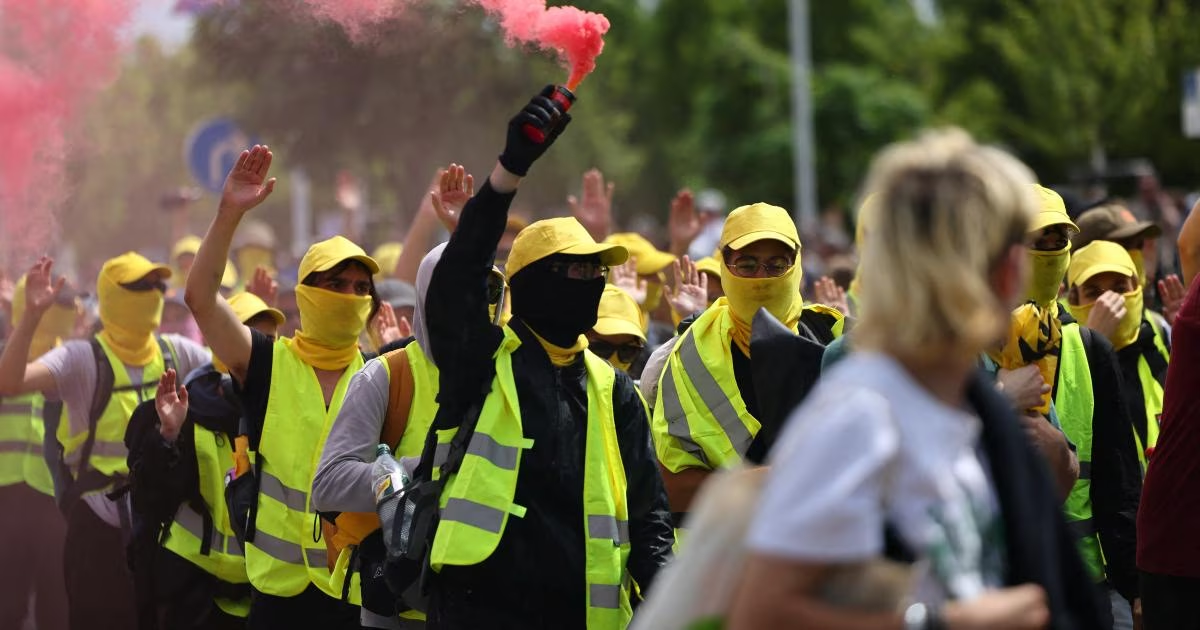
Thousands of demonstrators gathered in the city of Erfurt, eastern Germany, on Saturday, to express their categorical rejection of the policies of the far-right 'Alternative for Germany' party. Protesters carried out extensive closures of the main roads leading to the convention center hosting the party's annual meeting, in a symbolic and practical attempt to obstruct the arrival of participating delegations.

According to estimates from field security sources, the number of participants in these protests exceeded 15,000 people, spread around the city and its center. German authorities mobilized riot police, with additional police reinforcements brought in from other federal states to ensure that the situation did not get out of control and to secure the conference.

Trade unions and civil society organizations, along with left-wing political forces, formed the backbone of these protest movements, which were characterized by sitting in the streets to block traffic. Demonstrators raised slogans warning of the rise of the far-right and its threat to democratic values and pluralism in German society, under close security surveillance by security forces.

Meanwhile, the 'Alternative' party renewed confidence in its current leadership by re-electing Alice Weidel and Tino Chrupalla to lead the party for a new term. This step comes at a time when the party is witnessing a remarkable rise in national opinion polls, where it is strongly competing and sometimes surpassing the conservative bloc led by Friedrich Merz.

_The opening sessions of the conference were marked by a sharp escalation in tone, with party leaders describing the protesters outside as 'enemies of democracy'. Alice Weidel, in her speech to the conferees, emphasized the party's hardline stances, stressing that Germany would not be a place for illegal immigrants, and promised to adopt unprecedented deportation measures if the party came to power.

For his part, the controversial leader Björn Höcke delivered a speech focusing on what he considered a decline in the level of services and general conditions in the country, using daily issues to confirm his vision of 'state deterioration'. This discourse reflects the party's strategy to attract voters by focusing on livelihood crises and linking them to the current government's policies regarding immigration.

These political movements gain double importance as they precede crucial local elections in the states of Saxony-Anhalt and Mecklenburg-Vorpommern in the east of the country. Through this conference, the party seeks to translate its growing popularity in polls into actual electoral gains that enable it to directly influence political decision-making within the German states.

Criminals and illegal immigrants have no place in Germany, and we will work on strict deportation policies.

PALESTINE

Sun 05 Jul 2026 10:19 am - Jerusalem Time

Warnings of imminent danger threatening the life of Dr. Hussam Abu Safiya inside the occupation prisons

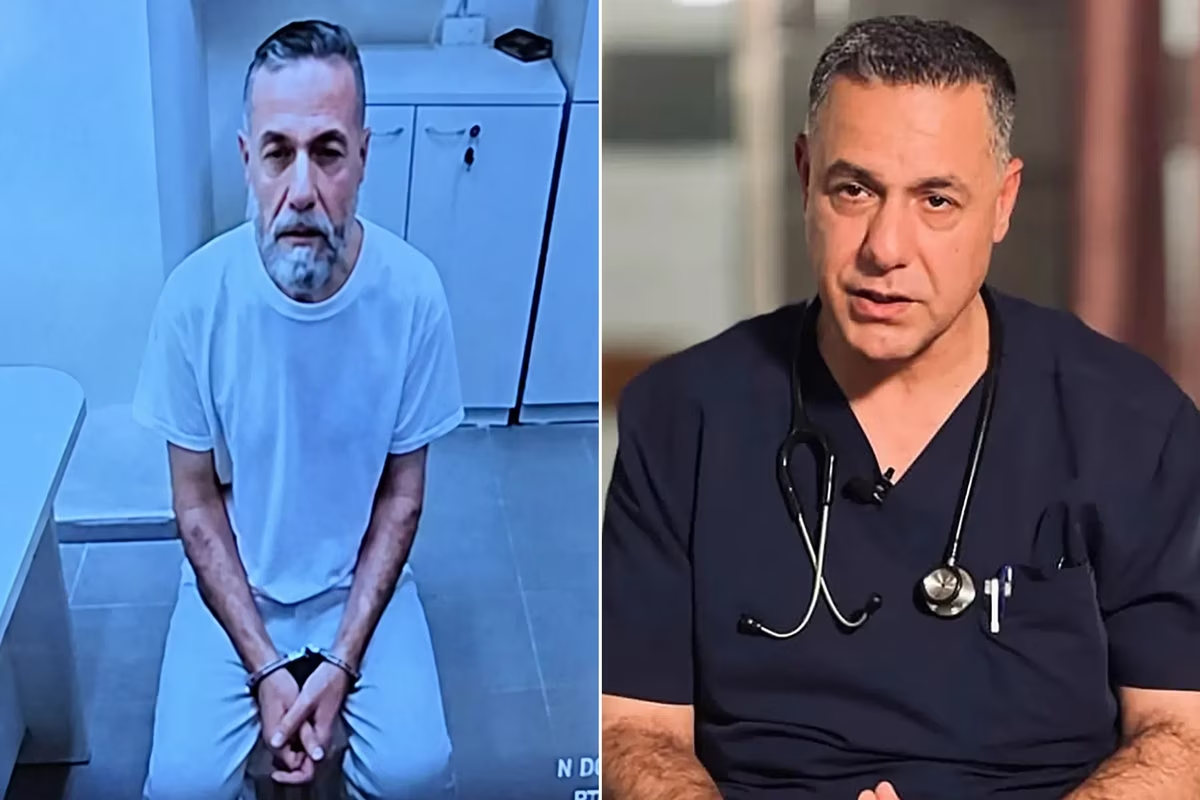
A human rights association has issued strong warnings about a rapid and dangerous deterioration in the health condition of Palestinian doctor Hussam Abu Safiya, who is detained in Israeli occupation prisons. Sources clarified that the doctor faces an imminent danger threatening his life after being recently transferred to the underground interrogation section in Ramla Prison, where these cells lack the most basic human and health necessities.

According to the testimony of the defense lawyer who was able to visit him two days ago, Abu Safiya's body showed clear signs of brutal torture, including bruises and severe injuries to the head, around the eyes, ears, and neck. The lawyer stated that his client appeared in a state of extreme exhaustion and general weakness, as he found it very difficult to breathe or continue speaking fluently as a result of the abuse he was subjected to.

The lawyer conveyed from the captive doctor details of a brutal assault he was subjected to inside his cell, where between four and five jailers severely beat him all over his body without regard for his health condition. These assaults come under harsh detention conditions, where the doctor remains constantly handcuffed and shackled, and is deprived of access to potable water or sufficient food that meets his human needs.

Medical and legal reports indicate that Abu Safiya suffers from previous chronic diseases including heart problems and high blood pressure, conditions that require regular and continuous medical care which he completely lacks inside prison. Sources also confirmed that he contracted scabies due to lack of hygiene and poor detention conditions, in addition to losing about 25 kilograms of his weight since his arrest due to the systematic starvation policy.

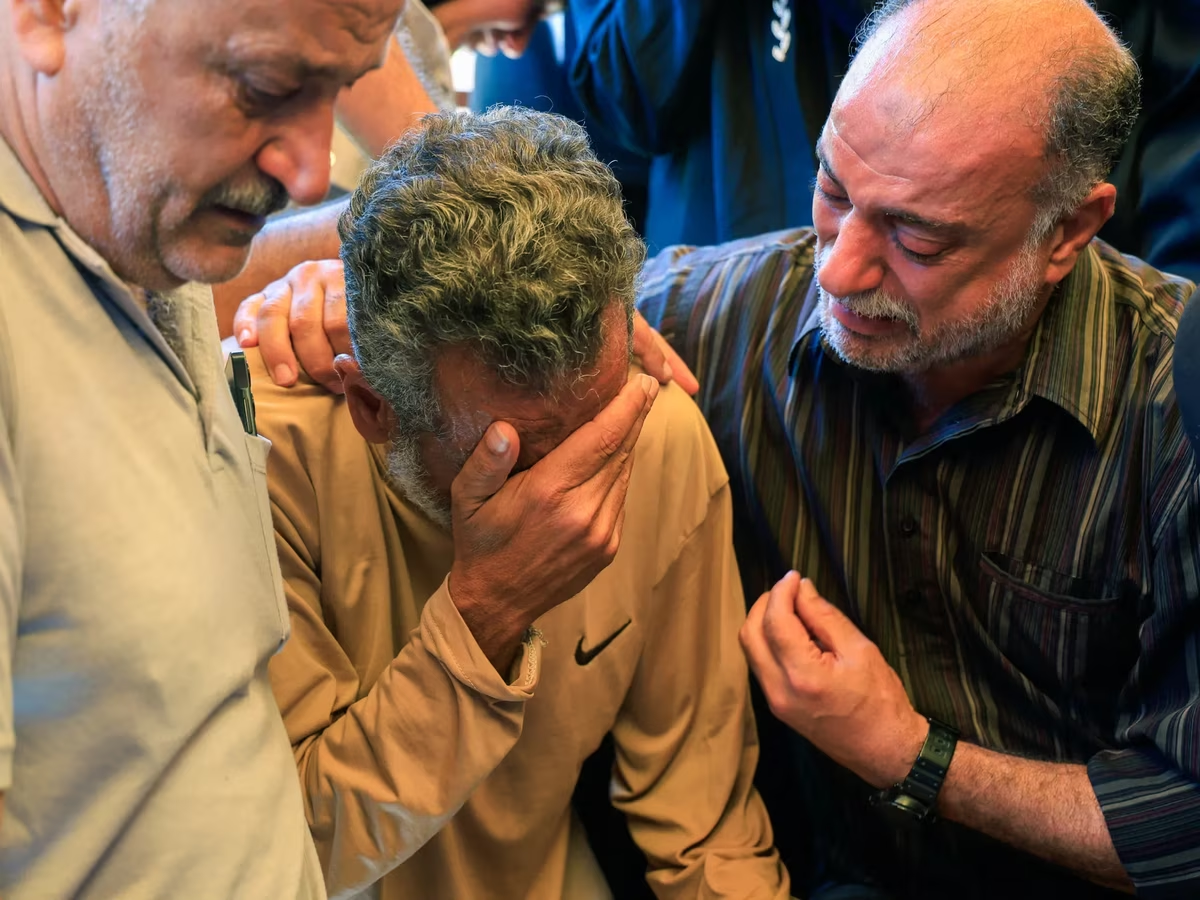
For its part, Dr. Abu Safiya's family held the occupation authorities and the prison service administration fully responsible for any harm that might befall him, describing his solitary confinement as a dangerous escalation and a retaliatory punitive measure. The family considered that what their son is being subjected to is an attempt to physically liquidate him through deliberate medical neglect and continuous physical torture amidst an international silence regarding the occupation's crimes against medical personnel.

On the international level, UN and human rights organizations, including the World Health Organization and the International Committee of the Red Cross, renewed their calls for immediate intervention to ensure the safety of the Palestinian doctor and provide him with the necessary treatment. These organizations stressed the need for the occupation authorities to adhere to international laws that protect prisoners and detainees, especially medical personnel who must enjoy special protection according to the Geneva Conventions.

Abu Safiya suffers from recent and dangerous injuries and bruises to the head and around the eyes, and appeared in a state of extreme weakness that makes him unable to breathe or speak normally.

ARAB AND WORLD

Sun 05 Jul 2026 10:19 am - Jerusalem Time

On the 250th Anniversary of Independence.. Trump Sparks Controversy with Commemorative Coin and Harsh Speech from Mount Rushmore

The United States of America today marked the 250th anniversary of its declaration of independence from Great Britain in 1776, an occasion commemorating the founding of the first modern republic in the Western world. Various states witnessed widespread celebrations, including military parades and popular marches, concluding with fireworks displays that lit up the skies of major cities, at a time when the country is navigating complex political and economic turning points.

US President Donald Trump chose Mount Rushmore, which features rock carvings of four prominent historical presidents, as the platform for his anticipated speech on the quarter-millennium anniversary. Trump's speech was characterized by a harsh tone, as he directly criticized his political opponents, warning against what he described as the 'communist threat' and progressive movements that he believes target the country's traditional identity.

In a move that sparked widespread legal controversy, Trump announced the unveiling of a design for a commemorative $100 banknote bearing his personal signature for the first time in American history. This move contradicts prevailing customs and laws that restrict signatures on banknotes to the Secretary of the Treasury and the Treasurer, opening up debate about the symbolism and legality of this action.

Trump's symbolic ambition was not limited to currency; media reports revealed that he had previously published a design for a commemorative American passport bearing his personal image on his 'Truth Social' platform. Trump described this proposal as representing 'a new passport that welcomes everyone with strict adherence to laws,' which observers considered an attempt to solidify his personal imprint on the nation's sovereign documents.

For his part, New York City Mayor Zahran Mamdani emerged as one of the strongest voices opposing Trump's directions, emphasizing in a televised speech that the strength of the United States lies in its ethnic and cultural diversity. Mamdani pointed out that attempts to confine American identity to a single mold contradict the principles upon which the country was founded two and a half centuries ago.

These celebrations come amidst alarming figures reflecting the extent of internal division, as a recent poll conducted by the 'Reuters/Ipsos' institute showed that 38% of Americans doubt the United States will remain a unified nation in the near future. An 'AP-NORC' poll also revealed that only 40% of citizens feel genuine pride in this historic anniversary, reflecting a decline in trust in national institutions.

Economically, the 250th anniversary coincided with unprecedented financial challenges, as the costs of servicing the US public debt exceeded the national defense budget for the first time. Despite these challenges, Trump launched the 'Freedom 250' program, which aims to beautify the capital Washington and organize major events to enhance national spirit, according to his political vision.

Looking back at history, the Declaration of Independence drafted by Thomas Jefferson in 1776 included the phrase 'all men are created equal,' a phrase that continues to spark discussions about historical contradictions. At the time these words were written, Jefferson himself owned hundreds of slaves, and subsequent laws such as the Naturalization Act of 1790 restricted citizenship to 'free white persons.'

Social media users widely reacted to Trump's proposals regarding the commemorative coin and passport, with opinions divided between supporters who saw them as striking symbolic ideas to commemorate the anniversary, and opponents who viewed them as deepening division. Some analysts believed that turning these proposals into official reality would face significant legal and constitutional obstacles within the operational institutions in Washington.

In conclusion, the 250th anniversary of US independence remains an occasion to recall the past and confront present challenges, amidst an intense struggle over the definition of American identity. While official celebrations continue, the question remains about the American political system's ability to overcome current divisions and preserve national unity in the face of escalating economic and social crises.

American identity is fundamentally based on diversity and immigration, not on a single ethnic or linguistic basis.

PALESTINE

Sun 05 Jul 2026 10:19 am - Jerusalem Time

Palestinian Presidency warns of comprehensive explosion due to escalating settler terrorism in the West Bank

The official spokesman for the Palestinian Presidency, Nabil Abu Rudeineh, issued a strong warning about the serious consequences of the situation in the region exploding in a way that might become uncontrollable. He explained in a statement issued on Saturday, July 4, 2026, that the escalation of what he described as 'organized terrorism' led by settler gangs systematically and dangerously targets Palestinian villages and towns.

The Palestinian Presidency affirmed that these bloody attacks are not carried out in isolation from the military establishment, but rather take place with direct protection and support from the Israeli occupation army. These attacks in the West Bank coincide with the ongoing policy of daily killing and massacres committed by the occupation against civilians in the besieged Gaza Strip.

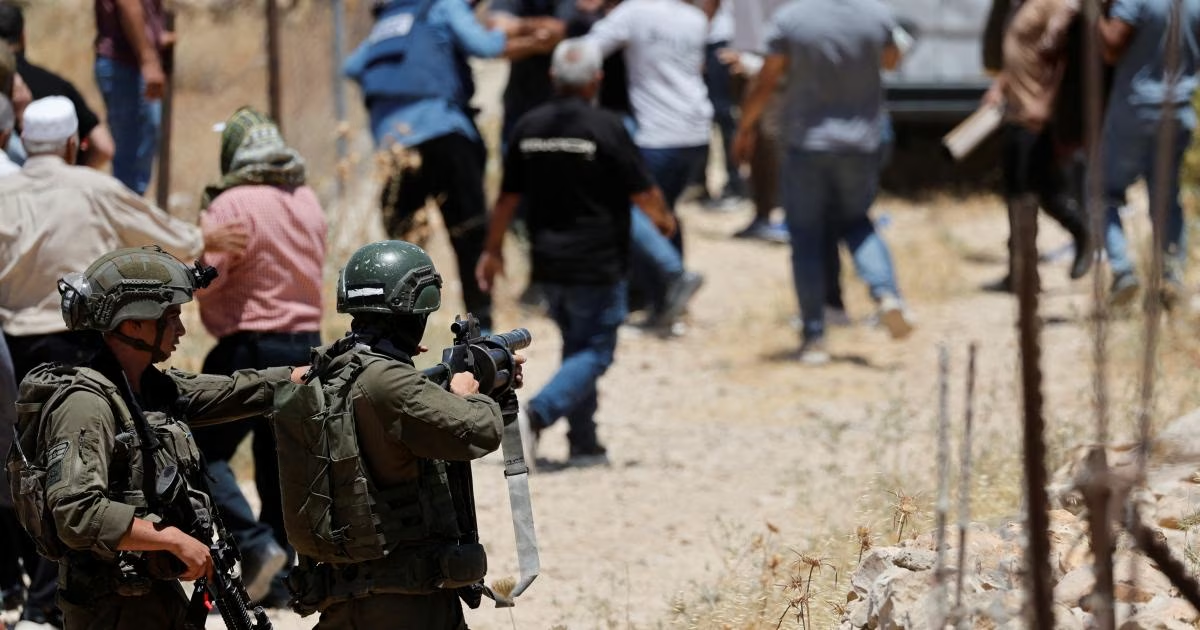
Official sources monitored the concentration of settler crimes in the governorates of Jenin, Nablus, Jerusalem, and Hebron, where the attacks included terrorizing safe citizens inside their homes. The assaults also extended to burning large areas of agricultural land and uprooting ancient olive trees, in an attempt to undermine the elements of Palestinian steadfastness.

The violations were not limited to physical assaults but also included the destruction of public and private property and the illegal seizure of vital water sources. Abu Rudeineh stressed that these practices aim to impose a new colonial reality and liquidate the Palestinian national project through the de facto policy pursued by the occupation government.

The Palestinian Presidency linked the escalation in the West Bank to the ongoing genocide and forced displacement war in the Gaza Strip for a thousand days. It considered what is happening to be a comprehensive plan to displace the Palestinian people and commit war crimes that contradict all international conventions, foremost among them Security Council Resolution 2334.

The Palestinian leadership issued an urgent appeal to the international community, specifically mentioning the American administration, to take practical and immediate stances that go beyond verbal condemnation. It demanded the necessity of compelling the occupation authorities to comply with international law and provide urgent international protection for the Palestinian people in all their places of presence.

The spokesman for the Presidency concluded his statement by emphasizing that the region today stands at a very dangerous historical turning point due to the absence of international accountability. He warned that the continued disregard for Arab and international legitimacy would keep the region in a state of permanent turmoil and on the brink of the abyss, directly threatening regional security and peace.

The continuation of these policies and the failure to adhere to international legitimacy places the entire region at a dangerous historical turning point and keeps it on the brink of the abyss.

PALESTINE

Sun 05 Jul 2026 10:19 am - Jerusalem Time

Foreign activists in Germany face deportation for solidarity with Palestine

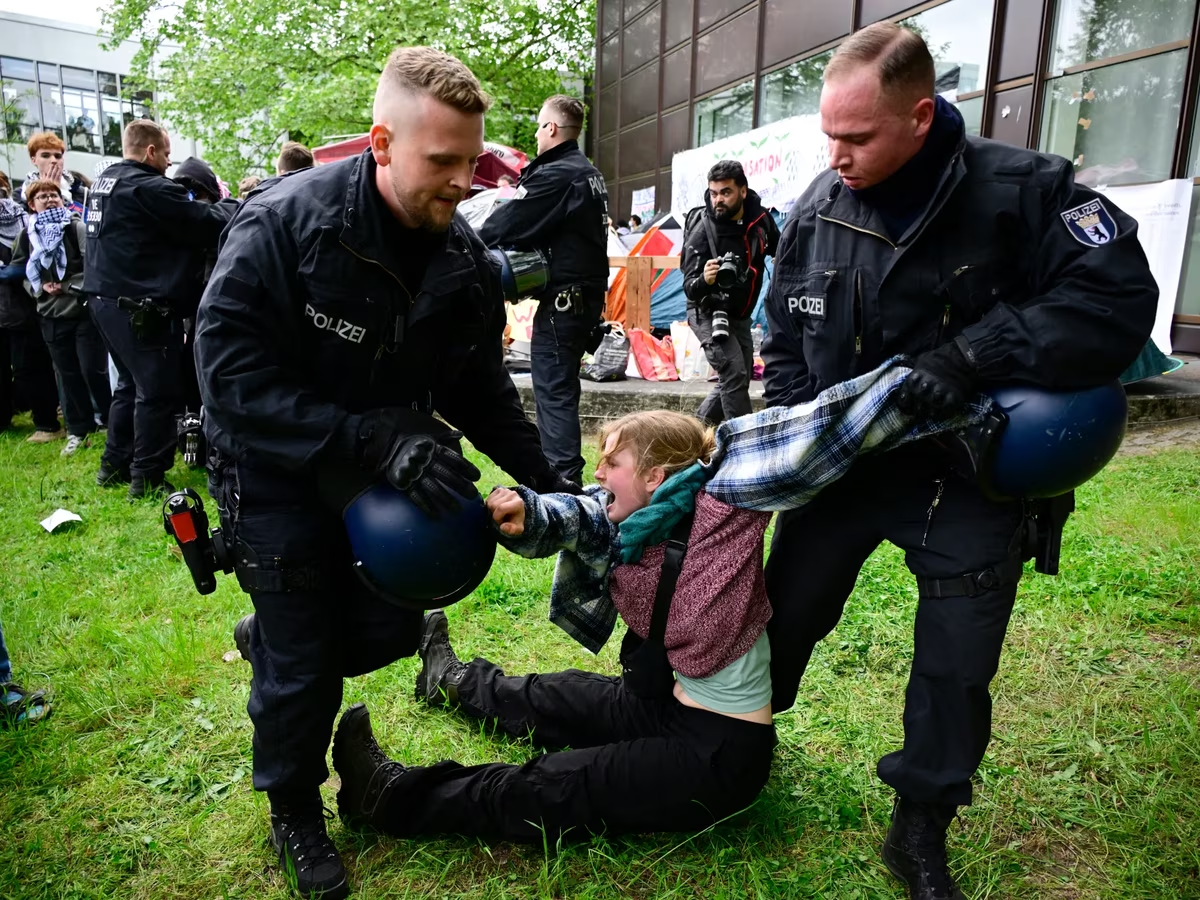
The German government is facing increasing accusations of using legal intimidation tactics against foreign activists residing in its territory, with the aim of deterring them from participating in events supporting Palestine and demanding an end to the war in the Gaza Strip. Sources reported that these measures are no longer limited to immigrants of Arab origin but have extended to include citizens from Western countries who have found themselves facing complex legal battles targeting their professional and legal futures.

American activist Cooper described her experience as exceeding expectations in terms of the level of repression exercised, considering what she went through as a clear message to anyone who opposes Germany's official stance on Gaza. Cooper affirmed that the authorities seek to create a state of general fear through criminal investigations and the suspension of legal statuses, leading to the threat of actual deportation from the country.

In a related context, Chilean activist Luis Cortez was detained after participating in a peaceful sit-in at the Free University of Berlin in November 2023. Despite his attempt to comply with the authorities' requests to leave the site, he was arrested and placed on a legal path that ultimately led to the foreigners' office refusing to renew his official residency.

Cortez explained that his acquittal by a court did not intercede for him with the German bureaucratic institutions, which kept him in a 'gray area' preventing him from living a normal life. The Chilean activist believes that the insistence of the public prosecutor's office and the university on prosecuting him despite the lack of evidence reflects a clear political use of the legal system to silence dissenting voices.

For his part, Irish activist Shane O'Brien revealed shocking details regarding attempts to deport him, indicating that his lawyers reviewed internal documents proving there was no legal basis for this step. O'Brien affirmed that the case continued only due to direct pressure exerted by the German Ministry of Interior, raising questions about the independence of administrative decisions in immigration cases.

All three cases share the shock of the illusion of 'protection' that Western passports once granted their holders in the face of authorities. Despite the American activist acknowledging that she possessed a kind of privilege compared to refugees, this did not prevent security agencies from pursuing and harassing her because of her moral stance on events in the Palestinian territories.

These activists believe that laws in Germany are being applied with extreme selectivity when it comes to freedom of expression regarding the Palestinian issue. They pointed out that educational and security institutions work in close coordination to ensure that no voice breaks the barrier of silence imposed around the violations occurring in the Gaza Strip.

Despite these immense pressures, activists emphasize that their humanitarian motive remains the primary driver for their continued solidarity, considering that silence in the face of 'genocidal war' is a dereliction of moral duty. The Irish activist affirmed that attempting to stop the massacres in Gaza represents the minimum commitment to the human values that Western democracies claim to protect.

These practices have led to a radical change in these activists' view of European principles, with Cooper considering that the experience revealed 'deep-seated racism' and a blatant contradiction in freedom of expression standards. They expressed deep skepticism about the official institutions' commitment to the rights and freedoms they promote in international forums while violating them domestically.

Today, the stories of these activists are becoming a living example for a broader discussion within German society about the dividing lines between the application of immigration laws and systematic political repression. With the war ongoing, the confrontation between authorities and those in solidarity appears poised to escalate, putting Germany's human rights reputation at stake before global public opinion.

Standing against genocide is a moral duty that cannot be silenced, and what is happening is a message of intimidation to all those in solidarity.

PALESTINE

Sun 05 Jul 2026 10:19 am - Jerusalem Time

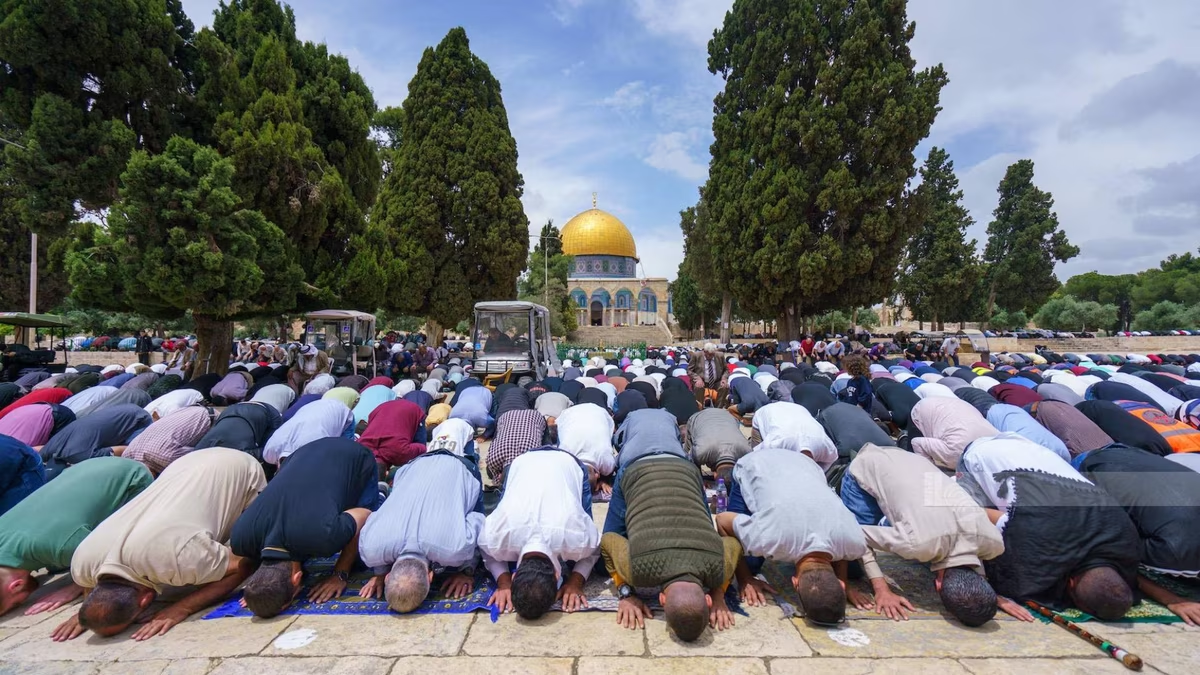
Despite military restrictions... 50,000 perform Friday prayers in Al-Aqsa Mosque

Al-Aqsa Mosque witnessed a massive influx of worshipers performing Friday prayers, with the Islamic Endowments Department in Jerusalem estimating their numbers at around 50,000 worshipers. This spiritual migration came in response to calls for steadfastness and pilgrimage to the Noble Sanctuary, despite continuous attempts to empty it and surround it with military barracks.

Field sources reported that the occupation forces transformed occupied Jerusalem into a military barracks, with armed elements heavily deployed on the roads leading to the mosque. These forces erected iron barriers to obstruct pedestrian movement and carried out extensive identity checks on citizens, which prevented a large number of young men from reaching the Old City.

These measures come amidst a systematic escalation targeting worshipers, as the occupation seeks to impose a new reality that restricts the Palestinian presence in Al-Aqsa Mosque. Forces stationed at the gates deliberately turned back many visitors under flimsy security pretexts, in an attempt to intimidate worshipers and reduce their numbers inside the courtyards and covered prayer areas.

It is worth noting that the occupation authorities have continued to impose a strict siege on Jerusalem for three years, preventing Palestinians in the West Bank and Gaza Strip from accessing their mosque. Currently, the possibility of prayer is limited to the residents of Jerusalem and the occupied interior, who in turn face a series of complications and restrictions aimed at isolating Al-Aqsa Mosque from its Palestinian surroundings.

Approximately 50,000 worshipers were able to reach the mosque and perform prayers in its courtyards and squares, in response to calls for pilgrimage to it.

ARAB AND WORLD

Sun 05 Jul 2026 10:19 am - Jerusalem Time

Intense Diplomatic Moves Between Putin and Trump, and Military Escalation Reaching St. Petersburg

The Kremlin announced a phone call between Russian President Vladimir Putin and his American counterpart Donald Trump, on the occasion of the 250th anniversary of the United States' independence. During the conversation, the two leaders discussed ways to reach a political settlement for the Ukrainian crisis, amidst ongoing preparations for the upcoming NATO summit in the Turkish capital, Ankara.

Yury Ushakov, Assistant to the Russian President for Foreign Affairs, explained that the discussion primarily focused on the war in Ukraine, especially with Trump's expected participation in the Ankara summit on July 7th and 8th. Ushakov noted that Putin provided a detailed explanation of the current situation on the ground, emphasizing that Russian forces continue to advance steadily on various fronts.

In a related context, the Ukrainian presidency revealed a similar call between President Volodymyr Zelenskyy and Donald Trump, during which developments on the front lines were reviewed. Zelenskyy expressed optimism in an official statement about a real opportunity to end the conflict, stressing that the American role remains crucial in supporting diplomatic efforts aimed at achieving peace.

The Ukrainian and American sides agreed to continue these discussions during the scheduled meetings on the sidelines of the NATO summit in Turkey, which is expected to be attended by leaders from 32 countries. These diplomatic moves come at a sensitive time when military fronts are witnessing unprecedented escalation and shifts in the balance of power on the ground.

On the ground, the Ukrainian military command categorically denied Moscow's claims of controlling the strategic city of Kostiantynivka in the eastern Donetsk region. President Zelenskyy described the Russian statements as pure lies aimed at boosting the morale of the invading forces, asserting that the city remains under the control of Ukrainian defense forces.

Military sources reported that Ukrainian forces are engaged in fierce battles to defend Kostiantynivka, which is considered one of the last defensive barriers before the cities of Kramatorsk and Sloviansk. This city holds great strategic importance as a key axis for Russian attacks seeking to gain full control of the Donbas region.

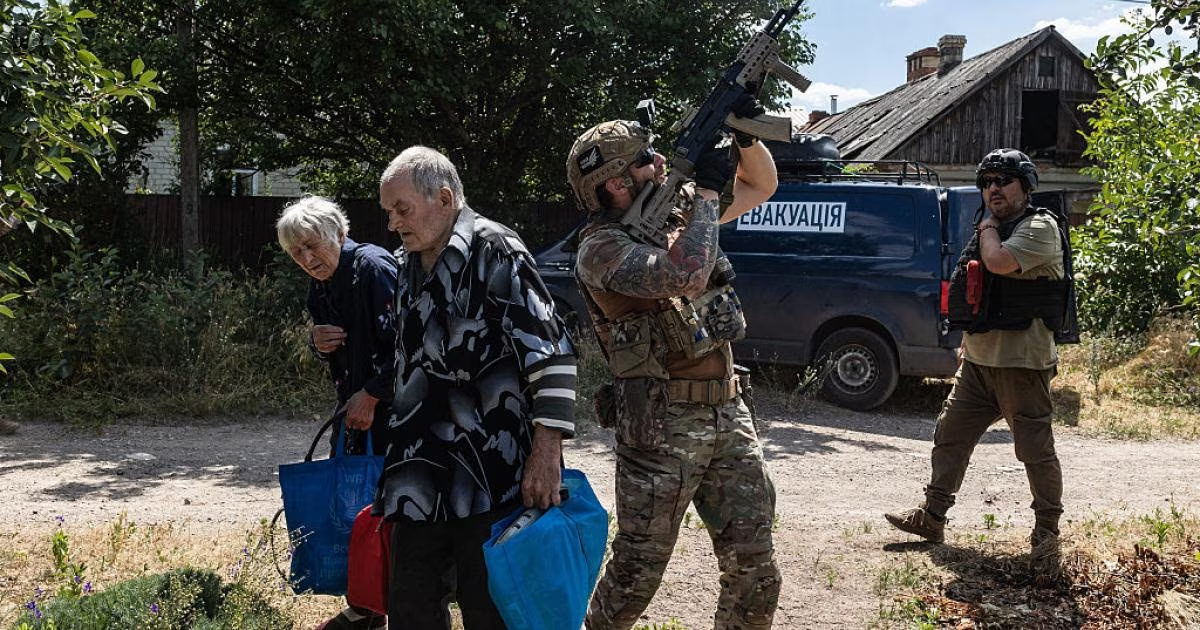
Regarding deep strikes, Ukraine launched a widespread drone attack targeting St. Petersburg, Russia's second-largest city and President Putin's hometown. Field sources confirmed that the strikes hit an oil port near the Finnish border, as well as the famous historic Peterhof complex, in a notable development in Ukrainian military operations.

For its part, the Russian Ministry of Defense announced that its air defenses managed to intercept and shoot down about 500 drones and 10 'Flamingo' missiles in one night. Moscow vowed to respond forcefully to these attacks targeting vital and historical facilities, considering that the Ukrainian escalation aims to destabilize internal stability in Russia.

President Zelenskyy indicated that the night attacks successfully hit the Russian naval base in Kronstadt, St. Petersburg, reflecting Kyiv's ability to reach distant targets. These strikes come in response to intense Russian missile attacks that targeted the capital Kyiv and resulted in the deaths of 30 civilians last week.

By intensifying its strikes deep inside Russia, Ukraine seeks to pressure the Kremlin to sit at the negotiating table on fair terms. Observers believe that the shift of military operations to major cities like St. Petersburg represents a new phase of the conflict that began in February 2022.

Drone attacks have led to widespread disruptions in daily life in several Russian regions, with air traffic disrupted at a number of international airports. Local reports also indicated power and water outages in border areas due to attacks on energy infrastructure and fuel depots.

Gas stations in some Russian cities witnessed long queues and a severe shortage of fuel, which local officials attributed to damage to storage facilities due to Ukrainian strikes. These developments reveal the widening scope of the confrontation to include an economic and logistical war of attrition that directly affects the Russian interior.

On the Russian side, President Putin appeared in televised footage wearing military uniform alongside his general staff, where he thanked the soldiers participating in military operations in eastern Ukraine. Putin emphasized the strategic importance of controlling major cities in Donetsk, considering it a necessary step to achieve the goals of the special military operation.

As the NATO summit in Ankara approaches, attention turns to what the bilateral meetings between Trump and European and Ukrainian leaders will yield. The question remains about the ability of the incoming American administration to formulate a peace initiative that ends the worst armed conflict witnessed on the European continent since the end of World War II.

President Trump and I discussed the current situation on the front line, in addition to our diplomatic efforts, and there is a real possibility of ending this war.

PALESTINE

Sun 05 Jul 2026 10:18 am - Jerusalem Time

The passing of freed prisoner Maher Younis after decades of struggle

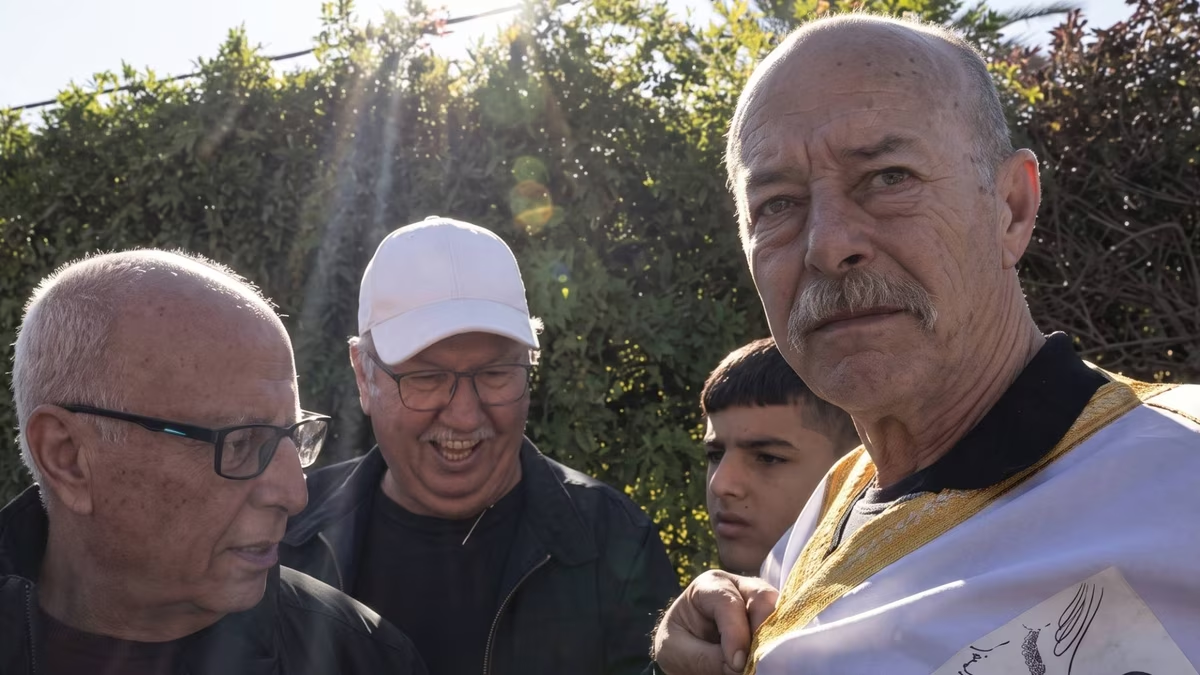
The Palestinian arena lost today, Sunday, the fighter and freed prisoner Maher Younis, who passed away as a result of a sudden deterioration in his health. Younis's passing comes after a long struggle and a bitter detention experience that lasted forty years, making him a national symbol of steadfastness and defiance in the face of the Israeli jailer.

The deceased regained his freedom on January 19, 2023, after completing the full term of his unjust sentence in the occupation's detention centers. The deceased was born in the village of Ar'ara in the Triangle in 1958, and grew up in a struggling family that made many sacrifices for the Palestinian cause over decades.

The roots of the deceased's legal pursuit date back to the early eighties, specifically in January 1983, when occupation forces arrested him on charges of belonging to the Palestinian National Liberation Movement 'Fatah'. He was then charged with participating in resistance acts and killing an Israeli soldier, leading to a life sentence that was later set at forty years.

Over four decades, Younis was transferred between various Israeli prisons and detention centers, where he faced harsh detention conditions and systematic abuse policies. Despite all attempts to break his will, he remained steadfast and maintained his position as one of the most prominent leaders of the prisoner movement, and for many years was classified as the second oldest Palestinian detainee.

The moment of his release early last year was not ordinary, as the occupation authorities imposed a tight security cordon around his home and prevented any celebrations or reception of popular delegations. These measures reflected the occupation's fear of public rallying around national symbols who spent the prime of their youth behind bars defending the rights of their people.

Maher Younis's death leaves a lump in the throats of Palestinians, as it brings to mind the extent of the health and physical suffering that pursues freed prisoners even after their release from cells. Local sources confirm that the long years of captivity left a deep impact on the deceased's health, which ultimately led to this severe health setback that claimed his life.

The deceased recorded his name among the longest periods of captivity in contemporary Palestinian history, ending four decades of steadfastness behind bars.

OPINIONS

Sun 05 Jul 2026 10:18 am - Jerusalem Time

An Empire Born: A Different Reading of the United States in its 250th Year

Washington's Message

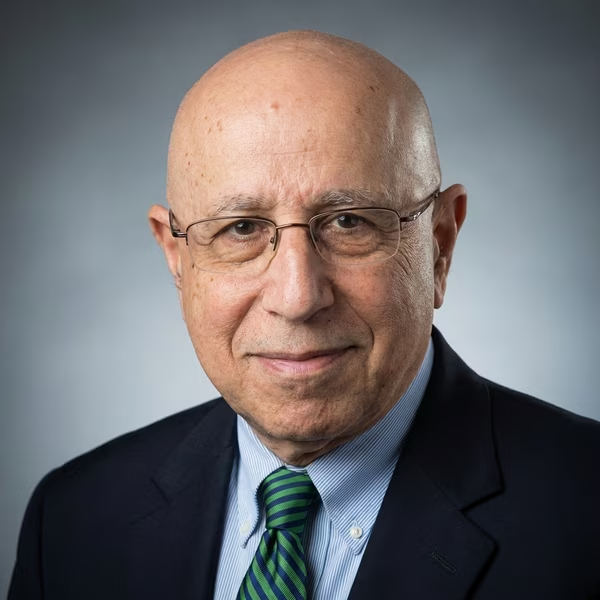
Washington – Said Arikat – 7/5/2026

Opinion Piece

On Saturday, July 4, the United States celebrated its 250th anniversary, in a scene dominated by national celebration and a display of military, technological, and economic power that has made it the most influential nation in the world. The official discourse presented the occasion as the culmination of two and a half centuries of democratic success, constitutional stability, and global leadership, affirming the image of the United States as a model of freedom and a leader of the international order.

However, this celebratory narrative conceals another face of American history, a face no less important than the story of democracy and the constitution, and perhaps one that explains a large part of the United States' rise to its current position. There is a growing historical interpretation that views the United States not as having transformed into an empire after World War II or at the end of the 19th century, but rather as having been born an empire since its declaration of independence in 1776. According to this approach, expansion, land acquisition, subjugation of indigenous peoples, and then extending influence beyond its borders were not separate stages in the nation's history, but rather the project upon which the republic was founded from its inception.

From this perspective, American history is not viewed solely as a continuous march towards freedom, but also as a history of building an expansionist power that used law, institutions, the military, and the economy to solidify its influence within the American continent and then globally. Thus, the question posed on the 250th anniversary is not only how the United States became the greatest power in the world, but also: Was this rise the fruit of an exceptional democratic model, or the result of an imperial project that accompanied the nation since its birth?

This interpretation starts from the premise that expansion was not an accidental outcome of the American state-building, but rather the foundation upon which the state itself was built. Since independence, the new government declared its sovereignty over vast areas inhabited by indigenous peoples and considered geographical expansion part of its national mission. To achieve this, it utilized constitutional institutions, federal laws, and the military, making the expansion of the state's territory a permanent political goal, not merely a response to changing historical circumstances.

This argument also explains why the United States adheres to what is known as "American exceptionalism," i.e., the belief that it differs from European empires because it emerged from a revolution against colonialism and championed the slogans of freedom and self-determination. However, many historians believe that empires are not defined solely by possessing colonies, but by their ability to impose unequal power and control relations. From this perspective, the United States has practiced imperial behavior since its inception, even if it refused to use that description.

Independence did not end the imperial system managed by Britain, but rather shifted the center of power from London to American political elites. Indigenous peoples were the first to pay the price for this transformation, as they faced a new authority more aggressive in land acquisition and less committed to previous agreements. Wars against tribes, forced displacement policies, and dispossession became official tools for state-building, not marginal events in its history.

In this context, the concept of "settler colonialism" gains special significance, as it explains the nature of the American project. The intention was not merely to control the indigenous population, but to replace them with a new society. Therefore, land became the primary goal, and the presence of indigenous peoples became an obstacle to the settlement project, leading to organized policies of displacement and exclusion, implemented through state institutions, law, and military force.

Moreover, the western frontier (the American West) was not a space of chaos as depicted by traditional narratives, but rather subject to government administration aimed at transforming open lands into private property and integrating them into the American economy. Treaties with indigenous peoples were often used as temporary solutions until they became an impediment to expansion, at which point they were bypassed or abrogated.

With the completion of control over the American continent in the late 19th century, the expansion project did not stop but changed direction. The Spanish-American War of 1898 ushered in the era of global empire, where Washington extended its control over the Philippines, Puerto Rico, and Guam, but presented its intervention as a project to liberate peoples, not occupy them.

However, the war in the Philippines revealed the continuation of the same methods used within the American interior, including extensive military campaigns, scorched-earth policies, concentration camps, and a large number of civilian casualties. The geography changed, but the philosophy of expansion remained the same.

Throughout the 20th century, the American empire evolved from direct control to indirect influence. The need to annex territories no longer existed; instead, hegemony was exercised through military bases, security agreements, economic dominance, influence over governments, and the shaping of international institutions. After World War II, the United States possessed the ability to reshape the global order to serve its interests, without the need to establish a colonial empire in the traditional sense.

During the Cold War, this influence acquired a new ideological justification: confronting communism. In the name of this goal, Washington intervened in the affairs of many countries, contributing to the overthrow of elected governments and supporting authoritarian regimes when it deemed it necessary to protect its strategic interests. Thus, the American empire expanded under the slogans of security and defending the free world.

The collapse of the Soviet Union did not lead to a contraction of this influence; instead, it opened the door to a new phase of unipolar dominance, characterized by the expansion of NATO, the continued American military presence, and the escalation of foreign interventions under the banners of counter-terrorism, protecting international security, and spreading democracy. The political language changed, but the essence of the relationship between power and influence remained constant.

Domestically, these transformations were reflected in the nature of the state itself. The powers of security agencies expanded, electronic surveillance increased, and the presence of military and security institutions in public administration strengthened, leading a number of researchers to argue that the effects of empire are no longer limited to foreign policy but have extended to the internal structure of the American political system.

This interpretation does not deny that the United States has made major contributions to the development of constitutional institutions, the global economy, and scientific innovation, nor does it diminish the importance of the principles upon which it was founded, foremost among them freedom, equality, and the rule of law. However, it emphasizes that these principles coexisted, from the beginning, with an expansionist project that relied on force and dominance to build the state and enhance its international standing.

Therefore, the celebration of 250 years since the founding of the United States opens the door to a deeper historical review that does not merely recount achievements but also pauses at the human and political cost of the expansion project. Understanding the United States as both a democratic state and an empire at the same time may be more capable of explaining the contradictions of its domestic and foreign policy, and of understanding the reasons for the ongoing debate about its role in the world.

The question posed by this historical occasion remains open: Can the United States, as it enters the third quarter-millennium of its existence, redefine its power away from the logic of expansion and dominance, or will the imperial legacy remain one of the essential components of its political identity and global role? The answer to this question will not only determine the future of American policy but will also affect the shape of the international order in the coming decades.

ARAB AND WORLD

Sun 05 Jul 2026 10:18 am - Jerusalem Time

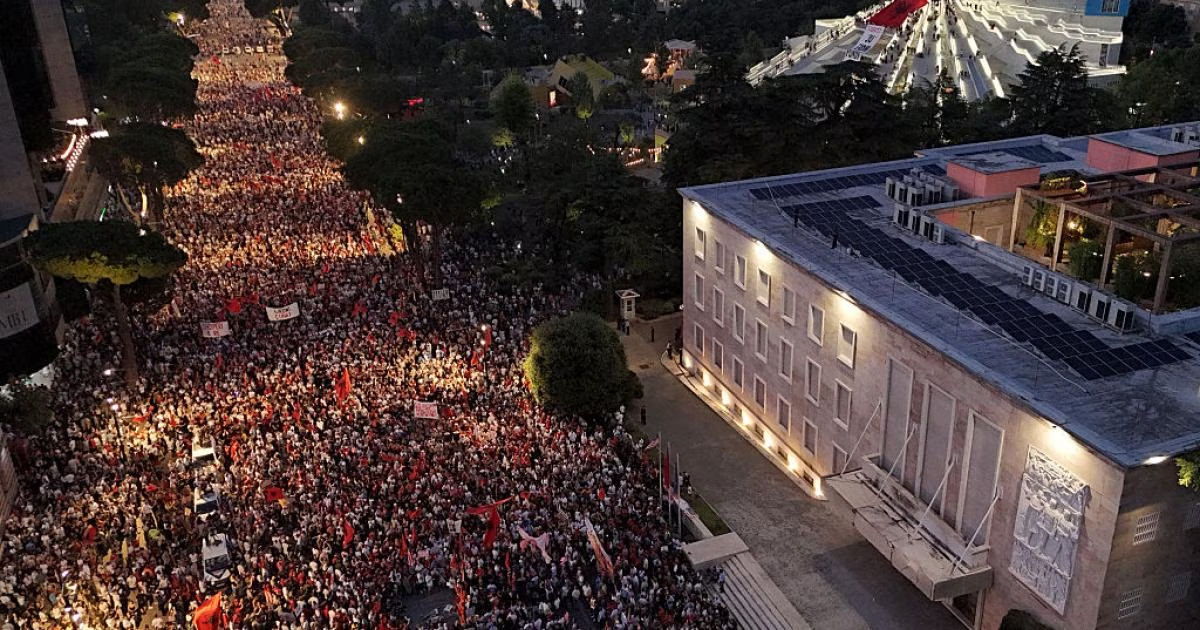
Tirana Ignites with 'Flamingo Revolution': Tens of Thousands Protest Against Trump Family Project in Albania

The streets of the Albanian capital, Tirana, on Saturday hosted the largest protest march since the launch of the popular movement opposing controversial investment projects. Tens of thousands of citizens gathered on the thirty-fifth day of protests, expressing their categorical rejection of a luxury tourist resort project linked to the family of US President Donald Trump.

The spark for this movement ignited in late May, when plans were announced to build a massive hotel and resort overseen by Ivanka Trump and her husband Jared Kushner. The proposed project is located on the coast of one of the country's unique nature reserves, raising widespread fears of destroying the ecological balance in the region.

The demands of the protesters expanded over time to go beyond the environmental aspect, as demonstrators called for the resignation of Prime Minister Edi Rama and his government. Participants in the marches accused the executive authority of corruption and facilitating the seizure of public lands for foreign investors under the guise of tourism development.

Activists named their movement the 'Pink Flamingo Revolution,' a symbolic reference to the flamingos that use the targeted reserve as a key stop on their seasonal migrations. Environmental experts warn that the $4.6 billion project will threaten Lake Zvërnec, which is a vital habitat for migratory birds.

The investment plan includes transforming Sazan Island, which was known as a secret military base during the communist era, into a tourist destination for the elite. Opponents believe that converting historical and military sites into private properties represents a squandering of national sovereignty and Albania's historical heritage.

The past few days witnessed a dangerous escalation on the ground, with violent clashes between protesters and riot police in front of the Parliament building. Security forces used tear gas and water cannons to prevent demonstrators from obstructing the entry of deputies, resulting in injuries on both sides.

Security sources reported that 15 police officers were transferred to hospitals for treatment after being pelted with stones and solid objects during the clashes. In contrast, authorities launched an arrest campaign targeting 25 demonstrators, 19 of whom remain in custody, amid human rights demands for their immediate release.

Human rights organizations entered the crisis, with the 'Albanian Helsinki Committee' criticizing what it described as the excessive use of force by security forces. The committee affirmed in a statement that the existence of individual acts of violence does not give the police the right to deal harshly with large peaceful gatherings.

Saturday's demonstration carried a special symbolic character, as it coincided with the 62nd birthday of Prime Minister Edi Rama. Protesters held a giant cake made of concrete, expressing their rejection of the 'concrete pouring' policy in green areas, chanting slogans affirming that 'Albania is not for sale.'

Albania is not for sale, and the protected areas law that threatens our national environment must be repealed.

ARAB AND WORLD

Sun 05 Jul 2026 10:18 am - Jerusalem Time

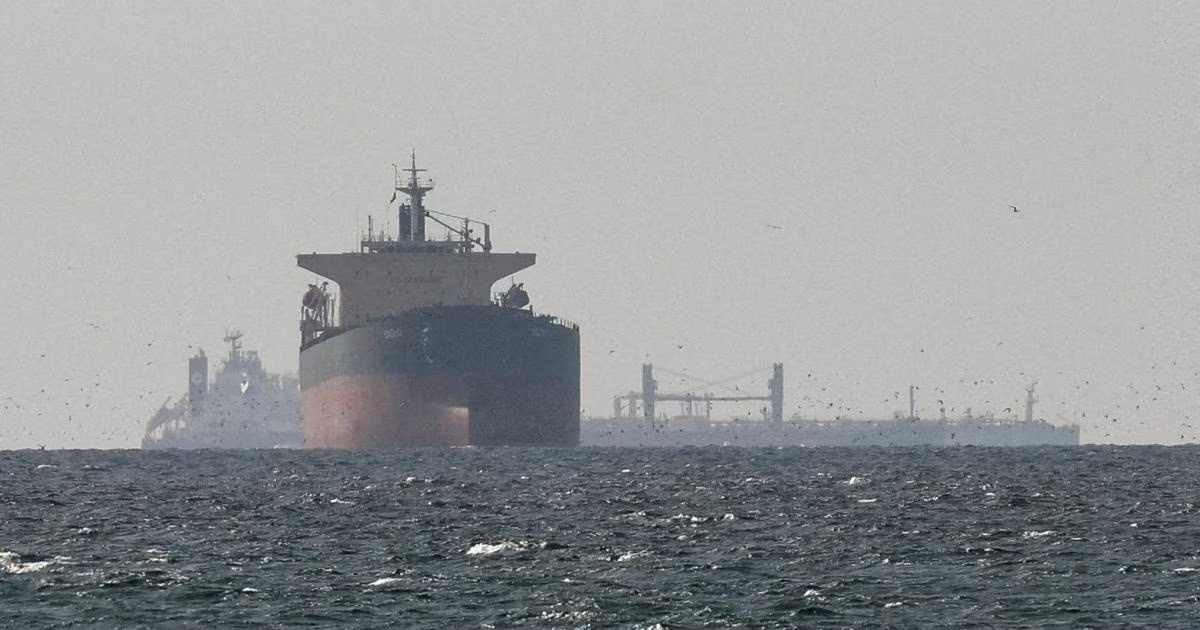
US Reservations on European-Omani Agreement to Secure Navigation in the Strait of Hormuz

Informed sources in the US capital, Washington, reported that the American administration views with suspicion and unease the recent agreement concluded by Britain and France with the Sultanate of Oman regarding the security of the Strait of Hormuz. These reservations stem from the firm American principle that rejects any regional security arrangements not falling under the leadership umbrella of the United States, especially in vital waterways.

The sources stated that US President Donald Trump had previously directed harsh criticism at Washington's major allies within and outside NATO, due to their refusal to join an international coalition that Washington sought to form. The aim of this coalition was to secure navigation during the peak of regional tensions involving international and regional parties in confronting Iranian moves in the region.

The current disagreement highlights that the European move proposes a separate path for addressing navigation security, which Washington considers a deviation from unified coordination. Observers believe that the hesitation previously shown by allies has now turned into independent initiatives that could weaken the United States' grip on maritime security issues in the Arabian Gulf and the Strait of Hormuz.

Procedurally, the new European agreements provide a framework that regulates the Iranian role in managing navigation within the Strait, which Washington does not officially endorse in its political discourse. Despite the existence of a US-Iranian memorandum of understanding that grants Tehran a role in regulating ship traffic during certain phases, Washington refuses to legitimize this role through other international agreements.

In a related context, President Trump emphasized his country's rejection of imposing any financial fees on ships transiting the Strait in the future, even after the expiration of the deadlines specified in existing understandings. In contrast, London and Paris are focusing on building a technical and military mechanism to ensure smooth passage, which reflects a divergence in priorities between the two sides of the Atlantic regarding this sensitive issue.

British Prime Minister Keir Starmer and French President Emmanuel Macron had affirmed in a joint statement that the Strait of Hormuz represents an indispensable artery for the global economy. The two leaders expressed their full readiness to deploy a multinational military mission to support freedom of navigation, emphasizing the need to maintain regional stability and respect the sovereignty of states bordering the waterway.

Reports concluded that the Sultanate of Oman's agreement to work with the French and British sides to ensure navigation safety in its territorial waters represents a significant strategic step. However, the biggest challenge remains how to balance these efforts with the American desire to dominate security arrangements, which could lead to new political tensions within the Western allied camp.

Washington is uncomfortable with any security agreement in the region that is not under its direct umbrella or leadership.

PALESTINE

Sun 05 Jul 2026 10:18 am - Jerusalem Time

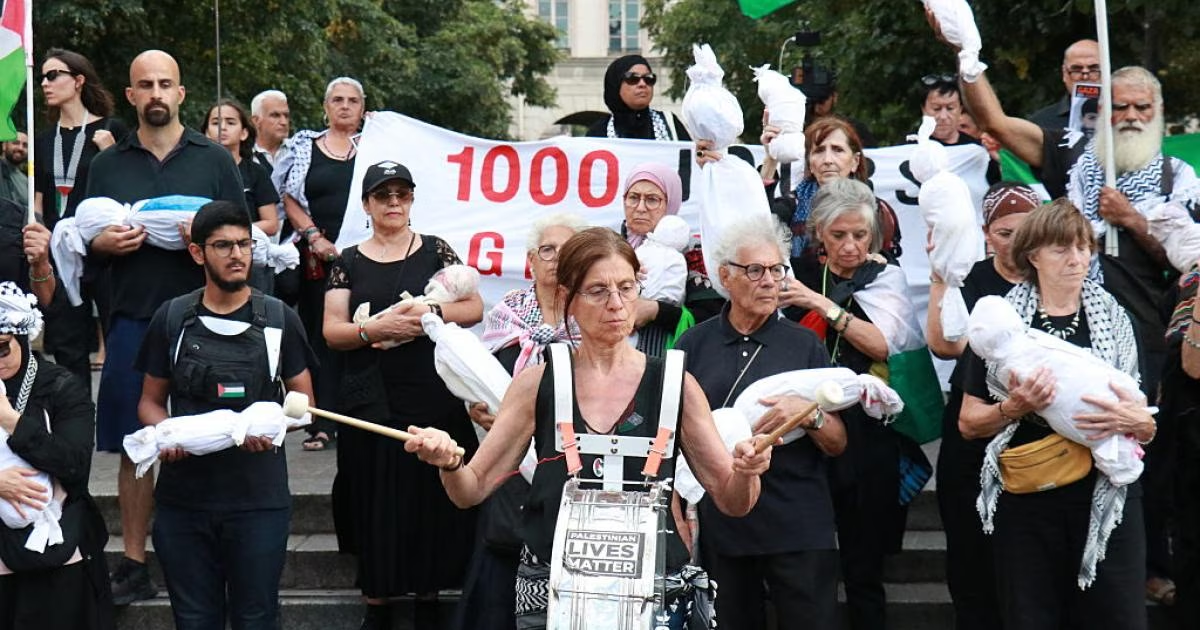
1000 Days of Aggression: Global Marches Sweep Major Capitals Condemning the War of Annihilation in Gaza

Hundreds of activists in the French capital, Paris, commemorated the passage of a thousand days since the outbreak of the devastating Israeli war on the Gaza Strip with a silent protest march. Participants wore black clothes and paraded through public squares and markets, carrying symbolic models of shrouded children to express the magnitude of the atrocities committed against civilians, amidst wide interaction from passersby who were moved by the impactful visual scenes.

Demonstrators in Paris held up banners bearing the slogan 'Not just numbers,' indicating that Palestinian victims have stories and lives beyond official statistics. Protesters demanded the necessity of breaking the prevailing international silence regarding the crimes committed, emphasizing the importance of immediate action to hold the occupation leaders accountable and stop the massacres targeting families in the besieged strip.

In the Asian continent, the Indonesian city of Bandung witnessed angry marches demanding an immediate and unconditional halt to the Israeli bombing and an end to the unjust siege. Participants' voices resonated with chants supporting the Palestinian right, calling on the international community to assume its legal and moral responsibilities towards the genocide suffered by children and women in Gaza.

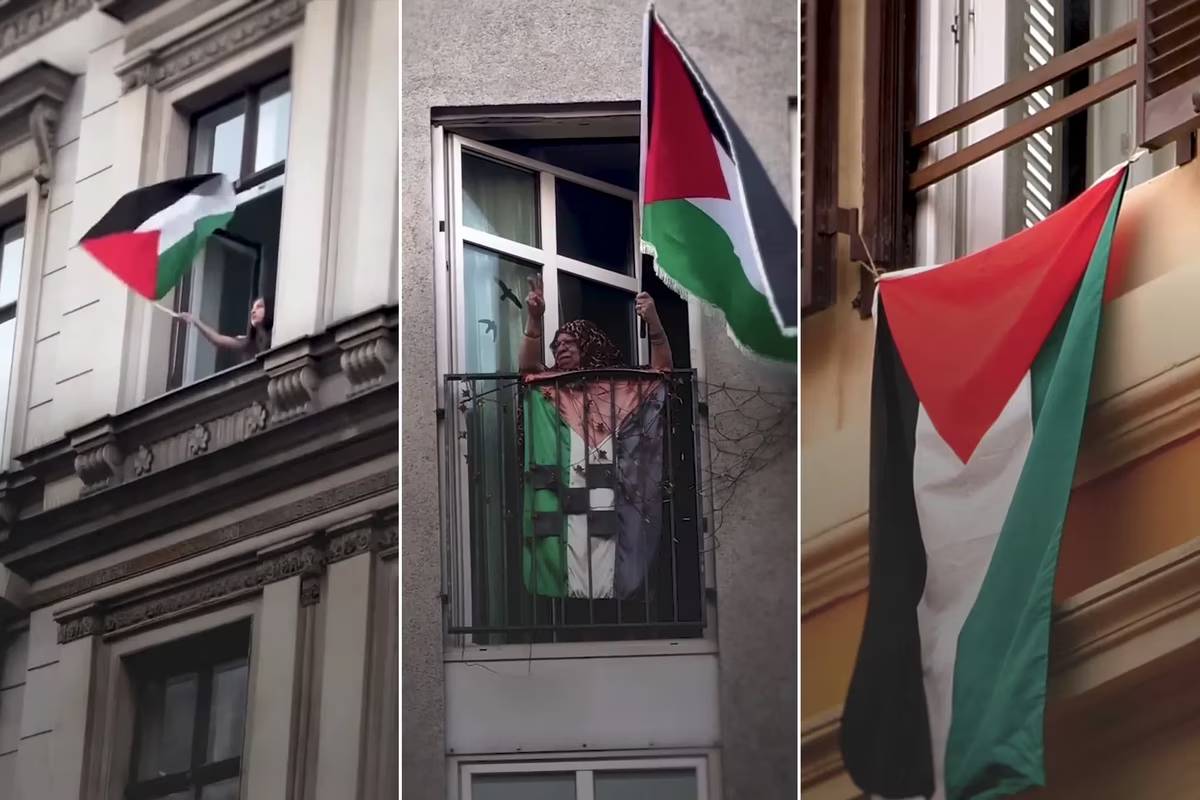
In the Danish capital, Copenhagen, a massive march swept through the city's main streets condemning the continuation of military aggression. Demonstrators held a giant banner linking the current thousand days to 78 years of Nakba and Palestinian suffering, affirming that the current conflict is an extension of decades of occupation and forced displacement practiced against the Palestinian people.

Elite human rights activists and members of Arab and Islamic communities, along with Danish solidarity activists who heavily raised Palestinian flags, participated in the Copenhagen event. The demands in this demonstration focused on the necessity of stopping arms exports to the occupation authorities and initiating international legal procedures to prosecute those responsible for war crimes before the competent courts.

The torch of solidarity moved to the Swedish capital, Stockholm, where hundreds demonstrated to demand an immediate halt to the aggression and the release of Palestinian prisoners held in occupation prisons. Participants highlighted the suffering of detainees, raising pictures of national and professional figures such as leader Marwan Barghouti and Dr. Hossam Abu Safiya, to remind of the targeting of medical and political cadres.

The Stockholm demonstration included a silent theatrical performance embodying the systematic violations suffered by Palestinian journalists and doctors while performing their humanitarian and professional duties. Organizers affirmed that these activities will continue and escalate until the Palestinian people achieve their freedom and the war machine, which has not stopped claiming lives for a thousand days of killing and destruction, ceases.

Not just numbers... 1000 days of genocide and 78 years of continuous suffering.

PALESTINE

Sat 04 Jul 2026 6:35 pm - Jerusalem Time

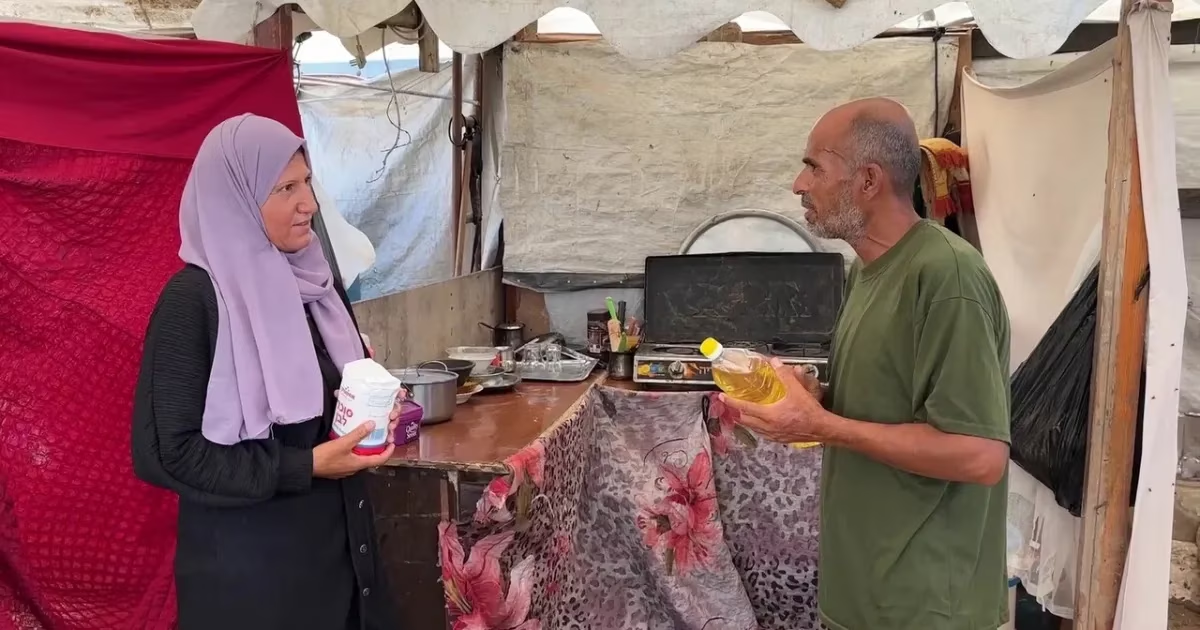
Gaza Returns to the Barter Era: Oil and Flour Replace Missing Cash Under the Weight of the Siege

The Gaza Strip is witnessing a forced transformation in the nature of daily commercial transactions, as residents have returned to the primitive barter system due to a severe shortage of cash liquidity and widespread damage to banking infrastructure. This crisis comes amidst strict restrictions imposed by the occupation, preventing the flow of banknotes and small denominations into the markets, leading to an unprecedented economic recession and a sharp decline in families' purchasing power.

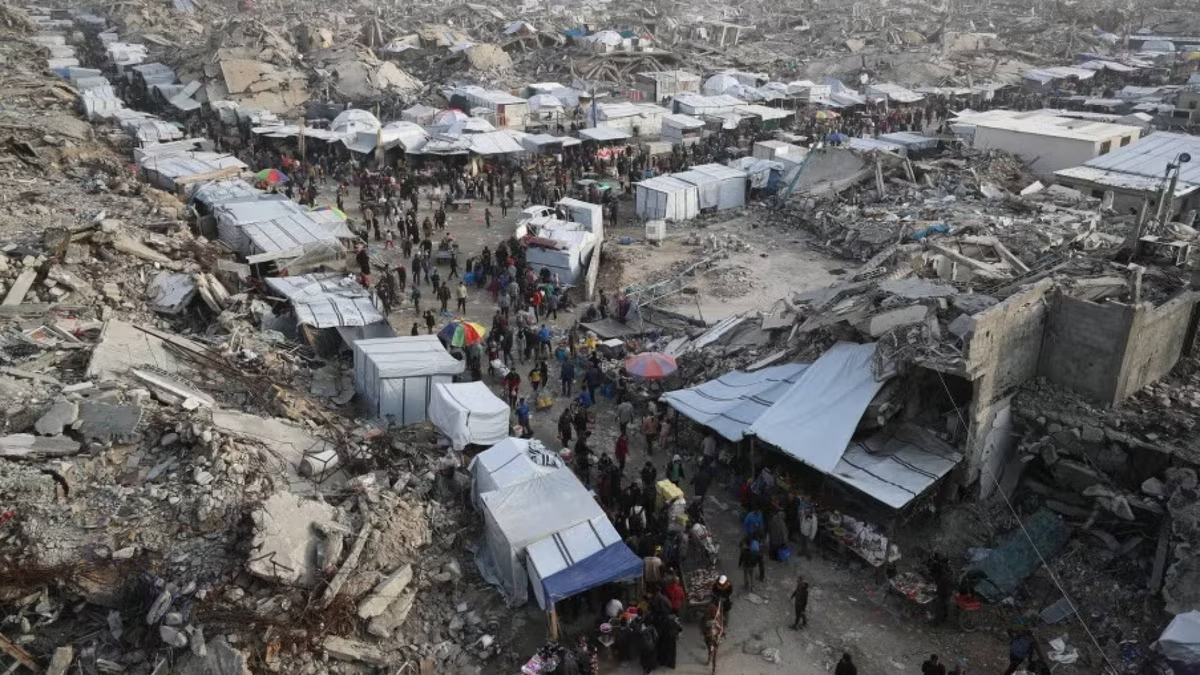
In the overcrowded displacement camps, the exchange of in-kind goods has become the only way to feed children and secure basic necessities such as oil, sugar, and flour. Field sources reported that residents are forced to knock on their neighbors' doors to offer surplus relief aid in exchange for other food supplies they lack, in a self-initiated attempt to cope with the absence of job opportunities and the lack of paper currency.

Testimonies from displaced persons describe a bitter reality, with one citizen stating that markets are completely devoid of cash, making the possession of any surplus commodity the only way to manage living affairs. He explained that the spread of unemployment and the complete cessation of salary payments have contributed to deepening reliance on this traditional system, which sets the sector back decades.

Suffering is not limited to the absence of cash, but also extends to a severe scarcity of basic goods, posing complex challenges for hundreds of thousands of families to secure daily sustenance. Displaced Umm Saeed recounts that she is forced to offer portions of food aid to neighbors in exchange for rice and lentils, noting that bartering has even included clothes and personal necessities.

Amidst the disruption of bank branches and ATM networks, families have faced extreme difficulties in relying on digital solutions or alternative electronic wallets. Displaced persons complained about the ineffectiveness of these applications on the ground due to the erosion of their purchasing power as a result of high fees and complex operational restrictions imposed by shops that accept this type of payment.

One displaced person, who supports a family of eight, explained that he is forced to barter cooking oil for notebooks and pens to secure his daughter's needs for high school. He confirmed that electronic applications have become useless due to the high commissions deducted from the balance, in addition to obliging buyers to a minimum purchase that prevents them from acquiring simple necessities for children.

The current deterioration in cash liquidity is linked to a series of direct targeting of Palestinian bank headquarters in the Gaza Strip throughout the aggression. Official reports issued by the Monetary Authority indicate that more than 90% of bank branches and ATMs are out of service due to total destruction or permanent power and internet outages.

Financial institutions warned that the destruction of this vital infrastructure has almost completely disrupted the operational capacity of the local banking system. This situation has cut off financial supply lines and financially isolated the Gaza Strip from the West Bank and the outside world, exacerbating the severity of the economic and social crisis experienced by displaced persons in tents.

In addition to the absence of banknotes, a new dilemma emerged in the form of the growth of an illegal parallel market for exchanging money and liquidating balances via mobile phone applications. Some money changers exploited the desperate need of residents for cash to impose exorbitant withdrawal commissions ranging from 30% to 50%, further draining the limited financial resources of citizens.

For its part, the Palestinian Monetary Authority issued official warnings, threatening unlicensed entities with strict legal action to combat these practices. The Authority affirmed that these monopolistic behaviors exacerbate living difficulties and contribute to deepening the financial siege imposed on the residents of the Strip, calling for the necessity of finding international solutions for liquidity flow.

I have not dealt with cash for about two years due to unemployment and lack of liquidity, and bartering is our only way to avoid the specter of famine.

ARAB AND WORLD

Sat 04 Jul 2026 6:35 pm - Jerusalem Time

Continuous Israeli Violations in Southern Lebanon and Widespread Destruction Hampering Life in Nabatieh

The pace of Israeli violations of the ceasefire agreement in southern Lebanon has escalated, with warplanes launching a raid targeting the town of Mansouri in the Tyre district. This attack resulted in varying injuries to a citizen, who was subsequently transferred to hospitals in the city of Tyre for necessary treatment amidst a state of field tension.

Local sources reported that a drone belonging to the occupation army dropped a sound bomb near a civilian vehicle in the city of Nabatieh, causing injuries among those present at the scene due to the explosion. This tactic is part of an intimidation policy adopted by the occupation since the cessation of large-scale military operations to push residents away from their areas.

Violations were not limited to air raids but extended to include intense fire sweeping operations using heavy machine guns in the towns of Hadatha, Al-Tiri, and Konin. Field sources stated that sounds of massive explosions were heard in the early morning hours inside the town of Konin, indicating continued Israeli ground military activity at those points.

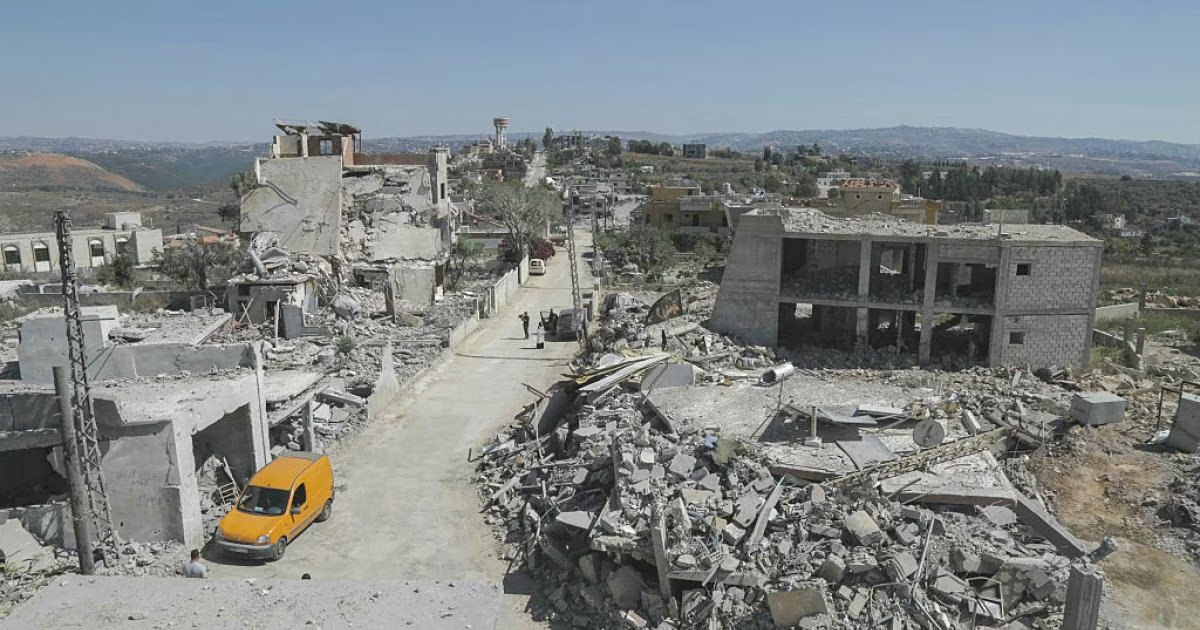
In the city of Nabatieh, which is the economic and cultural nerve center of southern Lebanon, the extent of the massive destruction that befell its historical market and vital facilities has been revealed. This market, which has existed for decades and housed hundreds of shops, is now rubble, reflecting the brutality of the recent Israeli war that directly targeted the city's infrastructure.

Currently, the city is witnessing a timid and limited return of its residents who were displaced during the confrontations, under extremely complex living conditions. Despite the announcement of a ceasefire, the continuous overflight of drones and intermittent raids instill fear in the returning residents and limit the movement to restore normal life in residential neighborhoods.

On the services front, Lebanese government agencies are making diligent efforts to rehabilitate damaged essential facilities to ensure the continued presence of residents. Technical teams were able to restore water pumping to Nabatieh neighborhoods two days ago, in a first step towards alleviating the suffering of residents who endured inside the city despite the shelling.

As for the energy sector, it witnessed a slight improvement with the return of electricity through the official state grid yesterday, albeit for very limited supply hours. In contrast, private generator networks, on which citizens primarily rely, remain out of service, increasing the difficulty of operating the remaining establishments.

Commercial activity in central Nabatieh is suffering from a near-total paralysis, as most shops and economic institutions remain closed due to destruction or lack of resources. Residents are struggling to secure their basic living needs with great difficulty, amidst the rubble of buildings that once formed a vibrant commercial center.

Field reports indicate that the occupation seeks, through these continuous violations, to create a de facto buffer zone by preventing residential stability. Sweeping operations and firing towards border residential neighborhoods occur daily, representing a clear violation of international understandings that sponsored the cessation of hostilities.

In light of this bitter reality, the reliance remains on the ability of Lebanese institutions to accelerate reconstruction efforts and provide security for returning residents. Eyes are turned towards the international community to pressure the occupation authorities to stop their violations and ensure the implementation of ceasefire provisions to protect civilians in southern villages and cities.

The occupation resorts to using sound bombs with the aim of displacing residents and preventing them from returning to their homes in border areas.

PALESTINE

Sat 04 Jul 2026 6:35 pm - Jerusalem Time

7 Martyrs in Gaza within 48 Hours and Continued Demolition of Buildings East of the Strip

Medical sources in the Gaza Strip announced the martyrdom of 7 Palestinians and the retrieval of the bodies of 9 others during the past forty-eight hours, due to ongoing Israeli aggressions. This new toll raises the total number of victims of the genocide war since October 2023 to more than 73,000 martyrs, amid continued violations of the announced ceasefire agreement.

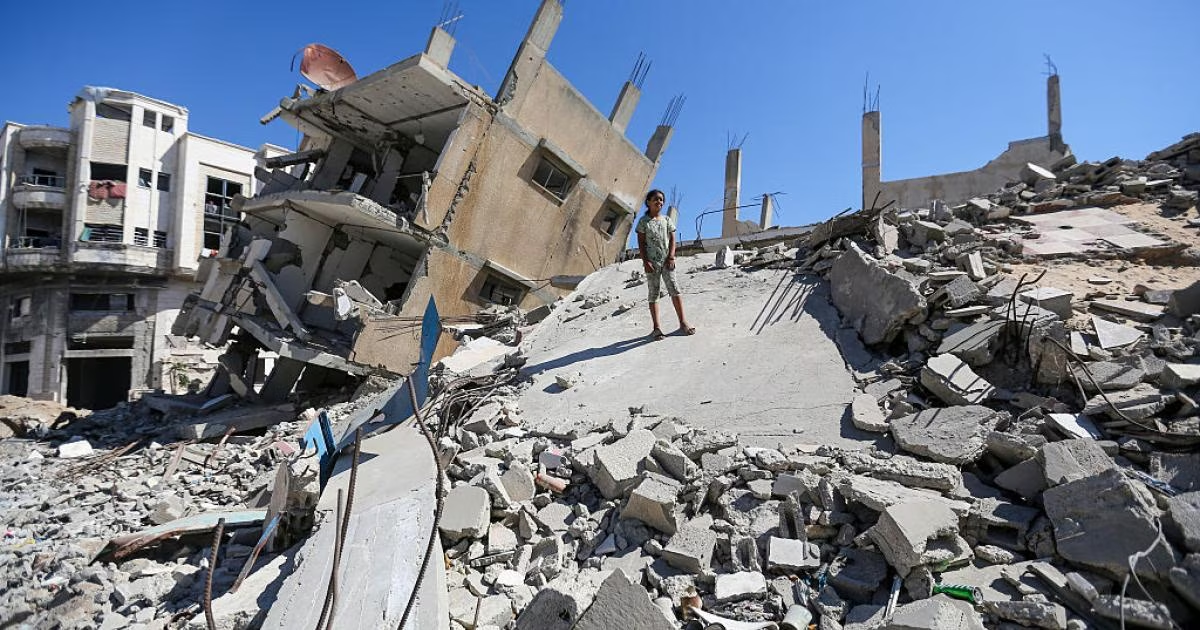
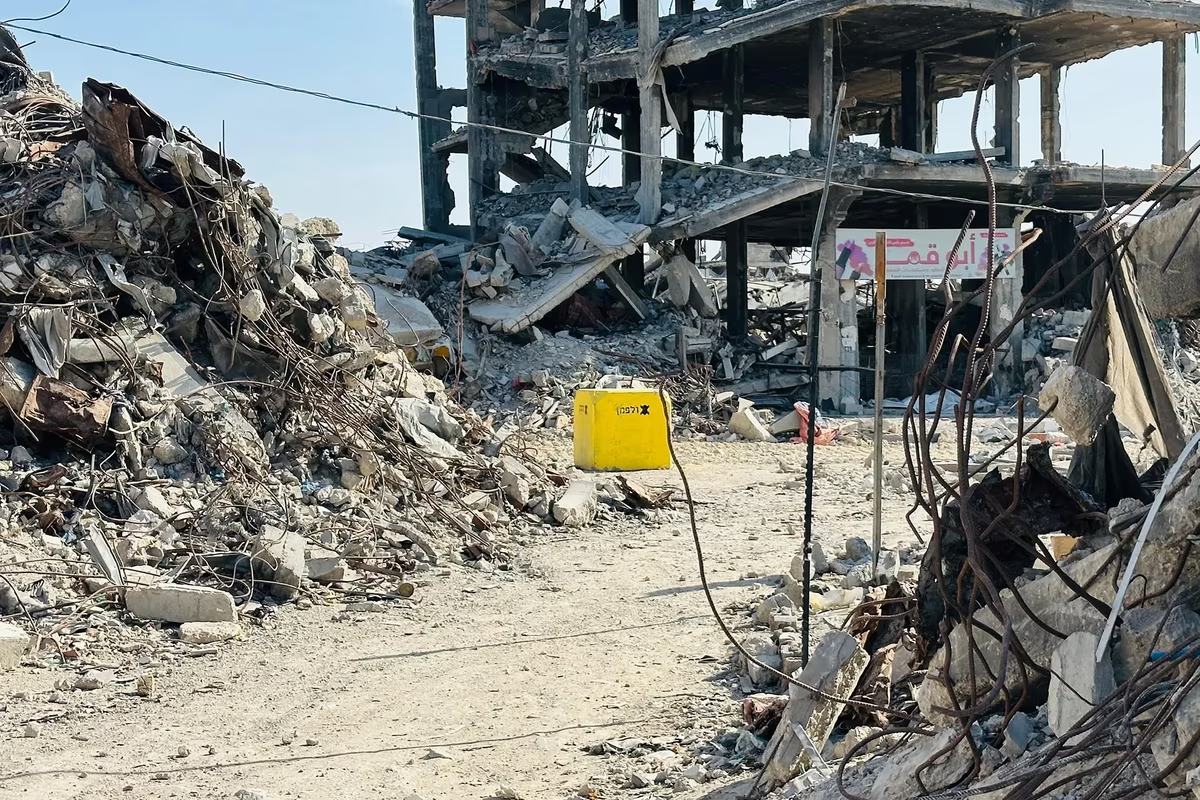
On the ground, sources reported that the occupation army has not stopped carrying out demolition and bombing operations of residential buildings in the eastern areas of Gaza City and the central part of the Strip. The systematic destruction operations also included the southeastern neighborhoods in the cities of Khan Yunis and Rafah, where massive explosions were heard shaking the border areas since late night hours.

The demolition operations coincide with intense flights of reconnaissance drones at very low altitudes over residential neighborhoods and displacement camps. Local sources confirmed that the sound of these aircraft has become a harbinger of concentrated targeting operations carried out daily by the occupation, keeping residents in a constant state of anticipation and security anxiety.

The residents of the Strip face a complex living and humanitarian reality amid the expansion of Israeli military control, which has covered about 70% of Gaza's area. The annexation of large parts of the central Strip to what is known as the 'Yellow Line' has deprived thousands of families from returning to their residential areas, which have turned into rubble, amid a complete absence of basic services.

On the humanitarian front, Israeli control imposes strict restrictions on the movement of individuals and goods, which has hindered the access of essential relief aid to the besieged population. The closure of crossings and military control have also prevented hundreds of wounded and sick people from traveling abroad for treatment, exacerbating the health catastrophe suffered by the Strip.

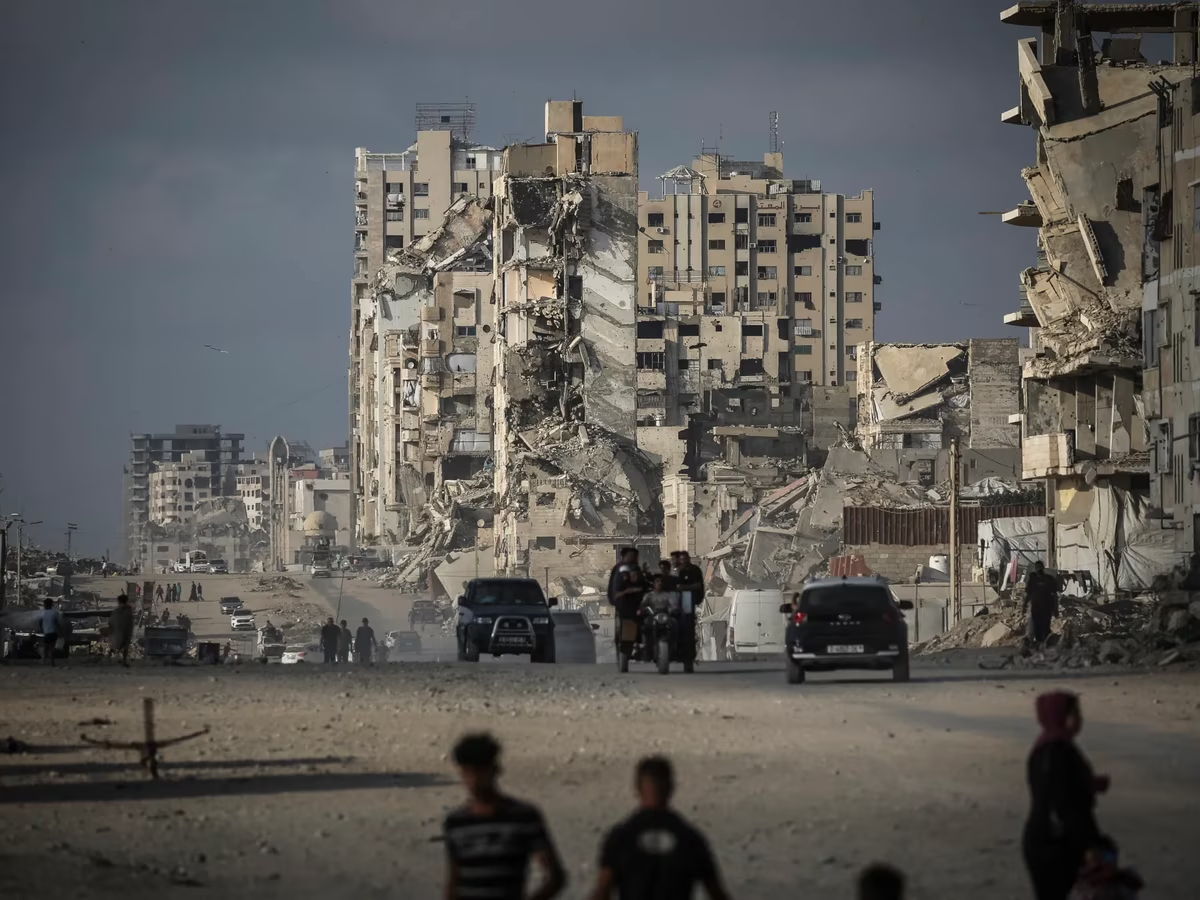
It is worth noting that the ongoing genocide war since October 7 has left widespread destruction affecting about 90% of the civilian infrastructure in the Gaza Strip. With continued bombing and demolition, international fears are growing about the impossibility of living in areas controlled by the occupation, in the absence of any security guarantees for Palestinian civilians.

The sounds of explosions are still continuously heard, coinciding with continuous flights of Israeli drones at low altitudes.

PALESTINE

Sat 04 Jul 2026 6:35 pm - Jerusalem Time

Memory of Torment: Live Testimonies Documenting the Hell of Israeli Detention Centers from Khiam to Nafha

The experience of detention in Israeli occupation prisons remains a bleeding wound in the memory of those who lived it, as former detainees recount horrific testimonies of the torture and humiliation they endured. These testimonies come at a time when fears for the lives of current prisoners are increasing amidst Israeli legislation that grows harsher day by day.

Abu Ahmed Ghanawi, one of the survivors of the Khiam detention center, describes his entry into prison in the 1980s as a 'passage to hell'. Ghanawi recalls how he spent his first days shackled inside a car trunk, then in a cramped solitary cell where he was deprived of the most basic human necessities before the violent interrogation rounds began.

Ghawi revealed brutal methods that included hanging on the 'torture pole' and electric shocks to sensitive parts of the body, which led to his permanent infertility. He also recalled harsh moments when he heard the groans of detainees who died under torture next to him, while the jailers used threats against his family to break his will.

In another testimony, Qassem Ramadan (Abu Ali) reviews his journey of torment that moved between Ansar, Majdal, Ashkelon, and Nafha prisons after the invasion of Lebanon in 1982. Ramadan describes the prisons as bleak places beyond description, where isolation and daily beatings were the constant rule in dealing with detainees.

Ramadan recounts how he would lose his sense of time inside the cells, relying on the chirping of birds to realize the dawn. He points out that the food provided was often rotten, while detainees used loaves of bread as insulation against the bitter cold that ravaged their exhausted bodies.

As for the released female prisoner Kifah Afifi, she tells the story of her arrest at the age of seventeen while on her way to carry out a commando operation. Afifi describes the moment she entered occupied Palestine shackled, and how she drew strength from the scent of orange blossoms despite blatant threats of rape and physical assault by interrogators.

Afifi spoke about the atrocities of the Khiam detention center, where she was placed inside iron cages and doused with gasoline in an attempt to terrorize her. She recalled how the agent Amer Fakhoury practiced his sadism by extinguishing cigarettes on the wounds of detainees, in a desperate attempt to extract confessions or break their legendary steadfastness behind bars.

Despite their confinement, female detainees devised means of secret communication, with Afifi referring to her relationship with the prisoner Suha Bechara and their exchange of messages via 'birds'. These smuggled messages were a way to boost morale and follow news from outside, despite strict censorship and the penalties imposed when discovered.

Testimonies also touched upon catastrophic health conditions, where skin diseases such as eczema and lice spread among detainees due to lack of hygiene. Detainees were forced to collect small sums of money among themselves to buy essential medicines in the face of deliberate medical neglect by prison administrations.

Kifah Afifi asserts that her will was not broken despite the six years of torment she spent in Khiam, emphasizing that steadfastness was the only option to confront the torturer. This steadfastness eventually resulted in her release in 1994 as part of an exchange deal, returning to her family bearing indelible scars.

These narratives are not just fleeting memories, but a historical documentation of a dark era of Israeli practices against Palestinians and Lebanese. The precise details reveal a clear methodology aimed at destroying human dignity and disfiguring bodies and souls away from the eyes of international oversight.

Ghawi, Ramadan, and Afifi's testimonies intersect at the fact that the Israeli jailer used all available means, from electric shocks to waterboarding, to extract information. However, all three agree that solidarity among detainees was the fundamental pillar that enabled them to survive.

Today, with the occupation destroying Abu Ahmed Ghanawi's home in southern Lebanon once again, the tape of memories returns to link the past of prisons with the present of aggression. The suffering that began in the cells of Khiam continues in different forms, making the documentation of these testimonies a moral and national necessity.

In conclusion, these testimonies remain conclusive evidence of the inhumanity in Israeli interrogation basements, and a cry to the international community to pay attention to the suffering of thousands of prisoners. The wound of the detention centers, which has not yet healed, remains a testament to the immense sacrifices made by an entire generation for freedom and dignity.

The cell does not easily leave the detainee; the sounds, the smell of dampness, and the threats remain an open wound that seeps into the body and sleep.

PALESTINE

Sat 04 Jul 2026 6:35 pm - Jerusalem Time

Gaza Health: Death toll exceeds 73,000 since the start of the aggression

The Ministry of Health in the Gaza Strip, in an urgent statistical statement, revealed the continuous increase in the number of victims of the ongoing Israeli aggression for more than a year. Medical sources clarified that the cumulative toll of officially registered martyrs in the ministry's records has jumped to record levels, reflecting the scale of the humanitarian catastrophe that has befallen the Strip. These figures come amid extremely complex health conditions experienced by hospitals that are still operating with minimal capabilities.

According to the latest statistical report, the total number of martyrs since October 7, 2023, has reached approximately 73,090 martyrs, whose data has been documented by the competent authorities. The ministry also indicated that the number of injured has reached 173,553 people, many of whom suffer from severe injuries and amputations that require advanced surgical intervention not currently sufficiently available within the besieged Strip.

Regarding field developments over the past two days, medical sources reported the arrival of 16 martyrs at various hospitals in the Strip during the last forty-eight hours. These deaths coincided with the registration of 16 new injuries and cases of varying severity, indicating the continued flow of victims to health centers despite the decrease in the intensity of direct military operations in some areas.

The statement detailed the period following the announcement of the ceasefire on October 11, where the ministry recorded shocking figures reflecting the repercussions of previous injuries and field violations. The total number of martyrs who have fallen since that date reached 1,066 martyrs, which confirms that the blood toll is still open despite the relative calm that was hoped for from the agreement.

Regarding injuries during the same period, statistics showed that 3,445 injured people have been registered since October 11, with the causes of injuries varying between direct targeting or health complications resulting from a lack of medicine. Medical teams face enormous challenges in dealing with these cases amid the destruction of health infrastructure and a large number of hospitals being completely or partially out of service.

In a related context, rescue and civil defense teams continue their strenuous efforts to search for the missing under the rubble of homes and buildings destroyed by air raids. The Ministry of Health confirmed that the total number of bodies recovered from under the rubble since the ceasefire came into effect reached 797, who were transferred to hospitals to complete burial procedures and official documentation within national records.

Sources stressed that these figures represent only the cases that medical teams were able to reach and document inside hospitals, while thousands of people are still missing. Officials in Gaza suggest that the actual number of martyrs may be much higher than announced, due to the presence of bodies in inaccessible areas or under the rubble of residential neighborhoods that have been completely razed to the ground.

The Ministry of Health concluded its statement by emphasizing the need for urgent international intervention to save the dilapidated health system and provide essential medical supplies for thousands of injured. The ministry warned that the continued siege and prevention of fuel and medical equipment entry will inevitably lead to an additional increase in the number of deaths among the injured who face the risk of death daily due to the lack of necessary healthcare.

The cumulative death toll since October 7, 2023, has reached 73,090 martyrs in our official records.

PALESTINE

Sat 04 Jul 2026 6:35 pm - Jerusalem Time

16 Martyrs in Gaza in Two Days, Israeli Demolition Operations Continue in Khan Yunis

The Ministry of Health in the Gaza Strip announced today, Saturday, that hospitals received 16 martyrs and 16 injured individuals over the past forty-eight hours, amidst escalating Israeli violations of the ceasefire agreement in effect since October 2025. Medical sources clarified that these victims fell as a result of direct shelling or succumbed to previous injuries, in addition to the retrieval of bodies from under the rubble of destroyed homes.

The Ministry detailed in its statement that among the seven martyrs who recently died, six were martyred due to shelling and direct gunfire, while the seventh succumbed to an old injury. Rescue teams also successfully recovered nine bodies of martyrs who were missing under the rubble in areas previously subjected to shelling, raising the official death toll.

On the ground, occupation forces escalated systematic destruction operations in the southern Strip, where engineering units carried out extensive demolition and blasting operations targeting entire residential blocks in the eastern and northeastern areas of Khan Yunis city. Local sources confirmed that the explosions were concentrated in the town of Bani Suhaila, areas under the control and incursion of occupation vehicles that continue to destroy infrastructure there.

Demolition operations in Khan Yunis coincided with intense low-altitude flights by Israeli warplanes, causing panic among displaced people in the western areas of the city. In the city of Rafah, in the far south, Israeli artillery targeted northwestern areas with shells, while occupation forces launched flares into the sky over the western parts of the city amidst suspicious military movements.

In Gaza City, the Al-Tuffah neighborhood in the east witnessed a field escalation, characterized by Israeli tanks firing their heavy machine guns randomly and intensely towards citizens' homes. The gunfire was accompanied by artillery shelling targeting the outskirts of the neighborhood, reflecting the occupation's insistence on breaching the fragile truce and targeting civilians in various governorates of the Strip with impunity.

With this new toll, the total number of victims of the genocide war waged by the occupation since October 7, 2023, has risen to 73,090 martyrs and 173,553 injured. Official data indicates that the occupation's violations of the last ceasefire agreement alone have resulted in the martyrdom of 1,066 individuals and the injury of thousands of others since the agreement came into effect months ago.

This escalation comes at a time when Gaza continues to suffer from massive destruction affecting about 90% of its civilian infrastructure due to two years of continuous shelling. UN reports confirm that the scale of the humanitarian catastrophe requires immense international efforts, as the cost of rebuilding what the occupation has destroyed is estimated at more than $70 billion, amidst the ongoing siege and daily military violations.

The toll of victims resulting from the occupation's violations of the ceasefire agreement alone has reached 1,066 martyrs and 3,445 injured since last October.

PALESTINE

Sat 04 Jul 2026 6:35 pm - Jerusalem Time

Palestinian family survives deliberate arson attempt by settlers east of Ramallah

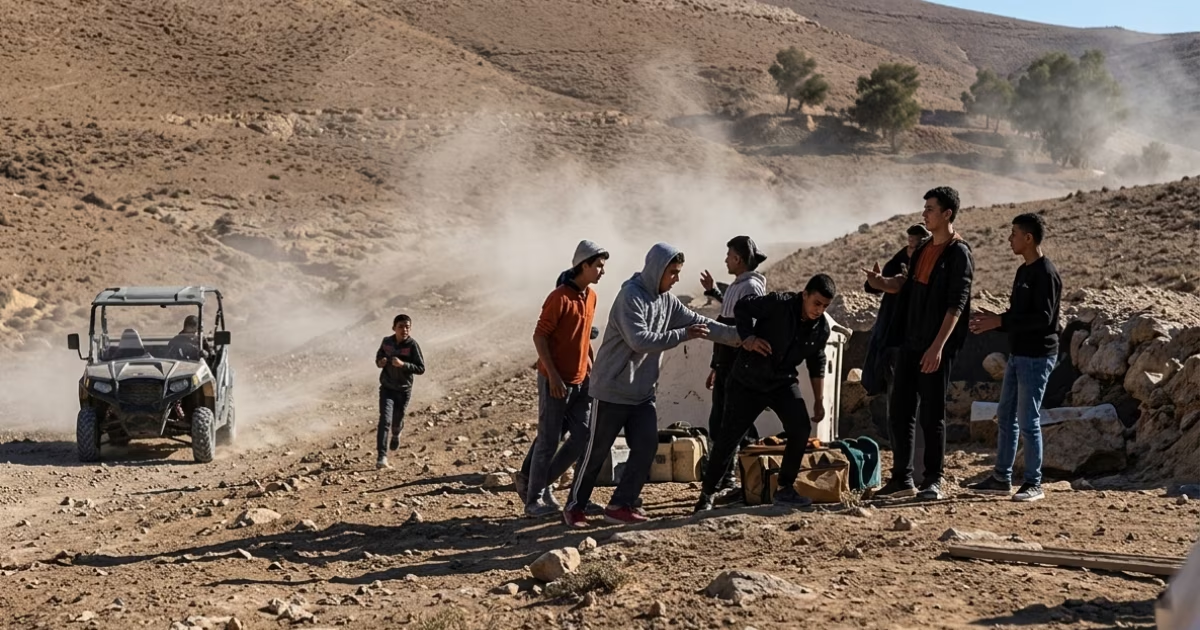
The family of citizen Muhammad Yousef Kaabneh was subjected to an attempted mass murder at dawn today, Saturday, after a group of settlers set fire to their residential structure in the village of Taybeh, east of Ramallah city. Local sources reported that the attackers infiltrated the vicinity of the house and cut the protective fence before throwing highly flammable materials at the dwelling where the family lives with their four children.

The sources stated that the family managed to escape from the tin and wood structure at the last minute, as the swift response of the residents and night watch committees prevented a certain massacre. Residents succeeded in controlling and extinguishing the fire before it consumed the entire contents of the house, amidst a state of panic that prevailed among the children who miraculously escaped the flames.

This crime comes in the context of a series of systematic attacks carried out by settlers against Palestinian communities east of Ramallah, with the aim of terrorizing residents and forcing them into forced displacement from their lands. These attacks are similar to the displacement policies implemented by settlers in various areas of the occupied West Bank under the direct protection of the occupation army forces.

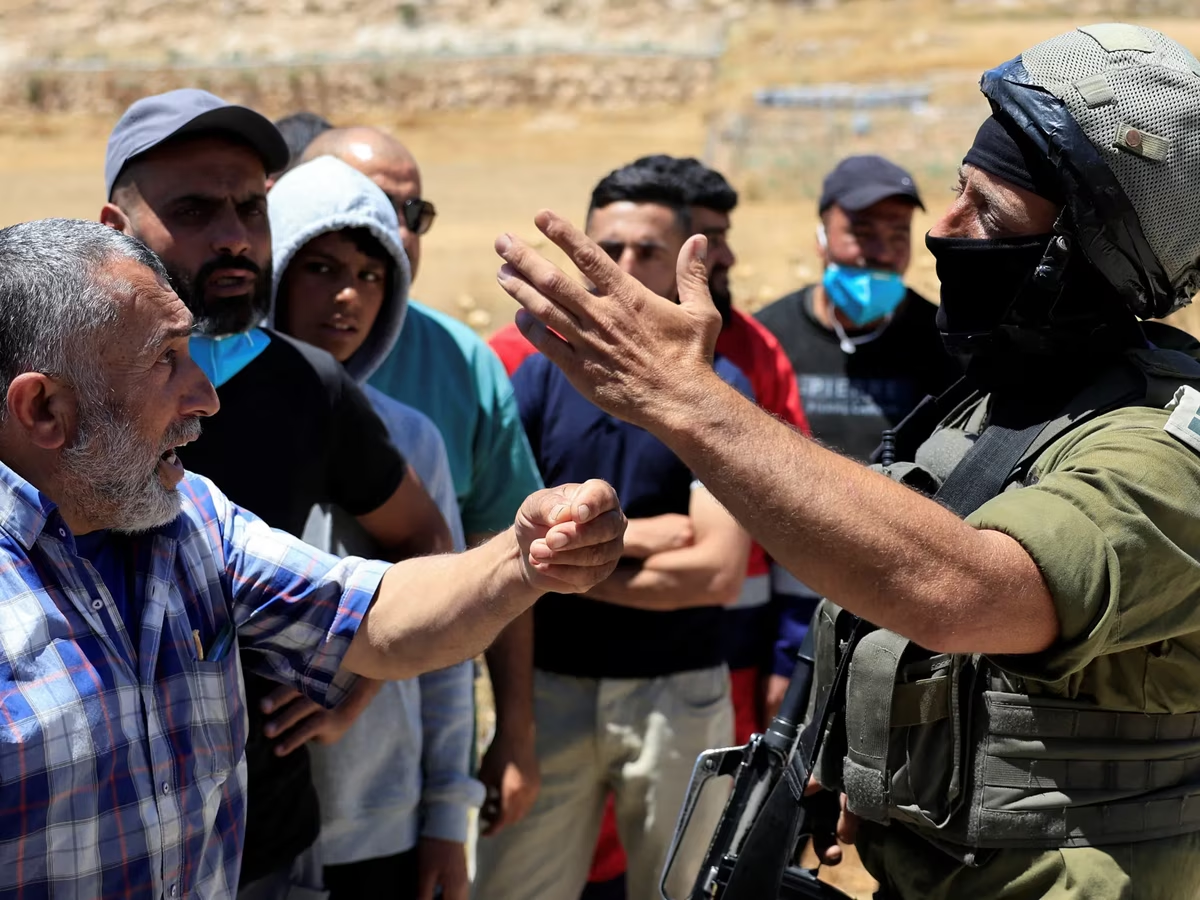
In the southern West Bank, settlers attacked the homes of citizens in the Khillet al-Homs area of Yatta town, resulting in injuries to a number of Palestinians, including bruises and suffocation cases due to pepper spray being sprayed on their faces. Instead of pursuing the attackers, occupation soldiers arrested one of the injured Palestinians to secure the safe withdrawal of the settlers from the targeted area.

The attacks were not limited to Ramallah and Hebron but extended to include organized attacks on the Yarza area in the northern Jordan Valley and Idhna town west of Hebron, where a number of citizens sustained various injuries. These simultaneous attacks reflect the widening scope of settler violence, which has been targeting Palestinian villages and towns daily with clear field coordination.

For its part, the National Office for the Defense of Land and Resistance to Settlement revealed in its weekly report a dangerous escalation in official settlement policies. The report clarified that the occupation army uses military orders as a primary tool to expand existing settlements and legitimize new pastoral outposts at the expense of the private lands of Palestinian citizens.

The report indicated that more than 113 military orders have been issued since October 7, 2023, a record number equivalent to the volume of orders issued over the past twenty years combined. These decisions aim to impose a new geographical reality that facilitates the annexation of vast areas of the West Bank and undermines any possibility of Palestinian geographical contiguity.

The family miraculously survived as the children were evacuated immediately upon noticing the fire in the residential structure, with the night watch preventing a humanitarian catastrophe.

PALESTINE

Sat 04 Jul 2026 6:34 pm - Jerusalem Time

Occupation Army Admits to Authenticity of Documentation of Brutal Torture of Palestinian Prisoner in Gaza

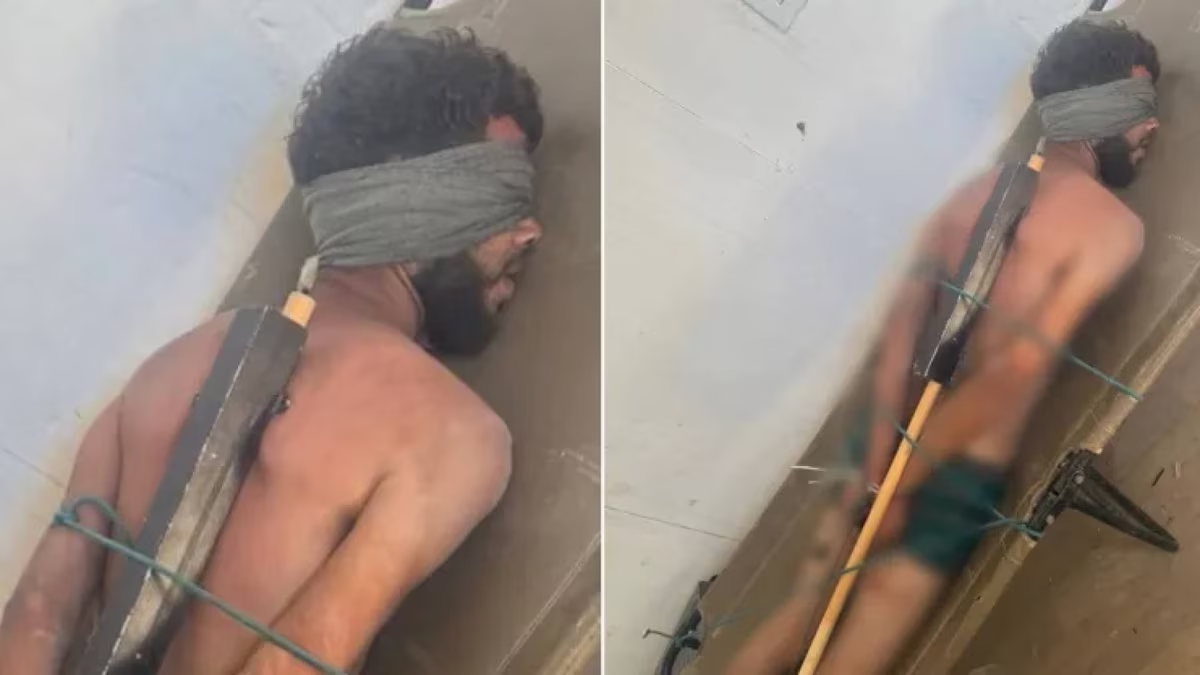
The Israeli occupation army has officially admitted the authenticity of circulating images documenting the brutal torture of a Palestinian prisoner in the Gaza Strip by its forces. The leaked footage showed the detainee lying on the ground in a humiliating position, blindfolded and with hands tied with wires, while an iron rod was placed over his back in a scene that reflects the extent of physical and psychological abuses suffered by prisoners inside the occupation's detention centers.

Official media sources affiliated with the occupation army quoted a military spokesman confirming that these scenes are real and indeed occurred during military operations within the Strip. The spokesman claimed that the military command has opened an investigation to ascertain the circumstances of the incident and identify those involved, in an attempt to absorb the escalating human rights and international anger resulting from the leakage of these documents that condemn the behavior of field soldiers.

The image was leaked to the public after an Israeli soldier named 'Joseph Benamo' brazenly posted it on his personal Instagram account, accompanied by the phrase 'Good morning' in Hebrew. Although the soldier later deleted the image and closed his account after its widespread dissemination, the incident sparked a wide wave of condemnation and was considered conclusive evidence of war crimes committed against civilians and detainees.

For its part, the human rights organization 'Breaking the Silence' commented on the incident, affirming that this abuse represents the actual policy of the occupation on the ground and is not merely isolated individual actions. The organization clarified that the Israeli army follows a policy of covering up criminals, as it had previously reinstated soldiers accused of torture into military service despite medical reports proving they caused fractures and punctures in the lungs of detainees due to severe beatings.

Human rights data coming from detention centers indicates a catastrophic situation, with reports confirming the martyrdom of more than one hundred Palestinians since October 2023 after being arrested alive, only to return later in body bags. These figures confirm that what is leaked in images and videos represents only a small part of the bitter reality experienced by thousands of Palestinian prisoners in secret and public prisons and detention camps.

These practices resulting from abduction and abuse represent the actual policy of the occupation, and are merely the tip of the iceberg.

PALESTINE

Sat 04 Jul 2026 6:34 pm - Jerusalem Time

Israeli estimates suggest a return to fighting in Gaza within two months under the pretext of 'resistance weapons'

Hebrew media sources revealed Israeli security assessments indicating the possibility of a resumption of military operations in the Gaza Strip within two months, specifically before the legislative elections scheduled for next October. These estimates cite the possibility of Hamas being declared 'in violation' of the ceasefire agreement due to its adherence to its weapons, at a time when occupation forces continue their ongoing field violations.

Reports stated that the occupation authorities expect an announcement from the 'Peace Council,' headed by US President Donald Trump, stating that Hamas has not adhered to the signed agreements. This council oversees reconstruction efforts, while a national committee manages daily life affairs in the Strip during the current transitional phase, which is witnessing escalating tension.

Should this announcement be made, the Israeli army plans to operate militarily in areas not currently under its direct control, threatening a return to full-scale fighting. Political sources reported that the Director-General of the Peace Council, Nikolai Mladenov, had postponed declaring Hamas a party in violation of the agreement in response to pressure from international mediators to grant an additional opportunity.

The sources indicate that Mladenov granted a deadline that ends after three months, and if there is no fundamental change in the movement's stance on its weapons, the declaration will be officially activated. Israel considers the disarmament of the resistance a fundamental condition for any long-term arrangements, setting the end of the movement's rule and its disarmament as strategic goals that have not been fully achieved.

On another front, the Israeli military establishment has taken new precautionary measures by deploying an additional military division along the border with Jordan. This step comes in anticipation of a repeat of scenarios similar to the October 7 attack, and after nearly a thousand days since the outbreak of the major confrontation, reflecting the increasing security concerns of the occupation.

Politically, these developments coincide with the approaching Israeli legislative elections, which represent a real test for Benjamin Netanyahu's continued stay in power. His right-wing coalition faces severe internal crises and deep political divisions, as his camp seeks to maintain a majority of 61 seats in the Knesset amidst widespread criticism of his management of the war file.

For its part, leading sources in the Hamas movement confirmed that the resistance leadership succeeded in extracting recognition from mediators to exclude any formulations suggesting surrender. The movement clarified that the official response submitted in Cairo included an agreement to replace the term 'disarmament' with phrases related to 'confining, collecting, and storing weapons,' which is considered a thwarting of the fundamental Israeli demand.

In the context of international arrangements, reports revealed discussions held by the Peace Council regarding the timelines for what is known as the 'Day After' plan. The plan includes a US approach to proceed with gradual reconstruction in areas under Israeli control, even without a final agreement on Palestinian resistance weapons.

Estimates indicate that infrastructure preparation work in the targeted areas will take between three to six months, in preparation for the transfer of displaced Palestinians to them. These operations are concentrated in the so-called 'Yellow Zone,' which are the areas where the occupation army is deployed and constitute about 70% of the total area of the Gaza Strip, according to Netanyahu's statements.

Regarding the internal security file, proposals have been put forward for a new Palestinian police force to take over security tasks in the reconstructed areas, to be trained in Egypt. This force is expected to work alongside international stabilization forces that will be deployed later to ensure the implementation of the transitional phase provisions and prevent a return to military escalation.

On the ground, the occupation's violations of the ceasefire agreement signed in October 2025 continue, with the Ministry of Health in Gaza recording the martyrdom of 1059 people since then. These figures reflect the fragility of the current calm amidst the ongoing systematic Israeli targeting of civilians and vital facilities in various areas of the Strip.

This tension comes two years after a genocidal war launched by Israel, which resulted in the martyrdom of more than 73,000 Palestinians and the injury of over 173,000 others. The destruction affected about 90% of the civilian infrastructure, making the Gaza Strip a disaster-stricken area requiring enormous international efforts to restore life to normal.

Despite the US administration's announcement of the start of the second phase of the peace plan in mid-January, obstacles still hinder actual implementation. The main disagreements revolve around the timing of a full Israeli withdrawal, comprehensive reconstruction mechanisms, in addition to the complexities associated with the Palestinian weapons file, which the resistance refuses to relinquish.

In conclusion, the situation in the Gaza Strip remains open to all possibilities, between international efforts for calm and repeated Israeli threats to return to war. The coming days remain crucial in determining the course of the conflict, especially with the intertwining of Israeli electoral calculations with the complex security and humanitarian files in the Strip.

Israel expects the Peace Council to declare Hamas in violation of the agreement because it still retains its weapons, which could pave the way for a return to fighting.

PALESTINE

Sat 04 Jul 2026 6:34 pm - Jerusalem Time

"Voice of Palestine"... 3 Decades of Building Awareness and Reinforcing the National Narrative

Dr. Ahmed Rafiq Awad: The founding team had to invent a journalistic language suitable for the people and the stage, but feelings of pride and belonging overcame all the difficulties of establishment.

Khaled Masmar: The radio's experience abroad and at home faced continuous targeting from the occupation, reflecting an understanding of the importance of Palestinian media in exposing its crimes.

Aayed Owaimer: The radio's media discourse is based on the rights of the Palestinian people and defending their national narrative, as well as exposing the occupation's crimes and policies.

Khaled Siam: The spirit of belonging was the driving force behind the radio's experience, and workers did not look at financial returns but at the importance of building the first radio institution on Palestinian land.

Mohammed Al-Baz: "Voice of Palestine" remained a unifying radio that did not express a specific faction but rather the various components of the Palestinian people, as an extension of the revolution radio's approach.

Wisal Abu Alia: The value of national media is not measured by technical development alone, but by its ability to protect the Palestinian narrative, defend the truth, and preserve memory.

Ramallah - Exclusive to "Al-Quds"-

The thirty-second anniversary of the launch of the official "Voice of Palestine" radio carries the testimonies of its founders and media professionals, who recall the journey of the birth of the first Palestinian national radio from the homeland, amidst difficult circumstances and limited resources, but with a great will that made it a platform for the Palestinian narrative and a guardian of national identity, and it continues its work defying all circumstances.

Founders and broadcasters, in separate interviews with "Al-Quds", agree that the radio was an extension of the "Voice of the Storm" experience, the voice of the Palestinian revolution, before it launched from Jericho on July 2, 1994, to accompany the building of the National Authority's institutions, and developed a media discourse that preserved national constants, despite political and technological transformations and the occupation's repeated targeting of its headquarters and staff.

They emphasize that the strength of "Voice of Palestine" was not in its material capabilities, but in the spirit of belonging that led its workers, and the continuation of its mission to defend the Palestinian narrative, keep pace with citizens' concerns, and develop its media tools, ensuring that the national word remains present in the face of attempts at falsification and silencing.

A mix of pride and belonging to the national project

Writer and political analyst, and one of the founding broadcasters, and the first to inaugurate the official "Voice of Palestine" radio with his voice, Dr. Ahmed Rafiq Awad, recounts the details of the early days of the launch of the official "Voice of Palestine" radio, recalling a stage he describes as a mix of pride and faith in the national project and voluntary work, where the founding team felt that they were participating in making a new history for Palestinian media, and laying the first brick for an institution that would later become one of the most prominent national voices, stressing that the founding team had to invent a journalistic language suitable for the people and the stage, but feelings of pride and belonging overcame all the difficulties of establishment.

Exceptional circumstances in the beginning

Awad confirms that the launch of the radio on July 2, 1994, in Jericho and what followed in the early days was characterized by exceptional circumstances, as the team worked long hours throughout the day, without salaries or incentives, or ready editorial policies or reference frameworks regulating the work.

Awad stresses that everything achieved at that time was the result of personal initiatives and a high sense of responsibility and belonging, so much so that the workers slept in the same cramped room where they edited the news, while they themselves participated in carrying and installing equipment, and preparing and isolating the studio, at a time when food reached them from the national security forces due to limited resources.

Presence in memory

Awad recalls the names of a number of founders who participated in that experience, including: Ibrahim Melhem, Asef Hamidi, Ahmed Zaki, Youssef Mahmoud, Naseer Faleh, and Jamal Ma'ari, explaining that the team was local at its beginning before the arrival of cadres who returned from exile, and that everyone shared the hardship of work and their feeling that they were establishing a new national stage that deserved sacrifice.

Awad points out that one of the biggest challenges in the early days was not only technical, but also in inventing a new journalistic language that suited the nature of the political stage, existing agreements, and the aspirations of the Palestinian people, in the absence of any ready instructions or editorial policies.

Awad confirms that discussions and differences within the team ultimately led to the formulation of a media discourse that gained popular and political acceptance.

Part of the political system and societal mind

Awad believes that "Voice of Palestine" was not just a media outlet, but became part of the Palestinian political system and societal mind, and therefore, like other Palestinian institutions, it was subjected to direct pressure and targeting, recalling the bombing of the radio's headquarters in Ramallah and Gaza, and the resulting costs borne by the institution and its workers.

An Arab media school

Despite the ongoing debate about the radio's performance after it became an official institution, especially in light of the Palestinian division, Awad confirms that the experience, after more than three decades, has turned into an Arab media school that has graduated generations of media professionals and established methods of editing and presentation, and has maintained its presence in an environment full of conflicts and challenges.

Awad stresses that the anniversary of the founding of Voice of Palestine will remain for him a moment of hope-making, and a memory that cannot be absent from the conscience of everyone who participated in the birth of this voice.

Establishing the radio is a national necessity

Broadcaster Khaled Masmar, one of the founders of the Revolution Radio "Voice of the Storm", recalls the early beginnings of Palestinian radio media, stressing that the idea of establishing a Palestinian radio was not just a media project, but a national necessity imposed by the conditions of the diaspora and the need for a platform to address Palestinians and the world, and to convey the voice of the Palestinian revolution at a pivotal stage in the history of the cause.

Masmar recounts that the launch of the radio came from abroad, at a time when Palestinians were scattered in exile, and fedayeen action needed a media arm to keep pace with its political and military presence.

An important turning point in the history of establishment

Masmar points out that the turning point came after the Battle of Karameh in 1968, when the relationship between the Fatah leadership and the late Egyptian President Gamal Abdel Nasser was strengthened, who, after meetings with the movement's leadership, agreed to allocate a frequency from Cairo's Middle East Radio to launch "Voice of the Storm" radio, the voice of the Palestinian revolution.

Masmar emphasizes that the project was not limited to providing a radio frequency, but required building a new media experience different from the prevailing radio discourse at the time, especially after the June 1967 defeat and its psychological and political effects on Palestinians and Arabs.

This is how it began

According to Masmar, the late media professional Fouad Yassin was therefore assigned to form a new team of Palestinian students studying in Cairo, and to choose voices capable of addressing the public in a different language.

Khaled Masmar was one of four broadcasters who formed the core, along with Abdul Shakour Al-Tawtangi, Al-Tayeb Abdul Rahim, and Yahya Al-Omari, while the team received intensive training in presentation, writing, and formulating the media message.

Masmar explains that the work was not limited to news bulletins, but also included the production of short national anthems prepared by Palestinian and Egyptian poets and composers, which contributed to raising morale, becoming part of the national memory, while the media discourse was based on what Fouad Yassin described as "the honest word expressing the brave bullet" fired by the Palestinian fedayeen.

Radio in the homeland

Regarding the radio's transfer to the homeland after the Oslo Accords, and the establishment of Voice of Palestine as a continuation of "Voice of the Storm" radio, Masmar explains that he did not participate in the establishment of "Voice of Palestine" radio, as he had moved to work in national and political guidance, but he contributed through a radio program dedicated to the national security forces and security agencies, while the task of establishment was undertaken by a number of internal cadres alongside media professionals who came from abroad.

Targeting the radio

Masmar points out that the radio's experience, both abroad and at home, faced continuous targeting from the Israeli occupation, from pursuing broadcasting sites in Lebanon to destroying radio headquarters and transmitters in Ramallah and Gaza, considering that this reflects the occupation's awareness of the importance of Palestinian media in exposing its crimes.

Masmar extends greetings to the workers of "Voice of Palestine" throughout its various stages, calling for the continuation of the national mission while taking into account the specificity of working within the institutions of the Palestinian Authority, and expressing his hope that this voice will continue to develop until the dream that the late President Yasser Arafat used to repeat is realized, that broadcasting will one day originate from Jerusalem.

Retaining symbolic status in consciousness and conscience

Head of the official "Voice of Palestine" radio sector, Aayed Owaimer, believes that the radio, 32 years after its launch in the homeland, still retains its symbolic status in Palestinian consciousness and conscience, as a media institution that has been linked to the journey of the Palestinian cause since the years of the revolution when it launched under the name "Voice of the Storm", and continued to play its national role after its launch in the homeland, despite the political and technological transformations witnessed by the world.

Its journey with the revolution

Owaimer reviews the radio's journey, explaining that it accompanied the leadership of the Palestinian revolution in the capitals it moved between, and since its establishment carried the message of defending Palestine, land, people, and cause, based on Palestinian national rights, foremost among them the right of the Palestinian people to exist and establish their independent state with Jerusalem as its capital, and to end the Israeli occupation.

Owaimer points out that this message was transferred to the homeland with the entry of the Palestinian National Authority, and the radio launched again from the homeland on July 2, 1994, considering that moment an embodiment of Palestinian political entity after long years of sacrifices.

Keeping pace with the times

Owaimer confirms that the radio, despite the great competition imposed by the digital revolution and the multiplicity of media outlets, still enjoys public trust, and has maintained its approach and national message alongside the components of official media, while developing its media tools to keep pace with the times.

Owaimer says: "The radio has harnessed technology and social media platforms, under the directives of the General Supervisor of Official Media, Minister Ahmed Assaf, to expand its presence across platforms such as Facebook, TikTok, and X, ensuring the continued delivery of the Palestinian voice to various parts of the world."

Continuing to convey suffering

Owaimer points out that the radio's message is not limited to conveying news, but extends to conveying the suffering of Palestinians, and attracting international public opinion to support the Palestinian cause, especially in light of the genocide war to which the Palestinian people are exposed.

Owaimer explains that the radio did not overlook internal issues, as it worked through specialized programs to play the role of mediator between citizens and officials, and contributed to addressing many daily issues, based on its belief that strengthening the steadfastness of citizens is a shared national responsibility.

Owaimer stresses that the media discourse of the radio and official media remained constant, based on Palestinian national rights, expressing the aspirations of Palestinians for freedom and independence, and exposing the crimes of the occupation and defending the Palestinian narrative in various forums.

Harnessing capabilities to convey occupation crimes

In his discussion of the coverage of the Israeli aggression and genocide war, Owaimer explains that the official Palestinian media, including the radio, harnessed its capabilities to convey the crimes of the occupation with sound and image, benefiting from digital platforms and in multiple languages, stressing that this presence, along with the efforts of other national media outlets, contributed to strengthening international popular solidarity with Palestinians, which was embodied in demonstrations witnessed in many capitals around the world.

Utilizing technology to serve its media mission

Regarding the main challenges, Owaimer considers that the decline witnessed by traditional media in the face of digital platforms represents the biggest challenge, but he confirms that "Voice of Palestine" has made significant progress in utilizing technology to serve its media mission. Owaimer stresses that the radio will remain faithful to its national mission, and to the martyrs of the Palestinian people and prisoners, and to the pioneers who founded Palestinian media, affirming its continuation as an important tool in defending Palestinian national rights, no matter the challenges.

The story of the first establishment

Broadcaster Khaled Siam, one of the founders of "Voice of Palestine" radio and its former Director-General, recalls the details of the early days of the radio's launch on July 2, 1994, describing the experience as the birth of a national institution preceded by long years of Palestinians waiting for a voice emanating from their land, after decades during which they followed "Voice of the Storm" radio, the voice of the Palestinian revolution, from abroad, sometimes secretly, at a time when listening to it could expose its owner to persecution and imprisonment.

Siam says: "The establishment of the radio came with the establishment of the Palestinian National Authority and the beginning of redeployment in Jericho after the Oslo Accords, to form an extension of the Palestinian media experience abroad, and of the historical 'Here Jerusalem' radio."

Siam confirms that the beginnings were not easy, as the radio launched from Jericho with very modest technical capabilities, but it relied on the interaction of journalists and media professionals at home, along with cadres who returned from abroad carrying radio experience accumulated during years of work in exile.

The spirit of belonging is the true driving force behind the radio's experience

Siam points out that the spirit of belonging was the true driving force behind the radio's experience, as workers did not look at working hours or financial returns, but at the importance of building the first national radio institution on Palestinian land.

He recalls that salaries were delayed for months, and what the workers received were merely limited financial advances insufficient for life's necessities, but this did not affect their drive to make the project a success, because the public was eager to hear a voice coming from the homeland and expressing its issues.

Siam recalls his personal experience, explaining that he returned to Palestine in mid-1994, and was among the founders who worked day and night to launch the radio, benefiting from their previous experiences.

The duo Ibrahim Melhem and Daniela Khalaf

Siam confirms that success was achieved thanks to teamwork, citing the program "Palestine Good Morning" presented by the duo: Ibrahim Melhem and Daniela Karim Khalaf, which achieved a wide presence in the Palestinian street, along with programs that contributed to solidifying the radio's position.

Ahmed Rafiq Awad, the first voice on air

Siam notes that the first voice to be broadcast on the radio's experimental airwaves on the night of June 30, 1994, was the voice of Dr. Ahmed Rafiq Awad.

Siam confirms that his media work and experience abroad later extended to the establishment of "Voice of Palestine – Program Two" radio in the Gaza Strip in 2000.

Systematic targeting

Siam dwells at length on the Israeli attacks on the radio, pointing to the destruction of the exchange center and transmitter station in Ramallah, and the bombing of the Program Two building in Gaza, which resumed broadcasting only 45 minutes after being under the rubble, then the bulldozing of the historical transmission station that broadcast via medium wave, leading to the destruction of the Broadcasting and Television Authority building and the transmission tower in Ramallah.

He confirms that these attacks not only targeted buildings, but also the radio's historical archive in an attempt to silence the Palestinian narrative.

Siam believes that the strength of "Voice of Palestine" in its early days lay in focusing on the quality of language and content and the boldness in addressing people's issues, rather than relying on material capabilities.

Siam points out that the development of technology at present has provided better tools, and contributed to a wider spread of the radio.

Presence in absence

Siam recalls those who passed away from the radio's staff, foremost among them: the head of the General Authority for Radio and Television, Radwan Abu Ayash, and radio staff: Youssef Al-Qazzaz, Aref Salim, Ibrahim Al-Desouki, Khaled Al-Dabbas, Ahmed Ariqat, Engineer Samir Al-Sharif, Salim Abu Amro, Kamal Al-Alawneh, and Saeed Ayad, in addition to the radio's martyrs, including: Engineer Jamil Nawarah, Issam Al-Talawi, Issam Al-Lulu, Tamim Ma'mar, and Ismail Al-Mabhouh, also recalling that the martyr Shireen Abu Akleh was one of the first radio staff, before joining Al Jazeera channel.

Extension of the "Voice of the Storm" experience

Broadcaster Mohammed Al-Baz, one of the founders of "Voice of Palestine" radio in the Gaza Strip, recalls the radio's journey as an extension of the "Voice of the Storm" experience, the voice of the Palestinian revolution that launched from exile, stressing that the birth of "Voice of Palestine" on July 2, 1994, in the homeland was not a new beginning as much as it was a culmination of a media journey that spanned decades, during which Palestinian radio carried the national narrative from one capital to another until it returned to the homeland.

Al-Baz points out that the first building blocks of this experience were laid by the late media professional Fouad Yassin, who formed the founding cell of "Voice of the Storm" radio, which included: Al-Tayeb Abdul Rahim, Yahya Al-Omari, Abdul Shakour Al-Tawtangi, and Khaled Masmar, before Yahya Rabah, Nabil Amro, Ahmed Abdul Rahman, Ziad Abdul Fattah, Barakat Zalloum, and Abdul Majeed Faraoun later joined, while he personally belongs to the second generation, after taking responsibility for "Voice of the Revolution" radio in Aden since 1978, before later holding positions as Director-General of Programs and Director-General of Training and Development in the Palestinian Broadcasting and Television Authority, and participating in the establishment of the Authority and "Voice of Palestine" in the Gaza Strip in 1994.

Al-Baz confirms that the launch of the radio from Jericho would not have been possible without the contribution of the German "Friedrich" institution, and the German expert who succeeded in transferring broadcasting equipment and the studio to Jericho across Israeli checkpoints, coinciding with the arrival of the late President Yasser Arafat to the homeland.

A deeply symbolic transformation

Al-Baz describes the moment when Dr. Ahmed Rafiq Awad's voice resonated saying: "Here is the Voice of Palestine," as a deeply symbolic transformation, explaining that the difference between the phrase "This is the Voice of Palestine," which was used by the revolution radios abroad, and "Here is the Voice of Palestine," reflects the transfer of the voice from exile to the homeland.

Al-Baz goes back to the early beginnings in Cairo in 1968, when "Voice of the Storm" radio launched from Sharifain Street through Middle East Radio, benefiting from the transfer of "Voice of the Arabs" to the Maspero building.

Al-Baz recalls the first programs, such as: "News and Commentary," "Words to Palestine... Homeland and People," "Our Land Palestine... The Oldest Land on Which Human History Shone," and "Talk of the Occupied Land," in addition to the revolutionary anthems written by Abu Al-Sadiq Al-Husseini and Saeed Al-Muzayen, and composed by the Egyptian musician Abdul Azim Mohammed, which he believes contributed to raising the morale of Palestinians and consolidating national identity.

Expanding content

Al-Baz says: "The radio's return to the homeland opened the way for expanding content, as 'Voice of Palestine' succeeded in just one and a half years in producing about 62 political, cultural, religious, sports, educational, health, and agricultural programs, in addition to programs dedicated to prisoners and martyrs, and also witnessed the launch of 'Voice of Palestine – Program Two' in Gaza on Land Day in 2000, which was inaugurated by the late Yemeni President Ali Abdullah Saleh and Arab and Palestinian figures."

Al-Baz stresses that "Voice of Palestine" remained a unifying national radio that did not express a specific faction, but rather the various components of the Palestinian people, which he considered an extension of the approach of the Palestinian revolution radio.

Al-Baz points out that the challenges did not stop, whether in the early days of establishment with limited cadres and resources, or during the current war that ended the existence of Gaza radio, and led to the martyrdom of a number of workers in the Broadcasting and Television Authority, among hundreds of Palestinian journalists who lost their lives.

Al-Baz confirms that Palestinian media, with all its components of television, radio, and written press, will remain part of the national liberation project, extending greetings to the martyrs of media and prisoners, and stressing that the word will continue to be written in blood for Palestine until the establishment of the independent Palestinian state with Al-Quds Al-Sharif as its capital.

An important national memory

Broadcaster at "Voice of Palestine" radio, Wisal Abu Alia, does not view the radio as a traditional media institution, but rather as a national memory that accompanied Palestinians in their most complex stations, and carried, through its airwaves, the Palestinian narrative from exile to the homeland, and from pain to hope, preserving national identity in the face of attempts at obliteration and distortion.

Abu Alia recalls the radio's journey as a voice linked to the conscience of Palestinians, stressing that it did not only play the role of news conveyor, but carried the story of an entire people, with all the pain of the Nakba, the bitterness of refuge and displacement, and the insistence of refugees on adhering to the right of return, in addition to conveying the image of the Palestinian striving for freedom and building the future.

The witnessing radio

Abu Alia explains that this role made the radio a witness to various national stages, accompanying Palestinians in moments of pain as well as in moments of achievement, and becoming part of their collective memory.

Abu Alia points out that the return of the Palestinian leadership to the homeland opened a new stage for the radio, in which it transcended its news role to become a partner in building national institutions and promoting public awareness, based on the conviction that building a state begins with building people, and that national media is responsible for consolidating the values of belonging and citizenship and preserving Palestinian identity.

The constant message

Despite 32 years since the radio's launch in the homeland, Abu Alia confirms that its message has remained constant, even if media tools and means have changed.

Abu Alia believes that the value of national media is not measured by technical development alone, but by its ability to protect the Palestinian narrative, defend the truth, and preserve national memory, ensuring that Palestine is conveyed to future generations as its people lived it, not as the occupation tries to portray it.

Challenge of preserving the message

In her discussion of challenges, Abu Alia considers that the most serious challenge facing the radio today is preserving its message amidst a fast-paced media world saturated with platforms and information, and in the face of attempts to falsify consciousness and distort the Palestinian narrative.

Abu Alia stresses the need to combine speed and credibility, professionalism and national commitment, in addition to developing media content, investing in young competencies, and benefiting from modern technologies without compromising the constants on which the radio was founded.

The deepest challenge: the occupation

Abu Alia confirms that the Israeli occupation remains the deepest challenge, after it targeted the word as it targeted people, pointing to the bombing of the radio building, and the martyrdom of a number of its media professionals in the Gaza Strip and the West Bank while carrying out their mission, as well as the persecution of correspondents and the closure of the radio office in occupied Jerusalem, in an attempt to silence the Palestinian narrative.

Abu Alia points out that "Voice of Palestine" has proven, over more than three decades, that the national message does not stop with bombing or targeting, and that the free word is capable of surviving as long as there are media professionals who believe that defending the truth is defending the homeland, and that the radio will remain a carrier of the Palestinian people's memory, and a defender of their right to freedom and independence.


PALESTINE

Sat 04 Jul 2026 10:38 am - Jerusalem Time

European Balconies Transform into Platforms of Solidarity with Gaza Strip

The features of solidarity with the Palestinian cause in Europe have moved from public squares and arenas to windows and house balconies, in a scene reflecting the depth of popular support for the Gaza Strip. This image has integrated with the ongoing protest activities against the continuous Israeli violations since October 7, 2023, where private homes have become an integral part of the struggle in Western capitals.

In major cities like Berlin, London, and Paris, supporters are keen to show their support by raising Palestinian flags of various sizes from their windows overlooking the marches. These individuals do not merely observe; they wave their hands in support of the demonstrators passing in the streets, creating a sense of cohesion between the field movement and domestic empathy that has broken the barrier of silence.
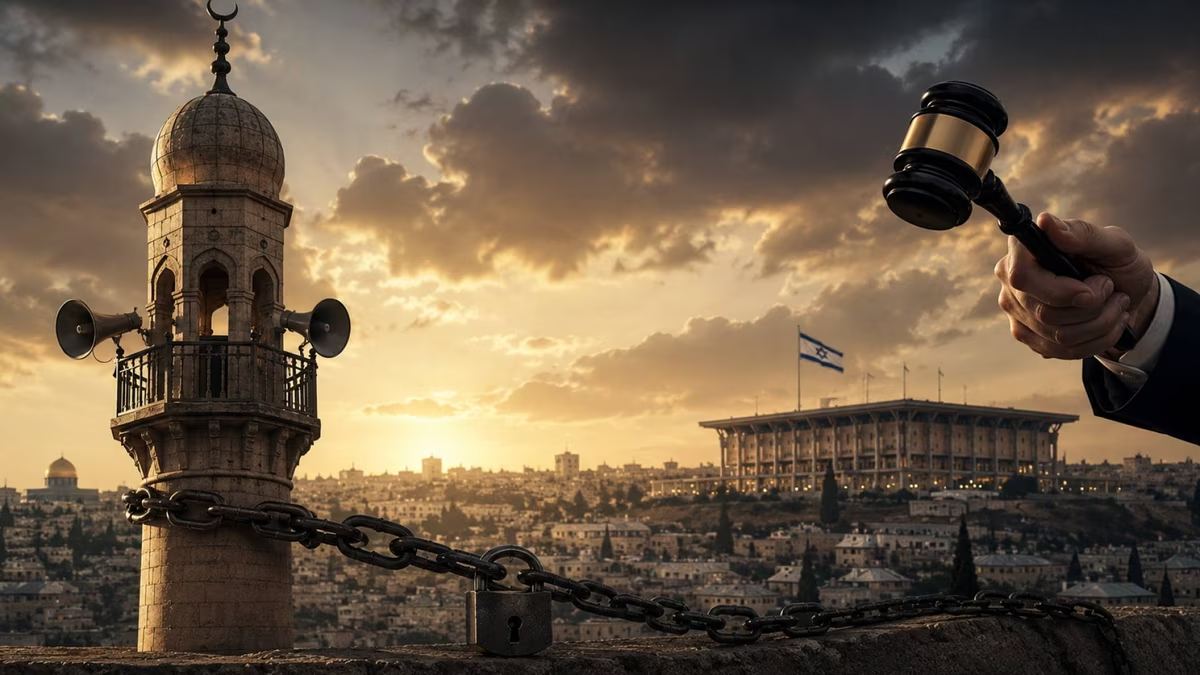
This phenomenon, which has been expanding, also included cities like Rome, Brussels, and Amsterdam, where residents from inside their homes respond to the protesters' chants with phrases calling for the freedom of Palestine. This method has provided an opportunity for the elderly or those whose circumstances do not allow them to go down to the street to participate actively, transforming their homes into small media platforms that clearly convey the message of solidarity.

In addition to flags, the Palestinian keffiyeh and banners condemning the war of extermination have emerged as essential symbols adorning the facades of residential buildings in vibrant European neighborhoods. This visual scene is accompanied by vocal participation, represented by warm applause and chanting slogans demanding an end to the aggression, which boosts the morale of participants in mass marches and confirms the comprehensiveness of the popular stance.
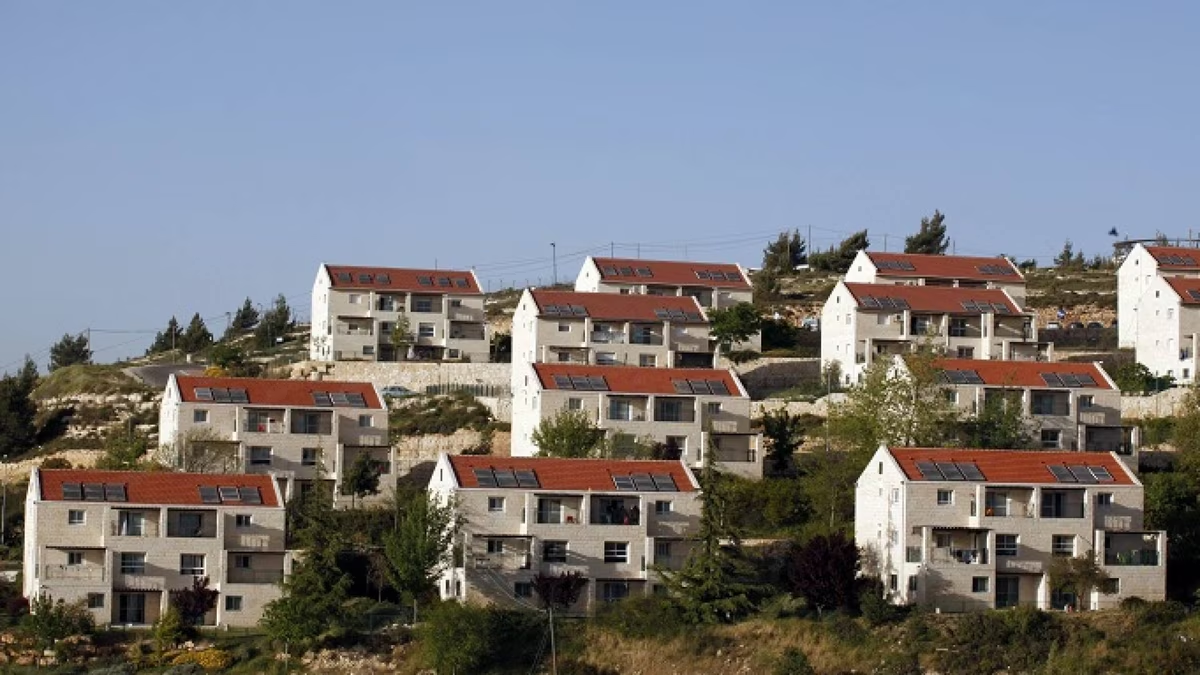
In contrast, these movements have not gone without political reactions, as solidarity activities have faced sharp criticism from the Israeli Foreign Ministry, which accused some countries of leniency with what it described as 'anti-Semitism.' Despite these pressures, solidarity manifestations continue to expand, indicating a radical shift in European collective consciousness towards Palestinian rights and a rejection of Israeli policies in the region.

This phenomenon has re-engineered the balconies of European cities, turning them into small platforms of solidarity that provide those who cannot go down to the street with a space for active participation.

PALESTINE

Sat 04 Jul 2026 10:37 am - Jerusalem Time

International Plan to Transfer Gaza Residents to the 'Yellow Zone' Under the Supervision of the Peace Council

Media sources have revealed intensive international movements led by regional and international parties under the umbrella of the 'Peace Council,' aimed at changing the demographic and security reality in the Gaza Strip. These movements come amid increasing international pressure on the Israeli government to improve humanitarian conditions, with American efforts to find a civilian alternative to manage the Strip's affairs away from current structures.

According to informed sources, the Cypriot capital hosted extensive meetings over the past week, including members of the Palestinian technocratic committee and international advisors. Former UN envoy Nikolay Mladenov and former British Prime Minister Tony Blair participated in these deliberations to finalize timelines for population transfer.

The new plan centers on transferring groups of the Strip's residents to areas located outside what is known as the 'Yellow Line' within a period not exceeding a few months. This step aims to create buffer zones and temporary communities under the supervision of joint Palestinian and international forces, in an attempt to disengage civilian ties with armed factions.

Reports indicated that the current consensus allows these measures to proceed even if the factions are not disarmed in the near future. Observers believe that this approach aligns with the interests of Benjamin Netanyahu's government, which seeks to empty areas controlled by factions of civilians to facilitate subsequent military operations.

Land and infrastructure preparation in the targeted areas are scheduled to begin within three to six months. The Tel al-Sultan area will be the first destination to receive tens of thousands of Gazans in the experimental phase, before expanding to accommodate hundreds of thousands in later stages.

Despite the clear timelines, the mechanisms for selecting residents who will be allowed to move remain unclear. The meetings have not yet decided on the demographic composition of the beneficiaries of these reconstructed areas, raising questions about the security and political criteria that will be followed.

The plan stipulates not using heavy building materials in current reconstruction operations, as a precautionary measure as long as disarmament has not been fully achieved. Instead, reliance will be placed on temporary housing solutions described as 'high quality,' with the provision of health and educational facilities and workplaces to ensure the continuity of daily life.

Regarding the security aspect, sources reported that internal security management will be entrusted to a new Palestinian police force currently being trained in the Arab Republic of Egypt. This force is expected to work alongside an international stabilization force that will be deployed in the Strip in the coming months to ensure calm.

For its part, the Israeli army will maintain its presence within the external security envelope of the Strip, withdrawing only from areas where civilians will be settled. This positioning aims to maintain overall security control while reducing direct friction with residents in the new residential areas.

These developments coincide with changes in official Israeli terminology, with directives issued to use the description 'freedom of movement plan' instead of 'voluntary migration.' This linguistic change aims to mitigate international criticism that considered previous terms as promoting forced displacement operations that violate international law.

In an angry reaction, Hamas called on the Arab League to hold an emergency summit to confront what it described as dangerous displacement schemes. A spokesman for the movement considered these projects a direct threat to Arab national security and a blatant challenge to the will of Arab states, foremost among them Egypt.

The 'Yellow Zone' is defined as the areas under Israeli forces' control since the ceasefire agreement in October 2025. This area has witnessed continuous field transformations, with the army installing concrete blocks to define the security belt that represents its current deployment range.

It is worth noting that the Peace Council leading this initiative is chaired by US President Donald Trump and was officially launched in January 2026 in Davos, Switzerland. The Council acts as an interim administrative body with international legal personality, responsible for coordinating international funding for the redevelopment of the Gaza Strip.

The implementation of this plan remains contingent on field developments and the extent to which local and international parties respond to the proposed security arrangements. Amid ongoing tension, the residents of the Strip await their fate between promises of temporary reconstruction and fears of displacement looming with every new political move.

The project does not target the Palestinian people alone, but represents a direct threat to the Arab national security system and a challenge to the will of Arab states.

PALESTINE

Sat 04 Jul 2026 10:37 am - Jerusalem Time

Escalation of Settler Attacks in the West Bank: Attacks in Abu Falah and Seizure of Homes in Jalud

Dozens of Israeli settlers attacked a peaceful march that included dozens of Palestinians and foreign solidarity activists in the town of Abu Falah in the occupied West Bank. The attackers used pepper spray and severe beatings to prevent participants from reaching their agricultural lands, which settlers have banned access to for nearly a year and a half.

This event comes as part of repeated attempts by residents to break the settlement blockade imposed on the area and reclaim ownership of their confiscated lands. The assault resulted in varying injuries and severe suffocation cases due to toxic gas among a number of participants, including international solidarity activists.

Nazem Saleh, head of Abu Falah municipality, confirmed that the purpose of the march was to accompany farmers to their productive lands, which had been subjected to burning and tree cutting during the ban period. He explained that this policy directly aims to push landowners to abandon their land in preparation for its complete seizure for settlement expansion.

For his part, settlement resistance activist Munther Amira stressed that persistence in accessing land represents the first line of defense to protect it from confiscation. He pointed out that the continued deprivation of Palestinians from utilizing their lands threatens to turn them into vital areas of influence for the surrounding settlements.

In a related context, Israeli Finance Minister Bezalel Smotrich boasted about the accelerating pace of settlement, announcing the establishment of 160 new settlement farms. He also revealed the government's approval for the establishment of more than 100 additional settlements deep in the West Bank, reflecting an official trend to support these violations.

The attacks were not limited to Abu Falah but extended to the Abu Anjim area south of Bethlehem, where sources reported that occupation forces assaulted worshippers during Friday prayers. Field documentation showed soldiers brandishing their weapons and firing tear gas canisters at unarmed worshippers.

In the Masafer Yatta area, residents of Khirbet al-Hums performed Friday prayers on their lands threatened with confiscation in a clear defiance of the occupation mechanisms that surrounded the place. These protest steps come in response to continuous attempts to restrict shepherds and farmers in areas classified as 'C'.
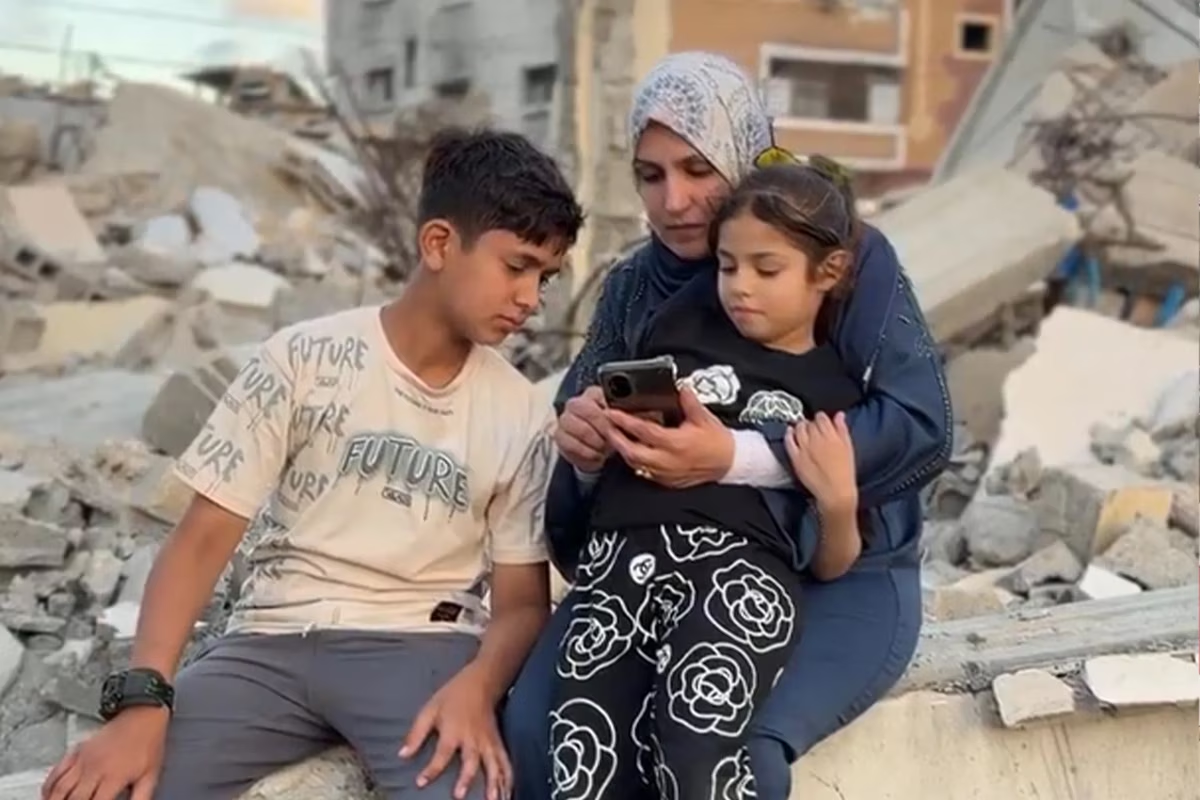
Another attack occurred in the town of Turmus Ayya north of Ramallah, where settlers set fire to large areas of agricultural land belonging to Palestinians. These scenes are repeated in the southern Hebron, where residents are subjected to physical assaults and systematic destruction of crops, wells, and springs.

In the village of Jalud, settlers seized a two-story house belonging to citizen Mohammed Salameh, despite his legal attempts and appeals to the relevant authorities. The targeted house is surrounded by a group of settlement outposts that are constantly expanding at the expense of private citizens' property.

Raed Haj Mohammed, head of the village council in Jalud, described the incident as a serious and unprecedented escalation targeting houses that are still under construction. He pointed out that settlers have positioned themselves very close to the heart of the village, threatening the security and daily stability of the residents.

UN data indicates that settler attacks have seen a qualitative leap of 130% since the beginning of 2023, reflecting the absence of legal deterrence. Currently, about half a million settlers live in illegal settlements under international law, amid increasing international pressure to stop these policies.

The Fourth Geneva Convention considers the construction of settlements and the transfer of civilian populations to occupied territories a grave breach of international law and an obstacle to peace. Despite international condemnations, including statements from Israel's allies, settlement expansion continues to devour more Palestinian lands daily.

According to official Palestinian data, attacks by the army and settlers since October 8, 2023, have resulted in the martyrdom of 1,175 Palestinians and the injury of thousands more. Approximately 24,000 citizens have also been arrested and 33,000 displaced from their homes in various governorates of the West Bank and Jerusalem.

Observers warn that these systematic attacks aim to impose a new reality on the ground that paves the way for the annexation of large parts of the West Bank. Through this policy, the occupation seeks to undermine any future opportunity for the establishment of an independent and geographically contiguous Palestinian state on the 1967 borders.

Accessing the land, despite the assault, represents a step to protect it from confiscation and seizure amidst the escalation of systematic attacks.

PALESTINE

Sat 04 Jul 2026 10:37 am - Jerusalem Time

Injuries and Arrests in Settler Attack on Al-Tabana Village in Occupied Jerusalem

The Bedouin village of Al-Tabana, located in the vicinity of Khan al-Ahmar area east of occupied Jerusalem, was subjected to a violent attack by Israeli settlers on Friday evening, resulting in injuries among Palestinian citizens. Official sources in Jerusalem Governorate reported that one of the settlers deliberately ran over two Palestinians with a motorized vehicle, causing them bruises and various injuries, while another settler sprayed toxic pepper spray at a group of young men in the area.

Following the attack, Israeli army forces stormed the village to provide protection for the settlers and arrested four Palestinian citizens. These arrests came after the villagers confronted a group of settlers attempting to steal flocks of sheep belonging to local residents, as part of the systematic policy of harassment practiced by settler groups against Bedouin communities.

This field escalation coincides with dangerous Israeli political decisions, as the Ministerial Committee for National Security Affairs ('the Cabinet') recently approved a plan to build 13 new settlements in the heart of the West Bank. Palestinian parties warned that this step directly aims to dismember Palestinian governorates and completely isolate the occupied city of Jerusalem from its geographical surroundings.

Khan al-Ahmar area is considered one of the most targeted areas for settlement projects due to its strategic location connecting the north and south of the West Bank. International and Palestinian reports confirm that any displacement of the residents of this area would definitively eliminate the chances of establishing a geographically contiguous Palestinian state, which the occupation authorities seek to impose as a fait accompli through continuous settlement expansion.

In a related context to the violations in the southern West Bank, the Israeli army established a new military outpost in the 'Al-Kuraiseh' area, affiliated with the city of Dura in Hebron Governorate. This step aims to enhance military control and facilitate the movement of settlers in agricultural areas that witness daily attacks, including burning crops and preventing farmers from accessing their lands.

Madar, the Palestinian Center for Israeli Studies, revealed an unprecedented surge in the pace of establishing settlement outposts in recent years. Data showed that the annual average of outpost establishment increased from only 8 outposts in the last decade to 86 new settlement outposts in 2025, reflecting a sharp acceleration in the confiscation of Palestinian lands and the legitimization of random outposts.

Official statistics indicate that the West Bank has been in a state of turmoil since October 8, 2023, due to joint military operations between the army and settlers. This continuous aggression has resulted in the martyrdom of 1,175 Palestinians and the injury of about 13,000 others, in addition to arrest campaigns targeting 24,000 citizens, and forced displacement affecting 33,000 people from their homes and lands.

International law affirms that all settlement activities in the occupied territories are illegal and constitute a war crime, and the United Nations considers them the biggest obstacle to achieving peace. Despite international condemnation, the Israeli government continues to support settler militias and provide them with legal and military cover to carry out their attacks against Palestinian civilians and their property throughout the West Bank.

Displacing the residents of Khan al-Ahmar will sever geographical communication between the northern and southern West Bank, undermining the chances of establishing a Palestinian state.

PALESTINE

Sat 04 Jul 2026 10:37 am - Jerusalem Time

Knesset preliminarily approves bill to restrict the call to prayer in Jerusalem and the West Bank

The Israeli Knesset, during a session held on Wednesday, approved a controversial bill to ban the call to prayer via loudspeakers in a preliminary reading. The draft law is scheduled to be referred to the relevant parliamentary committees for discussion and preparation, in preparation for its presentation for three additional readings in the coming weeks before it finally comes into effect.

The provisions of the new legislation, according to media sources, include imposing strict restrictions on the use of loudspeakers in mosques located within populated areas. The geographical scope of this ban extends to all cities and towns in the West Bank and occupied Jerusalem, representing a new escalation against the religious rituals of Palestinians.

The law primarily focuses on preventing the call to prayer during the night and early dawn hours, specifically from eleven at night until seven in the morning. This timing aims to directly restrict the dawn call to prayer, under the pretext of preventing noise in mixed residential areas or those close to settlements.

Deliberations revealed that the current version of the law is an amended version of previous proposals that had faced internal opposition. This technical amendment was made to ensure that Jewish rituals would not be affected, as ultra-Orthodox religious parties expressed concerns that the ban might include loudspeakers in synagogues that announce the beginning and end of the Sabbath.

By limiting the ban hours to the late night period, the government coalition succeeded in neutralizing the objections of religious parties, as the announcement of the Sabbath usually occurs at sunset. With this agreement, the Knesset proceeds with legislation that Palestinians view as a blatant assault on freedom of worship and religious heritage in the occupied territories.

The new bill stipulates the prevention and prohibition of using loudspeakers for the call to prayer in populated areas, with its application covering areas of the West Bank and occupied Jerusalem.

PALESTINE

Sat 04 Jul 2026 10:37 am - Jerusalem Time

Jerusalem Governorate warns of a settlement plan to establish 13 new colonies in the West Bank

The Jerusalem Governorate issued a strong warning about the serious repercussions of the Israeli Ministerial Committee for National Security Affairs (the Cabinet) approving a vast settlement plan. The plan includes the establishment of 13 new colonies affiliated with the so-called 'Binyamin Council' settlement, a step described by the Governorate as an attempt to impose a new geographical reality that isolates the occupied city of Jerusalem from its Palestinian surroundings and its natural extension in the West Bank.

The Governorate affirmed in an official statement that the intensification of colonial projects recently falls within the political bidding associated with the electoral cycle of the occupation authorities. It clarified that the occupation government seeks through these decisions to appease extremist fascist right-wing currents and ensure their support at the ballot boxes, by confiscating more Palestinian lands and legitimizing illegal settlement expansion.

According to field data, the implementation of the project will begin with a first phase in the coming months, including the immediate construction of four to six new colonies. The occupation authorities also intend to legitimize a group of pastoral colonial outposts spread in the area, transforming them into permanent settlements that receive direct government recognition and funding, thereby entrenching settlers' control over vast areas of land.

The plan targets two strategic geographical axes. The first axis extends in the areas located northwest of Jerusalem Governorate, reaching west of Ramallah and Al-Bireh Governorate, alongside bypass road 60. This route aims to tighten control over key entrances and ensure geographical continuity for settlers at the expense of the surrounding Palestinian villages and towns, which will find themselves besieged by settlement construction.

The second axis of the project focuses on the eastern slopes of Ramallah Governorate towards the Palestinian Jordan Valley, which threatens to completely dismember the West Bank and isolate its north from its south. Local sources indicated that this linkage between colonial blocs represents part of a broader vision to annex large areas of the West Bank and prevent the establishment of any geographically contiguous Palestinian entity in the future.

The acceleration of colonial projects is linked to the occupation's electoral cycle; where geography and Palestinian blood are exploited as an entry point for political bidding.

PALESTINE

Sat 04 Jul 2026 10:36 am - Jerusalem Time

Between the Scent of Bread and the Whiz of Bullets.. Details of the Tragedy of the Assassination of Dr. Mohammed Matar and His Family in Gaza

The pains of war have returned to knock on the door of the Palestinian Matar family once again, not through an airstrike this time, but through severe neurological pains attacking the head of the mother, Suad Matar. These pains forcibly bring her back to the memory of a horrific tragedy that occurred more than two years ago, when she lost her doctor husband and three of her children in a treacherous Israeli attack.

The chapters of the story began on the morning of December 21, 2023, when the family was living their ordinary life in the Al-Saftawi neighborhood north of Gaza City. The mother was kneading bread for her five children, while Dr. Mohammed Matar was moving around the house before a sudden knock on the door broke the calm.

Dr. Mohammed went to open the door, but he barely did so when an Israeli special force ambushed him with heavy gunfire from behind. The doctor returned to his family drenched in his blood, and in his last moments, he told his son Yahya that his father had pushed him away to take the bullets instead of him, protecting his beloved child with his body.

The occupation soldiers did not stop at direct gunfire; tanks began shelling the house with successive shells, turning its walls into rubble over the heads of the residents. The screams of the children Malak, Yahya, Dima, Ahmed, and Fatima rose, as they pleaded with their mother to get them out of the hell of fire and endless collapses.

In those difficult moments, as the rubble was collapsing, Dr. Mohammed tried to give his wife his last will before losing consciousness completely. The shelling quickly sealed the family's fate, as the doctor and three of his children were martyred immediately, while the mother lost consciousness due to severe head and back injuries.

The soldiers stormed the house after the shelling stopped and found the mother drenched in her blood, so they thought she had died and left her among the ruins. In contrast, the two surviving children, Ahmed and Fatima, were transferred to 'Soroka' Hospital in the occupied interior, to begin a new chapter of suffering and forced displacement away from their mother's embrace.

Suad regained consciousness days later to find herself in the hospital, surrounded by news of the loss and destruction that had befallen her family. Eyewitnesses told her that she was seen wandering aimlessly towards her old home, suffering from severe burns and fractures, in a state of shock that made her unable to remember how she survived certain death.

The mother continued to suffer from fractures in her back and chest bones and stable shrapnel in her head, but the physical pain was nothing compared to the tragedy of losing her life partner and children. Suad remained alone in the northern part of the Strip, while her two surviving children were in the center, separated by the occupation's bullets and impenetrable military checkpoints.

After three months of forced separation, the International Committee of the Red Cross succeeded in transferring the two children, Ahmed and Fatima, to Al-Aqsa Martyrs Hospital. There, the mother met her children in a scene that blended the miracle of survival with the bitterness of loss, as only these two children, burdened with harsh memories, remained of her large family.

Suad's tragedy is compounded by the fact that her son Yahya's body is still missing to this day, as his body has not been found under the rubble. Although skeletal remains believed to belong to him were found around the house, the absence of a final farewell remains an open wound in the heart of the mother who was deprived of burying her son.

Today, the mother remembers her martyred children; Malak, who dreamed of a promising future, Dima, who had not yet left her childhood, and Yahya, who sacrificed himself for his father. All that remains of them are torn photos and a memory burdened with the details of that morning when the bread dough turned into the color of blood.

Sources close to the family confirm that the mother's health condition remains unstable, as she periodically shows signs of psychological trauma and neurological pain. Despite attempts at recovery, the lack of specialized medical care under the siege exacerbates the suffering of the survivors of this horrific massacre.

Today, Suad wishes for a simple wish that reflects the magnitude of the tragedy, which is for her children and husband to visit her in her dreams so she can hug them, even if only once. She says that being deprived of a final farewell is a pain that days cannot heal, nor can years of long patience alleviate its intensity.

The story of Dr. Mohammed Matar and his family remains a testament to the extent of the violations suffered by medical personnel and civilians in the Gaza Strip. It is a story that summarizes the reality of thousands of families that have been annihilated or dispersed, leaving behind stories of resilience and endless pain amidst the rubble of destroyed homes.

My father pushed me away to protect me from the bullets before he fell to the ground, uttering the two testimonies.

OPINIONS

Sat 04 Jul 2026 10:36 am - Jerusalem Time

From Behind Washington's Desk... Mamdani Paints a Picture of a Renewed America: "We Define the Meaning of Freedom"

Washington's Message

Washington – Said Arikat – 7/4/2026

In a rare scene combining historical symbolism and direct ideological confrontation, New York City Mayor, Zahran Mamdani, on Friday delivered a speech on the occasion of the 250th anniversary of the founding of the United States, from behind a desk belonging to George Washington, the first American president. The speech, around which newly naturalized citizens gathered, constituted a preemptive response to what President Donald Trump is expected to announce later from "Mount Rushmore," at a time when Trump continues his policy of deporting large numbers of immigrants during his second term.

Mamdani, born in Uganda and who obtained his American citizenship in 2018, recalled the successive waves of immigrants who built the city, speaking of the Irish fleeing a famine created by colonialism, the Chinese sailors who founded Chinatown, the Jews fleeing pogroms, and the Italians and Syrians seeking opportunity. He said they "made their homes here, and helped make New York," despite federal laws that sought to exclude them. The speech came days after the US Supreme Court rejected Trump's attempt to end birthright citizenship, a clear indication that the legacy of rights is not a relic of the past.

Mamdani went on to paint a picture of America that does not resemble the rhetoric of "greatness" promoted by Trump, saying that the powerful have always seen the country as "a field of superiority where freedom is allowed only to a select few, and where not everyone is created equal." Instead of celebrating Christopher Columbus, he praised explorers Verrazzano and Hudson, in a deliberate reshaping of the national narrative. He called on those gathered to use "their own power to define what America means," warning against the policy of division and fragmentation which he described as "the cheapest trick in politics."

The Mayor concluded his speech by offering an alternative definition of patriotism that radically contradicts exclusionary nationalism, emphasizing that "patriotism has never been a claim that our nation is flawless. Patriotism is every just protest, every march under the heavy sun, and every valid act of dissent a decade ahead of its time." This statement comes as Trump prepares to deliver a speech at a massive celebration at Mount Rushmore that includes fireworks, an aerial display, and a salute to the six branches of the armed forces, in a scene that will remain a landmark in the deep division over the meaning of the 250th anniversary.

The choice of George Washington's desk by Mayor Mamdani was not merely a fleeting archaeological detail, but rather an establishment of counter-legitimacy. Sitting behind the first president's desk, surrounded by newly naturalized citizens, creates a visual narrative that says the essence of the republic lies in its constant renewal through newcomers, not in its imagined purity. It is an act of appropriation of foundational symbolism by someone who belongs to backgrounds that have long been considered alien to the national narrative. By this act, Mamdani transformed Washington himself from an icon of the white elite into a witness to a pluralistic American transformation, and established a historical ground for his speech that populist rhetoric would find difficult to uproot without clashing with the legacy of the Founding Fathers themselves.

The timing of the speech carries dimensions beyond calendrical coincidence, as it comes just days after candidates supported by Mamdani's social democratic current won local elections within New York, and in major liberal cities such as Philadelphia, Denver, and Washington. These victories do not merely reflect dissatisfaction with the Democratic center, but rather indicate a thirst among a young and diverse urban base for a discourse that combines economic justice and immigrant rights in the face of Trump's policies. It seems that Mamdani is leveraging electoral momentum to present himself as a model for a national opposition that does not merely defend gains, but seeks to wrest the initiative of defining American identity from the grip of the nationalist right, a gamble that has not yet been fully tested.

Redefining patriotism as "just protest" and "a march under the heavy sun" represents a profound shift in progressive rhetorical strategy, which has long been accused of hesitation in embracing the language of national pride. Here, Mamdani does not abandon the concept of love of country, but re-frames it so that radical critique becomes the highest form of loyalty. This formulation targets a segment of Americans exhausted by the dichotomy of "blind love" or "declared hostility" towards the country, and establishes a political project that sees pluralism and accountability as the essence of national strength, not a threat to it. And if Trump's speech at Mount Rushmore will elevate the rocks of the ancestors, Mamdani's speech reminds us that it is the river that carved those rocks.