PALESTINE

Mon 06 Jul 2026 8:21 am - Jerusalem Time

Child martyred and others injured by occupation bullets during Qalandia camp raid

The Palestinian Ministry of Health announced this evening the martyrdom of 16-year-old child Walid Nidal Abu Snaineh, who succumbed to his critical injuries sustained by Israeli occupation forces' bullets. This occurred during a widespread military incursion carried out by Israeli forces into Qalandia camp, located north of occupied Jerusalem, where live bullets targeted the upper part of the child's body before he was transferred to the hospital in critical condition.

Medical and field sources reported that the incursion also resulted in two other children being injured by live bullets in their lower extremities, with their injuries described as moderate. Occupation forces spread throughout the camp's alleys and completely closed its main entrances, obstructing the movement of citizens and ambulances attempting to reach the injured amidst heavy gunfire and tear gas canisters.

In a related field development, local sources stated that a Palestinian girl was injured by live occupation bullets while near the 'Sikkal' intersection adjacent to the camp, and she was immediately transferred to Palestine Medical Complex in Ramallah. Sources confirmed that the girl's health condition was described as serious due to her direct injury, while Israeli forces continued to target passing vehicles in the area with bullets and sound bombs.

For its part, Palestinian Red Crescent Society crews confirmed that they dealt with another young man injured by live bullets in the thigh area during the violent confrontations that erupted inside the camp. The society clarified that its field crews provided the necessary first aid to the injured person before transferring him to the hospital for further treatment, noting the difficulty of field work amidst the continued heavy firing of tear gas canisters towards civilians.

The Israeli military operation extended to include the neighboring town of Kafr Aqab, where occupation vehicles stormed the town's neighborhoods and carried out raids that resulted in the arrest of three young men whose identities are not yet known. The incursion was interspersed with scattered confrontations during which soldiers fired a barrage of tear gas and sound bombs towards residential homes, causing suffocation cases among citizens without recording direct bullet injuries in that area.

Reports from Jerusalem Governorate indicate that occupation forces continued their military deployment around Qalandia camp until late hours, imposing a strict security cordon on the area. Despite no widespread house raids being recorded inside the camp itself, a state of extreme tension prevails in the area amidst the escalation of live bullet use by occupation soldiers directly against youths and children.

The Palestinian Ministry of Health announced the martyrdom of child Walid Nidal Abu Snaineh, who succumbed to his critical injuries sustained by occupation forces' bullets during the Qalandia camp raid.

OPINIONS

Mon 06 Jul 2026 8:21 am - Jerusalem Time

"OPEC+" continues cautious production increase after Strait of Hormuz crisis subsides... and markets await stability test

Washington Message

Washington – Saeed Erikat – 7/6/2026

OPEC+ announced on Sunday that it would raise its oil production by 188,000 barrels per day starting next August, a move that reflects the alliance's continued policy of gradual increases over the past months, amidst attempts to restore balance to global energy markets after months of severe disruptions that accompanied the war on Iran and the closure of the Strait of Hormuz, according to a New York Times report on Sunday.

The decision included Saudi Arabia, Russia, Iraq, Kuwait, Kazakhstan, Algeria, and Oman. The alliance affirmed in an official statement that member states will continue to monitor market conditions continuously, emphasizing the importance of a cautious approach that ensures price stability and a balance between supply and demand.

The announcement came weeks after the United States and Iran signed a framework agreement on June 17 that reopened the Strait of Hormuz to international navigation, ending a closure that lasted nearly four months and led to widespread disruption in global oil supplies, raising crude prices to unprecedented levels before they began to gradually decline.

Brent crude prices had jumped during the first weeks of the war to about $118 per barrel, before falling to about $72 with the resumption of navigation and the start of normal Gulf oil exports, which limited the impact of the latest OPEC+ decision, as analysts believe that markets had already absorbed the supply increase before its official announcement.

This new increase is an extension of a series of similar decisions, after the alliance raised production by 188,000 barrels per day during May and June, and before that announced an increase of 206,000 barrels per day, as part of a monthly review of market conditions, with its next meeting scheduled for August 2.

Despite the economic nature of the decision, its background is closely linked to geopolitical developments that have redrawn the balance of power in the global energy market. The war on Iran led to sharp price fluctuations and posed unprecedented challenges to the oil alliance, which found itself facing a dual test: maintaining its internal cohesion and preventing markets from sliding into a new wave of instability.

Pressure on the alliance increased after the UAE withdrew from OPEC+ in late April, following disagreements with Saudi Arabia over production levels, a development observers considered an indication of escalating differences within the organization, at a time when Riyadh is trying to maintain its leading role in managing the global oil market in coordination with Russia.

Energy experts believe that the resumption of navigation through the Strait of Hormuz has restored a large part of confidence to the markets, after the increases approved by OPEC+ during the war had a limited impact due to the disruption of shipping routes. With the resumption of Gulf exports, production increases are now more capable of reaching global markets, although their price impact remains limited due to abundant supplies and declining fears of supply shortages.

The decision reflects OPEC+'s transition from crisis management to post-war management.

The new production increase does not seem to be an attempt to lower prices as much as it represents an announcement that the alliance has begun to transition from managing a geopolitical crisis to managing a recovery phase. During the closure of the Strait of Hormuz, the problem was not a lack of production, but rather the inability of oil to reach markets. Today, after the resumption of navigation, the goal is to send a reassuring message to consumers that supplies will be sufficient if calm continues. Therefore, the decision has a political dimension as much as it has an economic dimension, and confirms that OPEC+ still sees price stability as a priority that precedes maximizing short-term returns.

The war highlighted the fragility of the global energy market, as the past months have proven that the oil market is affected not only by the volume of production, but also by the security of maritime passages and political stability. The closure of the Strait of Hormuz disrupted a large part of global oil trade, which led to price increases despite no significant decline in the production capacity of exporting countries. This means that maritime transport security has become a factor equal to production itself in determining prices, which will push consuming countries to increase their investments in diversifying energy sources, and will also push producers to search for alternative export routes that reduce reliance on strategic straits.

Despite the alliance's success in maintaining a unified production policy, internal challenges have not disappeared. The disagreements that led to the UAE's exit revealed that the national interests of producing countries may sometimes take precedence over collective considerations, especially given differing financial needs and production ambitions. Furthermore, continued coordination between Saudi Arabia and Russia will remain a crucial factor in the alliance's continued influence in the markets. If regional conditions stabilize and geopolitical risks decline, managing internal disagreements may become more complex than managing market fluctuations themselves, which will test OPEC+'s ability to maintain its unity and leadership role in the coming years.

OPINIONS

Sun 05 Jul 2026 7:00 pm - Jerusalem Time

In the Jurisprudence of National Priorities!

Dr. Ibrahim Melhem

Editor-in-Chief

While people are suffocating and the area of the country, surrounded by shifting yellow lines at times, and at other times by isolation and apartheid gates that cut off the rural belt from the north of the West Bank to its south, and from its east to its west, and amidst frantic theft operations of livestock, water, and the food basket in Area (C).. At the same time that the occupation army and the settlers' army are alternating in rapid and terrifying geographical and demographic decisive operations in the West Bank, and the threat of starvation and displacement looms over those confined to one-third of the afflicted Strip's area; at this time when people are enduring their pains, the debate intensifies around the priorities of the stage.. between elections intended to renew legitimacy, or agreements that are extremely difficult to achieve, to end years of estrangement that caused people suffering whose thread has not been cut for over a thousand days, and between managing our affairs with what little money is available in our leaky piggy bank to maintain the sustainability of services, especially in the education and health sectors.I was struck by what Dr. Ghassan Al-Khatib wrote in his article published today on page three, and the ideas it contained that deserve attention, and placing a set of red lines under them, especially those related to the danger of "silent annexation" of villages and towns, and the intimidation, terrorization, and deliberate impoverishment that the good villagers in those villages are subjected to; through cutting down their trees, stealing their sheep, and demolishing their homes, which are the pegs that keep them rooted in their land against the fierce winds of "decisive action" that blow upon them day and night.And here the question arises: What is the benefit of a homeland without citizens? And what is our need for elections without voters?It is an urgent and pressing necessity today to place this item at the forefront of the agenda of the weekly government meetings, and the periodic meetings of the Executive and Central Committees. All national parties should engage, with a unified media discourse in which all media outlets and social networks participate locally, regionally, and internationally, as part of a battle to protect and empower people in the targeted villages and towns in the West Bank, in parallel with working to stop the war of extermination in Gaza, and enabling thousands of sick and wounded to travel abroad for treatment, and mobilizing an international, official, and popular effort to achieve this goal.And if the ijtihad of scholars has settled on the principle that "necessities permit prohibitions" as a fundamental principle in the jurisprudence of priorities, then it is permissible for us today to exercise ijtihad by analogy to adjust the national priorities agenda according to what the acceleration of events and their degree of danger dictate, for existential risks permit adjusting the national priorities ladder.It is not a priority at all to be preoccupied with the type of furniture, or the quality of the tiles, or the desired curtain colors for furnishing the house, while raging fires consume its roof and walls!

OPINIONS

Sun 05 Jul 2026 7:00 pm - Jerusalem Time

A Stance... Priority of Priorities in a Time of Declining Capabilities

The forced decline in the financial resources of the Palestinian National Authority has reopened a legitimate discussion about how to prioritize in light of limited capabilities and insufficient revenues. Some rightly believe that health should be at the top of priorities, while others assert that investing in the education of new generations is most important. A third group argues that justice, maintaining security and order, and the rule of law are guarantees for the continuation of other services. All these opinions are valid and their importance cannot be underestimated.However, I would like to draw attention to a priority that does not compete with these sectors and others, but rather precedes them in the current circumstances because it represents a condition for protecting the national cause itself. It is a cross-sectoral priority that deserves the concerted efforts of governmental, non-governmental, international institutions, and the entire Palestinian society. This is the support for Palestinian villages, rural areas, and Bedouin communities surrounding or surrounded by settlements in the occupied West Bank, so that a day does not come when we say, 'I was eaten the day the white bull was eaten.'The importance of this priority lies in the fact that the occupation seems to believe that the current moment is opportune to settle the historical conflict over land, taking advantage of regional and international circumstances, and the state of Palestinian exhaustion. This belief translates into a policy aimed at dispossessing Palestinians of their lands located outside the urban areas of villages, reminiscent of what happened in large parts of Palestine after the Nakba of 1948, when residents were gradually separated from their lands and livelihoods.The matter is not limited to land seizure, but extends to besieging these communities and isolating them from their surroundings. Military checkpoints, gates, closures, and restrictions on movement make access to schools, universities, hospitals, and health centers more difficult and costly, turning basic services into a daily burden that threatens the stability of residents and their ability to remain in their homes.The pressure increases through direct economic targeting, as farmers are often prevented from accessing their lands, cultivating them, tending to their livestock, or harvesting their crops. The cost of accessing workplaces outside the villages also rises, whether in terms of time, expenses, or risks. The result is continuous economic exhaustion that aims not only to impoverish the residents, but to gradually push them to leave their lands, thereby achieving internal or external displacement.In addition, there are daily attacks carried out by settler groups and the occupation army against villages and Bedouin communities, which include assaulting citizens, destroying crops, uprooting trees, burning vehicles, homes, and mosques, stealing livestock, and other acts of violence and intimidation that have become a daily reality in dozens of locations. The effects of these attacks are not limited to material losses, but aim to break the will of the residents and convince them that the cost of staying has become higher than their ability to endure.Through personal experience, and through communication with a large number of residents of these villages and communities, it is clear that these areas and their residents do not receive the attention required by the seriousness of the conditions they live under, whether from governmental bodies or from non-governmental and international institutions. While efforts are distributed among multiple files, this front, which represents the first line of defense for Palestinian land, remains in need of exceptional attention commensurate with its importance.What is required is not to diminish the importance of education, health, or other public services, as these are all indispensable pillars for building Palestinian society. However, preserving these sectors loses much of its value if we simultaneously lose the land they are supposed to serve, or allow it to be emptied of its inhabitants. The battle taking place today in many areas of the West Bank is not a battle of services, but a battle of existence, and its direct goal is to redraw the demographic and geographical map in favor of the Zionist settlement project.Therefore, rebuilding the hierarchy of priorities in light of resource scarcity should not be limited to distributing spending among sectors, despite its importance. Rather, it must start from a more fundamental question: where can every shekel, every project, and every governmental, non-governmental, or international effort achieve the greatest impact in protecting Palestinian existence? In my estimation, there is no more urgent answer today than supporting the steadfastness of villages, rural areas, and Bedouin communities threatened with confiscation and displacement, because they are not just population centers that need services, but rather the first lines of defense for Palestinian land and its political future. If the occupation succeeds in breaking their steadfastness, we will lose a part of the geography upon which the idea of the Palestinian state itself is based.

OPINIONS

Sun 05 Jul 2026 6:59 pm - Jerusalem Time

Maher Younes .. From the Cell to the Nation's Memory

The news of Maher Younes' passing was not fleeting for me. It was a personal pain, just as it was a pain for everyone who knew him during his long years of captivity. Those who lived with him realize that Palestine did not just lose a released prisoner, but lost an exceptional human being, who lived great in his giving, and departed great in people's love. I knew Maher Younes inside the occupation prisons, where personalities are stripped of their masks, and a person's true self emerges. And there, Maher was always as he was: close to everyone, humble, calm, generous, never hesitating to serve a prisoner, never withholding a kind word, and never passing by a comrade's pain without trying to alleviate it. His presence gave those around him a feeling of familiarity, as if the homeland had managed to find a place for itself within the walls of the cells. It was difficult to mention Maher's name without the name of his companion and cousin, Karim Younes, also coming to mind. Together, they formed one of the most prominent duos in the history of the prisoner movement; the cause brought them together, and the cells united them for forty full years. But each had his own unique flavor; if Karim represented the solid intellectual stature, Maher was the warm heart that embraced everyone. Forty years of life are not just years of imprisonment, but a complete life offered as a sacrifice for Palestine. Years in which a family could have been built, children could have grown up, and simple dreams that every human being wishes for could have been realized. But Maher chose, as his comrades chose, for his life to be a part of the nation's life. And when he was released, he did not leave Palestine, which he carried in his heart while behind bars. He remained loyal to his cause, close to people, humble as we knew him, carrying the story of the prisoners in his actions before his words. It is difficult for an article to summarize the virtues of a man whom people lived with more than they heard about. There are people who are not immortalized by position or fame, but by their morals, their sincerity, and their impact on the hearts of those who knew them. And Maher Younes was one of them. Today we bid him farewell, but we do not bid farewell to his legacy. Nations that give birth to men of Maher Younes' caliber do not lose them to death, but preserve them in their memory, to remain witnesses to a generation that wrote the meaning of patience, and proved that freedom may be delayed, but it is not defeated. May God have mercy on Maher Younes, and make his good legacy and his loyalty to Palestine a heritage passed down through generations, and proof that some men, even if they are absent, remain present in the nation's memory, and in the hearts of those who knew them.

PALESTINE

Sun 05 Jul 2026 6:59 pm - Jerusalem Time

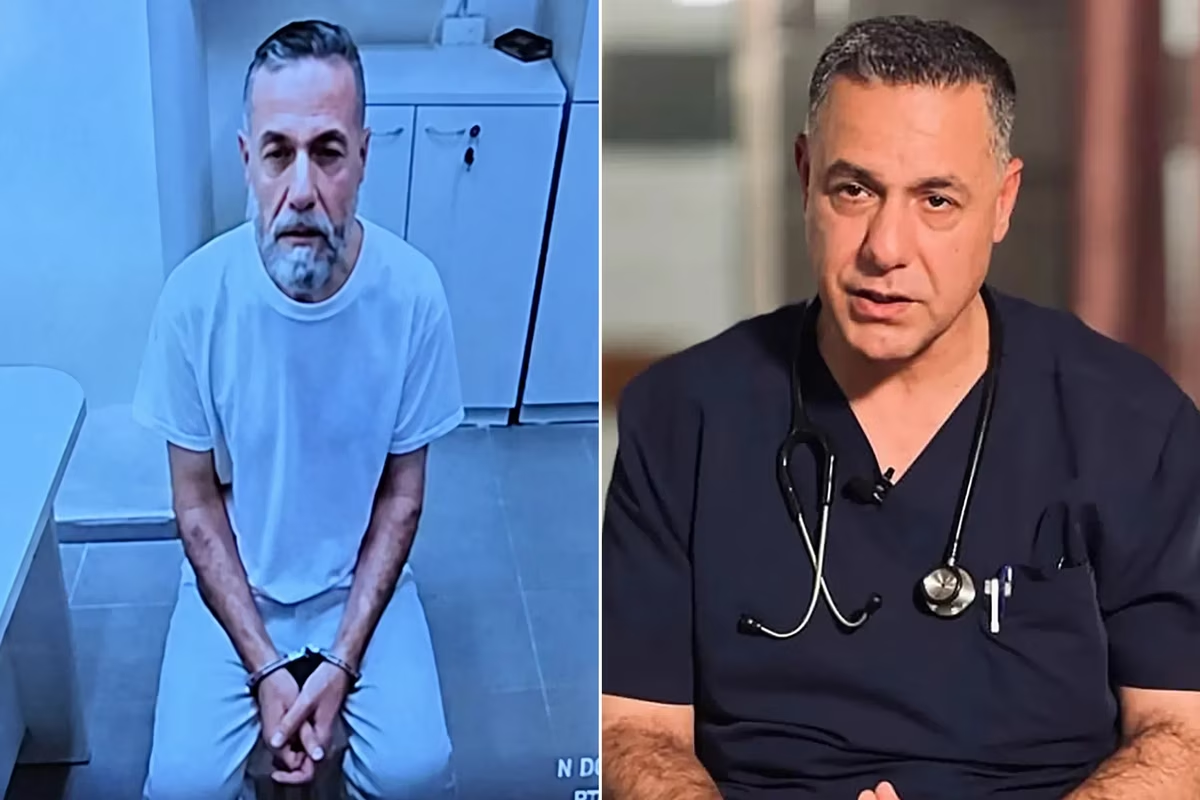
Prisoners' Affairs Commission warns of silent assassination attempt targeting Kamal Adwan Hospital director

The head of the Prisoners' Affairs Commission, Raed Abu Al-Homs, issued a strong warning about a systematic Israeli plan aimed at liquidating the director of Kamal Adwan Hospital, Dr. Hussam Abu Safiya, who is detained in occupation prisons. Abu Al-Homs explained that various military and intelligence agencies of the occupation are involved in a widespread campaign of abuse targeting the doctor, by subjecting him to harsh detention conditions that violate all international norms and conventions, which puts his life in imminent danger and necessitates urgent international human rights intervention.

Official sources in the Commission reported that the imprisoned doctor is being subjected to what can be described as an 'organized crime' inside solitary confinement cells, where clear signs of severe beating and violent physical torture appear on his body and face. These practices are accompanied by a deliberate starvation policy and complete deprivation of necessary medicines and medical care, as part of what the Commission considered an unethical medical crime aimed at undermining the steadfastness of Palestinian medical personnel who performed their duty during the aggression.

Regarding his health condition, the statement indicated a rapid and dangerous deterioration in Dr. Abu Safiya's condition, as his features had shockingly changed and he appeared extremely exhausted due to the continuous restraints on his hands and feet. The doctor is currently suffering from severe difficulty in breathing and speaking, which reflects the extent of physical and psychological pressure exerted on him in 'Nitzan' prison in Ramla, where he has been held in complete solitary confinement since his transfer.

Abu Al-Homs called on international organizations, especially the World Health Organization and Physicians for Human Rights, to assume their legal and moral responsibilities by launching an international campaign to pressure the occupation authorities for his immediate release. He stressed that the current stage does not tolerate delay, emphasizing the need to harness all diplomatic and human rights capabilities to prevent the occupation from completing its crime against a medical figure who provided great services to the wounded and children in the Gaza Strip.

It is worth noting that the occupation forces arrested Dr. Hussam Abu Safiya in December 2024, while he was performing his humanitarian duties inside Kamal Adwan Hospital in the northern Gaza Strip. The occupation's media machine tried to portray the arrest as a security achievement by fabricating false accusations, in an attempt to justify his continued detention in inhumane conditions aimed at breaking his will and physically liquidating him away from the spotlight.

Dr. Abu Safiya is being subjected to an organized crime, and the effects of abuse are clearly visible on his body amid a deliberate policy of starvation and medical deprivation.

PALESTINE

Sun 05 Jul 2026 6:59 pm - Jerusalem Time

Systematic Escalation of Settlement in the West Bank: Arson of Facilities, Electricity Cut, and Siege of Bedouin Communities

The intensity of systematic attacks carried out by settler groups escalated on Sunday in various areas of the West Bank and occupied Jerusalem, with these assaults characterized by their diversity and severity. The crimes committed ranged from burning vital commercial establishments to cutting off essential services from citizens' homes, in a clear attempt to tighten the noose on the Palestinian presence.

These attacks are carried out under full cover and direct protection from Israeli occupation army forces, which provide logistical and security support to settlers during their acts of sabotage. This integrated policy aims to terrorize residents and push them towards forced displacement from their lands and historical properties.

In the village of Al-Lubban Al-Sharqiya, south of Nablus, settlers stormed a restaurant located in a vital area serving students of Al-Zaytoonah University in the early hours of dawn. The attackers smashed the contents of the establishment and stole sums of money inside before setting fire to all its corners, leading to total destruction.

Ya'qoub Owais, head of the village council and owner of the affected restaurant, confirmed that the material losses resulting from the fire are estimated at about one million shekels, representing a severe economic blow. Owais pointed out that this attack is not the first, but rather part of a series of attacks that have targeted homes, vehicles, and olive groves in the area in recent months.

The wave of sabotage moved to the south of Hebron, specifically in the Sha'ab al-Butm area in Masafer Yatta, where the home of citizen Muhammad al-Jabareen was subjected to a provocative intrusion. Settlers engaged in acts of hooliganism in front of family members before cutting the main electricity cable that supplies the house with power.

Media activist Osama Makhamreh explained that Masafer Yatta faces a fierce demographic war aimed at displacing its residents by depriving them of the most basic necessities of life such as water and electricity. Settlers also pursue shepherds daily to prevent them from reaching pastures, coinciding with raids on caves and primitive dwellings of the residents.

In occupied Jerusalem, official sources documented a new attack in the (Al-Ka'abneh Al-Kassarat) gathering near the town of Anata, east of the holy city. One of the settlers deliberately released his flock of sheep among the tents and homes of citizens, leading to a state of tension and completely obstructing movement.

Jerusalem Governorate stated in a communiqué that these actions fall within the policy of 'settler hooliganism' aimed at besieging Bedouin communities and isolating them from their surroundings. Through these practices, the occupation seeks to change the geographical and demographic reality in the eastern part of the occupied capital in favor of settlement expansion.

Official data issued by the Wall and Settlement Resistance Commission indicate that the number of settlers in the West Bank has exceeded 750,000 settlers. These are distributed across a wide network comprising 141 official settlements, in addition to 224 pastoral and military settlement outposts that form spearheads for seizing more Palestinian lands.

The largest settlement bloc is concentrated in 15 major settlements built on East Jerusalem lands, where about a quarter of a million settlers reside to impose a new reality. This system relies on the integration of roles between extremist field groups and the occupation army to implement the policy of fait accompli and destroy the elements of Palestinian steadfastness.

Attackers smashed doors and stole a sum of money before setting the restaurant on fire, which led to its complete burning and a loss of one million shekels.

PALESTINE

Sun 05 Jul 2026 6:59 pm - Jerusalem Time

Occupation claims assassination of two field commanders from the resistance in Gaza

The spokesperson for the Israeli occupation army announced the execution of a series of targeted air raids in various areas of the Gaza Strip, claiming to have eliminated two field cadres from the Hamas movement. Military sources alleged that these operations were carried out to thwart offensive plans that were targeting forces infiltrating the Strip, indicating that the aerial action aimed to remove what it described as a 'direct threat' to the safety of soldiers and their field movements during the current year.

In details of the targeting, the occupation army claimed that an airstrike carried out on Saturday in the northern Gaza Strip resulted in the assassination of Muhammad Najib Ashour, whom the occupation identified as a faction commander in the elite forces of Hamas's military wing. According to Israeli claims, Ashour's targeting came based on precise intelligence monitoring that accused him of directing combat operations and offensive plans towards the front lines of the occupation forces in active engagement areas.

Regarding operations in the southern axes, the military spokesperson's statement referred to another raid that occurred last Wednesday, July 1st, targeting Tamer Saeed Abu Nahal. The occupation claimed that Abu Nahal held the position of a military cell commander, and that he was involved with Ashour in advancing combat projects that targeted army personnel, which necessitated issuing direct orders for their elimination through airstrikes described by sources as precise after several days of monitoring.

The occupation army concluded its statement by affirming that the Southern Command continues to maintain its full deployment in the field according to approved operational plans. Sources emphasized the continuation of intensive military activity in all axes of the Strip to confront any security threats, placing these assassinations within the framework of ongoing efforts to undermine the field capabilities of the Palestinian resistance in Gaza, amidst widespread media coverage of the repercussions of these targetings.

The army will continue intensive field work to remove any security threat that its elements may face in all axes.

PALESTINE

Sun 05 Jul 2026 6:58 pm - Jerusalem Time

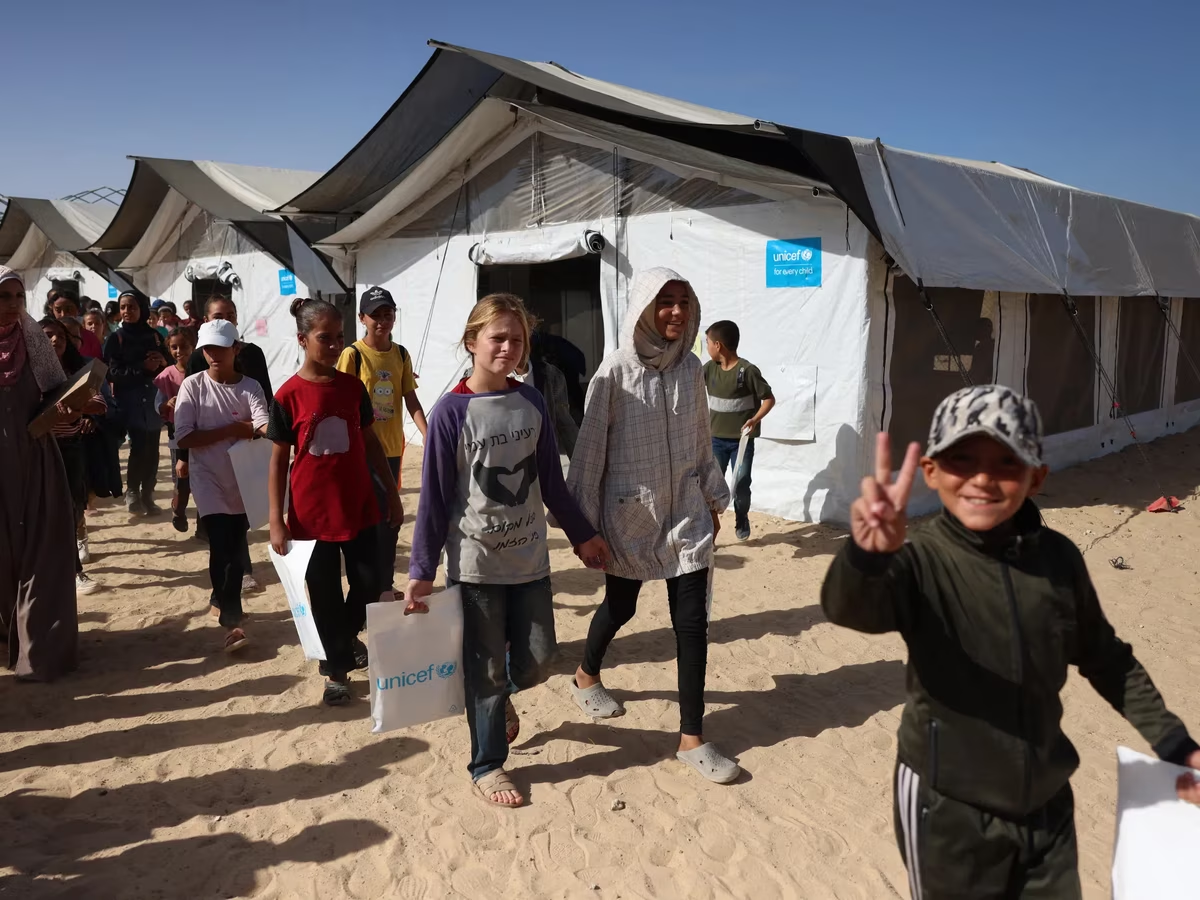
UNICEF: Continuous bombing prevents the protection of Gaza's children, and terror has become a normalized reality

The United Nations Children's Fund (UNICEF) stressed that providing effective protection for children in the Gaza Strip remains impossible as long as military operations and aerial bombardment continue. The organization clarified that the absence of safety prevents children from living their normal lives, as anxiety and fear have become an integral part of their daily lives amid a complete collapse of the childhood system.

Responsible sources in the international organization reported that children who were supposed to be in school seats or playgrounds now find themselves facing a harsh reality. They are forced daily to painstakingly search for basic necessities such as food, water, and medicine, in a desperate attempt to survive amidst conditions described by the organization as inhumane.

UNICEF spokesperson, Louise Wateridge, indicated that field reports are no longer able to keep up with the accelerating scale of atrocities, as new tragedies emerge after every report of a child's injury or death. She affirmed that psychological trauma has permeated the fabric of childhood, leaving the young in a vicious cycle of displacement, hunger, and endless diseases.

In an accurate description of the field reality, sources stated that residents are now confined to an area not exceeding 40% of the total area of the Strip, leading to dangerous overcrowding. This overcrowding was accompanied by a horrific health deterioration, reaching the point where children were exposed to attacks by rodents and rats while sleeping in dilapidated displacement centers.

Regarding human losses, data from the Ministry of Health's information unit revealed shocking figures, with 21,638 children martyred since the beginning of the aggression, representing about 30% of the total victims. More than 45,000 children were also injured with varying degrees of wounds, including about a thousand children who underwent amputations of their limbs, leaving them with permanent disabilities.

The targeting did not stop at lives but systematically affected the educational system, as data from the Ministry of Education indicates the martyrdom of more than 19,000 male and female students. Educational staff also suffered heavy losses with the martyrdom of 801 teachers and workers in the educational sector, which hinders any immediate hope of restoring the educational process.

Regarding educational infrastructure, the bombing caused the complete or partial destruction of 179 government schools, in addition to damage to 105 schools belonging to the United Nations Relief and Works Agency (UNRWA). This widespread destruction makes returning to classrooms a distant prospect even if military operations cease, given the enormous scale of destruction and lack of resources.

UNICEF concluded by affirming that any humanitarian response, no matter how strong, cannot be a substitute for an immediate cessation of violence and a sustainable flow of aid. The organization stressed that the children of Gaza desperately need to reclaim their stolen childhood, which requires securing their homes and schools and ensuring their protection from the incessant bombing.

Protection for children in the Gaza Strip cannot be provided while bombs continue to fall from the sky; terror has become completely normalized.

OPINIONS

Sun 05 Jul 2026 6:58 pm - Jerusalem Time

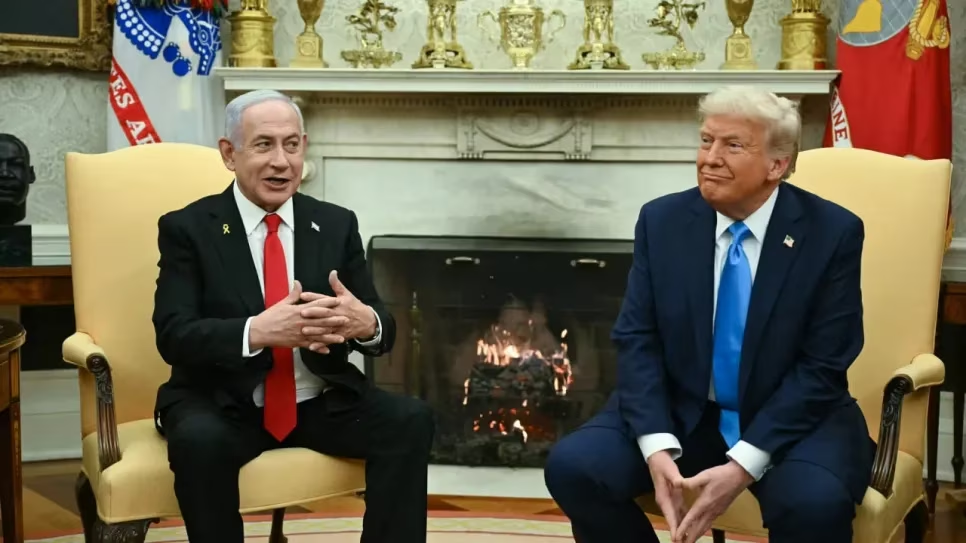
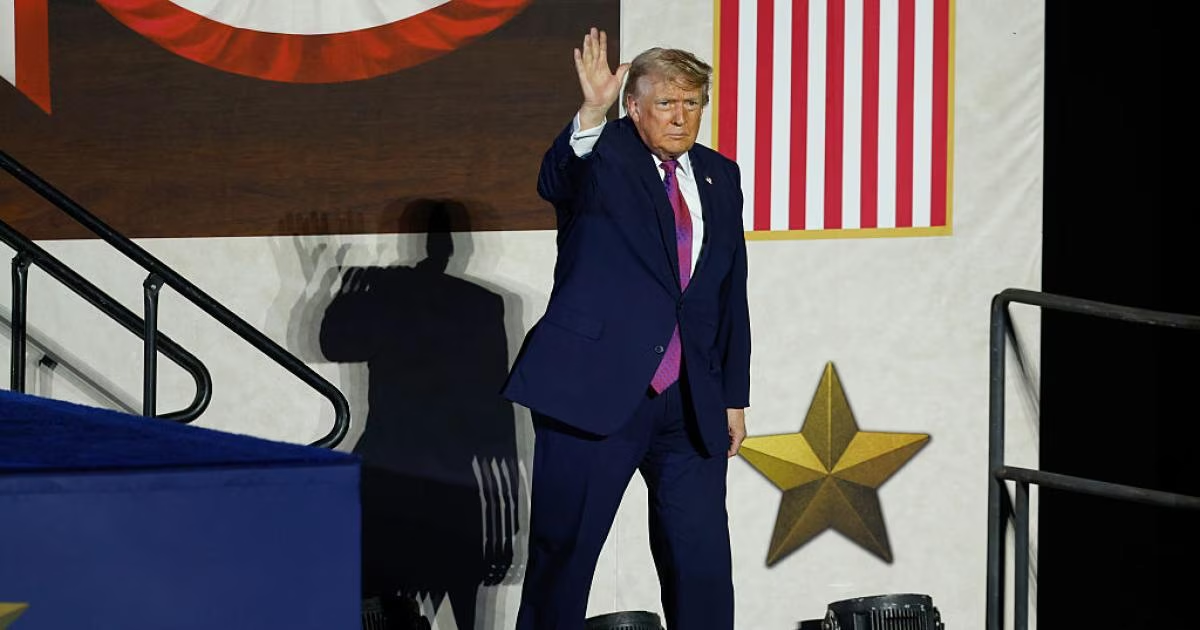
Trump Before Anticipated Meeting with Netanyahu: "He Knows Who's in Charge"

Washington's Message

Washington – Said Arikat – 5/4/2026

In a statement carrying political dimensions beyond diplomatic courtesy, US President Donald Trump said that Israeli Prime Minister Benjamin Netanyahu "knows who's in charge," ahead of a potential meeting between the two men at the White House next week or the week after, in their first encounter since the controversial meeting in the White House Situation Room on February 11th.

Trump clarified, in a brief phone interview with Axios, that Netanyahu requested a meeting in Washington, adding: "We get along very well… He knows who's in charge," in a remark that seemed aimed at highlighting his leadership position in managing the relationship with Israel, after months that witnessed clear differences between the two sides on sensitive regional issues.

According to an Israeli official, holding the meeting next week might be difficult due to Trump's commitments to the NATO summit in Turkey on July 7th and 8th, suggesting that the meeting might be postponed to the following week.

For his part, the Israeli Prime Minister's office announced that Netanyahu called Trump to congratulate him on the 250th anniversary of US independence, confirming that the two leaders agreed to hold a meeting soon in the United States. The statement added that Netanyahu emphasized during the call that the United States is a "guarantor of global freedom," and that Israel appreciates the depth of the strategic relations between the two countries.

Despite the positive atmosphere surrounding the announcement of the meeting, American sources confirm that the personal and political relations between Trump and Netanyahu are no longer as strong as they once were. Axios quoted an American official saying that a number of Trump's closest advisors are now convinced that "Netanyahu was wrong in all his assessments," a notable shift within the US President's inner circle.

The roots of this divergence date back to what followed their meeting in February, when Netanyahu proposed a plan for a joint war against Iran. However, the subsequent months saw a difference in priorities, after Trump preferred to establish a ceasefire with Tehran, and signed a memorandum of understanding to extend the truce and launch a new round of nuclear negotiations, despite Israeli reservations.

According to Axios, Trump pressured the Israeli government to reduce its military operations in Lebanon, considering that continued escalation hinders the negotiation process with Iran, and advocated for a framework agreement for an initial withdrawal of Israeli forces from southern Lebanon, which was not met with enthusiasm by Netanyahu's government.

These developments reveal a widening gap between American and Israeli calculations. While Trump focuses on achieving a diplomatic breakthrough with Iran that can be marketed as a foreign policy achievement, Netanyahu believes that continued military pressure is the most effective way to weaken Tehran and its allies.

The importance of the upcoming meeting for Netanyahu increases given his preparations for the Israeli elections scheduled for next October, while opinion polls indicate a decline in his popularity. A photo of him with the US President inside the White House would give him political momentum and send a message to the Israeli voter that he still maintains close relations with the American administration.

In a related context, Trump said he was following the funeral ceremonies of former Iranian Supreme Leader Ali Khamenei, who was killed on the first day of the war, according to the account reported by Axios. He added that negotiations with Iran would be temporarily suspended for a week until the end of the funeral ceremonies, confirming that both sides agreed during this period to refrain from any military actions.

The US President claimed that the Iranians are "begging for a deal," but he also indicated that the United States would not exploit the gathering of senior Iranian officials during the funeral ceremonies to launch a new attack, saying that eliminating them "would deprive Washington of negotiating partners." He also expressed surprise at the scenes of grief that accompanied the funeral, wondering if they were "real or artificial tears."

Trump's latest rhetoric reflects his attempt to combine a policy of military deterrence with openness to political settlement, at a time when the relationship with Netanyahu appears more complex than it was in previous years, with increasing differences in priorities between the two allies regarding the future of the war, the Iranian nuclear file, and regional security arrangements.

Trump's phrase "He knows who's in charge" reveals a shift in the nature of the relationship between Washington and Tel Aviv, as the US President no longer treats Netanyahu as a partner who sets the pace, but rather as an ally required to adapt to American priorities. The message is directed to the American domestic audience as much as it is directed to Israel, and its content is that the White House sets the boundaries of political and military action, and that support for Israel no longer means granting its government absolute freedom to formulate regional policies that conflict with American interests.

The potential meeting comes at a highly sensitive time for Netanyahu, who faces difficult elections and a decline in popularity, making any photo of him with the US President of great electoral value. However, the symbolic gain may conceal a different reality, as the American administration seems more determined to impose its agenda, whether concerning Iran or Lebanon. Therefore, the visit, if it takes place, may be an occasion to confirm the continuation of the alliance, but it will not necessarily mean full agreement in visions or a return of the relationship to its former state.

Data indicates that the disagreement between Trump and Netanyahu is no longer a tactical one, but has become linked to a difference in each party's perception of the regional order after the war. While Trump seeks to use the truce and negotiations with Iran to build new security arrangements that would give him a diplomatic achievement, Netanyahu prefers continued military pressure to prevent Tehran from regaining its influence. This disparity may make the relationship between the two men based on common interests, but less harmonious and more prone to tension whenever the political and strategic calculations of the two parties conflict.

PALESTINE

Sun 05 Jul 2026 6:57 pm - Jerusalem Time

Among the Graves.. The Story of a Gazan Family Displaced by Aggression to Khan Yunis Cemeteries

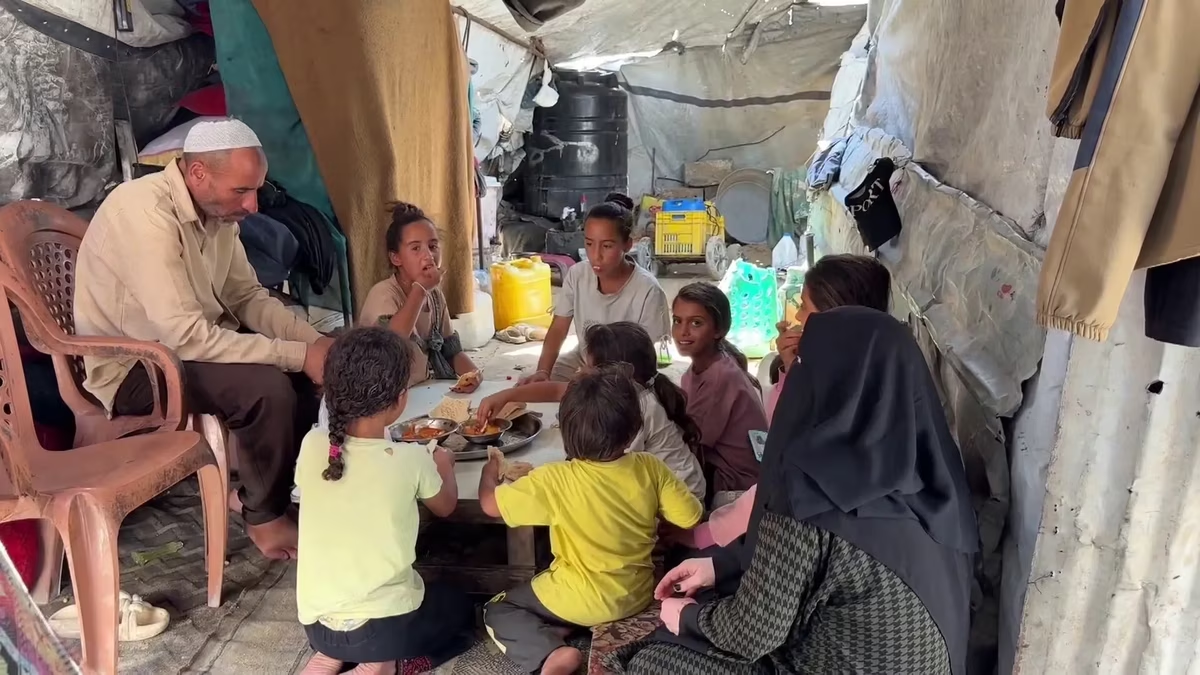
The tragedy of displacement in the Gaza Strip is embodied in its harshest forms in the story of citizen Mazen Younis's family, who found no refuge from the ravages of the Israeli aggression except the cemetery of the Austrian neighborhood in the Mawasi area of Khan Yunis. This family, consisting of ten members, was forced to leave their home in the Manara neighborhood, embarking on a journey of dispersion that ended among the graves of the dead, in the complete absence of safe shelter options.

The head of the family, burdened by illness and worry, recounts how he returned from a medical treatment trip in the West Bank in 2025 only to be shocked by the bitter reality his family was living. He found his children and wife facing inhumane conditions, where the cemetery had become a makeshift dwelling lacking the most basic necessities for a dignified life, amidst a complete international silence regarding the suffering of civilians.

For more than a year and a half, the family has been living inside a primitive tent surrounded by worn-out canvas barriers separating them from tombstones and graves. The suffering is exacerbated by the spread of insects, rodents, and scorpions, which have become a constant threat to the lives of young children, who spend their day in an unhealthy environment lacking potable water or sanitation.

Field sources reported that Mazen Younis's health has deteriorated significantly, as he suffers from heart disease and a sharp decline in his weight, which dropped from 120 kilograms to 67 kilograms. Younis attributes this deterioration to his difficult psychological state and malnutrition, as well as his feeling of helplessness in meeting his children's basic needs, which he cannot provide.

Mazen's young daughters bear a burden beyond their years, as they go out daily on arduous journeys to fetch water and secure meals from charitable 'takayas' (soup kitchens). Instead of going to school, they spend long hours in queues, reflecting the extent of the loss faced by an entire generation of Gaza's children due to the ongoing war and displacement.

For her part, Mazen's wife described living in the cemetery as 'a complete marginalization of humanity,' noting that the scorching summer heat makes staying inside the canvas tents unbearable. She confirmed that the family lacks cooking gas and essential life supplies, forcing them to rely on very primitive means to manage their simple daily affairs.

The Younis family's situation is not an isolated exception in the Gaza Strip; rather, it is part of a painful phenomenon observed by journalistic sources, where thousands of displaced people have set up their tents inside the western cemeteries in Khan Yunis. These displaced people, most of whom came from the northern part of the Strip, found themselves crowding the dead in their places after the earth, despite its vastness, became too narrow for them.

Reports from the area indicate that the cemeteries are no longer even large enough for the dead, yet they are crowded with hundreds of families searching for lost safety. Observers describe the scene as 'very harsh,' especially when children play among the graves, in a reality that forces them to coexist with death and destruction on a daily and direct basis.

The plea made by Mazen Younis remains a cry in the wilderness, demanding the necessity of neutralizing children and civilians from the war machine and providing shelter that preserves their dignity. With the aggression continuing, these families remain caught between the hammer of displacement and the anvil of living in cemeteries, awaiting a solution that will end this humanitarian tragedy that has exceeded all limits.

My children fetch water and get tired instead of going to school, and they have nothing to do with this war waged by the occupation.

OPINIONS

Sun 05 Jul 2026 10:28 am - Jerusalem Time

Lobbies in Palestine: Invisible Influence Networks and Decision-Making Between Politics, Economy, and Society

Dr. Ibrahim Nairat

Opinion Writer

In the Palestinian context, the political scene does not appear as it is presented in official discourse, government statements, or inter-factional exchanges. Behind this declared surface, a more complex system operates, where politics intertwines with economics, society with family, and external funding with internal decision-making, forming a network of influence that is difficult to grasp directly, yet is present in the details of daily political life. This network, which can metaphorically be described as "lobbies," is not a single entity or a specific organization, but rather a system of informal relationships that reproduce power and guide decisions outside traditional institutional frameworks.

In this investigation, it is not about claiming the existence of a "conspiracy" or a single center directing decisions, but rather about understanding the mechanisms of invisible influence that form in a political environment characterized by division, multiple centers of power, weak unified institutions, and continued reliance on external funding. This environment makes it natural for personal relationships, social networks, and organizational loyalties to take precedence over strict institutional rules.

Studies published by Cambridge University Press on governance and the role of NGOs in Palestine indicate that the flow of external funding to civil society organizations was not merely developmental or humanitarian support, but also contributed to reshaping the structure of actors within society. Some of these organizations, according to academic analysis, no longer operate solely according to local priorities stemming from the social base, but rather according to funding conditions and criteria of external donors, which led to the emergence of a class of intermediaries between the internal and external, controlling the flow of resources and redefining public priorities.

This transformation produced what resembles an undeclared "civil lobby," which does not exert direct political influence, but affects the formulation of public discourse, the direction of projects, and the determination of who receives funding and who is marginalized. Over time, some civil society organizations became part of a broader network of influence where politics intersects with international funding, and local agendas mix with donor priorities.

In parallel, studies published in the Journal of Palestine Studies, along with the works of researcher Rex Brynen, provide a deeper picture of the structure of Palestinian political elites after Oslo. These literatures indicate that the process of state-building did not lead to a clear separation between state and society, but rather reproduced elite networks that rely on loyalty and internal relationships as much as they rely on official institutions. These elites do not operate only within party frameworks, but within overlapping circles of personal, organizational, and interest-based relationships, making the decision-making process a product of internal balances rather than the application of clear institutional policies.

In this context, access to political decisions itself becomes a complex negotiation process between multiple centers of influence within factions and institutions, where organizational considerations intersect with personal calculations, and power is continuously redistributed according to unwritten balances.

Economics, in turn, is not outside this equation. According to political economy analyses published in works such as Profit over Palestine via OpenEdition Books, it is clear that the relationship between capital and power in the Palestinian context is not a separation between two sectors, but a deeply intertwined relationship. Networks of interests form between businessmen and political circles, producing a pattern that can be described as crony capitalism, where the market does not operate independently of political influence, but within it and under its shadow.

In this model, money is not only used for production or investment, but also as a tool of political influence, whether through funding, partnerships, or control over vital economic sectors. This overlap makes it difficult to distinguish between economic and political decisions, as each becomes an extension of the other within a single network of interests.

As for civil society, it has undergone a profound structural transformation over recent decades, as illustrated by "NGOization" studies published through academic platforms such as ULiège ORBi. A large part of civil and activist work has been transformed into professional organizations that rely on external funding and operate according to specific programs and donor criteria. This transformation, although it enhanced organizational capabilities in some areas, also contributed to creating a gap between institutions and the popular base, and reshaped civil society as part of a financial management network rather than an independent social pressure movement.

In this framework, civil society itself becomes part of an indirect influence system, where politics intertwines with funding and institutional reputation building, and some organizations transform into intermediary actors between the Palestinian interior and the outside world.

This structure cannot be separated from the traditional social role, where family, clan, and local ties still play an effective role in shaping influence, especially at the local level. In elections, in employment, and in conflict management, these ties remain an influential element, operating not outside the state, but within it and in parallel with it. This overlap adds an additional layer of complexity, where power is not confined to official institutions, but distributed across a wide social network.

In the background, the international dimension remains a crucial element. The Palestinian issue is not a closed internal issue, but an open space for multiple international and regional influences, through political and financial support, or through diplomatic pressure, or through indirect influence on the priorities of local actors. This connection makes the Palestinian decision part of a broader network of international relations, where local calculations intersect with regional and international balances.

When these elements are combined—political elites, economy, civil society, social structure, and the international dimension—it becomes clear that what is called "lobbies" in the Palestinian context is not a separate entity or an accidental phenomenon, but a description of a structural network of influence operating within the political system itself. This network does not abolish institutions, but redefines their role and boundaries, and makes political decisions the result of a constant interaction between the official and the unofficial.

The fundamental problem revealed by this structure is not about the existence of influence itself, but about the absence of clear boundaries between institutions and networks, between law and relationships, between state and society, and between internal and external. This absence creates a state of political fluidity, where centers of power constantly change, public trust in institutions remains vulnerable to fluctuation, and it is difficult to build a political system based on stable and clear rules.

Ultimately, politics in Palestine cannot be understood as merely a system of institutions, but as a complex structure of layers of influence and impact, where official and unofficial forces operate in a wide gray area, where decisions are sometimes made away from the spotlight, but in all cases determine the entire political reality.

OPINIONS

Sun 05 Jul 2026 10:27 am - Jerusalem Time

Deconstructing the US-Israeli Colonial Relationship

"A comparative reading of ethnic cleansing against Native Americans and Palestinians, from the fabrication of pretexts to massacres and the question of destiny."In deconstructing the historical US-Israeli relationship and the unlimited and endless support from Washington for Zionist gangs before 1948 and subsequently for Israeli governments of various political colors in their war against the Palestinian presence on their historical land, it is essential to foresee what the history of the extermination of indigenous peoples in America says about the future of Palestine and its people. Especially since both cases are closely similar: settlers came from across the seas and the ends of the earth to slaughter and expel a people living on land inherited generation after generation.In America, all projects of extermination, displacement, and cultural killing did not fully succeed in erasing the original identity of North America: after nearly two and a half centuries of attempts at obliteration, more than five hundred federally recognized indigenous nations in the United States today are still fighting legal battles to reclaim lands, water rights, and sacred sites, and are witnessing a clear linguistic and cultural revival. In recent decades, they have received official recognition and belated government apologies, proving that the collective spirit of resistance cannot be erased by force alone. However, the price paid was immeasurable, including the loss of more than ninety percent of the indigenous population during the first four centuries of colonization, according to most historical estimates, and the transformation of entire peoples from owners of a continent into a marginalized minority living on the fringes of geography and politics in their original lands. This is precisely the fate that a segment of the right-wing settler movement in Israel today is trying to impose on Palestinians, through forced displacement plans sometimes openly declared by Israeli officials, through escalating settlement expansion in the West Bank, and through the policy of "gradual emptying" of Gaza of its inhabitants under the pretext of "reconstruction" or "humanitarian areas."Perhaps the fundamental difference that gives Palestinians a margin not available to indigenous peoples in America is that their battle has not yet been decided. International law, despite all its inability to deter, still recognizes the right to self-determination for the Palestinian people, and global public opinion—especially among younger generations in the West itself—is gradually shifting in favor of the Palestinian cause after recent years of war, and Palestinian steadfastness on the land (a "sumud" that parallels the insistence of Native American nations to survive against all odds) remains a daily tool of resistance no less important than any armed resistance.The lesson offered by the experience of Native Americans is twofold: a warning that settler colonialism, when left without a real international brake, and at the same time a testament that peoples targeted for annihilation never completely disappear, and that narrative, identity, and belonging to the land can survive even the cruelest attempts at extermination, to return and demand—even if belatedly and with enormous sacrifices—their right to justice, recognition, and land.The question posed to the world today is not whether the comparison between the two experiences is "accurate" in every detail, but whether the world is ready this time, unlike two centuries ago, to intervene before it is too late, instead of merely offering a belated apology decades and centuries after the crime has occurred.Historical Approaches Between Two ColonialismsIn the summer of 1890, about three hundred Lakota Indians, mostly unarmed women, children, and elders, surrendered at Wounded Knee Creek in South Dakota to the United States Army. Within an hour, soldiers emptied their machine guns into the crowd. This was not an isolated incident, but a logical conclusion to a project that lasted nearly four centuries: replacing one people with another, and transforming an inhabited land into an empty "promised land" waiting to be settled.A little over a century later, in another part of the world, the same vocabulary is repeated: "settlement," "evacuation," "security," and "a land without a people for a people without a land." Palestine is not America, and the time is not the same, but the colonial structure upon which both projects are based is almost an exact replica: an indigenous people to be uprooted, a religious narrative mobilized to justify the uprooting, massacres creating "facts on the ground," and institutions reshaping geography and memory simultaneously.Institutionalized Religious Myth... A Cover for Bloody TerrorThe colonization of North America was not merely an economic adventure. The early settlers who landed on the shores of New England in the seventeenth century saw themselves as the "new Israelites" escaping the bondage of Europe to the American "promised land," and their speeches and documents were filled with biblical metaphors about "Canaanites" from whom the land must be cleared. In the nineteenth century, the concept was formulated in the phrase "Manifest Destiny," which presented settler expansion as a divine will, not merely a state policy. The "Doctrine of Discovery," issued by the papacy in 1493, granted Christian kingdoms the "legitimacy" to seize any land inhabited by non-Christians, and this principle remained a legal basis relied upon by American courts until the nineteenth century to justify the confiscation of indigenous lands.The same religious pretext, though its doctrinal details differed, was present in the Zionist project. The founding discourse, from the First Zionist Congress in Basel in 1897 and from the "Balfour Declaration" in 1917 until today, blended a secular European-born nationalism with a selective invocation of religious text to justify settlement. This blend was particularly solidified in settler movements such as Gush Emunim, which emerged after the 1967 war and saw the West Bank as a "promised land" that should not be relinquished. The result in both cases is the same: transforming a purely political-military operation, the seizure of inhabited land from its people, into a "sacred mission" that transcends moral and legal debate.Institutionalization and Framing of Ethnic CleansingColonialism in North America did not stop at settlement but was based on a series of massacres and forced displacement projects that became state policy. The "Indian Removal Act" of 1830 led to the "Trail of Tears," when tens of thousands of Cherokee, Choctaw, and Creek people were uprooted from their lands east of the Mississippi River and marched in forced marches during which thousands died from hunger, cold, and epidemics. In California in the mid-nineteenth century, the local government funded "bounties" for the scalp of every Indian killed, as part of an organized extermination campaign that wiped out the majority of the state's indigenous population within two decades. Then came the Sand Creek Massacre in 1864 and the Wounded Knee Massacre in 1890, closing a chapter of armed resistance with direct mass killing.The scene in Palestine was no less brutal. During the Nakba in 1948, Zionist gangs uprooted most of the Palestinian people from their homes, and more than 531 towns, villages, and communities were erased from the map, either by demolition or by renaming and colonial settlement over their ruins. The displacement process was not "peaceful" as the official Israeli narrative tries to portray it; rather, it was accompanied by direct massacres, the most famous of which were the Deir Yassin massacre in April 1948, the Tantura massacre, and the death march from the cities of Lydda and Ramle, where residents were forced to walk long distances under the summer heat without water, and many died along the way. Since then, massacres have continued: Kafr Qasim 1956, Sabra and Shatila 1982, Ibrahimi Mosque 1994, leading to the ongoing aggression on the Gaza Strip since October 2023. Despite a ceasefire agreement coming into effect in October 2025, the Israeli killing machine continues to claim lives in a pattern reminiscent of the "minor wars of extermination" that continued against Native American nations for decades after the major wars officially "ended."Post-Physical Extermination - Erasing Culture and MemorySettler colonialism does not stop at land and body but extends to language, name, and memory. In America, since the late nineteenth century, "boarding schools" were established for indigenous children, where they were forcibly removed from their families and forbidden to speak their languages or practice their rituals, under the explicit official slogan: "Kill the Indian, save the man." Thousands of children died in these schools from hunger, disease, and neglect, and the American government officially acknowledged this fact more than a century after it occurred. The goal was openly declared: to liquidate the collective identity of indigenous peoples, not just their physical existence.In Palestine, the erasure of memory takes different forms but leads to the same path: renaming villages and streets with Hebrew names, confiscating and smuggling Palestinian archives, restricting education and curricula in Jerusalem and the occupied interior, criminalizing the commemoration of the Nakba and even raising the Palestinian flag and wearing the keffiyeh, in addition to a continuous siege of Palestinian cultural institutions in Jerusalem, and systematic destruction of universities, libraries, and archaeological sites in Gaza during the recent war. The goal in both cases is not only to empty the land of its people but to empty the collective memory of its narrative, so that the "absent" becomes without a trace proving that it was once "present."Geographical Control EngineeringAfter the suppression of armed resistance by Native Americans, the United States resorted to confining indigenous populations to sovereign-free "reservations," geographically divided and scattered without communication, under direct administrative guardianship of the federal government, and their natural resources were subjected to the needs of settlers, not their indigenous inhabitants. The result was economically isolated communities, still suffering today from the highest rates of poverty, unemployment, and health and psychological problems among all groups in the United States.In the West Bank, Gaza, and even the territories occupied in 1948, the pattern is repeated with contemporary tools: dividing the West Bank into areas "A," "B," and "C" devoid of geographical connection, a network of checkpoints, bypass roads, and a separation wall that keeps Palestinian communities as scattered enclaves, and a suffocating siege on the Gaza Strip that controls the entry of food, medicine, and fuel. Settlement in the West Bank, where the settler population has exceeded 700,000, continues to expand over the very land that is supposed to be the focus of any political solution, just as Indian "reservations" shrank year after year whenever wealth was discovered there or settlers needed it.Why is the term "genocide" invoked?Many in the West, and in Israel specifically, reject comparing the two experiences, arguing differences in historical context, scale, and time, and consider describing what happened and is happening in Gaza as "genocide" to be a political, not legal, description. This is a real and ongoing dispute: while international human rights organizations, UN officials, and a preliminary ruling by the International Court of Justice in January 2024 speak of a "plausible risk" of genocide in Gaza, Israel and the United States officially reject this description, describing military operations as "self-defense" against armed organizations. Similarly, American historians have debated for decades the description of the fate of Native American nations: was it an intentional "genocide," or a "catastrophe" primarily resulting from epidemics against which no one had immunity? Most historians today suggest that epidemic and organized violence combined: settler policies, wars, and forced displacement were what transformed epidemic vulnerability into a near-complete demographic collapse, rather than mitigating it.This debate between the two experiences does not negate the argument that the American official establishment's fear of applying the comparison domestically underlies the US position supporting the Israeli entity, even though the matter for Palestine is clearer and more mature. Native American nations did not have an internationally recognized state or regional allies, while the Palestinian cause enjoys international recognition of the right to self-determination and support from dozens of countries. Moreover, contemporary media and digital documentation make what is happening in Palestine today visible to the entire world in real-time, unlike what happened to indigenous peoples, which remained out of sight for many long decades.

OPINIONS

Sun 05 Jul 2026 10:27 am - Jerusalem Time

Is Israel Entering a Phase of Full Fascism?

The crisis Israel is experiencing today does not represent a break from its political history, but rather an extension of a long process of reshaping the state according to the requirements of the colonial-settler project. The recent crisis between the Israeli government and the Supreme Court does not appear to be merely a legal dispute over institutional powers, but rather reflects a deeper conflict over the nature of the political system taking shape within Israel. The escalating questioning of the court's decisions, and the calls from figures in the Netanyahu-Ben Gvir-Smotrich coalition to limit its powers or override its rulings, cannot be read in isolation from the path that began before the war of extermination on Gaza, when Benjamin Netanyahu's government proposed its project to reshape the judiciary and subject it to the hegemony of the executive branch. In early 2023, Israel witnessed the largest wave of protests in its history, in objection to what was called the "judicial reform." The objection at that time was not limited to opposition parties, but extended to academic, economic, and military circles, and reached thousands of reserve soldiers who warned that undermining the independence of the judiciary threatens the cohesion of the state and its institutions. When the war of extermination on Gaza broke out, this conflict temporarily receded under the weight of military mobilization, but it did not end. Rather, it has returned today in a more acute form, having become more linked to the future of the ruling coalition itself. However, reading this crisis requires caution against falling into a common assumption, which is that Israel was a stable "democratic" model and then today began to deviate towards absolute authoritarianism. This description ignores the fact that the Zionist project, since its inception, was based on a colonial-settler foundation that cannot be democratic, and that the Palestinian people were never part of the "democracy" that has long been marketed as Israel's distinguishing feature. Since its establishment at the expense of the rights of our Palestinian people, their land, and their resources, state institutions have been associated with colonial settlement, land confiscation, occupation, racial discrimination, denial of national rights, and attempts to erase Palestinian identity and liquidate the national cause. Therefore, the ongoing transformation is not Israel's transition from "democracy" to fascism, but rather its transition from a colonial-settler system that maintained, within Israeli society itself, a degree of institutional balances, to a more extreme system, in which even those internal constraints that regulated the relationship between authorities and gave the state an institutional image before the world are receding. However, stopping at the constitutional crisis alone is not enough to understand the Israeli scene. Despite the sharp division between the government and the opposition over the judiciary and the limits of executive power, the political stances and electoral programs of most Zionist parties reveal an almost complete consensus on the fundamental issue, which is the rejection of the establishment of an independent, sovereign Palestinian state in accordance with international legitimacy resolutions and international law. More importantly, this consensus is not limited to internal issues, but extends to the core of the conflict with the Palestinian people. All Zionist parties, although they differ in language and style, agree on rejecting a full withdrawal from the occupied territories, maintaining Israeli control over Jerusalem and most of the territories and its right to expand settlement in Area C according to the Oslo Accords, and over borders, crossings, security, and natural resources, while proposing different formulas for a limited-power Palestinian self-rule, based on managing the population within separate geographical enclaves, in addition to special arrangements for the Gaza Strip that do not stem from ending the occupation, but from reorganizing its administration and the continued risks of displacement, especially in the Gaza Strip and refugee camps in the West Bank. This means that the conflict within Israel is not a conflict between a peace project and an occupation project, but between different visions for managing the colonial-settler project itself. Therefore, relying on changing the government alone, or on the results of the upcoming Knesset elections next November, as an entry point for a fundamental change in Israeli policy towards the Palestinian people, finds no support in the declared political programs of all Zionist forces, and may thus be a political distraction that some want to be preoccupied with. Hence, the question today is not limited to whether Israel is heading towards a constitutional crisis, but whether it is entering a new phase in the development of its political project, in which even the institutional constraints that governed its internal structure for decades recede, in favor of a more integrated model between settler colonialism, extremist religious nationalism, and the concentration of executive power. This transformation may have another equally important dimension. With the growing critical voices against Israel within American society, especially among younger generations, in academic circles, and within increasing sectors of the Democratic Party, the Israeli right may seek to fortify its political project internally, and reduce any institutional constraints that could limit its policies, in preparation for dealing with an international environment that may become less lenient than it was in past decades. In this context, the executive branch's overreach may not be merely an internal matter, but part of a strategy aimed at strengthening the government's ability to confront any future external pressures. It is still too early to definitively state that Israel has indeed entered a phase of full fascism, but the indicators warrant serious consideration. When the judiciary becomes a target for delegitimization campaigns, when state institutions are reshaped to serve a racist ideological project, and when extended war is used to enhance the concentration of power and weaken oversight, the matter goes beyond the limits of traditional political disagreement, to reflect a transformation in the nature of the system, increasingly acquiring authoritarian and fascist characteristics in its political structure and practices. What is happening today does not change the essence of the colonial-settler project upon which Israel was founded, but rather reveals it more clearly and frankly. What was presented for decades as a "democracy oasis" is today exposed by its internal contradictions, while the Zionist consensus continues to deny Palestinian national rights and reject any political project that could lead to any historical settlement that would undermine their colonial project. From here, the ongoing transformations within Israel not only necessitate a re-reading of the nature of its political system, but also a review of many of the assumptions that governed Palestinian political thought over the past decades. If Israeli disagreements revolve around the form of government and the mechanisms of power distribution, while the rejection of the establishment of a Palestinian state remains a consensus among all Zionist forces, then the Palestinian national liberation project is required to rebuild its strategy based on this reality, not on betting on changes in Israeli governments, but on strengthening broad Palestinian national unity, investing in transformations in the international system, strengthening common solidarity with all progressive forces around the world, including anti-Zionist Jewish forces, and continuing the political, legal, and popular resistance struggle until the end of the occupation and the embodiment of the right to self-determination and an independent, sovereign Palestinian state. * Member of the Fatah Movement's Advisory Council.

OPINIONS

Sun 05 Jul 2026 10:27 am - Jerusalem Time

A Reading on the Peace Council's Decision to Cancel UNRWA's Work in Gaza

In a move with deep political implications, the so-called "Peace Council," established by US President Donald Trump in the wake of the alleged ceasefire in the Strip, has once again stirred controversy regarding the future of the United Nations Relief and Works Agency for Palestine Refugees (UNRWA) in Gaza. This was done by calling for an end to the agency's role and the abolition of its headquarters in the Strip. This call cannot be read in isolation from the broader political context, especially in light of discussions about Gaza's reconstruction projects and the accompanying proposals regarding the identity of those responsible for managing the Strip in the post-war phase. This step raises crucial questions about the future of the refugee issue, international arrangements in the Palestinian territories, and the nature of the ongoing political conflict. The "Peace Council" and the redefinition of the conflict... The statements of the "Peace Council" were not limited to administrative aspects but revealed a political vision aimed at "emptying the Palestinian cause of its essence as a people suffering under Israeli occupation, and reducing the conflict to merely a humanitarian aid issue." This approach, as described by the "Resistance Committees in Palestine," represents a "comprehensive destructive project targeting both the people and the cause." UNRWA is not just a relief organization; it is an embodiment of international recognition of the continuity of the right of return and a symbol of the Palestinian cause in international forums. Therefore, targeting it is read as an attempt to impose a new political reality that negates the national dimension of the conflict. The legal dimension and the impossibility of administrative cancellation. Palestinian factions and forces believe that these calls "reveal a clear bias towards the Israeli agenda, with the aim of canceling the right of return and undermining established national rights." They affirm that the agency was established by UN General Assembly Resolution No. 302 of 1949, and its dissolution can only be achieved by a similar resolution from the General Assembly. This legal dimension grants UNRWA immunity against any unilateral decisions, as attempting to circumvent it does not negate the historical and legal rights of refugees. UN Secretary-General António Guterres warned that any infringement on the agency's work or property is a violation of international law and the 1946 Convention on the Privileges and Immunities of the United Nations. Are we facing an alternative UNRWA? Strategic studies indicate the existence of American and Israeli trends calling for the dismantling of UNRWA, considering the Gaza Strip as the "strategic starting point" for achieving this. The scenario of replacing it with other UN agencies such as the World Food Programme and the World Health Organization, or relying on a local body supported by Arab and international forces, is being proposed. However, this path faces many obstacles; most notably the enormous service vacuum that the agency will leave, especially in the absence of a local authority capable of assuming responsibility, in addition to the bureaucratic and logistical complexities of transferring tasks employing nearly 29,000 employees, the majority of whom are refugees themselves. Repercussions of the decision on the humanitarian situation. In light of the suffocating humanitarian crisis in the Gaza Strip, any infringement on UNRWA's work is a direct threat to the lives of millions. The agency is considered the "backbone" for providing education, healthcare, and food aid to more than 5.9 million Palestinian refugees. The factions warned that strengthening support for UNRWA and ensuring its continuity, especially in Gaza, which is suffering from a severe humanitarian crisis, is the "highest degree of responsibility." Therefore, discussing cancellation at this time entails deepening suffering and creating a humanitarian vacuum that other parties may not be able to compensate for. Conflict of influence. The UNRWA file carries regional and international dimensions, as it is seen as an arena for the struggle for influence. Donor countries and international actors face varying pressures between calls for reform or cancellation. In this context, some sources indicate that the United States seeks to grant the "Peace Council" broad powers similar to a "new United Nations" in which selected countries make decisions, which raises Western concerns about creating a parallel mechanism to the United Nations without international legal basis. The "Peace Council's" call to cancel UNRWA's work in Gaza is not merely an administrative measure, but a link in a long political struggle aimed at redefining the nature of the Palestinian-Israeli conflict, and here we recall the saying of the late revolutionary sage George Habash, "The conflict may extend for a hundred years or more, so those with short breath should step aside." Despite the significant challenges facing the agency, the attempt to erase it clashes with legal, humanitarian, and political realities. UNRWA remains, for now, the international umbrella for refugee rights and the most prominent guarantor of the continuity of their cause on the international agenda, and any attempt to circumvent it requires a comprehensive political settlement, not unilateral decisions aimed at imposing a new reality by force. * Media File Official at the National Popular Conference for Jerusalem

OPINIONS

Sun 05 Jul 2026 10:27 am - Jerusalem Time

A Tribute to the Presbyterian Church for its Principled Stance

The American Presbyterian Church recently voted in favor of recognizing the genocide in Gaza, a position also adopted by many churches and Christian spiritual authorities in America and throughout the world. While we express our gratitude to the Presbyterian Church for its humanitarian and ethical stance, and for adopting the Kairos Palestine document, we call upon and urge all Christian churches in our world to adopt this document and to clearly and explicitly declare principled humanitarian and ethical positions regarding the suffering of our people, especially in the afflicted Strip. Our appeal is sent from the heart of our holy city to all Orthodox, Catholic, and Evangelical churches in America and throughout the world. Advocating for an end to the suffering of the Palestinian people and siding with the justice of this cause should not be reduced to merely a political matter; rather, it is a profoundly humanitarian, ethical, and spiritual issue. We reject the use of ornate diplomatic language when discussing the suffering of the Palestinian people, merely to appease this party or that. The war of extermination and the pain and suffering of our people do not require diplomatic statements; rather, they require clear, bold, and strong stances aimed at achieving justice and freedom, ending the occupation, and calling for a true peace built on respect for human freedom and dignity. We hope that the Presbyterian Church's stance will encourage other churches to take similar positions, for silence is not permissible, nor is ignoring the suffering of this oppressed people. The Holy Gospel is full of verses that always urge siding with every oppressed, suffering, and tormented person. Christianity does not call us to silence when we should openly declare the values of our faith, our humanity, and the ethical principles we should advocate for. Siding with the oppressed Palestinian people is not interference in a political matter; rather, it is at the core of sublime Christian values and principles. The 'least of these brothers' of Jesus, whom the Bible speaks of, are the oppressed and suffering in this world, especially in Palestine, the Holy Land, and particularly in the afflicted Strip. Our appeal is directed to all Christian churches in America not to succumb to any pressure or blackmail from any party whatsoever. The Presbyterian Church, which we thank from the bottom of our hearts for its stance expressed in its recent statement, has stood in the right place in history and taken a position consistent with the values of the Gospel and its message in this world. And as we appreciate the positions issued by churches and Christian authorities in the world regarding the war of extermination, we call for these positions to be clearer and bolder. What we want from Christian churches in America and the West is to raise their prayers for Palestine, crucified like its Lord, and for afflicted and tormented Gaza. Light your candles with the intention of peace, and for the oppressed Palestinian human being, may this light illuminate the darkness of this world and change the face of humanity, so that it may be a face of greater justice, fairness, and solidarity with the tormented and oppressed human. Yes, we want your prayers, because we believe that the God we pray to and worship is indeed the supporter of the weak, the oppressed, and the suffering everywhere. And with prayer, we also want clearer positions. Do not be afraid of any political entity, for the prophetic voice that must come from church leaders must not take into account any political entities that may be annoyed by these positions. The prophetic voice of the Church must be committed to the values of Christian faith, without working to appease any political entity, for our first and last concern is to please God, and we do not care much if this political entity or that is pleased with us. The voice of the Church in the West must be a Christian voice par excellence, not afraid to speak the word of truth before any unjust authority. And I say to the churches and Christians in the West: If you want to be true Christians, you must reject the injustices suffered by the Palestinian people, and call for the achievement of justice and peace in a land from which justice and peace have been absent for many years. We are not advocates of wars or a culture of revenge and killing, for a human being, for us, remains a human being, whatever their religion, background, or skin color, for all human beings belong to one human family created by God, and when one member suffers, the whole body suffers. And we learn from our divine book that we must live joy with the joyful, and pain with the suffering. So we rejoice with every human being who lives joy, and we suffer with every human being who lives pain, suffering, loss, and deprivation. And Palestinians live pain, and they have been condemned to be besieged, their freedom violated, and they are targeted in their lives and in all the details of their lives full of pain, aches, and suffering. Thank you to the Presbyterian Church, and to all churches that speak the word of truth in these difficult times. And no matter how long it takes, truth must triumph over falsehood, and good must triumph over evil, and the oppressed Palestinian human being must enjoy the long-awaited freedom, for which they have made an enormous amount of sacrifices. * Archbishop of Sebastia for the Greek Orthodox

ARAB AND WORLD

Sun 05 Jul 2026 10:19 am - Jerusalem Time

Thousands of protesters block roads to 'Alternative' party conference in Germany amid security reinforcements

Thousands of demonstrators gathered in the city of Erfurt, eastern Germany, on Saturday, to express their categorical rejection of the policies of the far-right 'Alternative for Germany' party. Protesters carried out extensive closures of the main roads leading to the convention center hosting the party's annual meeting, in a symbolic and practical attempt to obstruct the arrival of participating delegations.

According to estimates from field security sources, the number of participants in these protests exceeded 15,000 people, spread around the city and its center. German authorities mobilized riot police, with additional police reinforcements brought in from other federal states to ensure that the situation did not get out of control and to secure the conference.

Trade unions and civil society organizations, along with left-wing political forces, formed the backbone of these protest movements, which were characterized by sitting in the streets to block traffic. Demonstrators raised slogans warning of the rise of the far-right and its threat to democratic values and pluralism in German society, under close security surveillance by security forces.

Meanwhile, the 'Alternative' party renewed confidence in its current leadership by re-electing Alice Weidel and Tino Chrupalla to lead the party for a new term. This step comes at a time when the party is witnessing a remarkable rise in national opinion polls, where it is strongly competing and sometimes surpassing the conservative bloc led by Friedrich Merz.

_The opening sessions of the conference were marked by a sharp escalation in tone, with party leaders describing the protesters outside as 'enemies of democracy'. Alice Weidel, in her speech to the conferees, emphasized the party's hardline stances, stressing that Germany would not be a place for illegal immigrants, and promised to adopt unprecedented deportation measures if the party came to power.

For his part, the controversial leader Björn Höcke delivered a speech focusing on what he considered a decline in the level of services and general conditions in the country, using daily issues to confirm his vision of 'state deterioration'. This discourse reflects the party's strategy to attract voters by focusing on livelihood crises and linking them to the current government's policies regarding immigration.

These political movements gain double importance as they precede crucial local elections in the states of Saxony-Anhalt and Mecklenburg-Vorpommern in the east of the country. Through this conference, the party seeks to translate its growing popularity in polls into actual electoral gains that enable it to directly influence political decision-making within the German states.

Criminals and illegal immigrants have no place in Germany, and we will work on strict deportation policies.

PALESTINE

Sun 05 Jul 2026 10:19 am - Jerusalem Time

Warnings of imminent danger threatening the life of Dr. Hussam Abu Safiya inside the occupation prisons

A human rights association has issued strong warnings about a rapid and dangerous deterioration in the health condition of Palestinian doctor Hussam Abu Safiya, who is detained in Israeli occupation prisons. Sources clarified that the doctor faces an imminent danger threatening his life after being recently transferred to the underground interrogation section in Ramla Prison, where these cells lack the most basic human and health necessities.

According to the testimony of the defense lawyer who was able to visit him two days ago, Abu Safiya's body showed clear signs of brutal torture, including bruises and severe injuries to the head, around the eyes, ears, and neck. The lawyer stated that his client appeared in a state of extreme exhaustion and general weakness, as he found it very difficult to breathe or continue speaking fluently as a result of the abuse he was subjected to.

The lawyer conveyed from the captive doctor details of a brutal assault he was subjected to inside his cell, where between four and five jailers severely beat him all over his body without regard for his health condition. These assaults come under harsh detention conditions, where the doctor remains constantly handcuffed and shackled, and is deprived of access to potable water or sufficient food that meets his human needs.

Medical and legal reports indicate that Abu Safiya suffers from previous chronic diseases including heart problems and high blood pressure, conditions that require regular and continuous medical care which he completely lacks inside prison. Sources also confirmed that he contracted scabies due to lack of hygiene and poor detention conditions, in addition to losing about 25 kilograms of his weight since his arrest due to the systematic starvation policy.

For its part, Dr. Abu Safiya's family held the occupation authorities and the prison service administration fully responsible for any harm that might befall him, describing his solitary confinement as a dangerous escalation and a retaliatory punitive measure. The family considered that what their son is being subjected to is an attempt to physically liquidate him through deliberate medical neglect and continuous physical torture amidst an international silence regarding the occupation's crimes against medical personnel.

On the international level, UN and human rights organizations, including the World Health Organization and the International Committee of the Red Cross, renewed their calls for immediate intervention to ensure the safety of the Palestinian doctor and provide him with the necessary treatment. These organizations stressed the need for the occupation authorities to adhere to international laws that protect prisoners and detainees, especially medical personnel who must enjoy special protection according to the Geneva Conventions.

Abu Safiya suffers from recent and dangerous injuries and bruises to the head and around the eyes, and appeared in a state of extreme weakness that makes him unable to breathe or speak normally.

ARAB AND WORLD

Sun 05 Jul 2026 10:19 am - Jerusalem Time

On the 250th Anniversary of Independence.. Trump Sparks Controversy with Commemorative Coin and Harsh Speech from Mount Rushmore

The United States of America today marked the 250th anniversary of its declaration of independence from Great Britain in 1776, an occasion commemorating the founding of the first modern republic in the Western world. Various states witnessed widespread celebrations, including military parades and popular marches, concluding with fireworks displays that lit up the skies of major cities, at a time when the country is navigating complex political and economic turning points.

US President Donald Trump chose Mount Rushmore, which features rock carvings of four prominent historical presidents, as the platform for his anticipated speech on the quarter-millennium anniversary. Trump's speech was characterized by a harsh tone, as he directly criticized his political opponents, warning against what he described as the 'communist threat' and progressive movements that he believes target the country's traditional identity.

In a move that sparked widespread legal controversy, Trump announced the unveiling of a design for a commemorative $100 banknote bearing his personal signature for the first time in American history. This move contradicts prevailing customs and laws that restrict signatures on banknotes to the Secretary of the Treasury and the Treasurer, opening up debate about the symbolism and legality of this action.

Trump's symbolic ambition was not limited to currency; media reports revealed that he had previously published a design for a commemorative American passport bearing his personal image on his 'Truth Social' platform. Trump described this proposal as representing 'a new passport that welcomes everyone with strict adherence to laws,' which observers considered an attempt to solidify his personal imprint on the nation's sovereign documents.

For his part, New York City Mayor Zahran Mamdani emerged as one of the strongest voices opposing Trump's directions, emphasizing in a televised speech that the strength of the United States lies in its ethnic and cultural diversity. Mamdani pointed out that attempts to confine American identity to a single mold contradict the principles upon which the country was founded two and a half centuries ago.

These celebrations come amidst alarming figures reflecting the extent of internal division, as a recent poll conducted by the 'Reuters/Ipsos' institute showed that 38% of Americans doubt the United States will remain a unified nation in the near future. An 'AP-NORC' poll also revealed that only 40% of citizens feel genuine pride in this historic anniversary, reflecting a decline in trust in national institutions.

Economically, the 250th anniversary coincided with unprecedented financial challenges, as the costs of servicing the US public debt exceeded the national defense budget for the first time. Despite these challenges, Trump launched the 'Freedom 250' program, which aims to beautify the capital Washington and organize major events to enhance national spirit, according to his political vision.

Looking back at history, the Declaration of Independence drafted by Thomas Jefferson in 1776 included the phrase 'all men are created equal,' a phrase that continues to spark discussions about historical contradictions. At the time these words were written, Jefferson himself owned hundreds of slaves, and subsequent laws such as the Naturalization Act of 1790 restricted citizenship to 'free white persons.'

Social media users widely reacted to Trump's proposals regarding the commemorative coin and passport, with opinions divided between supporters who saw them as striking symbolic ideas to commemorate the anniversary, and opponents who viewed them as deepening division. Some analysts believed that turning these proposals into official reality would face significant legal and constitutional obstacles within the operational institutions in Washington.

In conclusion, the 250th anniversary of US independence remains an occasion to recall the past and confront present challenges, amidst an intense struggle over the definition of American identity. While official celebrations continue, the question remains about the American political system's ability to overcome current divisions and preserve national unity in the face of escalating economic and social crises.

American identity is fundamentally based on diversity and immigration, not on a single ethnic or linguistic basis.

PALESTINE

Sun 05 Jul 2026 10:19 am - Jerusalem Time

Palestinian Presidency warns of comprehensive explosion due to escalating settler terrorism in the West Bank

The official spokesman for the Palestinian Presidency, Nabil Abu Rudeineh, issued a strong warning about the serious consequences of the situation in the region exploding in a way that might become uncontrollable. He explained in a statement issued on Saturday, July 4, 2026, that the escalation of what he described as 'organized terrorism' led by settler gangs systematically and dangerously targets Palestinian villages and towns.

The Palestinian Presidency affirmed that these bloody attacks are not carried out in isolation from the military establishment, but rather take place with direct protection and support from the Israeli occupation army. These attacks in the West Bank coincide with the ongoing policy of daily killing and massacres committed by the occupation against civilians in the besieged Gaza Strip.

Official sources monitored the concentration of settler crimes in the governorates of Jenin, Nablus, Jerusalem, and Hebron, where the attacks included terrorizing safe citizens inside their homes. The assaults also extended to burning large areas of agricultural land and uprooting ancient olive trees, in an attempt to undermine the elements of Palestinian steadfastness.

The violations were not limited to physical assaults but also included the destruction of public and private property and the illegal seizure of vital water sources. Abu Rudeineh stressed that these practices aim to impose a new colonial reality and liquidate the Palestinian national project through the de facto policy pursued by the occupation government.

The Palestinian Presidency linked the escalation in the West Bank to the ongoing genocide and forced displacement war in the Gaza Strip for a thousand days. It considered what is happening to be a comprehensive plan to displace the Palestinian people and commit war crimes that contradict all international conventions, foremost among them Security Council Resolution 2334.

The Palestinian leadership issued an urgent appeal to the international community, specifically mentioning the American administration, to take practical and immediate stances that go beyond verbal condemnation. It demanded the necessity of compelling the occupation authorities to comply with international law and provide urgent international protection for the Palestinian people in all their places of presence.

The spokesman for the Presidency concluded his statement by emphasizing that the region today stands at a very dangerous historical turning point due to the absence of international accountability. He warned that the continued disregard for Arab and international legitimacy would keep the region in a state of permanent turmoil and on the brink of the abyss, directly threatening regional security and peace.

The continuation of these policies and the failure to adhere to international legitimacy places the entire region at a dangerous historical turning point and keeps it on the brink of the abyss.

PALESTINE

Sun 05 Jul 2026 10:19 am - Jerusalem Time

Foreign activists in Germany face deportation for solidarity with Palestine

The German government is facing increasing accusations of using legal intimidation tactics against foreign activists residing in its territory, with the aim of deterring them from participating in events supporting Palestine and demanding an end to the war in the Gaza Strip. Sources reported that these measures are no longer limited to immigrants of Arab origin but have extended to include citizens from Western countries who have found themselves facing complex legal battles targeting their professional and legal futures.

American activist Cooper described her experience as exceeding expectations in terms of the level of repression exercised, considering what she went through as a clear message to anyone who opposes Germany's official stance on Gaza. Cooper affirmed that the authorities seek to create a state of general fear through criminal investigations and the suspension of legal statuses, leading to the threat of actual deportation from the country.

In a related context, Chilean activist Luis Cortez was detained after participating in a peaceful sit-in at the Free University of Berlin in November 2023. Despite his attempt to comply with the authorities' requests to leave the site, he was arrested and placed on a legal path that ultimately led to the foreigners' office refusing to renew his official residency.

Cortez explained that his acquittal by a court did not intercede for him with the German bureaucratic institutions, which kept him in a 'gray area' preventing him from living a normal life. The Chilean activist believes that the insistence of the public prosecutor's office and the university on prosecuting him despite the lack of evidence reflects a clear political use of the legal system to silence dissenting voices.

For his part, Irish activist Shane O'Brien revealed shocking details regarding attempts to deport him, indicating that his lawyers reviewed internal documents proving there was no legal basis for this step. O'Brien affirmed that the case continued only due to direct pressure exerted by the German Ministry of Interior, raising questions about the independence of administrative decisions in immigration cases.

All three cases share the shock of the illusion of 'protection' that Western passports once granted their holders in the face of authorities. Despite the American activist acknowledging that she possessed a kind of privilege compared to refugees, this did not prevent security agencies from pursuing and harassing her because of her moral stance on events in the Palestinian territories.

These activists believe that laws in Germany are being applied with extreme selectivity when it comes to freedom of expression regarding the Palestinian issue. They pointed out that educational and security institutions work in close coordination to ensure that no voice breaks the barrier of silence imposed around the violations occurring in the Gaza Strip.

Despite these immense pressures, activists emphasize that their humanitarian motive remains the primary driver for their continued solidarity, considering that silence in the face of 'genocidal war' is a dereliction of moral duty. The Irish activist affirmed that attempting to stop the massacres in Gaza represents the minimum commitment to the human values that Western democracies claim to protect.

These practices have led to a radical change in these activists' view of European principles, with Cooper considering that the experience revealed 'deep-seated racism' and a blatant contradiction in freedom of expression standards. They expressed deep skepticism about the official institutions' commitment to the rights and freedoms they promote in international forums while violating them domestically.

Today, the stories of these activists are becoming a living example for a broader discussion within German society about the dividing lines between the application of immigration laws and systematic political repression. With the war ongoing, the confrontation between authorities and those in solidarity appears poised to escalate, putting Germany's human rights reputation at stake before global public opinion.

Standing against genocide is a moral duty that cannot be silenced, and what is happening is a message of intimidation to all those in solidarity.

PALESTINE

Sun 05 Jul 2026 10:19 am - Jerusalem Time

Despite military restrictions... 50,000 perform Friday prayers in Al-Aqsa Mosque

Al-Aqsa Mosque witnessed a massive influx of worshipers performing Friday prayers, with the Islamic Endowments Department in Jerusalem estimating their numbers at around 50,000 worshipers. This spiritual migration came in response to calls for steadfastness and pilgrimage to the Noble Sanctuary, despite continuous attempts to empty it and surround it with military barracks.

Field sources reported that the occupation forces transformed occupied Jerusalem into a military barracks, with armed elements heavily deployed on the roads leading to the mosque. These forces erected iron barriers to obstruct pedestrian movement and carried out extensive identity checks on citizens, which prevented a large number of young men from reaching the Old City.

These measures come amidst a systematic escalation targeting worshipers, as the occupation seeks to impose a new reality that restricts the Palestinian presence in Al-Aqsa Mosque. Forces stationed at the gates deliberately turned back many visitors under flimsy security pretexts, in an attempt to intimidate worshipers and reduce their numbers inside the courtyards and covered prayer areas.

It is worth noting that the occupation authorities have continued to impose a strict siege on Jerusalem for three years, preventing Palestinians in the West Bank and Gaza Strip from accessing their mosque. Currently, the possibility of prayer is limited to the residents of Jerusalem and the occupied interior, who in turn face a series of complications and restrictions aimed at isolating Al-Aqsa Mosque from its Palestinian surroundings.

Approximately 50,000 worshipers were able to reach the mosque and perform prayers in its courtyards and squares, in response to calls for pilgrimage to it.

ARAB AND WORLD

Sun 05 Jul 2026 10:19 am - Jerusalem Time

Intense Diplomatic Moves Between Putin and Trump, and Military Escalation Reaching St. Petersburg

The Kremlin announced a phone call between Russian President Vladimir Putin and his American counterpart Donald Trump, on the occasion of the 250th anniversary of the United States' independence. During the conversation, the two leaders discussed ways to reach a political settlement for the Ukrainian crisis, amidst ongoing preparations for the upcoming NATO summit in the Turkish capital, Ankara.

Yury Ushakov, Assistant to the Russian President for Foreign Affairs, explained that the discussion primarily focused on the war in Ukraine, especially with Trump's expected participation in the Ankara summit on July 7th and 8th. Ushakov noted that Putin provided a detailed explanation of the current situation on the ground, emphasizing that Russian forces continue to advance steadily on various fronts.

In a related context, the Ukrainian presidency revealed a similar call between President Volodymyr Zelenskyy and Donald Trump, during which developments on the front lines were reviewed. Zelenskyy expressed optimism in an official statement about a real opportunity to end the conflict, stressing that the American role remains crucial in supporting diplomatic efforts aimed at achieving peace.

The Ukrainian and American sides agreed to continue these discussions during the scheduled meetings on the sidelines of the NATO summit in Turkey, which is expected to be attended by leaders from 32 countries. These diplomatic moves come at a sensitive time when military fronts are witnessing unprecedented escalation and shifts in the balance of power on the ground.

On the ground, the Ukrainian military command categorically denied Moscow's claims of controlling the strategic city of Kostiantynivka in the eastern Donetsk region. President Zelenskyy described the Russian statements as pure lies aimed at boosting the morale of the invading forces, asserting that the city remains under the control of Ukrainian defense forces.

Military sources reported that Ukrainian forces are engaged in fierce battles to defend Kostiantynivka, which is considered one of the last defensive barriers before the cities of Kramatorsk and Sloviansk. This city holds great strategic importance as a key axis for Russian attacks seeking to gain full control of the Donbas region.

Regarding deep strikes, Ukraine launched a widespread drone attack targeting St. Petersburg, Russia's second-largest city and President Putin's hometown. Field sources confirmed that the strikes hit an oil port near the Finnish border, as well as the famous historic Peterhof complex, in a notable development in Ukrainian military operations.

For its part, the Russian Ministry of Defense announced that its air defenses managed to intercept and shoot down about 500 drones and 10 'Flamingo' missiles in one night. Moscow vowed to respond forcefully to these attacks targeting vital and historical facilities, considering that the Ukrainian escalation aims to destabilize internal stability in Russia.

President Zelenskyy indicated that the night attacks successfully hit the Russian naval base in Kronstadt, St. Petersburg, reflecting Kyiv's ability to reach distant targets. These strikes come in response to intense Russian missile attacks that targeted the capital Kyiv and resulted in the deaths of 30 civilians last week.

By intensifying its strikes deep inside Russia, Ukraine seeks to pressure the Kremlin to sit at the negotiating table on fair terms. Observers believe that the shift of military operations to major cities like St. Petersburg represents a new phase of the conflict that began in February 2022.

Drone attacks have led to widespread disruptions in daily life in several Russian regions, with air traffic disrupted at a number of international airports. Local reports also indicated power and water outages in border areas due to attacks on energy infrastructure and fuel depots.

Gas stations in some Russian cities witnessed long queues and a severe shortage of fuel, which local officials attributed to damage to storage facilities due to Ukrainian strikes. These developments reveal the widening scope of the confrontation to include an economic and logistical war of attrition that directly affects the Russian interior.

On the Russian side, President Putin appeared in televised footage wearing military uniform alongside his general staff, where he thanked the soldiers participating in military operations in eastern Ukraine. Putin emphasized the strategic importance of controlling major cities in Donetsk, considering it a necessary step to achieve the goals of the special military operation.

As the NATO summit in Ankara approaches, attention turns to what the bilateral meetings between Trump and European and Ukrainian leaders will yield. The question remains about the ability of the incoming American administration to formulate a peace initiative that ends the worst armed conflict witnessed on the European continent since the end of World War II.

President Trump and I discussed the current situation on the front line, in addition to our diplomatic efforts, and there is a real possibility of ending this war.

PALESTINE

Sun 05 Jul 2026 10:18 am - Jerusalem Time

The passing of freed prisoner Maher Younis after decades of struggle

The Palestinian arena lost today, Sunday, the fighter and freed prisoner Maher Younis, who passed away as a result of a sudden deterioration in his health. Younis's passing comes after a long struggle and a bitter detention experience that lasted forty years, making him a national symbol of steadfastness and defiance in the face of the Israeli jailer.

The deceased regained his freedom on January 19, 2023, after completing the full term of his unjust sentence in the occupation's detention centers. The deceased was born in the village of Ar'ara in the Triangle in 1958, and grew up in a struggling family that made many sacrifices for the Palestinian cause over decades.

The roots of the deceased's legal pursuit date back to the early eighties, specifically in January 1983, when occupation forces arrested him on charges of belonging to the Palestinian National Liberation Movement 'Fatah'. He was then charged with participating in resistance acts and killing an Israeli soldier, leading to a life sentence that was later set at forty years.

Over four decades, Younis was transferred between various Israeli prisons and detention centers, where he faced harsh detention conditions and systematic abuse policies. Despite all attempts to break his will, he remained steadfast and maintained his position as one of the most prominent leaders of the prisoner movement, and for many years was classified as the second oldest Palestinian detainee.

The moment of his release early last year was not ordinary, as the occupation authorities imposed a tight security cordon around his home and prevented any celebrations or reception of popular delegations. These measures reflected the occupation's fear of public rallying around national symbols who spent the prime of their youth behind bars defending the rights of their people.

Maher Younis's death leaves a lump in the throats of Palestinians, as it brings to mind the extent of the health and physical suffering that pursues freed prisoners even after their release from cells. Local sources confirm that the long years of captivity left a deep impact on the deceased's health, which ultimately led to this severe health setback that claimed his life.

The deceased recorded his name among the longest periods of captivity in contemporary Palestinian history, ending four decades of steadfastness behind bars.

OPINIONS

Sun 05 Jul 2026 10:18 am - Jerusalem Time

An Empire Born: A Different Reading of the United States in its 250th Year

Washington's Message

Washington – Said Arikat – 7/5/2026

Opinion Piece

On Saturday, July 4, the United States celebrated its 250th anniversary, in a scene dominated by national celebration and a display of military, technological, and economic power that has made it the most influential nation in the world. The official discourse presented the occasion as the culmination of two and a half centuries of democratic success, constitutional stability, and global leadership, affirming the image of the United States as a model of freedom and a leader of the international order.

However, this celebratory narrative conceals another face of American history, a face no less important than the story of democracy and the constitution, and perhaps one that explains a large part of the United States' rise to its current position. There is a growing historical interpretation that views the United States not as having transformed into an empire after World War II or at the end of the 19th century, but rather as having been born an empire since its declaration of independence in 1776. According to this approach, expansion, land acquisition, subjugation of indigenous peoples, and then extending influence beyond its borders were not separate stages in the nation's history, but rather the project upon which the republic was founded from its inception.

From this perspective, American history is not viewed solely as a continuous march towards freedom, but also as a history of building an expansionist power that used law, institutions, the military, and the economy to solidify its influence within the American continent and then globally. Thus, the question posed on the 250th anniversary is not only how the United States became the greatest power in the world, but also: Was this rise the fruit of an exceptional democratic model, or the result of an imperial project that accompanied the nation since its birth?

This interpretation starts from the premise that expansion was not an accidental outcome of the American state-building, but rather the foundation upon which the state itself was built. Since independence, the new government declared its sovereignty over vast areas inhabited by indigenous peoples and considered geographical expansion part of its national mission. To achieve this, it utilized constitutional institutions, federal laws, and the military, making the expansion of the state's territory a permanent political goal, not merely a response to changing historical circumstances.

This argument also explains why the United States adheres to what is known as "American exceptionalism," i.e., the belief that it differs from European empires because it emerged from a revolution against colonialism and championed the slogans of freedom and self-determination. However, many historians believe that empires are not defined solely by possessing colonies, but by their ability to impose unequal power and control relations. From this perspective, the United States has practiced imperial behavior since its inception, even if it refused to use that description.

Independence did not end the imperial system managed by Britain, but rather shifted the center of power from London to American political elites. Indigenous peoples were the first to pay the price for this transformation, as they faced a new authority more aggressive in land acquisition and less committed to previous agreements. Wars against tribes, forced displacement policies, and dispossession became official tools for state-building, not marginal events in its history.

In this context, the concept of "settler colonialism" gains special significance, as it explains the nature of the American project. The intention was not merely to control the indigenous population, but to replace them with a new society. Therefore, land became the primary goal, and the presence of indigenous peoples became an obstacle to the settlement project, leading to organized policies of displacement and exclusion, implemented through state institutions, law, and military force.

Moreover, the western frontier (the American West) was not a space of chaos as depicted by traditional narratives, but rather subject to government administration aimed at transforming open lands into private property and integrating them into the American economy. Treaties with indigenous peoples were often used as temporary solutions until they became an impediment to expansion, at which point they were bypassed or abrogated.

With the completion of control over the American continent in the late 19th century, the expansion project did not stop but changed direction. The Spanish-American War of 1898 ushered in the era of global empire, where Washington extended its control over the Philippines, Puerto Rico, and Guam, but presented its intervention as a project to liberate peoples, not occupy them.

However, the war in the Philippines revealed the continuation of the same methods used within the American interior, including extensive military campaigns, scorched-earth policies, concentration camps, and a large number of civilian casualties. The geography changed, but the philosophy of expansion remained the same.

Throughout the 20th century, the American empire evolved from direct control to indirect influence. The need to annex territories no longer existed; instead, hegemony was exercised through military bases, security agreements, economic dominance, influence over governments, and the shaping of international institutions. After World War II, the United States possessed the ability to reshape the global order to serve its interests, without the need to establish a colonial empire in the traditional sense.

During the Cold War, this influence acquired a new ideological justification: confronting communism. In the name of this goal, Washington intervened in the affairs of many countries, contributing to the overthrow of elected governments and supporting authoritarian regimes when it deemed it necessary to protect its strategic interests. Thus, the American empire expanded under the slogans of security and defending the free world.

The collapse of the Soviet Union did not lead to a contraction of this influence; instead, it opened the door to a new phase of unipolar dominance, characterized by the expansion of NATO, the continued American military presence, and the escalation of foreign interventions under the banners of counter-terrorism, protecting international security, and spreading democracy. The political language changed, but the essence of the relationship between power and influence remained constant.

Domestically, these transformations were reflected in the nature of the state itself. The powers of security agencies expanded, electronic surveillance increased, and the presence of military and security institutions in public administration strengthened, leading a number of researchers to argue that the effects of empire are no longer limited to foreign policy but have extended to the internal structure of the American political system.

This interpretation does not deny that the United States has made major contributions to the development of constitutional institutions, the global economy, and scientific innovation, nor does it diminish the importance of the principles upon which it was founded, foremost among them freedom, equality, and the rule of law. However, it emphasizes that these principles coexisted, from the beginning, with an expansionist project that relied on force and dominance to build the state and enhance its international standing.

Therefore, the celebration of 250 years since the founding of the United States opens the door to a deeper historical review that does not merely recount achievements but also pauses at the human and political cost of the expansion project. Understanding the United States as both a democratic state and an empire at the same time may be more capable of explaining the contradictions of its domestic and foreign policy, and of understanding the reasons for the ongoing debate about its role in the world.

The question posed by this historical occasion remains open: Can the United States, as it enters the third quarter-millennium of its existence, redefine its power away from the logic of expansion and dominance, or will the imperial legacy remain one of the essential components of its political identity and global role? The answer to this question will not only determine the future of American policy but will also affect the shape of the international order in the coming decades.


ARAB AND WORLD

Sun 05 Jul 2026 10:18 am - Jerusalem Time

Tirana Ignites with 'Flamingo Revolution': Tens of Thousands Protest Against Trump Family Project in Albania

The streets of the Albanian capital, Tirana, on Saturday hosted the largest protest march since the launch of the popular movement opposing controversial investment projects. Tens of thousands of citizens gathered on the thirty-fifth day of protests, expressing their categorical rejection of a luxury tourist resort project linked to the family of US President Donald Trump.

The spark for this movement ignited in late May, when plans were announced to build a massive hotel and resort overseen by Ivanka Trump and her husband Jared Kushner. The proposed project is located on the coast of one of the country's unique nature reserves, raising widespread fears of destroying the ecological balance in the region.

The demands of the protesters expanded over time to go beyond the environmental aspect, as demonstrators called for the resignation of Prime Minister Edi Rama and his government. Participants in the marches accused the executive authority of corruption and facilitating the seizure of public lands for foreign investors under the guise of tourism development.

Activists named their movement the 'Pink Flamingo Revolution,' a symbolic reference to the flamingos that use the targeted reserve as a key stop on their seasonal migrations. Environmental experts warn that the $4.6 billion project will threaten Lake Zvërnec, which is a vital habitat for migratory birds.

The investment plan includes transforming Sazan Island, which was known as a secret military base during the communist era, into a tourist destination for the elite. Opponents believe that converting historical and military sites into private properties represents a squandering of national sovereignty and Albania's historical heritage.

The past few days witnessed a dangerous escalation on the ground, with violent clashes between protesters and riot police in front of the Parliament building. Security forces used tear gas and water cannons to prevent demonstrators from obstructing the entry of deputies, resulting in injuries on both sides.

Security sources reported that 15 police officers were transferred to hospitals for treatment after being pelted with stones and solid objects during the clashes. In contrast, authorities launched an arrest campaign targeting 25 demonstrators, 19 of whom remain in custody, amid human rights demands for their immediate release.

Human rights organizations entered the crisis, with the 'Albanian Helsinki Committee' criticizing what it described as the excessive use of force by security forces. The committee affirmed in a statement that the existence of individual acts of violence does not give the police the right to deal harshly with large peaceful gatherings.

Saturday's demonstration carried a special symbolic character, as it coincided with the 62nd birthday of Prime Minister Edi Rama. Protesters held a giant cake made of concrete, expressing their rejection of the 'concrete pouring' policy in green areas, chanting slogans affirming that 'Albania is not for sale.'

Albania is not for sale, and the protected areas law that threatens our national environment must be repealed.

ARAB AND WORLD

Sun 05 Jul 2026 10:18 am - Jerusalem Time

US Reservations on European-Omani Agreement to Secure Navigation in the Strait of Hormuz

Informed sources in the US capital, Washington, reported that the American administration views with suspicion and unease the recent agreement concluded by Britain and France with the Sultanate of Oman regarding the security of the Strait of Hormuz. These reservations stem from the firm American principle that rejects any regional security arrangements not falling under the leadership umbrella of the United States, especially in vital waterways.

The sources stated that US President Donald Trump had previously directed harsh criticism at Washington's major allies within and outside NATO, due to their refusal to join an international coalition that Washington sought to form. The aim of this coalition was to secure navigation during the peak of regional tensions involving international and regional parties in confronting Iranian moves in the region.

The current disagreement highlights that the European move proposes a separate path for addressing navigation security, which Washington considers a deviation from unified coordination. Observers believe that the hesitation previously shown by allies has now turned into independent initiatives that could weaken the United States' grip on maritime security issues in the Arabian Gulf and the Strait of Hormuz.

Procedurally, the new European agreements provide a framework that regulates the Iranian role in managing navigation within the Strait, which Washington does not officially endorse in its political discourse. Despite the existence of a US-Iranian memorandum of understanding that grants Tehran a role in regulating ship traffic during certain phases, Washington refuses to legitimize this role through other international agreements.

In a related context, President Trump emphasized his country's rejection of imposing any financial fees on ships transiting the Strait in the future, even after the expiration of the deadlines specified in existing understandings. In contrast, London and Paris are focusing on building a technical and military mechanism to ensure smooth passage, which reflects a divergence in priorities between the two sides of the Atlantic regarding this sensitive issue.

British Prime Minister Keir Starmer and French President Emmanuel Macron had affirmed in a joint statement that the Strait of Hormuz represents an indispensable artery for the global economy. The two leaders expressed their full readiness to deploy a multinational military mission to support freedom of navigation, emphasizing the need to maintain regional stability and respect the sovereignty of states bordering the waterway.

Reports concluded that the Sultanate of Oman's agreement to work with the French and British sides to ensure navigation safety in its territorial waters represents a significant strategic step. However, the biggest challenge remains how to balance these efforts with the American desire to dominate security arrangements, which could lead to new political tensions within the Western allied camp.

Washington is uncomfortable with any security agreement in the region that is not under its direct umbrella or leadership.

PALESTINE

Sun 05 Jul 2026 10:18 am - Jerusalem Time

1000 Days of Aggression: Global Marches Sweep Major Capitals Condemning the War of Annihilation in Gaza

Hundreds of activists in the French capital, Paris, commemorated the passage of a thousand days since the outbreak of the devastating Israeli war on the Gaza Strip with a silent protest march. Participants wore black clothes and paraded through public squares and markets, carrying symbolic models of shrouded children to express the magnitude of the atrocities committed against civilians, amidst wide interaction from passersby who were moved by the impactful visual scenes.

Demonstrators in Paris held up banners bearing the slogan 'Not just numbers,' indicating that Palestinian victims have stories and lives beyond official statistics. Protesters demanded the necessity of breaking the prevailing international silence regarding the crimes committed, emphasizing the importance of immediate action to hold the occupation leaders accountable and stop the massacres targeting families in the besieged strip.

In the Asian continent, the Indonesian city of Bandung witnessed angry marches demanding an immediate and unconditional halt to the Israeli bombing and an end to the unjust siege. Participants' voices resonated with chants supporting the Palestinian right, calling on the international community to assume its legal and moral responsibilities towards the genocide suffered by children and women in Gaza.

In the Danish capital, Copenhagen, a massive march swept through the city's main streets condemning the continuation of military aggression. Demonstrators held a giant banner linking the current thousand days to 78 years of Nakba and Palestinian suffering, affirming that the current conflict is an extension of decades of occupation and forced displacement practiced against the Palestinian people.

Elite human rights activists and members of Arab and Islamic communities, along with Danish solidarity activists who heavily raised Palestinian flags, participated in the Copenhagen event. The demands in this demonstration focused on the necessity of stopping arms exports to the occupation authorities and initiating international legal procedures to prosecute those responsible for war crimes before the competent courts.

The torch of solidarity moved to the Swedish capital, Stockholm, where hundreds demonstrated to demand an immediate halt to the aggression and the release of Palestinian prisoners held in occupation prisons. Participants highlighted the suffering of detainees, raising pictures of national and professional figures such as leader Marwan Barghouti and Dr. Hossam Abu Safiya, to remind of the targeting of medical and political cadres.

The Stockholm demonstration included a silent theatrical performance embodying the systematic violations suffered by Palestinian journalists and doctors while performing their humanitarian and professional duties. Organizers affirmed that these activities will continue and escalate until the Palestinian people achieve their freedom and the war machine, which has not stopped claiming lives for a thousand days of killing and destruction, ceases.

Not just numbers... 1000 days of genocide and 78 years of continuous suffering.

PALESTINE

Sat 04 Jul 2026 6:35 pm - Jerusalem Time

Gaza Returns to the Barter Era: Oil and Flour Replace Missing Cash Under the Weight of the Siege

The Gaza Strip is witnessing a forced transformation in the nature of daily commercial transactions, as residents have returned to the primitive barter system due to a severe shortage of cash liquidity and widespread damage to banking infrastructure. This crisis comes amidst strict restrictions imposed by the occupation, preventing the flow of banknotes and small denominations into the markets, leading to an unprecedented economic recession and a sharp decline in families' purchasing power.

In the overcrowded displacement camps, the exchange of in-kind goods has become the only way to feed children and secure basic necessities such as oil, sugar, and flour. Field sources reported that residents are forced to knock on their neighbors' doors to offer surplus relief aid in exchange for other food supplies they lack, in a self-initiated attempt to cope with the absence of job opportunities and the lack of paper currency.

Testimonies from displaced persons describe a bitter reality, with one citizen stating that markets are completely devoid of cash, making the possession of any surplus commodity the only way to manage living affairs. He explained that the spread of unemployment and the complete cessation of salary payments have contributed to deepening reliance on this traditional system, which sets the sector back decades.
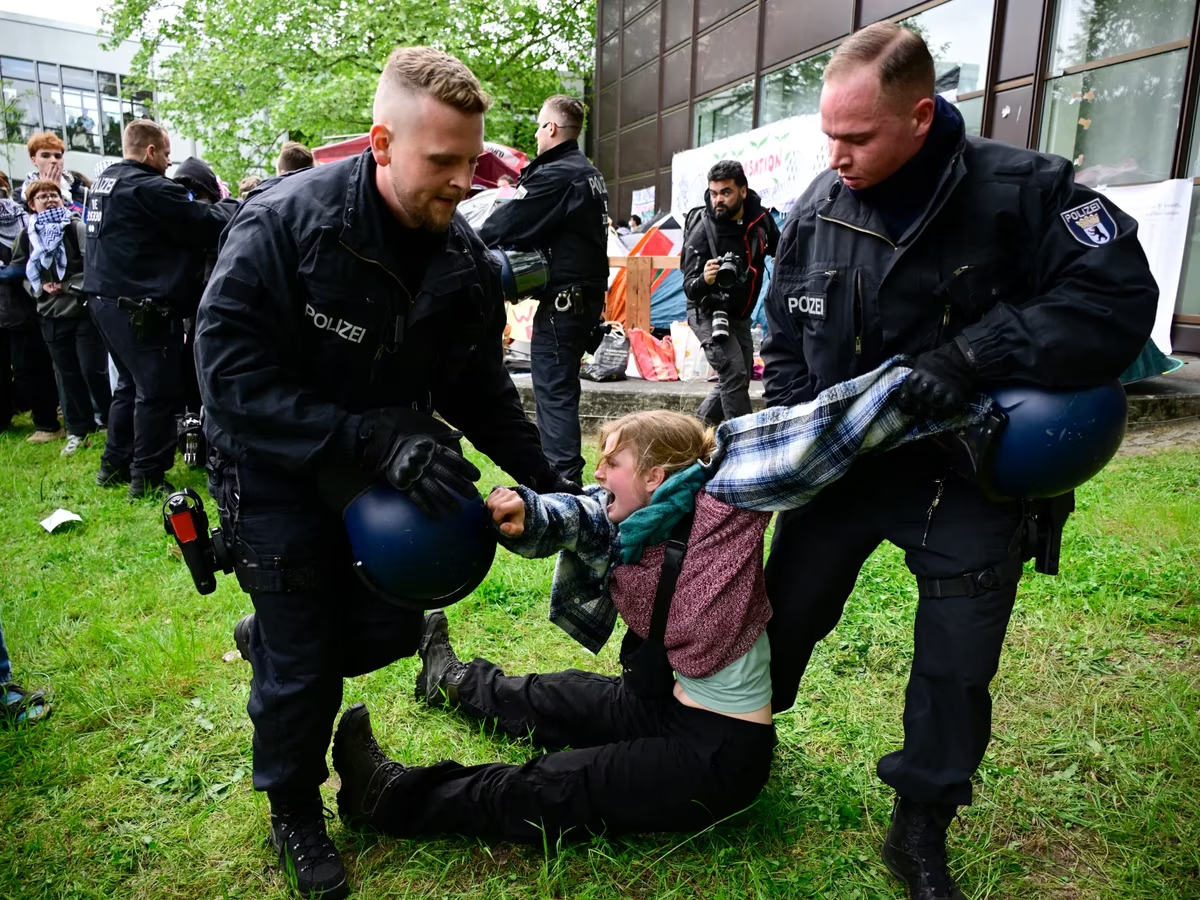
Suffering is not limited to the absence of cash, but also extends to a severe scarcity of basic goods, posing complex challenges for hundreds of thousands of families to secure daily sustenance. Displaced Umm Saeed recounts that she is forced to offer portions of food aid to neighbors in exchange for rice and lentils, noting that bartering has even included clothes and personal necessities.
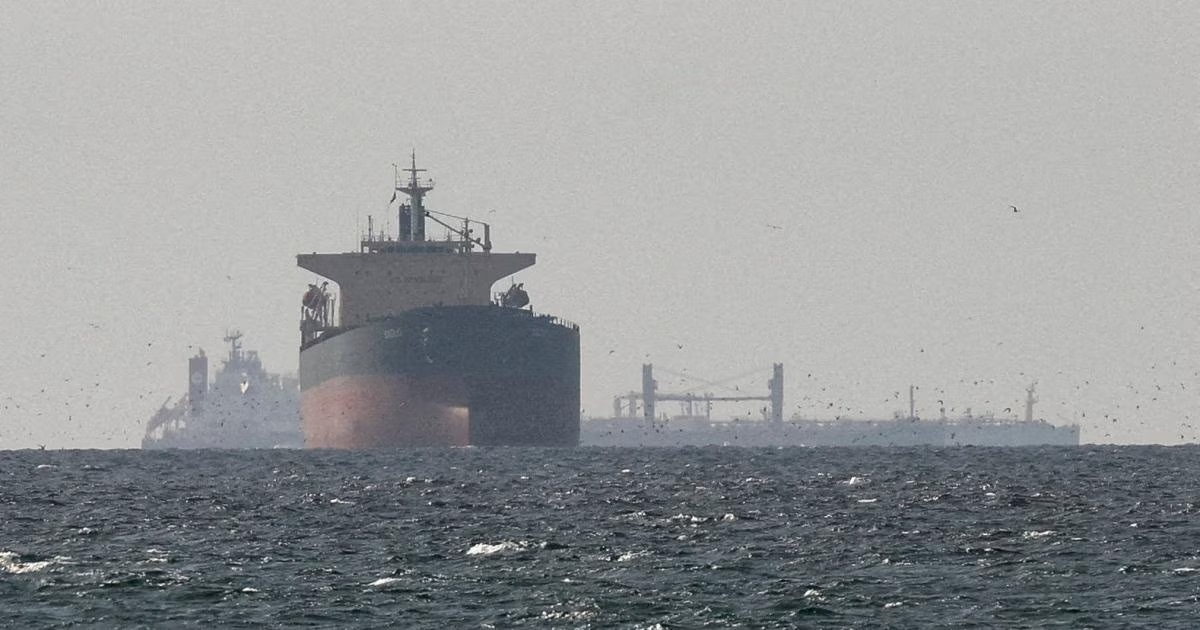
Amidst the disruption of bank branches and ATM networks, families have faced extreme difficulties in relying on digital solutions or alternative electronic wallets. Displaced persons complained about the ineffectiveness of these applications on the ground due to the erosion of their purchasing power as a result of high fees and complex operational restrictions imposed by shops that accept this type of payment.
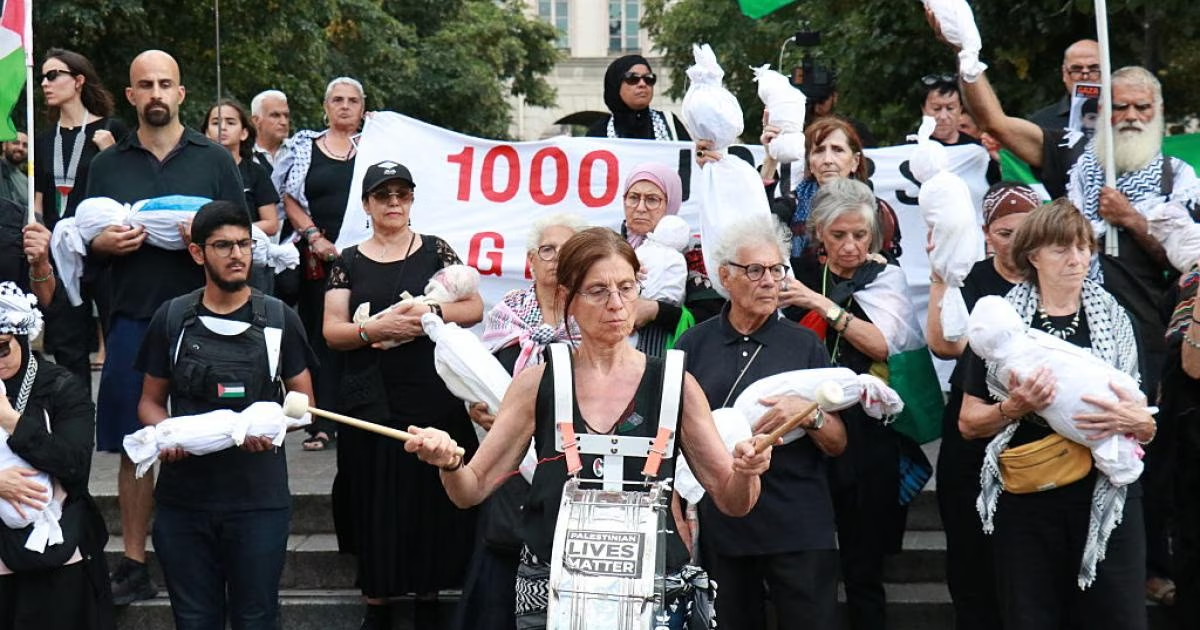
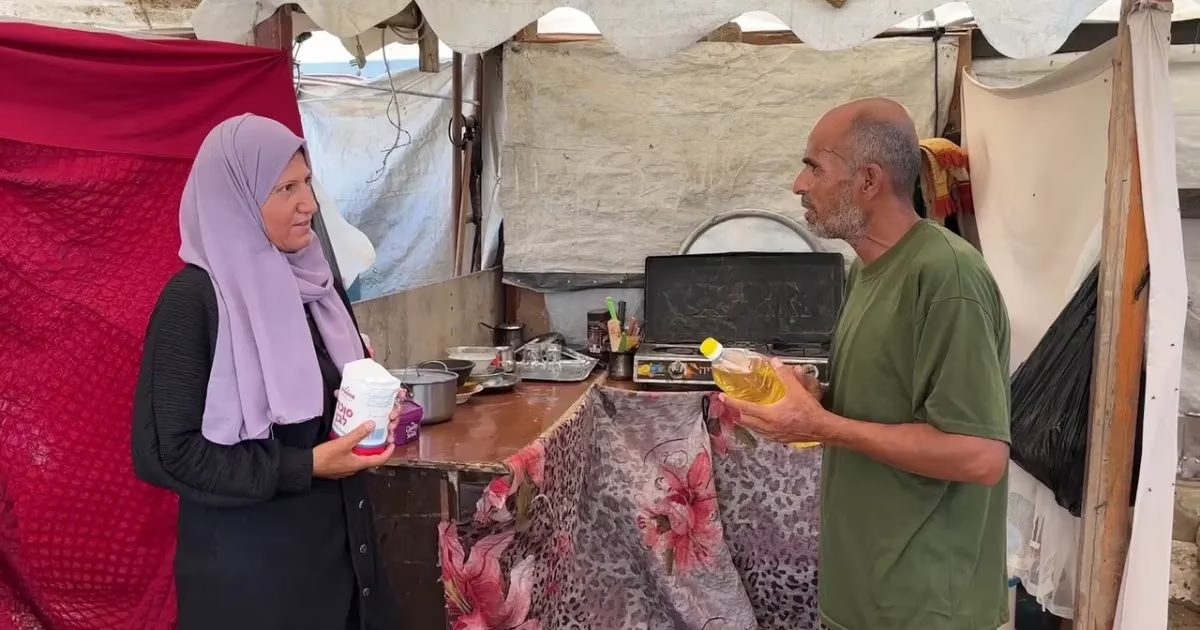
One displaced person, who supports a family of eight, explained that he is forced to barter cooking oil for notebooks and pens to secure his daughter's needs for high school. He confirmed that electronic applications have become useless due to the high commissions deducted from the balance, in addition to obliging buyers to a minimum purchase that prevents them from acquiring simple necessities for children.

The current deterioration in cash liquidity is linked to a series of direct targeting of Palestinian bank headquarters in the Gaza Strip throughout the aggression. Official reports issued by the Monetary Authority indicate that more than 90% of bank branches and ATMs are out of service due to total destruction or permanent power and internet outages.

Financial institutions warned that the destruction of this vital infrastructure has almost completely disrupted the operational capacity of the local banking system. This situation has cut off financial supply lines and financially isolated the Gaza Strip from the West Bank and the outside world, exacerbating the severity of the economic and social crisis experienced by displaced persons in tents.

In addition to the absence of banknotes, a new dilemma emerged in the form of the growth of an illegal parallel market for exchanging money and liquidating balances via mobile phone applications. Some money changers exploited the desperate need of residents for cash to impose exorbitant withdrawal commissions ranging from 30% to 50%, further draining the limited financial resources of citizens.

For its part, the Palestinian Monetary Authority issued official warnings, threatening unlicensed entities with strict legal action to combat these practices. The Authority affirmed that these monopolistic behaviors exacerbate living difficulties and contribute to deepening the financial siege imposed on the residents of the Strip, calling for the necessity of finding international solutions for liquidity flow.

I have not dealt with cash for about two years due to unemployment and lack of liquidity, and bartering is our only way to avoid the specter of famine.

ARAB AND WORLD

Sat 04 Jul 2026 6:35 pm - Jerusalem Time

Continuous Israeli Violations in Southern Lebanon and Widespread Destruction Hampering Life in Nabatieh

The pace of Israeli violations of the ceasefire agreement in southern Lebanon has escalated, with warplanes launching a raid targeting the town of Mansouri in the Tyre district. This attack resulted in varying injuries to a citizen, who was subsequently transferred to hospitals in the city of Tyre for necessary treatment amidst a state of field tension.

Local sources reported that a drone belonging to the occupation army dropped a sound bomb near a civilian vehicle in the city of Nabatieh, causing injuries among those present at the scene due to the explosion. This tactic is part of an intimidation policy adopted by the occupation since the cessation of large-scale military operations to push residents away from their areas.

Violations were not limited to air raids but extended to include intense fire sweeping operations using heavy machine guns in the towns of Hadatha, Al-Tiri, and Konin. Field sources stated that sounds of massive explosions were heard in the early morning hours inside the town of Konin, indicating continued Israeli ground military activity at those points.

In the city of Nabatieh, which is the economic and cultural nerve center of southern Lebanon, the extent of the massive destruction that befell its historical market and vital facilities has been revealed. This market, which has existed for decades and housed hundreds of shops, is now rubble, reflecting the brutality of the recent Israeli war that directly targeted the city's infrastructure.

Currently, the city is witnessing a timid and limited return of its residents who were displaced during the confrontations, under extremely complex living conditions. Despite the announcement of a ceasefire, the continuous overflight of drones and intermittent raids instill fear in the returning residents and limit the movement to restore normal life in residential neighborhoods.

On the services front, Lebanese government agencies are making diligent efforts to rehabilitate damaged essential facilities to ensure the continued presence of residents. Technical teams were able to restore water pumping to Nabatieh neighborhoods two days ago, in a first step towards alleviating the suffering of residents who endured inside the city despite the shelling.

As for the energy sector, it witnessed a slight improvement with the return of electricity through the official state grid yesterday, albeit for very limited supply hours. In contrast, private generator networks, on which citizens primarily rely, remain out of service, increasing the difficulty of operating the remaining establishments.

Commercial activity in central Nabatieh is suffering from a near-total paralysis, as most shops and economic institutions remain closed due to destruction or lack of resources. Residents are struggling to secure their basic living needs with great difficulty, amidst the rubble of buildings that once formed a vibrant commercial center.

Field reports indicate that the occupation seeks, through these continuous violations, to create a de facto buffer zone by preventing residential stability. Sweeping operations and firing towards border residential neighborhoods occur daily, representing a clear violation of international understandings that sponsored the cessation of hostilities.

In light of this bitter reality, the reliance remains on the ability of Lebanese institutions to accelerate reconstruction efforts and provide security for returning residents. Eyes are turned towards the international community to pressure the occupation authorities to stop their violations and ensure the implementation of ceasefire provisions to protect civilians in southern villages and cities.

The occupation resorts to using sound bombs with the aim of displacing residents and preventing them from returning to their homes in border areas.