







By: Said Arikat
July 2, 2026
News Analysis
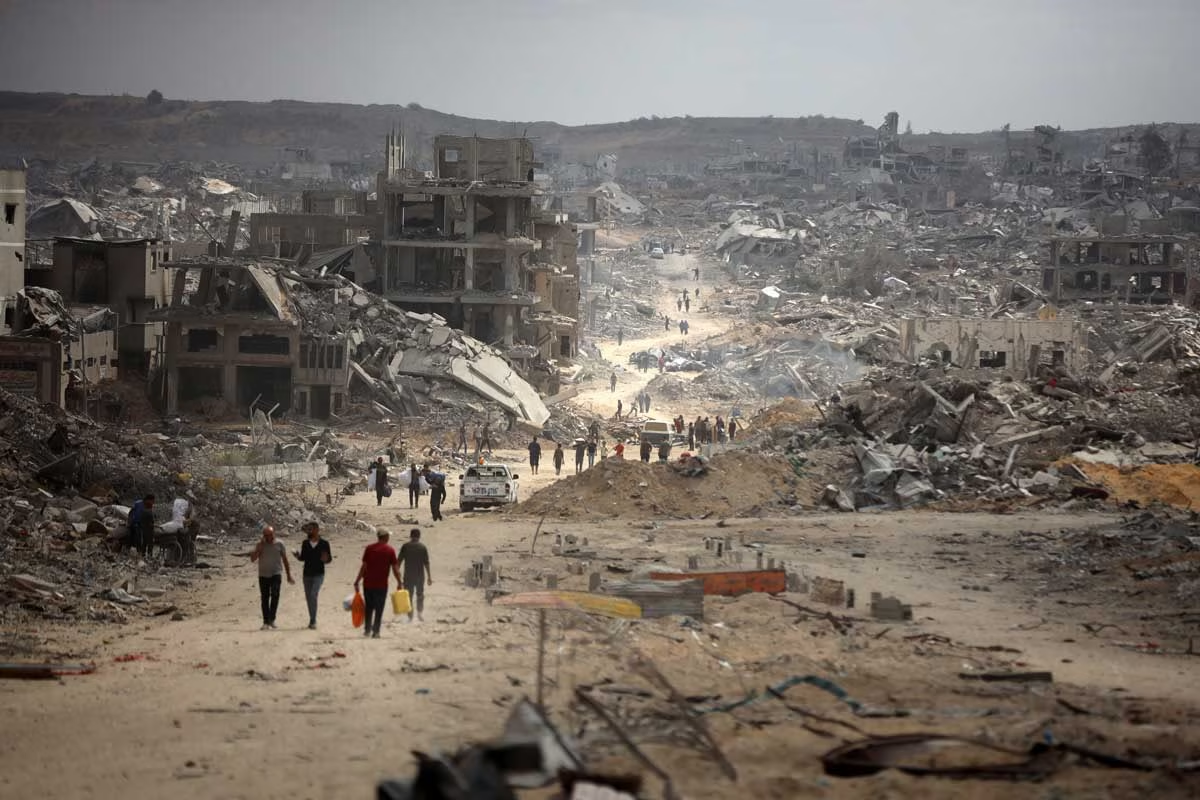
Washington, D.C- One thousand days have passed since the beginning of what many international legal experts, United Nations officials, and human rights organizations have described as a genocide in Gaza. During those one thousand days, Israel has continued its devastating military campaign against the Palestinian people while enjoying unprecedented diplomatic, military, and financial support from the United States. Despite repeated international appeals, mounting evidence of civilian suffering, and growing legal scrutiny before international courts, Washington has remained Israel’s indispensable ally.
Yet history often produces consequences that are neither anticipated nor intended. While successive American administrations sought to shield Israel from external pressure, the Gaza war has unleashed a political transformation within the United States itself—one that may ultimately reshape the Democratic Party and, over time, American foreign policy.
Gaza has ceased to be merely another Middle Eastern conflict. For millions of younger Americans, it has become a defining moral issue, comparable to apartheid in South Africa or the Vietnam War for previous generations. What once occupied the margins of American political debate has moved to its center, particularly within Democratic primaries, where candidates’ positions on Israel and Palestine increasingly influence electoral outcomes.
The latest evidence came in Colorado, where 29-year-old Melat Kiros stunned the Democratic establishment by defeating fifteen-term Representative Diana DeGette in the June 30 primary. Kiros’s political journey is emblematic of this new generation. She was dismissed from her law firm after refusing to remove a social media post calling for an end to what she described as genocide in Gaza. Rather than retreat, she entered politics, turning that experience into the foundation of her congressional campaign. Her victory demonstrated that what was once considered a political liability can now become an electoral asset among Democratic primary voters.
Only weeks earlier, New Jersey voters delivered another message by nominating Dr. Adam Hamawy, a decorated Army surgeon who had volunteered on a humanitarian medical mission to Gaza. Witnessing the destruction firsthand profoundly altered his political outlook. His campaign openly challenged Washington’s unconditional support for Israel, arguing that American values require consistency in defending human rights regardless of nationality. His victory suggested that firsthand testimony from Gaza now carries political weight with Democratic voters.
New York’s Democratic primaries on June 23 reinforced the same trend. Progressive candidates who openly advocated Palestinian rights, demanded conditions on military aid to Israel, and challenged the influence of powerful pro-Israel lobbying organizations performed strongly against establishment-backed rivals. Although every district has its own political dynamics, together these contests revealed a national pattern that is becoming increasingly difficult to dismiss.
Attention is now focused on Michigan, where Dr. Abdul El-Sayed is seeking the Democratic nomination for the United States Senate. His coalition of young voters, Arab Americans, Muslim Americans, organized labor, and progressive activists reflects the changing composition of the Democratic electorate. Should El-Sayed prevail in August, it would represent another milestone in a political movement whose momentum has been fueled in significant part by outrage over Gaza.
These races are not isolated events. They are symptoms of a much deeper realignment taking place within American politics.
The rise of New York mayoral nominee Zohran Mamdani has become another defining illustration of this transformation. Mamdani has consistently defended Palestinian rights despite intense criticism and well-funded opposition. His electoral success demonstrates that candidates no longer need to moderate their positions on Israel to remain politically viable within Democratic primaries. On the contrary, among younger voters, speaking openly about Palestinian rights increasingly signals authenticity rather than political risk.
This generational shift extends well beyond a handful of high-profile campaigns. Poll after poll has shown that younger Democrats view Israel’s conduct in Gaza far more critically than older generations. Many reject the assumption that support for Israel should remain unconditional. They increasingly frame Palestinian rights within the broader language of civil rights, racial justice, international law, and universal human dignity. Gaza has become part of the same political vocabulary that once mobilized movements for Black Lives Matter, climate justice, and immigrant rights.
Equally significant is the changing role of money in Democratic politics. For years, organizations such as AIPAC demonstrated an extraordinary ability to influence congressional elections through massive independent expenditures. Candidates often viewed confrontation with pro-Israel lobbying groups as politically fatal.
That assumption is beginning to erode.
Money still matters enormously in American elections, and AIPAC remains among the country’s most formidable political organizations. Yet recent primaries suggest that even enormous financial advantages cannot always overcome a motivated grassroots electorate driven by deeply held moral convictions. Where Gaza becomes the defining issue for voters, expensive negative advertising often proves less effective than it once did. Small-dollar fundraising, volunteer mobilization, and digital organizing are increasingly offsetting traditional advantages enjoyed by establishment candidates.
None of this means that American policy toward Israel will change overnight. Congressional leadership remains overwhelmingly supportive of Israel, bipartisan institutional commitments remain deeply entrenched, and the strategic relationship between Washington and Tel Aviv continues to enjoy powerful political backing. Foreign policy evolves far more slowly than electoral politics.
Nevertheless, politics ultimately follows generations.
The Democratic Party that emerges over the next decade will almost certainly be led by politicians whose formative political experience was not the Cold War, the September 11 attacks, or even the Iraq War. It will be shaped by leaders whose political awakening occurred while watching the destruction of Gaza unfold in real time on their phones, hour after hour, day after day, for nearly three years.
That reality may prove to be one of the most enduring legacies of this war.
The tragedy in Gaza has inflicted immeasurable suffering on Palestinians. Nothing can diminish that human cost. Yet history often reveals its deepest consequences in unexpected places. Ironically, while Israel has pursued military victory with steadfast American backing, the conflict may be transforming the politics of Israel’s closest ally in ways that neither government anticipated.
One thousand days after the war began, the bombs continue to fall. But another battle is unfolding inside the United States—not on the battlefield, but at the ballot box. There, a new generation of Americans is redefining the meaning of solidarity, accountability, and American leadership in the world. If current trends continue, the political legacy of Gaza may outlast the war itself, reshaping the Democratic Party and eventually forcing a fundamental reconsideration of America’s relationship with Israel.
Share your opinion
1,000 Days Since the Beginning of the Gaza Genocide: How the War Is Reshaping American Politics