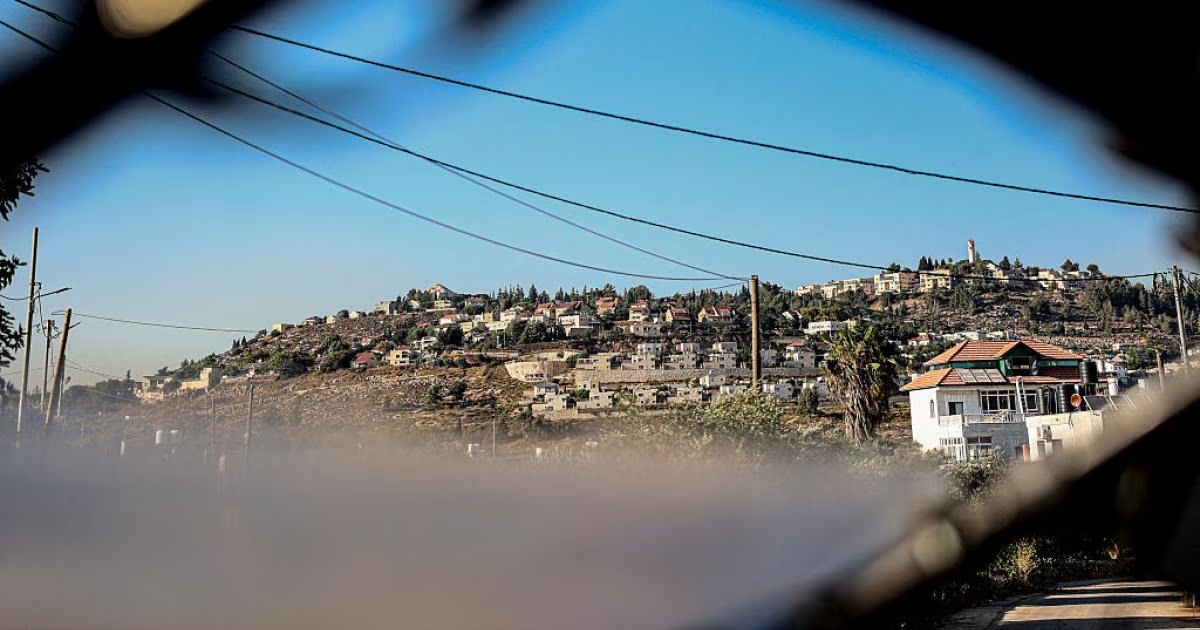







Investigative journalistic sources have revealed the establishment of a new Israeli settlement outpost in a strategic and sensitive location west of Ramallah city in the occupied West Bank. This step comes in the context of escalating settlement expansion operations aimed at changing the geographical and demographic reality in the region, threatening the Palestinian presence in the surrounding communities.
The investigation, based on a precise analysis of satellite images and geographical data, reported that the occupation continues to plant settlement outposts in locations described as 'controlling points'. This policy aims to strengthen the connection between existing settlements and expand their scope of influence and field control at the expense of Palestinian lands.
The new outpost, named 'Ma'oz Tzur', is located in the northern West Bank, specifically on a hill overlooking several Palestinian towns west of Ramallah. This location gives settlers a significant geographical advantage in monitoring natural passages and highlands that connect Palestinian villages and cities to each other.
Geographical data indicates that 'Ma'oz Tzur' is situated on a ridge extending between the towns of Bil'in, Beit Ur al-Tahta, Beitunia, and Ein Arik, and is only about two kilometers from the 'Beit Horon' settlement. This positioning places it in direct confrontation with a settlement bloc that includes the 'Dolev' and 'Talmon' settlements, enhancing its strategic value.
The danger of this location stems from its ability to control the surrounding geographical area, allowing settlers to precisely monitor the movement of Palestinian citizens. It also contributes to creating an illegal geographical connection between scattered Israeli settlements west of Ramallah, leading to the strangulation of Arab population centers.
According to the tracking of construction phases, satellite images showed that settlement activity at this site actually began after June 29, 2025. The first phase began with extensive land leveling, the construction of dirt roads, and initial access paths to enable heavy machinery to enter the elevated area.
During the period between May and July 2025, sources observed significant changes in the site's topography, including the removal of large parts of the natural vegetation. Parts of the mountain hills were also leveled to prepare them for the establishment of facilities, coinciding with connecting the site to the main road network used by settlers.
By the end of 2025, work at the 'Ma'oz Tzur' outpost moved to a more advanced stage, including expanding the internal road network and establishing equipment collection areas. Engineering teams affiliated with the settlers began identifying buildable plots of land, giving a clear indication of the intention to transform it into a permanent community.
By early 2026, aerial images documented the appearance of ready-made residential units and integrated service infrastructure at the site, confirming the acceleration of construction. Road connections were intensified and leveled areas were expanded, in a step aimed at accommodating larger numbers of settlers in record time.
Field estimates indicate that the area of ongoing works within the outpost reached approximately 1.45 square kilometers, equivalent to nearly 1450 dunams of land. The security and vital perimeter of this outpost extends over an area exceeding 4 kilometers, meaning the confiscation of vast areas of citizens' lands.
This transformation from an emerging settlement point to a permanent residential outpost reflects the strategy of imposing a fait accompli adopted by the occupation authorities. Observers confirm that such projects primarily aim to dismember the West Bank and prevent the establishment of any contiguous Palestinian entity in the future.
In conclusion, the investigation shows that 'Ma'oz Tzur' is not just mobile homes, but part of a broader plan to consolidate control over the commanding heights in the West Bank. This outpost establishes new geographical realities that further complicate the field situation and impose severe challenges on the Palestinian residents in the Ramallah Governorate.
The project is not limited to establishing a new settlement community, but falls within broader efforts to enhance geographical connectivity between settlements and consolidate control over elevated locations.


Share your opinion
Discovery of a new outpost west of Ramallah: 'Ma'oz Tzur' devours 1450 dunams