PALESTINE

Mon 15 Jun 2026 12:08 am - Jerusalem Time

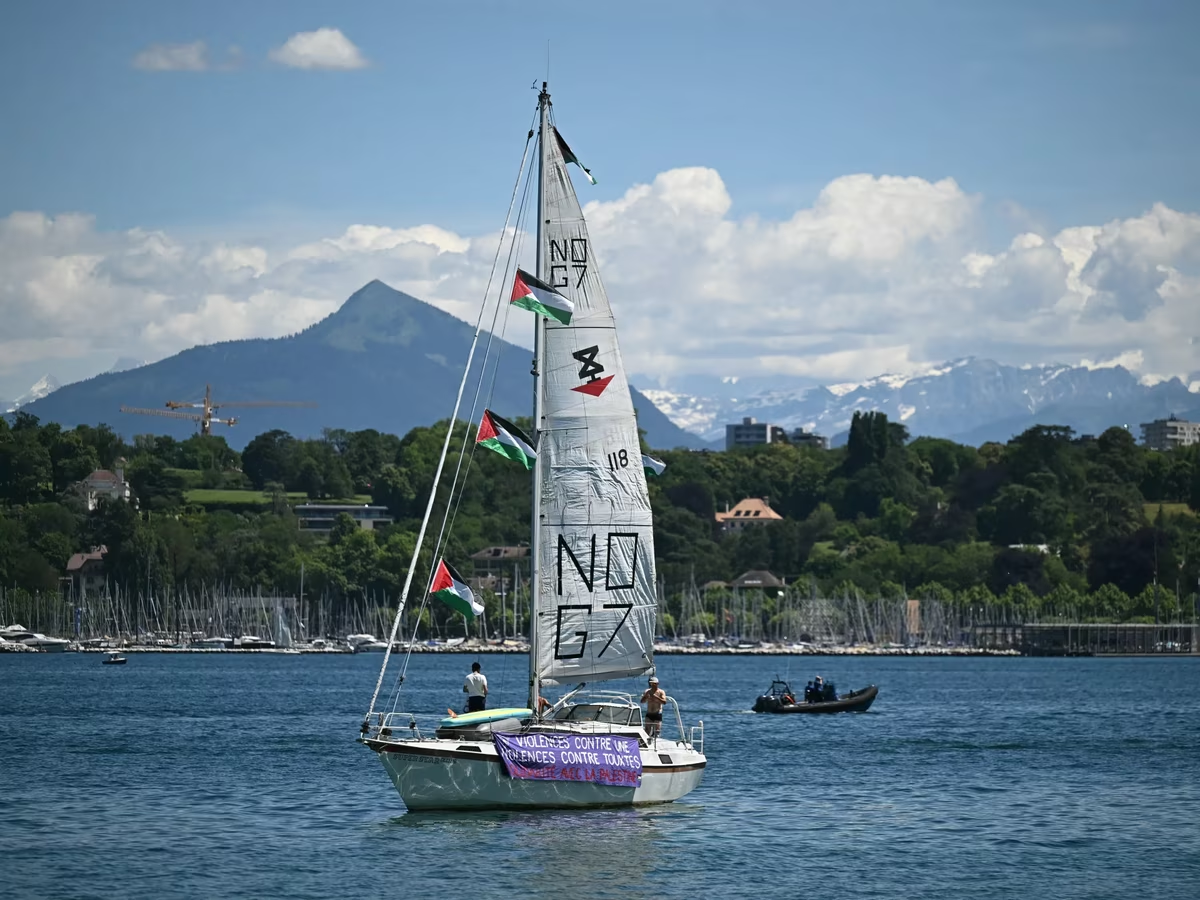
International preparations to launch a new naval fleet to break the siege on the Gaza Strip

The representative of the "Global Fleet of Resilience" in Turkey, Bahçeci İsmail Sungur, revealed the start of logistical and technical arrangements to launch a new naval campaign aimed at reaching the shores of the Gaza Strip within the next few months. Sungur explained that the upcoming mission will see broader international participation than its predecessors, with a significant increase in the number of ships and activists, in an effort to break the Israeli siege imposed on the Strip and draw the world's attention to the escalating humanitarian tragedy there.

This announcement came during an extensive meeting held by international activists in Istanbul today, Sunday, dedicated to evaluating the results of the last mission targeted by Israeli occupation forces at sea. Informed sources confirmed that the meeting focused on the necessity of continuing the popular naval movement as an international pressure tool, noting that military threats will not deter solidarity activists from continuing their efforts to deliver relief aid and solidarity messages to besieged Palestinians.

In the context of legal prosecution, Sungur indicated that intensive diplomatic and legal efforts are currently underway to release activists who are still detained by the occupation authorities since the last mission. He added that legal teams have already begun filing lawsuits before European courts and international forums to prosecute Israeli officials involved in the assault on peaceful boats, considering that international silence encourages the occupation to repeat its violations in international waters.

On May 18th, the Israeli navy carried out an attack against the "Fleet of Resilience" boats that were sailing in the international waters of the Mediterranean Sea. The fleet at that time included about 50 boats with 428 activists representing 44 countries, all of whom were arrested and their relief cargo, intended for the residents of the Strip who suffer from the consequences of the ongoing siege since 2007, was confiscated.

That attack sparked a wave of global human rights condemnations, with Amnesty International describing Israeli practices as "shameful and inhumane" and lacking any international legal cover. These actions come at a time when about 2.4 million Palestinians in Gaza are living in catastrophic living and health conditions, as a result of the ongoing war of extermination that has left tens of thousands of victims and almost completely destroyed the infrastructure.

The organizers of the new fleet stressed that their goal is not limited to the material aspect and the distribution of food parcels, but also extends to providing moral support and breaking the isolation that the occupation is trying to impose on Gaza. Sources from within the organizing committee confirmed that preparations are underway in high coordination with human rights and humanitarian organizations around the world to ensure the greatest possible political and media protection for participants in the upcoming journey.

Messages received from the residents of the Strip confirm that their needs are not limited to humanitarian aid, but also include moral support and international solidarity.

PALESTINE

Mon 15 Jun 2026 12:07 am - Jerusalem Time

7 Killed and Destruction of Civilian Facilities in a Series of Israeli Attacks on the Gaza Strip

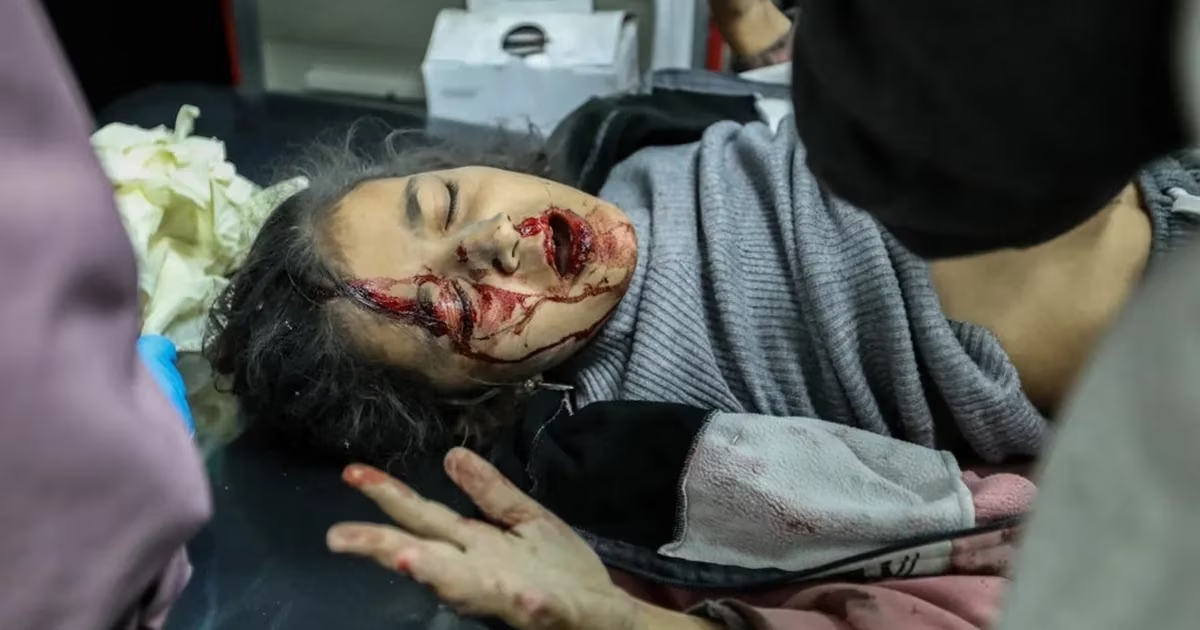
Medical sources in the Gaza Strip reported the martyrdom of 7 Palestinians, including a child, and the injury of several others with varying degrees of wounds as a result of a series of airstrikes and shootings carried out by Israeli occupation forces today, Sunday. The attacks focused on different areas of the Strip, with the Ministry of Health confirming that these aggressions come within the context of ongoing escalation despite existing understandings.

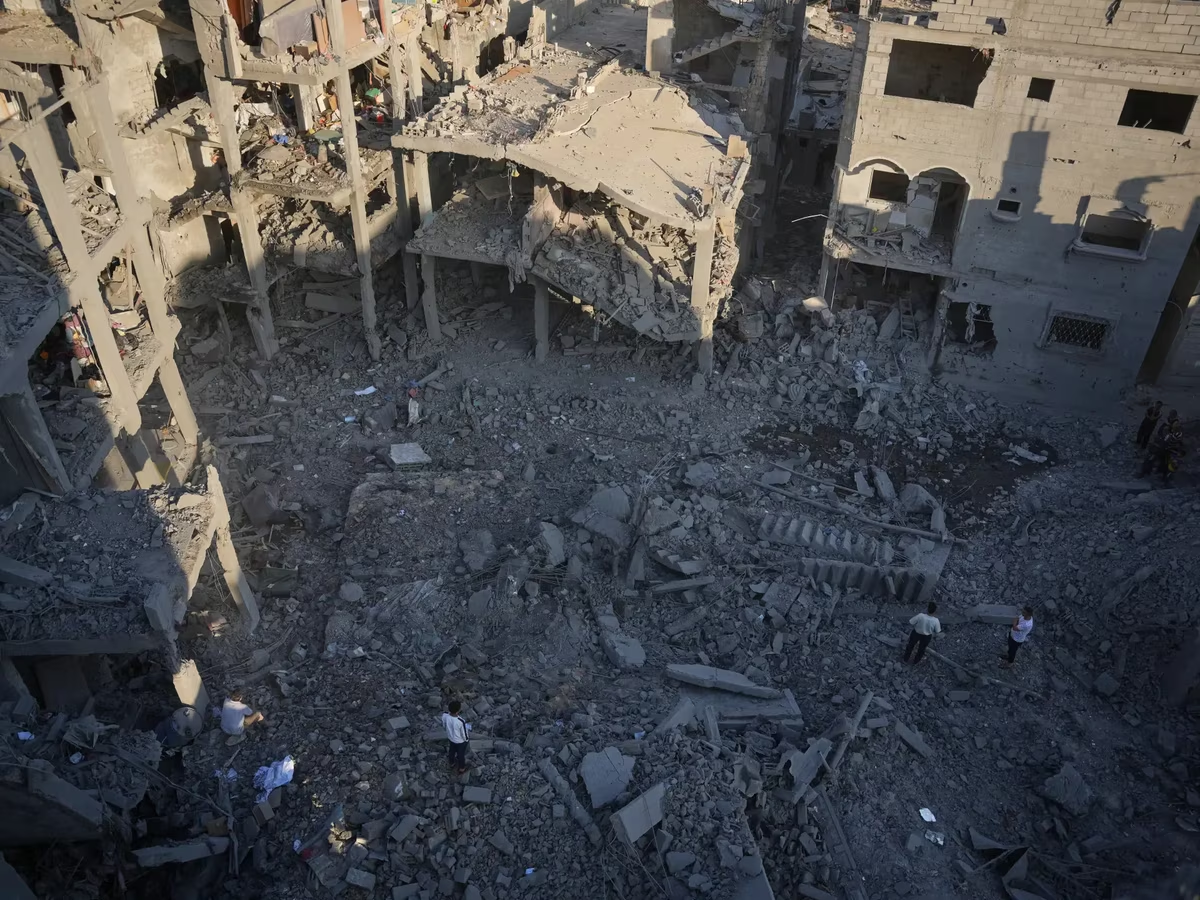
In field details, 4 citizens were martyred in Jabalia camp north of the Strip after shelling targeted a group of commercial shops, causing widespread destruction in the area. This coincided with the occupation army carrying out systematic demolition operations of civilian facilities and residential buildings in the eastern areas of Gaza City and Jabalia town, where huge explosions were heard shaking the northern region.

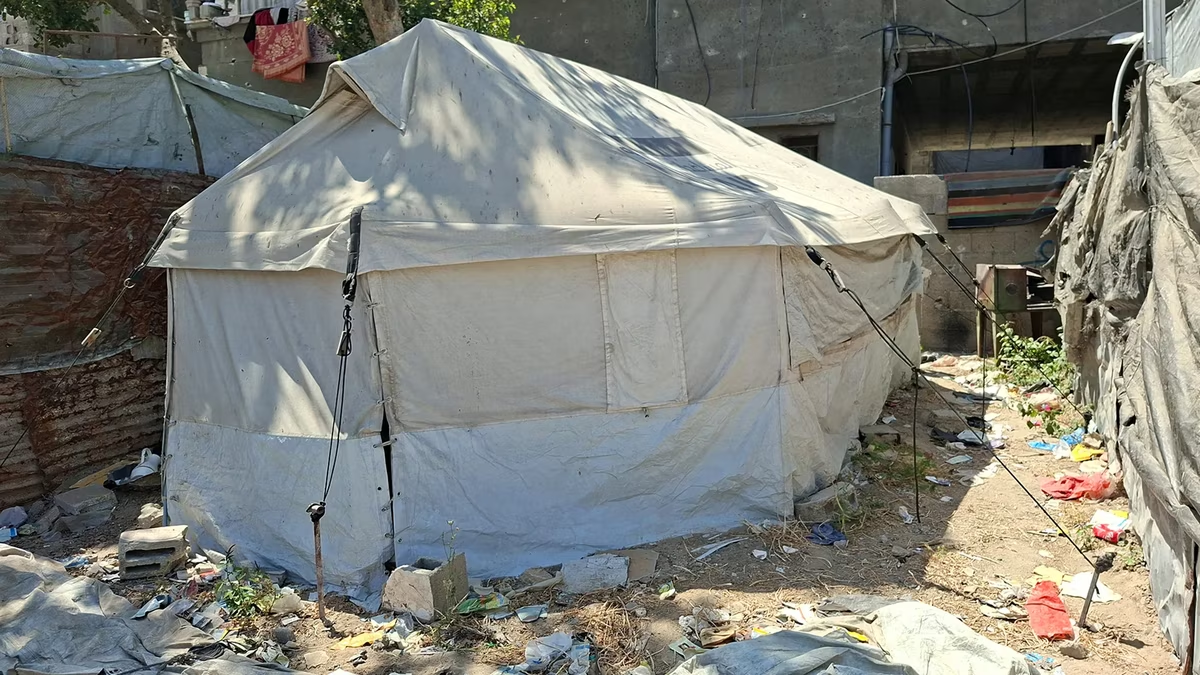
In the southern part of the Strip, medical sources announced the martyrdom of young man Zaki Mohammed Al-Qarra (30 years old) and child Amir Al-Bashti (13 years old) by bullets and shelling from a drone targeting displaced persons' tents in Khan Yunis city. The sources clarified that the attack also resulted in the injury of other citizens, one of whom was described as seriously wounded, which raises the pace of humanitarian suffering in overcrowded shelters.

In Gaza City, a Palestinian died in Al-Shifa Hospital from wounds he sustained earlier from occupation forces' fire, while the coastal areas of the city were subjected to intense shelling from Israeli warships. These field developments come amid continued Israeli violations of the ceasefire agreement in effect since October 10, 2025, which has seen hundreds of casualties since its signing.

Official data issued by the Ministry of Health indicates that the toll of victims from Israeli violations since last October has reached 986 martyrs and more than 3,100 injured. These figures reflect the extent of ongoing violations directly targeting civilians in various governorates of Gaza, undermining international efforts to stabilize the relative calm.

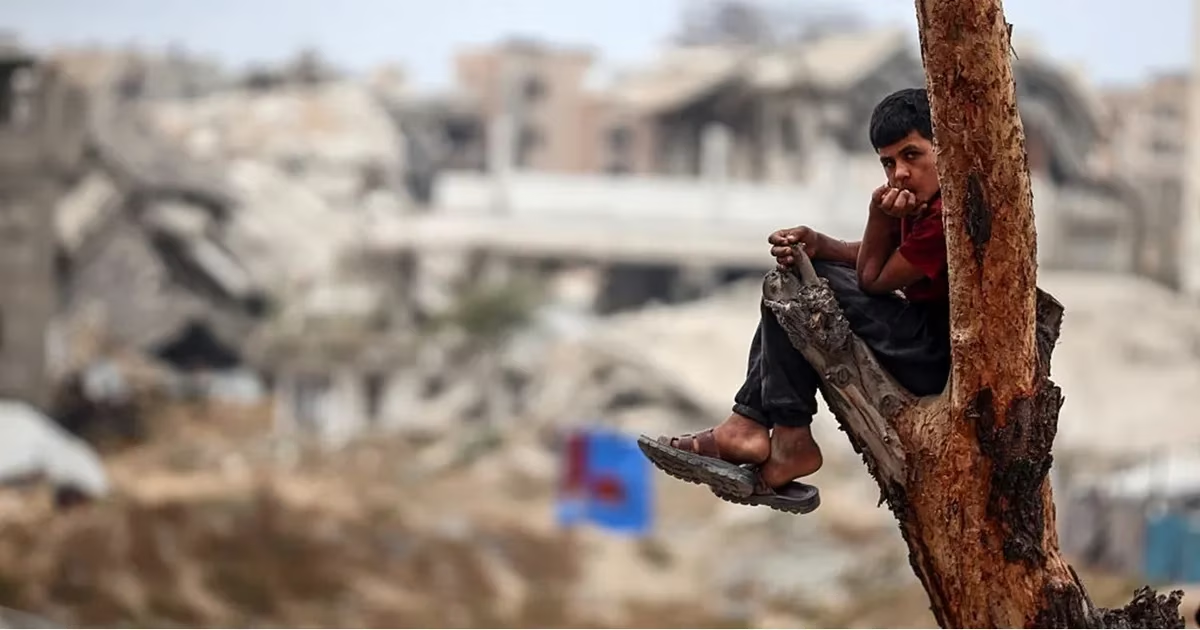
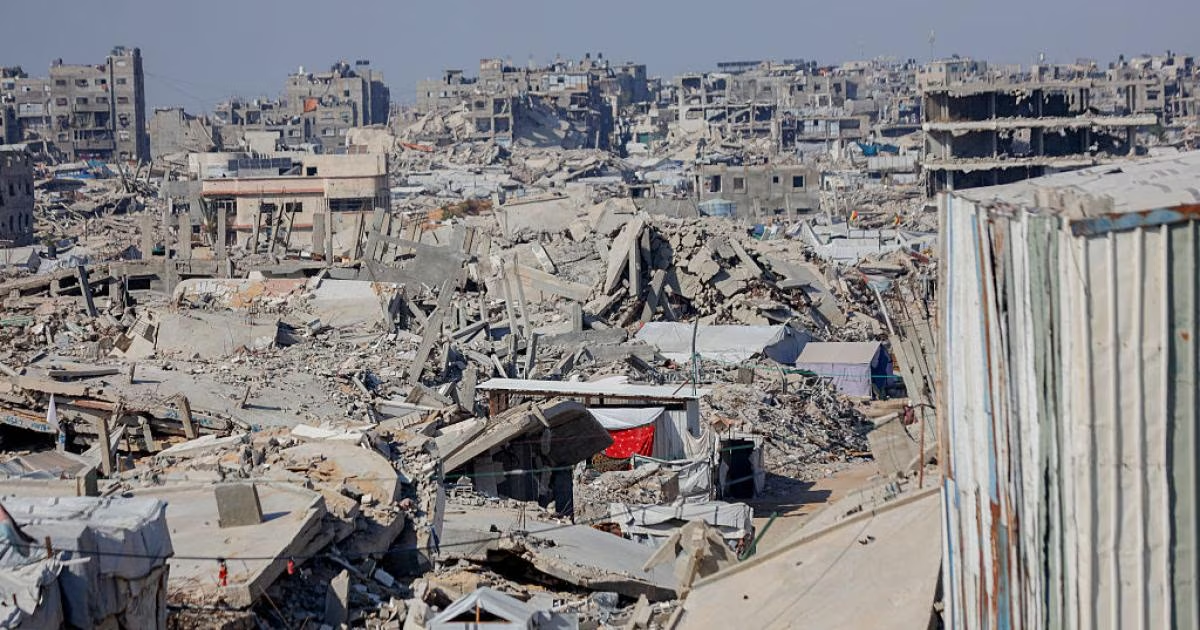
Regarding the total toll, the number of martyrs since the start of the aggression on October 7, 2023, has risen to about 73,000 martyrs, while the number of injured has exceeded 173,000. Military operations have caused the destruction of approximately 90% of the civilian infrastructure, forcing hundreds of thousands to live in tents lacking the most basic necessities for a dignified life and essential services.

The number of martyrs since the start of the genocide war on October 7, 2023, is approximately 73,000, with 90% of the infrastructure destroyed.

PALESTINE

Mon 15 Jun 2026 12:07 am - Jerusalem Time

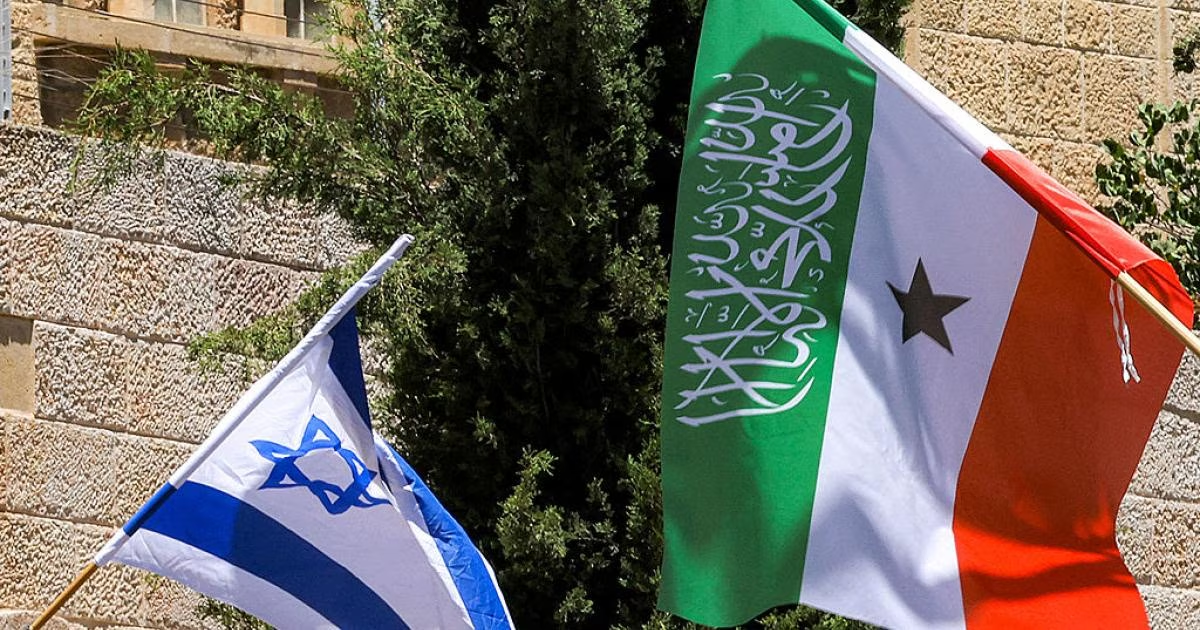
President of "Somaliland" in Israel to Open Embassy in Jerusalem.. Hamas Calls it a "Political Sin"

The president of the self-proclaimed separatist region of "Somaliland," Abdirahman Mohamed Abdullahi, began a first-of-its-kind official visit to Israel, where he met with his Israeli counterpart Isaac Herzog on Sunday. This visit comes as part of strengthening bilateral relations, just a few months after Tel Aviv officially recognized the region, which unilaterally declared its secession from Somalia.

Sources reported that the visit primarily aims to inaugurate an embassy for the region in occupied Jerusalem, fulfilling previous promises made by Abdullahi after receiving an official invitation from Israeli Prime Minister Benjamin Netanyahu. Israel is the first country to grant the region full diplomatic recognition since its declaration of independence following the civil war in 1991.

Abdullahi, in a statement issued by the Israeli Prime Minister's Office, expressed his deep gratitude for this step, describing the visit as having special historical significance as it is the first state visit by the region's president. He noted that his country had sought international recognition for decades but had only received a response from the Israeli side.

For his part, Israeli President Isaac Herzog welcomed the visiting delegation, considering this partnership to open broad horizons for direct cooperation between the two sides in various fields. Herzog affirmed that both parties face common security challenges in the Horn of Africa, particularly concerning combating what he described as extremism and protecting maritime navigation.

The visit's agenda includes high-level meetings with Benjamin Netanyahu and Foreign Minister Gideon Sa'ar, in addition to participating in economic events aimed at attracting Israeli investments to the region. The visit is scheduled to conclude on Monday with the official ceremony for the embassy's opening in Jerusalem, according to Hebrew media reports.

In contrast, these moves were met with strong Palestinian condemnation, with Hamas describing the region's intention to open an embassy in occupied Jerusalem as a major "political sin." The movement affirmed in a statement that this behavior represents a blatant violation of all international laws and a disregard for Arab and Islamic positions regarding the issue of Jerusalem.

Hamas condemned in the strongest terms the meeting of the region's president with the leaders of the occupation, noting that these leaders have a criminal record against the Palestinian people and Arab nations. It stressed that opening up to an entity that continues to desecrate holy sites and Judaize Al-Aqsa Mosque is a stab in the back of the just Palestinian cause.

The movement called on the League of Arab States and the Organization of Islamic Cooperation to take immediate action to prevent this separatist region from breaking Arab and international consensus. It demanded that the concerned parties exert pressure to prevent the continuation of this diplomatic decline towards building relations with an entity that commits massacres it described as the most horrific in modern history.

The pace of cooperation between the two sides has accelerated since the beginning of this year, with Israeli Foreign Minister Gideon Sa'ar visiting the region last January. This visit was followed by a mutual appointment of ambassadors, with Israeli Ambassador Michael Lotem commencing his duties in the region last April, amidst official protests from the Somali government in Mogadishu.

The Somali government views these moves with great seriousness, describing previous Israeli visits to the region as an "unauthorized intrusion" into its national sovereignty. Mogadishu fears that this Israeli recognition could encourage other separatist movements in the African continent, threatening the stability of the entire region.

The Somaliland region enjoys a sensitive strategic location on the Gulf of Aden and possesses its own governing institutions, army, and currency, yet it has lacked international legitimacy. Observers believe that rapprochement with Israel is an attempt by the region's leaders to break the international isolation imposed on them for more than three decades.

These developments have raised widespread regional concerns about hidden plans related to the future of the Gaza Strip, with warnings emerging about the possibility of using the region as a destination for the displacement of Palestinians. These concerns come amid an absolute rejection from neighboring Palestinian countries, such as Egypt and Jordan, of any attempts to displace residents from their lands.

Reports confirm that Israel seeks through this alliance to strengthen its influence in the Horn of Africa and secure its shipping lanes in the Red Sea. In return, the separatist region hopes that this recognition will pave the way for other countries to follow Tel Aviv's lead, despite strong Arab opposition to this step.

The opening of the embassy in occupied Jerusalem remains the most controversial point, as Palestinian and Arab national forces consider it an attempt to enshrine the occupation's sovereignty over the holy city. Popular and official calls continue for the necessity of reversing this step, which serves the occupation's agendas in the region and harms Arab national security.

Opening an embassy in occupied Jerusalem is a political sin and a violation of all international norms and laws, and a disregard for the unified Arab and Islamic position.

PALESTINE

Mon 15 Jun 2026 12:07 am - Jerusalem Time

Shifts in British Public Opinion Towards 'Brexit' and the Murder of Infant Sam Shakes the Conscience of the Occupation

Political debate in Britain regarding the utility of withdrawing from the European Union has strongly resurfaced, with prominent conservative politician Michael Heseltine calling for a comprehensive review of the 'Brexit' decision. The former Deputy Prime Minister accused the leaders of the Leave campaign of making false and misleading promises to voters, noting that economic and political realities have proven the failure of those approaches years after official implementation.

These escalating calls are based on tangible shifts in British public sentiment, as recent opinion polls have shown increasing skepticism about the benefits promoted by proponents of separation. Observers believe that Britain, which officially left the bloc in early 2020, is now suffering from the consequences of economic isolation that were not anticipated to this extent by a large segment of voters.

In a notable development in May 2026, former Health Secretary Wes Streeting described the decision to leave as a 'catastrophic mistake' that must be corrected by returning to the European fold. This view was reinforced by the results of a YouGov poll last April, which revealed that 63% of citizens demand closer ties with Brussels, while 55% support full re-membership in the Union.

On another front, media reports highlighted a horrific crime committed by Israeli occupation forces in the West Bank, resulting in the death of seven-month-old infant Sam Abu Heikal. The incident, which occurred in the Tal Rumeida neighborhood of Hebron, sparked a wave of outrage after details emerged of indiscriminate shooting at a Palestinian family inside their vehicle.

B'Tselem, a human rights organization, documented through video clips the harsh moments following the shooting, showing the infant's father, Fahd Abu Heikal, desperately trying to save his child who was shot in the head. The organization confirmed that the car was slowing down in response to soldiers' orders and posed no security threat, making its targeting a clear case of extrajudicial execution.

Journalistic sources indicated that this crime created a rift in the state of denial within Israeli society regarding its army's practices in the occupied territories. Although Israeli attention to atrocities committed in Gaza and the West Bank remains minimal, the horror of infant Sam's murder forced some Hebrew media outlets to address the violence of soldiers and settlers more frankly.

Analysts believe that the emergence of these facts may represent the beginning of a limited retreat in the policy of overlooking daily crimes, but they doubt the ability of this shock to bring about structural change in the Israeli military mindset. The incident, which occurred on June 5th, adds to a long record of violations that often pass without real accountability for the perpetrators.

In the context of ongoing wars, French reports revealed a humanitarian tragedy facing the Ukrainian army, where the number of amputee soldiers has risen to approximately 120,000. These shocking figures reflect the heavy human cost of the conflict with Russia and place immense pressure on Ukraine's medical and social systems to rehabilitate these injured individuals.

Medical associations in Ukraine are seeking to innovate therapeutic methods based on sports, such as climbing, to help soldiers adapt to their new prosthetics. These initiatives aim to provide psychological and physical support to amputees, in an attempt to reintegrate them into society after the war has radically and permanently altered the course of their lives.

Regarding decolonization, the government of the Democratic Republic of Congo has initiated intensive diplomatic efforts to reclaim its historical archives from Belgium. Kinshasa is demanding access to maps and secret documents related to mineral wealth fields that were surveyed and plundered during the Belgian colonial period, which are still preserved in Brussels museums.

Congo's Minister of Mines held meetings with European officials to demand the digitization and official handover of these documents, considering this information a sovereign right of the Congolese people. This step comes within the framework of African nations' efforts to regain control over their natural resources and understand their economic history shaped by colonial powers.

The roots of this issue trace back to the Berlin Conference of 1884, convened by German leader Bismarck to partition the African continent among major European powers. That conference legitimized the exploitation of Congo by King Leopold II, who transformed the country into a private estate under the guise of alleged humanitarian and missionary work.

That historical era led to a massive depletion of Congo's wealth, as the Belgian king used national and economic arguments to justify the colonization of vast areas tens of times larger than Belgium. Today, Congo seeks to turn this page by reclaiming its documents that record the extent of organized plunder its lands endured.

These international files intertwine to paint a picture of a world facing the consequences of its past decisions, whether related to old colonialism or modern political alliances like Brexit. While peoples seek justice and truth, field crimes in Palestine remain a constant reminder of the necessity of international intervention to protect civilians from the machinery of war and occupation.

Video recordings document an Israeli soldier firing at the family's car as it slowed to a stop, and the vehicle posed no danger at the moment it was targeted.

ARAB AND WORLD

Mon 15 Jun 2026 12:07 am - Jerusalem Time

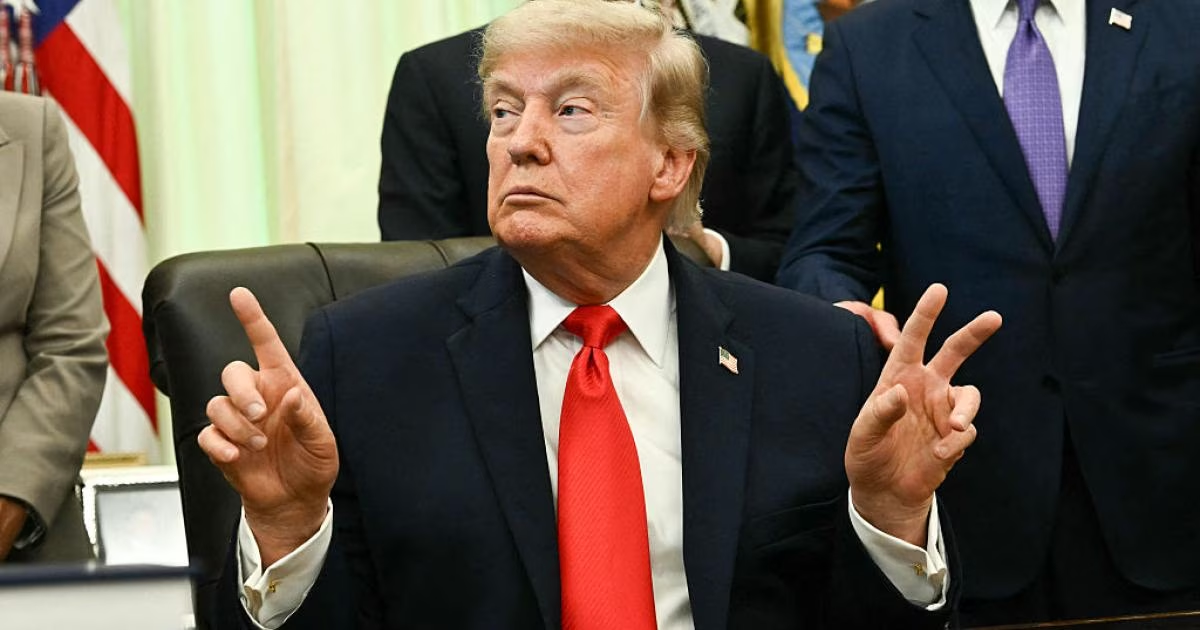
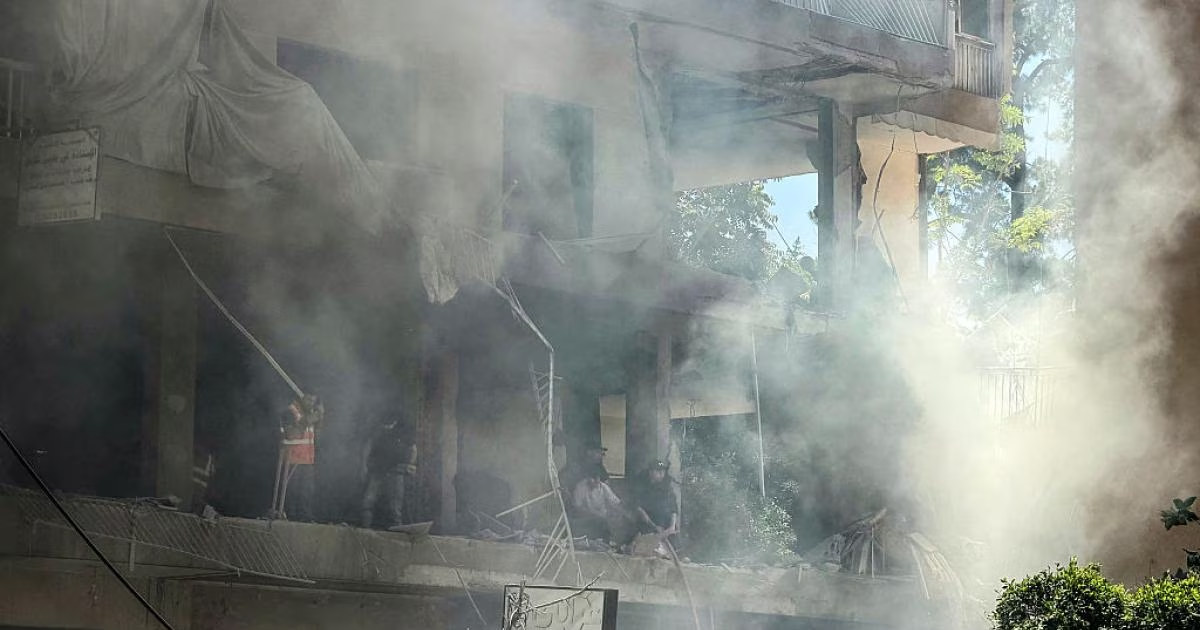
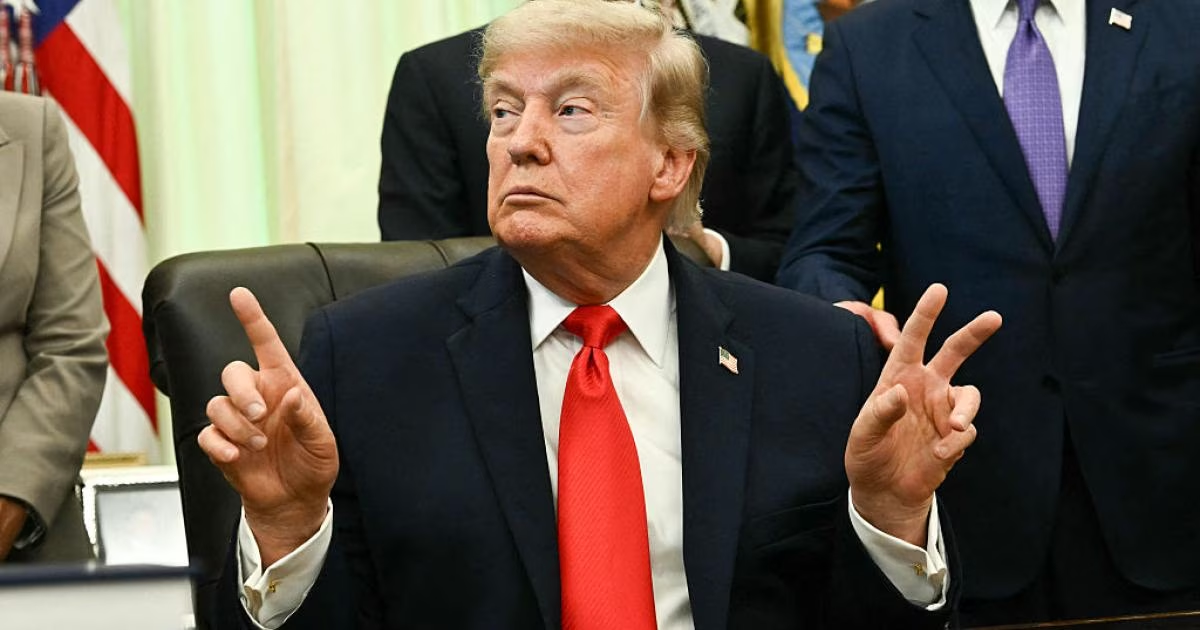
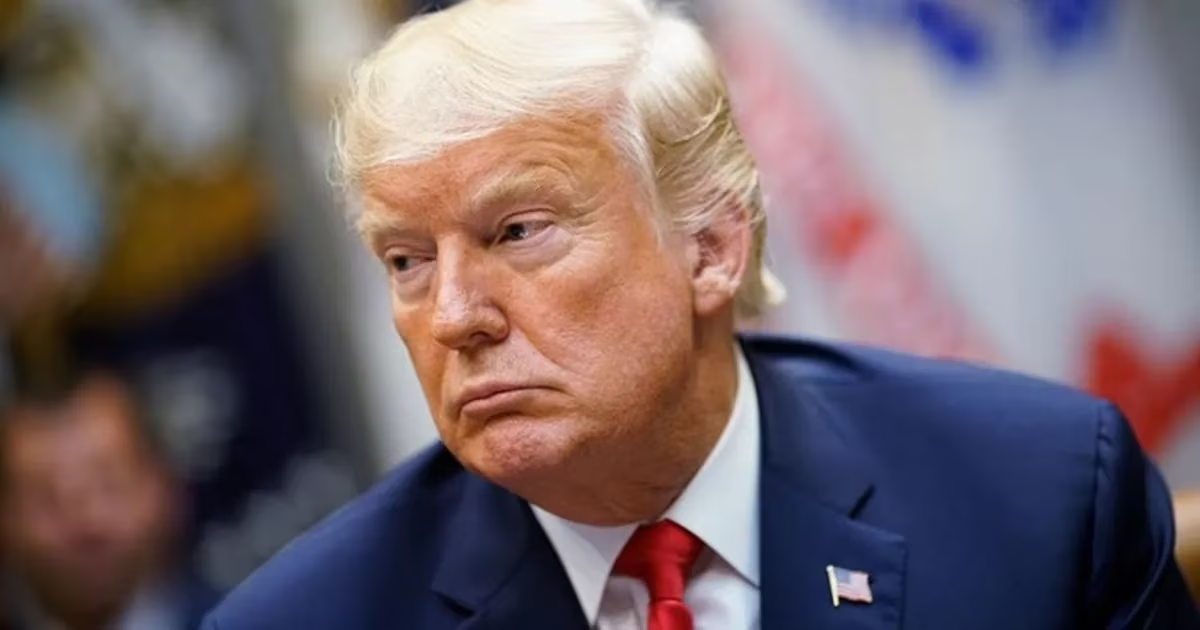
Trump harshly attacks Netanyahu: Beirut raid delayed a historic agreement with Iran that was to be signed within hours

Media sources revealed a state of intense anger felt by US President Donald Trump towards Israeli Prime Minister Benjamin Netanyahu, following the aerial raid carried out by the occupation army on the southern suburb of Beirut. Trump confirmed in phone calls and press statements that this attack caused a disruption to a precise timeline for signing a historic agreement with the Islamic Republic of Iran.

The US President clarified that the agreement with Tehran is still in place and on track, expecting it to be signed electronically within two to three hours from now. He indicated that the Israeli strike did not cancel the agreement, but rather delayed it for a few hours at a time when the world was anticipating an official announcement that would end decades of tension.

Trump described the timing of the Israeli attack as 'extremely bad,' expressing his astonishment at Netanyahu's decision to make this move just one hour before the scheduled signing of the framework agreement. According to informed sources, Trump used harsh and expletive language in his description of Netanyahu, expressing his displeasure at the Israeli leadership's lack of 'good judgment' in this sensitive circumstance.

In a related context, sources stated that the US administration is closely monitoring the field and political repercussions of the raid that targeted a residential building in Beirut. Trump affirmed that he would directly request the Iranian leadership to exercise restraint and not respond to the Israeli strikes that targeted sites linked to Hezbollah, to ensure that the ongoing understandings do not collapse.

For his part, Trump stressed via his 'Truth Social' platform that the Beirut attack should not have happened, especially given the intensive efforts to reach what he described as a 'peace agreement' with Iran. He added that this agreement would achieve comprehensive stability in the region, including the Lebanese arena, calling on all parties for an immediate ceasefire to allow for diplomacy.

On the ground, the Israeli raid on Beirut's southern suburb resulted in the martyrdom of three people and the injury of others, according to Lebanese civil defense teams. The occupation authorities justified the attack as a response to the infiltration of three Hezbollah drones into Israeli airspace, which Tehran considered an escalation that would not go unpunished.

In the first official Iranian reaction, Mohammad Jafar Asadi, Deputy Commander of the Central Operations Room of the Iranian Armed Forces, stated that the Israeli aggression against Lebanon would not go unanswered. These statements come at a sensitive time when Washington and Tehran are trying to finalize a draft agreement that would end hostilities and open new horizons for bilateral relations.

In turn, Iranian President Masoud Pezeshkian affirmed that Iranian state institutions are working with a unified vision aimed at protecting national interests and preserving state sovereignty during the negotiation process. Despite the field escalation, it appears that the Iranian leadership remains committed to the negotiation path, which may lead to tangible results in the coming hours.

In contrast, Iranian Parliament Speaker Mohammad Bagher Ghalibaf questioned the seriousness of the American commitment to peace efforts, considering that the Israeli attack reflects a contradiction in positions. Observers believe that these statements reflect the extent of internal pressures facing the Iranian government to balance military response and the anticipated political gains from the agreement.

Press reports quoted Israeli officials as saying that Netanyahu strongly opposes any American-Iranian rapprochement, fearing that it would ease pressure on Tehran and enable it to support its allies in the region. It appears that the recent Israeli military action was aimed, in part, at sending a clear message of objection to the path Trump is taking.

Political assessments in Washington indicate a sharp division within American circles regarding the current Israeli government's policies and their impact on US national security. A team of advisors believes that Netanyahu's actions have become a burden on Trump's ambitions to achieve a 'grand bargain' in the Middle East before the end of his term.

Despite the escalating tension, the US President insists on describing this day as 'exceptional and important,' expressing great optimism about the possibility of overcoming the obstacle of the Beirut raid. Trump is betting on his ability to convince the various parties that lasting peace is the only option available to avoid a comprehensive regional war that no one desires.

Global capitals are awaiting the outcome of the coming hours, as a joint statement is expected to announce the details of the American-Iranian understandings. The success of this agreement, if signed, would be a major strategic shift that redraws the map of alliances in the region, despite continuous field obstruction attempts.

The Beirut attack should not have happened this morning, especially on a special day when we are close to reaching a peace agreement with Iran.

PALESTINE

Mon 15 Jun 2026 12:06 am - Jerusalem Time

Charred boats and torn nets: How the occupation assassinates the fishing sector and the memory of the sea in Gaza?

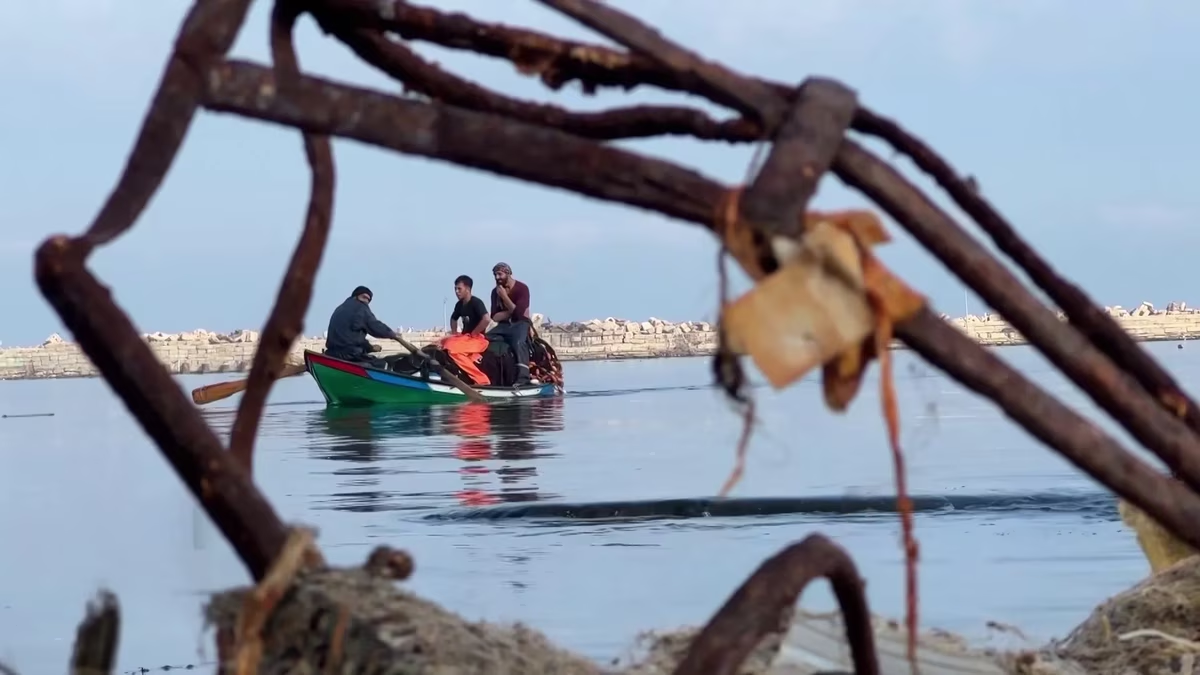
The Palestinian fisherman 'Abu Asad' stands with a tone filled with sorrow on the shore of Gaza's sea, observing the state of the port that once pulsed with life and activity. He describes the current scene as having turned into a graveyard of shattered structures and ruins inhabited by the memories of fishermen, after the Israeli war machine destroyed the boats and launches that once covered the horizon, transforming the sole source of livelihood for thousands of families into charred wreckage.

The military attacks launched by gunboats and warplanes were not merely targeting wooden planks, but rather a systematic attempt to assassinate the 'memory of the place' and cut off the lifeline of the fishing community. The fishing profession in Gaza has become a perilous adventure, as the naval blockade clamps down on fishermen, and bullets pursue them in every movement and stillness, making the pursuit of a livelihood an unequal daily battle.

In light of this harsh reality, Zakaria Bakr, head of the fishermen's committees in the sector, spoke about the 'ingenuity of necessity' that manifested among fishermen to counter the destruction of their equipment. Bakr explained that fishermen have resorted to using small paddles re-manufactured from the remnants of destroyed boats, in a desperate attempt to continue working despite the almost complete paralysis of fishing activity due to the deliberate destruction of essential equipment in the port.

Fishermen's innovations did not stop at recycling wood; they extended to transforming 'Styrofoam' panels and old 'refrigerator doors' into makeshift rafts they improvise to navigate the sea. These simple means reflect the magnitude of the tragedy and determination simultaneously, as these men try to flirt with the waves with tools that offer no protection from the sun's heat or the occupation's bullets, solely to secure their children's daily sustenance.

The suffering extends beyond sailing and pursuit at sea, as the danger reaches fishermen even when they are resting on the sand. One fisherman recounts that bullets pursue them every second, indicating that the occupation is not content with direct firing at sea, but also targets tents erected on the beach, depriving them of a sense of security even during moments of exhausting fatigue.

Today, fishing nets stand empty as a verdict of hunger and loss threatening thousands of families who have lost their breadwinners or their tools of work due to the ongoing aggression. The scene of boats unable to sail encapsulates the chapters of the great human tragedy in the Gaza Strip, where the sea has transformed from a source of good and giving to an arena of pursuit and siege that encircles Gazans by land, air, and sea.

Today, the Gazan fisherman digs in rock to secure his daily sustenance, as the occupation deliberately destroyed most boats and fishing equipment completely.

PALESTINE

Mon 15 Jun 2026 12:05 am - Jerusalem Time

Israeli Escalation in Southern Lebanon: Incursion into Majdal Zoun for the First Time Since 2000, Hezbollah Responds with Drones

Israeli occupation forces intensified their military aggression on wide areas in southern Lebanon this Sunday morning, with artillery shelling targeting the Qatrani area, part of Jezzine. This coincided with intense aerial raids that targeted the town of Al-Sraira after midnight, resulting in widespread destruction of homes and properties and large fires in agricultural lands, while local residents miraculously escaped death.

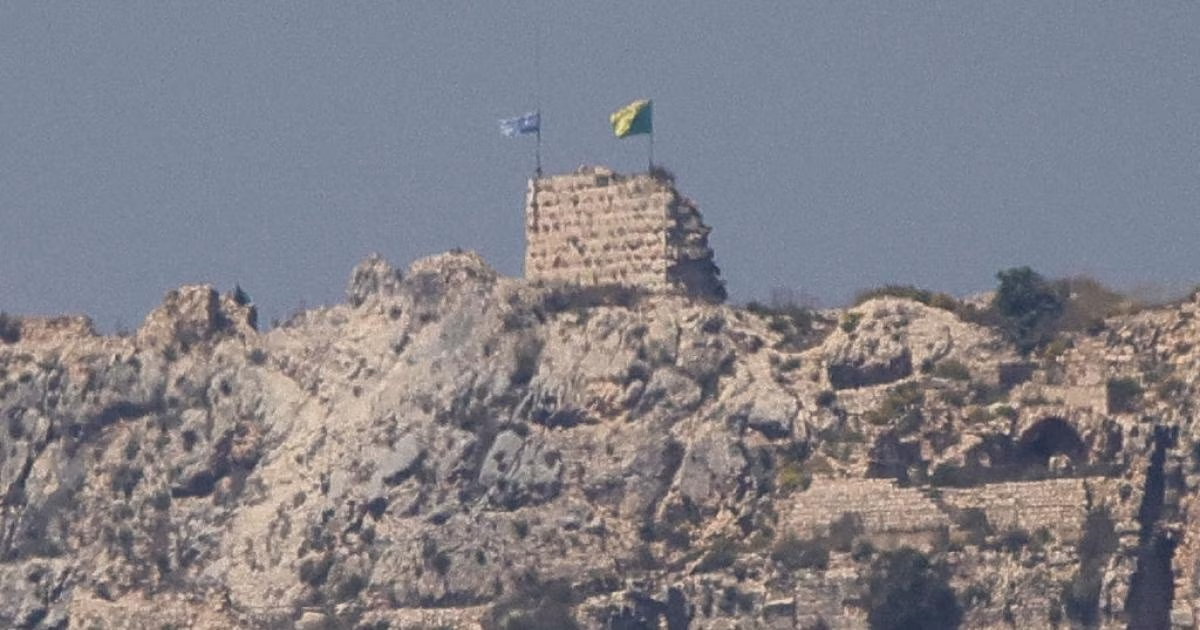
In a significant field development, field sources reported the incursion of Israeli army units into the town of Majdal Zoun in the Tyre district, marking the first time occupation forces have reached this point since their withdrawal in 2000. This incursion was accompanied by intense air cover, including raids on Mansouri, Qleileh, and Hosh Tyre, reflecting the occupation's desire to expand the scope of ground operations.

Regarding human casualties, two people were martyred at dawn today after an Israeli drone targeted a 'pickup' vehicle traveling on the road to the town of Mseileh. This incident comes in the context of systematic targeting of vehicles and movements on main roads in the south, with raids also hitting the town of Haris and the Maamoura and Abbasiyah areas with successive strikes.

In response, Hezbollah announced a series of military operations in response to the Israeli incursion and shelling, targeting gatherings of occupation soldiers and vehicles in the town of Majdal Zoun with a concentrated rocket barrage. The party also confirmed in an official statement the targeting of a military site in the town of Houla using kamikaze drones that accurately hit their targets, as part of a strategy to counter attempts at ground advancement.

For its part, Israeli media acknowledged the downing of two drones launched by Hezbollah in the Ras Naqoura area of Western Galilee, after sirens sounded in border settlements. The occupation army indicated that it had opened an investigation into the failure of air defense systems to intercept the two drones, which crossed the border and fell inside the occupied territories without reports of injuries.

Politically, Israeli Finance Minister Bezalel Smotrich called for intensifying military strikes and implementing what he described as the 'Dahieh doctrine' by destroying residential buildings in Beirut. Smotrich considered that the continued shelling from Lebanon towards northern towns represents a test of the threats issued by Benjamin Netanyahu, demanding widespread retaliatory responses that go beyond current lines.

Human rights reports indicate that the toll of the ongoing Israeli aggression since last March has risen to 3,711 martyrs and over 11,000 injured. Medical and field sources also recorded the martyrdom of 30 Lebanese army personnel during this period, the latest of whom was a soldier who sustained serious injuries after being targeted by a drone in the city of Nabatieh yesterday.

Also in the field, occupation forces continued their scorched-earth policy by carrying out extensive demolition operations in the border town of Khiam, coinciding with the issuance of evacuation warnings to residents of more than 20 southern towns. Israeli military orders demanded residents immediately move north of the Zahrani River, in a step aimed at displacing the remaining residents and emptying the border area.

Saturday had witnessed a bloody escalation that resulted in the martyrdom of 5 people, including the mayor of the town of Al-Rihan, following a series of more than 30 raids targeting southern villages. The resistance then responded by targeting engineering vehicles and military bulldozers of the 'Yaghi' and 'Nemira' types using 'Ababil' drones, achieving direct hits on advancing forces at the outskirts of the villages.

These rapid developments come at a time when diplomatic circles are awaiting the results of indirect negotiations between the United States and Iran regarding a comprehensive de-escalation agreement. According to informed sources, Tehran stipulates that any imminent agreement must include guarantees related to the Lebanese file and an end to the aggression on the south, to include the Gulf states and Israel within the framework of a regional settlement.

In light of this complex reality, southern Lebanon remains an arena for an open confrontation where field calculations intertwine with international political pressures. With the continued incursion into new points such as Majdal Zoun, fears are growing of the situation sliding into an all-out war that is not limited to border villages, but extends to include the Lebanese interior and vital facilities in implementation of repeated Israeli threats.

The shelling towards northern towns is a test of the Dahieh doctrine announced by Prime Minister Benjamin Netanyahu.

OPINIONS

Mon 15 Jun 2026 12:05 am - Jerusalem Time

Technology as a Tool of Genocide: How the Occupation Employs Digital Space in its War on Gaza?

Ramallah - “Alquds ” dot com

Ramallah - “Alquds ” dot com

Opinion Writer

In light of the immense digital revolution the contemporary world is experiencing, cyberspace has transformed from a means of communication into a complex tool for control and international competition. While the world boasts about the achievements of artificial intelligence and the Internet of Things, urgent questions arise about how these technologies are being adapted to serve bloody political and military agendas, especially in a besieged geographical area like the Gaza Strip.

The Gaza Strip is experiencing an unprecedented humanitarian tragedy under the weight of genocidal war and starvation, as the Israeli occupation seeks to impose a complete isolation on the Strip. This policy is manifested in preventing international media delegations from entering, and directly targeting journalists and activists to ensure that suffering remains confined within walls and away from the eyes of the world.

Israeli control over the digital space in Gaza is not merely a technical superiority; rather, it is a systematic employment of technology as one of the tools of genocide. Testimonies from specialists, including Moroccan engineer Ibtihal Abu Al-Saad, who resigned from Microsoft, have revealed the danger of the software provided to the occupation to confront and track Palestinians.

Successive periods of war witnessed a complete قطع of communication services at the peak of military operations, leading to the loss of many facts and realities. This deliberate absence of networks was not the result of accidental technical malfunctions, but rather a deliberate policy that views the image as a real danger and documentation as an international scandal that the occupation seeks to avoid.

Despite the grave dangers, journalists and citizens in Gaza continued to defy the digital wall of silence, risking their lives to document chapters of daily suffering. These individuals faced a dual policy from the occupation, ranging from direct physical liquidation to a digital genocide war targeting Palestinian content through complex algorithms.

The digital genocide war relies on the development of special software aimed at restricting the Palestinian narrative and blocking it from global platforms. The Palestinian finds himself fighting on the ground and in virtual spaces alike, as these tools seek to achieve political gains represented in legitimizing forced displacement and killing the truth.

One of the most prominent factors that contributed to the occupation's success in imposing its narrative is the convergence of interests with major technology companies, especially those based in the United States. These companies granted the occupation enormous technical advantages that were employed in ethnic cleansing operations and tracking civilian targets in the afflicted Strip.

Support was not limited to the technical aspect; Western governments also provided extensive political and media cover for the occupation's operations. These powers used their advanced technological capabilities to direct global public opinion away from the crimes committed on the ground, which contributed to prolonging the aggression without a real international deterrent.

Lobbying groups and interests played a pivotal role in recruiting influencers through social media to market the occupation's narrative. In contrast, supporters of the Palestinian cause were subjected to campaigns of intimidation and digital persecution aimed at silencing any voice calling for justice or exposing the falsehood of Israeli claims in international forums.

In contrast, the weakness of the political stances of Arab and Islamic governments emerges as a negative factor that led to the occupation's monopolization of the narrative. Official media and technological capabilities were not sufficiently employed to support the Palestinian right, leaving the digital arena open to systematic Israeli propaganda.

This official dereliction in building a media and technical system capable of confronting misinformation granted the occupation the freedom to proceed with the most heinous act of genocide. The catastrophic effects of these policies are still evident in Gaza, where the world needs tremendous efforts to delve into the depths of this tragedy and discover the extent of the crime.

What is being documented today in terms of testimonies and stories is not just fleeting texts, but an attempt to break the digital siege imposed on Gaza. Documenting the experiences lived by the residents of the Strip is a victory for the oppressed and an affirmation of the values of truth in the face of a technological killing machine that does not differentiate between civilian and military.

These issues must be deeply investigated by researchers and human rights activists to understand how technology has transformed from a means of human liberation to a tool for enslavement and extermination. The responsibility lies with the international community to hold accountable companies whose software contributes to the shedding of innocent blood and facilitates mass killings.

In conclusion, the lingering messages from Gaza remain a testament to the steadfastness of a people who refuse to break in the face of the most powerful technological systems. The battle of awareness and narrative is no less important than the battle on the ground, and it requires global solidarity to ensure that the full truth reaches without distortion or deliberate digital concealment.

The humanitarian catastrophe in Gaza is too great to be described in words or documented in images; you have to live it to understand the magnitude of the tragedy.

PALESTINE

Mon 15 Jun 2026 12:05 am - Jerusalem Time

Palestinian factions submit their response to 'Mladenov's map' and insist on full Israeli withdrawal

The Islamic Resistance Movement (Hamas) announced the submission of the official response of the Palestinian factions to the 'roadmap' presented by the High Representative of the Peace Council, Nikolay Mladenov. This step came after a series of intensive consultations held in the Egyptian capital, Cairo, with the aim of reaching a comprehensive national vision regarding the proposed international proposals.

The movement affirmed in an official statement that the Palestinian response primarily focuses on the necessity of faithfully implementing the first phase of the understandings. This phase includes a comprehensive cessation of all forms of Israeli aggression against the Gaza Strip, and ensuring the complete withdrawal of occupation forces from all areas of the Strip without exception.

Mladenov's map, which was presented last May, comes as an executive framework consisting of 15 clauses aimed at implementing the broader plan proposed by US President Donald Trump. This map seeks to establish specific mechanisms for thorny issues including reconstruction, the deployment of an international stabilization force, and the rebuilding of police agencies in Gaza.

The unified Palestinian position stressed the importance of adhering to the urgent humanitarian measures that were pledged at the start of the ceasefire. This includes the flow of relief aid, the provision of fuel, the permanent opening of crossings, and the securing of shelters for displaced persons who lost their homes during the years of war.

Informed sources explained that the meetings hosted by Cairo since June 6 included representatives of the factions and mediators from Egypt, Qatar, and Turkey. These efforts resulted in the crystallization of a unified political position that expresses the aspirations of the Palestinian people to obtain their legitimate rights and self-determination.

Hamas indicated that the factions dealt with the proposals with high national responsibility, considering that the success of any agreement depends on Israeli adherence to the humanitarian protocol. It also demanded the necessity of immediately starting comprehensive reconstruction operations to compensate for the massive destruction that affected civilian infrastructure.

The movement's delegation in Cairo is scheduled to continue its consultations with international mediators to follow up on implementation mechanisms and ensure that the occupation does not renege on its commitments. These moves aim to transform paper understandings into a tangible reality that ends the suffering of the residents of the besieged Strip.

The first phase of Trump's original plan came into effect in October 2025, but the Palestinian side accuses Israel of procrastination. Despite the factions' adherence to the requirements of that phase, the occupation continued its aggressions and reneged on the partial withdrawal pledges stipulated in previous agreements.

In a related context, Israel insists on presenting the disarmament of the factions as a prerequisite for moving to advanced stages of reconstruction. This is rejected by the Palestinian forces, who see the resistance's weapons as a fundamental guarantee in light of the continued Israeli threats to resume military operations.

These political developments come two years after a devastating war that left unprecedented human and material losses in modern Palestinian history. Statistics indicate the martyrdom of about 73,000 people and the injury of more than 173,000 others, the vast majority of whom are women and children.

On the ground, media sources reported that the Israeli army chief of staff, Eyal Zamir, has already approved new operational plans to return to fighting. The Israeli military establishment is monitoring what it describes as Hamas's attempts to restore its military capabilities and tunnel networks that were damaged during previous confrontations.

For his part, Hamas political bureau member Hussam Badran stated that the atmosphere in Cairo was very positive and constructive. Badran affirmed that the national consensus reached strengthens the supreme interests of the Palestinian people and places the international community before its responsibilities to end the occupation.

Anticipation remains the master of the situation, awaiting the Israeli and mediators' response to the newly submitted Palestinian position. While the factions seek to establish their political and humanitarian rights, Israel brandishes the option of military force, placing the region at a crucial crossroads between sustainable peace or a return to escalation.

The Palestinian factions dealt with the roadmap with high responsibility and positivity, while emphasizing the necessity of implementing the first phase in all its details.

OPINIONS

Mon 15 Jun 2026 12:04 am - Jerusalem Time

No Agreement in Sight Between America and Iran, War Continues

As I have repeatedly mentioned in my previous articles, the war is still ongoing despite fragile truces and the lack of an agreement so far. I have explained more than once the nature of the renewed ancient conflict between the United States of America and the Islamic Republic of Iran, which effectively began after the fall of the Shah in 1979. American-Iranian relations during the Shah's era were strong and multifaceted on both political and economic levels, but they were completely severed after Khomeini came to power following the Iranian Revolution and the overthrow of the Shah through widespread popular protests.

The crisis escalated with the American hostage incident in Iran, followed by the severance of diplomatic relations and the closure of embassies between the two countries, a situation that persists to this day. Over the years, this conflict has evolved to take various forms of indirect political and military confrontation, leading to the open war witnessed in the region since the beginning of this year.

Iran's strong support for the "Hamas" movement since the events of October 7, 2023, and the continuation of this support during the war in Gaza, have also contributed to deepening the confrontation between Iran and its axis on one hand, and Israel and the United States on the other. Iran has also reinforced what is known as the unity of fronts by supporting its allies in the region, foremost among them Hezbollah in Lebanon, the Houthis in Yemen, and its loyal Iraqi factions, which possess an arsenal of missiles and drones that have contributed to expanding the scope of the conflict.

The view of this old-new war indicates that it is a long and complex war, with no decisive solutions appearing on the horizon. The conflict is not limited to political and security interests only, but extends to deep ideological and intellectual dimensions. On one hand, Iran adheres to its regional project and its vision based on the Guardianship of the Islamic Jurist, and on the other hand, Israel, with American support, seeks to end the influence of the Iranian regime and reduce its military and regional capabilities.

It has become clear that the war continues despite multiple truces and ongoing intermittent negotiations. Negotiations seem like a long series that has not yet reached its final episode, despite repeated talk about the possibility of concluding a peace agreement between the United States and Iran. Personally, I believe that the scene is too complex to be resolved by a quick agreement, and I do not yet find sufficient indicators to suggest that a final agreement is imminent.

This conflict is historically and ideologically rooted, and the slogans of mutual hostility between the two parties make it difficult to bridge the deep gap between them through a political agreement alone, especially in light of the human losses and destruction inflicted on Iran and Israel as a result of many years of confrontation.

Among the most prominent obstacles preventing a final agreement is the issue of Iranian influence in the Middle East, especially the issue of Iran's regional allies. The war is still ongoing between Israel and Hezbollah in Lebanon, and threats remain in the Red Sea and the Arabian Gulf, whether through tensions related to the Bab al-Mandab Strait or the Strait of Hormuz, and the accompanying direct impact on global trade and energy security.

These developments have had a significant impact on the global economy, with oil prices experiencing sharp fluctuations, and transportation, shipping, and travel costs rising, contributing to increased inflation rates and higher prices for basic commodities in many countries around the world. Therefore, the effects of this war are no longer limited to its direct parties, but have extended to affect economies and peoples across different continents.

Countries in the region have also not been immune to the repercussions of this conflict, as many Arab countries face increasing security challenges as a result of ongoing military tensions. This has led to escalating concerns about the stability of the region and its political and security future.

Inside Iran, the picture appears more complex. There is a segment of Iranians who still support the current regime and reject any agreement that might be seen as a concession to the United States, while there are other groups demanding broader political reforms, and perhaps fundamental changes in the structure of the regime. This internal division increases the difficulty of making fateful decisions regarding the future of the relationship with Washington.

The Iranian nuclear file remains one of the most prominent outstanding issues in any potential negotiations, in addition to the issue of frozen Iranian funds and disagreements over the mechanisms for their release or utilization. Many questions also arise about Iran's readiness to reshape its regional relations or modify its policies towards its allies in the region in exchange for political and economic gains.

The most important question remains: Can an agreement be reached with Iran amidst the current complexities, potential disparities within governing institutions, and ongoing military confrontations in the region? And can the different parties overcome decades of conflict and mutual suspicions to reach a lasting settlement?

In conclusion, the status of the agreement remains unresolved, and the internal Iranian and regional scene appears highly complex. It is likely that the coming days will bring more military and political developments that will affect the course of American-Iranian relations and the future of the entire region. Nevertheless, I believe that the war is still ongoing, and the chances of reaching a comprehensive and final agreement are still distant at present, despite efforts to reach peaceful solutions.

PALESTINE

Mon 15 Jun 2026 12:04 am - Jerusalem Time

International Medical Movement to Isolate the Israeli Medical Association and Freeze its Global Membership

The British journal 'The Lancet', which holds a prestigious position in global scientific circles, has revealed a growing international movement aimed at boycotting the Medical Association of the Israeli occupation authorities. This move comes against the backdrop of the Association's negative stance on the ongoing aggression against the Gaza Strip, and the systematic destruction of Palestinian health facilities that resulted from it.

The leading medical journal published an article explicitly calling for the suspension of the Israeli Association's membership in the World Medical Association, emphasizing the need for a firm stance on the violations that have affected the health system in Gaza. This call has sparked a wave of concern within medical circles in 'Tel Aviv', where Hebrew reports warned of the repercussions of this step on the occupation's scientific standing and its ability to conduct joint research.

For his part, Ido Wolf, head of the Oncology Department at Ichilov Hospital, expressed his deep concerns about the success of the boycott campaign, stressing that it could lead to suffocating medical isolation. Wolf pointed out that these measures would negatively affect the supply of innovative medicines, training programs, and international research cooperation, on which the Israeli medical system heavily relies.

This global movement is led by a group of health organizations and activist doctors, most notably the 'People's Health Movement' and the 'Doctors for Gaza' organization active in the Netherlands. The 'Health Council for Jewish Voice for Peace' also participates in the campaign, adding broad human rights momentum to the demands for accountability of medical institutions affiliated with the occupation.

The campaign organizers directly accuse the Israeli Medical Association of abandoning its ethical, humanitarian, and professional obligations. Activists believe that the Association's absolute silence regarding the occupation army's targeting of hospitals, clinics, and ambulances, as well as the arrest and killing of medical personnel, constitutes unacceptable complicity in war crimes.

According to media sources, the campaign has so far succeeded in collecting signatures from more than 1150 individuals and health institutions around the world, as part of organized legal efforts. These efforts aim to officially include the issue of 'Israel's' expulsion on the agenda of the World Medical Association's General Assembly, scheduled to convene next October.

In contrast, the Israeli Medical Association tried to defend its position by describing these accusations as 'lies', warning that these steps represent a dangerous precedent that could lead to a comprehensive isolation of the academic and medical sectors. However, Lesley London, a professor at the University of Cape Town, asserts that the Association did not play any role in preventing the atrocities suffered by Palestinians, but rather provided implicit cover for them.

Despite the World Medical Association currently rejecting calls for expulsion on the pretext of maintaining channels of communication, popular and professional pressures continue to escalate. This confrontation is a new episode in 'The Lancet's' series of criticisms of the occupation, as the journal previously published letters in 2014 accusing 'Tel Aviv' of committing explicit war crimes.

The Israeli Medical Association was complicit in the unimaginable brutal operations inflicted upon Palestinians during the war.

ARAB AND WORLD

Mon 15 Jun 2026 12:04 am - Jerusalem Time

G7 Summit in France: Anticipated Meeting Between Sisi and Trump to Discuss Middle East Issues

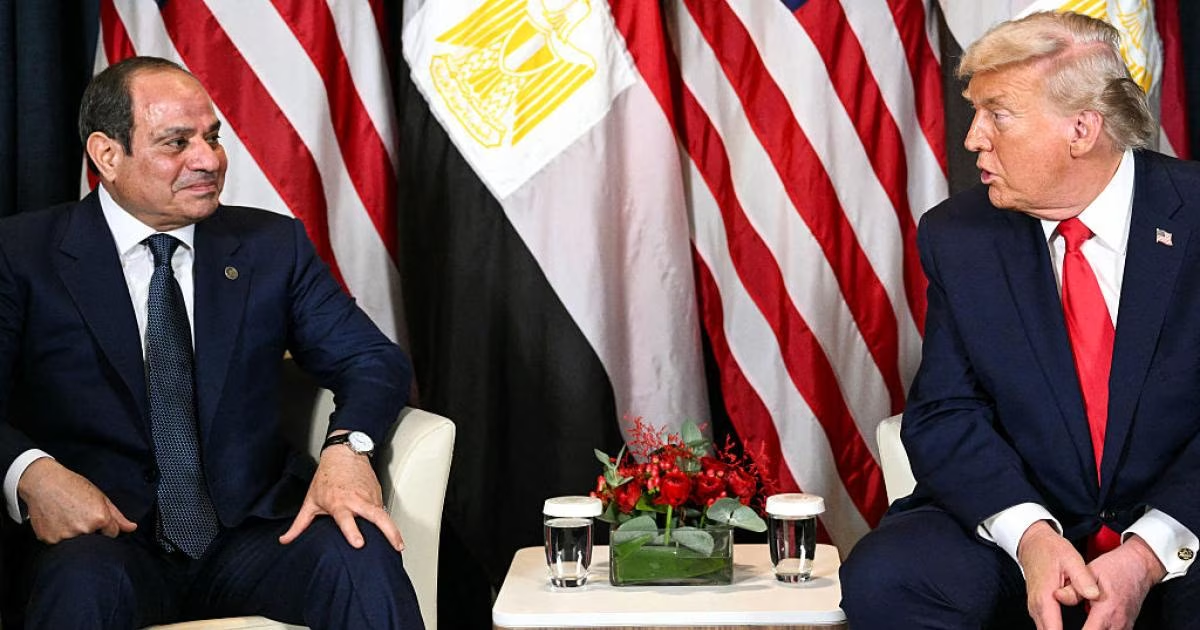
The French city of Evian is preparing to host the summit of the Group of Seven (G7) major industrialized nations between June 15 and 17, amidst widespread international anticipation. The Egyptian presidency officially announced the participation of President Abdel Fattah El-Sisi in this summit, in response to an invitation from his French counterpart Emmanuel Macron, who expanded the circle of participation to include Arab leaders.

The agenda for the visit is expected to include a high-level bilateral meeting between President Sisi and US President Donald Trump on the sidelines of the meetings. This meeting aims to coordinate joint efforts on urgent regional issues, especially given the exceptional circumstances the Middle East region has been experiencing since the beginning of this year.

This summit comes at a very sensitive time, as it is the first major international gathering since the outbreak of military confrontations, which included American and Israeli strikes against Iranian targets last February. These developments have led to an expansion of the conflict to include Lebanese territories, placing de-escalation at the top of the priorities for the leaders meeting in France.

In a related context, Saudi Crown Prince Mohammed bin Salman apologized for not accepting the invitation to participate in the international summit, citing prior commitments that prevented his travel. Official Saudi sources confirmed that the Kingdom is closely following the outcomes of the summit, despite the absence of representation at the highest leadership level in this forum.

Cairo plays a pivotal role in diplomatic mediation efforts, having engaged in intensive communications between Washington and Tehran in cooperation with regional partners such as Qatar, Turkey, and Pakistan. Despite this mediation, Egypt maintained a firm stance in condemning the attacks that targeted American interests and allied bases in the Arabian Gulf region in recent months.

Regarding the Iranian file, US President Donald Trump stated that an imminent agreement to end the war would be signed soon, indicating that this would be followed by the reopening of the Strait of Hormuz to international navigation. However, diplomatic circles are still awaiting official confirmation from the Iranian side regarding the timing of the signing or the final terms of the agreement.

It is worth noting that Egypt successfully hosted an international peace conference last October, which led to a ceasefire agreement in the Gaza Strip between Israel and resistance factions. The document of that agreement was signed in Sharm El Sheikh with guarantees from the leaders of Egypt, the United States, Turkey, and Qatar, paving the way for the start of humanitarian truce phases.

President Abdel Fattah El-Sisi participates in the work of the G7 summit, with a bilateral meeting scheduled with US President Donald Trump.

PALESTINE

Mon 15 Jun 2026 12:04 am - Jerusalem Time

Legal warnings to a London synagogue over a real estate exhibition promoting Israeli settlements

A Jewish synagogue in the Edgware area of the British capital, London, has received an urgent legal notice warning of the legal and ethical repercussions of hosting a real estate event promoting the sale of properties in occupied West Bank settlements. Sources reported that the notice was sent to the 'Edgware United Synagogue,' which is scheduled to host the 'Great Israeli Real Estate Event' on Sunday, amidst widespread criticism from human rights and legal organizations.

The International Centre of Justice for Palestinians, a UK-based legal organization, sent an official letter to the synagogue's management on Saturday evening to inform them of serious concerns regarding reputation and legal responsibility. The letter clarified that the event is being used as a platform to market properties built on occupied Palestinian lands, which contradicts prevailing international and legal directives.

The legal notice emphasized that British government guidelines clearly advise companies and entities not to engage in any economic or financial activities related to Israeli settlements. The letter warned that the synagogue's hosting of this event, even if its role is limited to providing the venue, facilitates illegal activities and bestows upon them internationally rejected legitimacy.

For his part, London Mayor Sadiq Khan intervened in the crisis, expressing his strong opposition to holding this real estate exhibition in the British capital. Khan confirmed that he discussed the matter directly with the Metropolitan Police, noting that security authorities would assess any criminal allegations related to the potential sale of illegal properties in preparation for taking necessary action.

On the parliamentary level, more than 100 British MPs signed a letter addressed to Foreign Secretary Yvette Cooper, demanding immediate intervention to cancel the event. The MPs considered that allowing this activity constitutes a breach of the United Kingdom's obligations under international law and contradicts the official position rejecting settlement expansion in the occupied territories.

In a related context, reports revealed a list of companies participating in the exhibition, which includes Israeli real estate developers openly promoting projects in illegal settlements. Among these companies are 'Harry Zahav,' which offers units in the 'Nijohot' settlement south of the Hebron Hills, in addition to the 'Meshulam Levinstein' group, which carries out projects in Jerusalem and the West Bank.

The 'Tifoch Sheli' real estate agency is also participating in the event, promoting properties in the large 'Ma'ale Adumim' settlement in the West Bank, alongside 'Africa Israel Residences.' These companies are part of a widespread settlement system that faces continuous international criticism due to its violation of Palestinian rights to their lands.

Solidarity groups, including the Palestinian Youth Movement and the International Jewish Anti-Zionist Network, plan to organize widespread protests in front of the synagogue in the Edgware area. Protesters aim to pressure the synagogue's management to cancel the event and express their rejection of using religious institutions to promote illegal settlement activities.

A spokesperson for the British government responded to these developments by affirming that settlement expansion in the West Bank is wrong and illegal. The spokesperson announced that the government is in the process of issuing updated guidelines in the coming days to clarify ways to avoid projects that support settlements, in a step aimed at strengthening oversight of such activities.

Sources indicated that the event organizers initially tried to keep the venue secret to avoid pressure, but the leak of the location led to legal and public mobilization. Institutions that host such exhibitions face the risk of prosecution on charges of facilitating dealings with entities operating in occupied territories in violation of local and international laws.

These legal moves come at a time when Britain is witnessing a growing debate about the role of companies and institutions in supporting the Israeli occupation. Observers believe that the legal notice sent to the synagogue represents a precedent that may prompt other institutions to reconsider hosting events related to settlement activity in the future.

The legal letter stated that companies engaging in business within settlements face significant commercial and legal risks, including the potential for involvement in war crimes under some legislation. The legal organization urged the synagogue's management to take an ethical and legal stance consistent with the principles of international justice.

Pressure continues on the British Foreign Secretary to take a firm stance that prevents London from becoming a platform for marketing settlements, especially in light of increasing tensions in the Palestinian territories. Opponents believe that the government's silence on such events sends wrong messages about London's commitment to the two-state solution and international law.

In conclusion, anticipation remains the master of the situation, awaiting the outcome of the field protests and the investigations promised by the British police. This issue represents a new test of the extent of British laws' ability to curb economic activities related to Israeli settlement on occupied Palestinian lands.

Allowing the event to proceed will not only contradict British government guidelines but will also violate the state's obligations under international law.

ARAB AND WORLD

Sun 14 Jun 2026 3:48 pm - Jerusalem Time

Dead and wounded in an Israeli raid targeting a residential apartment in Beirut's southern suburb

Israeli warplanes launched an airstrike targeting the southern suburb of the Lebanese capital, Beirut, resulting in civilian casualties. Medical sources reported that the initial toll of the aggression indicates one martyr and four others with varying injuries, due to the shelling that hit a densely populated residential area.

Local sources stated that the attack was carried out by two missiles launched by a warplane without any prior warning to residents, leading to widespread destruction at the targeted site. The raid focused on a residential apartment located near Qalqas Bakery on the vital highway connecting the Al-Musharrafieh area to the airport bridge.

For his part, the office of Israeli Prime Minister Benjamin Netanyahu announced that the airstrikes were carried out based on direct instructions from him and Defense Minister Yoav Gallant. The joint statement claimed that the attacked targets belonged to Hezbollah, describing them as facilities used for military purposes.

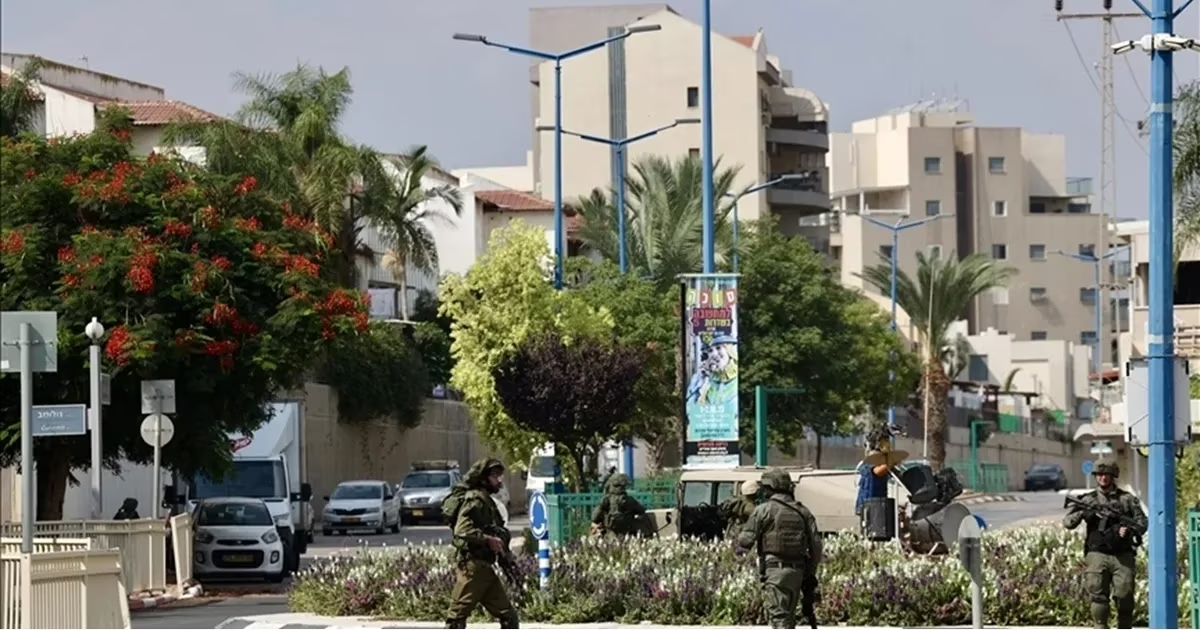
This field escalation comes at a time when the Israeli army announced the detection of three drones that penetrated northern airspace coming from Lebanese territory. The army spokesman clarified that two drones crashed in open areas in the north without casualties, while investigations are still ongoing regarding the fate of the third drone.

In the context of political incitement, ministers from the far-right in the Israeli government called for an increase in the pace of military operations against the Lebanese capital. These ministers demanded the adoption of a scorched-earth policy in response to what they described as drone threats targeting northern settlements.

Finance Minister Bezalel Smotrich stated that targeting northern areas represents a real test of what is known as the 'Dahiya Doctrine'. Smotrich urged the prime minister to firmly apply this doctrine by destroying residential buildings in the heart of Beirut's southern suburb to deter any future attacks.

In turn, National Security Minister Itamar Ben-Gvir joined the chorus of inciters, emphasizing the need for an excessive response to any violation of ceasefire agreements. Ben-Gvir considered that the southern suburb must shake under the weight of Israeli shelling for every missile or drone launched towards Israel.

These statements indicate a premeditated intention by the occupation government to expand the scope of targeting to include infrastructure and civilian areas in Lebanon. Observers believe that this escalatory rhetoric paves the way for a new phase of direct military confrontation that may exceed the established rules of engagement.

Israeli officials had previously hinted that targeting population centers in the north would be met with a violent response reaching deep into Beirut. Tel Aviv claims that this policy enjoys understandings and support from the American administration, which gives it political cover to continue its military operations.

A state of extreme tension prevails in the Lebanese atmosphere following this raid, amid fears of the situation sliding into an all-out war. Ambulance and civil defense teams continue search and rescue operations at the raid site in the southern suburb, in anticipation of missing persons under the rubble of the targeted apartment.

For every drone or missile, and for every violation of the ceasefire, the Dahiya must tremble.

PALESTINE

Sun 14 Jun 2026 3:47 pm - Jerusalem Time

Death of the Prisoner Imad Sarhan in Gilboa Prison After 25 Years of Detention

The Israeli occupation authorities informed the family of Palestinian prisoner Imad Rajeh Sarhan today, Sunday, of their son's martyrdom inside Gilboa Prison. Local sources clarified that the 47-year-old martyr, a resident of occupied Haifa, passed away due to a severe heart attack that struck him yesterday, Saturday, without the prison administration providing precise details about the circumstances of his death.

Martyr Sarhan is considered one of the veteran prisoners, having been arrested by occupation forces on October 15, 2001, and sentenced to life imprisonment. From the first moments of his arrest, the martyr faced a long journey of suffering that began with harsh military interrogations and the use of systematic torture methods that left health scars that never left him until the moment of his martyrdom.

Both the Commission of Detainees and Ex-Detainees Affairs and the Palestinian Prisoner's Society confirmed that Sarhan suffered for years during his detention from a policy of repeated solitary confinement that affected his psychological and physical condition. He was also subjected to deliberate medical neglect and deprivation of necessary treatment, which led to him contracting chronic and serious heart, artery, and vein diseases, in addition to his continuous struggle with high blood pressure.

In recent years, Prisoner Sarhan's health condition witnessed a rapid and severe deterioration that forced him to use a wheelchair for movement inside his cells. Despite losing the ability to move normally, the Prisons Service continued to detain him in conditions lacking the most basic humanitarian necessities, disregarding all human rights appeals for his release to receive treatment.

Human rights organizations stressed that Martyr Sarhan is a new victim of the slow killing policy practiced inside prisons, which has escalated unprecedentedly recently. Sources indicated that prisoners face a comprehensive system of abuse, including starvation and severe isolation, in the complete absence of the International Committee of the Red Cross's role and its prevention from carrying out its monitoring duties.

With the martyrdom of Prisoner Sarhan, the number of martyrs of the prisoner movement who have died since the start of the genocide war rises to 90 martyrs, a number that reflects the extent of the crimes committed behind bars. This brings the total number of martyrs of the prisoner movement since 1967 to 327 martyrs, including 118 prisoners who were serving life sentences, like Martyr Sarhan.

The leading bodies of the prisoners held the occupation authorities fully responsible for this crime, calling on the international community to break its silence and take effective measures to hold the occupation leaders accountable. This incident comes at a time when more than 9,400 Palestinian prisoners are held in prisons, including over 3,300 administrative detainees held without charge or legal trial.

With Sarhan's martyrdom, the number of documented martyrs of the prisoner movement since the start of the genocide crime rises to 90 martyrs.

ARAB AND WORLD

Sun 14 Jun 2026 3:47 pm - Jerusalem Time

Global anticipation for an agreement to end the 106-day war between Washington and Tehran

The eyes of the international community are focused on the anticipated final draft of an agreement aimed at ending the 106-day military confrontation between the United States and Iran. Diplomatic descriptions of this development fluctuate between it being a comprehensive memorandum of understanding or an initial framework for a final agreement, while anticipation surrounds the timing of the official announcement that could change the political map in the region.

For his part, US President Donald Trump considered reaching this stage an exceptional political success, noting that this achievement coincides with his reaching the age of eighty. Trump described the agreement as imposing strict restrictions preventing Tehran from possessing a nuclear weapon, comparing it to previous agreements which he considered inadequate in protecting American and international interests.

In contrast, a state of extreme caution prevails in Iranian circles, where media sources close to decision-making circles reported that Tehran fears the agreement will be turned into a tool for political propaganda in favor of the US administration. The final Iranian position remains reserved, awaiting confirmation that all demands related to national sovereignty and economic interests are met before official signing.

The US administration adheres to firm demands including the complete dismantling of Iran's nuclear program infrastructure, with the necessity of disposing of its highly enriched uranium stockpile either through destruction or technical processing. Washington also stipulates the imposition of a strict and comprehensive international monitoring system to ensure that nuclear activities do not return to their previous military paths under any circumstances.

Regarding sanctions, Washington links any step towards releasing frozen Iranian assets to the extent of Tehran's commitment to the terms of the agreement, especially concerning ensuring the security of international navigation in the Strait of Hormuz. US conditions also include halting support for regional allies, which Washington sees as necessary to ensure sustainable regional stability after the cessation of hostilities.

In contrast, Tehran insists on the necessity of a comprehensive and complete lifting of all economic sanctions imposed on it, including ending restrictions on oil exports and banking transactions. The Iranian government demands a timeline not exceeding 30 days for lifting maritime restrictions, while affirming its legitimate right to develop a nuclear program for peaceful purposes and maintain low levels of uranium enrichment.

Internally in Iran, parliamentary voices have emerged expressing concern about some technical details in the agreement, with the deputy head of the National Security Committee pointing to ambiguities regarding the mechanisms for implementing the opening of the Strait of Hormuz and estimating the actual value of the funds to be released. Intensive discussions continue within Iranian political circles to assess whether the agreement crosses the red lines set by the supreme leadership.

This agreement represents an impenetrable barrier against Iranian nuclear ambitions, and it is a political achievement that coincides with a pivotal stage.

PALESTINE

Sun 14 Jun 2026 3:47 pm - Jerusalem Time

Bodies under displaced persons' tents.. Random graves double the tragedy of unidentified martyrs in Gaza

Mohammed Awad, a displaced citizen in the Sheikh Radwan neighborhood north of Gaza City, was shocked to find the body of a child buried at a shallow depth under his tent while he was trying to expand a sewage pit. The incident revealed the tragedy of random graves that residents were forced to create at the height of ground military operations, where playgrounds and public squares turned into temporary burial sites due to the inability to access official cemeteries.

Local sources reported that ambulance crews transported the discovered body to complete documentation procedures within the lists of unidentified martyrs, a humanitarian dilemma that is worsening over time. Awad lives in a tent on a playground where dozens of martyrs were buried in the first months of the war, and despite most bodies being moved later, some remained forgotten under the sand.

Paramedic Karim Al-Attal confirmed that the playground where the displaced are currently residing had previously contained about 100 bodies, pointing to the repeated incidents of unexpectedly finding the remains of martyrs in various areas of the Gaza Governorate. He explained that the absence of personal data for some victims makes it difficult to identify them, especially with the repeated displacement of families and the loss of contact with their relatives.

For its part, the Euro-Mediterranean Human Rights Monitor documented the existence of about 30 large random mass graves containing nearly 3,000 bodies in various governorates of the Strip. The monitor also pointed to the creation of more than 120 small mass graves, each containing three or more individuals, reflecting the scale of the catastrophe left by the ongoing aggression on civilian populations.

In a similar incident in the Al-Karama neighborhood, citizen Majed Shaheen found a decomposed body next to his home at the beginning of this year, and despite his repeated attempts through social media platforms to identify the owner of the body by his clothes, no one was able to identify him. Shaheen was forced to exhume the remains and rebury them in an official cemetery, awaiting any clue that might lead to his identity in the future.

Fares Afana, director of the ambulance unit in medical services, attributes the increase in the number of unidentified persons to the systematic policies followed by the occupation, including exhuming and bulldozing graves and preventing medical teams from recovering victims. He added that the extermination of entire families led to the absence of any relative who could identify the bodies left in the streets or under the rubble for long periods.

At Al-Shifa Medical Complex, the forensic medicine department manages a massive file containing more than 1,000 unidentified bodies, where each martyr is given a sequential number and a record that includes photos and DNA samples. Dr. Ahmed Adhheer explained that these procedures aim to facilitate the identification of victims in the future if the necessary laboratory equipment and materials for DNA testing become available.

Adhheer revealed that the occupation authorities handed over 480 bodies that had been held since the ceasefire agreement, but without providing any clarifying data about their identities or the circumstances of their martyrdom. Specialized committees succeeded in identifying only 110 bodies from this batch, while hundreds of them are still registered on the lists of unidentified persons.

Government estimates in Gaza indicate that the number of missing persons has reached about 10,000, most of whom are believed to still have their bodies under the rubble of destroyed homes. Civil defense teams face extreme difficulties in reaching these missing persons due to the lack of heavy machinery and the continued targeting of vital areas, which makes the actual number of martyrs likely to increase.

Medical reports confirm that there are dozens of martyrs who were buried in random graves during periods of strict siege without being presented to the competent authorities or having their data recorded. This absence of official documentation during harsh war moments complicates the legal and humanitarian file of these victims and deprives their families of the right to know and a dignified burial.

Medical sources stressed that the file of unidentified persons requires international intervention to provide mobile laboratories and the necessary chemical materials for analyzing remains, especially with the decomposition of many bodies. This issue is considered one of the deepest wounds left by the war, as thousands of families remain in limbo between the hope of finding their missing loved ones or obtaining final answers.

In the context of comprehensive statistics, the Palestinian Ministry of Health announced that the toll of the aggression has exceeded 72,000 martyrs and more than 173,000 injured, figures that reflect the unprecedented scale of destruction. These numbers are still likely to rise with the continuation of search operations in random graves and under the rubble of residential areas that have been razed to the ground.

In conclusion, random graves stand as a silent witness to the harsh conditions experienced by the residents of Gaza, where playgrounds and displacement sites have turned into forced burial grounds. The biggest challenge for human rights and medical organizations remains to ensure the documentation of every victim and the preservation of their dignity, in a reality that becomes more complex with each passing day since the end of major military operations.

The file of unidentified martyrs is becoming more complex over time and requires the availability of many materials, equipment, and tests to try to identify them.

PALESTINE

Sun 14 Jun 2026 3:47 pm - Jerusalem Time

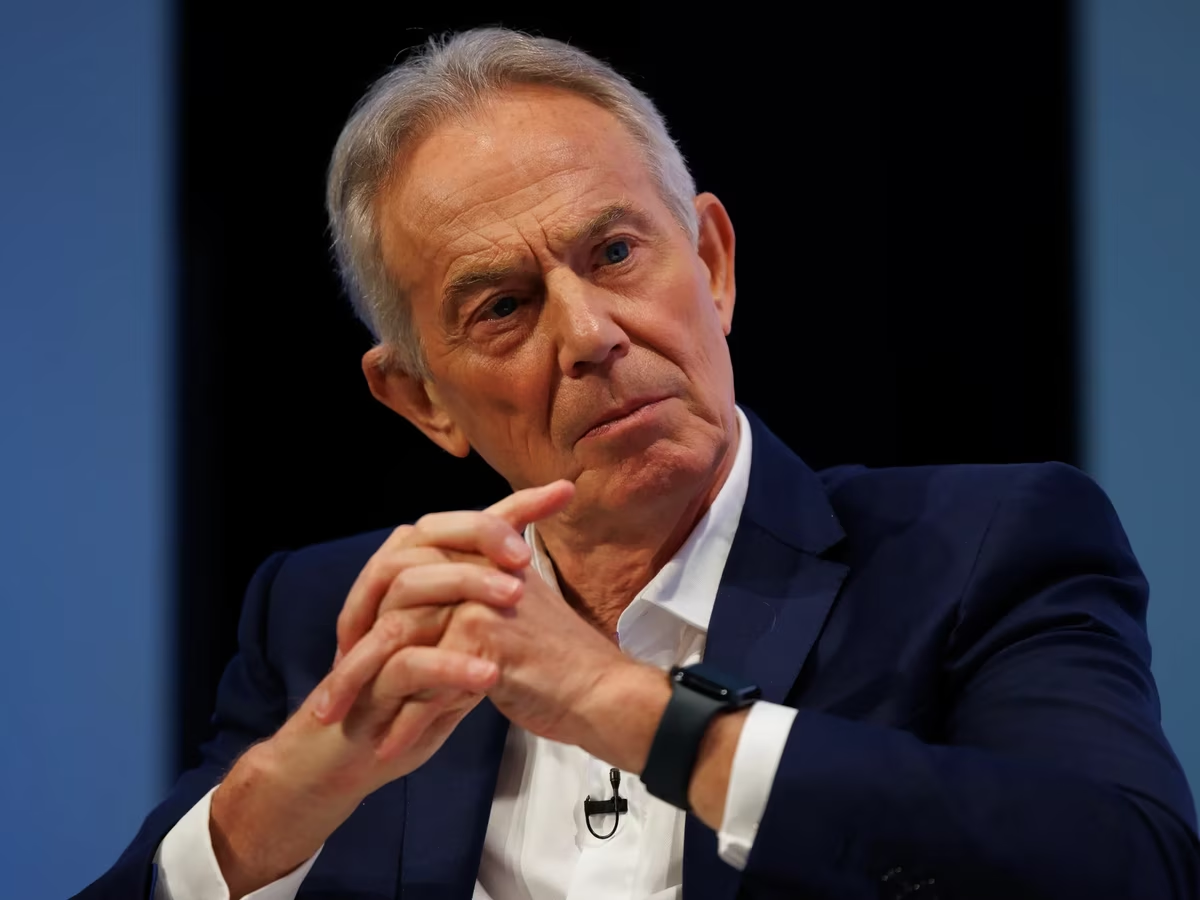
Tony Blair Joins Leadership of Peace Council's Executive Arm to Manage and Reconstruct Gaza

International press reports have revealed that former British Prime Minister Tony Blair is preparing to take on a prominent leadership role in managing the crisis in the Gaza Strip. Blair will work within the framework of the 'Peace Council' chaired by US President Donald Trump, which is the body responsible for overseeing the affairs of the Strip and implementing stalled reconstruction plans.

Informed sources stated that Blair will assume additional and vital responsibilities in the executive arm of the Council, despite no official announced change in his current position title. This move aims to leverage his extensive international network to advance stabilization efforts in the region, which is suffering from the aftermath of a devastating two-year war.

Data indicates that Blair's primary focus will be on coordinating the flow of urgent humanitarian aid to Gaza, in addition to contributing to the management of the Council's executive team. This step comes at a sensitive time that requires high coordination among international parties to ensure the delivery of essential supplies to the besieged population.

Blair had previously faced objections from Arab countries that prevented his appointment as a key envoy for the peace plan, due to his previous stances in the Iraq War in 2003. However, the current US administration appears to see his extensive experience as a necessary element to overcome the diplomatic obstacles hindering the path to a final solution.

In a related context, the reconstruction process is suffering from a deep stalemate due to the continuation of Israeli military operations and repeated violations of the ceasefire agreement signed last September. Field reports confirm that these violations have undermined efforts to begin the actual phase of restoring the collapsed infrastructure in the Strip.

UN organizations describe the humanitarian situation in Gaza as extremely dire, with hundreds of thousands of Palestinians still living in tents and temporary shelters lacking the most basic necessities of life. Residents face a severe shortage of food and potable water, placing immense pressure on the Peace Council to accelerate the pace of relief work.

The field work is expected to undergo a shift with Bulgarian diplomat Nikolay Mladenov taking over supervision of the implementation of the second phase of the international plan. Mladenov will work in coordination with Blair to ensure overcoming internal Israeli political complexities, especially with the approaching general elections in Tel Aviv and their impact on war and peace decisions.

The White House announced in mid-January the adoption of official structures for managing the transitional phase, which include executive councils, national committees, and an international stabilization force. The first meeting of these structures was held in Washington last February, based on UN Security Council Resolution 2803, which established the legal framework for ending the conflict.

It is worth noting that the Gaza Strip was subjected to a genocidal war that began in October 2023, resulting in the martyrdom of more than 72,000 Palestinians and the injury of approximately 172,000 others. Military operations also led to the destruction of nearly 90% of vital facilities and infrastructure, making the task of the Peace Council and Tony Blair extremely complex.

Blair will be more involved in leading the executive arm of the Council, with a special focus on coordinating the entry of humanitarian aid into Gaza.

PALESTINE

Sun 14 Jun 2026 3:46 pm - Jerusalem Time

Maps of Israeli Expansion: Security Belts and Spheres of Influence Devour 1100 sq km in Gaza, Lebanon, and Syria

Recent field data and geographical documentation have revealed a transformation of what Israel describes as 'buffer security zones' in the Gaza Strip, southern Lebanon, and Syria from temporary lines into vast areas of occupation and military influence. The areas currently under direct Israeli control or military influence exceed 1100 square kilometers, indicating a strategy to establish permanent security belts that vary between combat positioning, field control, and imposing movement restrictions.

The occupation authorities justify this expansion on security grounds. Israeli Security Minister Yisrael Katz announced in April 2025 that the army would not withdraw from areas it designated as 'safe' in the Gaza Strip, even if future settlements are reached. This approach also extends to the northern front, where Israel has maintained military positions in southern Lebanon despite ceasefire agreements, considering them part of a new buffer zone.

In southern Lebanon, geographical matching operations of recently published visual materials showed that Israeli movements have expanded to include a wide network of strategic military positions. Field sources documented the construction of a bridge over the Litani River, in addition to observing vehicles and forces inside the town of Taybeh, reflecting a desire to establish strongholds that go beyond the traditional Blue Line.

Among the most prominent Israeli strongholds in Lebanon is the historic Beaufort Castle, where investigations confirmed the presence of occupation forces inside it, about five kilometers from the border. The Israeli Security Minister explicitly stated that forces would remain in this strategic castle as part of what he described as the new security zone, to ensure field superiority in the eastern sector.

Estimates based on geographical measurement tools indicate that the area of Israeli occupation or military influence in southern Lebanon has reached approximately 625 square kilometers. This area represents about 6% of the total Lebanese territory, most of which is located within areas that have been subjected to repeated evacuation orders and intensive shelling, leading to widespread destruction of infrastructure.

In the Gaza Strip, the pattern appears similar in terms of seeking to impose a new geographical reality by expanding the 'Yellow Line'. Despite many months passing since previous understandings, Israeli Prime Minister Benjamin Netanyahu announced last May an increase in the percentage of land included in the buffer zone to reach 70% of the total area of the Strip.

Map analysis results showed that only about one-third of the Gaza Strip's area is currently outside the scope of direct ground occupation or declared areas of influence. The area under direct military control is estimated at approximately 425 square kilometers, with forces deployed in strategic axes that divide the Strip and control its vital joints.

On the Syrian front, the Israeli army exploited field developments and the fall of the regime in December 2024 to move quickly and cross the lines of the 1974 disengagement agreement. Israeli forces controlled the former buffer zone before expanding their deployment to deeper positions in the Quneitra and Daraa governorates, reaching the vicinity of the strategic Mount Hermon.

Mount Hermon holds exceptional importance in Israeli security doctrine, with Yisrael Katz announcing in early 2025 that the army would remain in the area and around the mountain indefinitely. This presence is accompanied by the establishment of permanent military sites, supply routes, and advanced observation points overlooking vast areas of the Syrian interior.

Satellite images detected the construction of new logistical sites north of the separation line near Majdal Shams, where forces are positioned more than two kilometers deep inside Syrian territory. The expansion also included the towns of Jubata al-Khashab, Hamidiya, Quneitra, and Qahtaniya, where Israeli military vehicles were seen moving freely in those areas.

The area of Israeli military influence in southern Syria is estimated at approximately 235 square kilometers, an area not entirely under permanent infantry control but under fire control and surveillance. Within this area, Israel manages fixed positions and military roads that ensure rapid intervention when necessary, effectively turning it into a sphere of influence.

This field expansion coincides with political pressure and Israeli demands for disarmament in the three southern Syrian governorates: Quneitra, Daraa, and Sweida. Experts believe that this security concept aims to create a security belt that practically extends to the road connecting Damascus and Sweida, which places vast areas under direct military threat.

These security belts imposed by Israel on the three fronts reflect a shift in military strategy from 'border defense' to 'preventive occupation'. By seizing land and establishing facts on the ground, Israel seeks to impose its terms in any future negotiations, relying on geographical control that makes a return to pre-conflict borders complicated.

In conclusion, updated maps show that Israel has succeeded in carving out strategic areas from neighboring countries and the Gaza Strip under the guise of buffer zones. With the continued construction of logistical facilities and military roads, these areas appear likely to remain as long-term spheres of influence, radically changing the geopolitical map of the region.

The army will not withdraw from the so-called 'safe areas' in the Gaza Strip even after any future settlement is reached.

LATEST NEWS

Sun 14 Jun 2026 3:45 pm - Jerusalem Time

Unveiling the Features of an Anticipated Iranian-American Memorandum of Understanding: Cessation of Military Operations and Suspension of Oil Sanctions

Informed sources in Tehran reported that the features of a new memorandum of understanding are beginning to crystallize between the Iranian and American sides. Mehdi Mohammadi, an advisor to the Speaker of the Iranian Parliament, revealed the main axes that will form the general framework of this anticipated agreement. These understandings aim to de-escalate tensions in the region by establishing legal and practical foundations to ensure stability in the coming period.

The leaked clauses indicate that the agreement includes a comprehensive cessation of all military operations directed against Iran and Lebanon, with Washington providing clear guarantees to prevent the renewal of field tensions. This military track serves as a first step to build trust between the two parties, ensuring the protection of infrastructure and national sovereignty from any external targeting during the memorandum's validity period.

On the financial front, the memorandum stipulates the immediate release of a portion of Iranian assets that were frozen in foreign banks due to previous sanctions. This step is scheduled to coincide with the implementation of other clauses, providing liquidity to support the Iranian economy in facing current challenges.

Regarding the energy sector, Mohammadi clarified that the understanding calls for the suspension of sanctions imposed on Iranian oil exports for an initial period of up to sixty days. This measure aims to increase economic exchanges and meet the growing international need for the return of Iranian crude to global markets, especially in light of the energy crises affecting the world.

The memorandum also addresses the issue of international navigation, with the United States committing to ending the imposed naval blockade, particularly in the strategic Strait of Hormuz region. This step would restore maritime trade and international transport to normalcy, reducing shipping risks and contributing to the stability of global energy prices that have been affected by recent tensions.

It is noteworthy that the first phase of these negotiations will not address the Iranian nuclear file, as Tehran stipulates the implementation of initial commitments by Washington before entering into this complex file. Sources confirmed that the Iranian side insists on seeing tangible results on the ground regarding the lifting of economic sanctions before sitting at the nuclear negotiations table.

In the final phase of the agreement, the focus will be on reconstruction and compensation for damages resulting from previous military operations. Leaks speak of a proposal to establish a massive investment fund worth up to $300 billion, allocated to finance development projects and compensate for losses, representing a radical shift in the trajectory of regional and international relations.

On the other hand, the initial commitments must be fully implemented before moving to the phase of comprehensive nuclear issues talks.

PALESTINE

Sun 14 Jun 2026 3:45 pm - Jerusalem Time

Targeting Al-Aqsa: Warnings of Gradual Changes Affecting the Status Quo

Sheikh Muhammad Hussein: Targeting facilities aims to withdraw the powers of the Islamic Endowments Department and impose Israeli sovereignty over Al-Aqsa Mosque. Sheikh Ekrima Sabri: Attacks on Al-Aqsa Mosque are no longer limited to extremist settler groups, but the occupation police have become a direct party to them. Maarouf Al-Rifai: Targeting distributed facilities reflects an attempt to tighten control over various aspects of Al-Aqsa within a policy to redefine the entity managing the mosque. Hatem Abdel Qader: What is happening is not limited to controlling facilities but coincides with continuous and unprecedented incursions into Al-Aqsa Mosque, in addition to provocative practices. Ahmed Al-Rifai: What is happening is not limited to targeting specific facilities only, but directly affects the powers of the Endowments Department and the Jordanian guardianship over Al-Aqsa. Ziad Abhais: The danger currently lies in reducing the role of the Islamic Endowments Department and gradually replacing it with the occupation police as the entity managing daily life within it, in preparation for establishing a Jewish administration. Ramallah – Exclusive to "Al-Quds" – The circle of warnings regarding what is happening inside the blessed Al-Aqsa Mosque is expanding, following the targeting of a number of facilities belonging to the Islamic Endowments Department, by breaking their locks and preventing their repair or re-operation, amid fears that these measures are part of a new phase in a continuous process that pressures the powers of the Endowments and limits its ability to manage the mosque's facilities and daily services, leading to a change in the existing reality. Officials and specialists confirm in separate interviews with "Al-Quds" that these continuous measures, ongoing for about four months, are accompanied by an escalation in repeated incursions into Al-Aqsa Mosque, and the performance of rituals within its courtyards, in addition to restrictions imposed on renovation and construction work, and harassment of workers in Al-Aqsa Mosque. They believe that these practices are inseparable from attempts to impose a new reality inside Al-Aqsa Mosque, directly affecting the role of the Jordanian guardianship and the endowment administration that has existed for decades, as part of a gradual process aimed at reshaping the administration of Al-Aqsa Mosque and gradually reducing the role of the Endowments, in exchange for expanding the presence of Israeli security entities that will eventually become a de facto authority, noting that this process is accompanied by steps aimed at changing the nature of the religious use of Al-Aqsa Mosque, which requires the necessity of a broader movement at the political, diplomatic, and legal levels to preserve the status quo. "Jerusalem Endowments": This is how the targeting of facilities began. An official source in the Islamic Endowments Department in Jerusalem, who preferred not to be named, explained in his interview with "Al-Quds" that the Israeli occupation police targeted about four months ago four facilities inside the blessed Al-Aqsa Mosque by breaking their locks and taking control of them, under "flimsy pretexts not based on any acceptable evidence," and then prevented the Endowments Department from repairing them or installing new locks on them. The source explains that these measures come within the context of a continuous policy aimed at undermining the powers of the Endowments inside Al-Aqsa Mosque, noting that the targeted facilities are still partially used; Dar Al-Hadith is used for teaching the Holy Quran and noble Hadith to women, while the Dome of the Chain is used as a headquarters for Al-Aqsa Mosque affairs employees, while guards inspect the Dome of Solomon daily, with the continued prohibition of closing its doors or re-securing them. The source indicates that the occupation police periodically inspect these facilities and take punitive measures against any party attempting to repair or secure them, including expelling those responsible for maintenance work or installing locks, in a step aimed at imposing a new reality inside Al-Aqsa Mosque and preventing the Endowments from exercising its normal powers. The source indicates that this policy is not limited to preventing the closing of doors, but extends to disrupting construction, agriculture, and maintenance work inside Al-Aqsa Mosque, so that any defect or damage occurring in its facilities is prohibited from being repaired, which reflects a clear attempt to weaken the role of the Endowments and reduce its administrative sovereignty inside Al-Aqsa Mosque. The Endowments are still adhering to their powers. The source confirms that the Endowments Department, despite these restrictions, still maintains its daily presence inside a number of facilities, such as Dar Al-Hadith and the Dome of Bab Al-Rahma, but the goal of these measures is to completely undermine its role and replace it with the de facto authority exercised by the occupation police inside the mosque. The source considers that these practices come within a broader "Judaization" policy that includes daily incursions and the performance of Talmudic rituals within the courtyards of Al-Aqsa. The necessity of action to stop these measures. The source calls for urgent Arab and Islamic diplomatic action, in addition to an active Jordanian role as the holder of the Hashemite guardianship, in order to stop these measures and restore matters to what they were before the targeting of facilities and preventing the Endowments from performing its duties. In the context of a broader plan, the Mufti of Jerusalem and the Palestinian Territories, Sheikh Muhammad Hussein, confirms that the targeting of a number of facilities of the blessed Al-Aqsa Mosque belonging to the Islamic Endowments Department and preventing maintenance and renovation work falls within a broader plan aimed at imposing control over the mosque and undermining the powers of the Endowments Department and the Hashemite guardianship over Islamic and Christian holy sites in Jerusalem. Hussein explains that four facilities belonging to the Islamic Endowments inside Al-Aqsa Mosque had their locks broken in recent months, while the competent authorities were prevented from repairing or renovating them, noting that these measures do not represent an isolated incident, but come within a long series of continuous violations against Al-Aqsa Mosque, its facilities, and its workers. Hussein indicates that the incursions carried out by settler groups into Al-Aqsa Mosque have become almost daily, and witness the practice of Talmudic and Torah rituals and ceremonies within its courtyards, in addition to chanting songs, performing dances, and raising flags, considering that these practices represent a direct violation of the sanctity of the mosque and the sacredness of the place. Hussein confirms that the restrictions also affect the construction committees and workers in Al-Aqsa by obstructing the periodic maintenance work necessary to preserve the historical and cultural landmarks of the mosque, which embraces Islamic artifacts dating back to successive centuries. Illegitimate interference. Hussein confirms that Al-Aqsa Mosque constantly needs renovation, construction, and maintenance work as a unique historical and cultural site, and that the attack on the offices of the competent authorities and the storage sites for maintenance materials constitutes illegitimate interference in the management of the mosque's affairs and properties. Officially supported targeting. Hussein believes that these policies come within a project supported by extremist Israeli figures and ministers who encourage incursions and support imposing more control over Al-Aqsa Mosque. The necessity for UNESCO to assume its responsibilities. Sheikh Hussein calls on international institutions, foremost among them UNESCO, to assume their responsibilities towards protecting Al-Aqsa Mosque and the holy city as part of the global human heritage, also calling on Arab and Islamic countries, governments, peoples, and institutions, to intensify their efforts to protect Al-Aqsa Mosque and confront the repeated attacks on it. Attempts to withdraw the powers of the Endowments. Hussein stresses that targeting the Endowments facilities aims directly to withdraw the powers of the Islamic Endowments Department and impose Israeli sovereignty over the mosque, affirming that the Endowments Department continues to perform its duties despite the challenges, with the support of the Palestinian people and the Hashemite guardianship led by King Abdullah II of Jordan. Hussein affirms that Al-Aqsa Mosque will remain a purely Islamic mosque for Muslims, due to its great religious and doctrinal status as the site of the Prophet Muhammad's (peace be upon him) night journey, the first of the two Qiblas, the second mosque built on earth, and the heart of Muslims around the world. Expansion of occupation police intervention. The head of the Supreme Islamic Council in Jerusalem, Sheikh Ekrima Sabri, confirms that the Israeli occupation authorities have escalated their measures inside the blessed Al-Aqsa Mosque by targeting four of its facilities, noting that these facilities have been subjected to assault and emptying, and preventing specialized employees from using them or benefiting from them in performing their religious and administrative duties. Sabri explains that one of the targeted facilities was designated for memorizing the Holy Quran, while another facility was designated for teaching the noble Hadith, while the third was used as a center for lessons and religious activities, in addition to another facility. Sabri indicates that the Israeli measures also included punishing the supervisor of Dar Al-Quran by expelling her from Al-Aqsa Mosque for six months without justification. Sabri affirms that the attacks on Al-Aqsa are no longer limited to extremist settler groups, but the occupation police have become a direct party to them by providing protection for the intruders and securing their practices within the mosque's courtyards, including displays that involve dancing, making noise, and provocation in its courtyards. Sabri considers that these practices represent a clear derogation from the powers of the Islamic Endowments Department, which has jurisdiction over the administration of Al-Aqsa Mosque, calling for empowering the Endowments to fully exercise its legal and natural role. Fears of reshaping the existing reality. The media advisor to the Governor of Jerusalem, Maarouf Al-Rifai, warns of Israeli steps aimed at emptying a number of facilities in Al-Aqsa Mosque belonging to the Islamic Endowments Department of their administrative and religious functions, under security pretexts, affirming that the goal goes beyond closing specific facilities to a broader project to reshape the existing reality in Al-Aqsa Mosque. Al-Rifai explains that these measures work to reduce the actual presence of the Jordanian Islamic Endowments Department inside Al-Aqsa, and weaken its ability to manage the daily affairs of Al-Aqsa Mosque, allowing the occupation police to expand as a de facto authority that controls the details of the place and re-distributes powers in an undeclared manner, as part of a gradual change to what is known as the status quo. Al-Rifai indicates that targeting facilities distributed in different parts of Al-Aqsa Mosque reflects an attempt to tighten control over various aspects of Al-Aqsa and not only specific locations, which falls within a long-term policy based on gradually transferring powers from the Endowments to the Israeli occupation authorities, in preparation for redefining the entity that manages the mosque and controls its daily administration. Direct pressure on the Hashemite guardianship. On the political level, Al-Rifai considers that these steps represent direct pressure on the Jordanian Hashemite guardianship over Islamic and Christian holy sites in Jerusalem, and an attempt to reduce its historical and internationally recognized legal role, serving the projects of Judaizing the holy city and strengthening Israeli control over Al-Aqsa Mosque. Meanwhile, Al-Rifai stresses that stopping these policies requires integrated action at several levels, and not just condemnations. Al-Rifai calls on Jordan to intensify diplomatic and legal action in international forums, and activate violation files before specialized institutions, in addition to strengthening financial and administrative support for the Endowments Department and enabling it to perform its role, and documenting all violations professionally and presenting them to the international community periodically. Al-Rifai also calls for a more effective Palestinian role by strengthening popular presence and steadfastness inside Al-Aqsa Mosque, unifying official, popular, and media efforts in confronting these measures, in addition to supporting Al-Aqsa Mosque guards and Endowments employees legally and through media. Activating the role of specialized institutions in Jerusalem. On the Arab and Islamic level, Al-Rifai calls for moving from condemnation to actual political and diplomatic pressure, activating the role of institutions specialized in Jerusalem, and providing sustainable financial support for projects related to protecting the Islamic presence in Al-Aqsa Mosque. The importance of real pressure on Israel. Internationally, Al-Rifai stresses the necessity of exerting real pressure on Israel to abide by international law and respect the historical and legal status quo of Al-Aqsa Mosque as part of the occupied Palestinian territories according to international legitimacy resolutions. He concluded that what is happening is not only related to administrative facilities, but is a gradual process targeting the mosque's identity, its administration, and the future of its guardianship. Targeting the Hashemite guardianship. The head of the Islamic-Christian Commission for the Support of Jerusalem and Holy Sites, Hatem Abdel Qader, warns of escalating Israeli attempts to impose new realities inside the blessed Al-Aqsa Mosque, affirming that the recent measures affecting a number of the mosque's facilities represent a direct targeting of the role of the Islamic Endowments Department and the Hashemite guardianship over Islamic holy sites in Jerusalem. Abdel Qader explains that the occupation authorities recently broke the locks of four facilities inside Al-Aqsa Mosque and prevented their re-closing or recovery by the competent authorities, considering that these steps come within a policy aimed at tightening control over parts of Al-Aqsa Mosque and gradually imposing Israeli sovereignty over it. Abdel Qader indicates that what is happening is not limited to controlling facilities, but coincides with continuous and unprecedented incursions into Al-Aqsa Mosque, in addition to provocative practices that include performing Talmudic prayers, religious rituals, and wedding ceremonies within its courtyards. Unprecedented targeting of Al-Aqsa. Abdel Qader affirms that these measures constitute an unprecedented targeting of the blessed Al-Aqsa Mosque, stressing that the Islamic Endowments is the only legitimate authority authorized to manage Al-Aqsa Mosque in its entire area of 144 dunams, based on the historical and legal Hashemite guardianship, and it was affirmed in the Wadi Araba Treaty, as was emphasized during the meeting that included King Abdullah II, Israeli Prime Minister Benjamin Netanyahu, and former US Secretary of State John Kerry. Abdel Qader indicates that Al-Aqsa Mosque, according to existing understandings, is an Islamic mosque designated for Muslims, and that tourist visits to it can take place normally without becoming a means of claiming rights or sovereignty within the mosque. Challenges facing the Authority and Jordan. Abdel Qader calls for international pressure on the Israeli government to stop its interference in the affairs of the Islamic Endowments, calling on Arab and Islamic countries to provide effective political and media support for the Hashemite guardianship. Abdel Qader considers that Jordan and the Palestinian Authority are facing these challenges on the ground without sufficient Arab support, referring to the agreement signed in 2013 between President Mahmoud Abbas and King Abdullah II, which affirmed the recognition of the Hashemite guardianship and its importance. Abdel Qader holds Israel responsible for the repercussions of the continuation of these policies, warning that continued violations in Al-Aqsa Mosque could lead to further escalation and an explosion of the situation in the region. Serious violation of the sanctity of Al-Aqsa and the authority of the Endowments. The head of the Preaching and Guidance Department in the Palestinian Ministry of Endowments and Religious Affairs and the monitor of violations of holy sites and mosques, Ahmed Al-Rifai, holds the Israeli occupation authorities and its police fully responsible for targeting four facilities belonging to the Islamic Endowments Department inside the blessed Al-Aqsa Mosque, affirming that breaking the locks of these facilities and emptying them represents a serious violation of the sanctity of the mosque and the powers of the authority responsible for its administration, which is the Islamic Endowments Department. Al-Rifai explains that the attack on these Islamic facilities comes within a continuous series of violations that Al-Aqsa Mosque is subjected to, including repeated incursions into its courtyards, restricting worshipers, preventing some of them from reaching it, in addition to attacking its workers. Violation of international norms and conventions. Al-Rifai considers that these measures constitute a violation of international norms, conventions, and laws related to the protection of places of worship and holy sites around the world. Al-Rifai indicates that what is happening is not limited to targeting specific facilities only, but directly affects the powers of the Islamic Endowments Department and the Jordanian guardianship over Al-Aqsa Mosque, considering that all facilities and establishments inside the mosque fall under the responsibility and administration of the Islamic Endowments belonging to the Hashemite Kingdom of Jordan. Al-Rifai affirms that the Palestinian Ministry of Endowments coordinates continuously with the Jordanian Ministry of Endowments and the Islamic Endowments Department in Jerusalem to follow up on these violations and work to stop them, stressing that the Palestinian and Jordanian sides adopt a unified position in confronting the repeated attacks on Al-Aqsa Mosque and its holy sites. Verbal positions are not enough. Al-Rifai calls on international institutions concerned with protecting heritage, holy sites, and places of worship to assume their responsibilities and take practical steps to stop the violations against Al-Aqsa Mosque, considering that merely verbal positions are no longer sufficient in the face of escalating attacks. Al-Rifai appeals to people of conscience around the world to intervene to protect Al-Aqsa Mosque and all other Islamic holy sites, foremost among them the Ibrahimi Mosque. The necessity of empowering the custodians and guards of Al-Aqsa to perform their duties. Al-Rifai stresses the necessity of empowering the custodians, guards, and workers of Al-Aqsa Mosque to fully perform their duties, and rejecting any measures that prevent them from protecting and managing the facilities of Al-Aqsa Mosque. Al-Rifai affirms that Dar Al-Hadith, religious schools, teaching centers, and all other properties of Al-Aqsa Mosque must remain under the supervision of the Islamic Endowments Department, and that any interference in its work or restriction of the powers of those in charge of it is considered a direct attack on its legal and administrative rights within the blessed mosque. An integrated strategy to change the identity of Al-Aqsa Mosque. The researcher in Jerusalem affairs, Ziad Abhais, confirms that the escalating Israeli measures inside Al-Aqsa Mosque, the latest of which was the targeting of some of its facilities, cannot be viewed as separate or temporary steps, but rather fall within an integrated strategy aimed at changing the mosque's identity and establishing a new religious reality in its place, leading to its transformation from a purely Islamic holy site to a shared holy site, and then to what extremist Jewish groups call "Temple Mount" over the entire area of Al-Aqsa Mosque. Imposing temporal division. Abhais explains that this strategy is based on four main pillars, the first of which is imposing the temporal division of Al-Aqsa Mosque and expanding its scope of application, which has been largely achieved in recent years. Imposing spatial division. The second pillar, according to Abhais, is the endeavor to impose spatial division, by focusing on specific areas within Al-Aqsa Mosque, especially the southwestern corner, then the eastern courtyard and the Bab Al-Rahma prayer hall, which are still within the scope of Israeli targeting with the aim of allocating parts of them to settlers permanently. Imposing Torah rituals and ceremonies. Abhais indicates that the third pillar is the imposition of Torah rituals and ceremonies inside Al-Aqsa Mosque, so that it gradually becomes a place where Jewish religious rituals are practiced regularly, including rituals related to the Torah narrative of the Temple, in an attempt to establish a new perception of the nature of the place and its religious identity. Reducing the role of the Endowments and replacing it with a Jewish administration. Abhais points out that the fourth pillar, which is the most dangerous in the current stage, is the change in the administration of Al-Aqsa Mosque, by reducing the role of the Islamic Endowments Department, which has exclusive jurisdiction over the affairs of Al-Aqsa Mosque, and gradually replacing it with the occupation police as the entity managing daily life within it, in preparation for establishing a Jewish administration that will manage the mosque as if it were a Jewish religious site. Restoring the deterrence equation. Abhais believes that confronting these policies requires restoring the deterrence equation at various levels, starting from adhering to the legal and political framework that recognizes the administration of Al-Aqsa Mosque by the Islamic Endowments, through the Palestinian popular presence, steadfastness, and popular uprisings, to various forms of pressure and confrontation that have previously contributed to limiting Israeli measures. Abhais affirms that Al-Aqsa Mosque is directly affected by the transformations witnessed by the Palestinian issue, but betting on ending the Palestinian presence or weakening the Palestinians' connection to the mosque will remain a losing bet. Abhais calls for a broader Arab and Islamic role in defending Al-Aqsa Mosque, as the mosque is a right for Muslims in general and not for Palestinians alone, by strengthening its presence in public awareness, intensifying popular, political, and economic efforts against the occupation, and ending the manifestations of normalization that give it more ability to impose its realities inside the blessed Al-Aqsa Mosque.

LATEST NEWS

Sun 14 Jun 2026 10:27 am - Jerusalem Time

Reconstruction of Eastern Libya.. Haftar's Family Strategy to Consolidate Influence and Gain International Legitimacy

The areas of eastern Libya under the control of the General Command are witnessing an unprecedented urban boom, with cities like Benghazi and Derna transforming into major workshops for building bridges, highways, and residential complexes. Field Marshal Khalifa Haftar, through his sons, has succeeded in attracting dozens of foreign companies to reconstruct areas damaged by Hurricane Derna, leading to a radical change in the region's infrastructure.

Belqasem Haftar, the Field Marshal's son, assumed the presidency of the 'Libya Development and Reconstruction Fund,' an entity that now controls all investment projects in the East. The House of Representatives granted this fund extensive powers under exceptional laws that exempt it from usual financial oversight and allow it to borrow directly from the Central Bank, raising questions about transparency.

International partnerships for the fund have expanded to include British, Polish, and American companies, in addition to cooperation with the European Union in development, security, and border management. European Ambassador Nicola Orlando announced broad agreements to support reconstruction efforts and modernize service institutions in Benghazi, reflecting increasing international recognition of the de facto authorities in the East.

The list of contracted companies includes more than 22 international companies of various nationalities, including Egypt, Turkey, Italy, France, the UAE, and Russia. Egyptian companies such as Al-Arjani Group and Arab Contractors stand out, alongside Turkish and European companies specializing in heavy contracting, tourism development, and artificial intelligence, giving the reconstruction projects a global character.

In contrast, western Libya suffers from a clear setback in the implementation of infrastructure projects despite the Tripoli government launching programs such as 'Return to Life.' Sources attribute this setback to periodic armed conflicts between rival factions, in addition to funding crises and the withdrawal of some foreign companies due to non-payment of dues or security tensions.

Observers believe that the strict military discipline in areas controlled by Haftar has provided a safe environment for foreign companies to operate without fear of armed clashes. However, this stability is described as 'authoritarian stability' that relies on extreme centralization of decision-making and the exclusion of any opposition, ensuring the unification of financial and political resources to serve the reconstruction project.

The British think tank 'Chatham House' warned that the Reconstruction Fund acts as a tool to empower the ruling elite and build private financial patronage networks for the Haftar family, away from Tripoli's oversight. The institute indicated that the goal of presenting Belqasem Haftar as an economic facade is to bring him civilian and technocratic legitimacy before the international community as an alternative to a purely military facade.

On the human rights front, 'Human Rights Watch' documented violations related to the confiscation of properties and apartments of civilians in neighborhoods in Benghazi under the pretext of urban development. The organization considered that preventing displaced families from returning to their homes without fair compensation constitutes a crime of forced displacement that violates international laws and places those responsible under prosecution.

The objectives of these projects go beyond the service aspect to direct political employment, where urban achievements are linked to the person of Field Marshal Haftar and the 'Dignity Operation.' Military names have been given to new cities and bridges, in an attempt to consolidate 'the Field Marshal's rule' and market his political project as a maker of stability and development in the face of political division.

Financial data indicates that the fund received massive allocations amounting to 10 billion dinars as a first installment, with hundreds of millions of dollars of foreign currency being spent. Banking reports confirm that the volume of spending in the East is equivalent to the budgets allocated for investments in the West, but with a fundamental difference in the speed of implementation and the absence of oversight mechanisms.

Libyan academic Faraj Dardour believes that Haftar seeks to gain popular loyalty and ensure the survival of his sons in power by controlling all vital sectors. Dardour warned that this unsupervised spending has caused a huge public debt and a deterioration in the value of the local currency, increasing the suffering of citizens despite the dazzling urban appearance.

Haftar's family strategy in the South also relies on integrating service projects with military maneuvers to enhance influence, as happened in the 'Shield of Dignity 2' maneuvers. Saddam and Belqasem Haftar play a pivotal role in managing these files, indicating a precise distribution of roles between the military and investment aspects to solidify the family's rule.

Today, the Libya Reconstruction Fund represents the 'long arm' that controls the joints of the economy in the east of the country, benefiting from the disaster of Hurricane Daniel, which served as a starting point for expanding its powers. The fund now has the right to open foreign currency accounts abroad, granting it complete financial independence from central institutions in the capital, Tripoli.

Ultimately, the reconstruction file in Libya remains an arena for the struggle for legitimacy and influence between East and West, with each side using field achievements as a propaganda tool. While the East boasts of its urban boom, concerns remain about the economic and human rights costs of these projects, which are being built in the complete absence of accountability and transparency.

Projects in eastern Libya are used to whitewash corruption and looting, and what drives the architectural activity is the availability of unlimited and unplanned financial coverage.

OPINIONS

Sun 14 Jun 2026 10:27 am - Jerusalem Time

Hejaz Railway Project.. Israel Concerned by Saudi-Turkish Rapprochement

Israel views the Saudi-Turkish rapprochement with clear concern. Tel Aviv does not see the agreements between Ankara and Riyadh as ordinary economic steps, nor does it treat them merely as transportation and railway projects. In materials published by Israeli newspapers in June 2026, Turkey appears as a power attempting to reorder trade, security, and political lines in the region, from the Gulf to Syria and Lebanon, and from the Eastern Mediterranean to Israel's northern borders.This interpretation began with the railway file; "Maariv" published a report on June 9, 2026, about Turkey and Saudi Arabia signing two memoranda of understanding in the fields of railways and logistics. According to the report, the two countries seek to revive and modernize the "Hejaz Railway" line, as part of a land corridor connecting Turkey to Syria, Jordan, and Saudi Arabia, with long-term plans that may extend the network towards Oman and the Indian Ocean. The report presents the project as a major shift in the trade map, especially given the tensions in the Strait of Hormuz and the risks facing maritime navigation routes.In another report in the same newspaper, the plan appeared more sensitive from an Israeli perspective. It stated that Turkey and Saudi Arabia are close to adopting a railway route through Syria and Jordan, a step that could weaken the need for the economic corridor proposed to connect India to the Middle East and Europe via Israel. That corridor relies on normalization with Saudi Arabia or its practical approval, while the Turkish-Saudi route gives Riyadh another option that does not pass through Israel.For this reason, Israeli concern goes beyond commercial competition, as the issue relates to Israel's position in regional connectivity projects. If Turkey and Saudi Arabia succeed in establishing a stable land corridor from the Gulf to Europe, Israel could lose some of the value it sought to build through international corridor projects. Tel Aviv realizes that infrastructure in the Middle East is inseparable from politics, and that a railway line can turn into a tool of influence no less important than military alliances.At the same time, Israel is also cautiously following the Egyptian-Turkish rapprochement. "Maariv" published a report on June 12, 2026, about a joint air exercise between Egypt and Turkey at several Egyptian Air Force bases. The exercise included unifying combat concepts, exchanging training expertise, and joint operational sorties. This step came after a joint naval exercise between the two sides in September 2025 under the name "Friendship Sea," which was their first naval exercise in 13 years.This maneuver is particularly important because Egypt has been a central security partner for Israel for decades, while Turkey adopts a more assertive rhetoric towards Tel Aviv. "Maariv" quoted the "Rai Al Youm" website as saying that Washington asked its diplomatic teams in Cairo and Ankara to provide clarifications about the nature of security and military contacts between the Egyptian and Turkish defense ministries. The report also pointed to increasing American and German interest in the extent of coordination between the two sides, and to initial discussions about a broader military cooperation framework that could include additional countries.In Lebanon and Syria, the picture appears broader, as Zvi Bar'el wrote in "Haaretz" on June 11, 2026, that the threats made by Turkish President Recep Tayyip Erdoğan against Israel conceal a plan to formulate a new regional order led by Turkey. Bar'el believes that Erdoğan is trying to influence negotiations between Lebanon and Israel, and is pushing to link the Lebanese file to Syrian interests, so that Washington and Tel Aviv do not exclusively formulate security arrangements on the borders of Lebanon and Syria.Bar'el based his assessment on Erdoğan's speech to his party members in the Turkish parliament, when he said that Turkey's security does not begin in Hatay province, but in Aleppo, Damascus, and Beirut. The author interprets these words as a declaration of expanding Turkey's security sphere. According to this interpretation, Ankara does not see Syria as a separate arena, nor does it treat Lebanon as a distant file. It views both countries as part of a security and political environment in which it wants to directly influence.According to "Haaretz," Damascus fears that any agreement between Lebanon and Israel under American auspices could lead to the establishment of an Israeli military presence in southern Lebanon, which might create a precedent to be used later in Syria. It also fears that Washington might pressure it to sign a similar agreement with Israel under terms it cannot accept. Here, Syrian President Ahmed Al-Shara' is trying to establish the principle of "unity of channels," meaning preventing Lebanon from acting alone in the negotiation process with Israel. Erdoğan enters at this point to send a message to Israel and the United States that any Lebanese-Israeli agreement cannot ignore Syria or the Turkish role.All these moves are linked to a broader idea discussed by Turkish Foreign Minister Hakan Fidan, as reported by "Haaretz," which is the idea of "regional ownership of security." Ankara wants to build a security system based on cooperation among regional countries instead of relying entirely on the United States. Turkey benefits from a growing Gulf sentiment that American guarantees are no longer sufficient, especially with Iranian tensions and navigation threats.In this sense, the Saudi-Turkish rapprochement gives Turkey an economic entry point into the Gulf. Coordination with Egypt opens a military door for it in the Eastern Mediterranean, and its role in Syria and Lebanon gives it political space close to Israel's borders. Therefore, Tel Aviv sees these developments as an indication of a new phase, in which Ankara seeks to transform geography, railways, maneuvers, and political rhetoric into a cohesive network of influence. Israel's concern here does not stem from a single project, but from the accumulation of Turkish steps that could redefine Ankara's position in the Middle East and weaken Israel's ability to monopolize connectivity and security routes in the region.

PALESTINE

Sun 14 Jun 2026 10:27 am - Jerusalem Time

The world awaits.. Is the agreement between Washington and Tehran imminent?

Dr. Raed Al-Dabai: The potential agreement will not be able to end the main causes of conflict between the two sides due to the continued deep differences over complex strategic issues.. Areeb Al-Rantawi: Including Lebanon in any anticipated memorandum of understanding could be an important opportunity to support stability and open the door to consolidating a ceasefire.. Dr. Qusai Hamed: Any potential agreement between Washington and Tehran will remain, according to current data, a fragile agreement of an emergency nature imposed by the political and security circumstances of both parties. Dr. Jamal Harfoush: Seriousness in negotiations does not necessarily mean an imminent final agreement, and fundamental issues still pose obstacles to any comprehensive understanding. Samer Anabtawi: The success of the anticipated agreement will remain linked to the United States' ability to compel Israel to implement understandings related to Lebanon and other regional arenas. Dr. Osama Abdullah: The current stage represents a mutual test of intentions rather than a path towards a historic agreement, despite the seriousness of ongoing political movements. Ramallah - Exclusive to \"Al-Quds\" - Political and media indicators are increasing regarding the rapprochement between Washington and Tehran to formulate a new understanding, at a time when what is happening is not yet considered a comprehensive final agreement, but rather falls within a complex negotiation process aimed at managing tension and reducing the chances of regional explosion. A number of writers, political analysts, and university professors, in separate interviews with \"Al-Quds,\" believe that the motives of both parties are linked to an increasing awareness of the cost of escalation, compared to the need for arrangements that ensure the stability of international navigation and energy markets, with fundamental issues remaining unresolved, including the nuclear program, ballistic missiles, regional influence, and the relationship with Israel, in addition to the issues of the Straits of Hormuz and Bab al-Mandab and economic sanctions, noting that any potential understanding could expand to include various regional arenas, reflecting the interconnectedness and entanglement of Middle East crises from the Gulf to the Red Sea, reaching Gaza and Lebanon. Some believe that including regional fronts in any potential agreement reflects a shift in the international approach, based on recognizing Iran as an influential regional power whose role cannot be bypassed, in exchange for an American endeavor to manage influence instead of direct confrontation. However, this path, according to other estimates, remains fragile and open to the possibility of regression, given the continued differences between American and Iranian positions, and the intertwining of the Israeli factor in regional decision-making equations. Writers, analysts, and university professors agree that the agreement, if reached, will not be a final solution to the conflict, but rather a transition from a phase of open confrontation to a new phase of controlling the rules of engagement and managing balances, and that the continued hotspots of tension in Lebanon, Syria, Gaza, and the West Bank keep the possibilities of escalation alive, given the differing positions of international and regional powers. A serious but... Dr. Raed Al-Dabai, Professor of Political Science at An-Najah National University, believes that current political data indicate a serious path between the United States and Iran to reach a framework agreement that regulates the relationship between the two parties and limits the possibilities of escalation, but it does not amount to a final settlement or a radical end to the existing conflict between them. Al-Dabai explains that the trend towards this type of agreement reflects a growing conviction in Washington and Tehran that the continuation of tension and open confrontation carries a high strategic, security, and economic cost that exceeds the cost of reaching a temporary understanding that ensures the management of differences instead of resolving them. Interests of both parties Al-Dabai points out that the United States primarily seeks to prevent the expansion of confrontation in the region, especially after recent military developments and the accompanying threats to international navigation, in addition to its keenness on the stability of global energy markets, which have been directly affected by regional tensions. Al-Dabai indicates that Iran views the agreement as an opportunity to alleviate the economic sanctions imposed on it, recover part of its frozen financial assets, and maintain its regional position and influence, benefiting from the cards of power it possesses in the region. Searching for a new formula of understanding Al-Dabai emphasizes that international pressures related to energy security and global trade movement have pushed all parties to search for a new formula of understanding based on managing the conflict and establishing clearer rules of engagement in the coming years. Al-Dabai points out that the potential agreement will not be able to end the main causes of conflict between the two sides, due to the continued deep differences over complex strategic issues including the Iranian nuclear program, ballistic missiles, the security of the Straits of Hormuz and Bab al-Mandab, economic sanctions, and the relationship with Israel, in addition to Iranian regional influence and the role of its allies in the region. Iran's opportunity to impose its vision Regarding the discussion about the agreement covering all fronts, Al-Dabai believes that this issue carries important strategic implications, as it reflects Iran's success in imposing its vision based on considering its national security and regional influence as a single, indivisible issue. According to Al-Dabai, from this perspective, Tehran refuses to separate the nuclear file from issues related to Lebanon, Iraq, Syria, the Gulf, the Red Sea, and even security arrangements related to Israel. Al-Dabai points out that including these issues within a single negotiation framework reflects a practical American recognition of Iran's status as an influential regional power that possesses direct tools of influence in a number of Middle East arenas, especially after its success in utilizing strategic pressure cards related to navigation and energy. Transition from open confrontation Al-Dabai emphasizes that any agreement covering various fronts will not mean ending conflicts or addressing their roots, but rather a transition from a phase of open confrontation to a new phase of managing regional balances. Al-Dabai points out that the continued Israeli occupation of territories in Lebanon, Syria, the Gaza Strip, and the West Bank keeps the causes of tension and conflict alive, making the region vulnerable to new rounds of escalation, especially given the possibility of differences between what the United States might accept and what Israel might reject. Understanding is closer than ever Areeb Al-Rantawi, Director of the Al-Quds Center for Political Studies, suggests that an agreement between the United States and Iran is approaching, considering that the accumulated political and diplomatic indicators during the recent period suggest that understanding is closer than ever, and may see the light within hours or a few days, unless unexpected developments occur or US President Donald Trump backs down from the current path, given his known volatile and unpredictable positions. Al-Rantawi explains that the political environment surrounding the negotiations has become more mature than before, noting that both parties realize the extent of the risks of sliding into a comprehensive war in the region, and the high political, economic, and security costs it could cause. Mediating countries do not want a widespread confrontation Al-Rantawi points out that the countries involved in mediation efforts and diplomatic endeavors, foremost among them the Gulf states, Egypt, Turkey, and Pakistan, do not want a widespread confrontation to erupt that could make them pay direct costs as a result of its regional repercussions. Despite his optimism about the possibility of reaching an agreement, Al-Rantawi calls for caution in reading the scene, reminding that Trump announced dozens of times in the past two months that an agreement was imminent without that being practically translated. According to Al-Rantawi, the agreement remains a possibility until it is officially signed, while the possibilities of regression or setback remain until the last moments. The agreement may include various regional tension arenas Al-Rantawi confirms that careful monitoring of positions and leaks from various parties indicates that the anticipated agreement is not limited to bilateral issues between Washington and Tehran, but includes various regional tension arenas, within an approach based on the unity of fronts or arenas. He points out that American, Iranian, and Israeli sources have spoken similarly about this trend, while the Pakistani mediator confirmed that the situation in Lebanon occupies a prominent position within the understandings expected to be concluded. Including Lebanon reflects Iran's success Al-Rantawi believes that including Lebanon in the potential agreement reflects Iran's success in adhering to the demand to link regional arenas to each other, a demand it raised since the beginning of the war and which was then widely questioned by Arab and regional parties. He points out that the field developments and mutual military tug-of-war between Iran and Israel in recent months have shown Tehran's seriousness in defending this approach and its readiness to bear its consequences. Al-Rantawi emphasizes that including Lebanon in any anticipated memorandum of understanding could be an important opportunity to support stability and open the door to consolidating a ceasefire. Al-Rantawi calls on Lebanese forces, especially official institutions, to deal with this data as a political opportunity that can be exploited for Lebanon's benefit, instead of being preoccupied with internal disputes or debates related to Iran's role, considering that the next stage may push various Lebanese and Arab parties to search for ways to benefit from this new regional shift. Fundamental gaps still exist Dr. Qusai Hamed, Professor of Political Science at Al-Quds Open University, believes that the escalating talk about an imminent agreement between the United States and Iran does not necessarily mean that the two parties are on the verge of signing a final and comprehensive understanding, noting that fundamental gaps still exist between the two sides despite the political movement and continuous negotiations during the recent period. Efforts to reach a closer understanding Hamed explains that current indicators reflect efforts to reach a closer understanding, but the contradictory statements issued by American and Iranian officials reveal the continued divergence in understanding the nature and content of the agreement. The American administration presents the agreement as a framework that imposes restrictions on Iran in matters related to the nuclear program, weapons, drones, and freedom of navigation in the Strait of Hormuz, while Tehran views the understanding differently, seeking to keep the nuclear file within the negotiation circle according to its own vision and conditions without accepting direct dictates on it. According to Hamed, this divergence makes it difficult to talk about a solid agreement capable of ending the state of tension between the two parties, suggesting that if an understanding is reached, it will be limited to a temporary memorandum or framework of understanding aimed at postponing confrontation and reducing the chances of escalation instead of addressing the roots of existing differences. The most urgent goal Hamed points out that the most urgent goal for both parties is to ensure the continuity of navigation, open the Strait of Hormuz, and avoid any developments that could threaten global economic stability, which constitutes a fundamental meeting point between Washington and Tehran. Hamed indicates that the remaining issues, foremost among them the nuclear file and regional files, will remain subject to differences and political tug-of-war. The Lebanese arena is one of the most prominent obstacles Hamed points out that the Lebanese arena represents one of the most prominent obstacles to the success of any future understanding, explaining that Iran views Lebanon as an essential part of any potential regional arrangements and seeks to include it in understandings with the United States. Hamed believes that Israel has a significant impact on the chances of success or failure of these understandings, especially given Israeli Prime Minister Benjamin Netanyahu's desire to maintain a wide margin of control over the Lebanese front, particularly pressuring the Lebanese government to disarm Hezbollah, and his rejection of any arrangements that might lead to strengthening what is known as the unity of fronts between Iran and its allies. A fragile and emergency agreement Hamed points out that any potential agreement between Washington and Tehran will remain, according to current data, a fragile agreement of an emergency nature imposed by the political and security circumstances of both parties, while the issues of Lebanon and the nuclear program remain among the most prominent issues capable of reigniting tension and confrontation in the region, making the chances of reaching a comprehensive and stable settlement still distant. A more mature and serious negotiation path Dr. Jamal Harfoush, Professor of Scientific Research Methods and Political Studies at the Academic Research Center University in Brazil, believes that the increasing talk about a potential agreement between the United States and Iran has, at the current stage, gone beyond media leaks and mutual political messages through mediators, to reflect a more mature and serious negotiation path compared to previous years, given a mutual understanding between the two parties of the magnitude of the challenges posed by the continued tension and open conflict in the region. He explains that the American administration now views the continuation of the regional engagement as a factor that drains its strategic interests and threatens the stability of its allies, while Iran faces accumulated economic pressures and widespread sanctions that have pushed it to seek a way out that allows it to alleviate the economic and political burdens it faces, which has contributed to creating an environment more willing to engage in serious negotiations. Seriousness does not mean an imminent final agreement Despite these indicators, Harfoush stresses that seriousness in negotiations does not necessarily mean an imminent final agreement, explaining that a number of fundamental issues still pose obstacles to any comprehensive understanding, foremost among them the Iranian nuclear program, the economic sanctions imposed on Tehran, Iran's regional role, in addition to the issue of mutual guarantees related to the implementation of any future agreement. Test of wills Harfoush considers the current stage closer to a "test of wills" between the two sides than to a stage of final resolution. Harfoush points out that the currently available data reflect a common desire in Washington and Tehran to move from managing conflict to managing understandings, but the success of this path will remain linked to the extent of the two parties' ability to make calculated concessions that ensure the preservation of their respective internal political balances, in addition to taking into account the interests of regional allies and partners. Regarding estimates that speak of an agreement not limited to the nuclear file only, but extending to include various arenas of tension in the region, Harfoush explains that this carries deep strategic implications, as it reflects a growing conviction among the concerned parties that the crises of the Middle East are interconnected, and that addressing any issue in isolation from other issues is no longer a realistic option, given the entanglement of situations in Iraq, Syria, Lebanon, Yemen, the Red Sea, and the Gaza Strip. Redrawing regional rules of engagement Harfoush believes that expanding the scope of potential understandings to include these issues indicates a shift in negotiations from the level of limited technical agreements to the level of redrawing regional rules of engagement and regulating influence among active powers, thereby limiting the possibilities of direct and indirect confrontation. According to Harfoush, any comprehensive agreement of this kind will have direct repercussions on the Palestinian issue and the regional balance of power and alliances, and may represent the beginning of a new phase aimed at addressing the roots of chronic tension in the Middle East and opening the door to relative stability if the necessary political will is available to all parties. A step that may pave the way for a new phase of negotiations Political writer and analyst Samer Anabtawi believes that the political indicators circulating in recent days suggest an imminent agreement of intent between the United States and Iran, a step that may pave the way for a new phase of negotiations aimed at addressing the outstanding contentious issues between the two parties, which have prevented a comprehensive and final agreement for years. He explains that what is currently being discussed does not represent a complete settlement of existing crises, but rather a general framework that establishes a new negotiation path, given the continued differences over a number of fundamental issues. Anabtawi attributes this to the deep crisis of trust between Washington and Tehran, pointing out that previous experiences, especially the American withdrawal from previous understandings after their conclusion, reinforced Iranian suspicions about guarantees for the implementation of any future agreement, which pushed both sides to adopt a declaration of intent formula instead of a comprehensive agreement that resolves all issues at once. Factors that contributed to pushing negotiations to this stage Anabtawi believes that a number of factors contributed to pushing negotiations to this stage, most notably the failure of the American administration to achieve its stated goals through a policy of pressure and force, whether related to weakening the Iranian regime or extracting strategic concessions from it. Anabtawi believes that Iran's ability to withstand militarily, and its demonstrated readiness to respond to any attacks targeting it or its interests, strengthened its negotiating position during the past period. He emphasizes that the Iranian leadership maintained its fundamental constants during the negotiations, and adhered to its rights related to lifting sanctions, recovering its frozen funds, and ensuring its oil interests, in addition to emphasizing the principle of the unity of fronts and arenas as a key condition for any regional settlement. Anabtawi points out that the United States, in turn, faced political, economic, and military challenges that limited its ability to move towards an open confrontation, given the decline in public support for war within the United States, and the rising economic and geopolitical cost of any new escalation. Anabtawi points out that Iran suffered significant human, material, and military losses during the war, but the cohesion of the internal front and the unity of position among various Iranian political currents strengthened its ability to continue negotiations from a stronger position. Iranian insistence on linking any comprehensive understanding to the fate of its allies Anabtawi emphasizes that the inclusion of all regional fronts in the agreement, including Lebanon, Iraq, and Yemen, came as a result of continuous Iranian insistence on linking any comprehensive understanding to the fate of its allies in the region. Anabtawi believes that the Lebanese file was one of the most complex issues in the negotiations, as Tehran insisted that any agreement include a cessation of Israeli aggressions against Lebanon and the withdrawal of Israeli occupation forces from the south, while Washington at various stages tried to separate the Lebanese and Iranian tracks. Anabtawi stresses that the success of the anticipated agreement will remain linked to the United States' ability to compel Israel to implement the understandings related to Lebanon and other regional arenas, pointing out that Tehran still considers the unity of fronts a fundamental condition that cannot be bypassed in any future agreement, which makes these issues an integral part of the ongoing understanding process between the two sides. Talk of a comprehensive agreement is still premature Political researcher and academic Dr. Osama Abdullah believes that the intensity of leaks and media reports about an imminent agreement between the United States and Iran does not necessarily reflect an approaching final settlement, noting that talk of a comprehensive agreement is still premature, despite serious indications of a mutual desire to reduce tension and avoid sliding into an open military confrontation. Abdullah explains that the relationship between Washington and Tehran has for years fluctuated between escalation and negotiation, but the current stage differs in that both parties have moved from testing strength to realizing its limits. Military options have not changed Iranian behavior According to Abdullah, Washington has come to realize that maximum pressure policies or military options have not achieved their goals in changing Iranian behavior, while Iran has come to realize that the continuation of open confrontation imposes an economic cost and drains its ability for regional movement. Abdullah points out that an increasing number of American and European research centers now believe that the Middle East can no longer tolerate a widespread regional war, given the tensions extending from the Gulf to the Red Sea, passing through Iraq, Syria, and Lebanon to Gaza. Therefore, what is happening is closer to understandings for managing the conflict rather than ending it. The main obstacle Abdullah explains that the main obstacle to any comprehensive agreement is the entanglement of contentious issues, which are no longer limited to the nuclear program, but include Iran's regional influence, its ballistic missile program, its relationship with Israel, and its network of regional allies, issues that are difficult to resolve within a single negotiation framework. Abdullah believes that the current stage represents a mutual test of intentions rather than a path towards a historic agreement, despite the seriousness of ongoing political movements. In contrast, Abdullah confirms that if reports of an agreement covering regional fronts are true, this reflects a strategic shift in the American approach, from dealing with Iran as a nuclear file to recognizing it as an active regional power that cannot be bypassed. Inclusion of fronts acknowledges interconnected crises Abdullah points out that the inclusion of various fronts in the agreement means acknowledging the interconnectedness of the region's crises, where the Gulf cannot be separated from Iraq, or Lebanon from the Iranian role, or the Red Sea from the overall regional conflict, which could lead to the formulation of new rules of engagement that limit the possibilities of explosion. Abdullah believes that the most sensitive dimension relates to the Palestinian issue, which may be included or excluded from any major regional arrangements, given historical precedents that have shown the tendency of international powers to prioritize security issues. Abdullah believes that the inclusion of all fronts in the agreement may open a phase of "influence management" instead of direct conflict, where major powers seek to reduce costs without abandoning their strategic interests.


OPINIONS

Sun 14 Jun 2026 10:21 am - Jerusalem Time

To the Heads of State and leaders of the G7 Countries:


The United States of America, Canada, France, Germany, Italy, Japan, the United Kingdom, and the European Union

In preparation for your upcoming summit meeting in Évian-les-Bains, France on June 15-17, 2026: Mr. President, Prime Ministers, Chancellors, distinguished leaders,

I come before you not as a government official, but as an Israeli peace activist and negotiator, someone who has spent nearly fifty years working with Israelis and Palestinians, speaking with political leaders, peace activists, ordinary citizens, and, at times, even with those whom governments refuse to speak to.


I am here to tell you something that many people no longer believe:


Peace between Israelis and Palestinians is still possible.


But it will not happen on its own.


For decades, the international community has supported a two-state solution in words while allowing realities on the ground to move steadily further away from it. Today we are at the edge of a cliff. The decisions made in the next year may determine whether two states remain possible or whether Israelis and Palestinians are condemned to permanent conflict.


The Gaza war has taught us a painful lesson.There is no military solution.Israel cannot bomb its way to security.Palestinians cannot fight their way to freedom.The alternative to a political solution is not victory for one side. The alternative is endless war.


The G7 countries possess enormous political, economic and diplomatic leverage. It is time to use it.


I also want to speak plainly about the role of the United States and of President Trump.The reality is that no international leader today possesses more influence over Israeli decision-making than President Trump. He has demonstrated repeatedly that when he chooses to make an issue a priority, Israeli leaders listen. He also has significant influence with key Arab partners whose participation will be essential to any lasting peace.


If that influence is used not only to stop wars but to build peace, it could become one of the most important diplomatic achievements of our time. The G7 should work in partnership with the United States, helping to create a unified international framework that combines American leadership, European commitment, regional participation, and international guarantees. Only such a coalition has the weight necessary to move the parties beyond the failures of the past.


I ask you to support five concrete steps.


First, make it clear that the goal of international policy is the creation of a sovereign Palestinian state living in peace and security beside Israel.


Not as a distant aspiration.Not as a slogan.As a real political objective with a timetable.


Second, support the rebuilding of Gaza under a legitimate Palestinian governing authority that rejects armed militias and is capable of delivering security, services, accountability and hope.The people of Gaza deserve a future beyond war.At the same time, Gaza cannot be rebuilt while armed organizations continue to operate outside the authority of the state. There must be one legitimate governing authority, one security structure, and one monopoly on the use of force. Disarmament must be part of the political process, implemented in a way that provides confidence to both sides and is linked to the broader framework of peace, reconstruction, security, and statehood.


Third, insist on security arrangements that guarantee that Gaza and the West Bank will never again be used as launching grounds for attacks against Israel.


Israelis must know that peace means security.Palestinians must know that security will not be used as a permanent justification for occupation.Both peoples deserve safety, dignity, and freedom.


Fourth, support democratic renewal.


Neither Israelis nor Palestinians should be denied the opportunity to elect leaders capable of making peace.


Too often, leaders have become prisoners of political survival rather than servants of their people’s future.If current leaders cannot deliver a political future, then new leaders must emerge through democratic means.


Fifth, create an international implementation mechanism with real authority, resources, and accountability.


We do not need another declaration.We need a process that survives changes of governments and political crises.The conflict has become internationalized. The solution must be internationally guaranteed.


Ladies and gentlemen,


The people I meet on both sides are exhausted.Israeli parents want their children to live without fear.Palestinian parents want their children to live with dignity and freedom.


These are not contradictory aspirations.They are complementary aspirations.


The future I believe in is simple:


Israel as the democratic nation-state of the Jewish people with full equality for all of its citizens.


Palestine as the democratic nation-state of the Palestinian people with full equality for all of its citizens.


Mutual recognition of the historic connection of the Jewish people to the Land of Israel and of the Palestinian people to the Land of Palestine.


Open borders for cooperation.Strong borders for security.Regional integration.Economic partnership.And an end to the belief that one people can achieve its national aspirations by denying the aspirations of the other.


History will not judge us by the speeches we give.History will judge us by whether we had the courage to act when action was still possible.


The choice before us is clear:


Two states, mutual recognition, security, and peace.


Or perpetual war.


I ask you to help make the right choice.


The window for a two-state solution is not closed, but it is closing. Future generations of Israelis and Palestinians will ask whether we acted while there was still time. Let our answer be yes.


Thank you,


Dr. Gershon Baskin


ARAB AND WORLD

Sun 14 Jun 2026 7:59 am - Jerusalem Time

Israeli claims of discovering a "medical and military city" under Beaufort Castle in southern Lebanon

Hebrew media sources, quoting leaders in the Israeli occupation army, reported the discovery of what they described as a large-scale military infrastructure belonging to Lebanese Hezbollah, located beneath the historic Beaufort Castle in southern Lebanon. The commander of the military operation claimed that forces found fortified facilities including a fully equipped field hospital and operating rooms, indicating that these fortifications were a fundamental part of Hezbollah's defense lines.

The Israeli general responsible for the mission stated that the destruction of this infrastructure followed precise monitoring operations, emphasizing that the biggest challenge facing his forces was not only the ground fortifications but also the continuous threat posed by Hezbollah's drones. He explained that these drones represent a significant technical and military obstacle to the movements of the occupation army in the border region.

According to the Israeli narrative, the unit tasked with carrying out the attack on the Jabal al-Shaqif area had been on high alert for two full years, undergoing intensive training in methods of storming fortified positions. Sources mentioned that the military plans for this operation were presented to the Chief of Staff of the occupation army at least three times, and implementation was postponed each time for undisclosed reasons.

The military commander described the site as a "real underground city," designed to withstand long periods without aerial detection or artillery shelling. He claimed that the discovered system contains strategic stores of food and water sufficient for combat elements for several continuous months without the need for external supplies, reflecting the complexity of Hezbollah's logistical planning.

Regarding the medical aspect, the Israeli army claimed that the underground hospital includes medical beds and advanced surgical equipment capable of providing healthcare to the wounded at levels comparable to traditional hospitals. Hebrew sources considered that the presence of such medical facilities deep within the fortifications aims to maintain the combat capability of the elements in the event of widespread ground confrontations.

Israeli claims also included the seizure of massive quantities of military equipment and qualitative weapons inside the fortified warehouses in the vicinity of the castle. The report indicated the discovery of hundreds of explosive devices prepared for planting along roads and mountain passes, with the aim of obstructing any ground advance by Israeli occupation army vehicles in the area.

The military commander stressed in his statements that the combat system built by Hezbollah in this area is extremely complex, and was specifically designed to counter the Israeli army's ability to cross the Litani River. He considered these fortifications to represent the pinnacle of the party's military engineering, combining harsh natural terrain with reinforced concrete underground facilities.

Hebrew sources claimed the existence of evidence indicating what they described as an "Iranian connection" in equipping and preparing these strategic sites, alleging that the engineering expertise and necessary funding for building such underground cities came from external sources. The Israeli occupation army did not immediately provide concrete evidence to support these claims, which have been repeated in previous reports about the party's facilities.

These developments come amid escalating tension on the northern front, where the Israeli occupation army, by disseminating this information, seeks to highlight the extent of the challenges it faces in southern Lebanon. Beaufort Castle is considered a strategic and historical site overlooking vast areas of the Upper Galilee and southern Lebanon, making control of its vicinity a vital military objective.

In conclusion, Hebrew reports confirmed that the military operation in the Shaqif area was one of the most difficult battles fought by special units recently due to the geographical nature and defensive fortifications. The Israeli announcement remains within the framework of a unilateral narrative, on which no official comment has been issued by Hezbollah or the Lebanese authorities so far.

It is an underground city in every sense of the word, comprising a system that provides food and water for months, and a hospital equipped with beds to treat the wounded at the highest level.

LATEST NEWS

Sun 14 Jun 2026 7:59 am - Jerusalem Time

German Intelligence Pursues Extremist 'Christian Influencers' on Social Media

The political and security landscape in Germany is facing a new challenge: the rise of a soft front for the far-right through social media platforms. This front relies on influencers who use religious language and Christian symbols to push emotionally charged political agendas, prompting intelligence agencies to intervene.

The German government confirmed in an official response to parliamentary inquiries that the Federal Office for the Protection of the Constitution (domestic intelligence) has already begun monitoring groups and individuals seeking to spread extremist ideologies under a Christian guise. Government sources clarified that these actors exploit religious discourse to justify hostile stances against specific social groups.

Reports indicate that these influencers, now dubbed 'Christfluencers,' blend religious preaching with right-wing conspiracy theories. A notable aspect of this activity is the clear attempts at networking with official political circles, particularly members of the opposition party Alternative for Germany (AfD).

For its part, the German Green Party emphasized that the security action does not target the Christian religion or official churches that reject racism. MP Marlene Schönberger stated that the far-right uses attractive religious images and narratives primarily aimed at attracting young people through the digital space.

Schönberger added that these influencers have links to international right-wing movements, including the 'MAGA' movement associated with former US President Donald Trump. This overlap between cross-border ideology and local symbols raises serious concerns among decision-making circles in Berlin about the future of societal stability.

Lamya Kaddor, the Green Party's spokesperson for religious policy, called for greater attention to the exploitation of Christian symbols. She considered the transformation of religion from a spiritual domain into a tool for identity mobilization and social segregation a direct threat to the country's values of tolerance and coexistence.

Despite widespread debate, the German government refused to disclose the list of names or groups currently under surveillance. Security sources justified this reservation by their desire to prevent targets from developing defensive strategies that could hinder the collection of sensitive intelligence information.

This issue places the German state in a delicate position, as it tries to balance protecting the democratic system with freedom of religious opinion. Authorities affirm that they are not monitoring conservative religiosity, but rather pursuing those who use religious cover as a facade for incitement against constitutional institutions and liberal values.

Observers believe that the appeal of these symbols to the AfD's audience stems from the party's focus on defending the 'Christian identity of the West.' This discourse resonates widely with segments of the population who fear the effects of immigration and globalization, making digital platforms fertile ground for the spread of these messages.

In a related context, the Christian Democratic Union (CDU) is experiencing a fierce internal debate about how to deal with the electoral rise of populism. Pressure is mounting to uphold the 'firewall' that prevents any form of political cooperation with the AfD in the German states.

Prominent CDU leaders, such as Dennis Radtke, warned that any rapprochement with the far-right would mean the end of the party as a centrist political force. Other officials threatened to leave the party if this ethical and political commitment were broken under the pressure of election results.
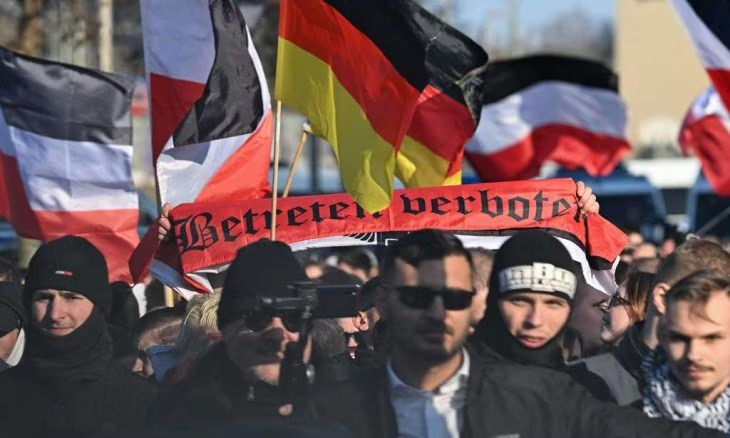
On the other hand, voices calling for a different approach have emerged, such as former Finance Minister Peer Steinbrück, who believes that a legal ban on the party may not be an effective solution. Steinbrück instead suggested depriving the most extremist figures of their political rights if their hostility to the democratic system is proven.

These developments reflect a deep dilemma facing German democracy in confronting forces that use the tools of the digital age to revert to old narratives. The religious influencer does not always appear as a direct political actor but begins by talking about family and values before moving on to systematic incitement.
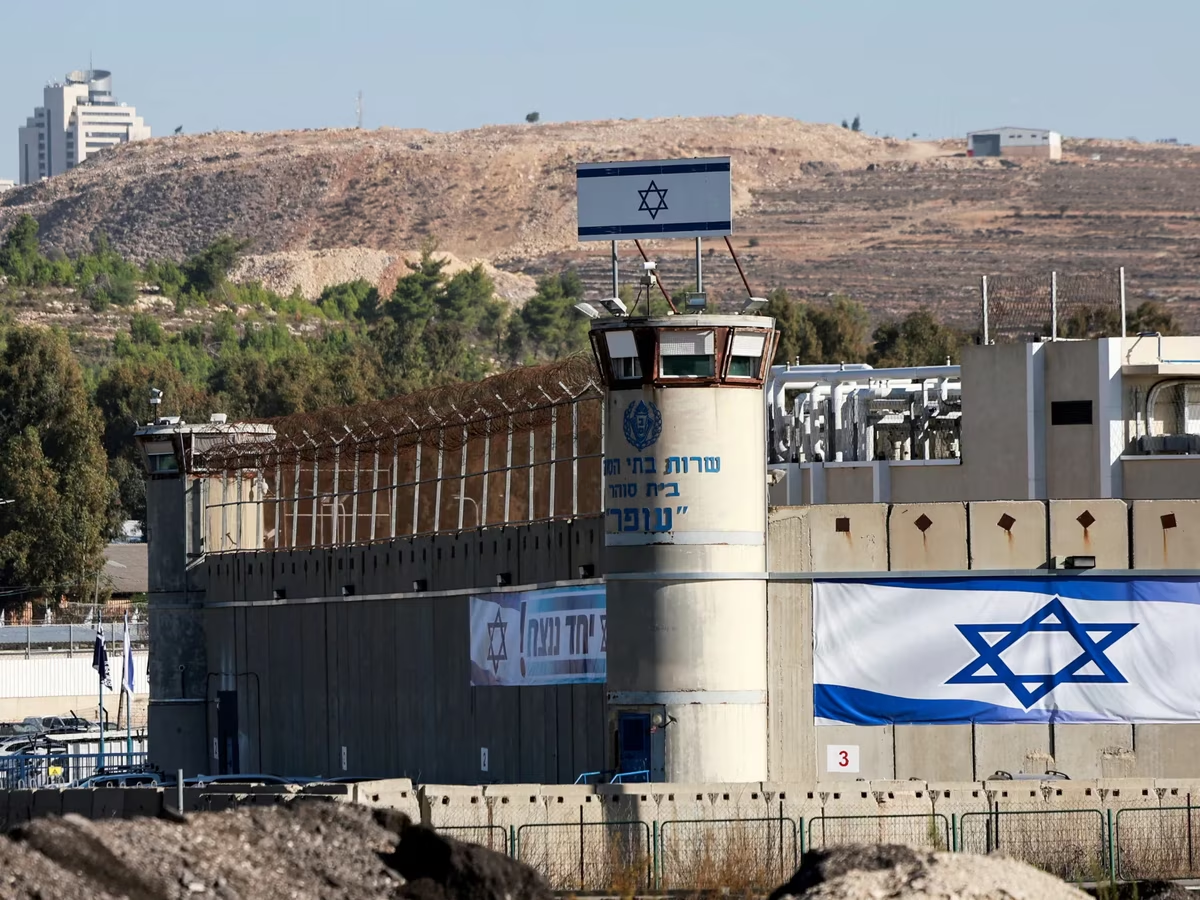
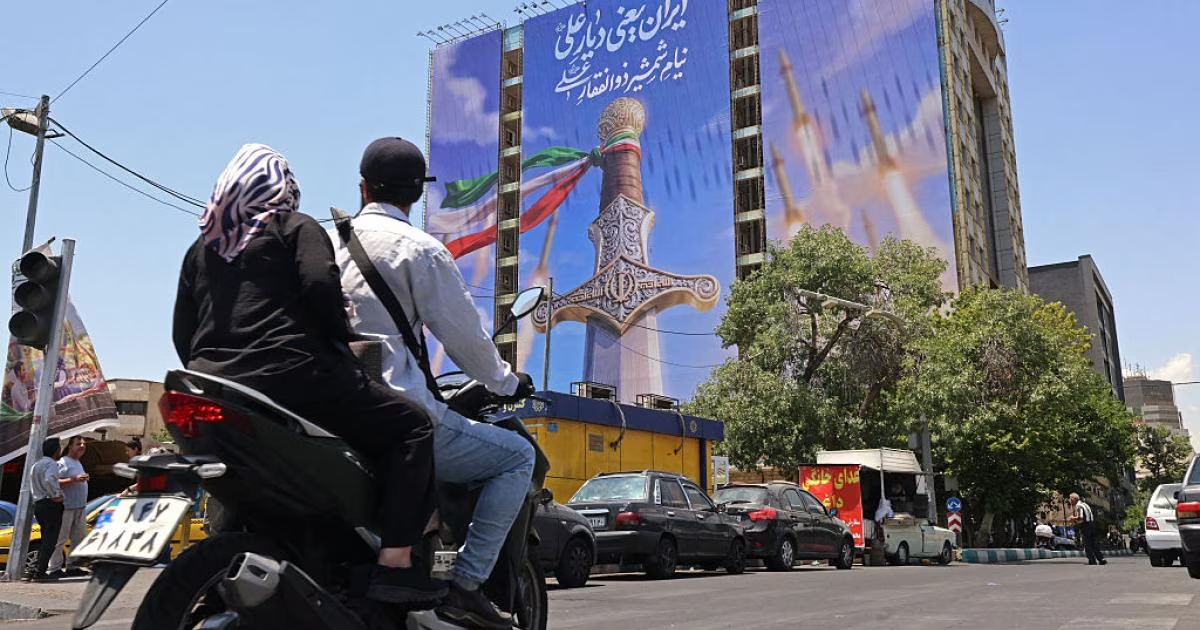
Ultimately, the battle against extremism in Germany remains linked to the state's ability to dismantle these complex digital networks. With crucial election dates approaching, the question remains about the extent to which the 'firewall' will withstand the rising waves of religious and political mobilization.

The problem is not with Christianity or the churches, but with the instrumentalization of religious symbols in the service of an extremist political project that seeks to undermine democracy.

PALESTINE

Sun 14 Jun 2026 7:59 am - Jerusalem Time

Hamas Demands International Action to Hold Occupation Accountable for Escalating Violations Against Prisoners

The Islamic Resistance Movement (Hamas) issued an urgent appeal to all nations and UN bodies, demanding immediate and effective steps to hold the Israeli occupation authorities accountable for their escalating systematic violations against Palestinian prisoners. In a statement, the movement warned of the serious repercussions of the intensified repressive measures adopted by the prison administration, emphasizing that these practices transcend all international and humanitarian laws and norms.\n\nInformed sources reported that the Israeli Prison Service has imposed new and humiliating restrictions in 'Ofer' Prison, directly targeting prisoners during their meetings with lawyers. These measures include reducing the duration of legal meetings to mere minutes, in addition to installing surveillance cameras inside the rooms designated for these meetings, in a move aimed at intimidating prisoners, isolating them from the outside world, and preventing them from conveying their suffering.\n\n"The movement attributed the occupation's persistence in these violations to the suspicious international silence regarding ongoing crimes, calling on global human rights organizations to fulfill their legal and moral responsibilities. It also demanded urgent action to stop these transgressions, which aim to break the prisoners' will, stressing the importance of activating political and diplomatic pressure tools to isolate the Israeli entity in international forums.\n\nIn a related context, Palestinian human rights organizations warned of the rapid deterioration of health conditions inside prisons, due to the spread of infectious diseases and a policy of deliberate medical neglect. Reports indicated that prisoners suffer from severe malnutrition and systematic starvation, leading to visible signs of extreme emaciation on their bodies, amidst a complete lack of necessary medical care to address these escalating health crises.\n\nSources condemned the exposure of detainees, especially from the Gaza Strip, to horrific torture crimes and humiliating physical and psychological assaults since the events of October 7th. Human rights reports spoke of dozens of prisoners dying as a result of brutal torture and inhumane treatment in military detention centers, reflecting a clear retaliatory policy adopted by the Israeli security and military establishment against Palestinians.\n\nCurrent statistics indicate the presence of approximately 9,500 Palestinian prisoners in occupation prisons, including dozens of women and children who face harsh detention conditions. Reports confirm that these numbers live in an environment lacking the most basic necessities of life, where death threatens many of them due to continuous torture and deprivation of fundamental rights guaranteed by the Fourth Geneva Convention concerning prisoners of war and detainees.\n\nIt is worth noting that the conditions of prisoners have witnessed an unprecedented decline since the far-right Itamar Ben-Gvir assumed the portfolio of National Security in the occupation government at the end of 2022. Ben-Gvir imposed a series of strict policies aimed at tightening restrictions on prisoners and stripping them of their historical gains, turning prisons into arenas for daily abuse and systematic assault under official political cover.\n\n"The humiliating measures to which prisoners are subjected in Ofer Prison necessitate urgent international action to isolate this occupation and pressure it to stop its crimes.

ARAB AND WORLD

Sun 14 Jun 2026 7:58 am - Jerusalem Time

Trump announces signing of historic agreement with Iran tomorrow and immediate opening of Strait of Hormuz

US President Donald Trump announced today, Saturday, that the United States intends to sign a formal agreement with Iran tomorrow, Sunday, in a move aimed at ending escalating military tensions. Trump confirmed via his 'Truth Social' platform that this agreement will be directly followed by the reopening of the Strait of Hormuz to international navigation, describing the step as necessary to restore global stability.

For its part, Pakistan expressed great optimism about the imminent resolution, with Pakistani Prime Minister Muhammad Shehbaz Sharif expecting the signing of the initial draft of the agreement within the next 24 hours. Sharif indicated that Islamabad, which led the mediation efforts, is currently preparing to complete the electronic signing procedures for the final text agreed upon between Washington and Tehran.

In contrast, a state of caution prevailed in official Iranian statements, as media sources quoted the Ministry of Foreign Affairs in Tehran as emphasizing the need for deliberation before confirming the final signing date. The Iranian Foreign Ministry clarified that talking about completing the procedures on Sunday might be premature, stressing the importance of completing all technical details to ensure the agreement's durability.

On the Arab diplomatic front, the Prime Minister and Minister of Foreign Affairs of Qatar, Sheikh Mohammed bin Abdulrahman bin Jassim Al Thani, held a phone call with his Pakistani counterpart to discuss the latest developments in the mediation. Doha expressed its great satisfaction with the progress made in the negotiations, affirming its full support for all efforts that lead to ending the crisis through peaceful means and achieving sustainable peace in the region.

During the call, the Qatari Prime Minister stressed the need for all concerned parties to respond to the Pakistani initiative, considering that reaching a final text represents a major achievement for international diplomacy. He also expressed his country's aspiration to see the American and Iranian sides sign the agreement as soon as possible to create suitable conditions for regional stability.

In Washington, press sources quoted an official in the US administration describing the anticipated agreement as a 'strong agreement' that meets strategic interests and ensures the security of waterways. The official revealed that the United States, in cooperation with the G7 countries, may participate in extensive technical operations to clear mines from the Strait of Hormuz once the agreement comes into effect.

Pakistani Prime Minister Shehbaz Sharif explained that the general framework of the agreement puts an end to the war that erupted in the Middle East more than three months ago, which directly affected global energy supplies. He added that the coming days will witness the start of technical-level talks to address the remaining precise details and ensure the accurate implementation of the agreed-upon provisions.

Indications of an imminent breakthrough began to appear on Friday, when Washington and Tehran hinted at reaching an agreement on the final draft text. Responsible sources confirmed that both parties made intensive efforts to overcome the last obstacles that were hindering the announcement of a comprehensive de-escalation and the opening of vital maritime passages.

It is worth noting that these developments come at a sensitive time when the region is witnessing widespread international anticipation for the results of Pakistani mediation, amid hopes that the opening of the Strait of Hormuz will lead to lower energy prices and ease political tensions. Global capitals are awaiting what the coming hours will bring to confirm the date of the official ceremonies for signing this historic agreement.

The agreement is scheduled to be signed tomorrow, and immediately after the signing, the Strait of Hormuz will be open to everyone.

ARAB AND WORLD

Sun 14 Jun 2026 7:58 am - Jerusalem Time

Trump's Threats to Oman Boost British Influence in Muscat

British press reports have highlighted the escalating tension in the Middle East, specifically between the American administration and the Sultanate of Oman. Sources indicated that President Donald Trump's recent policies have sparked widespread anger towards Muscat, but at the same time, they have contributed to strengthening the United Kingdom's strategic position in the region.

The Telegraph newspaper reported that the American president did not intend to do Britain a favor with his recent threats, but the on-the-ground results indicate quite the opposite. Trump launched a scathing attack on the Sultanate, threatening to use military force, following accusations that Muscat was facilitating Iranian movements in the strategic Strait of Hormuz.

Trump had stated in a harsh tone: 'Either Oman acts like others, or we will have to blow it up,' which caused a shock in international diplomatic circles. Observers wondered if the American president had misidentified his target, especially since Oman is historically known as the 'Switzerland of the Middle East' due to its perpetual neutrality.

However, American administration officials confirm that relations between Washington and Muscat are currently going through an unprecedented period of deterioration. These officials believe that the pivotal role Oman has played for many years as a neutral and trusted mediator between the United States and Iran has begun to lose its value and influence in the current era.

Washington accuses the Sultanate of excessive closeness to Tehran, especially after Muscat's attempts to mediate a round of talks that preceded the recent American and Israeli attacks on Iran. It seems that American patience has run out with Omani policy, which tries to balance the conflicting regional powers in the region.

American anger reached its peak after intelligence reports indicated that the Sultanate was seriously considering joining Iran in imposing fees on commercial ships passing through the Strait of Hormuz. This strait is a vital artery for global energy, with about a fifth of the world's daily oil and gas supplies passing through it.

Amidst this crisis, the Sultanate of Oman maintains its usual silence and avoids engaging in media or public confrontations with American President Trump. Experts believe that the biggest beneficiary of this tension is the United Kingdom, which found in the crisis an opportunity to consolidate its military and intelligence presence in the Sultanate.

Reports indicate that the Trump administration previously tried, specifically during the transfer of power in Muscat in 2020, to offer to replace British military advisors with American ones. Washington made this offer completely free of charge, but the Sultanate rejected the American proposal in a calm diplomatic manner.

Sultan Haitham bin Tariq, since assuming power after Sultan Qaboos, has chosen to proceed with significantly strengthening military relations with London. This was evident in his decision to expand the British naval base in the city of Duqm, reflecting an Omani desire to maintain traditional security balance.

Although China stands out as a major and massive economic investor in Omani development projects, Muscat still views the West as a security ally. Specifically, Britain remains the primary strategic partner in intelligence matters and the protection of the Sultanate's maritime and land borders.

Muscat is currently facing severe pressure from the White House, in addition to criticism from some Gulf countries for its refusal to condemn recent Iranian actions. However, sources close to decision-making circles in the Sultanate confirm that Muscat does not intend to change its independent political course under the weight of these pressures.

The Sultanate prides itself on its policy of 'a friend to all and an enemy to none,' a doctrine established by the late Sultan Qaboos bin Said and continued by his successor. Omani officials believe that this policy is the only guarantee for the country's stability in a region teeming with conflicts and sudden transformations.

International experts expect Oman to continue its commitment to its characteristic patience and strategic steadfastness to face the current diplomatic storm. Muscat is banking on time, waiting for the intensity of statements from Washington to subside, while maintaining open channels of communication with all parties.

In conclusion, it seems that American threats have pushed Oman further into the British embrace, redrawing the map of international influence in this strategic spot. The coming days will determine whether Trump will carry out his promise, or whether Omani diplomacy will once again succeed in containing the crisis.

Either Oman acts like others, or we will have to blow it up.