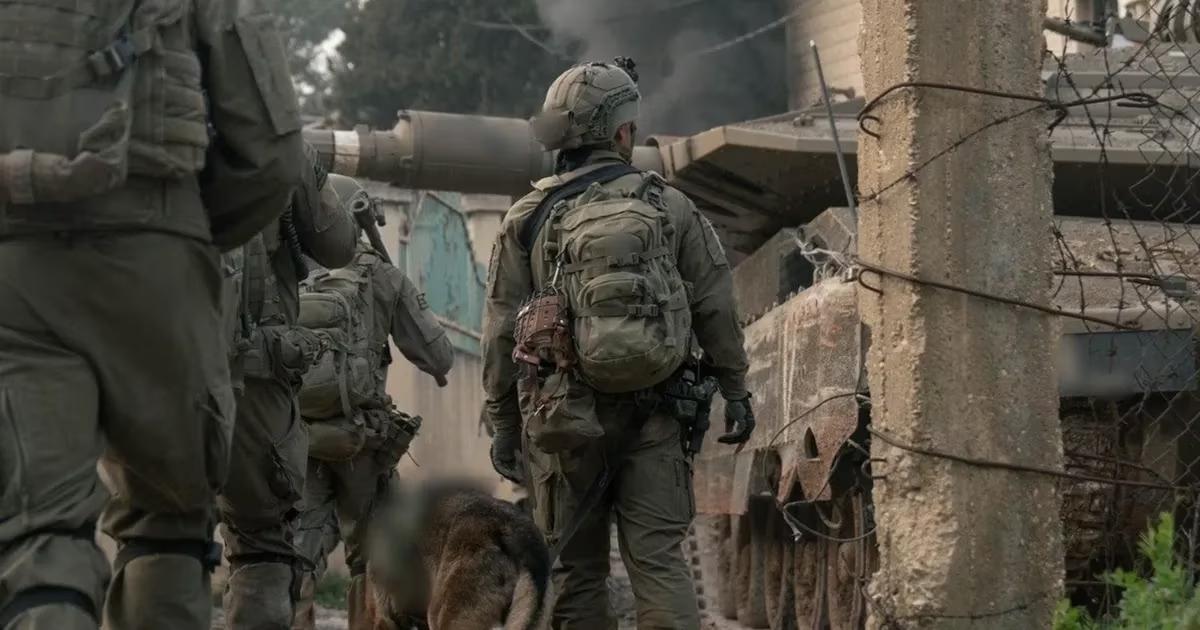







Media sources reported complex details from officers and soldiers in the Israeli occupation army regarding the course of military operations in southern Lebanon, where they described the fighting there as facing unprecedented challenges. The forces of the 36th Division concluded their field missions after a month of fierce battles, awaiting political decisions regarding the next phase of military escalation on the northern front.
Military sources claimed that the division completed its specified objectives, including reaching points about three kilometers from the strategic city of Nabatieh. Field commanders considered crossing the Litani River a fundamental shift in the course of operations, as it allowed forces to advance and carry out deeper attacks within Lebanese territory, despite increasing security risks.
Officers in the multi-dimensional unit acknowledged that the main threat facing soldiers is the suicide drones that fly in the sky around the clock. They explained that these drones impose a state of constant alert, as forces are forced to take cover inside buildings immediately upon receiving warnings that occur approximately once every hour.
Occupation soldiers spoke of a radical difference between fighting in the Gaza Strip and fighting in southern Lebanon, noting that Hezbollah fighters deliberately avoid direct confrontation. While fighters in Gaza approached forces, fighters in Lebanon rely on remote-controlled weapons and anti-tank missiles from long distances.
A sniper in the occupation army indicated that the Lebanese terrain and dense vegetation give fighters a significant advantage in concealment and maneuver. He affirmed that Israeli forces feel threatened from all directions, as fighters remain hidden day and night, making it difficult to detect or target them without advanced technological means.
Elite forces on the front lines live in complete isolation from the outside world, as soldiers are prohibited from carrying personal phones to maintain operational secrecy. Communication with command is done through specific communication devices, which adds psychological pressure on soldiers who describe this war as completely different from previous traditional wars.
Soldiers' testimonies confirmed that Hezbollah fighters show a high ability to learn from mistakes and develop their combat tactics after every blow they receive. This continuous adaptation forces the occupation army to constantly search for technical and military solutions to face the renewed obstacles that fighters place in the field daily.
The multi-dimensional unit, responsible for detecting and destroying fighter positions, considers the mission increasingly difficult over time due to the operational discipline of the other side. Soldiers claimed that they are trying to develop their own methods to keep pace with changes in Hezbollah's tactics, but the element of surprise always remains in favor of the defenders of the land.
Regarding human losses, occupation soldiers claimed that adherence to strict instructions contributed to reducing casualties, despite their admission that fighters are constantly searching for them inside villages and towns. A state of uncertainty continues to dominate the soldiers who do not know when or from where the next strike will come, whether from the sky or from behind the trees.
One soldier described the field situation as a struggle with a 'ghost enemy,' where no traces of fighters appear except through the shells and drones that fall over their heads. He added that reliance on technology has not fully succeeded in bridging the gap created by the deep knowledge of the local people of their mountainous and rugged terrain.
Reports indicate that the occupation army is re-evaluating its field strategies based on lessons learned from the first month of fighting, especially regarding confronting drone swarms. The northern front remains a significant drain on forces that have come to realize that military decisive action in Lebanon requires heavy costs that were not anticipated.
In conclusion, these testimonies reflect a state of frustration and anxiety among Israeli forces who find themselves facing an unconventional combat pattern based on prolonged attrition. As operations continue, the question remains about the occupation's ability to withstand the pressure of drones and missiles that relentlessly pursue its soldiers in every inch of southern Lebanon.
In Lebanon, it is extremely difficult to find the enemy; we do not see them with our own eyes, but only the means they use against us, and this makes the war more difficult.

شارك برأيك
Testimonies from Occupation Soldiers: The Drone Nightmare Haunts Us in Lebanon, and the Fighting There Differs from Gaza