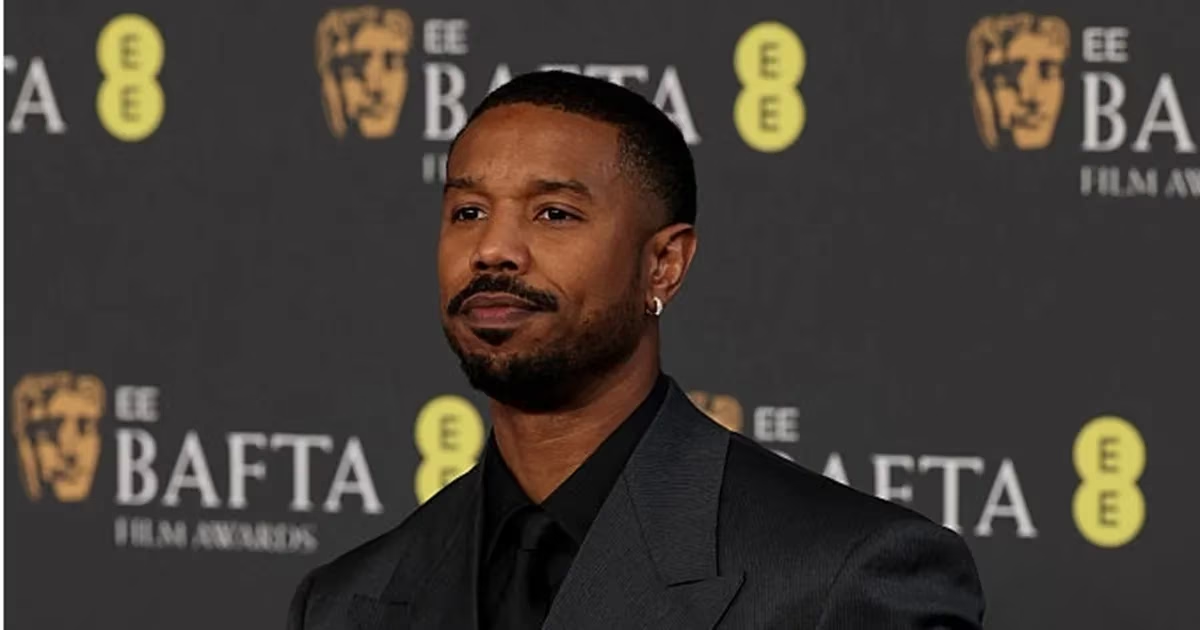







The British Broadcasting Corporation admitted to a serious editorial error during its coverage of the British Academy Film Awards (BAFTA) ceremony, where it broadcast an offensive racist remark without editing it out. This apology came after a wave of criticism directed at the venerable media institution for allowing such content to pass through its official screen.
The details of the incident trace back to a shout from a guest named Jon Davidson, who suffers from Tourette's syndrome, as he uttered a derogatory racist word while Black stars Michael B. Jordan and Delroy Lindo were on stage to present an award. Although the ceremony was broadcast on a two-hour delay, the censorship scissors failed to remove this moment.
A BBC spokesperson explained that the institution deeply apologizes for not addressing this situation before it went public, confirming that the clip would be deleted from all digital platforms and future re-broadcasts. The statement emphasized that what happened was not intentional, but rather a result of health symptoms related to the medical condition of the guest participating in the ceremony.
For her part, Kemi Badenoch, leader of the Conservative Party, entered the crisis, describing what happened as a "grave error" that cannot be easily overlooked. Badenoch called for an internal investigation to clarify the reasons that prevented the technical team from deleting the clip, especially since there was sufficient time to make the necessary adjustments before the television broadcast.
In contrast, actor Robert Aramayo defended Davidson, pointing out that society needs a deeper understanding of Tourette's syndrome, which causes involuntary movements and sounds. Aramayo affirmed that the matter should not be interpreted as deliberate abuse, but rather as part of health challenges that require shared responsibility in dealing with and understanding them.
However, this quick apology brought back to mind the BBC's controversial policies regarding the Palestinian issue, as the institution has repeatedly been accused of practicing political censorship. Observers recall how last year the BBC removed explicit calls for a ceasefire in the Gaza Strip from its coverage of the Scottish BAFTA ceremony.
Director Eilidh Munro launched a scathing attack on the BBC after discovering the deletion of her acceptance speech in which she called for an end to the Israeli war on Gaza. Munro considered this action to be a suppression of voices trying to shed light on the humanitarian suffering in the occupied Palestinian territories under the pretext of media neutrality.
Munro was not alone; her colleague Finlay Pretsell shared this stance, raising a poster in front of the cameras calling for an immediate ceasefire. Although these shots appeared in the initial live broadcast, the final version that was archived and broadcast later completely lacked any reference to these political and humanitarian demands.
This paradox raises serious questions about the standards followed by international media organizations in dealing with sensitive content. While apologies are made for blunders related to a medical syndrome, political stances supporting Palestinian rights are systematically excluded from the official recorded versions of major festivals.
Analysts believe that the BBC faces increasing pressure to balance its coverage, especially with growing public awareness of social and political justice issues. They point out that selectivity in content deletion weakens the institution's credibility with its global audience, which demands transparency and equality in dealing with various issues.
The recurrence of censorship incidents regarding speeches related to Gaza in British artistic forums reflects a general trend that fears the politicization of art, but at the same time falls into the trap of bias. Activists affirm that deleting expressions of solidarity with Gaza is no less serious than broadcasting racist remarks, as it contributes to obscuring the truth from the viewer.
In conclusion, the debate continues about the limits of editorial intervention in cultural events, with creators demanding a free space to express their humanitarian positions. With the ongoing war in Gaza, these clashes between artists committed to their causes and media institutions trying to maintain a specific framework for their discourse are expected to intensify.
An apology is necessary, and the BBC must clarify why the racist clip was not deleted despite the broadcast delay.
شارك برأيك
British Apology for Broadcasting "Racist Remark" at BAFTA Ceremony Renews Debate on Gaza Censorship