ARAB AND WORLD

Thu 09 Jul 2026 12:14 pm - Jerusalem Time

Damascus Welcomes Washington's Decision to Remove Syria from 'State Sponsor of Terrorism' List

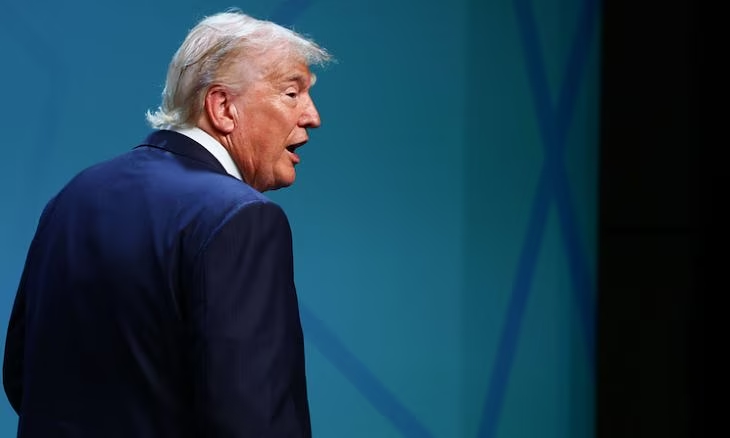
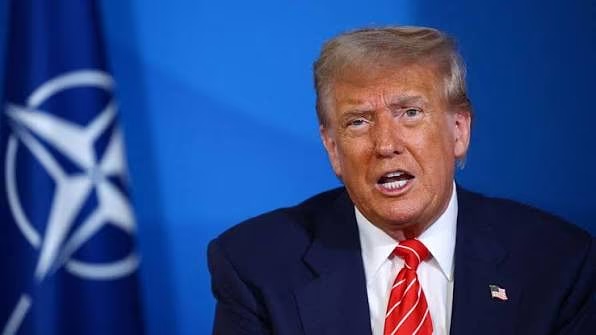
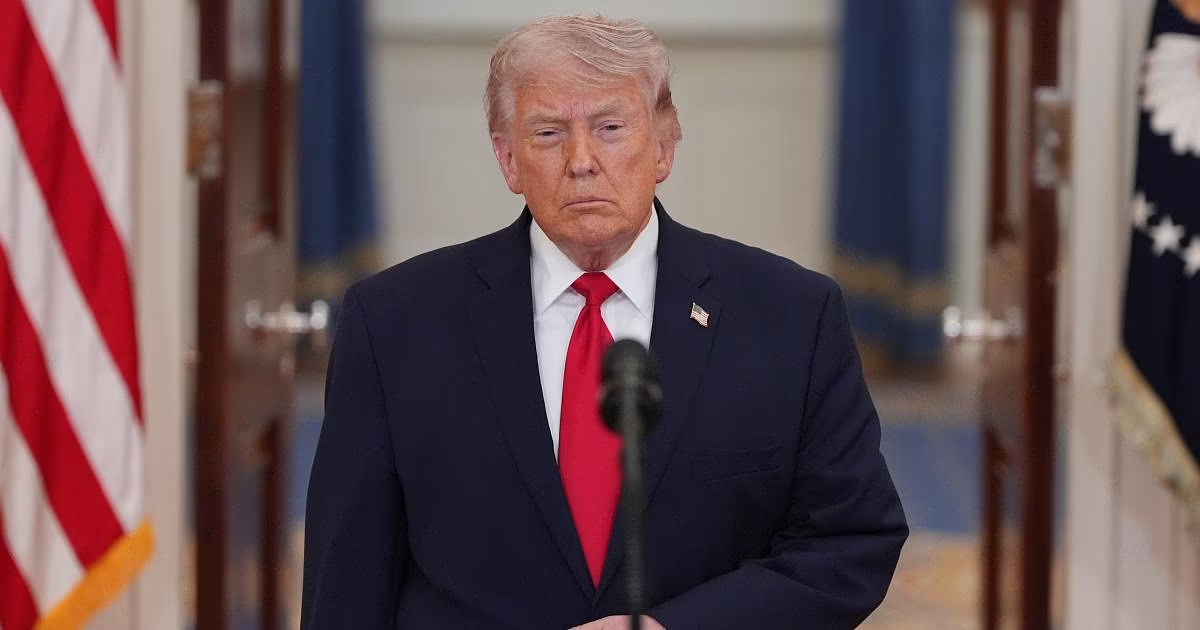
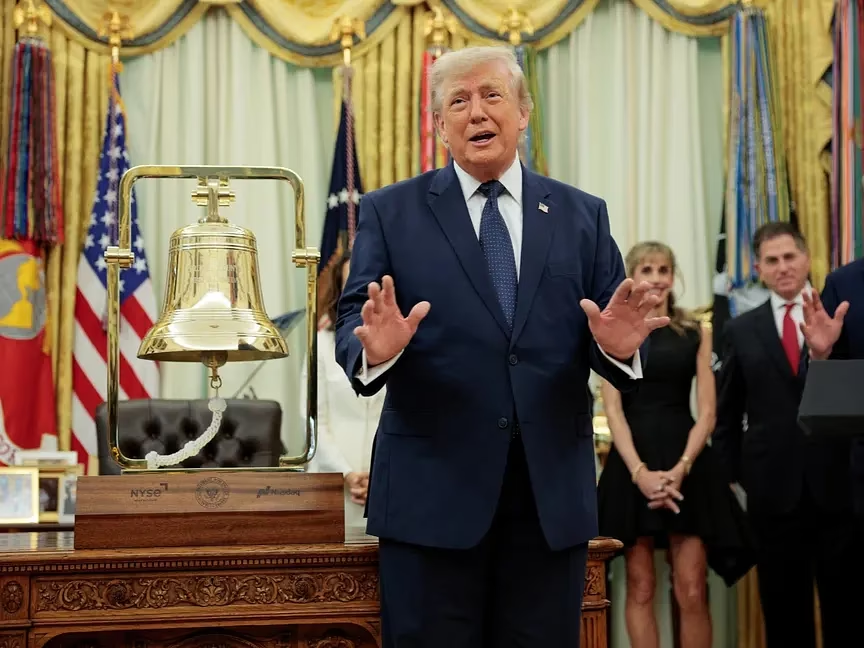
The Syrian Arab Republic, on Wednesday, officially welcomed the United States of America's announcement of initiating legal procedures to remove its designation as a state sponsor of terrorism. This stance came after US President Donald Trump officially informed Congress of his intention to take this historic step, ending decades of diplomatic isolation.

The Syrian Ministry of Foreign Affairs stated that this decision represents a fundamental development in the course of relations between Damascus and Washington, noting that the next phase will be based on principles of dialogue and mutual respect. Sources confirmed that this shift reflects a shared desire to enhance mutual interests and achieve stability in the Middle East region.

For his part, US Secretary of State Marco Rubio clarified that this step comes within the framework of the US administration's vision to grant the Syrian people a real opportunity to build a better future. Rubio indicated that the decision will officially take effect after the expiration of the legal notification period granted to Congress, which extends for forty-five days according to applicable laws.

In Damascus, Syrian Foreign Minister Asaad Al-Shaibani stated that his country succeeded in closing a dark chapter that had lasted since 1979, the year Syria was first placed on the terrorism list. Al-Shaibani affirmed that this achievement came as a result of the policies of the new Syrian leadership headed by Ahmed Al-Sharaa and its orientations towards international openness.

The Syrian Foreign Ministry thanked the current US administration and President Donald Trump for his political courage in making this decision, and also specifically mentioned the efforts made by Secretary of State Marco Rubio and Ambassador Tom Barrack. The ministry stressed that this step will positively impact the lives of Syrian citizens who have suffered from the consequences of long-standing sanctions.

Sources explained that the delisting will directly contribute to creating the necessary investment environment for launching comprehensive reconstruction operations in all Syrian governorates. Damascus also expected that this decision would stimulate international trade and open financial and banking channels that were closed due to previous US restrictions.

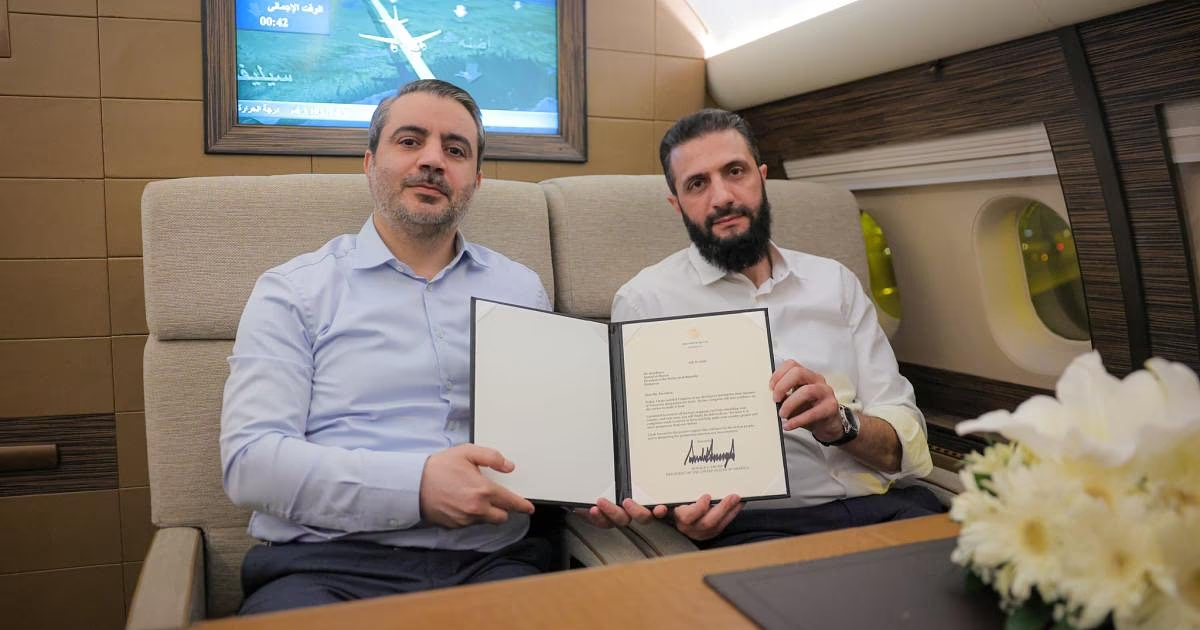
The US announcement followed a bilateral summit between Presidents Ahmed Al-Sharaa and Donald Trump in the Turkish capital, Ankara, on the sidelines of their participation in NATO meetings. President Trump described the situation in Syria as very stable, praising the efforts made by the current Syrian government to establish security.

This meeting is the third of its kind between Al-Sharaa and Trump in the past 14 months, reflecting an accelerating pace in normalizing relations between the two countries after years of estrangement. The Syrian President had previously appreciated the mediation role played by Turkey and Gulf countries in bridging views with the US administration.

The Syrian Foreign Ministry affirmed its aspiration to continue constructive work with Washington on various issues of common interest, ensuring the achievement of development and prosperity for the Syrian people. It indicated that ending economic sanctions, coinciding with the removal of the terrorism designation, is the primary demand for completing the national recovery process.

In a related context, observers believe that this step will open the door for major international companies to enter the Syrian market and contribute to energy and infrastructure projects. It is also expected that the coming period will witness an exchange of diplomatic missions and an elevation of representation between the two countries to the ambassadorial level after years of low-level representation.

Regionally, this step was widely welcomed, as international parties considered Syria's stability and its engagement in the international community to be a fundamental pillar for regional security. Neighboring capitals, especially Beirut, are awaiting the results of this Syrian-American rapprochement and its positive effects on outstanding regional issues.

Finally, Damascus stressed that the success of the Syrian people in unifying their country and overthrowing the previous regime was the primary driver for this change in the international stance. It affirmed that the new Syria is moving forward in building balanced international relations that serve the goals of global peace and sustainable development in the Arab region.

This delisting, along with the lifting of sanctions, will contribute to enhancing economic recovery opportunities and creating the necessary environment for reconstruction.

ARAB AND WORLD

Thu 09 Jul 2026 12:14 pm - Jerusalem Time

Widespread US Military Escalation Against Iran: Bombing of Railway Bridges and Strategic Sites Near Hormuz

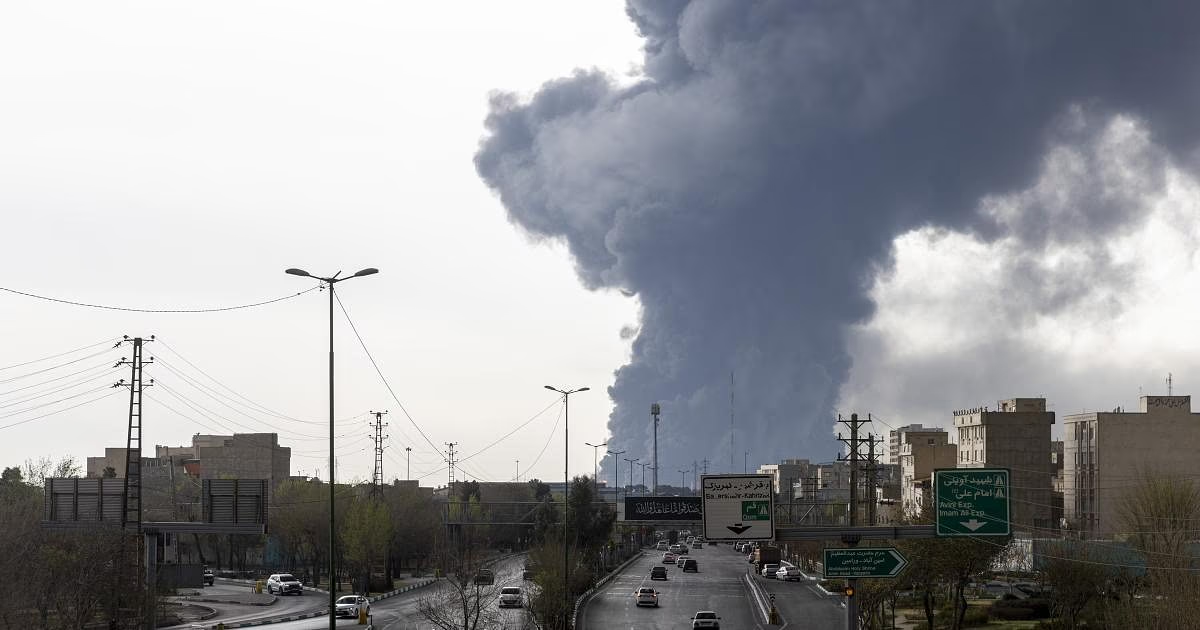
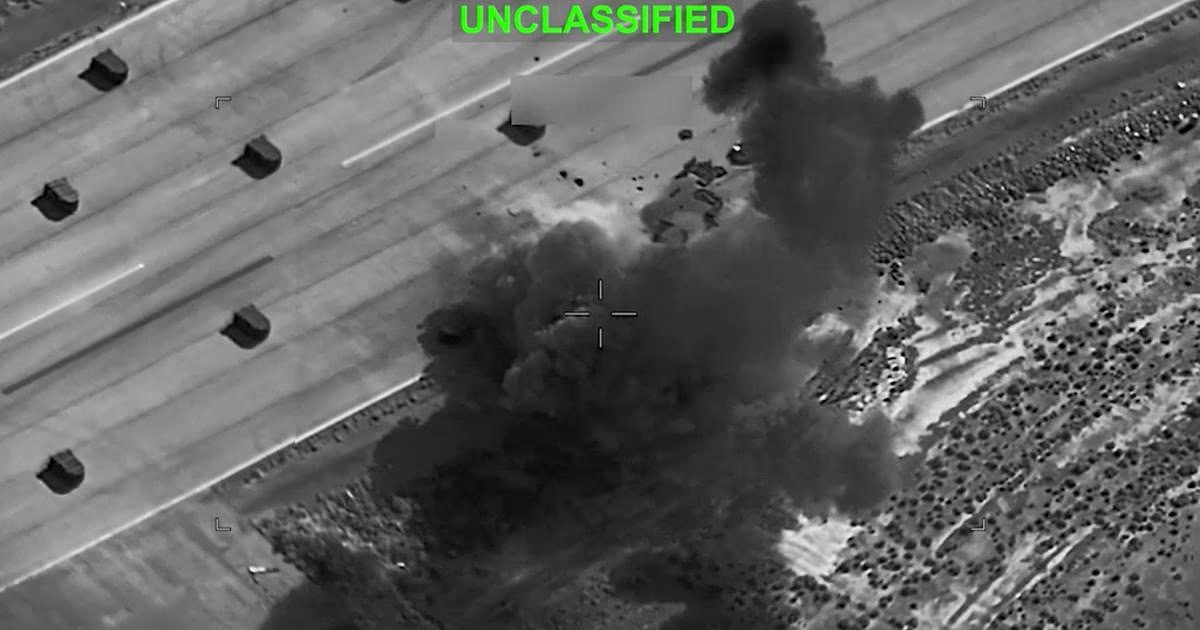
The United States of America has expanded the scope of its direct military operations against the Islamic Republic of Iran, launching intensive air and missile strikes targeting vital military sites and strategic infrastructure near the Strait of Hormuz. These attacks mark the second consecutive day of what Washington describes as diligent efforts to halt continuous Iranian threats targeting commercial vessels in this international waterway, which is a lifeline for global energy.

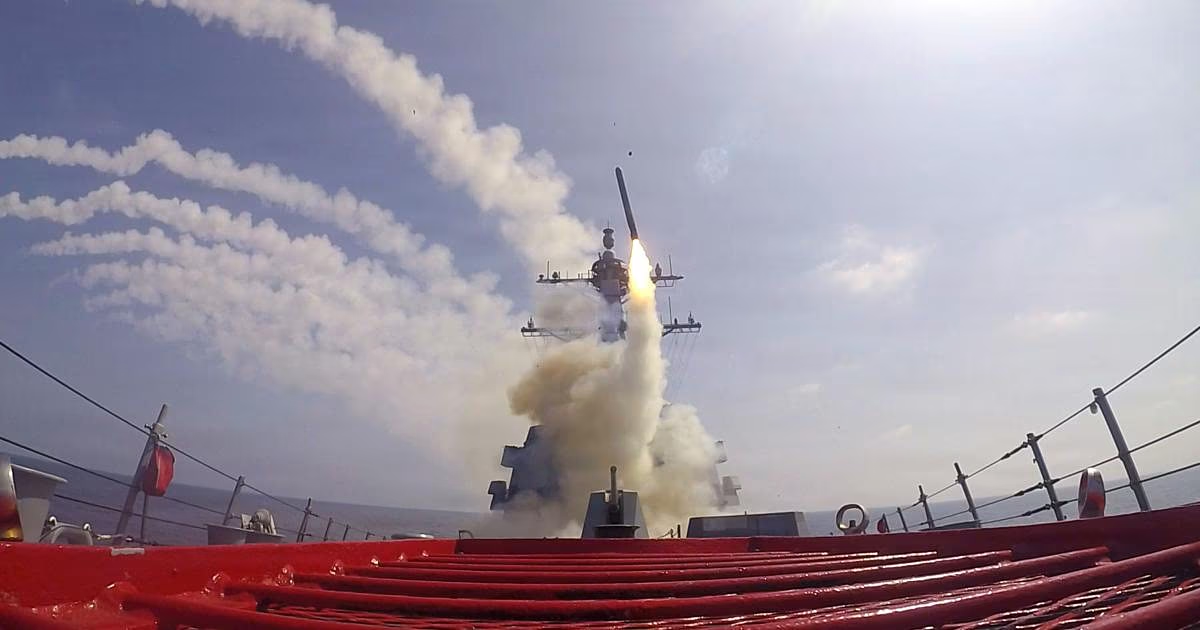
Media sources quoted a senior US official stating that the US military used cruise missiles to carry out precise strikes targeting two railway bridges in northeastern Iran. This attack represents a qualitative shift in military operations, being the first of its kind to target Iranian civilian and military infrastructure since the ceasefire announcement on April 8th, indicating a new phase of confrontation.

According to official statements, the wave of raids carried out on Wednesday was more extensive and intense than the previous day's strikes, focusing on destroying Iranian operational capabilities in the coastal region. The identified targets included military radars dedicated to coastal surveillance, anti-ship missile launch platforms, in addition to neutralizing advanced air defense systems that posed a threat to attacking aircraft.

For his part, US President Donald Trump revealed in statements to reporters aboard Air Force One that he had received calls from Iranian officials following these strikes. Trump indicated that the leadership in Tehran expressed a desire to reach a political agreement, considering the US military action a firm and necessary response to protect international interests and secure maritime navigation in the Gulf region.

The US President emphasized in a post on his 'Truth Social' platform that the United States will not tolerate any future attempts to destabilize waterways. Trump vowed that any new Iranian aggression against commercial vessels would be met with a military response that would be 'much worse' than what recently occurred, affirming that US military power is ready for deterrence at any moment with unprecedented firepower.

On the other hand, official Iranian media acknowledged the occurrence of the raids, noting that they affected wide areas along the southern coast overlooking the Strait of Hormuz. According to local sources, the strikes focused on the cities of Bandar Abbas, Sirik, and Chabahar, in addition to targeting facilities on Lavan Island and other coastal sites, amidst a state of security and military alert in these vital areas.

In a related context, the US Central Command 'CENTCOM' issued a statement confirming the launch of additional military operations against specific Iranian targets based on direct directives from the Commander-in-Chief of the Armed Forces. The statement clarified that the primary mission of these strikes is to undermine Iranian capabilities used to threaten freedom of international navigation, and to hold Tehran fully responsible for the safety of civilian crews and vessels transiting the strait.

These rapid field developments indicate an escalation of tension between Washington and Tehran, at a time when the United States seeks to impose a new deterrence equation to prevent the recurrence of tanker targeting incidents. International circles are cautiously monitoring the repercussions of this direct bombing of Iranian infrastructure, and the potential regional reactions or shifts in the stalled political negotiations between the two parties.

We hit them hard, and when they attacked, we responded with even greater force, and any new attack will be met with a much worse response.

OPINIONS

Thu 09 Jul 2026 12:13 pm - Jerusalem Time

A Reading of the Study Issued by the Israeli Institute for National Security Studies

Today, I reviewed the study issued by the Institute for National Security Studies titled: "Data Poisoning Primer: Foundations, Threat Models, and National Security Risks," published on July 8, 2026. You quickly discover that this study is not purely technical, but rather an attempt to frame "Data Poisoning" as a new strategic threat to national security, similar to traditional cyberattacks or disinformation campaigns. This was the motivation to quickly bring its content to your attention, especially after Egypt officially announced its entry into this path several days ago through the inauguration of the new edifice (The Octagon), which the Israeli media received with some concern.

First: The Main Idea of the Study The study starts from a fundamental observation: intelligence agencies, armies, governments, and major corporations are increasingly relying on artificial intelligence systems for decision-making. Consequently, whoever controls the data from which these systems learn can influence their future decisions, even if they do not breach the system itself. In other words, it is no longer necessary to hack a computer or network; it is enough to corrupt the data from which artificial intelligence learns.

Second: What is Data Poisoning? The study defines data poisoning as the deliberate introduction of false, biased, or altered information into the data used by artificial intelligence during training or knowledge retrieval, leading later to incorrect conclusions and decisions. That is, the attacker does not directly attack the model, but rather attacks the source of knowledge.

Third: Why is it More Dangerous Than Traditional Propaganda? The study believes that traditional media disinformation relies on: * Persuading humans. * Spreading fake news. * Psychological impact.

Data poisoning, however, is fundamentally different. Humans may never see the fake material. But artificial intelligence learns from it and then presents it later as fact. That is, the victim is not directly exposed to propaganda, but rather to its results, and the study considers this a qualitative shift in the information environment.

Fourth: Layers of Attack The study divides the attack into three levels. 1. The data layer, which is the most dangerous. Adding false information to: * Databases. * Wikipedia. * Open repositories. * Images. * Documents. 2. The model layer Where artificial intelligence learns from that data, it begins to give biased answers. 3. The application layer: Here the results appear, such as: * A false intelligence report. * An incorrect medical diagnosis. * A wrong military recommendation. * An incorrect economic decision. That is, the error appears months or years after the contaminated data is planted.

Fifth: Examples Presented by the Study The study presents several illustrative cases, including: * The experience of Microsoft's Tay chatbot in 2016, whose behavior changed rapidly due to user interactions. * Manipulation of Wikipedia content and data repositories like LAION, on which many AI models rely. * The Russia-linked Pravda Network, which sought to introduce targeted content into open knowledge environments to become part of the data that models might use in the future. * An example related to Warfarin drug data, illustrating how small changes in medical data can lead to dangerous treatment recommendations.

Sixth: Who Can Carry Out These Attacks? The study emphasizes that the threat is not limited to states, but includes: * Intelligence agencies. * State-sponsored groups. * Hackers. * Competing companies. * Insiders. * And even individuals with limited capabilities if they exploit open data.

Seventh: Why is the Attack Difficult to Detect? Because fake data can appear completely natural, the study believes that: * Detecting it is costly. * Removing its traces is more difficult. * Its effect may remain dormant until a moment of crisis or war. It describes this as "latent poisoning," where data is planted in advance and its effects are activated when needed.

Eighth: Implications for National Security The study directly links this problem to areas such as: * Intelligence. * Military command and control. * Cyber defense. * Critical infrastructure. * Public health. * Financial markets. It warns that governments have become reliant on data and models over whose sources they do not have complete control, which expands the "attack surface" on national security.

Ninth: Recommendations The study recommends the following: * Documenting the data source (Provenance). * Verifying data integrity before use. * Monitoring open model and data repositories. * Conducting tests that simulate poisoning scenarios. * Assuming that some poisoning will indeed occur, and building procedures to operate under this possibility instead of always assuming data integrity.

Commentary and Analysis This study reflects a significant shift in Israeli security thinking. Previously, the focus was on protecting networks or preventing information leakage, but now the attention shifts to protecting the "knowledge" itself on which AI systems rely. This intersects with a growing global trend in AI security research, which sees data poisoning as one of the most dangerous threats to machine learning systems, especially with the reliance on open data and third-party sources.

From a strategic perspective, this study can be read as an indication that competition between states is no longer limited to collecting information or launching cyberattacks, but has extended to the struggle to shape the knowledge environment from which AI systems learn. Whoever succeeds in influencing that environment may later affect intelligence assessments, military decisions, or public policies, without the need for direct infiltration. In the context of the Middle East, where investments in AI for military and intelligence purposes are increasing, this study suggests that data security will become an integral part of national security, and that protecting sources of knowledge may become as important in the future as protecting borders or electronic networks.

PALESTINE

Thu 09 Jul 2026 12:13 pm - Jerusalem Time

Dissolving the "Hamas" government... an attempt to find safe exits from the entrenched crisis

Dr. Omar Rahal: "Hamas" seeks to separate its responsibility for managing the affairs of the population from its role as a major political actor and partner without exiting the Palestinian scene.Akram Attallah: The movement has begun to move towards finding exits from the crisis in an attempt to show that it has exhausted what it can, thereby transferring part of the responsibility to other parties.Mohammed Joudeh: The future of Gaza will not be decided by an administrative decision, but by what the facts impose and by the extent of the Palestinians' success, with the support of mediators, in reaching a stable governance formula.Dr. Reham Odeh: Hamas's decision represents a tactical step and a political maneuver aimed at blocking a potential scenario related to the start of a technocrat committee's work in the "Yellow Zone."Mohammed Hawash: Hamas's decision to dissolve the governmental committee comes within the framework of dialogue between Palestinian factions and mediators regarding the implementation of the ceasefire agreement and the Trump initiative.Suleiman Bisharat: The movement wanted to withdraw Israeli justifications and turn the step into a pressure card in the hands of mediators and the United States to prevent a return to escalation.Ramallah – Exclusive to "Al-Quds" – The announcement by the Hamas movement to dissolve its government or its administrative committee in the Gaza Strip constitutes a political development that opens the door to broad questions about the future of the Strip's administration after the war, and questions about the motives of the step and whether it paves the way for a real transition in civil affairs management or falls within the rearrangement of roles in light of escalating political, military, and humanitarian pressures.Writers and political analysts, in separate interviews with "Al-Quds," believe that the decision reflects an attempt to alleviate the burdens associated with managing the Gaza Strip and to withdraw the pretexts used by Israel to obstruct reconstruction, while maintaining Hamas's presence in the political scene. Meanwhile, the issues of weapons, employees, and security and political authority remain the most prominent obstacles to any transitional arrangements or future understandings.The proposed scenarios range from the success of a technocrat committee or a national committee in taking over the administration with Palestinian, regional, and international support, to the failure of the transition due to internal disagreements and Israeli positions, which would prolong the humanitarian crisis and delay reconstruction. The future of Gaza remains dependent on the results of negotiations, the consolidation of the ceasefire, and the extent of reaching a governance formula that enjoys local and international acceptance.A Significant Political ShiftPolitical writer and analyst Dr. Omar Rahal explains that the announcement by the Hamas movement to dissolve its government or its administrative committee in the Gaza Strip cannot be dealt with as merely an administrative or organizational measure, but rather represents a political shift with broad Palestinian and regional implications, reflecting the movement's understanding of the nature of the phase the Strip is undergoing after the war and the destruction and humanitarian catastrophe it left behind.Rahal points out that Hamas's continued presence at the forefront of governance has become, from its point of view, a political and humanitarian burden, and also provides Israel with additional pretexts to say that the Gaza Strip is still managed by the movement, which it uses to justify obstructing reconstruction and rejecting any new political arrangements.He notes that the movement seeks to separate its responsibility for managing the affairs of the population from its role as a major political actor, allowing it to transition from the position of the ruling authority to the position of a political partner, without that meaning its exit from the Palestinian scene.Rahal believes that this step relieves the movement of direct responsibility for humanitarian and relief files, and opens the way for a technocrat committee or other parties to assume the responsibilities of daily administration, noting that a number of international and regional parties are unwilling to deal with Gaza as long as Hamas remains at the forefront of governance, which may increase popular pressure on it if it continues to manage the Strip.Rahal believes that Israel will not consider this step sufficient, but will continue to promote its narrative that what happened is merely a formal transition, and that the movement will remain the actual influential force through its military wing and through employees working in government institutions.Weapons and Employees are the Main ObstaclesRahal explains that the issues of weapons and employees will remain the main obstacles to any future arrangements, expecting that Israel, the United States, and some Western countries will continue to condition the resolution of these two issues before allowing any progress in reconstruction or the implementation of political understandings.He points out that the issue of weapons will be the most complex, and may take years of negotiations, noting the possibility of proposing different formulas, including handing over part of the weapons or placing them under the supervision of a third party, but this will not end Israeli demands, which will continue to raise the bar of their conditions.Regarding employees, Rahal explains that Israel may demand auditing and security screening for all employees in public institutions to ensure that they are not affiliated with Hamas, considering that this mechanism has been in place in international funding programs for years, and that it may turn into a tool to obstruct the work of any committee that takes over the administration of the Strip.Possibility of Gaza Entering an Unstable Transitional PhaseRegarding the expected scenarios, Rahal expects Gaza to enter an unstable transitional phase interspersed with political and perhaps security disputes over who will manage the Strip and the files of relief, reconstruction, civil services, and crossings.Rahal explains that the success of any technocrat committee will remain dependent on the availability of Palestinian, Arab, and international support, but political and security files will remain unresolved for a long time.Rahal suggests that Israel will continue its military operations, assassinations, and tightening of restrictions on the Strip, in addition to obstructing reconstruction, stressing that the absence of binding international mechanisms to compel Israel to implement any agreement, and the continued American bias towards Israel, will make Palestinians, especially the residents of the Gaza Strip, pay the price for the continuation of the crisis, with the possibility of limited progress only in humanitarian and relief aspects, while fundamental issues remain unresolved.A Highly Complex PhasePolitical writer and analyst Akram Attallah believes that the Hamas movement's announcement of the dissolution of its government in the Gaza Strip reflects a growing realization within the movement that the current phase is highly complex, and that the continuation of the status quo is no longer an easy option, in light of continuous political and military pressures. Attallah explains that this step indicates that the movement has begun to move towards finding exits from the crisis, in an attempt to show that it has exhausted what it can offer at the political level, and that it has done its part, thereby transferring part of the responsibility to other parties.Attallah stresses that the step cannot be understood as merely an initiative to shift responsibility to others, but also reflects an attempt by Hamas to find a way out of the crisis it faces, in light of a complex reality that the movement realizes is difficult to sustain.Regarding the next phase, Attallah confirms that the dissolution of the government or the administrative committee will not constitute a major turning point in the course of events in the Gaza Strip, noting that he does not expect different scenarios to emerge directly from this step, because the core of the issue is not related to the civil committee or its existence.The Weapon File is the Knot of KnotsAttallah stresses that the core of the crisis is linked to the rule of the Hamas movement itself, and to the power capabilities it possesses, especially weapons, pointing out that this file represents the "knot of knots" in any future arrangements concerning the Gaza Strip.Attallah indicates that the administrative committee is merely an administrative apparatus that operates under the power of Hamas and is protected by it, and therefore, changing this administrative framework does not alter the basic existing equation.Attallah notes that as long as Hamas's basic elements of power, primarily weapons, remain unchanged, the scene will remain the same, and the dissolution of the government will not lead to fundamental transformations or a different political reality, because the issue goes beyond the administrative structure to the nature of the authority and the actual power existing in the Gaza Strip.The Current Political Environment is Radically DifferentPolitical writer and analyst Mohammed Joudeh believes that the Hamas movement's announcement of the resignation of its government in the Gaza Strip and the handover of the Strip's administration to the National Committee for Gaza Administration could, if implemented effectively and not formally, constitute one of the most prominent political transformations since the movement's control of the Strip in 2007.Joudeh stresses that the importance of the step lies not in changing the entity that manages ministries and civil institutions, but in whether it represents the beginning of a real political transition that reshapes the governance system, and not merely an administrative rearrangement that gives parties more time to manage the crisis.Joudeh explains that the current political environment differs radically from previous stages, as the recent war's effects were not limited to changing the reality on the ground, but also reshaped regional and international positions towards the future of the Gaza Strip, so that the discussion shifted from merely a ceasefire to searching for the identity of the entity that will manage the Strip after the war, and how to establish an executive authority that enjoys Palestinian, regional, and international acceptance, allowing for the launch of reconstruction and the restoration of a minimum level of stability.Under Practical TestJoudeh points out that any announcement of handing over the administration of Gaza to the National Committee will be subject to a practical test related to Hamas's readiness to transition from managing authority to participating in new political arrangements.Joudeh explains that mediators will measure the success of the step by the extent of transferring actual powers and enabling the new administration to carry out its tasks away from dual decision-making or conflicting authorities.Joudeh indicates that Hamas's options have become narrower, in light of an increasing convergence among regional and international parties on the necessity of finding a new governance formula in Gaza as an entry point for reconstruction and achieving stability, even if there is no complete agreement on the details of the next phase, noting that a return to the previous governance model has become more difficult.Four Possible ScenariosJoudeh outlines four possible scenarios; the first is the success of a gradual and organized transition of Gaza's civil administration in parallel with political and security understandings, which opens the door for the flow of aid, reconstruction, and improved services.Joudeh indicates that the second scenario is a limited administrative transition where security and sovereign files remain a point of contention, achieving partial humanitarian improvement without ending the state of uncertainty.The third, according to Joudeh, is the failure of the transition process due to Palestinian disagreements or the failure of understandings with mediators, which prolongs the humanitarian and economic crisis and delays reconstruction.According to Joudeh, the fourth scenario is the continuation of a transitional administration or local committees with major files, primarily security and reconstruction, remaining pending until a more comprehensive political agreement is reached.Hamas and the Shift Towards the Role of "Political and Resistance Actor"Joudeh believes that Hamas may move from the role of "administrative ruler" to the role of "political and resistance actor," while keen to maintain its presence in any future Palestinian arrangements and not accept its exclusion from the political system. Joudeh stresses that the future of Gaza will not be decided by an administrative decision, but by what the facts on the ground impose, and by the extent of the Palestinians' success, with the support of mediators, in reaching a stable governance formula.Joudeh emphasizes that the dissolution of the Hamas government does not necessarily mean the movement's exit from the political scene, and that the future of the Strip will remain linked to the consolidation of the ceasefire, the results of negotiations, internal Palestinian consensus, and the positions of regional and international parties.A Tactical Step and Political ManeuverPolitical writer and analyst Dr. Reham Odeh believes that the Hamas movement's decision to dissolve its government in the Gaza Strip does not reflect an actual relinquishment of power, but rather represents a tactical step and a political maneuver aimed at blocking a potential scenario related to the start of the work of the National Committee for Gaza "Technocrat Committee" in what is known as the "Yellow Zone" under the control of the Israeli army, and under the supervision of international forces.Odeh explains that this scenario is based on encouraging residents of areas under Hamas control to gradually move to the "Yellow Zone," which over time would lead to separating the population from the movement and isolating it popularly and politically. She believes that Hamas seeks to prevent this by formally announcing the dissolution of its government, while maintaining a governmental committee to manage affairs.Hamas's Attempt to Convince Mediators of its SeriousnessOdeh believes that the movement is simultaneously trying to convince mediators that it is serious about relinquishing governance, while continuing to cling to managing the security file in the Strip under the pretext of preventing a security vacuum, thereby putting the ball in the "Peace Council's" court to take the next steps.The Peace Council Appears UnconvincedIn her reading of the potential scenarios, Odeh indicates that the first scenario is based on the position of the "Peace Council," which appears unconvinced of Hamas's seriousness in handing over power, due to its continued adherence to weapons and managing the security file.Odeh believes that this may lead to continued Israeli targeting of the movement's elements and leaders, in parallel with the start of international forces' work within the "Yellow Zone" in cooperation with the Gaza committee, in addition to initiating the training of a new Palestinian police force, and introducing temporary housing in the form of caravans to establish humanitarian areas that encourage residents to move to them, thereby gradually contributing to isolating Hamas from the population and stripping it of its influence, with the possibility of Israel expanding the scope of the "Yellow Line" to include up to about 90% of the Gaza Strip's area, with the aim of imposing a fait accompli and pushing the movement to surrender its weapons voluntarily or by force.Attempt to Convince Hamas to Give Up its WeaponsAs for the second scenario, according to Odeh, it involves the continuation of negotiations with Hamas to convince it to give up its weapons, while its security control over the Strip remains and Israel continues to expand the "Yellow Line" to militarily isolate it.Odeh believes that this scenario also assumes that large numbers of residents will not move to the "Yellow Zone," if Hamas works to prevent this through incitement and treason campaigns against anyone who considers moving there, which may cause many residents to hesitate to take such a step, and affect the chances of success of this path.Within the Framework of Dialogue Between Factions and MediatorsPolitical writer and analyst Mohammed Hawash explains that the Hamas movement's decision to dissolve the emergency committee or the governmental committee that manages government institutions in the Gaza Strip comes within the framework of dialogue between Palestinian factions and mediators regarding the implementation of the ceasefire agreement and US President Donald Trump's initiative, noting that the step came under increasing pressure on the movement to present goodwill initiatives.Israel and the Reduction of the Trump Initiative to the Disarmament FileHawash indicates that Israel seeks to reduce the Trump initiative to the file of disarming the Gaza Strip and the Hamas movement in particular, and sets conditions related to dismantling weapons, at a time when mediators are pressuring the movement to take reciprocal steps, in exchange for unfulfilled Israeli commitments, especially regarding the entry of humanitarian and medical aid and the opening of crossings in a way that allows for meeting the basic needs of the Strip's residents.The Agreement is Contingent on Israel's Commitment to Withdraw from the StripHawash notes that the future of the agreement also remains linked to the extent of Israel's commitment to withdraw from the Gaza Strip, pointing out that it has not yet spoken of clear withdrawals, while continuing to leak plans and scenarios related to re-occupying the Strip and imposing a new reality, in addition to plans for forced displacement, which pushes mediators to demand that Hamas withdraw Israeli pretexts through clearer positions.On the Symbolism of Hamas's StepHawash believes that Hamas's dissolution of its committee is still symbolic, and that a real transformation requires Hamas to link the handover of Gaza's administration to its transfer to an official Palestinian entity, so that the National Committee for the administration of the Strip is a transitional phase towards the return of the Palestinian Authority in its comprehensive sense, and not within the framework of a conflict between Hamas and Fatah, but within the concept of Palestinian national legitimacy and the unity of Palestinian territories.A Proactive Step in the Employee FileHawash stresses that there is another aspect related to the file of Gaza employees, considering that the movement's demand to consider all its employees as government employees and to hold any new authority or international bodies responsible for their salaries and rights may reflect an unclear intention to fully exit from governance, as this could be a proactive step by Hamas to impose its vision in a soft manner.Hawash indicates that the National Committee for the administration of Gaza needs an environment that enables it to exercise its powers, including the existence of one law, one weapon, and one political authority, and that Hamas transforms into a political faction that has the right to participate and express opinions within the Palestinian political system, without interfering in the daily management of the Strip.The Possibility of Paving the Way for a New PhaseRegarding the upcoming scenarios, Hawash explains that Hamas's step may be a prelude to a new phase, but it alone will not be enough to move the situation unless accompanied by clear political measures, calling for empowering the committee to take over the administration of the Strip in cooperation with the Palestinian Authority, Arab countries, mediators, and the parties participating in the Trump initiative, warning against Israel's continued use of the weapons file as a pretext to obstruct any political progress.The Culmination of a Long Process of ReviewsPolitical writer and analyst Suleiman Bisharat explains that the Hamas movement's decision to dissolve the administrative committee or the governmental emergency committee that manages the Gaza Strip did not come only at an immediate timing, but was the culmination of a long process of reviews and convictions within the movement, whose features began before the war and strengthened afterwards, in light of its realization that managing the Strip has become a major political, economic, and humanitarian burden on it.Bisharat explains that this step also came in the context of a series of meetings held in Cairo between Palestinian factions and the Hamas movement, along with Egyptian, Qatari, and Turkish parties, considering that these contacts contributed to reaching a stage of maturity in understanding the future of the Gaza Strip and the nature of possible arrangements for the next phase.Blocking Netanyahu's Path Before the ElectionsBisharat indicates that the choice of this specific timing is linked to Hamas's belief that Israel, and its Prime Minister Benjamin Netanyahu, view the Gaza file as a political card linked to internal calculations and Israeli elections, and that the probabilities of escalation in the Strip are still higher than others.Bisharat believes that the movement, by dissolving the committee, wanted to withdraw any justifications that Israel might use for escalation, and turn the step into a pressure card in the hands of mediators and the United States to prevent a return to a new Israeli military path.Bisharat clarifies that the current step lies between real need and political need, questioning the extent of Hamas's conviction that dissolving the committee will open the way for the entry of the National Committee for the administration of Gaza or the technocrat committee, noting that the movement still believes that Israel may work to obstruct the existence of any Palestinian body that takes over the administration of the Strip.Israel is the Most Influential Party in the Course of EventsRegarding the upcoming scenarios, Bisharat confirms that Israel remains the most influential party in the course of events, and that it is capable of redirecting any step to serve its goals.Bisharat indicates that one scenario is Israel not allowing the technocrat committee to enter Gaza, which may push Hamas to maintain an administrative body under any name to prevent a vacuum that could be exploited by groups formed by Israel, leading to a state of chaos.The Entry of the Technocrat Committee is an Opportunity for HamasAs for the second scenario, according to Bisharat, it involves the entry of the technocrat committee and its taking over the administration of the Strip, which may give Hamas an opportunity to catch its breath, but it raises questions about the extent of the movement's indirect influence through employees and the local environment in which it still has wide influence and capabilities.Bisharat notes that the third scenario, although less likely, is the failure of transitional arrangements as a result of the Israeli position, which may push Hamas to re-form a committee to administer Gaza and return to the previous governance formula.


OPINIONS

Thu 09 Jul 2026 12:13 pm - Jerusalem Time

NATO in Ankara: An Alliance Searching for Itself in a World on Fire

The NATO summit is being held in Ankara amidst one of the most turbulent phases since the alliance's founding in 1949. The world is no longer experiencing a traditional Cold War, and the international system is no longer unipolar as it was after the collapse of the Soviet Union. Instead, it has entered a transitional phase where major powers are vying for influence, while wars and crises intertwine from Ukraine to the Middle East, all the way to the South China Sea.In this context, the Ankara summit gains importance that transcends final statements and traditional resolutions, as it represents a real test of the alliance's ability to maintain its unity amid escalating disagreements between the United States and its European partners, and increasing doubts about the future of American leadership of the alliance after Donald Trump's return to the White House.Trump does not view "NATO" as a strategic alliance as much as he sees it as a financial burden borne by Washington on behalf of Europe. Therefore, he continues to pressure allies to increase their military spending and reduce reliance on American forces, which has prompted Europeans to seriously consider building a more independent defense system, not necessarily as an alternative to the alliance, but to reduce complete dependence on American decisions.Hence came the talk about the concept of "NATO 3.0," which reflects a new phase in which the alliance seeks to redefine its role after the Ukrainian war, by distributing military and financial burdens differently, strengthening European defense industries, and increasing military production to confront what it considers long-term strategic challenges.However, these transformations are not only related to Europe; their effects extend to the Middle East, which has become a central arena in Western calculations after the Israeli war on Gaza, the confrontation with Iran, and the widening circle of tension in the Red Sea and the Arabian Gulf.The United States, preoccupied with competing with China and containing Russia, is no longer willing to engage in direct military involvement as before, and seeks to manage crises through regional allies, primarily Israel, while placing greater responsibility on Europeans to protect their security and interests.From this perspective, the Ankara summit appears to be part of a process of redistributing roles within the Western system, and not just a regular meeting of the alliance. The expansion of military industries, increased defense spending, and the conclusion of multi-billion dollar arms deals are all indicators that the West is preparing for a long phase of conflicts, not a phase of peace or political settlements.The choice of Turkey to host the summit also carries clear political implications. Ankara has become a player that is difficult to bypass within the alliance, benefiting from its geographical location, military capabilities, and advanced defense industries, in addition to its ability to communicate with contradictory parties, from Russia to Ukraine, and from the United States to the Middle Eastern countries.In contrast, the summit reveals the extent of contradictions within the Western camp itself. While the alliance declares its commitment to defending democracy and human rights in Ukraine, it continues to provide unlimited political and military support to Israel, despite the widespread destruction, killing, starvation, and siege in Gaza. This has led to a widening gap between Western rhetoric and its practices on the ground, and has greatly weakened its moral image in front of global public opinion.The war on Gaza has also reshaped public sentiment in many Western countries, where criticism of Israeli policies has escalated, and pressure on European and American governments has increased. This makes it difficult for "NATO" to ignore the political and strategic repercussions of this war, even if it is not officially on the summit's agenda.At the same time, the alliance continues to strengthen its support for Ukraine as the first line of defense against Russia, reflecting the continued European priority in the Atlantic strategy. However, this does not negate that the Middle East has also become a testing ground for the West's ability to protect its interests, especially with the expansion of Russian and Chinese influence, and the increasing roles of regional powers.Thus, the Ankara summit appears to be a new station in the process of reshaping the international system, where the West seeks to rearrange its internal affairs, distribute its military burdens, and enhance its defensive capabilities, in preparation for a long-term international competition that may extend for decades.As for the peoples of our region, these summits often do not bring tidings of peace as much as they reflect the continuation of a policy of conflict management, and the prioritization of strategic interests over the values of justice and human rights. This is confirmed by Western positions on the war of extermination in Gaza, and unconditional support for the Israeli occupation, in contrast to selectivity in applying international law.Recent years have proven that international alliances are not managed according to declared principles, but according to the balance of power and interest. Therefore, any Western talk about collective security or defending international law loses much of its credibility when the Palestinian people are excluded from these values, and Israel is granted political and military immunity that allows it to continue the occupation, settlement, siege, and extermination without accountability. Hence, the Ankara summit, no matter how much it raises slogans of unity and common defense, will remain for the peoples of the region a symbol of an alliance that continues to reproduce the same balances of power, instead of contributing to building a more just and equitable international system.

ARAB AND WORLD

Thu 09 Jul 2026 12:13 pm - Jerusalem Time

Full Military Alert in the Gulf: Qatar Raises Readiness, Air Defenses Counter Attacks in Kuwait and Bahrain

The Arabian Gulf region witnessed an unprecedented security escalation early Thursday morning, as Qatar, Bahrain, and Kuwait declared a state of maximum alert to confront increasing regional threats. Qatari authorities raised the security threat level to its highest degrees, issuing urgent appeals to citizens and residents to remain indoors and follow safety instructions issued by the Ministry of Interior until further notice.

In Manama, sirens blared across Bahrain, while official sources confirmed that air defense systems began intercepting aerial attacks described as Iranian in origin. The Bahraini Ministry of Interior urged everyone to remain calm and immediately proceed to the nearest safe places, while following official updates through accredited channels to avoid rumors.

Concurrently, the General Staff of the Kuwaiti Army announced that its air defenses engaged in widespread interception operations against missile attacks and hostile drones that penetrated its airspace. Military sources clarified that the sounds of explosions heard in various areas are a direct result of successful interception operations carried out by defensive systems to protect vital installations.

This Gulf alert followed explicit Iranian threats, as media outlets quoted military sources in Tehran stating the Iranian army's intention to launch large-scale attacks targeting American bases deployed in the region. These threats come in response to a series of violent airstrikes launched by US forces on sites within Iranian territory in recent hours.

For its part, the US military confirmed the start of additional and expanded strikes against Iranian military targets, under direct guidance from President Donald Trump, who vowed a 'harsh night' for Tehran. The US Central Command clarified that these operations aim to undermine Iran's ability to threaten international navigation in the Strait of Hormuz, holding it responsible for the recent escalation against commercial vessels.

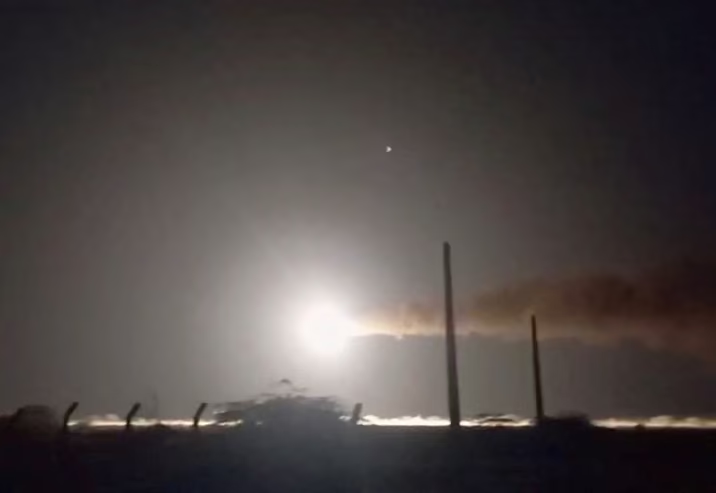
Field reports from inside Iran reported hearing violent explosions in the coastal city of Bushehr, in addition to a complete power outage in large parts of the southern city of Chabahar. Despite reports of explosions near the Bushehr nuclear plant, Iranian sources denied any material damage to the nuclear facility so far.

In the strategic city of Bandar Abbas, Iranian air defenses participated in attempts to intercept what they described as 'hostile targets' flying in the region's sky. Local news agencies confirmed that the sounds of explosions shook the cities of Sirik and Bandar Abbas, reflecting the widening scope of direct military confrontation between Washington and Tehran.

US officials indicated that Wednesday's raids were more comprehensive than previous operations, targeting advanced coastal radars and anti-ship missile launch sites. This US strategy aims to cripple Iranian defensive and offensive capabilities in vital waterways to force Tehran to halt its continuous attacks.

In a related context, the US President warned that the United States would not hesitate to launch larger attacks if Iranian threats to US interests and its allies in the region continued. Trump stressed that US forces are on high alert to respond to any attempt to target its soldiers or military bases hosted by countries in the region.

On the diplomatic front, a state of international concern prevails regarding the region sliding into a full-scale war that could lead to the collapse of the global economy and the cessation of energy supplies. Major capitals are closely monitoring developments in the coming hours, especially with Gulf countries directly entering the circle of targeting and defensive response.

The Qatari Ministry of Interior activated emergency messaging systems via mobile phones, warning of potential security threats and urging everyone to stay in 'safe places'. These measures are the strictest taken by Doha in years, indicating the seriousness of the threats facing the region amid the current conflict.

The Kuwaiti Army stressed in its latest statement the necessity for citizens to adhere to security and safety instructions, confirming that the armed forces are working around the clock to secure the airspace. The statement indicated that air monitoring systems are accurately tracking any suspicious movements in regional airspace to deal with them immediately before they reach their targets.

In Iran, the 'Mehr' agency reported that air defenses are still in continuous engagement in the southern regions, with unknown warplanes continuing to fly over military sites. Iranian coastal cities are experiencing a state of panic with repeated explosions and rising columns of smoke from some targeted sites.

In conclusion, the situation in the Gulf remains open to all possibilities, with continued military buildups and the exchange of missile strikes between the warring parties. Political circles are awaiting whether international efforts will succeed in containing the situation, or if the region is heading towards a major confrontation whose outcomes cannot be predicted.

Air defenses are currently countering missile attacks and hostile drones, and the sounds of explosions are a result of intercepting these targets.

ARAB AND WORLD

Thu 09 Jul 2026 12:13 pm - Jerusalem Time

Truce Collapses Between Washington and Tehran: Trump Orders New Strikes and Tensions Escalate in the Strait of Hormuz

US President Donald Trump's efforts to end the conflict with Iran faced substantial obstacles following a new exchange of military attacks between the two sides. The White House found itself with limited options as the ceasefire agreement, which did not last long against escalating field tensions, crumbled.

Trump officially announced that the temporary agreement to end the conflict had reached its end, directing US forces to launch new strikes last Wednesday. This move came in response to Iran targeting US military sites in Bahrain and Kuwait, in a new episode of mutual escalation.

The latest spark ignited after an American bombing of Iranian targets, in response to attacks targeting oil tankers in the strategic Strait of Hormuz. This escalation highlighted the deep gap between the two parties, despite less than a month passing since the signing of a memorandum of understanding aimed at establishing a permanent truce.

Observers believe that the current US administration's options appear complex and difficult, as any additional escalation carries the risk of returning to a full-scale war. Nevertheless, Trump stressed that the ongoing events would end quickly, in an attempt to calm international concerns that immediately reflected on the markets.

Global oil prices reacted sharply to these developments, recording a rise of about seven percent immediately after the announcement of the new strikes. Economic experts fear that continued tension in the Strait of Hormuz could lead to a global energy crisis, given the strategic importance of this waterway.

Washington aims, through military pressure, to force Tehran to return to the negotiating table to make concessions on its nuclear program. However, the Iranian leadership shows no signs of backing down, but rather shows readiness to endure more military strikes in order to maintain its regional influence.

In a related context, Trump faces increasing internal pressure with the upcoming midterm elections scheduled for next November. The latest opinion polls showed a significant decline in the president's popularity, reaching 34 percent, which threatens the Republican Party's control of Congress.

These developments cast a heavy shadow over the recent NATO summit held in Turkey, where the Iranian file dominated discussions. Hopes of transforming the memorandum of understanding signed in June into a final peace agreement are gradually fading in the face of the explosive military reality.

Reports indicate that fundamental issues in the conflict, such as control over the Strait of Hormuz, remain unresolved between the two parties. While Tehran demands a leading role in managing the waterway, Washington and its allies in the Gulf insist on ensuring unrestricted international navigation.

Informed sources reported that Washington's cancellation of oil waivers granted to Iran further complicated the diplomatic scene. This measure deprived Tehran of huge financial revenues it was counting on, pushing the hardline current there to adopt more stringent positions in the face of US pressure.

Strategic analysts believe that the current pattern of conflict may continue for a long time without reaching a military or diplomatic resolution. Experts described the current situation as a state of 'controlled instability,' where violence recurs without a clear exit that satisfies all concerned parties.

Trump had marketed the temporary truce agreement as a major political achievement serving his electoral promises to avoid costly foreign interventions. But the reality on the ground proved that achieving the 'unconditional surrender' that Washington previously demanded remains a distant goal given the current circumstances.

Serious concerns arise that rising gasoline prices resulting from the war could further weaken the Republicans' electoral position. The White House realizes that American voters prioritize the economic situation, making prolonging the conflict a major political risk.

Ultimately, the Strait of Hormuz remains the most prominent knot in this conflict, through which five global oil shipments pass daily. As long as interpretations of sovereignty and administration in this passage remain divergent, the possibilities of military explosion will remain and threaten the stability of the entire region.

Trump has put himself in a predicament, and it does not seem that he will achieve significant gains from Iran either by military or diplomatic means.

OPINIONS

Thu 09 Jul 2026 12:13 pm - Jerusalem Time

The End of the Misyar Marriage!

Dr. Ibrahim Melhem

Editor-in-Chief

He satirized Iran's leaders as Jarir never satirized Al-Farazdaq, and praised them as Al-Mutanabbi never praised Sayf al-Dawla; sometimes he elevated them to the highest ranks, and at other times he brought them down to the lowest. He described them as wonderful negotiators, then demoted them to the status of devils, calling them "evil and untrustworthy scum." Yesterday, he announced the end of the "Memorandum of Understanding" with Tehran after he had satisfied his desire from a "Misyar marriage" he entered into out of necessity; due to the expiration of the deadline granted to him to wage wars without returning to the legislators, he circumvented them, using a deceptive description, "military operation," to justify activating the "multiplication table" and targeting vital facilities, water and power stations, and perhaps moving towards occupying "Kharg Island," which his acquisitive self has always pushed him to control and sell its oil, just as he did with Venezuelan oil. Do not be surprised if Trump returns to "polygamy" with a "new Misyar" through which he renews the language of praise and commendation, and sings about the wisdom of the leadership in Tehran, content with the spoils of return; for the "Strait of Hormuz" was a small detail and a forgotten thing in the nuclear negotiations equation, before Tehran discovered - thanks to "Trump's artificial intelligence" - that it possessed a weapon no less powerful than the nuclear arsenal; for the geography of the vast Persian plateau with its critical straits gives it the ability to control supply chains and cut off the energy lifeline from factory engines and production centers in oil and gas-hungry countries.

OPINIONS

Thu 09 Jul 2026 12:13 pm - Jerusalem Time

America Between Two-Party Monopoly and Public Opinion Shifts: Is the United States Approaching a New Political Phase?

For over two centuries, the American political system has been based on a deeply entrenched two-party duality, with the Republican and Democratic parties alternating in governing the state and shaping its domestic and foreign policies. This duality has become an unwritten part of the United States' political and constitutional structure. Despite the emergence of independent parties and movements at various junctures, they have remained unable to break this monopoly or transform into a viable political alternative capable of national competition.However, what the United States is witnessing today goes beyond mere traditional competition between the two parties. Acute political polarization, declining trust in institutions, widening economic and social disparities, demographic and cultural shifts, and the rise of digital media and social networking platforms are all indicators that American society is undergoing a profound reshaping. This raises a question larger than just the birth of a third party: Is America entering a new political phase that will redefine its party system and its role in the world?Globalization, the decline of the middle class, and increasing wealth inequality have shaken the confidence of broad segments of Americans in traditional elites. The disagreement between Republicans and Democrats is no longer just electoral competition; it has transformed into an ideological and cultural division over national identity, immigration, civil liberties, the economy, the role of the state, and the future of American democracy itself.In contrast, opinion polls reveal a growing number of Americans who prefer to identify as independents, reflecting the widening gap between public sentiment and the political establishment. However, this shift does not necessarily mean the imminent birth of a third party capable of competing with the two major parties, because the American electoral system, the mechanism of the Electoral College, and campaign finance laws are designed to make breaking the two-party duality extremely difficult.Therefore, the discussion of a "third way" should not be limited to the creation of a new party, but rather to the emergence of a new intellectual and political current that may push the two parties themselves to review their programs and priorities, in response to the rapid transformations within American society.These transformations appear more evident among younger generations, who view issues of social justice, human rights, military spending, and international relations from a perspective different from previous generations. Public opinion no longer treats official policies as given, but has become more willing to question and criticize them.This shift was clearly evident in the stance on the Israeli war on the Gaza Strip, where American universities, media outlets, research centers, and many political circles witnessed an unprecedented debate about the limits of American support for Israel, and the extent to which American policies align with the principles of international law and human rights. Within the Democratic Party, and to a lesser extent within the Republican Party, voices emerged calling for a review of some aspects of American policy towards Israel, while strategic support for Israel remained a broad consensus within the official establishment.As for the Palestinian issue, it has become one of the issues that clearly reveals the depth of these transformations. After decades of broad consensus within the American political establishment on supporting Israel as a strategic ally, with differences in managing the conflict rather than in the essence of the relationship, this consensus has witnessed a relative decline in some academic, media, and political circles, especially among younger generations. This has opened the door for broader discussions about the limits of American support, and the necessity of reconciling strategic interests with commitment to international law and human rights. Although these transformations have not yet translated into a fundamental change in official policies, they may represent the beginning of a cumulative process that will leave its mark on the decision-making process in the coming years.Foreign policy is not isolated from the domestic environment; rather, it is an extension of it. The wider the gap between public sentiment and official policies, the greater the pressure to reconsider priorities and strategies. Therefore, the future of the American role in the Middle East, and foremost the Palestinian issue, will remain deeply linked to the transformations taking place within American society itself.Therefore, the real question is not: Will a third party be born? But rather: Can the United States produce a new political majority that holds a different vision for its global role, and rebalances interests and values, power and legitimacy, and security and respect for international law?The American experience confirms that major transformations do not begin with the birth of new parties, but with a change in ideas, then a shift in public mood, and then a reshaping of programs, institutions, and policies. What the United States is witnessing today may not be the end of the two-party duality, but it may be the beginning of a new phase in which the ability of the two parties to monopolize the political sphere in the way America has known for decades declines.The future of the United States will not only be determined by the results of the upcoming elections, but by the extent to which American society succeeds in formulating a new political contract that responds to its internal transformations and redefines its position in the world. If these transformations continue to accumulate, their effects will not be limited to the American interior, but will extend to international politics as a whole, especially the Middle East and the Palestinian issue, where American public opinion, over time, may become a more influential factor in guiding foreign policies and decision-making.

LATEST NEWS

Thu 09 Jul 2026 12:13 pm - Jerusalem Time

Israel Refuses to Withdraw from Southern Lebanon, Escalating Tensions in the Strait of Hormuz

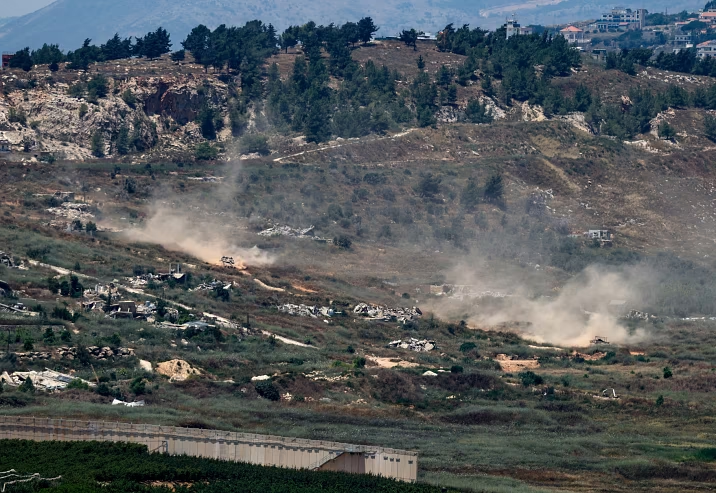
Informed sources reported that the Israeli government reiterated its refusal to withdraw from the areas it controls in southern Lebanon, affirming its commitment to maintaining a military presence there for an indefinite period. This Israeli stance comes as a direct response to statements made by US President Donald Trump, indicating a divergence in views between Tel Aviv and Washington regarding security arrangements on the northern border.

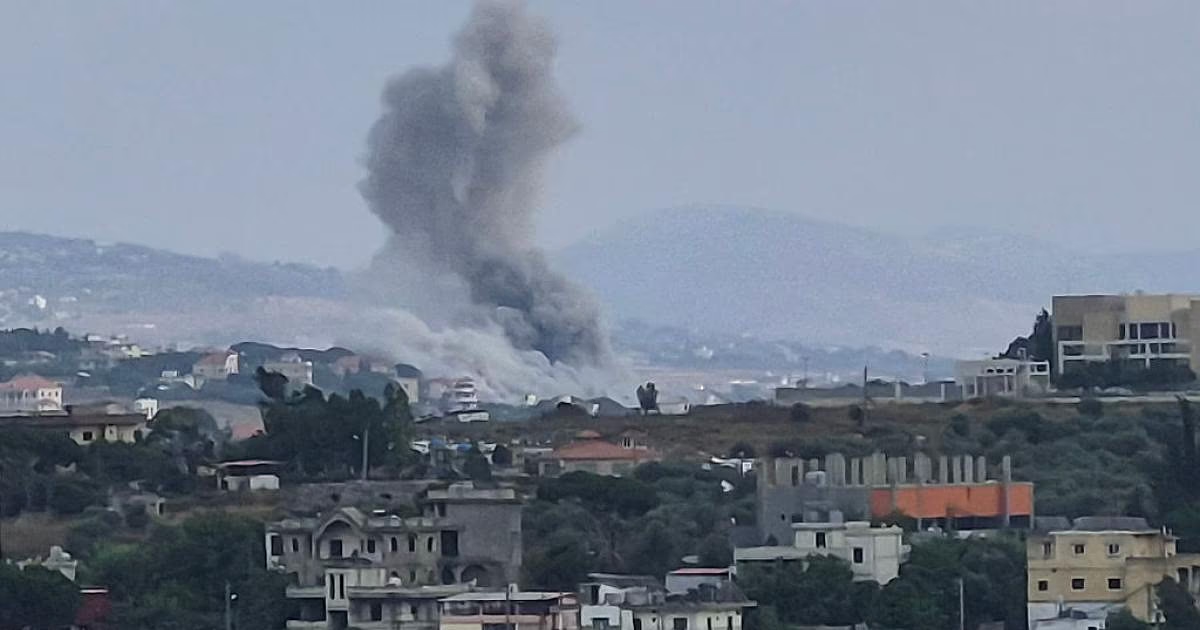
In a related context, the region entered a new phase of military escalation between the United States and Iran, leading to the collapse of the fragile truce that had existed between the two parties. Sources stated that mutual threats and exchanges of fire caused widespread disruptions to ship traffic and commercial navigation in the Strait of Hormuz, which represents the most important global energy artery.

Field reports warned that the continued military buildup in sensitive waterways puts the security of international navigation at risk. Observers believe that the synchronization of Israeli intransigence in Lebanon with the flare-up in the Strait of Hormuz reflects a state of comprehensive regional instability, amidst the absence of effective diplomatic solutions to contain the successive crises.

Israel reiterates its commitment to remaining in southern Lebanon in response to the new US administration's directives.

ARAB AND WORLD

Thu 09 Jul 2026 12:12 pm - Jerusalem Time

Widespread American Escalation Against Iran: Targeting 90 Military Sites Along the Coast

The US Central Command (CENTCOM) announced a new and extensive round of air and missile strikes against military targets belonging to Iran. Military sources clarified that these operations are part of a strategy aimed at curbing Tehran's offensive capabilities that threaten the security of maritime navigation in the strategic Strait of Hormuz region.

The American target bank included approximately 90 military sites precisely distributed across the map of Iranian capabilities, with strikes focusing on neutralizing air defense systems and coastal surveillance devices. The attacks also targeted warehouses designated for storing ballistic missiles and drones, in addition to destroying logistical infrastructure and naval capabilities deployed along the coast.

Informed sources confirmed that Washington seeks, through this escalation, to weaken the Iranian Revolutionary Guard's ability to intercept commercial vessels or threaten the safety of civilian sailors. The US administration considers these military moves necessary to ensure the flow of global trade through international waterways that have recently witnessed escalating tensions.

In a field reading of the operations' trajectory, media sources from Washington reported that talk of de-escalation or an end to the escalation round is still premature given the current data. The sources indicated that US forces are prepared to resume strikes if Tehran undertakes any new hostile action targeting shipping lanes near the Omani coasts.

Military data issued by 'CENTCOM' indicates a significant development in the size and intensity of operations, with the number of targets increasing from 80 sites the previous day to 90 targets in the latest strike. This quantitative escalation reflects an American desire to send strong deterrence messages by prolonging the duration of air operations and expanding the geographical scope of targeting.

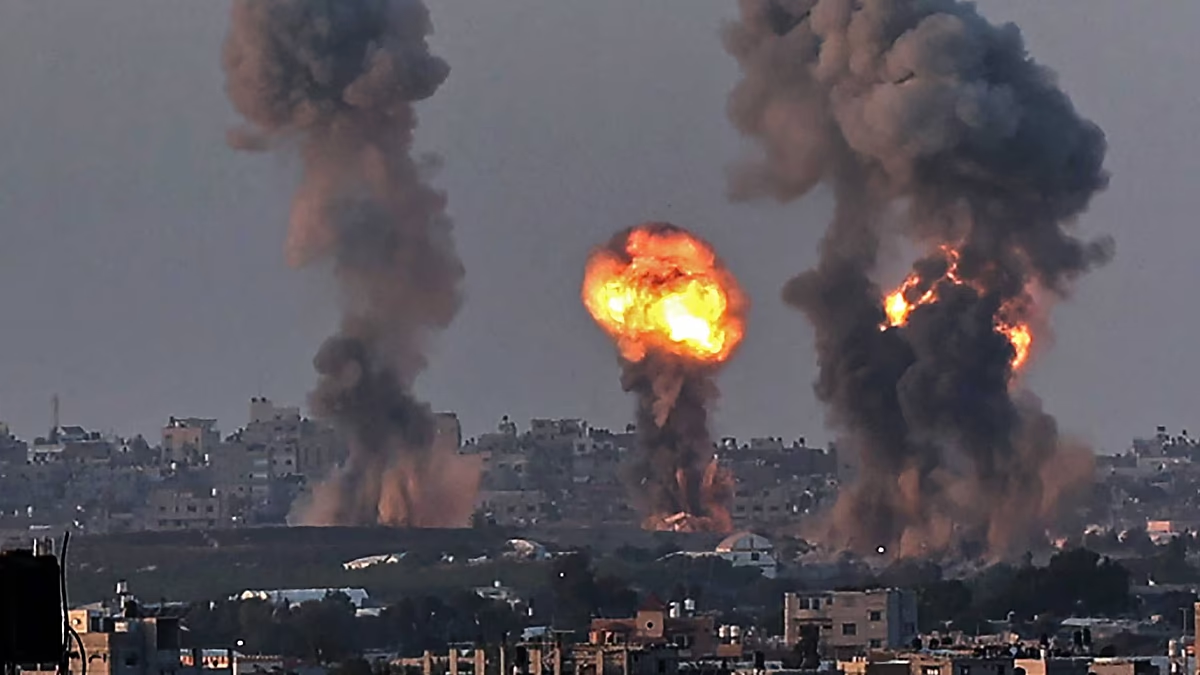
The recent strikes were not limited to disputed Iranian islands or limited sites as usual, but extended to include the logistical depth along the entire Iranian coast. Activists and media outlets circulated footage showing massive fires breaking out and successive explosions heard in various Iranian regions, confirming the accuracy and wide scope of the American attack.

CENTCOM justifies this widespread military action by defending freedom of navigation, holding Tehran responsible for disrupting global trade. International circles are cautiously monitoring Iran's potential reaction, amid fears of the region sliding into a comprehensive confrontation if the exchange of military strikes continues at this escalating pace.

The operation comes as part of efforts to undermine Iran's ability to target commercial vessels and civilian sailors in one of the most important international maritime passages.

OPINIONS

Thu 09 Jul 2026 12:12 pm - Jerusalem Time

Are the upcoming Israeli elections merely a competition between Netanyahu and his opponents for the premiership?

It seems we are heading for an election battle, different from all previous elections, as there are deep internal crises afflicting the occupation state, a loss of public trust in the government, cracks in the Likud and a rebellion against Netanyahu's leadership, as well as threats of not accepting the election results from Netanyahu and his alliance. These elections may be accompanied by fabricated clashes and confrontations, especially in Arab areas, to disrupt the elections or use them as a pretext to outlaw Arab parties and prevent them from participating in the elections. The upcoming Israeli elections are not merely a competition between Benjamin Netanyahu and his opponents for the premiership, nor are they a traditional transfer of power between right-wing and centrist parties. Rather, for the first time since the establishment of the occupation "state," they appear to be a referendum on the results of a war whose repercussions have not yet ended, on the limits of Israeli power, and on the future of the relationship with the United States as the partner without whom "Israel" cannot fight a major regional war. Netanyahu senses danger to his leadership and the significant potential that might overthrow his leadership and remove him not only from the political scene but also lead him to prison, not just for the criminal charges pending against him before the Israeli judiciary. Instead, he will be held accountable after the formation of an official investigation committee for the security and intelligence failure on October 7, 2023, and the major mistakes in the continuous wars on more than one front, which the opposition, political and media elites, and former military and security leaders believe Netanyahu fought to serve his political and personal interests, leading Israel to disaster. Netanyahu rushes to Washington to meet his war partner, Trump, to seek a lifeline. The visit is not to deepen the traditional alliance between the two parties but to establish the rules for the next phase. Netanyahu will try during this visit to drag Trump back into war against Iran, considering that the war did not achieve its major goals, and the American-Iranian memorandum of understanding did not take Israeli security and political interests into account. Netanyahu realizes that Trump wants to solidify the agreement with Iran, serving American economic and strategic priorities and enhancing his political standing and chances of winning for him and his party in the upcoming November congressional midterm elections. Netanyahu is also looking to enhance his chances of winning and returning as prime minister in the upcoming October Israeli general legislative elections. Therefore, he will pressure Trump, if he fails to drag him into war with Iran again, to amend the American-Iranian memorandum of understanding to respond to Israeli security, military, and political interests in Lebanon, regarding the Strait of Hormuz issue, the Iranian nuclear program and highly enriched uranium, the Iranian missile program, Iran's regional role, and its relations with its allies from Arab and Palestinian liberation movements. This will enable him to market himself as the leader capable of bringing security to Israel and achieving victory over enemies. Opinion polls reveal that Netanyahu no longer monopolizes the leadership of the scene, and the rapid rise of former Chief of Staff Gadi Eisenkot has reshuffled the cards within the opposition camp, leading in a number of polls over Naftali Bennett, while the Likud is retreating from its traditional position without collapsing. But the most important thing is that the same polls do not give either camp a stable majority, making the most likely scenario the re-production of the same division that Israel has suffered from in recent years, with a Knesset divided between intersecting blocs and a renewed inability to produce a strong government capable of making major strategic decisions. Reading the election discourse is more important than reading the numbers. Netanyahu is fighting his battle on the premise that he is the indispensable war leader, and that replacing him means admitting failure and abandoning the war's goals. As for the opposition, led by Eisenkot and Bennett, it does not present itself as a leadership for a new war, but as a leadership that rebuilds the state exhausted by war, but on the basis of extremist, racist, and war rhetoric. Therefore, its programs feature headlines that would not have topped any Israeli election campaign years ago: an official investigation committee into the failures of October 7, reorganization of the army, addressing the conscription crisis, expanding reserve forces, reforming the military establishment, and restoring public trust in the state. These are the priorities of a government preparing to restore the ability to wage war, not a government that learns from the lessons of war to make policy from outside it, nor a government that declares it is going to war. The opposition attacks Netanyahu because he did not achieve victory, but it does not promise Israelis to achieve this victory tomorrow. Instead, it first promises to rebuild the tools that make the next war possible. This is an implicit admission that the last war did not exhaust the army alone, but exhausted the state, society, and trust in leadership. In contrast, the opposition is confused regarding the United States, which has become a protector and supporter of Israel in any war. On the one hand, the opposition's discourse attacks Netanyahu because, according to the opposition, he has become a captive of American will and has accepted Washington's restrictions on the war, no longer able to impose his priorities. On the other hand, none of the opposition leaders call for disengagement from Washington or for fighting wars without it. Instead, they make restoring the relationship with it under new assumed conditions one of their most important goals. The question that the opposition avoids is more important than its slogans: If the problem is Netanyahu, would the United States have chosen war if the prime minister were someone else? And if Washington has redefined its interests and now believes that expanding regional wars no longer serves its economic and political priorities, do Eisenkot or Bennett have the ability to change the American decision, or is the most either of them can do to improve the management of the relationship with Washington, which will remain the final arbiter in the decision of war and how to exit it? The battle is no longer between proponents of war and proponents of peace, but between those who believe that Israel needs a comprehensive review before any new war, and those who try to convince the voter that the problem lies in Netanyahu's person, not in the transformations that have affected Israel's surrounding strategic environment. Perhaps the most important thing revealed by the election campaign is that Israel itself no longer speaks with confidence about its ability to wage a long regional war alone. The talk about rebuilding the army, expanding mobilization, reforming command systems, and reorganizing the relationship with the United States is not the discourse of someone preparing for an imminent military decision, but the discourse of an entity recalculating after discovering that the power it possessed is no longer sufficient to achieve the goals it set for itself. Most likely, according to the polls, the elections will not produce a governing majority but will reproduce the crisis of the political system itself. Then Israel will face an unprecedented paradox: a new leadership that may emerge from the ruins of Netanyahu but lacks a governing majority, or Netanyahu remains without a majority that enables him to continue his project. In both cases, the crisis is not a crisis of individuals, but a crisis of a "state" searching for a new strategy after the limits of power clashed with the limits of politics, and the limits of Israeli will clashed with the limits of American will. The most important outcome of the elections may not be knowing who sits in the prime minister's office, but discovering that Israel, for the first time in decades, is entering a phase where the American question is part of the Israeli question. Whoever governs in Tel Aviv will not be able to ignore the fact that the decision of war is no longer purely an Israeli decision, and that rebuilding the army may not be easier than rebuilding the ability to influence the American decision, or to do without it, because rebuilding the army is also no longer possible without America.

OPINIONS

Thu 09 Jul 2026 12:12 pm - Jerusalem Time

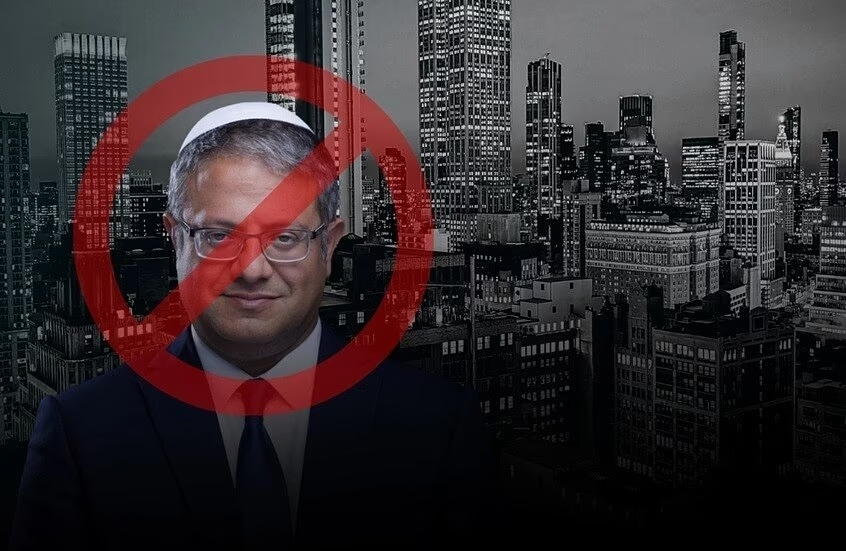
Ben Gvir's Visit to New York Canceled After Legal Action Led by Hind Rajab Foundation and Center for Constitutional Rights

Washington Message

Washington - Said Arikat - 7/9/2026

Israeli National Security Minister Itamar Ben Gvir canceled a planned visit to New York City amidst widespread legal actions and protests led by human rights organizations, including the Hind Rajab Foundation and the Center for Constitutional Rights, demanding investigations against him and legal action should he enter US territory.

Ben Gvir was scheduled to participate in events related to a United Nations summit on police and security issues, but the visit was canceled before its due date, a move that raised questions about whether legal and public pressure in the United States played a role in the decision.

The Hind Rajab Foundation, concerned with documenting violations committed against Palestinians and prosecuting those responsible, along with the Center for Constitutional Rights, led a campaign demanding that US authorities take action against Ben Gvir, based on accusations related to his policies, statements, and his ministry's practices towards Palestinians.

Human rights organizations also submitted requests to the US Department of Justice and the New York State Attorney General to explore the possibility of opening legal investigations, considering that Ben Gvir's presence in the United States necessitates examining his responsibility for policies that, according to these organizations, may amount to violations of international law and human rights.

The announcement of the visit coincided with calls for protests in New York, in which pro-Palestinian groups participated, in addition to American Jewish organizations opposing the policies of Ben Gvir, who is considered one of the most right-wing and hardline members of the Israeli government.

Ben Gvir's office did not officially announce that legal actions or protests were the reason for canceling the visit, nor did it provide a detailed explanation for the decision, merely refraining from confirming the trip's details. However, organizations involved in the campaign considered the cancellation a direct result of the pressure they exerted through legal and media channels.

The cancellation of the New York visit comes after previous reports spoke of Ben Gvir canceling another visit to the United States due to complexities related to his visa, which sparked controversy about the restrictions that some Israeli officials may face when traveling to Western countries amid escalating international criticism of Israeli policies in the Palestinian territories.

Observers believe that Ben Gvir's case reflects the widening gap between the current Israeli government and broad sectors of civil and human rights society in the United States, where the movements of right-wing Israeli officials have become subject to increasing legal and public scrutiny, especially in light of the war in Gaza and the escalating international demands for accountability.

The cancellation of Ben Gvir's visit to New York indicates a growing shift in the nature of the confrontation regarding Israeli officials accused of pursuing controversial policies. Instead of limiting pressure on them to political and diplomatic forums, human rights organizations have begun using legal tools to try to restrict their international movement. Although these actions do not necessarily mean opening successful judicial files, they create a new reality that makes some Israeli officials face political and legal risks when traveling abroad, especially to Western countries.

Ben Gvir's case reveals the widening disagreement within the United States itself regarding dealing with the current Israeli government. While American political sectors still provide strong support for Israel, hardline right-wing figures like Ben Gvir face increasing criticism from human rights organizations, civil groups, and even some American Jewish voices. This shift reflects a transition of part of the American debate from merely supporting the alliance with Israel to questioning the policies pursued by specific government figures and their impact on Israel's international image.

The cancellation of the visit also carries a political message that goes beyond Ben Gvir himself, as it reflects the escalating importance of international accountability amidst the ongoing war in Gaza and the global debate about the responsibility of political and military officials. Current legal pressure may not lead to immediate results, but it accumulates political restrictions on the movement of some officials and affects their ability to participate in international forums. It also opens the door for a broader discussion about the relationship between political immunity and legal accountability in issues of human rights and armed conflicts.

OPINIONS

Thu 09 Jul 2026 12:04 pm - Jerusalem Time

How the Hysteria of War Advocates in Washington Is Paying Off


By: Said Arikat


July 9, 2026


News Analysis


Washington, D.C- The abrupt collapse of the diplomatic opening between Washington and Tehran raises a deeply unsettling question: can a well-organized political campaign—driven by ideological conviction, powerful lobbying networks, and relentless media messaging—override a sitting president’s own instinct for negotiation? Recent events suggest the answer is yes.


When reports emerged in mid-June that Washington and Tehran were approaching a diplomatic breakthrough, opponents of engagement reacted with remarkable speed and coordination. After President Trump and Iranian President Pezeshkian electronically signed a Memorandum of Understanding on June 17—two days earlier than expected—those committed to military pressure treated the agreement not as an opportunity to prevent another war but as a strategic setback to be reversed.


The MOU established a sixty-day negotiating period intended to halt direct military confrontation and create space for a broader political settlement. Almost immediately, influential Republican lawmakers, AIPAC and other pro-Israel advocacy organizations, conservative policy institutes, and much of the American mainstream media launched a sustained campaign portraying the agreement as weakness. Television studios filled with commentators warning that Trump had “rewarded” Iran; editorials framed negotiations as capitulation, not prudent statecraft. The objective was not merely to criticize the agreement but to make the political cost of supporting diplomacy prohibitively high.


Few voices were more prominent than Israeli Prime Minister Benjamin Netanyahu. Given repeated access to major American television networks and newspapers, Netanyahu openly argued that military pressure should continue and any pause would only strengthen Iran. Rather than encouraging Washington to test whether negotiations could produce a more stable regional order, he consistently presented continued coercion as the only acceptable policy. This was not a subtle diplomatic disagreement but a direct public effort by the leader of a close ally to shape U.S. domestic debate and influence presidential foreign-policy choices—reflecting a longstanding preference for confrontation over negotiated accommodation.


AIPAC and allied advocacy organizations amplified that message across Capitol Hill. Their influence is neither hidden nor accidental. For decades they have built one of the most effective lobbying operations in American politics, rewarding legislators who embrace Israel’s security agenda while exerting formidable pressure on those who question it. In the Iran debate, members of Congress faced an unmistakable message: supporting negotiations carried significant political risks; advocating continued pressure remained the safer course.


Much of the mainstream media reinforced this narrative. Television panels repeatedly featured former military officials, pro-Israel analysts, and advocates of confrontation, while giving comparatively little attention to voices arguing that diplomacy deserved an opportunity. Public discussion focused less on whether negotiations could prevent another costly war than on whether Trump had appeared sufficiently “tough.” Political perception quickly became political reality.


The campaign succeeded in transforming a significant diplomatic opening into a domestic political liability. Instead of debating the strategic benefits of sustained negotiations, Washington became consumed by accusations of weakness and appeasement. Once diplomacy had been reframed as surrender, reversing course became politically easier than defending the agreement. Trump’s subsequent suspension of the MOU following allegations that Iran had struck three commercial tankers departing the Strait of Hormuz effectively closed the diplomatic window before negotiations were given a genuine chance. Whatever the veracity of those allegations, the political atmosphere had already become so toxic that the agreement’s survival appeared increasingly unlikely.


This episode illustrates a persistent imbalance in American foreign policymaking. Military action is subjected to remarkably modest political scrutiny, while diplomacy is expected to prove its success before it is even allowed to begin. Negotiators must demonstrate certainty in an uncertain world; advocates of military force are rarely held to the same standard. That asymmetry benefits those who favor confrontation. They do not need to prove that war will succeed—only to convince political leaders that pursuing diplomacy carries greater domestic political risks than abandoning it.


The uncomfortable reality is that Washington’s Middle East policy is shaped not only by strategic calculations but by powerful political constituencies capable of defining the boundaries of acceptable debate. When lobbying organizations, sympathetic media voices, influential donors, and foreign leaders converge around a single message, the space for independent policymaking narrows considerably. Presidents remain constitutionally empowered to make foreign policy, but politically they often govern within limits established by interests far beyond the Oval Office.


The strategic questions, meanwhile, remain unanswered. What exactly constitutes victory? Is the objective regime change, deterrence, behavioral modification, or indefinite crisis management? If military operations are not connected to clearly defined political goals, they risk becoming self-perpetuating exercises that generate instability without producing durable security. History repeatedly demonstrates that military superiority cannot substitute for political settlements. Air strikes can destroy infrastructure and kill commanders; they cannot negotiate verification regimes, establish durable security arrangements, or resolve the political disputes that give rise to conflict.


If the present course continues, Washington and Tehran are likely to become trapped again in the familiar cycle of escalation, retaliation, regional instability, economic disruption, and eventually renewed calls for negotiations—only after far greater human, political, and financial costs have been incurred. Diplomacy did not fail because it proved incapable of resolving differences. It was undermined before its effectiveness could be tested. The strategic realities that persuaded both governments to sign the June MOU have not disappeared. Geography, economics, regional security, and the catastrophic costs of another prolonged conflict continue to argue for negotiation rather than perpetual confrontation.


The larger lesson extends beyond one suspended agreement. It exposes the extraordinary power of organized political campaigns to redefine diplomacy as weakness and military escalation as strength. It illustrates how lobbying organizations, sympathetic media ecosystems, and determined political leaders can manufacture an atmosphere in which compromise becomes politically suspect while confrontation is celebrated as leadership. Whether one supports or opposes the June agreement is ultimately less important than recognizing how the debate unfolded. Democratic policymaking depends on genuine deliberation, not campaigns designed to delegitimize diplomacy before negotiations even begin. When public discourse is dominated by political pressure rather than strategic analysis, the prospects for peaceful conflict resolution diminish dramatically.


Wars almost always end at negotiating tables. The tragedy is that far too often, those negotiations begin only after opportunities for diplomacy have been sacrificed to political theatre, lobbying pressure, and the manufactured certainty that another round of military escalation will somehow accomplish what every previous one has failed to achieve.

PALESTINE

Wed 08 Jul 2026 9:35 pm - Jerusalem Time

Irish Parliament Approves Law Banning Import of Israeli Settlement Products

The Irish Parliament has officially approved a bill to ban the import of all goods and products manufactured in Israeli occupation settlements established on occupied Palestinian territories. This step represents one of the most stringent trade measures taken by an EU member state against settlement expansion policies, reinforcing Dublin's position as a leading critic of occupation policies in the Old Continent.

The new legislation explicitly prohibits the entry of any goods originating from settlements located outside the internationally recognized 1967 borders, with the ban extending to agricultural products, commercial goods, and materials related to residential sectors. The law aims to dry up the economic source of settlements, which the United Nations and most countries worldwide consider illegal and an impediment to peace opportunities in the region.

The center-right coalition government in Dublin affirmed that the drafting of this law was not arbitrary but directly based on the advisory opinion issued by the International Court of Justice in 2024. That international legal opinion stressed that the Israeli presence in the West Bank, East Jerusalem, and the Gaza Strip is an illegal occupation that must end, which provided Dublin with the legal cover to legislate the trade ban.

With this decision, Ireland becomes the first country in the European Union to move forward with implementing a comprehensive and complete ban, surpassing the steps taken by Spain last October, which were limited to a package of partial restrictions. This Irish approach reflects a determination to translate political stances into tangible economic measures that impact the structure of settlements in the occupied territories.

This trade move complements a series of bold diplomatic positions, as Dublin had previously announced its official recognition of the State of Palestine earlier in 2024. These positions led to severe tension in bilateral relations, reaching the point where the occupation's foreign minister, Gideon Sa'ar, closed the Israeli embassy in Dublin after accusing the Irish government of adopting hostile policies.

In a related context, Irish authorities had taken individual punitive measures last month, including banning Israeli National Security Minister Itamar Ben-Gvir and Finance Minister Bezalel Smotrich from entering its territory. This ban came against the backdrop of their statements and extremist positions towards international activists, specifically those participating in the 'Global Flotilla of Resilience' which seeks to break the siege on Gaza.

Ireland is currently leading a movement within the European Union to review the Association Agreement signed with the occupation since 1995, which grants Israel preferential trade advantages. Although the European Union recently announced studying options to restrict trade with settlements, the lack of consensus among member states still hinders a unified collective decision, prompting Dublin to act unilaterally.

This legislation is directly based on the advisory opinion of the International Court of Justice, which deemed the occupation of the West Bank and Jerusalem illegal.

PALESTINE

Wed 08 Jul 2026 9:34 pm - Jerusalem Time

Escalation of Settler Attacks in the West Bank: Siege and Destruction of Water Networks in the Jordan Valley

Groups of settlers escalated their systematic attacks against Palestinian citizens in the northern Jordan Valley and various governorates of the West Bank and occupied Jerusalem early Wednesday morning. These attacks occur under the direct protection of the Israeli occupation army, with operations focused in the areas of East Atouf and Ras al-Ahmar, as part of plans aimed at the forced displacement of residents and the seizure of their lands and properties.

In a dangerous field development in the Jordan Valley, settler groups permanently closed the road leading to the 'Ras al-Ahmar' residential cluster, isolating and besieging 38 Palestinian families with their livestock. These measures prevented the delivery of water, food, and fodder to those besieged, in a step aimed at restricting livelihoods and forcing residents to leave the area.

The siege was accompanied by widespread destruction of vital infrastructure, as settlers sabotaged the main water pipeline leading to the cluster, causing a complete water cutoff and damaging vast agricultural areas planted with bananas and other crops. The destruction also affected water networks in the 'Al-Mi'yar' area and east of 'Aqaba' village, including revenue meters belonging to citizens.

In a related context, settler gangs stormed the 'Samra' residential cluster in the Jordan Valley, carrying out provocations and acts of hooliganism against unarmed residents. Field sources reported that settlers attempted to steal property and livestock at gunpoint, causing panic among women and children, amid the continued policy of intimidation against pastoral communities.

In the Ramallah governorate, settlers launched an attack targeting citizens' homes in the town of 'Umm Safa' northwest of the city, coinciding with others gathering at the entrances to the town of 'Burqa' to obstruct traffic and inspect vehicles. In occupied Jerusalem, settlers began establishing a new fenced pastoral outpost near the town of 'Jaba', in a preparatory step to confiscate surrounding lands.

In the southern West Bank, Masafer Yatta and Khirbet al-Khalil were not spared from these attacks, as shepherds and farmers were pursued and subjected to direct physical assaults. These repeated attacks aim to force Palestinians to evacuate their pastures and agricultural fields for the benefit of settlement expansion, in the absence of any legal or international deterrent to these practices.

Groups of settlers permanently closed the road leading to the residential cluster in Ras al-Ahmar, resulting in the siege of 38 Palestinian families.

PALESTINE

Wed 08 Jul 2026 9:34 pm - Jerusalem Time

Fears of lifeline collapse.. Gaza refugees warn of consequences of UNRWA service suspension

A state of anxiety and confusion is escalating among hundreds of thousands of Palestinian refugees in the Gaza Strip, following successive reports about plans to exclude the United Nations Relief and Works Agency (UNRWA) from providing its vital services. The agency represents the primary pillar on which the population relies for education, healthcare, and food aid, especially in light of the ongoing aggression and harsh humanitarian conditions.

On the ground, sources reported that a school belonging to the international agency in the town of Khuza'a, east of Khan Yunis, suffered severe damage as a result of Israeli airstrikes targeting the area. This incident highlights the dangers facing the educational infrastructure managed by the international organization, which serves thousands of students who are now without homes or safe schools.

Many Palestinian families consider their lives to have been organically linked to the agency for many decades, as UNRWA is the sole source of income for thousands of employees. Afaf Siam, a refugee who works with her husband in the agency's education sector, confirms that any harm to the organization means the loss of livelihood stability for her entire family, especially since her daughter also works as a nurse in its clinics.

Siam adds that UNRWA is not just a donor, but an integral part of the social and economic fabric of Gaza, where successive generations have graduated from its schools. She believes that reducing services will lead to catastrophic consequences that go beyond the material aspect to depriving young people of job opportunities and professional growth within their besieged community.

For his part, young Izz al-Din al-Najjar recounts his experience with the agency's services that have accompanied him since birth, noting that UNRWA clinics were his family's first refuge for receiving treatment. Al-Najjar confirms that the agency's schools were not just classrooms, but an educational environment that helped refugees face difficult life challenges and build their national and intellectual personalities.

Al-Najjar points out that food aid, especially the periodic distribution of flour every three months, represents a safety valve for families suffering from food insecurity. He warns that the absence of this support in light of the current economic collapse will expose the lives of hundreds of thousands to the risks of real famine, exacerbating the unprecedented humanitarian crisis in the Strip.

On the political front, analysts believe that targeting UNRWA goes beyond administrative and financial aspects to an attempt to liquidate the political symbolism of the refugee issue. Political analyst Talal Abu Rukba confirms that the agency is the most prominent international witness to the 1948 Nakba, and that its existence is legally linked to United Nations resolutions concerning the right of return and compensation.

Abu Rukba explains that UNRWA serves about 75% of the population of the Gaza Strip, which makes its role pivotal and beyond the capabilities of other local and international institutions. He believes that attempts to transfer its powers to alternative relief agencies are primarily aimed at stripping Palestinians of their status as refugees and turning them into mere displaced persons in need of temporary humanitarian aid.

Political analyst warns that ending the agency's mandate will necessarily lead to the closure of camps as historical evidence, paving the way for resettlement projects and the dissolution of national identity. This dangerous shift threatens Palestinian political rights and empties the issue of its internationally recognized legal content for decades.

In the crowded alleys of the camps, there is a feeling that the world is abandoning its commitments to the victims, as refugees see UNRWA as the 'lifeline' that cannot be replaced. Other international institutions, despite their importance, do not have the political mandate or the massive infrastructure that the agency possesses in the fields of sustainable education and health.

Reports indicate that any change in UNRWA's status will leave a huge gap in basic services that no other entity can fill in the short term. The agency's hospitals and schools operate within an integrated system built over 75 years, and its collapse means the collapse of the entire social and service system in the Gaza Strip.

Refugees emphasize that adhering to UNRWA is adhering to historical rights, not just a search for a livelihood or free treatment. Every ration card or school certificate issued by the agency carries within it international recognition of their status as refugees awaiting return to their homes from which they were forcibly displaced.

In light of the continued raids targeting UN facilities, international demands for the protection of UNRWA headquarters and the assurance of its continued funding are increasing. Observers believe that international silence regarding the targeting of schools and clinics gives a green light to undermine the international system established to protect human rights in conflict zones.

In conclusion, the fate of millions of refugees remains dependent on international political decisions, while the people of Gaza continue their daily struggle for survival. UNRWA, despite all pressures, remains the only remaining symbol of international commitment to an issue that is the longest in modern history, and any retreat from supporting it represents a stab in the side of international justice.

Suspending UNRWA does not only mean closing an institution, but for us it means suspending our lives, livelihoods, and the future of our children.

PALESTINE

Wed 08 Jul 2026 9:34 pm - Jerusalem Time

8 Martyrs in Gaza Due to Ongoing Occupation Violations of Ceasefire Agreement

Medical sources in the Gaza Strip announced the martyrdom of eight Palestinian martyrs since Wednesday morning, as a result of a series of attacks and violations carried out by the Israeli occupation forces in various areas of the Strip. These field developments come amid the occupation's continued disregard for ceasefire understandings, leading to civilian casualties in shelters and residential areas.

In details of the field massacres, an occupation drone targeted a tent housing displaced people near the Turkish slaughterhouse area south of Khan Yunis city, resulting in the martyrdom of four members of one family and varying injuries to others. Gaza City also witnessed similar attacks, where a child was martyred in the Zeitoun neighborhood by machine gun fire mounted on a military crane east of the city, while another young man was martyred in an airstrike that directly targeted him in Al-Oyoun Street in the western part.

These deadly targeting incidents indicate a de facto collapse of the guarantees associated with the ceasefire agreement signed in the Egyptian city of Sharm El Sheikh under international and Arab auspices on October 10, 2025. Despite the agreement officially entering into force, Israeli military operations have not ceased, putting the agreement, which aimed to end the war, at risk amidst the escalating daily killing.

According to the latest data issued by the Ministry of Health, the number of martyrs who have fallen since the presumed truce came into effect on October 11 has jumped to 1,084 martyrs, in addition to approximately 3,491 injured. Rescue and ambulance teams also managed to recover 799 bodies from under the rubble and in border areas during the same period, reflecting the extent of the destruction and violations committed.

Regarding the comprehensive statistics of the ongoing aggression since October 7, 2023, the total number of martyrs in the Gaza Strip has risen to 73,110 martyrs, while the number of wounded and injured has exceeded 173,599 people. These horrific figures confirm the continuation of the humanitarian catastrophe in the Strip, amidst human rights and international demands for the occupation to be compelled to stop its comprehensive aggression and provide protection for civilians.

The total number of martyrs since the ceasefire came into effect on October 11 has risen to 1,084 martyrs.

PALESTINE

Wed 08 Jul 2026 9:34 pm - Jerusalem Time

Occupation prevents Arab League Secretary-General from visiting West Bank and meeting Abbas

The General Secretariat of the League of Arab States announced today, Wednesday, that the Israeli occupation authorities refused to grant the necessary permits to the League's Secretary-General, Nabil Fahmy, to make his first visit to the occupied Palestinian territories. The tour was scheduled to include an official meeting with Palestinian President Mahmoud Abbas at the presidential headquarters in Ramallah in the West Bank.

Official sources in the Arab League reported that the Palestinian authorities informed the General Secretariat of the Israeli ban decision, which prevented the Arab delegation from reaching its scheduled destination today, Wednesday. This step comes amid a continuous Israeli escalation aimed at isolating the Palestinian leadership from its Arab and international depth.

In a press statement, the spokesperson for the Secretary-General clarified that Nabil Fahmy had chosen the Palestinian territories as his first foreign destination since assuming his position at the beginning of this month. This symbolic choice reflects the Arab League's insistence on placing the Palestinian issue at the forefront of the Arab diplomatic agenda during the upcoming period.

The statement stressed that the purpose of the visit was to deliver a direct message of support for the steadfastness of the Palestinian people in the face of repressive practices. Fahmy was also supposed to discuss with President Abbas ways for Arab action to confront the current challenges facing the Palestinian national project and the two-state solution.

The spokesperson described the conditions experienced by Palestinians in the West Bank as amounting to a comprehensive siege within cities and villages. He pointed out that settlement expansion is encircling Palestinian communities from all sides, preventing their geographical connection and stifling opportunities for a dignified life for the indigenous population.

Sources in the League also noted that settlers are engaging in acts of violence and intimidation under the direct protection of the Israeli occupation army. They confirmed that these practices are carried out with political encouragement from the Israeli government, which increases the suffering of civilians who face daily attacks on their property and lives.

The Arab League called on the international community to hold Israel accountable for its continuous violations of international and humanitarian law. It affirmed that defending a just peace requires effective steps to expose the occupation's practices and strengthen the steadfastness of Palestinians against the increasingly brutal and uncontrolled machine of oppression recently.

It is worth noting that Nabil Fahmy officially assumed his duties as Secretary-General of the League of Arab States on July 1st, succeeding Ahmed Aboul Gheit. His nomination was unanimously approved by Arab foreign ministers last March, based on an Egyptian proposal to enhance the Arab role in thorny regional issues.

Fahmy is considered one of the most prominent diplomatic figures in the region, having served as Egypt's foreign minister during a critical transitional period between 2013 and 2014. He possesses extensive experience in managing international files, which made his appointment a source of hope for activating joint Arab action mechanisms towards the Palestinian issue.

The Israeli ban decision coincided with international and local human rights reports warning of an unprecedented pace of settlement in the West Bank. These reports confirm that the occupation authorities are racing against time to impose a new reality on the ground that undermines any future opportunity for the establishment of an independent Palestinian state with Jerusalem as its capital.

The visit aimed to support the steadfastness of the Palestinian people and to affirm that the Palestinian issue will remain at the top of the Arab world's priorities.

OPINIONS

Wed 08 Jul 2026 9:34 pm - Jerusalem Time

Hormuz reignites confrontation… Sovereignty dispute undermines US-Iranian understanding

Washington's Message

Washington – Saeed Erikat – 7/8/2026

News Analysis

US President Donald Trump announced from Turkey on Wednesday morning the termination of the sixty-day memorandum of understanding between the United States and Iran, confirming that the agreement had reached its end after the recent military escalation between the two parties. Tehran quickly announced the same position, considering that the memorandum had lost its justification for continuation after it responded to American strikes with missile attacks targeting American bases in the region.

Thus, the understanding, which was seen as a temporary framework for de-escalation and opening a broader negotiation path, moved to a new phase of confrontation, bringing to the forefront the most sensitive question in the relationship between the two parties: Was the dispute about implementing the terms of the agreement, or about the nature of the security system that will govern the Gulf and the Strait of Hormuz in the next phase?

Recent developments reveal that the end of the memorandum of understanding was not the result of an isolated military incident, but rather the accumulation of fundamental differences over the interpretation of its basic terms. Washington and Tehran treated the agreement as carrying different meanings, especially regarding freedom of navigation, Iran's role in securing the Strait of Hormuz, and the limits of influence it could retain during the transitional period.

From the Iranian perspective, keeping the Strait of Hormuz open does not mean abandoning its security role in the region. Tehran believes that its historical and geographical responsibility for a large part of the strait gives it the right to supervise the movement of commercial ships, including notifying it of transit operations during the sixty-day period that was supposed to pave the way for a permanent agreement.

Washington, however, adopted a completely different interpretation, considering that the concept of "open strait" means ensuring freedom of navigation for commercial ships without the need for Iranian approval or prior coordination with it. From the American perspective, Iran's role is limited to ensuring safe passage, not possessing the authority to regulate it or control its routes.

Here emerged the core of the crisis: a dispute over the text of the agreement turned into a struggle over sovereignty and influence.

For Iran, the Strait of Hormuz is not just a maritime passage, but one of its most important strategic power cards. Tehran realizes that its ability to influence global navigation gives it a deterrent card in the face of American military superiority. Therefore, it views any arrangements that reduce its role in the strait as an attempt to strip it of its most important strategic tools.

From this perspective, allowing ships to pass through the southern corridor without notifying Iran is not read in Tehran as a technical measure, but as the beginning of a change in the rules of the game, and the creation of a new navigational reality that could continue even in the event of a return to military confrontation.

In contrast, the United States believes that accepting any formula that grants Iran an exclusive or semi-exclusive role in managing navigation could set a dangerous precedent, not only for the Gulf, but for the principle of international freedom of navigation. Washington also fears that mandatory coordination with Iran could turn into indirect political recognition of its influence over one of the world's most important maritime passages.

Therefore, the battle over Hormuz is not essentially a battle over ships, but over who has the right to set the rules for maritime security in the Gulf.

Before the collapse of the memorandum of understanding, negotiations had explored a compromise formula whereby commercial ships would notify Iran and one of the concerned Gulf states of navigation before transit. This formula aimed to achieve a difficult balance between the demands of both parties: maintaining a limited Iranian role in security arrangements, and preventing that from turning into recognition of an exclusive right to manage the strait.

However, this settlement did not withstand military escalation, after Iran considered some transit operations a direct challenge to its interpretation of the agreement, while Washington saw them as a natural exercise of freedom of navigation.

It appears that the American decision to respond militarily and re-impose oil sanctions was not only aimed at responding to Iranian escalation, but also at reshaping the deterrence equation. Washington wanted to send a message that any attempt to change navigation rules or impose a new fait accompli would be met with a high cost, and that the United States is still capable of using its military and economic tools simultaneously.

However, the re-imposition of oil sanctions raises questions about the value of economic incentives in any future negotiations. Lifting restrictions on Iranian oil exports was one of the most important tools Washington used to encourage Tehran to adhere to the agreement. But if these licenses can be revoked with every crisis, importing companies and countries may lose confidence in their continuity, which reduces their practical and political value.

Here a significant paradox emerges: Washington may use sanctions to pressure Iran, but at the same time, it may weaken one of its negotiating cards if the market loses confidence in the incentives it offers.

In conclusion, the collapse of the memorandum of understanding not only signifies the failure of a temporary arrangement between Washington and Tehran but also reveals the depth of the disagreement over the future of the security system in the Gulf. The two parties differed not only on the implementation of the agreement but also on its political and strategic meaning.

The fundamental question remains: Can a new negotiation path be revived based on a clearer formula regarding the Strait of Hormuz, or has the recent escalation closed the door to any quick settlement?

The most realistic option remains to return to a formula of understanding that guarantees freedom of navigation, while at the same time preserving the interests of all parties, without granting any party unilateral recognition of control over the strait. Continued confrontation, however, could turn Hormuz from a point of negotiating disagreement into the spark of a broader regional crisis whose repercussions would be difficult to contain.

Hormuz… A battle for legitimacy before it is a battle for navigation

The Strait of Hormuz crisis reveals that the real conflict is not just about the movement of ships, but about who has the right to define the rules of the security system in the Gulf. The United States defends the principle of international freedom of navigation, while Iran believes that its geographical location gives it an undeniable security role. Therefore, the current dispute represents a confrontation over influence and legitimacy more than a technical disagreement over transit procedures. Each party fears that concessions in Hormuz could lead to a greater strategic loss in the future regional balance.

Oil sanctions… A pressure tool that may lose its effectiveness

Oil sanctions are one of the most important American pressure tools on Iran, but they need a key element to remain effective: confidence in their continuity. If markets believe that any license to buy Iranian oil can disappear with the first political crisis, companies will hesitate to enter into long-term agreements. At that point, sanctions transform from a flexible negotiating tool into a pressure policy with limited impact. Therefore, the use of incentives and sanctions requires a delicate balance so that Washington does not lose one of its most important cards in any future negotiations.

End of the memorandum does not mean the end of diplomacy

Despite the seriousness of the escalation, the termination of the memorandum of understanding does not necessarily mean the end of the diplomatic path between Washington and Tehran. History proves that temporary agreements often collapse before major settlements mature. However, returning to negotiations requires addressing previously postponed issues, foremost among them the status of the Strait of Hormuz and the limits of Iranian maritime influence. If the two parties succeed in separating the dispute over sovereignty from the need to ensure navigation security, the current crisis could turn into an opportunity to rebuild a more sustainable understanding.

ARAB AND WORLD

Wed 08 Jul 2026 6:49 am - Jerusalem Time

Occupation soldiers document their violations inside citizens' homes in southern Lebanon

Video clips broadcast by soldiers of the Israeli occupation army via social media platforms showed a state of disregard for the property of Lebanese citizens in the occupied border villages. One of the soldiers documented, through his account on the 'TikTok' platform, a group of elements playing football inside a living room in one of the homes recently occupied in southern Lebanon.

According to what appeared in the recording, the occupation forces transformed the private home into something resembling a military barracks, with war equipment piled up next to household furniture. The soldiers deliberately tossed the ball with their heads before shooting it into a basket placed in the middle of the room, amidst shouts of joy and applause after scoring what they considered a goal, in a scene that reflects the extent of ethical and legal violations.

The soldier attached the clip with a provocative comment in which he wrote 'Brazil in Lebanon,' which sparked a wide wave of anger among Lebanese who were forcibly displaced from their homes. These actions come at a time when the occupation prevents thousands of families from returning to their villages and inspecting their properties, which are subjected to systematic sabotage by the invading forces.

On the ground, sources reported that these practices coincide with repeated Israeli violations of the ceasefire agreement recently reached. The occupation refuses, until this moment, to abide by the terms of the framework agreement signed between Beirut and Tel Aviv under American sponsorship, which threatens the collapse of the fragile calm in the region.

Both parties had signed an agreement on June 26 last year providing for a gradual Israeli withdrawal from the occupied Lebanese territories. The agreement stipulates that the first phase will begin from two pilot areas, but the absence of a clear timetable for a comprehensive withdrawal still constitutes a major obstacle to the implementation of understandings on the ground.

The Israeli occupation links the pace of its withdrawal to the Lebanese army imposing full security control over the border areas, in addition to disarming unofficial armed groups. These conditions are part of the pressures exerted by Tel Aviv to ensure new security arrangements in southern Lebanon after months of violent confrontations.

It is worth noting that the widespread Israeli aggression against Lebanon has continued since early March 2026, with Israeli forces penetrating distances exceeding 10 kilometers in some axes. Israel continues to occupy large areas of the South, some of which have been under military control for decades, and others were occupied during recent rounds of escalation.

Brazil in Lebanon.. This is how an Israeli soldier commented on a clip showing the desecration of civilian homes and their transformation into military barracks.

ARAB AND WORLD

Wed 08 Jul 2026 6:49 am - Jerusalem Time

Israel escalates its violations in southern Lebanon, and Aoun emphasizes the exclusivity of weapons

Lebanese media sources reported that Israeli occupation forces continued their field violations of the ceasefire agreement, carrying out extensive bombing operations in the town of Deir Sirian, part of the Nabatieh Governorate in the south of the country. This coincided with artillery attacks targeting the vicinity of the town of Nabatieh Fouqa towards the town of Meifdoun, reflecting the occupation's insistence on overstepping existing security understandings.

In a related context, the Emergency Health Operations Center of the Lebanese Ministry of Health revealed a tragic update to the cumulative toll of the Israeli aggression ongoing since early March. According to official data, the number of martyrs has risen to 4,320 people, while the number of injured and wounded reached approximately 12,203, as a result of continuous raids and shelling on various Lebanese regions.

For his part, Lebanese President Joseph Aoun strongly condemned the continued Israeli aggressions targeting civilians, noting the martyrdom of four citizens in Nabatieh yesterday. Aoun affirmed during his meetings with political and economic delegations in Beirut that the Lebanese state is committed to the ceasefire and demands that the international community exert effective pressure on Tel Aviv to respect international obligations.

The Lebanese President stressed that the state-building process has effectively begun, affirming that the decision regarding the exclusivity of weapons in the hands of legitimate Lebanese institutions will be implemented without retreat. Aoun clarified that the interest of the Lebanese lies in the establishment of a strong state capable of protecting its sovereignty, noting that Lebanon has secured international recognition that there are no Israeli ambitions in its territories.

On the diplomatic front, Israeli Foreign Minister Gidon Sa'ar announced that the next round of negotiations with the Lebanese side will be held next week in the Italian capital, Rome. Sa'ar's statements came during a meeting with his German counterpart in occupied Jerusalem, where he described the framework agreement reached two weeks ago as a historic step.

In contrast, official circles in Lebanon expressed reservations and rejection of choosing the Italian capital as the venue for the talks, indicating the presence of logistical and political obstacles to resuming dialogue. This disparity comes at a time when the United States is seeking to solidify the framework agreement signed on June 26 to ensure the stability of the northern borders.

The framework agreement, concluded under American patronage, stipulates a gradual and sequential withdrawal of occupation forces from the areas they infiltrated within Lebanese territory. This withdrawal is closely linked to the Lebanese army's ability to extend its full security control and disarm armed groups in border areas, in a clear reference to arrangements concerning Hezbollah.

Despite the ceasefire agreement in effect since November 2024, the field witnesses daily Israeli violations ranging from aerial and artillery shelling to sweeping operations. Beirut considers these movements an undermining of de-escalation efforts and an attempt to impose a new reality on the ground before completing the withdrawal phases stipulated in the recent agreements.

Field reports indicate that occupation forces still occupy large areas in southern Lebanon, having infiltrated some axes for a distance exceeding 10 kilometers. These forces are distributed in areas occupied during the current aggression that began in March 2026, in addition to border points controlled by the occupation for many years.

The international community faces repeated Lebanese demands for the necessity of setting a clear timetable for the Israeli withdrawal, especially since the framework agreement did not specify precise dates for ending the foreign military presence. Observers believe that Israeli procrastination in implementation aims to gain more time to strengthen defensive positions within Lebanese territory.

In conclusion, the situation in southern Lebanon remains subject to field developments and the extent of the parties' commitment to the signed agreements, amidst the continued fall of civilian casualties. The Lebanese government affirms that the only path to stability is the full implementation of international resolutions and ensuring the state's sovereignty over all its national territory without any external interference.

I will not under any circumstances accept anyone negotiating on behalf of Lebanon, and the decision regarding the exclusivity of weapons will be implemented, and there is no alternative to the establishment of the state.

ARAB AND WORLD

Wed 08 Jul 2026 6:49 am - Jerusalem Time

Widespread Military Escalation: 'Strong' American Strikes Target Iranian Depth in Response to Strait of Hormuz Attacks

The US Central Command (CENTCOM) announced, early Wednesday, the execution of a large-scale military operation targeting strategic sites within Iranian territory. Military sources clarified that these strikes come as legitimate defense and a direct response to a series of attacks that targeted international navigation in the Strait of Hormuz over the past twenty-four hours.

CENTCOM affirmed in an official statement via the X platform that the objective of these operations is to impose 'exorbitant costs' on the Iranian side as a result of its targeting of civilian-led commercial vessels in a vital international waterway. The Central Command described recent Iranian actions as unprovoked aggression and a clear violation of previously concluded ceasefire agreements.

For its part, a US official revealed to media sources that the target bank included a wide array of Iranian military capabilities, among them advanced air defense systems and coastal surveillance facilities. The raids also hit 'surface-to-air' missile launch sites and anti-ship cruise missile platforms, in addition to drone operating centers and vital port facilities.

In contrast, official Iranian media confirmed loud explosions in various areas in the south of the country, with seven explosions heard in the coastal city of Sirik. Iranian television also reported six other explosions in the vicinity of the strategic Qeshm Island, amidst a state of security and military alert in the region.

On the diplomatic and economic front, Washington took immediate punitive measures, with the US Treasury Department announcing the cancellation of the license that allowed a temporary lifting of oil sanctions on Tehran. The US administration described Iranian behavior in the Strait of Hormuz as 'absolutely unacceptable,' warning of severe consequences that would affect the Iranian economy.

These field developments come after three oil and gas tankers were subjected to simultaneous attacks, the most prominent of which was the targeting of the Qatari LNG tanker 'Al Ruqayyat'. The attacks, carried out by drones, caused a fire in the engine room of the Qatari tanker, which drew widespread condemnation from Doha, which held Tehran fully legally responsible.

Damage was not limited to the Qatari tanker, as navigation reports indicated damage to a giant Saudi crude oil tanker belonging to the 'Widian' company while it was passing off the coast of Oman. The UK Maritime Trade Operations (UKMTO) indicated that the targeted vessels suffered varying degrees of damage, emphasizing the seriousness of the situation in the waterway through which a large portion of global energy supplies pass.

In Doha, Qatari Foreign Ministry spokesman Majed Al-Ansari called on the Iranian side to cease all practices that threaten the safety of international navigation. Al-Ansari stressed that targeting commercial vessels constitutes a grave violation of international laws, calling on the international community to take a firm stance to protect waterways from military escalation.

Observers believe that this escalation coincides with sensitive internal circumstances in Iran, as the country is in its fifth day of mourning for the passing of Supreme Leader Ayatollah Ali Khamenei. It appears that the field tensions have dashed hopes for progress in negotiations that were being mediated by Pakistan and Qatar to reach a final agreement to end the state of war.

For its part, the Iranian Foreign Ministry strongly condemned the US decision to re-impose oil sanctions, considering it a violation of the 'Islamabad Memorandum'. Tehran held the US administration fully responsible for the repercussions of this escalation, noting that US threats hinder any potential negotiation path to achieve sustainable de-escalation.

In Washington, former President Donald Trump hinted at the need to intensify strikes and target Iranian vital facilities more broadly if a permanent agreement ensuring regional security is not reached. These statements reflect a state of political consensus in the United States on the necessity of a firm response against recent Iranian actions in the Arabian Gulf.

Following these events, global energy markets experienced a state of turmoil, with oil prices rising by 1% immediately after news of the US strikes. Experts fear that the continued military escalation in the Strait of Hormuz could lead to a global energy crisis, especially given the ongoing war that first erupted last February.

US Central Command forces have begun launching a series of powerful strikes against Iran to impose exorbitant costs for targeting and attacking commercial vessels.

OPINIONS

Wed 08 Jul 2026 6:48 am - Jerusalem Time

United States Delivers Strong Blows to Iran After Three Commercial Ships Targeted in Strait of Hormuz

Washington's Message

Washington – Said Arikat – 7/8/2026

The confrontation between the United States and Iran has entered a new phase of military escalation, after the United States launched strong strikes on Tuesday targeting sites inside Iran, in response to Tehran targeting three commercial shipments while crossing the Strait of Hormuz. This development returns the region to an atmosphere of direct confrontation and raises widespread fears of the collapse of the diplomatic path that began last month.

The American strikes came hours after Washington announced that the Iranian attacks on commercial ships represent a direct threat to the freedom of international navigation and global energy security, stressing that the response came "to protect international interests and ensure the security of maritime passages."

Fragile Agreement on the Brink of Collapse

As part of confidence-building measures, the United States had lifted the ban on Iranian oil sales after reaching a memorandum of understanding with Tehran on June 17, which stipulated a 60-day ceasefire, interspersed with intensive negotiations between the two parties aimed at reaching a comprehensive agreement addressing various outstanding issues, foremost among them the Iranian nuclear program, economic sanctions, and regional security arrangements.

The memorandum of understanding at the time indicated the desire of both sides to contain the military confrontation and open a new window for dialogue, but recent developments have put these understandings to an unprecedented test.

Future of Negotiations in the Balance

Observers believe that the reciprocal strikes between Washington and Tehran put the future of the 60-day negotiation period at stake, as the continuation of negotiations now depends on the ability of both parties to prevent military escalation from getting out of control.

Diplomats also fear that the recent military operations could undermine the fragile trust built over the past weeks, especially if followed by new rounds of reciprocal attacks or if the scope of clashes expands to include other regional parties.

Direct Threat to Navigation and Energy

The escalation comes at a time when the Strait of Hormuz represents one of the most important maritime passages in the world, as a large percentage of global oil and gas exports pass through it. Any disruption in navigation through the strait immediately impacts global energy markets and raises anxiety levels among oil-importing countries and shipping and insurance companies.

Signs of tension have already begun to appear in maritime transport markets, amid expectations of rising insurance and shipping costs if the confrontation between the two parties continues.

Difficult Choices for Both Sides

Despite the military escalation, diplomatic circles still hope to contain the crisis and bring both parties back to the negotiating table, considering that the alternative would be an open confrontation whose outcomes are difficult to predict.

In contrast, the Iranian leadership appears to be facing a complex equation between responding to American strikes to preserve its internal and regional prestige, and avoiding steps that could lead to a complete collapse of the negotiation process and the re-imposition of more economic pressures.

These developments reveal the fragility of any understandings reached between the United States and Iran when security and military files remain without clear solutions. A ceasefire does not gain its value merely from its announcement, but from the existence of monitoring mechanisms and direct communications that prevent miscalculation and contain emergency incidents. What happened in the Strait of Hormuz reflects that any limited friction is capable of transforming the negotiation path into a wide military confrontation. Therefore, the future of understanding will not depend only on political will, but also on the ability of both parties to separate field operations from the negotiation process.

The recent escalation also reconfirms that the Strait of Hormuz remains the most sensitive strategic card in the conflict between Washington and Tehran. Iran realizes that any disruption in this vital passage attracts the attention of the entire world, while the United States views ensuring freedom of navigation as a security and economic commitment that cannot be compromised. Hence, any targeting of commercial ships carries risks that go beyond bilateral relations, directly affecting energy markets and global supply chains, and prompting international powers to closely monitor the crisis.

The fundamental dilemma facing both parties is how to combine military deterrence with continued political dialogue. The United States seeks to send a message that attacks on international navigation will not go unanswered, while Iran tries to avoid appearing to back down under external pressure. Between these two objectives, negotiations become hostage to field developments. If the escalation is not contained quickly, the negotiation period, which was supposed to establish a new agreement, may turn into a final stop before the complete collapse of the diplomatic path.

OPINIONS

Wed 08 Jul 2026 6:48 am - Jerusalem Time

Rahm Emanuel outlines a new Democratic policy towards Israel... and early messages from the White House race

Washington Message\n\nWashington – Said Arikat – 7/8/2026\n\nNews Analysis\n\nThe question within the American Democratic Party is no longer whether Israel should be supported, but rather how to save the American-Israeli relationship from the policies of Benjamin Netanyahu's government. From this perspective, Rahm Emanuel, former White House Chief of Staff under President Bill Clinton, is trying to present himself as the statesman capable of protecting this historic alliance, even if it requires unprecedented criticism of the Israeli government.\n\nEmanuel's statements, coming from Israel where he is on a private visit, do not seem to be merely a reaction to developments in the Gaza war or to the performance of Netanyahu's government, as much as they reflect deep transformations within the Democratic Party, and also reveal an early start to a political positioning that may serve his ambitions in the presidential elections scheduled for 2028.\n\nEmanuel's discourse appears to be based on three main objectives.\n\nFirst, his repositioning within the Democratic Party. For decades, his name has been associated with the traditional pro-Israel wing. He served as an advisor to former US President Bill Clinton, then as White House Chief of Staff under Barack Obama, and was always among the politicians closest to the Israeli establishment. However, the mood within the Democratic Party has changed radically since the Gaza war, and the electoral base, especially youth and minorities, has become more sympathetic to Palestinians and more critical of Israeli policies. Therefore, Emanuel seems to be trying to maintain his identity as a supporter of Israel, but with new conditions that align with the transformations within the party.\n\nSecond, separating Israel from Netanyahu, which is perhaps the most important message in his speech. He does not say that the American-Israeli alliance has become a burden on Washington, but rather that Netanyahu's government has become a burden on this alliance. By doing so, he seeks to convince the American voter that supporting Israel does not necessarily mean supporting the current government, and that maintaining the strategic relationship requires a change in leadership and policies within Israel.\n\nThird, presenting himself as a realistic presidential candidate. Foreign policy has often been a weakness for many Democratic candidates, while Emanuel has long experience in Middle East affairs. Through this discourse, he tries to show himself as capable of criticizing an ally when it errs, without abandoning the commitment to its security, a position that may attract centrist voters who are concerned about the rising polarization within the party.\n\nHowever, it is also noteworthy that Emanuel does not adopt the discourse of the Democratic left, which calls for imposing isolation on Israel or severing relations with it. Instead, he proposes a different vision based on using American pressure tools to force Israel to change its behavior, rather than punishing or abandoning it. Therefore, he calls for an end to traditional military aid, imposing sanctions on settlers involved in violence, and limiting settlement expansion, while maintaining the security and political alliance between the two countries.\n\nA shift beyond the disagreement with Netanyahu\n\nThe importance of Rahm Emanuel's discourse lies in the fact that it reflects a shift within the traditional pro-Israel current in the Democratic Party, more than it reflects a personal disagreement with Benjamin Netanyahu. For decades, this current considered supporting Israel a matter beyond partisan considerations. Today, however, it has come to see that the continuation of the current Israeli government's policies threatens this historical consensus. Consequently, the criticism is no longer directed at Israel as a state, but at the political approach that, in the view of many, weakens its position within the American political community and depletes its strategic capital.\n\nFrom an Israeli perspective, this discourse represents a very important indicator, because it comes from a figure who cannot easily be accused of hostility towards Israel. Emanuel belongs to the American circles most connected to the Hebrew state, and his political history confirms his continuous support for it. When this type of criticism comes from a figure with such a background, it reflects the extent of concern within the Democratic establishment that the policies of Netanyahu's government are threatening Israel's position within the United States itself.\n\n2028 Election Stakes\n\nEmanuel's positions also reveal a growing realization that the upcoming presidential elections will not be decided solely by economic issues, but also by the candidates' ability to present a coherent vision for foreign policy. From this perspective, he tries to leverage his long experience in managing Middle East affairs to present himself as a pragmatic leader who combines supporting allies and defending American interests. However, this positioning remains fraught with risks, as he must strike a delicate balance between the demands of the changing Democratic base and the positions of traditional supporters of Israel, without losing either side.\n\nAs for his presidential ambitions, it is clear that Emanuel seeks to occupy the middle ground that has become almost vacant within the Democratic Party. He rejects the slogans of the radical left, just as he rejects the policies of the Israeli right, and presents himself as a representative of the "political pragmatism" current. However, the success of this strategy will depend on his ability to convince the Democratic base that he is not defending Israel at the expense of Palestinians, and at the same time convince pro-Israel voters that he is capable of protecting the historical alliance with it.\n\nFuture of the American-Israeli Relationship\n\nIf prominent figures from the Democratic establishment continue to adopt this discourse, the American political scene may witness the beginning of a new phase in managing the relationship with Israel, based on linking political and military support more closely to the behavior and policies of Israeli governments. This will not necessarily mean a decline in the strategic alliance, but rather its transition to a more conditional and accountable formula. If this trend takes root, future Israeli governments may find themselves facing a different American reality, in which the unconditional political guarantees they have relied on for decades will diminish.\n\nIn conclusion, Rahm Emanuel's discourse should not be seen as merely a criticism of the Netanyahu government, but rather as an attempt to redefine the foundations of the American-Israeli relationship at a stage witnessing a profound change in American public opinion. It also reflects the willingness of figures from the heart of the Democratic establishment to say that the continuation of current policies could lead to an erosion of American support for Israel, a development that the political establishment in Washington had avoided discussing publicly for many years.\n\nIn this context, Emanuel's positions can be read not only as a message to Israelis, but also as part of an early political campaign to present himself as a potential president capable of reshaping American policy in the Middle East, and finding a new balance between commitment to Israel's security and pushing for a just political settlement that guarantees Palestinian rights while preserving American interests in the region.

ARAB AND WORLD

Wed 08 Jul 2026 6:48 am - Jerusalem Time

Washington Summons Lebanese President, Rome Hosts Sixth Round of Negotiations with Israel

A White House official announced that the United States has extended a formal invitation to Lebanese President Joseph Aoun to visit Washington on July 21st. This move follows the signing of a framework agreement between Lebanon and Israel in the American capital last month, aimed at ending the ongoing hostilities between the two parties.\n\nIn a related context, diplomatic sources revealed that the Italian capital, Rome, will host the sixth round of negotiations between Lebanon and Israel on July 15th and 16th. A spokesperson for the Italian Foreign Ministry confirmed that these talks will proceed as scheduled unless unexpected field developments arise that impede the negotiation process.\n\nFor his part, Israeli Foreign Minister Gidon Sa'ar stated that the upcoming round in Rome aims to complete what was achieved in the historic framework agreement. Sa'ar clarified during a press conference in Jerusalem that close coordination is underway with the United States to ensure the momentum achieved in previous rounds is maintained.\n\nItalian Deputy Prime Minister Antonio Tajani welcomed his country's hosting of these Washington-sponsored talks, considering them a necessary step to achieve stability in the region. Tajani indicated that Italy supports all efforts aimed at transforming the framework agreement into a tangible reality that ends the state of armed conflict.\n\n The concluded framework agreement includes essential provisions related to the disarmament of Hezbollah and the gradual withdrawal of Israeli forces from areas they have encroached upon in southern Lebanon. It also stipulates the necessity of deploying the Lebanese army in two pilot areas as a first step to restore state sovereignty over all its southern territories.\n\nDespite diplomatic progress, Hezbollah continues to declare its categorical rejection of this agreement, considering it an undermining of resistance capabilities. In contrast, the Israeli government insists that the withdrawal of its forces is organically linked to ending the armed military presence of the party in border areas.\n\nIn Jerusalem, German Foreign Minister Johann Wadephul urged the Lebanese authorities to show determination in confronting Hezbollah's military influence. Wadephul stressed the need for Lebanon to extend its full authority to ensure that Israel is not exposed to any security risks originating from Lebanese territory in the future.\n\n The German minister described the ongoing negotiations as a "historic step" that was initially underestimated, affirming Berlin's and the European Union's support for this path. He added that the agreement represents a glimmer of hope for civilians on both sides of the border who have been directly affected by the widespread military operations.\n\nThe roots of the recent escalation date back to early March, when Hezbollah launched rocket barrages towards Israel in response to the assassination of a high-ranking Iranian figure. Since then, Israel has launched a widespread air and ground campaign that has resulted in severe human and material losses on the Lebanese side, including the displacement of over a million people.\n\nOfficial statistics indicate that approximately 4,300 people have been killed in Lebanon since the start of the confrontations, with most of the damage concentrated in the south of the country and the southern suburbs of Beirut. In contrast, the Israeli side recorded the deaths of 38 soldiers and civilian contractors during the past three months of intense fighting.\n\nThe American mediation, through inviting President Aoun to Washington, seeks to overcome obstacles preventing the implementation of the security provisions of the agreement. Observers believe that international pressure is increasing on Beirut to translate its diplomatic commitments into concrete actions on the ground that ensure the stability of Israel's northern borders.\n\nThe sixth round in Rome remains a real test of the parties' commitment to the proposed timeline for withdrawal and military deployment. With continued internal rejection from some Lebanese forces, the implementation of the agreement remains subject to the complex political and field balances in the region.\n\nThe agreement reached by Israel and Lebanon offers a glimmer of hope for residents on both sides of the border who are suffering from the escalation.

ARAB AND WORLD

Wed 08 Jul 2026 6:48 am - Jerusalem Time

Trump Faces Harsh Criticism After Targeting Muslim Kindergarten Children in Minnesota

US President Donald Trump faced a massive wave of political and human rights criticism after re-sharing a video on his 'Truth Social' platform targeting kindergarten children in Minnesota. The controversial video shows a group of young girls wearing hijabs during a school graduation ceremony, which observers considered an attempt to incite hatred against Muslims.
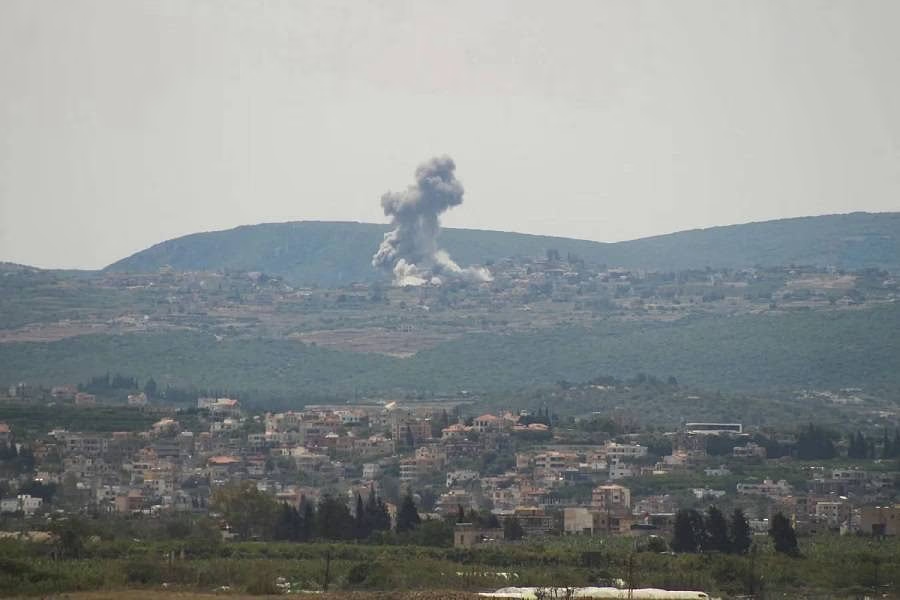
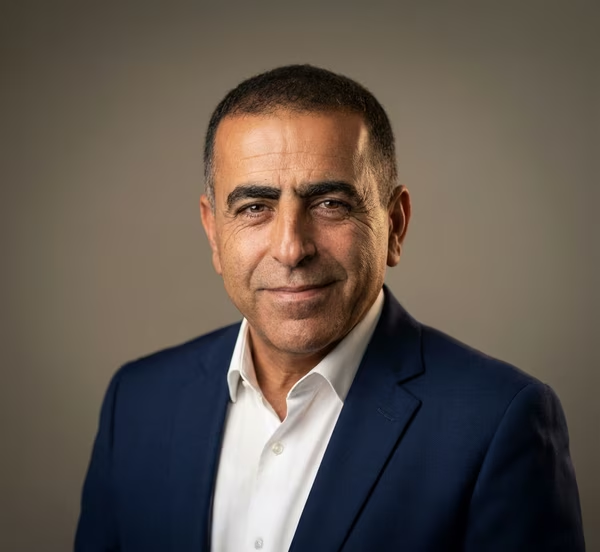
The incident dates back to the 'Gateway STEM Academy' in St. Paul, where the educational institution was documenting celebratory moments for its students at the end of the school year. The clip reflected the cultural and religious identity of the students' families without containing any political messages, but far-right accounts exploited it to incite against religious diversity in public schools.

The crisis began when a far-right account named 'End Wokeness' posted the video with a comment criticizing the girls for wearing hijabs in a public school. The controversy quickly escalated to a national level after Trump shared this content with millions of followers, leading to a flood of thousands of racist comments and demands for the deportation of the children and their families.

For his part, Minnesota Governor Tim Walz strongly condemned this behavior, describing it as a 'shameful and shocking' act unworthy of political leadership. Walz affirmed that targeting children because of their clothing or religious beliefs endangers their personal safety and creates an environment of fear within educational institutions that should be safe for everyone.

In a related context, Senator Scott Wiener considered Trump's actions to reflect an authoritarian and hateful tendency towards Muslim Americans. Wiener pointed out that such actions give a green light to extremists to practice discrimination, warning that this bigoted approach directly threatens the social cohesion and national fabric of the United States.

The Council on American-Islamic Relations (CAIR) entered the crisis with a strongly worded statement, affirming that what Trump did was not just a political viewpoint but actual incitement. The organization clarified that publishing children's photos in this context places their families and the school in the direct line of targeting by extremist groups that prey on minorities.

Although Trump's team later deleted the post and claimed the action was accidental, human rights circles were not satisfied with this step. Civil organizations demanded a formal and clear apology to the children and their parents, emphasizing that the moral and security damage had already occurred once the video spread widely.

Media sources reported that angry reactions extended to include legal demands to prosecute those responsible for publishing minors' photos without official permission from their guardians. Legal experts believe that using children's photos in inciting contexts could open the door to lawsuits related to privacy violations and deliberate endangerment.

Writer Ed Krassnstein commented on the incident, affirming that attacking kindergarten children reflects a decline in the level of political leadership that is supposed to protect citizens, not target them. He added that this behavior sends negative messages to the international community about the state of religious tolerance in the United States amidst sharp political polarization.

Activists also recalled Trump's previous stances in which he attacked military families and minorities, considering that targeting kindergarten children represents a 'new low' in American political discourse. They pointed out that silence on such transgressions contributes to normalizing hate speech and making it an acceptable part of public discussion on digital platforms.

In comments on social media platforms, activist Khadija Khan stressed the need to stop appeasing bigots who use religion and culture as tools to abuse others. She called on educational institutions to strengthen measures to protect student privacy in light of the increasing threats posed by the open digital space and political incitement.

This incident remains a focal point in the ongoing debate about the limits of freedom of expression on social media platforms and the responsibility of political leaders for what they publish. While Trump's team tries to overcome the crisis, human rights organizations continue to pressure to ensure that such incidents, which affect the safety of children and the dignity of religious communities, are not repeated.

An authoritarian president targeting young children is sickening and poses a real threat to the fabric of our nation.

PALESTINE

Wed 08 Jul 2026 6:47 am - Jerusalem Time

Saar announces the launch of a new round of negotiations with Lebanon in Rome next week

Israeli Foreign Minister Gideon Saar announced on Tuesday that the Italian capital, Rome, will host the next round of talks with the Lebanese side next week. Saar explained in a press conference held in occupied Jerusalem that this step comes as a continuation of the historic framework agreement reached less than two weeks ago under the auspices of the United States of America.

For his part, the spokesperson for the Italian Ministry of Foreign Affairs confirmed that the anticipated talks will take place on July 15 and 16, noting that the date stands unless any unexpected developments occur. This round is the sixth in the direct and indirect negotiation process between the two countries, which do not yet have formal diplomatic relations.

Italian Deputy Prime Minister and Foreign Minister, Antonio Tajani, welcomed his country's hosting of these talks, expressing on the 'X' platform his pleasure that Rome is hosting this dialogue sponsored by Washington. These meetings aim to establish the foundations for a permanent ceasefire and end the state of armed conflict that has recently plagued the region.

The framework agreement reached includes sensitive provisions, most notably the initiation of procedures to disarm Hezbollah and ensure a gradual withdrawal of Israeli forces from the territories they infiltrated in southern Lebanon. The agreement also stipulates the deployment of Lebanese army units in two pilot areas as a first step towards extending state sovereignty over the entire national territory.

In contrast, this agreement faces strong opposition from Hezbollah, which rejects its provisions entirely, especially those related to its weapons. The agreement has not yet specified a precise timeline for the Israeli withdrawal, as officials in Tel Aviv condition this step on achieving tangible progress in dismantling the military capabilities of the Iran-backed party.

Regarding international positions, German Foreign Minister Johann Vadivol urged the Lebanese authorities to show determination in confronting Hezbollah's influence and re-establishing state control in the south. Vadivol affirmed during his visit to Jerusalem that Germany strongly supports the historic initiative led by the United States to ensure regional stability.

The German minister stressed the need for Lebanon to ensure that Israel is not exposed to any security risks originating from its territories in the future. He indicated that Berlin and the European Union are fully prepared to provide the necessary support for the success of this negotiation process, which he described as a 'historic step that has been underestimated' in political circles.

Vadivol considered that progress in these negotiations represents a glimmer of hope for civilians on both sides of the border who have paid heavy prices as a result of the military escalation. He added that Germany will be a constant partner in supporting any path that leads to ending security threats and establishing the foundations of peace between the Lebanese and Israeli sides.

These diplomatic moves come after months of fierce fighting that erupted on March 2, following Hezbollah's launch of rocket barrages towards Israel. The party claimed at the time that the attack was in response to the killing of Iranian Supreme Leader Ali Khamenei in strikes attributed to the United States and Israel in February 2026.

Israel responded to these attacks with a wide-ranging military campaign that included intensive airstrikes and a ground invasion of several areas in southern Lebanon. The Israeli army issued repeated evacuation warnings to residents for over three months, leading to significant demographic and field changes in the border areas.

Military operations, according to official data, resulted in the deaths of approximately 4,300 people in Lebanon, in addition to the displacement of over a million citizens from their homes in the south and the southern suburbs of Beirut. On the Israeli side, 38 soldiers and civilian contractors were killed since the start of ground confrontations and mutual shelling.

All eyes remain on the Italian capital next week, as the international community awaits the outcome of the sixth round of negotiations. Mediators hope that international pressure will succeed in overcoming obstacles to the implementation of the framework agreement, despite the significant field and political challenges posed by the positions of local and regional parties.

The agreement reached by Israel and Lebanon represents a glimmer of hope for the residents on both sides of the border, who together suffer from Hezbollah's terrorism.

OPINIONS

Tue 07 Jul 2026 4:42 pm - Jerusalem Time

The Dawn of the Palestinian Electoral Battle: Who Owns the Street?


By Dr. Ibrahim Nairat

After nearly two decades of division and the suspension of the Palestinian electoral process, general elections are returning to the center of the political scene. They are not merely a delayed legal obligation, but a genuine test of the Palestinian political system in all its components. If the next electoral process reaches the ballot boxes, the battle will not only be about how many seats one force or another secures, but about a deeper question: who still has the ability to represent Palestinians after years of political transformation and fragmentation?

Elections do not begin on the day a date is announced, nor when electoral lists are registered. They begin much earlier, when political forces realize that the rules of the game have changed and that the public they addressed two decades ago is not necessarily the same public they face today. From this perspective, the current political movement can be viewed as the early stages of an electoral race that has begun before official campaigns are launched — a race to reshape positions, build alliances, and measure genuine public support.

Palestinian factions are moving in several directions at once. They are reassessing their calculations, searching for candidates, and testing their ability to compete. Yet they also recognize that their greatest challenge will not only come from political rivals, but from an internal question concerning their relationship with their own supporters and grassroots bases after years of absence from electoral accountability.

The Fatah movement, given its historical position and its experience in leading the Palestinian Authority, enters any future elections with significant political and organizational capital. However, it also faces difficult questions regarding performance, renewal, and its ability to regain the confidence of segments of its constituency. For Fatah, the battle will not only be against competing forces, but also against internal divisions and voices calling for a reassessment of the movement’s discourse and methods of work.

Hamas, meanwhile, faces its own complex test. It maintains an organizational presence and a committed support base, but it enters any electoral contest amid highly complicated political and security circumstances, in addition to the need to defend its experience in governing the Gaza Strip over recent years. As with Fatah, organizational strength alone may not be sufficient to determine the outcome. Palestinian voters will also judge experience, performance, and the ability to provide answers for the next phase.

Yet reducing the scene to a competition among factions alone would be an incomplete reading. There is another actor present with considerable influence, and perhaps one of the most decisive factors in determining the outcome of any election: the Palestinian street.

However, speaking of the street does not mean that it exists as a separate entity from political organizations. The street itself includes members, cadres, and supporters of the factions — people who grew up within these movements but who have increasingly developed questions and criticisms regarding leadership performance. Many have not necessarily abandoned their political affiliations, but they have become more skeptical about the ability of traditional structures to produce meaningful change.

This is one of the most significant consequences of years of prolonged division: the widening distance between many factions and their popular bases. The absence of elections has not only interrupted the process of political renewal and accountability; it has also weakened the daily relationship between parties and their supporters. Regular elections traditionally provided an opportunity for leaders to meet their constituencies, listen to their demands, renew their political discourse, and provide accountability for their performance.

But with the absence of this process for nearly two decades, the vitality of the relationship between leadership and the public has declined in some cases. Instead of remaining in constant engagement with their grassroots bases, parts of the factions became increasingly focused on managing authority, institutions, and political influence. Attention shifted toward positions and responsibilities at the expense of rebuilding organizations and reconnecting with society.

This transformation has affected how some forces are perceived in the street. A faction that historically relied on a long legacy of struggle or a broad organizational base may discover, at the moment of electoral testing, that part of its traditional support is no longer present in the same way. Not necessarily because supporters have moved to another political camp, but because time has changed, priorities have shifted, and new generations have emerged without a direct connection to the old organizational structures.

Here lies the most important question: what is the real weight of Palestinian factions today?

Does the size of organizations on the ground truly reflect their level of popular support? Or is there a growing gap between organizational strength and electoral strength? A faction may possess an extensive network of members and supporters, yet still face voters who want to evaluate performance rather than simply rely on historical memory.

Political affiliation no longer necessarily guarantees electoral loyalty, and historical legitimacy alone is no longer sufficient to secure support. Palestinian voters today are increasingly focused on issues beyond partisan identity: public services, economic conditions, freedoms, management of division, and the ability of political forces to offer practical solutions.

Therefore, if elections take place, they may represent the first real test revealing the difference between how factions perceive their own strength and their actual standing among the public. Some forces may enter the contest relying on their history and organizational structures, only to find themselves facing a society that has changed over twenty years and a public demanding actions rather than slogans.

The broader question raised by these elections is whether their results will provide a path for restoring initiative to the Palestinian street, or whether they will simply reproduce the traditional political landscape through new mechanisms.

Over the past years, a widespread perception has developed among many Palestinians that popular action possesses a level of influence and momentum that may not be equally available within official institutions, particularly given the constraints affecting the Palestinian Authority due to its political and security arrangements and agreements with Israel. Many believe these constraints have limited the leadership’s ability to act freely, while the street, with its collective energy and capacity for expression and mobilization, remains a force that is difficult to ignore or fully contain.

From this perspective, future elections are not viewed only as a mechanism for selecting representatives and institutions, but as a test of a larger question: Can political institutions restore public trust and respond to society’s aspirations, or will the gap between leadership and the street lead to a more independent popular role outside existing frameworks?

The public mood that has developed in recent years is not seeking only a change of names, but a restoration of the belief that its voice can influence outcomes and that political institutions represent its will rather than arrangements detached from it. For this reason, elections could become a defining moment: either rebuilding the bridge between society and its leadership, or exposing more clearly the distance that has emerged between the two.

In this context, lowering the electoral threshold and opening space for independent lists and new political figures may provide opportunities for emerging forces, as well as social and youth figures who believe the political system requires renewal. These actors could become influential if they succeed in transforming public frustration into organized political presence.

However, the path to elections remains filled with major challenges. Palestinian division, the issue of Jerusalem, political and security circumstances, and the experience of the postponed 2021 elections all make reaching election day far from guaranteed. Moreover, the success of elections cannot be measured only by whether they take place, but by their ability to produce broadly accepted legitimacy.

Ultimately, future Palestinian elections will not simply be a competition among lists and candidates. They will be a test of the relationship between factions and their society. They will reveal whether political forces can regain the confidence of their supporters, whether they still represent society as they once did, or whether a new reality has emerged beyond traditional structures.

The real race, therefore, is not only between factions, but also within each faction itself: between leadership and grassroots, between organization and society, and between the image political forces hold of themselves and the image citizens hold of them.

The significance of the coming elections lies not only in determining who wins parliamentary seats, but in revealing who has remained present in the consciousness of the people after two decades of division and waiting.

OPINIONS

Tue 07 Jul 2026 3:41 pm - Jerusalem Time

Trump renews threats to Iran: Targeting bridges and energy facilities brings escalation back to the forefront and raises doubts about the future of negotiations

WASHINGTON – Said Arikat – 7/7/2026

US President Donald Trump renewed his escalatory tone towards Iran, threatening to target vital infrastructure, including bridges and energy facilities, if ongoing negotiations between Washington and Tehran fail to reach an agreement. This escalation comes at a time when indirect communications are still ongoing between the two sides, amidst deep differences over a number of regional and strategic issues, raising questions about the seriousness of the diplomatic path and its ability to withstand the language of mutual threats.

Trump said, during his address to reporters at the White House on Monday, that the United States "will get the job done" if an agreement with Iran is not reached, stressing that his country is capable of destroying Iranian bridges within one hour and paralyzing the country's energy supplies. He added that he prefers to reach an agreement because he does not wish to harm the Iranian people, but at the same time stressed that the military option remains strongly on the table.

This is not the first time Trump has used public threats against Iran. On April 7, he stated that the United States "would wipe Iranian civilization from existence" if forced to use force, a statement that at the time drew widespread criticism as exceeding the traditional rhetoric that distinguishes between the ruling regime and the Iranian people, and was considered an indicator of an unprecedented escalation in American political discourse towards Tehran.

Trump's recent statements gain additional importance because, according to observers, they contradict the memorandum of understanding signed between the United States and Iran, which stipulates that both parties refrain from threatening or resorting to the use of force during the implementation period of the agreed understandings. Experts believe that merely threatening to strike civilian facilities and vital infrastructure weakens trust between the two parties and increases the difficulty of maintaining the negotiation path.

The US President's statements came at a time when the Iranian capital, Tehran, witnessed massive funeral ceremonies for Iranian Supreme Leader Ali Khamenei, who was killed along with several members of his family in the US-Israeli attack that targeted Iran on February 28, an attack that marked the beginning of the widespread war witnessed in the region.

Trump had previously announced that he had given Iran "a week of mourning" before resuming political pressure, in reference to the continued indirect communications hosted by Qatar regarding the implementation of the memorandum of understanding between the two countries. However, negotiations still face fundamental differences related to the Israeli war on Lebanon, the future of navigation in the Strait of Hormuz, and frozen Iranian funds abroad.

Observers believe that the return to the language of force at this time reflects the difficulty of reconciling military pressure and the diplomatic path, especially in light of the accumulated distrust between the two sides and the persistence of complex regional issues without clear solutions.

For his part, Iranian Foreign Minister Abbas Araghchi said on Tuesday that talks aimed at reaching a final agreement between Tehran and Washington will not begin if American threats continue, following President Trump's threat to "finish the job" if an agreement is not reached.

Araghchi wrote in a post on X: "Negotiations on a final agreement will not begin if threats continue. Respect your signature."

Araghchi's post was referring to an interim agreement signed by Iran and the United States last month, which calls on both sides to refrain from threatening or using force against each other.

Trump's statements reveal his continued reliance on a policy of "coercive diplomacy," which combines negotiation and military threats simultaneously. However, past experiences between Washington and Tehran indicate that this approach often leads to counterproductive results, pushing the Iranian leadership towards extremism instead of making concessions. Moreover, targeting civilian infrastructure, even at the level of threat, raises legal and ethical questions about the compatibility of such statements with international law and undermines the trust necessary for the success of any future political agreement.

The political timing of these statements reflects an American attempt to maintain leverage before entering more sensitive stages of negotiations. However, the continued use of escalatory rhetoric may give the hardline faction within Iran additional justifications for rejecting any settlement with Washington, considering that the United States still views military force as the primary tool for managing relations with the Islamic Republic. Therefore, threats may become an obstacle to negotiations rather than a means to enhance their chances of success.

The repercussions of threatening to target bridges and energy facilities extend beyond the bilateral relationship between Washington and Tehran, as any attack on these facilities could lead to widespread economic and regional disruptions, including oil markets, global supply chains, and navigation in the Arabian Gulf and the Strait of Hormuz. Furthermore, targeting civilian infrastructure could prompt other regional parties to engage in the confrontation directly or indirectly, which raises the probability of the conflict expanding and turning into a regional crisis that is difficult to contain politically or militarily.