






WASHINGTON – Said Arikat – 7/7/2026
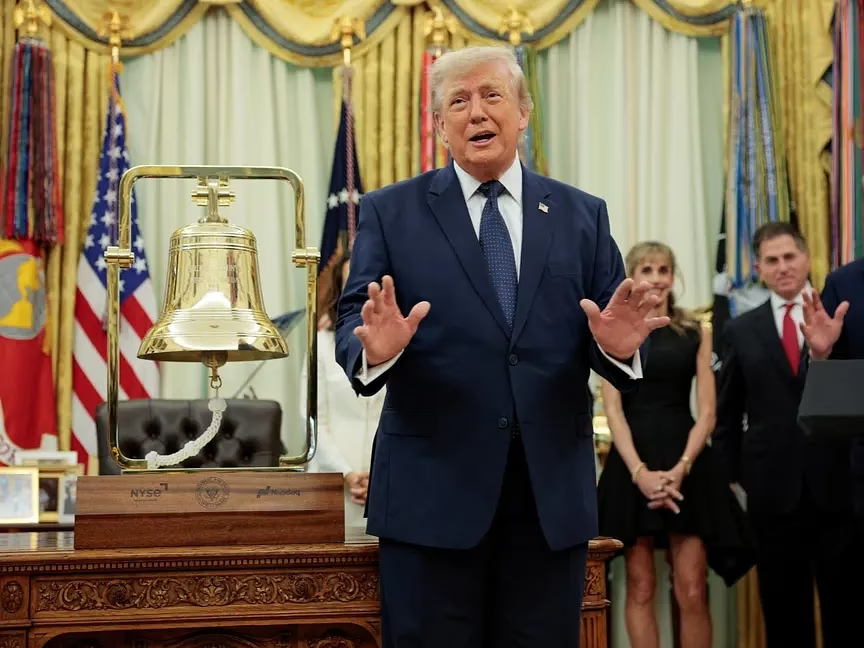
US President Donald Trump renewed his escalatory tone towards Iran, threatening to target vital infrastructure, including bridges and energy facilities, if ongoing negotiations between Washington and Tehran fail to reach an agreement. This escalation comes at a time when indirect communications are still ongoing between the two sides, amidst deep differences over a number of regional and strategic issues, raising questions about the seriousness of the diplomatic path and its ability to withstand the language of mutual threats.
Trump said, during his address to reporters at the White House on Monday, that the United States "will get the job done" if an agreement with Iran is not reached, stressing that his country is capable of destroying Iranian bridges within one hour and paralyzing the country's energy supplies. He added that he prefers to reach an agreement because he does not wish to harm the Iranian people, but at the same time stressed that the military option remains strongly on the table.
This is not the first time Trump has used public threats against Iran. On April 7, he stated that the United States "would wipe Iranian civilization from existence" if forced to use force, a statement that at the time drew widespread criticism as exceeding the traditional rhetoric that distinguishes between the ruling regime and the Iranian people, and was considered an indicator of an unprecedented escalation in American political discourse towards Tehran.
Trump's recent statements gain additional importance because, according to observers, they contradict the memorandum of understanding signed between the United States and Iran, which stipulates that both parties refrain from threatening or resorting to the use of force during the implementation period of the agreed understandings. Experts believe that merely threatening to strike civilian facilities and vital infrastructure weakens trust between the two parties and increases the difficulty of maintaining the negotiation path.
The US President's statements came at a time when the Iranian capital, Tehran, witnessed massive funeral ceremonies for Iranian Supreme Leader Ali Khamenei, who was killed along with several members of his family in the US-Israeli attack that targeted Iran on February 28, an attack that marked the beginning of the widespread war witnessed in the region.
Trump had previously announced that he had given Iran "a week of mourning" before resuming political pressure, in reference to the continued indirect communications hosted by Qatar regarding the implementation of the memorandum of understanding between the two countries. However, negotiations still face fundamental differences related to the Israeli war on Lebanon, the future of navigation in the Strait of Hormuz, and frozen Iranian funds abroad.
Observers believe that the return to the language of force at this time reflects the difficulty of reconciling military pressure and the diplomatic path, especially in light of the accumulated distrust between the two sides and the persistence of complex regional issues without clear solutions.
For his part, Iranian Foreign Minister Abbas Araghchi said on Tuesday that talks aimed at reaching a final agreement between Tehran and Washington will not begin if American threats continue, following President Trump's threat to "finish the job" if an agreement is not reached.
Araghchi wrote in a post on X: "Negotiations on a final agreement will not begin if threats continue. Respect your signature."
Araghchi's post was referring to an interim agreement signed by Iran and the United States last month, which calls on both sides to refrain from threatening or using force against each other.
Trump's statements reveal his continued reliance on a policy of "coercive diplomacy," which combines negotiation and military threats simultaneously. However, past experiences between Washington and Tehran indicate that this approach often leads to counterproductive results, pushing the Iranian leadership towards extremism instead of making concessions. Moreover, targeting civilian infrastructure, even at the level of threat, raises legal and ethical questions about the compatibility of such statements with international law and undermines the trust necessary for the success of any future political agreement.
The political timing of these statements reflects an American attempt to maintain leverage before entering more sensitive stages of negotiations. However, the continued use of escalatory rhetoric may give the hardline faction within Iran additional justifications for rejecting any settlement with Washington, considering that the United States still views military force as the primary tool for managing relations with the Islamic Republic. Therefore, threats may become an obstacle to negotiations rather than a means to enhance their chances of success.
The repercussions of threatening to target bridges and energy facilities extend beyond the bilateral relationship between Washington and Tehran, as any attack on these facilities could lead to widespread economic and regional disruptions, including oil markets, global supply chains, and navigation in the Arabian Gulf and the Strait of Hormuz. Furthermore, targeting civilian infrastructure could prompt other regional parties to engage in the confrontation directly or indirectly, which raises the probability of the conflict expanding and turning into a regional crisis that is difficult to contain politically or militarily.
Share your opinion
Trump renews threats to Iran: Targeting bridges and energy facilities brings escalation back to the forefront and raises doubts about the future of negotiations