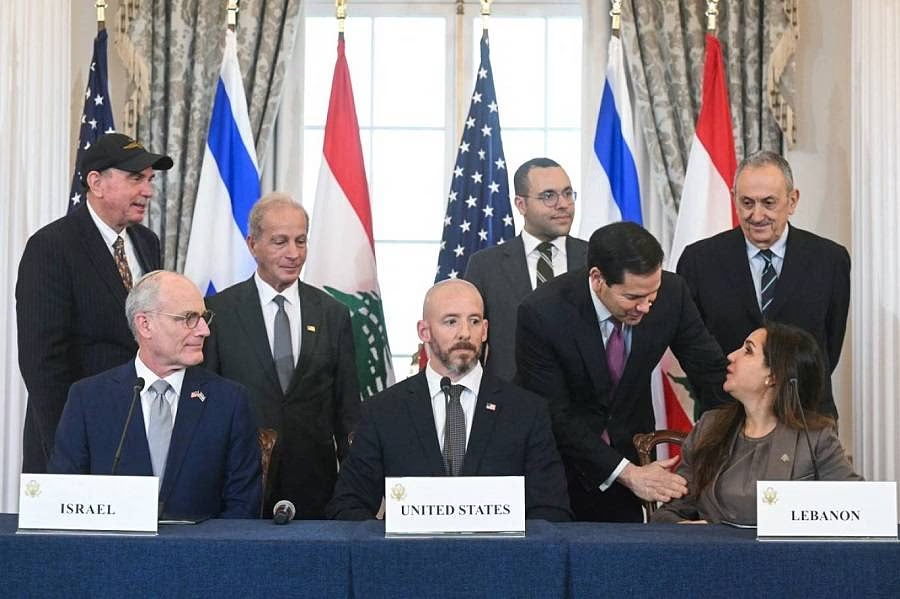







The Israeli Ambassador to the United States, Yehiel Leiter, revealed a plan for a new round of diplomatic talks between Israel and Lebanon in the Italian capital, Rome. This round is scheduled to begin on July 15 and 16, with discussions taking place at the ambassadorial level to address outstanding issues.
Leiter clarified during a meeting with the Council on Foreign Relations in Washington that his country views these negotiations as a fundamental opportunity to continue discussions on security and border arrangements. The meetings aim to strengthen regional stability mechanisms and avoid any slide towards a widespread military escalation that could threaten the region's security.
In the context of intense diplomatic activity, press reports indicated that Lebanese President Joseph Aoun would travel to Washington to meet with US President Donald Trump on July 21. This anticipated summit comes at a sensitive time, aiming to advance the political settlement process and solidify the pillars of the recent agreement.
On the ground, Israeli forces committed a serious violation of the two-week-old ceasefire agreement following an airstrike that targeted a civilian car deep in southern Lebanon. The attack resulted in the deaths of four people, including three women, in an escalation that sparked a wave of official and popular condemnation.
Local sources reported that the drone strike targeted the car of a public school principal as she was returning with her family from inspecting their home in the Nabatieh al-Fawqa area. The Lebanese Ministry of Health confirmed the casualty toll, noting that among the dead were a domestic worker and a Syrian worker who were with the family.
For its part, the Israeli army claimed that the strike targeted four individuals it described as 'suspects' who were approaching the prohibited security zone in the south. The military spokesman claimed that the operation was precise and aimed at eliminating what he described as an 'imminent threat' in that border area.
Lebanese MPs condemned this targeting, holding the international community responsible for its silence regarding repeated Israeli violations of Lebanese sovereignty. Political parties considered the bombing of civilians to be an undermining of de-escalation efforts and a blatant breach of the understandings reached under international patronage.
In another development, the Israeli army sent warning voice messages to residents of five predominantly Christian municipalities in the Marjayoun district. These messages urged residents to prevent the entry of what they described as 'strangers' into their villages, in a clear reference to preventing the return of Hezbollah elements to those areas.
These developments come after the signing of a framework agreement on June 26, sponsored by the US, aimed at establishing a roadmap to end the armed conflict. The agreement stipulates a gradual Israeli withdrawal, met by the deployment of the Lebanese army in specific areas as a first experimental step.
However, the agreement faces significant challenges, particularly concerning the annex on disarming Hezbollah, a clause that the party has unequivocally rejected. Observers believe that the absence of a clear timetable for the Israeli withdrawal further complicates the field and political landscape alike.
In his recent statements, the Lebanese President emphasized the need for the US administration to exert real pressure on Israel to complete its full withdrawal. He considered this withdrawal to be the only key to achieving any tangible progress on the path to peace and ensuring sustainable security on the borders.
President Aoun pointed out that the continued presence of Israeli forces on Lebanese territory undermines the authority of the state and prevents the army from exercising its sovereign duties. He affirmed that a just peace cannot be achieved under continued occupation and daily violations of airspace and land.
Border villages are experiencing a state of cautious anticipation amid ongoing intermittent Israeli strikes targeting what Israel claims are military infrastructures. Both sides exchange accusations of truce violations, putting the ceasefire agreement at risk before the Rome negotiation round.
International powers, led by the United States and Italy, are striving to provide a diplomatic environment that helps bridge the views between the two parties. The reliance remains on the ability of political channels to address outstanding issues away from the language of weapons that continues to rear its head in the South.
The continued occupation undermines the legitimacy of the state and prevents the deployment of the army, which is the primary obstacle to achieving a just and lasting peace.

Share your opinion
Upcoming Negotiations in Rome and a Bloody Israeli Violation Claims Civilian Lives in Southern Lebanon