OPINIONS

Sat 11 Jul 2026 11:19 am - Jerusalem Time

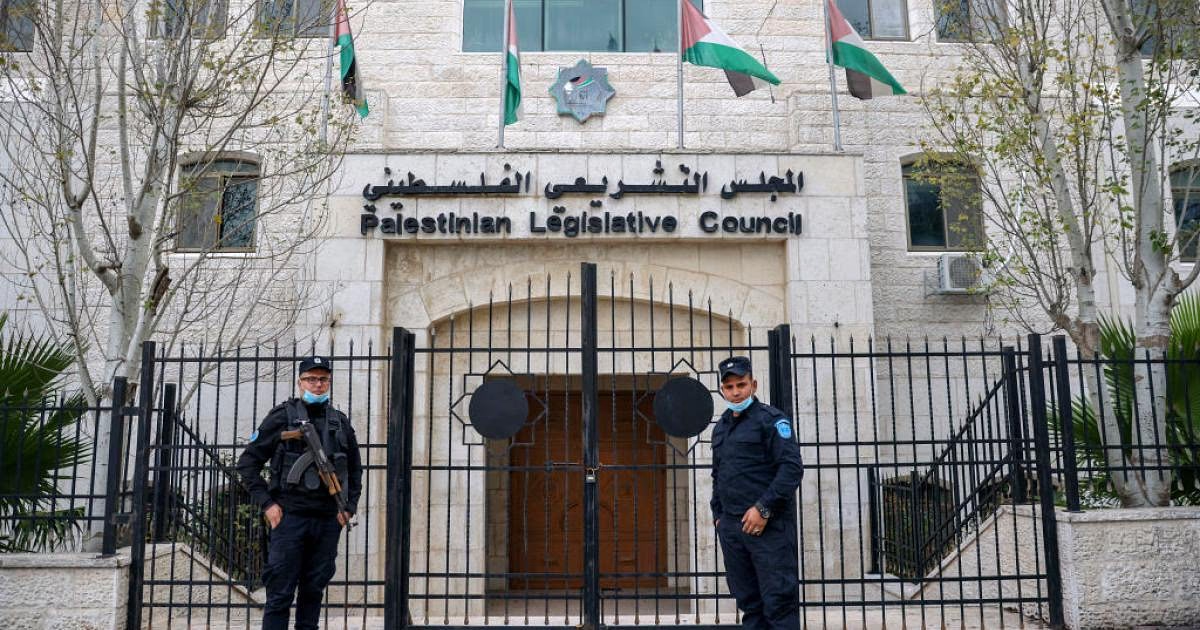
The Government and the Management of the Transitional Governance in the Gaza Strip

There is no doubt that the Palestinian government plays a significant role in managing aid and providing services to Palestinian citizens in the Gaza Strip within the recovery phase, through continuous coordination with partner UN and international organizations, donor countries, and entities, to implement coordinated and integrated interventions. This is done through the governmental operations room to rescue thousands of displaced families, secure alternative and safe shelters, and provide essential supplies to prevent the exacerbation of the humanitarian catastrophe suffered by the Palestinian people in the Gaza Strip.

Contributing to alleviating burdens in these circumstances, following the crime of genocide committed against the Palestinian people in the Gaza Strip, is a sacred and undisputed mission; regardless of the size and type of contribution or participation in managing, organizing, or delivering these contributions, it is a commendable effort to sustain life for the residents. However, this effort remains temporary and relates to services that can be provided by various governmental and community entities. It does not address the future of the Gaza Strip by returning the Gaza Strip to the administration of the Palestinian government and ending institutional division.

This raises a fundamental question about the policy adopted by the government/National Authority for dealing with the transitional governance in the Gaza Strip, dealing with the bodies established under Security Council Resolution 2803 and the relationship with them, and planning for the post-transitional phase, which is supposed to end by the end of 2027. Planning here is proactive, aiming to impose a fait accompli in the Gaza Strip where the government takes the initiative and has the ability to establish future governing bodies to unify the West Bank and Gaza together, and prevent the Peace Council or any other body from continuing to manage the transitional governance, thereby making its extension impossible.

In my opinion, working in the broader context takes two paths; the first: relates to implementing the conditional issues in Security Council Resolution 2803 concerning the reform required from the Palestinian Authority, which itself made written promises and commitments therein, "until the Palestinian Authority satisfactorily completes its reform program as stated in various proposals, including President Trump's 2020 peace plan and the Saudi-French proposal, enabling it to regain control of Gaza safely and effectively."

And the second: adopting a governmental strategy to deal with the transitional administration, clarifying its interventions and utilizing Palestinian Authority employees present in the Gaza Strip, and the nature of the relationship based on coordination between the bodies of the Palestinian government in the Gaza Strip and the West Bank on one hand, and the National Committee for the Management of the Gaza Strip "Technocrat Committee" on the other; including the volume of information, records, spatial planning, international aid, and the reconstruction plan or plans to contribute to revitalizing life in the Gaza Strip and the required recovery, and enabling the government to systematically and effectively take over the governance of the Gaza Strip upon the end of the transitional phase, and preventing the possibility of extending this administration after the international mandate expires at the end of 2027.

OPINIONS

Sat 11 Jul 2026 11:18 am - Jerusalem Time

The upcoming Palestinian elections.. a national entitlement and a political message the President wanted to convey to the world

The Palestinian issue is currently passing through one of its most sensitive and complex stages in decades, in light of a devastating war on the Gaza Strip, an unprecedented escalation of settlement and annexation in the West Bank, including Jerusalem, and the continued attempts by the occupation to impose new realities aimed at liquidating Palestinian national rights, foremost among them the right of the Palestinian people to self-determination and to establish their independent state with East Jerusalem as its capital.

Amidst these dangerous transformations, talking about holding presidential and legislative elections is no longer a political luxury or a postponed entitlement, but rather a national, political, and constitutional necessity, and a clear message to the world affirming that the Palestinian people, despite the occupation and aggression, still adhere to the state option, to democratic values, and to their right to choose their representatives through ballot boxes.

The Israeli occupation continuously seeks to portray the Palestinian situation as an entity incapable of managing itself or building its institutions, and it exploits the state of division and the disruption of democratic life to promote its narrative before the international community, claiming the absence of a Palestinian partner capable of representing its people. From here, restoring the democratic process represents a practical and political response to these claims, and confirms that Palestine, despite the occupation, possesses constitutional institutions and a people who believe in the peaceful transfer of power and the rule of law.

Throughout its long history, the Palestinian people have proven to be among the most committed peoples in the region to democratic practice. Palestine has witnessed presidential, legislative, local, and syndicate elections in the most difficult circumstances, and popular turnout has always been an expression of the belief that democracy is an integral part of the national project, and not a luxury linked to conditions of stability.

Today, after many years of electoral disruption due to political division and the circumstances imposed by the occupation, followed by the Israeli war that exacerbated the challenges, it has become necessary to rebuild the popular legitimacy of national institutions, renew trust between citizens and governing institutions, and open the way for the participation of all national forces within the framework of the Palestinian political system.

In this context, President Mahmoud Abbas's decision to proceed with issuing a decree to hold presidential and legislative elections, despite the political and security complexities and exceptional circumstances, reflects a far-sighted national vision that affirms that institution-building and the renewal of legitimacy cannot remain hostage to crises. This decision carries a clear message that the Palestinian leadership believes that the strength of the political system derives its legitimacy first from the will of the people, and that confronting the existential challenges imposed by the occupation requires strengthening the internal front, fortifying constitutional institutions, and renewing trust between citizens and state institutions, thereby solidifying the foundations of good governance and enhancing the steadfastness of the Palestinian people in confronting projects that target their national rights.

Furthermore, President Abbas's insistence on holding elections, even amidst war, aggression, continued occupation, and its attempts to disrupt Palestinian political life, confirms that the Palestinian national project does not stop at crisis management, but rather looks to the future and the building of an independent Palestinian state on solid constitutional and democratic foundations. The Palestinian leadership realizes that the world looks at the ability of peoples to entrench democratic values and the rule of law, and therefore this decision does not only address the Palestinian interior, but also sends a message to the international community that Palestine, despite being a state under occupation, is moving forward in establishing a modern state model that believes in political pluralism, the peaceful transfer of power, and respect for the will of the voter, and that the occupation alone is the real obstacle to completing this democratic path, not the Palestinian will.

Holding elections does not only mean choosing a president or members of a legislative council, but rather represents a strategic step towards reorganizing the internal Palestinian house, strengthening national unity, and reactivating constitutional institutions that form the basis of any modern political system. Moreover, the existence of an elected legislative council capable of exercising its oversight and legislative role enhances the ability of the Palestinian political system to face internal and external challenges.

From a political perspective, the elections represent a direct message to global public opinion, and to governments and international institutions, that the Palestinian state, for which its people are struggling for full recognition, is not just a political slogan, but a project for a modern state based on institutions, a constitution, and respect for popular will.

The international community, which constantly calls for reform and strengthening good governance, cannot ignore the importance of supporting the holding of Palestinian elections. Rather, it should exert pressure on Israel not to obstruct this national entitlement, especially in occupied Jerusalem, whose people must participate in it as they participated in previous entitlements, considering Jerusalem an integral part of the occupied Palestinian territory and the capital of the Palestinian state.

The elections will also send an important message to Arab and Islamic public opinion, stating that the Palestinian people, despite the extent of sacrifices and destruction, are still building their national institutions and adhering to the comprehensive national project, and that their battle is not only a battle for liberation from occupation, but also a battle to build a modern democratic state based on political participation and the rule of law.

In light of this, the next stage requires strengthening trust between citizens and their national institutions, and involving youth, women, academic and community elites in decision-making, because the future of the Palestinian issue will only be built through a broad national partnership based on free popular will.

At the same time, elections should be part of a comprehensive national vision to end the division, unify institutions between the West Bank and Gaza Strip, and rebuild the Palestinian political system on the foundations of partnership, pluralism, and recourse to ballot boxes as the only civilized means of transferring power.

It cannot be overlooked that the occupation will try, as it has done in the past, to obstruct this path or impose restrictions on it, especially in occupied Jerusalem. However, adhering to the right to hold elections in Jerusalem represents in itself a political and legal battle that affirms Palestinian sovereignty over the city and rejects any Israeli attempt to impose a fait accompli.

Elections are not the end of the road, but rather the beginning of a new stage of renewing the national project, strengthening the steadfastness of the Palestinian people, and solidifying Palestine's image before the world as a state under occupation, but one that believes in democracy, pluralism, and respect for popular will, and seeks to build strong institutions capable of leading the stage of liberation and independence.

It is time for Palestinian democracy to regain its natural role, and for elections to become a unifying station for all members of the Palestinian people, establishing a new stage whose title is unity, legitimacy, and national partnership, thereby enhancing Palestine's position at the Arab, Islamic, and international levels, and confirming that the occupation, no matter how long it lasts, will not prevent the Palestinian people's determination to build their free, democratic, and independent state.

OPINIONS

Sat 11 Jul 2026 11:18 am - Jerusalem Time

The Framework Agreement between Lebanon and Israel... Between the Requirements of Sovereignty and the Test of National Unity

The importance of international agreements lies not only in their procedural clauses but also in the philosophy that governs them and the way they redefine the nature of conflicts and the priorities for addressing them. From this perspective, the "Framework Agreement" signed between Lebanon and Israel under US sponsorship does not merely call for a technical reading limited to interpreting its articles. Rather, it demands a political and legal reading that explores the potential transformations it might bring about in the concept of sovereignty, the position of the Israeli occupation in the conflict equation, and the future of the Lebanese state and its national unity.

A careful reading of the agreement's clauses suggests that its approach does not stem from the Israeli occupation as the central issue requiring unconditional termination according to international law. Instead, it links progress in implementation to a set of internal security commitments, foremost among them being the exclusive control of weapons by the Lebanese state. Here, the fundamental question arises: Has ending the occupation become linked to the completion of internal Lebanese arrangements, or is the occupation still, legally and politically, the original cause of the conflict that necessitates its termination regardless of internal complexities?

The importance of this question lies in its touching upon the very philosophy of the conflict. It is a well-established principle in international law that occupation is an illegal situation, and its termination is an independent legal obligation that cannot be made conditional on terms imposed by the occupying power or linked to the conditions of the occupied state. If withdrawal becomes linked to verification mechanisms or an assessment of Lebanon's implementation of its security commitments, then the occupation practically transforms from a legal violation that must be removed into an element in a negotiable equation subject to postponement and reinterpretation.

What reinforces this impression is the agreement's adoption of language that speaks of "redeployment" or "repositioning" more than it speaks of complete and unconditional withdrawal, in addition to granting monitoring and verification mechanisms a pivotal role in determining the implementation path. Legal language is not just words; it defines the boundaries of obligations and determines their effects, just as the method of implementing the agreement may be no less important than its texts themselves.

Moreover, this extends to the American role, which, according to these mechanisms, appears to go beyond the limits of traditional mediation to actual participation in monitoring, evaluation, and coordination, with the potential linking of economic aid and reconstruction to the progress in implementing security commitments. Whatever the practical justifications for this link, it raises legitimate questions about the extent of its impact on the independence of Lebanese national decision-making.

From the perspective of international law, an equally important issue arises: Lebanon's right to resort to the United Nations and international judicial bodies to defend its rights and pursue Israeli violations. If some provisions of the agreement are open to an interpretation that might limit the effectiveness of this right or place it within political constraints, then the matter deserves serious discussion, because recourse to international legitimacy remains one of the most important elements of the Lebanese state's legal strength.

This reading becomes even more important when compared to the Lebanese-Israeli Armistice Agreement of 1949, which was based on respect for international borders, cessation of hostilities, and the establishment of a mixed commission chaired by the United Nations, while emphasizing that its provisions do not affect the political and legal rights of either party. Similarly, a comparison with the May 17, 1983 agreement, despite the different historical and political context, reminds us that the problem in any agreement lies not in its title, but in the extent of its impact on the independence of national decision-making and the balance between security requirements and sovereignty demands.

However, the most dangerous aspect raised by the framework agreement, if this understanding of its provisions and implementation mechanisms is correct, relates not only to the relationship between Lebanon and Israel but also to its potential repercussions on the internal Lebanese situation. Lebanon is not a state based on a single political majority, but on delicate national and constitutional balances, and any agreement that links the future of withdrawal, reconstruction, or stability to resolving highly sensitive internal disputes may shift the center of conflict from the borders to the interior, transforming a unifying national issue into a permanent axis of political division.

Herein lies the paradox. The occupation, in principle, is what is supposed to unite the national will to end it, not for its continuation or termination to be linked to the ability of Lebanese to overcome their internal differences. If this happens, the disagreement will not remain about the means, but may extend to defining the state's own priorities, which is a very dangerous development for social unity and institutional stability.

The building of the Lebanese state is not achieved by security stability alone, nor is sovereignty completed by the state's monopoly on the use of force alone. Rather, it is based on a balanced equation that combines ending any occupation, consolidating state authority, and preserving national unity. These elements are not contradictory but complementary, and any approach that prioritizes one over the other may open the door to new crises instead of providing lasting solutions.

Therefore, the true value of the framework agreement will not be measured solely by its ability to achieve a ceasefire or reduce tension, but by its adherence to the rules of international legitimacy, its respect for Lebanon's sovereignty, and its avoidance of turning the occupation into an open negotiating card, or turning internal division into a prerequisite for restoring national rights.

The question that will govern the future of this agreement remains: Will it be a step towards stability based on law and sovereignty, or an entry point to redefining the conflict such that the Lebanese interior becomes the primary testing ground? The answer to this question will determine not only the fate of the agreement but also the future of the Lebanese state. States are not built on equations that link their sovereignty to the conditions of others, but on solid national unity, strong constitutional institutions, and an inherent right to end occupation according to the provisions of international law. When these elements come together, peace becomes the fruit of justice, not a substitute for it.

OPINIONS

Fri 10 Jul 2026 7:35 pm - Jerusalem Time

Vance and Israel: The Beginning of a Dispute or the Beginning of a Succession?

In American politics, the importance of statements lies not only in their intensity but also in the questions they raise. The question posed by US Vice President JD Vance's stances today is:

Not: Has Washington's relationship with Israel changed?

But: Who will define the boundaries of this relationship in the next phase?

According to the Associated Press, Vance publicly criticized Israeli officials who attacked the negotiation process with Iran, warning against attacking Israel's "only strong ally" remaining, while also emphasizing that Donald Trump is one of the most supportive American presidents of Israel. This message seemed to tell the Netanyahu government that American support continues, but not necessarily on the terms Tel Aviv wants.

Herein lies the importance of the event. Vance did not emerge from a position of hostility towards Israel, nor did he present himself as an adversary, but rather spoke from within a different political vision titled: "America First." This vision does not reject the alliance with Israel, but it rejects any allied country becoming a party that dictates American foreign policy priorities, or pushes Washington towards choices that are inconsistent with its interests.

As for talk of the anger of "AIPAC" and pro-Israel circles, it must be dealt with cautiously. Not every criticism from Israel means a direct confrontation with its lobbying groups in Washington. However, Vance's statements raised concerns within some of these circles because they reflect the rise of a new Republican current less willing to grant any party unlimited influence over American decision-making.

Regardless of the extent of the real disagreement within the American administration, the significance of the statements lies in their timing and political ceiling. Washington finds itself today facing a complex equation: how to prevent Iran from expanding its influence without sliding into a new war in the Middle East?

Here, Vance seems closer to the school of conflict management and negotiation, while other voices tend towards hawkishness and maximum pressure.

This discussion cannot be separated from Lebanon. The American administration realizes that any understanding with Iran will have direct repercussions on multiple regional issues, including Lebanon. Therefore, any Israeli escalation in this file could turn into a pressure factor on negotiations, or an attempt to redirect their course. From here, Washington's keenness to keep the final decision in its hands, not in the hands of any other party, no matter how strong the alliance with it, can be understood.

Nevertheless, it is still too early to consider these statements a complete strategic shift in the American-Israeli relationship. Major American institutions still view Israel as a stable strategic ally, and pro-Israel forces still enjoy widespread political and media influence. Therefore, it may be more accurate to read Vance's positions as an attempt to recalibrate the relationship, not to completely reformulate it.

From here, the real question becomes: Are we facing a transient dispute over Iran, or the beginning of a deeper transformation within the Republican Party itself?

Vance realizes that Trump's political base does not want new wars in the Middle East, nor does it want to see the United States pay the cost of external conflicts that do not bring it direct gains. In contrast, Marco Rubio and another wing within the party represent a more traditional view of America's global role and its strategic alliances.

But what might happen next?

If Vance succeeds in transforming this stance from a transient statement into a fixed political line, we may see Republicans who are more daring in re-evaluating the cost of foreign alliances, and more inclined to link support for Israel to Washington's direct calculations.

However, if the stance remains confined to managing the Iran file, it will remain merely a tactical dispute within an established strategic relationship.

Therefore, the current conflict is not only about Iran, but about the future of the Republican Party after Trump. Will it remain a traditional conservative party that leads the international order as the United States has known it for decades? Or will it increasingly transform into a populist nationalist party that gives absolute priority to the American domestic agenda?

This transformation, if it deepens, will not only affect Iran or Lebanon, but will extend to all regional issues, including Palestine and Gaza; because any redefinition of the relationship between Washington and Tel Aviv will necessarily be reflected in the way the United States manages Middle East files.

Conclusion:

What we are witnessing today is not just a transient political debate, nor merely a dispute over Iran, but an indicator of a deeper discussion within the United States about the meaning of power, the limits of alliances, and foreign policy priorities.

Vance, in the eyes of some, may be just a vice president defending Trump's vision, but in the eyes of others, he has already begun his first steps towards politically inheriting Trump.

Whoever succeeds today in defining the meaning of "America First" may be the most capable tomorrow of inheriting Trump; not only in his position, but also in his audience.

PALESTINE

Fri 10 Jul 2026 7:35 pm - Jerusalem Time

Series of Israeli Violations of the Truce in Gaza: Raids, Bulldozing, and Civilian Casualties

Field sources in the Gaza Strip reported that Israeli occupation forces continued, during the night and early Friday morning, their systematic series of violations of the ongoing truce agreement. These violations included intense gunfire and extensive military movements in various areas of the Strip, leading to a state of extreme tension among citizens.

In Gaza City, Israeli military vehicles began targeting the remaining Palestinian homes in the 'Yellow Line' areas of the Al-Tuffah neighborhood, northeast of the city, after midnight. This shelling coincided with heavy gunfire in the eastern areas of Jabalia refugee camp and Beit Lahia town in the northern Strip, causing material damage to citizens' properties.

In the central region, occupation forces opened fire with their heavy machine guns towards residential neighborhoods east of Al-Masdar village and Al-Maghazi area. The targeting also extended to Palestinian homes on the eastern outskirts of Al-Bureij refugee camp, a move observers considered a deliberate escalation to terrorize residents and prevent them from returning to their normal lives.

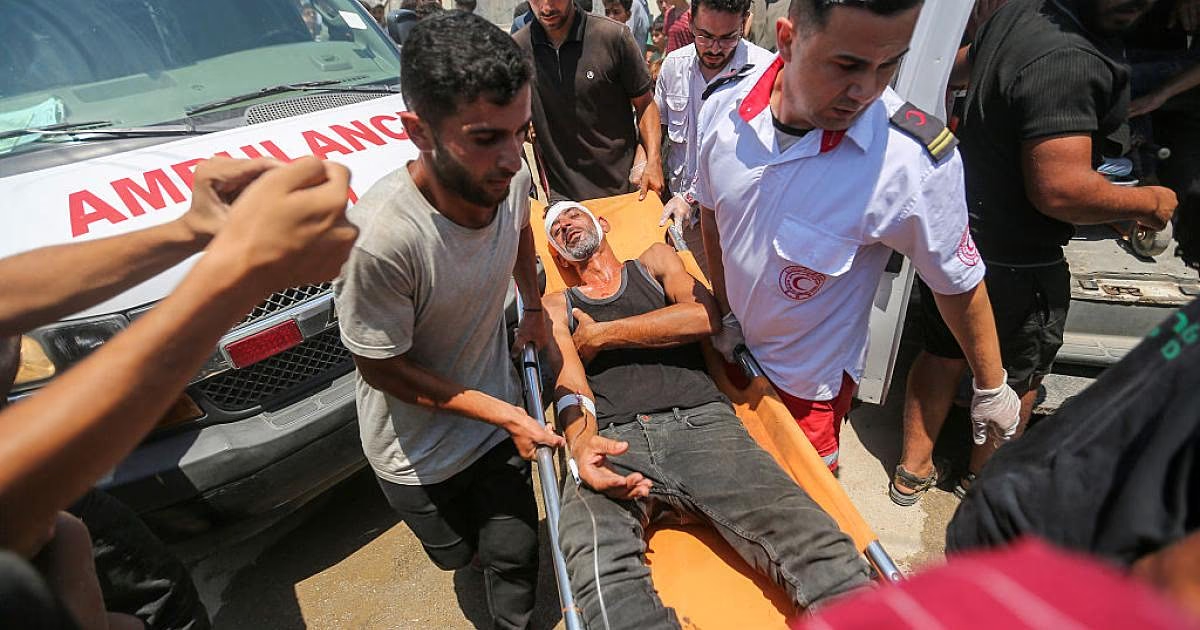
In the southern Strip, specifically in Khan Yunis city, a Palestinian citizen was shot by occupation forces in Al-Amal neighborhood. Ambulance crews from the Palestinian Red Crescent Society quickly transported the injured person to Al-Amal Hospital for necessary treatment, amidst continuous intensive drone flights.

In Rafah city, Israeli forces continue their military operations in the Al-Alam area northwest of the city, where extensive excavation and bulldozing work is underway. This was accompanied by direct gunfire towards the tents of displaced persons in that area, threatening the lives of thousands who sought refuge there in search of safety.

Sources quoted eyewitnesses confirming the continued Israeli military movements around the Al-Alam area, including changing the positions of the yellow concrete blocks. These field movements coincide with raids carried out by 'quadcopter' drones targeting sites and individuals in various areas of Gaza City, the central, and southern regions.

Despite the ceasefire agreement coming into effect on October 10, 2025, the occupation continues to violate it daily. These violations vary between artillery shelling and limited incursions, in addition to non-compliance with the signed protocols regarding the entry of essential humanitarian and medical aid to the besieged Strip.

According to the latest data from the Ministry of Health in the Gaza Strip, these continuous Israeli violations since the start of the truce have led to the martyrdom of more than 1072 Palestinians. The aggressions also caused injuries to approximately 3463 others with varying degrees of severity, placing immense pressure on the already dilapidated health system due to the war.

The Israeli occupation's violations of the truce agreement have resulted in the martyrdom of more than 1072 Palestinians and the injury of 3463 others since last October.

OPINIONS

Fri 10 Jul 2026 7:34 pm - Jerusalem Time

The matter is settled.. to the elections!

Dr. Ibrahim Melhem

Editor-in-Chief

Few words

By signing the presidential decree to hold legislative elections on November 28th and presidential elections in the first quarter of next year, President Mahmoud Abbas silences all speakers; the homeland will transform after this entitlement into an open arena for dialogues, mobilization, and formulating visions, in preparation for forming electoral lists according to the new system, which opens doors for the widest societal participation, especially for young people and women, for whom the new law guarantees a greater presence and deserved participation in decision-making, a presence that matches their sacrifices and their share of enduring pain and confronting hardships.

Today's elections represent a real window of hope that can stir stagnant waters, open wide political horizons, and offer a range of alternative options after circles have narrowed and crises have intensified; perhaps the ballot boxes will open the gate to the hoped-for relief.

From now until the appointed time, life will flow into hardened arteries, and complacent factions will face the moment of truth, for their "wooden" language will not help them gain the trust of voters after their presence has eroded, their image has faded, and their inability to respond to existential challenges, of which the citizen was the fuel, has been exposed, while these factions still live in a state of denial, refusing to acknowledge their mistakes and transgressions, and hesitating to conduct the necessary reviews of their policies, and to acknowledge their share of responsibility for the tragic conditions that have resulted in a dismal scene and a bad outcome.

The time of empty rhetoric and vague slogans has passed, and the moment of popular accountability has arrived, for today there is no protection for factions except what they have offered in terms of realistic programs that address people's concerns, heal their wounds, and alleviate their pains.

With the elections, we set a date for renewing blood, streamlining performance, and correcting paths towards a free and dignified homeland, adhering to the values of truth, justice, equality, and freedom… We know that there are challenges and attempts by the occupation to block the path towards this national entitlement, but the will to live will respond to fate, for there is no weapon stronger or sharper than the weapon of life, so march to the elections.

ARAB AND WORLD

Fri 10 Jul 2026 7:34 pm - Jerusalem Time

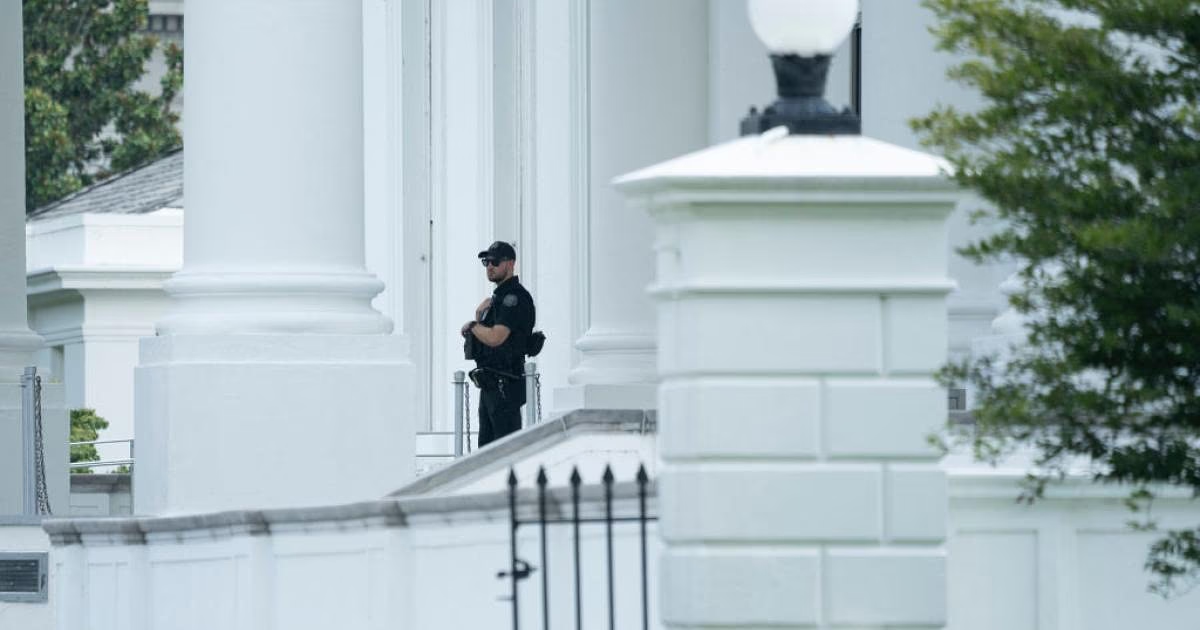
Plot to Assassinate Trump, Netanyahu, and Musk: Details of the White House Attack Conspiracy

The U.S. Department of Justice revealed exciting details of a terrorist plot targeting the White House, as a federal grand jury formally indicted eight men aged between 19 and 32. This legal step comes after extensive investigations led by the Federal Bureau of Investigation into a conspiracy aimed at launching an attack during a mixed martial arts event held at the U.S. presidential residence last June.

Judicial authorities clarified that the indictment includes serious charges related to international terrorism and planning premeditated killings, as the defendants face charges of conspiring to provide material support to terrorists. The charges also include planning to assassinate prominent government officials and committing murders in areas under federal jurisdiction, reflecting the seriousness of the thwarted plot.

According to the investigations, the list of targets set by the defendants included figures of global political and economic weight, led by U.S. President Donald Trump and Vice President J.D. Vance. The list also included Israeli Prime Minister Benjamin Netanyahu, billionaire Elon Musk, along with a number of senior officials in the U.S. administration and prominent Republican Party donors.

Regarding the military tactics used in the plot, security sources indicated that the defendants planned to use drones equipped with explosive devices to bomb the North Wing of the White House. The goal of this initial bombing was to create a state of panic and mass escape among attendees, forcibly directing them towards pre-determined exits by the attackers.

The bloody plan included deploying snipers in strategic locations surrounding emergency exits, where political figures and officials were to be targeted as they attempted to flee the scene of the explosions. The Federal Bureau of Investigation confirmed that it was able to monitor these movements and thwart the operation in its final stages before it became actually implemented last month.

Regarding how the cell members coordinated, the Department of Justice stated that the defendants relied on encrypted electronic applications and platforms and chat forums to exchange instructions and distribute roles. These platforms included 'Signal', 'Discord', 'TikTok', and 'Instagram', where they used these digital means to avoid traditional security surveillance during the preparation period for the operation.

Arrests began in Columbus, Ohio, where the first suspects were apprehended before the circle expanded to include the rest of those involved in other states. The timing of the alleged attack coincided with the United States' celebrations of the 250th anniversary of independence, an event that saw extensive attendance from U.S. state leaders and international guests.

Despite the presence of Israeli Prime Minister Benjamin Netanyahu's name on the list of main targets for the plot, he did not attend the event held at the White House at the time. As of now, no official comment has been issued by the defendants or their legal defense teams regarding these charges, which could lead to life imprisonment if convicted.

The plot involved using explosive-laden drones to bomb the North side of the White House, aiming to drive attendees towards exits where snipers were positioned.

ARAB AND WORLD

Fri 10 Jul 2026 7:34 pm - Jerusalem Time

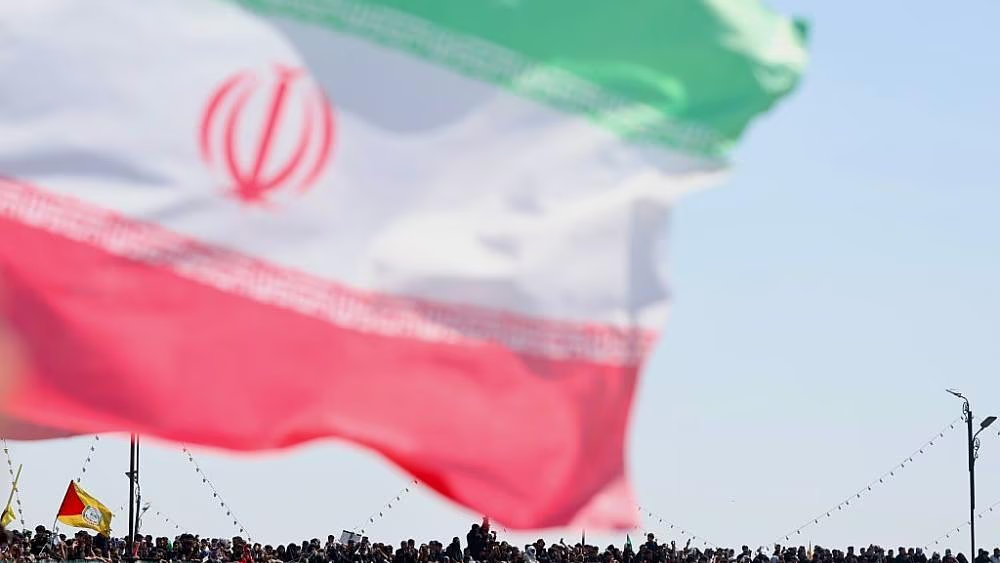
Diplomacy Under Fire: Tehran Insists on Negotiation Despite Military Escalation with Washington

Diplomatic movements are accelerating at regional and international levels in an attempt to contain the escalating tension between Iran and the United States. Multiple mediations are seeking to bring both parties back to the negotiating table, at a time when Tehran insists on balancing its high military readiness with keeping channels of dialogue open to avoid the region sliding into a comprehensive confrontation.

Informed sources reported that the Iranian Ministry of Foreign Affairs and military leaders have not closed the door to diplomacy despite the intensity of mutual rhetoric in recent days. Tehran affirms that it will not succumb to pressure or military threats, while emphasizing the necessity for Washington to adhere to its legal commitments outlined in previous memoranda of understanding between the two parties.

Fundamental points of contention hinder progress in the political track, foremost among them being Article 13 of the joint memorandum of understanding. This article concerns the necessity for the United States to release Iranian funds held abroad, an issue that Tehran considers a real test of the American side's seriousness in any future settlement.

The energy file also represents an additional stumbling block, especially after Washington announced the cancellation of exemptions related to Iranian oil exports and their financial revenues. Observers believe that this development imposes itself as a key item on the agenda of any potential meetings, as Tehran demands the lifting of restrictions imposed on its oil sector as a condition for de-escalation.

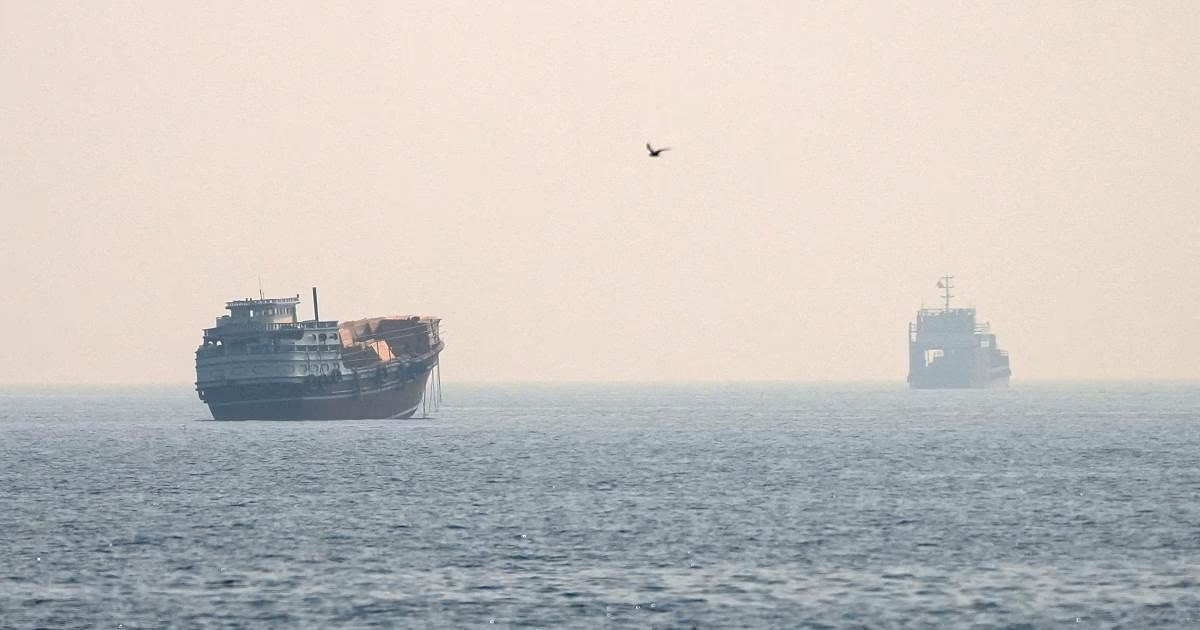
In a related context, the interpretation of Article 5 of the memorandum of understanding, concerning the mechanism for dealing with the Strait of Hormuz, remains a point of political and legal clash between the two capitals. There is a sharp divergence regarding how to implement security arrangements in the strategic waterway, which further complicates reaching a consensual security formula that ensures freedom of navigation and regional stability.

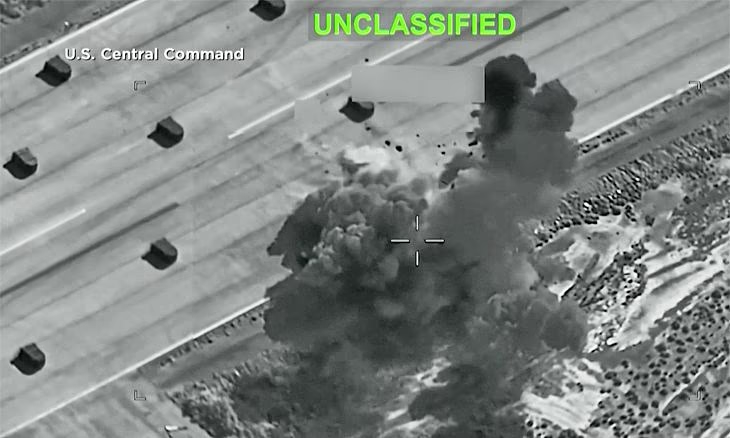
On the ground, the past hours witnessed an unprecedented escalation after the US Central Command (CENTCOM) carried out a series of extensive airstrikes. The attacks targeted approximately 90 military sites within Iranian territory, including advanced air defense systems, ballistic missile and drone storage facilities, as well as naval logistics bases.

Iran's Revolutionary Guard responded immediately by targeting American military bases in Kuwait, Bahrain, and Jordan. Military commanders in Tehran warned that the scope of attacks would expand significantly if American strikes continued, asserting that they have the capability to reach all American interests in the region.

Despite this direct confrontation, official Iranian statements indicate that the negotiation path has not yet ended, but it has become closely linked to a cessation of hostile operations. Regional capitals are watching the outcomes of this confrontation with great concern, amidst fears of mediations failing to defuse the crisis before it is too late.

Questions remain about diplomacy's ability to withstand the roar of explosions, given each party's adherence to its political and field conditions. While Washington insists on undermining Iranian military capabilities, Tehran refuses to make any concessions under the weight of bombardment, leaving the region open to all possibilities.

Iran has affirmed from the outset that the diplomatic path continues in parallel with military readiness to deal with any emergency developments.

LATEST NEWS

Fri 10 Jul 2026 7:34 pm - Jerusalem Time

Tehran Vows Retaliation for Infrastructure Targeting, Israel Seeks US Green Light to Join Attacks

The Secretary of Iran's Supreme National Security Council, Mohammad Bagher Zolghadr, vowed today, Friday, a decisive and direct response to any attack targeting his country's infrastructure. Zolghadr affirmed in an official statement that Israel would not be safe from this retaliation, emphasizing that Iranian forces are prepared to confront any escalation affecting the state's vital facilities.

This Iranian threat comes amidst renewed military exchanges between Washington and Tehran, the first such escalation since the signing of the memorandum of understanding last June. These developments reflect the fragility of previous understandings that followed the ceasefire announcement in April, once again placing the region on the brink of a volcano.

On Wednesday-Thursday night, US forces launched a series of intense airstrikes described as the most severe, targeting approximately 90 military objectives within Iranian territory. According to the US military command, these operations are in response to Iranian movements threatening US interests and its allies in the Gulf region.

For its part, Tehran accused the US administration of deliberately targeting vital civilian infrastructure, including strategic bridges and railway lines connecting the capital Tehran with the city of Mashhad. Iranian sources said that the timing aimed to obstruct the funeral ceremonies of the late Supreme Leader Ali Khamenei, who was assassinated last February.

In a related context, the Israeli Broadcasting Corporation revealed intensive diplomatic and military moves by Tel Aviv with Washington to directly participate in military operations. Sources clarified that Israel officially requested permission from US President Donald Trump for its forces to join the airstrikes against Iranian targets.

Israeli Prime Minister Benjamin Netanyahu's office reported that he held lengthy phone conversations with President Trump on Thursday evening. The discussions covered the latest field developments and US military movements in the Gulf region, without disclosing details of the US response regarding Israel's request to participate.

Observers believe that Israel has exerted continuous pressure on Washington to adopt tougher stances towards Iran's nuclear program and regional influence. However, Tel Aviv currently finds itself in the position of an observer while the United States leads the military campaign directly and unilaterally so far.

Israeli press reports indicated that the chances of the Israeli army's involvement in this round of conflict remain slim for strategic and political reasons. Washington fears that overt Israeli intervention could complicate efforts to rally international support and transform the conflict into a comprehensive religious confrontation.

Analyses suggest that Israel may, for the time being, be content with reaping the benefits of US military pressure on Tehran without bearing the cost of direct involvement. However, the scenario of Israeli intervention remains possible if Iran decides to expand the scope of its attacks to directly target Israeli depth.

Informed sources reported that Tehran has already begun to change the equation of retaliation, shifting from threatening to target US bases to explicitly naming Israel. The potential Iranian target bank includes US military bases in neighboring countries such as Kuwait, Bahrain, and Jordan, in addition to Israeli facilities.

Iran's Supreme National Security Council is the body responsible for formulating major military and political decisions in the country. The Council has shown clear firmness in dealing with the recent strikes, considering that continued US escalation will inevitably lead to an expansion of the geographical scope of the confrontation.

The Gulf region is witnessing an unprecedented military alert since the start of direct confrontations last February. These tensions coincide with the stalled negotiations led by regional parties such as Qatar and Pakistan, which aimed to reach a final agreement to end the state of hostility.

Security experts believe that targeting Iranian infrastructure represents a crossing of the red lines set by Tehran years ago. This shift in the nature of targets could push the Iranian Revolutionary Guard to carry out qualitative retaliatory operations that may affect international shipping lanes in the Strait of Hormuz.

In this complex landscape, anticipation remains the dominant factor, awaiting the outcomes of the US-Israeli discussions in the coming days. The region remains open to all possibilities, including the outbreak of a widespread regional war that transcends the limits of current localized clashes.

Any attack on infrastructure will be responded to, and the criminal Zionist regime responsible for these atrocities will not be safe from the retaliation of our fighters.

ARAB AND WORLD

Fri 10 Jul 2026 7:33 pm - Jerusalem Time

Aoun Adheres to Negotiation Path, Lebanese Army Prepares for Deployment in 'Experimental Areas'

Lebanese President Joseph Aoun reiterated his commitment to proceeding with the negotiation path with Israel, emphasizing that this is a strategic choice that will not be reversed under any pressure. Aoun clarified that the Lebanese state is committed to its full sovereignty in all diplomatic and field steps it takes during this sensitive phase.

President Aoun's statements came during his reception of a delegation from the 'Strong Republic' bloc, headed by Samir Geagea, at Baabda Palace, where the two sides reviewed the latest political developments. Aoun noted that criticisms targeting the principle of direct negotiation lack objectivity, reminding that Lebanese history has witnessed similar negotiation milestones since the 1949 Armistice Agreement.

Aoun considered the 'Framework Agreement' a real opportunity to restore usurped Lebanese rights through diplomatic channels, provided that the Israeli side adheres to the agreed-upon terms. He added that the current momentum provided by the United States gives Beirut additional leverage to pressure Tel Aviv and overcome obstacles to implementing the agreements.

In a direct attack on opponents of this path, the Lebanese President questioned the utility of continuing to make the Lebanese people pay the price for wars that serve the interests of external powers. He affirmed that some seek to keep the Lebanese file merely a pressure card in the hands of regional parties, specifically Iran, which the current official orientation of the state rejects.

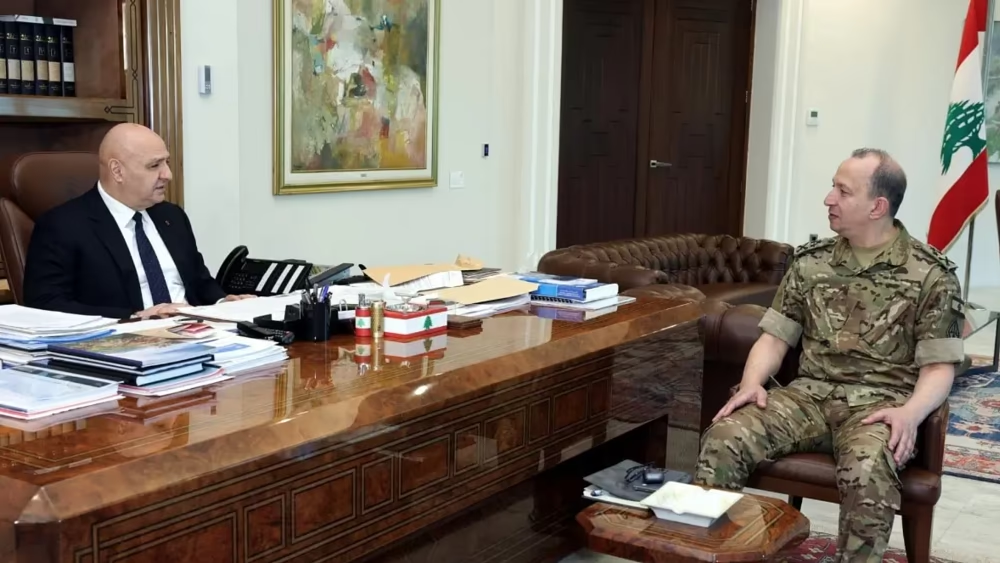
On the field level, President Aoun held a meeting with the Commander of the Lebanese Army, General Rodolphe Heikel, which focused on discussing the deteriorating security situation in the border villages. The meeting addressed the military institution's plans to deal with continuous Israeli aggressions and ensure the stability of areas experiencing escalating tensions.

The military meeting discussed the logistical arrangements for implementing the 'Framework Agreement' in what are known as the 'experimental areas' in southern Lebanon, where the army is scheduled to take over. The plan includes a wide deployment of Lebanese military units concurrently with the withdrawal of Israeli forces from those specified points.

Informed sources reported that coordination between the presidency and the army command will intensify in the coming days, with the anticipation of a high-level American military delegation arriving in the capital, Beirut. The American delegation aims to finalize the mechanisms for the Israeli withdrawal and ensure that no security breaches occur during the transfer of control.

At this stage, Lebanese authorities are seeking to obtain firm international guarantees to prevent Israel from reneging on its commitments, especially after previous attempts to backtrack on certain understandings were observed. Beirut considers field commitment to be the true test of the success of the negotiation path sponsored by Washington.

In a related context, it was decided to move the next round of negotiations from the American capital, Washington, to the Italian city of Rome, based on new diplomatic arrangements. This change came after American assurances to Beirut of the continued direct role of the United States as a mediator and guarantor in the anticipated tripartite talks.

It is expected that the Rome round of negotiations will begin in the middle of this month, where Lebanon will be represented by an official delegation authorized to discuss the executive steps for withdrawal. The Lebanese side links its participation to the necessity of achieving tangible progress on the ground, starting with the end of the Israeli military presence in the areas covered by the initial understandings.

I will not back down from the decision to negotiate that I have made, which enshrines the right of the Lebanese state to negotiate on its own and extricates the country from the repercussions of war.

PALESTINE

Fri 10 Jul 2026 7:33 pm - Jerusalem Time

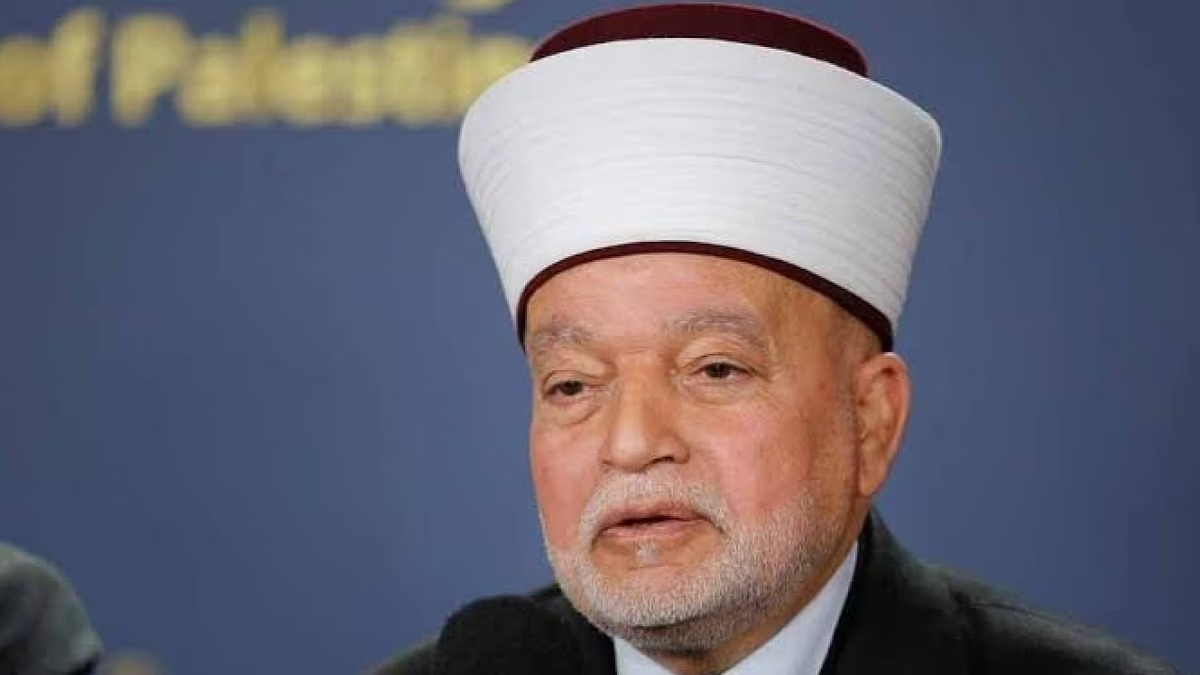
Occupation decides to ban Mufti of Palestine from Al-Aqsa Mosque after his arrest

Israeli occupation authorities today, Friday, released the Mufti of Jerusalem and the Palestinian Territories, Sheikh Muhammad Hussein, after detaining him for several hours following a sudden arrest operation carried out by occupation forces from inside the courtyards of the blessed Al-Aqsa Mosque, imposing restrictive conditions on his movement.

Sources reported that the release decision came with the condition of banning the Mufti from Al-Aqsa Mosque for a full week in a first stage, along with handing him an official summons to review the occupation's investigation centers later, where it is expected that the extension of the ban period will be considered to reach six months.

The background of this targeting dates back to the religious and national stances expressed by Sheikh Muhammad Hussein within the Holy Sanctuary, as the occupation authorities claimed that he prayed for the Palestinian martyrs and supplicated for the freedom of prisoners in occupation prisons, which Israeli security circles considered incitement that warrants prosecution and expulsion.

The occupation authorities handed the Mufti of the Holy Lands an official decision for immediate expulsion from Al-Aqsa Mosque for a week as an initial measure.

OPINIONS

Fri 10 Jul 2026 7:33 pm - Jerusalem Time

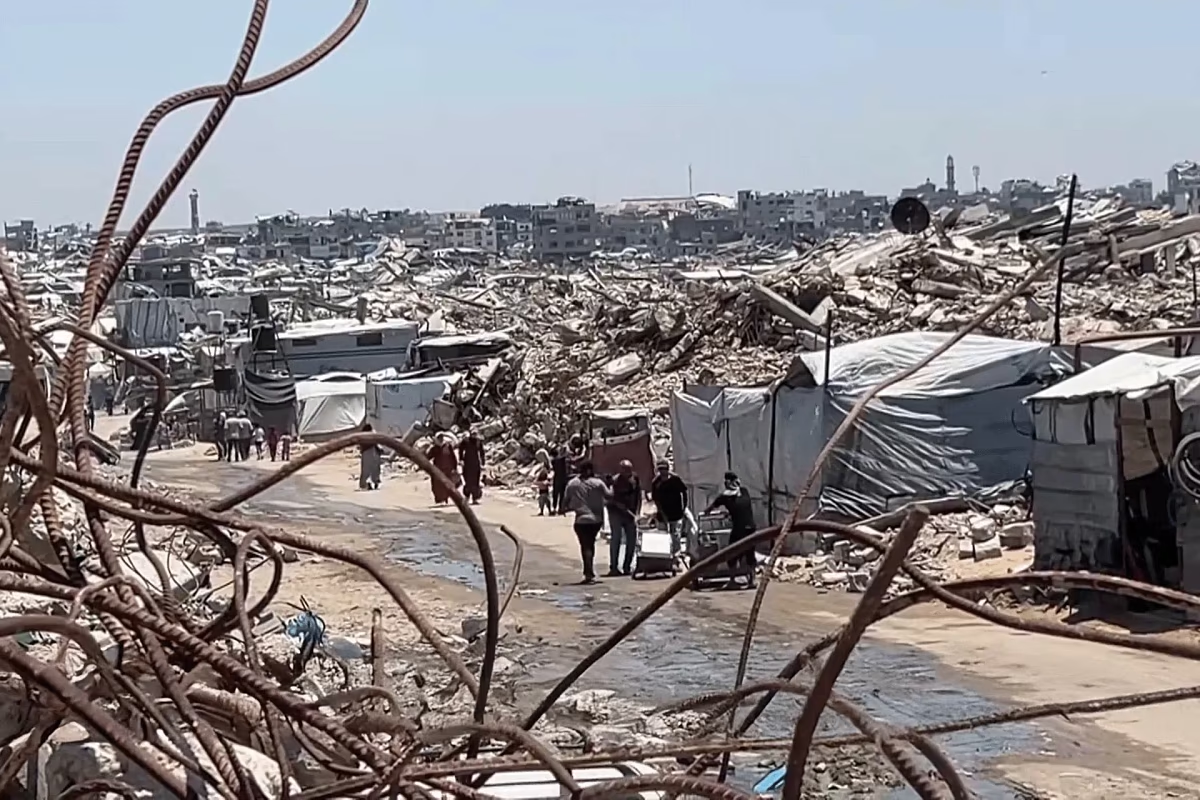
When the Tent Becomes a Homeland... How Has War Reshaped Life in Gaza?

In the Gaza Strip, the tent is no longer merely a temporary shelter that residents resort to to escape shelling. Instead, with the continuation of the war and the expansion of destruction, it has transformed into a permanent reality imposed on hundreds of thousands of Palestinians. What was initially viewed in the early days of the war as a transitional phase preceding a return to homes, has, after many long years, become a new way of life. Generations of children now know nothing of a homeland but a dilapidated tent, and nothing of a home but what they hear in their parents' conversations.

The most dangerous outcome of the war is not limited to the destruction of cities and residential neighborhoods, but extends to reshaping the human and social life of Palestinians. A home is not just a roof and walls; it is a space that preserves privacy, and gives a person a sense of security, belonging, and stability. When this space is taken away for continuous years, its effects are not limited to material loss, but extend to the structure of society as a whole.

The widespread destruction of homes has led to one of the largest waves of displacement in contemporary Palestinian history, with hundreds of thousands of families forced to live in tents lacking the most basic necessities of life. Sandy areas and open lands have turned into overcrowded population centers, lacking infrastructure and essential services, while the tent now serves the functions of a home, school, kitchen, and bedroom all at once.

Amidst this bitter reality, a new pattern of life has emerged, imposed by the conditions of war. Daily life details now revolve within a limited space that provides neither the minimum privacy, comfort, nor security, in light of the scarcity of potable water, food shortages, deteriorating health services, absence of sewage networks, and high temperatures in summer and cold winters, which has made the tent itself an additional source of suffering.

These conditions directly reflect on children, who represent the most affected group. An entire generation has been born and raised inside tents, never knowing the meaning of a normal home, stable life, or the environment needed for healthy psychological and social development. The continuation of this reality threatens to leave deep scars on children's mental health, and on their ability to learn, integrate, and build their future.

The repercussions do not stop at the humanitarian aspect but extend to the Palestinian social fabric. Life inside displacement camps and tents has imposed new patterns of social relations, weakened family privacy, and created immense economic and psychological pressures, at a time when families are struggling to secure the minimum requirements for survival. Social occasions, both joyful and sorrowful, are now held inside tents, a scene that embodies the extent of the transformation that has afflicted Palestinian society.

The numbers reveal the extent of the catastrophe that has befallen the Strip, where hundreds of thousands of housing units have been completely or partially destroyed, leaving hundreds of thousands of families homeless, which has made tents their only option. This reality not only reflects the extent of the destruction but also indicates a systematic targeting of the components of civilian life, making the restoration of life to normalcy an extremely complex task even if the war stops.

The transformation of the tent from a temporary shelter to a permanent residence cannot be separated from policies aimed at exhausting Palestinian society and keeping it in a state of continuous displacement, thereby depriving residents of stability and deepening humanitarian, social, and economic crises. The longer life in tents continues, the more difficult recovery becomes, and the wider the gap between what society was before the war and what it has become after it.

Perhaps the most dangerous aspect of the scene is that the world has begun to treat the presence of hundreds of thousands of Palestinians in tents as an ordinary reality, whereas it should be an exceptional situation requiring urgent action to end it. Normalizing tragedy is no less dangerous than the tragedy itself, because it transforms a humanitarian catastrophe into a familiar scene, and empties international law and humanitarian conventions of their practical content.

The tent, no matter how long it lasts, cannot be a homeland, nor a substitute for a home, nor compensation for a city destroyed or a neighborhood erased from existence. A homeland is not measured by a piece of cloth erected over sand, but by a person's right to live safely in their home, on their land and homeland, and among their memories. As long as tents are the most prominent symbol of the lives of hundreds of thousands of Palestinians in Gaza, the humanitarian catastrophe continues, no matter how much the sound of shelling recedes or news headlines change.

PALESTINE

Fri 10 Jul 2026 7:33 pm - Jerusalem Time

'Yellow Line' Expansion Devours 70% of Gaza's Area as Occupation Continues Demolition and Displacement Operations

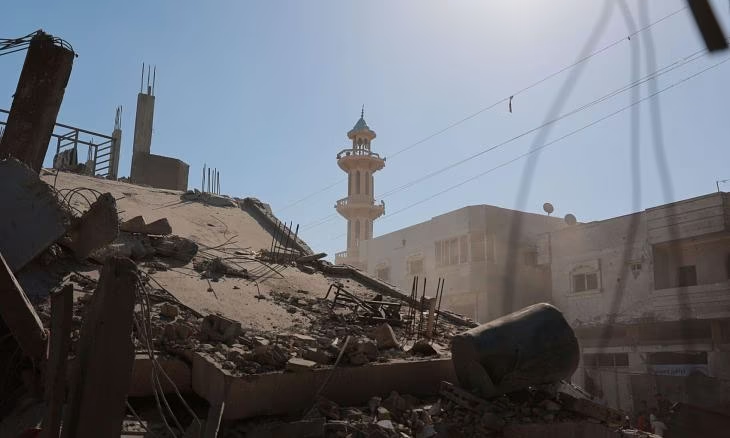
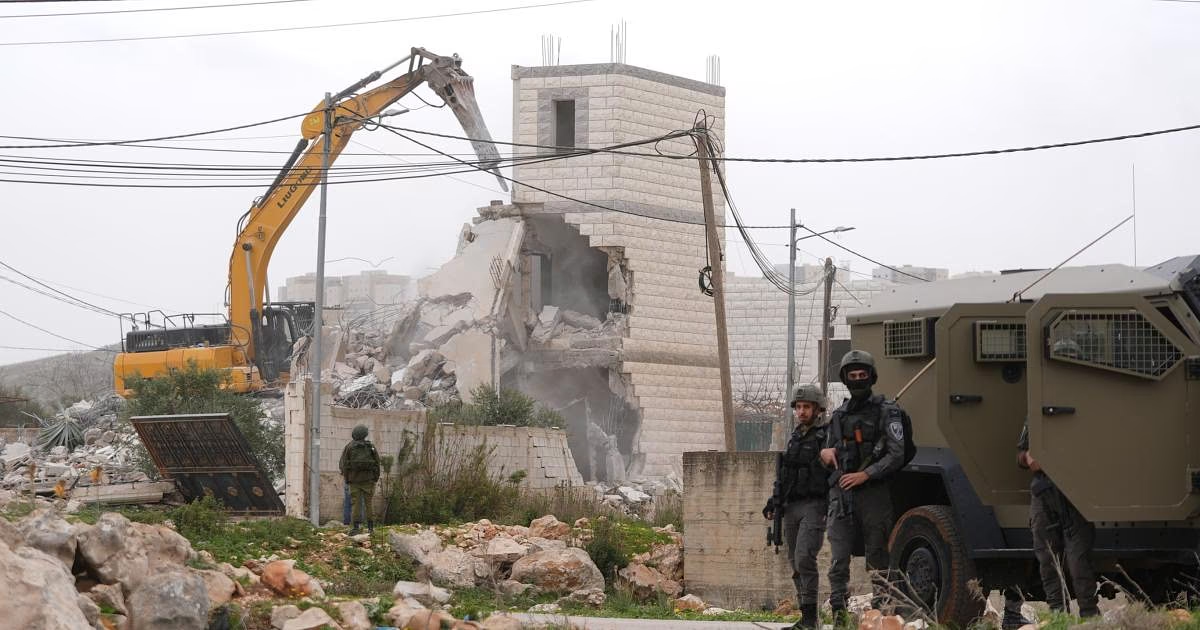
The Israeli occupation forces have escalated their field measures in the Gaza Strip by expanding the scope of what is known as the 'Yellow Line,' which has created a bitter reality for the besieged population. The engineering units of the occupation army carried out extensive demolition operations of residential buildings in the areas located behind this line, leading to the destruction of entire neighborhoods and the displacement of thousands of additional families.

Local sources reported that the occupation recently expanded the area of this security zone to engulf about 70% of the total land of the Gaza Strip, after it constituted 53% in previous stages. This systematic expansion has crammed more than two million Palestinians into very narrow spaces lacking the minimum necessities of life and basic services, exacerbating the humanitarian crisis unprecedentedly.

On the ground, the occupation army announced the assassination of Yahya Saeed Mohammed Hamdan in the southern part of the Strip, claiming he was a cell leader in the elite unit of the Hamas movement. The army statement alleged that Hamdan was among those who participated in the events of October 7, specifically in the storming of the Re'im military camp adjacent to the Strip, as part of the ongoing direct targeting operations of field cadres.

In the context of ongoing violations, a Palestinian woman was injured by the bullets of the occupation forces while she was in the Faluja area west of Jabalia refugee camp in the northern Strip. This coincided with intense artillery shelling targeting the eastern and northern areas, reflecting the continued breach of field understandings and the targeting of civilians in their presumed displacement areas.

Gaza City also witnessed massive explosions resulting from the demolition of residential blocks located behind the Yellow Line, as the occupation seeks to change the geographical features of the area. Injuries were also recorded among citizens east of Al-Bureij refugee camp and in the Al-Amal neighborhood in Khan Yunis city, due to direct firing from invading military vehicles.

On the human rights front, Al-Dameer Association for Human Rights issued a position paper warning against turning the eastern part of the Strip into a permanent buffer zone. The paper affirmed that what is happening is 'evacuation engineering' aimed at the forced displacement of Palestinian residents and creating an environment that makes continued life in those areas practically and legally impossible.

The human rights organization clarified that these practices constitute a grave violation of the occupation's obligations under international humanitarian law and fall within a systematic policy of long-term occupation. The paper called on the international community to act immediately to stop the crime of genocide and ensure that occupation leaders do not escape punishment before international courts.

As part of relief efforts, the Qatari Committee for the Reconstruction of Gaza continued to provide urgent humanitarian aid to the most affected groups in various governorates. The aid included providing assistive devices to hundreds of people with physical disabilities, including wheelchairs and walkers, to alleviate their suffering under harsh displacement conditions.

For its part, the United Nations warned that the severe shortage of fuel and specialized equipment hinders efforts to retrieve the bodies of martyrs from under the rubble. The international organization indicated that thousands of people are still missing, prolonging the suffering of families waiting to know the fate of their children amidst the decomposition of bodies and the difficulty of conducting DNA tests.

UN reports confirmed that the absence of explosive hazard assessment operations significantly delays the return of residents to their destroyed neighborhoods and slows down the pace of any future reconstruction operations. The accumulated rubble in the streets remains a major obstacle to the movement of rescue and ambulance teams, further complicating the already deteriorating humanitarian situation in all areas of the Strip.

Israeli warships continue to target the beach and sea area with heavy gunfire, depriving fishermen of their sole source of livelihood and threatening the lives of displaced people on the coast. The northeastern areas of Rafah city were also subjected to intermittent artillery shelling, indicating that there is no truly safe area throughout the Gaza Strip.

Observers believe that the occupation's insistence on expanding the 'Yellow Line' aims to impose new geographical realities that prevent the return of displaced people to their homes in the near future. This policy puts the international community to a real test of its ability to compel the occupation to abide by the decisions of the International Court of Justice and stop settlement and security expansion within the Strip's borders.

Human rights organizations called for immediate investigations into the crimes committed within the 'security zone,' considering that international silence gives the green light for the occupation to continue destroying infrastructure. They affirmed that accountability is the only way to stop the bloodshed and ensure the protection of civilians who are now without shelter or legal protection.

In conclusion of developments, the humanitarian situation in Gaza remains caught between the hammer of continuous shelling and the anvil of siege and the expansion of buffer zones. With continued restrictions on the entry of humanitarian aid, fears of a new famine disaster are increasing in the areas isolated by the occupation behind the newly established Yellow Lines.

The Yellow Line has become an engineering of evacuation and the transformation of areas into a security buffer zone under Israeli control, indicating a trend towards long-term occupation.

OPINIONS

Fri 10 Jul 2026 7:32 pm - Jerusalem Time

The People... The Sieve of Leadership

Dr. Ibrahim Nairat

Opinion Writer

The People... The Sieve of Leadership

The national project is not renewed by changing individuals alone, but by the people reclaiming their role at the heart of politics, to become capable of sifting through leaders and programs that carry a vision capable of keeping pace with the challenges of the current stage.

In moments of great transformation, the most important question is not: who leads? But rather: how do the people become capable of choosing who leads them? And who determines the direction of the national project? Peoples facing historical challenges cannot remain captive to political equations formulated for past circumstances, because changing reality necessitates reviewing tools, renewing vision, and sometimes reconsidering the leadership structure itself.

At the core of this review emerges a fundamental truth: that the people are not merely a source of legitimacy, but they are the sieve of leadership. Through their awareness, participation, and ability to evaluate and hold accountable, leaders capable of carrying the national project are sifted out, and ideas that are no longer able to respond to the transformations of reality are reviewed. Leadership does not arise only from within political institutions, but is also shaped by the nature of the society that produces it, by its level of awareness, and by its ability to choose and hold accountable.

Hence, the renewal of the national project does not begin only with the question of who holds responsibility, but with the deeper question: how do we rebuild the relationship between the people and politics? And how do we move from a society that receives decisions to a society that participates in making them? A national project that is separated from its people loses part of its vitality, while a project that makes the people a true partner in it possesses the ability to renew and endure.

Today, the Palestinian issue stands before a stage that differs in nature from previous stages. The political scene is changing rapidly, and the nature of the conflict itself is undergoing profound transformations. The occupation is accumulating facts on the ground, the region is reshaping its balances, and the international community is reordering its priorities, while widespread sectors of Palestinians feel a growing gap between people's aspirations and the performance of political institutions.

Under such circumstances, renewing the national project becomes a political necessity, not merely a reformist demand. But this renewal does not begin with the question of the next leader's name, nor with the form of future political arrangements, but rather with a deeper question: from where does leadership derive its legitimacy? And who has the right to determine priorities and draw the direction of the national project?

Historical experiences have proven that major national projects are not born in closed rooms, nor are they formulated within elite circles alone, nor are they imposed from top to bottom. They arise when the people return to their natural position as the rightful owners of evaluating the experience, reviewing the path, and participating in shaping the future.

Leaders, regardless of their history and the extent of their sacrifices, are not an end in themselves, but rather tools to achieve national goals that transcend individuals. And when the stage changes and the nature of the challenges shifts, it becomes natural to raise the question about the ability of the existing leadership structure to keep pace with the new transformations, not with the aim of denying the past, but with the aim of building upon it.

Returning the helm to the people does not mean discarding history, ignoring sacrifices, or diminishing the value of what previous generations have offered. Rather, it means respecting this history by transforming it into living experience that helps shape the future. Nations do not progress when they deny their experiences, nor when they remain captive to them, but rather when they extract lessons from them and re-employ them in a way that suits the new stage.

Therefore, the need today is not just to change names, but to rebuild political awareness itself. The current challenges no longer resemble the challenges of past decades. And the confrontation is no longer limited to the field or diplomacy, but extends to economics, technology, education, media, historical narrative, and building institutions capable of resilience and continuity.

The stage requires a new political awareness that recognizes that leadership is not a permanent privilege, but a responsibility subject to evaluation, accountability, and renewal. It also requires a political culture that views disagreement not as a threat to national unity, but as an opportunity to develop decisions, as long as it takes place within a framework that respects institutions and law and places national interest above narrow calculations.

Indeed, the true sieve for any leadership is not discourse alone, nor slogans, nor history alone, but rather people's trust and their ability to evaluate performance. The people are capable of distinguishing between those who have a vision for the future and those who merely manage crises, and between those who offer implementable solutions and those who repeat the language of the past with tools that are no longer suitable for the present.

Hence, the fundamental challenge is not just to produce new leadership, but to build the political environment that allows for the emergence and sifting of this leadership. Aware people are not content with granting legitimacy, but participate in making it, and are not content with waiting for decisions, but contribute to shaping them.

From Political Partnership to a State of Reception

However, reaching a stage where the people become a true sieve for leadership first requires acknowledging a deep problem that has accumulated over many years: the decline of the direct relationship between society and politics.

Over the decades, a growing gap has emerged between citizens and decision-making centers. The Palestinian, in many cases, is no longer a daily partner in producing national choices, but has become a recipient of their results. And leadership, whether within the Authority's institutions or in political factions, has become the party most in contact with regional and international interactions, most involved in the details of political decision-making, and most aware of the complexities of power balances and surrounding circumstances.

This shift was not the result of a single factor, but came as a result of multiple accumulations; including the conditions of occupation that imposed a complex political and security reality, the complexities of internal division, the nature of political work that in many stages tended towards centralization, in addition to the decline of spaces that allow for organized public participation, and people's preoccupation with daily life challenges.

Over time, politics began to seem like a field exclusive to elites and leaders, while society's role receded to the area of support or objection after decisions were made, instead of being a partner in discussion and the creation of alternatives.

And here emerged one of the most dangerous consequences: the weakening of public opinion's ability to objectively evaluate political performance. Judging policies does not depend only on emotional stances or intentions, but requires knowledge of available options, imposed constraints, power balances, possible alternatives, and how to manage conflict in a highly complex environment.

And when this knowledge is absent from the public sphere, political discussion becomes captive to impressions and slogans, rather than being a discussion based on understanding and analysis. And then it becomes difficult for society to exercise its natural role as a sieve for leadership, because a sieve needs knowledge and criteria, not just reactions.

Therefore, renewing the national project does not begin only with the emergence of new leadership, but with rebuilding the relationship between society and politics. Elections, despite their importance, are not enough alone to create a vibrant political society. They grant legitimacy, but they do not create the political awareness required to exercise oversight, participation, and the creation of alternatives.

The real political process begins before the ballot boxes, and continues afterwards. It begins when citizens become capable of understanding public decisions, discussing national options, monitoring performance, demanding accountability, and contributing to providing solutions.

Reclaiming the People's Role as a Political Actor

For many years, politics has been reduced to power, participation has sometimes been reduced to the moment of election, and national belonging has been reduced to aligning behind one party or another. While politics, in its broader sense, is a daily practice related to how society manages its affairs, how ideas are produced, and how those in charge are monitored.

An politically active people are not just the people who participate in choosing leadership, but the people who possess the ability to understand reality, discuss options, offer alternatives, and correct the course when needed.

The wider society's participation, the more connected leadership becomes to the people, the more accountable it becomes, and the more capable it becomes of reviewing its mistakes. Leadership that operates within a vibrant political society differs from leadership that operates in a vacuum; because an aware society is not content with supporting or rejecting a decision, but asks about its reasons and consequences, proposes alternative paths, and participates in developing the project to which it belongs.

Hence, the deeper question is not just: how do we produce new leadership? But: how do we reclaim the people as a political actor, not just a voter summoned to the ballot boxes every few years, nor a recipient who waits for decisions to support or oppose them after they are issued?

Strong societies are not measured only by the number of elections they hold, but by the vitality of their public sphere, and the ability of people to discuss, hold accountable, and initiate. Peoples who leave political thinking to elites alone gradually lose their ability to produce ideas and sift through leaders, while peoples who make politics a part of their public life have a greater ability to protect their national projects from stagnation and monopoly.

Therefore, reclaiming the political role of the people begins long before the ballot boxes. It begins in schools that teach critical thinking, not memorization; dialogue, not indoctrination; and public responsibility, not just individual success. And it begins in universities that are spaces for knowledge production and free discussion, not just institutions that grant degrees.

It also begins with media that does not just transmit events, but helps citizens understand their backgrounds and analyze their options. And it begins with research centers that provide knowledge and alternatives, and with unions and civil society organizations that restore society's natural role in influencing public decisions.

Political society is not built only through official institutions, but through a wide network of knowledge, participation, and mutual trust between people and their institutions.

The People... The Sieve of Projects Before Leaders

Reclaiming the people's political role does not only mean that they choose who leads them, but that they possess the ability to evaluate the projects and visions presented to them. The problem is not always with individuals alone, but with the absence of an environment capable of sifting through ideas and programs before sifting through names.

Leaders do not emerge from a vacuum, but are a reflection of the society that produces them. The more aware society is, and the more capable it is of discussion and accountability, the greater the chances of a leadership with a real vision emerging. But when the popular role is absent, the arena becomes more susceptible to the rise of discourses that rely on emotion, history, or slogans, instead of programs capable of dealing with the challenges of reality.

Indeed, the true sieve for any leadership is not the extent of its media presence, nor its ability to use influential discourse, nor its history alone, but its ability to present a viable project, to build trust, and to transform vision into policies, institutions, and achievements.

Hence, the required transition is not just from old leadership to new leadership, but from a political culture that focuses on individuals to a culture that focuses on projects. The question that should precede all questions is not: "Who represents me?" but rather: "What project protects my future and responds to the challenges of the current stage?"

This transformation requires that the evaluation criterion be based on competence, ability to achieve, clarity of vision, integrity, and the ability to work within institutions, not on personal or organizational loyalties or on the legacy of the past alone.

However, the responsibility for building this type of political life does not fall on society alone, nor on leadership alone. It is a shared responsibility. Leadership is required to open the way for participation, promote transparency, and accept criticism and accountability, while society is required to move out of the position of recipient, and reclaim its role in producing political knowledge, monitoring performance, and participating in the creation of alternatives.

Strong leadership does not fear an aware society, but needs it. And an aware society does not seek infallible leadership, but leadership capable of listening, learning, correcting, and taking responsibility.

Consolidating this culture requires building a new political awareness that considers disagreement a source of strength, not a source of division. Serious national discussion does not weaken the cause, but protects it from stagnation. Responsible criticism does not serve opponents, but helps correct the course. And societies that honestly engage in dialogue with themselves are more capable of facing challenges than societies that postpone difficult questions for fear of disagreement.

Towards a National Project That Returns the People to the Center of Decision-Making

The national project is not renewed by changing individuals alone, but by expanding the circle of participation in producing ideas, programs, and leaders. A people who participate in formulating the national vision are more willing to defend it, more capable of bearing its cost, and more keen to follow up on those who implement it.

However, when the national project is reduced to a limited group of political actors, society gradually loses its sense of shared ownership of the cause, and interaction with it turns into a seasonal or emotional state, instead of being a continuous national practice.

Therefore, returning the helm to the people does not only mean granting them the right to choose leadership, but empowering them to be a permanent partner in making, overseeing, and renewing politics. A people who possess knowledge and the ability to discuss and hold accountable become capable of exercising their true role as the sieve of leadership.

And when society becomes capable of sifting through leaders based on competence, vision, and integrity, not through loyalties, slogans, and the legacy of the past alone, the relationship between the people and leadership changes fundamentally. Leadership no longer becomes an authority separate from society, nor do the people become merely an audience waiting for results, but both parties become part of one national process.

Conclusion: From Leadership of the People to a People Leading Their Project

Today, the Palestinian issue, with its specificity and complexity, needs this transformation more than ever. It faces a reality that works to invest time, establish facts, and reshape geography and narrative. And confronting this reality is not only by managing daily crises, but by building a political society capable of thinking for the future, and of producing tools that suit the challenges of the coming decades.

The real gamble is not just on changing faces, but on rebuilding the relationship between the people and politics, between society and leadership, and between legitimacy and participation.

A people who do not participate in shaping their future leave others to shape it on their behalf, while a people who reclaim their political role are not content with choosing leadership, but participate in shaping it, holding it accountable, and renewing it when the national interest requires it.

Thus, the people... the sieve of leadership is not just a symbolic phrase, but a political rule: every strong leadership needs a strong society, and every vibrant national project needs a people present in its making, not just present in defending it.

The future is not made by a leadership separate from its people, nor by a people waiting for someone to make their future on their behalf, but it is made by a new relationship in which the people become the source of legitimacy, the balance of evaluation, and the sieve that sifts through leaders and projects capable of carrying the responsibility of the stage.


OPINIONS

Fri 10 Jul 2026 7:32 pm - Jerusalem Time

Israel Pushes Washington to the Brink of War with Controversial Intelligence Report

Washington Message\n\nWashington – Said Arikat – 10/7/2026\n\nA new Israeli intelligence report, speaking of an alleged Iranian plot to assassinate US President Donald Trump, has raised a wave of questions within political and intelligence circles in Washington, not only regarding the accuracy of the information contained therein, but also about its timing, and whether it represents a new attempt to influence the American decision-making process, and push the United States towards a broader military escalation against Iran, at a time when negotiation channels between the two countries remain open despite escalating tensions.\n\nCNN quoted two informed sources as saying that Israel informed the United States this week of intelligence information claiming that Iran had developed a new plan to target Trump, adding that this warning came amid the shaky ceasefire and the exchange of threats and strikes between Washington and Tehran.\n\nOne of the sources said that the Israeli warning included information about a specific plot, while another source explained that US intelligence agencies had been monitoring general indications of potential threats against Trump for weeks, but the Israeli report added a new narrative speaking of a specific operation.\n\nHowever, what is remarkable, according to American officials, is that Washington has not yet been able to independently verify the accuracy of the Israeli information, and US intelligence agencies were not following this scenario before receiving the warning, which led a number of officials to deal with it with extreme caution.\n\nSome American officials went further, considering that the Israeli report might be part of an attempt to influence President Trump's calculations, while he considers his options between expanding military operations against Iran, or giving diplomatic efforts a last chance to reach a new agreement.\n\nAlthough the United States has long warned of the possibility of Iran seeking revenge on Trump for his 2020 decision to assassinate the commander of Iran's "Quds Force" Qassem Soleimani, officials confirmed that the new information has not yet met the usual American intelligence verification procedures.\n\nWhen the White House was asked about the Israeli warning, it referred to statements made by Trump in which he said that Iran was seeking to assassinate him, adding: "They want to get rid of the leader of the United States... I am on all their lists," describing the Iranians as "sick, evil people."\n\nTrump later also said that he had seen a new list that put him at the top of the figures targeted by Iran, without clarifying whether he meant the information conveyed by Israel.\n\nThese developments came days after chants by participants in the funeral of the late Iranian Supreme Leader Ali Khamenei called for Trump's killing, at a time when US intelligence agencies confirm that they are monitoring a number of individuals and entities who have discussed carrying out potential attacks, but have not yet observed actual executive steps.\n\nIn parallel, disagreements continue between Trump and Israeli Prime Minister Benjamin Netanyahu on how to deal with Iran. While Netanyahu pushes for a tougher military option, the US administration keeps the door open for negotiations, despite Trump's announcement of the end of the memorandum of understanding with Tehran.\n\nAmerican officials confirmed that undeclared contacts between Washington and Tehran are still ongoing with the aim of reaching a new nuclear agreement before mid-August, while US forces have drawn up plans for potential strikes, but have postponed their implementation to allow for diplomatic solutions.\n\nThe Israeli report raises questions that go beyond the content of the intelligence information itself, to touch upon the nature of the relationship between Washington and Tel Aviv and the limits of the latter's influence on American decision-making. Within American institutions, there is a growing realization that information from any ally, no matter how important that ally is, cannot become the basis for a decision to go to war before it is independently verified. It seems that the doubts surrounding the Israeli report reflect this trend, especially with American officials admitting that they did not possess independent evidence confirming the accuracy of the Israeli claims before the warning arrived.\n\nOver the past decades, Israel has faced criticism within the United States for its continuous attempts to push American administrations towards adopting tougher policies in the Middle East. This debate recalls many issues, including promoting the danger of Iraqi weapons of mass destruction before the 2003 invasion, as well as repeated lobbying campaigns to direct military strikes against Iran. From this perspective, a number of American analysts believe that the latest report may fall within a broader context of using intelligence information as a means to influence the White House's choices, serving the security priorities of the Israeli government, even if it results in the United States becoming involved in conflicts for which it bears all political, military, and economic costs.\n\nThese developments revive an old debate within the United States about whether American policy in the Middle East is formulated according to American national interests, or whether it is sometimes influenced by the calculations of allies, foremost among them Israel. The experiences of previous wars, especially the Iraq War, have prompted broad sectors of politicians and experts to call for not being drawn into unverified information or assessments that could be used to justify new military interventions. Therefore, the caution shown by American intelligence institutions regarding the Israeli report reflects a growing trend towards greater independence in evaluating information, and prioritizing direct American interests over political and regional pressures, regardless of their source.

ARAB AND WORLD

Fri 10 Jul 2026 11:38 am - Jerusalem Time

Security motives behind changing Trump's flight path from Turkey to Washington

US President Donald Trump's decision to return from Turkey on the old presidential plane instead of the new one raised widespread questions about the security arrangements accompanying his movements. This step came after his participation in the NATO summit, where the new plane was first directed to Mildenhall Air Base in Britain before the President later joined it.

Trump justified this action via his 'Truth Social' platform by his desire to give American armed forces personnel stationed in Britain the opportunity to see the new plane and tour inside it. However, this justification did not prevent the emergence of speculations indicating the existence of vulnerabilities in the security equipment of the modern aircraft, especially in light of the escalating military tensions between Washington and Tehran.

Press reports quoted informed sources as saying that the aircraft swap was not merely a show-off move, but rather came based on a direct recommendation from the US Secret Service. The agency considered that using the old plane represented a necessary precautionary measure at the present time to ensure the highest levels of protection for the President.

Information indicates that the new presidential plane still lacks some of the complex defensive systems and security capabilities that have proven their effectiveness in the old plane over years of service. Although there was no specific and direct intelligence threat at that moment, the security recommendation preferred to rely on the technically more ready version.

During a press conference, Trump did not provide definitive answers about the nature of the security concerns, but he focused on the external threats facing the US presidency in general. He clearly referred to what he described as potential Iranian assassination attempts, emphasizing that the position of president always places him in a circle of constant danger.

Speaking to reporters later while on board the new plane, Trump described the trip as potentially perilous, a reference observers interpreted as being directed at the Iranian leadership. When asked about the seriousness of the threats against him, Trump affirmed that he considers himself the number one target on the adversaries' list.

For its part, sources from Washington stated that the modification of the flight path and not taking a direct route from Ankara to the United States reflects the state of security alert surrounding the President. Although Trump affirmed that Iranian threats were not the sole reason for changing the route, the general context of the trip clearly showed the extent to which security concerns affect the White House's movements.

I am at the top of their list, and the President's life is in constant danger.

PALESTINE

Fri 10 Jul 2026 11:38 am - Jerusalem Time

Sinjil confronts settlement with popular protection: Volunteer committees to monitor hills and secure homes

The town of Sinjil, located northeast of Ramallah city in the occupied West Bank, is witnessing a state of permanent popular mobilization to confront the escalating settler attacks. Dozens of volunteers from the town's residents take turns monitoring the hills and rugged roads surrounding their homes, in an attempt to detect any suspicious movements that might signal imminent attacks under the cover of darkness.

Popular protection groups have become an urgent necessity imposed by the harsh field conditions, especially with the repeated targeting of homes and agricultural properties. Sources reported that residents primarily rely on night monitoring and rapid communication through available technologies to repel any threat targeting the security of their families and lands.

These self-initiated efforts come at a time when the occupation government continues to expand settlement activity unprecedentedly across the West Bank. Israeli authorities are working to legitimize new settlement outposts and turn them into launching pads for organized attacks against neighboring Palestinian villages and towns.

In late June, volunteers spread out on the mountainous heights overlooking Sinjil, using powerful searchlights to detect movements near settlement outposts. Youth groups also organize car patrols within the town's neighborhoods to ensure a rapid response in case of any emergency or infiltration attempt.

Residents heavily rely on instant messaging groups via the 'WhatsApp' application to exchange warnings and information about the movements of the occupation army and settlers. This method has contributed to strengthening the local community's ability to confront attacks and reduce human and material losses during late-night hours.

Many farmers in Sinjil have been subjected to direct attacks, including volunteer Fadi Alwan, who was injured while harvesting wheat. These incidents highlight the extent of the risks faced by Palestinians in their attempts to access their lands and secure their daily livelihood amidst continuous threats.

Sinjil town is located in a sensitive geographical position on the main road connecting Ramallah and Nablus, making it a target for settlement projects. Several settlements surround the town from the northern and eastern sides, tightening the noose on its residents and depriving them of natural urban expansion.

Occupation authorities have imposed a bitter geographical reality by erecting a barbed wire fence on the eastern side of the town alongside the vital Road 60. They have also installed iron gates at the main entrances, isolating vast areas of agricultural land and preventing their owners from accessing them freely.

The Wall and Settlement Resistance Commission recently announced that the occupation had seized approximately 464 dunams of Sinjil's land under the designation of 'state land'. This occupational legal measure aims to expand the 'Karmei Oz' settlement outpost, threatening to swallow what remains of the green spaces surrounding the town.

Sinjil Mayor, Moataz Tawafsheh, confirmed that the town has been experiencing a significant escalation in the pace of violence since the outbreak of the war on the Gaza Strip in October 2023. He explained that local institutions were forced to strengthen forms of community protection to deal with the increasing security challenges imposed by settler militias.

Repeated acts of violence and attacks over the past months have resulted in the martyrdom of two residents from the area and the displacement of dozens of families. These policies have also led to the displacement of more than 100 people from Bedouin communities that lived on the outskirts of the town, due to continuous intimidation.

Many citizens resorted to fortifying their homes with primitive means to protect their children from 'price tag' attacks carried out by settlers. Citizen Abdul Ghani Fuqaha installed iron bars and a high fence around his home after it was attacked with Molotov cocktails that almost claimed the lives of his family members.

Sinjil residents believe that community protection is the first and only line of defense in the absence of international and field protection. Stories of solidarity among young people who rush to the aid of any home under attack stand out as a model of Palestinian steadfastness in the face of forced displacement policies.

Despite modest resources, volunteers insist on continuing their nightly duties to protect their ancestors' legacy and lands from confiscation. Sinjil town remains a living witness to the ongoing conflict in the West Bank between the Palestinian will to survive and settlement expansion supported by force of arms.

The town's residents found themselves compelled to organize their self-efforts to protect the area amidst escalating threats.

LATEST NEWS

Fri 10 Jul 2026 11:38 am - Jerusalem Time

Tehran hints at nuclear option and Strait closure in response to US attacks

The Iranian scene witnessed a wave of angry reactions following US President Donald Trump's statements, in which he described Iranians with harsh terms, announcing the end of the memorandum of understanding signed between the two parties. These statements coincided with widespread military operations carried out by the US army targeting vital sites across Iran, which prompted the Iranian armed forces to respond by targeting American bases in Gulf countries, amid warnings of the region sliding into a comprehensive confrontation.

In this context, Hossein Shariatmadari, director of the Kayhan newspaper, which is close to decision-making circles, affirmed that his country possesses all the necessary technologies to produce nuclear weapons, pointing out that the only obstacle is the political decision based on religious fatwas. Shariatmadari explained that any change in this direction depends entirely on the vision of the supreme leadership in light of the unprecedented American escalation, considering that the language of force is the only one Washington understands at present.

For his part, Ali Akbar Velayati, advisor to the Iranian Supreme Leader, described the recent American moves as a dangerous political gamble that will be met with immediate and firm responses. Velayati held the US administration responsible for the collapse of diplomatic understandings, stressing that the region can no longer tolerate more adventures led by those he described as disreputable politicians, emphasizing that Tehran will not stand idly by in the face of continued practical violations of international conventions.

Hardline media circles in Tehran called for deterrent economic and military measures, including the complete closure of the Strait of Hormuz and preventing the flow of oil to global markets. These circles considered that exercising maximum pressure by disrupting navigation in Bab al-Mandab and strategic straits would make the cost of aggression prohibitive for the West, and force the United States to recalculate its security and psychological considerations in the region.

In a related context, the tone of personal threats against American and Israeli leaders escalated, with media platforms demanding the activation of operational capabilities to respond to the assassination of military commanders. In contrast, diplomatic voices emerged calling for the necessity of finding common interpretations of the provisions of security understandings to avoid armed conflict, warning that the transformation of the Strait of Hormuz into a nuclear or military conflict zone would destroy what remains of opportunities for fragile diplomacy.

The gap between us and nuclear weapons is will, not technology, and the Islamic Republic possesses the technical capability to produce them.

PALESTINE

Fri 10 Jul 2026 11:38 am - Jerusalem Time

4 Martyrs in New Israeli Raids on Gaza and Continuous Violation of Ceasefire Agreement

Israeli occupation forces continue to violate the ceasefire agreement in effect in the Gaza Strip since October 10, 2025, launching a series of airstrikes that resulted in the martyrdom of four individuals and the injury of others. Field sources reported that a drone targeted a gathering of civilians in the Nuseirat refugee camp in the central Strip, leading to the martyrdom of one citizen and varying injuries among those present.

In the southern Strip, two Palestinians were martyred following artillery and aerial bombardment that targeted the courtyard of a house in the Batn Al-Samin area, west of Khan Younis city. These aggressions come as part of a series of systematic attacks targeting populated residential areas, exacerbating the suffering of citizens who tried to return to their normal lives amidst the fragile calm.

Gaza City was not spared from this escalation, as one citizen was martyred and three others sustained various injuries due to a raid targeting a civilian vehicle in the Rimal neighborhood. Ambulance and civil defense crews rushed to the bombing site to transport the victims to nearby hospitals, amid a state of panic that spread among passersby in the neighborhood, which is a vital center in the city.

According to the latest data issued by the Ministry of Health, the toll of victims from Israeli violations of the ceasefire agreement has alarmingly risen to 1092 martyrs and 3507 injured as of Wednesday. These figures reflect the Israeli side's non-compliance with the terms of the calm, and its continued execution of targeted assassinations and bombings affecting civilians and infrastructure.

In a related context, the Palestinian Central Bureau of Statistics revealed shocking statistics about the victims of the ongoing aggression from October 2023 until the end of June 2026. The bureau documented the martyrdom of 73,090 Palestinians, including more than 20,000 children and 12,000 women, highlighting the scale of the humanitarian catastrophe that has befallen the Strip over more than two years of war.

Large crowds in Gaza City mourned the body of martyr Mohammed Al-Waheidi, a member of the Egyptian Committee in the Strip, who was martyred in a raid targeting his car earlier this week. Al-Waheidi was overseeing an initiative to install large display screens in displacement camps and destroyed areas to enable residents to watch World Cup football matches, in an attempt to alleviate the burden of the siege and destruction.

Medical sources confirmed that the raid that targeted Al-Waheidi in the Sabra neighborhood also led to the martyrdom of three other people who were in the vicinity. Among the victims were two siblings, children aged 8 and 10, who happened to be passing by at the moment of the bombing, raising renewed questions about the occupation's targeting of crowded areas without regard for the presence of children and civilians.

Fawaz Al-Waheidi, the son of the martyr, expressed his pride in the humanitarian role his father played, noting that he worked hard to bring moments of joy to the displaced in their tents. He added that his father believed that sports were a means to strengthen people's resilience, especially since the Egyptian national team had performed remarkably in the global tournament before its exit, creating a rare outlet for the residents of the afflicted Strip.

My father worked very hard to bring a kind of entertainment to the displaced and all those suffering in Gaza by bringing them the World Cup matches.

ARAB AND WORLD

Fri 10 Jul 2026 11:37 am - Jerusalem Time

Russia strengthens its economic influence in Syria with a new logistics center at Tartus port

Responsible sources revealed Russia's intention to operate a new commercial logistics center in the Syrian port of Tartus by mid-July. This center aims to utilize one of the berths of the naval base leased by Moscow to transform it into a commercial launching point, while maintaining military activity at the adjacent berth, in a move that reflects Moscow's determination to solidify its economic foothold during Syria's transitional phase.

The sources explained that the new center will manage large shipments of Russian goods, primarily wheat, grains, vegetable oils, and construction materials such as steel and clinker, with an initial capacity of up to 250,000 tons per month. This move comes in cooperation between the Syrian company 'Rusline' and the Russian-Syrian Business Council, and in direct coordination with the Syrian Sovereign Fund, to ensure the flow of essential goods on which Damascus heavily relies.

Customs data indicate that Syria's economic dependence on Moscow has reached record levels, with Russia and Crimea providing about 85% of Syria's wheat needs, totaling 2.9 million tons for the current season. Imports of Russian crude oil also saw a significant increase, with Syrian ports receiving about 16.8 million barrels last year, amidst close monitoring by Washington, which seeks to reduce this military and political influence in the region.

The center will initially handle Russian wheat, grains, animal feed, vegetable oils, timber, and steel, with the aim of shipping 250,000 tons per month.

PALESTINE

Fri 10 Jul 2026 11:37 am - Jerusalem Time

Report: Emergency Aid Accounts for 94.5% of Total UAE Support to Gaza

The United Arab Emirates continues to solidify its humanitarian role in the Gaza Strip, with recent data revealing that urgent relief aid accounted for 94.54% of the total support provided to the Strip. This move comes as part of a comprehensive strategy aimed at rapid response to humanitarian crises and providing essential needs for affected populations.

Official sources reported that the value of direct humanitarian aid reached approximately 4.66 billion UAE dirhams, implemented through 166 diverse relief projects. These figures reflect the UAE's commitment to addressing the difficult living challenges faced by the people of the Strip under current circumstances.

As part of the 'Gallant Knight 3' operation, the UAE succeeded in providing approximately 45% of the total international aid that reached the Gaza Strip between 2023 and 2025. The total cost of this support during that period amounted to nearly 4 billion dollars, making it a leading donor country to the Strip.

In the health sector, the UAE allocated 1.86 billion dirhams to support hospitals and medical centers suffering from a severe shortage of supplies. This support included the establishment of a field hospital inside Gaza and another floating hospital in the Egyptian city of Arish to provide urgent surgical and therapeutic care.

The floating hospital in Arish provided more than 12,000 medical services, in addition to performing over 5,000 complex surgical operations for the injured. Medical efforts also focused on fitting prosthetic limbs and providing physical rehabilitation services for hundreds of wounded who lost their limbs during the war.

In the water sector, the UAE implemented strategic projects including the establishment of desalination plants, drilling wells, and maintaining damaged networks at a cost of 24.59 million dirhams. These stations currently produce about two million gallons of potable water daily, contributing to bridging the significant water deficit gap in the Strip.

The developmental aspect was not absent from the support plans, with 260.39 million dirhams allocated for sustainable development projects, representing 5.28% of the total aid. These projects aim to enhance the local community's resilience and rehabilitate some vital facilities to ensure the continuity of essential services.

In the education sector, the value of support provided reached 6.95 million dirhams, focusing on equipping schools and educational centers with necessary supplies. These initiatives seek to ensure the continuity of the educational process and provide a suitable environment for students to continue their studies despite security and field challenges.

Regarding social services, the total cost of interventions amounted to approximately 37.53 million dirhams, including the distribution of food parcels, tents, and shelter supplies. This aid directly targeted the most vulnerable groups such as children, women, the elderly, and displaced persons in camps.

Statistics indicate that direct government aid was the main driver of this support, with a value exceeding 4.37 billion UAE dirhams. These efforts were complemented by contributions from national charitable organizations that played a pivotal role in delivering aid to those in need in various areas of the Strip.

The Emirates Red Crescent contributed 200.70 million dirhams, while the 'Mohammed bin Rashid Al Maktoum Global Initiatives' provided approximately 144.94 million dirhams. The International Charity Organization and Dubai Cares also participated with additional funds that enhanced the capacity of the humanitarian air and sea bridge.

Historically, figures confirm that support for Palestine represents a fundamental pillar of UAE policy, with total aid since the 1970s reaching approximately 15.34 billion dirhams. This historical aid covered 16 essential sectors through the implementation of more than 1392 development and relief projects in the Palestinian territories.

The UAE relies on an integrated system of land, air, and sea bridges to implement these operations, ensuring the uninterrupted flow of supplies. This high coordination has allowed overcoming logistical obstacles and delivering thousands of tons of food and medical supplies to the most affected areas in Gaza.

In conclusion, the report emphasizes that the UAE's vision for humanitarian work in Gaza goes beyond immediate support to include strengthening the foundations for future recovery. The 'Gallant Knight 3' operation continues to provide its intensive response, embodying a steadfast ethical and humanitarian commitment to the Palestinian people in the face of their successive crises.

Following the path of Zayed Al Khair, we will work to enhance our role among the world's leading countries in providing developmental and humanitarian aid and charitable work.

PALESTINE

Fri 10 Jul 2026 11:37 am - Jerusalem Time

Strategic Shift in Gaza: Hamas Dissolves its Government Committee and Hands Over Administration to the National Committee

The Islamic Resistance Movement (Hamas) announced a pivotal political and administrative step by deciding to dissolve the governmental emergency committee in the Gaza Strip and transfer all its tasks to the National Committee for Gaza Administration, which emerged from the Peace Council. Observers believe that this shift ends nearly two decades of the movement's direct control over the reins of governance in the Strip, and comes at a sensitive time coinciding with ongoing Cairo negotiations regarding the Peace Council's amended proposal to implement a ceasefire agreement.

This step presents Israel with new challenges in how to deal with the emerging administrative reality, especially with questions being raised about the possibility of separating the humanitarian file from the weapons file. These developments coincide with the ongoing deep humanitarian crisis in the Strip, where field reports indicate that the occupation continues its military operations, which have claimed the lives of more than a thousand martyrs since the last ceasefire announcement, with continued military control over about 70% of Gaza's area.

On the ground, the occupation authorities continue to manipulate the movement of border crossings, allowing only about 200 aid trucks to enter daily, which represents a clear violation of international humanitarian protocols. This reality necessitates the presence of a new administrative body capable of dealing with the international community and alleviating the burden of the siege imposed on the population suffering from a severe shortage of basic necessities.

For his part, Dr. Ibrahim Freihat, Professor of International Conflicts, considered Hamas's decision to represent a strategic transition from 'governing authority' to 'managing influence'. He explained that this step ends the phase in which the movement combined the tasks of governance and resistance work, while emphasizing that this shift does not in any way mean the end of the movement's political role in the general Palestinian scene.

Freihat identified four main axes that will form the core of discussions in the coming phase, starting with ending direct administration and the potential security and administrative vacuum that may follow. He also stressed that the reconstruction file and determining the political horizon for the Strip will be the real test of the National Committee's success in establishing itself as a legitimate and effective alternative for managing Gaza's affairs.

In a related context, a state of cautious anticipation prevails in the Gaza Strip among residents who hope that this step will contribute to breaking the political stalemate and stopping the continuous Israeli attrition operations. Analysts believe that the general mood tends to support any direction that opens serious prospects for the future of governance, away from the pretexts used by Israel to justify its continuous aggression under the claim of 'Hamas rule'.

The Israeli obstacle emerges as the biggest challenge to this transformation, as Tel Aviv stipulates the disarmament of Palestinian factions as a prerequisite for any progress in political or humanitarian files. In contrast, Hamas and the rest of the factions reject linking the weapons file to relief needs, proposing a formula for restricting heavy weapons and handing them over to a consensual Palestinian authority according to a special protocol to be set by the National Committee.

Informed sources indicate that the factions participating in the Cairo dialogues seem to agree on this formula, which in some aspects intersects with US administration statements about the necessity of dealing with heavy weapons as a priority. However, the American position remains not encouraging enough to pressure the Israeli side to accept these new administrative arrangements without impossible conditions.

At the regional level, experts believe that Washington's preoccupation with Iran and Lebanon files weakens the momentum of international pressure to achieve a breakthrough in Gaza. Also, the transformation of the Peace Council into a non-governmental organization may weaken its international legitimacy, giving Israel more room for maneuver and action away from strict international oversight, especially with the upcoming Israeli elections in October.

Observers warned against the proposed 'humanitarian zone' project in Rafah under the supervision of Ali Shaath and the protection of an international force, considering it an attempt to divide the Strip and entrench geographical separation. Some believe that this plan may keep the option of displacement open by crowding thousands of Palestinians into narrow border areas, which Hamas seeks to prevent by announcing the dissolution of its government and demanding the National Committee's responsibility for the entire Strip.

Analytical insights concluded that the top priority must focus on the relief aspect and completely separate it from security and political complexities to prevent Gaza from turning into a state of permanent attrition. Experts also stressed the need for the Palestinian leadership to present unified national initiatives to prevent the transitional phase from turning into a sustainable reality of destruction and marginalization, citing previous examples where reconstruction stalled for many years.

Hamas's step represents a transition from governing authority to managing influence, ending the phase that combined governance and resistance without ending its political role.

ARAB AND WORLD

Fri 10 Jul 2026 11:37 am - Jerusalem Time

Under American supervision.. The first areas of Israeli withdrawal from southern Lebanon to be identified within days

A high-ranking American official revealed anticipated field developments in southern Lebanon, confirming that the first 'pilot area' for the withdrawal of Israeli forces will be identified within a few days. The Lebanese Army is scheduled to take control of security in this area, which is currently under Israeli occupation, as part of international understandings aimed at ending military escalation.

Informed sources clarified that technical and field work is currently underway to prepare accurate maps and identify additional pilot areas that will be included in subsequent withdrawal phases. This move comes as part of Washington's efforts to ensure a smooth transition of security authority and prevent any vacuum that could lead to renewed armed clashes in the border region.

In a related context, the American Ambassador to Lebanon, Michel Issa, informed Lebanese President Joseph Aoun of the imminent arrival of an American military delegation in Beirut. The mission of this delegation will be to directly supervise the Israeli withdrawal operations from two pilot areas that were previously agreed upon within the 'Framework Agreement' signed in Washington at the end of last month.

Reports from the Lebanese presidency indicate that coordination with the American side focuses on establishing precise implementation mechanisms to ensure no security breaches occur during the handover process. The American Ambassador stressed during his meeting with President Aoun that the stability of the South is a top priority for the international community at the current stage.
Lebanon and Israel signed an internationally sponsored agreement on June 26th last year, which stipulates a gradual withdrawal of Israeli forces in exchange for an intensive deployment of the Lebanese Army. The agreement also includes provisions related to the disarmament of Hezbollah in the border areas, a point that still raises widespread debate about the mechanisms of its implementation on the ground.

The Lebanese side links its participation in the upcoming round of negotiations, scheduled to be held in the Italian capital Rome, to the extent of Israeli commitment to withdrawing from the pilot areas. Diplomatic sources reported that Beirut stipulates seeing tangible steps on the ground before sitting down again at the negotiating table scheduled for mid-July.

For his part, Lebanese President Joseph Aoun stressed the necessity of permanently establishing a ceasefire and pressuring the Israeli side to stop all hostile acts. Aoun emphasized during official meetings the importance of restoring Lebanese sovereignty over all territories in the South to enable the state to fulfill its constitutional duties and protect its citizens.

Despite these understandings, the agreement still lacks a final and comprehensive timetable for the withdrawal of Israeli forces from the entire 10-kilometer deep security zone. Israel insists that the presence of its forces is directly linked to ending Hezbollah's armed presence and dismantling its military infrastructure in those areas.
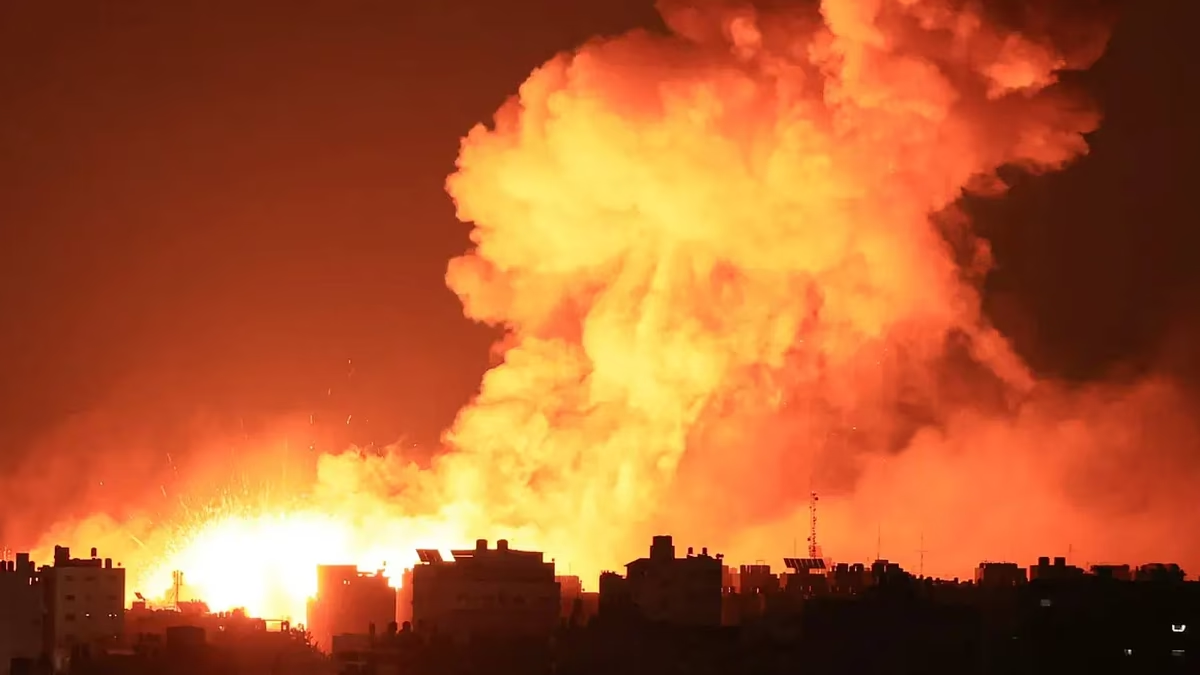
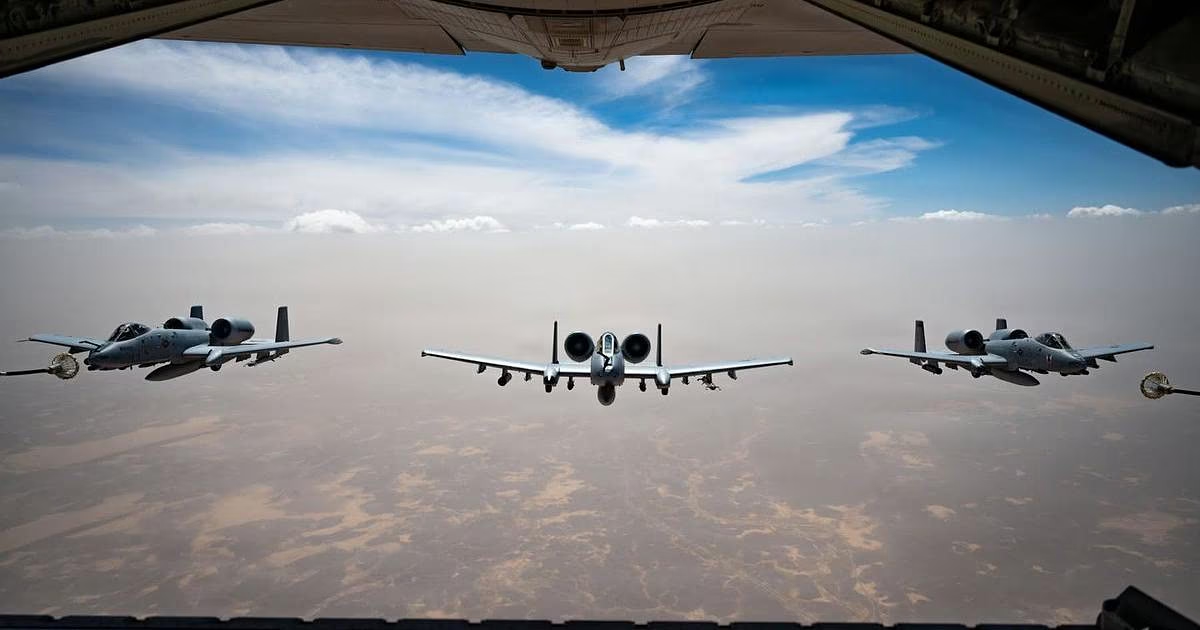
In contrast, Hezbollah continues to express hardline positions regarding surrendering its weapons, relying on its regional alliances, which places the Lebanese state before major logistical and political challenges. Observers believe that the success of the 'pilot areas' will be the real test of the Lebanese Army's ability to impose its sole control in the South.

The Italian capital Rome is expected to host a decisive round of negotiations on July 15 and 16, with an American desire to move the dialogue from Washington to Europe. This geographical change aims to facilitate the return of delegations to their political references for quick consultations on pending fundamental issues that require high sovereign decisions.

These diplomatic moves coincide with preparations for an official visit by the Lebanese President to Washington in the last week of this month. This visit comes at the invitation of US President Donald Trump, where border issues and final security arrangements are expected to top the agenda of the bilateral summit.

On the ground, the United Nations Interim Force in Lebanon (UNIFIL) described the current situation as 'very fragile' despite the relative calm that has recently prevailed in the region. The international force confirmed that it has intensified its patrols and operational activities to support stability and facilitate the return of displaced Lebanese to their villages damaged by military operations.

UNIFIL clarified in a statement that it is working to coordinate with all parties to prevent any misunderstanding that could lead to a renewed outbreak of violence. The international forces also contribute to the repair of damaged infrastructure and vital roads to facilitate the movement of civilians and technical teams of the Lebanese Army in the border areas.

The sources concluded by emphasizing that the coming days will be crucial in determining the course of the conflict, either success in establishing the 'pilot areas' model and moving towards a comprehensive solution, or a return to the square of tension if the withdrawal procedures falter or the Lebanese Army faces obstacles in extending its authority.

Preparations are underway to implement what was agreed upon regarding the pilot areas, and an American military delegation will determine the implementation mechanism on the ground.

PALESTINE

Fri 10 Jul 2026 11:37 am - Jerusalem Time

British PM candidate calls for accountability for Israel and criticizes Starmer's stance on Gaza

Andy Burnham, a prominent candidate for Prime Minister in Britain, called for intensified international efforts to pressure the Israeli government and hold it accountable for what he described as escalating war crimes in the Gaza Strip. Burnham stated in press remarks that on-the-ground evidence clearly indicates grave violations that require international legal action to ensure that those responsible for this suffering do not escape punishment.

The British official considered the scale of destruction and killing witnessed in the Strip to be a 'scar on the collective conscience' of humanity, emphasizing that targeting Palestinian civilians and children is unacceptable under any pretext. He pointed out that determining the nature of these crimes ultimately falls within the jurisdiction of international courts, but stressed the necessity of taking firm political stances to stop the ongoing bloodshed.

Burnham expressed his deep shock at the reports and images coming from Gaza, affirming that he would work with international partners to put an end to this humanitarian tragedy. He clarified that the British position must be clearer in criticizing Israeli practices, with the necessity of obliging the occupation government to adhere to the rules of international humanitarian law without exception.

The British candidate accused Benjamin Netanyahu's government of systematically undermining the two-state solution and making it practically impossible through settlement expansion and continuous aggression. He also accused Israel of violating ceasefire understandings and continuing killing operations targeting innocent people in various areas of the Strip, which complicates the chances of achieving lasting stability.

In the context of punitive measures, Burnham called for serious consideration of imposing additional sanctions on those involved in acts of violence and incitement, affirming his full support for imposing strict restrictions on arms export licenses to Israel. This proposal aims to ensure that British military equipment is not used in military operations targeting civilians in Gaza or the West Bank.

Burnham also called for discussing economic measures aimed at banning the trade of goods produced in illegal settlements established on West Bank lands. He believed that these steps send a strong message to the international community about the necessity of respecting UN resolutions and stopping support for entities that blatantly and systematically violate human rights.

Burnham sharply criticized the stance of Keir Starmer's government, considering that the official British response to the war was not up to the required level and was characterized by extreme slowness. He pointed out that London was very late in demanding an immediate ceasefire, which led to increasing popular and political criticism of the Labour Party's foreign policy.

Burnham offered a clear apology for the way the Labour Party handled the war in its early stages, acknowledging a general feeling of frustration with those positions. He emphasized the need to correct the course and strengthen the British position to be more consistent with humanitarian principles and international calls to stop aggression and protect civilians.

The war on Gaza has caused sharp divisions within the Labour Party since October 2023, as Keir Starmer faced immense pressure due to his initial lenient stance towards Israel. His early refusal to call for a ceasefire led to widespread resignations and protests within the party before he later retreated and adopted a more critical discourse.

On the ground, health data indicates a continued toll of casualties despite talks of calm understandings, with more than a thousand Palestinians martyred in the latest wave of raids. Medical sources confirm that injuries have exceeded three thousand since July, reflecting the continuation of the Israeli military approach in targeting populated areas.

Overall statistics since the start of the war of extermination on October 7 indicate that more than 73,000 martyrs and over 173,000 injured in an unprecedented toll. The aggression also caused the destruction of about 90% of the infrastructure and vital facilities in the Gaza Strip, bringing the daily lives of residents close to the brink of total collapse.

The suffering in Gaza represents a scar on the collective conscience, and the continued killing of innocent Palestinians, including children, is unacceptable.

PALESTINE

Fri 10 Jul 2026 11:36 am - Jerusalem Time

Starmer's Successor Candidate Calls for Sanctions on Israel and Ban on Settlement Goods

Andy Burnham, widely seen as a leading candidate to succeed Keir Starmer as leader of the Labour Party and Prime Minister of the UK, has emphasized the need for the United Kingdom to take tougher measures against Israel. Burnham clarified that the current policy requires a comprehensive review to ensure real pressure is exerted to halt the escalation in the Gaza Strip and the West Bank, noting that the party's previous record on this issue faced sharp criticism.

In recent press statements, Burnham expressed regret over the Labour Party's stance at the beginning of the Israeli military operations, considering the party's reaction not to have met the expectations of many. He indicated that the delay in calling for a ceasefire was a mistake that must be corrected by adopting firmer and clearer positions regarding the ongoing violations in the occupied Palestinian territories.

The Labour candidate stressed the necessity of seriously considering imposing new economic sanctions targeting illegal settlement activities in the West Bank. He called for investigating legal mechanisms aimed at banning the trade of goods and products originating from these settlements, affirming that this step represents an effective means of pressure to comply with international laws that consider settlements an obstacle to peace.

Burnham touched upon international reports discussing serious transgressions during the war, pointing to increasing evidence suggesting the possibility of war crimes being committed in Gaza. However, he clarified that the final determination on these accusations falls within the jurisdiction of international courts and competent judicial bodies, and it is not for political leaders to issue final judgments without a legal process.

Burnham's statements revealed the depth of tensions caused by the war within the Labour Party, where the previous leadership's positions led to divisions among members. Observers believe that these new calls for sanctions reflect an attempt to mend relations with the party's base, which criticized what it described as 'leniency' towards Israeli policies in recent months.

Despite his escalating tone towards the Israeli government, Burnham was keen to emphasize the party's constants regarding combating hatred, stressing the party's commitment to the principle of zero tolerance for any form of antisemitism. He considered that political criticism directed at the policies of the State of Israel must be completely separated from any discriminatory practices against the Jewish community in Britain.

Burnham concluded his remarks by affirming that Britain possesses diplomatic and economic tools that it has not utilized sufficiently to influence the course of events. He called on the British government to strengthen its international stance and contribute more effectively to efforts aimed at ending the conflict and ensuring the protection of civilians, considering that the time has come to move from words to concrete actions.

Britain has been too slow in calling for a ceasefire, and we must now strengthen our position and make an additional effort to pressure the Israeli government.

PALESTINE

Fri 10 Jul 2026 11:36 am - Jerusalem Time

Abbas Issues Decree to Hold Legislative Elections Next November

Palestinian President Mahmoud Abbas issued a presidential decree setting November 28th as the official date for holding the Palestinian legislative elections. This step aims to bring the democratic process back to the political forefront after a state of stagnation and procrastination that lasted for nearly two decades.

According to the issued decree, all Palestinians in occupied Jerusalem, the West Bank, and the Gaza Strip were invited to participate in a free and direct vote to elect members of the Legislative Council. The electoral process is scheduled to be conducted based on the provisions of General Elections Law No. (1) of 2007 and its subsequent amendments.

The electoral system approved in the decree adopts the principle of full proportional representation, where candidacy is through unified electoral lists instead of the district system or individual candidacy. This system aims to ensure broader representation for various political forces within the upcoming Palestinian parliament.

This announcement comes at a sensitive time when the Palestinian political system has suffered from a long absence of constitutional entitlements, with the last legislative elections dating back to early 2006. Moreover, the presidency has not seen any elections since 2005, leading to an erosion of institutional legitimacy.

The Palestinian street recalls the decision to postpone the elections scheduled for 2021, which were then canceled by a presidential decision under the pretext that the occupation authorities would not allow them to be held in Jerusalem. Concerns are currently escalating about a repeat of the same scenario if real international guarantees are not provided.

The anticipated electoral process faces a series of complex field and political challenges, foremost among them the mechanism for organizing voting within the city of occupied Jerusalem. The biggest challenge also emerges in the Gaza Strip, which is reeling under the weight of a devastating war that has left unprecedented humanitarian and security repercussions.

Political and human rights circles criticized the decree for being limited to legislative elections without setting a binding date for presidential elections simultaneously. Despite the indication that they might be organized in the first quarter of next year, the absence of a precise date raised suspicions among forces demanding a comprehensive electoral path.

In the context of analytical readings, observers believe that elections alone may not be enough to bring about the desired reform within the Palestinian Authority and the Palestine Liberation Organization. They emphasize that renewing legitimacy requires deep institutional reforms that end the long-standing internal division.

Hani Al-Masri, Director of Masarat Center for Policy Research, considered that the announcement of the date raises fundamental questions about the political circumstances surrounding the decision. He pointed out that the reasons that led to the postponement of the 2021 elections are still valid, and have even become more complex under the current circumstances.

Political sources questioned whether there were international guarantees or approval from the occupation authorities to allow Jerusalemites to exercise their electoral right. These sources affirmed that the absence of comprehensive national consensus before issuing decrees could weaken the chances of success for the entire democratic process.

Al-Masri indicated in media statements that the current preparations suggest a tendency to manage the electoral process unilaterally. He warned that imposing certain conditions or issuing laws without broad national consultations could lead to political exclusion that limits equal participation.

Palestinian human rights organizations stressed the necessity of linking the legislative and presidential paths, given the concentration of broad powers in the presidency. They considered that separating the two entitlements could lead to more constitutional and political crises in the near future.

The current experience brings to mind what happened in the 2006 elections, when the results were obstructed and confiscated due to external and internal interventions. Analysts warn that the continuation of the war on Gaza and the escalation of settlement expansion in the West Bank constitute a material obstacle to the integrity and inclusiveness of the vote.

Estimates concluded that elections must be part of a comprehensive national vision aimed at confronting the fateful challenges facing the Palestinian cause. Without this consensus, ballot boxes might become a tool to perpetuate the current crisis instead of being a way out towards unity and reform.

Elections should be part of a comprehensive national vision to confront fateful challenges, and the absence of consensus could turn them into a factor that deepens division.

PALESTINE

Fri 10 Jul 2026 11:36 am - Jerusalem Time

Israeli artillery shelling targets Al-Bureij refugee camp in the central Gaza Strip

Israeli occupation artillery renewed its targeting of residential areas in the Gaza Strip today, with the latest shelling focusing on Al-Bureij camp in the central region. Field sources reported that shells fell in the vicinity of populated areas, causing panic among citizens and displaced persons seeking refuge in the camp.

These attacks come as part of an ongoing military escalation targeting vital camps that are already suffering from significant overcrowding due to repeated waves of displacement. Sources confirmed that artillery shelling has become a daily routine threatening the lives of civilians throughout the central sector, coinciding with continuous ground and air military operations.

It is worth noting that Al-Bureij camp is one of the areas most affected by the recent military operations, as it has been repeatedly targeted by artillery shells and airstrikes, leading to widespread destruction of infrastructure and homes, amidst harsh humanitarian conditions experienced by the residents of the Strip for months.

Artillery strikes renew targeting of vital and overcrowded camps with residents and displaced persons in the Strip.

ARAB AND WORLD

Fri 10 Jul 2026 11:36 am - Jerusalem Time

The Brink of Open Confrontation: The Collapse of De-escalation Between Washington and Tehran and the Ignition of Gulf Fronts

The drums of war are beating loudly again in the Middle East with the renewed direct exchange of fire between the United States and Iran, at a time when diplomatic efforts are facing significant setbacks. Washington speaks of the necessity of imposing deterrence and protecting international navigation, while Tehran insists on what it describes as its sovereign right to respond to what it considered an American aggression that reached deep into its territory.

The Strait of Hormuz has once again become the heart of the field and political confrontation, where the mutual military strikes have cast doubt and collapse over the recently signed memorandum of understanding. It seems that the short-lived de-escalation is facing its toughest test, after rounds of mutual pressure turned into an open military confrontation that targeted vital and strategic facilities.

The American military campaign included targeting strategic sites in the cities of Bandar Abbas, Sirik, and Bushehr, where the Iranian nuclear reactor is located, reflecting an unprecedented escalation in the target bank. The raids also targeted the islands of Qeshm and Abu Musa for the first time, and extended to include logistical and military facilities near the Strait of Hormuz and the Sea of Oman, all the way to the city of Mashhad.

Sources reported that Washington aims, through these intensive operations, to strip Iran of its naval and military capabilities by destroying radars and coastal missile platforms. The US administration seeks, through these military messages, to emphasize that the security of international waterways represents a red line that cannot be crossed under any circumstances.

In contrast, Tehran did not stand idly by, responding with widespread targeting of American military bases and facilities spread across Gulf states and Jordan. Iranian forces used ballistic missiles and drones to strike sites in Kuwait, Bahrain, and Qatar, asserting that these attacks come within the framework of legitimate self-defense.

The American narrative in justifying the escalation is based on accusing Iran of violating the essence of the memorandum of understanding by harassing and targeting commercial vessels in international waterways. Washington believes that reducing Tehran's ability to threaten navigation is the only way to ensure the stability of the global economy and maritime trade through the Strait of Hormuz.

On the other hand, the Iranian leadership rejects these accusations entirely, considering that the United States violated the understandings by expanding its military operations to include civilian infrastructure. Tehran stresses that its military response was proportionate and aimed at protecting its national sovereignty from continuous external interference.

Article Five of the memorandum of understanding stands out as a major stumbling block and a legal and political point of contention between the two powers, as each party interprets its obligations differently. The article stipulates ensuring the safe passage of ships, but Tehran considers that regulating this passage falls within its absolute sovereign powers in its territorial waters.

While Washington believes that the agreement obliges Iran to completely refrain from any interference in ship traffic, Tehran sees it as an acknowledgment of its leading role in managing the strait. This radical difference in interpretation led US President Donald Trump to announce the termination of the memorandum, which opened the door to widespread military escalation.

Military sources reported that the United States struck more than 170 targets in five Iranian provinces, most of which focused on fast boats and missile depots. Despite the extent of the destruction, observers believe that Washington has not yet succeeded in breaking Iran's will or subjecting it to new negotiating terms under pressure of force.

Military analyses confirm that the current conflict has turned into a long-term war of attrition, as Iran possesses complex geography and military capabilities that allow it to maneuver. In contrast, the US administration faces internal pressures from Congress and the American public who reject involvement in a comprehensive and costly regional war in the Middle East.

Researcher Kelly Shannon pointed out that the wording of Article Five was deliberately vague, allowing each party to entrench itself behind interpretations that serve its national interests. She explained that the lack of mutual trust makes the diplomatic path a difficult option, despite being the most realistic to avoid a major regional catastrophe that no one desires.

Amidst this charged atmosphere, regional mediations continue in a last-ditch effort to salvage what can be saved from understandings and prevent the region from sliding into a full-scale war. Questions remain about whether these strikes are merely a means to improve negotiating terms, or if they are the actual beginning of a major confrontation that will change the face of the region.

The tension between the White House and the Israeli government further complicates the scene, as Israel may push for further escalation, contrary to the American desire to contain the crisis. With the final decision remaining in Washington's hands, the world awaits what the coming days will bring in light of managing the conflict with military force instead of diplomatic channels.

The United States has significantly expanded its list of targets, targeting more than 170 objectives, but it will not be able to wrest the Strait of Hormuz card from Tehran's hand.

PALESTINE

Thu 09 Jul 2026 12:14 pm - Jerusalem Time

Israeli Watchtowers in Gaza: Execution Platforms Pursuing Displaced Persons in Their Tents

Israeli occupation forces besiege the daily lives of displaced persons in the Gaza Strip through 23 military sites heavily armed with advanced watchtowers and cranes. These sites control the fate of thousands of families who have no shelter other than tents, as these metal structures have transformed from mere field monitoring tools into platforms for direct, indiscriminate targeting and killing of civilians.

Field and human rights reports have revealed a strict military pattern based on deploying these military cranes at strategic points in various areas of the Strip. According to data from the Palestinian Centre for Human Rights, these towers were primarily designed for precise field targeting, stripping refugee tents of any ability to provide protection for displaced families.

These military platforms impose a suffocating psychological and physical siege around the clock, as the sound of bullets and shells fired from them towards displaced persons' gatherings never stops. This continuous targeting has turned the residents' lives into a journey of delayed death, where danger lurks for anyone moving within the sight of these towers, which overlook no detail.

The tragedy of this reality is embodied in live testimonies from the field, where citizen Ghassan recounted the details of his child's martyrdom before his eyes in the area where he was playing. The grieving father described his desperate attempts to protect the rest of his family members by cramming them into narrow corners behind the tent, in a desperate attempt to avoid the continuous bullets penetrating the worn-out fabrics.

In a related context, citizen Huda Maqat lives in a state of constant terror after bullets penetrated her tent, threatening the life of her only remaining child. Huda, who previously lost three family members and had a fourth suffer an amputation, expresses her fear of losing what she has left in the complete absence of any rescuer or international protection from the encroachment of the Israeli killing machine.

Medically, sources in emergency and ambulance services confirmed that the nature of injuries resulting from the fire of these towers confirms a premeditated intention for systematic killing. Fares Afana, director of emergency and ambulance services, explained that bullets fired from the cranes are precisely concentrated in the upper parts of the body, specifically in the chest, head, and neck areas, which increases the likelihood of death or complete paralysis.

This field policy has led to the martyrdom of a large number of people and severe injuries that caused permanent disabilities to hundreds of civilians. Observers believe that these towers have redefined the geography of the Gaza Strip, as they are no longer just border or security points, but have become killing tools closely linked to people's lives, claiming their souls without warning and leaving deep scars.

These developments come at a time when the occupation army has expanded its military presence within the Strip, with official estimates indicating its control over about 70% of Gaza's geographical area. This field expansion gives military towers greater ability to expose large areas of displaced persons' gatherings, facilitating direct targeting of unarmed civilians.

It is worth noting that the ongoing genocide since October 2023 has resulted in a heavy toll exceeding 73,000 martyrs and more than 173,000 injured. In parallel with human losses, destruction has affected about 90% of the civilian infrastructure, making the Gaza Strip an uninhabitable environment amidst continued bombing and deadly military surveillance.

Bullets from Israeli cranes are concentrated to kill, and injuries are concentrated in the upper parts of the body such as the chest, head, and neck.

PALESTINE

Thu 09 Jul 2026 12:14 pm - Jerusalem Time

Occupation notifies of demolition of commercial establishments in Jenin and escalating settler attacks in the West Bank

On Wednesday, Israeli occupation authorities issued demolition notices for eight Palestinian commercial establishments located near the town of Arraba, south of Jenin city. The army gave the owners of these establishments a period not exceeding one week to completely evacuate them, in preparation for demolition operations under the pretext of building without a permit.

Local sources reported that a military force accompanied by teams from the Israeli Civil Administration stormed the area and conducted field tours that included shops, workshops, and agricultural facilities. This area is considered a vital economic artery for Jenin Governorate, as it includes dozens of warehouses, car showrooms, and industrial workshops that support hundreds of families.

These measures come in the context of a continuous escalation of the demolition policy in the West Bank, where data from the Wall and Settlement Resistance Commission indicate that 341 demolition operations have been carried out since the beginning of this year. These operations have resulted in the destruction of 740 structures and the displacement of more than 900 Palestinian citizens, most of whom are children and women.

In the southern West Bank, specifically in the town of Yatta in Hebron Governorate, settlers launched a violent attack on citizens' lands in the Hawara area. The settlers brought their livestock into the agricultural fields, causing widespread damage to crops, before the assault escalated into a physical attack on the residents.

Medical sources confirmed that a number of Palestinians, including children, suffered bruises and suffocation due to being beaten and sprayed with pepper spray by the settlers. Palestinian Red Crescent teams provided field treatment to the injured, amid severe tension in the area due to continued provocations.

During the attack in Yatta, occupation forces, who were providing protection to the settlers, arrested brothers Mustafa and Ismail Al-Jabour. These scenes were repeated in several villages and towns in Hebron, where military force is used to secure settler group attacks on unarmed farmers.

In Ramallah and Al-Bireh Governorate, a Palestinian citizen was subjected to a direct attack by a group of settlers while driving his vehicle through Marj Sa'id road near the town of Al-Mughayyir. The attackers smashed the vehicle's windows and caused material damage to it after besieging it and terrorizing its driver.

In another attack in Ramallah Governorate, settlers stormed a house under construction in the town of Deir Ammar, west of the city. The intruders carried out extensive acts of vandalism inside the house and destroyed its contents, as part of a series of attacks targeting Palestinian communities surrounded by settlements.

Moving to Bethlehem Governorate, occupation forces stormed the town of Abu Njeim southeast of the city on Wednesday evening. Field sources reported that the forces arrested a Palestinian citizen whose identity was not immediately known, and seized his private vehicle before withdrawing from the town.

Human rights reports indicate that these practices disregard the rules of international humanitarian law, especially the Fourth Geneva Convention. The convention prohibits the destruction of private property in occupied territories, unless there is an absolute military necessity, which does not apply to the targeted commercial and civilian establishments.

Observers believe that the escalating pace of demolitions and settler attacks aims to impose a new geographical reality that serves settlement expansion. These field pressures coincide with economic restrictions aimed at forcing Palestinians to leave their lands in 'C' areas in favor of accelerating settlement projects.

The targeted area in Arraba is an important economic and agricultural center in Jenin Governorate and includes dozens of shops and industrial workshops.