ARAB AND WORLD

Mon 13 Jul 2026 7:58 am - Jerusalem Time

Widespread Arab Condemnations of Iranian Attacks and International Calls for De-escalation in the Strait of Hormuz

The foreign ministers of Saudi Arabia, Qatar, Bahrain, Oman, and Jordan expressed their strong condemnation of what they described as repeated Iranian attacks targeting the security and stability of the region's countries. These positions came during a series of intensive telephone calls made by the Saudi Foreign Minister, Prince Faisal bin Farhan, with his counterparts in those countries to discuss the rapidly developing situation.

The diplomatic discussions emphasized the necessity of immediate action to reduce the intensity of military escalation and ensure the safety of international waterways, foremost among them the Strait of Hormuz. The ministers affirmed their complete rejection of any attempts that would undermine the sovereignty of Arab states or endanger the safety of their citizens and facilities as a result of increasing regional tensions.

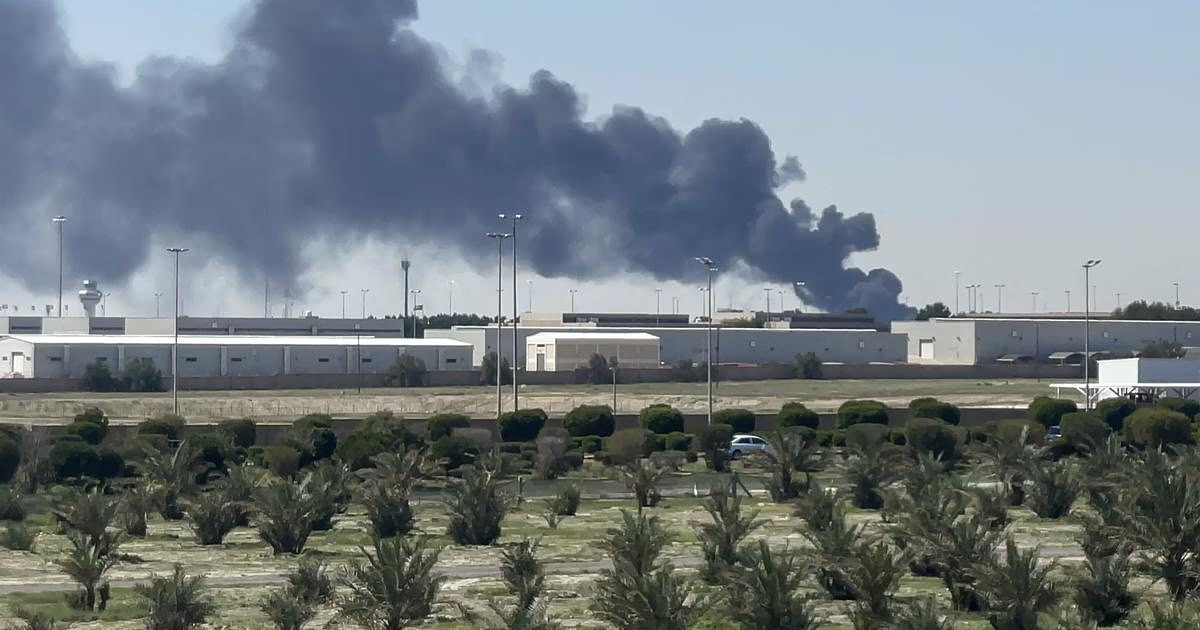
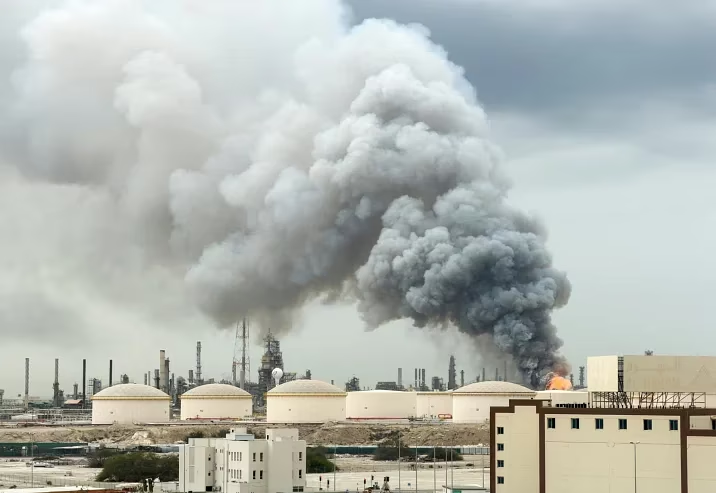
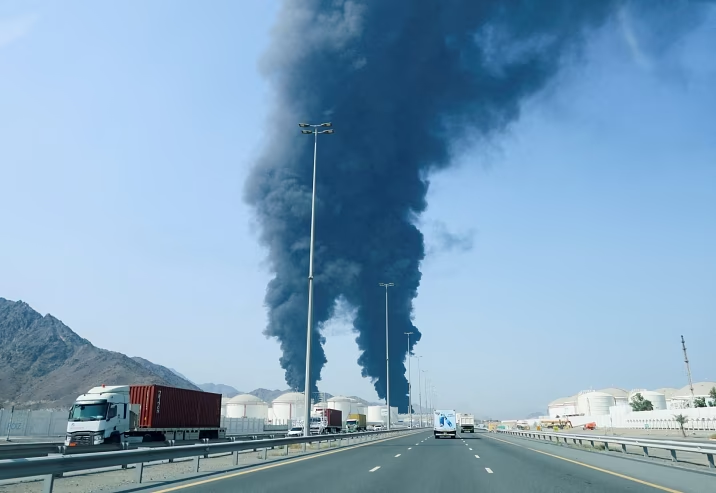
The past hours witnessed a wave of widespread attacks that affected five Gulf countries in addition to Jordan, in the most violent escalation since the de-escalation period that began last April. Field reports indicated that these attacks targeted vital sites, amidst direct accusations against Tehran for being behind these military operations.

For its part, the Iranian Revolutionary Guard announced escalatory measures, represented by the closure of the Strait of Hormuz to maritime navigation until further notice, threatening global energy supplies. Tehran justified this action by targeting two commercial vessels that it claimed had violated the transit rules imposed by the Iranian naval forces in the region.

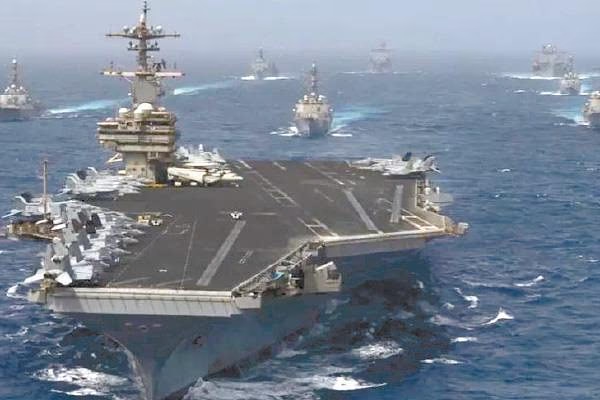
In a direct military response, the US Central Command (CENTCOM) launched widespread airstrikes targeting approximately 140 military sites within Iranian territory. Military sources explained that the strikes focused on neutralizing ballistic missile and drone capabilities, in addition to destroying ammunition depots and military communication networks.

Iran's response to the American attacks was not delayed, as Tehran announced missile bombardment targeting bases where American forces are present in Kuwait, Bahrain, Qatar, and Jordan. This direct exchange of fire raised international fears of the region sliding into a comprehensive and open confrontation that transcends the limits of usual clashes.

On the political front, US President Donald Trump announced that the memorandum of understanding reached with Iran last June had completely ended. Trump considered the recent Iranian escalation a violation of all previous understandings, closing the door to diplomatic efforts that had been led by regional and international parties.

That memorandum had been signed through intensive Qatari and Pakistani mediation, and it was hoped to be the cornerstone of a final agreement to end the chronic state of tension between Washington and Tehran. However, the recent field developments in the Strait of Hormuz and the targeting of military bases have dashed the chances of dialogue for the time being.

Global capitals are watching with great concern the repercussions of the closure of the Strait of Hormuz, which is a major artery for global trade and oil transport. Economic sources warned that the continued closure of the strait would lead to unprecedented jumps in global energy prices, adding new burdens to the already strained international economy.

Amidst this crisis, the affected Arab countries continue to coordinate their positions to ensure the protection of their national security and prevent the conflict from spreading further into their territories. These countries call on the international community to exert real pressure on all parties to return to the negotiating table and spare the region the ravages of a comprehensive war.

We affirm our categorical rejection of anything that would undermine the sovereignty of states or threaten the security and stability of the region, with the necessity of ensuring freedom of international navigation.

ARAB AND WORLD

Mon 13 Jul 2026 7:58 am - Jerusalem Time

Iran accuses Washington of undermining diplomacy and vows retaliation after strikes targeted 140 sites

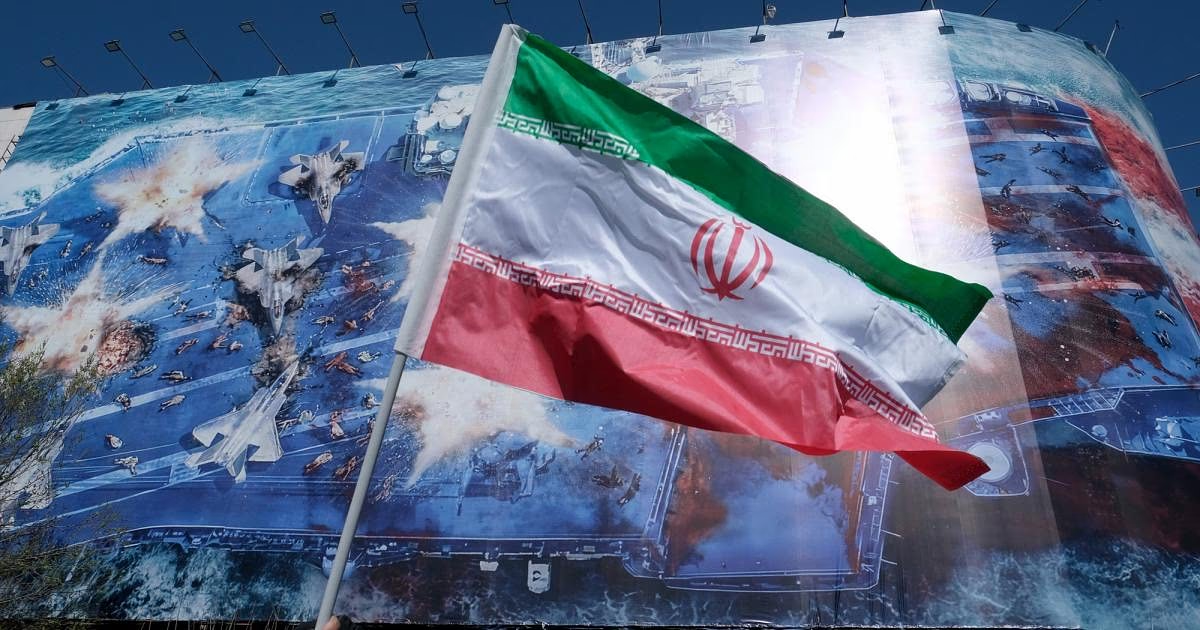
The Iranian Ministry of Foreign Affairs strongly condemned the military strikes carried out by the United States on its territory, describing them as an aggressive act that undermines all diplomatic efforts. Tehran affirmed in an official statement that Washington is responsible for thwarting the efforts made over the past months to de-escalate the situation in the West Asia region.

Iranian diplomacy considered these attacks a blatant violation of the principles of the United Nations Charter and international laws governing state sovereignty. Tehran warned that the continuation of this American military approach poses a direct threat to international peace and security, and pushes the region towards further instability.

For its part, the US Central Command (CENTCOM) announced a wide wave of airstrikes targeting about 140 military targets within Iranian territory. Military sources explained that the attacks hit missile and drone sites, in addition to ammunition depots, naval facilities, and coastal communication and surveillance networks.

Sources indicated that these operations came under direct orders from US President Donald Trump, with the aim of holding Iranian forces accountable for targeting commercial vessels. Washington claimed that the strikes seek to weaken Tehran's ability to threaten international navigation in the Strait of Hormuz and ensure the safety of civilian sailors crossing the waterway.

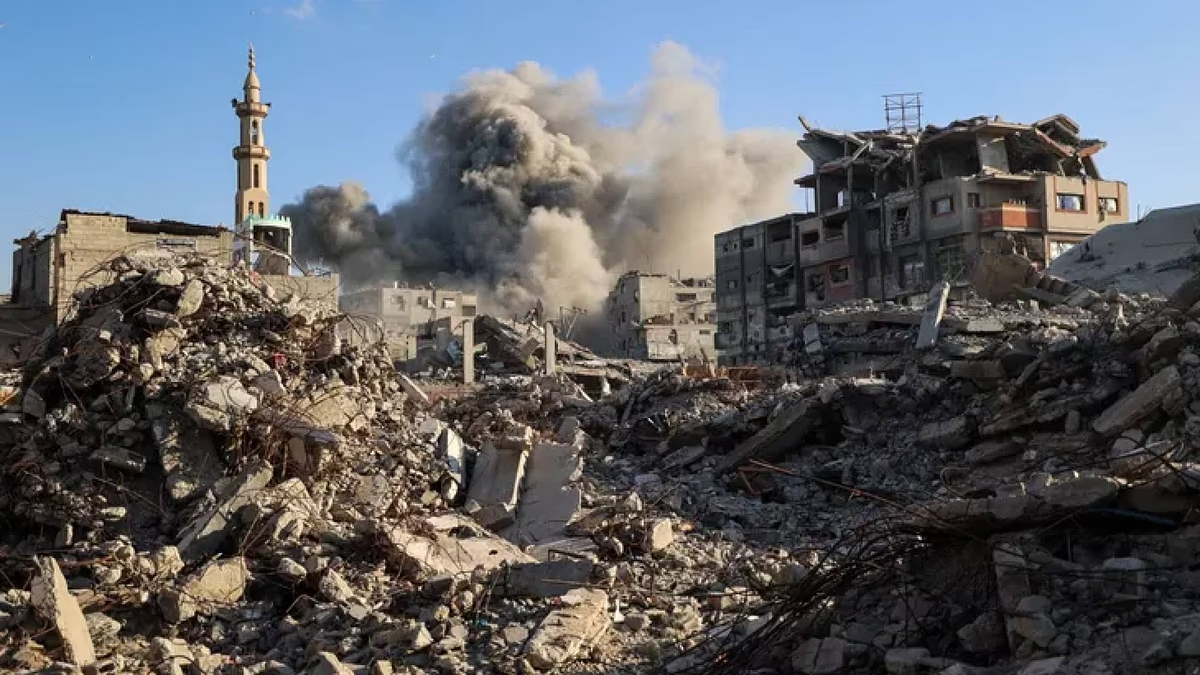
In contrast, media sources in southern Iran reported hearing violent explosions shaking several strategic areas, including Qeshm Island and the cities of Jask, Sirik, and Bandar Abbas. These areas are vital centers overlooking the Strait of Hormuz, where US strikes focused on disrupting Iranian defensive and offensive capabilities there.

In a remarkable field development, the Iranian Revolutionary Guard announced the complete closure of the Strait of Hormuz to maritime navigation until further notice, in response to the American escalation. This decision came hours after the Revolutionary Guard announced targeting two commercial vessels in the strait, claiming they violated the transit rules recently imposed by Iranian authorities.

Iran's response was not limited to closing the strait, but extended to targeting sites where US forces are stationed in several countries in the region. Tehran announced that it had launched missile strikes at military sites in Kuwait, Bahrain, Qatar, and Jordan, as part of what it described as a legitimate response to American aggression.

On Sunday, the region witnessed a wave of attacks, the widest since the undeclared truce between Washington and Tehran last April. These attacks affected six Arab countries, including Qatar, the UAE, Kuwait, Bahrain, Oman, and Jordan, amid direct accusations against Iran of being behind these escalatory operations.

Tehran accused the US administration of causing the return of insecurity in the Strait of Hormuz, through what it described as overt interference in the security arrangements taken by Iran. The Iranian Foreign Ministry said that the US military presence is the main reason for disrupting international trade and destabilizing waterways.

These rapid developments bring tension to its peak in the Gulf region, amid international fears of a comprehensive confrontation that would affect global energy supplies. Observers believe that the closure of the Strait of Hormuz represents a strong bargaining chip used by Tehran to counter the military and economic pressures exerted by Washington.

In light of this escalation, international circles are awaiting global reactions and the positions of major powers regarding this direct conflict. Questions remain about the extent to which remaining diplomatic efforts can contain the situation and prevent the region from sliding into a large-scale war whose outcomes cannot be predicted.

These brutal attacks are not only a blatant violation of the principles of the United Nations Charter, but also pose a serious threat to international peace and security.

OPINIONS

Mon 13 Jul 2026 7:58 am - Jerusalem Time

Peace Council statement disappointing

A correct direction, a realistic legal vision, and an independent political will were expressed by "Human Rights Watch" through its statement issued in response to the statements of the American "Peace Council" led by President Trump, in which it said that "the Gaza Strip does not need the United Nations Relief and Works Agency for Palestine Refugees in the Near East (UNRWA)."

The Peace Council's decision revealed from its very first step that it does not respond to the interests of the afflicted people: the Palestinian people in the Gaza Strip, and expressed its first bias towards the plans of the Israeli colony aimed at eliminating the place and role of UNRWA in direct cooperation with the American administration, to weaken UNRWA, diminish its role, and impoverish it by stopping financial aid to it, with the aim of eliminating it from operation and the result and goal is to work to eliminate the reasons for its existence, which is the issue of Palestinian refugees who represent half of the Palestinian Arab people, and with the aim of eliminating their identity, eliminating their cause, eliminating their right to return to Lod, Ramle, Jaffa, Haifa, Acre, Safed, Tiberias, Beisan, Beersheba, and to all the cities and villages from which they were expelled in 1948, and restoring their properties from and in them.

The refugee issue is not a secondary issue, left to the passage of time; it is a reality and a human existence for Palestinian refugees in the camps of Lebanon, Syria, and Jordan, and their right to return according to UN Resolution 194.

And this was their motive, their initiative, and their continuous struggle. They were the ones who ignited the revolution: Yasser Arafat, Khalil al-Wazir, Salah Khalaf, George Habash, Talat Yaqoub, Abu al-Abbas, Abdul Wahab al-Kayyali, and dozens who fell along the way due to assassinations, or passed away due to old age. They were the ones who created the revolution and revived the Palestinian cause, before the issue moved from exile to the homeland as a result of the First Intifada in 1987, and the Oslo Accords in 1993.

The Peace Council, which failed from its first step and its first statement, recorded failure in achieving a practical step for the benefit of the Palestinian people in the Gaza Strip:

1- Stopping the continuous organized Israeli killing and assassination operations.

2- Stopping the continued deliberate Israeli destruction of all that remains in the Gaza Strip.

3- Opening the crossings and freedom of movement for entry and exit from the Gaza Strip.

4- Introducing essential and necessary aid, starting with food, clean water, and equipment and tools for removing rubble.

The colonial government, despite all it has done in the Gaza Strip, from killing tens of thousands, injuring twice that number, and destroying two-thirds of the buildings, facilities, and infrastructure of Gaza Strip institutions, and depriving it of schools, mosques, churches, residential buildings, streets, water wells, and workshops, is still working to continue removing life, and making the Gaza Strip unfit for human habitation and human life, with the aim of displacing and expelling the people of the Gaza Strip as it did in 1948 with the people of the first occupation areas: deliberate massacres, and pushing Palestinians towards refuge and migration.

Human Rights Watch, based on the legitimacy of UN Resolution 302, and its follow-up to what UNRWA does, rejected the statement of the so-called Peace Council, which lacks the spirit and goal of peace, and revealed its motives as an institution born from the ideas of President Trump, who announced its formation and heads it. So what will come out of it and from it for the afflicted people??.

The Peace Council's statement applies to the saying: "He came to apply kohl, but blinded her instead."

OPINIONS

Mon 13 Jul 2026 7:58 am - Jerusalem Time

The Battle for Access to AI Models is Israel's Next Strategic Challenge

The above title is for a policy paper issued by the Israel Institute for National Security Studies (INSS) on July 1, 2026, by researcher Hadas Lorber. Specialists in Israeli national security issues consider Hadas's paper one of the most important papers published by the institute this year, 2026, because it simply reveals a qualitative shift in Israeli security thinking.

Previously, these institutions believed that Israeli superiority was achieved through: 1- possessing the best minds. 2- possessing strong startups. 3- close cooperation with the United States, enabling it to possess unique American weaponry not available to others in the region.

Now, the paper implicitly states, "Even if Israel is a close ally of Washington, its access to the most powerful AI models may not be guaranteed, as these models have become pillars and tools of American national security."

The researcher here relies on a specific incident: the US administration imposing restrictions on Anthropic on June 12, 2026, including restricting access to some of its advanced models, especially Fable 5 and Maythos 5, for users and entities outside and inside the United States for non-Americans, for national security reasons. The researcher adds that this event is not an exceptional case but represents the beginning of a new phase in international politics, where AI models themselves become a strategic asset subject to government control.

The researcher clarifies here that the concept of digital sovereignty previously focused on data, cloud computing, and internet regulation, but the new phase centers on sovereignty over access to advanced AI models. This means that possessing data or chips alone is no longer sufficient; rather, the ability to use advanced models may become a geopolitical leverage tool.

Accordingly, the paper believes that Israel is required to re-evaluate its policy in four interrelated areas:

* Technological sovereignty.

* Artificial intelligence.

* Computational infrastructure.

* National security.

It adds that complete reliance on American companies may turn into a strategic weakness in the future if Washington decides to restrict access to these technologies.

It should be clarified here that researcher Hadas's paper aligns with other papers and assessments recently published by interested parties around the world, especially Chinese and Russians. A comparison shows that this paper agrees with the papers of Russian and Chinese researchers on three axes.

1- Artificial intelligence has become a geopolitical weapon and is no longer just a computer program, but a strategic resource similar to:

* Oil in the 20th century.

* Nuclear weapons during the Cold War.

2- The United States has begun to monopolize technology, but while Chinese and Russian articles say that Washington may make AI part of national security, the Israeli paper says that this is already happening now.

3- Alliances are no longer enough.

Even the closest allies may be subject to restrictions if American interests conflict with their own.

Why are Israelis concerned?

Israelis are concerned because Israel relies heavily on American companies such as:

* OpenAI

* Anthropic

* Google

* Microsoft

If these companies operate according to US national security directives, then part of Israel's superiority will become dependent on a political decision in Washington, and this is what the paper considers a strategic threat that must be prepared for.

The broader strategic implication of the paper

I believe that the most dangerous thing in this paper is not what it says about Israel, but what it reveals about American strategy.

If the United States has indeed begun to control who can use advanced AI models, then we are facing a new phase that can be called:

"The era of AI diplomacy"

That is, access to AI models may become like:

* Exporting fighter jets.

* Exporting electronic chips.

* Exporting nuclear technology.

In other words, artificial intelligence is transforming from a commercial product into a tool of political and strategic influence.

In conclusion, the INSS paper confirms that Israel now believes that the battle of the future will not only be about possessing the latest warplanes, air defenses, and artificial intelligence, but about the right to access it. It reflects a growing realization that the United States may use advanced models as a foreign policy tool, even towards allies when interests diverge, an issue whose chapters we lived through after the signing of the US-Iranian memorandum of understanding last June, and that the concept of national security is no longer limited to weapons and economy, but also includes control over computational infrastructure and smart models themselves. In this sense, the paper is consistent with the trend dominating studies and papers of the most important research centers in the world, especially American and Russian ones such as Geopolitical Futures and Geopolitika.ru, that artificial intelligence is gradually becoming one of the most important determinants of power in the new international and regional systems.

This raises the legitimate question: where are we as Palestinians and as Arab and Islamic countries, especially those specialized in Arab national security, from these developments? And what are their explanations for Arab and Islamic national security in the era of artificial intelligence, which has clearly become one of the most important pillars of state national security, especially after the crimes of genocide committed by Israel against Palestinians and Arabs, crimes that have not yet stopped?

OPINIONS

Mon 13 Jul 2026 7:58 am - Jerusalem Time

Elections and the Reconstruction of the National Liberation Project

With the issuance of the presidential decree setting the date for the legislative elections on November 28th, Palestinian political life enters a long-awaited new phase. However, the importance of this entitlement lies not in its date or procedures, but rather in the question that imposes itself today: what is the relationship between this democratic entitlement and the task of rebuilding the Palestinian national liberation project? And can elections become part of this process, or will they remain merely a constitutional entitlement that reproduces the crisis under more complex circumstances?

There is no disagreement that elections are an inherent democratic right, and that renewing legitimacies is a national necessity that should not remain hostage to postponement or political calculations. A political system capable of confronting challenges, or restoring citizens' trust in its institutions, cannot be built without returning to the will of the people and respecting their right to choose their representatives as the source of authorities and the owner of legitimacies.

However, the Palestinian experience has confirmed that elections, no matter how fair, are not enough on their own to address a political and national crisis of this magnitude, if there is no agreement on the nature of the stage, its priorities, the rules of national partnership, respect for political pluralism, and commitment to representative political references.

Elections are not a national project in themselves, but rather one of the tools of political action. Their true value is measured by their ability to contribute to rebuilding the political system, strengthening the unity of national institutions, renewing trust between citizens and their institutions, and placing the national liberation project back at the center of political action.

This issue takes on exceptional importance in light of the attempts to reshape the political and geographical reality of the Palestinian cause. The continuation of the war of extermination, starvation, and displacement in the Gaza Strip and the formation of alternative administrations there, and the escalation of settlement and annexation in the West Bank, and even the displacement of our camps, do not only target land and people, but aim to impose a new political reality, in which the Palestinian people are reduced to population clusters managed under occupation through the re-engineering of the region, instead of recognizing them as a people with a right to freedom, self-determination, and national independence.

In contrast, the international and regional systems are undergoing profound transformations, revealed by the war on Gaza and the unprecedented expansion of global popular solidarity that accompanied it, the increasing recognition of the State of Palestine despite the symbolism of some without consequences, and the unprecedented expansion of criticism of Israeli policies, especially in the West, including in the United States, in addition to the rapid shifts in the international balance of power. Although these changes have not yet translated into decisive international policies, they open new opportunities for us Palestinians, just as they impose new challenges on us.

However, the reliance should not be on these transformations alone, nor on waiting for the outcomes of regional and international changes, but rather on possessing an independent national political vision and will, capable of seizing opportunities and confronting risks. External changes may provide new margins for movement, but they cannot compensate for the absence of the necessities of rebuilding the national liberation project, nor for the continuation of division, nor for the weakness of institutions.

Perhaps the biggest mistake is to reduce elections to a means of renewing authority, while the real challenge lies in rebuilding the Palestinian national liberation project, and renewing its tools, mechanisms of action, and forms of struggle, in line with the transformations imposed by the war, and restoring the اعتبار of our cause as a national liberation cause for a people striving for freedom and independence, not a matter of managing populations under occupation.

What is required today is not only to rebuild the political system, but to redefine the relationship between its institutions and objectives, so that the national authority becomes a tool in the service of the national liberation project, and not for the national project to become a tool in the service of authority.

From this perspective, the amendments introduced to the election law, whether related to the number of members of the Legislative Council, the threshold percentage, or others, deserve a calm, responsible, and broad national discussion, not from the perspective of prior support or rejection, but from the perspective of their impact on political life. The challenge lies not only in expanding representation, but also in preserving programmatic competition, strengthening the role of political and societal forces, limiting fragmentation, and preventing the prevalence of local, personal, or tribal considerations or the influence of political money over national choices.

Hence, elections should be included within a broader political and national process, starting with a responsible national dialogue, not based on quotas or sharing positions, but on agreement on the nature of the stage and its priorities, the minimum national program, the foundations of national partnership, respect for election results, and strengthening the status of the Palestine Liberation Organization as the sole legitimate representative of our people, and working to develop and activate its institutions on democratic foundations as a broad national front, ensuring the participation of all components of our people in the homeland and the diaspora.

The legitimacy our people need today is not only electoral legitimacy, but also national legitimacy, measured by the ability of elected institutions to protect the national liberation project, preserve the unity of the people, land, and cause, and defend inalienable Palestinian rights, foremost among them the right to self-determination and the embodiment of an independent and sovereign Palestinian state.

Electoral entitlement has become a political reality today, but its success will not depend on election day alone, but on the ability of national forces, civil society, and national independents to restore people's trust, build a comprehensive national political discourse, protect the national will from political money and centers of influence and from all forms of external influence, and strengthen national partnership in confronting the most dangerous project targeting our cause.

While elections should include the presidency at the same time without postponement to another time next year, and ensure the participation of our people in all governorates of the homeland, including Gaza and Jerusalem, they are not a battle for power, but should be part of a battle to rebuild the Palestinian national movement, renew its institutions, regain political initiative, and unite the energies of our people in confronting the occupation and its plans.

If we Palestinians make good use of this entitlement, it could become an important step in the path of rebuilding the national liberation project on the foundations of partnership, democracy, and independence. However, if it is reduced to a competition for power or to reproducing division, it will remain just another stop in managing the crisis, while what is required is to overcome it, and move towards a new stage in which the national liberation project, with all its political, democratic, and struggle dimensions, is the compass that guides Palestinian national action.

* Member of the Fatah Movement's Advisory Council.

PALESTINE

Mon 13 Jul 2026 7:58 am - Jerusalem Time

Washington and Tehran... mutual threats and accelerating developments bring back the specter of confrontation

Dr. Tamara Haddad: Tehran adopts a strategy of "calculated revenge" to prove its ability to respond and impose its conditions, and Washington raises the level of its threats to push Iran to recalculate.

Sari Sammour: There are no guarantees about the non-expansion of the confrontation or its getting out of control, especially with indications of a possible escalation after the World Cup.

Dr. Hussein Al-Deek: Trump's statements in response to being targeted aim to strengthen American deterrence and send a message that any targeting of the American leadership will be met with a harsh response.

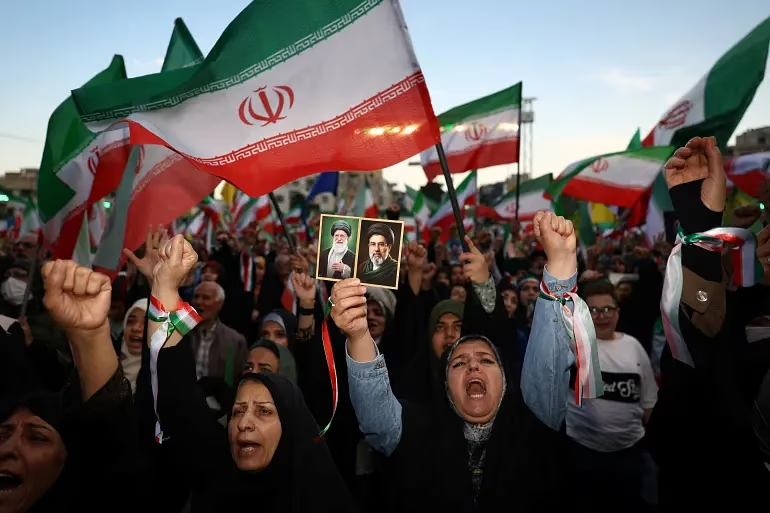
Labib Taha: The massive funeral of the former Supreme Leader and the millions-strong marches that accompanied it came as a surprise to the United States and contributed to its feeling that its goals had not been fully achieved.

Dr. Qusai Hamed: The possibility of war returning has become likely, given the mediators' inability so far to bring the two parties back to the negotiating table or contain the escalating tension.

Nouman Tawfiq Al-Abed: The new Supreme Leader's statements aim to convey a message that the assassination of Iranian leaders will not prevent Tehran from responding, but may push it to adopt more hardline positions.

Ramallah - Exclusive to "Al-Quds" -

The accelerating developments between the United States and Iran are bringing the region back into a cycle of tension, with escalating political and military rhetoric and an exchange of threats between Tehran and Washington, at a time when doubts are increasing about the ability of previous understandings to prevent the collapse of the truce, amidst continuing disagreements over the Strait of Hormuz, the nuclear file, and deterrence mechanisms between the two parties.

Writers, political analysts, specialists, and university professors, in separate interviews with "Al-Quds", believe that the current stage is characterized by a cautious balance based on the exchange of pressures and military messages, as Tehran tries to maintain its cards of influence and confirm its ability to respond, while Washington continues to tighten its deterrence and pressure policy to extract concessions in the pending files, amidst increasing indications of the fragility of the negotiation process and the difficulty of reaching a stable settlement.

They point out that the scene remains open to multiple possibilities, starting with the continuation of limited confrontations and mutual strikes, and may extend to a wider regional escalation if developments get out of control, while the diplomatic path remains open but faces major challenges, with the continued divergence of the positions of the two parties and the overlap of regional and international calculations, which threatens navigation and energy security and stability in the region.

A new, extremely dangerous stage

Political writer and researcher Dr. Tamara Haddad confirms that the Arabian Gulf region is entering a new, extremely dangerous stage at both the political and military levels, in light of the escalating tension between Iran and the United States, especially after Iranian statements regarding the Strait of Hormuz, and the mutual responses between the Iranian leadership and US President Donald Trump.

Haddad explains that Iran affirms its adherence to the option of closing the Strait of Hormuz, at a time when Washington is awaiting a clear position from the Iranian Foreign Ministry regarding opening the strait without fees, and without targeting passing ships, noting that the file has become a key point of contention between the two sides.

Haddad believes that the statements of Iranian Supreme Leader Mojtaba Khamenei regarding revenge for his father's killing, along with the positions of the Revolutionary Guard, reflect the continuation of the theory of revenge within Iranian calculations. In contrast, Trump responded with an unprecedented threat, especially after Israeli intelligence information spoke of the possibility of him being targeted by Iran, stressing that any attempt to do so would be met with a wide military response against Tehran.

Haddad confirms that these developments come in a fragile regional environment still affected by the repercussions of the recent war between the United States and Israel on the one hand, and Iran on the other, noting that the existing memorandum of understanding was built on an unstable reality, in the absence of a clear common ground between the two parties, and the Strait of Hormuz remaining the core of the problem.

Leaders are part of the deterrence and revenge equation

According to Haddad, the implications of the escalation go beyond media warfare and the exchange of political messages, as they reflect the transition of the conflict to a stage of "personal deterrence," where political leaders themselves have become part of the equation of revenge and deterrence.

She points out that Iran seeks to demonstrate its ability to respond to preserve the prestige of the regime and its internal cohesion, while Washington tries to establish a policy of maximum deterrence to prevent any targeting of American interests or leaders.

Haddad explains that Tehran adopts a strategy of "calculated revenge." It does not want to be dragged into a comprehensive war, but it seeks to prove its ability to respond and impose its conditions in any negotiation, especially regarding the Strait of Hormuz file and related issues, while Washington continues to raise the level of threats to push Iran to recalculate.

Haddad points out that the importance of the Gulf is not only linked to the American military presence, but also to its being a major artery for global energy, which means that any military escalation will affect oil prices, navigation, and international supply chains.

Limited escalation and fears of sliding into a regional confrontation

Regarding the possibilities of returning to war, Haddad explains that the most likely scenario is a limited escalation through indirect operations, cyberattacks, and the deliberate targeting of American and Israeli interests, in exchange for limited responses that maintain deterrence without an open war. However, Haddad warns of another scenario: the possibility of sliding into a wide regional confrontation if there is a miscalculation or a large number of casualties.

According to Haddad, the third scenario is to contain the escalation through diplomatic channels, due to all parties' awareness of the high cost of a comprehensive war, stressing that the region does not necessarily face a wide war, but it is experiencing a very dangerous stage due to the high probability of miscalculation, while mutual deterrence remains the most prominent factor in preventing a major explosion.

Understandings that do not last long

Political writer and analyst Sari Sammour explains that the memorandum of understanding signed between the United States and Iran was not sustainable for long, and the American side is working to violate it, which has already happened, but he stresses that the degree of the upcoming escalation remains unpredictable in light of the fluidity and tension in the region.

Sammour points out that the United States is currently carrying out "calculated" escalation operations, and Iranian responses are within calculated limits, but there are no guarantees about the non-expansion of the confrontation or its getting out of control, especially with indications, statements, and leaks talking about the possibility of escalation after the World Cup.

Sammour believes that the statements of Iranian Supreme Leader Mojtaba Khamenei regarding revenge for his father's killing left the door open, noting that Tehran has become accustomed to issuing threats of revenge without specifying a date or announcing the start of direct operations.

Targeting Trump and internal calculations

As for US President Donald Trump's repeated statements about the possibility of him being personally targeted, Sammour believes that they may be more related to American internal calculations and Trump's personality, rather than being an indication of actual plans to assassinate him.

He points out that Trump uses this rhetoric to justify escalation and create a special image of himself, citing the change in his rhetoric between talking about making peace and stopping wars on the one hand, and saying that he targeted Iran or that he is exposed to assassination on the other.

Between the scenario of returning to de-escalation and escalation

Regarding the upcoming scenarios, Sammour explains that the first scenario is Trump's return to de-escalation and the re-implementation of the memorandum of understanding, but he considered it an unlikely scenario.

The second scenario, according to Sammour, is the continuation of limited and calculated escalation between the two parties with the aim of improving negotiation conditions and reaching a new understanding.

Sammour points out that the third scenario is the expansion of military operations, including a greater escalation around the Strait of Hormuz and perhaps its extension to the Bab al-Mandab Strait through the Houthis entering the confrontation line, which could lead to an expansion of the circle of responses and tension in the region.

Israel's role in the scene

Sammour draws attention to Israel's role in the scene, referring to reports that spoke of Gulf demands for the United States to pressure Israel to prevent its intervention, because any Israeli participation could expand the circle of fire and lead to a series of strikes and responses that would return the region to the atmosphere of the previous war, and perhaps on a wider scale.

He believes that the danger of the situation lies in the inability of any party to guarantee the course of events, explaining that the United States may be able to start the war, but it will face difficulty in how to end it.

Sammour points out that Trump's personality and his management style based on volatility and not relying entirely on institutions, along with Israeli pressures, make reading the American position more complex, as the transition between de-escalation and war remains a possibility.

Clash of wills between Washington and Tehran

Professor of Political Science and specialist in American affairs and international relations, Dr. Hussein Al-Deek, confirms that what is happening between the United States and Iran represents a clash of wills between them, suggesting that the next stage will witness more military escalation, considering that this long-term conflict will not be resolved politically through negotiations, but by military force.

Al-Deek explains that there is a shift in the positions of a number of regional countries and countries of the world, especially NATO countries and Western Europe, towards the issue of closing the Strait of Hormuz and freedom of navigation, pointing out that the path opened by the Sultanate of Oman as a safe path in cooperation with the International Maritime Organization was targeted by Iran, which the United States considered a form of control, piracy, and aggression in the Gulf, which increases the possibilities of escalation.

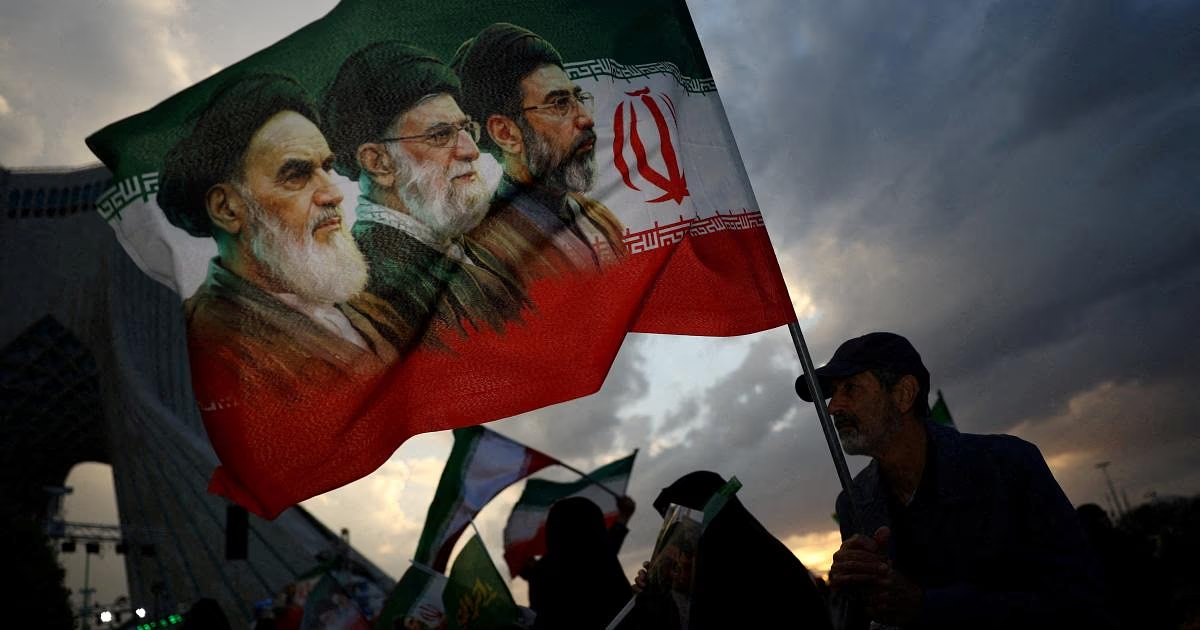
He points out that Iranian statements regarding revenge, and the banners raised during the funeral of Iranian Supreme Leader Ali Khamenei which included threats to target US President Donald Trump, along with intelligence information provided by Tel Aviv to Washington about possible Iranian plans to assassinate Trump, prompted the latter to announce that he had issued orders for a devastating military response if he was subjected to an assassination attempt.

Al-Deek points out that the fundamental question is not about whether a military clash will occur or not, but about the nature of this clash, and whether it will turn into an open war similar to the previous war, or will remain within the framework of limited strikes, localized operations, and targeting sensitive centers.

Expectations of controlled escalation in the short term

He expects that the remaining period of the next sixty days will witness a controlled escalation in the form of strike-for-strike and specific operations, but he expects in the long term the possibility of re-imposing the siege on Iran and opening the Strait of Hormuz by force by Washington and its European allies, and perhaps a return to a wide confrontation, amidst increasing Israeli pressures towards escalation.

Al-Deek explains that the proposed scenarios include the continuation of mutual strikes, or the region sliding into an open war during which the United States and Israel target Iranian energy centers and infrastructure, or an attempt to create internal unrest by supporting opposition groups, while the scenario of returning to negotiations remains weak, considering that Iran may use it to gain time and not to reach an agreement.

Personalization of the conflict

Al-Deek points out that the mutual statements regarding targeting Trump personally carry implications related to the "personalization of the conflict," so that targeting the Supreme Leader is met with targeting the American President, and through them, Iran aims to strengthen the internal front and confirm its ability to respond.

In contrast, Al-Deek believes that Trump's statements in response aim to strengthen American deterrence, and send a message that any targeting of the American leadership will be met with a harsh response, pointing out that these statements reveal the fragility of the memorandum of understanding between the two sides, and the possibility of the truce ending and a return to military operations, stressing that the region is facing a dangerous stage and that the drums of war are beating again.

Failure to achieve American goals

Writer and political analyst Labib Taha explains that the current escalation between the United States and Iran reflects a Western methodology based on trying to achieve goals through negotiations that were not achieved during the war, pointing out that Washington did not succeed in achieving its primary goals of overthrowing the Iranian regime or resolving the missile and nuclear files in the way it sought, which prompted it to try to interpret the ambiguous clauses in the understandings in a way that serves its interests.

He confirms that the continuation of the war faced internal pressures in the United States, in addition to international objections due to the absence of any UN mandate that would legitimize it.

Escalation as a negotiation tool

Taha explains that military escalation represents, from the perspective of the United States, part of the negotiation tools, as it seeks to conduct negotiations under pressure by continuing military strikes or using hard and soft power tools to push Iran to make concessions.

Taha points out that one of the reasons for the tension is Iran's feeling that the Strait of Hormuz card may be taken from it after the Omani initiative, explaining that the circulating proposals stipulate the resumption of work on the southern route of the strait through Omani territorial waters as it was before the war, while the northern route passing through Iranian waters requires coordination with Tehran without imposing fees, which the Sultanate of Oman rejects based on international law which considers the strait an international waterway open to navigation.

He explains that Iran's targeting of commercial ships came within its efforts to preserve the Hormuz card, while the United States considered this a violation of Article Four of the agreement concluded between the two sides last month, which stipulates ensuring freedom of navigation and opening the strait, while Tehran believes that the implementation of this commitment must be according to its conditions.

Taha points out that the nuclear file is still subject to negotiations and has not yet been resolved, noting that Washington also sought to empty the clause related to Lebanon of its content, although the agreement stipulated a cessation of military operations on all fronts, by overlooking daily Israeli violations and opening a new negotiating path so that the ceasefire would not be recorded as a gain for Iran.

New American conditions

Taha confirms that the United States has added new conditions that were not previously included, including what US Secretary of State Marco Rubio raised during his Gulf tour, linking investment and reconstruction in Iran to changing its regional behavior and missile and drone programs.

Taha believes that the massive funeral of former Supreme Leader Ali Khamenei and the millions-strong marches that accompanied it came as a surprise to the United States and to US President Donald Trump, and contributed to its feeling that its goals had not been fully achieved.

Taha believes that the outbreak of a comprehensive war is still unlikely, but not impossible, explaining that any wide confrontation would be a "bone-breaking" event, as the United States would seek to end Iran, while Tehran believes that such a war would change the face of the region, stressing that the developments of the next stage will remain subject to the political and military decisions of both parties.

A high level of tension between the two sides

Professor of Political Science at Al-Quds Open University, Dr. Qusai Hamed, confirms that the mutual escalation between Iran and the United States, in light of Iranian Supreme Leader Mojtaba Khamenei's statements regarding revenge for his father's killing, and Trump's threat to annihilate Iran if he is personally targeted, reflects a high level of tension between the two sides, and confirms that the understanding that stopped the war was only a fragile agreement that was not based on solid political rules that would guarantee its continuation or establish a permanent de-escalation.

Hamed explains that the mutual rhetoric should not be viewed only from the perspective of personalizing the conflict, but as an indicator of the tense nature of the relationship between the two parties, pointing out that the agreement reached was an emergency agreement imposed by temporary circumstances and interests, especially for the United States, rather than a stable political settlement, which explains the return of political and military escalation shortly after the cessation of fighting.

The possibility of war returning has become likely

Hamed confirms that the developments of the current stage indicate that the possibility of war returning has become likely, given the mediators' inability so far to bring the two parties back to the negotiating table or contain the escalating tension.

He points out that there are two main scenarios; the first is the resumption of military confrontation, and although not at the same pace as the previous war, it may be more intense than the limited clashes that followed the first de-escalation.

The United States resorting to coercive diplomacy

Hamed points out that there is another scenario, which is the United States resorting again to the policy of "coercive diplomacy," by tightening economic sanctions and raising the level of military threat, with the aim of pressuring Iran and forcing it to back down from its positions and return to previous understandings or accept a new agreement on American terms.

Hamed confirms that the main dilemma currently lies in the faltering negotiation process, and the absence of indications of progress within the specified deadline, or Washington's ability to impose its conditions related to the nuclear file, the Strait of Hormuz, and Iran's ballistic missile program.

The region is closer to escalation

Hamed explains that the absence of tangible results from the negotiations pushes the two parties to exchange blows and military responses, suggesting that the region is closer to a new escalation than to a political agreement. Hamed believes that any potential understanding in the next stage will likely not go beyond the framework of the agreement reached after forty days of fighting.

Hamed believes that the scene is gradually moving towards more escalation, despite the unresolved possibilities of a comprehensive war, pointing out that any exceptional incident could lead to unprecedented responses, and open the door for the confrontation to expand to include Israel and American interests in the region, thus returning the crisis to its starting point and establishing a new stage of instability.

Multiple political messages

Writer, political researcher, and specialist in international relations, Nouman Tawfiq Al-Abed, believes that escalation remains the most prominent feature of the scene in the Gulf region, especially with regard to the Strait of Hormuz, pointing out that the mutual political rhetoric between Iran and the United States is witnessing a continuous escalation that reflects the continued state of tension between the two parties, in the absence of real indications of de-escalation.

According to Al-Abed, the statements of the new Iranian Supreme Leader Mojtaba Khamenei that "revenge and retribution for the killing of his father Ali Khamenei is an inevitable demand," and that those responsible for the assassination will be held accountable, along with his call for "the free people of the world" to participate in this response, carry several political messages.

Al-Abed explains that the most prominent of these messages is the confirmation that the new Iranian leadership is still committed to the policy of response and non-retreat, and that the change in leadership has not changed the Iranian approach, but rather the new leadership appears to be more hardline than its predecessor and more committed to the policies followed by the former Supreme Leader.

Al-Abed explains that the second message of these statements is directed at opponents, and its purport is that the assassination of Iranian leaders will not prevent Tehran from responding, but may push it to adopt more hardline positions.

Assassination of the Supreme Leader strengthens the negotiating position

Al-Abed points out that the assassination of the first figure in the Iranian leadership did not push Iran to make concessions or surrender, but rather strengthened its adherence to its positions during negotiations, despite the long war and severe siege it was subjected to, noting that the exchange of threats between the two sides increases the possibilities of escalation, and pushes the countries of the region to raise security and diplomatic readiness levels.

Al-Abed believes that the Israeli factor is strongly present in this crisis, suggesting that Israel is behind many of the causes of tension, whether since the beginning of the war or through the intelligence information it provides to the United States, which he believes aims to fuel the crisis more than provide accurate information.

Al-Abed explains that Iranian statements also aim to show the cohesion of Iranian state institutions, and to confirm that the Supreme Leader is still managing the crisis, and that political and military institutions continue to implement his directives, which reflects the stability of the internal system's structure.

Disavowing previous understandings

In contrast, Al-Abed explains that Trump has become accustomed to issuing contradictory statements and tweets, considering that the threat of using force contradicts the memorandum of understanding that was concluded during the NATO meeting.

Al-Abed points out that part of the American administration, along with Israel, seeks to disavow previous understandings and retain the option of military strikes and siege without sliding into a comprehensive war.

Likelihood of continued American pressures and strikes

Al-Abed suggests that the United States will continue its current approach of strikes and pressures, while avoiding a wide war that would drain its capabilities and lead to an expansion of the conflict and damage to the global economy.

Al-Abed points out that this scenario may continue until Tehran accepts American proposals, or Washington is subjected to regional and international pressures that push it to return to adhering to the memorandum of understanding or reaching a permanent agreement that gives it, from its point of view, a better negotiating position.


OPINIONS

Mon 13 Jul 2026 7:57 am - Jerusalem Time

Demonizing Ideas

I return to what I wrote two days ago in the newspaper about the motives behind the internal accusations, skepticism, betrayal, and cruelty towards each other, and that the cause of this behavior is a feeling of weakness, helplessness, and failure in the face of a difficult reality. It is neither a victory nor a defeat, and because what has happened and is happening to us is not easy or comprehensible given the weight of the catastrophe, the extent of the destruction, and the cruel loss, some have emerged to hurl accusations indiscriminately, distribute patriotism according to their narrow understanding, and seize the opportunity to pounce on others, exploiting our internal reality where moments and days are constrained, and the space for destruction expands. With the enormous technological development, crowded with suspicious yellow pages, the pace of rumors has increased and the truth has disappeared. This space has become susceptible to snatching and partiality, taking words out of their context for a purpose desired by adversaries, and people's destinies have become intertwined, liars have mastered their game, and much of the truth has been lost, and as the Palestinian proverb says: 'The good and the bad have mixed.'

And because I do not doubt what some have brought forth, I am among those who believe that some build their ideas on what they read and see without verifying that the matter is partial or incomplete, and contains deception stemming from premeditated intentions. Out of good intentions, these people are excused, even if they are obliged to scrutinize next time before issuing judgments that reach the limits of skepticism and betrayal, for this incomplete information cannot be used to build positions, and listening to yellow pages shakes social cohesion and spreads hatred.

Anyone following the Palestinian situation in recent years can feel the extent of rumors and misleading news, and the unknown and unidentified yellow pages that stand behind them. These pages work to spread sedition that no longer stops between factions and parties, but has extended to create sedition between Gaza and the West Bank, and between one city and another, and between one family and another. They tamper with everything and have no limits, sometimes attacking a leader or a president, and other times attacking an academic and a ministry, and trying to tamper socially, economically, and politically, from all angles.

The most dangerous thing about these pages is that some believe them, and that they find those who promote their lies without awareness, knowledge, or understanding, so they grow, multiply, and roll. Therefore, it is imperative for us to say that your reading of the news does not mean that it is real news, but it is necessary to obtain it from credible sources, and to investigate to make sure first, and then to build your correct idea, and not be exposed to rumors.

Rumors destroy society, and disagreement with others does not allow anyone to spread poison against them falsely and accuse them indiscriminately just because they expressed an idea, whether you agreed with it or disagreed. Even disagreement has principles and is based on ethics, the foundation of which is respect for human beings, and discussing ideas with evidence and proof, not with incitement, distortion, and betrayal. Demonizing ideas does not produce truth, nor does it build a society, but rather deepens division, and gives rumor-mongers a greater opportunity to tamper with our awareness and cohesion, while the truth remains in need of a balanced mind, a living conscience, and a responsible word.

PALESTINE

Sun 12 Jul 2026 11:00 am - Jerusalem Time

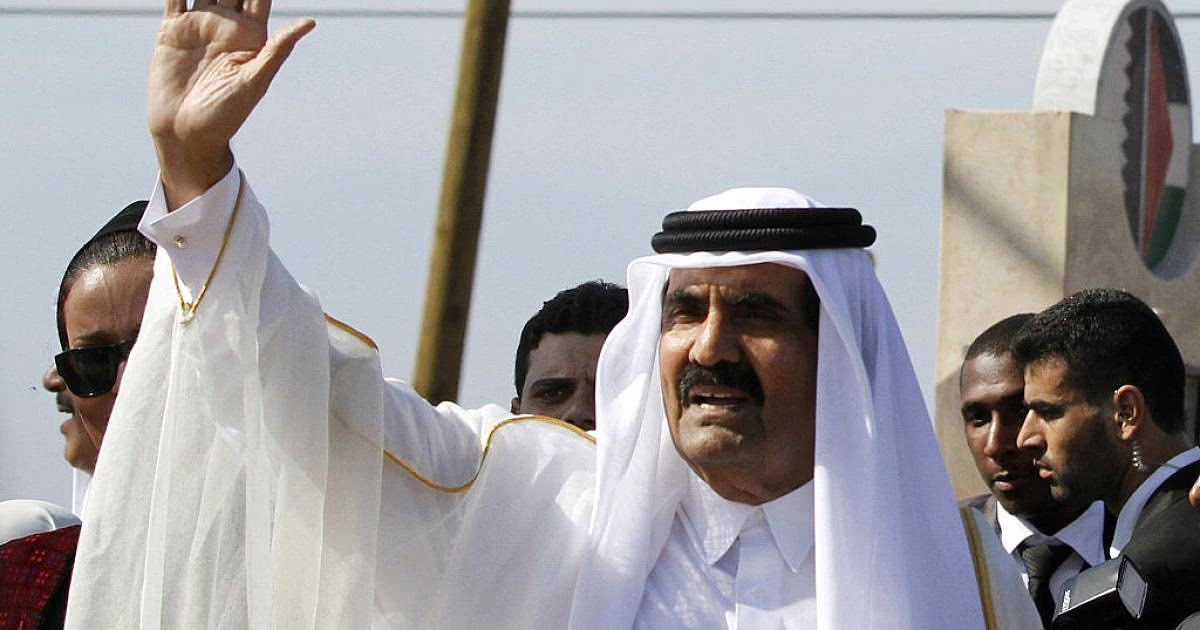
The Passing of the Father Emir Sheikh Hamad bin Khalifa Al Thani: The Journey of a Leader Who Laid the Foundations of Modern Qatar's Renaissance

The State of Qatar and the Arab and Islamic nations bid farewell this Sunday morning to the Father Emir Sheikh Hamad bin Khalifa Al Thani, who passed away at the age of 74. The Qatari Emiri Diwan announced the news in an official statement, mourning the leader whose name was associated with radical transformations that made Qatar a formidable player in the international equation.

The deceased was born in Doha in early 1952, growing up in an environment that relied on limited resources before the major gas discoveries. He received his early education in Qatar, then joined the Royal Military Academy 'Sandhurst' in the United Kingdom, graduating in 1971, to return to his country and begin his journey in building the Qatari military institution.

On May 31, 1977, Sheikh Hamad was sworn in as Crown Prince and appointed Minister of Defense, a period that saw the laying of the first cornerstones for the development of the armed forces. His vision from the outset was characterized by a desire for radical change and to transform the country from a state of traditional dependence to the horizons of a modern, integrated state.

Sheikh Hamad assumed power on June 27, 1995, beginning a phase described as the 'great leap forward'. During that period, the country faced difficult economic challenges and a nearly empty treasury, but his will was directed towards unprecedented exploitation of natural resources to secure the future of coming generations.

Sheikh Hamad is considered the true architect of Qatar's gas industry, having decided on massive investments in the North Field despite the financial risks at the time. By 1996, Qatar began exporting its first shipments of liquefied natural gas, becoming under his reign the largest exporter of this clean energy in the world, which provided enormous financial flows used for development.

The renaissance during the Father Emir's era was not merely material; it also included building people and institutions, as he launched the 'Education City' project which attracted the most prestigious international universities. His reign also saw the promulgation of the country's first permanent constitution in 2003, which established the foundations for institutional work and popular participation in decision-making.

On the political front, Sheikh Hamad adopted an independent and active foreign policy, making Doha a center for international mediation and conflict resolution. He sought for Qatar to be an active partner at the international table, not just a subject of discussion, which enhanced its presence in international forums and organizations.

The Father Emir's name was associated with supporting just Arab causes, foremost among them the Palestinian cause, as he was among the first leaders to break the siege on the Gaza Strip. Qatar also played a pivotal role during his reign in the reconstruction of southern Lebanon after the 2006 aggression, and in providing humanitarian aid in various crises.

His years in power witnessed an unprecedented sports and cultural boom, culminating in Qatar's historic win to host the 2022 World Cup finals. This achievement was considered an extension of his vision to place Qatar at the heart of global attention, and to break stereotypes about the Arab region and its organizational capabilities.

In a move described as historic and unprecedented in the Arab region, Sheikh Hamad announced on June 25, 2013, his abdication of power to his son, Sheikh Tamim bin Hamad Al Thani. In his abdication speech, he affirmed that the time had come to open the way for a new generation to lead the building process with a youthful spirit and a renewed vision.

After handing over power, he held the title of 'Father Emir' and remained a national symbol widely respected inside and outside Qatar, continuing the development process he began. His later years were characterized by tranquility and presence at major national events, observing the fruits of his planting that blossomed in all fields.

Sheikh Hamad's vision was distinguished by the ability to balance modernity and authenticity, as he preserved Qatari and Arab identity amidst global openness. Throughout his reign, he sought to raise the income level of Qatari citizens to be among the highest globally, with a focus on quality education and healthcare.

Close sources confirm that the deceased believed that wealth should be a means for national liberation and building independent will, not just numbers in banks. This explains Qatar's bold stances on complex regional and international issues, where dialogue and prioritizing the voice of reason were the adopted approach.

With the passing of Sheikh Hamad bin Khalifa Al Thani, a bright page in Qatar's modern history closes, but his impact will remain etched in the institutions, cities, and projects he built. His memory will forever be associated with the image of the leader who dared to dream and transformed the desert into a global beacon of gas, knowledge, and sports.

Sheikh Hamad's grand project was for the region to be at the heart of the world, not on its periphery, for wealth to be a blessing, not a curse, and for Qatar to possess its own independent decision and voice.

ARAB AND WORLD

Sun 12 Jul 2026 11:00 am - Jerusalem Time

Rubio, the 'de facto ruler': How Venezuela is run from Washington offices after Maduro's overthrow

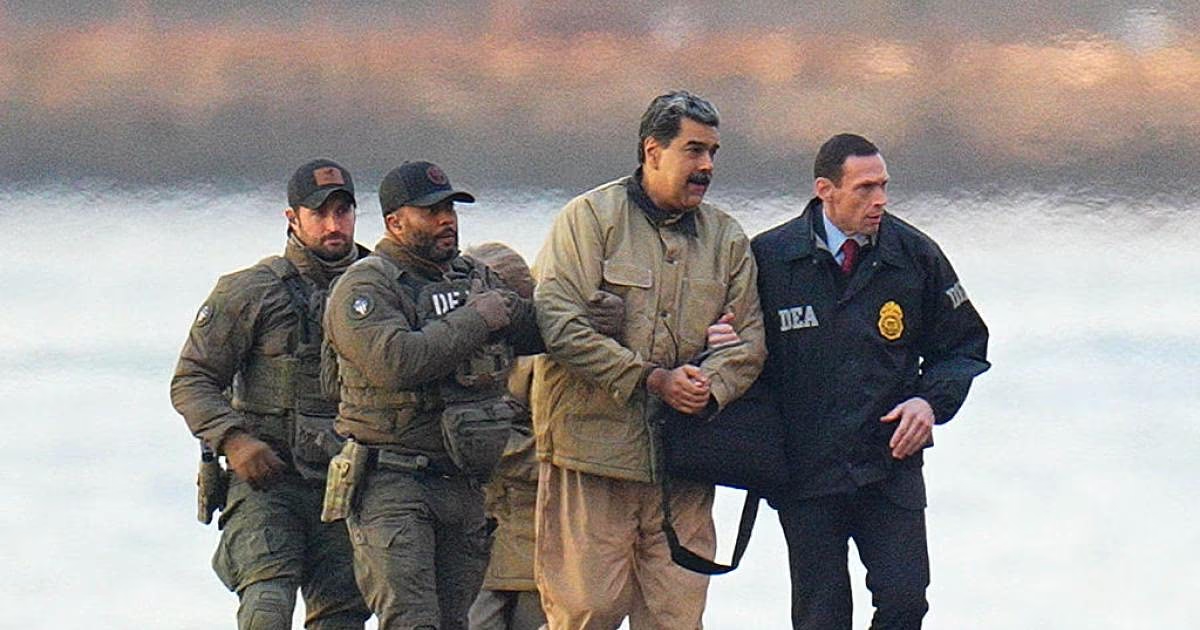
International press sources have revealed an unprecedented escalation of American influence in Venezuela, with US Secretary of State Marco Rubio now described as the de facto ruler of the country from his office in Washington. This development follows the military operation carried out by the United States, which resulted in the arrest of President Nicolas Maduro last January, opening the door to a transitional phase under direct supervision from the US administration.

Reports indicate that Rubio's influence has extended to managing natural resources and financial decisions for the interim government led by Delcy Rodriguez. Media sources quoted officials close to the White House as saying that President Donald Trump expressed his desire for Rubio to be the next leader of Venezuela, having previously suggested sending him to reside permanently in the capital, Caracas, to oversee the ongoing transformations.

Despite Rubio remaining in Washington, he manages sensitive files in Venezuela via phone and modern communication tools, leading observers to liken his situation to that of Paul Bremer, the civilian administrator who governed Iraq after the US invasion in 2003. The current administration in Caracas relies on direct directives from Washington in distributing resources and managing the suffocating economic crises plaguing the country.

The leaked information was based on interviews with more than 12 officials and figures close to decision-making circles in Washington and Caracas, all of whom confirmed that Rubio holds the financial reins. The American plan, as Rubio previously announced, aims to prevent the complete collapse of the Venezuelan state before transitioning to an economic recovery phase that ensures Western companies access to the energy market.

The Venezuelan oil sector stands out as one of the most important priorities on the current American agenda, as Washington seeks to secure the flow of supplies and open the door for American investments. Rubio personally oversees the drafting of new oil policies aimed at reintegrating the Venezuelan economy into the global system after years of isolation and sanctions imposed during Maduro's era.

Regarding the relationship between Washington and the interim government, sources revealed daily and intensive communication between Rubio and Delcy Rodriguez via WhatsApp. These conversations go beyond official political issues to include side discussions and precise coordination on media movements, with Rodriguez requesting prior approval from the US administration before making statements to international media outlets.

These arrangements reflect the unequal nature of the relationship between the two parties, as the statements of the top Venezuelan official are subject to careful review by American officials before publication. This scene indicates the extent of Washington's dominance over the new authority in Caracas, raising questions about the degree of independence of Venezuelan national decision-making in the current phase.

Analysts believe that this model represents an embodiment of the 'hard power' policy pursued by the Trump administration, where conditions are imposed on defeated parties with little regard for traditional principles of sovereignty. This approach recalls old colonial practices that the United States had abandoned decades ago, especially in its historical spheres of influence in Latin America.

In a related context, sources reported that Washington transferred quantities of enriched uranium from an old reactor in Venezuela to its territory, in a move described as securing sensitive materials. This step is part of a series of security measures taken by US forces to ensure that dangerous technologies or resources do not fall into the hands of hostile parties during the transitional period.

Despite close American supervision, the interim government faces significant challenges related to popular legitimacy, as it did not come through the ballot box but as a result of direct military intervention. Internal and international demands are growing for the necessity of launching a genuine political transition process that leads to free and fair elections, away from the continuous external tutelage represented by Rubio's office.

Intelligence reports warn that excessive reliance on American support could lead to counterproductive results if tangible economic stability, felt by the Venezuelan citizen, is not achieved. The absence of the rule of law and reliance on 'remote management' could hinder the attraction of long-term investments that the country needs to rebuild its dilapidated infrastructure after years of mismanagement.

The question remains open as to how long Washington will continue to manage Venezuela's affairs from abroad, and whether this strategy will actually lead to a stable democratic system. While the US administration insists that its goal is stability, critics argue that Washington is rebuilding Venezuelan institutions in a way that primarily serves its geopolitical and economic interests.

Rubio exerts influence over a sovereign state in a manner similar to the role played by US civilian administrator Paul Bremer in Iraq after the 2003 invasion.

PALESTINE

Sun 12 Jul 2026 9:43 am - Jerusalem Time

US Military Delegation in Beirut to Arrange 'Trial' Israeli Withdrawal from South Lebanon

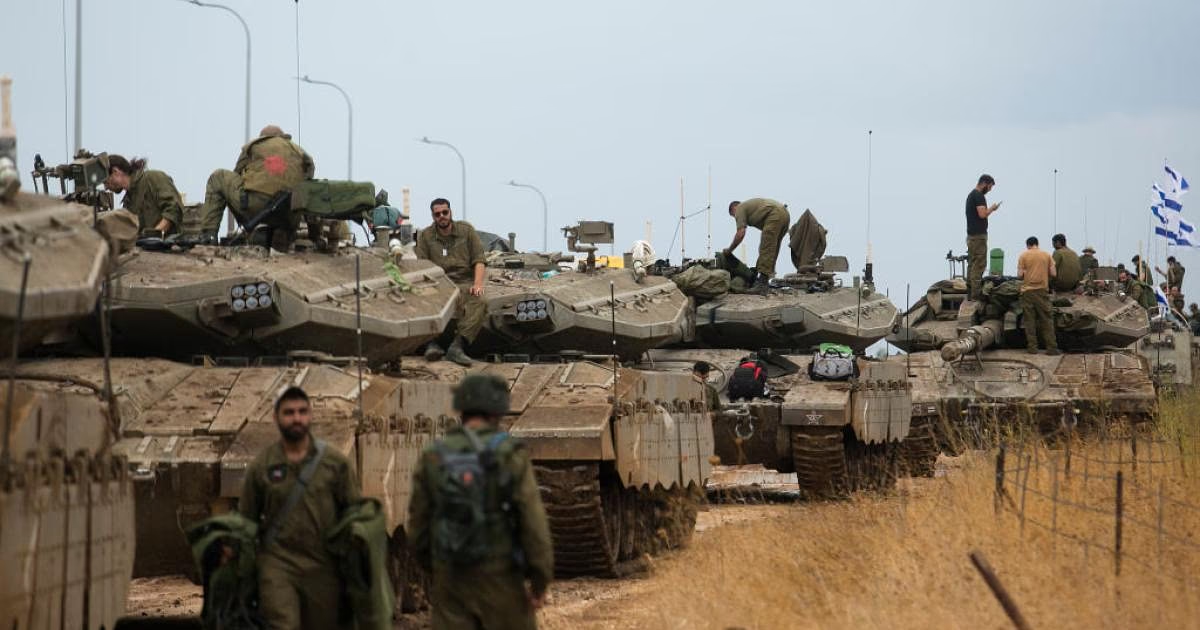
The issue of Israeli withdrawal from South Lebanon is entering a new phase with the announcement that a US security and military delegation is preparing to visit the capital Beirut next week. This step aims to finalize the technical and logistical arrangements for a trial withdrawal of occupation forces from two border areas, as part of implementing the terms of the security agreement concluded between the concerned parties.

Informed sources reported that the anticipated delegation belongs to the US Central Command, and will be responsible for direct oversight of the first phase of the agreement's implementation. This phase includes an initial withdrawal from the fringes of the areas where Israeli forces encroached during recent ground operations, to ensure a gradual transfer of security responsibilities.

Field assessments indicate that the evacuation process will primarily include the towns of Zawtar Al-Sharqiyah and Zawtar Al-Gharbiyah, while discussions have mentioned the town of Frun as an additional option. Despite these leaks, field reports indicate that occupation forces are not actually stationed within the town of Frun, shifting the focus to the adjacent border villages.

For its part, Hebrew media reported that the expected timeline for implementing this withdrawal might extend over the next two weeks, following the conclusion of the US delegation's visit to Lebanon. However, the Lebanese side continues to demand a formal and clear timetable that translates verbal commitments into concrete actions on the ground, away from procrastination.

Israel is setting conditions for implementing this step, most notably obtaining final approval from the US Central Command and ensuring the Lebanese Army's ability to deploy immediately. Tel Aviv rejects the idea of an uncoordinated gradual withdrawal, emphasizing the necessity for the Lebanese Army to take over positions immediately after its forces leave to ensure the non-return of armed manifestations.

In the context of diplomatic pressure, media sources reported that the US administration explicitly requested the Israeli side to halt military operations described as 'unusual'. Washington aims with this request to prevent any field escalation that could undermine ongoing understandings with Beirut or negatively affect open diplomatic channels.

Despite these American requests, the field reality continues to witness ongoing tensions, as occupation forces continue demolition and destruction operations of buildings in areas under their control. Air raids and targeting also continued in areas outside the scope of the ground incursion, the latest of which was an attack targeting a civilian vehicle in the town of Kafr Rumman.

In Beirut, there is a state of caution regarding Israeli proposals, as Lebanese officials emphasize the necessity of dealing with border areas as an integrated geographical unit. Lebanon rejects partial withdrawal formulas, demanding that the step include the entire area of Zawtar Al-Sharqiyah and Al-Gharbiyah to ensure effective sovereignty of the Lebanese state over its territories.

Observers believe that Israel is trying to turn this phase into a 'test' of the Lebanese state's seriousness in extending its authority and withdrawing weapons from the area south of the Litani. Tel Aviv uses these pretexts as political leverage before the international community, claiming that previous security commitments have not been fully implemented, which places an additional burden on American mediation.

Israel is treating this phase as a test of the Lebanese state's ability to extend its full control and withdraw weapons from the region.

ARAB AND WORLD

Sun 12 Jul 2026 9:43 am - Jerusalem Time

Forgery and Money Laundering Suspicions Haunt Kushner's Tourism Project in Albania

Recent judicial documents have revealed a legal crisis surrounding the luxury tourist resort project in Albania, in which Jared Kushner, former US President's son-in-law, is involved. Suspicions center on Albanian businessman Artur Shehu, residing in Miami, USA, who is suspected of using forged ownership documents for land later sold to the project's development company.

Albanian authorities are currently seeking to arrest Shehu on charges related to his involvement in extensive money laundering operations linked to international drug trafficking proceeds. This pursuit comes as part of a broader investigation into a criminal network believed to have smuggled cocaine from South America to European ports, then invested those funds in major real estate projects within Albania.

Albanian public prosecution clarified that there are strong indications that real estate assets on the Albanian coast were acquired illegally through forgery. Among these assets is the land whose ownership was transferred last April to 'Albania Land Development' company, the executive arm of 'Sazan Real Estate Development' company led by Kushner and a group of investors.

For his part, Kujtim Çakrani, lawyer for businessman Artur Shehu, denied all accusations against his client in detail, considering that the facts on which the prosecution relies do not reflect the truth. Despite acknowledging the issuance of an arrest warrant for Shehu, he stressed that his client was not involved in any activity related to drug trafficking or forgery of official documents.

In Washington, the US Department of Justice remained silent on the matter, with a spokesperson declining to comment on whether the department had received an official request from Tirana to locate or extradite Shehu. This silence raises questions about the course of judicial cooperation between the two countries in a case affecting the investment interests of a figure close to American political circles.

Regarding the development companies, 'Sazan Real Estate Development' company affirmed its belief that the land purchase process was conducted according to proper legal procedures and in good faith. While a spokesperson for Jared Kushner declined to comment on media reports, 'Albania Land Development' company has not issued any official comment on the suspicions surrounding the seller.

International media reports indicated that the current investigation file does not include any direct accusations against Kushner, his partners, or the project's implementing companies. Nor has any evidence emerged to prove the investors' knowledge of the criminal suspicions surrounding Shehu at the time of the deal's completion, which places the project in a legal gray area pending the final investigation results.

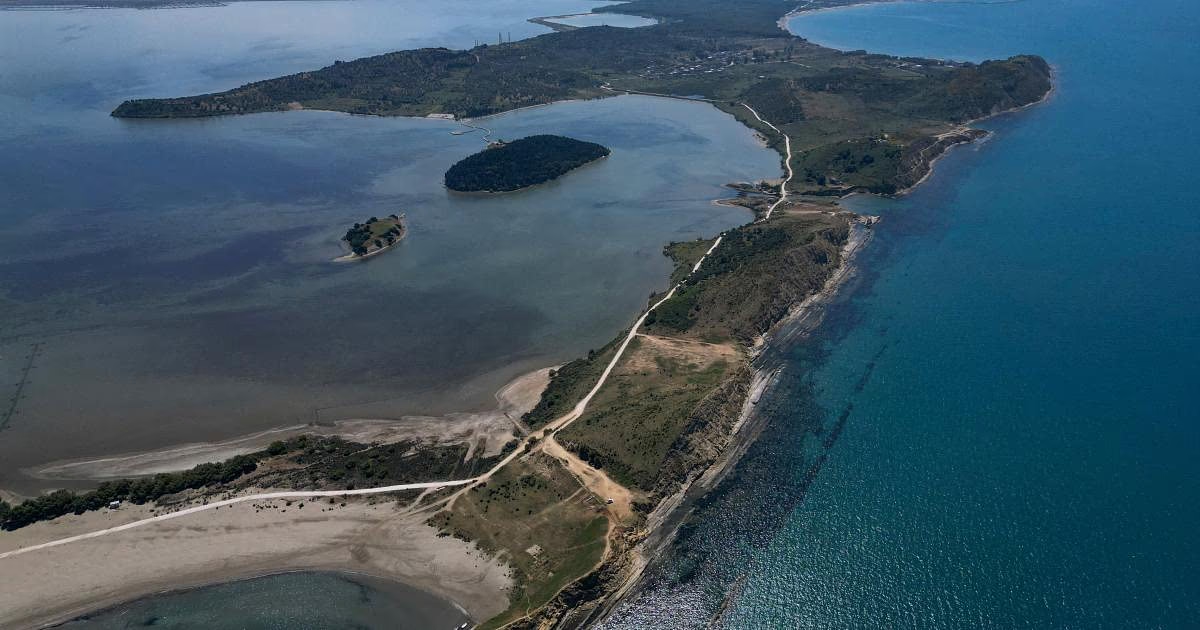
These judicial developments coincide with escalating public anger in Albania, where widespread protests have erupted since late May under the slogan 'Albania is not for sale'. Protesters oppose the project, which extends over Sazan Island and the Vjosë-Nartë coastal area, and these protests have on several occasions escalated into direct confrontations with security forces.

The investigations indicate reasonable suspicions that some real estate assets were obtained using forged ownership documents, including land that was later transferred to the tourism project.

PALESTINE

Sun 12 Jul 2026 9:43 am - Jerusalem Time

Settlers Detain US Congressman in West Bank, Teen Shot by Occupation Forces in Ramallah

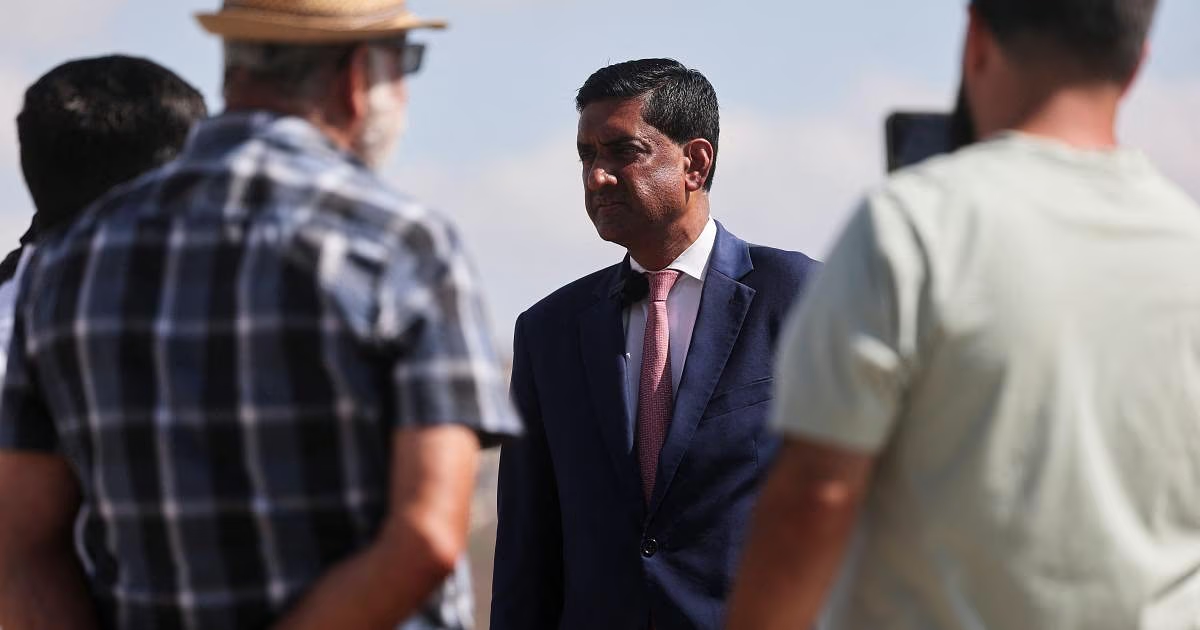
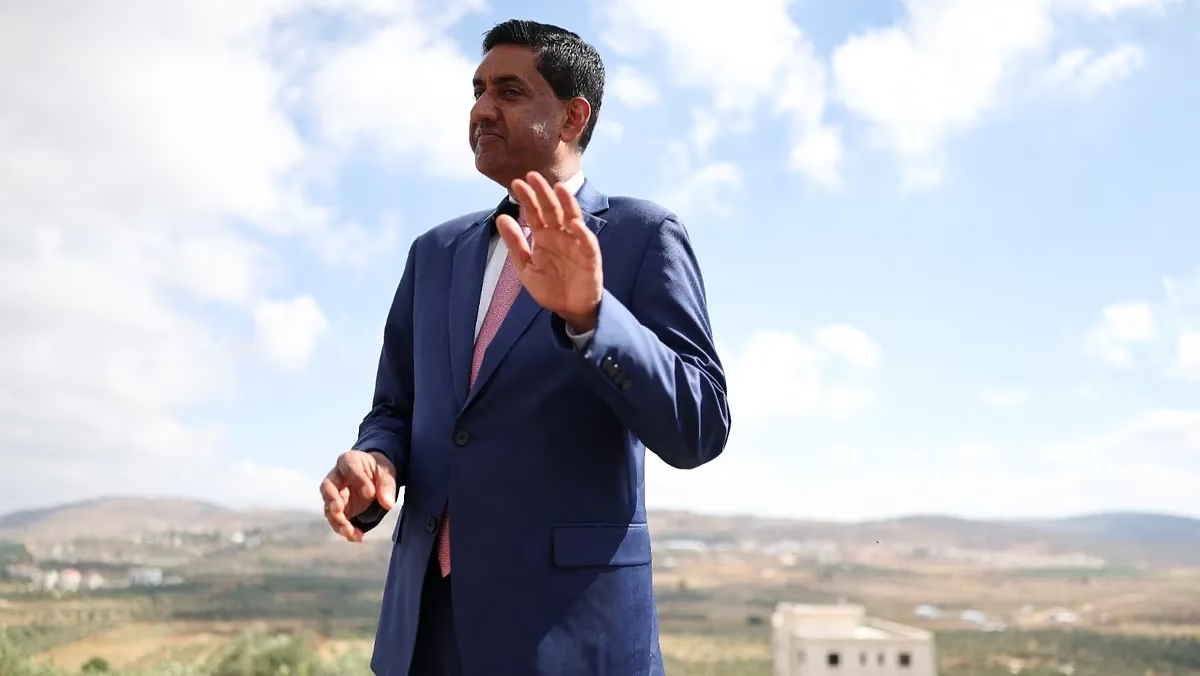
US Democratic Congressman Ro Khanna revealed details of a serious incident he experienced during his recent visit to the occupied West Bank. Khanna, who represents California, explained that a group of Israeli settlers armed with American-made 'M-4' rifles detained him and surrounded the vehicle he was in.

The incident occurred in the southern West Bank, specifically near the village of Khirbet Zanuta, whose residents have been forcibly displaced due to repeated settler attacks. The US Congressman indicated that the settlers blocked their way and called Israeli army forces, who sided with the settlers instead of protecting the American delegation.

For his part, Cameron Kasky, Congressman Khanna's aide, confirmed that the group remained detained for over an hour at gunpoint. Kasky explained that they had to contact the US Embassy in Jerusalem for urgent assistance, and were only released after the intervention of Israeli police officers later.

In a related context, Al-Mughayyir village, northeast of Ramallah, witnessed a new field escalation following a raid by dozens of settlers under heavy protection from the occupation army. The attack targeted the home of citizen Abdul Latif Abu Alia, where settlers attempted to impose a new reality by forcibly bringing their livestock into the vicinity of the house.

Field sources reported that occupation forces fired live ammunition, tear gas, and sound grenades intensely at citizens who tried to confront the settlers. These clashes resulted in a 17-year-old boy being shot in the leg, after which he was transferred to the hospital for necessary treatment.

The tear gas and sound grenades fired by occupation soldiers caused fires to break out in the lands surrounding the Abu Alia family home in Al-Mughayyir village. These attacks come at a time when the village residents are suffering from the loss of vast areas of their agricultural lands and ancient olive trees to the surrounding settlement outposts.

Official statistics issued by the Wall and Settlement Resistance Commission indicate a frightening escalation in the pace of settler attacks, with approximately 3500 attacks recorded during the first half of this year. These attacks include the demolition of schools, uprooting of trees, and direct physical assault on Palestinian citizens in various governorates.

In additional reports, eight Palestinians were injured to varying degrees in different areas of the West Bank as a result of joint attacks by settlers and occupation forces. The injuries included a child in Al-Mughayyir village who was hit by a sound grenade in the head, in addition to four citizens who were severely beaten in the Masafer Yatta area south of Hebron.

The attacks were not limited to individuals, but also targeted infrastructure and property, as settlers attacked Qabalan municipality crews south of Nablus and destroyed a farm in the Al-Masoudiya area. Widespread destruction of crops and trees was also recorded in Khirbet Masoud near Ya'bad town in Jenin governorate, as part of the economic squeeze policy on Palestinians.

Congressman Ro Khanna believes that what he witnessed in the West Bank represents a 'moral test' for the Democratic Party and American leadership regarding the issues of Palestine and Gaza. Khanna affirmed that his visit, coordinated by Palestinians, aimed to see the reality without embellishment, emphasizing the need to condemn the apartheid system existing in the occupied territories.

Pressure is increasing within the US Congress to demand a halt or restriction of military aid provided to Israel, which amounts to $3.8 billion annually. Democratic representatives are demanding guarantees that these weapons, especially light ones, are not used in attacks carried out by settlers against Palestinian civilians.

It is worth noting that the situation in the West Bank has reached unprecedented levels of violence since October 7, 2023, with 1751 martyrs and approximately 13,000 injured. These figures coincide with widespread arrest campaigns targeting approximately 24,000 Palestinians, amid settlement expansion that is devouring what remains of the future Palestinian state's lands.

If you are unwilling to defend the human rights of Palestinians and condemn the apartheid system, then your moral stance is questionable.

PALESTINE

Sun 12 Jul 2026 9:43 am - Jerusalem Time

Gaza Health: 7 martyrs, total aggression toll rises to 73,221 martyrs

Medical sources in the Gaza Strip reported the martyrdom of seven people and the injury of twenty-eight others during the past forty-eight hours, due to ongoing Israeli attacks in various areas of the Strip. The sources confirmed that civil defense and ambulance crews face immense challenges preventing them from reaching those missing under the rubble of destroyed homes and in rugged roads, which indicates the presence of additional victims not yet included in official records.

In a related context, the Ministry of Health revealed an increase in the number of casualties since the signing of the ceasefire agreement on October 11th, with the number of martyrs reaching 1,098 people, while 3,535 others were injured. Reports indicated that these figures come amidst continuous field violations, including bombing and demolition of residential blocks, where specialized teams have only been able to recover 800 cases since the start of this fragile truce.

Regarding the comprehensive statistics since the outbreak of the aggression on October 7, 2023, medical records documented an increase in the cumulative total of martyrs to 73,221, while the number of injured rose to 173,643 people. The ministry noted that these data reflect the unprecedented humanitarian catastrophe experienced by the residents of the Strip amid the targeting of the health system and the obstruction of rescue efforts and field documentation.

Documentation teams also announced the addition of 96 new martyrs to the official lists after completing all their data and approving them by specialized committees since the beginning of last June. Health authorities warned of the near-complete paralysis affecting the ambulance system, which directly hinders the monitoring of the actual number of victims who are still trapped under the rubble in areas of incursions and clashes.

Ambulance and civil defense crews are still unable to reach the rubble and roads to recover more victims due to field complexities.

ARAB AND WORLD

Sun 12 Jul 2026 9:43 am - Jerusalem Time

US Escalation Against the Press: Journalists Summoned for Interrogation Over 'Qatar Plane' Leaks

Media circles in the United States witnessed a notable escalation following the issuance of court orders compelling several 'New York Times' journalists to testify before a federal grand jury. This step comes within the context of investigations by the Department of Justice into the publication of journalistic reports that addressed security vulnerabilities and concerns related to the new presidential plane, which was presented as a gift to President Donald Trump by the State of Qatar.

Informed sources reported that the US Attorney General in Manhattan, Jay Clayton, was the one who issued the subpoenas, which were delivered last Friday. The manner in which these orders were executed sparked widespread controversy, as federal officers went directly to the homes of some journalists to officially deliver the summons, which observers considered a tactic of intimidation.

Judicial authorities set next Wednesday as the date for the journalists to appear before the grand jury for an investigation into what was described as an 'alleged violation of federal criminal law'. The investigations focus on how sensitive information related to the security of the presidential plane became public, which the current administration considers a threat to national security that goes beyond the scope of journalistic work.

For its part, the US Department of Justice maintained a cautious stance, with a spokesperson refusing to directly confirm or deny the issuance of the orders in press statements. However, the department stressed that its policy does not target media work itself, but aims to prosecute those involved in leaking classified documents and information protected by law.

In contrast, human rights and media organizations described these moves as an 'unusual escalation' aimed at undermining the independence of news organizations. These entities viewed the prosecution of journalists for their professional reports as an attempt by the Trump administration to impose self-censorship on the media and prevent it from revealing facts that might cause political embarrassment.

The National Press Club of America strongly criticized these measures, calling on the Department of Justice to withdraw the subpoenas immediately and unconditionally. The club affirmed in an official statement that targeting journalists in their homes infringes upon the essence of the First Amendment of the US Constitution, which guarantees freedom of expression and the press, warning of dire consequences for democracy.

This tension coincided with President Trump's nomination of Attorney General Jay Clayton to head the National Intelligence Directorate, which intensified parliamentary criticism. The Reporters Committee for Freedom of the Press demanded that Clayton be held accountable during his confirmation hearing in the Senate, linking his performance in this case to his eligibility for the high intelligence position.
On the ground, President Trump had recently indicated his use of an old presidential plane for his trip from the Turkish capital Ankara to Britain, leaving the new plane for inspection. Sources explained that the plane gifted by Qatar underwent thorough inspections by US military technicians at Mildenhall Air Base to ensure its technical and security integrity.

Despite the security controversy, video clips showed the US President boarding the new Qatari plane at the British base in preparation for his return to Washington. The issue remains open to the possibility of legal escalation between the executive branch and the press, amidst the insistence of human rights organizations on protecting the public's right to know and preventing the suppression of fundamental freedoms.

When federal officers arrive at journalists' homes carrying subpoenas, this is not a normal application of the law, but a blatant assault on press freedom.

PALESTINE

Sun 12 Jul 2026 9:42 am - Jerusalem Time

Founder of 'Free Palestine' Party in New Zealand: Gaza is the Holocaust of Our Era and Major Powers are Complicit

Paul Hopkinson, founder of the 'Free Palestine' Party in New Zealand, affirmed that the party primarily aims to hold the New Zealand government and international powers accountable for what he described as complicity in the genocidal war in the Gaza Strip. Hopkinson explained that what the world is witnessing today is the Holocaust of our era, whose details are broadcast live amidst suspicious international silence.

The political activist and high school teacher reviewed the party's objectives, which came into existence last May, noting that its political program focuses on bringing the Palestinian issue back to the forefront of global attention. He added that recent regional tensions have led to a decline in media momentum around Gaza, which the party seeks to address before the 2026 elections.

Hopkinson stressed that the establishment of the party represents a tool to hold New Zealand politicians accountable, whom he considered partners in the ongoing suffering of the Palestinian people for decades. He pointed out that the coalition-based political system has not changed the reality of complicity, whether the parties are in power or in the opposition.
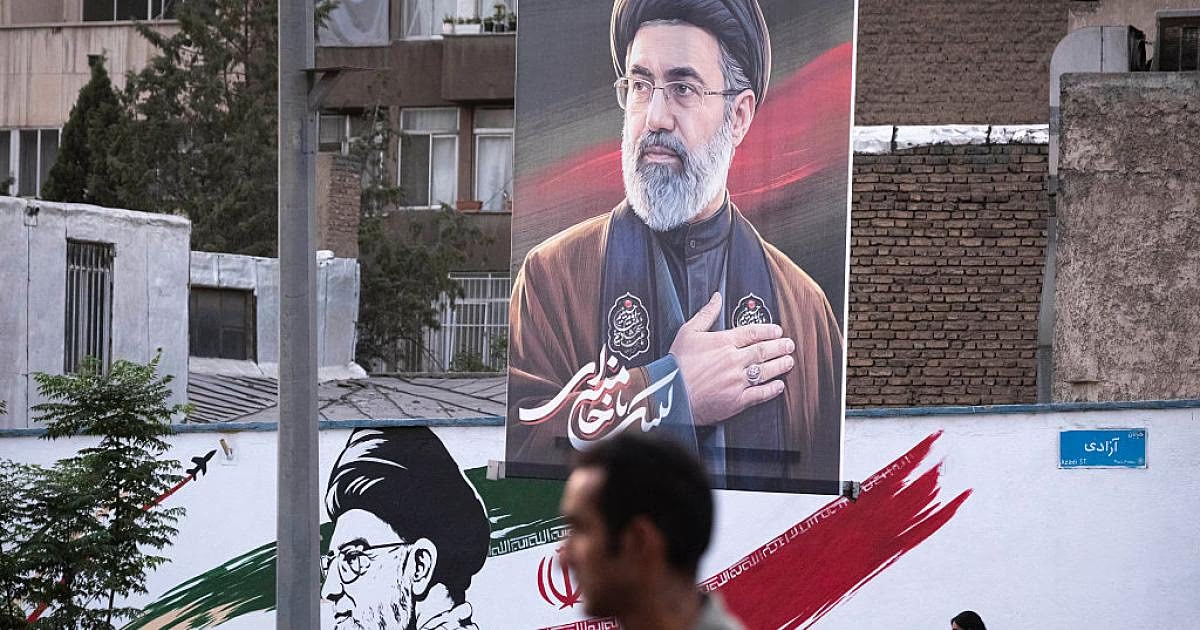
The party's founder considered that all traditional political forces in his country failed the moral test regarding Palestine once they came to power. He attributed this to New Zealand's subservience to what he described as the 'American Empire,' which makes it part of a system that indirectly supports Israeli crimes.

Hopkinson described the Palestinian issue as the most important moral issue in the contemporary world, affirming that his party will remain dedicated to defending it. He strongly criticized the major powers' failure to take effective measures to stop the massacres, with some even going so far as to militarily and politically support the occupation.

In a sharp critique of the occupation, Hopkinson described Israel as a 'rogue state' that has caused global economic crises and dragged the region to the brink. He noted that continuous attacks and tensions with Iran threaten international navigation in the Strait of Hormuz, reflecting the destructive impact of Israeli policies.

The New Zealand activist expressed his conviction that peace in the Middle East will not be achieved as long as the Israeli entity continues in its current form. He affirmed that the party's success so far lies in restoring momentum to the public discussion about Palestinian rights within and outside New Zealand society.

Regarding public interaction, Hopkinson explained that the party received widespread public support, enabling it to attract the required members for registration in record time. Despite attacks from the Zionist lobby, public awareness of the reality of the crimes committed in Gaza is continuously increasing.

He indicated that the party's priorities, if it reaches parliament, will be to demand New Zealand's withdrawal from military alliances with the United States and Europe. The party believes that these alliances make their country a partner in imperialism and in covering up genocide crimes.

Sources revealed the party's dissatisfaction with the participation of New Zealand soldiers in joint military exercises with American and Israeli forces coinciding with the aggression on Gaza. Hopkinson considered that these practices reinforce the state of complicity that the party seeks to end through legislative channels.

The party adopts the slogan 'From the river to the sea, Palestine will be free,' emphasizing a legal and political battle to defend freedom of expression. This comes amidst attempts by some Western countries to ban this slogan and restrict solidarity movements with the Palestinian people.

Hopkinson described the siege imposed on the Gaza Strip as the most technologically advanced in history, where civilians are deprived of the most basic necessities of life. He affirmed that the victim cannot be blamed for their reactions to an occupation that practices the most heinous forms of abuse and systematic killing.

The founder of the 'Free Palestine' Party called on global solidarity movements to intensify pressure on the Israeli occupation by all available means. He stressed that expanding solidarity networks is the only way to confront Zionist influence and the imperialism that supports the continuation of the occupation.

It is worth noting that the ongoing Israeli aggression since October 2023 has caused massive destruction, affecting 90% of the infrastructure in the Gaza Strip. Despite ceasefire announcements, raids and restrictions on aid continue to claim the lives of hundreds of civilians weekly.

What is happening in Gaza is the Holocaust of our era that we are watching live, and the major powers are not just silent but complicit.

LATEST NEWS

Sun 12 Jul 2026 9:42 am - Jerusalem Time

Military Escalation in the Gulf: Air Raid Sirens Blare in Bahrain, UAE Repels Widespread Iranian Attack

The Arabian Gulf region woke up this Sunday morning to an unprecedented military escalation, as the Bahraini Ministry of Interior announced the sounding of air raid sirens across the country. Bahraini authorities urged citizens and residents to remain calm and immediately proceed to the nearest safe places, emphasizing the need to obtain information from official channels amidst the rapidly unfolding developments.

In a related context, the UAE Ministry of Defense confirmed that its air defense systems are currently repelling missile threats and drones launched from the Iranian side. The ministry clarified that the explosions heard in various parts of the country resulted from the interception of ballistic missiles, cruise missiles, and suicide drones.

This security flare-up follows the US Central Command's announcement of the start of a third round of air and missile strikes against strategic targets within Iranian territory. Military sources indicated that these attacks came in response to the Iranian Revolutionary Guard Corps (IRGC) targeting a commercial cargo ship that was legally transiting the international Strait of Hormuz.

Reports clarified that the targeted vessel was the container ship 'M/V GFS Galaxy', flying the Cypriot flag, which sustained severe damage and a fire in its engine room, leading to its immobilization. Maritime sources confirmed the loss of one civilian crew member due to the attack, prompting the United States to decide to impose a 'heavy cost' on Tehran to ensure the security of international navigation.

For his part, US Secretary of Defense Pete Hegseth stated that the Iranian regime made a bad choice by targeting civilian navigation, and is now paying the price for those provocations. Hegseth emphasized that US military operations aim to degrade the IRGC's ability to launch future attacks against sailors and commercial vessels in vital waterways.

On the Iranian side, the IRGC announced the complete closure of the Strait of Hormuz to international navigation until further notice, justifying it as necessary to stop what it described as 'American interventions'. The IRGC warned in a statement that any new aggression on Iranian territory would be met with a decisive and strong response, claiming that the targeting of the ship came after it violated navigation regulations.

Media sources quoted American officials saying that the airstrikes precisely targeted Iranian air and surface surveillance radars, as well as ballistic missile depots and drone launch platforms. The targets also included surface-to-air missile sites in an attempt to neutralize Iranian air defenses and secure freedom of movement for friendly air forces in the region.

Meanwhile, local sources inside Iran reported hearing violent explosions shaking the cities of Bushehr, Bandar Abbas, and Sirik in the south of the country. Reports also emerged of more than ten explosions in the strategic Hormozgan province, in addition to targeting facilities on Qeshm Island, amidst a state of widespread security and military alert in the border provinces.

Field data indicates that the region has entered a new phase of direct confrontation, where attacks are no longer limited to proxies but have shifted to targeting mutual depths. International capitals are closely monitoring with great concern the repercussions of the closure of the Strait of Hormuz, which is the main lifeline for global energy supplies, and the sharp jumps in oil prices that may result.

Amidst this tension, a state of anticipation prevails for what the coming hours will bring, especially with the continued activity of air defenses in the region and intensive military aircraft flights. Sources confirm that military coordination between the United States and its allies in the region has reached its highest levels to ensure the protection of vital facilities and to counter any attempts at further escalation by Tehran.

UAE air defenses are currently dealing with missile attacks and drones coming from Iran, and the sounds heard are the result of intercepting ballistic and cruise missiles.

ARAB AND WORLD

Sun 12 Jul 2026 9:42 am - Jerusalem Time

Death of two children and loss of others after a ferry sank in the Euphrates River in Deir ez-Zor

Field sources in Syria reported a tragic sinking incident in the city of Deir ez-Zor, after a water ferry carrying dozens of civilians collided with the floating military bridge. The violent collision caused all those on board the ferry to fall into the waters of the Euphrates River, amidst a state of panic and urgent rescue attempts by residents and competent authorities.

According to preliminary information issued by civil defense teams, the accident resulted in the drowning death of two children in a non-final toll, while rescue teams managed to recover and rescue more than 15 civilians who were struggling to survive. Search operations are still ongoing in the riverbed to find the rest of the passengers who disappeared after the ferry sank.

Sources explained that the ferry was carrying more than 35 people at the time of the accident in the early hours of Sunday morning. The direct collision with the iron structure of the military bridge caused the ferry to capsize quickly, making survival difficult, especially in conditions of poor lighting and river currents.

Water rescue teams and volunteers in the area are combing the banks of the Euphrates River in search of potential survivors or the bodies of the missing, amidst calls to tighten safety procedures on water transport means that connect the two banks of the river. These ferries are a vital means of transport for local residents in light of the damage to infrastructure and fixed bridges in the region.

It is worth noting that the city of Deir ez-Zor relies heavily on floating bridges and water ferries to move between its neighborhoods divided by the river. Warnings have recently been repeated about the danger of these primitive means, especially in the absence of regular maintenance and the overcrowding of ferries with numbers exceeding their capacity for passengers and goods.

Two children died in an initial toll, and more than 15 civilians who were on board the ferry that collided with the military bridge were rescued.

OPINIONS

Sun 12 Jul 2026 9:42 am - Jerusalem Time

Closure of Hormuz and the Stalled Nuclear Deal… Washington Returns to Power Politics and Israel Pushes the Region Towards War

Washington's Message

Washington – Said Arikat – 7/12/2026

News Analysis

The announcement by the Iranian Revolutionary Guard Corps Navy on Saturday evening to completely close the Strait of Hormuz was not an isolated event from the escalating confrontation between Tehran and Washington, but rather appeared to be a direct result of the military and political pressure policy reaching a breaking point. The Strait, which remained open to international navigation despite years of sanctions and tension, has today become a confrontation card used by Iran to say that the continuation of war, threats, and coercion will not go unpunished, and that the repercussions of the conflict will not remain confined within its borders, but may extend to energy markets and the arteries of global trade and the economy as a whole.

In this sense, the closure of Hormuz reveals the depth of the predicament that American policy towards Iran has reached. Once again, relations between the two countries are at a crossroads, but the stalled nuclear deal this time does not seem to stem from technical disagreements over centrifuges or uranium enrichment levels as much as it reflects the failure of the American bet on the possibility of combining military pressure and political negotiation. President Donald Trump's administration seems to be returning to traditional policy based on coercion and force, after the "maximum pressure" policy failed to extract the concessions it promised.

The irony is that Washington is demanding that Tehran return to the negotiating table, while continuing to use sanctions and military threats as key tools in managing the crisis. This is an equation that is difficult to produce a stable agreement, because negotiating under bombardment or the threat of bombardment does not build trust, but rather pushes the other party to seek counter-deterrent tools. From this angle, specifically, one can understand the transition of the Strait of Hormuz from a theoretical threat card to a political and field tool in the confrontation.

Recent statements by senior American officials reveal that Washington has practically begun to move away from the idea of a comprehensive settlement in favor of managing an open conflict, allowing it to maintain economic and military pressure tools without offering a viable political vision to end the crisis. The American discourse no longer focuses on the nuclear program alone, but has linked any future understanding to Iran's regional behavior and the security of navigation in the Strait of Hormuz, thus expanding the list of conditions as negotiations approach a point of understanding.

The American administration is demanding that Tehran officially announce the guarantee of freedom of navigation and an end to targeting commercial vessels. These demands may seem legitimate in principle, but the question Washington avoids is: how did the crisis reach this point in the first place? The Strait of Hormuz was not closed in a political vacuum, and navigation did not turn into a pressure card away from the context of war and escalation. The Strait remained open for many years despite harsh sanctions, before military confrontation pushed Iran to rediscover the strategic value of the most important geographical card it possesses.

From the Iranian perspective, Hormuz is no longer just a waterway, but has become one of the few remaining deterrent cards after years of sanctions, isolation, and military pressure. The announcement of its complete closure reveals that Tehran has decided to move this card from the realm of threat to direct use. If major powers are able to strangle the Iranian economy with sanctions, Iran wants to say that it, in turn, is capable of influencing one of the most important arteries of the global economy.

This does not mean that closing the Strait is a step without risks or that its humanitarian and economic repercussions can be ignored. But it becomes more understandable when placed in its full political and military context. Countries that adopt a policy of coercion cannot assume that the targeted party will endlessly accept playing the role of recipient of blows and sanctions without using the power cards available to it.

In the background of this scene, the Israeli role emerges as one of the most influential factors in pushing the crisis towards the brink of war. The Israeli government has not hidden its opposition to any agreement that eases pressure on Iran, and has consistently considered that exhausting and weakening Tehran is more beneficial than a settlement that gradually reintegrates it into the regional and international system. For this reason, Israel has exerted continuous political and security pressure to keep the military option present in American calculations.

For Israel, Iran remaining under constant pressure is more consistent with its security vision than any agreement that establishes a new regional balance. Therefore, every round of negotiations is subjected to a campaign of skepticism and pressure that pushes Washington to raise its conditions or return to the threat of force. Here lies one of the problems of American policy: that Israel's security priorities have, in many cases, narrowed the margin of American diplomatic decision-making and pushed the Trump administration towards choices that may not serve long-term American interests.

Previous experiences have proven that military force may destroy a facility or delay part of a nuclear program, but it does not eliminate scientific knowledge or erase the political motives behind it. Rather, the continuation of the threat may push Iran to further extremism, and strengthen the voices that believe that possessing more effective deterrent tools is the only way to protect the country from future attacks.

In light of this reality, President Trump's options appear more limited. Returning to a widespread military confrontation carries the risk of the region sliding into a war whose trajectories cannot be controlled, especially after the Strait of Hormuz directly entered the conflict equation. As for accepting a compromise settlement, it may face Israeli opposition and internal American pressure, while the continuation of the current situation means consecrating a policy of "managing the conflict" instead of resolving it.

More dangerously, the Gulf states may be the first to pay the price of this equation. Saudi Arabia, along with a number of Gulf Cooperation Council countries, has come to the conviction that economic development and national transformation projects cannot flourish in a region living to the rhythm of repeated wars. The closure of the Strait of Hormuz places the economies, security, and future projects of the Gulf at risk of a confrontation that these countries were not the decision-makers in igniting.

From here, one can understand the Saudi and Gulf openness to Iran, the expansion of international partnerships, and the endeavor to reduce polarization away from the logic of rigid axes. This does not mean abandoning the relationship with the United States, but rather reflects a growing desire to possess a more independent regional decision, and not to allow the region to once again become an arena for settling scores between major powers or for prioritizing Israel's interests at the expense of Gulf stability.

Ultimately, the dispute is no longer about the number of centrifuges or the amount of enriched uranium. The closure of the Strait of Hormuz confirms that the crisis has turned into a struggle over the shape of the security system in the Middle East, the limits of regional influence, and the role of military force in shaping the future of the region.

If Washington continues to prioritize tools of pressure and war over diplomacy, and if Israel continues to push the American administration towards confrontation and thwart settlement opportunities, then Iran's use of its available power cards will become more likely and dangerous. And then the question will not be when the two parties will return to the negotiating table, but how many crises and wars the region must go through before Washington realizes that coercion does not create an agreement, and that the security of the Middle East cannot be built on permanent war.

LATEST NEWS

Sun 12 Jul 2026 9:42 am - Jerusalem Time

Comprehensive Regional Escalation: Iran Bombs American Bases in Gulf States in Response to 'CENTCOM' Strikes

The Iranian Revolutionary Guard announced today, Sunday, the launch of the third phase of its military operations against what it described as 'American aggression,' with simultaneous strikes targeting US military facilities and bases in Qatar, Kuwait, Bahrain, and the Sultanate of Oman. Tehran affirmed that these attacks are a legitimate defense in response to the targeting of its territory, noting that its target bank included command and control centers and logistical support.

In detail of the attacks, the Iranian military statement revealed that Al Udeid Air Base in Qatar was targeted with a barrage of ballistic missiles, leading to the destruction of a fighter jet maintenance center and vital command facilities. Sources indicated that Qatari air defenses managed to intercept two waves of air attacks, while the Ministry of Interior raised the country's security alert level to the maximum in anticipation of new missile waves.

In the Sultanate of Oman, Iranian strikes hit the strategic Duqm Port, where the Revolutionary Guard's air force targeted fuel supply platforms and logistical support centers belonging to US aircraft carriers. Tehran considered these Omani facilities to be an essential part of the US military support system facilitating operations against Iranian territory, making them a legitimate target in this round of conflict.

On the Kuwaiti side, the General Staff of the Army announced that air defense systems intercepted hostile targets that penetrated national airspace, affirming full readiness to protect the state's sovereignty. This coincided with the Iranian army's announcement of using drones to attack 'Patriot' systems, ammunition depots, and radar sites belonging to the US army stationed in Kuwait, in an unprecedented field escalation.

As for Bahrain, the Ministry of Interior called on citizens and residents to remain calm and head to shelters and safe places immediately upon the sounding of sirens. Field reports indicated the targeting of radar sites and communication systems belonging to the US Fifth Fleet stationed in Manama, while a state of cautious anticipation prevails in the Bahraini street awaiting official statements regarding the extent of the damage caused by the attack.

In parallel with the ground shelling, the Revolutionary Guard announced the closure of the Strait of Hormuz 'until further notice,' confirming the targeting of a second commercial vessel on the pretext of violating navigation regulations. This decision puts global trade and energy supplies at risk, especially after Iranian assurances that any American attempt to forcibly open the waterway will be met with a decisive and comprehensive military response throughout the region.

For its part, the US Central Command 'CENTCOM' had earlier announced the execution of one of its largest military operations, targeting approximately 140 sites inside Iran. The airstrikes included missile and drone storage facilities, complex communication networks, and coastal surveillance radars in the Bushehr, Bandar Abbas, and Qeshm Island areas, in response to a previous Iranian attack on a Cypriot container ship.

Sources reported that the third wave of US strikes raised the total number of targets hit inside Iran to over 300 targets in just one week. The US Secretary of Defense stated that Tehran made a 'bad choice' by targeting international navigation, emphasizing that the United States will continue to work to protect its interests and allies in the region, regardless of the cost of military escalation.

Observers believe that this military explosion nullifies the memorandum of understanding signed between Washington and Tehran last June through Qatari and Pakistani mediation. It appears that the region has slipped into an open confrontation that transcends traditional rules of engagement, with US bases in Gulf states becoming direct targets for Iranian missiles, putting regional security and global stability at stake.

Amidst this escalating tension, relevant authorities in the region continue to assess the damage caused by the missile and drone barrages, while international concerns grow about these mutual strikes turning into a comprehensive regional war. World capitals are awaiting the outcome of the coming hours, amidst timid international calls for de-escalation at a time when the language of weapons seems to prevail between Tehran and Washington.

US interventions to open an illegal passage in the Strait of Hormuz are the main reason for insecurity in the region.

ARAB AND WORLD

Sun 12 Jul 2026 9:41 am - Jerusalem Time

UAE Intercepts Iranian Missile and Drone Attack Amid Widespread Military Escalation in the Gulf

The Ministry of Defense in the United Arab Emirates announced early Sunday morning that air defense systems are effectively confronting a large-scale missile attack and drones launched from Iranian territory. The ministry clarified in an official statement that air defenses are currently dealing with threats including ballistic and cruise missiles, in addition to unmanned aerial vehicles that attempted to penetrate the country's sovereign airspace.

UAE authorities reassured citizens and residents that the loud sounds heard in various parts of the country are a direct result of successful interception operations carried out by air protection units. Official sources confirmed that the armed forces are on full alert to monitor and secure air borders against any additional attacks that may target vital installations or residential areas.

This attack coincides with the US Central Command's announcement of the start of a third round of concentrated airstrikes against military targets deep inside Iran. The US military action came in response to the Iranian Revolutionary Guard Corps targeting the Cypriot-flagged container ship 'M/V GFS Galaxy' while it was transiting the Strait of Hormuz, causing severe damage to the ship and the loss of one of its crew members.

Informed sources reported that the US attacks precisely targeted Iran's air and surface surveillance radar network, in addition to strategic missile and drone depots. The list of targets also included missile launch sites and surface-to-air defense launchers in an attempt to curb Tehran's ability to threaten international navigation and regional installations.

Inside Iran, media reports confirmed a series of violent explosions in coastal and southern areas, with the sound of shelling heard in Bushehr city and the strategic port of Bandar Abbas. Sources indicated that more than ten explosions occurred in Hormozgan province, in addition to targeting sites on Qeshm and Sirik islands, amid a state of confusion among local forces.

For its part, the Iranian Revolutionary Guard Corps announced the complete closure of the Strait of Hormuz to international navigation until further notice, considering this step a response to what it described as illegal American interventions. The Revolutionary Guard warned in a statement that any new attack would be met with a decisive and strong response, claiming it had fired warning shots at ships that attempted to take unauthorized routes.

In a related context, the US Secretary of Defense stressed that the Iranian leadership made a 'bad choice' by targeting commercial vessels, confirming that they are now paying a heavy price as a result of this escalation. The Secretary indicated that the United States will continue to destroy the military capabilities used by Tehran to attack civilian mariners and ensure freedom of navigation in international waterways.

_The effects of the military escalation extended to neighboring countries, as authorities in the Kingdom of Bahrain activated sirens in several areas as a precautionary measure following the US strikes on Iran. The region is experiencing a state of extreme tension with the continued sound of explosions and rising smoke columns from the targeted installations, especially in the Fujairah petroleum industries area, which witnessed intensive defensive activity.

International powers are closely monitoring developments in the Gulf region, amid calls for restraint and avoiding a slide into a comprehensive regional war. This direct confrontation between UAE air defenses and Iranian threats represents a dangerous shift in the course of the conflict, especially with US forces entering as a direct party in targeting the military infrastructure of the Revolutionary Guard.

UAE air defenses are currently dealing with missile attacks and drones coming from Iran, and the audible sounds are a result of the interception systems.

ARAB AND WORLD

Sun 12 Jul 2026 9:41 am - Jerusalem Time

Widespread Military Escalation: US Strikes Target Iranian Depth and Strait of Hormuz Closure

The US Central Command announced early Sunday a new wave of aerial and missile attacks against military targets deep within Iran. These rapid field developments follow a dangerous escalation in the Gulf waters, where Washington accused the Iranian Revolutionary Guard of targeting a civilian cargo ship while it was transiting the strategic Strait of Hormuz.

In his first official comment on the military operation, US Secretary of Defense Pete Hegseth affirmed that Tehran had made a grave mistake by targeting international navigation. Hegseth clarified in a brief statement that the Iranian side is now paying the price for its hostile choices, emphasizing that the United States will not tolerate any compromise in protecting vital maritime routes.

For its part, military sources explained that the third round of strikes this week directly targeted the military infrastructure of the Revolutionary Guard. The targets included advanced air and surface surveillance radars, in addition to drone warehouses, ballistic missile launch platforms, and surface-to-air missiles that threaten air traffic and navigation.

The American move came in response to what Washington described as a 'blatant' attack targeting the container ship 'M/V GFS Galaxy', flying the Cypriot flag. Reports indicated that the ship suffered significant structural damage and a fire broke out in the engine room, leading to its incapacitation and the loss of one of its civilian crew members at sea.

In response, Tehran retaliated with unprecedented escalatory measures, as the Iranian Revolutionary Guard announced the complete closure of the Strait of Hormuz until further notice. Iranian authorities justified this decision by the necessity of stopping what they called 'illegal American interventions,' warning that any new aggression would be met with a decisive and strong response in the region.

Field sources inside Iran reported hearing violent explosions shaking several coastal cities and strategic islands in the south of the country. The explosions were concentrated in the areas of Bushehr, Bandar Abbas, and Sirik, while Hormozgan province alone recorded more than ten explosions targeting military and vital sites belonging to Iranian forces.

The US Central Command indicated that it had given Tehran repeated opportunities to adhere to international memorandums of understanding and respect the safety of commercial vessels, but Iran's repeated failure necessitated a military response. These operations, according to the American statement, aim to undermine Iran's ability to threaten civilian mariners and ensure the freedom of global trade.

An international state of anticipation prevails regarding the outcomes of this military escalation in one of the world's most important energy passages, amidst fears of the region sliding into a comprehensive confrontation. Major capitals are monitoring the repercussions of the Strait of Hormuz closure on global energy prices and the stability of supply chains passing through the Arabian Gulf.

Iran made a bad choice and is now paying the price.

ARAB AND WORLD

Sun 12 Jul 2026 9:41 am - Jerusalem Time

Ahead of Al-Zaidi's Visit to Washington: Iraqi Armed Factions Cling to Their Weapons and Refuse Compromise

A group of Iraqi armed factions operating under the banner of the 'Islamic Resistance' announced their full adherence to their military arsenal, rejecting any attempts to compromise on their weapons in the upcoming phase. This escalating stance comes at a sensitive time, as Iraqi Prime Minister Ali Faleh Al-Zaidi prepares to head to the American capital, Washington, for an official visit, during which the issue of weapon control by the state is expected to top his main agenda with the American administration.

The factions affirmed in an official statement that they are continuing to carry out their field operations, in addition to continuing intensive training programs and developing the combat capabilities of their fighters periodically. Informed sources indicated that this stance reflects a wide gap between the Iraqi government's aspirations to impose the rule of law and the factions' vision, which sees their weapons as a strategic guarantee that cannot be abandoned under any political or international pressures.

The list of forces refusing to surrender weapons includes factions with significant military and political weight, most notably Kata'ib Hezbollah and Harakat Al-Nujaba, in addition to Kata'ib Sayyid Al-Shuhada and Ansar Allah Al-Awfiya. These groups have an influential presence in the Iraqi security landscape, and their names have been associated with thorny regional issues and border tensions, making the process of convincing them to abandon their weapons a formidable challenge for the executive authority in Baghdad.

For its part, the Iraqi government seeks to adhere to the timeline it set for ending the missions of the international coalition forces in the country, scheduled for next September 30. The government's plan aims for this withdrawal to coincide with the completion of all legal and field procedures to restrict weapons to official military institutions only, a path that the government considers a fundamental pillar for the stability of the state and its full sovereignty.

In a related context, Prime Minister Ali Al-Zaidi stressed in recent statements that his government will not tolerate the presence of any armed manifestations outside the framework of law and legitimate institutions. Al-Zaidi clarified that the government program places combating corruption and building a state of institutions at the forefront of priorities, emphasizing that justice and equality cannot be achieved in the presence of armed forces parallel to the state.

On the procedural level, Iraqi authorities announced in early June the formation of a high-level committee specialized in weapon control, headed by the spokesperson for the Commander-in-Chief of the Armed Forces. This committee has already begun to implement its field and administrative tasks, in an attempt to translate government promises into tangible reality, despite the significant obstacles posed by the rigid positions of the armed factions.

Observers believe that Al-Zaidi's upcoming visit to Washington will be a real test of the government's ability to maneuver between international pressures demanding disarmament and the complex internal reality. While Baghdad tries to reassure the international community of its ability to maintain security, the factions continue to send messages of strength, asserting that they will not be part of any agreement that strips them of their military capabilities, which they deem necessary to confront threats.

We will not allow any weapons to remain outside the framework of the state and law, and we will continue our efforts to build a state governed by justice.

ARAB AND WORLD

Sun 12 Jul 2026 9:41 am - Jerusalem Time

Tehran Threatens to Withdraw from MOU with Washington Amid Military Escalation in Hormuz

The Islamic Republic of Iran has issued a stern warning to the American administration, asserting that it may cease fulfilling its obligations stipulated in the joint Memorandum of Understanding. This stance was articulated by Iran's Permanent Representative to the United Nations, Amir Saeid Iravani, who emphasized that continued American violations are pushing Tehran towards disengaging from its reciprocal commitments.

Iravani clarified in a statement broadcast by official media that Iran's adherence to the memorandum is contingent on Washington's honest and fully responsible implementation of its promises. The Iranian representative indicated that recent attacks by US forces constitute a blatant violation of Iranian sovereignty and territorial integrity, placing fragile agreements on the brink of collapse.

These developments come amidst escalating field tensions in the Strait of Hormuz region, where both sides have exchanged military strikes over the past few days. This field escalation directly threatens the course of diplomatic talks that began after the ceasefire last April, and international mediators are striving to prevent the situation from sliding into a full-scale confrontation.

On the diplomatic front, sources reported that efforts made in the previous two rounds of negotiations in Switzerland and Qatar have not yielded tangible results so far. While discussions in Switzerland were direct, meetings in Doha took place through mediators, yet the gap between Tehran's demands and Washington's conditions continues to widen, hindering any real progress.

For its part, the American administration is adopting a dual strategy based on military escalation while keeping diplomatic channels open to a minimum. Washington insists that the implementation of understandings is linked to clear security guarantees, especially regarding freedom of international navigation and the cessation of military activities targeting commercial vessels in vital waterways.

In a related context, media sources quoted US President Donald Trump vowing an unprecedented military response that could be twenty times greater if ships are subjected to any new attack. Trump refused to distinguish between deliberate attacks or those that might occur by mistake, demanding that Tehran issue an official statement guaranteeing the permanent opening of the Strait of Hormuz.

Observers in Washington believe that Tehran's failure to adhere to what they describe as 'the simplest terms of the memorandum' raises deep doubts about the feasibility of any future nuclear agreement. American political circles consider that continued maritime provocations undermine opportunities to return to the negotiating table and place the current administration under internal pressure to impose further economic sanctions.

Regarding personal threats, Trump revealed that he had issued special instructions to the military and security agencies to deal with any assassination attempts that might target him, accusing Iran of placing him at the top of its target list. Despite the absence of confirmed intelligence information about imminent plots, Trump continues to use these threats in his political discourse to highlight the magnitude of security challenges facing his country.

If the United States continues to violate its commitments under the Memorandum of Understanding, Iran will not consider itself bound by its commitments under this understanding.

OPINIONS

Sun 12 Jul 2026 9:36 am - Jerusalem Time

Washington’s Iran Strategy Risks Turning Crisis Management into Permanent War


By: Said Arikat

July 12, 2026

News Analysis

Washington, D.C: The latest faltering of US–Iran diplomacy is easily presented as another dispute over centrifuges and uranium enrichment. It is, however, increasingly difficult to escape a more troubling conclusion: Washington believes coercion and diplomacy can be deployed simultaneously without cost to the credibility of either.

President Donald Trump’s administration appears to be reverting to the politics of force after failing to secure through “maximum pressure” the sweeping Iranian concessions it once promised. The result is not a formal abandonment of diplomacy, but a drift towards a less ambitious, more dangerous objective: managing the confrontation indefinitely rather than resolving it.

The gradual expansion of American demands illustrates the problem. The nuclear program is no longer the sole focus. Iran’s regional behavior and, increasingly, freedom of navigation through the Strait of Hormuz are being folded into the negotiations.

Insisting that commercial shipping move safely through a critical waterway is not unreasonable. But context matters. From Tehran’s perspective, Washington has a habit of expanding the terms of negotiation whenever a narrower compromise appears possible. What begins as a nuclear negotiation risks becoming a demand for a wholesale revision of Iranian strategic behavior.

Here lies the central contradiction. Iran is expected to surrender leverage before receiving credible guarantees that sanctions will be lifted, military threats withdrawn or US commitments honored over time. Washington calls this pressure in the service of diplomacy. Tehran inevitably sees diplomacy conducted under duress.

The Strait of Hormuz is central to this calculation. For Iran, Hormuz is no longer merely a coastal waterway. After years of sanctions and military pressure, it has become one of Tehran’s few remaining instruments of strategic leverage.

Expecting Iran to abandon that leverage before a wider settlement is reached may satisfy Washington’s negotiating preferences, but it is politically implausible. Iranian leaders would have to explain why they surrendered a powerful bargaining card in return for American assurances that a future administration might simply reverse.

Recent history makes that concern far from theoretical. The US withdrew from the 2015 nuclear agreement after international inspectors had repeatedly verified Iranian compliance. Washington subsequently restored sweeping sanctions and waged a campaign of extraordinary economic pressure. Whatever one thinks of the Iranian system, this record hardly enhanced America’s credibility as a negotiating partner.

The Israeli factor, too often treated as secondary in Washington, is anything but. Successive Israeli governments have opposed arrangements that ease pressure on Iran. Their preference is understandable: a constrained Iran poses fewer immediate challenges than one reintegrated into the global economy.

But Israeli and American interests are not interchangeable, nor are Israel’s preferences synonymous with those of the wider Middle East. Israel increasingly appears to favour the permanent containment and exhaustion of Iran over the emergence of a negotiated regional balance. Its political influence in Washington has helped strengthen the argument that diplomatic compromise signals weakness and that sustained military pressure can eventually force Tehran into capitulation.

Trump has often appeared receptive. Israeli leaders adeptly portray Iranian concessions as tactical deception and diplomacy as a dangerous postponement of inevitable confrontation.

Decades of experience suggest otherwise. Military force can destroy facilities and kill commanders, but it cannot erase scientific expertise or permanently extinguish a state’s strategic ambitions. Overreliance on force risks producing the very outcome they seek to prevent: if Iran concludes that negotiations cannot protect it, the argument for a nuclear deterrent grows stronger.

This is the paradox. Washington demands confidence while maintaining maximum pressure, invites negotiations while brandishing military threats, and seeks irreversible concessions for commitments whose durability is uncertain. Trust is difficult under sanctions; under the shadow of bombs, nearly impossible.

Trump’s room for maneuver is consequently narrowing. A renewed military confrontation could quickly escalate, drawing in the Strait of Hormuz, US Gulf bases, Israeli cities and critical energy infrastructure. Yet compromise carries its own risks. Hardliners would accuse Trump of retreat, and Israel would mobilize against any deal it deemed insufficient. Managing the conflict may therefore seem easier than resolving it.

For Washington, perhaps. For the region, the calculation looks very different.

The Gulf states have become increasingly alert to the costs of permanent confrontation. Saudi Arabia is recalibrating around a basic economic reality: ambitious national transformation cannot coexist with recurring regional wars. Riyadh’s engagement with Tehran and its diversification of international partnerships do not constitute a rejection of the United States. They reflect a desire for greater strategic autonomy and an unwillingness to allow Gulf security to be dictated solely by Washington’s priorities or Israel’s threat perceptions.

Other Gulf capitals share these concerns. Oil installations, shipping routes, airports and financial centers are acutely vulnerable to escalation. Another American-Israeli confrontation with Iran is not a policy-seminar topic; it threatens decades of economic planning and trillions of dollars in investment.

This emerging Gulf pragmatism reflects a broader transformation of the regional order. Saudi Arabia and its neighbors increasingly seek flexible partnerships rather than rigid blocs built on permanent hostility towards Iran. Their aim is not to embrace Tehran, but to make coexistence less costly than confrontation. Washington would be wise to recognize the distinction.

The nuclear dispute is no longer simply a quarrel over centrifuges and enriched uranium. It has become part of a wider contest over the region’s future security architecture: who defines it, whose interests it serves and whether military dominance or political accommodation will shape the coming decades.

The US must decide what diplomacy is for. If it is merely a mechanism for extracting surrender under pressure, Tehran has little incentive to see it as a path to durable settlement. If diplomacy is intended to reconcile competing interests, Washington must eventually accept that compromise requires concessions from both sides.

Israel’s security concerns deserve serious consideration, but they cannot automatically become the organizing principle of American Middle East policy, especially as much of the region moves cautiously towards de-escalation. If Washington continues to privilege coercion over accommodation while letting Israeli pressure keep military confrontation central to its Iran strategy, the prospects for a sustainable agreement will recede further.

The alternative may not be immediate regional war, but something quieter and ultimately more dangerous: a Middle East trapped in permanent crisis management, where ceasefires are temporary, negotiations tactical and every unresolved confrontation awaits the next spark. That is not stability. It is war indefinitely postponed.

OPINIONS

Sat 11 Jul 2026 5:24 pm - Jerusalem Time

Armed Settlers Detain Congressional Delegation in West Bank for 90 Minutes

Washington Message

Washington – Said Arikat – 7/11/2026

US Democratic Congressman Ro Khanna revealed that armed Israeli settlers detained an American delegation visiting the southern occupied West Bank for approximately ninety minutes, an incident he described as directly embodying the reality of the occupation and the violence Palestinians face daily.

According to Khanna's tweet on "X" (formerly Twitter), a group of armed settlers with American-made M4 rifles intercepted the delegation while it was visiting the Palestinian village of Khirbet Zanuta, south of Hebron. They prevented the bus carrying the delegation members from leaving the area until Israeli army and police forces arrived and intervened to end the incident.

The American congressman, who represents the Silicon Valley district in California and is seen as one of the Democratic figures who might contend for the 2028 presidential elections, was visiting the ruins of Khirbet Zanuta, a small Palestinian Bedouin community whose residents were forced to leave after escalating settler attacks, before their homes were demolished.

Khanna recounted to "Reuters" that a car carrying several armed settlers arrived suddenly and blocked the narrow road leading out of the village, before other settlers joined them in a second vehicle. The group began to hurl insults at the delegation members in both Hebrew and Arabic, and also kicked the bus tires and surrounded it, a scene documented by photos and videos taken by delegation members, in addition to a photojournalist who was accompanying the visit in another vehicle.

Khanna said that when two Israeli military vehicles arrived, he initially thought the soldiers had come to secure the delegation's passage and end the detention. However, he was surprised, according to his account, that the soldiers stood talking to the settlers and smoking cigarettes with them, before later, after the settlers left, blocking the road again with one of the military vehicles.

He added that the delegation was only able to continue its journey after contacts were made with the US Embassy in Jerusalem and the Israeli police, noting that his aide, Cameron Caskey, requested urgent intervention from the embassy during the ongoing detention.

Khanna said: "I felt completely helpless at that moment, despite my privileges as a US Congressman. If settlers can make a Congressman feel helpless for ninety minutes, imagine what Palestinians experience under occupation every day."

He stressed that this incident was the most frightening moment during his three-day visit to the West Bank, adding that he now feels a greater responsibility to convey the suffering of Palestinians to the American public.

He said: "I believe I have a special responsibility to speak about the injustice Palestinians face, and I will travel across the United States, whether I decide to run for president or not, to tell what I witnessed firsthand in the West Bank, and to convey the story of Palestinians as it is."

For its part, the Israeli occupation security forces stated that they received reports of civilians blocking a road, and that police and army personnel intervened to disperse them and reopen the road, allowing the American delegation to complete its visit.

This incident reveals the expansion of settler violence in the West Bank to a level that is no longer limited to Palestinians alone, but now also affects foreign officials who enjoy political and diplomatic immunity. The detention of a US Congressman for nearly an hour and a half represents a remarkable political precedent and raises questions about the Israeli authorities' ability to enforce the law on settlers, or their willingness to do so. It also provides critics within the United States with new evidence that the lawlessness in the West Bank has become an issue difficult to ignore even by Israel's closest allies.

The incident has an internal political dimension in the United States, as it comes at a time when divisions within the Democratic Party are increasing regarding unconditional support for Israel. A growing number of Congress members are calling for a review of US policy towards the occupation and settlements, and linking military aid to respect for international law and human rights. A personal experience lived by a prominent representative like Ro Khanna would lend greater credibility to calls for a reassessment of the nature of the US-Israeli relationship, especially since his testimony is based on direct field experience, not on reports or secondhand accounts.

The incident also raises broader questions about the implications of continued settlement on Israel's international image and its relations with its Western allies. The more incidents of settler violence increase, and accusations of authorities' inability to deter them recur, the greater the political, legal, and diplomatic pressure on the Israeli government. At the same time, such incidents give greater momentum to international efforts demanding the protection of Palestinian civilians, and may lead to growing calls within the United States and Europe to review the mechanisms for using military aid, and to ensure that it is not employed in a manner that contradicts the legal and humanitarian obligations declared by donor countries.

OPINIONS

Sat 11 Jul 2026 4:46 pm - Jerusalem Time

Palestinian Political Time... How Did Israel Win It? And How Do We Reclaim It?

There are moments in the history of peoples when not only geography changes, but the direction of time itself changes. And I fear that the Palestinian issue has entered one of those moments.

For many years, Palestinians believed that time was working in their favor. They believed, and many in the world with them, that no matter how long the occupation lasted, it would remain an exceptional situation, that rights do not expire with time, and that the settlement project would ultimately clash with the will of a people clinging to their land, with international law that rejects occupation, and with a human conscience that cannot accept injustice forever.

But politics is not managed by intentions, but by the movement of facts.

Today, Israel appears to be fighting a completely different battle. It no longer seeks only to control the land, but to control the political time of the Palestinian issue, so that the passage of years becomes a strategic gain for it, not a burden.

This is the idea that explains most of what we are witnessing in the West Bank.

Settlement is no longer just about building new housing units, but has become a redrawing of the map. Bypass roads are no longer infrastructure projects, but tools to reshape Palestinian geography. As for the control over historical and archaeological sites, from Sebastia and Bir Haram al-Rama to Solomon's Pools and others, it is no longer a cultural matter, but an attempt to rewrite the narrative, and to confer historical legitimacy on a political project whose proponents know that force alone does not create legitimacy.

Whoever reads what is happening as a series of isolated decisions misses the bigger picture. These policies are not reactions, but parts of an integrated strategy based on one idea: that the occupation, with the passage of time, becomes normal, and that the facts imposed by force turn into realities that the world deals with as a fait accompli.

And here lies the most dangerous equation of the current phase.

The problem is not that Israel has become stronger, as the imbalance of power has been present since the beginning of the conflict. The problem is that political time has begun to work more in its favor than in favor of the Palestinians. And every year that passes, without a comprehensive national vision, turns in Israeli calculations into a new opportunity to consolidate facts, expand settlements, redefine the place, and reduce the space available for any just political solution.

Perhaps the most dangerous aspect of this transformation is that Israel no longer acts as if it is managing an open conflict, but as if it is managing a post-conflict phase. It builds institutions, changes laws, redistributes powers, connects settlements to Israeli infrastructure, and invests in the historical narrative, as if telling the world that the future of this land has been decided, and all that remains is for everyone to get used to it.

As for the Palestinians, they often still manage the daily crises more than they shape the future of the cause. This is not to diminish the scale of sacrifices, nor to ignore the brutality of the occupation, but rather a sincere call to review the way of thinking. The Palestinian issue does not suffer from a crisis of right, for the right is constant, but it suffers from a crisis of transforming this right into a renewed national project, which possesses a vision for the future as much as it possesses loyalty to the past.

The Palestinian national project today needs to redefine its priorities. The battle is no longer fought only in the field, but in schools and universities, in economics and media, in scientific research, in protecting the national narrative, and in strengthening the steadfastness of the Palestinian people on their land. Every successful institution, every outstanding student, every village that endures, every documented narrative, and every economic initiative that reduces dependency, is part of the battle for political time, which is no less important than any confrontation on the ground.

The Palestinian experience has taught us that the occupation can occupy the land, but it cannot occupy the will. However, the will, no matter how strong, needs a project to transform it into an achievement, and a vision that makes time an element of strength, not an element of attrition.

The Palestinian issue stands today at a historical crossroads. Either the Palestinian remains a prisoner of crisis management, chasing a new crisis every day, while his future is silently reshaped, or he moves to a new stage, whose title is regaining the initiative, and building a national project that thinks about the next decade, not the next week, and creates the future instead of merely defending the present.

Israel may be able to add a new settlement to its map, or change the name of a mountain, or impose a law, or re-present an archaeological site as part of its narrative. But it will not win simply because time has passed, because time does not create victory, but rather those who know how to invest time create it.

And if the occupation has succeeded in turning time into one of its weapons, then the Palestinian national task is no longer just to protect the land, but to reclaim political time itself. Peoples are not defeated when they lose a round, nor when the balance of power is against them, but they are defeated when they stop believing that they are capable of shaping their future.

As for Palestine, it has proven over more than a century that its history has never been an ally of those who occupied it, but has always been an ally of those who persevered, stood firm, and in every generation rewrote their story with their own hands. Therefore, the question that should concern us is not: How long can the occupation remain? But: How do we make every day that passes a step towards restoring the national project, not an additional step in consolidating the occupation project?

That is the real challenge... and that is the battle worth fighting.

OPINIONS

Sat 11 Jul 2026 4:45 pm - Jerusalem Time

Legislative elections: a right and a necessity

The Palestinian President issued a presidential decree setting the date for the legislative elections on the twenty-eighth of November, which put an end to the doubts of those who questioned the holding of elections that have been absent for many, many years. The last elections were twenty years ago, and since then they have been suspended for many reasons, most notably the occupation and the division, which prevented the holding of elections, affecting Palestinian politics, Palestinian legislation, and vital issues on the one hand, and existential issues on the other. Democracy has been absent all these years, replaced by temporary laws, decrees, and decisions, and there were no representatives and parliament to exercise their assigned role, like the peoples of the world.

The absence of legislative elections in the Palestinian scene has had a profound impact on the disruption of the most important parliamentary legislative institution for the people, and the most important oversight tool over the executive and judicial institutions. In their absence, the scene became incomplete, full of interpretations that are sometimes right and sometimes wrong, which led the Palestinian society into extremely dangerous contradictions, and interpretations of old texts that do not conform to our reality, which has undergone many changes and developments.

Setting the date for the elections puts an end to the doubts of those who question their possibility, and the issuance of the presidential decree means that there is no turning back from holding them. They will be followed by presidential elections at the beginning of next year, and in parallel, elections for the National Council of the Palestine Liberation Organization will be held, so that the democratic scene will be complete in all its pillars based on the people's authority, as they are the source of powers and have the right to choose their representatives.

The important political circumstance and the dangerous crossroads that our national cause is going through, and the occupation's policies aimed at eliminating our people's cause and continuing the war of extermination and displacement, necessitate the revival and renewal of the spirit in all institutions that represent our people, in the hope of overcoming this difficult stage and the dangerous conspiracies being hatched against our people and their cause. This calls for strengthening our internal front through ballot boxes that guarantee everyone's participation, ensure the democratic transfer of power, strengthen national unity instead of fragmentation and continued division, and grant legitimacy to institutions derived from the will of the people, thereby contributing to facing current challenges and defending our people's rights and national constants.

The upcoming elections are an important crossing point for our cause, and they are a necessary pillar and an urgent need at a time when all of Palestine is exposed to a series of dangers, not the least of which is the war of extermination and the policies of settlement and Judaization. Therefore, renewing legitimacy means revitalizing all aspects of work, whether partisan, popular, institutional, or otherwise. This also pushes Palestinian society to mobilize its energies in all fields, but the most dangerous question here is, will the occupation allow elections to be held in Jerusalem? And will it agree to hold them in the West Bank and Gaza? And what are the tools we possess to hold elections despite the occupation and its policies? It is true that the international community supports us in this, but everyone knows the ability of the international community to influence the occupation, so what are the alternatives if the occupation does not agree to hold the elections?
PALESTINE

Sat 11 Jul 2026 11:20 am - Jerusalem Time

Palestinian Society of Endocrinology and Diabetes Organizes Scientific Event

Ramallah - Quds.com - By Ahmed Jalajel - The Palestinian Society of Endocrinology and Diabetes, in cooperation with Al-Quds Pharmaceutical Company, and with the participation of the Palestinian Heart Association, the Internal Medicine Association, and the Family Medicine Association, organized a scientific event to announce the launch of the new drug Empa L for the treatment of diabetes.

The event was attended by the Undersecretary of the Ministry of Health, Dr. Wael Al-Sheikh, who reviewed the health situation and the exceptional challenges facing the health sector in Palestine under the current circumstances, and the significant pressures these circumstances have placed on health capabilities and resources. He affirmed that these challenges exceed the capabilities of individual health institutions, necessitating concerted efforts to maintain the continuity of health services and ensure patient safety and the quality of care provided to them in the best possible way despite the difficult circumstances, in addition to the participation of a large number of endocrinologists, diabetologists, internists, family doctors, and healthcare providers.

The event discussed the latest scientific developments in the management and treatment of diabetes and obesity. The program also included a scientific presentation on the pharmacological properties of the new drug, its mechanism of action, and the clinical evidence supporting its efficacy and safety, in line with approved treatment guidelines.

Dr. Sufian Baseet, President of the Palestinian Society of Endocrinology and Diabetes, emphasized the importance of strengthening cooperation between scientific societies and national pharmaceutical companies to support continuous medical education and enable doctors and healthcare providers to stay informed about the latest evidence-based therapeutic developments, noting that recent years have witnessed significant progress in understanding diabetes, its treatment methods, and monitoring technologies, which imposes a continuous responsibility to update knowledge and harness these developments to serve patients and improve their quality of life.

Dr. Baseet also extended his thanks and appreciation to the lecturers, participants, and organizers who contributed to the success of this scientific day, expressing his anticipation for more scientific events that promote the exchange of knowledge and expertise.

For his part, Professor Rami Qutob, General Manager of Al-Quds Pharmaceutical Company, expressed his pride in the cooperation with the Palestinian Society of Endocrinology and Diabetes, affirming the company's commitment to developing and providing high-quality pharmaceutical products that meet the needs of patients, support medical staff, and contribute to improving the level of healthcare in Palestine, and working to provide the latest treatments that contribute to promoting community health.

The event concluded with an interactive scientific discussion on the latest trends in the treatment of diabetes and obesity, emphasizing the importance of continuing to hold scientific events that contribute to the exchange of experiences and the promotion of evidence-based medical practice.

Improving what Dr. Wael Al-Sheikh, Undersecretary of the Ministry of Health, mentioned and said, the meaning would be to address the poor health situation, and the reason is not the ministry but the current circumstances, and that it is our duty to work to maintain patient safety as much as possible.

OPINIONS

Sat 11 Jul 2026 11:19 am - Jerusalem Time

Southern Lebanon Between Israeli Escalation and Settlement Pressures: Lebanon at a Critical Crossroads

Washington's Message

Washington – Said Arikat – 7/11/2026

News Analysis

Southern Lebanon is entering a new phase of tension, amidst continued Israeli strikes and expanding American diplomatic pressures aimed at imposing new security arrangements along the border. Meanwhile, Lebanon finds itself facing a complex equation that combines preserving its sovereignty, fulfilling its international obligations, and avoiding a slide into a widespread military confrontation.
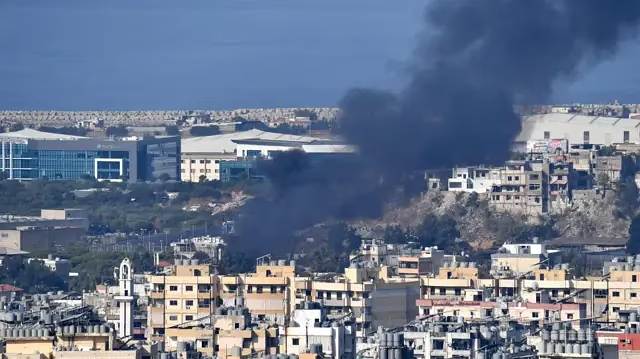
Recent days have witnessed a field escalation, represented by a series of Israeli raids targeting towns in southern Lebanon, under the pretext of targeting sites and elements belonging to Hezbollah. The raids resulted in deaths, injuries, and damage to property and infrastructure, at a time when Israel asserts that it will continue its military operations as long as it considers threats on its northern border to exist.

In contrast, the Lebanese army intensified its deployment in a number of southern areas in coordination with the United Nations Interim Force in Lebanon (UNIFIL), in an attempt to prove the state's ability to extend its authority south of the Litani River, a demand that enjoys wide international support, but faces complex political and security challenges on the ground.

Military developments coincided with internal and external political activity, as Lebanese President Joseph Aoun held a series of meetings with security and military leaders to follow up on developments, while Washington continued its contacts with Lebanese and Israeli officials in an attempt to prevent the deterioration of the situation and push towards more stable security arrangements.

However, these efforts are still clashing with a fundamental obstacle, which is Israel's insistence on retaining the freedom to carry out military operations inside Lebanese territory, in exchange for Lebanon's adherence to Israel's full withdrawal from the territories it still occupies, and an end to its daily violations of Lebanese sovereignty.

American Pressures

Today, the United States appears to be the most influential external player in the Lebanese file. Washington is not content with mediating between Beirut and Tel Aviv, but also seeks to reshape the security reality in the South beyond merely establishing a ceasefire, to include long-term arrangements related to the deployment of the Lebanese army, strengthening UNIFIL's role, and limiting Hezbollah's military activity in border areas.

Observers believe that the American administration considers the success of these arrangements as part of a broader project to redraw security balances in the Middle East after the recent war, and to link the Lebanese arena to a new regional security system that includes a number of Arab countries.

However, this proposal faces widespread internal objections, as Lebanese political forces fear that international pressures will turn into a means of imposing new political and security realities without addressing the roots of the crisis, foremost among them the continued Israeli occupation of parts of Lebanese territory, and repeated aerial and ground violations.

Hezbollah's Dilemma

Hezbollah's future remains the most sensitive issue in any discussion concerning southern Lebanon. Israel believes that any agreement that does not lead to the removal of the party from the border and its disarmament will remain an incomplete agreement, while the party rejects any arrangements that affect its military role as long as the Israeli occupation exists.

As for the Lebanese state, it tries to reconcile its international obligations with the complex internal reality, realizing that any attempt to impose solutions by force may lead to dangerous internal divisions, at a time when Lebanon is already suffering from an unprecedented economic and financial crisis.

Possible Scenarios

The first scenario is the success of American mediation in establishing limited security understandings, allowing for the continued deployment of the Lebanese army and reducing the intensity of Israeli strikes, without reaching a comprehensive political agreement.

The second scenario is the continuation of the current situation, where Israeli raids and limited responses continue, keeping the South in a state of chronic tension that drains all parties.

The third and most dangerous scenario remains the possibility of a complete collapse of diplomatic efforts as a result of a major field incident or a miscalculation, which could lead to the outbreak of a widespread confrontation whose repercussions would be catastrophic for Lebanon and the entire region.

Recent developments reveal that Israel no longer deals with southern Lebanon as merely a front for containing threats, but as an area for reshaping the rules of engagement in a way that gives it a wider margin for military action inside Lebanon. This approach raises fears of consecrating a reality in which Israeli strikes become commonplace, effectively weakening the concept of Lebanese sovereignty and creating a state of permanent instability, even in the absence of an all-out war.

In contrast, Washington realizes that continued escalation could undermine its efforts to rearrange regional files after the war with Iran. Therefore, the American administration seeks to contain the Lebanese crisis quickly, not only to protect Israel's security, but also to prevent the opening of a new front that could hinder its regional priorities and affect its economic and strategic projects in the Eastern Mediterranean and the Gulf.

As for Lebanon, it faces a complex dilemma. On the one hand, it needs the support of the international community to revive its economy and strengthen state institutions, and on the other hand, a wide segment of Lebanese rejects any settlement that is understood to come at the expense of national sovereignty or grant Israel permanent security privileges. Therefore, the success of any future agreement will remain linked to its ability to achieve a real balance between security and sovereignty, rather than being merely a response to military power balances.

In conclusion, it appears that southern Lebanon stands today at a delicate crossroads. Either political efforts succeed in transforming the fragile calm into sustainable stability, or the region remains hostage to the equation of mutual deterrence, where any limited field development is enough to reignite one of the Middle East's most sensitive and complex fronts.

OPINIONS

Sat 11 Jul 2026 11:19 am - Jerusalem Time

On the Necessities of Filling the Governance Vacuum in the Gaza Strip

After the Hamas movement announced the dissolution of the emergency committee that was managing the Gaza Strip at the administrative and civilian levels, the Strip officially entered a state of absence of official governance.

It is true that Hamas has kept the managers and employees in the ministries, and that the Palestinian Authority still has some important activities and programs in the Strip, especially in the fields of health and education. However, it is also true that the Strip is now experiencing a state of absence of an official government to manage its affairs.

It is worth noting here that the Authority was the official governing body before mid-June 2007, and that Hamas became the official body managing governance affairs in the Strip after the division events.

It is worth noting here that the official body that is supposed to professionally and technically handle governance affairs in the Gaza Strip at this stage is the technocrat committee, according to one of the provisions of the Trump plan, which has now become Security Council Resolution No. 2803.

It is clear that Netanyahu and his right-wing government are working to impede the entry of the committee into the Gaza Strip because he focuses on the priority of disarming Hamas instead of implementing the plan as a single package, including the entry of the technocrat committee, the start of early recovery and reconstruction, and allowing the entry of tents and caravans.

Netanyahu's priority lies in disarmament, while the priority of national forces lies in the entry of the technocrat committee and its subsequent tasks, provided that this coincides with gradual withdrawals by the occupation army from the Gaza Strip, instead of increasing the area of occupation control, which has reached 70% according to Netanyahu's statements.

In addition to the continued advance west of the Yellow Line in the Strip's area, the occupation army continues to launch attacks on displaced persons' tents, including targeted assassinations.

Some indicators have emerged from the Peace Council that suggest their danger to the national cause and the future of the Strip, including the announcement of the cancellation of UNRWA operations, which symbolize the refugee issue, and granting immunity to council members at all levels, which abolishes accountability and oversight mechanisms and exposes assets and lands to the risks of permanent control. This also includes preparations for establishing a green zone east of Rafah city as a pilot project, in addition to allocating areas of land for stabilization forces.

Therefore, there are political challenges facing our people in the Strip, in addition to livelihood challenges of an economic and social nature.

The scarcity of food and medicine, high prices, the emergence of war profiteers, and some events that indicate increasing unrest in the social fabric, such as internal conflicts of a violent nature, all require coordinated intervention among active community forces.

The challenges facing our people in the Strip require advancing community initiatives and work mechanisms that work to fill the vacuum.

Palestinian society has extensive professional and administrative experience, and structures and frameworks that represent civil society organizations, the private sector, and trade unions.

We need these structures and components to cooperate in these exceptional circumstances our people are going through to fill the prevailing governance vacuum.

Certainly, this proposal is temporary and transitional until the technocrat committee enters to begin implementing its tasks.

We need to form a body of civil society organizations to provide and supervise services and monitor certain phenomena such as high prices and the fragility of civil peace.

The desired body is important to work on maintaining civil peace and social cohesion.

It is also appropriate for the body to have a national reference from Palestinian national forces, as well as from the Authority and the Organization. The body should also push to oppose displacement schemes, such as the idea of green cities, and expose their objectives, as well as oppose attempts to separate the Strip from the West Bank by pushing for participation in general elections that must include the Strip, Jerusalem, and the West Bank as unified Palestinian territories politically, legally, and geographically according to international law and the Palestinian national program.

Therefore, it is not appropriate to leave the Strip without a governance system, knowing that the occupation aims to exploit the vacuum to sow chaos in the social structure to make the Strip an unsuitable place for living with the aim of implementing the displacement and ethnic cleansing scheme.