ARAB AND WORLD

Fri 06 Feb 2026 9:21 am - Jerusalem Time

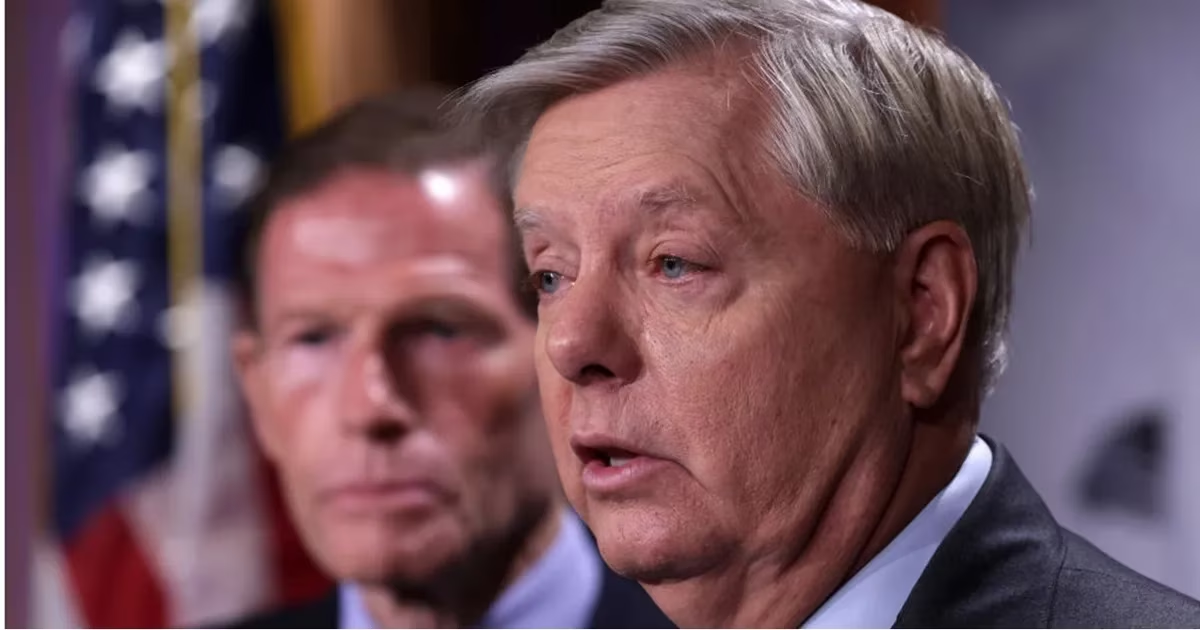
Lindsey Graham ends meeting with Lebanese army commander over Hezbollah stance

US Senator Lindsey Graham announced that he abruptly ended a meeting with Lebanese Army Commander Rudolph Heikel due to differing views on the classification of Hezbollah. Graham explained in a post on the 'X' platform on Thursday that he held a meeting he described as 'very short' with Heikel, where he directly asked him if he considered Hezbollah a terrorist organization. The army commander's response was a rejection within the Lebanese context, which prompted the senator to immediately end the meeting.

Graham considered Hezbollah a 'clear terrorist organization' that caused the bloodshed of Americans, pointing to its official designation as a foreign terrorist organization by successive US administrations since 1997. The senator added that the continuation of this stance by the Lebanese Armed Forces undermines confidence in them as a reliable partner, expressing his dissatisfaction with what he described as 'double-speak' in the Middle East.

In a related context, the Lebanese government had approved a decision last August to restrict weapons to the state, which includes Hezbollah's weapons. However, the party has affirmed on several occasions its adherence to its weapons, linking this to the necessity of ending Israeli aggression and withdrawing from occupied Lebanese territories.

For its part, the Lebanese Army announced in a previous statement that its plan to extend control and restrict weapons had achieved the goals of its first phase in the area south of the Litani River, while warning that continuous Israeli violations negatively affect the completion of these steps.

In the same context, Lebanese Prime Minister Nawaf Salam affirmed last Tuesday that the main obstacle preventing the completion of the state's authority in the south is the continued Israeli occupation of several border points, stressing the need for a complete withdrawal to enable the state to exercise its sovereignty.

As long as this position continues on the part of the Lebanese Armed Forces, I do not believe we have a reliable partner in them.

PALESTINE

Fri 06 Feb 2026 8:21 am - Jerusalem Time

Map reveals Emirati plan to build residential complex near 'Yellow Line' in Rafah

A new map revealed on Thursday an Emirati plan to build a residential complex for Palestinians near the 'Yellow Line' in the city of Rafah, southern Gaza Strip, specifically in areas that are still under the control of the Israeli occupation army since the ceasefire agreement last October. Informed sources reported that the UAE is preparing a plan to build a complex to house thousands of displaced Palestinians in the city of Rafah, which is under Israeli military control.

The sources confirmed that they had seen a map showing that the site where the 'Temporary Emirati Housing Complex' would be built would be near Rafah, which was once a city with a quarter of a million inhabitants, but is now almost completely destroyed and devoid of residents due to Israeli forces. The map shows that the Emirati housing will be located near the 'Yellow Line' agreed upon under the ceasefire agreement, from which the occupation army was supposed to withdraw in the second phase of the agreement, but this has not happened yet despite the American administration's announcement of moving to this phase.

The 'Yellow Line' separates the areas of deployment of the Israeli occupation army, which constitute about 53 percent of the eastern part of the Strip, and the areas where Palestinians are allowed to move freely to the west. The occupation reneges on its commitments in the agreement, both regarding the issue of withdrawal from the Gaza Strip and repeated violations by firing and shelling, which have resulted in hundreds of martyrs and wounded among Palestinians.

According to international sources, an Emirati official commented on what the map showed: 'Abu Dhabi remains committed to intensifying its humanitarian efforts to support Palestinians in Gaza,' without confirming or denying the plan to build the temporary housing site. Diplomats questioned the political feasibility of the Emirati project, due to most Palestinians' refusal to reside in areas controlled by the occupation army, noting that the Emirati initiative resembles an American proposal to establish temporary housing for Palestinians in areas controlled by Tel Aviv.

An American official stated that the UAE is coordinating its housing initiative with Washington and the Peace Council, a new global entity established by President Donald Trump, and with the US-backed Palestinian National Committee tasked with administering the Gaza Strip. The official added: 'We are always impressed by the UAE's efforts to improve the lives of Gaza residents.'

In mid-January, the United States announced the entry into force of the second phase of US President Donald Trump's plan for the Gaza Strip, despite Israeli demands to postpone it. The plan, which the occupation evades, includes reopening the Palestinian side of the Rafah crossing between Gaza and Egypt, and implementing an additional Israeli withdrawal within the Gaza Strip, to enable the launch of the reconstruction process, as well as disarming Hamas and Palestinian factions in the Strip.

Abu Dhabi remains committed to intensifying its humanitarian efforts to support Palestinians in Gaza.

ARAB AND WORLD

Fri 06 Feb 2026 8:21 am - Jerusalem Time

Israeli raids target the South and Bekaa, and Iranian messages to Hezbollah to be ready for confrontation

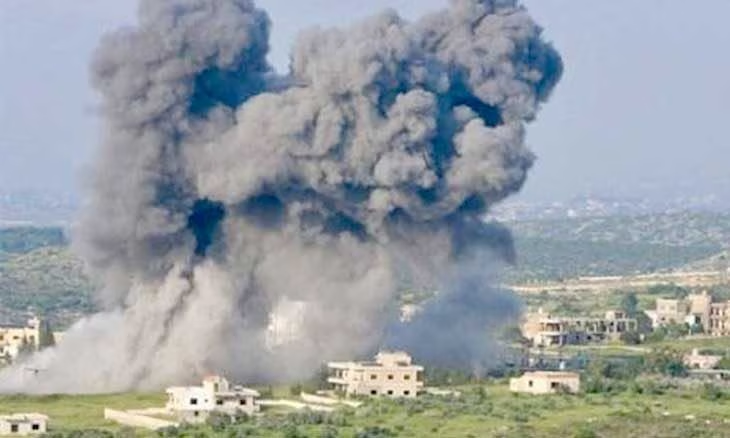
The Lebanese arena witnessed a remarkable field escalation, as Israeli warplanes carried out a series of raids targeting areas in the South and Bekaa. Sources reported that eight raids targeted the town of Al-Mahmoudiya and Wadi Barghaz in the Nabatieh district, followed by shelling on the Al-Wazaiya area in Jabal Al-Rayhan and the Hermel Al-Zghrin heights in the east of the country. The Israeli army spokesman announced that the attacks targeted Hezbollah targets in various areas.

Politically, French Foreign Minister Jean-Noël Barrot began a tour in Beirut that includes the three presidents, focusing on preparing for a conference to support the Lebanese Army scheduled to be held in Paris next March, with the participation of about 50 countries. These moves come at a time when information revealed preparations by President General Joseph Aoun to visit Washington and meet with US President Donald Trump, coinciding with his heading of Lebanon's delegation to the Paris conference.

At Baabda Palace, a prominent meeting was held between President Aoun and the head of the Loyalty to the Resistance bloc, MP Muhammad Raad, where the repercussions of the regional confrontation were discussed. Raad affirmed after the meeting the keenness to cooperate to end the occupation and protect national sovereignty, stressing that Hezbollah will not be neutral towards any threats affecting the region, considering that the priority is to enhance stability, reconstruction, and the state's assumption of its sovereign responsibilities.

On the governmental field level, Prime Minister Nawaf Salam begins an inspection visit to the border areas in the South, including the army barracks in Tyre, Naqoura, Bint Jbeil, and Marjayoun. This visit, accompanied by MPs from the Amal Movement and Hezbollah under the guidance of Parliament Speaker Nabih Berri, aims to confirm the official presence in the areas facing the Israeli occupation.

Diplomatically in Washington, Army Commander General Rudolf Heikal continued his meetings with American officials, including US President's advisor Massaad Boulos and Senator Lindsey Graham. Discussions focused on continued military support for the Lebanese Army, amid American indications linking this support to field progress in the plan to restrict weapons, which was confirmed by Lebanon's ambassador to Washington, Nada Maawad, who described the meetings as positive.

In a related context, Tehran sent a clear message through Ali Akbar Velayati, advisor to the Iranian Supreme Leader, in which it affirmed Iran's full readiness to confront any threat from the United States and Israel. The spokesman for the Iranian army, Muhammad Akrami Nia, stated that the armed forces have strengthened their capabilities by adding a thousand strategic drones, warning that any confrontation will include American bases in the region, putting President Trump before the options of reconciliation or war.

Internally, MPs from the Loyalty to the Resistance bloc warned of the pressures exerted by Washington and Tel Aviv. MP Ali Ammar considered that the region is going through a very sensitive stage targeting the axis of resistance, while MP Hussein Al-Hajj Hassan stressed the rejection of concessions to Israeli demands, affirming that what President Trump proposes under the name of 'peace by force' is an attempt to impose surrender and plunder wealth, calling for national unity to confront these challenges.

US President Donald Trump must choose between reconciliation or war; the Iranian armed forces are ready for both options.

PALESTINE

Fri 06 Feb 2026 8:06 am - Jerusalem Time

United Nations: Over 900 Palestinians displaced in West Bank since early 2026

The United Nations has warned of the continued displacement of Palestinians in the occupied West Bank at "high levels," amid escalating Israeli settler violence and demolition operations, confirming that more than 900 Palestinians have been forced to leave their homes since the beginning of 2026. Stéphane Dujarric, Spokesperson for the UN Secretary-General, stated that this large number of displaced persons is mostly due to "settler violence and restrictions on access, particularly through demolitions," noting that the phenomenon has seen an alarming escalation in recent weeks.

During a press conference, Dujarric explained that the UN Office for the Coordination of Humanitarian Affairs (OCHA) documented, between January 20th and last Monday, more than 50 attacks carried out by Israeli settlers, resulting in Palestinian casualties, damage to property, or both.

He added that the United Nations is conducting initial assessments of damages and needs following these incidents, with the aim of guiding the UN humanitarian response, emphasizing the necessity for all parties to adhere to international humanitarian law, particularly regarding the protection of civilians and civilian infrastructure.

These warnings come at a time when UN complaints continue regarding Israel's non-compliance with the humanitarian protocol of the ceasefire agreement in effect since October 10th in the Gaza Strip, concerning the entry of fuel, humanitarian aid, and rubble removal equipment.

In a related context, Dujarric noted that more than 18,500 patients in the Gaza Strip still require specialized treatment not available locally, commending the efforts of the World Health Organization and its partners in evacuating 8 patients and 17 companions through the Rafah crossing to Egypt.

The UN spokesperson reiterated the call to reopen referral pathways for patients to the occupied West Bank, including East Jerusalem, to alleviate pressure on the overwhelmed health system in the Gaza Strip.

It is worth noting that the Israeli army had taken control of the Palestinian side of the Rafah land crossing last May, imposing strict restrictions on movement, and only allowing limited quantities of fuel and aid, which exacerbated the humanitarian crisis within the Strip. Despite the reopening of the crossing earlier this week, Palestinians returning from Egypt to Gaza complained of ill-treatment and significant harassment, amid Israeli procedures described as highly complex.

This large number of displaced persons is mostly due to settler violence and restrictions on access, particularly through demolitions.

ANALYSIS

Fri 06 Feb 2026 3:22 am - Jerusalem Time

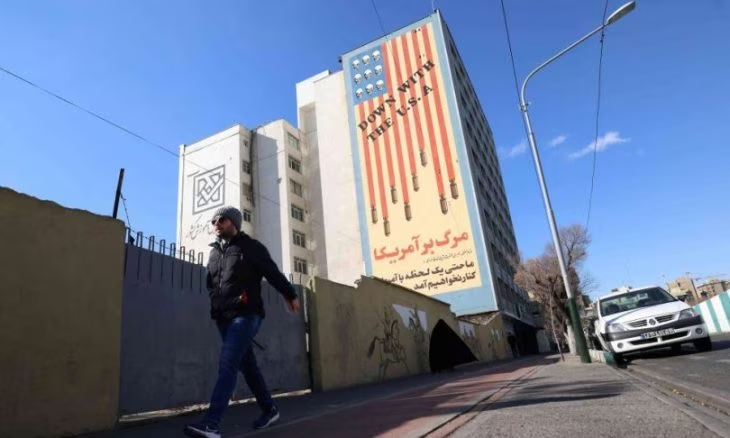
David Hearst warns Trump: Plan to force Iran to surrender 'a fatal mistake'

British journalist David Hearst warned US President Donald Trump against making a 'fatal mistake' in his foreign policy by attempting to force Iran to surrender under the threat of military action. In an analytical article, Hearst noted that Trump, emboldened by supposed diplomatic and military successes in the NATO, Venezuela, and Gaza files, misjudges the true strength of the Islamic Republic and its strategic depth.

The analysis revealed details of a plan promoted by Trump's envoy Steve Witkoff and his son-in-law Jared Kushner, which relies on a 'swift and limited' air strike targeting regime leaders to force them to sign a deal that would grant Washington a monopoly over Iranian oil in exchange for the return of American companies like Boeing to operate there. Hearst described this notion as 'political madness' that ignores the reality on the ground.

Hearst explained that Trump's assessment of Iran's weakness relies on 'dysfunctional' Israeli and American intelligence sources, emphasizing that Tehran possesses a surplus of regional cards, ranging from its spiritual influence in Iraq, Lebanon, and Bahrain, to the Revolutionary Guard's ability to close the Strait of Hormuz, through which 20 million barrels of oil pass daily, which could cripple the global economy and directly clash with Chinese interests.

On the military front, the article indicated that Iran would not be content with a limited response, as happened after the assassination of Qassem Soleimani in 2020, but might instead use its arsenal of more than 3,000 ballistic missiles to strike targets including Israel's partners in the region. Hearst stressed that the Revolutionary Guard, which controls half of oil exports and manages a parallel economic system, would not hand over the country's budget to the US Treasury, as some in Washington delude themselves.

Regarding the diplomatic track, Hearst pointed out a divergence in views; Turkey seeks to establish a regional forum for negotiations, while Tehran insists on direct talks in Oman limited to the nuclear file and on the condition that the 'sword hanging over its neck' is lifted. Hearst concluded his article by calling on Trump to read Iranian history, asserting that Tehran, which has survived wars and sanctions for decades, will not accept a return to an era of foreign hegemony.

The British journalist concluded that Trump and Netanyahu have the ability to ignite a 'third Gulf war,' but completely lack the ability to extinguish it, considering that the chance of successful talks avoiding confrontation is no more than one in ten given the current mindset of the US administration.

Iran is not Venezuela; and any attack on it will not be interpreted as a preliminary rebuke for negotiation, but rather as an existential threat that will ignite a third Gulf war that cannot be extinguished.

ISRAELI AFFAIRS

Fri 06 Feb 2026 1:34 am - Jerusalem Time

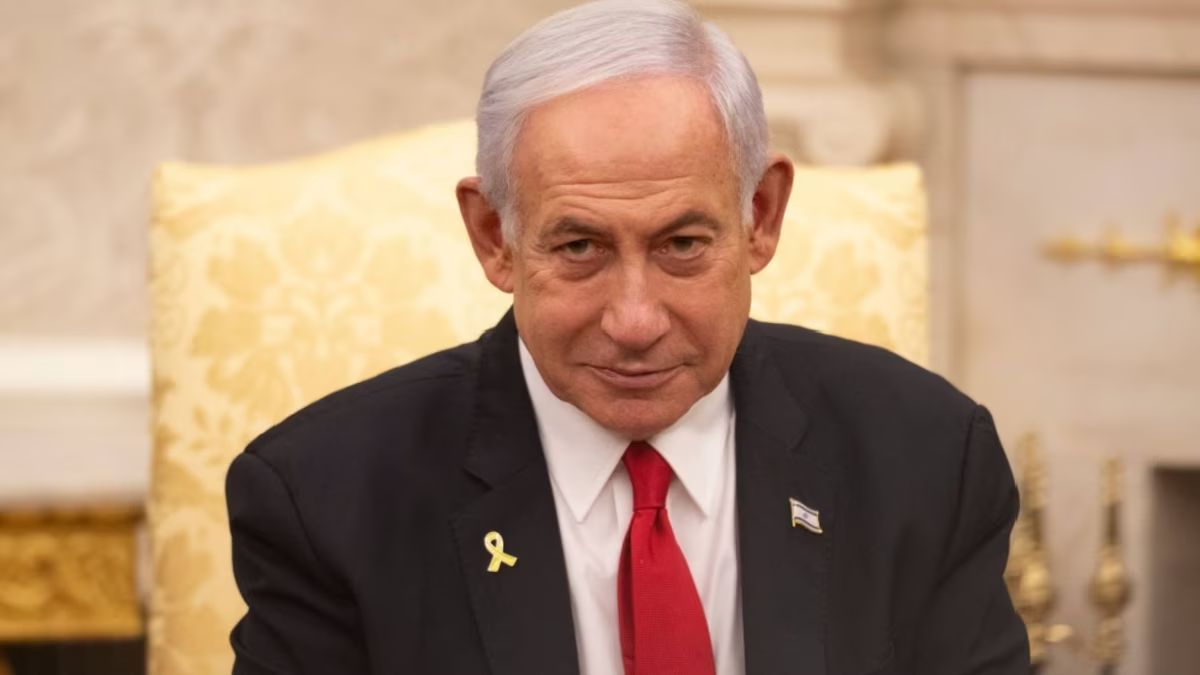
Netanyahu reveals 'failure' documents, attacks Supreme Court, and proposes 'equal' inquiry committee

The Prime Minister of the occupation, Benjamin Netanyahu, revealed on Thursday evening the content of the official document he submitted to the occupation's Comptroller as part of the ongoing investigations into the events of October 7, 2023, and the preceding circumstances, sharply criticizing the Supreme Court's decision to freeze the Comptroller's work on this file.

Netanyahu announced that he had handed detailed answers to the State Comptroller during a four-hour meeting last December, indicating that the document includes minutes of security meetings spanning 12 years, from Operation 'Protective Edge' until the morning of the attack. He also accused the Supreme Court of obstructing the revelation of the truth, considering that the issuance of the freeze decision just six days after he submitted his answers raises questions about the timing's coincidence, calling for the immediate cancellation of the interim order to allow former officials to review and comment on the documents.

Netanyahu affirmed that the occupation's Comptroller's examination is not a substitute for a 'national inquiry committee,' proposing a new formula for its formation based on what he described as 'democratic equality.' This composition stipulates that half of the committee members be chosen by the government coalition, and the other half by the opposition, emphasizing the necessity that neither the government nor the Supreme Court interfere in determining its composition, but rather that it be done through public representatives in the Knesset.

Netanyahu cited the model of the American inquiry committee into the events of September 11, affirming his full readiness to be the first to appear before it to give his testimony.

A political analysis by informed sources provided a critical reading of the leaked document, explaining that it puts the leaders of the security system in confrontation with 'misleading public opinion.' The analysis pointed to a state of 'blindness and arrogance' within the security agencies that were preoccupied with warning about the repercussions of legal reforms instead of monitoring the imminent Hamas attack. The documents also proved that Netanyahu himself, despite proposing assassinations in some minutes, did not realize the extent of the existential threat and historically did not propose the option of 'occupying Gaza' or comprehensively eliminating the movement.

The minutes revealed a significant gap between the reassuring messages military leaders were giving in closed rooms and their subsequent public warnings, reflecting a stark contradiction in assessing the situation. The analysis concluded that the document places everyone in the same basket in terms of being trapped by concepts, making the responsibility for the failure shared between the political level and the security leadership without one side having an advantage over the other in bearing the consequences of what happened.

The occupation's Comptroller's examination is not a substitute for a national inquiry committee, and I propose a formula based on democratic equality in its formation.

PALESTINE

Fri 06 Feb 2026 12:50 am - Jerusalem Time

Occupation forces ban 12 Jerusalemites from Al-Aqsa and open a settlement tunnel in Silwan

On Thursday, Israeli occupation authorities issued orders banning 12 Palestinians from occupied Jerusalem, including a Sharia judge, from Al-Aqsa Mosque, while settlers continued to storm the mosque. Sources in the Jerusalem Governorate reported that occupation forces issued 12 orders to ban individuals from the blessed Al-Aqsa Mosque for a renewable period of one week.

The sources stated that among those banned were the Sharia judge of Jerusalem, Sheikh Iyad Al-Abbasi, released prisoners, mosque guards, and Jerusalemites, as part of the ongoing targeting and harassment policy against the city's residents. A report by the Governorate also indicated that two employees of the Islamic Endowments Department, Mahdi Al-Abbasi and Abdul Rahman Al-Sharif, were transferred to administrative detention for four months by a decision issued by the occupation army minister, Yisrael Katz.

Since the beginning of February, occupation authorities have issued dozens of ban orders from Al-Aqsa Mosque, in addition to more than 100 orders during last January. These measures come ahead of the holy month of Ramadan, as the occupation police have threatened to intensify arrests against worshipers attempting to perform I'tikaf (seclusion for worship) in the mosque.

Regarding the incursions, sources reported that 279 settlers stormed Al-Aqsa Mosque on Thursday, where they performed public prayers, loud dancing and singing circles, and Talmudic rituals including prostration, in a continuous violation of the status quo inside the blessed mosque.

Concerning Judaization policies, the Jerusalem Governorate considered the opening of an archaeological tunnel in the city an attempt to falsify Palestinian history. It clarified that the opening of the so-called 'Pilgrims' Road' colonial tunnel in the town of Silwan is a false exploitation of the archaeological site of 'Street of the Tombs,' which is an ancient Roman road unrelated to Jewish historical claims.

Israeli President Isaac Herzog had opened the road on Wednesday to settlers and tourists, with the participation of settlement entities and Zionist funders. The tunnel extends 600 meters, starting from beneath the homes of Jerusalemites in Wadi Hilweh in Silwan, reaching the foundations of the Buraq Wall west of Al-Aqsa Mosque, at an estimated cost of about 15 million dollars.

In a related context, the Jerusalem Governorate announced that occupation authorities have begun work on paving the 'Road 45' settlement road north of occupied Jerusalem, with the aim of connecting the settlements established north of the city and east of Ramallah with Jerusalem. The road extends from the town of Mikhmas in the east to the Qalandia tunnel in the west, with a length of approximately 5 kilometers, confiscating about 280 dunams of Palestinian citizens' lands.

The opening of the so-called 'Pilgrims' Road' colonial tunnel is a direct extension of the occupation's policies in falsifying Palestinian history and exploiting antiquities to legitimize settlement expansion.

ISRAELI AFFAIRS

Thu 05 Feb 2026 11:43 pm - Jerusalem Time

Ehud Olmert: What is happening in the West Bank is ethnic cleansing in partnership with the security establishment

In a statement described as unprecedented in its strength and clarity, former Israeli Prime Minister Ehud Olmert confirmed the existence of systematic ethnic cleansing against Palestinians in the occupied West Bank, emphasizing that these actions are carried out with the participation and complicity of the Israeli security establishment. Olmert called on capable international powers to intervene directly to arrest the attacking settlers and investigate the parties that provide them with support.

Olmert explained in statements to Hebrew media sources that the attacks by what are known as 'hilltop youth' are deliberately aimed at carrying out ethnic cleansing through daily bloody attacks, stressing that the army and police forces turn a blind eye to these crimes. He also expressed his doubts about the role of the General Security Service (Shin Bet), considering that it is not making the necessary effort to stop this phenomenon.

Olmert directly accused the ruling establishment, indicating that the failure to arrest the attackers and leaving Palestinian victims unprotected, and often even arresting them, reflects 'actual partnership' and support for these crimes. He added that stopping the issuance of administrative detention orders against settlers sends a clear signal of blessing these trends.

Olmert strongly criticized the situation in the West Bank, describing it as 'abnormal,' and pointing out that the police are deliberately not performing their duty. He also noted that the attackers are inspired by the head of national security who provided them with weapons and prevented security agencies from doing their duty, in reference to current government policies that enjoy the support of state leaders.

In conclusion of his statements, Olmert warned that continued turning a blind eye to armed settlers who burn, kill, and destroy property will make Israel pay a heavy price. These statements coincide with similar positions by former Defense Minister Moshe Ya'alon, who recently admitted that the occupation represents 'corruption,' supporting previous historical warnings about the nature of Israeli control over Palestinian territories.

There is no way to stop what is happening except through actual partnership, support, and advocacy from the world, as there are attempts to carry out ethnic cleansing through daily bloody attacks.

PALESTINE

Thu 05 Feb 2026 11:43 pm - Jerusalem Time

United Nations: Settler attacks displace nearly 700 Palestinians in West Bank during January

The United Nations announced on Thursday that attacks and harassment by occupation settlers in the occupied West Bank led to the displacement of nearly 700 Palestinians during January, the highest rate recorded since the outbreak of the war more than two years ago. According to figures issued by the United Nations Office for the Coordination of Humanitarian Affairs (OCHA), and based on data collected by several UN agencies, at least 694 Palestinians were forcibly displaced from their homes last month.

The UN Human Rights Office reported that in late January, settler violence became a major factor in forced displacement. Displacements saw a significant increase due to the complete emptying of the Ras Ein al-Auja community in the Jordan Valley, as 130 families left their homes after months of continuous harassment.

Farhan al-Jahalin, a resident of the displaced community, stated: 'What is happening today is a complete collapse in the community due to continuous settler attacks day and night.' These developments come amid escalating field pressures on Bedouin and agricultural communities in the Jordan Valley and West Bank areas.

According to a 2025 report by the 'Peace Now' organization, grazing is used as a means to impose presence on agricultural lands and deprive Palestinians of them, with the support of the occupation government and army. Allegra Pacheco, director of the West Bank Protection Consortium, said: 'No one is putting pressure on the occupation authorities to stop this, so settlers feel complete impunity,' adding that the focus on Gaza has allowed the continuation of 'ongoing ethnic cleansing' in the West Bank.

It is worth noting that the West Bank is home to more than half a million settlers in settlements considered illegal under international law. Since the outbreak of the war in October 2023, at least 1035 Palestinians have been killed in the West Bank by occupation forces or settlers, according to figures from the Palestinian Ministry of Health.

What is happening today is a complete collapse in the community due to continuous settler attacks day and night.

ARAB AND WORLD

Thu 05 Feb 2026 7:09 pm - Jerusalem Time

Crucial Talks in Oman Between Washington and Tehran Amid Trump's Military Option Threats

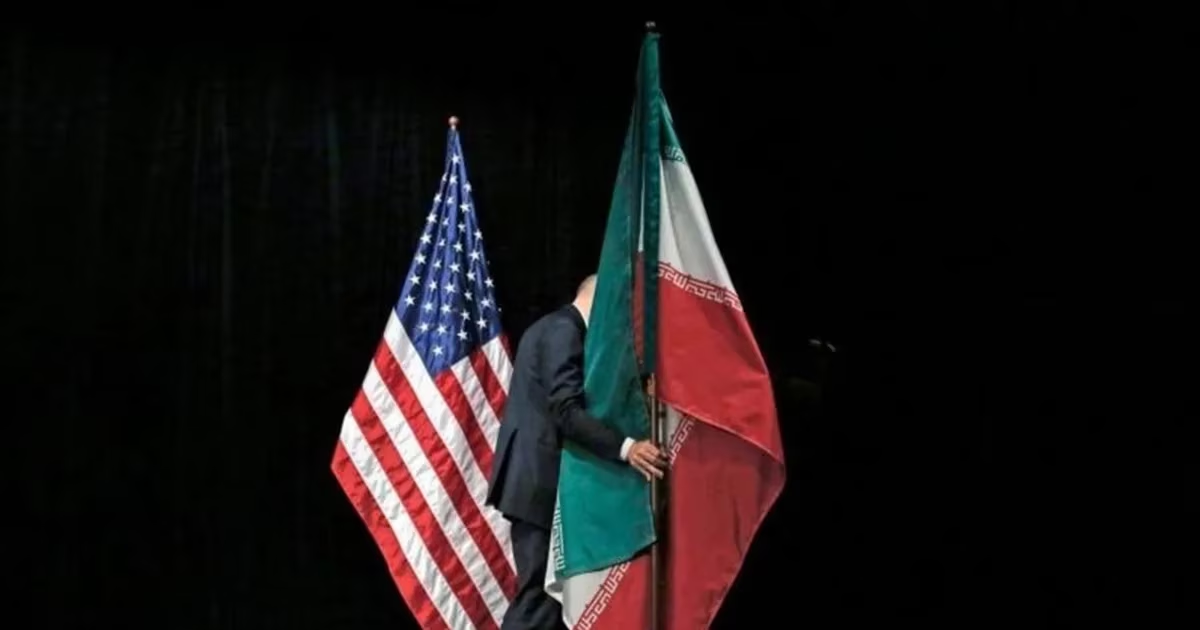
Attention turns to the Sultanate of Oman tomorrow, Friday, where the United States and Iran are scheduled to hold crucial talks, at a time when US President Donald Trump is brandishing the military option in a region that has witnessed intense conflicts since 2023. This round comes amid US pressure to expand the negotiation agenda to include issues beyond the nuclear program.

US Secretary of State Marco Rubio clarified that Washington seeks to include the Iranian nuclear program, the development of ballistic missiles, support for armed groups in the region, in addition to the human rights file, on the discussion table. In contrast, Tehran maintains its position of refusing to discuss any file except its nuclear program, emphasizing that its defensive capabilities are a red line.

The nuclear program is the central point of contention, especially after Iran reached 60% uranium enrichment, a level approaching military grade. The year 2025 witnessed a significant escalation on the ground when US forces, alongside Israel, participated in strikes targeting Iranian nuclear facilities in June, before a ceasefire was reached, the results of which on the ground are still not entirely clear.

Regarding military capabilities, Tehran possesses a massive arsenal of ballistic missiles that it has used directly against Israel on several occasions over the past two years. While Israeli Prime Minister Benjamin Netanyahu describes these capabilities as an existential threat, Iranian Foreign Minister Abbas Araqchi stresses that Iranian missiles are outside the scope of any potential political settlement.

Regionally, Iran's influence faces unprecedented challenges, especially after the fall of Bashar al-Assad's regime in Syria and its allies in the 'Axis of Resistance' suffering strong blows. In Iraq, Washington is pushing to prevent the infiltration of pro-Tehran groups into the executive power, while the Houthis in Yemen still represent a strong arm for Tehran by threatening international navigation in the Red Sea.

Domestically, the Iranian leadership faces increasing pressure after a wave of bloody protests erupted last December due to economic crises. President Trump has exploited these disturbances to toughen his tone, warning Tehran against suppressing protesters, and emphasizing that the US administration is closely monitoring how the regime deals with popular demands.

Iran's defensive and missile capabilities will never be a subject of any negotiations.

PALESTINE

Thu 05 Feb 2026 7:09 pm - Jerusalem Time

Dismembered remains in boxes... The tragedy of Gaza families identifying mutilated martyrs' bodies

The crimes of the Israeli occupation against the people of the Gaza Strip continue, as it detains hundreds of martyrs' bodies during the war, then delivers them as mutilated bodies and dismembered remains that are difficult to identify due to torture and decomposition, which increases the suffering of the families of the missing in their attempt to identify the fate of their children. Yesterday evening, Wednesday, Al-Shifa Complex witnessed the arrival of 54 bodies and 66 boxes containing dismembered remains and human organs, which were released by the Israeli occupation, through the Red Cross organization. The Palestinian Ministry of Health stated that its medical teams continue to deal with the bodies according to approved medical procedures and protocols, in cooperation with relevant bodies and committees, in preparation for completing examination, documentation, and delivery to the families.

The Palestinian Center for Missing Persons and Forcibly Disappeared Persons stated that the Israeli army's delivery of 54 bodies and 66 boxes containing dismembered remains and human organs raises real and escalating concerns about deliberate tampering with the bodies, including mutilation and dismemberment, and reinforces fears and suspicions about organ theft. The center reminded that the occupation authorities still detain hundreds of bodies of Palestinian martyrs, including at least 777 documented martyrs, among them children, women, and prisoners, in addition to hundreds of martyrs from the Gaza Strip whose bodies are detained without disclosing their identities or the circumstances of their detention.

The Palestinian Center for Missing Persons and Forcibly Disappeared Persons stressed that what is happening necessitates an urgent and independent international investigation into the fate of the detained bodies, and an examination of the possibilities of tampering, mutilation, and organ theft.

Dr. Munir Al-Bursh, Director-General of the Ministry of Health in the Gaza Strip, commented, asking: "What law permits returning a human being as dismembered remains? How can we return names to bodies when we do not possess the necessary examination tools, nor the minimum forensic medical capabilities that enable us to identify or document them as befits human dignity? We are not dealing with numbers recorded in reports, but with fathers and mothers, sons and daughters, each of whom has a name, a memory, a dream, and a home that is still waiting."

Al-Bursh condemned the delivery of martyrs' bodies in boxes and as dismembered remains, describing these violations as not merely a procedural violation, but a moral and humanitarian crime, and a blatant violation of all international laws and conventions that were once established to protect human dignity, alive and dead.

Today, the forensic medicine and criminal evidence departments began their work at Al-Shifa Medical Complex, to deal with the remains of the martyrs that were received yesterday from the International Committee of the Red Cross. The director of Al-Shifa Complex explained that the specialized teams are working according to approved protocols for dealing with bodies and human organ parts, with the aim of documenting them and identifying the identities of the martyrs, in preparation for informing their families and enabling them to identify their relatives, within a humanitarian and legal framework that preserves the dignity of the martyrs and the rights of their families.

After receiving the bodies of martyrs after their release by the occupation previously, forensic medicine and criminal evidence faced difficulty in identifying the identities of the martyrs due to the disappearance of their features as a result of torture and abuse of the bodies, which led to the burial of dozens of them as unidentified in mass graves without being identified.

What law permits returning a human being as dismembered remains? How can we return names to bodies when we do not possess the necessary examination tools?

OPINIONS

Thu 05 Feb 2026 6:58 pm - Jerusalem Time

Gaza the Besieged Between Ideological Walls: Sanctifying the Idea and Denying Humanity

Dr. Ibrahim Nairat

Opinion Writer

Gaza is not merely a besieged spot on the map, but a mirror of extended political and moral failure, a place where geography has shrunk and conflict has expanded to the point of suffocation. Since the Oslo Accords, peace has seemed more like an unwelcome burden than a historical option, a temporary phase that quickly turned into something to be overcome. The real question was not how to reach a settlement, but how to live without one.

In Israel, the entire society cannot be reduced to a single stance, but the nationalist and religious right-wing camp that dominated decision-making in recent decades treated Oslo as a tactical error, not a path to be completed. This camp did not view a settlement as a solution, but as a postponed threat, and did not see a Palestinian state as a possible partner, but as a danger to the state's identity and future. Fear of demography, of mutual recognition, and of the very idea of equality, made true peace more unsettling than continued conflict. Thus, agreements were emptied of their content through settlement and the imposition of facts, transforming the idea of a solution into a permanent crisis management. Deep down, an equation resided that accepted neither gradualism nor compromise: either complete control over the land, or an open-ended, endless conflict.

On the other side, Hamas stands with a project that views Palestine as an indivisible unit, a project not based on temporary solutions or incomplete compromises. Time is a central element in this vision, as history is seen as a long path not measured by the logic of quick achievement. If the goal is not achieved today, it will be achieved in the future. The land is left as one complete piece, and Islam is seen as the ultimate guarantor, not politics or international balances. In this sense, the present is not the center of decision, but the distant promise that gives the conflict its meaning and continuity.

But what both parties fail to realize, or refuse to acknowledge, is that the camp of peace is much wider than the camp of rejection, and that the street, here and there, has become more aware than leaders assume. The average Palestinian realizes that denying the existence of the other is no longer possible, just as the average Israeli realizes that force alone cannot erase an entire people or abolish their presence forever. The equation, at the level of the people, has become both understandable and harsh: neither side can swallow the other, nor can the other erase it, and any talk of a “final solution” is now nothing more than a costly political illusion.

And herein lies the most dangerous paradox. While the base of realistic understanding expands in societies, political options narrow, and the voice of projects that only thrive in an atmosphere of rejection grows louder. The war between the right-wing camp in Israel and Hamas is not only managed as a military confrontation, but as a systematic process of excluding the very ideas of peace, a process aimed at pushing them out of the public sphere, distorting them, associating them with weakness or betrayal, and making a return to them almost impossible. In this context, blood becomes the real guarantor of the equation's continuation. The more blood is shed, the more rational language recedes, the camp of compromise shrinks, and the cost of any voice calling for a solution rises. Blood does not resolve the conflict, but it resolves the debate, and closes the windows through which peace might enter. With each round, the idea of mutual recognition is buried deeper under the rubble, not because it is unrealistic, but because it does not serve those who thrive on conflict.

But what both parties also fail to realize is that the entire path is heading towards a bottleneck that is narrowing with time. Right-wing Israel acts as if time is on its side, but in reality, it is struggling against it. With each passing year, the issue becomes more complicated, legitimacy erodes, internal division deepens, and military superiority turns into a political and moral burden. The occupation, long managed as a security file, has become an existential knot, whose explosion cannot be postponed indefinitely.

Conversely, Hamas bets on time as a historical promise, but it clashes with an exhausted societal reality. Gaza, presented as a symbolic reservoir for the future, is being depleted in its present, and with it, the people's capacity for endurance and for imagining a life outside the logic of long waiting. Time here does not only act as an ally, but as a harsh test for society, accumulating fatigue and deepening the gap between rhetoric and reality.

Thus, while each side thinks it is pressuring its opponent, it is in fact pressuring all of reality to the point of suffocation. Every step towards the brink is presented as steadfastness, but ultimately it brings everyone closer to a point of no return, where slogans are not enough, force does not decide, and future promises do not convince.

Gaza is the place where this tragedy intensifies. It bears more than it can endure; it is used to test the illusions of control and postponed salvation. A small area burdened with more than it can bear, used to test grand illusions, the illusion of permanent control, and the illusion of postponed salvation. Between these two illusions, the larger, often silent, camp of peace is crushed, aware of the impossibility of annihilation, and unable to impose its logic in a time of blood.

In the end, the question urgently imposes itself, inescapable: Have the parties truly exhausted all their tools, or does war turn into a ready option every time a small space appears to achieve goals of exclusion? Is the conflict ignited because there is no alternative, or because the alternative—sitting down, recognizing, and accepting a solution—threatens the ideological structures upon which these projects are built? Either the parties realize, sooner or later, that there is no escape from sitting down, not as a concession but as an existential necessity, or they continue to manage the conflict with blood, round after round, until there is nothing left to exclude but humanity itself.

Thus, peace is not killed because it is impossible, but because it is undesirable by forces that need conflict to justify their existence. With each round of war, we not only move further away from a solution, but collective consciousness is re-conditioned to believe that a solution was never possible in the first place. And when everyone realizes the extent of the loss, the question may no longer be how to achieve peace, but how much more blood must be shed until a simple idea, known to people for a long time, is allowed to resurface.


PALESTINE

Thu 05 Feb 2026 6:09 pm - Jerusalem Time

Abbas receives draft interim constitution, declares 2026 year of democracy and elections

The President of the State of Palestine, Mahmoud Abbas, on Thursday received the first copy of the draft interim constitution for the State of Palestine, during his reception of the Constitution Drafting Committee, headed by Counselor Mohammed Al-Haj Qassem and the committee members, at the presidential headquarters in Ramallah.

The President praised the arduous efforts made by the committee, emphasizing that the issuance of this constitution represents a pivotal step paving the way for the actual transition from the "authority stage" to the "state stage," which has so far been recognized by more than 160 countries around the world.

In an important political context, Abbas announced that the current year is the "year of democracy," revealing a comprehensive electoral roadmap that includes setting a date for holding elections for the Palestinian National Council at home and abroad, setting a date for holding the eighth Fatah conference, in addition to holding local elections next April. Abbas stressed that the new constitutional texts focus on safeguarding rights and freedoms, and ensure effective empowerment of women and youth, reflecting their true status in Palestinian society.

For his part, the head of the committee, Counselor Mohammed Al-Haj Qassem, explained that the draft was the result of continuous work that lasted approximately 7 months, during which 70 meetings were held with various civil society institutions and relevant bodies. He affirmed that the interim constitution preserved the pillars of a modern state, most notably political pluralism, separation of powers, and empowering parliament to exercise its full oversight and legislative powers.

At the end of the meeting, the President issued instructions to refer a copy of the draft constitution to the Executive Committee of the Palestine Liberation Organization for review, in preparation for its public release to receive comments and suggestions. A decision will be issued later to regulate the procedures, mechanisms, and timeframe for its publication.

The issuance of this constitution represents a pivotal step paving the way for the actual transition from the authority stage to the state stage.

ARAB AND WORLD

Thu 05 Feb 2026 5:09 pm - Jerusalem Time

Trump: The US presidency is the most dangerous job in the world, and I worry about assassination

US President Donald Trump revealed his concern for his personal safety after surviving two assassination attempts, stressing that he deliberately keeps these fears out of his mind so that he can continue to perform his duties, describing the US presidency as "the most dangerous job in the world statistically." Trump said, in an interview with American media sources on Wednesday conducted inside the White House, in response to a direct question about whether he feared for his safety: "Yes, I worry about it, but you have to put it out of your mind, otherwise you won't be able to do your job."

Trump added that his experience after the two assassination attempts made him realize the extent of the risks associated with the position, pointing out that the presidency is more dangerous than driving race cars or bullfighting, according to him. The meeting lasted for about an hour, during which highly sensitive internal and external issues were discussed, foremost among them immigration, internal security, and crime, in addition to the economy, foreign policy, and his political future.

Regarding immigration, Trump strongly defended his administration's policies, stressing that illegal border crossings have reached their lowest levels in years, and that federal operations focus on those he described as "the most dangerous criminals," such as murderers and drug traffickers. At the same time, he acknowledged the need to adopt a "quieter touch" in some security interventions, after incidents witnessed in Minneapolis, while emphasizing continued firmness.

The US President touched on the events in Minneapolis and the shooting incidents that sparked widespread controversy, admitting that "what happened should not have happened," but he stressed his full support for law enforcement agencies, considering that any retreat from supporting them "means losing control of the state."

Trump also revealed that his administration is considering expanding its security interventions to include five new American cities, without naming them, explaining that he prefers this to be done at the request of state governors or mayors, rather than by imposing intervention by force. He hinted at major cities suffering from high crime rates, such as Chicago, stressing that his government is capable of "restoring security quickly."

On the economic front, Trump attributed the improvement in economic indicators to his administration's policies, speaking about artificial intelligence as a key driver of economic growth in the next phase. He also made indirect criticisms of the Federal Reserve's performance and independence.

Regarding foreign policy, Trump issued a strong warning to Iran, saying that its leadership "should be very worried," without revealing specific steps or measures, content to leave the door open for all scenarios. As for his political future, Trump avoided giving a decisive answer about whether he seeks to remain in power after the end of his current term, considering that ambiguity "makes things more exciting."

The US presidency is statistically the most dangerous job in the world. Yes, I worry about my safety, but I have to put that out of my mind to be able to work.

PALESTINE

Thu 05 Feb 2026 5:09 pm - Jerusalem Time

Israel bombs 'Mirage' water tank in Rafah, putting facility serving 70,000 people out of service

Activists on social media circulated a video documenting the Israeli occupation army blowing up a main water tank north of Rafah city in the southern Gaza Strip. Geolocation confirmed that the explosion, which occurred on February 2nd, targeted the 'Mirage' water tank, funded by the Turkish Red Crescent, which serves approximately 70,000 people in the eastern and northern areas of Rafah city, according to data from the Coastal Municipalities Water Utility in the Strip.

Satellite images obtained by journalistic sources, taken on February 3rd, showed the complete destruction of the tank and its surroundings. An Israeli soldier wrote on the video he shared on social media, 'We specialize in painting and minor renovations... Details in private messages,' in a sarcastic reference to the bombing operation.

According to local reports, the tank has a capacity of 3,000 cubic meters and has contributed to solving the water scarcity crisis for Rafah residents since its establishment. The Coastal Municipalities Water Utility had opened the tank as part of a project that included 3 wells and a transmission line in the 'Morag' area in July 2010, funded by the Turkish Red Crescent at a cost of 450,000 US dollars.

This targeting comes in the context of what UN experts described as a 'thirst war.' Experts had previously expressed their dismay at Israel's deliberate prevention of Palestinians in Gaza from accessing clean drinking water, describing it as a blatant violation of international law and a crime against humanity.

Experts said that 'Israel is using thirst as a weapon to kill Palestinians, and cutting off water and food is a silent, deadly bomb.' It is worth noting that since October 2023, Israeli military operations have systematically targeted water facilities, wells, pipelines, and desalination units, with occupation forces destroying 89% of Gaza's water and sanitation infrastructure, leaving more than 90% of households suffering from water insecurity.

Israel is using thirst as a weapon to kill Palestinians, and cutting off water and food is a silent, deadly bomb.

PALESTINE

Thu 05 Feb 2026 4:54 pm - Jerusalem Time

Occupation's bulldozing of Allied soldiers' cemetery east of Gaza sparks widespread anger in Britain

Recent satellite images have shown Israeli occupation forces bulldozing parts of the 'Gaza War' cemetery, which contains the remains of British, Australian, and other Allied soldiers who fell in the First and Second World Wars. Footage and evidence revealed by journalistic sources on Wednesday for the cemetery, located in the Al-Tuffah neighborhood of Gaza City, show extensive excavation and plowing operations and the removal of tombstones in the southern corner of the cemetery, in addition to the construction of an earthen dam using heavy equipment.

In response, British political figures, veterans' organizations, and soldiers' families expressed strong dismay, describing what happened as a desecration of the dead and a lack of respect for history and diplomacy, amidst calls for an official investigation into the incident at the highest levels.

While craters from airstrikes appear around the site, the damage within the cemetery's boundaries looks different, with rows of tombstones removed and massive sand barriers erected. According to image analysis, these signs of destruction were not visible in March of last year, but they became clearly apparent in footage dated August 8, before appearing more extensive in subsequent images from December.

The damaged area appears as barren land compared to the rest of the cemetery, which is covered in grass. The destruction seems to have affected vast areas according to the images, with a site dedicated to Canadian peacekeeping forces outside the main wall completely erased. Also, 6 sections containing the remains of over 100 World War II soldiers, mostly Australians, and 4 sections for British World War I soldiers who fell during battles with Ottoman forces, were leveled.

Sources quoted the former cemetery guard, Issam Jarada, as saying that the bulldozing operations took place in two phases. The first phase covered the cemetery's perimeter to a depth of 12 meters where olive trees were planted, while the second targeted an area of approximately one thousand square meters inside the walls.

Jarada added: "The bulldozing affected the area containing the graves of Australian soldiers, extending from the visitors' benches to the memorial." He also said: "I saw the signs of destruction and sand barriers immediately after the Israeli forces withdrew from the area in late April."

For its part, the occupation forces claimed that the work in the area was against the backdrop of military activity to clear sites that they said contained infrastructure for armed elements, and claimed that these measures, which took place in the context of extensive operations in the Gaza Strip, were "necessary for the security of soldiers on the ground."

A spokesperson for the occupation army said that the area was an "active battlefield," stressing that work in sensitive areas "is done with the approval of senior leadership and in a manner consistent with the nature of the site." This cemetery, overseen by the Commonwealth War Graves Commission, represents an important historical site containing the remains of thousands of soldiers who served in the Allied forces during the two World Wars.

The bulldozing affected the area containing the graves of Australian soldiers, extending from the visitors' benches to the memorial.

ARAB AND WORLD

Thu 05 Feb 2026 4:24 pm - Jerusalem Time

End of 'New START' Treaty: World Enters Nuclear Uncertainty After Last Restrictions Fall

Nuclear relations between Russia and the United States entered an unprecedented phase with the expiration of the 'New START' treaty, signed in 2010, yesterday, Wednesday, without a replacement agreement or formal talks to extend it. With the expiry of this treaty, the last legal restrictions that for more than half a century limited the size of the strategic nuclear arsenals of the world's two largest nuclear powers, which possess more than 80% of the global nuclear arsenal, have been lifted.

The 'New START' treaty formed the cornerstone of the nuclear arms control system, setting a strict ceiling on the number of strategic nuclear warheads that both Moscow and Washington could deploy, in addition to restrictions on ballistic missiles and strategic land, sea, and air bombers. With the absence of these restrictions, both parties are theoretically able to increase their arsenals, although any actual expansion would face technical and financial obstacles and take years. The treaty was signed in the Czech capital, Prague, in 2010 between then-US President Barack Obama and his Russian counterpart Dmitry Medvedev.

The treaty limited the nuclear arsenals of both Russia and the United States to 1,550 deployable warheads, 30% less than the limits set in the 2002 agreements, and also imposed restrictions on the number of launch platforms and heavy bombers, which amounted to 800 for each party. The treaty included joint inspection mechanisms for military sites to ensure transparency between the two parties, and the renewal mechanism for the agreement was designed to be simple, requiring only the consent of both parties through a diplomatic note.

Negotiations to renew the treaty stalled during Donald Trump's presidency, who demanded China's inclusion in nuclear restrictions. In January 2021, the Joe Biden administration and Moscow reached an agreement to extend the treaty for five years until February 5, 2026. Relations between Moscow and Washington had reached their lowest point before the Russian invasion of Ukraine on February 24, 2022, with escalating disagreements on multiple international issues.

On August 9, 2022, Russia announced the suspension of US inspections of its military sites, justifying this by the obstacles faced by similar Russian inspections in the United States. A meeting was planned in Cairo at the end of 2022 to resume inspections, but it was postponed indefinitely, with Moscow accusing Washington of "hostility." On February 1, 2023, Russia accused the United States of "destroying the legal framework" of the treaty.

This step comes after the United States withdrew during the Trump administration from two prominent international agreements, namely the Iranian nuclear deal and the "Open Skies" treaty, and Washington also backed out of the main provisions of the Intermediate-Range Nuclear Forces Treaty. Moscow announced its openness to future security talks but stressed that it would respond firmly to any threats, asserting that Washington ignored Putin's proposal to extend adherence to the restrictions for an additional year. In contrast, Washington indicated that President Trump would determine the next steps, with his desire to involve China. China described the end of the treaty as regrettable, while UN Secretary-General António Guterres warned of a critical moment for international security, at a time when the global nuclear stockpile had decreased to about 12,000 warheads in 2025.

UN Secretary-General António Guterres warned that the world is going through a critical moment for international security, calling for negotiations on a new framework for nuclear arms control.

ISRAELI AFFAIRS

Thu 05 Feb 2026 3:54 pm - Jerusalem Time

Poll: 48's Parties are the Kingmakers in Forming the Next Israeli Government

A new poll revealed that Palestinian parties in the occupied territories of 48 will be the kingmakers in forming any future government in the occupying state, after their share of "Knesset" seats increased if elections were held. In the poll conducted by media sources and published on Wednesday, it became clear that Benjamin Netanyahu's government coalition, consisting of far-right parties, is strengthening and could get 54 seats in the Knesset if elections are held. However, the surprising part is that Palestinian parties will get 15 seats, following their unification into the "Joint List," which includes 4 parties.

In detail, the poll showed that the Likud party, led by Netanyahu, would get 26 seats, an increase of one seat from the previous elections. In second place is Naftali Bennett's party, which the poll expects to get 22 seats, one seat less than what it got in last week's poll. The third largest party is the Joint List, which the heads of the "Arab parties" announced their intention to form last month, and it is expected to win 15 seats.

According to the opinion poll, the coalition parties will win 54 seats, an increase of three seats from the previous poll, compared to 66 seats for the parties opposing Netanyahu. The current poll indicates that neither bloc will be able to form a government without the support of the Arab (Palestinian) parties.

Shas party and Otzma Yehudit party will win nine seats, while Yesh Atid party and the Democratic party will each get eight seats. Yisrael Beiteinu party will get seven seats, and "Yashar" party led by Gadi Eizenkot and United Torah Judaism party will get six seats. The Religious Zionist party will win four seats. As for Blue and White party and the Reservists party led by Yoaz Hendel, they will not cross the winning threshold.

The results of the current poll indicate that neither bloc (right-wing and opposition) will be able to form a government without the support of the Arab parties.

PALESTINE

Thu 05 Feb 2026 3:24 pm - Jerusalem Time

Global Resilience Flotilla announces date of its next journey to break the siege on Gaza from Barcelona

The organizing committee of the Global Resilience Flotilla to break the siege on Gaza announced today, Thursday, the date of its next journey towards the Strip, and also revealed the ports from which the flotilla's ships will sail. The committee stated - during a press conference in Johannesburg, South Africa - that the flotilla's ships will sail on March 9th from the Spanish city of Barcelona and other ports in the Mediterranean Sea towards Gaza.

The committee also revealed the organization of two land convoys from North Africa and Asia towards the Gaza Strip in March as well, explaining that the convoy will carry medical and food aid. Regarding the flotilla, the organizers said they plan for the next flotilla to include more than 100 boats carrying thousands of activists.

They added that more than a thousand doctors, environmental and health experts, and war crimes investigators are scheduled to participate in the upcoming mission to break the siege on Gaza. The organizing committee called on people from all countries and from all specializations, from doctors to engineers, to join the land convoy that will set off simultaneously with the naval flotilla to help the people of the Gaza Strip.

Regarding the threats that the flotilla's ships may face from Israel, the organizers said that they are not comparable to those borne by the children of Gaza and what Palestinians have suffered for 8 decades due to the apartheid system, demanding the international community to protect international law and confront any attempt to attack the flotilla.

They stressed that the suffering of the people of the Gaza Strip is unimaginable, especially the thousands of sick and wounded who are waiting to travel for treatment, while those returning to the Strip are subjected to inspections by the occupation authorities. The organizing committee of the Resilience Flotilla called on the international community to act to end the genocide and support Palestinians in obtaining their freedom, noting that Palestine has become a symbol of resilience in the face of oppression and a source of inspiration for action for freedom and justice.

The organizers also said that it is time for humanity to fight genocide and colonial plans, especially Israel, which deliberately starves children in Gaza to death despite its claim of being the most democratic in the Middle East.

Last October, Israeli navy ships attacked dozens of boats belonging to the Global Resilience Flotilla while they were sailing in international waters towards Gaza, seized them, and arrested hundreds of international activists on board.

The threats that the flotilla's ships may face are not comparable to those borne by the children of Gaza and what Palestinians have suffered for 8 decades due to the apartheid system.

ARAB AND WORLD

Thu 05 Feb 2026 3:09 pm - Jerusalem Time

Israeli Analyst: Iran Negotiates with Washington Under Threat, Wide Gap Precedes Oman Meeting

Israeli writer and analyst Zvi Bar'el said that Iran agreed to enter into negotiations with the United States under the weight of military threat, but the gap between the two sides remains wide, amid ambiguity surrounding the form and structure of the talks expected to begin tomorrow in the Sultanate of Oman. Bar'el explained in an article published by the Israeli newspaper "Haaretz" that it is not yet clear who will participate in these talks, nor the issues that will be on their agenda, or the duration of their holding.

Last Friday, it seemed that an initial agreement had been reached on holding the meeting in Istanbul, where Iranian Foreign Minister Abbas Araghchi visited Turkey and met with his Turkish counterpart Hakan Fidan and President Recep Tayyip Erdoğan. Sources reported that the agreement included Erdoğan's sponsorship of a multilateral meeting, including representatives from the United States and Iran, as well as representatives from Saudi Arabia, Qatar, Pakistan, Egypt, and the United Arab Emirates. However, Iran later requested to move the meeting location from Istanbul to Muscat, without providing any official explanation.

A Turkish commentator working for an opposition media outlet in Ankara told Haaretz: "Turkey was surprised by the decision, and even disappointed," adding that the meeting was supposed to be an important diplomatic showcase for Erdoğan, who has been working since the beginning of the crisis with Iran to advance the negotiation process between Washington and Tehran. The commentator believed that the Iranian retreat stemmed from Tehran's fear that it would be forced, within a multilateral platform, to discuss issues it considers outside the scope of negotiation, such as reducing the number of ballistic missiles and cutting ties with its allies.

Nevertheless, the analysis indicated that Iran did not need to change the meeting venue to define the framework of the negotiations, suggesting that it sought to present the current meeting as a continuation of the five rounds it held with the United States in April and May 2025, rather than as new negotiations with a broad agenda. Despite this, the meeting venue and the composition of the delegations have not been definitively settled, at a time when Washington expressed its readiness to hold the meeting in Oman, while press sources reported that the United States still insists on holding it in Turkey.

If an agreement is reached and talks are held in Muscat, the writer expects the meeting to focus on two main issues: reducing the threshold of the American military threat, and limiting negotiations to the nuclear file only, which are two basic conditions set by Tehran for agreeing to dialogue. Iranian leaders affirmed in this context: "We will not negotiate under threat," stressing that the ballistic missile file is not open for discussion at all.

Upon his arrival in Oman to participate in negotiations with the United States in May, Araghchi stated that Iran seeks to present the current meeting as an extension of the previous five rounds. In contrast, the gap between Washington's and Tehran's positions appears wide, especially after US Secretary of State Marco Rubio stated that negotiations should also include the missile issue and Iran's relations with its allies and regional organizations.

Despite this, the writer indicates that Tehran, despite its rhetoric, actually agrees to negotiate under a significant military threat, and that its desire to lift sanctions forces it to discuss other issues demanded by the United States. The writer believes that narrowing this gap may pass through an agreement on a mechanism for managing negotiations within a "step-by-step" framework, proposed by Turkish Foreign Minister Hakan Fidan, and accepted by Saudi Arabia, Qatar, and Egypt, and perhaps Iran as well.

This framework stipulates clear time stages that oblige Iran to implement agreed-upon measures, including handing over its 60% enriched uranium stockpile to a third country immediately upon reaching a specific stage. Russia has already offered to host this uranium shipment, while sources reported that Ankara may make a similar offer. The writer added that in the second stage, Iran will be asked to allow the return of all IAEA inspectors, and in the third stage, the remaining nuclear enrichment facilities will be destroyed.

In return, Iran will demand a gradual and agreed-upon lifting of US sanctions, in addition to the cancellation of international sanctions imposed on it under the "snapback" clause stipulated in the 2015 nuclear agreement. Before all that, the Iranians will demand the removal of the American threat of attack, amid fears that such a framework agreement would give the Iranian regime room for maneuver and weaken the impact of military pressure that initially made negotiations possible.

Amid the divergence between the fear of a "bad deal" that serves Iran, and the belief that an all-out war is the only way to achieve tangible results, Bar'el expects Arab countries and Turkey to play a pivotal role. In this context, Erdoğan visited Saudi Arabia two days ago and met with Crown Prince Mohammed bin Salman, before heading to Egypt the next day and holding lengthy talks with President Abdel Fattah el-Sisi.

Although these meetings were officially presented within the framework of strategic cooperation, their essence revolved around the potential war against Iran and ways to avoid it and the expected regional repercussions. The analysis noted that these countries were appreciated by US President Donald Trump, who listened to their positions, but they have not yet succeeded in convincing Iran to accept even part of Washington's conditions.

At the same time, Tehran realized that its recent attempts to improve its relations with Saudi Arabia and the UAE and strengthen its relations with Egypt did not constitute a sufficient protective umbrella, and that its strategic partners, China and Russia, did not stand firm in the test of defending it. The writer affirmed that the United States and Iran are conducting an unequal bilateral dialogue, in which the survival of the Iranian regime is threatened in the face of American regional interests, without certainty about which side will back down first.

Iran actually agrees to negotiate under a significant military threat, and its desire to lift sanctions forces it to discuss issues demanded by the United States.

PALESTINE

Thu 05 Feb 2026 3:09 pm - Jerusalem Time

Occupation military admission: Destroying Gaza tunnels needs two more years, and the army has only completed half the mission

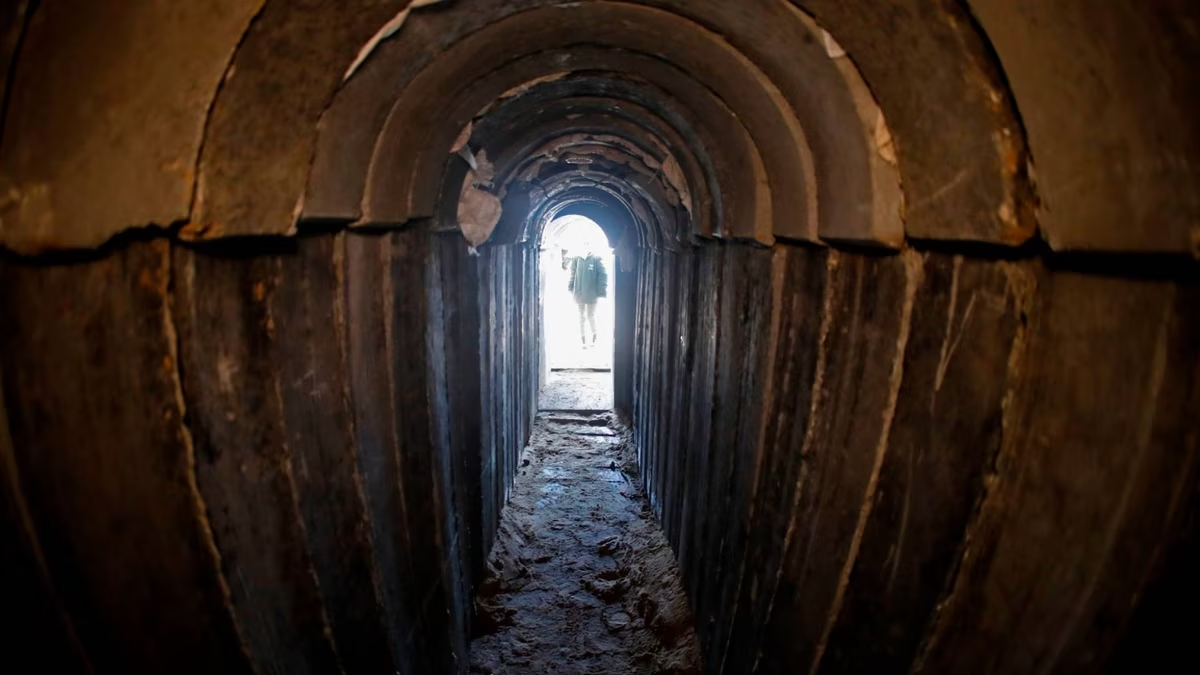
A military source in the occupation army estimated on Thursday that its forces need two additional years to completely destroy the tunnel network in the Gaza Strip, in a clear acknowledgment of the difficulty of the military mission despite nearly two and a half years since the war began.

Hebrew media sources quoted the source as saying that the army has only been able to deal with approximately half of the tunnels in the Strip. The source explained that the occupation army is waging what he described as a 'fierce campaign' against Hamas's secret network, noting that the final elimination of this complex system may take a long time, extending for another two years.

These statements come at a time when preparations are being made to move to the second phase of the ceasefire agreement. Despite the agreement, the occupation continues to carry out almost daily attacks, especially within what is called the 'Yellow Line' area under army control, where forces carried out demolition operations of citizens' homes east of Gaza City this morning, coinciding with airstrikes on various areas.

On the ground, a Palestinian citizen was martyred on Thursday by occupation fire in Khan Yunis, south of the Strip. This comes after a bloody day that saw the martyrdom of 24 citizens, including 8 children, 3 women, and a paramedic.

According to human rights and field data, occupation forces have killed 576 martyrs since the ceasefire agreement came into effect last October, including 179 children and 69 women, in addition to injuring 1526 people.

The army has only been able to deal with approximately half of the tunnels in the Strip, and the final elimination of this system may take another two years.

ARAB AND WORLD

Thu 05 Feb 2026 3:09 pm - Jerusalem Time

Abu Dhabi talks conclude with prisoner exchange agreement, continued field escalation in Ukraine

The two-day talks between Ukrainian, Russian, and American delegations, aimed at finding a solution to the war in Ukraine, concluded today, Thursday, in the Emirati capital, Abu Dhabi, according to a Ukrainian spokeswoman. Diana Davityan, spokeswoman for the head of the Ukrainian delegation, Rustem Umerov, told reporters: "The negotiations have ended," noting that Kyiv will announce further details later.

Steve Witkoff, special envoy for US President Donald Trump, had stated that delegations representing the United States, Ukraine, and Russia agreed to exchange 314 prisoners, adding that much work still needs to be done to end the war. Witkoff wrote in a post on the X platform: "Today, delegations from the United States, Ukraine, and Russia agreed to exchange 314 prisoners, the first such exchange in five months."

Witkoff added: "This outcome was achieved through detailed and productive peace talks. While much work remains to be done, steps like these prove that sustained diplomatic engagement yields tangible results and advances efforts to end the war in Ukraine." He continued that discussions would continue, with further progress expected in the coming weeks.

For his part, Russian envoy Kirill Dmitriev said there was progress and positive movement in the talks, while chief Ukrainian negotiator Rustem Umerov affirmed that the discussions were beneficial and focused on concrete steps and practical solutions. This round came under pressure from US President Donald Trump's administration to reach a consensus, despite continued disagreements on key issues, most notably Moscow's demands for Kyiv to cede territory in Donetsk and the fate of the Zaporizhzhia nuclear power plant.

On the ground, the Ukrainian capital, Kyiv, experienced another night of Russian escalation, including drone and missile strikes targeting Ukrainian territory. Sources reported damage to a multi-story residential building as a result of debris from drones hitting the Ukrainian capital during the night hours, where residents experienced a real night of terror after hearing multiple explosions in different neighborhoods.

According to local authorities, a number of civilians were injured as a result of this attack, while the Ukrainian Air Force stated that Russian forces used two ballistic missiles and more than 180 drones in the attack. The Air Force confirmed that its air defenses shot down more than 150 drones, but the two missiles and a number of drones hit their targets in 16 locations inside Ukraine, further complicating the energy and electricity situation.

For its part, the Ukrainian army said today, Thursday, that it carried out a series of "successful" strikes on the infrastructure of a Russian medium-range ballistic missile launch site last January. The Ukrainian General Staff said that some buildings were damaged and one of the hangars at the Kapustin Yar test site near the Caspian Sea was severely damaged, noting the use of the Ukrainian-made "Flamingo" missile in these operations.

Today, delegations from the United States, Ukraine, and Russia agreed to exchange 314 prisoners, the first such exchange in five months.

PALESTINE

Thu 05 Feb 2026 2:54 pm - Jerusalem Time

Amnesty reveals neglected health crisis among elderly in Gaza

Amnesty International, based on joint research with HelpAge International, stated that the elderly in the Gaza Strip are facing a "neglected" physical and psychological health crisis. They pointed out that this comes amid the ongoing Israeli blockade on essential aid and medicines, and the recent ban on humanitarian organizations.

Both organizations reported that elderly individuals stated in a health survey that food scarcity forced them to skip entire meals, sometimes to make what was available accessible to family members, while others had to reduce doses of medication for serious illnesses due to unavailability. According to testimonies documented by Amnesty International, displaced elderly people spoke of severe harm they suffered as a result of deprivation of nutritious food, adequate shelter, and healthcare, amid a continuous blockade and repeated forced displacements since October 2023.

Erika Guevara-Rosas, Senior Director for Research, Advocacy, Policy, and Campaigns at Amnesty International, said that the elderly in Gaza are suffering an "unprecedented collapse" in their health as a direct result of "Israel's deliberate subjection of Palestinians in the Gaza Strip to living conditions intended to destroy them physically." She added that the "cruel and inhumane" Israeli restrictions on aid entry have undermined the ability of the elderly to access care, medicines, nutritious food, and shelter.

HelpAge International's survey, which included 416 elderly individuals, showed that 76% live in often overcrowded tents, and 84% said that their living conditions harm their health and violate their privacy, while 79% reported being forcibly displaced more than 3 times since October 2023.

68% stated that they reduced or stopped medication doses due to depletion, 11% had not eaten any meal in the previous 24 hours, while 48% reduced their food portions to make food available to others. Amnesty International called on Israeli authorities to lift the blockade "immediately and unconditionally" and allow the entry of medicines, shelter materials, and other essential supplies, emphasizing that the rights and needs of the elderly in Gaza "must not be neglected."

The elderly in Gaza are suffering an unprecedented collapse in their health as a direct result of Israel's deliberate subjection of Palestinians to living conditions intended to destroy them physically.

PALESTINE

Thu 05 Feb 2026 2:54 pm - Jerusalem Time

Debate between Tucker Carlson and the US Ambassador in Tel Aviv regarding the conditions of Christians in Palestine

The prominent American journalist and political commentator, Tucker Carlson, published a new episode today, Thursday, on his social media accounts under the title: "How does the US-funded Israeli government treat Christians in the Holy Land?" In this episode, Carlson hosted the Archbishop of Jerusalem, Hosam Naoum, who testified about repeated settler attacks on Christian villages and communities. The episode achieved widespread reach, exceeding 1.8 million views on the "X" platform in just 10 hours.

As interaction with the episode escalated, the US Ambassador in Tel Aviv, Mike Huckabee, entered the fray, sending a direct message to Carlson saying: "Instead of talking about me, why don't you talk to me directly? You seem to be stirring up a lot of controversy about the Middle East. Why are you afraid of the truth?" Tucker Carlson quickly responded, welcoming the invitation, saying: "Thank you very much. I'd be delighted. We will contact your office today to schedule an interview."

Commentators and activists reacted to this debate, considering that the US Ambassador "put himself in a predicament" by confronting Carlson, who possesses a broad religious and political background. Followers pointed out that the difference lies in using logic versus "religious myths" that only convince those who believe in them, emphasizing that Carlson succeeded in highlighting what they described as "Israeli lies" related to the conditions of Christians in Palestine, and that the oppression under occupation includes all religious components.

In the context of the interactions, activists recalled the direct Israeli targeting of churches in the Gaza Strip during the ongoing war, considering that the Christian world has begun to realize the reality of the situation in the occupied territories. Observers believe that these public discussions necessitate international action by calling for a global summit to discuss hate crimes and racism, and intensifying media campaigns that continuously present these violations to international public opinion.

Why are you afraid of the truth?.. I'd be delighted, we will contact your office today to schedule an interview.

ISRAELI AFFAIRS

Thu 05 Feb 2026 2:39 pm - Jerusalem Time

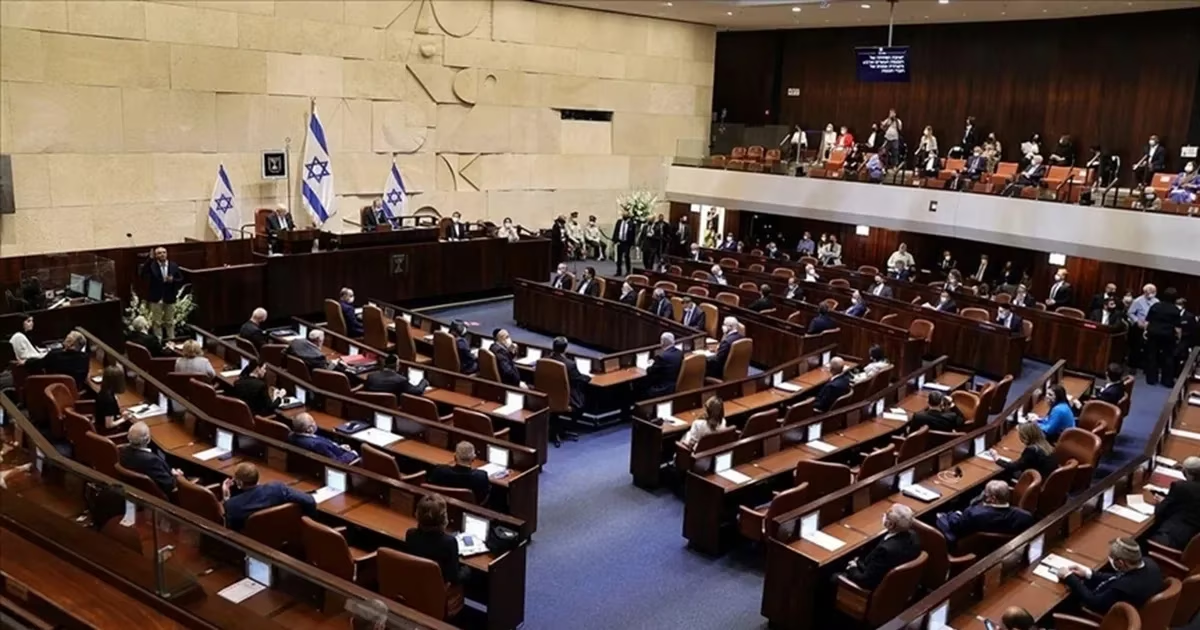
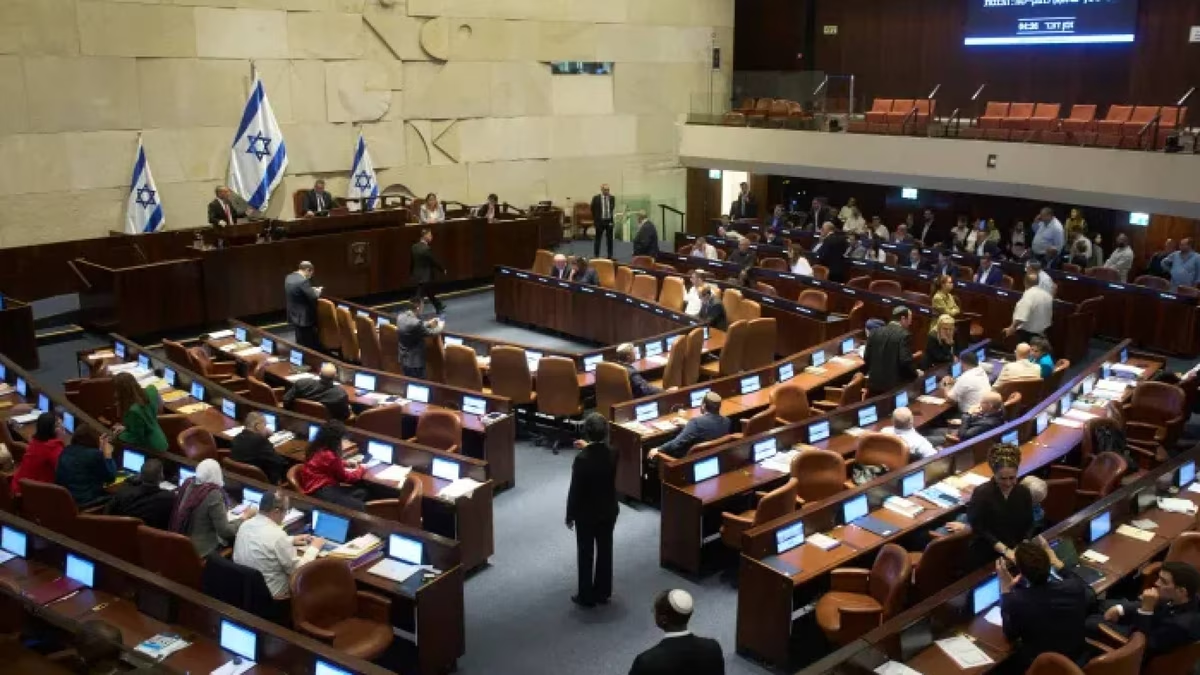
Knesset moves to approve special court to issue death sentences against October 7 participants

In a remarkable legal and political development, the Knesset intends to approve a new bill in the coming weeks aimed at prosecuting all those who participated in the October 7, 2023 attack. The project seeks to establish a special court for this purpose, defining the actions of Hamas (elite) fighters as 'crimes of genocide, crimes against humanity, and war crimes'.

According to the draft bill, indictments against detainees linked to the events will be presented before a special military court established under the 'British Emergency Regulations of 1945'. The three-member court panel consists of a presiding judge who is a civilian judge required to have previously worked in a central court, and two officers qualified to be central court judges.

The main objective of the court is to issue death sentences against detainees participating in the attack. The bill stipulated that an appeal against the death sentence is submitted 'automatically' even if the defendant does not request it, and the execution of the sentence does not require the approval of the Chief of Staff. The project indicated that trials will be public, broadcast via a special website, documented with audio and video, and preserved in the state archive.

The bill carries the number 5020 for the year 2025, and was submitted by MK Simcha Rothman from the Religious Zionism party and Yulia Malinovsky from the Yisrael Beiteinu party. The project has currently reached an advanced stage, as it is scheduled to be discussed before the Law Committee on February 18, 2026, in preparation for its referral for second and third readings to become an enforceable law.

This move dates back to a discussion that began on November 1, 2023, when legal experts called for the event to be considered a war and an organized act, not an ordinary criminal offense. The legal concept of the court is based on controversial principles, including 'collective responsibility' by convicting everyone who participated or assisted without proving their individual act, relaxing rules of evidence on the pretext of difficulty in collecting them, and expanding charges to include 'genocide' according to Israeli law of 1950.

The main objective of the court is to issue death sentences against detainees participating in the attack, with appeals being automatic and without the need for the Chief of Staff's approval.

PALESTINE

Thu 05 Feb 2026 2:24 pm - Jerusalem Time

Israel threatens to return to fighting in Gaza and prepares a plan to evacuate civilians

Israel is preparing for the possibility of renewed fighting in the Gaza Strip, after several indications from officials and military personnel on the pretext of being unable to disarm the Hamas movement. Israeli press reports monitor leaks that fuel the possibility of a return to military operations under the pretext of the movement rebuilding its military power and field positions.

Yedioth Ahronoth newspaper stated that the Israeli army is close to calling up reserve forces to confront the possibility of renewed fighting, and quoted military officials as saying that Hamas is likely to continue its attempts to attack the forces despite the ceasefire. The sources claimed that the movement replaced commanders who were killed during the war, up to the brigade level.

Senior Israeli officers believe that intermittent military operations may become the norm in the coming years to undermine Hamas' capabilities. Assessments indicated that the movement will not voluntarily give up its weapons, while the Shin Bet warned political leaders in closed meetings against resuming the production of rockets and explosive devices inside the Strip.

The sources revealed a new plan by the army to evacuate civilians in preparation for a large-scale ground operation later this year, focusing on resettling them east of the 'Yellow Line'. Military officials believe that the current flow of aid may provide a diplomatic margin to confront accusations of famine in the event of a resumption of hostilities.

In this context, the head of the State Camp party, Benny Gantz, said that it is time to cross the 'Yellow Line' after months of discussion without progress in disarmament. Gantz added that Hamas cannot be granted immunity or accept its control over half of the Strip, stressing that Israel will be forced to dismantle the movement, especially in the absence of prisoners in Gaza currently.

On the other hand, media sources stated that the military leadership presented alternatives similar to the 'Lebanese model', which is based on launching periodic raids to thwart military reinforcement activities. The army believes it is necessary to give a chance for current moves to disarm peacefully, while being ready for a swift and decisive operation to restore full control over the Strip if those efforts fail.

It is worth noting that the current ceasefire agreement came after a two-year war since October 2023, which resulted in the martyrdom of about 72,000 Palestinians and the injury of more than 171,000 others, in a bloody toll described as a war of genocide.

It is time to cross the Yellow Line; Hamas cannot be granted immunity and rebuild its rule and control over half of the Gaza Strip.

OPINIONS

Thu 05 Feb 2026 2:09 pm - Jerusalem Time

The Deception of Democracy in the Modern State: How Majorities Are Manufactured in Public Opinion Labs?

Ramallah - "Al-Quds" dot com

Ramallah - "Al-Quds" dot com

Opinion Writer

Political public opinion labs are the primary controllers in the process of unethical consciousness engineering, where the collective mind is directed without a value-based reference. Imagine the scene of the laborer who sacrifices his strength and wages to stand for hours under the sun, steadfast for a cause they made him believe was for the benefit of his children, while in reality, he is a tool in the hands of others. This behavior does not stem from free will, but from a systematic disabling of individual consciousness that makes a person see the sacrifice of their true interests as an offering for the triumph of an image carefully crafted for them.

Here, the deception of democracy in its contemporary form emerges, as a glittering facade for expressing popular will, while in reality, it is an arena for consciousness engineering. The modern state has harnessed its technical and media tools to transform democracy from a free choice between clear alternatives into a domestication process that produces an artificial majority. This majority is only achieved through political mobilization led by the public opinion engineer, who infiltrates through the loopholes of fear and need, transforming humans into caricatures that execute precisely drawn scenarios.

And if we look at the scene with a logical eye, we will find an impossible contradiction; where the worker and the factory owner, the conservative and the liberal, all unite in supporting the same person, and each believes that he is the savior of their conflicting interests. This impossible consensus only succeeds through the engineering of collective consciousness so that everyone becomes mere 'ultras' in herd politics. Nevertheless, the conscious individuals who take their stances based on a solid self-vision remain the exception that is difficult to subject to domestication tools.

Indeed, the modern democratic system operates through a long engineering accumulation that begins with changing terminology in educational curricula and pumping media narratives that create imaginary enemies. The public opinion engineer does not wait for election day, but rather prepares the psychological ground that makes his choice seem like the only way out. This system relies on the innate human fear of isolation, transforming natural diversity into a false sense of consensus through repetition and exaggeration, which pushes the individual to abandon their logical questions to join the crowd in search of false security.

To complete this control, the trick of 'demonizing the opponent' is resorted to, an old trick that the public opinion engineer has revived with modern techniques. The opponent is portrayed as a devil threatening existence, which pushes the supporter to adopt extreme positions to defend their image in front of themselves so as not to admit their naivety. Thus, logical questioning turns into a psychological burden, and the individual prefers subservience over the pain of confrontation with their conscious mind, where direct interest is replaced by the safe belonging to the herd.

Ultimately, economic helplessness and anxiety about the future are transformed into emotional loyalty, where no real solutions are offered, but rather a sedative for emotions and an illusion of personal victory. Emerging from this tunnel requires restoring an independent value system. Here, the genius of the Islamic model of 'Shura' (consultation) and 'Ahl al-Hall wal-Aqd' (people of binding and loosing) stands out, where the process relies on quality and a conscious elite that resists psychological manipulation, transforming the political process from mobilizing instincts to an exchange of opinions among the wise, and a restoration of true sovereignty away from engineered ballot boxes.

Democracy in its modern version does not begin with endorsement, but ends with it; it is a complete system for managing perception that begins years before an individual reaches the ballot box.

PALESTINE

Thu 05 Feb 2026 1:24 pm - Jerusalem Time

3 Dead and Intensive Occupation Raids on Gaza Amid Continued Truce Violations

The death toll from the continuous violations of the ceasefire agreement in the Gaza Strip rose to three martyrs on Thursday, including a released prisoner who had been deported, amid a field escalation that included airstrikes and artillery shelling targeting various areas of the Strip.

Local sources reported the martyrdom of young Bahaa Mohammed Al-Fajm by occupation forces' bullets in the town of Bani Suhaila, east of Khan Yunis. Rami Ibrahim Abu Qarshin also died from injuries he sustained months ago in a previous bombing of the city. In a significant development, released prisoner Basel Al-Haimouni, who was deported from Hebron to Gaza as part of the "Wafaa Al-Ahrar" deal in 2011, was mourned today after succumbing to injuries from a bombing that targeted him yesterday, Wednesday.

On the ground, occupation forces continued their violations, carrying out demolition operations of citizens' homes east of Gaza City concurrently with artillery shelling, while aircraft launched raids on eastern Deir al-Balah, and helicopter gunships opened fire east of Al-Bureij refugee camp in the central region.

In the southern part of the Strip, warships heavily opened fire towards the coasts of Khan Yunis and Rafah, while aircraft launched an airstrike east of Khan Yunis, amidst ongoing military movements targeting civilians and facilities.

These developments come after a bloody day in which 24 citizens were martyred, including 8 children. According to official statistics, the number of victims of the occupation's violations of the ceasefire agreement reached 576 martyrs, including 179 children and 69 women, and 1526 injured. Meanwhile, the total death toll from the ongoing genocide war since October 7, 2023, has risen to more than 71,803 martyrs and over 171,570 injured, in addition to the destruction of 90% of the Strip's infrastructure.

The targeting of Al-Haimouni represents a new crime that reflects the occupation's insistence on pursuing released prisoners even after their deportation.

PALESTINE

Thu 05 Feb 2026 12:09 pm - Jerusalem Time

Arrival of 54 bodies and 66 boxes of remains of Gaza martyrs at Al-Shifa Complex

The Director-General of the Ministry of Health in Gaza, Dr. Munir Al-Barsh, revealed new chapters of the violation of the dignity of Palestinian martyrs, confirming the arrival of 54 bodies of martyrs at Al-Shifa Medical Complex, accompanied by 66 boxes containing human remains and organs, which were released through the International Committee of the Red Cross.

Al-Barsh questioned in his statements the law that permits returning a human being in pieces, describing the scene as shocking and testing the conscience of the world, as medical teams stand before closed boxes searching inside them for the features of the martyrs without possessing the necessary examination tools or the minimum medical and forensic capabilities to identify and document them in a manner befitting human dignity.

The Director-General of Health affirmed that these are not just numbers in reports, but rather fathers, mothers, and children, each with a name and a memory, emphasizing that handing over bodies in boxes and dismembered represents a moral crime and a blatant violation of international conventions established to protect human dignity, alive and dead.

Al-Barsh pointed out that previous instances witnessed the retrieval of bodies bearing traces of mutilation and torture, considering that retrieving bodies today in dismembered form suggests that the goal is to erase identity, break memory, and humiliate the living, demanding a self-evident right for the human body to be preserved, its dignity protected, and international laws respected.

For its part, the Ministry of Health in Gaza confirmed in an official statement the arrival of the 54 bodies and the 66 boxes containing the remains at Al-Shifa Medical Complex, after the Israeli occupation authorities released them and transferred them via the Red Cross organization.

To be returned as remains, and for their bodies to be delivered in boxes, is not merely a procedural violation, but a moral and humanitarian crime, and a blatant violation of all international laws and conventions.

PALESTINE

Thu 05 Feb 2026 11:54 am - Jerusalem Time

Occupation army launches wide raid campaign and arrests dozens of Palestinians in the West Bank

Occupation forces launched on Thursday a series of incursions and raids in several cities and towns in the Bank and Jerusalem, resulting in the arrest of a number of citizens, amid continuous violations against Palestinians.

In the city of Hebron, south of the Bank, sources reported that the forces raided the home of Sheikh Hatem Qafisha and arrested him, and also arrested citizen Muhammad Ali Al-Najjar in the "Qanan Al-Taweel" area of Yatta city during a wide field campaign that targeted homes.

In northern Jerusalem, arrests included teenager Yanal Qassem Abadi and four other young men in Anata town during continuous raids. In Qalqilya city, forces arrested young man Muhammad Sa'sa' after storming his home, while released prisoner Jumaa Ramadan was arrested in Zeita Jama'in town, south of Nablus.

Ramallah governorate also witnessed raids that resulted in the arrest of two young men, Mujahid Ghazi Na'san and Bahaa Fouad Abu Alia, after storming their homes in the eastern neighborhood of Al-Mughayyir village.

These arrests reflect the continued policy of the occupation forces in escalating daily incursions in the West Bank and Jerusalem, which include raiding homes, vandalizing their contents, and arresting citizens, as part of what sources described as continuous pressure on Palestinians.

These arrests reflect the continued policy of the occupation forces in escalating daily incursions in the West Bank and Jerusalem, which include raiding homes and vandalizing their contents.