PALESTINE

Sat 07 Feb 2026 3:28 am - Jerusalem Time

UN begins installing relief housing units as part of 'Gaza Neighborhoods' program

The United Nations Development Programme (UNDP) announced on Thursday the actual start of installing the first batch of relief housing units in the Gaza Strip. This step comes as part of the 'Gaza Neighborhoods' program, which aims to support the most vulnerable groups and provide urgent shelter solutions in light of the escalating humanitarian crisis in the Strip.

This process is being carried out in close coordination with the Government Emergency Room, the Ministry of Public Works and Housing, and relevant ministries, as well as international partners. The project aims to provide temporary housing solutions that preserve the dignity of displaced persons, with units consisting of a durable metal structure covered with insulating panels to withstand weather conditions.

UNDP expressed its gratitude to the Federal Republic of Germany, the Republic of Korea, and the Kingdom of Sweden, in appreciation of their generous support and funding for these units, which come at a very critical time, especially with the number of displaced persons within the Strip reaching approximately 1.9 million Palestinians, making the needs for transitional shelter enormous and unprecedented.

The program affirmed that this initiative is part of the 'Neighborhood Approach' strategy it is implementing in cooperation with other UN agencies. This vision is not limited to providing shelter only, but extends to include improving access to health and educational services, providing water and sanitation supplies, and solid waste management.

Sources revealed that additional transitional shelter units have been prepared and purchased in advance, and work is currently underway to complete the procedures for their entry into the Strip based on joint field assessments of the needs of the local community in various affected areas.

This initiative is part of the 'Neighborhood Approach' strategy, which aims to provide dignified shelter solutions for displaced persons and improve access to basic services.

PALESTINE

Fri 06 Feb 2026 10:28 pm - Jerusalem Time

Investigation reveals details of armed groups' cooperation in Gaza with the occupation and the assassination of a security officer

A new investigative report, broadcast on Friday evening, revealed direct cooperation between armed groups and the Israeli occupation army in the Gaza Strip, based on documented audio and video confessions of an agent who was arrested after carrying out the assassination of an officer from the internal security apparatus in Gaza.

The investigation showed the agent's confessions as he received direct orders from an Israeli intelligence officer, who asked him to place a hidden camera on his clothes to document the entire operation from planning to execution. Footage obtained from security agencies in Gaza highlighted direct communication between the agent and the Israeli intelligence officer while following the details of the assassination of Internal Security Officer Ahmed Zamzam, which was carried out on December 24, 2020.

During the investigations, the agent (M.J.) confessed to carrying out the operation under full cover from the Israeli occupation army, while the recording camera installed on his clothes showed immediate instructions from the Israeli intelligence officer leading up to the assassination. The confessions also revealed that the perpetrators of the operation were trained by Israeli intelligence, and that they used silenced pistols and two electric motorcycles. According to the investigation, Officer Ahmed Zamzam was directly responsible for the file of armed groups cooperating with the occupation.

Following the assassination, a source in the resistance security stated that one of the three agents involved in the assassination of Lieutenant Colonel Zamzam in the Maghazi refugee camp in the central Gaza Strip confessed, after his arrest, that agent Shawqi Abu Naseera summoned him and two other agents to a meeting with an officer from the occupation intelligence.

The source added that the Israeli officer informed the agents that their mission was to kill Lieutenant Colonel Zamzam on the pretext that he was managing a security file that could lead to their exposure and that of other agents, noting that the officer handed them three silenced pistols, three electric motorcycles, clothes equipped with small cameras, and phones connected to wireless headphones, in addition to the coordinates of Officer Zamzam's movement path.

The investigation also revealed the names and training locations of members of armed groups cooperating with the Israeli occupation army in the Gaza Strip, and presented the full protocol for recruiting Israeli agents within the Strip. In the promotional material for the investigation, the voice of one person appeared saying: 'My father.. see if the camera on the shirt is working,' referring to the field documentation of operations.

The investigation showed that a network of armed groups is spread across the Gaza Strip from north to south, moving freely behind the 'Yellow Line' which represents the security separation route where Israeli forces are stationed. These groups face multiple accusations of cooperating with the occupation, despite denials from some of their leaders, amid increasing evidence of their movement within areas prohibited to Palestinians according to the ceasefire agreement.

Among the most prominent of these formations is the 'Popular Forces' group, founded by Yasser Abu Shabab, who was later killed and succeeded by Ghassan Al-Dahini. Hussam Al-Astal also leads another armed group that has sparked widespread controversy due to its frequent appearance in video clips within areas prohibited to Palestinians south of Khan Younis. Last August, Al-Astal officially announced the formation of his groups under the name 'The Striking Force for Combating Terrorism,' a move that raised suspicions, especially since he was detained until the beginning of the war on the Strip on charges related to dealing with Israel by the Ministry of Interior in Gaza.

In the Shuja'iyya neighborhood east of Gaza City, a group led by Rami Adnan Helles is active, while Ashraf Al-Mansi leads what is known as the 'Popular Army' in Beit Lahia and Beit Hanoun, a group that was formed last September under the direct patronage of Yasser Abu Shabab, revealing a network of coordination and cooperation between these armed formations across the geography of the Gaza Strip.

The Israeli officer informed the agents that their mission was to kill Lieutenant Colonel Zamzam on the pretext that he was managing a security file that could lead to their exposure.

PALESTINE

Fri 06 Feb 2026 9:13 pm - Jerusalem Time

Israeli fears of foreign journalists entering Gaza and its impact on global public opinion

Israelis are anticipating the imminent entry of foreign journalists into the Gaza Strip, where destruction and devastation are widespread, amidst Israeli fears that the Strip will once again dominate global headlines. Gadi Ezra, an Israeli propaganda expert, affirmed that the scenes of destruction and chaos in Gaza will prompt journalists, as humans who wish to present new angles and justify their role, to launch a widespread media campaign in traditional media, social networks, and various political circles.

Ezra added in an article published by Yedioth Ahronoth that the fundamental problem Israel will face is a narrative mix combining the description of Gaza as 'the world's largest open-air prison' and accusations of 'genocide.' He explained that the world will witness an exaggerated presentation including humanitarian stories, images of obliterated areas, and calls for a peaceful life that the media will portray as being prevented by 'Israeli thugs.'

The Israeli expert pointed out that the narrative foreign journalists will return with is an accusation against the army of using Gaza residents as human shields and depriving them of their dignity. He warned that these details would marginalize the events of October 7th in international memory, while enhancing Palestinians' sense of pride and identification with their nationalism, which serves their goal of tarnishing Israel's international reputation.

He explained that the anticipated coverage would portray Israeli operations in Gaza in a bloody light, consistent with the goals of the anti-Israel camp seeking to establish a Palestinian state and describe Israel as an apartheid state. He considered that the entry of journalists would intensify the media conflict, as it would provide each party with an opportunity to showcase its priorities to the world.

In a related context, Ezra noted that the current competitors in the arena are seeking to win the support of US President Donald Trump through various methods, indicating that whoever succeeds in portraying themselves as the ultimate savior will increase their chances of winning the support of the US administration. He concluded by saying that the entry of journalists represents a major challenge, but it could become an opportunity if the Israeli narrative is conveyed, claiming that the presence of a moderate civilian leadership in Gaza is an Israeli interest to pave the way for the elimination of Hamas.

The scenes of destruction in Gaza will prompt journalists to present new angles that may ignite a widespread media campaign against Israel in global media.

ANALYSIS

Fri 06 Feb 2026 9:04 pm - Jerusalem Time

Thomas Friedman’s Misguided Equivalence Between ICE and Hamas Obscures Israel’s Occupation

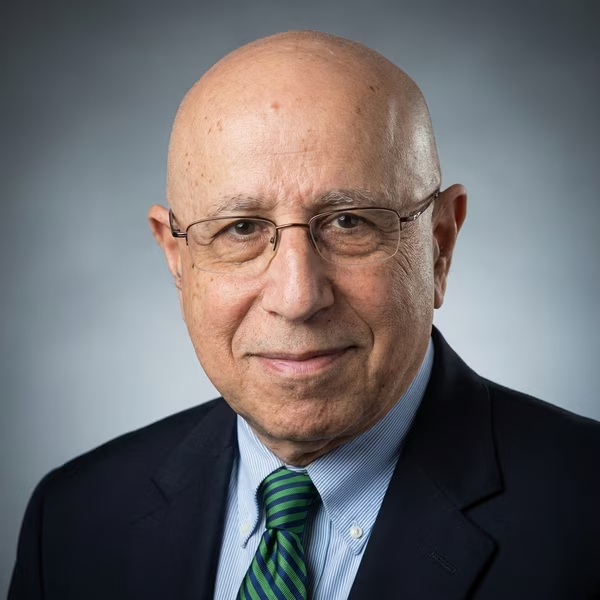
Said Erikat

Opinion Writer

By: Said Arikat

Thomas Friedman’s recent column, “Minneapolis and Gaza Now Share the Same Violent Language,” attempts to draw a moral and operational equivalence between American domestic policing under ICE and the violence witnessed in Gaza. On the surface, his argument might seem provocative: masks, gunfire, chaos, and political opportunism. Yet a closer reading reveals a familiar pattern in Friedman’s work—a selective framing that downplays Israel’s systematic occupation while subtly conflating Palestinian resistance with lawlessness. In attempting to critique U.S. domestic enforcement, Friedman inadvertently reinforces the very narratives that normalize Israel’s decades-long military domination.

Friedman’s comparison rests heavily on optics. He notes that ICE officers, like Hamas fighters, wear masks, suggesting a hidden intent or fear of accountability. He argues that photographs of the two could be indistinguishable. This observation, however, collapses a vast power asymmetry into a superficial visual parallel. ICE officers operate as agents of a state with judicial oversight, paid salaries, and a political mandate; Hamas fighters operate as militants resisting an occupying power with a centuries-long history of displacement and disenfranchisement. By suggesting that a visual resemblance implies equivalence in behavior or culpability, Friedman sidesteps the structural realities of occupation. The Israeli military, whose conduct he treats as exceptional yet morally constrained, routinely engages in actions—airstrikes, targeted assassinations, checkpoints, collective punishment—that far exceed ICE’s domestic reach and consequences.

Friedman’s critique of ICE is in part valid. The videos he cites—of Renee Good and Alex Jeffrey Pretti being shot or endangered—demonstrate the hazards of aggressive enforcement and militarized policing. Yet he frames these incidents as part of a moral symmetry with Gaza’s suffering, implying that American citizens are subject to the same patterns of state violence as Palestinians under occupation. This is misleading. In Gaza, Israel’s occupation is constant, pervasive, and designed to control not just movement but resources, governance, and survival. Palestinians live under checkpoints, airstrikes, siege, and a military judiciary that functions outside ordinary civilian law. The trauma and structural violence are not momentary episodes of overreach but a sustained system of control—one that Friedman, despite his extensive Middle East reporting, rarely confronts directly in his work.

Friedman also frames Netanyahu’s electoral calculations as morally equivalent to Trump’s ambitions in Minneapolis, suggesting that both leaders exploit violence for political gain. While it is certainly true that political expediency shapes decision-making everywhere, his framing minimizes the fact that Israel’s policies are embedded in occupation. Netanyahu’s calculations are not about mere electoral optics—they are about maintaining an internationally contested military occupation, displacing populations, and enforcing a systemic hierarchy of citizenship. To equate this with domestic U.S. politics, where ICE actions occur within the framework of a legal system with avenues for accountability, is to obscure the magnitude of Israeli state violence.

Equally troubling is Friedman’s treatment of Palestinian casualties. He expresses sympathy for the journalists killed in Gaza but presents their deaths primarily as collateral damage in a narrative about Israel’s “fire, ready, aim” culture. He fails to interrogate the legal and moral frameworks that govern an occupying army’s responsibilities under international law. By highlighting these deaths as errors or lapses rather than as the predictable outcome of an ongoing siege and occupation, Friedman perpetuates the normalization of Israeli military impunity. The pattern is consistent with his longstanding stance: unwavering support for Israel, coupled with a selective acknowledgment of harm when it cannot be ignored.

Ironically, Friedman’s column indirectly supports the very analogy he seems hesitant to make: ICE officers do, in fact, emulate Israeli occupation practices. Militarized raids, coordinated assaults on civilian areas, targeting of individuals based on perceived threat, and a culture of anonymity—all mirror techniques used by the Israeli military in Gaza and the West Bank. Yet Friedman quickly draws back from this implication, reframing it as a superficial resemblance rather than a critique of systemic influence. His reluctance to fully confront this reality reflects a broader reluctance in his work to challenge Israel’s strategic and moral policies, even when parallels are unmistakable.

Friedman’s column further underplays the human agency and resistance of Palestinians. Hamas is presented largely as an obstacle to peace or a political nuisance, rather than as a movement emerging under conditions of occupation, siege, and systemic disenfranchisement. By emphasizing the group’s electoral or military calculations, Friedman ignores the context that produces these choices. He paints Palestinian actions as morally flawed, while glossing over Israel’s structural role in creating and sustaining the conditions for conflict. In doing so, he mirrors a common journalistic bias: attributing violence primarily to the oppressed while treating the oppressor’s decisions as strategic necessity or electoral politics.

Finally, Friedman’s repeated invocation of electoral politics—Trump, Netanyahu, Hamas—is reductive. It suggests a symmetry of choice that obscures power disparities. Palestinian leadership does not wield a state apparatus comparable to Israel’s. ICE officers, despite abuses, operate under a domestic legal framework with comparatively limited lethality. By failing to account for these differences, Friedman’s moral equivalence risks flattening the lived realities of those under occupation, presenting them as morally ambiguous actors rather than victims of a structured system of oppression.

In sum, Thomas Friedman’s attempt to link Minneapolis policing with violence in Gaza is a superficial, misleading equivalence that obscures the reality of Israeli occupation. His visual analogies and focus on individual incidents distract from systemic power imbalances, leaving readers with an impression of symmetry that does not exist. If anything, Friedman inadvertently confirms that American enforcement agencies have imported occupation-style practices, yet he cannot—or will not—fully acknowledge the ethical and political implications. The column thus reflects a long-standing pattern: a reluctance to critically confront Israel’s military actions and occupation, even while drawing attention to abuses elsewhere. ICE may mirror some tactics of the Israeli military, but the moral and structural context is crucial—and Friedman’s framing obscures it entirely.

PALESTINE

Fri 06 Feb 2026 8:13 pm - Jerusalem Time

Egypt: Division of Gaza Strip a red line, no stability for Israel without a Palestinian state

Egyptian Foreign Minister Badr Abdel Aty said on Friday that attempts to divide the Gaza Strip are a "red line that cannot be accepted," accusing Israel of obstructing the travel of Palestinians through the Rafah crossing and hindering the entry of humanitarian aid. Abdel Aty added, in a press conference following a meeting of the ministerial committee of the Arab-Islamic Contact Group in Slovenia, that this Egyptian position is firm regarding the unity of the Strip.

The Egyptian minister pointed out that the situation in Gaza remains very fragile despite some slight progress, and criticized the limited opening from the Palestinian side at the Rafah border crossing, stressing that Israel places obstacles to the movement of Palestinians from both sides and hinders the arrival of essential relief supplies to the besieged Strip.

Regarding the West Bank, Abdel Aty affirmed that the situation is deteriorating with Israel's continued policy of repression, intimidation of civilians, and seizure of land by force, emphasizing that the absence of a political horizon exacerbates the crisis on the ground.

Regarding the de-escalation path, Abdel Aty explained: "We are working to consolidate the ceasefire in Gaza, and we are consulting with our partners in the Middle East, the European Union, and the United States regarding an agreement to move forward," without delving into additional details about the terms of these consultations.

Abdel Aty stressed the importance of intensifying the entry of humanitarian aid, describing the situation on the ground in Gaza as "tragic," and pointing out that stability for Israel in the region cannot be achieved without the establishment of an independent Palestinian state.

Last mid-January, the United States announced the entry into force of the second phase of US President Donald Trump's plan for Gaza, despite Israel's request to postpone it. However, Tel Aviv continues to tighten procedures through the Palestinian side of the Rafah crossing and continues its military operations.

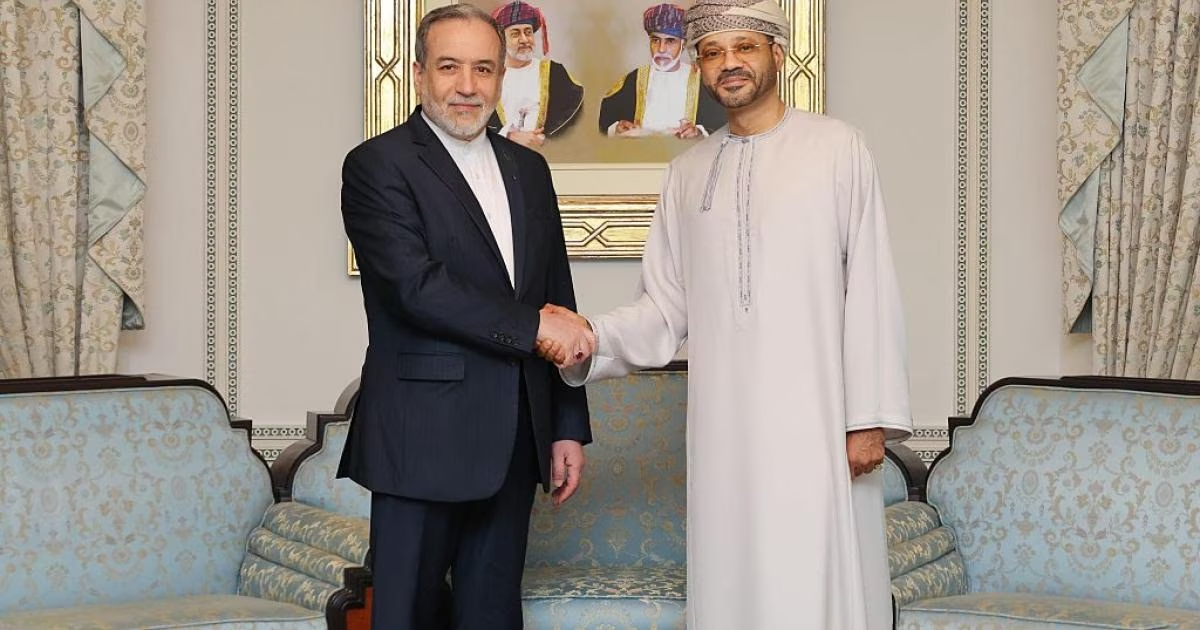
On regional affairs, Abdel Aty said that Egypt is working intensively to prevent the outbreak of a comprehensive war and encourage diplomatic solutions to stop the escalation. This coincided with the Omani capital, Muscat, hosting negotiations between the United States and Iran today, Friday, resuming a path that was disrupted in June 2025 after raids targeted Iranian facilities.

Attempts to divide the Gaza Strip are a red line that cannot be accepted, and there is no stability for Israel without the establishment of a Palestinian state.

ISRAELI AFFAIRS

Fri 06 Feb 2026 8:13 pm - Jerusalem Time

Former Netanyahu bodyguard reveals moral and behavioral scandals of his family

Ami Ben Dror, the former head of the security team for the Prime Minister of the occupation, Benjamin Netanyahu, revealed a series of moral and behavioral scandals related to Netanyahu and his family, especially his wife Sara, whom he described as "obsessed with theft." Dror explained in a press interview on Friday that he joined the VIP protection unit after the assassination of Yitzhak Rabin and worked with former leaders such as Shimon Peres and Ehud Barak.

Dror pointed out that Netanyahu systematically evaded paying restaurant bills, which forced security personnel and assistants to pay them out of their own pockets. He recounted an incident at the "King David" hotel in Jerusalem, where Netanyahu ignored the bill despite it being brought early, describing his behavior as "garbage on a moral level," considering that his position exacerbated these behaviors in him and his inner circle.

Regarding Sara Netanyahu, Dror described her as suffering from "kleptomania" (pathological obsession with theft), confirming that she steals hotel towels and official gifts that belong to the state. He added that she is the center of gravity in the home and was the driving force behind stopping the plea bargain deal to ensure remaining in power, believing that her son Yair would politically inherit his father.

The former head of security also confirmed details of Yair Netanyahu's physical assault on his father, incidents that Netanyahu had previously denied. Dror explained that these assaults were severe and required direct intervention from the security team to protect Netanyahu, noting that this incident was the main reason behind sending Yair to live in Miami, USA.

Dror touched upon Netanyahu's relationship with his daughter "Noa" from his first wife, revealing that he had to meet her secretly in Jerusalem cafes between 1996 and 1999 away from the eyes of his current family, before the meetings completely ceased, which he considered behavior that does not indicate a "normal father."

Dror concluded his remarks by expressing his hope of seeing Netanyahu behind bars, not out of revenge but to achieve justice. He accused him of obstructing prisoner exchange deals for political motives, which led to the death of about 44 prisoners who could have returned alive, stressing that his decisions were always subject to procrastination and political pressure.

Netanyahu was never a moral person; he used to eat in restaurants without paying the bill, and guards and assistants were forced to pay the bill for him.

ARAB AND WORLD

Fri 06 Feb 2026 7:13 pm - Jerusalem Time

Extensive Transformations in Syria and Iraq.. Washington's Priorities in Military Repositioning

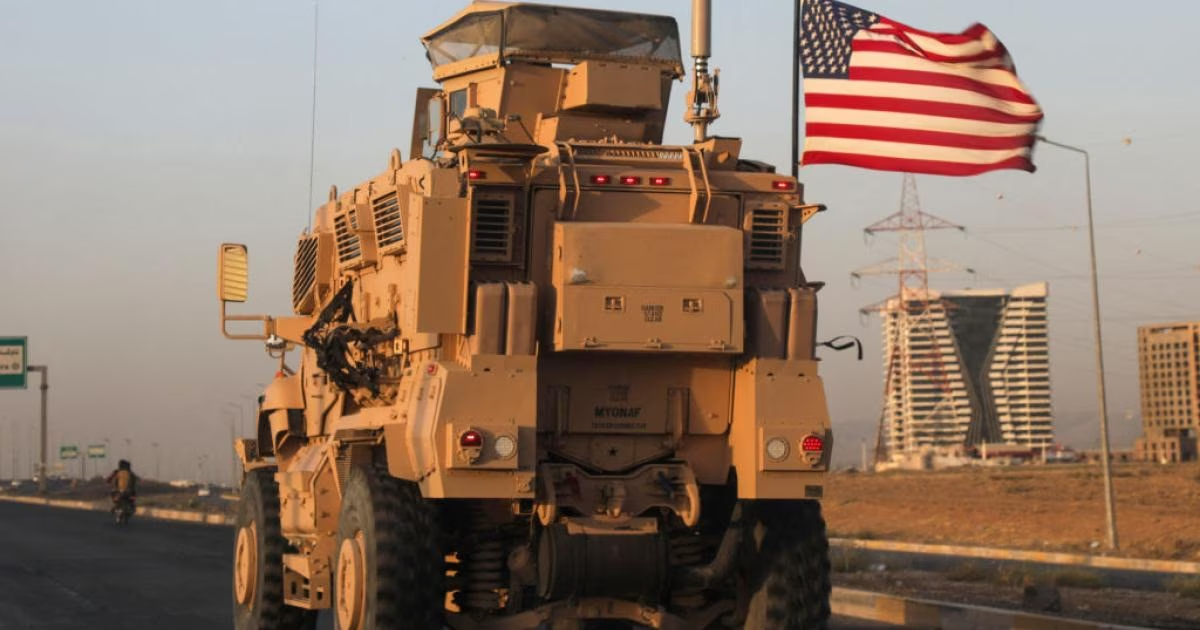
The Syrian and Iraqi arenas are witnessing rapid security and political changes, coinciding with an American military repositioning in the region, represented by withdrawals from strategic sites that had been under American control for years. These movements raise questions about the priorities of the American administration in the post-direct presence phase, and the goals it seeks to achieve on both the political and security levels in Syria and Iraq.

A high-ranking security source revealed that American forces have begun gradual withdrawal operations from the Al-Shaddadi base south of Hasakah Governorate in Syria, heading towards Erbil in the Kurdistan Region of Iraq. The withdrawal included the transfer of equipment via ground convoys and the evacuation of some personnel by air, without full clarification of the reasons or their connection to larger redeployment plans in the region.

This move came after statements by US administration officials regarding a complete withdrawal from Syria by mid-this year, amid the declining role of the Syrian Democratic Forces as a main force against ISIS, and the advance of the Syrian army in the northeast of the country. The US envoy for Syrian affairs coordination, Tom Brack, confirmed that Syrian government forces are qualified to take over security tasks after Damascus joined the international coalition to combat ISIS last November, which reshaped the military and political landscape in the region.

In Iraq, the Higher Military Committee confirmed the completion of the withdrawal of the US-led international coalition forces from Ain al-Asad base in Anbar, as part of an agreement signed with Baghdad in 2024. The agreement stipulates the termination of the military coalition's mission by the end of 2025, and the evacuation of forces from the region by this September.

The withdrawal included the gradual transfer of equipment and soldiers to bases such as Erbil and Harir, with a focus on continued security and intelligence coordination with local forces to ensure border monitoring and the pursuit of ISIS cells. Experts indicate that the American goal is not limited to direct withdrawal, but also includes preventing the return of ISIS, ending Iranian influence, supporting the political process to achieve relative stability, protecting Israel's security and continuing attempts to bring Damascus into security agreements with Tel Aviv, protecting economic interests, and containing Russian influence in the region.

Syrian government forces are qualified to take over security tasks after Damascus joined the international coalition to combat ISIS last November.

PALESTINE

Fri 06 Feb 2026 6:28 pm - Jerusalem Time

Muscat Negotiations Between Tehran and Washington: A Test for Regional Balances and the Future Role of Hezbollah

The Sultanate of Oman has returned to the forefront of the regional scene as a platform for indirect negotiations between the United States and Iran, at a highly complex moment where the ongoing war in Gaza intersects with escalating tension on the Lebanese front. Through this channel, Washington seeks to contain the regional explosion and prevent it from sliding into a comprehensive confrontation, while the discussions in Muscat go beyond the nuclear file to include the core of regional balances and the future roles of Tehran's allies.

According to analytical sources, the current negotiations aim to extract guarantees related to Iranian regional behavior and the nuclear program, while Tehran seeks an economic breathing space to confront accumulated pressures. However, the current American vision, influenced by President Donald Trump's administration, emerges as an obstacle to flexible solutions, placing the region at a pivotal moment that may not be repeated.

Hezbollah stands out as one of the undeclared variables at the negotiating table, as the party is no longer merely a military ally, but an influential element in the equation of stability in the Eastern Mediterranean. Any understanding between Washington and Tehran will directly reflect on the ceiling of its military movement and its internal positioning in Lebanon, especially in light of the challenges raised by the party's leaders, including Sheikh Naim Qassem and Hajj Mohammad Raad, regarding support mechanisms in the event of aggression against Iran.

Should the negotiations succeed, the scene may move towards a reduction in military escalation, especially on the southern front of Lebanon, in exchange for strengthening political presence within the equation of "controlled stability." New approaches to the relationship between arms and the state may be proposed, based on adapting to regional transformations, a path that coincides with international pressures that increased after the Lebanese army commander's return from his recent visit to Washington.

However, if the negotiation process fails, expectations indicate a doubling of pressure on fragile arenas, foremost among them Lebanon. Hezbollah may find itself facing a broader Israeli escalation that goes beyond the familiar rules of engagement, amid internal economic collapse and a decline in the state's ability to contain, making the cost of confrontation higher and the margin for maneuver much narrower.

The data indicate that the post-Oman negotiations phase will necessitate a redefinition of roles according to new balances that place internal stability at the core of calculations. Hezbollah will face a historical test to transform these shifts into a stabilizing element, especially since the next decade in Lebanon will be managed by more precise and sensitive equations towards any error in assessing the cloudy regional situation.

Whatever the outcomes of the Oman negotiations, their results will establish a new reality in the regional environment within which Iran's allies operate, foremost among them Hezbollah.

PALESTINE

Fri 06 Feb 2026 5:28 pm - Jerusalem Time

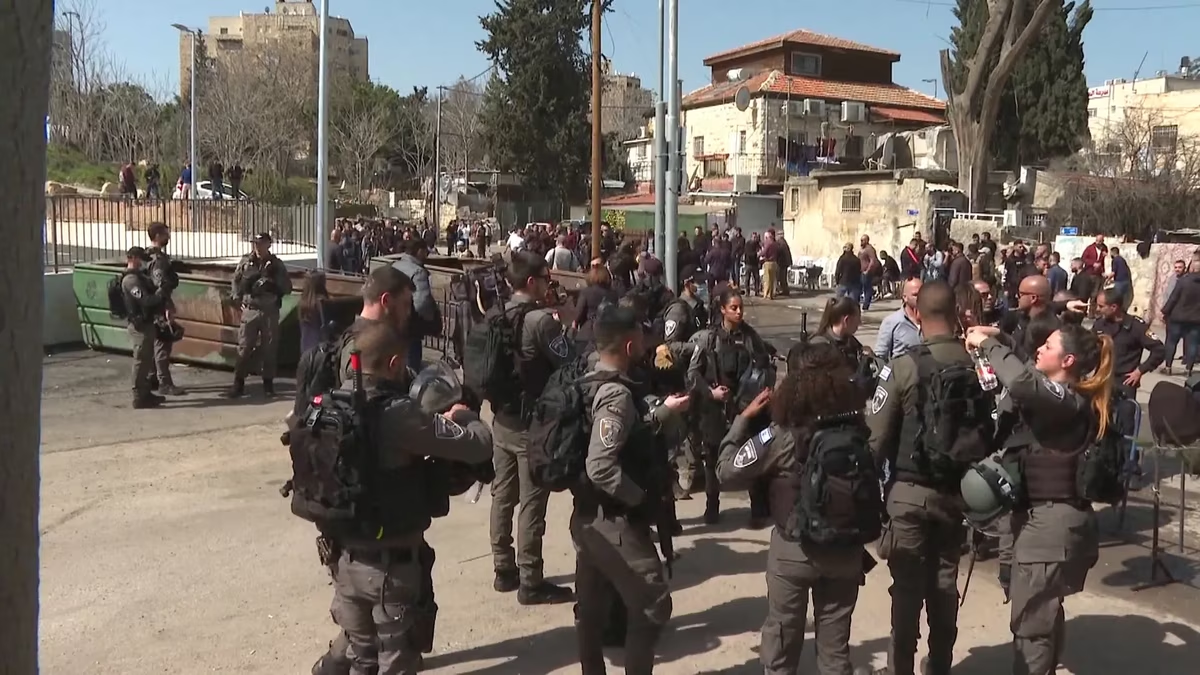
Registration of Jerusalem lands.. an Israeli plan to confiscate Palestinian property and entrench settlement

The issue of Palestinian lands in occupied Jerusalem has returned to the forefront, following an Israeli decision to complete the registration of the city's lands in the land registry, in a move that Palestinian parties say aims to facilitate control over lands in East Jerusalem and enhance settlement expansion. According to press reports, the Israeli government has allocated about 30 million shekels (approximately $9.6 million) to implement what it calls 'land settlement and registration,' a process that actually began in 2018.

Palestinian parties and human rights organizations confirm that the decision exploits real estate regulation to expand settlement, and reinforces the application of the 'Absentee Property Law' which is used to seize Palestinian properties, amid great difficulties faced by Jerusalemites in proving ownership due to Israeli complexities. On the ground, reports indicate the registration of about two thousand dunams over the past eight years, most of which are for neighborhoods and settlements, in addition to transferring lands to state ownership and attempts to issue eviction orders against Palestinian families.

Jerusalemites warn that these steps represent an unprecedented escalation that threatens their existence and aims to change the demographic and geographic reality of the city. Data indicates that the number of settlers in the West Bank reached about 770,000 by the end of 2024, distributed among 180 settlements and 256 settlement outposts, 138 of which are classified as pastoral and agricultural.

The United Nations affirms that settlement in the occupied Palestinian territories is illegal and undermines the possibility of implementing the two-state solution, calling for decades for its cessation without success, as Israel seeks to change the demographic structure of the region and displace Palestinians, entrenching the occupation and liquidating the Palestinian cause.

According to data from the Palestinian Wall and Settlement Resistance Commission, settler groups committed about 4,723 attacks in the occupied West Bank during 2025, resulting in the martyrdom of 14 Palestinians and the displacement of 13 Bedouin communities comprising 1,090 people.

The decision exploits real estate regulation to expand settlement, and reinforces the application of the 'Absentee Property Law' which is used to seize Palestinian properties.

PALESTINE

Fri 06 Feb 2026 5:13 pm - Jerusalem Time

Severe Fuel Crisis in Gaza Puts Hospitals and Essential Services on the Brink of Collapse

The Gaza Strip is experiencing a severe fuel crisis that directly impacts hospitals, government agencies, municipalities, and essential services, amidst escalating challenges despite the second phase of the ceasefire agreement coming into effect. From the Nasser Medical Complex in Khan Yunis, south of the Strip, sources reported that electricity generators are operating at no more than 40% of their maximum capacity, due to fuel shortages and the breakdown of some generators due to a lack of spare parts, while the Israeli occupation prevents the entry of new large generators.

Sources added that the number of fuel trucks that have entered Gaza since the agreement came into force does not exceed 14% of what is required, which threatens the continuity of operations at the Nasser Complex and delays the provision of medical services to patients, especially children, the elderly, and those with chronic diseases. They confirmed that the medical sector faces double pressure due to fuel shortages, as hospitals rely on generators to ensure the continuity of operating rooms and critical departments, noting that the continuous shortage threatens the healthcare system's ability to provide necessary care and increases the difficulty of transferring emergency cases for treatment abroad.

In Gaza City, sources quoted the management of a fuel station as saying that 70% of stations were completely or partially damaged during the recent war, while the daily supplied fuel volume is insufficient to meet needs. Sources said that sales have dropped from more than 10,000 liters per day before the war to only about 200 liters currently, indicating that residents are forced to rely on black markets and unsafe alternatives, amid a significant increase in prices.

Sources warned that the restrictions imposed by the Israeli occupation on the entry of fuel equipment and spare parts further complicate the crisis, as there are no alternatives to operate generators or repair damaged equipment, which leaves residents and healthcare providers in direct confrontation with an ongoing crisis that threatens their daily lives.

Residents of the Gaza Strip suffer from complex crises created by Israel with the aim of pressuring the population and turning their lives into an unbearable hell, after a two-year war of extermination, which left more than 71,000 martyrs and over 171,000 injured, and massive destruction affecting 90% of civilian infrastructure.

The number of fuel trucks that have entered Gaza since the agreement came into force does not exceed 14% of what is required, which threatens the continuity of operations at the Nasser Medical Complex and delays services for patients.

PALESTINE

Fri 06 Feb 2026 4:58 pm - Jerusalem Time

Occupation Army Issues Evacuation Warning for Building in Zeitoun Neighborhood in Preparation for Bombing

The Israeli occupation army issued an urgent warning on Friday to residents of the Zeitoun neighborhood in the Gaza Strip, specifically those living at the intersection of 'Umm Al-Mu'minin' and 'Al-Ma'madani Al-Barriya' streets, demanding them to immediately evacuate a specific building and its surrounding areas, in preparation for launching a military attack on it in the near future.

The occupation army clarified in its statement that this warning targets a building marked in red, in addition to all residents in its vicinity, in preparation for launching a military attack on it in the near future.

The occupation army attributed the targeting decision to its claim of the presence of 'terrorist infrastructure' belonging to the Hamas movement inside or near the mentioned building, making it a target for imminent aerial operations.

On the other hand, the military statement emphasized the necessity for civilians to stay at least 100 meters away from the site to ensure their safety, stressing that the evacuation must be carried out 'immediately' due to the seriousness of the field situation.

The evacuation must be carried out immediately due to the seriousness of the field situation.

OPINIONS

Fri 06 Feb 2026 4:30 pm - Jerusalem Time

"Targeting Iran and Redrawing the Map of Influence in the Middle East"

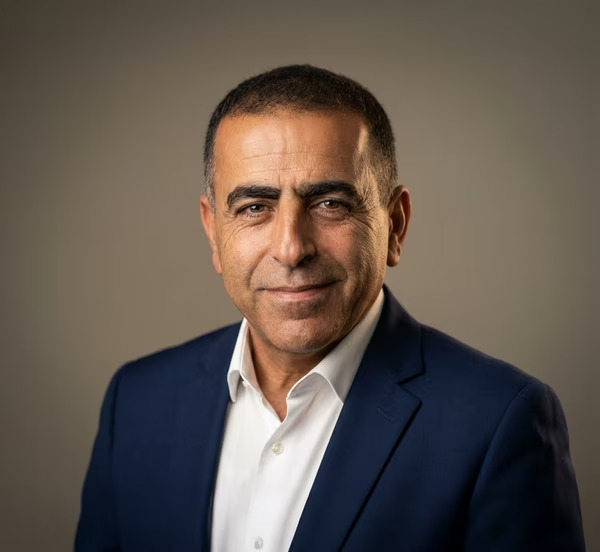
Dr. Ibrahim Nairat

Opinion Writer

The Middle East is witnessing today the birth of a new American strategy, completely different from the old calculations that were based on protecting Israel's security alone to ensure influence in the region. What is particularly striking is the American policy towards Syria, where Washington allowed legitimacy to reunify the country despite Israel's historical opposition, and abandoned the Kurds and Druze who were seen as allies. This step is not random, but part of a more ambitious American vision aimed at transforming Syria from an open conflict zone into a player that can be integrated into the network of Arab alliances, a محور capable of confronting Iranian influence and managing tensions in a precise manner.

Iraq represents a strategic gateway that prevents Iran from using its territory as a pressure tool against this axis, while Jordan provides a base of stability and a geographical and political link between the Gulf states and the Levant. As for the Gulf states, they form the beating heart of this trend due to their economic, geopolitical, and military power, in addition to their ability to exert direct pressure on Iran and monitor the Strait of Hormuz and vital supply lines. In this context, it is noted that the Trump administration gave Arab countries a greater role in regional talks, with Turkey actively involved in some files, in a clear indication of Washington's endeavor to distribute influence and empower regional allies to play direct roles in crisis management, away from the traditional approach that placed Israel at the center of all equations.

What distinguishes American policy today is that the threat of using force against Iran is not seen as an end in itself, but as a pressure tool within an undeclared strategy aimed at gradually removing Iran from the Arab scene and imposing new balances without being drawn into a comprehensive confrontation. At the same time, Washington sends a clear message to its Arab allies that it is capable of protecting their interests and ensuring regional stability. The American move towards Iran is no longer presented as a direct service to Israel as before, but comes within a broader vision that includes energy security, regional influence, and strategic stability in the Middle East, a vision that is gaining increasing acceptance within the American street, where the idea of fighting costly wars in defense of Israel has become widely questioned.

This shift is also reflected in the Israeli discourse itself, as Benjamin Netanyahu announced that Israel will seek in the future to rely more on itself, and reduce its military dependence on the United States in protecting its security. This statement cannot be separated from the changes in American policy, nor from the escalation of calls within the United States not to supply Israel with weapons used to kill civilians, which reflects a tangible change in the American political and popular mood towards the nature of the unconditional support that Israel enjoyed for decades.

Despite all this, Arab-American relations have not been affected over the decades, even in the most intense moments of tension, such as the United States' support for Israel in its wars against Lebanon, the occupation of Palestinian territories, and the Gaza wars. These relations have remained relatively stable, which reflects the ability of Arab countries to separate their political differences with Israel from their strategic interests with Washington. The Abraham Accords were a first attempt to translate this trend into practical reality, but they are not the only condition, as the United States can manage the new scene and integrate the Palestinian issue into a diplomatic path that reduces historical tensions without harming broader strategic partnerships.

With this approach, old challenges turn into opportunities to redraw the map of influence in the Middle East. American policy is no longer just a deterrent to Iran or a protective umbrella for Israel, but a project to build an integrated Arab network capable of achieving stability and engaging in long-term economic and political partnerships, with careful management of chronic conflicts. Allowing the reunification of Syria, and integrating Iraq, Jordan, and the Gulf states into a cohesive Arab axis, along with using military and political pressure on Iran, reflects Washington's ability to maintain its central role as a guarantor of regional balance, while achieving broader strategic goals that include reducing Iranian influence, and reshaping the relationship between Arabs and Israel within a more pragmatic and less costly framework.

In conclusion, this American strategy represents a structural shift in the approach to the Middle East: from almost complete reliance on Israel to building a broader regional balance, in which roles are distributed among Arab allies and Turkey, and threats are managed instead of being drawn into open wars. This approach not only reflects an evolution in Washington's understanding of its interests, but also a response to internal American shifts that reject costly wars and unconditional support, and seek a more rational policy that achieves stability, protects American interests, and gives the region a real opportunity to escape the cycle of continuous conflicts.

PALESTINE

Fri 06 Feb 2026 4:28 pm - Jerusalem Time

Details revealed of secret deportation of Palestinians from America on luxury plane owned by Trump friend

International press sources revealed details concerning a secret American operation to deport a number of Palestinians from the United States to the occupied West Bank, via a luxurious private jet owned by a real estate magnate close to the family of US President Donald Trump. A report published by The Guardian newspaper stated that the 'Gulfstream' aircraft, owned by businessman Gil Dezer, departed from a detention center in Arizona with handcuffed and shackled Palestinians on board, and landed at Ben Gurion Airport after stops in New Jersey, Ireland, and Bulgaria.

The operation took place on the morning of January 21st, when 8 Palestinians were deported and briefly detained by the occupation authorities before being released at the Ni'lin checkpoint in the West Bank. Eyewitnesses reported that the deportees arrived in a difficult condition, wearing light prison clothes in cold weather, and carrying their belongings in plastic bags.

Gil Dezer, the owner of the plane, is a long-time partner of President Trump and a prominent donor to his election campaigns, and also serves as a member of the Miami branch of the 'Friends of the Israel Defense Forces' organization. The investigation indicated that this flight is part of a shift in the mass deportation policy pursued by the current Trump administration, where private planes are leased through intermediary companies to carry out the tasks of the US Immigration and Customs Enforcement.

Among the deportees was Maher Awad (24 years old), who lived in the United States for 10 years and left behind a newborn daughter in Michigan. Awad described his experience as bitter, noting that the occupation forces received them at the airport and transported them to the military checkpoint where they were dropped off 'like animals' on the side of the road, before finding help from local residents to contact their relatives with whom they had lost contact for a long time.

Mohammed Kanaan, an academic living near the checkpoint, reported that the army does not usually release prisoners in that area, noting that he hosted the men in his home and provided them with food and necessary communications. Records show that the Dezer family, which runs a major real estate company, has contributed more than $1.3 million to support Trump, and they have a close personal friendship that spans more than two decades.

Operational estimates indicate that the cost of such flights ranges between $400,000 and $500,000. While Dezer claimed no knowledge of the passengers' identities, human rights organizations criticized this 'opaque' private jet system that facilitates mass deportations without legal accountability or regard for humanitarian procedures, especially with the scattering of Palestinian families whose members still reside in the United States.

They dropped us off like animals on the side of the road.. This is how one of the Palestinian deportees described the moment they arrived at a military checkpoint in the West Bank after a difficult journey from America.

ARAB AND WORLD

Fri 06 Feb 2026 4:28 pm - Jerusalem Time

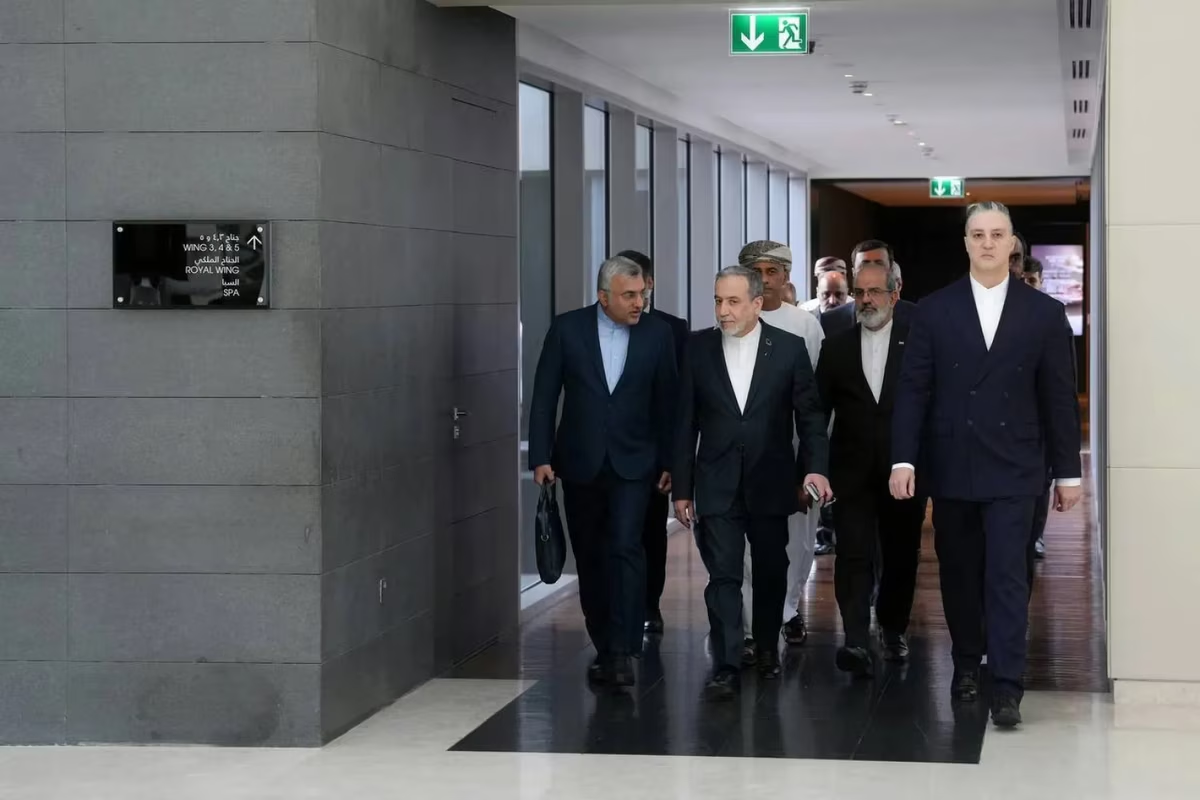
Positive Atmosphere in Muscat: First Round of Iranian-American Negotiations Concludes

The first round of negotiations between Tehran and Washington in the Omani capital, Muscat, concluded today, Friday, after discussing the nuclear file, amidst talk of a "positive atmosphere." Iranian Foreign Minister Abbas Araghchi said after the talks ended that the current round "was positive," adding: "I can say it's a good start."

The Iranian minister explained that his country's delegation listened to the American point of view, indicating the possibility of reaching a positive framework, and noted that the negotiators would return to their capitals for the necessary consultations. Araghchi confirmed that the date of the next round would be determined during upcoming consultations with his Omani counterpart, considering that if negotiations continue in this manner, it might be possible to reach an agreed-upon framework.

For its part, the Iranian news agency reported that assessments indicate a desire from both sides to continue talks, while press sources quoted Axios as saying that the negotiations in Muscat concluded with another round to be held in the coming days. These diplomatic moves come with the participation of US Special Envoy Steve Witkoff, with assurances that any agreement must be based on mutual respect.

These talks came at a time when Washington keeps the military option on the table, while Tehran affirms it will defend itself against any "excessive demands." Iran stresses the necessity of limiting talks to the nuclear file to lift international sanctions, while the United States insists that discussions also address the ballistic missile program and Iranian support for armed groups in the region.

This round is the first since the United States launched strikes in June 2025 on key sites of the Iranian nuclear program during the 12-day war initiated by Israel against Iran. The talks took place amidst Washington's strengthening of its military capabilities in the Middle East by deploying a naval fleet led by an aircraft carrier, while US President Donald Trump did not rule out the use of force if the diplomatic path failed.

In a related context, press sources quoted the "Wall Street Journal" as reporting that the commander of the US Central Command (CENTCOM), Admiral Brad Cooper, joined his country's delegation in these talks, reflecting the security and military importance Washington attaches to this round of negotiations in Muscat.

The current round was positive, and I can say it's a good start and we can reach a positive framework.

PALESTINE

Fri 06 Feb 2026 3:58 pm - Jerusalem Time

A Palestinians killed by occupation bullets in Jabalia and Beit Lahia, north of Gaza

Medical sources in hospitals north of the Gaza Strip reported on Friday the martyrdom of two individuals as a result of being targeted by Israeli occupation forces' bullets in the areas of Jabalia al-Balad and al-Waha, amid the continued intensive military operations targeting northern areas.

According to eyewitnesses and field sources, the body of the first martyr was recovered from the al-Waha area, northwest of Beit Lahia, while the second martyr succumbed after direct gunfire towards citizens in the Jabalia al-Balad axis.

On the other hand, medical teams are facing extreme difficulty in reaching some besieged areas due to continuous shelling and the presence of occupation snipers, which threatens to increase the number of victims amid the tight siege on those areas.

Medical teams are facing extreme difficulty in reaching some besieged areas due to continuous shelling and the presence of occupation snipers.

PALESTINE

Fri 06 Feb 2026 2:46 pm - Jerusalem Time

"Hind Rajab Foundation" files complaint in the United States against former Israeli soldier on charges of war crimes and genocide in Gaza

Said Erikat

Opinion Writer

News Analysis

The "Hind Rajab Foundation" (HRF) has filed a legal complaint with the competent authorities in the United States against Adi Carney, an Israeli citizen and former sergeant in the 603rd Combat Engineering Battalion of the Israeli army, demanding a criminal investigation against him on the basis of accusations related to committing war crimes and acts "amounting to genocide" during the Israeli war on the Gaza Strip.

This step comes within an escalating path followed by the Foundation in prosecuting former Israeli military personnel in more than one country, based on the principle of activating judicial jurisdiction in countries whose laws allow the prosecution of those accused of serious international crimes, especially in cases of suspected crimes against humanity, war crimes, or genocide. According to what the Foundation announced, the complaint filed in the United States is not the first against Carney, as it was preceded by complaints in several jurisdictions around the world, including Peru, where – according to the Foundation – a formal criminal investigation was opened against Carney on charges of genocide. It also indicated that it had submitted additional files in other countries, as part of what it described as a strategy of "activating jurisdiction wherever the accused is found," so that his movement outside Israel becomes fraught with potential legal procedures, which may include investigation, summons, or even arrest.

The American complaint acquires special importance because Carney is currently in the United States, which – according to the Foundation – opens the door for the activation of American jurisdiction, and gives the case an urgent character, especially with its announcement that Carney is scheduled to give a public speech at Boston University this evening. This detail goes beyond being a procedural piece of information; it places the case at a sensitive intersection between law and politics, where hosting a former military figure becomes a public test of the meaning of "accountability" in the American public sphere, not in courtrooms alone.

Observers note that the move of the battle to the American arena is not only linked to the weight of the United States as a political power, but also to the nature of the internal debate within it about the war on Gaza, as universities have become a central stage for the struggle over narrative and legitimacy. In this context, the complaint – even before it turns into a full judicial procedure – becomes a political and legal message at the same time: a message that says that the time for dealing with accusations as an "ethical disagreement" or a "point of view" may recede in favor of turning them into litigable legal files.

The "Hind Rajab Foundation" says that its files include materials it considers "evidence" or "indicators" of Carney's involvement in military operations during the war on Gaza, and believes that these operations were not just ordinary military participation, but were linked to a broader context of widespread destruction that affected residential areas and civilian infrastructure, amid increasing international accusations against Israel of committing grave violations of international humanitarian law. The Foundation also stresses that it targets "individual accountability" and not just government accountability, considering that impunity – in its view – begins when the boundaries between political decision and field implementation are blurred.

However, this type of action raises a deeper problem that goes beyond the name of the accused: the legal battle against specific individuals reflects a shift in human rights pressure tools, but at the same time reveals the limitations of the international system, which often falters in the face of the political calculations of major powers. Even when serious accusations such as genocide and war crimes are available, the most sensitive question remains: Do national judicial systems have the will to open files that might anger powerful allies? Or will international law remain in many cases more of a moral language than an executive mechanism?

On the other hand, others believe that repeated filing of complaints in several countries is not just "distraction," but a calculated strategy based on a simple principle: if doors are not opened in one capital, they may be opened in another. Hence the importance of the "Peru experience," where the Foundation says that a formal investigation has already been opened, indicating that some judicial systems may be more amenable to interacting with these files than others. This approach is based on the idea that international justice, when it falters in major institutions, may find alternative paths through national courts, albeit slowly.

In the United States, observers expect the case to spark widespread debate, not only among legal professionals, but also within universities and civil institutions, where the question of justice intertwines with the question of freedom of expression and the limits of hosting. Between those who see hosting Israeli military figures as part of "open debate," and those who consider it normalization with practices accused of committing international crimes, the political and moral gap widens. The presence of the accused on American soil also adds a practical dimension that cannot be ignored, because the case – if it proceeds – will test the limits of American law in dealing with crimes committed outside its borders.

While no official comment has yet been issued by the American authorities regarding the complaint, the Foundation's move reflects a growing trend to transform the war on Gaza into a multi-track international accountability file, where the confrontation is not limited to political statements or human rights reports, but extends to the courts. Ultimately, the case may not be merely an attempt to condemn a specific person, but an attempt to redefine the larger question: who holds accountable, and how, and where, when the destruction becomes so widespread that it exceeds the world's ability to merely condemn verbally?

In this context, the American complaint appears to be part of a broader shift in how the conflict is approached; instead of relying on major international initiatives that may falter due to vetoes or political balance calculations, active institutions are moving to open parallel judicial paths, hoping that the accumulation of cases and the overlap of jurisdictions will lead to the creation of a new legal reality at some point. Between the success or failure of these endeavors, the constant remains that the war on Gaza is no longer fought with weapons alone, but is also managed by law and documents, and by a narrative battle that seeks to establish the meaning of crime and define the meaning of responsibility.

ARAB AND WORLD

Fri 06 Feb 2026 2:36 pm - Jerusalem Time

Muscat Talks: A Highly Sensitive Stop in the Strained Relationship Between America and Iran

Said Erikat

Opinion Writer

News Analysis

All eyes are on Muscat, Oman, where talks are being held that are considered among the most sensitive stops in the strained relationship between Iran and the West. Muscat gains its importance from being a reliable communication channel in regional crises, and a place that has long been used to exchange messages and turn corners when direct channels are closed. This round comes at a time when political and economic pressures on Tehran are escalating, against indications of a mutual desire to avoid sliding into an open confrontation.

Although the nuclear file dominates the headlines, the broader framework of the talks relates to Iran's position in the regional system and the limits that Washington and its allies seek to impose on Tehran's influence. In return, Iran is trying to establish an equation that says it is not a party that can be indefinitely besieged, and that any settlement must include recognition of its role and its security interests. Therefore, Muscat is not just a technical stop related to enrichment rates or inspection mechanisms, but a political test that goes beyond the nuclear issue to a bigger question: What is the ceiling of Iran's role in the Middle East?

Within this context, Iran presents itself in its political discourse as confronting what it calls "savagery," referring to the policies of subjugation and collective punishment that it says are practiced through sanctions and threats. This discourse is not just a propaganda detail, but reflects an attempt to frame the conflict as a struggle over the rules of international conduct: Are crises managed through law and institutions, or through the balance of power and political blackmail?

The central question remains: Is the nuclear issue the basis? Practically, the nuclear program represents the clearest point of contact, but it does not encapsulate the essence of the crisis. A large part of the tension is linked to Iran's ability to build deterrence tools and expand its regional influence, which makes the nuclear agreement, for its adversaries, an insufficient step unless accompanied by broader political and security restrictions. Here, the talks turn into a double test: a technical test on nuclear commitments, and a political test on the nature of the "possible deal" in the region.

In this framework, it appears that both parties possess mutual pressure tools, but they also have strong reasons to avoid an explosion. Washington needs de-escalation that prevents rising regional and economic costs and reduces the risks of energy market disruption or the expansion of tension in the Gulf. Tehran needs a window that alleviates the effects of sanctions and grants it negotiating legitimacy, or at least prevents a rapid deterioration that could threaten its internal stability. However, the fundamental problem remains the lack of trust: every concession is read as weakness, and every flexibility is interpreted as a potential deception.

Related to this point is the issue of double standards, which is one of the most prominent files in Iranian and regional discourse. Criticizing Iran for a nuclear program under supervision, while remaining silent about nuclear arsenals not subject to any supervision, creates a gap in the credibility of the international system. Moreover, selective dealing with international law weakens the ability of international institutions to play a balancing role, and gives conflicting parties additional justifications for escalation.

In contrast, another equally influential axis emerges, which is the international community's inability or limited capacity to impose balanced rules, or its movement within limits set by major powers. This reality explains why Muscat acquires additional value: it is not a substitute for institutions, but an attempt to reduce the impact of international deadlock through a more flexible and less noisy negotiating path.

As for Trump's actual goals, they are read within a broader framework than merely returning to a policy of pressure. The American approach in his era was not focused on amending the terms of a nuclear agreement only, but on reshaping regional balances, providing guarantees to allies, and demonstrating Washington's ability to impose its conditions. From this perspective, any talks in Muscat will be a reflection of an American equation that believes pressure must precede settlement, not be a substitute for it.

On the Iranian side, power cards are a decisive factor in determining the course of negotiations. Iran possesses military capabilities, regional influence, and networks of relationships that allow it to influence more than one arena. It has also developed tools to adapt to sanctions by redirecting trade and economic alliances. These cards give it a negotiating margin, but at the same time, they are used by its adversaries as an argument for continued pressure, on the pretext that Tehran invests its resources in expanding its influence instead of improving internal conditions.

If Muscat does not produce a breakthrough, the most likely scenario is a return to a cycle of slow escalation: additional sanctions, mutual security operations, and a long war of nerves. The danger of this path is that it does not require a clear declaration of war; rather, the accumulation of small steps is enough to generate a major clash. In a charged regional environment, any naval or security incident could turn into an explosion point. Therefore, Muscat appears to be an attempt to freeze the path before reaching the point of no return.

Ultimately, the question of "what does the fall of Iran mean?" is no longer just a political proposition or a theoretical debate, but has become a scenario whose consequences are seriously discussed within decision-making circles. Iran is not a marginal state in the region; any major upheaval in it could have direct impacts on Gulf security, the stability of energy markets, and the safety of maritime passages, in addition to the balances of countries such as Iraq, Syria, and Lebanon. Moreover, a collapse of this kind could open the door to extended internal chaos, and establish a dangerous model based on overthrowing states through tools of pressure and dismantling instead of political settlements.

Accordingly, the Muscat talks are understood as an attempt to establish a minimum level of understanding, or at least prevent a slide towards a rapid deterioration whose outcomes cannot be controlled. Although these talks do not include guarantees of success, they remain one of the few opportunities available to reintroduce politics into a file that has long been governed by the logic of escalation and confrontation.

ARAB AND WORLD

Fri 06 Feb 2026 2:29 pm - Jerusalem Time

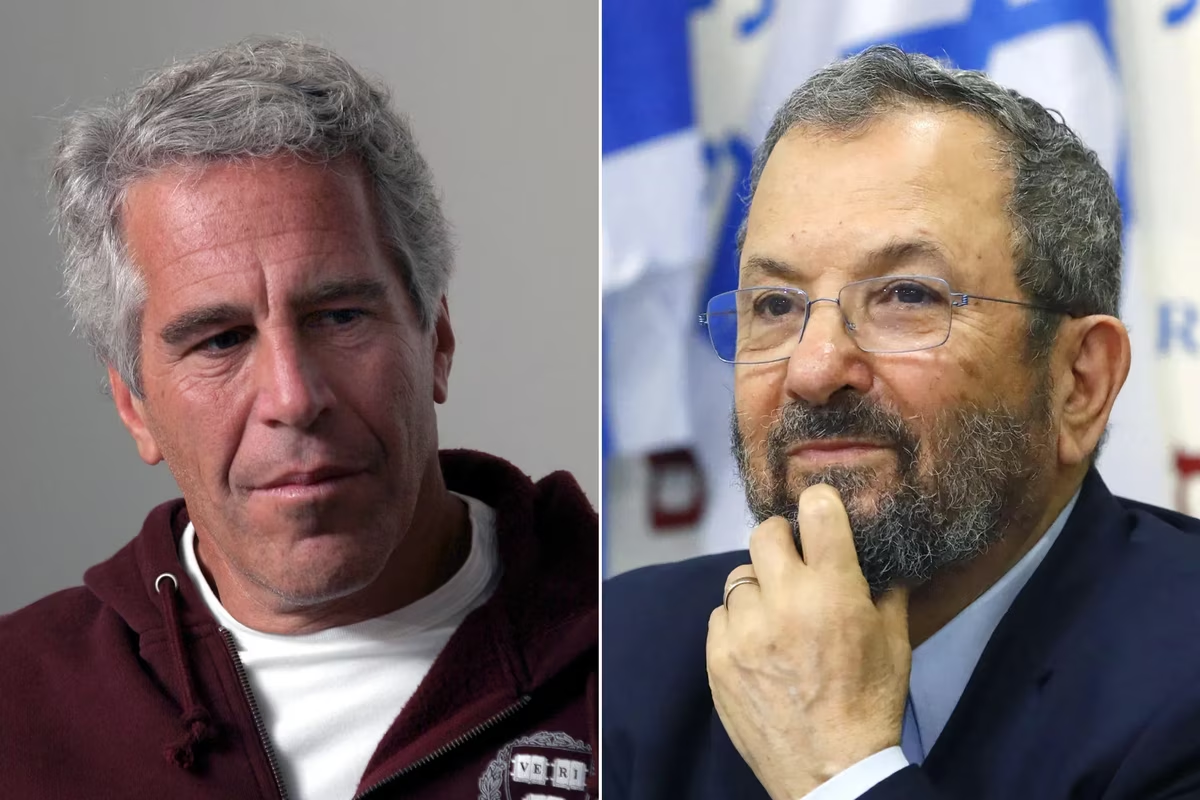
Epstein–Barak Correspondence: Documents Raise Questions About Influence, AI, and Demographics

Said Erikat

Opinion Writer

Documents, correspondence, and leaks from files related to Jeffrey Epstein have revealed the nature of a years-long relationship between him and Ehud Barak, the former Israeli Prime Minister and Minister of Defense. The circulated materials indicate that communication between the two was not merely social, but involved political and strategic discussions, including sensitive issues related to the region and its demographic and technological balances.

According to parts of these leaks, Epstein and Barak discussed various issues since 2013, including perceptions related to Iran, the utilization of advanced technology including artificial intelligence tools, in addition to ideas related to geopolitical transformations in the Arab world after the major wave of unrest the region witnessed.

However, the most dangerous aspect of this issue lies not only in the content of the discussions but in the model of influence it reflects: where money becomes a platform for access to decision-making rooms, and "consultations" turn into a cover for advancing interests. Even if the documents do not prove the existence of a military decision or an official plan, the mere continuation of communication between a high-ranking official and an individual with a documented criminal record raises serious ethical and political questions about the boundaries between "dialogue" and "planning," and between "advice" and "direction."

Among the most striking aspects in these materials was what was attributed to Barak regarding the possibility of transferring approximately one million immigrants of Russian origin to Israel, within the context of discussions about immigration and population balance. This issue is central to internal Israeli political calculations, as immigration policies have long been linked to matters of identity and the distribution of electoral power, as well as reshaping demographic reality to serve the state's long-term visions.

Conversely, the circulated data shows that Epstein was not merely a financial or social figure, but tried – according to the leaks – to play the role of a mediator connecting political influence with technology and capital networks. There were indications of his interest in directing Barak towards American technology companies related to data analysis and artificial intelligence, in a context that seems closer to building multi-faceted influence than to abstract intellectual discussions.

Here, a highly sensitive point emerges: the discussion of artificial intelligence in this context is not an innocent technical detail, but a sign of the shift of influence from traditional politics to "data power." When artificial intelligence becomes part of political discourse, the real question becomes: for whose benefit are these tools built? And who are they targeting? The danger increases when Epstein—historically associated with suspicions of blackmail and exploitation—appears as a link between technology and political decision, making the story more akin to an early warning than a fleeting scandal.

As for the more severe allegations circulating on social media platforms—such as talk of planning a military strike against Iran, or seeking systematic profit from the chaos of Arab countries—the documents published so far do not provide conclusive evidence for them, but the margin of "possibility" widens with each new batch of leaks from Epstein's files.

However, this does not diminish the seriousness of the overall picture reflected by this correspondence: dealing with the Middle East as a space amenable to re-engineering, people, borders, and demographics, and with tools managed away from public oversight and accountability. Even when "plans" are not directly announced, the nature of the language used and the way of thinking reveal a political mind that sees the region only as raw material for arrangement and redistribution.

While it cannot be definitively stated that these discussions turned into official policies or executive decisions, they at least reveal a dark side of the network of relationships that may form behind the scenes: where interests intersect, technology intertwines with power, and peoples are reduced to numbers and maps, not rights.

PALESTINE

Fri 06 Feb 2026 12:44 pm - Jerusalem Time

Norwegian Doctor Mads Gilbert: Europe is Morally Collapsing and Trump's Plan is an 'Absurd Comedy'

In decisive terms, Norwegian doctor Mads Fredrik Gilbert described Europe's stance on the Palestinian issue compared to the war in Ukraine as a "deep moral collapse," considering the double standards a shameful part of European history. Gilbert, born in 1947, dedicated 43 years of his professional life to supporting the Palestinian people since his first work in Beirut in 1982, where he witnessed the brutality of attacks targeting hospitals and infrastructure.

In an interview with media sources on the sidelines of a solidarity conference in Copenhagen, Gilbert reviewed his experience in Gaza hospitals during the wars of 2006, 2009, 2012, and 2014, condemning the targeting of the Palestinian medical system, which he described as the best globally in managing mass casualties. He angrily pointed to the killing of more than 1,700 workers in the medical sector since October 7, 2023, without any international accountability, questioning the world's reaction if the victims had been Jewish doctors.

Gilbert also praised the exceptional courage of Palestinian and Arab journalists in Gaza, who conveyed the details of the genocide to the world despite the martyrdom of nearly 250 of them. He described these journalists as "heroes in his heart," emphasizing that the truth they conveyed was the strongest weapon that prevented Western media from continuing to falsify reality.

Regarding his intellectual transformation, Gilbert revealed that he had intended to volunteer in Israeli "kibbutzim" in 1967, influenced by his upbringing, but he backed down after realizing the reality of the occupation to become an active member of the Norwegian-Palestinian Committee. He recalled his first shock in Beirut in 1982 during Israel's invasion of Lebanon, where he discovered the absence of any international protection or respect for the Geneva Conventions when it came to Israeli aggressions.

Concerning current political developments, Gilbert described the "peace plan" proposed by US President Donald Trump as "ridiculous" and reflecting an "absurd and comedic" reality. He denounced the idea that the parties responsible for bombing and extermination should oversee the reconstruction or governance of Gaza, considering it a form of modern colonialism and imperialism.

In conclusion, Gilbert called for comprehensive sanctions, an arms embargo, and complete isolation of Israel and the United States to save what remains of Gaza. He expressed his pride in the growing global popular solidarity movement, affirming his firm belief that Palestine will ultimately be liberated and defeat colonialism, calling on everyone to raise their voices, each according to their talent and specialty.

Imagine if some of Israel's enemies had killed 1,700 Jewish doctors, nurses, and medical students, what would the world have said then? There would have been a huge uproar.

PALESTINE

Fri 06 Feb 2026 11:51 am - Jerusalem Time

Freedom Flotilla Announces Largest International Movement to Break Gaza Siege Next March

The global “Freedom Flotilla” announced on Thursday evening the launch of what it described as the “largest relief movement in history” to break the Israeli siege imposed on the Gaza Strip, through two simultaneous land and sea routes, next March, with the participation of thousands of activists from more than 100 countries. The flotilla stated in a statement published on the “X” platform that the initiative represents “the largest coordinated humanitarian relief operation for Palestine in history,” confirming that the movement will officially begin on March 29, 2026, through “a naval fleet and a land humanitarian convoy simultaneously.”

The statement added that the initiative comes as “a peaceful and coordinated response to the genocide, siege, famine, and destruction of civilian lives committed by Israel in Gaza,” stressing that this time the movement is not limited to sailing only, but aims for “the entire world to rise up” to break the siege. The “Freedom Flotilla” clarified that the movement will involve “thousands of volunteers” from more than 100 countries, including more than a thousand doctors, nurses, and healthcare workers, in addition to teachers, engineers, reconstruction teams, and investigators of war crimes and “environmental genocide,” according to the statement.

The announcement comes at a time when the humanitarian crisis in the Gaza Strip continues, amid Palestinian and international accusations against the Israeli occupation of not adhering to the humanitarian protocol of the ceasefire agreement in effect since October 10 last year, especially regarding the entry of fuel, humanitarian aid, and rubble removal equipment. Despite the agreement entering its second phase last January, Palestinian sources confirm that the occupation continues to violate it daily, leading to deaths and injuries among civilians.

The Israeli army had seized the Palestinian side of the Rafah land crossing in the southern Strip last May, tightening the siege further, and only allowing the entry of “very scarce” quantities of fuel and aid, which exacerbated the humanitarian situation inside Gaza. The crossing was reopened last Monday amid strict Israeli restrictions, while Palestinians returning from Egypt to the Strip complained of ill-treatment, confirming that they were subjected to significant harassment during their crossing.

Ships heading towards Gaza have previously been subjected to Israeli attacks in past years, as international bodies accused Israel of engaging in acts of “piracy” and seizing ships and expelling activists who were on board. On October 1 last year, the “Freedom Flotilla” announced that the Israeli army attacked 42 of its ships while they were sailing in international waters towards Gaza, and arrested hundreds of international activists before beginning their deportation.

With American support, the Israeli occupation began a two-year genocide war in the Gaza Strip on October 8, 2023, resulting in approximately 72,000 Palestinian martyrs and over 171,000 injured, most of whom are children and women, in addition to the destruction of about 90 percent of the civilian infrastructure, according to Palestinian data.

The occupation has imposed a siege on the Gaza Strip for 18 years, while about 1.5 million Palestinians out of approximately 2.4 million are homeless, after the war of genocide destroyed their homes. The roots of the conflict date back to 1948 when the Israeli occupation was established on Palestinian lands occupied by armed Zionist gangs that committed massacres and displaced hundreds of thousands of Palestinians, before later completing the occupation of the rest of the Palestinian territories, amid continuous refusal to withdraw and establish a Palestinian state.

The initiative represents the largest coordinated humanitarian relief operation for Palestine in history, and aims for the entire world to rise up to break the siege.

ISRAELI AFFAIRS

Fri 06 Feb 2026 11:36 am - Jerusalem Time

Muscat Negotiations Between Tehran and Washington Begin: Israel Awaits and Warns Against Partial Agreement

Israel is closely monitoring the negotiations between Iran and the United States, which began in Oman today, Friday, and which Tel Aviv is trying to complicate and thwart. Sources reported that the Muscat negotiations are starting indirectly, noting that the Iranian delegation does not object to moving to direct negotiations if it perceives progress in the talks.

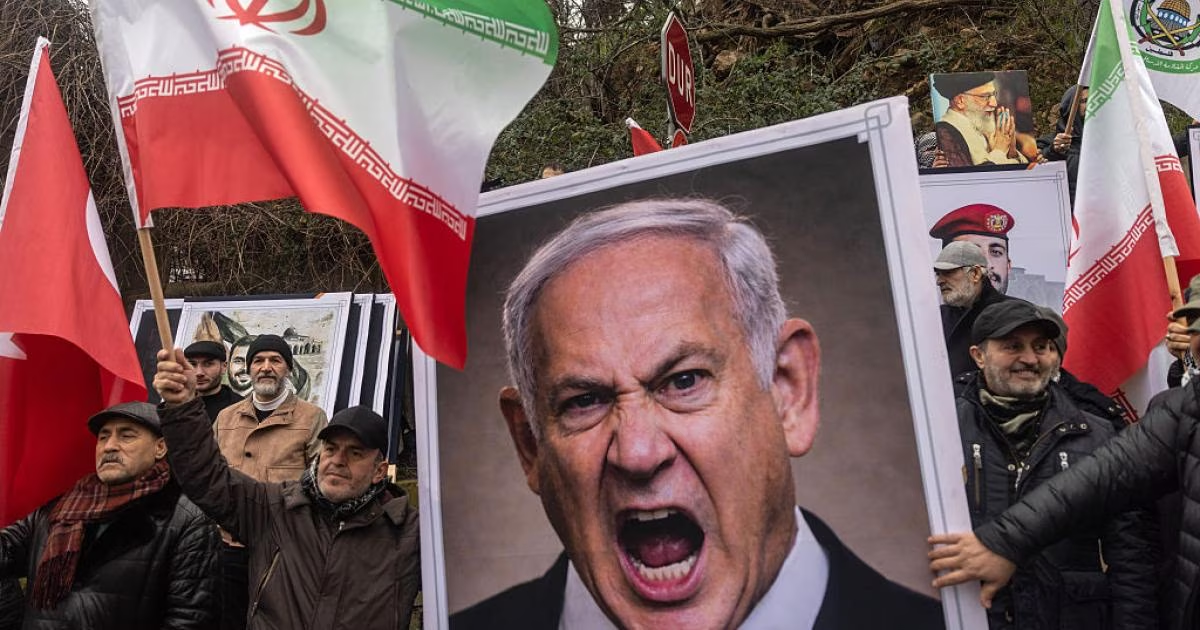
In Israel, the security and political cabinet met yesterday, Thursday, to discuss the negotiations. During the meeting, Prime Minister Benjamin Netanyahu said that Tel Aviv would respond with 'unprecedented force' to any potential Iranian attack in light of Iran's warnings of a 'regional war' if it were targeted by the United States. Netanyahu clarified, according to Hebrew reports, that he does not yet know President Donald Trump's final decision regarding the negotiations, emphasizing that bilateral coordination is at its highest levels.

Sources in occupied Jerusalem reported that Israel has been promoting the failure of the negotiations even before they began, as it is strenuously trying to convince Washington that Tehran is not trustworthy and cannot fulfill its commitments, describing the negotiation process as 'absurd.' Israeli fear is that the path will lead to an agreement limited to the nuclear file only, without addressing the long-range missiles that Tel Aviv sees as an existential threat.

Media outlets quoted politicians and security sources as estimating that the negotiations are likely to fail, given the belief that Iran is not serious, which was conveyed to US envoy Steve Witkoff during his meeting with Netanyahu in Tel Aviv.

Reports stated that Witkoff informed the Israeli side that the United States understands Tel Aviv's red lines, especially regarding the missile file and support for proxies in the region. Both views agree on the necessity for Iran to abandon its enriched uranium stockpile and halt future enrichment.

Israel had announced raising its alert level in anticipation of an Iranian missile attack in response to any potential American action. This coincided with escalating pressure on Tehran, while the Iranian army warned that the scope of any confrontation would include the entire region and American bases, following Trump's threats of military option.

US-Israeli coordination is at its highest levels, and we will respond with unprecedented force to any potential Iranian attack.

LATEST NEWS

Fri 06 Feb 2026 11:36 am - Jerusalem Time

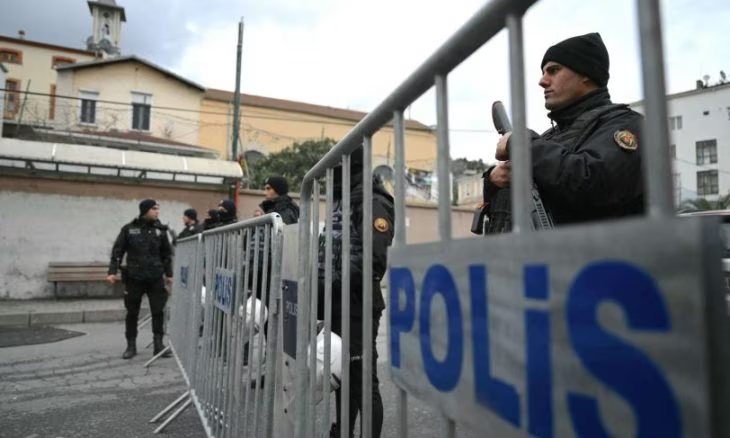
Turkish Intelligence Dismantles Mossad Spy Network, Uncovers Plot to Infiltrate International Supply Chains

Security sources reported on Thursday that the Turkish intelligence agency successfully apprehended two individuals involved in working for the Israeli intelligence agency 'Mossad', identified as 'Mehmet Budak Derya' and 'Veysel Kerim Oğlu'. The arrests took place in Istanbul after a period of meticulous surveillance that proved their involvement in transferring sensitive information to the Israeli occupation.

Details indicate that 'Derya', a mining engineer and owner of a company established in 2005, began his contact with Mossad in 2012 through an official who used the alias 'Ali Ahmed Yassin'. Cooperation developed in 2013 during meetings in European countries with Israeli intelligence officers using pseudonyms, where he was tasked with recruiting 'Veysel Kerim Oğlu', a Palestinian by origin with Turkish citizenship, to be a partner in intelligence operations with a salary paid by Israel.

According to the sources, the two suspects exploited their commercial activities in the Middle East to gather information about Palestinians opposing Israeli policies and transfer it to Mossad. Derya was also involved in sending photos of warehouses in the Gaza Strip and attempting to enter the drone parts trade in 2016 under Mossad's direction, where they tried to lure Tunisian engineer Mohamed Zouari before his assassination in Tunisia in the same year.

The investigations revealed that Mossad placed utmost importance on the secrecy of the two agents, providing Derya with an encrypted communication system and subjecting him to lie detector tests in Asian and European countries in 2016 and 2024. He was also tasked with purchasing technical equipment and SIM cards from Turkey and sending their technical data for use in cyber and intelligence operations.

The sources uncovered a dangerous plot that was arranged last January, aiming to establish a shell company under Derya's management to infiltrate international commercial supply chains. The plan involved managing complex shipping operations through three companies in Asian countries to secure, store, and export products to end-users specified by Mossad. However, the vigilance of Turkish intelligence and the Istanbul Public Prosecutor's Office led to the thwarting of the plot and the arrest of those involved before its execution.

The goal was to infiltrate international commercial supply chains, and Mossad coordinated the shipment of products secured from countries it specified to end-users.

PALESTINE

Fri 06 Feb 2026 11:21 am - Jerusalem Time

Netanyahu officially admits responsibility for the assassination of Al-Qassam leader Mazen Faqha in 2017

The head of the Israeli occupation government, Benjamin Netanyahu, admitted for the first time responsibility for the assassination of the leader in the Izz ad-Din al-Qassam Brigades, the military wing of the Islamic Resistance Movement Hamas, the released prisoner Mazen Faqha in Gaza City in 2017. According to media sources, Netanyahu's admission came as part of responses he submitted to the Israeli State Comptroller regarding his government's actions against the Hamas movement in Gaza.

Journalistic sources stated on Thursday that Netanyahu revealed for the first time in his responses to critics that Tel Aviv was responsible for assassinating Mazen Faqha, a prominent leader in the military wing of Hamas in 2017. The sources clarified that the assassination was carried out by the Palestinian Ashraf Abu Leila, whom Hamas later executed on charges of espionage and carrying out the operation.

Mazen Faqha was one of the most prominent leaders of the "Al-Qassam Brigades" in the occupied West Bank before his arrest. He was released as part of a prisoner exchange deal in 2011 and was then deported to the Gaza Strip, where he continued his leadership activities.

Faqha was assassinated in front of his home on March 24, 2017, in the Tal al-Hawa neighborhood west of Gaza City. The Israeli occupation did not officially claim responsibility for the operation at the time, but the Palestinian Ministry of Interior in Gaza confirmed then that the assassination was carried out by collaborators with the occupation.

On May 26, 2017, the Ministry of Interior in Gaza carried out the execution sentences against the three convicted individuals (two by hanging and the third by firing squad) involved in Faqha's assassination, after investigations proved their direct involvement with the occupation's intelligence agencies.

Netanyahu reveals for the first time in his responses to critics that Tel Aviv was responsible for assassinating Mazen Faqha, a prominent leader in the military wing of Hamas in 2017.

PALESTINE

Fri 06 Feb 2026 11:06 am - Jerusalem Time

Palestinians in Israel decide on a three-day comprehensive strike in protest of the occupation's complicity with crime gangs

The High Follow-up Committee for Arab Citizens, in light of the escalating murder rates and the Israeli government's complicity with crime gangs, decided to begin preparations for a general and comprehensive strike for all workers and facilities in Arab communities. This decision comes after a bloody week that saw the killing of 12 people, amidst accusations against the Israeli ruling establishment of deliberate silence regarding the violence and extortion that is rampant in Arab towns.

The committee clarified that the strike will last for three consecutive days, during which all economic activities will be halted, while ensuring communication with social organizations to guarantee the success of the move and protect strikers from the risk of dismissal. The Follow-up Committee also approved organizing a 'disruption march' next Sunday, where convoys of cars will set off from various regions towards Jerusalem, followed by a press conference to highlight the issue internationally and locally.

In the context of national preparations, the committee began preparing to commemorate the 50th anniversary of Land Day on the third of next March, by issuing hundreds of thousands of copies of a special booklet documenting the occasion. The Follow-up Committee also reiterated its condemnation of the ongoing Israeli aggression on the Gaza Strip and denounced the repeated attacks by settlers in the West Bank, Jerusalem, and the blessed Al-Aqsa Mosque.

For its part, Hebrew press sources revealed that the head of the occupation government, Benjamin Netanyahu, is seeking to evade responsibility for the horrific numbers of Arab casualties. At the same time, the Supreme Court postponed ruling on a petition demanding the dismissal of National Security Minister Itamar Ben-Gvir, despite his abysmal failure and interference in police work, while newspaper editorials described the situation as a deliberate destruction of the internal Palestinian home.

On the academic analysis front, Professor As'ad Ghanem, a political science lecturer, emphasized the necessity of formulating a work program that strengthens community immunity and pressures the Netanyahu and Ben-Gvir government to change its policies, calling for an international campaign to expose government complicity. Ghanem stressed the importance of field partnership to confront the 'monster of crime' that threatens the Palestinian presence in Israel.

In turn, the mayor of Tamra, Musa Abu Roumi, called for adopting a media campaign to push the Jewish street to break its silence, warning that the fire of crime would spread to Jewish residential complexes. Abu Roumi emphasized the need to increase the activity of Arab local government and not rely solely on parliamentary movements, noting that the level of protests is still below what is required to confront the acceleration of crime.

Crime is still faster and greater than protests, and we, as heads of Arab local authorities, must escalate in defense of our public's fundamental right to security and safety.

ARAB AND WORLD

Fri 06 Feb 2026 11:06 am - Jerusalem Time

Trump at National Prayer Breakfast: I deserve to go to heaven for the good deeds I've done

US President Donald Trump said on Thursday that he deserves to go to heaven, justifying this by what he described as the "good deeds" he has done in his life, in a speech he delivered during his participation in the National Prayer Breakfast in Washington, D.C. Trump added, in a statement that received widespread interaction, that he was joking previously when he said he would never go to heaven, before returning to say: "When I think about it seriously, maybe I should go to heaven."

The US President continued his speech to the attendees, saying: "I am not a perfect candidate, but I have done a lot of good things for perfect people." These statements came in the context of his discussion of faith and religion and their role in public life, during the annual event that brings together political and religious figures from various orientations, and is a well-established tradition in American political life.

The National Prayer Breakfast is known as a platform where US presidents deliver speeches of a religious and moral nature, often carrying indirect political messages. Trump's statements sparked mixed reactions on social media platforms, with some of his supporters considering them an expression of his self-confidence, while critics saw them as part of his controversial style in political discourse.

Trump's statements reflect his usual style of mixing humor and seriousness, which sparks widespread debate about his actions and speeches. These statements also show the controversial personality of the president, which is not without a dramatic character in American political life.

I am not a perfect candidate, but I have done a lot of good things for perfect people.

ARAB AND WORLD

Fri 06 Feb 2026 10:22 am - Jerusalem Time

Hebrew sources: Washington backs down from including missiles and proxies in its negotiations with Iran

Journalistic sources, quoting an official familiar with Middle Eastern affairs, reported that the United States and Iran have agreed to limit the talks scheduled for next Friday to the Iranian nuclear program only, excluding other contentious issues.

The source indicated that Washington accepted Iranian conditions after intensive interventions from regional countries, including Qatar, Saudi Arabia, and Oman, while warning that Tehran had shown its readiness to enter a wide regional conflict if its conditions related to the negotiation framework were rejected.

No official statement has been issued by the American administration yet confirming or denying the retreat from the request to include the Iranian missile program and the activity of proxies in the region within the discussion agenda, which had been a fundamental point of contention.

The sources confirmed that regional countries seek to avoid having an overbearing neighbor, but at the same time, they realize that any military confrontation or attack on Iran will lead to severe damage to the entire region, which prompted them to pressure Washington to allow for the diplomatic path.

The sources concluded that despite the hardline rhetoric from Tehran, the Iranian leadership may ultimately be willing to abandon its nuclear program, but the negotiation process remains shrouded in ambiguity, especially since Washington's position on the maximum demands has not yet fully crystallized.

Iran is ready for a regional conflict if its conditions for the negotiation framework are rejected, and regional countries realize that any attack on Tehran will harm the entire region.

PALESTINE

Fri 06 Feb 2026 10:22 am - Jerusalem Time

Official statistics confirm the continuation of occupation crimes and escalating violations in the second phase of the Gaza agreement

Statistics and figures published by official bodies in the Gaza Strip confirmed that the crimes of the Israeli occupation in the second phase of the ceasefire agreement have not decreased, since the American announcement of the transition to this phase in the middle of last month. The Ministry of Health and the Government Media Office in Gaza issued figures documenting the occupation's violations and its continuous crimes against Palestinians, which ignore its commitments stipulated in the ceasefire agreement in effect since October 10, 2025.

The Ministry of Health stated in its statistical report on Thursday that 27 martyrs and 18 injured arrived at hospitals during the past 24 hours, noting that since the ceasefire, the total number of martyrs has reached 574, injuries 1518, and body retrievals 717. It added that the total toll since the start of the Israeli war of extermination on October 8, 2023, has reached 71,851 martyrs and 171,626 injuries.

In addition to the casualties, most of whom are children and women, the occupation army destroyed 90 percent of the civilian infrastructure in Gaza, with a reconstruction cost estimated by the United Nations at about $70 billion.

On Wednesday evening, official sources in Gaza reported that the occupation army has committed 1520 violations since the ceasefire, resulting in the martyrdom of 556 Palestinians and the injury of 1500 others. They explained that the violations included 522 shooting incidents, 73 incursions by military vehicles into residential neighborhoods and areas, 704 bombing and targeting operations, and 221 demolition operations of various homes and buildings, stressing that among the martyrs were 288 children, women, and elderly, compared to 268 men, while civilians constituted about 99 percent of the total casualties.

The sources continued: "Among the injured, more than 900 are children, women, and elderly, while the number of injured civilians reached 1488, or 99.2 percent." The Israeli occupation army still occupies more than 50 percent of the Gaza Strip, represented by the southern and eastern strips and large parts of the north.

As for the first phase of the agreement, which lasted 95 days, the occupation committed 1244 violations during it, resulting in the martyrdom of 449 Palestinians, the injury of 1246, and the arrest of 50 people.

The violations also included 402 direct shooting incidents at civilians, and 66 incursions by military vehicles into residential areas. They also included 581 bombing and targeting operations of citizens and their homes, and 195 demolition and destruction operations of homes, institutions, and civilian buildings.

As for the period since the start of the second phase on January 15, 2026, until Thursday morning (21 days), field sources have monitored at least 276 Israeli violations, resulting in the martyrdom of 125 Palestinians and the injury of 272 others. During this period, 150 shooting incidents at civilians were recorded, 7 incursions by military vehicles, 123 bombing and targeting operations of citizens and their homes, and 26 demolition operations of various homes and buildings.

In addition to the daily bloody bombing, the occupation prevents the entry of agreed-upon quantities of food, medicine, medical supplies, and shelter materials into Gaza, where about 2.4 million Palestinians, including 1.5 million displaced persons, live in catastrophic conditions.

On an almost daily basis, the Hamas movement calls on mediators and the international community to exert pressure on the Israeli occupation to stop the ongoing war of extermination in Gaza.

After Israeli procrastination and evasion attempts, Washington announced in the middle of last month the start of the second phase of the agreement, which is based on US President Donald Trump's plan. Among the provisions of this phase are: the formation of transitional governance structures for Gaza, the disarmament of the Hamas movement and other Palestinian factions, the implementation of an additional withdrawal of the Israeli occupation army, and the initiation of reconstruction efforts for what Tel Aviv destroyed.

Civilians constituted about 99 percent of the total casualties since the start of the ceasefire, amid ongoing bombing, demolition, and incursion operations.

ARAB AND WORLD

Fri 06 Feb 2026 9:51 am - Jerusalem Time

Kamala Harris Reactivates Campaign Account, Sparking 2028 Run Speculation

Former US Vice President Kamala Harris on Thursday reactivated a campaign account on social media, sparking widespread speculation about her potential return to the White House race in the next cycle. Harris said in a video posted on her 'X' platform account, which she renamed 'Headquarters_67': 'I'm really excited about this,' in a symbolic reference to the numbers 6 and 7, popular among 'Gen Z' members. The account also appeared on the 'TikTok' platform under the name 'Headquarters' only, after remaining inactive since Donald Trump's victory was announced in the November 2024 elections.

Harris explained that the reactivated account will work to provide information aimed at American youth, with a focus on highlighting what she described as 'our great brave leaders,' including elected officials and prominent civil society figures, and concluded her speech by inviting followers to stay in touch.

This move comes at a time when several opinion polls have shown Harris leading the list of potential Democratic Party candidates for the 2028 presidential election, ahead of prominent rivals such as California Governor Gavin Newsom. In contrast, President Donald Trump's camp launched an immediate attack, with White House spokeswoman Abigail Jackson mocking Harris's increased media presence, and the 'Trump War Room' account posting sarcastic comments about her political return.

The activation of the accounts coincided with a promotional tour Harris is undertaking in US states for her new book '107 Days,' a title that refers to the duration of her abbreviated presidential campaign in 2024 after Joe Biden's withdrawal. The book detailed Biden's nomination and his blunders, and her recalculations with the former administration's team.

Harris announced that her promotional tour will continue throughout 2026, which political analysts and informed sources considered a practical and early prelude to a new return to the competition for the US presidency.

I'm really excited about this, stay in touch and we'll meet there.

OPINIONS

Fri 06 Feb 2026 9:48 am - Jerusalem Time

Israel... and the Logic of Permanent Conflict

The conflict in this Arab and Islamic region is not the result of a fleeting miscalculation or a temporary political failure, but rather an expression of a structural logic that is reproduced whenever a real opportunity for stability arises.

To understand Israeli behavior towards its Arab and regional surroundings, it is not enough to rely on traditional security or ideological explanations.

Despite their importance, these approaches fail to explain the continuity of the conflict and its structural nature, even during periods when international pressure for a settlement intensifies.

The concept of «functional entities» provides a deeper analytical framework, by viewing Israel not as a natural state that emerged within its historical and geographical context, but as an entity created to perform a specific strategic function within a broader international and regional system.

In this model, the legitimacy and continuity of the Israeli entity are measured by its ability to perform its functional role, not by the extent of its natural integration into its surroundings.

A functional entity is one in which the function precedes the state, and the role is more important than stability.

According to this perspective, the emergence of Israel can be read as part of post-colonial arrangements, where it was established in the heart of a culturally homogeneous but politically fragmented Arab-Islamic region, to play a role that limits the formation of a cohesive Arab regional power, and keeps the geopolitical sphere in a state of permanent fluidity.

Within this context, Israeli military superiority is not merely a security option or a political tool, but an existential condition.

Strategic balance, or even approaching it, threatens the function itself, and raises fundamental questions about the justifications for the continued existence of this entity and its role.

Therefore, Israel opposes any regional arrangements based on a balance of power or collective security, and seeks to keep the region in a state of attrition and open conflict, with varying degrees of intensity.

The Palestinian issue lies at the heart of this logic.... For recognizing the existence of the Palestinian people and their inalienable rights, foremost among them the right of return and self-determination, practically means stripping Israel of its functional character and transforming it into a normal state subject to the rules of international law.

Hence, the denial of the Palestinian narrative continues, as do attempts to empty the issue of its political content, and reduce it to humanitarian or livelihood dimensions, in line with managing the conflict rather than resolving it.

A clear structural contradiction emerges here: while the international system, theoretically, seeks stability and conflict resolution, this Israeli entity relies on managing conflict rather than ending it. A just and comprehensive peace undermines the logic of superiority and exceptionalism, and re-presents Israel as an ordinary state in its surroundings, which contradicts its functional structure and regional role.

In conclusion:

Israel, within the framework of its functional logic, lives in a structural contradiction with the idea of a just peace, with regional stability, and with the full recognition of established and inalienable Palestinian rights.

Without addressing this contradiction at its roots, conflict will remain the rule, not the exception, and stability and peace will remain postponed, not absent by chance but hindered by the special role and function of the replacementist and racist Zionist entity.

PALESTINE

Fri 06 Feb 2026 9:44 am - Jerusalem Time

The New Escalation.. An Attempt to Shuffle the Cards and Resume the Genocide

Dr. Omar Rahal: The bombing, simultaneous with the opening of the crossing, is a pressure message to Gazans that the option of leaving is available as a form of forced displacement.

Nevin Abdel Hadi: The escalation will have a negative impact on the work of the technocrat committee, the post-war phase, reconstruction, and the flow of aid.

Talal Awkal: Israel's handling of the second phase provisions reflects its intention to continue the war on the Strip, driven by internal political and electoral considerations.

Dr. Saad Nimer: The future work of the technocrat committee will remain contingent on Israel's approval of various sectors, which allows it to easily obstruct its work.

Samah Khalifa: Any active movement at the crossing or the return of a committee with national symbolism is an implicit recognition of a Palestinian entity, which Israel rejects.

Daoud Kuttab: The escalation reflects a political and military direction by Netanyahu, linked to his desire to change the course of the proposed arrangements regarding the future of Gaza.

Ramallah – Exclusive to "Al-Quds" – The Israeli escalation on the Gaza Strip continues at a highly sensitive time, coinciding with the opening of the Rafah crossing and the anticipation of the return of the technocrat committee to manage civil affairs in the Strip, in a scene that reflects a political and security complexity beyond the military dimension, to impose a political scene consistent with the Israeli vision for controlling the Gaza Strip.

Writers, political analysts, and university professors, in separate interviews with "Al-Quds", believe that the renewed raids, and the resulting martyrs and injuries, reaffirm that the ceasefire is still fragile, and that the field is being used as a tool to impose new realities on the ground.

The writers, analysts, and university professors believe that the bombing, simultaneous with the opening of the Rafah crossing, carries direct pressure messages to the people of the Strip, by linking movement and travel to the forced option of displacement, within the framework of policies that restrict return and impose strict measures on those crossing.

They point out that these developments are seen as an attempt to empty any civil arrangements of their content, and to keep the crossing a tool of control rather than a humanitarian outlet, while they believe that the work of the technocrat committee faces increasing obstacles, whether through Israeli conditions or objections to its symbols and role, which threatens to disrupt its tasks and delay the entry of aid and reconstruction, and makes the future of Gaza's administration dependent on security and political considerations imposed by Tel Aviv, in the absence of effective international pressure.

Continuous Military Approach Since the Beginning of the War

Writer and political analyst Dr. Omar Rahal believes that the renewed Israeli raids on the Gaza Strip and the accompanying martyrs and injuries reflect a continuous military approach that has not ceased since the beginning of the war, stressing that the occupation state "will not stop targeting civilians and innocents," and that this escalation was expected within Israel's endeavor to maintain the upper hand militarily and impose new equations in the Strip.

Rahal explains that Israel, through the renewed strikes, seeks to establish itself as a party that determines the rules of the game and the rules of engagement, and to send a message that it is capable of reaching any target inside Gaza.

Attempt to Extract Political Gains

Rahal considers that these operations are inseparable from an attempt to extract political gains that Tel Aviv could not achieve through the negotiating track, whether direct or indirect, pointing out that the use of military force comes as an alternative to political setbacks at the negotiating table.

Rahal affirms that the escalation is also linked to Israel's continued attempt to "restore deterrence" after its military and security image was shaken following the events of October 7, 2023.

Rahal explains that the Israeli government, led by Benjamin Netanyahu, has not achieved its declared political goals of the war, except for the continued targeting of civilians and the destruction of civilian objects, which pushes it to intensify its operations to demonstrate its ability to act and decide.

Rahal points out that these operations have an internal Israeli dimension, in light of the approaching elections, where Netanyahu sends messages to his coalition partners, political opponents, and his public, indicating that he is still capable of managing the confrontation.

These moves also carry, according to Rahal, regional messages to mediators and international parties that Israel is moving according to its own vision and that its ability to escalate faces no real restrictions.

In the field context, Rahal notes that Israel views with concern what it considers to be the reorganization and administration of civil and security affairs within Gaza by the Hamas movement, including the appearance of armed elements, which pushes it to try to prevent any civil or administrative presence attributed to the resistance, as this factor constitutes one of the motives for the current escalation.

Rafah Crossing and Forms of Forced Displacement

Rahal expects that the escalation will have direct repercussions on the Rafah crossing, predicting an increase in displacement through it and a delay in the return of the technocrat committee tasked with managing the crossing.

Rahal believes that the opening of the crossing is practically taking place under Israeli conditions, and that the bombing, simultaneous with the opening of the crossing, carries a pressure message to the people of Gaza that the option of leaving is now available, describing this as a form of forced displacement under the weight of military operations.

Rahal explains that the return of citizens to the Strip will not be smooth, expecting the imposition of strict Israeli restrictions and procedures, which may include obstacles, arrests, and selectivity in the numbers and categories allowed to return.

Rahal believes that this policy reflects an endeavor to impose a new reality on the ground that restricts the movement of the population and subjects it to Israeli security and political considerations.

Netanyahu and the Intensification of Conditions

Rahal affirms that Netanyahu adopts the method of intensifying conditions and procedural details to slow down the implementation of any understandings, so that all issues remain open for political bargaining.

Rahal points out that Israel's objections may extend to formal details related to the work of the technocrat committee, which portends great difficulties for its movement and the entry of aid or access to different areas within the Strip.

Rahal affirms that everything related to the administration of the Gaza Strip and the work of civil committees will remain, in the coming phase, subject to strict Israeli supervision and control, and that the continuation of conditions reflects a tendency to keep the humanitarian and political file in Gaza a permanent pressure card on the conflict table.

The Agreement Remaining a Pipe Dream That Has Not Come True

Writer Nevin Abdel Hadi, managing editor at the Jordanian Al-Dustour newspaper, explains that the Gaza agreement, signed in Sharm El Sheikh at the suggestion of US President Donald Trump, created a global moment of optimism that the war on the Gaza Strip had ended, especially since it explicitly stipulated its cessation, along with post-war arrangements. However, what happened on the ground, according to Abdel Hadi, proved that this agreement remained a pipe dream that did not come true, but rather turned into a political illusion that quickly collided with the reality of continued Israeli aggression.

Abdel Hadi explains that the war on Gaza has not stopped since the signing of the agreement, but has continued in various forms of genocide and assassinations, in addition to preventing the entry of food, water, and medicine, in a scene that reflects that what is called global peace does not mean Israel, which acts as if it is not a party to any agreement or commitment.

Abdel Hadi affirms that the continuous Israeli raids aim to maintain a dangerous state of escalation and instability, not only in Gaza, but also Palestinian, Arab, and international.

Entrenching Violence and Killing Peace Opportunities

Abdel Hadi points out that the renewed raids in continuous scenes of genocide cannot be separated from a clear Israeli endeavor to entrench more violence and kill any opportunity for achieving a just and comprehensive peace.

Abdel Hadi believes that what Israel is doing makes peace impossible, and undermines any possibility of moving to the post-war phase or starting reconstruction, in light of flagrant violations of international law and turning a blind eye to all efforts aimed at calming the situation in Gaza and the region.

Abdel Hadi affirms that Israel, historically and currently, does not seek peace and does not recognize itself as an occupying power, but rather imposes its presence by military force and the fires of wars, whether in Gaza, the West Bank, or occupied Jerusalem.

Abdel Hadi notes that this insistence on violence and rejection of any agreements or peace visions puts the region in a continuous spiral of genocide and instability.

International Community's Silence and the Belief That the War Has Ended

Abdel Hadi questions the position of the international community, which chose silence regarding what Israel is committing, believing that the war ended as soon as the Gaza agreement was announced and talks about its second phase began. Abdel Hadi points out that this silence made international reactions fall into the category of "inaction," while the burden of political and diplomatic confrontation remained confined to Arab countries, primarily Jordan and Egypt, which formed a solid dam against Israel's plans, especially those related to displacement.

Abdel Hadi stresses that the martyrs of Gaza are not just numbers, but that a return to daily statistics reveals the scale of the catastrophe.

Abdel Hadi explains that, according to the daily statistical report, the number of martyrs and injured due to Israeli bombing and targeting since the ceasefire last October until Thursday evening, February 5, reached 574 martyrs and 1518 injured. Abdel Hadi describes these statistics as dangerous, given what they indicate about the scale of the tragedy and the crimes committed, stressing that they require an immediate reaction from the international community and the United States, as a witness to the violation of peace agreements and their emptying of content.

Impact of Escalation on the Technocrat Committee

Abdel Hadi believes that the ongoing escalation in the Gaza Strip will affect the work of the technocrat committee, and the possibility of its return or delay, and will affect the post-war phase, reconstruction, the flow of humanitarian aid, and the return of movement to the Rafah crossing, stressing that all these files will be negatively affected as long as the war has not actually stopped, and peace remains elusive.

Abdel Hadi considers that the reality imposed by Israel, through its intransigence, renewed raids, rising number of martyrs, disruption of basic life necessities, and obstruction of humanitarian aid entry, imposes a great deal of gloom.

Abdel Hadi points out that the absence of real international pressure on Israel to implement the Gaza agreement and seriously enter its second phase has kept the agreement frozen and needs someone to "break the ice" to revive it.

Technocrat Committee and Fear of the War Ending

Regarding the technocrat committee, Abdel Hadi notes Israeli Prime Minister Benjamin Netanyahu's objection to the committee's emblem, which includes an eagle and the colors of the Palestinian flag, considering this objection expected, as the committee is Palestinian and it is natural for it to carry national symbols.

Abdel Hadi believes that Netanyahu's objection reflects a fear that the committee's work will mark the beginning of the end of the war on Gaza, and the beginning of a new phase that makes peace possible and reconstruction a reality, stressing that this objection should not be given any political importance.

Israeli Tendency to Thwart Trump's Plan

Writer and political analyst Talal Awkal confirms that Israeli behavior since the presentation of US President Donald Trump's plan, which became clearly evident after the handover of Israeli prisoners and bodies, indicates a clear Israeli tendency to thwart the plan unless it fully meets the conditions set by the Israeli government.

Awkal explains that Israeli handling of the provisions of the second phase of the plan reflects an intention to continue the war on the Gaza Strip, albeit at a less intense pace, driven by internal political and electoral considerations related to the prime minister and his government.

Awkal points out that what encourages Israel to continue this approach is the silence of the US administration and indirect complicity, in addition to Washington's reduced focus on the Gaza file amidst the multiple crises it faces and the prioritization of other files, especially the Iranian file, as political priorities.

Awkal notes a noticeable decline in the role of regional and international mediators, who are now content with demands and condemnations without exerting effective pressure capable of changing Israeli behavior.

Fragility of the Palestinian Situation and Limited Options

Awkal explains that Israel is aware of the fragility of the Palestinian situation and the limited options available, which pushes it to continue pressuring the residents of the Strip through multiple means, including repeated bombing and preventing the entry of tents, caravans, vehicles, and everything that would improve living conditions. Awkal believes that these policies aim to spread chaos and incite internal rebellion, leading to the creation of a conviction among the residents that emigration may become the only option in light of Israel's endeavor to make the Strip an uninhabitable place at its minimum.

Awkal addresses the Israeli measures related to movement through the Rafah crossing, describing them as carrying a clear message to those returning not to return, by subjecting them to humiliating interrogation procedures, in contrast to relative facilities for those leaving.

Technocrat Committee Subject to Israeli Procedures

Awkal points out that the message also extends to the administrative committee expected to return to resume its work, as it too is subject to harsh Israeli procedures despite being a committee that received official cover and Arab approval.

Awkal believes that the committee may return after additional interventions, but this will not change the nature of Israeli dealings with the existing reality in the Gaza Strip.

Granting Israel Room to Maneuver and Carry Out Strikes

Dr. Saad Nimer, Professor of Political Science at Birzeit University, believes that the renewed Israeli raids on the Gaza Strip reflect a reality that has existed since the signing of the ceasefire agreement, which is the continued targeting of Palestinians, especially civilians, as part of Israeli efforts to establish a new security situation that places security control over the Strip in the hands of the occupation.

Nimer explains that this model is very similar to what exists in other arenas, such as the Lebanese model, where a ceasefire does not constitute an obstacle to limited military interventions.

Nimer points out that this reality is based on an American-Israeli understanding that grants Israel room to maneuver and carry out limited strikes against elements or leaders of the Hamas movement during the ceasefire period. Nimer believes that this practically means the continuation of Israeli security control over the Strip, despite the agreement, noting that Israel has not adhered to a number of the first phase provisions, including the entry of humanitarian aid, the opening of the Rafah crossing, and allowing the entry of medicines and basic needs.

Nimer believes that the continued targeting makes the ceasefire closer to being unilateral, in light of Israel's endeavor to establish an equation in which the Gaza Strip is considered an affair subject to the authority of its army.

Absence of Detailed Texts from Trump's Plan

Regarding the Rafah crossing, Nimer explains that the main problem is that the plan proposed by US President Donald Trump's administration, which included a clause to open the crossing after the ceasefire, lacked executive details. It was supposed, according to Nimer, that these details would be discussed within security committees or through the guarantor states of the agreement, namely Qatar, Egypt, and Turkey, but the absence of details allowed Israel to impose its own arrangements, including the establishment of a new crossing known as "Ra'afim," which it uses to inspect travelers, arrest whomever it wishes, and control entry and exit movement and determine the allowed numbers.

Nimer affirms that the lack of objection from the sponsoring states to this scenario is due to the absence of clear detailed texts in the original plan, considering that the Israeli goal of controlling entry through the crossing is to regulate the entry of Palestinians into the Strip and push them to leave it.

Israeli Rejection of Granting the Committee Any Political Dimension

Nimer addresses the file of the technocratic administrative committee for managing the Gaza Strip, pointing out that Israel refuses to grant this committee any political dimension, and insists on limiting its role to civil aspects such as education, health, and reconstruction.

Nimer notes that Israel even objected to changing the committee's emblem, which included a design similar to the Palestinian Authority's emblem, considering this an attempt to pave the way for the Authority's entry into the Strip, which it categorically rejects as part of its endeavor to separate Gaza from the West Bank.

Nimer explains that the future work of the committee will remain contingent on Israeli approvals for various sectors, from the entry of aid and building materials to the management of basic services, which gives Tel Aviv the ability to easily obstruct its work by restricting supplies.

Nimer points out that the committee is linked, in one way or another, to structures established by the American plan, such as the so-called "Peace Council" and its associated executive body, ensuring the continuation of Israeli hegemony.

Nimer believes that Israel will reject any attempt to give the committee a political character or link it to the Palestinian National Authority.

Preventing the Emergence of a Palestinian Entity with Sovereign Characteristics

Writer and political analyst Samah Khalifa believes that the renewed Israeli raids on the Gaza Strip, within the return of scenes of genocide, carry deep political implications that go beyond the direct military dimension, and reflect Israel's insistence on preventing the emergence of any Palestinian entity with sovereign characteristics, even if it comes under the name of a technocratic administration.

Khalifa explains that the main message Israel seeks to convey is to thwart the symbolism of the Palestinian state and undermine any sovereign appearance that could be formed in the Strip.

Khalifa affirms that what is happening in Gaza cannot be considered a passing military escalation or merely a security reaction, but rather a central political act in which Israel uses military force as a tool to reshape the Palestinian and regional scene.

"Maximum Pressure" Strategy

Khalifa points out that the return of violent raids since February 2026, despite talks of de-escalation efforts, falls within the "maximum pressure" strategy adopted by Benjamin Netanyahu's government to achieve specific internal and external goals.

Khalifa explains that the Israeli government employs the continuation of the war internally in light of a deep political crisis facing Netanyahu, by keeping Israel in a permanent state of emergency in which accountability is suspended and political entitlements are postponed.

Externally, which is the most important dimension according to Khalifa, Israel aims to establish an equation that any resistance path, whether military or political, will cost the human existence of Palestinians, and not just the organizational structure of factions.

Khalifa explains that Israel seeks, through military pressure and scenes of destruction, to force Palestinian parties to make fundamental concessions in the disarmament and administration of the Strip files, with the aim of improving negotiation conditions, and also works to impose a new security reality by establishing buffer zones and security lines that ensure full Israeli sovereignty, and prevent the reconstruction of the military capabilities of factions before moving to the next phase of the proposed peace plan.

Khalifa believes that these policies also aim to eliminate any possibility of a unified Palestinian administration with national authority, and to reproduce a politically exhausted and susceptible to security pressure Strip, making it unqualified to be a partner in any future settlement.

The Crossing and the Fear of It Turning into a Tool for "Soft Displacement"

Regarding the Rafah crossing in light of this escalation, Khalifa believes that its partial opening, the delayed arrival of the technocrat committee, and the associated Israeli interventions reflect an identity and sovereignty crisis.

Despite the partial reopening of the crossing in early February 2026, Khalifa explains that movement through it is still restricted by strict Israeli security conditions that allow only about fifty people to pass daily.

Khalifa points out that the current escalation reinforces fears that the crossing will turn into a tool for "soft displacement" under humanitarian cover, instead of being a lifeline to alleviate the suffering of the Strip's residents.

Khalifa affirms that Israel deals with the crossing as a sovereign tool and a political symbol, as any active movement through it or the return of a Palestinian committee with national symbolism is considered, from its point of view, an implicit recognition of the existence of an independent Palestinian administrative entity in Gaza, which Israel rejects.

"The Day After" and Submission to Israeli Standards

Khalifa notes that Netanyahu's objection to the committee's emblem, which includes an eagle symbol similar to the Palestinian Authority's emblem, reflects the essence of the political conflict, as Israel sees the use of Palestinian flag colors as an attempt to link Gaza to the West Bank politically.

Khalifa explains that this symbolic clash has effectively disrupted the tasks of the national committee for managing Gaza, as Israeli insistence on removing any Palestinian sovereign symbolism has delayed its assumption of its civil tasks, while Israel stipulates that the administration must be purely local and stripped of any political or national dimension.

Khalifa affirms that Israel uses military force to dismantle any emerging Palestinian sovereign structure, while employing the crossing file and the symbols crisis as pressure tools to ensure that "the day after" in Gaza is fully subject to its security standards, far from any unified national representation, with the continued obstruction of the committee's return and the postponement of operational understandings until the form of a security-restricted administration, devoid of national symbols and subject to strict international supervision, becomes clear.

Israel's Dissatisfaction with Trump's Plan

Writer and political analyst Daoud Kuttab believes that the renewed Israeli raids on the Gaza Strip, in scenes that recall images of genocide, reflect a political and military direction by Benjamin Netanyahu's government that goes beyond field responses, and is linked to its desire to change the course of the proposed arrangements regarding the future of the Strip.

Kuttab explains that the Israeli government appears dissatisfied with the plan proposed by US President Donald Trump's administration, and remains displeased with Washington's attempts to make unilateral decisions.

Kuttab points out that Israeli military superiority pushes Netanyahu to escalate the situation with the aim of re-occupying the remainder of the Gaza Strip and imposing new realities on the ground.

Seeking to Create a System Completely Subordinate to Israel

Kuttab affirms that Netanyahu's objection to the technocrat committee's emblem, due to its containing an eagle and the colors of the Palestinian flag, reflects a striking paradox that reveals the nature of the Israeli project in Gaza, which is to seek to create a system completely subordinate to Israel.

Kuttab believes that the extremist Israeli government deliberately fabricates justifications for not adhering to the second phase of understandings, and shows a clear desire to thwart Trump's agreement and the proposed administrative committee, in addition to its rejection of any foreign military presence entering the Strip, thereby entrenching its continued direct control over affairs.