






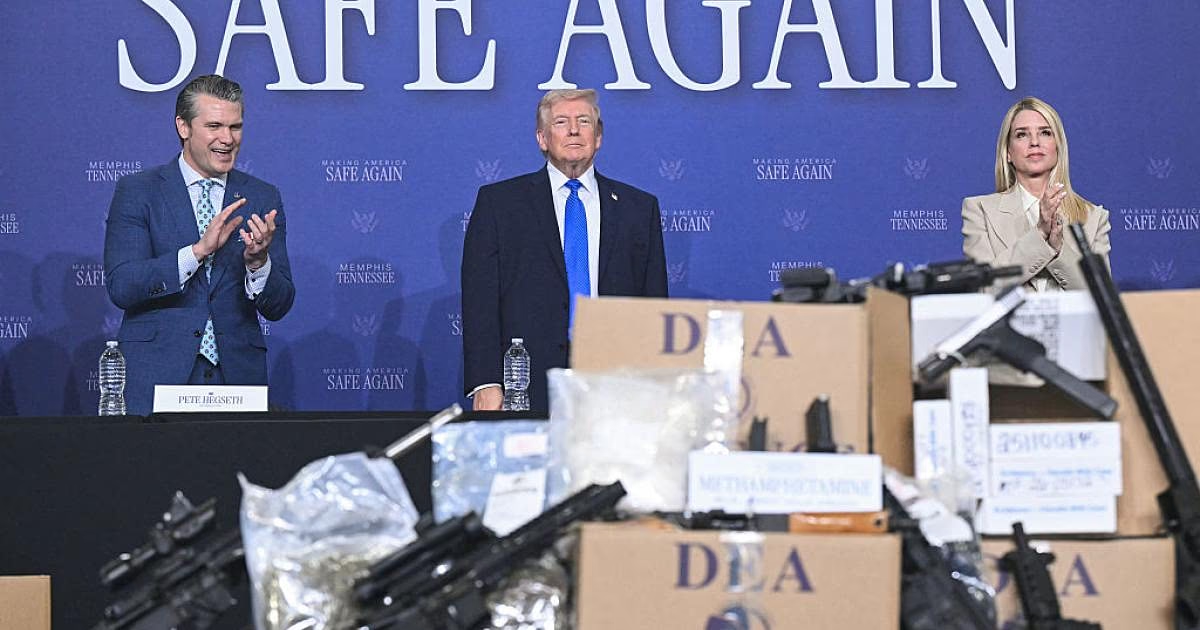
An extensive journalistic investigation, based on internal US government documents, has revealed the failure of military strikes carried out by President Donald Trump's administration to achieve their stated goals of reducing cocaine supplies. Assessments showed that operations targeting suspected boats at sea did not lead to any tangible change in drug prices or availability within US markets, putting the White House's official narrative to the test.
These findings starkly contradict repeated statements by President Trump, who on numerous occasions asserted that the military campaign had succeeded in paralyzing maritime trafficking by over 97%. However, Drug Enforcement Administration reports and classified Pentagon briefings to Congress painted a completely different picture of the field and logistical reality of organized crime networks.
According to the investigation, criminal organizations demonstrated high resilience in adapting to military pressures by developing alternative and complex strategies. These networks gradually abandoned the use of speedboats in international waters, instead opting for larger vessels sailing along coastlines to avoid direct detection and targeting by US forces.
Changes were not limited to maritime routes but also included an increased reliance on air transport via planes taking off from secret airstrips located on the Colombian-Venezuelan border. These flights typically head towards Guyana and Suriname, away from areas where US naval units are deployed, ensuring an uninterrupted flow of shipments in global supply chains.
Drug Enforcement Administration officials indicated that traffickers have extensively used commercial vessels recently as cover for their operations. Land trafficking across traditional borders also remained a primary route unaffected by maritime operations, and even saw a slight increase in frequency of use to compensate for any temporary disruptions that might occur in other routes.
Security analysts confirmed that military pressure on a specific trafficking corridor does not necessarily eliminate the trade but rather pushes it to seek new vulnerabilities. The investigation clarified that traffickers possess financial and logistical capabilities that allow them to change their tactics faster than traditional security agencies, which rely solely on hard power, can respond.
Regarding the economic indicators of drug trade, internal reports stated that cocaine prices in major US cities did not experience the expected increase that usually follows supply shortages. This price stability is strong evidence that the quantities of drugs reaching consumers have not been affected by ongoing military operations in the Caribbean and Pacific.
Furthermore, laboratory analyses of seized cocaine showed that its purity levels remain record-high. This means that traffickers are not forced to mix the product with other substances to compensate for shortages, confirming that their available stockpiles are sufficient to meet increasing demand without the need to ration distribution.
For its part, a Pentagon spokesperson defended the military operation, considering its success to be measured by its ability to disrupt criminal networks and dismantle their infrastructure. He argued that traffickers' resort to changing tactics is itself an acknowledgment of the effectiveness of the military pressure exerted on them, even if it does not immediately reflect on the volume of smuggled quantities.
In contrast, the White House spokesperson described questioning the utility of these efforts as 'ridiculous,' emphasizing that the administration has succeeded in deterring many from engaging in this deadly trade. She affirmed that the ultimate goal is to protect American society from 'poisons' flowing across borders, regardless of the logistical challenges posed by gangs.
On the humanitarian and legal front, the deaths of 221 people in these operations since September 2025 have drawn widespread criticism from human rights organizations and legal experts. Some considered these strikes to amount to 'extrajudicial executions,' especially since they occur in international waters without clear legal procedures or trials for suspects.
The investigation concluded that the military war on drugs, despite its high human and material cost, has not succeeded in breaking the supply chain. While the administration continues to promote numerical successes, the facts on the ground indicate that trafficking networks are still able to circumvent the world's most powerful armies to ensure their goods reach their final destination.
Trafficking networks always find and exploit weaknesses, and pressure on one route simply pushes them to expand into alternative routes.
شارك برأيك
Investigation Reveals Failure of Trump's Military Strikes to Curb Cocaine Flow to US