






Washington Message
Mamdani threatens to arrest Netanyahu in New York, and the International Criminal Court's warrant pursues the Israeli Prime Minister to the United Nations
Washington – Said Arikat – 19/7/2026
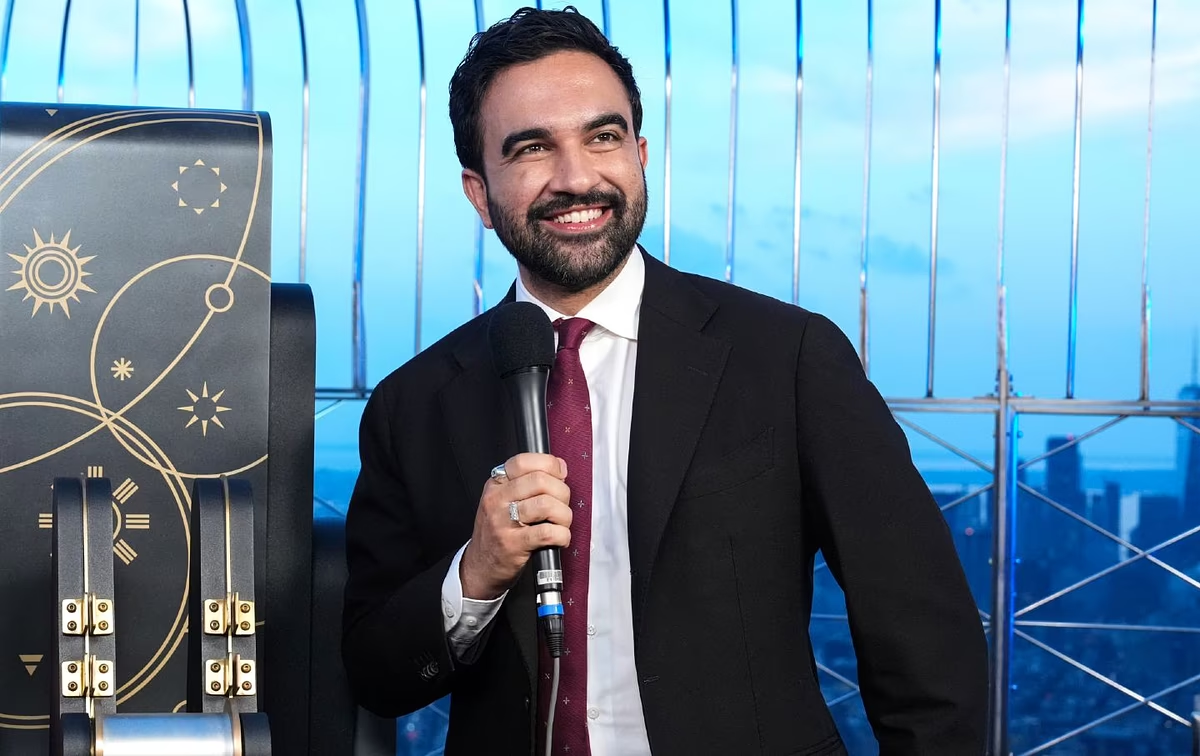
New York City Mayor, Zohran Mamdani, reopened the legal accountability file for Israeli Prime Minister Benjamin Netanyahu, after announcing that he is holding legal consultations with relevant departments in the city to discuss the possibility of arresting him if he visits New York to participate in the United Nations General Assembly meetings next September, in a move that reflects the escalating political and legal pressures on the Israeli leadership in the wake of the devastating war in the Gaza Strip.
Mamdani said, in an interview with the New York Times, that Netanyahu "belongs in The Hague," referring to the arrest warrant issued against him by the International Criminal Court on charges related to committing war crimes and crimes against humanity in Gaza. He added that what Israel has committed in recent years, especially since the outbreak of the recent war, has made the demand for Netanyahu's accountability a position adopted by an increasing number of politicians and human rights activists around the world.
The New York Mayor clarified that he is holding "active discussions" with the city's legal department to determine the limits of his legal powers, stressing that any step will be taken within the framework of the law, saying: "We will do everything allowed by law in New York City, but we will not invent new laws to achieve that."
This stance comes months after Mamdani pledged, during his election campaign, to seek Netanyahu's arrest if he visited the city, a promise that sparked widespread debate about the extent of local authorities' ability to execute a warrant issued by the International Criminal Court, given that the United States is not a party to the Rome Statute establishing the court.
In contrast, Netanyahu tried to downplay the importance of these statements, considering that Mamdani "hates America deep down," and accusing him of siding with Hamas, in a repetition of a political approach repeatedly adopted by the Israeli government, which links any criticism of Israeli policies or calls for accountability of Israeli officials to supporting terrorism or anti-Semitism, a discourse that critics believe aims to avoid discussing the essence of the accusations related to violations of international law.
Israeli Ambassador to the United Nations, Danny Danon, also confirmed that Netanyahu will attend the United Nations General Assembly meetings in New York as scheduled, and will address the international community to defend what he described as "Israel's inherent right to defend its citizens," denying that calls for his arrest would pose any obstacle to his visit.
From a legal perspective, international law experts believe that Netanyahu's presence inside the United Nations headquarters grants him legal protection related to diplomatic immunities and agreements regulating the work of the international organization. However, his status outside the building, while moving within New York City, raises complex legal questions about the extent to which the International Criminal Court's warrant can be executed, even if the United States is not a party to the Rome Statute.
Although the execution of any arrest attempt seems unlikely given the legal and political complexities, the mere raising of this possibility reflects the shift in the political debate within the United States, where the demand for accountability of Israeli officials is no longer exclusive to human rights circles, but has found resonance within local leaders and elected officials in the Democratic Party.
Mamdani is considered one of the most prominent Democratic voices supporting Palestinian rights, and he condemned the attacks of October 7, 2023, but he has made criticism of the Israeli war on Gaza a central theme in his political discourse, considering that defending the rights of Palestinians represents one of the most pressing moral issues of his era.
This comes at a time when the American political scene is witnessing a remarkable shift in attitudes towards Israel, after nearly half of the Democratic members of the House of Representatives voted in favor of a bill calling for a halt to military aid to Israel, indicating a decline in the traditional consensus within the party regarding unconditional support for the Hebrew state.
Mamdani's statements reveal that the arrest warrant issued by the International Criminal Court is no longer just a legal document, but has become a political burden that pursues Netanyahu wherever he goes. Even if it cannot be practically executed, it imposes a new reality in which the Israeli Prime Minister is forced to confront questions about his international legitimacy, instead of merely marketing the traditional Israeli narrative. With the widening circle of demands for accountability, Israel faces an unprecedented challenge in the erosion of the political immunity it enjoyed for decades in Western capitals.
Netanyahu's response, based on accusing his critics of anti-Israel sentiment or sympathy with Hamas, also reflects a worsening political crisis more than a legal response to the accusations. Since the beginning of the war on Gaza, the Israeli government has adopted a discourse that mixes criticism of military policies with anti-Semitism, in an attempt to silence voices calling for accountability. However, the increasing scale of destruction and human losses, and the growing international human rights reports, have made this discourse less capable of containing the escalating criticism within the United States and Europe, where the demand for accountability has gained wider acceptance.
Perhaps the political importance of Mamdani's case does not lie in the possibility of Netanyahu's arrest, which is practically a remote possibility, as much as it lies in the significance it carries within the American political community. A few years ago, merely discussing the accountability of a high-ranking Israeli official was considered a political taboo, but today it has become part of the public debate within the Democratic Party, in parallel with the escalation of voices rejecting continued unconditional military support for Israel. This shift indicates that the war on Gaza has not only created a humanitarian crisis, but has also created a deep rift in Israel's image within American public opinion.
شارك برأيك
Mamdani threatens to arrest Netanyahu in New York, and the International Criminal Court's warrant pursues the Israeli Prime Minister to the United Nations