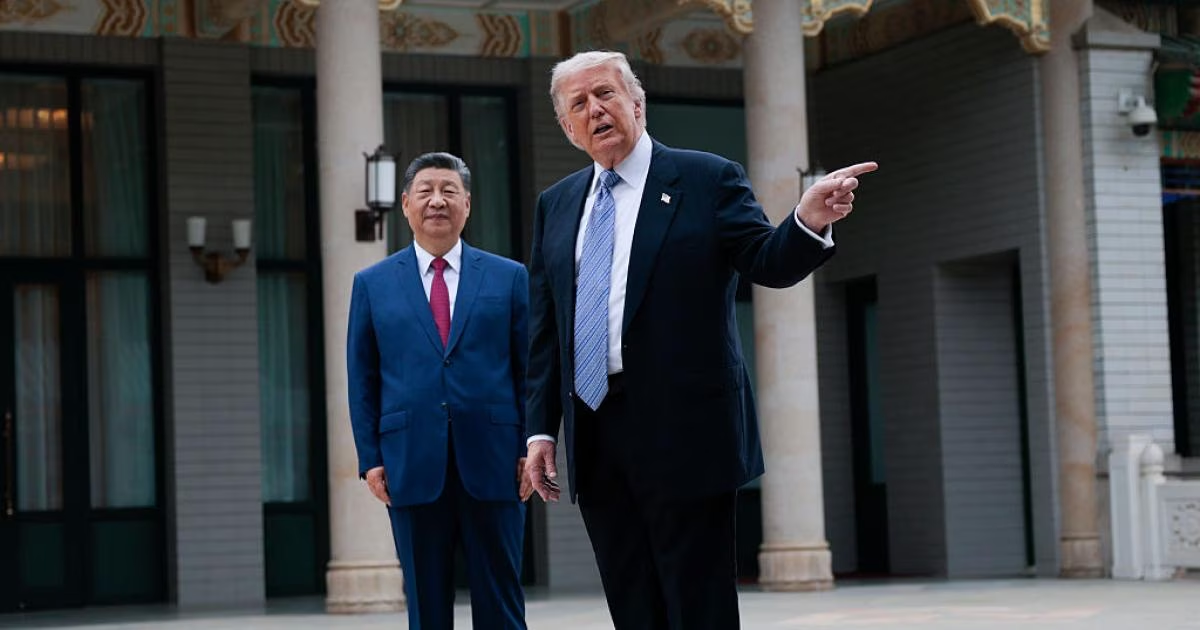







As the dust of battle begins to settle and the memorandum of understanding between Washington and Tehran is signed, international focus shifts to evaluating the outcomes of months of military escalation. Although the discussion centers on mutual concessions, a careful reading of the scene reveals a silent winner who did not fire a single bullet in this confrontation: China, which leveraged the crisis to solidify its position as a balanced international power.
Beijing, which condemned the American and Israeli attacks on Iranian territory from the very first moments, strongly denounced the assassinations of senior leaders in Tehran. Chinese diplomacy maintained an approach advocating negotiation, presenting itself as a responsible alternative that prefers dialogue over the uncalculated military adventures pursued by Washington.
Sources reported that Chinese Foreign Minister Wang Yi led intensive diplomatic efforts with the Iranian side throughout the conflict, and Beijing also supported regional mediation efforts. This role was clearly evident in the statements of Iranian Foreign Minister Abbas Araghchi, who publicly thanked China for its constructive contribution to advancing the negotiation process towards a ceasefire.
Analysts believe that China succeeded in highlighting the contradiction between its diplomatic moves and what it described as the reckless military campaign led by the United States and Israel. This narrative resonated widely in the Global South, which viewed the war with suspicion and apprehension about its repercussions on global stability and the international trade system.
The war was not merely a military conflict; it also exposed deep fissures within the Western allied front, as European governments showed clear hesitation to engage in the conflict. These public divisions over the legitimacy and economic costs of the war provided Beijing with strategic breathing room and weakened Washington's ability to lead a unified international coalition.
Chinese state media used the events of the war to reinforce the message that the United States is an unreliable and volatile partner in its political choices. International reports cited researchers stating that Washington's image was significantly damaged, as it now appears to many as a harsh power that imposes exorbitant costs on its allies without guaranteeing clear results.
In the background, Beijing used the failure of the American military decisive action in Iran to send veiled messages regarding the Taiwan issue. If Washington's overwhelming military power could not impose a quick outcome against a regional power, then this raises major questions about its ability to intervene in more complex conflicts in East Asia.
On the energy front, China faced a real test, as it imports half of its oil needs from the region, yet it demonstrated unexpected resilience. Thanks to its massive reserves and diversification of supply sources, Beijing was able to absorb the shock of navigation disruption in the Strait of Hormuz without experiencing collapses in its domestic economy.
China did not merely protect its energy security; it also practiced 'energy diplomacy' by increasing its exports of refined petroleum products to regional countries that were suffering from severe shortages. This move even included US allies such as the Philippines, which enhanced Beijing's influence as a reliable supplier in times of major crises.
The global oil price crisis gave a strong boost to China's strategy of transitioning towards clean energy and electric vehicles. As a global leader in this sector, Beijing presented itself as a power driving sustainable alternatives in a turbulent world, transforming an economic threat into a long-term investment and political opportunity.
Analytical sources indicated that the failure to achieve clear strategic objectives from the war weakened American deterrence globally. China is closely observing how US military interventions often leave behind long-term instability, and it uses this argument to convince its neighbors that relying on American protection may be a losing bet.
The Iranian experience proved to China that technological and military superiority does not necessarily mean the ability to impose political will. This conclusion reinforces Beijing's confidence in its approach based on soft power and close economic ties, as more effective tools than direct confrontations that drain resources and international reputation.
As the region enters a fragile peace, the United States appears to have exhausted a large part of its diplomatic and political capital in a war that did not achieve its ultimate goals. In contrast, China emerges with new leverage, benefiting from its role as an impartial mediator and an economic power capable of withstanding the most severe geopolitical shocks.
Ultimately, the final results of China's gains from the war on Iran may not appear immediately, but they have laid the foundation for a shift in the balance of power. Beijing is now more capable of presenting its vision for a multipolar world order, based on the failure of unilateral military approaches to achieve the desired stability in the Middle East.
Washington appears to many as harsh as China, but less predictable and less strategically efficient in managing international crises.
شارك برأيك
China reaps the fruits of the war on Iran: Strategic and diplomatic gains without a single bullet