






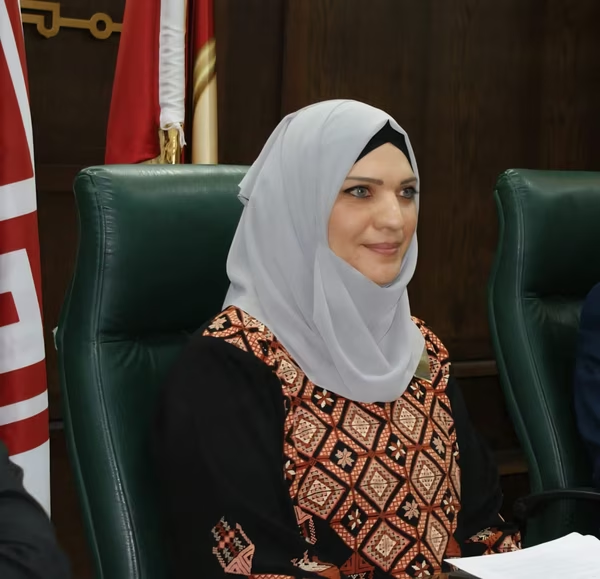

Amidst accelerating cultural transformations and the global intermingling of fashion styles, the Palestinian thobe stands out as a deeply rooted expression of identity and belonging, carrying a visual memory that documents the human connection to its land and history. This thobe is present as one of the most prominent features of Palestinian cultural distinctiveness, reflecting a rich diversity in its forms, ornaments, and connotations. The importance of preserving it in its authentic form emerges as part of protecting cultural meaning and safeguarding identity in a rapidly changing global context.
The Palestinian thobe is an integrated visual system, with each region having its own distinct language. The dense embroidery of Hebron with its deep colors reflects the steadfastness of the place, while the Bethlehem thobe appears with the precision of its ornaments and its artistic richness, and in the Gaza thobe, the simplicity and fluidity of lines stand out. The map of Palestine is embodied on the fabric through these details that express a deep cultural and geographical diversity, making any ill-considered change a direct affront to the Palestinian visual identity.
The world's openness to new design patterns has led to attempts to reintroduce the Palestinian thobe in contemporary forms. Some of these attempts achieved a conscious balance between authenticity and renewal, by preserving embroidery patterns and their connotations, while introducing thoughtful modifications to cuts or fabrics to suit modern life. These models confirm that modernity can be an extension of heritage when managed with awareness and respect.
In contrast, practices that strip the thobe of its content are increasing through the introduction of random ornaments or changing the locations of embroidery, which deprives it of its connotations, or presenting it as a commercial product separate from its cultural context. These practices affect the essence of the thobe and weaken its presence as a symbol of identity. Any tampering with the structure of the Palestinian thobe is not development, but a direct distortion of a visual memory that has endured through time.
Preserving the Palestinian thobe requires conscious management of development processes. Introducing new materials or additional colors remains possible within limits that preserve the original spirit of the embroidery, its location, and its connotations. Every stitch carries meaning, and every pattern belongs to a context, and any change outside this framework causes the thobe to lose the language it speaks.
Leading Palestinian experiences have emerged that presented the thobe in modern forms without compromising its essential elements. Palestinian designers have been able to bring this attire to international platforms, while preserving its authenticity as a cultural product that carries a message. These experiences confirm that the strength of the thobe lies in its commitment to its roots, and that its global presence increases the more it is true to its identity.
The Palestinian's connection to their thobe goes beyond the aesthetic dimension to a deep emotional relationship. On national and social occasions, the thobe transforms into a silent declaration of identity and an affirmation of presence and continuity. When a Palestinian woman wears her thobe, she carries a history of steadfastness, and expresses a deeply rooted belonging connected to the land and memory.
Amidst attempts to erase identity, preserving the thobe takes on a cultural dimension that reflects adherence to distinctiveness and enhances cultural presence. Supporting this heritage through documentation, education, and empowering craftswomen forms a basis for its continuity as a living part of culture, not just an element preserved in memory.
On an international level, the Palestinian thobe is one of the most prominent symbols of cultural identity, which necessitates its presentation in its accurate and authentic form. Any distortion in its features reflects on the image of identity itself, and weakens its presence as a coherent cultural symbol. Commitment to its authenticity represents a cultural responsibility that goes beyond taste to a stance.
In conclusion, the Palestinian thobe is a living identity that renews itself without losing its essence. The challenge lies in achieving a conscious balance between development and preserving authenticity, in a way that maintains the symbolism of this attire as one of the most important expressions of Palestinian identity. In the age of globalization, a clear identity remains a source of strength, and the Palestinian thobe remains a witness to a people who preserve their history in its details, and wear it with confidence and awareness.
شارك برأيك
The Palestinian Dress ( Thobe..) An Identity That Cannot Be Distorted in the Age of Globalization