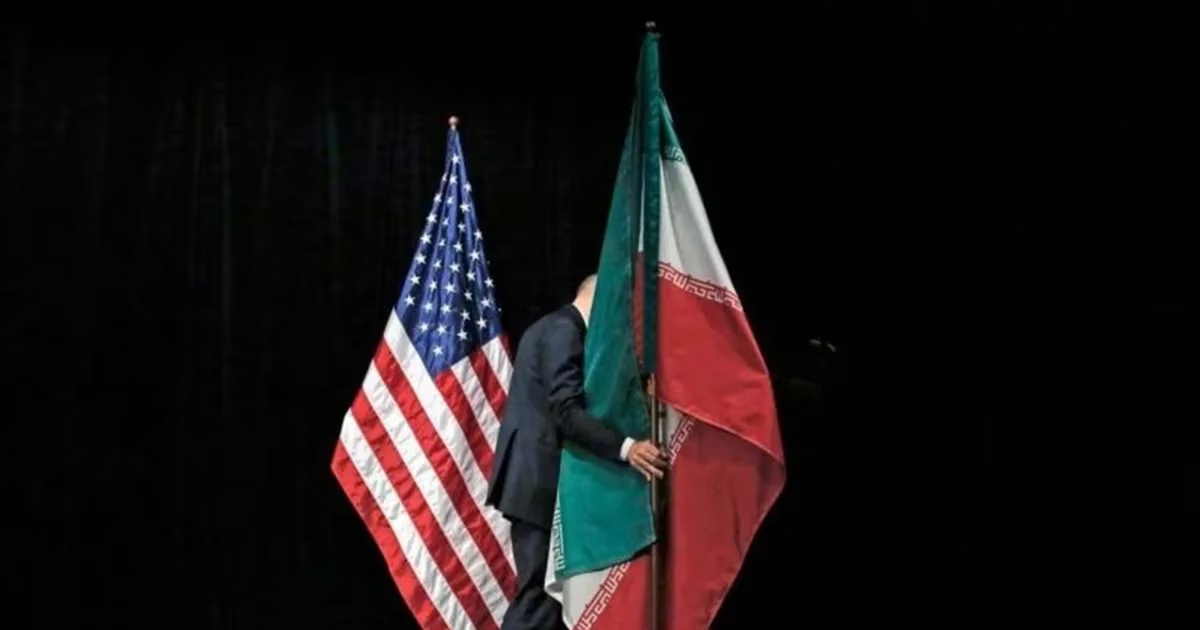







Israeli writer and analyst Zvi Bar'el said that Iran agreed to enter into negotiations with the United States under the weight of military threat, but the gap between the two sides remains wide, amid ambiguity surrounding the form and structure of the talks expected to begin tomorrow in the Sultanate of Oman. Bar'el explained in an article published by the Israeli newspaper "Haaretz" that it is not yet clear who will participate in these talks, nor the issues that will be on their agenda, or the duration of their holding.
Last Friday, it seemed that an initial agreement had been reached on holding the meeting in Istanbul, where Iranian Foreign Minister Abbas Araghchi visited Turkey and met with his Turkish counterpart Hakan Fidan and President Recep Tayyip Erdoğan. Sources reported that the agreement included Erdoğan's sponsorship of a multilateral meeting, including representatives from the United States and Iran, as well as representatives from Saudi Arabia, Qatar, Pakistan, Egypt, and the United Arab Emirates. However, Iran later requested to move the meeting location from Istanbul to Muscat, without providing any official explanation.
A Turkish commentator working for an opposition media outlet in Ankara told Haaretz: "Turkey was surprised by the decision, and even disappointed," adding that the meeting was supposed to be an important diplomatic showcase for Erdoğan, who has been working since the beginning of the crisis with Iran to advance the negotiation process between Washington and Tehran. The commentator believed that the Iranian retreat stemmed from Tehran's fear that it would be forced, within a multilateral platform, to discuss issues it considers outside the scope of negotiation, such as reducing the number of ballistic missiles and cutting ties with its allies.
Nevertheless, the analysis indicated that Iran did not need to change the meeting venue to define the framework of the negotiations, suggesting that it sought to present the current meeting as a continuation of the five rounds it held with the United States in April and May 2025, rather than as new negotiations with a broad agenda. Despite this, the meeting venue and the composition of the delegations have not been definitively settled, at a time when Washington expressed its readiness to hold the meeting in Oman, while press sources reported that the United States still insists on holding it in Turkey.
If an agreement is reached and talks are held in Muscat, the writer expects the meeting to focus on two main issues: reducing the threshold of the American military threat, and limiting negotiations to the nuclear file only, which are two basic conditions set by Tehran for agreeing to dialogue. Iranian leaders affirmed in this context: "We will not negotiate under threat," stressing that the ballistic missile file is not open for discussion at all.
Upon his arrival in Oman to participate in negotiations with the United States in May, Araghchi stated that Iran seeks to present the current meeting as an extension of the previous five rounds. In contrast, the gap between Washington's and Tehran's positions appears wide, especially after US Secretary of State Marco Rubio stated that negotiations should also include the missile issue and Iran's relations with its allies and regional organizations.
Despite this, the writer indicates that Tehran, despite its rhetoric, actually agrees to negotiate under a significant military threat, and that its desire to lift sanctions forces it to discuss other issues demanded by the United States. The writer believes that narrowing this gap may pass through an agreement on a mechanism for managing negotiations within a "step-by-step" framework, proposed by Turkish Foreign Minister Hakan Fidan, and accepted by Saudi Arabia, Qatar, and Egypt, and perhaps Iran as well.
This framework stipulates clear time stages that oblige Iran to implement agreed-upon measures, including handing over its 60% enriched uranium stockpile to a third country immediately upon reaching a specific stage. Russia has already offered to host this uranium shipment, while sources reported that Ankara may make a similar offer. The writer added that in the second stage, Iran will be asked to allow the return of all IAEA inspectors, and in the third stage, the remaining nuclear enrichment facilities will be destroyed.
In return, Iran will demand a gradual and agreed-upon lifting of US sanctions, in addition to the cancellation of international sanctions imposed on it under the "snapback" clause stipulated in the 2015 nuclear agreement. Before all that, the Iranians will demand the removal of the American threat of attack, amid fears that such a framework agreement would give the Iranian regime room for maneuver and weaken the impact of military pressure that initially made negotiations possible.
Amid the divergence between the fear of a "bad deal" that serves Iran, and the belief that an all-out war is the only way to achieve tangible results, Bar'el expects Arab countries and Turkey to play a pivotal role. In this context, Erdoğan visited Saudi Arabia two days ago and met with Crown Prince Mohammed bin Salman, before heading to Egypt the next day and holding lengthy talks with President Abdel Fattah el-Sisi.
Although these meetings were officially presented within the framework of strategic cooperation, their essence revolved around the potential war against Iran and ways to avoid it and the expected regional repercussions. The analysis noted that these countries were appreciated by US President Donald Trump, who listened to their positions, but they have not yet succeeded in convincing Iran to accept even part of Washington's conditions.
At the same time, Tehran realized that its recent attempts to improve its relations with Saudi Arabia and the UAE and strengthen its relations with Egypt did not constitute a sufficient protective umbrella, and that its strategic partners, China and Russia, did not stand firm in the test of defending it. The writer affirmed that the United States and Iran are conducting an unequal bilateral dialogue, in which the survival of the Iranian regime is threatened in the face of American regional interests, without certainty about which side will back down first.
Iran actually agrees to negotiate under a significant military threat, and its desire to lift sanctions forces it to discuss issues demanded by the United States.
شارك برأيك
Israeli Analyst: Iran Negotiates with Washington Under Threat, Wide Gap Precedes Oman Meeting