ARAB AND WORLD

Sat 27 Dec 2025 10:28 am - Jerusalem Time

Gaza between the Fragile Ceasefire and the Manufacture of 'Non-Peace': A New Reality or a Permanent Impasse?

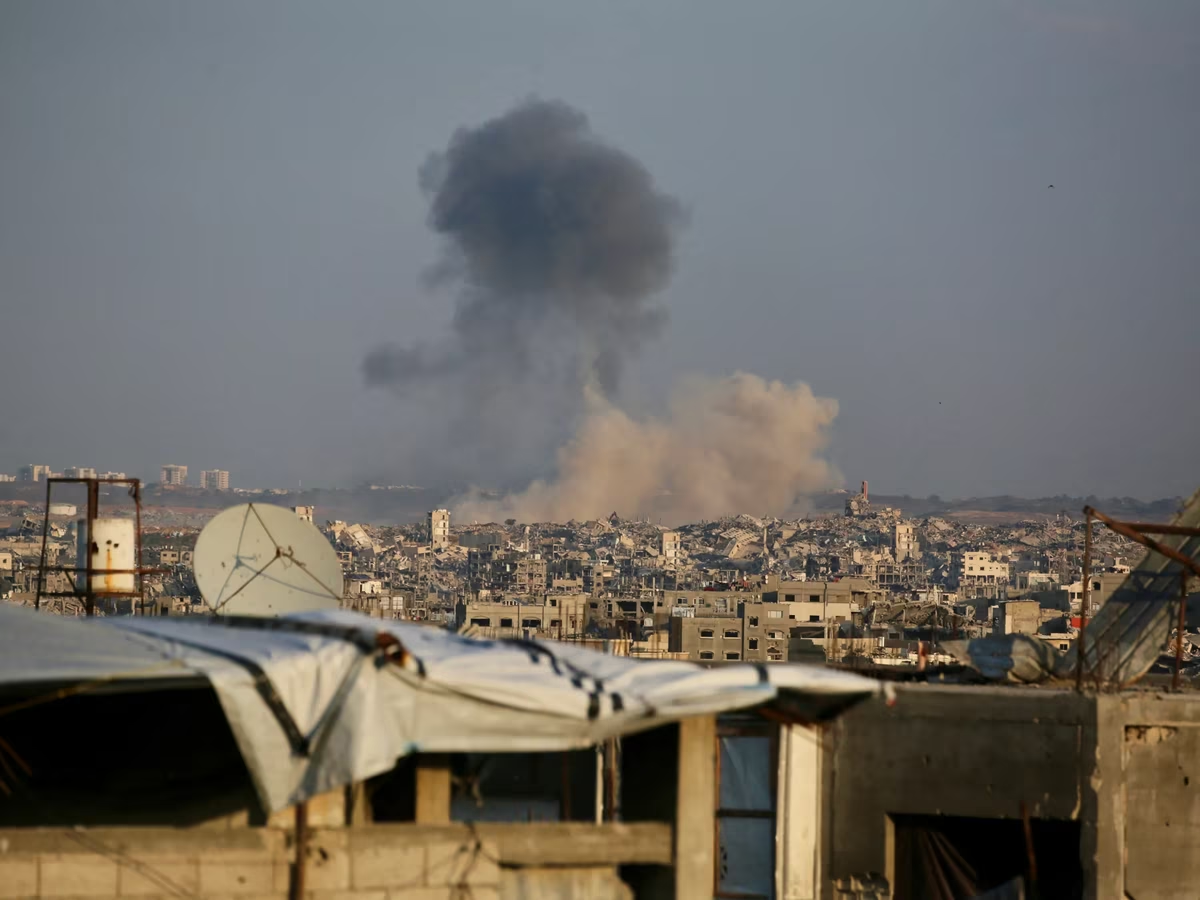
Gaza has entered a phase that can be described as the 'new normal (realistic) situation,' a characterization that carries no positive dimension as much as it reflects the transition of the conflict from a comprehensive war to a low-intensity but persistent dispute. Despite the cessation of widespread fighting and the partial entry of humanitarian aid since the ceasefire came into effect on October 10, the overall scene does not suggest a genuine path toward peace or reconstruction, but rather toward cementing a state of non-war and non-peace, according to Daniel Byman, a professor at Georgetown University and director of the Program on War, Unconventional Threats, and Terrorism at the Center for Strategic and International Studies, in a lengthy article in 'Foreign Affairs' magazine.

Formally, according to Byman, the ceasefire appears as an achievement: the release of nearly two thousand Palestinian prisoners, the return of all living Israeli captives and most of the bodies of the deceased, the opening of several crossings, and the commitment to admit 600 trucks daily. The Israeli occupation army has also redeployed to what is known as the 'yellow line,' effectively controlling more than half of the sector's area. However, these steps, despite their humanitarian importance, have not translated into a clear political path, but have been accompanied by the continuation of limited clashes and casualties from both sides, mostly Palestinian civilians (400 people according to the Gaza Health Ministry).

The core problem is that the ceasefire was not an entry point for a political solution, but a mechanism for managing the conflict. Relations between Israel and Hamas are now managed according to the logic of mutual containment: limited strikes, messages of strength, and preventing a major explosion without addressing the structural causes of the conflict. In this context, the American plan with its twenty points seems ambitious in theory, but practically frozen, especially in the aspects of disarming Hamas and building an alternative authority in Gaza.

For its part, the United States is trying to play the role of coordinator more than being a pressuring party. Visits by senior American officials and the establishment of a military-civil coordination center are symbolic steps reflecting a desire to maintain the ceasefire, but they do not rise to the level of the political and security investment required to bring about a real transformation. The American administration avoids direct involvement in reconstruction or imposing coercive security arrangements, which opens the door to a long-term political and security vacuum.

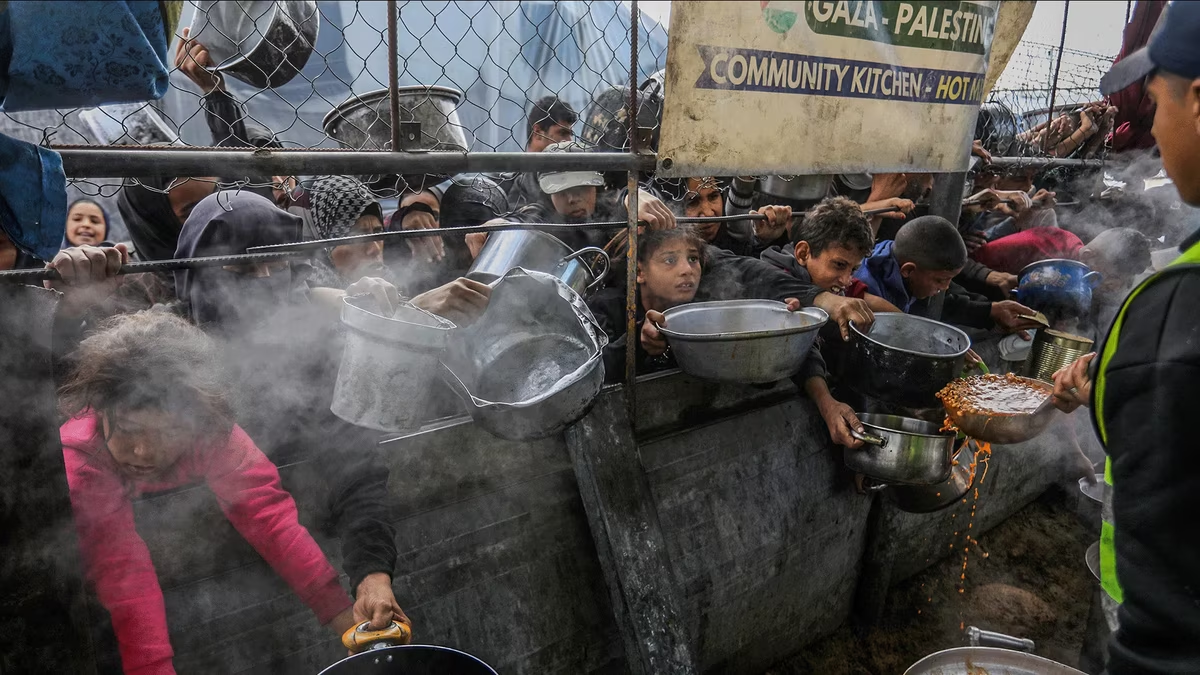
On the ground, Byman points to the continuation of the humanitarian tragedy. About 90 percent of Gaza's population remains displaced, and more than 1.5 million people need emergency shelter. Despite Israeli promises, the average entry of aid has not exceeded 120 trucks per day, according to UN reports, while rains and cold have increased the severity of suffering. This harsh humanitarian reality does not produce sufficient political pressure, but is managed as a chronic crisis that can be contained.

The researcher also affirms that one of the most complex issues is the idea of establishing an international force for stabilization. Israel sees it as necessary to prevent Hamas's return, but conditions its right of veto on its formation. The United States promotes the idea but refuses to participate in it, while Arab and Islamic countries hesitate, fearing it will turn into a tool to suppress Palestinians on behalf of Israel without a clear political horizon for a Palestinian state. As for obtaining UN authorization, it clashes with the Russian-Chinese political veto in the framework of international power struggles.

Byman says: 'Disarming Hamas seems the most realistic file on paper and impossible in implementation. The movement, ideologically and practically, sees the weapon as the source of its legitimacy and survival. Past experiences confirm that Hamas will not voluntarily relinquish its military power, as it is the only guarantor of its internal control and protection from its rivals. Moreover, its behavior after the ceasefire, including targeting influential families opposed to it, aims to re-establish its prestige and send a clear message that it is still the effective authority in Gaza.'

Moreover, reconstructing Gaza does not seem any closer. The estimated cost of about 70 billion dollars, and the American condition that Arab countries bear the financial burden, are met with clear lukewarm response. Investing in a region witnessing intermittent violence and open to sudden escalation is not an attractive option for any donor party.

As for the question 'Who governs Gaza?' it remains unanswered. The talk of a technocratic government or a 'reformed' Palestinian authority hides the reality of the absence of any viable alternative between two bitter choices: the continuation of Hamas rule or the return of direct Israeli military occupation. Any political entity that does not enjoy the acceptance of both sides will be incapable of governing or providing security, which reproduces the cycle of violence.

Israel, for its part, does not want a new comprehensive war, but is not ready to accept Hamas as a permanent neighbor. Internal pressures, declining military gains, and international costs are all factors pushing toward controlling the conflict rather than resolving it. The expected result is periodic Israeli strikes to prevent Hamas's power from growing, without seeking to overthrow it completely.

Hamas, in turn, does not want a comprehensive war, but sees limited violence as a necessary tool to control the interior and prove existence. With any real attempt to undermine its political or military influence, it is likely to resort to escalation, even if the price is additional destruction for Gaza, because that enhances its narrative as a 'resistance movement' facing Israel and 'collaborating authorities.'

Byman warns that over time, with the decline of international interest, the 'yellow line' may turn into semi-permanent borders, and Gaza becomes a forgotten space managed by crises rather than solutions. Without continuous American pressure and long-term political investment, which does not align with the pattern of foreign policy under the Trump administration, what awaits Gaza is not peace, but the sustainability of the conflict with less noisy and more cruel tools.

The ceasefire experience in Gaza reveals how the international community has shifted from seeking to resolve the dispute to managing its repercussions. Instead of addressing the roots of the conflict—occupation, blockade, and the absence of a political horizon—the focus is on temporary security arrangements and conditional humanitarian aid. This approach does not end the violence, but reproduces it periodically, keeping Palestinians captive to a fragile reality where life is measured by its ability to endure rather than evolve.

The paradox is that all parties declare their rejection of the current situation, but practically contribute to its consolidation. Israel prefers containment over risk, Hamas prefers survival over change, and the United States prefers formal achievement over long-term commitment. In the shadow of this negative convergence, Gaza becomes a laboratory for the failure of international policy, where peace is replaced by crisis management, and justice by temporary equations of power.
ARAB AND WORLD

Sat 27 Dec 2025 9:59 am - Jerusalem Time

Progress in Security Talks Between Syria and the Israeli Occupation

Israeli media outlets, citing a Syrian source close to President Ahmed al-Shar'a, revealed significant progress in the undeclared talks between Syria and the Israeli occupation regarding reaching a security agreement, suggesting that it may be signed in the coming period.

The past few weeks have witnessed an important breakthrough in the negotiation process, amid talk of the possibility of holding a high-level Syrian-Israeli meeting in one of the European countries, which may witness the official signing of the agreement.

The Syrian source indicated that this progress is primarily due to "the great efforts exerted by US President Donald Trump," noting that the anticipated agreement may include a diplomatic annex alongside security arrangements, and it is not ruled out that it will be signed in a direct meeting between Syrian President Ahmed al-Shar'a and Israeli Prime Minister Benjamin Netanyahu.

In the same context, Syrian Foreign Minister Asaad al-Shibani had announced last month that Damascus expects to reach a security agreement with Tel Aviv before the end of the year, based on the 1974 Disengagement Agreement, with "minor modifications," and without creating new buffer zones.

In contrast, the Israeli occupation still rejects Damascus's demand for the withdrawal of the Israeli army from all points it controlled within Syrian territory after the fall of the deposed Bashar al-Assad's regime.

Sources in Israel report that the Israeli army may withdraw from some of the nine points it currently controls, but this is conditional only on signing a full peace agreement with Syria, not just a security agreement.

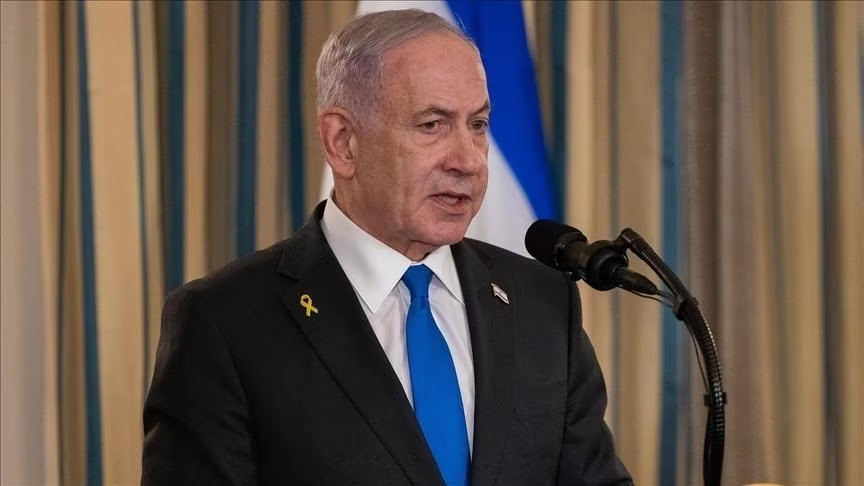
Coinciding with these leaks, Israeli Prime Minister Benjamin Netanyahu escalated his rhetoric towards Syrian President Ahmed al-Shar'a, considering that the latter "has begun taking steps that Tel Aviv will not accept." The Israeli Broadcasting Corporation reported that Netanyahu strongly attacked al-Shar'a during a meeting of the Narrow Security Cabinet (Cabinet), upon his return from a visit described as "historic" to the White House.

The Corporation quoted Netanyahu as saying: "The Golanite returned inflated from Washington and started doing everything we will not accept," referring to the nom de guerre by which al-Shar'a was previously known, adding that the Syrian president "is seeking to bring Russian forces to the Syrian-Israeli border."

The Corporation indicated that al-Shar'a had told US President Donald Trump, during his visit to Washington about a week and a half ago, that Israel violated the 1974 Disengagement Agreement after the fall of the previous regime, expanded its military presence inside Syrian territory, expelled UN forces, and carried out more than a thousand attacks, including sensitive sites such as the presidential palace and the Ministry of Defense.

The Syrian president clarified that his country refrained from military response to those violations, in order to focus on rebuilding the state in the post-fall of the previous regime.

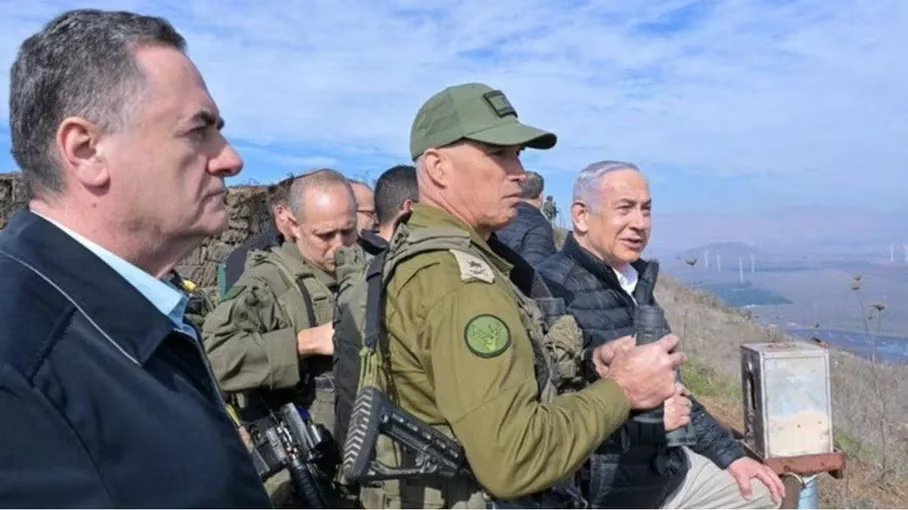
In the same context, the Corporation mentioned that Netanyahu and his Defense Minister Yisrael Katz conducted a field tour inside Syrian territory, a step that provoked widespread criticism.

Despite the Syrian government's assurances that it poses no threat to the occupation, the Israeli army continues its repeated incursions into Syrian territory, alongside launching air raids that resulted in civilian casualties and the destruction of military sites, vehicles, and weapons belonging to the Syrian army.

Syrian residents in the border areas also complain about the repeated Israeli aggressions on their agricultural lands, which are their only source of livelihood, in addition to the destruction of hundreds of dunams of forests, the arrest of civilians, the establishment of military checkpoints, and the imposition of searches on passersby.

PALESTINE

Sat 27 Dec 2025 9:39 am - Jerusalem Time

Qabatiya under fire for the second day.. The occupation imposes a curfew in Jenin

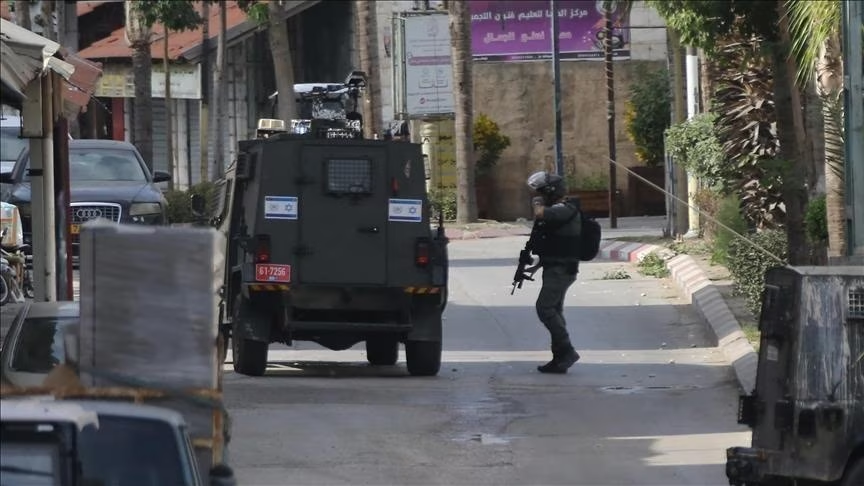
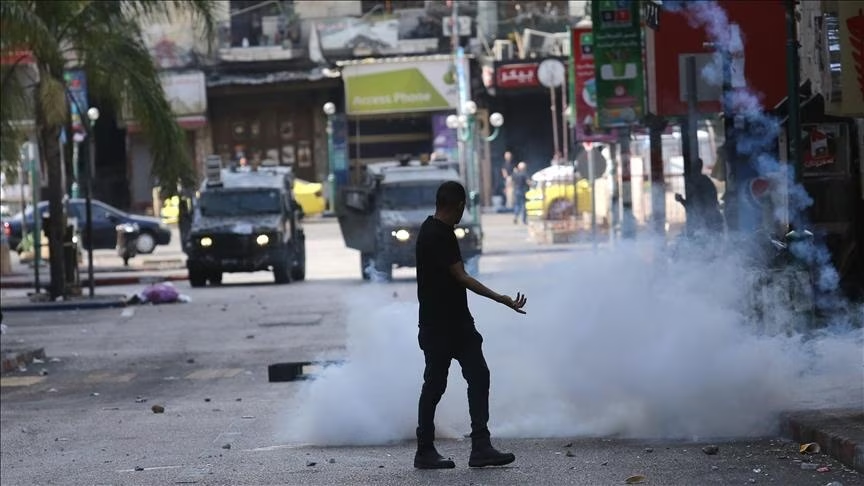
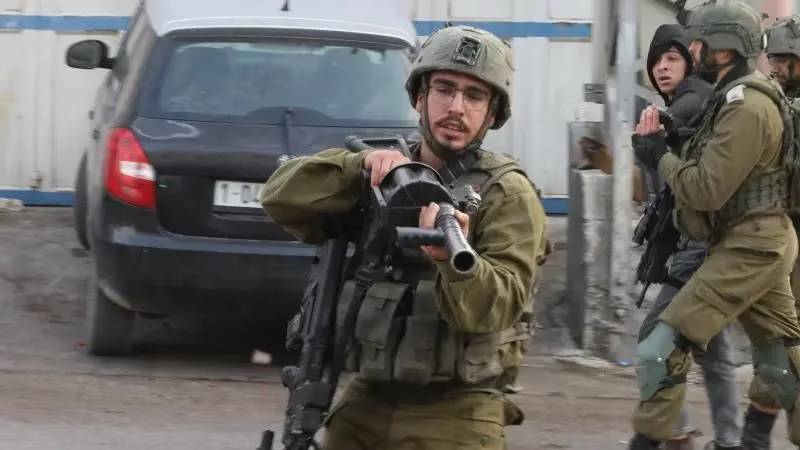
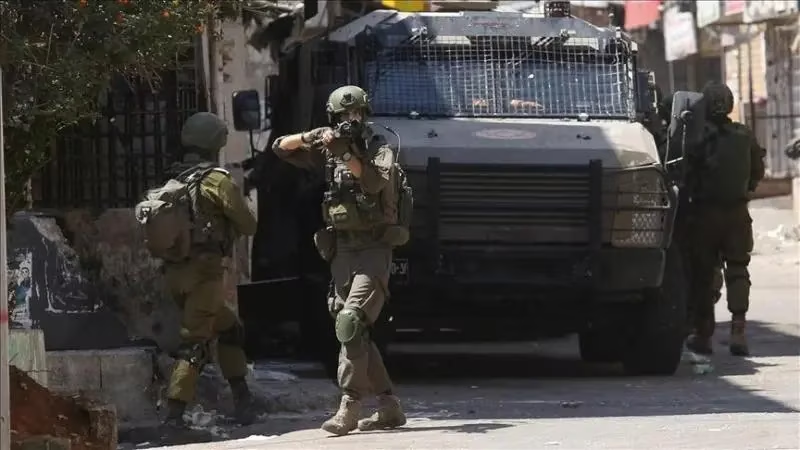
The occupation army continued, on Saturday, its military escalation in the town of Qabatiya south of the city of Jenin in the northern West Bank, for the second consecutive day, amid widespread deployment of forces and imposition of strict measures that affected the residents and infrastructure.

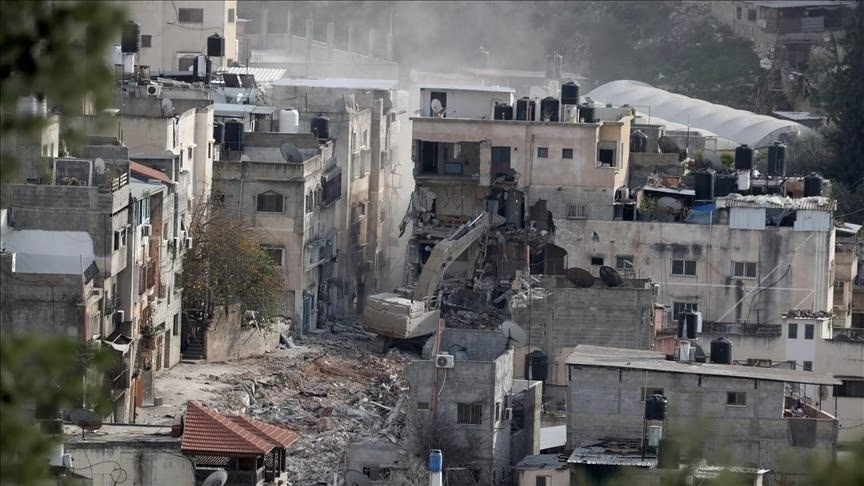
Palestinian sources reported that occupation forces pushed additional military reinforcements into the town since early morning hours, including vehicles and bulldozers, which spread out in several neighborhoods, while closing main entrances and streets with earthen barriers, leading to near-total paralysis in the movement of citizens.

Occupation forces continue to impose a strict curfew, coinciding with the storming of dozens of homes, tampering with their contents, in addition to carrying out extensive bulldozing and destruction operations that affected streets and infrastructure networks.

In a related context, occupation forces arrested a number of citizens during the raids, including Ahmed Hassan Nazal, Yasser Khuzaymiyya, and the father of the martyr Marouh and the prisoner Mahmoud, after raiding his home in the town.

Occupation forces had arrested, on Friday, the citizen Yunus Abu al-Rab after storming his home in Qabatiya, and took him to an unknown destination, while his family underwent field investigations.

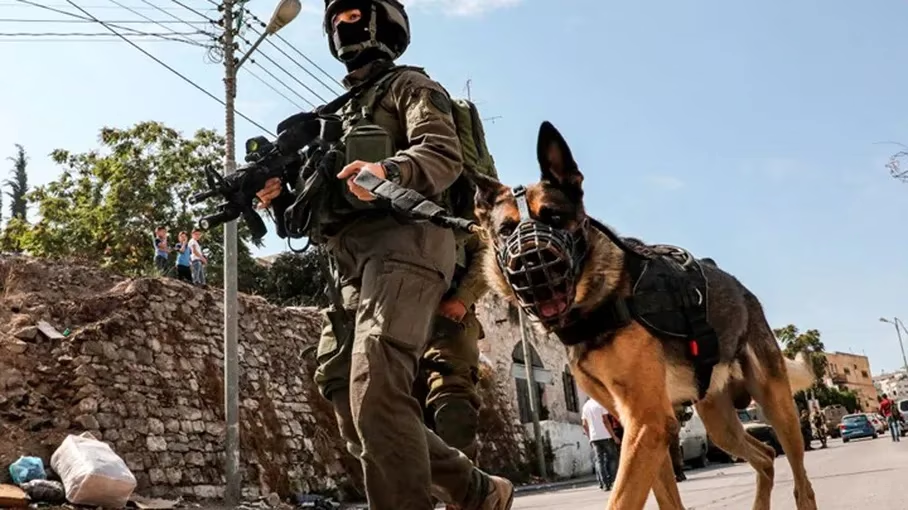
This escalation comes after the town was stormed on Friday with a large military force consisting of about 50 vehicles and several bulldozers, accompanied by the deployment of special forces and snipers on rooftops of homes and buildings, alongside intensive reconnaissance aircraft flights, which created a state of tension and alert among the locals.

The occupation army announced, in a statement issued on Friday, the start of a military operation in Qabatiya claiming to 'thwart terrorist acts,' according to its claim.

This aggression is considered an extension of the collective punishment policy pursued by the occupation against Palestinian towns in the West Bank, which manifests in repeated incursions, arrest operations, and destruction of public and private property.

PALESTINE

Sat 27 Dec 2025 6:27 am - Jerusalem Time

Israel is losing the war of perceptions and ideas

Israel launched Operation "Wrath of God" to assassinate a group of Palestinian leaders in a retaliatory move after the Munich Olympics operation in 1972, but the assassination list was not primarily directed at the military and political officials responsible for the Munich operation; instead, it focused on leaders with media, cultural, and diplomatic roles. The assassination of figures like Bassel al-Kubaisi, a prominent Iraqi academic, and the Algerian Muhammad Boudia, who had extensive connections with global resistance movements, and even in the Beirut operation, two of those targeted in the assassination led by Ehud Barak were engaged in media and cultural affairs in the Palestinian revolution.

Reflecting on the map of Israeli assassinations, which extended into the space of many countries around the world, leads to questioning an early Israeli plan to strike any bright and modern image of Palestinians, confining them within the image of the extremist terrorist representing a society inferior in civilization to Europeans and Americans, translating the saying of a land without a people.

In Madrid in 1991, the world was surprised by the appearance of an elderly doctor and political and social activist heading the Palestinian negotiating delegation, and it seems that the charisma of Dr. Haider Abdel Shafi was more than Israel could bear or allow, for Palestinians should not have their version of De Gaulle or Mandela, and what is happening is embarrassing, especially since the quiet presence of Abdel Shafi was bringing out the demagogic charisma of a stubborn person with a broad history of violence and cruelty, like Israel's Prime Minister at the time, Yitzhak Shamir.

Palestinians were not allowed to have a special face from the beginning, as the Nakba occurred while colonial ideas about the backwardness of the East, and sometimes its savagery, still lived in Western societies, and the images of the Nakba and exile were distant, not showing Palestinian faces, thus withdrawing part of their human credit, and stifling the idea of sympathy in its cradle.

In contrast, with the rise of Nazism, thousands of Jewish professionals and academics emigrated to American universities, and in an intellectually flattened environment somewhat under the direct influence of pragmatism, and without the historical depth of society in America, the emigrants from the Jewish intelligentsia turned into stars drawing a large part of their brilliance from investing in the victimization of anti-Semitism, engaging in a rising issue at the time related to minorities and identity anxiety, entering first into intellectual leftist circles and politically Democrats, integrating that with the media and extensive dominance over cultural production. The Arab media in its stumbling and faltering beginnings offered only what complicates the situation and deepens the negative image of the Arab, compared to the positive one enjoyed by the Jew, so the mobilization and incitement discourse launched by Egyptian President Gamal Abdel Nasser, which was directed for local consumption, was utilized in the opposite direction, casting an image of a gang with an unrealistic tendency on the Arabs.

This extends to the Palestinians, although Abdel Nasser himself adopted a rational discourse when speaking calmly with foreign journalists, but the sifting process takes place within the broader and calmer cultural and media manufacturing system in the West, so that sympathy with Israel, as a human and moral remorse for the scandal represented by anti-Semitism, became a fad that Western intellectuals and influencers rush to adopt and affirm, as if it were one of the necessities of the civilized person.

The poet Mahmoud Darwish noted in his way this unfair situation, but no effective action was taken institutionally, and Palestinians remained among the absent, or specifically presented in the space of misunderstanding, and with the entry of Islamic extremism, the image became loaded with more fears among Westerners, so Palestinians are forbidden from presenting their fair share of the available narrative to the world, then the war on Gaza came to represent a fundamental reversal in the war of perceptions that was woven to besiege Palestinians, for the issue is no longer Palestinian in the polarizing sense of the conflict, but it has taken a global dimension, and from American and European universities, campaigns of advocacy for Palestine were launched by youth raised in the West, resembling Westerners in their behaviors and actions, and the value structures they carry, and that was embarrassing and an entry to raising the big and unspoken questions among American politicians, especially among Republicans, who began to rally around the slogan "America First."

This different tone that rose in the last two years attracted the attention of the right-wing activist Charlie Kirk, whose last weeks of life will remain in the category of puzzles for a long time, and may join other American puzzles like the assassination of Kennedy and the disappearance of Oscar Zeta Acosta, the activist for the rights of Americans of Latin origin.

Kirk remained close to university circles in his political activity, and stopped at the moral burden that Israel constitutes on his country, and with his political sense, he adopted the slogans carried by hundreds of thousands of students in American universities, and although he did not take clear or heroic positions, or even minimally human ones, until a clash was forming with Benjamin Netanyahu and the lobby that supports him in Washington, New York, and Los Angeles, the influential cities, but not all of the American pulse, especially among Republicans concentrated in states with white majorities, large sectors of which began to see the ugly face of Israel, which is shedding the makeup that carries the ashes of the Holocaust.

The major transformation is carried by one of the influencers in Republican circles, Tucker Carlson, who confronted with great patience and nervousness the accusation of anti-Semitism, which remained the last bullet in the Zionist lobby's arsenal, in the face of questions expanding on the populist scale among Republicans, and in recent days, Carlson contacted Trump, to start a broad internal battle before the midterm elections next year, which Republicans can lose a lot of their ground in, due to the tension and chaos left by Trump in foreign policy, and the Israeli file is at the forefront of the hot friction points in the Republican camp.

Trump, bound by family and business relations with the American Zionist elite, will not do much expected, in the face of escalating pressures in Washington and influential cities, but that does not extend to those preparing for succession, especially his deputy JD Vance, who spoke in an unusual way for first-tier American leaders, in his recent visit to Israel, and it is expected that he will take advanced positions if he can overcome the caution and awe he lives with to avoid any mistakes that hinder his political career, and Carlson himself realizes that, and declares that he will not become a burden on Vance in the upcoming electoral battle.

Netanyahu with his brazen face that seeks to win everything, and to exploit a major humanitarian catastrophe for his benefit, and his survival and protection of his corruption, will harm Israel in the long term, but it seems that the bulldozing process that occurred with the rise of settlers and extremists in Israel has damaged the position that Israel stole in the war of perceptions and ideas, in contrast, a new generation of youth is emerging to gain positions that Palestinians and their supporters were not expected to have, a generation consisting of Palestinian, Arab, and Muslim students and activists, including Zahran Mamdani, and although governed by the major American equations, it can enter a new struggle on an open ground after decades of monopolizing perceptions and ideas for the Israeli narrative almost exclusively.

ANALYSIS

Sat 27 Dec 2025 6:23 am - Jerusalem Time

Christian Zionism: A Theological Contradiction and Historical Paradox

The notion of 'Christian Zionism' appears to be a strange theological paradox. Christian theology, as established by Paul in the first century AD, was based on transitioning Christianity from a Jewish reform movement to a universal religion, by opening it to non-Jews (Gentiles), focusing on Jesus' crucifixion and resurrection as the path to salvation—which the Noble Quran later denied—and on concepts of grace, faith, and the New Covenant. This transformation constituted a radical break and decisive transcendence of Judaism.

In contrast, the rabbinic Jewish current, which crystallized after Jesus' death, remained steadfast in rejecting the messianic nature of the latter, rejecting the idea of the 'New Covenant,' affirming the supremacy of Torah law over faith, and opposing the reconciliation attempt made by Paul and others between law and faith.

From this perspective, Christianity in its essence represents a negation, transcendence, and interpretive and theological break with Talmudic Judaism and with any subsequent utilization of Hebrew texts in modern ideological projects, chief among them Zionism. Therefore, any talk of 'Christian Zionism' entails not only a deep philosophical and theological contradiction but also reveals a glaring historical paradox.

But what is this 'Christian Zionism' that many believe in, especially in America? It is, in essence, a theological belief based on faith in the second coming of Christ on the land of Israel. Among the fundamental principles of Christian Zionism is the assertion that the establishment of the modern state of Israel and the return of Jews to what is called the 'Promised Land' constitute a direct fulfillment of biblical prophecies, and that this reality will prepare the theological stage for the second return of the Lord Christ.

Based on that, supporting Israel becomes a religious duty viewed as a divine commitment. However, the essence of this support is not linked to Israel in itself, as much as it is linked to its symbolic role as a prerequisite for Christ's return in an eschatological vision. Therefore, this support remains steadfast and unconditional, regardless of the genocidal crimes or systematic discriminatory policies committed by Israel against Palestinians.

The Catholic and Orthodox churches reject 'Christian Zionism' from a theological perspective, albeit to varying degrees. The Catholic Church does not officially classify it as heresy, but it explicitly rejects it because it is based on a theology of 'two covenants' instead of the single covenant fulfilled in Christ, peace be upon him, and because it links biblical prophecies to modern political entities. The Catholic Church affirms, based on its fundamental doctrinal documents, especially the decrees of the Second Vatican Council (1962–1965), that there are no sacred political entities, but rather Christ is the perfection and fullness of the covenant, and the Church is the community of the New Covenant, not a substitute state or a sacred geographical entity.

As for the Orthodox churches, they view Christian Zionism largely as a grave theological error, which may sometimes rise to the level of heresy, because (Orthodoxy) rejects the literal reading of prophecies and rejects any return to the concept of 'election' that is ethnic or geographical after Christ, that is, after the fulfillment of his message with its universal and comprehensive dimension, as understood by traditional Christian theology.

Christian Zionism in the United States is considered a widespread religious-political current, especially within evangelical Protestant circles. This current is based on the belief that the establishment of the state of Israel falls within a 'divine plan' that requires strengthening Israel's power in preparation for Christ's return. According to this eschatological perspective, ethical and political considerations are marginalized; for settlement, nor the apartheid system in the West Bank, nor the ongoing genocide in Gaza, are considered issues of significant moral weight, because Palestinian suffering is reduced to secondary details in the face of the 'greater plan,' that is, ensuring Israel's strength and security as a prerequisite for Christ's return.

Of course, many in Israel are aware of these theological backgrounds that essentially transcend mere 'Israel's security.' According to this conception, Israel itself becomes a transitional entity that loses its importance after the realization of Christ's return. Nevertheless, a pragmatic alliance exists between the two sides, as the settler right supports this current and exploits it politically because it serves its expansionist and racist goals on the ground.

In conclusion, 'Christian Zionism' is not considered an expression of Christian faith as much as it reveals a dangerous eschatological deviation, in which the spiritual message is reduced to a political function, and the sacred is reproduced as a tool to justify power, violence, and killing. When the logic of salvation is replaced by the logic of geography, and the ethical universality is replaced by awaiting a temporal end conditioned by oppression and displacement, theology transforms from a horizon of liberation to a device for human annihilation.

The most dangerous aspect of this current is not only its theological contradiction, but its ability to disable the moral conscience in the name of prophecy, and to legitimize genocide in the name of salvation. At this point, silence is no longer a neutral position, but becomes complicity; and debate is no longer merely a doctrinal disagreement, but a moral test for humanity itself: either a faith that saves humanity, or a theology that justifies killing and extermination.

PALESTINE

Sat 27 Dec 2025 5:37 am - Jerusalem Time

The Israeli Army Launches Raids and Artillery Bombardment East of Gaza

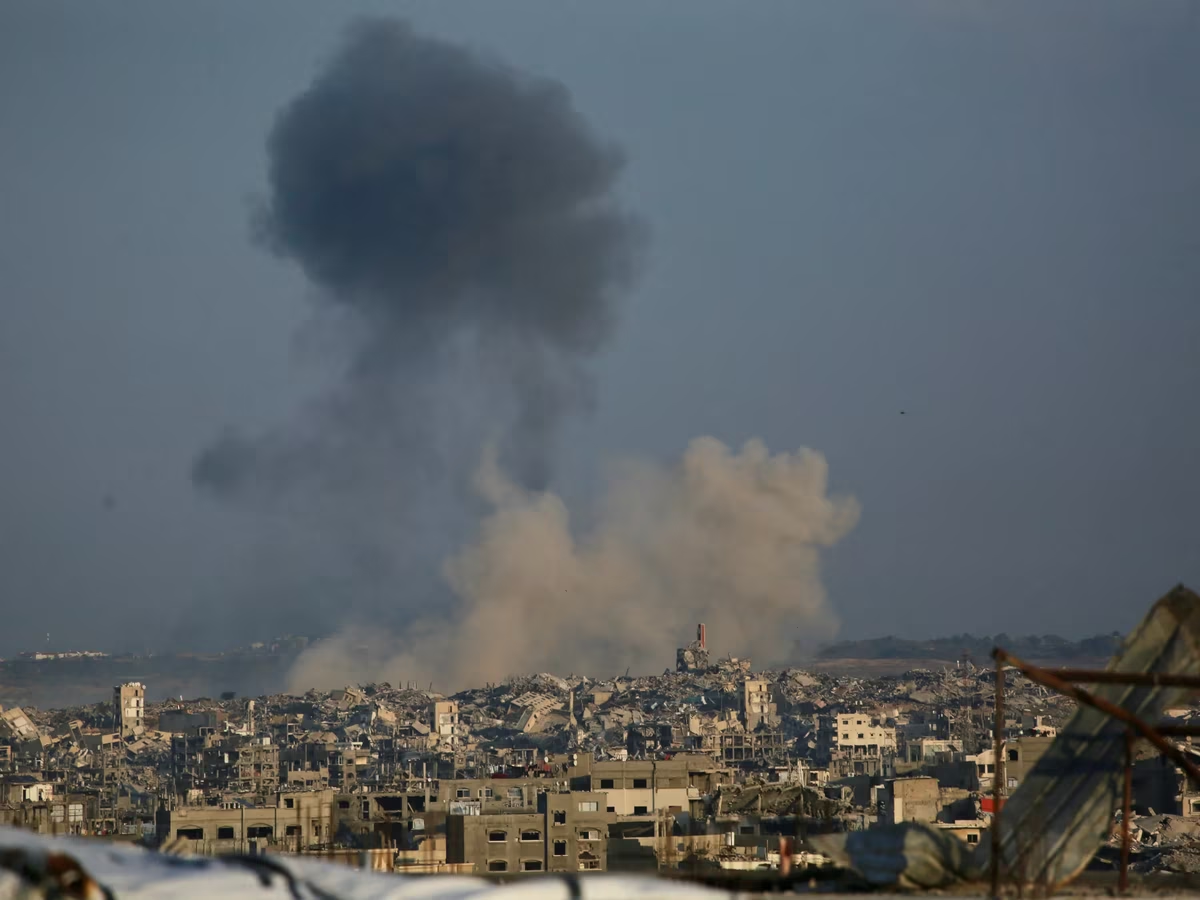
On Friday evening, the Israeli army launched airstrikes and artillery bombardment on various areas east of Gaza City, within the areas it still controls under the ceasefire agreement.

This comes as part of the ongoing Israeli violations of the agreement that entered into force on October 10, 2025.

Eyewitnesses said that the Israeli army carried out two consecutive airstrikes east of the Zaytoun neighborhood east of Gaza City, while Israeli artillery shelled various areas of the Sanafur junction in the Tuffah neighborhood east of Gaza City.

These violations came hours after a Palestinian was martyred by occupation gunfire in the Jabalia camp north of the Gaza Strip, within the areas from which Israel withdrew under the agreement.

This also came in the wake of Egypt accusing Israeli Prime Minister Benjamin Netanyahu of seeking to obstruct the implementation of the second phase of the agreement and attempting to ignite the region.

The second phase of the agreement includes several essential files, most notably reconstruction, expanding the Israeli withdrawal, forming a technocratic committee to manage the sector, disarming Hamas, in addition to forming a peace council and establishing international forces.

Israel is shirking its commitments stipulated in the first phase of the agreement, most notably stopping hostile actions, as it continues to fire and bomb in scattered areas of the sector, resulting since October 11 until Wednesday in the killing of 406 Palestinians and injuring 1,118 others.

The agreement ended a war of genocide launched by Israel on October 10, 2023 with American support and lasted two years, leaving about 71,000 Palestinian martyrs and more than 171,000 injured, and massive destruction affecting 90% of the infrastructure with a reconstruction cost estimated by the United Nations at around 70 billion dollars.

PALESTINE

Sat 27 Dec 2025 5:30 am - Jerusalem Time

Israeli helicopters open fire from their machine guns in Qabatiya and bulldozers close internal roads

Israeli helicopters opened fire from their machine guns in open areas inside the town of Qabatiya south of Jenin on Friday evening, while occupation bulldozers began closing internal roads in the town.

This came after the Israeli army announced the start of a military operation in Qabatiya by forces from the paratroopers, Duvdevan unit, Shin Bet, and prison service to thwart what it called terrorism, following the killing of two Israelis in the operation that took place near the city of Beit She'an northeast of Israel.

The Israeli army stated in a statement that its forces raided the home of the perpetrator of the operation and are preparing to demolish it, and that they continue to comb additional sites in the area to arrest wanted individuals and seize combat means.

For its part, a Hebrew newspaper reported that a force from the Israeli army raided the home of the family of the perpetrator of the operation, whom it identified as Ahmed Abu al-Rub (37 years old), and arrested his father, Yunis Abu al-Rub.

A military source said that the army and Shin Bet are interrogating members of the family of the perpetrator of the Beit She'an operation after raiding their home in Qabatiya.

Local sources reported that about 44 military vehicles and several bulldozers raided Qabatiya while imposing a curfew on it, and soldiers spread out in its streets, while snipers climbed the roofs of several buildings.

The sources indicated that the Israeli forces closed main roads leading to the town.

Israeli National Security Minister Itamar Ben-Gvir said that the operation carried out by what he described as the "killer" from the north of the West Bank shows once again the urgent need to pass a law imposing the death penalty on perpetrators.

Ben-Gvir added that "anyone who goes out to carry out an anti-Semitic terrorist operation with the aim of killing should know that Israel will not allow him to continue living and will send him to hell."

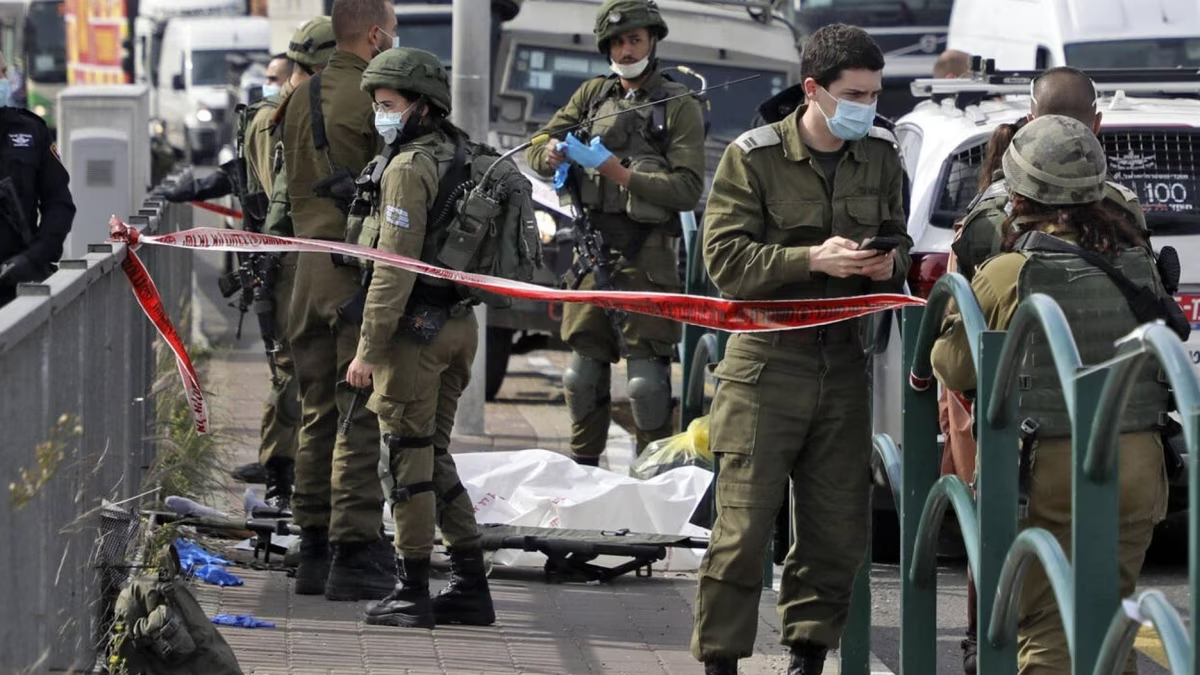
The Israeli ambulance service announced the death of two people and the injury of two others in a combined ramming and stabbing operation in Beit She'an and Afula.

The Israeli police said that the operation occurred at 3 sites, and that its perpetrator is injured and was transferred to the hospital.

The Israeli army radio quoted a security source as saying that the perpetrator of the Beit She'an operation infiltrated from the security fence area in the Jerusalem area, and that he was banned from entering Israel, and was imprisoned 10 years ago for participating in confrontations with army forces.

International humanitarian law explicitly prohibits collective punishment measures against civilians for crimes they did not commit, including Article 33 of the Fourth Geneva Convention, which stipulates the prohibition of collective penalties and considers them war crimes.

The Israeli army has been continuing a large-scale military operation in the north of the West Bank since January 21, 2025, which it began in Jenin camp and then expanded to Nur Shams and Tulkarm camps.

Since then, the Israeli army has imposed a strict siege on the three camps, and continues to destroy the infrastructure and homes and shops of citizens, leading to the displacement of about 50,000 Palestinians, according to official data.

ARAB AND WORLD

Sat 27 Dec 2025 4:23 am - Jerusalem Time

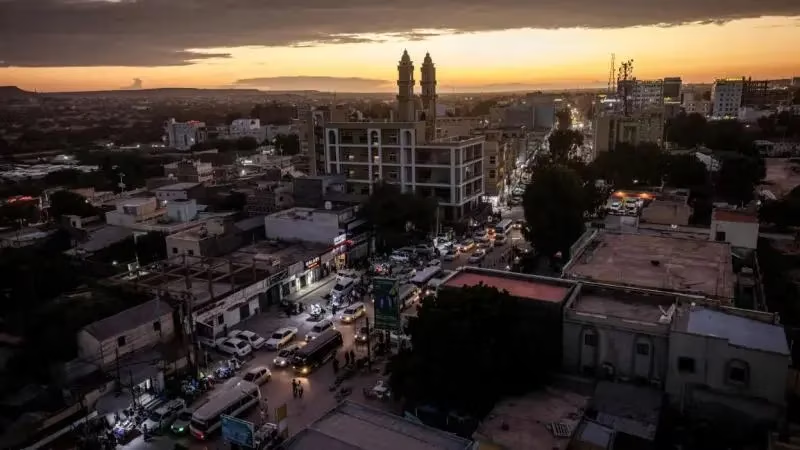
Trump: Not Ready to Recognize 'Somaliland'... and the Somali Government Rejects Israeli Recognition

US President Donald Trump announced that he is not ready to recognize the independence of "Somaliland" at this time, unlike Israel, which became the first country in the world to recognize "Somaliland as an independent and sovereign state" yesterday Friday.

This comes as the Somali government, on Friday evening, confirmed its "categorical" rejection of Israel's declaration recognizing the independence of "Somaliland," emphasizing that Somalia is "one country," and the Israeli recognition is considered "null and void."

Trump told an American newspaper that he "will not rush to follow in the footsteps of Israeli Prime Minister Benjamin Netanyahu in recognizing the independence of Somaliland, noting that the matter requires more research and study."

Trump wondered: "Does anyone really know what Somaliland is?"

Yesterday Friday, Netanyahu recognized the independence of "Somaliland," pledging to President of Somaliland Abdurahman Mohamed Abdullahi to convey a message on this matter to Trump during their scheduled meeting next Monday in Florida.

Netanyahu said during a video call with Somaliland President Abdurahman Mohamed Abdullahi: "I will convey to President Trump your readiness and desire to join the Abraham Accords."

However, Trump confirmed that he is not influenced by this proposal, indicating that his talks with Netanyahu will focus on the Gaza sector.

The US President did not show enthusiasm for the offer of "Somaliland" to host an American military port near the entrance to the Red Sea, saying dismissively: "Not a big deal. Everything is under study. I study many things and always make great decisions, and their results are correct."

For its part, the office of Somali Prime Minister Hamza Abdi Barre stated in a statement that "the Federal Republic of Somalia renews its absolute and non-negotiable commitment to its sovereignty, national unity, and territorial integrity," describing Israel's recognition of the independence of "Somaliland" as "a deliberate attack on Somalia's sovereignty and an illegal step."

The statement affirmed that "the Somaliland region is an integral part of the sovereign territories of the Federal Republic of Somalia, and it is not permissible to separate or dispose of it," adding that the federal government confirms that Somalia is "one sovereign state that cannot be divided, and any recognition that seeks to undermine this reality is null and void."

The government warned that "such unlawful actions (Israel's recognition) seriously undermine regional peace and stability, and exacerbate political and security tensions in the Horn of Africa, the Red Sea, the Gulf of Aden, the Middle East, and the entire region."

It emphasized that such actions "contradict the collective responsibilities of states in combating terrorism, including Al-Shabaab and ISIS, and threaten to create favorable conditions for terrorist groups to exploit political instability and undermine efforts made to achieve peace and security."

The government affirmed its determination to "take all necessary diplomatic, political, and legal measures, in accordance with international law, to defend its sovereignty, unity, and internationally recognized borders."

It also called on the Republic of Somalia "all countries and international partners to respect international law, adhere to the principles of non-interference and regional integrity, and act responsibly for the sake of peace, stability, and security in the Horn of Africa."

Since declaring its secession from Somalia in 1991, the "Somaliland" region, which does not enjoy official recognition, has acted as an administratively, politically, and security-wise independent entity, with the central government unable to extend its control over the region, or its leadership to achieve independence.

The Somali government refuses to recognize the Somaliland region as an independent state, considers it an integral part of the territories of the Federal Republic of Somalia, and views any deal or direct dealings with it as an assault on the country's sovereignty and unity.

PALESTINE

Sat 27 Dec 2025 3:19 am - Jerusalem Time

Gaza Agreement File Returns to the Forefront of International Decision-Making Again

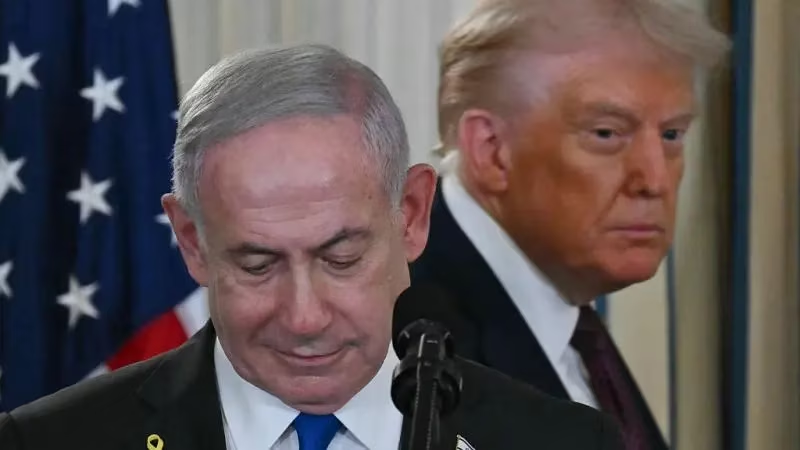
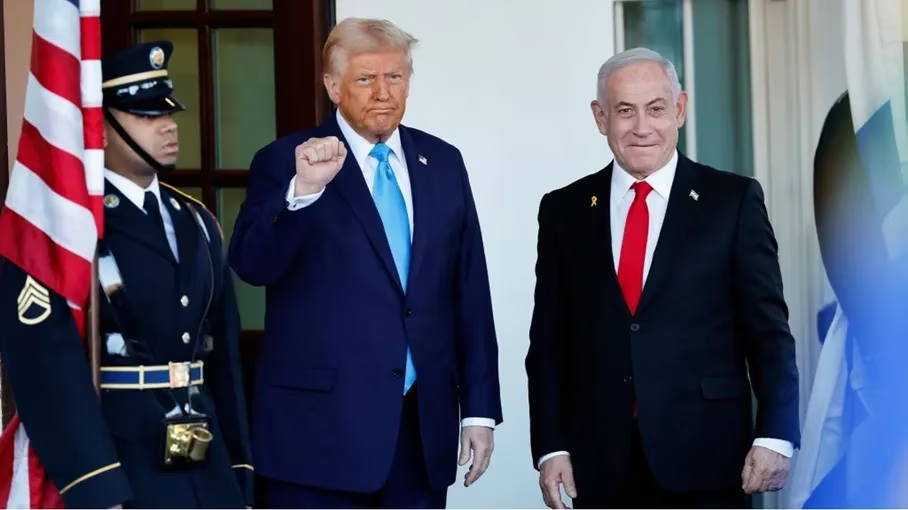
In a moment of extreme political and security sensitivity, the Gaza file returns to the forefront of international decision-making with the approach of a meeting described as 'decisive' between Israeli Prime Minister Benjamin Netanyahu and US President Donald Trump, amid divergences in positions between Washington and Tel Aviv regarding the future of the ceasefire agreement and the transition to its second phase.

Between American pressures to consolidate the calm and launch a political path that includes a technocratic government, an international force, and gradual disarmament, and Israeli insistence on stringent security conditions and using escalation as a pressure card, the Gaza Strip stands before two contradictory fates: either consolidating a fragile political path or sliding again towards confrontation, awaiting what the decisions in Florida will yield.

The United States appears, according to what has leaked from positions within the White House, more eager than Israel to push the agreement forward. There is a clear sense of frustration among Trump's team with the performance of the Israeli government, as reported by Israeli Channel 12 from White House officials.

The channel also quoted these officials as saying that the American administration believes Netanyahu is placing political and security obstacles that prevent moving to the next stage, whether through statements rejecting withdrawal from the Gaza Strip or through the field behavior of the Israeli army, which is viewed Americanly as threatening the ceasefire.

In contrast, Netanyahu seeks to readjust the agreement's path to serve his internal and security priorities, benefiting from Trump's sensitivity towards Israeli security issues. While primarily betting on convincing the American president to adopt his tough stance on disarming 'Hamas' and rejecting any loose formulations.

However, this bet collides with the reality of a clear gap between Netanyahu on one hand and Trump's key advisors Jared Kushner and Steve Witkoff on the other. According to the Israeli channel, what Washington is proposing today goes beyond mere ceasefire to a comprehensive vision that includes establishing a peace council chaired by Trump and forming a Palestinian technocratic government to manage civil administration in Gaza, in addition to deploying an international stabilization force.

This vision enjoys Egyptian, Qatari, and Turkish support, but faces deep Israeli reservations, especially regarding the Turkish role and the mechanism for dealing with weapons, and even towards the idea of a Palestinian government relatively independent of direct Israeli control.

Since the American administration realizes that the success of any political path in Gaza depends on providing a minimum of humanitarian and security stability, the pressures that will be exerted on Netanyahu in the Florida meeting will include a clear commitment to ceasefire, protecting civilians, and facilitating the entry of aid, according to what Israeli media report from officials in Trump's administration.

Therefore, the future of the Gaza agreement will not be decided only in the field, which remains susceptible to daily Israeli violations, but at the political table in Washington. And the meeting in Florida may outline the general framework for the next phase: either a gradual political path fraught with challenges, or a return to the repeated cycle of Israeli aggression, with all its repercussions on Gaza and the region as a whole.

ARAB AND WORLD

Sat 27 Dec 2025 1:50 am - Jerusalem Time

Israeli Discussions on Issues of Netanyahu-Trump Summit: Gaza, Lebanon, Syria, Iran, and Turkey

In recent days, Israeli discussions have intensified regarding the issues that Prime Minister Benjamin Netanyahu will discuss with US President Donald Trump, particularly Gaza, Lebanon, Syria, Iran, and Turkey, which will be the focus of the summit, amid Israeli calls for Netanyahu to distinguish between areas where flexibility can be shown to the American administration and issues that he must not touch, especially those related to Israel's vital security interests.

Major General Giora Eiland, former head of the National Security Council, noted that 'these five main issues: Gaza, Lebanon, Syria, Iran, and Turkey, have a gap, even tension, between the American and Israeli positions. This does not necessarily mean that this summit will lead to a crisis; on the contrary, Netanyahu will act correctly if he shows flexibility in at least two issues, or even if he knows how to reach an agreement on the other issues as well. Nevertheless, it is important not to compromise on the important principles of the occupation.'

He added in an article published on the Walla website that 'the first issue under discussion at the Trump-Netanyahu summit is Lebanon, coinciding with the imminent holding of the summit with the recent escalation of voices threatening war on Lebanon from the Israeli side, whether from the right-wing government leadership or from military security sources. Supporters of renewing the war against Hezbollah base this on the lesson learned from Hamas's attack on October 7, which is the necessity for Israel to prevent organizations like Hezbollah and Hamas from strengthening their power.'

Eiland explained that 'according to the Israeli position, since the party seeks to rebuild its strength, and the Lebanese government is unable to completely disarm it, renewing the war is the optimal option. As for the American position, it is the opposite; it sees that combining political and economic pressure on the Lebanese government and weakening the party after the war will ultimately lead to neutralizing it as a threatening military force. In this regard, it is correct to accept the American position and not consider it a concession, because Israel's interest also lies in avoiding another unnecessary war in this region.'

The former general affirmed that 'the second issue under discussion is Syria, where the American administration tends to support the new Syrian president, who recently visited Washington and was given an opportunity to consolidate his rule and control over most of the country. The United States shows interest in Damascus and Tel Aviv reaching a security agreement under which the latter withdraws from most of the Syrian territories it controlled about a year ago.'

He pointed out that 'Israel's security need to retain large areas inside Syria is minimal, given that the official border line is ideal from a military perspective, as it allows it to have full control over Syria. Unlike Lebanon, there are no hostile Syrian villages near the border, and the permanent presence of Israeli forces inside Syria will inevitably lead to escalating tension with the local population, and incidents of gunfire have already occurred, resulting in injuries to soldiers.'

He added that 'the third issue that the summit will discuss is Gaza, and here Israel's interests must not be touched, unlike Syria and Lebanon. The occupation cannot accept all the American administration's demands regarding the Gaza issue, which seeks to move to the second phase of Trump's ambitious plan for Gaza's future, consisting of three parts: first, disarming Hamas and its ability to govern; second, rebuilding Gaza according to a massive plan costing $112 billion; and third, withdrawing military forces from most of the territories it controls inside Gaza.'

Eiland continued that 'the problem with this plan lies in the sequence of operations; the Americans are interested in starting the reconstruction of Gaza, while at the same time, Egypt, Qatar, and Turkey, the mediating countries, demand the withdrawal of the Israeli army. Meanwhile, Israel's supreme interest is to oppose these two demands before Hamas disarms itself. In this issue, Netanyahu must not retreat or make any concessions, because surrender means losing most of the gains of the war in Gaza.'

He clarified that 'the fourth issue is the Iranian threat; the United States, like Israel, is determined to prevent Iran from obtaining nuclear weapons, and there is no disagreement between them on this issue. However, it is not as concerned about Iran's efforts to produce a large number of ballistic missiles and their launchers. These missiles, each carrying a warhead weighing half a ton and characterized by high accuracy, caused significant damage to Israel in the war that took place six months ago.'

He added that 'Iran is seeking to build a capability far superior to what it had in the previous war, and from Israel's perspective, this represents an existential threat that must be prevented from materializing. Here, Netanyahu will have to make a great effort to convince Trump and his team of the validity of this matter.'

Eiland concluded by saying that 'the fifth issue under discussion at the Trump-Netanyahu summit is the Turkish threat, and it seems that the biggest gap between Tel Aviv and Washington relates to Turkey's behavior and ambitions. Trump admires strong leaders with expansionist tendencies and views President Recep Tayyip Erdogan in this light, as he believes his declared promises to seek stability in the Middle East in general and Gaza in particular.'

He claimed that 'it is important for Netanyahu to know how to demonstrate the threat that Turkey poses not only to the occupation, but also to Cyprus and Greece. It will be important to emphasize to Trump that regarding the future of Hamas, Turkey will certainly act against American interests, specifically dismantling the movement.'

PALESTINE

Fri 26 Dec 2025 10:59 pm - Jerusalem Time

Harvest of 2025 in Gaza.. Year of Hunger and Destruction

The year 2025 witnessed pivotal transformations in the course of the war in the Gaza Strip, where Gaza starved to death, and there were countless numbers of martyrs, wounded, missing, and displaced. As the end of the year approaches, Gazans await an improvement in the situation and the reconstruction of what was destroyed by the Israeli war.

The "Special Window from Gaza" segment shed light on the developments and successive events that the Gaza Strip experienced during 2025 through a report that reviewed the year's harvest, and hosted analysts and observers who spoke about future prospects, and what Palestinians in Gaza anticipate in 2026, especially regarding their tragic humanitarian conditions.

At the beginning of 2025, the then-elected US President Donald Trump assigned the task to his special envoy Steve Witkoff, and the time frame was to sign an agreement to end the war before Trump entered the White House. In mid-January of last year, an agreement was reached to cease fire, which entered into force on the 19th of the same month, and included 3 phases, the most prominent of which was Israel's complete withdrawal from the Gaza Strip.

The agreement lasted only weeks, as at the beginning of March last year, Israel resumed extensive military operations in the sector, effectively ending the truce on March 18 last year by launching a massive air attack, and the war returned with greater ferocity, and the sector entered a new phase of humanitarian suffering.

In mid-April, while the war entered its eighteenth month, Qatari and Egyptian efforts continued to resume the ceasefire through the resumption of talks in Cairo, and the Islamic Resistance Movement (Hamas) announced its readiness to conclude a deal to end the war that includes the release of all remaining Israeli prisoners in one batch and a truce for 5 years.

However, Hamas's offer was met by Benjamin Netanyahu's government with the approval of the mini-cabinet at the beginning of May 2025 of the "Gideon Chariots" operation to fully occupy the Gaza Strip, and Israel launched the "Gideon Chariots 2" operation at the beginning of September last year to fully occupy the city of Gaza and displace Palestinians from it.

The war on the towers of Gaza City began, and hundreds of thousands of people were forced to flee south under the lava of air and artillery bombardment.

In this atmosphere, the US President proposed a new proposal through his envoy Witkoff aimed at finding a diplomatic solution before the Israeli military operation, ensuring a comprehensive solution for the release of all Israeli prisoners in exchange for ending the war.

The Hamas delegation met in Doha to study the American proposal on September 9 last year, and during the meeting, Israel bombed the Hamas leadership headquarters in the Qatari capital.

International and American efforts doubled to contain the escalation's repercussions, and on September 29, the US President announced a peace plan and war cessation consisting of 20 points, and on October 10 last year, the first phase of the agreement entered into force, and the United States, Qatar, Egypt, and Turkey signed the war cessation document during the peace summit in Sharm El-Sheikh.

In November last year, the UN Security Council issued Resolution 2803 welcoming President Trump's plan to end the war on Gaza, and since the agreement entered into force, Israeli violations of its provisions continued, amid delays in transitioning to the second phase.

The most likely scenario

In his commentary on the debate related to the second phase of the ceasefire agreement, Thomas Warrick, a former US State Department official, linked the withdrawal of Israeli forces from the Gaza Strip to the establishment of the international force and the disarmament of Hamas, noting that Trump will announce on the 6th of next month the deployment of the international force.

As for Bilal Al-Salaima, a lecturer at the Graduate Institute of International Studies in Geneva, he predicted that the most likely scenario is stagnation, because the Israeli side is trying to sabotage the ceasefire agreement and does not want the international force, evidenced by the ongoing Israeli violations in the sector, in addition to no movement on the ground so far regarding the international force, and it is not known where it will be deployed or the mandate that will be given to it.

For his part, the expert on Israeli affairs Jackie Khoury described the current phase as gray, saying that there are political calculations for Netanyahu, suggesting that the current situation in the Gaza Strip will continue for a long time.

PALESTINE

Fri 26 Dec 2025 6:39 pm - Jerusalem Time

Christians in Gaza.. Christmas without joy and families torn apart by war

The Israeli soldier, fortified inside his tank, did not ask about the religion of the eighty-year-old woman Ilham Farah before he ran her over in front of the Palestine Stadium in the heart of Gaza as she tried, panting, to cross the road during her displacement from the besieged area in the first months of the war.

The Israeli pilot did not verify the identity of those who took shelter behind the walls of the Pervilius Church when he dropped his bombs on the heads of the Christians inside it, killing more than 18 people at once.

The Israeli sniper did not pause to confirm the religion of the two young men who wandered in the square of the Latin Monastery Church before his bullets felled them dead.

Israel targeted the people of Gaza with its crimes as one entity without distinction, so the entire sector was in the sights of the same annihilation for two full years of war, where the people of Gaza stood as one body facing the same fate, and suffered under the circle of pain, killing, siege, and starvation, and their unspoken words say that survival or death in the Gaza Strip can only be collective.

More than 60 Christians perished in the genocide war, either through direct targeting, or due to the siege and closure where there is no treatment or medicine, just like what happened to thousands of Muslims who remained in the city.

Nevertheless, people shared what was available of life's necessities, where churches opened their doors to displaced Muslims, and everyone shared the bite and the shelter, and the spirit of coexistence and solidarity emerged at the peak of hell, and Christian health and relief institutions continued to provide their services without discrimination.

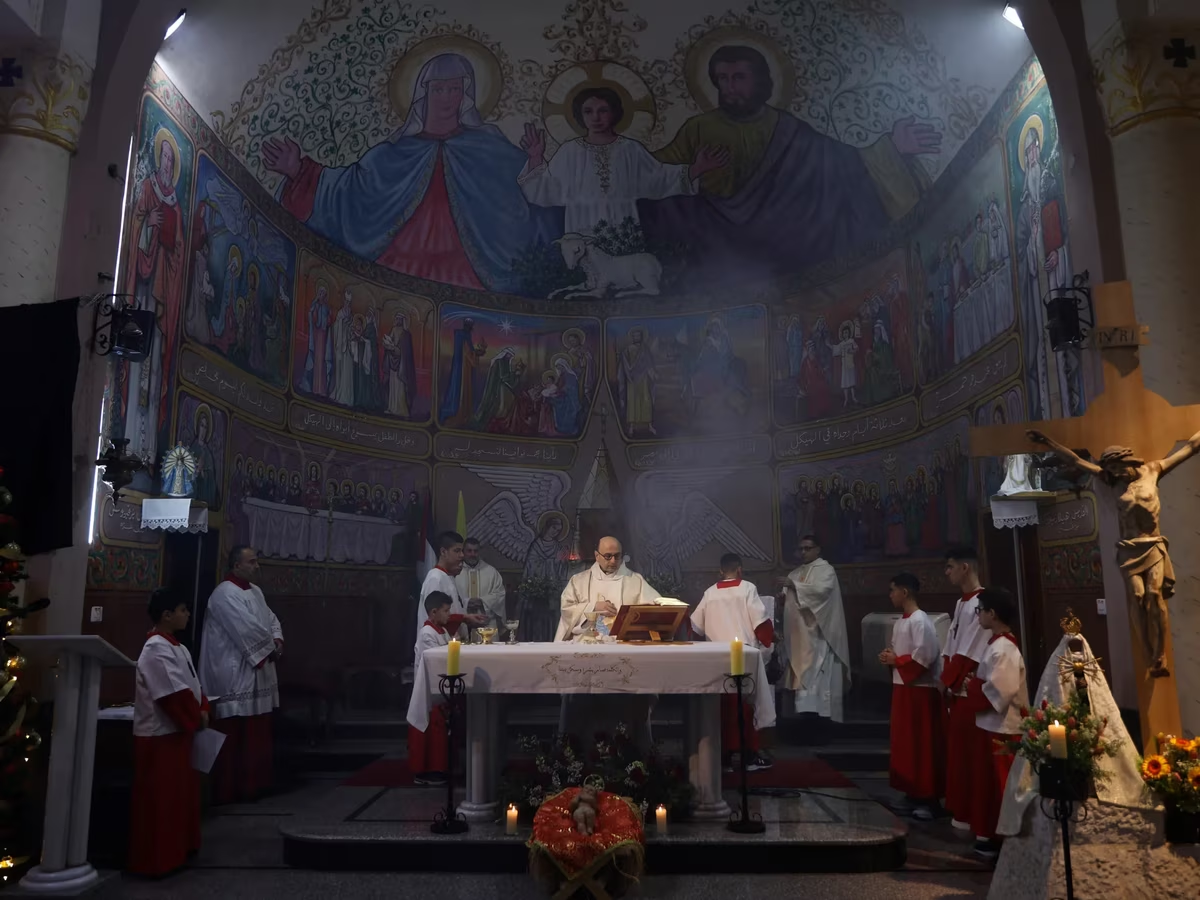
Amid this heavy pain, Christmas arrived this year for 516 Christians in Gaza, where they held modest celebrations, without decorations or lights, "for the city is still in its ruins and mourning its losses," as they say.

Patriarch of the Holy Land Pierre Battista entered Gaza on the night of December 21st, to announce from its heart through a modest celebratory mass the beginning of the Christian holidays, in a small attempt to snatch a moment of life from the heart of a city whose wounds have not yet healed.

During the first mass prayer according to the Western calendar on the night of December 25th, which was held at the Latin Monastery Church (Holy Family) east of Gaza City, and it is the central church where celebrations of Catholic Christians in the sector are held.

The church seemed burdened with memories of two full years of sorrow, almost without decorations or festive appearances, and the rituals were limited to pure religious rites. Inside, empty seats for martyrs who perished inside and outside this place, as if the worshippers carry the pains of grief and extermination.

The hymns are recited in a faint voice, while modest decorations hang on the sides that do not resemble any features of celebration in peacetime years, and a mass that seemed closer to a collective endurance prayer, and a final attempt to preserve religious rituals.

In the outer square of the church, Dimitri Paul Shard sat distracted, alone on one of the wooden benches, with no joy of the holiday on his face. I approached him and asked why he was sitting alone at the height of this crowding, so he answered "The war left me alone, I lived it alone." He added after a smile filled with sadness "I sent my children out of Gaza out of fear for them and their children, but I refused to leave it."

Although he is dual-nationality and could leave Gaza whenever he wanted as he says, he thwarted all embassy attempts to evacuate him, for Gaza is dear to his heart and he could not bear to leave it in these circumstances, despite losing his multi-story home and a number of his friends.

While the man stares around as if the whole place reflects his feeling of isolation, Najla Saba (67 years old) was on the opposite side of the square trying to break her solitude by making a video call with her family in Bethlehem in the West Bank.

A joy that Najla could not be part of, so she shared with them and embraced them with her eyes through the small window on the phone screen, despite the great lump in her throat for not being able to be with them physically, amid a painful feeling of separation and deprivation.

Najla recalls those days when Christian families in the Gaza Strip used to travel easily to Bethlehem to attend holiday celebrations, and she says as if flipping through an old photo album, not knowing if she can live its details again, "The most beautiful holidays were those we spent in Bethlehem, where mass prayer, lights, processions, decorations, celebrations, and family gatherings."

But this year she is in the Gaza Strip alone without family, where the war separated her from her children and the city's people, and she adds "I feel my heart cracking every day with their distance more, and I try to pretend strength in front of them but I burn with a feeling of alienation from within."

This forced separation and deliberate dispersion by Israel, the people of Gaza see it as preventing them from reuniting, in line with the policy of spoiling and establishing a limit on everyone who decided to stay in the Gaza Strip. Israel has been tightening on Christians even before the war, and refuses without reasons to grant many of them permits to cross to the occupied Palestinian territories.

Nevertheless, Najla insists on staying in the Gaza Strip, saying with a bitter smile "I do not want to leave Gaza, I was born here and taught generations in UNRWA schools, and my family's roots are deep in this land, and Gaza for me is everything, my heart, my soul, and my eye."

What Najla wishes most, amid the ongoing dispersion of her children until today, is that a holiday comes where she can gather them around one table, not from behind the phone screen.

A few steps from the church entrance, the girl Amal Hilal (16 years old) was taking pictures with her friends in front of a lonely Christmas tree lit with a few simple lights.

She comments on that Christmas tree saying that it is simple because it expresses their current state, and adds "We do not decorate the tree as in previous years, not because we do not want to, but because people's feelings are exhausted, and our gathering is the real holiday, for the holiday is in our hearts before it is in the decorations."

At the outer gate of the church sits Amal without participating in the children's play, her eyes fixed on the void left by the absence of her grandfather George, who was killed in a bombing that targeted the church during the war.

While the stories of the young and old intersect, this year's holiday takes its form in faint prayers and faces exhausted by loss and sorrow.

Despite the destruction and the shrapnel of Israeli booby-trapped robots that still reach the church from the eastern borders, as if reminding everyone that the war has not ended yet, Gaza says in its own way "Even from under the ashes, a new birth can begin."

PALESTINE

Fri 26 Dec 2025 6:11 pm - Jerusalem Time

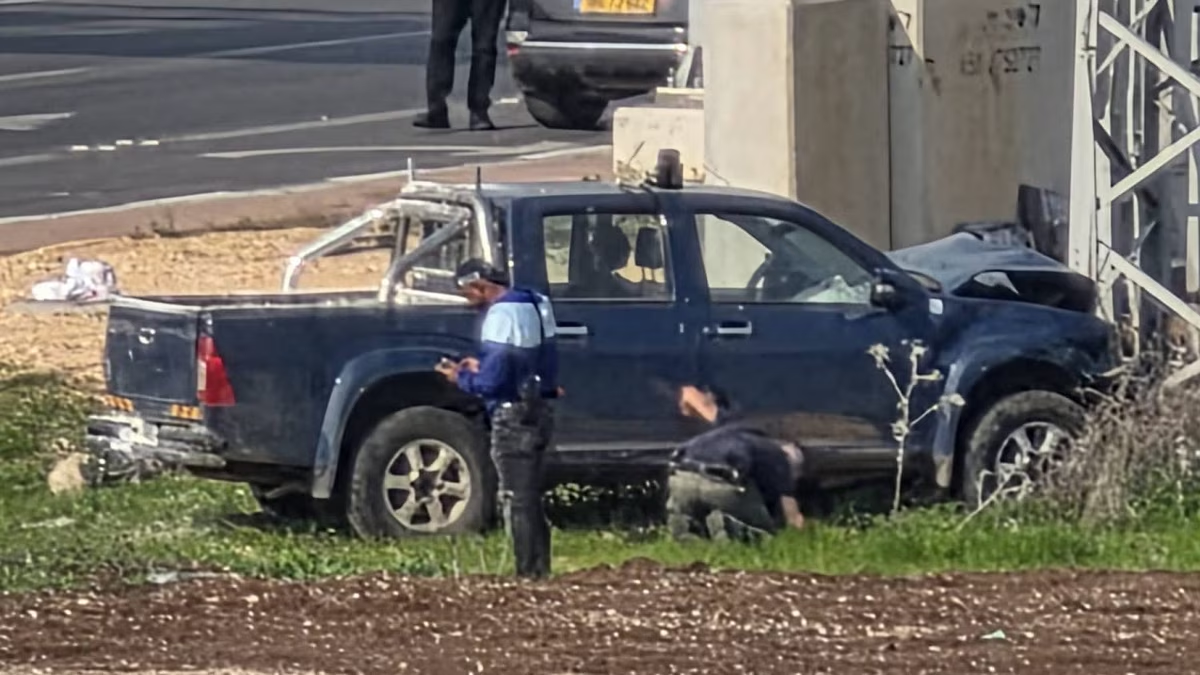
Israelis killed and injured in operation in Beisan and Afula.. How was it carried out and what did the resistance factions say?

Israelis were killed and injured today, Friday, in an operation carried out by a Palestinian from the West Bank in two locations in the city of Beisan and a third in Afula, northern Israel, amid escalating violence by settlers and the occupation army in the occupied West Bank cities.

The Israeli police and the General Security Service are still investigating the operation, while the Israeli army is conducting an assessment of the situation in various areas, and has reinforced its forces in what it described as the "contact zone" with the West Bank.

Since October 7, 2023, the intensity of operations carried out by Palestinians in Israel, which its security agencies have not been able to prevent, has been escalating, but how was the Beisan operation carried out and who is responsible for it?

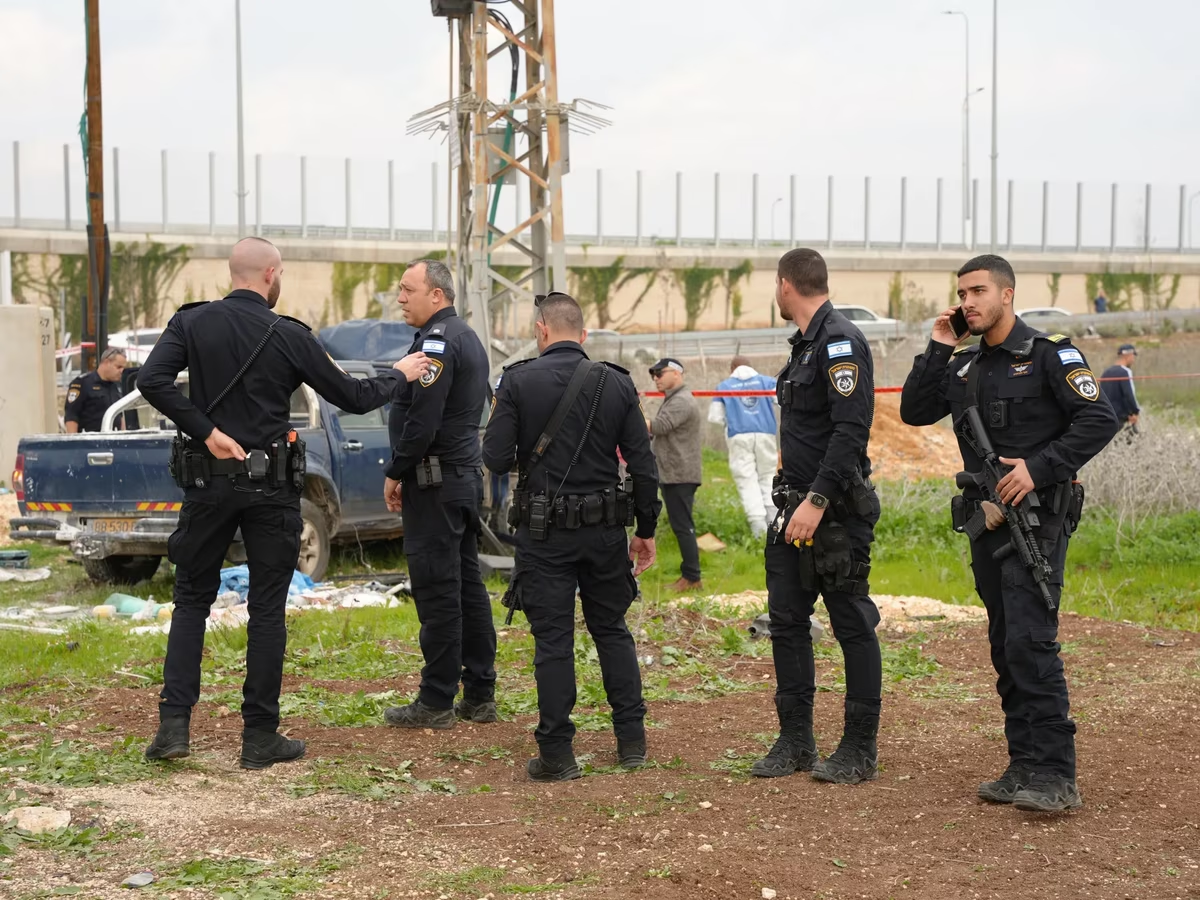
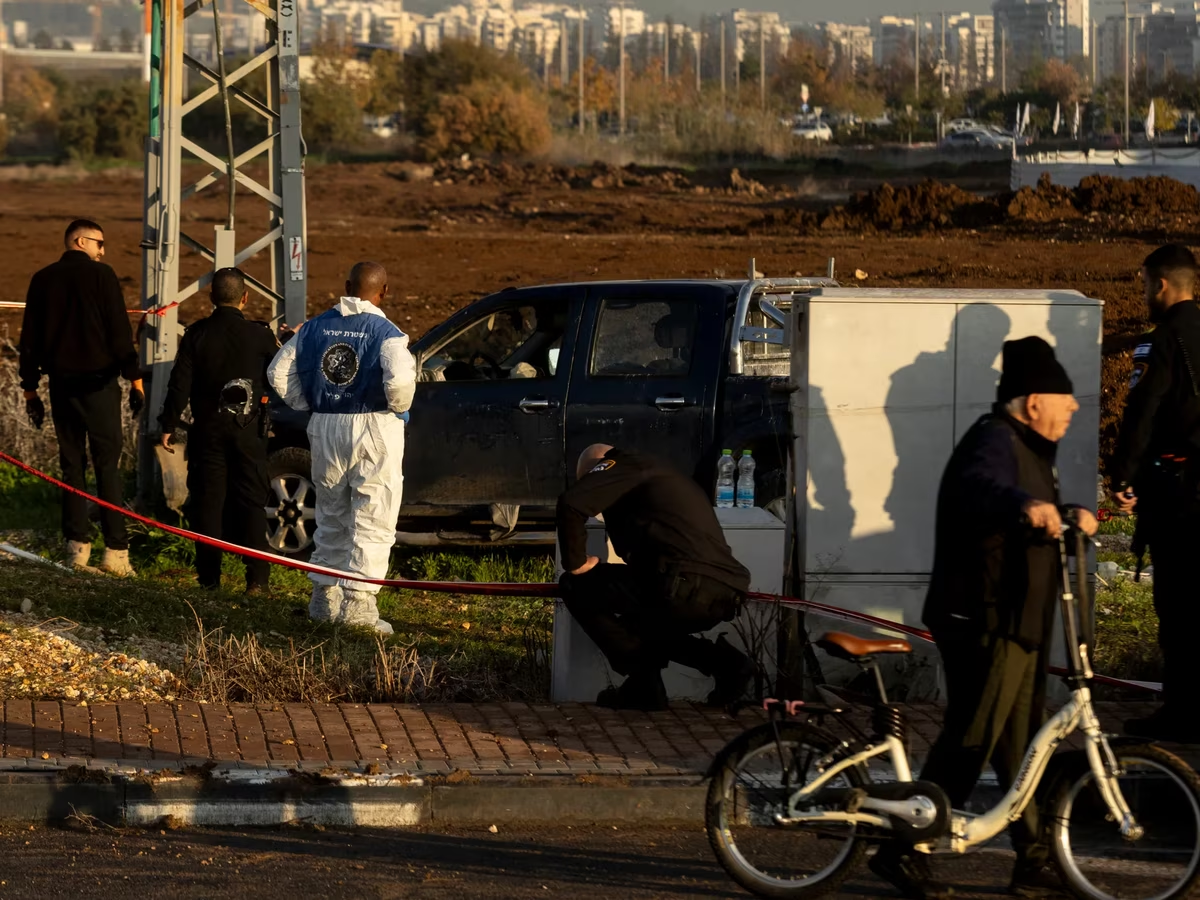
Initial Israeli investigations indicate that the perpetrator first ran over an Israeli youth on Yaakov Street in the city of Beisan, then ran over another on Hashomeron Street in the city. After that, he headed to Kibbutz Tel Yosef in Marj Ibn Amer near the area, where he got out of the car and stabbed an Israeli woman.

The perpetrator also headed towards the Afula area where he ran over another Israeli. However, a security guard in the area fired at the perpetrator, then the Israeli police arrested him and transferred him to the hospital, saying his injuries are moderate.

Israeli media reported that the dual operation in the two cities lasted about 50 minutes.

According to Israeli emergency services, a man was killed by being run over, while a woman was killed by stabbing in two locations in the city of Beisan, northern Israel.

The Israeli Broadcasting Corporation also said that two Israelis were injured in the operation with moderate and minor injuries, after initially reporting that 6 people were injured.

The Israeli Shin Bet said that the perpetrator of the operation is the Palestinian youth Ahmed Abu al-Rab (37 years old) from Qabatiya, south of the city of Jenin in the northern West Bank, which has been facing a wide Israeli operation (Iron Wall) since January, leading to the displacement of thousands and the destruction of Palestinians' homes and infrastructure in the city, while Qabatiya faces ongoing Israeli raids and arrests, the latest of which resulted in the martyrdom of a Palestinian boy after the occupation directly fired at him.

The Shin Bet also mentioned that Abu al-Rab belongs to the Islamic Jihad movement, which has not claimed responsibility for the operation so far.

Israeli media also quoted the army as saying that the perpetrator of the operation is an "illegal resident working in Israel for years".

After the dual operation, forces from the Duvdevan unit (the most prominent special forces units in the Israeli army) along with paratroopers and police stormed the town of Qabatiya, where they began implementing an intensive military operation, according to orders from Israeli Defense Minister Yoav Gallant.

The Israeli army confirmed that it deployed air forces to provide fire support and surveillance over the Jenin and Qabatiya areas, and its forces stormed the perpetrator's home, and engineering forces began sweeping it in preparation for demolishing it.

According to the Israeli army's statement, the operation in Qabatiya aims to "locate every terrorist and thwart him and strike the terrorist infrastructure in the town", according to its description, without specifying the duration of the military operation.

On its part, the Israeli Army Radio reported that forces from various units are working to encircle Qabatiya and establish barriers in the area.

Yedioth Ahronoth newspaper quoted a source as saying that the Israeli army deployed forces north of the West Bank and the Jordan Valley to secure areas of the apartheid separation wall.

Politically, Israeli Prime Minister Benjamin Netanyahu emphasized that "the Israeli government will continue to work to thwart anyone who seeks to harm its citizens", according to his expression.

He noted that Israel faces from time to time what he described as "bloody acts" despite carrying out several operations to thwart what he called "terrorism" during the past year.

For his part, National Security Minister Itamar Ben-Gvir stated that the dual operation in northern Israel shows the "urgent need to apply the death penalty law", a bill that Ben-Gvir is pushing for its approval, which stipulates that a person who intentionally or negligently causes the death of an Israeli, and when the act is carried out with a racist motive or hatred and to harm Israel, he must face the death penalty.

The Islamic Jihad movement has not issued any statement so far.

For its part, the Islamic Resistance Movement considered the operation that took place in the cities of Beisan and Afula as an expression of the accumulated popular anger and a result of the occupation's daily crimes.

It also warned the occupation against continuing its aggressive policies, affirming that its crimes will not achieve security for it.

PALESTINE

Fri 26 Dec 2025 5:55 pm - Jerusalem Time

Conflict between American Diplomacy and Israeli Escalation in Gaza

The diplomatic moves led by Washington to push towards the second phase of the ceasefire agreement in Gaza intersect with an accelerated military escalation by the Israeli army in the sector.

These days, eyes are directed in two directions: one on Gaza, where Israeli violations continue relentlessly, and another on Florida, which is expected to host a meeting between US President Donald Trump and Israeli Prime Minister Benjamin Netanyahu at the end of this week.

This delicate political moment comes amid the labor pains of moving to a second phase of the Gaza agreement, but the field in the sector has another face.

In the Tuffah neighborhood east of Gaza City, the Israeli occupation army has escalated its military operations in recent days through organized mining and demolition of residential blocks, and the evacuation of hundreds of families from their areas, in a clear violation of the terms of the declared ceasefire.

Diplomatically, in closed rooms, negotiations and calculations are being conducted that go beyond the borders of the besieged sector to place the fate of the entire ceasefire on the table of American-Israeli balances.

The Trump administration promotes the second phase as imminent through its envoys, but the absence of an official announcement of its details, and its coincidence with a notable field escalation, raise questions about its seriousness and limits.

As for Tel Aviv, as usual, it puts a stick in the wheels of the fragile negotiations, by showing a high degree of stubbornness regarding the transition to the next phase of the agreement.

Israel continues to link the negotiations to security conditions, including maintaining freedom of military action within Gaza, rejecting any complete withdrawal or real redeployment, in addition to disarming the Islamic Resistance Movement "Hamas", and returning the body of the last Israeli soldier.

In contrast, Hamas affirms its commitment to any agreement that ensures a comprehensive cessation of aggression, a clear withdrawal, and lifting of the siege. But it sees in the repeated Israeli breaches evidence of the absence of a serious partner.

As for Washington, it markets itself as capable of controlling the pace of the phase and containing the escalation, but at the same time, it does not exert any notable pressure on Tel Aviv to stop its daily breaches.

Until now, the wall of the crisis has not announced its collapse, but it is on the verge of falling at any moment, due to a military escalation that erodes what remains of the ceasefire, and a political path that appears optimistic on the surface. While its folds hide a minefield of extreme complexity.

ARAB AND WORLD

Fri 26 Dec 2025 5:13 pm - Jerusalem Time

The Israeli Government Recognizes the Somaliland Breakaway Region as an 'Independent Sovereign State'

The Israeli government announced on Friday the recognition of the Somaliland breakaway region as an "independent sovereign state", a step likely to face widespread regional rejection, due to the region's lack of official recognition since declaring secession from Somalia in 1991.

The office of Israeli Prime Minister Benjamin Netanyahu stated in a press release that the latter "announced today the official recognition of the Republic of Somaliland as an independent sovereign state".

The statement noted that the Israeli Mossad contributed to strengthening the recognition between the two sides.

It added: "The Prime Minister, the Foreign Minister, and the President of the Republic of Somaliland signed a joint reciprocal declaration".

It continued: "This declaration comes in the spirit of the Abraham Accords that were signed at the initiative of President Trump".

The "Abraham Accords" are normalization agreements signed in 2020 between Israel and the UAE and Bahrain under US sponsorship, later joined by Sudan and Morocco.

PALESTINE

Fri 26 Dec 2025 4:43 pm - Jerusalem Time

Netanyahu: We face bloody acts and will continue to strike anyone who threatens Israel's security

Netanyahu: "Israel" faces bloody acts despite intensive efforts to thwart what he described as "terrorism".

The Israeli Prime Minister, Benjamin Netanyahu, made statements following the double operation in "Beisan" and "Afula", confirming that "Israel" faces bloody acts despite intensive efforts to thwart what he described as "terrorism" over the past year.

Netanyahu emphasized that his government will continue to work to protect its citizens and strike anyone who seeks to harm them.

On the ground, the Israeli army announced the sending of additional military reinforcements to the "contact line" area, while occupation forces began raiding the town of Qabatiya (hometown of the perpetrator) south of Jenin.

The army explained that these movements come as part of "operational activity" in response to the attack, amid reports indicating that the perpetrator had been residing and working inside "Israel" in what was described as an "illegal" manner for years.

For his part, Itamar Ben-Gvir made hardline statements, considering that the perpetrator committed an "anti-Semitic" operation.

Ben-Gvir said: "Whoever carries out such acts with the aim of killing must know that we will not allow him to live", in reference to his orientations towards toughening penalties and executing the perpetrators.

ARAB AND WORLD

Fri 26 Dec 2025 4:25 pm - Jerusalem Time

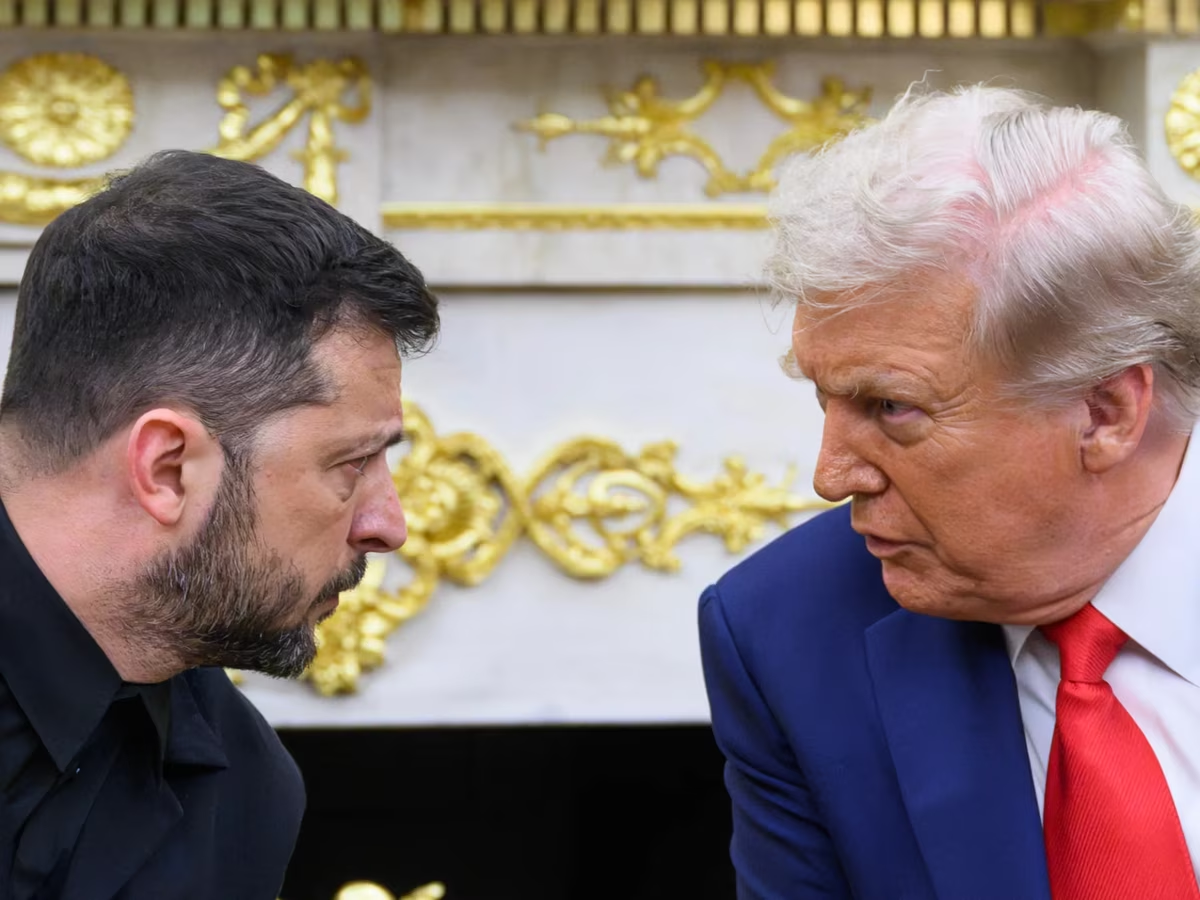
Trump meets Zelensky on Sunday.. and Kyiv declares state of alert

A Ukrainian official said that President Donald Trump will meet his Ukrainian counterpart Volodymyr Zelensky on Sunday at Mar-a-Lago in Palm Beach, while Ukrainian authorities declared a state of alert in the capital Kyiv.

The Ukrainian President said that many issues can be resolved before the end of the year, amid Washington's intensification of diplomatic efforts to end the war with Russia, and clarified -in a post on the "X" platform- that sensitive issues, including any possible concessions on Ukrainian lands, must be discussed at the level of heads of state.

Zelensky had conducted, yesterday Thursday, talks with Steve Witkoff, the special envoy of the American President, and Jared Kushner, Trump's son-in-law.

The Ukrainian President indicated that some documents related to a broader framework for ending the conflict and ensuring the reconstruction of Ukraine "almost ready", while some are "completely ready".

Zelensky earlier this week revealed a draft peace plan of 20 points, describing it as the main framework for ending the war.

Although the plan includes security guarantees for Kyiv to prevent any future Russian aggression, disagreement remains with Washington regarding the lands that Moscow demands Ukraine to concede, in addition to the future of the Zaporizhzhia nuclear plant under Russian forces' control.

In the context, a Russian newspaper reported that President Vladimir Putin informed some senior Russian businessmen that he might be open to exchanging some lands controlled by Russian forces in Ukraine, but he wants the entire Donbas region.

Andrei Kolesnikov, the newspaper's Kremlin correspondent, said that Putin briefed businessmen on the details of the plan in a meeting held in the Kremlin late Wednesday evening.

Kolesnikov wrote in the newspaper that Putin wants the entire Donbas, but -away from that region- "does not rule out a partial exchange of lands from the Russian side".

On the ground, Ukrainian authorities declared a state of alert in the capital Kyiv following Russian attacks that targeted several areas and resulted in the death of 4 people and injury of others, according to local authorities, which clarified that the attacks particularly affected the Kherson, Donetsk, and Zaporizhzhia regions.

The Ukrainian army said that its forces engaged in 121 combat clashes with Russian forces along the front line during the past hours, adding that Ukrainian units targeted areas of Russian forces' gathering, command points, and air defense means, with significant losses recorded among the attacking forces, and that the fighting focused particularly on the eastern and southern fronts.

These developments come amid the continuation of the war since February 24, 2022, where Moscow conditions the end of it on Kyiv's renunciation of joining Western military alliances, which Ukraine considers an infringement on its sovereignty and interference in its internal affairs.

ARAB AND WORLD

Fri 26 Dec 2025 4:19 pm - Jerusalem Time

Mossad publicly attacks Qatar in response to Lieberman

The Mossad issued a public and sharp response to the statements of Yisrael Beiteinu party leader Avigdor Lieberman, in a step considered exceptional on both political and security levels, and opened the door to an unprecedented attack from the intelligence agency on the state of Qatar.

Lieberman had directed accusations at the Mossad during a conference in Tel Aviv, speaking about what he called a "media group" dedicated to improving Qatar's image, and indicated that these understandings were not presented to the cabinet or the subcommittee on intelligence.

According to the Mossad's statement, Qatar does not merely support a channel that the agency described as "encouraging hatred, anti-Semitism, and terrorism," but also works to spread systematic incitement against the occupation worldwide, through multiple platforms.

This escalation came after Lieberman's statements, which aroused anger within the occupation's security establishment, as "the Mossad felt that the prevailing impression suggests that it had been protecting Qatar throughout the past years or defending its integrity" according to Hebrew newspapers.

The Mossad's statement said "it is fully aware of the negative role played by Qatar, and deals with it as a hostile state that hosts terrorist elements and funds anti-Semitic incitement activities in universities, through networks linked to the Muslim Brotherhood" according to its claim.

It indicated that "it maintained public silence, acted responsibly, and placed the hostage issue at the forefront of its priorities, which is a decisive factor in continuing communication with Doha."

It added: "Qatar was the most effective mediator in hostage exchange deal negotiations, which led to avoiding any public steps that could fail these efforts."

The Mossad said in its statement that "it opposed closing the offices of a channel in Israel, fearing that it would negatively affect Qatari mediation in the hostage file, and saw the necessity of postponing it until after their return, given Qatar's influence on Hamas."

PALESTINE

Fri 26 Dec 2025 4:09 pm - Jerusalem Time

The Israeli Army Intends to Carry Out a Military Operation in Qabatiya North of the West Bank

The Israeli army announced on Friday its intention to carry out a military operation in the town of Qabatiya north of the occupied West Bank, claiming that the perpetrator of the stabbing and ramming incident in the city of Beit She'an in northern Israel originated from there.

The army stated in a statement: "Through the initial investigation into the ramming and stabbing attack carried out in the Beit She'an area, and later in Afula, it was revealed that the perpetrator is an illegal resident who infiltrated into the territory of the State of Israel several days ago."

It added: "Additional forces are reinforcing the contact zone (between the West Bank and Israel), and the forces are preparing to enter into field activity inside the town of Qabatiya" near Jenin in northern West Bank.

Earlier on Friday, two Israelis were killed and two injured in a ramming and stabbing operation in the city of Beit She'an in northern Israel, before a passerby fired at the perpetrator, resulting in him sustaining moderate injuries.

Israeli authorities confirmed that the perpetrator of the operation is from the town of Qabatiya, while the newspaper "Yedioth Ahronoth" stated that his identity is Ahmed Abu al-Rab, 37 years old.

For his part, Defense Minister Yoav Gallant issued instructions to the Israeli army "to act forcefully and immediately against the village of Qabatiya, from which the perpetrator originated," according to a statement from his office.

National Security Minister Itamar Ben-Gvir also stated in a statement: "Anyone who commits a terrorist attack motivated by anti-Semitism with the intent to kill should know that the State of Israel will not allow him to remain alive," in his words.

This comes as the Israeli army continues, since January 21, 2025, a military operation in northern West Bank that it began in Jenin camp, then expanded to Nour Shams and Tulkarm camps.

Since that time, the army has besieged the three camps and continues to destroy and demolish the entire infrastructure and citizens' property, hundreds of homes and shops, while the displacement of their residents, numbering about 50,000, continues, according to official data.

Since the genocide war in Gaza began on October 8, 2023, the Israeli army and settlers in the West Bank have killed at least 1,103 Palestinians and injured about 11,000, in addition to arresting more than 21,000.

Israel is also intensifying its crimes to annex the West Bank to it, especially through demolishing Palestinians' homes, displacing them, and expanding settlements, according to Palestinian authorities.

Annexing the West Bank by Israel would end the possibility of implementing the two-state solution (Palestinian and Israeli), as stipulated in UN resolutions.

Israel was established in 1948 on Palestinian lands occupied by armed Zionist gangs that committed massacres and displaced hundreds of thousands of citizens, then Tel Aviv occupied the rest of the lands, and refuses to withdraw and establish a Palestinian state.

ARAB AND WORLD

Fri 26 Dec 2025 3:41 pm - Jerusalem Time

China Expands Its Economic Influence by Strengthening Gold Reserves

China seeks to expand its economic and political influence by increasing its gold reserves, considering it a strategic pillar that enhances the presence of countries in the global financial system and forms a lifeline that protects them from market fluctuations and dollar blackmail.

China is the second largest importer of gold globally, and in recent years, it has turned to acquiring the precious metal from Arab countries rich in natural resources, whose markets are among the most prominent centers for gold trade in the world.

This step comes as part of Beijing's efforts to reduce its dependence on Western markets, especially amid the escalating trade war.

In parallel with imports, Beijing has intensified its efforts in gold mining through its national and semi-governmental companies, as China Nanfang Gold and Zijin Mining have signed partnership and investment agreements with several Arab countries to develop mining projects and exploit natural resources.

China has also focused on enhancing Sudanese gold production through companies like Wanbao Mining and Morinko, which have expanded their activities in Sudan to develop mines and establish a Chinese presence in the sector, despite the volatile political and security situations, through agreements with local authorities.

Beijing's gaze has not been limited to the Arab region, as it has expanded the scope of its investments to include African countries and others in Latin America and Asia, as part of a long-term strategy aimed at ensuring a strong foothold in the global gold sector.

China's open appetite for 'world gold' is no longer hidden, as it appears determined to build an economic empire based on growing financial influence, in a world where the balances of economic power are changing at a dazzling speed resembling the shine of gold itself.

PALESTINE

Fri 26 Dec 2025 3:35 pm - Jerusalem Time

10 Palestinians Injured by Suffocation During Raid on Nablus Town

10 Palestinians were injured by suffocation on Friday after inhaling toxic gas fired by the Israeli army during a raid on the town in the city of Nablus in the northern occupied West Bank.

Local sources reported that "occupation forces raided the town of Beita and fired sound bombs and toxic gas at the citizens, leading to the injury of a number of them with suffocation cases".

In turn, the Palestinian Red Crescent Society said in a statement that its crews in Nablus provided the necessary first aid to 10 suffocation victims.

Since the genocide war in Gaza began on October 8, 2023, the Israeli army and settlers in the West Bank have killed at least 1103 Palestinians, injured about 11,000, in addition to arresting more than 21,000.

PALESTINE

Fri 26 Dec 2025 2:57 pm - Jerusalem Time

The Israeli Supreme Court Approves the Demolition of 25 Residential Buildings in Nour Shams Camp

The Israeli Supreme Court approved the demolition of 25 residential buildings in the Nour Shams refugee camp for Palestinian refugees in the northern occupied West Bank, despite acknowledging that they are civilian buildings.

The Arab-Israeli human rights center "Adalah" stated in a statement on Friday that "the Israeli Supreme Court issued a decision late Wednesday evening rejecting the petition submitted by Palestinians from the Nour Shams refugee camp and adjacent areas, along with the center, against orders to demolish 25 civilian residential buildings in the camp".

The center explained that the court relied in its decision on secret materials and information provided by the prosecution in partnership with military intelligence, without disclosing them to the petitioners or the defense team, and considered them sufficient to justify the demolition decision.

It noted that the court adopted the position of the Israeli army, which claimed that the demolition orders are based on a "justified military need".

It added that this decision came "despite the prosecution's acknowledgment during the session that the targeted buildings are civilian residential homes not used for military purposes, and belong to families with no connection to any military activity".

It continued: "The state justified the demolition based on considerations related to facilitating future military movements within the camp, not based on an existing or urgent military necessity at the present time".

The center explained that it "acknowledged the lack of immediate urgency for implementing the demolition, and that the area has been free of any combat activity for more than a year, yet the court accepted the army's justifications, considering that the military command has broad authority in this matter, and that its intervention is limited to exceptional cases, which it saw as not present in this case".

It pointed out that the court decided that the implementation of the demolition orders will not begin before December 27, 2025.

During the court sessions, the Adalah Center emphasized that the decision leads to creating a permanent reality of forced displacement prohibited under international humanitarian law, "especially since all residents are considered protected civilians and their property is protected under these standards".

It added that "this decision comes within a broader context of repeated judicial approval of a widespread demolition policy in refugee camps in the northern West Bank, based on general security considerations and secret materials that cannot be challenged, which consecrates the imposition of a permanent reality of displacement and prevention of return, in clear violation of the principles of international humanitarian law and the protection of civilian populations".

The center mentioned that this petition is the fourth it has submitted in recent months against collective demolition orders in the camps of Jenin, Nour Shams, and Tulkarm, where the Supreme Court rejected intervention in the previous cases, considering that these decisions fall within the military command's powers.

The Israeli army began at the beginning of this year with extensive military operations in the Palestinian camps in the northern occupied West Bank.

Since the start of the genocide war in Gaza on October 8, 2023, Israel has intensified its crimes in preparation for officially annexing the occupied West Bank to it, including demolishing homes, displacing Palestinians, and expanding settlement construction.

Annexing the West Bank to Israel would end the possibility of applying the principle of a two-state solution (Palestinian and Israeli), as stipulated in numerous resolutions issued by the United Nations.

Since the start of the genocide war in Gaza, the Israeli army and settlers in the West Bank have killed more than 1,103 Palestinians, injured about 11,000, in addition to arresting more than 21,000.

Meanwhile, Israel's genocide war in Gaza has left about 71,000 Palestinian dead and 171,000 injured, mostly children and women, along with massive destruction, with the United Nations estimating the cost of reconstruction at about 70 billion dollars.

PALESTINE

Fri 26 Dec 2025 2:41 pm - Jerusalem Time

Death of a settler in a stabbing operation in Afula, northern occupied Palestine

Death of an Israeli settler, after being subjected to a "stabbing operation".

Palestinian and Hebrew media reported the death of an Israeli settler, after being subjected to a "stabbing operation" carried out by a young man in the city of Afula, northern occupied Palestine.

According to initial reports, large forces of the Israeli police rushed to the scene and began extensive searches, while she was transferred to the hospital in critical condition before her death was announced later.

The Israeli police in the Northern District announced their ability to arrest and "neutralize" a suspect who carried out a stabbing near the "Ain Harod" area, following a security pursuit that began immediately after the incident, which resulted in a woman being seriously injured (her death was announced later).

According to initial data, the security agencies received a report about a woman being stabbed, and the suspect's vehicle fled the site towards the city of Afula.

Shortly after search and investigation operations, police patrols managed to spot the vehicle, stop it, and neutralize those inside.

The police forces in the Northern District continue their intensive presence at the scene of the incident and along the path taken by the vehicle, where technical and criminal teams began examining the circumstances of the incident and collecting evidence to determine the perpetrator's motives and the background of the operation.

PALESTINE

Fri 26 Dec 2025 2:29 pm - Jerusalem Time

Head of Shin Bet warns of worsening arms smuggling via drones: Strategic threat

The head of Shin Bet, David Zini, warned of the worsening phenomenon of smuggling combat means into the occupied Palestinian territories via drones across the borders with Jordan and Egypt, describing it as a "continuing catastrophe" and considering it a "strategic threat".

These statements came during recent security deliberations, including an exceptional meeting held last week at the office of the Attorney General, Gali Baharav-Miara, with the participation of officials from Shin Bet, the police, and the army, alongside legal entities.

According to the data presented in those deliberations, tens of thousands of drone breaches were recorded in the occupation's airspace over the past year, transporting thousands of weapons, including firearms and explosives, alongside drugs and other criminal smuggling operations, according to the occupation's claims.

The data indicates that some of these drones are capable of carrying tens of kilograms, or even more than a hundred kilograms in some cases, and a security official said during one of the discussions: "We are four to five years late" in dealing with the phenomenon.

In recent times, the occupation police placed the primary responsibility for the file on the army, but in recent weeks, it was decided to transfer part of the responsibility for monitoring drones to the police, after the army reported that the intensity of tasks resulting from developments in Gaza and the north does not allow it to control this threat.

The Operations Department in the police began extensive work recently in preparation for taking on part of the responsibility for monitoring drones, and a police official said: "The army realized that its borders are penetrable, and the one who is supposed to monitor the drones is the army", adding: "Today, it is no longer possible to evade this issue, as it is worsening, but throughout the past period there was a vacuum, and no one took responsibility, and practically combat means entered Israel freely".

In the meeting held last week chaired by the Attorney General, the legal aspects of addressing the phenomenon were discussed, where representatives of the security agencies agreed that it constitutes one of the central threats, whether on the level of state security or on the criminal level, and according to data provided in several police and security deliberations in recent months, there are days when "dozens of drones cross the border without hindrance", as expressed by one of the sources participating in the discussions.

Two days ago, army forces detected an attempt to smuggle a drone carrying 40 pistols from the Jordanian border, and the weapons were seized, but the drone operators were not arrested, and a security official said: "There is great difficulty in arresting the operators, and there is hardly any possibility of knowing from where it is operated (the drone), and the main challenge now is to monitor all drones".

In an exceptional step, the Minister of Security in the occupation government, Yisrael Katz, signed an administrative detention order a week ago against a resident of the town of Be'er Hadaj in the Negev, suspected of being a central smuggler of combat means via drones across the southern borders.

The order was issued after information provided by Shin Bet regarding his involvement in smuggling combat means, "including unusual combat means or those with great capacity to endanger state security". Administrative detention was imposed on him "due to the inherent danger of his activity to state security", and nevertheless, the report quoted sources that the army and police seizures are "a drop in the ocean" compared to the size of the phenomenon, as described in one of the recent discussions.

ARAB AND WORLD

Fri 26 Dec 2025 1:31 pm - Jerusalem Time

Poll: Israeli Opposition Needs Arab MPs to Prevent Netanyahu from Forming Government

A poll in Israel on Friday showed that the opposition will inevitably need Arab MPs in the Knesset if it wants to prevent Prime Minister Benjamin Netanyahu from forming a new government.

The poll was conducted by the private Lazar Institute, with a representative sample of 500 people and a margin of error of 4.4 percent, according to the Hebrew newspaper Maariv.

According to the poll results, if elections were held today, Netanyahu's supporting camp would get 50 seats in the 120-seat Knesset, while the opposition would get 60 seats and Arab MPs 10 seats.

According to Israel's basic system, forming a government requires at least 61 MPs' confidence in the Knesset (parliament).

However, most Israeli opposition parties say they will not ally with Arab MPs to form a government.

If the opposition does not get the required 61 seats, this means re-elections, similar to what happened several years ago when the Naftali Bennett-Yair Lapid government was formed in 2021 with the support of the United Arab List led by Mansour Abbas.

Officially, general elections will be held at the end of October 2026 unless early elections are held.

According to the results, the far-right Religious Zionism party led by Finance Minister Bezalel Smotrich and the opposition Blue and White party led by former Defense Minister Benny Gantz will not succeed in the elections if held today.

Based on the above, the poll results indicate the Israeli opposition's need for Arab MPs to topple Netanyahu's government.

On the other hand, the poll results indicate a division in the public regarding an inquiry committee into the failure of the security and military institutions to repel Hamas's attack on October 7, 2023, formed by the government, and support for a committee formed by the Chief Justice.

The Netanyahu government opposes forming this committee, fearing it will hold it responsible for the security and military failures previously acknowledged by Israeli officials.

According to the results, 62 percent of Israelis say they trust the results of an inquiry committee formed by Chief Justice Isaac Amit.

In contrast, 28 percent do not trust the results of such a committee, while 10 percent said they have no specific opinion.

The poll also showed a division regarding an inquiry committee that the Israeli government said it would form into the events of October 7.

21 percent said they would fully trust the results of this committee, 21 percent partial trust, while 46 percent said they would not trust its results, and the remaining percentage has no specific opinion.

On Wednesday, the Knesset (parliament) approved in a preliminary reading a bill submitted by Likud party MP Ariel Kallner, granting the government the authority to form a 'political committee' to investigate the events of October 7, with 53 supporters (out of 120) versus 48 opponents.

The Knesset still needs to vote on the bill in three readings for it to become effective law.

On October 7, fighters from the Hamas movement attacked military bases and settlements adjacent to the Gaza Strip, killing and capturing hundreds of Israelis, in response to 'the daily crimes of occupation for decades against the Palestinian people and their sanctities, especially Al-Aqsa Mosque,' according to the movement.

Israeli officials consider what happened on October 7 to represent the 'biggest intelligence and military failure' that caused significant damage to Israel's image and its army in front of the world.

Regarding Netanyahu's interrogation in the case known as 'Qatar Gate,' which accuses officials in his office of 'promoting Qatari interests,' 44 percent of Israelis surveyed today (Friday) supported this step, while 27 percent considered the interrogation unjustified, and 29 percent had no specific opinion.

For its part, Qatar denied the allegations against it in the case, considering them 'baseless,' while Netanyahu said what is happening is nothing but political persecution to topple the right-wing government.

PALESTINE

Fri 26 Dec 2025 12:49 pm - Jerusalem Time

Release of an Israeli soldier who ran over a Palestinian during prayer and placed under house arrest

The Israeli police, today Friday, released a reserve soldier who ran over a Palestinian while performing prayer near the city of Ramallah in the occupied West Bank, and decided to place him under house arrest after interrogating him, according to what Hebrew media reported.

The Israeli police announced yesterday Thursday the arrest of a reserve soldier and his interrogation after a video clip spread showing him running over a Palestinian man who was praying on the side of the road near Ramallah.

The soldier was later released, with forced residence imposed on him for five days with strict conditions, and he was prohibited from approaching the village of Deir Jarir where the incident occurred, or communicating with any of the parties to the case.

The Israeli police announced their cooperation with the Israeli occupation army in the investigation, noting that the incident also included the soldier firing from his weapon inside the village.

The army confiscated the soldier's weapon and ended his military service, given the seriousness of the incident.

This incident comes amid ongoing Israeli escalation in the West Bank, including East Jerusalem, since the start of the genocide war on the Gaza Strip, which has resulted in the martyrdom of at least 1103 Palestinians, the injury of about 11,000 others, and the arrest of more than 21,000, according to Palestinian data.

OPINIONS

Fri 26 Dec 2025 12:02 pm - Jerusalem Time

Towards a New Path for Peace

Gershon Baskin

Gershon Baskin

Opinion Writer

Throughout my life in Israel, and over the past forty-seven years, I have sought Palestinian partners who share the same values and vision of the world as I do, and I have found them. This means they believe that Israel and Palestine must find a path to peace. And this path to peace must be based on the belief that on the land stretching between the river and the sea, two peoples live who are deeply connected to the same land – historically and religiously.

And the shared vision must be that both peoples have the right to self-determination on this land – that is, two states for two peoples. And the decisive element for me in determining whether the partnership is genuine or not is the belief that cross-border cooperation is what creates peace, not high walls or strong fences.

I have always had doubts about those who promote the separation model (we here and they there), because they are unable to envision actually achieving peace, and do not truly believe in it. Politicians, even in the left-wing ranks, who focus on separation between Israel and Palestine, and who emphasize separation not only as a political separation, fear presenting a vision of peace as a reality in which Israelis and Palestinians continue to interact and cooperate – because true peace cannot be anything else.

Most Israelis and Palestinians say: «I want peace» – but they do not believe that the other side wants it. And objectively, Israelis and Palestinians alike have sufficient evidence to justify the claim that the other side does not want peace. And it is often difficult to find people, especially leaders, on both sides who show a genuine commitment to real peace with the other side. They exist, but they are not dominant, and rarely speak of real peace.

At the end of April 2026, Palestinians are scheduled to hold local elections in cities, towns, and villages throughout Palestine. And within one year of the end of the war, national elections for the presidency and parliament are supposed to be held. This will be the first test of its kind to know where the positions of Palestinian public opinion have reached. The last Palestinian elections were held in 2006.

How will Israelis (and Palestinians as well) react if there is a leading Palestinian political party that carries the following program?


The Political Program

The party is founded on the firm conviction that the Palestinian people deserve a democratic, fair, and modern political system – a system that serves citizens, not factions, protects freedoms, and opens a realistic path towards independence, prosperity, and peace.

The party envisions an independent Palestinian state living side by side with Israel, based on full political, economic, diplomatic, and security cooperation. And we believe that sustainable stability and dignity for both peoples can only be achieved through partnership, mutual recognition, and shared responsibility.

Democratic Governance and Civil Liberties

The party is committed to building a liberal parliamentary democracy based on the separation of powers, the rule of law, and the supremacy of elected institutions. We support an accountable government, an independent judiciary, and transparent public administration.

The party defends individual rights and freedoms, including freedom of expression, free and independent media, political pluralism, and the right to peaceful protest. Public office is a responsibility, not a privilege, and opportunities must be based on competence and merit – not loyalty or favoritism.

Palestinian women and youth are a fundamental axis in our vision – not as symbols, but as equal partners in leadership, representation, and decision-making.

Social Justice and Development

The party believes that political freedom must be accompanied by economic opportunities and social justice. We call for comprehensive economic development, equal access to education and employment, and fair distribution of public resources. A strong Palestinian state must be productive, innovative, and capable of providing dignity and opportunities for all its citizens.

The Pillars of the Palestinian State – The Four Pillars

The party believes that the establishment of a viable and responsible Palestinian state must be based on four fundamental pillars (the four pillars):

•       Demilitarized: Ensuring security through professional institutions, the rule of law, and regional cooperation, not through militias or armed factions.

•       De-radicalized: Rejecting extremism, incitement, and violence, and promoting tolerance, civic education, and peaceful political participation.

•       Democratic: Governed by elected institutions, accountable leadership, and guaranteeing civil rights.

•       Developed: An economically strong state, integrated into regional and global markets, and capable of achieving prosperity for its people.

The Political Settlement and the Two-State Framework

The party supports the two-state solution through negotiations, based on the 1967 borders, with an agreed land swap of approximately 5%. This framework allows for:

•       Geographical continuity between Gaza and the West Bank, and the annexation of about 80% of Israeli Jewish settlements to Israel, within the framework of the final status agreement.

•       Jerusalem as the capital of both states: Palestinian neighborhoods as the capital of the State of Palestine, and Jewish neighborhoods as the capital of the State of Israel.

•       The Old City of Jerusalem not subject to exclusive sovereignty, but managed by a special international committee including Palestine, Israel, Jordan, Saudi Arabia, and the United States, ensuring freedom of worship, access, and protection of holy sites.

Refugees and Reconciliation

The party supports redefining the right of return as the right of Palestinian refugees to return to the State of Palestine, alongside: full compensation, and voluntary integration options in the Palestinian state or, in agreed cases, in third countries. This approach aims to achieve justice, dignity, and realism – without perpetuating the conflict.

Regional Integration and Peace

The Palestinian-Israeli partnership envisioned by the party is part of a broader regional future: full integration of Israel into the Middle East, with comprehensive diplomatic and economic relations with the Arab and Islamic worlds, alongside a sovereign and democratic Palestinian state.

The party categorically rejects violence as a political tool. We believe that dialogue, persuasion, and diplomacy – not coercion or armed struggle – are the only legitimate means to achieve national goals.

Our moderation is not weakness; it is strategic responsibility. Our vision is not an abstract theory; it is practical, balanced, and achievable.

The party was founded to offer Palestinians a reliable political alternative – an alternative that restores confidence, renews leadership, and opens a real path towards the state, peace, and shared regional prosperity.


Amazing and sincere!

What an amazing program. And it is not fantasy. This is indeed the political program of a new Palestinian party. This party will participate in the local and national elections in Palestine during 2026. Its establishment and electoral strategy will be announced soon.

This Palestinian political party constitutes a challenge to everything we have known so far. It is a challenge to the existing Palestinian political parties that have dominated Palestinian political life for decades. This new party is the new vision, the new hope for Palestine, but it is also hope for Israel. Let us see Israeli political parties adopt a parallel political program. When that happens, we will be more able to envision the possibility of real peace.


* Director of Middle East Affairs at the International Communities Organization, and Co-Chair of the Two States Alliance.


PALESTINE

Fri 26 Dec 2025 11:59 am - Jerusalem Time

Occupation army launches raids on central and southern Gaza Strip and kills 3 Palestinians

The Israeli occupation army launched raids on several areas in the central and southern Gaza Strip, coinciding with artillery shelling and firing from its helicopters, as the occupation announced that its forces killed 3 Palestinians near the yellow line.

The Israeli army launched raids on areas east of Gaza City in the central sector, noting that the bombing focused on the Tuffah neighborhood.

In the Shujaiya and Tuffah neighborhoods east of the city, the Israeli army launched raids, and sounds of explosions were heard and columns of smoke were seen. The nature of the targets hit by the Israeli bombing was not clear.

The Israeli bombing that targeted areas east of Khan Yunis city in the southern sector focused within the yellow line areas controlled by the Israeli army, especially the Bani Suhaila area, which also witnessed operations to demolish Palestinian citizens' homes.

In the southern sector as well, the occupation army's artillery shelled areas east of Rafah city, and the artillery shelling coincided with firing from the occupation's helicopters and tanks.

Meanwhile, the Israeli army announced the elimination of a person who crossed the yellow line in the northern Gaza Strip, and it had announced yesterday evening, Thursday, the assassination of two resistors, described as "armed men" who approached the yellow line in the southern sector.

The occupation army claimed that the two armed men posed a threat to it, and clarified that the air forces, under the guidance of the infantry brigade, eliminated them.

The Israeli army still controls the southern and eastern strips of the sector, in addition to large parts of northern Gaza, thus continuing to occupy nearly 60% of the sector's area.

Israel continues its violations of the ceasefire in Gaza, which came into effect on October 10 last, where it killed 411 Palestinians, according to what was announced by the government media office in Gaza last Tuesday.

ARAB AND WORLD

Fri 26 Dec 2025 11:55 am - Jerusalem Time

Trump's Efforts to Form an International Force and Transition to the Second Phase in Gaza Falter

Despite the commitment of US President Donald Trump to move to the second phase of the ceasefire agreement in Gaza, and promoting the formation of an international "peace council" and a multinational stabilization force, these promises continue to collide with a highly complex political and security reality. Weeks after the end of the first phase of the agreement, there are no tangible indicators of actual international readiness to engage in field arrangements within the Gaza Strip, which remains an open battlefield fraught with risks.

The latest setback to this path came with Azerbaijan's announcement, one of the countries Washington has contacted, expressing serious doubts about participating in the proposed international force. Hikmat Hajiyev, aide to Azerbaijani President Ilham Aliyev, said his country finds it difficult to join a force expected to be deployed in Gaza as part of a US-mediated ceasefire plan, pointing to the ambiguity of the legal mandate and the scope of the mission. In statements to the Japanese "Nikkei" agency, Hajiyev clarified that Washington has already contacted Baku to include its forces in what it calls the "international stabilization force," but he emphasized that "no final decision has been made yet."

This Azerbaijani position does not appear isolated, but rather reflects a broader pattern of international caution. Despite the UN Security Council approving a resolution last month to establish the force, with official support from countries like Turkey, Qatar, Egypt, the UAE, Saudi Arabia, Indonesia, Pakistan, and Jordan, practical progress on the ground is almost nonexistent. Officials attribute this stagnation to the lack of clear answers regarding the nature of the mission, rules of engagement, and limits of authority in a highly fragile security environment.

Hajiyev explicitly expressed his country's concern that the Security Council resolution "does not address the questions related to specific rules of engagement in Gaza, methods of operation, and the scope of the mission's mandate." He added that Azerbaijan, which waged a military conflict with Armenia until 2023, faces an internal challenge in convincing public opinion to send additional forces to a new and complex conflict zone. These observations reveal a central dilemma facing most candidate countries for participation: how to engage in a high-risk mission without clear authorization or sufficient political and security guarantees?

According to the American vision, the stabilization force will be tasked with maintaining security in Gaza, contributing to disarming the devastated sector, in addition to training Palestinian police forces in preparation for the post-war phase. However, this proposal raises widespread doubts, as many capitals see that combining direct security tasks, such as disarmament, with training and administrative roles, could turn the international force into a party to the conflict, not a neutral mediator, which increases the likelihood of it being targeted.

The United States had hoped to begin operations of this force at the start of the new year, but the timeline has faced repeated delays. Informed sources on the negotiations indicate that one of the main reasons for the disruption lies in disagreements over the identity of participating countries. Israel categorically rejects the presence of Turkish forces in Gaza, which has frustrated other potential partners, such as Azerbaijan, Pakistan, Saudi Arabia, and Indonesia, who see Ankara's exclusion as an indication of the mission's politicization and its subjugation to narrow Israeli considerations.

In this context, the US Central Command, responsible for coordinating humanitarian aid and establishing the force, held a summit in Doha to which several countries were invited, but Turkey was excluded based on an explicit Israeli request. This exclusion raised questions about the extent of the independence of the supposed international project, turning it in the eyes of many into an extension of the Israeli security perspective, not a multilateral initiative enjoying genuine consensus.

Moreover, caution is not limited to geographically distant countries. Jordan, one of the most prominent regional parties concerned with Gaza, announced through King Abdullah II in an interview with "BBC" late in October that it will not send forces to the sector. A high-level Emirati official also said in November that his country's accession to the force "would be difficult at the present time." As for Turkey, seen as a pivotal player, Turkish officials, who spoke on condition of anonymity, confirmed that no final decision has been made yet regarding participation, although Ankara has already prepared a military brigade for potential deployment.

Ankara, like other capitals, awaits what will result from the upcoming meeting between US President Donald Trump and Israeli Prime Minister Benjamin Netanyahu later this month, hoping to obtain clarifications on the future of the force and the role of each party in it. However, this waiting itself reflects a crisis of confidence in the American vision, which still appears incomplete in its features.

In conclusion, it is clear that the gap remains wide between the ambitious American discourse on the second phase of the Gaza ceasefire, and the international reality cautious about engaging in implementing this discourse. The absence of a clear legal framework, conflicting agendas, and fear of being drawn into direct confrontation with "Hamas," make the "international stabilization force" more of an idea than an implementable project. While the fragile ceasefire continues under the pressure of violations and political tensions, Gaza's future remains suspended between immature international initiatives and a field reality that rejects partial and temporary solutions.


PALESTINE

Fri 26 Dec 2025 10:03 am - Jerusalem Time

Field escalation in the West Bank.. Closures, simultaneous raids, and settler violence

The West Bank witnessed a field escalation this morning, Friday, manifested in military closures and simultaneous raids on several cities and towns.

The Red Crescent reported that its crews received, yesterday evening, from the Bir Nabala emergency center, an injury to a 17-year-old child, who was hit by three bullets in the hand, chest, and leg, after Israeli occupation forces fired at him, and he was transferred to the hospital for treatment.

In the early morning hours today, Israeli occupation forces closed the Atara military checkpoint north of Ramallah, which caused disruption to the movement of Palestinians coming and going from villages and towns northwest and west of the city, in addition to those coming from the northern governorates, according to eyewitnesses.

In Hebron, Israeli occupation forces notified the demolition of the house of the martyr Imran Al-Atrash (18 years old), after raiding his family's house in the Wad Al-Hariya area and handing them the demolition notice. They also raided the towns of Dura, Idhna, and Sa'ir, and spread out on the roads and around citizens' homes.

In the town of Halhul north of Hebron, Israeli occupation forces raided a number of citizens' homes, searched them, tampered with their contents, and posted threatening posters on the walls and doors of shops and homes, without reporting any arrests.

In the north of the West Bank, Israeli occupation forces raided Balata camp and the Balata Al-Balad area east of Nablus, where security sources reported that the forces raided the eastern area from the Awarta military checkpoint, raided the old mosque and a number of homes, searched them and tampered with their contents, without reporting any arrests.

As for Jerusalem, the governorate said that Israeli occupation forces raided the towns of Al-Jib and Bir Nabala, where clashes erupted resulting in the injury of two citizens by bullets, and the arrest of one of them, and the forces raided a health center in Bir Nabala.

In the same context, Israeli occupation forces abused a young man at the entrance of the Aweis neighborhood in Ras Al-Amud in the town of Silwan, and closed the road leading to the neighborhood.

Israeli settlers continued their attacks and violations of Palestinians' properties.

Local sources reported that settlers attacked the town of Deir Dibwan east of Ramallah, raided the farm, assaulted two workers by beating them, before stealing a herd of 150 heads and fleeing.

The sources indicated that the town had previously been subjected to repeated attacks by extremist settlers, including stealing sheep, burning vehicles and shops, and assaulting citizens.

About 750,000 settlers live in hundreds of settlements built on West Bank lands, including 250,000 in East Jerusalem, and they commit daily assaults against Palestinian citizens with the aim of forcibly displacing them.

In November 2025, settlers committed 621 assaults against Palestinians and their properties and livelihoods in the West Bank, according to data from the Palestinian Anti-Wall and Settlement Resistance Commission.

Since the genocide war in Gaza began on October 8, 2023, the Israeli army and settlers in the West Bank have killed at least 1,103 Palestinians, injured about 11,000, in addition to arresting more than 21,000.