PALESTINE

Mon 09 Feb 2026 1:55 am - Jerusalem Time

Israel approves measures to legitimize annexation of West Bank, Rajoub describes it as 'state of neo-Nazis'

The Israeli Ministerial Committee for Political and Security Affairs (the Cabinet) approved a package of dramatic decisions aimed at entrenching Israeli sovereignty and deepening annexation operations in the occupied West Bank. These measures included the annulment of existing Jordanian laws that prevented the sale of land to Jews, a step described by settlement circles as the most significant in decades.

Informed sources reported that the decisions included declassifying land records and publishing them for public access, which facilitates acquisition and direct purchase operations by settlers and Jewish companies. The Cabinet also abolished the requirement for a transaction permit from the Civil Administration, allowing real estate transactions in the West Bank through mechanisms similar to those applied within the Green Line.

In a notable field step, the Israeli government decided to expand supervision and enforcement powers to include Areas (A) and (B), which are administratively and security-wise under the Palestinian Authority according to the Oslo Accords. These operations will focus on prosecuting what Israel describes as water violations, damage to archaeological sites, and environmental risks, thereby giving its agencies a new legal foothold in the heart of Palestinian communities.

The decisions also included transferring building permit powers in the settlement bloc in Hebron and the Ibrahimi Mosque from the Palestinian Hebron Municipality to the planning institutions of the Israeli Civil Administration. This measure aims to overcome legal obstacles previously posed by the municipality to settlement expansion and facilitate settlers' access to holy sites in the city.

Defense Minister Yisrael Katz announced that this policy aims to ensure Israel's future in the region and strengthen settlement by removing all bureaucratic and legal obstacles. Katz affirmed the government's commitment to creating 'legal certainty' that enables settlers to live and build on an equal footing with the rest of the citizens of the Hebrew state.

For his part, Finance Minister Bezalel Smotrich stated that the era of treating settlers as second-class citizens under Jordanian laws has completely ended. Smotrich added that the government is working to normalize life in the West Bank and fighting for the land to strengthen its grip on what he described as 'the Land of Israel'.

In a related context, it was decided to revive the 'Land Purchase Committee,' which had ceased operations about twenty years ago, to undertake state-initiated purchase operations to provide land reserves for settlement expansion. The Cabinet also approved the establishment of a dedicated municipal administration for the Rachel's Tomb complex in Bethlehem to assume maintenance and service responsibilities away from Palestinian local authorities.

The Palestinian Presidency condemned these decisions, describing them as a continuation of a comprehensive war and an unprecedented escalation targeting the historical Palestinian presence. The Presidency warned in an official statement that these steps represent a practical implementation of displacement plans and violate all signed agreements and international legitimacy resolutions.

The Palestinian Authority affirmed that any harm to the Ibrahimi Mosque and the transfer of powers within it is completely rejected and could lead to an explosion of the situation on the ground. It called on the international community and the US administration to intervene immediately to stop these measures that undermine the two-state solution and threaten the security and stability of the entire region.

In a special statement, Lieutenant General Jibril Rajoub, Secretary-General of the Fatah Central Committee, described Israel as a 'state of neo-Nazis' seeking to erase Palestine, land and people. Rajoub affirmed that the Palestinian people would confront these plans with steadfastness and resilience, emphasizing that the time has come to isolate this 'rogue' state internationally and regionally.

Rajoub stressed that all Palestinian political factions are united in confronting this official terrorism and will not surrender to attempts at uprooting. He clarified that these Israeli policies constitute a blatant provocation to international law and a challenge to all countries of the Middle East and the international community as a whole.

Hamas, for its part, considered the Cabinet's decisions aimed at swallowing the entire Palestinian land and posing a real existential threat to the Palestinian people. The movement called for building a unified national response program to confront the war of extermination and the liquidation of the Palestinian presence led by the far-right government.

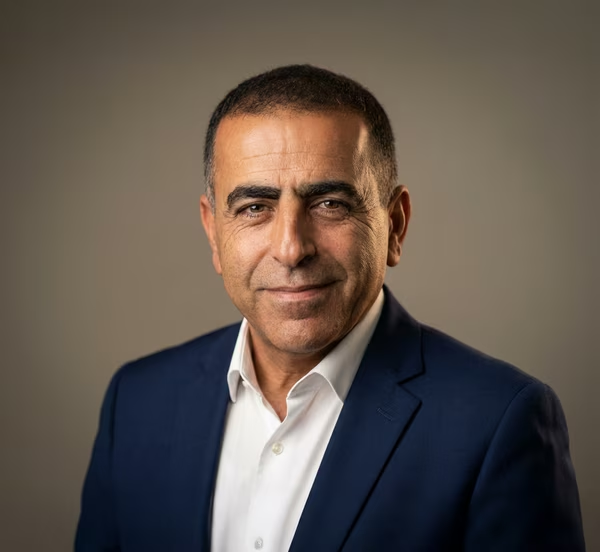
On the internal Israeli front, MK Ayman Odeh believed that the government is racing against time to impose strategic realities on the ground before the upcoming parliamentary elections. Odeh indicated that the primary goal is to definitively rule out the possibility of establishing a Palestinian state and prevent it permanently through intensified settlement and silent displacement.

The Council of Settlements welcomed the decisions, considering them the most important since 1967 because they enshrine de facto Israeli sovereignty. The Council stated in its announcement that the government has practically declared that this land belongs to the Jewish people, ending decades of legal ambiguity in the region.

These decisions express a clear policy based on strengthening Israeli control in Judea and Samaria, promoting settlement, and ensuring Israel's future in this land for generations.
ISRAELI AFFAIRS

Mon 09 Feb 2026 1:25 am - Jerusalem Time

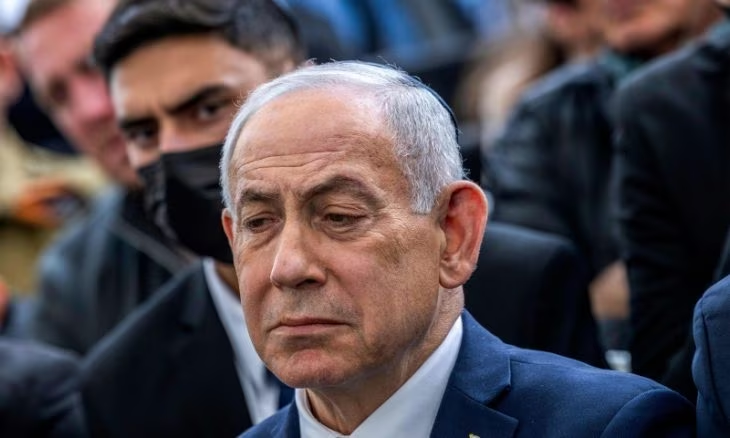
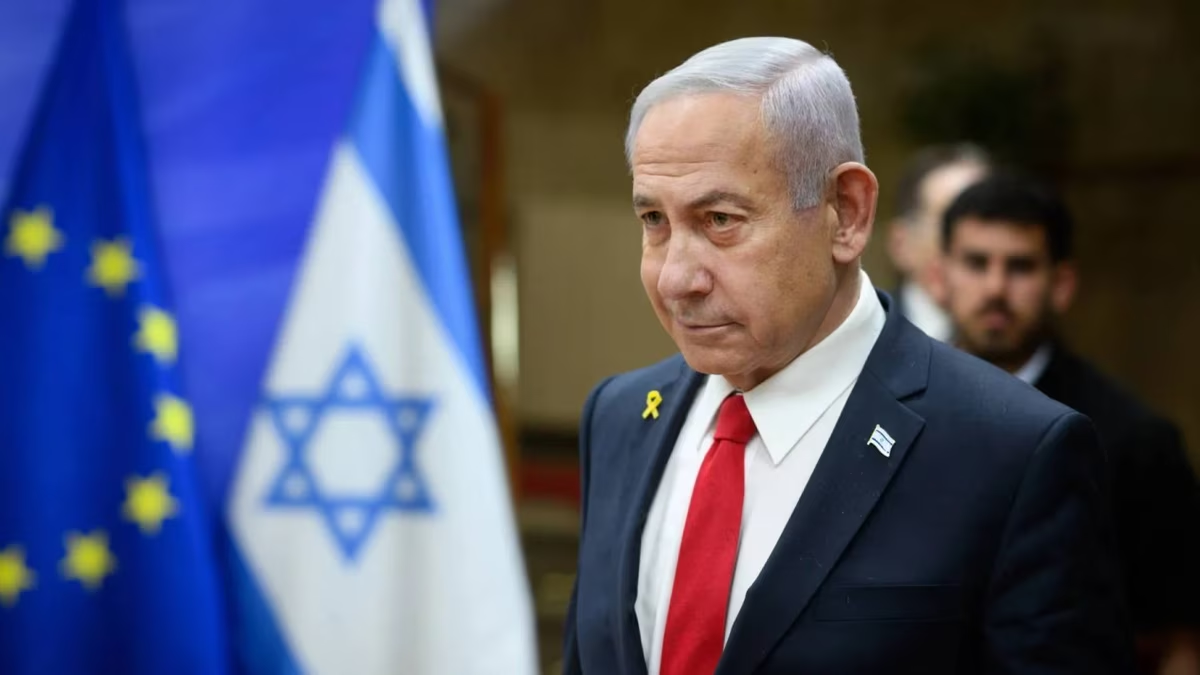
Netanyahu to bring Iranian missile and nuclear files to White House on Wednesday

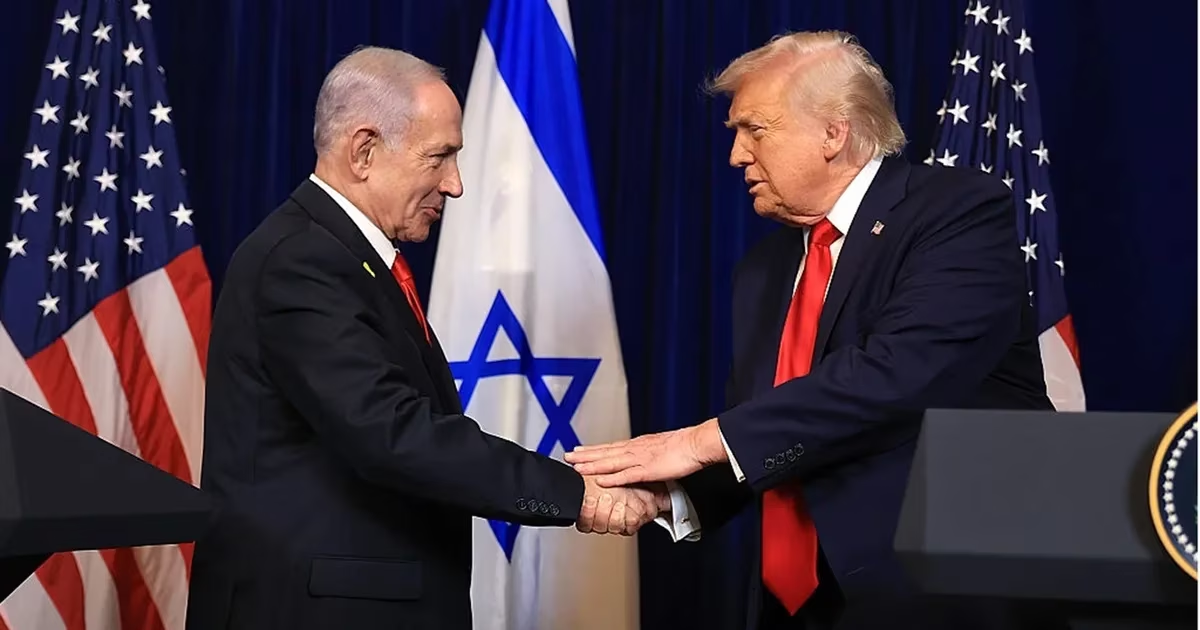
Hebrew media sources revealed intensive diplomatic and military movements by Tel Aviv ahead of Prime Minister Benjamin Netanyahu's anticipated visit to Washington. Reports indicated that an extensive meeting was held between American and Israeli officials, with its agenda focused on the war in the Gaza Strip and escalating Iranian threats in the region. These preliminary discussions aim to coordinate positions before the direct meeting scheduled for Wednesday between Netanyahu and US President Donald Trump.

During his meeting with Trump, Netanyahu seeks to extract strict American commitments regarding any future agreement with Tehran, where he will demand that the agreement include provisions imposing clear restrictions on the range of Iranian intercontinental missiles. Israeli demands also include a fundamental condition that all quantities of enriched uranium be removed from Iranian territory, to ensure that the regime cannot possess a nuclear weapon under any circumstances, which Tel Aviv considers a red line that cannot be compromised.

In a move reflecting the operational nature of the visit, Netanyahu is accompanied by a high-level military delegation comprising elite generals from the occupation army and prominent air force commanders. The presence of this military delegation at the White House aims to provide detailed intelligence and technical reports to the new American administration, emphasizing the necessity of continued unlimited arms support and air cover for Tel Aviv in light of the current security challenges in the Gaza Strip and other fronts.

Ongoing deliberations also focused on mechanisms to maintain what is called Israel's 'qualitative military edge' in the Middle East, ensuring that its military capabilities remain the most advanced in confronting emerging threats. Observers believe that this visit represents an initial test of the nature of the relationship between Netanyahu and the Trump administration in its new term, especially regarding how to deal with Iranian regional ambitions and the future of military operations in the Palestinian territories.

Netanyahu will ask Trump to include provisions in any future agreement that restrict the range of Iranian missiles and ensure the removal of enriched uranium from the country.

ISRAELI AFFAIRS

Mon 09 Feb 2026 1:11 am - Jerusalem Time

Escalating Israeli Incitement Against Islamic Organizations in the West Under the Guise of 'Soft Jihad'

The intensity of Israeli incitement against Islamic organizations and human rights institutions operating in Western societies has escalated. Research circles in Tel Aviv have deemed these entities to be engaged in a strategic battle of consciousness, whose impact surpasses that of traditional military confrontations. Israeli observers believe that the current conflict with the Palestinian people now extends beyond geographical borders, reaching the heart of academic and cultural institutions in the United States and Europe.

In this context, Ayala Kainan, a researcher in social networks and artificial intelligence, claimed that Islamic movements realized early on the importance of controlling the historical and cultural narrative. In an article for 'Yedioth Ahronoth' newspaper, she indicated that Israel and its allies in the West cannot continue to ignore what she described as a 'soft combat front' aimed at undermining liberal values from within.

Israeli claims were based on old documents that American security authorities allegedly seized decades ago, including a document from 1991 that spoke of a long-term strategy for infiltrating Western institutions. These reports claim that the ultimate goal is to change the cultural identity of Western societies by building a wide network of schools, universities, and research centers that adopt a discourse contrary to the prevailing narrative.

Israeli propaganda uses the term 'soft jihad' to describe the legal and media activities carried out by Muslim communities and supporters of the Palestinian cause. Kainan claims that these activities are not aimed at direct confrontation in the streets, but rather seek a gradual erosion of trust in Western identity, ultimately weakening political and military support for Israel.

Israeli incitement also touched upon historical events, such as the 1993 Philadelphia meeting monitored by the FBI, to claim that there is organized coordination to support Palestinians through civilian tools. This strategy, according to the Israeli claim, focuses on using emotional and legal language that appeals to the Western conscience and attracts young generations in prestigious universities.

Regarding the current student movement, Israeli sources directed direct accusations at the organization 'Students for Justice in Palestine' (SJP), considering it an executive arm for foreign agendas. Reports claimed that this organization receives funding and guidance from entities linked to the Muslim Brotherhood, with the aim of creating a state of continuous popular pressure against Israeli policies.

The Israeli researcher linked current human rights organizations to former relief institutions closed by Washington, such as the 'Holy Land Foundation,' in an attempt to brand current civil activity as illegal. These approaches aim to push Western governments to take restrictive measures against institutions that adopt a discourse critical of the Israeli occupation and its practices in the Palestinian territories.

Kainan warned that ignoring these movements under the guise of 'freedom of expression' or 'cultural diversity' poses a strategic danger to Israel, especially with the increasing campaigns to delegitimize it. She explained that the success achieved by these organizations is clearly evident in the decline of support for Israel among young people in the West, who are now more inclined to adopt the Palestinian narrative.

Israeli incitement views political Islam as a transnational ideology that cannot be contained solely through economic improvements or living welfare. Accordingly, these circles demand the adoption of a comprehensive Western strategy to monitor foreign influence in universities and ensure full transparency in the funding sources of civil society organizations.

Israeli recommendations call for strengthening what they call 'digital culture' to counter Palestinian content on social media platforms, which they consider part of the war of consciousness. These recommendations emphasize the need to seriously address awareness campaigns targeting the Western public, considering that the real conflict is now taking place in the global public opinion sphere.

It is noted that Israeli discourse tries to exploit Western fears of 'Islamophobia' to justify the suppression of pro-Palestinian political activity, by portraying it as an existential threat to Western civilization. Sources believe that refusing to criticize these organizations under the pretext of fighting discrimination gives them legal cover to continue changing societal and political values in Europe and America.

Israel's focus on the 'narrative' reflects an implicit acknowledgment of the failure of traditional military tools to resolve the conflict on the international stage. While Israel possesses a sophisticated military arsenal, it finds itself in a defensive position against student and human rights movements that succeed in isolating it morally and politically in international forums and major universities.

In conclusion of the incitement, the Israeli researcher demanded the necessity of recognizing that this activity represents a 'strategic challenge' that requires security and intelligence coordination between Israel and Western countries. This includes monitoring curricula and teacher training programs, to ensure that what she described as ideas hostile to Western values and to Israel do not infiltrate future generations.

This report reflects the deep concern within the Israeli establishment about losing control over global public opinion, as the Palestinian narrative has found a wide resonance that transcends traditional boundaries. Incitement against Islamic and human rights organizations remains a key tool in Tel Aviv's attempt to regain the initiative in the international battle of consciousness.

Wars today are decided by narratives no less than by weapons and combat means, and Israel cannot ignore the consciousness front.

PALESTINE

Mon 09 Feb 2026 1:10 am - Jerusalem Time

Widespread Raids in the West Bank: Arrests in Nablus and Ramallah, Assault on an Elderly Man

An Israeli special force stormed the city of Nablus in the northern West Bank on Sunday evening, with the operation focused on the Martyrs' Roundabout area in the city center. The raid resulted in the arrest of young man Khamis Abu Suriya, while the forces fired a barrage of tear gas canisters at citizens before withdrawing from the area.

In the context of field assaults, the Palestinian Red Crescent Society reported that its teams dealt with an injury to a 70-year-old elderly Palestinian man. The society clarified that the elderly man was severely beaten by occupation soldiers during the military operation in Nablus, necessitating his immediate transfer to the hospital for treatment.

The town of Beita, south of Nablus city, witnessed violent confrontations between Palestinian youths and occupation forces who stormed the town and raided a number of homes. Israeli forces used live ammunition and toxic gas canisters to disperse the demonstrators who pelted military vehicles with stones to express their rejection of the raid.

In Ramallah Governorate, occupation forces arrested young man Youssef Mohammed Naasan after raiding his commercial shop in the village of Al-Mughayyir, northeast of the city. Local sources reported that a large military force deployed throughout the village and forced shop owners to close their doors under threat of arms.

The raid on Al-Mughayyir village included assaults on civil defense volunteers, as soldiers searched their vehicles and abused them in the field. The army also heavily fired sound bombs and tear gas towards homes, leading to cases of suffocation among citizens inside their houses.

In a related development, Israeli forces stormed the village of Shaqba, west of Ramallah, where they set up a military checkpoint in the center of the village to restrict movement. Occupation forces forced merchants to close their shops, a step that has been repeated in several areas of the West Bank as part of the collective punishment policy.

These escalations come within the framework of an intensive campaign launched by Israel in the West Bank since the start of the war on October 7, 2023. These assaults include killings, arrests, and settlement expansion, which observers describe as an actual prelude to the official annexation of large parts of the West Bank.

According to the latest official statistics, the number of victims in the West Bank since October 2023 has risen to at least 1,112 martyrs and about 11,500 injured. The number of Palestinian detainees in occupation prisons during this period has also exceeded 21,000 detainees, amid harsh detention conditions.

Red Crescent teams transported a 70-year-old elderly man to the hospital after he was severely beaten by occupation soldiers during the raid on Nablus city.

PALESTINE

Sun 08 Feb 2026 11:41 pm - Jerusalem Time

Dead in Gaza and the Escalating Crisis of Hearing Impairments Due to Explosions

Israeli attacks continued on various areas in the Gaza Strip, resulting in the martyrdom of five Palestinians, two of whom succumbed to injuries sustained earlier. These field developments come amidst ongoing violations of the ceasefire agreement, as drones and military outposts targeted civilian gatherings in the northern, central, and southern parts of the Strip.

Regarding the details of the field targeting, sources reported the martyrdom of a Palestinian and the serious injury of another after an Israeli drone dropped a bomb towards them in the Al-Atatra area. The attack occurred near the Sakhnin school northwest of Beit Lahia, where the victims were present in an area that had suffered extensive destruction in recent months.

In the central Strip, a young Palestinian man was martyred by the bullets of occupation forces stationed in the eastern areas of Deir al-Balah city. At the same time, medical teams recorded the martyrdom of a 16-year-old boy in the Al-Zaytoun neighborhood northeast of Gaza City, after being directly shot in the area opposite Salah al-Din Mosque.

In Khan Yunis city to the south, medical sources announced the martyrdom of two new individuals who were receiving treatment for previous injuries sustained during military operations. This new toll raises the number of victims of occupation violations since the start of the ceasefire agreement to 576 martyrs and over 1500 injured, threatening the stability of the fragile truce.

Beyond direct injuries, a severe health and humanitarian crisis has emerged, with thousands of Palestinians losing their hearing due to pressure waves from high-explosive bombs. Initial medical estimates indicate that approximately 35,000 people in the Gaza Strip currently suffer from hearing loss or severe impairment, placing an additional burden on the dilapidated healthcare system.

Three-year-old child Lujain is an example of this suffering, having lost about 70% of her hearing ability due to the successive explosions that shook her residential area. The child's family faces severe difficulties in securing her treatment and rehabilitation journey amidst the destruction of specialized care centers in the southern Strip and the absence of necessary technical capabilities.

For his part, Lujain's father explained that the rehabilitation process requires advanced medical equipment not currently available in Gaza, noting that the high costs fall entirely on the families. He added that the treatment journey, which began three months ago, faces significant obstacles, most notably the lack of assistive devices and the difficulty of accessing specialized examination centers.

In a related context, child Karam Raihan lost more than half of his hearing ability after his eardrum ruptured due to an Israeli shelling that targeted an area near his location. His family recounts a long struggle to find suitable hearing aids, given the scarcity of centers that provide maintenance and periodic examination services for people with hearing disabilities in the Strip.

Fadl Karaz, an activist in the field of rights for people with hearing disabilities, confirmed that the number of people suffering from hearing loss has doubled alarmingly during and after the war. Karaz stressed the urgent need for international and local efforts to pressure the occupation authorities to allow the entry of medical hearing aids and necessary spare parts for their maintenance, which have been banned since October 2023.

International reports indicate that the destruction that affected 90% of civilian infrastructure in Gaza also included specialized health centers and medical laboratories. The United Nations estimates the cost of rebuilding what the war destroyed at about 70 billion dollars, an amount that reflects the scale of the catastrophe that has befallen the Strip over two years of intense fighting.

Hearing impairments resulting from the war are not just physical injuries, but a long-term social and educational barrier, especially for children who need early intervention. With continued Israeli restrictions on crossings, thousands of injured people remain deprived of their right to treatment and access to assistive devices that could save what remains of their senses.

In conclusion, the heavy toll of the two-year war, which left more than 72,000 martyrs and 171,000 injured, remains a testament to the scale of the humanitarian tragedy. With every new violation of the ceasefire, the list of victims grows, and wounds deepen in a society trying to pick up its pieces amidst the rubble of destroyed homes and vital facilities.

Medical estimates indicate that approximately 35,000 people have suffered from hearing loss or severe impairment due to the massive pressure waves caused by the explosions.

ARAB AND WORLD

Sun 08 Feb 2026 11:26 pm - Jerusalem Time

Dutch Parliament Votes to Reduce Reliance on Israeli Weapons

The Dutch Parliament witnessed a significant political shift by voting in favor of a proposal calling on the government to reduce its reliance on military technology and equipment imported from Israel. This step comes within the framework of Dutch efforts to enhance the strategic independence of the European continent and avoid engagement with suppliers facing international accusations of violating human rights and international humanitarian law in armed conflicts.

The decision gained significant political weight as it was supported by two of the three parties forming the prospective government coalition, which is expected to be officially installed this month. This trend reflects growing discontent within European political circles regarding ongoing Israeli military operations, particularly in the Gaza Strip, prompting lawmakers to demand a review of close defense relations with Tel Aviv.

In statements to media sources, Stephan van Baarle, head of the parliamentary bloc of the "DENK" party, affirmed that his party adopts a firm stance against the continued flow of Dutch funds to Israeli defense companies. Van Baarle pointed out that Israel uses Palestinian territories as a testing ground for its military systems before exporting them abroad, which raises serious ethical and legal concerns for the Dutch side.

Data issued by non-governmental organizations in the Netherlands indicates that government spending on military deals with Israel amounted to approximately two billion euros in recent years. Observers believe that this volume of military trade directly contributes to supporting the Israeli war economy, especially with major companies such as "Elbit Systems," which are closely linked to the Israeli security establishment.

Dutch parliamentarians stressed that continuing to conclude arms deals with Israel places the country in a position of complicity with practices described as "war crimes" and documented by international human rights bodies. Although the current decision focuses on reducing reliance, there are voices within parliament, led by the DENK party, demanding to go further by imposing a comprehensive and complete ban on arms trade with Israel.

Despite this progress in the military deals file, the Dutch Parliament still shows sharp divisions on political issues related to the conflict, as a proposal for official recognition of the Palestinian state was recently rejected. Van Baarle explained that the parties of the new government coalition did not give the recognition file the necessary priority, despite the electoral promises made by some of these parties to their voters earlier.

DENK pledged to continue political pressure within the parliament to push the government towards taking bolder diplomatic steps, including recognizing the State of Palestine. These political forces believe that reducing military cooperation should be followed by a clear political stance that supports the right of the Palestinian people to self-determination and sends a firm message to the Israeli occupation about the necessity of stopping its systematic violations.

Buying weapons from Israeli defense companies practically means funding the Israeli government and its war economy, which makes the purchasing countries complicit in financing the war machine.

PALESTINE

Sun 08 Feb 2026 10:26 pm - Jerusalem Time

Radical Transformation in the West Bank: Israeli Decisions End Oslo Era and Impose Institutional Annexation

Israeli steps are accelerating towards reshaping the legal and administrative reality in the occupied West Bank, through a series of decisions that go beyond mere traditional settlement expansion. These measures, approved by the ministerial committee, aim to shift the annexation process from field practices to a comprehensive institutional and legal level that strikes at the core of previously signed agreements.

Current data indicates that these decisions are the most significant since 1967, as they do not merely change the landscape, but rather reorganize property and demolition files on a wide scale. According to media sources and statements by the Settlement Council, the goal is to entrench Israeli sovereignty de facto by changing purchase and construction regulations.

Observers believe that these steps represent a transition from a direct military occupation model to a hybrid administrative model, in which Israeli civil institutions are granted broad powers. This is done without an official declaration of sovereignty, thereby solidifying the Israeli presence as the sole legal authority over the occupied Palestinian land.

Experts in Israeli affairs confirmed that Tel Aviv has moved beyond the logic of temporary occupation management and has begun to abolish the legal status of the West Bank as occupied territory under international law. The area is currently being dealt with under the name "Judea and Samaria," with its direct subjection to Israeli civil laws and regulations.

The great danger lies in ending the legal authority of the Palestinian Authority over areas classified (A) and (B), where it had administrative and security powers. The new decisions lead to the return of property and infrastructure management in these areas to direct Israeli control, which undermines the Oslo understandings.

Regarding land ownership, the transfer of "Tabu" (land registration) powers and property registration to the Israeli Civil Administration opens the door to legitimizing the seizure of Palestinian properties. These new laws allow for the transfer of land ownership to settlers even within densely populated urban areas that were considered far from targeting.

Reports indicate that the Civil Administration, overseen by Finance Minister Bezalel Smotrich, has transformed from a limited executive body into a comprehensive sovereign authority. This body can now intervene in all aspects of Palestinian life under the pretext of environmental protection, antiquities, or security requirements.

Hebron city and Rachel's Tomb area in Bethlehem stand out as two primary hotspots of danger within this new plan, as Israel seeks to impose a municipal authority for settlers there. Field steps have included withdrawing the powers of managing the Ibrahimi Mosque from the Hebron municipality and handing them over completely to the Civil Administration of the occupation.

On the international level, former diplomats warned that these measures clearly express Israel's intention to definitively eliminate the idea of an independent Palestinian state. They considered that international silence or merely condemning statements encourages the Israeli government to proceed with liquidating what remains of the two-state solution.

The Wall and Settlement Resistance Commission indicates that Israel is challenging the entire international community through these laws that legitimize settlement and abolish Palestinian institutional presence. The commission called for the necessity of an effective deterrent to stop the implementation of these decisions on the ground before it is too late.

In light of this transformation, Palestinians in major cities classified (A) are threatened with demolition and confiscation operations without any national legal authority to protect them. This development represents a complete collapse of the legal umbrella provided by international and local agreements for the Palestinian population over the past three decades.

Israeli government ministers, such as Israel Katz and Bezalel Smotrich, confirm that these decisions aim to remove what they describe as "discriminatory legal obstacles." This discourse reflects a desire to equate settlers with citizens inside Israel in terms of property and administrative rights in the West Bank.

For its part, Palestinian academic and diplomatic circles called for the necessity of moving from political statements to practical measures to confront annexation. This includes demanding that international parties impose tangible sanctions and ban dealings with Israeli institutions that manage the occupied territories.

The scene in the West Bank remains open to escalation possibilities, with Israel continuing to impose legal realities that will be difficult to reverse in the future. This stage is considered the most critical in the history of the conflict, where the language of negotiation is being replaced by the language of unilateral laws and absolute institutional control.

The decisions represent a clear transition from policies of imposing a fait accompli to actual, institutional, and comprehensive legal annexation of the West Bank.

ISRAELI AFFAIRS

Sun 08 Feb 2026 8:41 pm - Jerusalem Time

Anticipated Summit Between Trump and Netanyahu in Washington to Discuss Iranian Nuclear File and Future of Gaza

The office of Israeli Prime Minister Benjamin Netanyahu announced his departure for the American capital, Washington, next Wednesday for an official meeting with US President Donald Trump. This meeting comes at a sensitive time to discuss the ongoing negotiations regarding the Iranian nuclear file, which have recently seen developments in the Omani capital, Muscat.

This meeting marks the 15th in the history of the official relationship between the two leaders, as President Trump's second term witnessed an unprecedented intensification in the pace of direct communications. These successive meetings reflect the high level of strategic coordination between the current US administration and the occupation government in confronting regional challenges.

Official records indicate that Trump's first term saw 7 key meetings, which served as a platform for announcing historical decisions such as the recognition of Jerusalem as the capital of Israel and the normalization agreements. With Trump's return to the White House in January 2025, meetings accelerated to reach another 7 meetings in just one year, highlighting the depth of the current alliance.

The Iranian nuclear agenda tops the discussion table, as Netanyahu seeks to impose a "high ceiling" of Israeli conditions on any potential agreement between Washington and Tehran. These demands include the complete dismantling of Iran's nuclear infrastructure and the transfer of enriched uranium stockpiles outside Iranian territory to ensure no return to manufacturing.

In addition to the nuclear file, the ballistic missile file stands out as one of the fundamental points of contention that Netanyahu will raise, as he demands strict restrictions on Iran's missile range. Tel Aviv insists that the range of Iranian missiles should not exceed 300 kilometers, a demand that Tehran categorically rejects and considers an infringement on its defensive sovereignty.

Netanyahu is accompanied on his trip to Washington by the commander of the Israeli Air Force, in a move described by sources as unconventional and carrying clear military messages. This military presence aims to provide a detailed technical presentation to President Trump on available military options and the second round of potential airstrikes should diplomatic efforts fail.

On the Palestinian front, the two leaders will discuss the completion of the Gaza peace plan announced last September. Discussions will focus on mechanisms for the complete disarmament of the Hamas movement and the demilitarization of the Strip as a fundamental condition set by Israel before commencing any extensive reconstruction operations.

Discussions also touch upon the second phase of the Gaza plan, which includes the formation of an international administration under the name "Peace Council" to manage the affairs of the Strip. Both parties seek to ensure that the new administration is consistent with the shared Israeli-American security vision, thereby preventing the return of armed Palestinian factions to power.

Returning to the history of meetings in 2025, Netanyahu inaugurated Trump's second term with a visit on February 4, followed by meetings in April and July to discuss military operations against Iran. Meetings continued in September and October, where Trump visited occupied Jerusalem and delivered a speech in the Knesset, leading up to the Mar-a-Lago meeting last December.

Informed sources confirm that Netanyahu aims through this intensive activity to ensure that the US administration does not make any substantial concessions to Iran in the Muscat negotiations. The Israeli Prime Minister believes that maximum pressure is the only way to undermine the influence of the so-called "axis of resistance" in the region and reduce Iranian support for its allies.

The relationship between Trump and Netanyahu at this stage is characterized by great harmony, surpassing what it was in the first term, especially after overcoming the period of estrangement that preceded the US elections. This harmony is evident in the speed of decision-making related to joint military operations and high-level security coordination on regional issues.

The Wednesday meeting is expected to result in the formulation of joint "red lines" regarding Iranian ambitions, which could directly affect the course of international negotiations. Political circles are awaiting whether Trump will fully adopt the hardline Israeli demands regarding the Iranian missile and nuclear program.

In a related context, reports indicate that discussions will also address the expansion of regional normalization, complementing the "Abraham Accords" that began in the first term. Both parties seek to integrate more Arab countries into the regional security system to confront common threats, linking this to the path of a political solution in the Gaza Strip.

In conclusion, the 15th meeting between the two leaders represents the pinnacle of political and military coordination, as Netanyahu seeks to obtain full American cover for his upcoming moves. Whether on the Iranian or Palestinian file, the shared vision between the White House and Tel Aviv in Trump's second term appears more resolute towards changing the geopolitical reality in the Middle East.

Netanyahu seeks to pressure Trump not to make concessions to Iran, with a focus on restricting ballistic missiles and halting support for the axis of resistance.

ISRAELI AFFAIRS

Sun 08 Feb 2026 8:26 pm - Jerusalem Time

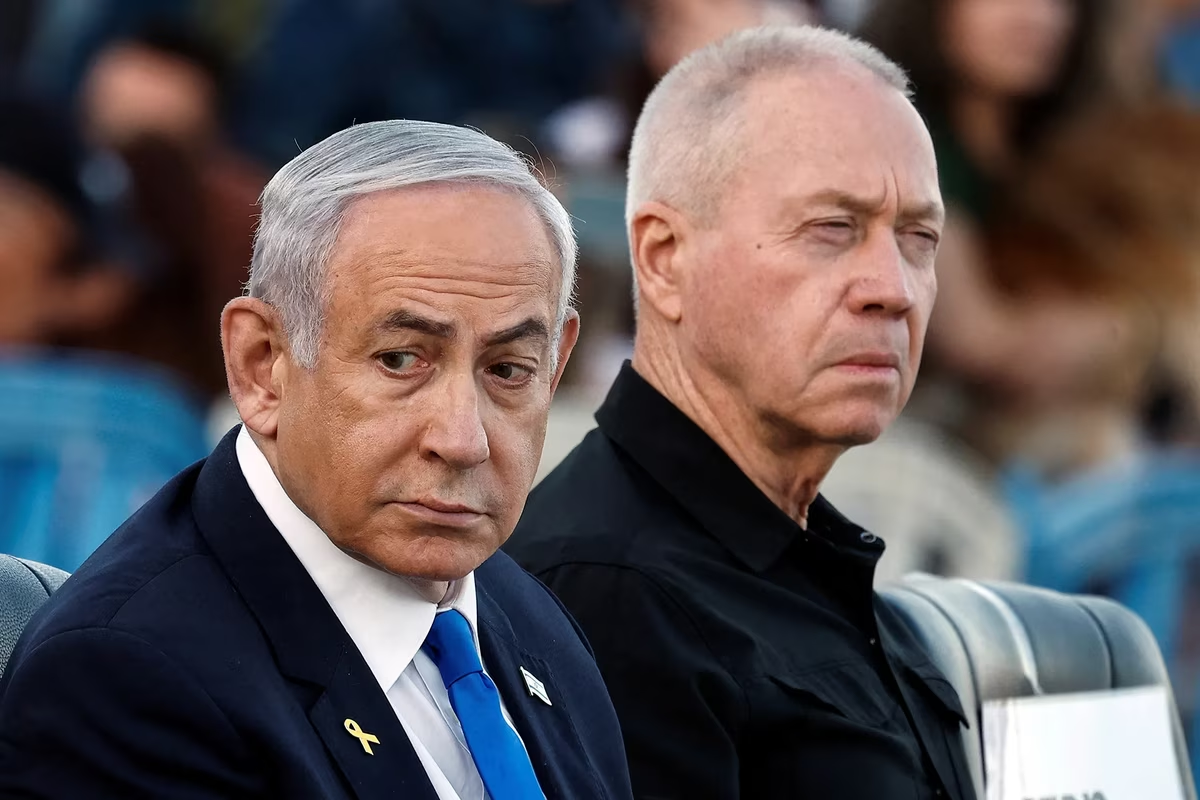
Gallant describes Netanyahu as 'a liar' and accuses him of falsifying facts about the October 7 failure

The Israeli political arena has witnessed an unprecedented escalation in the intensity of mutual accusations between former and current ruling figures, as former Defense Minister Yoav Gallant launched a direct and frank attack on Prime Minister Benjamin Netanyahu. Gallant described Netanyahu as 'a liar,' accusing him of attempting to craft a misleading narrative aimed at evading full responsibility for the security and military failures that preceded and accompanied the October 7, 2023 attack.

This outburst of statements came after Netanyahu published a lengthy 55-page document containing his official responses submitted to the State Comptroller regarding the events of the war. Through this document, Netanyahu attempted to shift blame onto army leaders and security institutions, claiming that they underestimated the seriousness of threats from the Gaza Strip and opposed taking decisive preemptive measures.

Gallant, in an interview with Israeli media, considered the timing of this document's publication a stab in the back of soldiers and the military establishment at a time when combat operations are still ongoing. He affirmed that Netanyahu systematically incited against army commanders and the internal security service (Shin Bet), trying to portray himself as the only figure who demanded toughness against Palestinian factions.

The former Defense Minister revealed sharp contradictions in Netanyahu's narrative, pointing out that the latter was not an advocate for major assassinations, such as targeting Hezbollah Secretary-General Hassan Nasrallah in their early stages. He clarified that there is a vast gap between the hawkish public rhetoric the Prime Minister promotes to the public and the political and personal calculations that govern his decisions behind closed doors.

Regarding military operations in the city of Rafah, Gallant refuted Netanyahu's claims that the delay was due to concerns among army leadership. He clarified that the real reason was purely logistical, as the army sought to secure a sufficient stock of ammunition in anticipation of a widespread conflict on the northern front, far from the political justifications Netanyahu is trying to promote.

Gallant also touched upon the funding issue, accusing Netanyahu of adopting a strategic policy of allowing money to flow into the Gaza Strip for many years. He claimed that this policy aimed to weaken the Palestinian Authority, but ultimately led to strengthening the military capabilities of factions in Gaza instead of deterring them, as was rumored.

The former minister strongly criticized Netanyahu's crisis management style, saying that his priorities begin with himself first, then the survival of his government, and only in the last place comes the interest of the state. He added that the Prime Minister attributes military successes only to himself, while he is quick to blame others for any failure or setback faced by Israeli policies.

For his part, opposition leader Yair Lapid joined the offensive front, asserting that Netanyahu's document is a desperate attempt to erase history and falsify established facts. Lapid indicated that he personally warned Netanyahu in August 2023 of the danger of multiple fronts igniting based on accurate intelligence reports, questioning how the Prime Minister could claim ignorance of those risks.

This war of words comes at a very sensitive time, as both Netanyahu and Gallant face international arrest warrants issued by the International Criminal Court since November 2024. These international legal pursuits further complicate the internal scene, as each party tries to clear its name before both Israeli public opinion and the international community.

Recent opinion polls indicate a clear erosion of Netanyahu's popularity, with more than half of Israelis expressing a desire for him to retire from political life. Nevertheless, Netanyahu appears determined to contest the upcoming elections, using all available tools to defend his political narrative and ensure his continued stay in power despite the corruption cases pursuing him.

Observers believe that Netanyahu's refusal to form an official and independent investigation committee so far reinforces the suspicions of the opposition and the military establishment about his true intentions. Instead of an official committee, Netanyahu is pushing for the formation of a 'political' committee that grants his ruling coalition the ability to choose its members, which the opposition considers an attempt to bury the facts.

The current conflict in Israel has transcended the boundaries of traditional political disagreement to become an existential 'battle of narratives' that touches the core of the state's security doctrine. This division is compared to the repercussions of the 1973 war, but observers believe that the current earthquake is more severe given the unprecedented scale of intelligence and political failure in Israel's history.

With the parliamentary elections approaching, the pace of leaks from secret meeting minutes is expected to increase, as each camp tries to use security information as a political weapon. This sharp polarization raises serious concerns within Israeli society about the possibility of political differences escalating into street violence before heading to the ballot boxes.

Ultimately, the lingering question in the Israeli street remains about who will be able to impose their final narrative about the October events. Between Gallant's accusations of deception and Netanyahu's defenses with leaked documents, the truth remains absent in the absence of an official and independent investigation that clarifies the most dangerous crisis Israel has faced in decades.

We have a lying prime minister... While our soldiers were dying, he chose to stab them in the back by inciting against the leaders of the security establishment.

OPINIONS

Sun 08 Feb 2026 7:02 pm - Jerusalem Time

When the Path is Lost: Palestinian Society and Broken Politics

Dr. Ibrahim Nairat

Opinion Writer

The Palestinian political scene today appears as a foggy space whose corners are difficult to grasp, not only due to the complexity of the imposed colonial reality, but as a result of a deep internal distortion accumulated over many years of division and impotence. Politics, which is supposed to be a tool for organizing, directing, and opening horizons for conflict, has turned into a heavy burden on the people, losing its ability to persuade and create meaning. The people seem to know their enemy well, but they do not see the path to it. This loss of direction does not mean an absence of awareness or a fading of will, but rather reflects a growing disconnect between the harsh daily experience of Palestinians and the political discourse that is supposed to represent and lead them.

The division is no longer merely a temporary disagreement or an emergency that can be contained by a deal or an internal settlement; rather, it has transformed into an entrenched structure that produces its own interests and closed language, reproducing itself sometimes in the name of realism, and other times in the name of necessity. Over time, the idea of a unifying national project has eroded, replaced by multiple conflicting narratives, each claiming to possess the complete truth, while all of them fail to provide a practical and convincing answer to the question of the future.

The division is no longer limited to factions or political elites only, but has extended to society itself. People no longer know what to do, what to believe in politically, and how to get out of this suspended state. Individual ideas and isolated experiences have multiplied, to the point where every opinion stands on its own, separate from any clear collective project or common horizon. In this vacuum, politics is no longer an act of change, but rather the management of a permanent crisis, and the goal is no longer to break the balance of power, but to adapt to it with the least possible losses.

In this context, the occupation found an ideal environment to deepen its control, not only because it reduces the cost of direct confrontation, but because it observes the disintegration of the Palestinian political sphere from within, without the need for constant or overt intervention. Disintegration here is not imposed by force alone, but is produced from within the Palestinian reality itself, through the absence of a project, the erosion of legitimacy, and the transformation of politics into a practice separate from the people.

The masses today are far from political participation, silent or withdrawn, but this withdrawal cannot be understood as indifference or passivity. It is an expression of deep and accumulated frustration. Skepticism about the usefulness of participating in democratic mechanisms has become understandable, because people no longer see a clear horizon or goal in these mechanisms. When democracy transforms from a tool of struggle and change into a formal ritual without substance, political action loses its meaning. The question is no longer: whom do we elect? But: why do we elect? And where does this path lead us anyway?

The picture is bleak, frustration is widespread, and political frameworks have gradually lost their legitimacy. Not because the masses suddenly decided to strip away this legitimacy, but because they failed to renew themselves and to build a genuine relationship of trust with the people. Legitimacy today is no longer derived from history alone, nor from past sacrifices only, but from the ability to read reality as it is, represent it honestly, and offer a reasonable horizon for exiting it.

With repeated disappointments, many people tend towards individual survival, or spontaneous, unorganized action, more as an expression of anger than as a sustainable political path. This is evident in un-framed uprisings, limited local initiatives, or forms of daily resistance outside traditional frameworks. These actions, despite their limitations, reveal something important: politics has not disappeared from society, but it has withdrawn from its official institutions. With the multiplicity of individual ideas within society, each individual searches for their own meaning, in the absence of a unifying project capable of gathering these energies and transforming them into an organized force.

Despite all this, popular awareness remains present. It appears in grassroots initiatives, in forms of local solidarity, and in the Palestinians' constant ability to redefine themselves outside official frameworks when they fail. The danger of the current moment lies not only in the bleakness of the picture, but in the vacuum that expands with the erosion of legitimacy and the absence of meaning. This vacuum will not remain neutral; it will either be filled by new initiatives stemming from society, rebuilding political action on different foundations, or it will be left for the occupation and projects of disintegration and containment to exploit.

Exiting this labyrinth does not begin with a mere call for participation, nor with the revival of mechanisms that have lost their spirit, but by re-posing the major questions that have been long postponed: What is the possible interim goal today? What is the viable form of a national project given the existing balance of power? And how can politics be rebuilt as a collective action that reflects the actual interests of the people, not as a closed administration practiced over their heads?

Restoring the compass requires courage in criticism, a frank acknowledgment of the extent of the breakdown, and a willingness to think in new or renewed forms of representation, starting from the social and political reality as it is, not as it is desired to be. These forms may be grassroots, or transcend traditional frameworks, or be more connected to society than to institutions, but in all cases, they must reconnect politics with the people, not reproduce the same rupture under new names.

The path may not be short or clear, but restoring meaning is the first step. Without it, the masses will remain on the margins of politics, and politics will continue to revolve in its own vacuum, while the rift between the people and those who claim to represent them deepens. Exiting this bleak moment is possible, but it is conditional on the birth of a politics that resembles the people, acknowledges their frustration, expresses it honestly, and transforms it from a state of paralysis and waiting into a founding energy for a new national path.

PALESTINE

Sun 08 Feb 2026 6:56 pm - Jerusalem Time

Warnings of deteriorating health condition of three prisoners in Megiddo Prison due to medical negligence

The Palestinian Commission of Detainees and Ex-Detainees Affairs launched an urgent distress call today, Sunday, to warn of the serious deterioration in the health conditions of three prisoners held in the Israeli Megiddo Prison. The commission confirmed in an official statement that these prisoners are facing a deliberate and systematic policy of medical negligence, aimed at undermining their physical well-being and depriving them of the most basic internationally guaranteed medical rights.

Sources explained that the occupation prison administration not only deprives patients of treatment but also imposes harsh living conditions on them, including policies of deliberate starvation and thirst. Prisoners are also subjected to humiliating daily searches, and are deprived of basic personal hygiene supplies, which exacerbates the spread of diseases and ailments inside the overcrowded cells.

Regarding the details of the medical cases, prisoner Abdullah Mahmoud Muzher, 25 years old, from Balata refugee camp, suffers from an old shrapnel injury in his left eye that causes him constant burning due to the lack of necessary cleaning drops. Muzher also complains of severe pain in his right hand that requires urgent surgical intervention, but the prison administration refuses to give him even simple painkillers to alleviate his suffering.

As for prisoner Muhammad Sobhi Hamadneh, 42 years old, from Nablus, he suffered a severe health setback after contracting an intestinal virus similar to 'amoeba' last February. This infection led to a massive weight loss, reaching only 37 kilograms, with a sharp drop in blood pressure that caused him recurrent fainting spells and extreme difficulty in breathing and standing.

Regarding prisoner Yaqoub Mahmoud Qadri, 53 years old, detained since 2003, he has been suffering from thyroid disorders for three years without surgical treatment. Qadri also suffers from multiple disc herniations in his spine and neck dating back more than twenty years, in addition to excruciating tooth pain that requires treatment in a specialized clinic, which the administration refuses to transfer him to.

These testimonies come at a time when human rights reports documenting the escalation of torture and abuse campaigns against Palestinian prisoners have been increasing since October 2023. Many ex-detainees have recently reported being subjected to systematic torture and starvation, which led to the appearance of symptoms of mental illness and severe emaciation on their bodies as a result of the inhumane conditions they endured.

For its part, Palestinian forces and factions condemned these crimes, describing what is happening inside the prisons as a 'full-fledged crime' taking place amidst complete international silence. Statements indicated that the occupation is exploiting the current circumstances to tighten the noose on prisoners and turn prisons into cemeteries for the living, in flagrant violation of the Fourth Geneva Convention concerning the protection of civilians and prisoners.

Official Palestinian statistics indicate that the number of prisoners in occupation prisons has exceeded 9,300, including more than 3,300 administrative detainees held behind bars without clear charges or fair trials. These figures reflect the scale of the widespread targeting of Palestinian society, where administrative detention is used as a tool for collective punishment.

It is worth noting that the history of the prisoner movement has recorded the martyrdom of 323 prisoners inside occupation prisons since 1967, as a result of torture, medical negligence, or deliberate killing. Human rights organizations demand the necessity of forming an international investigation committee to ascertain the extent of ongoing violations inside Megiddo Prison and other Israeli detention centers to ensure the protection of prisoners' lives.

Prisoners in Megiddo Prison suffer from difficult health conditions due to the deliberate medical negligence practiced by the prison service administration against them.

PALESTINE

Sun 08 Feb 2026 6:56 pm - Jerusalem Time

American documents reveal Jeffrey Epstein's funding of the occupation army and settlement activity

Official documents recently released by the US Department of Justice have revealed new details about the financial support provided by the late businessman Jeffrey Epstein to institutions affiliated with the Israeli occupation. The tax documents, dating back to 2005, show that Epstein, who was convicted of running a sex trafficking network, allocated funds to support military and settlement activities in the occupied Palestinian territories.

According to the extracted financial data, Epstein made a donation of $25,000 in March 2005 to the 'Friends of the Israel Defense Forces' association. His donations also included $15,000 to the 'Jewish National Fund,' an organization that plays a pivotal role in funding and expanding illegal settlements in the West Bank, in addition to supporting Jewish women's organizations with other amounts.

Epstein's support for the occupation was not limited to financial aspects but also extended to adopting political narratives that deny Palestinian rights, as revealed by electronic correspondence from 2012 showing his extremist stances. In a message addressed to an unspecified party, Epstein claimed that there was no historical existence for Palestine, asserting that it had never been an independent state or a purely Arab country despite the Arab population's presence since the seventh century.

These leaks come in the context of the announcement by US Deputy Attorney General, Todd Blanche, about the release of more than three million new files to the public as part of the ongoing investigations into the Epstein case. This step aims to shed light on the complex network of relationships the businessman forged with influential figures around the world before his mysterious death in his New York cell in 2019.

These documents re-highlight the list of global figures associated with Epstein's files, which included prominent politicians such as current US President Donald Trump and former President Bill Clinton. The list also included British Prince Andrew and former Israeli Prime Minister Ehud Barak, raising questions about the nature of the influence Epstein wielded in international and regional decision-making circles.

It is worth noting that Jeffrey Epstein had faced heavy federal charges related to sex trafficking and running a vast network for exploiting minors, where girls, some as young as 14, were subjected to abuses. The repercussions of this case continue to reveal hidden aspects related to the funding of political and military activities associated with the Israeli occupation through unofficial networks.

Palestine was never entirely an Arab country, nor was there ever an independent Palestinian state.

PALESTINE

Sun 08 Feb 2026 6:26 pm - Jerusalem Time

Escalation of Home Demolitions in the West Bank: 4,000 Structures Destroyed and 40,000 Palestinians Displaced

Cities and towns in the West Bank have witnessed a rapid Israeli escalation in the policy of demolishing homes and structures since October 7, 2023, with competent authorities recording the demolition of over 4,000 structures. These operations have severely exacerbated humanitarian crises, increasing the number of Palestinians forcibly displaced from their homes to over 40,000 displaced persons across various governorates.

This wave of demolitions comes within the framework of the occupation authorities' efforts to impose full control over vast areas exceeding 61% of West Bank lands. Observers believe that this trend primarily aims to reshape the geographical and demographic reality by creating new facts on the ground that would be difficult to alter in any future negotiations.

In the town of Jayyous, east of Qalqilya, the family of citizen Ammar Abu Shareb lives in constant anxiety, awaiting the implementation of a demolition order for their home, which represents their only shelter. Abu Shareb confirmed that his home, which he built after years of hard work, houses five young daughters, indicating that the family is preparing to live in a tent over the rubble of the house if the Israeli threat is carried out.

Nablus was not far from this scene, as occupation machinery carried out demolitions in the Al-Taawon Al-Alawi area under the pretext of proximity to surrounding settlements. These operations erase in a few hours years of work and savings that Palestinians invested in building their homes, leaving families homeless in the face of harsh living conditions.

For his part, the head of the Wall and Settlement Resistance Commission, Moayyad Shaaban, affirmed that the field figures reflect an unprecedented escalation in the history of the occupation. Shaaban explained that among the 4,000 structures demolished, more than 1,200 were inhabited homes, confirming that the targeting directly affects human presence.

Shaaban pointed out that these measures are not merely isolated administrative decisions related to building permits, but rather part of an integrated settlement project. He stressed that the ultimate goal is to empty the land of its original owners for the benefit of settlement expansion, which enjoys broad government support in Tel Aviv.

In a related context, the director of documentation at the Commission, Amir Daoud, revealed that in 2025 alone, more than 1,400 Palestinian structures of various types were demolished. Daoud warned that the danger remains imminent for approximately 9,000 other structures that have received demolition notices or are located in threatened areas, portending new waves of displacement.

Daoud highlighted a dangerous development: settlers moving from incitement to direct field participation in demolition and harassment operations. He described the current situation as a "coercive and expelling environment" imposed on Palestinians for decades, but which has reached its peak in the last two years through land confiscation and prevention of access to farms.

In turn, analyst Amtanis Shihadeh explained that settlers act as "agents of the settlement project" under full political and military cover. He added that the participation of settler representatives in the current government coalition has given them the power to implement their agendas, while the official establishment tries to evade international responsibility by portraying them as individual actions.

In the face of this complex reality, Palestinians find themselves facing limited options, consisting of steadfastness on the ground and international legal avenues despite their weak results. Experts warn that the continuation of this policy, alongside settlement expansion, could lead to a comprehensive field explosion in the West Bank due to the absence of any prospect for protecting property and lives.

What is happening reflects an unprecedented escalation, a systematic policy targeting the Palestinian presence and emptying the land of its inhabitants.

PALESTINE

Sun 08 Feb 2026 6:26 pm - Jerusalem Time

Israeli Cabinet approves decisions to legitimize annexation and accelerate settlement in the West Bank

The Israeli Ministerial Committee for Political and Security Affairs (the Cabinet) approved a set of decisions described as dramatic, aimed at accelerating settlement operations in the occupied West Bank. These measures include lifting legal restrictions that prevented the sale of Palestinian properties to Israelis, in addition to giving the green light for demolition operations in areas under Palestinian control, which is considered a clear violation of signed agreements.

Defense and Finance Ministers, Yoav Gallant and Bezalel Smotrich, announced in a joint statement that these steps will radically change the legal and civil reality in the West Bank. The ministers explained that the decisions aim to remove bureaucratic and legal obstacles that have existed for decades, including the annulment of Jordanian legislation that prevented non-Arabs from owning land in the region, and declassifying land registry records to facilitate access for Palestinian owners.

In a move that enhances direct control, the Cabinet decided to transfer licensing and construction powers in Hebron from the Palestinian municipality to the Israeli Civil Administration. This measure undermines local Palestinian institutions and grants settlers in the heart of the city an independent municipal entity that manages their affairs independently of the Palestinian administrative mechanisms in place since the Hebron Agreement of 1997.

The decisions also included the complete transfer of the administration of Rachel's Tomb complex in Bethlehem to Israeli authorities, separating it administratively from the Bethlehem municipality. According to informed sources, this administration will undertake all service tasks, including cleaning, maintenance, and gardening, which reinforces the geographical and administrative separation of religious and archaeological sites within Palestinian cities in favor of Israeli control.

Press reports indicated that these moves come within the framework of Gallant and Smotrich's efforts to impose a de facto annexation on the ground before the Israeli elections scheduled for next October. These decisions allow the Israeli army to carry out demolition operations in areas (A) and (B), which represents a fundamental breach of the Oslo Accords that granted the Palestinian Authority broad civil and security powers in those areas.

For its part, the Settlement Council in the West Bank welcomed these steps, describing them as the most important since 1967. The council stated in an official statement that the Israeli government has practically declared that the land belongs to the Jewish people, emphasizing that these decisions enshrine de facto Israeli sovereignty and end decades of hesitation in determining the fate of the occupied territories.

This approval comes at a sensitive political time, as Prime Minister Benjamin Netanyahu prepares to visit the United States to meet President Donald Trump. Israeli sources stated that pushing these decisions at this time aims to establish new facts on the ground, amidst fears of a change in American positions towards some regional issues and negotiations related to the region.

These decisions were not presented to the full Israeli government for approval, but rather were passed through the mini-Cabinet to ensure rapid implementation and avoid potential internal opposition or international pressure. Observers believe that this step represents the final blow to what remains of the two-state solution, as it ends the administrative distinction between Palestinian areas and settlements.

On the ground, these decisions are expected to lead to a widespread wave of demolitions of Palestinian buildings that Israel claims were built without permits in Palestinian-controlled areas. It will also open the door to unprecedented settlement expansion through land purchase deals that were previously legally stalled, which will lead to the final fragmentation of Palestinian geographical contiguity.

These decisions are the most important in 58 years, and the Israeli government today establishes its de facto sovereignty over the land.

PALESTINE

Sun 08 Feb 2026 6:26 pm - Jerusalem Time

Israeli escalation in Jerusalem: Travel ban by Netanyahu's decision, home demolitions, and expulsions from Al-Aqsa

Israeli Prime Minister Benjamin Netanyahu issued an official decision to renew the travel ban against the Jerusalemite female activist Hanadi Halawani. Netanyahu signed the decision prohibiting her from leaving Palestinian territories until early next March. Local sources reported that the occupation authorities summoned Halawani to the 'Qishla' investigation center in the Old City of Jerusalem to hand her the decision, claiming that her travel poses a direct security threat to the occupation.

In the context of urban restrictions, the occupation municipality in Jerusalem forced citizen Raed Abdel Aziz Dabash to carry out a self-demolition of his home and his son's home in the town of Sur Baher, located southeast of the occupied city. This coercive measure was taken under the pretext of building without a license, a method used by the occupation authorities to push Palestinians to demolish their properties with their own hands to avoid paying exorbitant demolition costs and fines imposed by municipal mechanisms if they carry out the operation.

Field data indicates that the two targeted homes in Sur Baher have a total area of about 90 square meters and have been inhabited by eight members of the Dabash family since their construction in 2014. The occupation authorities did not stop at demolition orders but also imposed harsh financial penalties on the family exceeding 100,000 shekels, equivalent to about 32,000 US dollars, as part of the policy of financial attrition against Jerusalemites.

Regarding the blessed Al-Aqsa Mosque, the pace of expulsion decisions targeting Jerusalemite activists and youth has escalated with the approach of the holy month of Ramadan. Human rights sources stated that the occupation authorities handed a group of young men expulsion decisions from the mosque for varying periods, starting from one week renewable and extending up to six months, in an attempt to empty the mosque of worshippers and activists during the upcoming period.

The list of new expellees from Al-Aqsa Mosque included the released prisoner Ramzi Al-Abbasi, in addition to the brothers Barakat and Mohammed Al-Zaatari. These decisions come as part of a wide security campaign targeting influential figures in the Jerusalemite street. Local circles believe that these measures aim to secure settler incursions and reduce the Palestinian presence in the mosque's courtyards during religious seasons.

These successive developments in occupied Jerusalem, from home demolitions and travel bans to expulsions from holy sites, reflect a systematic policy pursued by the Netanyahu government to tighten its security grip on the city. These measures coincide with ongoing field escalation affecting all aspects of Palestinian life in Jerusalem, portending further tension amid the continued policies of forced displacement and restrictions on freedom of worship and movement.

The occupation authorities handed a number of Jerusalem youth expulsion decisions from Al-Aqsa Mosque for periods up to 6 months with the approach of the month of Ramadan.

PALESTINE

Sun 08 Feb 2026 5:26 pm - Jerusalem Time

The occupation paves the way for rebuilding a camp in Jenin and launches a wide campaign of incursions in the West Bank

Israeli occupation forces escalated their repressive measures in the West Bank today, Sunday, carrying out a series of incursions that affected several cities and towns. These movements focused on the northern West Bank, where the city of Qalqilya and towns in Tulkarm and Jenin witnessed extensive searches of homes and commercial establishments, accompanied by direct assaults on citizens and their property.

In a significant development in southern Jenin, occupation authorities forced Palestinian families residing in the town of Arraba to evacuate their homes forcibly. Local sources reported that military notifications targeted shepherds living in the eastern part of the town, giving them a short deadline ending next Tuesday to leave their lands under threat of arrest and legal prosecution.

Ahmed Al-Arda, head of Arraba municipality, explained that this measure aims directly at re-establishing an occupation army camp that was located on the town's lands before it was evacuated in 2005. This step comes as part of the occupation's efforts to regain permanent military control over areas from which it previously withdrew, threatening to displace families who depend on these lands for their livelihood.

In the city of Qalqilya, occupation vehicles stormed the eastern neighborhoods and spread out in the market area, Jaljulia, and the vicinity of the municipality building. Soldiers raided a number of homes, including those belonging to the Al-Houtari and Al-Baz families, where they wreaked havoc and subjected their residents to harsh field interrogations, amidst heavy firing of tear gas canisters in populated areas.

Qalqilya also witnessed a physical assault on a young man riding an electric bicycle, where occupation soldiers pushed him to the ground and abused him before obstructing traffic in the main streets. These practices caused a state of extreme tension among citizens, especially with the occupation deliberately hindering the movement of residents between different neighborhoods.

North in Tulkarm, occupation forces stormed the town of Attil with a number of military vehicles and stationed themselves in its main street. The operation targeted commercial establishments specializing in selling fertilizers and agricultural materials, where they were thoroughly searched and their owners interrogated, in a step aimed at restricting the vital agricultural sector in the region.

The measures did not stop at searching; occupation soldiers detained a number of young men in the town of Attil after stopping their vehicles and checking their personal IDs. Simultaneously, another force stormed the neighboring town of Qaffin and deployed foot patrols in its western area, where they carried out extensive sweeping operations that caused panic among local residents.

Regarding settler attacks, extremist groups attacked the home of the Abu Awad family in the town of Turmus Ayya, north of Ramallah. This home faces repeated targeting aimed at imposing forced isolation on the family, as part of a broader settlement plan aimed at controlling the lands surrounding the town and annexing them to nearby settlement outposts.

Field reports indicate that the occupation has carried out extensive bulldozing operations around Turmus Ayya over the past three months, including uprooting more than 4,000 olive trees. These destructive acts are for the benefit of expanding a newly established settlement outpost in the western part of the town, depriving farmers of their primary source of livelihood.

In Nablus Governorate, settlers prevented Palestinian workers from installing a water tank for an artesian well that serves the towns of Beit Furik and Beit Dajan. This assault represents a direct threat to the water security of the residents, as settlers seek to control water sources in the region and prevent any development of Palestinian infrastructure.

Khirbet Al-Marajem, affiliated with the village of Duma, and the Bedouin neighborhood of Al-Shakara, south of Nablus, were also subjected to another attack by settlers. The attackers closed the roads leading to the khirbet using large stones, and attempted to assault citizens' property and homes, under the protection and complicity of the occupation forces present in the area.

These simultaneous escalations in the West Bank come as part of a broader strategy adopted by the occupation since the beginning of the current war. Observers believe that the intensification of killings, arrests, and displacement, along with accelerated settlement expansion, paves the way for imposing a new reality aimed at officially annexing large parts of the West Bank and undermining any chance for the establishment of a Palestinian state.

Occupation forces notified residents of the need to evacuate the lands where the camp is located, threatening them with arrest if they do not comply by Tuesday.

PALESTINE

Sun 08 Feb 2026 5:11 pm - Jerusalem Time

Mishal rejects disarmament and foreign rule in Gaza, and a worsening humanitarian crisis at the Rafah crossing

The head of the Islamic Resistance Movement (Hamas) abroad, Khaled Mishal, reiterated the movement's adherence to its positions rejecting any political arrangements that include disarming the resistance or imposing foreign rule on the Gaza Strip. Mishal affirmed during his participation in the 17th Doha Forum today, Sunday, that the movement is open to realistic approaches based on mutual international guarantees, not on stripping the resistance of its defensive tools.

Mishal considered that the proposals calling for disarmament do not represent a genuine international will, but rather a purely Israeli vision being marketed in international forums to circumvent the rights of the Palestinian people. He clarified that Palestinian weapons are a comprehensive national issue that does not concern a specific faction, stressing that resistance is a legitimate right guaranteed by international laws and divine laws for peoples under occupation.

The head of the Hamas movement abroad revealed that the movement, through mediators in Qatar, Egypt, and Turkey, has presented formulas and initiatives that include a long-term truce and the establishment of clear international mechanisms to prevent future military escalation. He indicated that the real guarantee lies in not using or displaying these weapons, rather than seizing them from the hands of a people facing continuous threats from the Israeli occupation.

Regarding the future administration of the Strip, Mishal stressed the rejection of any form of external guardianship or attempts to reproduce the mandate in modern forms. He said that the task of managing Palestinian affairs falls on the leadership of the Palestinian people with all its living forces, emphasizing that 'Gaza is for its people and Palestine is for its people,' and there is no place for any foreign administration to impose its will on the Gazans.

On the humanitarian front, Mishal called on the international community and the Peace Council to adopt a balanced approach that ensures an end to the suffering in the Gaza Strip and the immediate start of reconstruction operations. He demanded the full and permanent opening of the Rafah crossing to ensure the flow of relief aid and provide shelter for residents facing harsh conditions as a result of the ongoing aggression and Israeli violations.

On the ground, the Rafah border crossing is witnessing a escalating humanitarian crisis with hundreds of sick and wounded Palestinians queuing, waiting for their turn to travel and receive treatment abroad. Despite the resumption of work at the crossing in both directions, complex procedures and strict restrictions prevent the departure of critical cases that require urgent medical intervention unavailable within the besieged Strip.

Government media sources in Gaza reported that the Israeli occupation authorities continue to obstruct the travel of the vast majority of the wounded, refusing the departure of large numbers of them without clear reasons. The sources explained that no more than 50 patients are allowed to leave daily, which is a very small number compared to the enormous medical needs in the Strip.

The spokesperson for the Government Media Office, Tayseer Muhaysen, indicated that there are about 19,500 patients who have been medically referred under the supervision of the World Health Organization, but they remain stranded awaiting Israeli approval. Muhaysen warned that the current pace of travel means that the Strip will need many years to resolve the issue of the wounded and sick, threatening the lives of thousands of them.

Muhaysen also pointed out that the occupation authorities follow complex inspection and verification mechanisms, often leading to half of the applicants for travel being sent back and prevented from leaving at the last minute. He described these measures as part of the collective punishment policy practiced by the occupation against the approximately 2.2 million residents of the Gaza Strip.

In a related context, the Government Media Office warned of the occupation's attempts to find field tools and collaborating Palestinian militias to control the reality of the Strip and control the movement of crossings. The sources confirmed that the occupation seeks to use these elements to harm Palestinians returning to Gaza and create a state of security chaos to destabilize internal stability.

These developments come at a time when international pressure to open humanitarian corridors permanently is increasing, as the health system in Gaza faces a near-total collapse due to a lack of medical supplies and fuel. Palestinian appeals to the international community continue, emphasizing the need for intervention to pressure the occupation to lift restrictions on the movement of individuals and goods through the Rafah crossing.

In conclusion, the political stance of the Hamas movement and the deteriorating humanitarian situation in Gaza remain two interconnected issues that pose significant challenges to international mediators. With the movement's insistence on its national constants and its rejection of external dictates, the humanitarian crisis remains hostage to Israeli policies that use crossings as a tool for political and military pressure.

The Palestinian governs the Palestinian, Gaza is for the people of Gaza and Palestine is for the people of Palestine, and we will not accept foreign rule or international guardianship.

PALESTINE

Sun 08 Feb 2026 5:01 pm - Jerusalem Time

The Tragedy of the 'Identification Hall' in Gaza: Families Search for the Features of Their Children in Unidentified Bodies

Four trucks, typically used for cooling frozen goods, arrived at Al-Shifa Medical Complex in Gaza City. This time, however, they carried a heavy load of human remains and body parts, handed over by the Israeli occupation through the International Committee of the Red Cross. This shipment included 66 bags containing human organs, skulls, and bones, from which the smell of decomposition emanated. Some showed traces of medical instruments, indicating that autopsies and DNA testing had been performed by the Israeli side before their handover.

In addition to the bags of body parts, the trucks contained 54 bodies, some in a state of complete decomposition, likely exhumed from graves dug up by the occupation army during its military operations in the Strip. Among the remains were bodies of women and a boy no older than fourteen, while the identities of most remained unknown, turning each bag and body into a complex human and medical puzzle requiring strenuous efforts to unravel.

This batch is the sixteenth delivered by the occupation to the Red Cross outside official agreements, bringing the total number of bodies handed over in this context to 360. Families and medical authorities have only been able to identify 101 bodies, while 244 unidentified bodies have been laid to rest in the Deir al-Balah cemetery in the Central Governorate, each assigned a number and a special file for future reference.

Inside Al-Shifa Complex, what is known as the 'Identification Hall' has been set up, where photos of recently delivered martyrs are displayed. Most of them are believed to have been killed in the events of October 7, 2023, or died inside Israeli prisons. The latest handover came as part of arrangements that included the retrieval of the body of Israeli soldier Ran Gvili, opening new wounds for families who have been awaiting news of their loved ones for many long months.

Omar Abu Suleiman, a member of the forensic department at Al-Shifa Complex, described the condition of the bodies as suffering from 'advanced decomposition and unprecedented putrefaction,' noting that most arrived without clothes or personal belongings. Abu Suleiman stressed that the obliteration of features and disfigurement of bodies makes visual identification almost impossible, especially in the complete absence of DNA testing equipment in the Gaza Strip due to the siege and destruction.

In the corridors of the hall, families gather in a state of shock and anticipation, trying to distinguish between the displayed photos through minute signs such as tooth shape, old surgical scars, or finger details. Reactions vary between absolute silence and nervous breakdowns as distorted body images appear on screens, with every father and mother searching for a thin thread to end the deadly uncertainty they live in.

Among those present was Umm Ashraf, who lost her sons Ashraf and Ayman since the beginning of the war. She secretly went out to search for them in the photos of unknown martyrs. She said she tries to scrutinize details of eyebrows, beards, and teeth, emphasizing that her heart burns with longing to know their fate, whether they are among the martyrs or prisoners, to put an end to the sleepless nights and bitter waiting.

As for Umm Jihad, she stood at the entrance of the hall, hesitant to enter, fearing she might find her son a lifeless body and also fearing not finding him, thus remaining in the whirlpool of the unknown. She indicated that she is looking for a broken tooth or a mark on the face that distinguished her son, whom she raised to be her support, considering that confirming his martyrdom might be 'easier' than him remaining a prisoner in the hands of a merciless army, as she described it.

Beyond the humanitarian aspect, legal and Sharia complexities face the families of the missing. Judge Mahmoud Farroukh, head of the Sheikh Radwan Sharia Court, explains that the law does not grant the right to declare a missing person deceased directly. According to Article 119 of the Family Rights Law, a full year must pass after the end of the war before legal procedures for proving death can begin.

Based on theoretical estimates for the end of the war, the earliest date when wives of missing persons can apply to the courts to prove death will be October 2026. This long wait leaves the lives of thousands of families in limbo; neither the wife can determine her social status, nor can the children obtain their financial and inheritance rights stably and legally.

In cases where the martyr is known and buried in a known grave with witnesses, the court suffices with a judicial record that allows for the issuance of an official death certificate to facilitate transactions. Sharia courts in Gaza have so far succeeded in organizing more than 11,000 judicial records for martyrs whose identities and burial places have been confirmed, despite the significant field difficulties faced by judicial teams.

As for those who do not have witnesses or known graves, they remain in the category of 'missing persons,' and the courts resort to issuing 'temporary guardianship' for children to ensure they receive basic aid and expenses. This solution is a temporary bridge to protect families from financial and social collapse, but it does not end the psychological suffering associated with the absence of certainty about the fate of the head of the family.

The tragedy of the 'Identification Hall' in Al-Shifa Complex continues as a witness to the horror of war, where human bodies turn into numbers and files awaiting a medical or legal miracle. With each new batch of bodies, the hopes and pains of thousands of families are renewed, asking only for their right to know the fate of their loved ones and to bury them with dignity befitting their sacrifices.

And the file of the missing in Gaza remains a bleeding wound that transcends the limits of direct killing, to include judicial and social dimensions whose effects will extend for many years after the guns fall silent. In the absence of international technical capabilities to examine remains, the 'old scar' or 'broken tooth' remains the only available means for grieving mothers to decipher the code of death and absence.

The complete absence of DNA testing in Gaza makes identifying these bodies almost impossible, turning the crime into a long-term violation that is not limited to the killing itself.

LATEST NEWS

Sun 08 Feb 2026 4:46 pm - Jerusalem Time

Iran stipulates security protocol for Grossi's visit to targeted nuclear facilities

Iranian Foreign Minister Abbas Araghchi announced that his country has stipulated to the International Atomic Energy Agency (IAEA) the formulation of a specific technical and security protocol before allowing its inspectors to visit the nuclear facilities targeted by Israeli bombing. Araghchi clarified that this stance comes in the wake of the 12-day military confrontation between Tehran and Tel Aviv last June, emphasizing that the current priority is to secure the sites before any international delegations enter.

The Iranian Foreign Ministry attributed this strictness in inspection procedures to on-the-ground security risks, as official sources revealed the presence of unexploded shells and bombs within sensitive sites, particularly in the strategic Natanz and Fordow facilities. Tehran affirmed that coordination with the IAEA must go beyond traditional frameworks to account for the exceptional circumstances imposed by recent air attacks and to ensure the safety of international inspectors.

For his part, the Director-General of the International Atomic Energy Agency, Rafael Grossi, expressed reservations about the Iranian proposal, describing the demand for a special protocol as an unprecedented event in the history of the Agency's work with member states. Grossi indicated in diplomatic deliberations that the international organization had not previously encountered technical obstacles related to the presence of unexploded ordnance within supervised nuclear facilities, which places verification efforts in a legal and technical dilemma.

Political interpretations of this development suggest the possibility of an Iranian strategy to use the security file as leverage in upcoming negotiations, or that the Israeli strikes were not solely aimed at immediate destruction. Observers believe that the presence of unexploded or delayed-action bombs could be part of a military tactic to disrupt work at the facilities for long periods, or a means to push Tehran towards political concessions under the weight of continuous security threats.

In a related context, diplomatic circles are awaiting the start of a new round of indirect negotiations between Tehran and Washington in the Omani capital, Muscat, next week. These movements come at a very sensitive time, as international parties seek to contain nuclear escalation and prevent the region from sliding into a comprehensive confrontation, amidst field complexities imposed by the results of the recent war and its repercussions on the ground.

Despite increasing international pressure, Minister Araghchi reiterated his country's affirmation of the continuation of its uranium enrichment program in accordance with declared national plans, considering this right non-negotiable. He stressed that Iran is prepared to deal with all scenarios, including the possibility of war, emphasizing that the diplomatic path remains contingent on respect for Iranian sovereignty and recognition of the new security reality of the affected facilities.

This measure is related to safety and security issues, especially with the presence of unexploded bombs in the targeted areas.

PALESTINE

Sun 08 Feb 2026 4:16 pm - Jerusalem Time

Fifth Batch of Gaza Wounded Depart via Rafah Crossing for Treatment Abroad

The fifth batch of wounded and sick individuals from the Gaza Strip departed today, Sunday, via the Rafah land crossing, heading to the Arab Republic of Egypt to receive necessary medical treatment. This batch includes 44 critical Palestinian cases requiring medical intervention unavailable within the Strip due to the deterioration of the healthcare system.

The transfer of the injured took place after they were gathered at the headquarters of the Palestinian Red Crescent Society in Khan Yunis city, south of the Strip, where they were accompanied by World Health Organization teams to ensure their safety during the journey. This step comes amid an urgent need for thousands of wounded to travel after two years of continuous war.

Coinciding with the departure of the wounded, field sources reported the arrival of a group of returning Palestinians to the Egyptian side of the crossing to complete their entry procedures into Gaza. The sources confirmed a state of high alert at the border facility to facilitate the movement of travelers and injured individuals coming from various areas of the Strip.

Regarding technical commitments, reports revealed that the Israeli occupation authorities have not adhered to the agreed-upon agreement for operating the crossing, which stipulates allowing 150 people to depart and 50 others to return daily. Data indicated that the occupation is imposing technical and security obstacles that prevent the full implementation of these understandings.

A recent Palestinian statistic showed that the number of departures over the past four days did not exceed 138 people, while only 77 Palestinians were allowed to return to their homes. These figures reflect a significant gap between what was agreed upon and the reality on the ground imposed by the occupation army at the crossing.

The occupation army had abruptly closed the crossing last Friday and Saturday without providing any official justifications, leading to a backlog of travelers. Returnees also reported harsh testimonies about being subjected to field interrogations and deliberate insults while passing through Salah al-Din Street and on the Palestinian side of the crossing.

It is worth noting that the Rafah crossing resumed its activity on February 2nd, marking the first time the crossing has operated regularly in nearly two years. This operation comes as part of the second phase of US President Donald Trump's plan concerning the Gaza Strip, which was announced in mid-January.

These developments come at a time when Gaza is still recovering from a genocidal war that began in October 2023, resulting in the martyrdom of approximately 72,000 Palestinians and the injury of 171,000 others. Military operations also caused near-total destruction of infrastructure and civilian facilities in various governorates of the Strip.

The occupation did not adhere to the agreement for operating the Rafah crossing, which stipulated allowing 150 Palestinians to travel daily.

PALESTINE

Sun 08 Feb 2026 4:16 pm - Jerusalem Time

Occupation army announces targeting of armed group and killing of one of them, claiming they crossed the 'Yellow Line'

The Israeli occupation army announced today, Sunday, the execution of an aerial targeting operation against a group it described as armed, claiming they attempted to approach its military positions. The official narrative of the occupation claimed that monitoring and surveillance systems tracked the group's movements before the decision to attack was made, noting that the incident occurred within what the army describes as defense of sensitive security areas.

Sources reported that the occupation's air force launched a direct raid on the targeted site, which, according to Israeli claims, resulted in the death of one of the group's members. Despite the official statement, the occupation authorities did not provide any concrete evidence or field documentation proving the nature of the threat posed by that group or the identities of the individuals targeted in the raid.

The military statement was vague regarding geographical details, as the exact location where the targeting operation took place or the front that witnessed this security tension was not disclosed. The military censor also imposed a blackout on the identity of the person whose death was announced, merely referring to the incident within a general context lacking the detailed information customary in such operations.

The occupation army uses the term 'Yellow Line' to refer to hypothetical security boundaries or buffer zones, considering their crossing as a transgression of red lines that necessitate an immediate military response. These developments come amidst a state of continuous security alert, as the occupation seeks to impose new field equations under various security pretexts on different fronts adjacent to its military positions.

Surveillance systems tracked a group of armed individuals who crossed what is called the Yellow Line and approached military points.

ARAB AND WORLD

Sun 08 Feb 2026 3:16 pm - Jerusalem Time

Muscat Nuclear Negotiations: Cautious Diplomacy Under the Weight of Mutual Military Threats

On Friday evening, the Omani capital, Muscat, witnessed the launch of the first round of direct nuclear negotiations between the Iranian and American delegations, in a step aimed at breaking the deadlock surrounding the nuclear file. Despite positive statements from Iranian Foreign Minister Abbas Araghchi and his Omani counterpart Badr Al Busaidi, leading to optimism expressed by US President Donald Trump, the situation on the ground remains tense.

These negotiations are taking place at a time when the United States continues to strengthen its military presence in the region, with the aircraft carrier 'Abraham Lincoln' showcasing its combat capabilities off the Iranian coast. This intense military presence reflects the Trump administration's doctrine of 'peace through strength,' indicating that the military option remains strongly on the American table.

For its part, Tehran did not stand idly by, but rather showcased its missile power in conjunction with the diplomatic movement, revealing the 'Khorramshahr 4' ballistic missile. This missile features hypersonic capabilities reaching 16 times the speed of sound and a range of 3000 kilometers, making it capable of hitting strategic targets deep within and beyond the region.

Field skirmishes were not absent from the scene, as sources reported that an American aircraft shot down an Iranian reconnaissance drone that attempted to approach American naval vessels. The negotiations were also preceded by Iranian attempts to intercept a commercial ship flying the American flag in the Strait of Hormuz, reflecting the high state of tension preceding any potential political understandings.

Iranian Foreign Minister Abbas Araghchi affirmed that his country is entering this round with 'open eyes,' in reference to Tehran's incomplete trust in American intentions based on previous experiences. Araghchi clarified that Iran is prepared for all scenarios, including the option of war, despite its preference for diplomatic solutions that guarantee its peaceful nuclear rights.

In contrast, statements by US Secretary of Defense Pete Hegseth highlight the ideological dimension of the current administration, as he stressed that American power derives its momentum from faith-based values and a sacred duty. This rhetoric reinforces the conviction that Washington will not hesitate to use force if it believes that the diplomatic path does not achieve its goals of fully curbing Iranian capabilities.

Political readings indicate that the Trump administration, driven by intense Israeli pressure, seeks to impose quick and comprehensive deals that are not limited to the nuclear file alone. Washington insists on including Iran's ballistic missile program and regional influence in any future agreement, which Tehran considers a red line that cannot be crossed.

Tehran understands that Washington's acceptance of negotiations may be part of a broader strategy aimed at gaining time or justifying future military action if talks fail. Therefore, the Iranian leadership is keen to demonstrate its high military readiness, while hinting at its missiles' ability to penetrate the latest Israeli and American defense systems.

Despite the damage inflicted on the Iranian nuclear program during the June 2025 confrontations, reports indicate that those operations failed to achieve their ultimate goal of completely destroying the project. This relative military failure forces the US administration to carefully review its calculations before embarking on any new military adventure that could ignite the region.

Iran, for its part, appears ready to make technical concessions, such as reducing uranium enrichment levels to internationally acceptable levels, or freezing some activities for a specified period. Tehran bases this on religious fatwas that prohibit the possession of nuclear weapons, while at the same time affirming its adherence to the peaceful uses of atomic energy in accordance with international standards.

On the Israeli side, developments in Muscat are being closely monitored, as it views the Iranian regime as an existential threat that must be eradicated or radically curbed. Washington has tried to exploit internal unrest in Iran to pressure the regime, but these attempts have not yet led to tangible political change in the structure of governance in Tehran.

The current conflict is a conflict of wills par excellence, where each party seeks to use negotiations to serve its own agenda; Tehran wants to lift sanctions and develop its capabilities, while Washington wants to dismantle the Iranian threat. The question remains whether this round will lead to a historic agreement or whether it is merely a warrior's respite before a broader confrontation.

Negotiations in Muscat will not be easy by any means, especially with Washington's insistence on linking the nuclear file to regional proxies such as Hezbollah and the Houthis. This linkage represents a major dilemma for the Iranian negotiator, who views these proxies as a strategic depth that cannot be compromised under any political or economic pressures.

In conclusion, the coming hours and days remain crucial in determining the course of the relationship between the two poles, either reaching understandings that ensure a minimum of stability, or returning to the square of escalation. In both cases, the region stands on a hot plate, as the outbreak of an open confrontation will have catastrophic repercussions that extend beyond the borders of the two countries concerned.

Iran enters the diplomatic arena with open eyes and a firm memory, and it wants to conclude an agreement but is at the same time ready for war.

PALESTINE

Sun 08 Feb 2026 2:42 pm - Jerusalem Time

Injuries and Arrests in the West Bank, International Diplomatic Delegation Inspects Occupation Violations in Hebron

Various areas of the occupied West Bank witnessed a new escalation on the ground, as two Palestinian citizens were injured by Israeli occupation forces' bullets during widespread incursions. These attacks coincided with assaults carried out by groups of settlers targeting citizens' homes in the Musafir Bani Na'im area, east of Hebron.

Field sources reported that the occupation forces carried out an arrest campaign targeting at least 12 Palestinians, concentrated in the governorates of Nablus, Hebron, Tulkarm, and Ramallah. These actions come within the framework of the daily raid policy pursued by the Israeli army in Palestinian cities and towns under the pretext of security pursuit.

Regarding the incursions, Israeli forces raided the Al-Nour and Rafidia neighborhoods in Nablus city, in addition to the town of Asira al-Qibliya, where they arrested five citizens after searching their homes and tampering with their contents. Arrests also targeted five others from the town of Shuyukh and Al-Arroub refugee camp north of Hebron after similar raid operations.

At military checkpoints, occupation forces arrested a Palestinian citizen while he was passing through the Jabara military checkpoint south of Tulkarm. In the central West Bank, a military force stormed the village of Aboud northwest of Ramallah and arrested a young man from his home, raising the level of tension in the area which suffers from continuous restrictions.

Coinciding with these developments, a high-level international diplomatic delegation began a field visit to Hebron Governorate to examine the extent of Israeli violations. The delegation includes 24 consuls, ambassadors, and representatives of diplomatic missions and international organizations, including the European Union, UNRWA, and the World Food Program.

The international delegation's tour aims to observe the difficult living conditions faced by the residents of the Old City of Hebron, in light of the tightened military measures and restrictions on movement. The diplomats were briefed on the escalating humanitarian and economic challenges resulting from the policies of closure and settlement expansion surrounding the Ibrahimi Mosque.

Human rights reports indicate that Hebron city has recently been subjected to a series of repressive measures, including the imposition of curfews and the closure of streets with iron gates. Local officials believe that these practices aim to displace the indigenous population and expand the scope of Israeli control in the heart of the historic city.

In a related context, the Palestinian Prisoners' Club revealed in a recent statement that the number of prisoners in occupation prisons has exceeded 9,300 prisoners as of early February. This total includes 56 women and 350 children, living in harsh detention conditions lacking the most basic humanitarian and legal requirements.

Official statistics indicate that the occupation's attacks in the West Bank since October 2023 have resulted in a tragic reality, with 1,112 martyrs and approximately 11,500 injured. The number of recorded arrests during this period reached more than 21,000 cases, in an unprecedented escalation affecting all segments of Palestinian society.

Israel continues its settlement expansion policy in the West Bank, practices that the United Nations and international organizations describe as illegal and in violation of international law. Observers believe that this policy falls within the de facto annexation plans that the current Israeli government seeks to implement on the ground.

Popular and official concerns are growing about the occupation's exploitation of the current situation to change the geographical and demographic features in the West Bank. The Hebron area stands out as one of the most targeted areas, where settlers, with the support of the army, seek to tighten the noose on Palestinians in their residential neighborhoods.

Palestinians affirm that intensifying arrest campaigns, killings, and displacement aims to break popular will and pave the way for imposing full Israeli sovereignty. In the absence of international deterrence, these daily violations continue, turning the lives of citizens in the West Bank into a series of successive humanitarian crises.

The occupation fuels the alleged chaos in Hebron to pave the way for de facto annexation operations and the expansion of closed areas surrounding the Ibrahimi Mosque.

ISRAELI AFFAIRS

Sun 08 Feb 2026 1:42 pm - Jerusalem Time

Israeli Speculations on the Objectives of Netanyahu's Urgent Visit to Washington and the Iran File

A state of anticipation prevails within political and security circles in Israel ahead of the snap visit that Prime Minister Benjamin Netanyahu intends to make to Washington next Wednesday. This sudden move comes at a sensitive time, as speculations increase about the nature of the ongoing understandings between President Donald Trump's administration and the Iranian regime.

The office of the occupation government's prime minister clarified in a brief statement that the primary goal of the visit is to affirm Israel's firm stance on the necessity of including strict restrictions on the ballistic missile project in any negotiations with Tehran. Netanyahu also emphasizes the need to stop Iranian support for proxies in the region, considering these elements vital for Israel's national security.

Observers believe that the timing of the visit raises many questions, especially since Netanyahu has pre-scheduled appointments in the United States within the next two weeks. This urgency is interpreted by some as the existence of dramatic developments behind the scenes of the American-Iranian negotiations that may not satisfy Israeli ambitions to undermine the regime.

For its part, several Hebrew media outlets reviewed several scenarios for this visit, including the possibility of coordinating an imminent military strike against Iranian facilities. Meanwhile, other analyses suggested that Netanyahu is trying to escape increasing internal pressures and demands for accountability for the security failure on October 7th.

In a related context, political analyst Yaakov Bardugo indicated that there are fears of the influence of regional powers such as Saudi Arabia, Qatar, and Turkey on the White House's decision. Bardugo warned that the American focus solely on the nuclear file is not enough, stressing that Israel may be forced to act alone to neutralize the ballistic missile threat.

Reports indicate that Netanyahu seeks to hear President Trump's position directly, and not just rely on the meetings his advisors held with American envoys. It appears there is a gap in expectations between what Israel demands and Trump's desire to conclude a 'historic' agreement that ends tension without entering into an all-out war.

Domestically, Netanyahu faces harsh criticism from his political opponents, with outgoing Defense Minister Yoav Gallant describing him as a liar and the primary person responsible for military failures. Some circles consider the intensive foreign visits a way to divert attention from the political and legal crises pursuing him.

In a different reading, analyst Shimon Sheffer believes that President Trump will not be drawn into a direct military confrontation with Iran, but will rather seek a diplomatic solution that he can declare as a political victory. Sheffer recalls Netanyahu's repeated statements for decades about Iran approaching a nuclear bomb, describing them as a scare tactic that has not achieved its goals.

At the Institute for National Security Studies in Tel Aviv, researcher Raz Zimmt believes that Iranian Supreme Leader Ali Khamenei faces a real dilemma between conceding on missiles or facing collapse. Zimmt believes that missiles represent the regime's only insurance policy, and abandoning them may mean temporary protection but paves the way for the regime's future downfall.

Doubts are increasing about the extent of Washington's commitment to Israel's demands regarding missile range and warhead weights, despite statements from the US State Department about full coordination. It appears that the occupation government is cautiously monitoring Trump's statements, which sometimes ignore the issue of Iranian proxies in the region.

For his part, expert in American affairs Eitan Gilboa considered that the current coordination between Washington and Tel Aviv is limited to military aspects only, without political ones. Gilboa explained that Trump may have abandoned the 'regime change' strategy in Tehran, preferring to reach a permanent agreement that prevents major military escalation.

Media sources indicate that Israel is trying to exploit its strong relations with the Trump administration to ensure that no free concessions are given to Iran on the sanctions file. The Israeli bet remains on Netanyahu's ability to convince the American president that overthrowing the Iranian regime is in the interest of global stability.

Amidst these complexities, a question arises as to whether Tehran will accept Trump's new conditions, which differ from the 2015 agreement. Analysts believe that Iran may be forced to drink the 'cup of poison' and agree to technical restrictions in exchange for guaranteeing the regime's survival and lifting its economic isolation.

In conclusion, next Wednesday's visit remains a pivotal moment in determining the path of confrontation or settlement in the Middle East, as Netanyahu seeks to extract solid security guarantees. International circles await the results of this meeting, which may shape American policy towards Tehran for the next four years.

Israel cannot tolerate a neighboring state possessing nuclear weapons and ballistic missiles after the events of October 7th.

PALESTINE

Sun 08 Feb 2026 11:42 am - Jerusalem Time

Two Dead in Gaza from Israeli Fire, Ben Gvir Attacks Trump's Envoys

Field sources reported the martyrdom of two Palestinians and the serious injury of a third, as a result of military operations carried out by the Israeli army this Sunday morning. Occupation fire and artillery shells targeted the town of Beit Lahia in the northern parts of the Gaza Strip, as well as the eastern areas of Deir al-Balah city located in the center of the Strip.

The early hours of dawn witnessed a series of intense airstrikes and artillery shelling that targeted various areas under Israeli army control. These military movements come in the context of repeated violations of the ceasefire agreement, with the shelling focusing on the eastern neighborhoods of Gaza City and the cities of Rafah and Khan Younis in the south.

Eyewitnesses confirmed that helicopters and military vehicles fired indiscriminately at residential gatherings in Khan Younis. Witnesses explained that all targeted sites are within the 'Yellow Line', which is the division approved by the ceasefire agreement to separate areas of Israeli troop deployment from areas of Palestinian movement.

On the political front, Israeli National Security Minister Itamar Ben Gvir launched a scathing attack on US President Donald Trump's envoys. Ben Gvir accused Jared Kushner and Steve Witkoff of trying to push through the 'Peace Council' plan, which he sees as conflicting with Israeli security interests in the Gaza Strip.

In statements to the Hebrew Broadcasting Corporation, Ben Gvir described the American envoys as 'naive', considering that they are misleading President Trump about the reality on the ground. The extremist minister stressed his absolute rejection of any settlement that allows tens of thousands of armed men to remain within the Strip, in reference to his opposition to the terms of the proposed American plan.

These field and political developments come at a time when the Strip is trying to recover from the effects of a devastating war that lasted for two full years. That war left a heavy toll of more than 72,000 martyrs and 171,000 injured, with women and children forming the largest proportion of victims who fell during the military operations ongoing since October 2023.

International reports indicate that destruction has affected about 90% of the civilian infrastructure in the Gaza Strip, making life in large areas almost impossible. The United Nations estimates the cost of reconstruction at about $70 billion, amid enormous challenges facing those returning to their areas due to ongoing Israeli restrictions and obstacles.

The Americans are very naive, especially Kushner and Witkoff, because they are planting incorrect ideas in Trump's head about Gaza.

ISRAELI AFFAIRS

Sun 08 Feb 2026 11:42 am - Jerusalem Time

Ben Gvir Attacks Trump's Team on Gaza, Praises Netanyahu's Handling of Iranian File

Israeli National Security Minister Itamar Ben Gvir launched a sharp attack on US President Donald Trump's team, accusing them of adopting inaccurate views on the future of the Gaza Strip. Ben Gvir stated that there are attempts to plant misleading ideas within the new US administration regarding sensitive regional issues.

In statements made to the Hebrew Broadcasting Authority, Ben Gvir specifically named the President's son-in-law Jared Kushner and envoy Stephen Witkoff, accusing them of misleading President Trump. The far-right minister affirmed his categorical rejection of any international plans aimed at rebuilding the Gaza Strip, describing these approaches as unrealistic and unattainable.

Despite his criticisms of the American team, Ben Gvir expressed great confidence in Prime Minister Benjamin Netanyahu's ability to influence the White House's stance. He praised Netanyahu's management of the Iranian nuclear file, describing his performance as excellent and his ability to speak on equal terms with the American side as crucial for achieving Israeli interests.

These statements come at a sensitive time, as White House sources revealed President Trump's response to Netanyahu's request to advance the date of his official visit to Washington. The summit between the two parties is scheduled for next Wednesday to discuss developments on the ground in Gaza and increasing Iranian threats.

The Israeli Prime Minister's office clarified that the agenda Netanyahu is taking to Washington primarily focuses on setting strict conditions for any future negotiations with Tehran. These conditions include undermining Iran's ballistic missile capabilities, as well as ending its military and political influence in the region's countries.

In a move reflecting the military and security nature of the visit, press reports indicated that the commander of the Israeli Air Force would be part of Netanyahu's accompanying delegation. This accompaniment suggests the possibility of discussing operational plans or high-level security coordination related to the Iranian file and ongoing military operations.

Concurrently with these movements, the Omani capital, Muscat, witnessed the conclusion of a round of indirect negotiations between the United States and Iran, mediated by Oman. Witkoff and Kushner represented the American side in these talks, while Iranian Foreign Minister Abbas Araqchi led the Iranian delegation.

For his part, US Secretary of State Marco Rubio set clear parameters for the success of any dialogue with Tehran, pointing to the necessity of addressing the issue of supporting armed organizations. Rubio affirmed that Washington is closely monitoring Iran's seriousness in dealing with outstanding issues, including its human rights record and missile program.

In contrast, Iranian Foreign Minister Abbas Araqchi adopted a rigid stance towards American demands, emphasizing that his country would not compromise its national sovereignty. Araqchi stressed that Tehran only seeks to discuss the lifting of international sanctions that impose immense pressure on the Iranian economy and rejects the inclusion of other issues in the talks.

These political tug-of-wars reflect the complexity of the relationship between the occupation government and the Trump administration, especially with the presence of a right-wing current within Israel that rejects any compromises in Gaza. The upcoming meeting in Washington remains the real test of Netanyahu's ability to balance internal pressures with the aspirations of the new American administration.

The American administration will ultimately realize that rebuilding the Gaza Strip is unrealistic.

PALESTINE

Sun 08 Feb 2026 11:41 am - Jerusalem Time

Widespread Controversy Over Palestinian Curriculum Amendments and Ministry Clarifies Reality of External Pressures

Palestinian circles and social media platforms witnessed a heated debate following reports of significant amendments to national school curricula. These allegations included the deletion of content related to national constants and the alteration of established historical and cultural terms, raising widespread fears that official bodies were succumbing to conditional international pressures.

According to activists and local media, the alleged changes affected dozens of textbooks for students from first to tenth grade. Criticisms focused on undermining sensitive issues such as the issue of prisoners, the right of return, and the status of Jerusalem, in addition to replacing educational texts with others said to promote alternative narratives.

For its part, the Ministry of Education and Higher Education promptly issued a comprehensive clarifying statement to respond to these accusations and refute the published documents. The Ministry affirmed that the majority of what is circulated in the digital space has no connection to the official Palestinian curriculum, but rather is the result of forgery and distortion practiced by the Israeli occupation in schools in occupied Jerusalem.

The Ministry explained that the occupation authorities systematically seek to 'Israelize' education in the Holy City by changing evidence and examples in textbooks. It stressed that the attempt to attribute these distorted curricula to the Ministry falls within a disinformation campaign aimed at tarnishing the image of the national educational system before the Palestinian public.

In response to the criticisms, the Ministry accused externally funded media outlets of deliberately conflating the State of Palestine's international commitments with educational content. It indicated that these parties are trying to portray the alignment of education with UNESCO standards as a concession of national values, which the Ministry categorically denied.

The Ministry of Education reiterated its commitment to UNESCO standards related to educational quality and the development of students' scientific and educational skills. It clarified that these standards aim to modernize the educational system and align it with the requirements of the international labor market, without compromising the cultural identity or historical narrative of the Palestinian people.

As part of its development plan, the Ministry revealed the start of implementing an integrated educational system that includes the experience of interactive schools and the development of the teaching profession. It also referred to the new system for the General Secondary Education Examination ('Tawjihi'), which will be held over two years, a system aimed at early specialization and reducing the burden on students.

Despite official clarifications, concern still prevails among parents and educational specialists regarding the limits of the impact of international standards. Concerns focused on issues such as gender equality and the reformulation of family concepts, with critics demanding guarantees that education will not be separated from the system of Islamic values and societal traditions.

Activists and followers demanded the adoption of full transparency by publishing any curriculum amendments before their official adoption. They considered that preserving students' national awareness represents the first line of defense against attempts to erase identity, emphasizing that education under occupation must remain committed to historical rights.

In conclusion of the debate, observers stressed the importance of distinguishing between necessary academic development and ideological change that may be imposed through conditional support. National actors called for the formation of independent review committees to ensure the balance of curricula between global standards and Palestinian specificity, which is affirmed by international laws for peoples under occupation.

What is being circulated mostly relates to examples and evidence that the occupation has changed in the curricula of Jerusalem schools, as part of the policy of Israelizing the Holy City.

ARAB AND WORLD

Sun 08 Feb 2026 10:44 am - Jerusalem Time

Trump to Meet Netanyahu at White House Next Wednesday

Said Erikat

Opinion Writer

The office of Israeli Prime Minister Benjamin Netanyahu announced on Saturday evening that Netanyahu would travel to Washington to meet with US President Donald Trump on Wednesday morning, in an urgent visit that comes just one day after the start of US-Iranian talks in the Sultanate of Oman. Netanyahu is expected to depart for the United States on Tuesday and return on Thursday, in an intensive schedule that reflects the sensitivity of the current phase and the intertwining issues governing the relationship between Washington and Tel Aviv, primarily the Iranian file, both its nuclear and military aspects. In an official statement, Netanyahu's office stressed that the Prime Minister, against whom an arrest warrant was issued by the International Criminal Court in 2024 after being accused of war crimes committed in Gaza, believes that any negotiations with Iran should not be limited to the nuclear issue alone, but should include strict restrictions on the ballistic missile program, in addition to "ending support for the Iranian axis" in the region. The statement implicitly indicated Israeli concerns about the direction of the US-Iranian talks so far, a clear hint that Tel Aviv does not want to be left out of the decision-making room, nor to be surprised by a negotiating path that might lead to understandings that do not meet its security conditions. Experts believe that the timing of Netanyahu's visit is not a mere protocol detail, but a complex political message. Through this meeting, Israel is trying to transform itself into a party present in setting the American ceiling for negotiations, not just a recipient of the results. In contrast, Washington seeks to manage the Iranian file in a way that serves its broader interests, not necessarily Israel's maximum conditions. Therefore, the visit appears to be an attempt to reset the rhythm: Netanyahu wants to prevent an "incomplete settlement," and Trump wants a deal that is marketable domestically and internationally. For his part, Iranian Foreign Minister Abbas Araghchi stated on Saturday that Tehran would not accept the inclusion of the missile issue in any negotiation process. Araghchi said, in an interview with Al Jazeera while talks were ongoing in Muscat: "The missile program is absolutely non-negotiable," considering these missiles a "defensive matter." This Iranian stance reflects a constant red line for the Islamic Republic and indicates that the gap between the Israeli and Iranian visions is not a technical detail, but a disagreement over the definition of security itself and the limits of national sovereignty. US envoys Steve Witkoff and Jared Kushner met in Muscat on Friday with an Iranian delegation led by Araghchi, as part of indirect talks mediated by Omani Foreign Minister Sayyid Badr bin Hamad Al Busaidi. Al Busaidi said in a post on "X" that the meeting was "useful for clarifying Iranian and American viewpoints and identifying areas of possible progress," in diplomatic phrasing that suggests both parties laid out their general positions without major breakthroughs. In the same context, expectations speak of the United States and Iran preparing for a second round of nuclear talks in the coming days. The first round focused on Iran's nuclear program, while Araghchi was quoted as saying that his country would not give up its "right" to enrich uranium. Sources also reported that the ballistic missile file was not raised for discussion in the first sessions, which increases Israel's concern, as it considers this file essential to any agreement. According to Israeli media, Netanyahu was scheduled to be in Washington between February 18 and 22, but the date was moved up a week at Netanyahu's request, according to a White House official quoted by "Axios." This is Netanyahu's seventh visit to the United States since Trump began his second term just over a year ago. The last visit was in late December, when Netanyahu spent New Year's Eve at the Mar-a-Lago resort in Florida, indicating the close personal and political relationship between the two men. According to Israeli media, the new Israeli Air Force Commander, Brigadier General Omar Tischler, will join Netanyahu on this trip. Tischler was recently appointed to a role similar to a "military envoy" to the Pentagon, in preparation for taking command of the Air Force next April. Reports noted that he unusually joined Chief of Staff Eyal Zamir during a previous visit to the United States this month, where they met with Chairman of the Joint Chiefs of Staff General Dan Kin and other American officials at the Pentagon, suggesting that the military aspect is strongly present in the calculations of this phase. Considering the Air Force Commander's accompaniment on a political visit is not just "escort," but an indicator of the nature of the messages Israel wants to send. When missiles and enrichment are raised, the Air Force becomes the primary tool of pressure: either as a deterrent or as an operational option. Tischler's presence suggests that Tel Aviv does not want the visit to be read as merely a political dialogue, but as a re-establishment of the equation of "negotiation under the ceiling of power." It also places Washington under the responsibility of controlling its ally and preventing a slide into an uncalculated escalation. In contrast, a day after the Oman talks, Witkoff and Kushner visited the US aircraft carrier "USS Abraham Lincoln" on Saturday morning, a week after its arrival in the region amid escalating tensions between the United States and Iran. The carrier is stationed in the Arabian Sea, accompanied by a battle group including destroyers and naval cruisers, in a military display that reflects that the negotiation process is not separate from a show of force. CNN reported that the visit was at the invitation of the Commander of US Central Command, Admiral Brad Cooper. Witkoff later confirmed the visit in a post on "X," saying that he, along with Kushner and Cooper, "met with brave sailors and marines" aboard the carrier and its battle group, considering their presence to "support President Trump's message of peace through strength." He added that they met the pilot who "shot down an Iranian drone" that approached the carrier "without clear intent" last week. Witkoff and Kushner are expected to meet with Araghchi for the second time next week, as Trump said on Friday, describing the first meeting as "very good." Trump told reporters aboard Air Force One on its way to Mar-a-Lago for the weekend: "Iran seems to want to make a deal very badly, as they should." However, Trump, at the same time, continued to brandish options of force to compel Iran to an agreement on its nuclear program, amid a US naval buildup in the region. Thus, the threads of diplomacy intersect with military display at one moment: Washington negotiates and pressures, Tehran refuses to expand the files, and Tel Aviv seeks to raise the bar of conditions. Between these three parties, it seems that any potential progress will not be the product of "good intentions," but the result of precise balances between what can be accepted at the table and what must be rejected.

PALESTINE

Sun 08 Feb 2026 10:41 am - Jerusalem Time

Settlers cut off water to 100,000 Palestinians in Ramallah countryside

The countryside of Ramallah and Al-Bireh governorate witnessed a dangerous field escalation targeting vital infrastructure, as more than 100,000 Palestinian citizens face the threat of a complete water cut-off. This came after an attack carried out by groups of settlers on Saturday evening, targeting the main station of water wells in the 'Ein Samiya' area, located east of Kafr Malik town, which led to a complete disruption of supplies.

Local sources reported that more than 15 settlers stormed the water facility and physically assaulted employees of the Jerusalem Water Undertaking while they were performing their field work. The assault did not stop at physical intimidation; the attackers also deliberately destroyed the internal contents of the station and sabotaged the operational and technical equipment necessary for pumping operations, before occupation forces stormed the area with military vehicles to secure the withdrawal of the assailants.

For its part, the Jerusalem Water Undertaking issued an urgent statement warning of the catastrophic repercussions of this attack, which it described as brutal, stressing that the repeated attacks recently culminated in the complete cessation of pumping. The Undertaking explained that this forced halt deprives residents of their basic right to access drinking water, especially given the difficult conditions in the region.

According to technical data, this attack directly and immediately affects 19 Palestinian residential communities that rely exclusively on 'Ein Samiya' wells as their sole source of water supply. These wells are considered the main lifeline in the eastern Ramallah countryside, making their sabotage a tool of a systematic 'thirst' policy targeting the Palestinian presence in those areas.

Within the framework of legal and international actions, the Water Undertaking confirmed that it has begun intensive contacts with various relevant international and local parties to pressure for an end to these violations and to provide protection for water facilities. It stressed that the continued targeting of technical teams and equipment threatens Palestinian water security in an unprecedented way, and warns of a humanitarian crisis that will be difficult to control if immediate intervention is not made.

It called on the responsible authorities to provide urgent international protection for water facilities and their crews to ensure the continuity of work, and to immediately begin repairing what the settlers destroyed to restart the wells. These demands come at a time when fears are escalating about the expansion of targeting Palestinian natural resources as part of the tightening policy practiced by settler groups under army protection.

The continuation of this situation poses a serious threat to water security and warns of an exacerbation of the humanitarian crisis in the affected areas.

PALESTINE

Sun 08 Feb 2026 10:09 am - Jerusalem Time

Khaled Meshaal: Disarming the Resistance Under Occupation is an Attempt to Liquidate the Palestinian People

Khaled Meshaal, head of Hamas's political bureau abroad, stressed that any attempts to disarm the Palestinian resistance while the occupation continues represent an existential threat to the Palestinian people. Meshaal clarified that disarming Palestinians of their means of defense aims, in essence, to turn them into victims who are easy to eliminate, describing weapons as the 'soul' of the resistance that cannot be abandoned under military or political pressure.

Regarding the proposed security arrangements, Meshaal indicated that the movement adopts a logical approach that links the issue of weapons with providing a safe environment that allows for the relief of the Gaza Strip and the initiation of comprehensive reconstruction operations. He affirmed that the goal is to reach, through international mediators, a system of guarantees that prevents the re-ignition of military confrontations, away from the blackmail conditions that the Israeli government is trying to impose on the field and political reality.

The Hamas leader revealed details of the equation that the movement presents to international parties, which is based on the idea of preserving and securing weapons away from use or ostentatious displays, in exchange for decisive international guarantees against the recurrence of Israeli aggression on the Strip. He also pointed out that the resistance has submitted a proposal for a long-term truce to be a real safety valve, stressing that the real source of danger in the region is the occupation, not Gaza, which is internationally demanded to disarm.

Meshaal expressed optimism about the possibility of convincing the current US administration, led by Donald Trump, of this vision, attributing it to what he described as the 'pragmatic mentality' that currently governs Washington. He clarified that mediators are already engaged in discussions with the American side about this approach, seeking to impose it as a political reality on the Israeli side to end the state of conflict and ensure long-term stability in the region.

Disarming under occupation is an attempt to make our people easy victims to eliminate, and it is like disarming the soul.