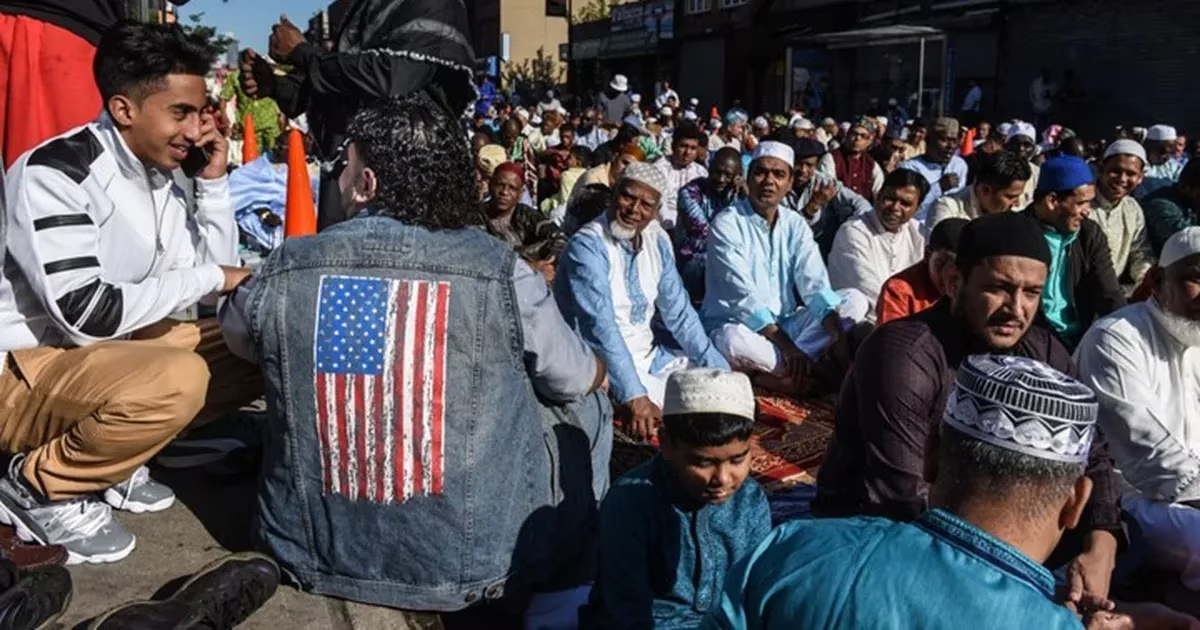







The intensity of Israeli incitement against Islamic organizations and human rights institutions operating in Western societies has escalated. Research circles in Tel Aviv have deemed these entities to be engaged in a strategic battle of consciousness, whose impact surpasses that of traditional military confrontations. Israeli observers believe that the current conflict with the Palestinian people now extends beyond geographical borders, reaching the heart of academic and cultural institutions in the United States and Europe.
In this context, Ayala Kainan, a researcher in social networks and artificial intelligence, claimed that Islamic movements realized early on the importance of controlling the historical and cultural narrative. In an article for 'Yedioth Ahronoth' newspaper, she indicated that Israel and its allies in the West cannot continue to ignore what she described as a 'soft combat front' aimed at undermining liberal values from within.
Israeli claims were based on old documents that American security authorities allegedly seized decades ago, including a document from 1991 that spoke of a long-term strategy for infiltrating Western institutions. These reports claim that the ultimate goal is to change the cultural identity of Western societies by building a wide network of schools, universities, and research centers that adopt a discourse contrary to the prevailing narrative.
Israeli propaganda uses the term 'soft jihad' to describe the legal and media activities carried out by Muslim communities and supporters of the Palestinian cause. Kainan claims that these activities are not aimed at direct confrontation in the streets, but rather seek a gradual erosion of trust in Western identity, ultimately weakening political and military support for Israel.
Israeli incitement also touched upon historical events, such as the 1993 Philadelphia meeting monitored by the FBI, to claim that there is organized coordination to support Palestinians through civilian tools. This strategy, according to the Israeli claim, focuses on using emotional and legal language that appeals to the Western conscience and attracts young generations in prestigious universities.
Regarding the current student movement, Israeli sources directed direct accusations at the organization 'Students for Justice in Palestine' (SJP), considering it an executive arm for foreign agendas. Reports claimed that this organization receives funding and guidance from entities linked to the Muslim Brotherhood, with the aim of creating a state of continuous popular pressure against Israeli policies.
The Israeli researcher linked current human rights organizations to former relief institutions closed by Washington, such as the 'Holy Land Foundation,' in an attempt to brand current civil activity as illegal. These approaches aim to push Western governments to take restrictive measures against institutions that adopt a discourse critical of the Israeli occupation and its practices in the Palestinian territories.
Kainan warned that ignoring these movements under the guise of 'freedom of expression' or 'cultural diversity' poses a strategic danger to Israel, especially with the increasing campaigns to delegitimize it. She explained that the success achieved by these organizations is clearly evident in the decline of support for Israel among young people in the West, who are now more inclined to adopt the Palestinian narrative.
Israeli incitement views political Islam as a transnational ideology that cannot be contained solely through economic improvements or living welfare. Accordingly, these circles demand the adoption of a comprehensive Western strategy to monitor foreign influence in universities and ensure full transparency in the funding sources of civil society organizations.
Israeli recommendations call for strengthening what they call 'digital culture' to counter Palestinian content on social media platforms, which they consider part of the war of consciousness. These recommendations emphasize the need to seriously address awareness campaigns targeting the Western public, considering that the real conflict is now taking place in the global public opinion sphere.
It is noted that Israeli discourse tries to exploit Western fears of 'Islamophobia' to justify the suppression of pro-Palestinian political activity, by portraying it as an existential threat to Western civilization. Sources believe that refusing to criticize these organizations under the pretext of fighting discrimination gives them legal cover to continue changing societal and political values in Europe and America.
Israel's focus on the 'narrative' reflects an implicit acknowledgment of the failure of traditional military tools to resolve the conflict on the international stage. While Israel possesses a sophisticated military arsenal, it finds itself in a defensive position against student and human rights movements that succeed in isolating it morally and politically in international forums and major universities.
In conclusion of the incitement, the Israeli researcher demanded the necessity of recognizing that this activity represents a 'strategic challenge' that requires security and intelligence coordination between Israel and Western countries. This includes monitoring curricula and teacher training programs, to ensure that what she described as ideas hostile to Western values and to Israel do not infiltrate future generations.
This report reflects the deep concern within the Israeli establishment about losing control over global public opinion, as the Palestinian narrative has found a wide resonance that transcends traditional boundaries. Incitement against Islamic and human rights organizations remains a key tool in Tel Aviv's attempt to regain the initiative in the international battle of consciousness.
Wars today are decided by narratives no less than by weapons and combat means, and Israel cannot ignore the consciousness front.




Share your opinion
Escalating Israeli Incitement Against Islamic Organizations in the West Under the Guise of 'Soft Jihad'