PALESTINE

Fri 27 Feb 2026 6:07 pm - Jerusalem Time

7 Dead, Including a Policeman, in Gaza.. Hamas: Occupation Violates Truce Agreement with Systematic Escalation

The Gaza Strip witnessed a new field escalation since dawn on Friday, resulting in the martyrdom of seven Palestinians, including a police officer, and the injury of several women and children in Israeli attacks targeting various areas. Field sources confirmed that occupation forces carried out airstrikes and sniper operations that violated the existing ceasefire understandings, leading to casualties among civilians and displaced persons.

In the details of the aggression, sources reported that an Israeli drone targeted a tent for displaced persons inside Mustafa Hafez School, near Nasser Hospital, west of Khan Yunis city. The bombing resulted in the martyrdom of one Palestinian and the injury of three others with varying degrees of wounds, at a time when drones continue intensive flights over shelters crowded with displaced people.

In the northern Gaza Strip, two Palestinians were martyred by the bullets of occupation forces stationed around the town of Beit Lahia, where shooting operations were concentrated in the Aslan and Al-Atatra areas. These attacks come amid the continued targeting of citizens attempting to move in areas near the contact line, constantly increasing the daily death toll.

In the central Gaza Strip, warplanes launched raids on Al-Bureij camp, leading to the martyrdom of four people in an initial toll from those raids that targeted residential areas. The Civil Defense also confirmed the recovery of the bodies of three other martyrs who fell as a result of targeting a group of citizens in the Al-Maslakh area, southwest of Khan Yunis city, by a drone.

Regarding the targeting of security institutions, the Ministry of Interior in Gaza mourned one of its members who was martyred after an airstrike targeted a police checkpoint on Salah al-Din Street. The ministry clarified that occupation planes targeted the security point at the entrance to Al-Bureij camp in the early hours of dawn, also leading to the injury of another policeman with serious wounds.

For its part, the Islamic Resistance Movement (Hamas) condemned this escalation, describing the targeting of police points as a blatant and serious violation of the ongoing ceasefire agreement. The movement's spokesman, Hazem Qassem, stated that these systematic attacks prove that the occupation does not value international efforts aimed at stabilizing calm, and insists on ignoring all political understandings.

In a related context, the Resistance Committees in Palestine considered the continued Israeli violations as organized terrorism aimed at spreading chaos in the Strip by striking the security and police system. In a statement, they indicated that the targeting of police points in Khan Yunis and Al-Bureij denounces a systematic plan to evade the commitments of the agreement reached under international auspices.

Official statistics issued by the Ministry of Health indicate that the number of martyrs since the start of the ceasefire agreement on October 10 last year has exceeded 618 martyrs. Medical teams also recorded the injury of more than 1663 Palestinians as a result of the continuous attacks that have not stopped despite the agreement coming into effect, threatening the collapse of the fragile truce.

These field developments come on the tenth day of the blessed month of Ramadan, with most of the raids occurring simultaneously with the suhoor time, doubling the state of panic among displaced families. Reports confirm that the targeted areas, especially in Mawasi Khan Yunis and Al-Bureij, are outside the control of the occupation army according to the maps agreed upon in the truce.

On the humanitarian front, nearly 1.9 million displaced Palestinians suffer from catastrophic living conditions in dilapidated tents lacking the most basic necessities for a dignified life. This suffering is exacerbated by the continued destruction of infrastructure, which has affected about 90% of civilian facilities in the Strip over two years of the genocide war waged by the occupation.

It is worth noting that the total number of victims of the Israeli aggression since October 2023 has exceeded 72,000 martyrs and more than 171,000 injured, an unprecedented toll reflecting the extent of the devastation. International organizations continue to warn against continued Israeli violations that hinder the delivery of humanitarian aid and further complicate the field and political scene in the region.

This systematic escalation against the Palestinian people decisively reflects Israel's disregard for efforts to stabilize calm in the Strip.

ISRAELI AFFAIRS

Fri 27 Feb 2026 6:07 pm - Jerusalem Time

Alliance Wars and the Re-engineering of the Region: A Reading of Netanyahu's Vision for the Three Axes

Current political readings indicate that the region is heading towards a new pattern of mobile wars, where fronts emerge, open, and freeze according to the interests of regional powers. Whether Iran is directly present or neutralized, its structural complexities remain an influential factor in the action-reaction equation.

The conflict in the Middle East is no longer poised to be a single, major, decisive confrontation, but has transformed into a series of escalating power tests. These tests move between geography, politics, and economics, creating a state of continuous attrition in the inflamed arenas.

Benjamin Netanyahu's recent statements delineate a new regional phase that transcends traditional media consumption. He spoke clearly about dividing the region into warring axes, describing regional powers as wounded or hostile axes that must be contained.

Netanyahu proposed the idea of establishing a third axis led by Tel Aviv, aiming to include countries that oppose the ideological orientations of the Shiite and Sunni axes. This proposal placed the UAE, Greece, and India at the core of the new formation, reflecting a desire to re-engineer alignments.

This shift in Israeli discourse reflects a strategic transition from a policy of conflict management to a policy of comprehensively redefining the enemy. The focus is no longer limited to the Iranian threat but has expanded to include any political structure that adopts the project of resistance or political Islam.

This dual description allows for the building of flexible alliances that transcend traditional contradictions between states, with the unifying theme being the control of environments that harbor opposing projects. The reference to an axis specific to Israel suggests a long-term strategic framework that intersects with energy interests and maritime corridors.

In this vision, Greece represents a vital gateway to the Eastern Mediterranean, while India emerges as a rising partner in alternative trade corridors connecting East and West. As for the UAE, it plays the role of the central financial and logistical player in this proposed system.

We are witnessing a serious attempt to establish a network of interests that goes beyond the purely military dimension to formulate an integrated system of influence. This proposal intersects with international shifts, especially within conservative American circles that advocate for reducing external costs.

Statements by American figures, such as Senator Josh Hawley, reflect a tendency to support regional arrangements based on functional alliances that bear the burdens of confrontation. This approach does not mean a complete American withdrawal, but rather a redistribution of roles to manage conflicts through reliable regional partners.

This Israeli proposal comes at a moment when the resistance axis is clearly exhausted due to continuous economic and military pressures. Tel Aviv is also exploiting the profound shifts in the Sunni environment that followed the Arab Spring waves to establish new political realities.

The Israeli reading assumes that the current moment is opportune to change the balance of power before any unexpected strategic shifts occur. Therefore, talking about the third axis is not just a description of reality, but a declaration of intent to build a new reality by force.

The fundamental question remains about the nature of the regional response to these moves, and whether other powers will be content with a cold repositioning? Historical experience indicates that the building of solid alliances often precedes major explosions and existential conflicts.

The region today appears to be at a transitional stage open to high-risk possibilities, where alignments harden and the spaces for political settlement narrow. Accelerating the race of axes could lead to counterproductive results that increase tension instead of preventing it.

In such historical moments, wars are not merely the result of miscalculation, but can be the product of cold planning aimed at reproducing balance. Accordingly, the title of the next phase may go beyond containing threats to reach imminent direct confrontations.

The shift in Israeli discourse reflects a transition from a conflict management approach to an approach of redefining the enemy and expanding the framework of confrontation.

OPINIONS

Fri 27 Feb 2026 6:07 pm - Jerusalem Time

The Structure of Violence and Theft: A Reading of the Savagery of the Zionist System After Al-Aqsa Flood

Ramallah - "Al-Quds" Dot Com

Ramallah - "Al-Quds" Dot Com

Opinion Writer

Opponents of the Zionist project face a system characterized by racism and brutality, a system that derives its savagery from societal components that align with its criminal objectives. The events following the Al-Aqsa Flood operation have widely exposed the structural ugliness of this society that feeds on the blood of Palestinians.

The slaughter in the Gaza Strip continues in full view and hearing of the entire world, in one of the most heinous acts of ethnic cleansing recorded in modern history. Despite the enormity of the crimes, observers believe that popular reactions in the region have not risen to the level of the event due to the repressive policies practiced by some regimes against their peoples.

Occupation forces have violated all taboos, from the blood of children and women to the desecration of the bodies of resistance fighters, their abduction, and mutilation. The aggression also included the demolition of safe havens, forcing thousands of Gazans into repeated forced displacement, which for some reached 19 times in just two years.

This repeated displacement reflects the magnitude of the danger lurking in every corner of the Strip, already exhausted by a suffocating siege that has lasted for nearly two decades. This aggression is not limited to the military establishment but extends to wide sectors of settlers in the occupied territories of 1948.

The audacity of settler ideology is evident in live testimonies, such as the incident of the theft of the Kurd family's home in Sheikh Jarrah neighborhood, where the thief justifies his actions by saying that 'someone else would take it if he didn't.' This mentality reflects the reality of the conflict as a struggle with gangs that practice robbery and looting under state protection.

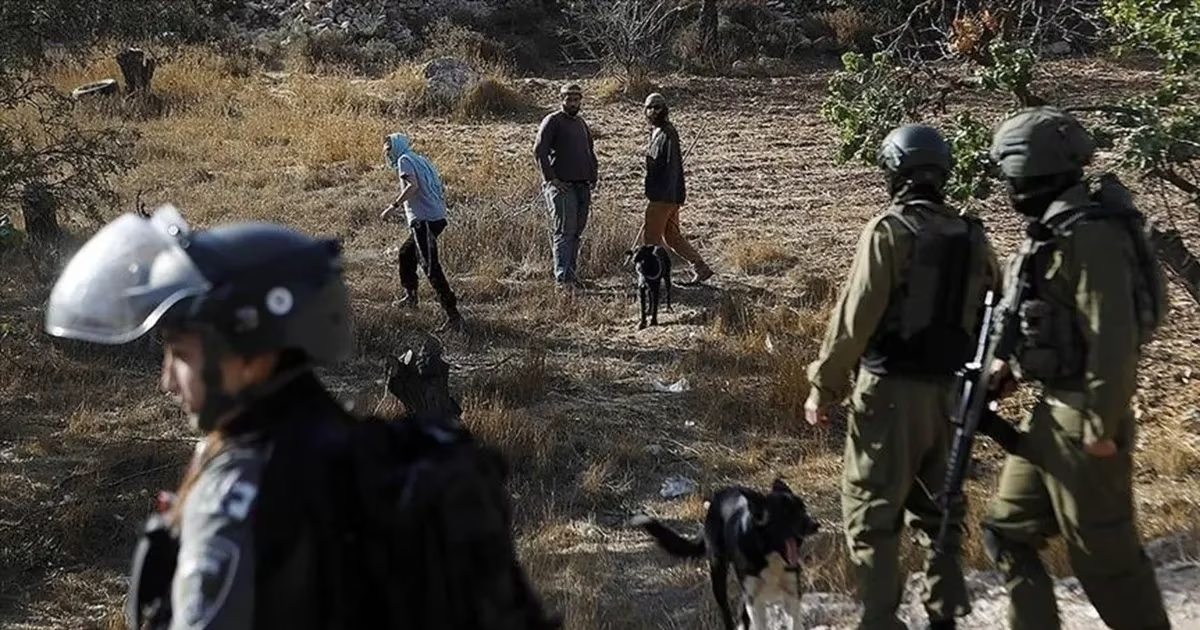
The forms of field criminality are numerous, including burning livestock alive, stealing Palestinian property, and burning homes and public facilities. Armed settler outposts are also widespread, practicing organized terrorism against neighboring Palestinian villages near their settlement outposts.

Recently, land and home seizures have accelerated to establish new settlement outposts, leading to the displacement of entire villages. These operations are accompanied by the violation of Palestinian dignity during incursions into camps and cities, in an attempt to break the will of popular steadfastness.

Places of worship have not been spared from desecration, with mosques and churches being turned into arenas for provocative dancing that expresses a thirst for blood rather than religious rituals. These actions come in the context of incitement led by extremist ministers in the occupation government who boast about torturing prisoners.

Occupation leaders, including Itamar Ben-Gvir, are trying to restore a false image of strength by abusing defenseless prisoners and crushing their dignity inside detention centers. These actions are a desperate reaction to the breakdown of the Israeli security system's prestige in the field.

Videos show soldiers boasting about killing children and raping Palestinians, in an unprecedented moral decline of the military establishment. Voices within the entity are also rising to demand the use of nuclear weapons against Gaza, reflecting a desire for comprehensive annihilation that spares no one.

Zionist violence extends to the internal components of the entity, as happened in the incident of extremist Jews being run over due to political disputes, or the pursuit of female soldiers. This internal savagery is not new but dates back many years when Yitzhak Rabin was assassinated by an extremist Jew.

It is worth noting that Rabin, who led Zionist gangs and participated in the displacement of Palestinians, was killed merely for attempting to conclude limited political agreements. Benjamin Netanyahu was then one of the most prominent inciters against Rabin to reach power by exploiting extremist rhetoric.

Netanyahu today lives in a stolen house in Jerusalem that originally belonged to the Palestinian doctor Tawfiq Canaan, who was displaced in 1948. This incident summarizes the essence of the entity based on the usurpation of the rights and historical properties of others without any legal or moral deterrent.

In the face of these facts, Arab voices emerge promoting 'coexistence' with this system under the guise of peace, calls that ignore the nature of the enemy. Adhering to the weapon of resistance in Gaza, Lebanon, and Yemen represents an existential necessity to achieve the minimum level of deterrence against an entity that understands only the language of force.

We are facing an entity that knows nothing but violence and theft, and its inherent qualities are those of evil and criminality, by virtue of extended historical facts.

PALESTINE

Fri 27 Feb 2026 6:07 pm - Jerusalem Time

Historic defeat for Labour in Manchester stronghold puts Starmer's future on the line

British Prime Minister Keir Starmer faced a severe political crisis after the Labour Party lost a historic seat in the 'Gorton and Denton' constituency in Manchester, a seat the party had dominated for nearly a century. Press reports considered this defeat a direct threat to Starmer's political future, especially after the party fell to third place in these by-elections.

The Green Party achieved a landslide victory in the constituency, securing about 41% of the votes, significantly outperforming the Labour Party, which only garnered 25%. The 'Reform UK' party came in second with 29%, reflecting a radical shift in political loyalties within the traditional strongholds of the British left.

In his first reaction, Starmer showed clear defiance by rejecting the idea of resignation, emphasizing his understanding of voters' frustration and their desire for change. Starmer described the Green and Reform parties as 'extremist' and seeking to tear the country apart, vowing to remain in office and fight for his constituents despite what sources described as a humiliating defeat.

Political sources attributed this failure to several factors, most notably Starmer's stance on the Israeli war on the Gaza Strip, which sparked widespread anger among Muslim voters. His controversial decision to prevent Andy Burnham from running also contributed to increasing internal divisions and alienating a large segment of the party's traditional supporters.

An analysis by 'Electoral Calculus' showed shocking results, predicting that the Prime Minister and almost all members of his government would lose their seats if these results were replicated nationally. The analysis indicated that the Labour Party's representation could shrink to only 33 seats, while the Green Party could jump from 5 seats to 249 seats.

The Muslim voting bloc played a pivotal role in these results, as the Gorton and Denton constituency has a high proportion of Muslim residents who turned to support the Green Party. Observers believe that the Green Party's pro-Palestinian rights campaign succeeded in attracting voters who felt disappointed by the policies of the current Labour leadership.

Sources within the Labour Party reported a growing sense of anxiety among Members of Parliament about their seats in the upcoming elections. A member of the party's council in the constituency confirmed that the Gaza issue has not been forgotten and voters will not forgive the party for its past stances, indicating that pressure is now mounting to push the party towards adopting more left-wing policies.

For its part, the 'Muslim Voice' alliance in Britain stated that this historic result sends a clear message that the votes of Muslim communities cannot be taken for granted by any party. The statement clarified that voters made a conscious choice to punish the Labour Party, which had failed them on fundamental issues including Gaza, the economy, and civil liberties.

The election campaign saw personal participation from Starmer, who called for unity, but his efforts did not succeed in countering Green Party candidate Hannah Spencer. Spencer received public support from former Labour leader Jeremy Corbyn, which strengthened her position among voters disgruntled with the current leadership's direction.

This setback comes at a time when the Green Party has been experiencing continuous growth since Zak Polanski took over its leadership in September 2025. This rise reflects voters' desire to find political alternatives capable of expressing their positions on international and local issues that the two major parties ignore.

Analysts believe that the British political scene is undergoing a comprehensive reshaping, as the historical dominance of the Labour and Conservative parties has begun to shake. The local elections scheduled for next May are a pivotal moment that will definitively determine Starmer's ability to remain at the head of the government or face an internal rebellion that will overthrow him.

Despite government attempts to downplay the results of the by-elections, considering them not always reflective of general trends, the demographic model used in recent analyses causes real fear in Downing Street. The numbers indicate that the 'Reform UK' party could become the leading force in the country if the bleeding of votes from the two traditional parties continues.

In a related context, the 'Muslim Voice' alliance stressed that what happened in Gorton and Denton is not an isolated incident, but rather the beginning of a new political reality that the Labour Party will face. The alliance confirmed that issues such as Islamophobia and the deterioration of national health services were strongly present in voters' minds alongside the Palestinian issue.

Reports conclude by noting that pressure is not limited to the grassroots but also extends to trade unions demanding Starmer move to the left. With major elections approaching, the Prime Minister finds himself trapped between his party's historical legacy and a new political reality that refuses to compromise humanitarian principles for party loyalty.

I will continue to fight for these people as long as I live, and the rebel parties want to tear our country apart.

ISRAELI AFFAIRS

Fri 27 Feb 2026 6:07 pm - Jerusalem Time

Israeli estimates of collapse of negotiations with Iran and American warnings of imminent military escalation

Hebrew media sources reported today, Friday, that prevailing assessments in Tel Aviv clearly indicate the likelihood of a collapse in the ongoing negotiations with Iran regarding its nuclear file. These predictions coincide with the monitoring of intensive American military mobilization in the region, which reinforces the hypothesis of an approaching military action against Tehran.

Press reports stated that the Israeli side shows noticeable satisfaction with the hardline stance adopted by the American administration at present. Washington has set conditions described as the highest ceiling since the start of the negotiation process, which reduces the chances of reaching compromises with the Iranian side.

Sources quoted a senior Israeli official as saying that the continuation of current data means a complete deadlock in the diplomatic horizon. The official added that current Iranian behavior does not suggest a desire to make substantial concessions that meet the recently imposed international demands.

In a related context, the Israeli security establishment is studying potential escalation scenarios in the event of a direct confrontation. Assessments concluded that the possibility of other regional parties engaging in the fighting, specifically Hezbollah in Lebanon and the Houthi group in Yemen, has become very likely.

Security analyses indicate that Hezbollah, despite the internal challenges it faces, will not stand idly by if Iran is subjected to a direct attack. Experts in Tel Aviv believe that the upcoming conflict may take on a pivotal and comprehensive character extending to several fronts simultaneously.

On the diplomatic front, the United States took a notable step by allowing its non-essential diplomatic staff to leave Israel immediately. This decision came as a precautionary measure reflecting the extent of concerns about a sudden and uncontrolled deterioration of security conditions.

The US Embassy urged its citizens in the region to seriously consider leaving as long as commercial flights are still available. It clarified that escalating tensions could at any moment lead to the suspension of civil aviation traffic to and from Israeli airports.

The US State Department issued a statement confirming authorization for government employees and their family members to depart the embassy due to increasing security risks. The statement emphasized that this measure comes in response to field assessments indicating the likelihood of imminent security incidents.

The embassy also warned that it might impose strict restrictions on the movement of its remaining staff in specific areas, including the Old City of Jerusalem and the West Bank. It indicated that these restrictions might be applied without prior notice based on developments in the security situation on the ground.

American warnings included an alert about potential attack plans that might target tourist gatherings, public facilities, and commercial markets. Washington called on its citizens to maintain a high level of vigilance and to stay away from demonstration areas or large gatherings that might be targets for escalation.

The region is experiencing a state of extreme anticipation amid mutual threats between Washington and Tehran, with intensive Israeli preparations for a potential Iranian reaction. Fears are growing that diplomatic failure could spark a widespread regional war that transcends traditional conflict boundaries.

Observers believe that recent American steps, both military and diplomatic, represent maximum pressure on decision-makers in Tehran. However, Tel Aviv continues to raise readiness on all fronts in anticipation of any scenario involving missile launches or drone attacks.

Regarding internal Israel, authorities have begun updating home front instructions and preparing shelters in some vital areas. These moves come amid intelligence reports of unusual movements by Iranian-allied forces in Syria and Lebanon.

In conclusion, the scene remains open to all possibilities, as the world awaits the results of the coming hours that may determine the fate of the nuclear agreement or open the door to a major military confrontation. All eyes remain on the field movements of American forces in the waters of the Gulf and the Mediterranean.

If the situation continues like this, there is no hope of reaching an agreement. This is not in the nature of the Iranians.

PALESTINE

Fri 27 Feb 2026 2:34 pm - Jerusalem Time

Historic Shift in American Public Opinion: 57% Support a Palestinian State and Unprecedented Decline in Support for the Occupation

A recent poll conducted by the 'Gallup' research institution has revealed a fundamental and unprecedented shift in American public opinion towards the conflict in the Middle East. The results showed that 57% of American citizens now support the establishment of an independent Palestinian state in the West Bank and Gaza Strip, reflecting a stabilization in this upward trend that began in 2020.

The data indicated that public sympathy in the United States has undergone a dramatic shift towards the Palestinian side after decades of absolute support for the occupation. While 54% of Americans leaned towards the occupation three years ago, this percentage has shrunk to only 36%, while sympathy for Palestinians has jumped to 41%, putting both sides at a historic parity for the first time.

Research sources reported that this radical change is primarily driven by the grassroots of the Democratic Party and independents. About two-thirds of Democrats currently express sympathy for Palestinians, compared to only about 25% in 2016, making the issue of military aid to the occupation a major point of contention in the party's primaries.

The shift was not limited to Democrats but also included independents, who for the first time in the history of 'Gallup' polls showed greater sympathy for Palestinians than for the occupation. 40% of independents lean towards the Palestinian narrative, compared to only 30% who support the occupation, which is the lowest level of support recorded for this influential political group.

Regarding age groups, the poll showed a wide generational gap, with young people aged 18 to 34 leading the advocates for Palestinian rights. Half of these young people affirm their sympathy for Palestinians, while the percentage of supporters of the occupation among them does not exceed a quarter, which explains the momentum of student protests in American universities.

The poll also observed a notable shift among middle-aged Americans (35-54 years old), who for the first time showed greater sympathy for Palestinians compared to last year. Even among seniors over 55, who remain the group most supportive of the occupation, their levels of sympathy recorded their lowest since 2005.

Analysts link this decline in American support to the policies of the right-wing government in Israel led by Benjamin Netanyahu. Netanyahu's popularity in the United States has fallen by about 15 percentage points over the past seven years, affected by his previous disagreements with the Obama administration and his close association with Trump, leading up to his management of the current war.

Regarding the Republican Party, 70% of its supporters still back the occupation, but this percentage has declined from the 80% level it was at before the outbreak of the war. Within the isolationist wing of the party, voices are emerging that question the utility of continuing to provide traditional military and financial support to the occupation without restrictions.

Sources explained that the ongoing war on the Gaza Strip and the military response, described as disproportionate, were key drivers of this accelerated shift. With the martyrdom of more than 72,000 Palestinians, half of whom are women and children, many American politicians and activists began describing what is happening as 'genocide,' a term that is now strongly echoed in progressive circles.

Despite widespread American support for the two-state solution, the poll revealed a gap between American aspirations and the reality on the ground in the region. Global 'Gallup' data showed that only 30% of Palestinians and settlers in the occupied territories support this solution, indicating the complexity of the scene on the ground compared to the external view.

Benedict Viggers, a global news writer at 'Gallup,' stated that closing the gap in American public opinion within a few years is astonishing. He added that partisan polarization on the Palestinian issue has reached its peak, with 75% of Democrats supporting a Palestinian state compared to only a third of Republicans.

These figures confirm that the Palestinian issue is no longer a secondary topic in American politics but has become a driver of internal elections and a determinant of foreign policy. The shift in the sentiments of independents and youth portends long-term changes in the nature of the strategic relationship between Washington and Tel Aviv in the coming decades.

Observers believe that the recognition of Jerusalem as the capital of the occupation and the latter's sovereignty over the Golan during the Trump era contributed to deepening American division over the conflict. While some considered them diplomatic victories, a wide segment of Democrats and independents saw them as undermining opportunities for a just peace, pushing them to adopt more equitable positions for Palestinians.

In conclusion, the poll highlights that American society is undergoing a comprehensive re-evaluation of its role in the Middle East. With the continuation of the war and the escalation of humanitarian crises, it appears that the Palestinian narrative has begun to find its way into the consciousness of the average American citizen, overcoming decades of systematic media and political marginalization.

This is the first time that sympathy for both sides has reached parity, which is truly remarkable; within a few years, that large gap in public opinion has been completely closed.

ANALYSIS

Fri 27 Feb 2026 2:34 pm - Jerusalem Time

Between Ideology and Reality.. Will Religious Discourse Redraw the Maps of the Middle East?

Expansionist statements by high-ranking American officials, based on biblical references to borders extending from the Nile to the Euphrates, raise fundamental questions about the nature of current strategic transformations. This language is not merely fleeting remarks, but touches upon a historical memory burdened by conflicts and awakens deep regional fears regarding the intentions of major powers in the region.

The American political scene has witnessed a remarkable increase in the influence of the conservative evangelical movement within the Republican Party over the past two decades. This movement does not treat Israel as a traditional strategic ally, but rather sees it as an extension of a theological vision linked to esoteric texts and religious conceptions of the end of history, which explains the infiltration of biblical terminology into official discourse.

Despite the power of this ideological discourse, the institutional structure of the American state remains governed by a complex network of vital interests. These interests include ensuring energy security and the stability of global markets, in addition to maintaining strategic alliances with Gulf states and Turkey, and confronting escalating competition with China and Russia.

American calculations in the region are managed in the language of numbers and military and economic indicators more than theological texts. The deep state realizes that any adventure to radically change the region's maps could lead to a comprehensive explosion that Washington cannot bear the consequences of, thus imposing a kind of restraint on extreme ideological ambitions.

Israel's existence and continuity depend on broad international coverage and a complex network of diplomatic relations that prevent it from engaging in uncalculated regional expansion. Despite its military power, any attempt to impose a new geographical reality would mean the disintegration of the alliance system that ensures its relative stability in its surroundings.

The real danger lies in the process of 'normalizing' expansionist language within the public sphere and transforming it into a legitimate subject for discussion. This shift gives extremist currents greater political audacity and creates a psychological environment conducive to accepting gradual field steps that may not appear aggressive on the surface but change reality in the long run.

History does not always change through major leaps or swift wars, but often through slow and systematic accumulations. These accumulations include amending administrative laws, expanding settlements, and imposing new realities on the ground that redefine the actual boundaries of control without the need for loud official announcements.

Peace projects proposed in the region are considered tools for re-engineering regional balances and distributing spheres of influence among active powers. These initiatives are fundamentally subject to calculations of power and interest, far from moral idealism, which requires a cold structural reading to understand their true objectives, free from emotions.

The future of the region is linked to three crucial factors: first, the ability of American institutions to balance the ideological convictions of some of its currents with supreme strategic interests. This balance determines the extent of impetus towards supporting expansionist agendas that may harm Washington's international standing.

The second factor is the stance of regional allies, specifically Arab states and Turkey, towards any shift in political discourse towards symbolic or actual expansion. The cohesion of these positions and their ability to maneuver politically constitute a bulwark against attempts to redraw maps based on religious perceptions.

The true compass for any political intentions is manifested in the course of field changes in Jerusalem and the West Bank. What happens on the ground in these areas is the most accurate indicator of the major powers' orientations, transcending media statements to reach the core of the geopolitical conflict.

Sound strategic analysis does not deny the existence of expansionist currents, but it warns against being drawn into the assumption of a 'master plan' without precise monitoring of power balances. Real power lies in building legal and media tools capable of confronting political deviations before they become an imposed reality.

Actors in the region must accurately distinguish between language and decision, and between religious symbolism and political implementation on the ground. Ultimately, politics is the art of managing the possible, and history is not driven by enthusiastic slogans but by the ability to read power balances and act within available spaces.

In conclusion, the Middle East remains an arena of contention between ideology and interest, where each party seeks to impose its vision. Vigilance against the transformation of discourse into policies, and policies into realities, is the only guarantee to prevent the transformation of theological myths into geographical maps that tear apart the region's stability.

The Middle East is not reshaped by discourse alone, but it may be reshaped if discourse turns into policies, policies into realities, and realities into new maps.

OPINIONS

Fri 27 Feb 2026 2:34 pm - Jerusalem Time

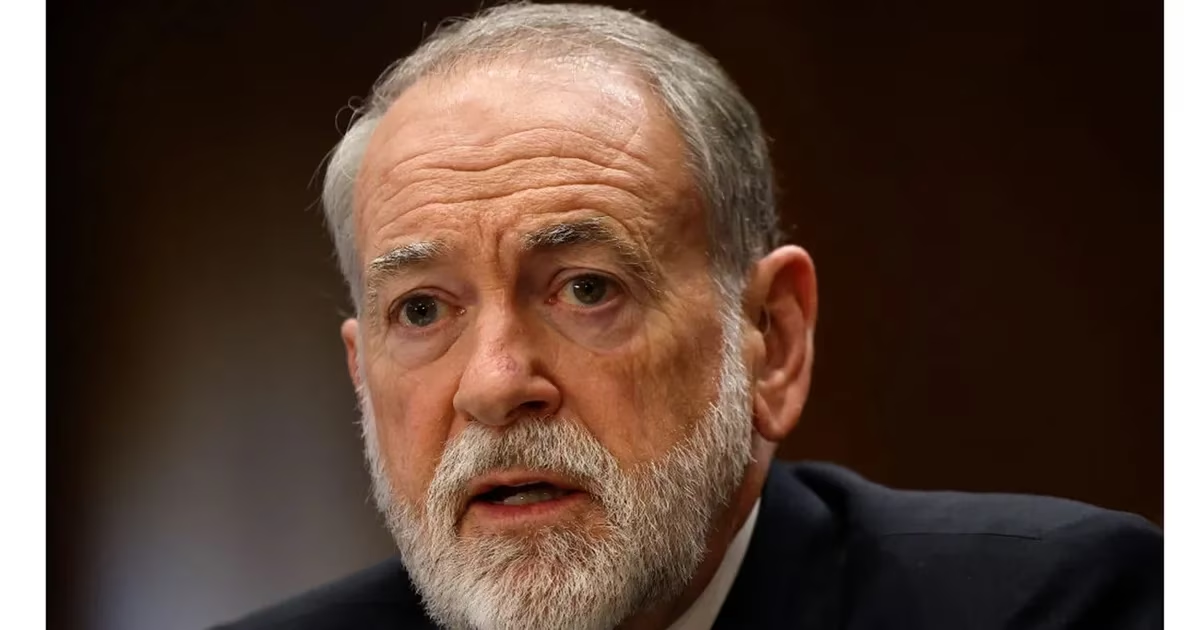
Between Diplomacy and Priesthood: Double Standards in International Politics and 'Huckabee' Appointments

Ramallah - "Al-Quds" Dot Com

Ramallah - "Al-Quds" Dot Com

Opinion Writer

Fundamental questions are escalating regarding the double standards governing international politics, especially when it comes to projecting religious beliefs onto official positions. This contradiction is clearly highlighted when comparing the Western model's acceptance of its officials' religiosity with the condemnation of any religious authority in Islamic contexts.

The appointment of Mike Huckabee to a high diplomatic post was not merely a fleeting administrative measure; rather, it revealed the depth of his evangelical background and its direct impact on his decisions. Nevertheless, this background was treated as part of a legitimate personal identity within an institutional system that claims separation of religion and state.

The great paradox lies in the fact that Western religiosity is often marketed as an individual conviction governed by modern constitutional controls, while Islamic orientation is classified as a reactionary project that threatens civility. This classification is not based on objective values but reflects power balances that grant one party the right to define what is civilized.

No serious international calls emerged demanding Ambassador Huckabee leave his 'Evangelical-Talmudic' beliefs at the threshold of his position, even though his stances further complicate the region's turmoil. Instead, he is allowed to pour oil on the burning fire under the guise of biased official diplomacy.

The priestly discourse adopted by some Western politicians is asked to be understood by the world within the context of multiculturalism, while any Islamic authority is preemptively assumed to be a threat to multiculturalism. This abhorrent duality reveals a structural flaw that threatens international peace and security and undermines the concept of justice.

In a related context to diplomatic movements in the region, Tel Aviv recently witnessed an Iftar dinner hosted by Emirati Ambassador Mohammed Al Khaja, attended by Israeli President Isaac Herzog. This event reflected attempts to establish a new political reality that transcends traditional conflicts under the name of peace.

During that dinner, Herzog praised Emirati President Mohammed bin Zayed, describing him as one of the most influential and wise leaders of the current era. Herzog considered the UAE a fundamental pillar of the Abraham Accords and a hub for stability in a region suffering from continuous unrest.

The Israeli President condemned what he described as campaigns of hatred and slander launched by some countries against the Emirati-Israeli peace process. He claimed that these alliances aim to build a common future, despite the ongoing Israeli military operations that draw widespread criticism in the Palestinian territories.

The meeting of representatives of different religions at the Emirati Embassy in Tel Aviv is presented as a model of religious tolerance, but it raises questions about the timing of these events. While Iftar dinners are held, human suffering continues in the occupied territories, highlighting a gap between diplomatic discourse and the reality on the ground.

Observers believe that this blend of religious values and politics is only permissible when it comes from dominant powers or those within their orbit. However, when others try to adhere to their value heritage, they face accusations of backwardness and attempts at isolation and political containment.

The legacy of power and colonial standards still controls the formulation of the current international system, where priestly obsession converges with major economic interests. This political recipe does not establish sustainable security but pushes towards an inevitable civilizational clash due to the absence of the principle of equality.

If the Western model allows the mixing of religion with politics to serve its interests, then condemning this behavior in others expresses a blatant privilege of power. The issue at its core is not the ambassador's religious identity, but the absence of the voice of reason and justice in dealing with the fateful issues of peoples.

Today, the Islamic world faces a great challenge in how to establish political legitimacy that respects its values and ancient heritage without sliding into absurd conflicts. What is needed is to build institutions that guarantee freedom and justice for all, away from the dominance of racist figures who impose their unilateral vision.

Ultimately, the question remains open about the international community's ability to overcome this duality and reach understandings that respect the specificities of peoples. True justice requires ceasing to grant immunity to certain identities and depriving others of the right to express themselves in the political sphere.

The issue is not the ambassador's religious identity as much as it is the absence of justice and the voice of reason in a world controlled by the privilege of power.

PALESTINE

Fri 27 Feb 2026 2:34 pm - Jerusalem Time

Strategic Report Monitors Transformations in the Palestinian Cause: 15.5 Million Palestinians Worldwide and Severe Economic Collapse in Gaza

Al-Zaytouna Centre for Studies and Consultations issued a summary of its periodic Palestinian Strategic Report for the years 2024-2025, which serves as an in-depth research reference co-authored by 15 specialized researchers. This edition comes at a pivotal historical moment following the Al-Aqsa Flood battle, to monitor the structural transformations that have occurred in the general Palestinian scene.

The report paints a complex picture of the internal Palestinian scene, where popular criticism of the Palestinian Authority's performance is escalating amid continued aggression and worsening violations in the West Bank. It also points to a deep crisis of confidence afflicting the political system, coinciding with controversial decisions related to allocations for prisoners and martyrs and the rearrangement of leadership.

Regarding the post-war management of the Gaza Strip, the study observed a divergence in visions between the Authority's readiness to assume tasks and Hamas's flexibility towards forming a community support committee. However, complexities remain, especially concerning the resistance's weaponry, which faces intense external pressure to end its military presence.

Demographically, statistics revealed that the number of Palestinians worldwide reached 15.5 million by the end of 2025, with more than half of them living in the diaspora. Estimates indicate that the Palestinian presence within historical Palestine has surpassed the number of Jews, with expectations of this gap widening by 2030.

The report documented massive human losses in the Gaza Strip, where the number of martyrs was estimated at about 77,000 over two years, in addition to 170,000 others suffering various injuries. Sources confirmed that the Strip lost about 10.6% of its population due to direct killing, forced displacement, and the deadly living conditions imposed by the occupation.

In occupied Jerusalem, Judaization operations have moved to unprecedented stages through intensified incursions into Al-Aqsa Mosque, exceeding 73,000 infiltrators in 2025. Through these policies, along with the demolition of homes in Sheikh Jarrah and Silwan, the occupation aims to alter the demographic balance in favor of the settlers.

The aggressions were not limited to residential areas but extended to religious and historical identity, as the occupation army destroyed 93% of Gaza Strip mosques and two-thirds of existing cemeteries. Historical churches were also directly targeted, in a clear attempt to erase the civilizational memory of the Palestinian people in the afflicted Strip.

Economically, Palestinians are experiencing a state of near-total collapse, especially in Gaza, where its GDP contracted by 84%, and unemployment rates reached 78%. In the West Bank, the situation was not much better, with the economy declining by 13% and a significant increase in the ranks of the unemployed.

The report clarified that the Palestinian Authority's budget remains hostage to political pressures, as it relies 84% on clearance funds and international grants. The occupation also controls the joints of foreign trade, as trade exchange with the Israeli side accounts for more than 60% of the total Palestinian trade movement.

On the ground, military confrontation continued with high intensity during 2024 and 2025, as the occupation army carried out thousands of airstrikes targeting infrastructure and civilians. In contrast, the Palestinian resistance maintained its operational capabilities in Gaza and the West Bank, despite the heavy human and material cost paid by the Palestinian people.

Data indicated the occupation's failure to achieve its declared strategic goals despite the extent of destruction, as resistance cells remained capable of carrying out qualitative operations. Sources recorded thousands of operations in the West Bank, reflecting the continuity of popular and armed confrontation against settlement expansion and daily aggressions.

Diplomatically, Palestine achieved progress in gaining international recognition, with the number of recognizing states reaching 159, despite Israeli intransigence and American reservations. The 'Beijing Declaration' emerged as one of the serious attempts to unify the Palestinian ranks, although it faced implementation obstacles related to the political program and international community conditions.

The report anticipates a future dominated by internal polarization and continuous economic pressures, with expectations of living conditions remaining fragile and linked to the extent of calm stability. Researchers believe that the occupation will continue its attempts to impose new geographical realities in Jerusalem and the West Bank to undermine any opportunity for establishing a contiguous Palestinian state.

In conclusion, the report emphasizes that these figures and statistics reflect a tragic reality but at the same time confirm the dynamism of Palestinian steadfastness. The center called for the necessity of adopting comprehensive strategic readings based on scientific data to confront the existential challenges facing the Palestinian cause at this stage.

No matter how accurate, numbers do not encapsulate the extent of human suffering, nor do they summarize the dynamics of steadfastness and resistance in the face of attempts to erase identity.

PALESTINE

Fri 27 Feb 2026 2:33 pm - Jerusalem Time

Washington allows embassy staff and their families to leave Israel for security reasons

The US Embassy in occupied Jerusalem has issued a decision allowing its non-essential staff and their family members to leave the occupied territories, in response to security assessments indicating potential risks. Diplomatic sources clarified that this measure comes in the context of growing concerns about the outbreak of a direct military confrontation with Iran, especially as political and military tensions in the region have reached unprecedented levels.

Although the embassy did not disclose the nature of the specific security threats that necessitated this measure, it confirmed that the decision falls under the category of voluntary 'authorized departure.' This classification grants the affected employees the freedom to choose whether to stay or leave, which differs from the forced departure procedures imposed earlier this week on diplomatic staff in the Lebanese capital, Beirut.

This diplomatic move coincides with the United States strengthening its military presence in the Middle East, where the region is witnessing one of the largest deployments of US forces. These military movements come at a sensitive time when Washington is engaged in complex negotiations with Tehran regarding its nuclear file, which have not yielded tangible results so far.

In a related context, informed sources reported that the latest round of nuclear talks, which concluded on Thursday, did not achieve any significant diplomatic breakthrough. This stalemate has intensified Iranian rhetoric, with Tehran threatening to target US military bases deployed in the region if it is subjected to any attack, while warning that any escalation could draw Israel into the heart of the confrontation.

On a broader international level, other Western capitals have begun to take similar precautionary steps by evacuating the families of their diplomats from several countries in the Middle East. Several countries have also issued warnings to their citizens, urging them to avoid traveling to Iran, in light of the state of alert and anticipation prevailing in the region due to the ongoing tensions between Washington and Tehran.

Authorized departure allows affected employees to decide whether or not they will leave, and it does not rise to the level of mandatory evacuation.

PALESTINE

Fri 27 Feb 2026 2:33 pm - Jerusalem Time

High Alert in Tel Aviv as Trump's Deadline Nears: Expectations of a Multi-Front War and Collapse of Geneva Track

Security and political circles in Tel Aviv are in a state of high alert, coinciding with the approaching deadline set by US President Donald Trump for the nuclear negotiations in Geneva. Sources reported that assessments indicate a high probability of these talks collapsing next Sunday, which would open the door for direct American military options against Iranian facilities.

Media reports stated that the stalemate in the Geneva track is due to Tehran's adherence to firm positions, as it categorically rejected American demands related to removing its enriched uranium stockpile from its territory. The Iranian leadership also expressed complete rejection of committing to the principle of 'zero enrichment' permanently, considering it a تجاوز of its red lines in nuclear sovereignty.

In a related context, Iran rejects any proposals aimed at dismantling its sensitive nuclear infrastructure, especially the 'Fordow', 'Natanz', and 'Isfahan' facilities. These complexities have led military circles in Tel Aviv to conduct dramatically described situation assessments, to discuss scenarios of an expected Iranian response if it is subjected to an airstrike by Washington.

Intelligence estimates indicate that any upcoming confrontation will not be limited to one front, but will quickly turn into a 'multi-front' war. Military analysts believe that the Houthi group in Yemen will be the first party to engage in fighting alongside Tehran, by targeting Israeli depth with missiles and drones.

Sources warned of the repercussions of Hamas's involvement in this potential confrontation, as the occupation army's leadership has developed plans for the complete occupation of the Gaza Strip and the elimination of the remaining leadership structure of the movement if a front is opened from the Strip. This threat comes as part of deterrence attempts to prevent the expansion of the conflict to include Palestinian territories.

As for the northern front and the Iraqi arena, current estimates tend to suggest that Hezbollah and pro-Iranian militias in Iraq may prefer not to officially and directly join the confrontation in its initial stages. However, reports indicate increasing internal pressures within these organizations pushing for active participation to enhance the unity of the arenas.

Yedioth Ahronoth newspaper, for its part, confirmed that preparations in Tel Aviv are taking place regardless of the final results of the Geneva talks, as the prevailing assumption is that failure is the most likely scenario. Operational plans are based on the premise that any American attack will be followed by an immediate and direct Iranian response targeting major cities and vital facilities within the occupied territories.

Estimates concluded that Tehran views any American military action as primarily serving Israeli interests, which increases the likelihood of retaliatory strikes against Tel Aviv. Accordingly, emergency and air defense agencies have stepped up their preparations to face scenarios of intense bombardment from different directions.

Any upcoming conflict will be multi-front, and if Hamas joins the confrontation, the direct meaning of that will be a complete occupation of the Strip and the elimination of the remaining leadership.

ISRAELI AFFAIRS

Fri 27 Feb 2026 2:33 pm - Jerusalem Time

Israeli Poll: Sharp Decline in Support for Two-State Solution, Dominance of Control and Annexation Trends

The results of a recent Israeli public opinion poll revealed a state of deep pessimism regarding the prospects of the conflict with the Palestinians, transcending traditional right-left divisions. The study's organizers explained that the results reflect a clear desire to avoid making decisive decisions, amidst the dominance of fear of the unknown and an inability to translate general understandings into concrete policies.

According to the poll conducted by researchers from Reichman University in December 2025, less than half of the Jewish public supports the idea of separation from the Palestinians in any form. The figures showed that only 22% support the two-state solution, while 23% lean towards unilateral separation, indicating a sharp decline in traditional political options.

In contrast, a majority of 55% expressed their preference for continued Israeli control over the West Bank territories. This percentage is divided between supporters of officially annexing the territories and those who prefer to maintain the status quo, escaping the implications of radical change.

Researchers Zion Heffler and Gilad Hirschberger noted that these results do not necessarily reflect an ideological adherence to the idea of 'Greater Israel'. Rather, they express a tendency to choose a path that does not require immediate concessions or tangible security risks at present, which explains the continuous erosion of support for the two-state solution since 2018.

The study confirmed that this shift in Israeli consciousness began before the events of October 7th, meaning it is a deep pattern of loss of faith in political solutions. The Jewish public believes that physical threats, such as armed operations and rockets, far outweigh symbolic or international legal threats.

Respondents view withdrawal from Palestinian territories as an immediate and clear threat to personal security, while the consequences of controlling millions of Palestinians are considered a theoretical or long-term issue. This perception creates a consistent bias in favor of avoiding separatist solutions, whether through bilateral agreements or unilateral steps.

The poll revealed a state of 'trap awareness', where the public refuses to pay the security price of withdrawal, just as it rejects the price of annexation that could harm the state's identity and global image. As a result of this contradiction, the priority emerges to postpone major decisions and maintain the current reality despite its clear instability.

Regarding the future of the Gaza Strip, more than half of the participants supported continued Israeli control over the Strip even after the end of combat operations. Widespread support emerged for ideas described as extreme, such as encouraging the emigration of Palestinian residents from Gaza, as a way to permanently remove the security threat.

In a striking paradox, the public showed openness to the idea of regional cooperation with moderate Arab countries, with more than half supporting this trend to enhance security. However, this percentage drops to only one-fifth if this cooperation is conditional on progress towards a two-state solution or making geographical concessions.

The study addressed a significant gap in understanding demographic reality, where a large majority of Jews believe there is a solid Jewish majority of 62% between the river and the sea. This conviction contradicts official census data indicating that the percentage of Jews in this region does not exceed 48%, which fuels the illusion of being able to continue control without threatening the state's future.

The results deepened the image of doubt and distrust towards Palestinians in general, with 80% of respondents believing that Palestinians primarily seek to destroy Israel. This certainty of an existential threat prevents any change in political perceptions and reinforces patterns of generalization and hostility.

This trend was not limited to Palestinians in the occupied territories but extended to Palestinians within Israel, with more than half of the Jewish public believing they supported the Hamas attack. This combination of demographic fear and security doubts reinforces hesitation in dealing with the long-term costs of continued conflict.

The researchers concluded that Israeli society is in a state of intellectual closure towards political solutions, preferring to manage the conflict rather than resolve it. The report states that the search for solutions that remove the threat, even if impractical, has become the primary driver of general political attitudes.

In conclusion, these data indicate that the gap between field reality and general perceptions in Israel is widening, complicating any international or regional efforts to revive the peace process. The option of 'postponing the decision' remains dominant, awaiting an unknown that everyone fears and lacks the tools to confront.

The Jewish public rejects withdrawal, which entails security risks, and annexation, which harms the state's image, creating a 'trap awareness' that pushes for postponing decisions and maintaining the status quo.

ARAB AND WORLD

Fri 27 Feb 2026 10:19 am - Jerusalem Time

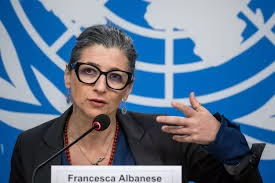
Francesca Albanese's Family Sues Trump Administration in Washington Federal Court

Said Erikat

Opinion Writer

Washington – Said Arikat - 2026

Francesca Albanese's family has filed a lawsuit in a federal court in Washington against the Donald Trump administration, challenging the sanctions imposed on her by the US government last year due to her stances on the war in Gaza and her criticisms of Israel.

The lawsuit, filed Wednesday in the US District Court for the District of Columbia, states that the sanctions "violate the First Amendment of the US Constitution," considering that Albanese's statements and her work within the United Nations fall under constitutionally protected freedom of speech and professional activity. The lawsuit was filed by Albanese's husband and minor daughter, arguing that the US measures have caused direct harm to the family, including financial and banking restrictions and complications related to residency and travel.

Albanese serves as the United Nations Special Rapporteur on the situation of human rights in the occupied Palestinian territories, an independent position appointed by the UN Human Rights Council. During the recent war in Gaza, she was one of the most prominent voices criticizing Israeli military operations and called for accountability for potential violations before the International Criminal Court.

In July 2025, the US administration imposed sanctions on Albanese, accusing her of taking "biased" positions and working to undermine the interests of the United States and its allies. The sanctions included her listing on the Treasury Department's registers, which entails freezing any assets subject to US jurisdiction and prohibiting financial transactions with her by American institutions or individuals.

The lawsuit names several senior officials in the Trump administration in their official capacities, including the Secretary of State, the Secretary of the Treasury, and the Attorney General, arguing that the sanctions decision was the result of a "high-level political directive" aimed at silencing a critical voice within an international institution.

In a statement, Albanese described the sanctions as an "attempt to intimidate her and deter her from performing her duties," affirming that she would continue her work as an independent expert mandated by the United Nations. For its part, the US administration defended its decision, stating that the measures are legal and fall within the executive branch's powers in foreign policy and protecting national interests.

The case highlights escalating tension between Washington and some UN human rights mechanisms, particularly concerning the Palestinian-Israeli issue. It also opens the door for a new judicial test of the limits of using US sanctions against international officials, and the extent to which such decisions are subject to review by US courts when they have effects that touch upon constitutional rights within the United States.

It is expected that the court will begin considering preliminary requests to temporarily halt the implementation of sanctions until the constitutionality of the measures is decided, in a case that may have repercussions extending beyond the direct parties to affect the relationship between US constitutional law and international accountability mechanisms.

This case reflects a growing clash between traditional US foreign policy tools, based on sanctions, and the domestic constitutional legal system that grants broad protection to freedom of expression. US courts have long given the executive branch wide latitude in national security matters, but targeting an individual working within an independent UN framework raises a new question about whether sanctions can become a tool of political deterrence against legal or human rights discourse. Consequently, the court may find itself facing a delicate test of balancing presidential powers and protecting individual rights within the US constitutional system.

At the international level, the repercussions of the lawsuit may extend beyond its legal boundaries to affect Washington's relationship with UN institutions, especially if the imposition of sanctions is considered a precedent that allows for punishing international experts for their reports or professional opinions. The success of the lawsuit could strengthen the independence of UN human rights mechanisms, while its failure could encourage other countries to take similar actions against UN rapporteurs who criticize their policies. In both cases, the issue appears to be an indicator of a broader shift in the interplay between international law and the domestic policies of major powers.

UNCATEGORIZED

Fri 27 Feb 2026 10:15 am - Jerusalem Time

It Wasn’t Only Russia: How Western Policy Helped Pave the Road to War

By Said Arikat

News Analysis

Washington, D.C. — Four years into the war in Ukraine, a rigid orthodoxy dominates Western debate: Russia alone caused the conflict. The invasion, we are told, was entirely unprovoked, and responsibility rests exclusively with the Kremlin. This conclusion is presented not only as a moral judgment but as strategic truth.


Yet claiming moral clarity is not the same as analytical honesty. Wars of this magnitude rarely emerge from a single decision detached from political context. Russia bears direct responsibility for launching the February 2022 invasion. Acknowledging that fact, however, should not preclude examining how Western policies helped shape the conditions in which war became increasingly likely.


For nearly two decades, Moscow repeatedly warned that Ukrainian membership in NATO crossed a fundamental security red line. These warnings were neither subtle nor concealed. At NATO’s 2008 Bucharest Summit, the alliance declared that Ukraine “will become a member.” Western leaders framed the pledge as support for sovereignty and democratic choice; Russia interpreted it as the continued advance of a hostile military alliance toward its borders.


Western officials insist NATO is purely defensive and therefore nonthreatening. That claim reflects how the alliance understands itself, not necessarily how others perceive it. International politics operates on perceptions of power rather than declarations of intent. Strategic stability depends less on what states believe about themselves than on what their adversaries fear.


The United States has long recognized this logic. Washington was prepared to risk nuclear confrontation during the Cuban Missile Crisis to prevent Soviet deployments in Cuba. No American policymaker would calmly accept a rival military alliance integrating Mexico or Canada into its security architecture. Yet Western leaders appeared surprised by Russia’s intense reaction to NATO’s gradual expansion toward Ukraine — a country central to Russian history, geography, and military planning.


Rather than treating Russian objections as a security concern requiring management, Western policymakers increasingly dismissed them as paranoia or imperial nostalgia. That dismissal was not strategy but wishful thinking. Ignoring an adversary’s stated fears does not neutralize them; it hardens them.


After Russia annexed Crimea in 2014, Western policy deepened rather than recalibrated. NATO expanded training missions, increased weapons transfers, and intensified intelligence cooperation with Ukraine. Kyiv moved steadily closer to NATO in practice while remaining outside its formal security guarantees. The result was a dangerous imbalance: enough integration to alarm Moscow, but insufficient deterrence to prevent escalation.


Ukraine thus entered a strategic gray zone — aligned militarily without protection, while Russia perceived a slow-motion absorption of a neighboring state it considered vital to its security. Western policymakers viewed this approach as a way to support Ukraine without direct confrontation. In practice, it produced mounting instability rather than equilibrium.


I witnessed how stark this disconnect had become in December 2021. As Russian forces massed along Ukraine’s borders, Moscow delivered two draft treaties to the Biden administration proposing what it called “security guarantees.” The documents demanded a legally binding prohibition on Ukrainian NATO membership and a rollback of NATO deployments in Eastern Europe. The proposals were sweeping and, in key respects, unacceptable. But they also represented an unmistakable signal that the Kremlin viewed the existing trajectory as intolerable.


Days later, Undersecretary of State Victoria Nuland entered the State Department briefing room to address the escalating crisis. I was present. When I and several colleagues asked whether the Russian proposals might serve as a starting point for serious negotiation — even if only to test Moscow’s bottom line — the idea was dismissed. There was little indication that Washington saw value in publicly engaging the core demand. Soon afterward, the United States and its allies formally rejected the drafts.


Rather than testing whether diplomacy could reduce tensions, Washington reinforced that NATO’s open-door policy was nonnegotiable. Principle took precedence over strategic timing. From Moscow’s perspective, diplomacy appeared exhausted before it had meaningfully begun.


Western leaders continue to describe the invasion as “unprovoked.” Yet from the Kremlin’s vantage point, NATO expansion — combined with the refusal even to discuss limits — constituted a cumulative provocation. Whether that perception was justified matters less than the fact that policymakers failed to account for it.


The deeper problem lies in the structure of the post–Cold War order itself. NATO expanded steadily eastward while no inclusive European security architecture emerged that meaningfully incorporated Russia. Enlargement advanced during a period of Russian weakness, producing a system in which one side’s security gains appeared to come at the other’s expense. Western policymakers assumed liberal integration would eventually override geopolitical rivalry. It did not.


Critics argue that acknowledging Western missteps risks legitimizing spheres of influence. Yet refusing self-examination carries its own danger. A foreign policy that treats its principles as immune from strategic consequences becomes incapable of learning from failure.


None of this alters the central fact that Russia chose war. But Western decisions narrowed diplomatic space and intensified confrontation. Two realities can coexist: Russia acted aggressively, and NATO policy helped create a crisis environment in which escalation became increasingly probable.


Four years later, the consequences are unmistakable. Ukraine lies devastated, Europe is rearming, Russia is entrenched in long-term confrontation with the West, and global instability has deepened. The promise that NATO expansion would produce a more secure Europe has yielded the opposite result.


If policymakers hope to prevent future catastrophes, they must abandon comforting myths. Strategic success requires understanding how one’s own actions appear to rivals, not merely asserting moral righteousness. The tragedy of Ukraine is not only that Russia chose war, but that Western leaders pursued policies that made that choice easier to imagine — and harder to avoid.

ARAB AND WORLD

Fri 27 Feb 2026 10:11 am - Jerusalem Time

Iran offers 'commercial incentives' to Washington to avoid military confrontation and ease sanctions

International press reports have revealed a new direction in Iranian diplomacy aimed at presenting wide-ranging economic incentives to the administration of US President Donald Trump. These proposals include opening vital sectors such as oil, gas, mining, and aviation to direct American investments, in an attempt to avoid any potential military action and alleviate the burden of economic sanctions that are crippling the Iranian economy.

Informed sources described this offer as a 'commercial prize' specifically designed to suit President Trump's inclinations, as he places great importance on economic returns and major commercial deals. Through this step, Tehran aims to build common interests that would make it difficult for Washington to proceed with military escalation options, while ensuring the renewed flow of foreign investments.

The leaked information indicates that planners in Tehran are carefully studying the Venezuelan model, where American energy companies were allowed to operate despite diplomatic estrangement and acute political tensions. Iran hopes that this path will lead to the release of tens of billions of dollars frozen in foreign accounts, in exchange for its activities being subject to a strict international monitoring mechanism.

In the context of diplomatic moves, Iranian Foreign Minister Abbas Araghchi announced significant progress in the third round of negotiations concluded in Geneva. Araghchi described these talks as the most focused and in-depth, noting that mutual understandings were reached on fundamental issues including the lifting of sanctions and technical steps related to the nuclear program.

Despite the positive atmosphere described by the Iranian side, other reports indicated the continued existence of fundamental gaps in positions between the two parties. Washington adheres to strict demands including the destruction of fortified nuclear sites and the transfer of the entire enriched uranium stockpile out of Iranian territory, which Tehran has categorically rejected so far.

US envoys, Steve Witkoff and Jared Kushner, informed the Iranian side that any future agreement must be permanent and comprehensive, going beyond the loopholes of the 2015 agreement. The US administration insists on not including 'sunset clauses' that would allow Iran to resume its nuclear activities after a specified period, emphasizing the need for eternal guarantees.

In an attempt to bridge viewpoints, Iran presented technical proposals including reducing uranium enrichment levels from 60% to just 1.5%, or suspending enrichment operations for several years. A proposal also emerged to establish an 'Arab-Iranian consortium' to manage and process nuclear fuel inside Iran to dispel international concerns about the possibilities of nuclear armament.

For its part, the United States still raises the slogan of 'zero enrichment' as a final strategic goal in any negotiations with Tehran, but it has shown slight flexibility behind the scenes. Sources indicate that Washington may allow limited operation of a research reactor in Tehran for the production of medical isotopes, provided that it is under close international supervision to prevent any deviation towards military purposes.

These developments come at a sensitive time, as news circulates about President Trump being briefed on a set of ready military options against Iranian facilities. The Iranian bet remains on the extent to which 'economic diplomacy' can convince the White House to replace the language of threat with the language of mutually beneficial commercial deals.

The Iranian strategy is based on offering a 'commercial prize' to American interests in the oil, gas, and mineral sectors in exchange for security and economic guarantees.

ARAB AND WORLD

Fri 27 Feb 2026 10:11 am - Jerusalem Time

US Intelligence Reports Refute Trump's Claims on Iranian Intercontinental Missiles

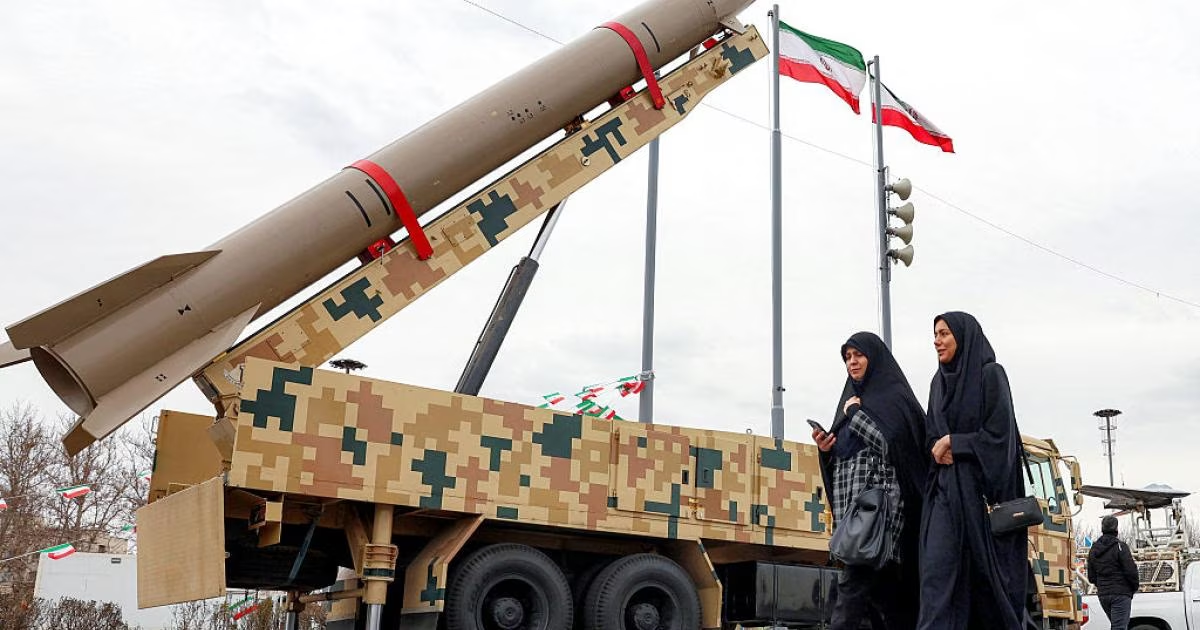
Informed sources indicate that US intelligence reports do not support recent claims made by President Donald Trump regarding Iran's imminent acquisition of intercontinental ballistic missiles. The sources clarified that current technical assessments raise major questions about the justifications put forward by the White House for threatening military action against Tehran.

The US President had stated during his 'State of the Union' address to Congress that Iran was rapidly developing missiles that would soon reach the American heartland. Trump considered this development a direct threat requiring decisive action, as part of his effort to rally public opinion behind his escalating policies towards the Iranian regime.

In contrast, two informed sources confirmed that there has been no fundamental change to the annual assessment submitted by the US Defense Intelligence Agency for 2025. This assessment clearly indicates that Iran may need a full decade, specifically until 2035, to be able to produce a militarily viable intercontinental ballistic missile.

For her part, White House spokeswoman Anna Kelly defended the President's stance, noting that Trump is right to highlight the serious risks posed by Iranian military programs. Kelly said that concerns about Tehran acquiring intercontinental missile technology remain a top priority for the current US administration.

Technical experts believe that even if Tehran receives technological support from allies such as China or North Korea, the process would take a long time. These experts estimate that producing a missile ready for actual combat operations requires at least eight years of continuous testing and development.

In the same context, press reports quoted US intelligence agencies as believing that Tehran is still years away from possessing long-range offensive capabilities. These assessments come at a sensitive time when the region is witnessing intense US military reinforcements coinciding with stalled nuclear negotiations between the two sides.

The White House has not yet provided additional details or concrete intelligence evidence to support the narrative presented by Trump to Congress. Observers describe this approach as the most aggressive towards Iran in decades, with Trump linking the missile program and support for armed groups to justify any future action.

Trump also claimed that Iran had begun rebuilding its nuclear facilities that were subjected to US raids last June, asserting that those sites had resumed operations. Despite these statements, no public reports have emerged confirming the resumption of activity at the three main sites previously targeted by US airstrikes.

For his part, US Secretary of State Marco Rubio adopted a tone that seemed more reserved than the President's statements, describing Iran as 'on a path' to acquiring these weapons. This phrasing reflects an attempt to balance tough political rhetoric with the technical reality imposed by intelligence reports.

On the other hand, Iran continues to deny its pursuit of nuclear weapons, asserting that all its activities fall under peaceful and research purposes. Iranian Foreign Minister Abbas Araqchi stressed that his country is not developing long-range missiles, and that its current arsenal is exclusively for self-defense.

Araqchi clarified in press statements that the range of Iranian missiles is predetermined with a ceiling not exceeding two thousand kilometers, which is sufficient to respond to regional threats. Tehran insists that its missile program is a sovereign right not subject to negotiation, despite increasing international pressure to restrict its ballistic capabilities.

Data from the International Atomic Energy Agency indicates that Iran halted its military nuclear program in 2003, despite continuing to enrich uranium. However, the high levels of enrichment raise international concerns about the possibility of converting the program to a military path in a short time.

Iran currently possesses the largest ballistic missile system in the Middle East, capable of reaching targets in Europe and surrounding US bases. Analysts believe that the development of Iranian space launch vehicles provides it with technical expertise that could be converted in the future into intercontinental missiles if the political decision is made.

However, David Albright, president of the Institute for Science and International Security, asserts that Tehran still lacks the technology to protect nuclear warheads during re-entry into the atmosphere. Experts conclude that the gap between political rhetoric and on-the-ground reality remains wide, especially with the damage to Iranian facilities from recent Israeli strikes.

Intelligence reports do not contain anything to support Trump's claim that Tehran will soon be able to develop a missile capable of reaching American territory.

PALESTINE

Fri 27 Feb 2026 10:11 am - Jerusalem Time

Israel Changes the Rules of the Game in Gaza: Systematic Escalation and Borders Drawn by Force

Gaza - Al-Quds Special Correspondent - The Gaza Strip has witnessed a gradual military escalation in recent weeks, taking on a systematic and expanding character, moving beyond the framework of limited operations or localized responses, to reflect the features of a new security strategy through which Israel seeks to re-engineer the field scene and impose different security equations by force.

This escalation is characterized by its geographical breadth and temporal recurrence, targeting multiple areas throughout the Strip, including residential areas and civilian sites, in the absence of effective international pressure that could curb this trajectory or limit its repercussions.

Observers believe that this shift cannot be read as a fleeting reaction, but rather as part of a deliberate policy aimed at redefining the rules of engagement and creating a new security reality within the Strip.

Expanding the "Yellow Line"

The escalation coincides with the expansion of what is known as the "Yellow Line," in a move that reflects a practical Israeli endeavor to redraw the security borders within Gaza, and create a wider field area controlled by Israeli forces.

Analysts believe that this expansion aims to enshrine greater freedom of movement for the occupation army, and establish a new deterrence equation based on continuous pressure and the cost of attrition.

Writer and political analyst Dhu al-Fiqar Suwerjo confirms that what is happening goes beyond the framework of "tactical responses," and reflects a systematic escalation policy aimed at reshaping the rules of engagement and imposing field realities that serve the Israeli security and military vision.

He points out to "Y" that the expansion of the "Yellow Line" constitutes a central tool in this strategy, allowing for the imposition of additional restrictions on the movement of residents and increasing pressure on the environment supporting the resistance.

Targeting Societal Resilience

The objectives of the escalation, according to Suwerjo, are not limited to the military dimension alone, but extend to an attempt to weaken the resilience of the population by expanding the scope of targeting to include civilians and residential areas, thereby exacerbating the psychological and social impact, and deepening the state of anxiety and instability.

He adds that the Israeli message is clear: raising the cost of any form of resistance or resilience, in an attempt to push Palestinian factions to make political or military concessions under continuous field and economic pressure.

Absence of International Deterrence

For his part, Adel Yassin, a specialist in Israeli affairs, believes that the widening scope of targeting reflects an Israeli feeling of the absence of effective international deterrence, in light of the international community's silence or inability to impose real pressure that would stop military operations or limit their scope.

Yassin told "Y" that this reality grants Israel a wide political and security margin for maneuver, with indirect support or supervision from international coordination circles.

Yassin points out that the escalation also serves internal political objectives, especially in light of a heated electoral atmosphere, as it is used to satisfy the right-wing public and demonstrate the continuation of "security control," in addition to restoring the confidence of settlers in the Gaza envelope in the military establishment's ability to protect them.

De-escalation at Stake

Regarding the future of the de-escalation agreement, Yassin warns that continued violations would undermine any political path or serious reconstruction efforts, stressing that the fate of the agreement remains dependent on the seriousness of mediators and the US administration in obliging Israel to its commitments.

He believes that any laxity in this context will keep the possibilities of explosion open, while regional and international pressure constitutes a decisive factor in curbing the escalation.

Observers agree that attempts to impose permanent realities by force in Gaza have historically proven to have limited long-term results, given the community's ability to adapt and endure. This makes any field gains susceptible to erosion over time, and leaves the scene open to multiple possibilities between escalation and containment.

The occupation forces continue their violations of the ceasefire agreement with the "Hamas" movement, which came into effect on October 10th. According to the Ministry of Health in Gaza, the number of martyrs and injured since the agreement came into force has reached 615 martyrs and 1,651 injured, in addition to the recovery of 726 martyrs from under the rubble.

OPINIONS

Fri 27 Feb 2026 10:11 am - Jerusalem Time

Decisive Days Ahead

Overall expectations indicate that yesterday's negotiations, Thursday, will be decisive and fateful, and the outcome of these negotiations will determine President Trump's stance. The options available if negotiations fail include a naval and aerial blockade, or a limited, focused strike targeting vital military and security objectives to subjugate Iran to American demands, or multiple strikes initiated by the United States and lasting several days to weaken the regime in preparation for its overthrow in the near future. Israel would enter the battle if it were subjected to bombardment by Iran.

Unofficial Israeli intelligence analyses suggest that a strike is inevitable and will be limited. However, what will determine everything after the strike is the Iranian response. If the Iranian response is as declared by Iranian military, security, and political leaders, then the region as a whole is heading towards a comprehensive regional war. But if the response is limited and far from Israel, the repercussions will not be significant, yet at the same time, this will not lead to a comprehensive change in positions, especially Iranian ones.

Meanwhile, unofficial Russian intelligence analyses suggest that what is happening is part of the pressure exerted by the United States against Iran to obtain the maximum possible concessions, and that no strike is coming in the near future.

Despite its complexities and President Trump's hesitation, the reality indicates that the true intentions, given the nature of the American military buildup, are heading to extremes, for several reasons, the most important of which are:

First - President Trump champions peace through strength, meaning subjugating countries to the Trumpian will and vision. Therefore, he is not seeking negotiations but rather Iran's submission to American conditions. All ongoing negotiations aim to justify the upcoming attack on Iran, and to claim that all diplomatic avenues have been exhausted to avoid war, in addition to gaining time for the military buildup, which was completed with the arrival of the largest American aircraft carrier, the "Gerald Ford."

Second - The Americans cannot accept any agreement that is limited in time or temporary, or resembles the Obama 2015 agreement. That is, what is required is a permanent agreement that allows President Trump to declare victory and that he has subjugated Iran. This permanent agreement would lead to the dismantling of the nuclear program in one way or another, and Iran would also agree to negotiate afterward on its ballistic missile capabilities and its relations with its allies.

Third - Any possible or probable agreement will clearly feature Israel, and this complicates reaching any agreement, as Israeli pressures are pushing the Trump administration to be tough in order to achieve a clear and unambiguous accomplishment.

Fourth - The flexible Iranian stance, willing to go to limits it has not reached before, cannot align with what President Trump wants, because what is required is Iran's surrender, or as Trump says, either you agree or we go the bad way.

Fifth - Israel, the central factor in the American-Iranian negotiations, will never accept any agreement according to the Iranian vision, meaning, as Netanyahu said, "We want a sustainable agreement, an agreement forever," and this was echoed by the American Jewish envoy and negotiator "Steve Witkoff."

Therefore, all ongoing diplomacy, called negotiations, has nothing to do with reality. What is required is not Iranian flexibility, nor concessions here and there. It is unequivocally clear that what is required is Iran's complete surrender to Zionist-American demands, and this confirms that the drums of war are drowning out everything else.

In a public opinion poll in Israel conducted by the "Israeli National Security Research Center" on February 25, approximately 51% of respondents stated that they support a unilateral strike by Israel against Iran. This alone indicates the true reality regarding the view of Iran, as does the statement by American Democratic Senator "Chuck Schumer," the minority leader in the US Congress, after a briefing from the CIA director, who said: "Look, the matter is serious... Trump must explain this to the American people," meaning we are facing an inevitable theater of war.

Previously, we said that the American-Israeli plan in the region was settled in the meeting between President Trump and Netanyahu a month ago at the "Mar-a-Lago" resort in Palm Beach outside Miami, where it was agreed to resolve the region's issues so that they would be completely subjugated to American interests, and transformed into an American lake with Israeli influence and captaincy to maintain its security, and this is not possible without subjugating Iran.

It is true that American Trump is somewhat hesitant, as the media suggests, and it is true that there is internal American division regarding resorting to the military option, but I personally do not see President Trump as hesitant. Rather, it seems to me that he is heading to war with Iran because he sees the matter from a personal perspective first, and he sees America's greatness in subjugating other countries to American will to plunder their wealth, as happened in Venezuela where he boasted in his "State of the Union" address about America obtaining 80 million barrels of oil, in addition to seeing himself as a messenger from God "Yahweh" sent to protect his chosen people, and this was clearly mentioned in the US National Security Strategy "Protecting Israel's Security," and this is not possible without subjugating Iran.

Anyone who hears President Trump's "State of the Union" address will understand that this man sees no one and understands only one language, the language of wrestling, of which he was and still is a fan. It's either victory or making a deal that leads to his victory, meaning he does not think of losing; in fact, this term does not exist in his vocabulary. That is why he carried out all this military buildup, or as he called it, the "beautiful fleet."

So the choices have become clear: honor and dignity or submission, because a man with President Trump's mentality does not understand the language of respect. The published "Epstein" files are enough to illustrate how he thinks: no morals, no honor. They only understand the language of force, the language of steadfastness, and the language of attrition.

The confrontation is imposed on Iran and its allies, and the conclusion of the battles initiated by the "Flood" will be determined by the upcoming battle. It will either be an end to the war and a move towards stability in the region by putting an end to arrogance, genocide, and ethnic cleansing, or entering into wars of attrition that will affect the entire region, and may even extend much further. As for submission to the Zionist-American agenda, that means losing everything for decades.

Decisive days are coming, carrying within them all hope for a Ramadan dawn filled with pride and dignity for every people who say, "Far be it from us to be humiliated."

PALESTINE

Fri 27 Feb 2026 10:10 am - Jerusalem Time

Smotrich's Statements... Gaza Between Settlement Strategy and Electoral Gains

Mohammad Joudeh: Smotrich's statements reveal what lies behind the deadline set for "Hamas," placing Gaza at a strategic crossroads between containment and the re-imposition of comprehensive control.

Hani Abu Al-Siba': These statements come in a political and electoral context, as Israeli parties use the Gaza issue as an influential card in the upcoming elections.

Fayez Abbas: Smotrich is trying to enhance his presence to ensure his survival in the Knesset by adopting the dream of re-establishing settlements in the Strip, despite the limited feasibility of achieving this goal.

Nihad Abu Ghosh: The displacement plan and the occupation of Gaza have become a central option for the far-right government, which explains Israel's reluctance to implement its commitments under the Trump plan.

Suleiman Basharat: Smotrich's statements aim to create fear among Palestinians, Arabs, and Muslims, given that the Zionist project is based on a policy of demographic replacement.

Yasser Manna': The idea of re-establishing settlements in the Gaza Strip is not new; it was proposed in the first weeks of the war, and the current discourse is a direct extension of this trend.

Ramallah - Exclusive to "Al-Quds"-

The statements by Israeli Finance Minister Bezalel Smotrich regarding the occupation of the Gaza Strip and the establishment of settlements there, if Hamas is not disarmed within the specified deadline, raise serious scenarios about the future of the Strip, amidst escalating discussions within Israeli political circles about a radical change in the existing reality. However, these statements may be understood within an electoral context.

In separate conversations with "Al-Quds," writers, political analysts, and specialists believe that these statements come within the context of electoral bidding, but they are interpreted as an indicator of trends within the Israeli government seeking to impose new realities on the ground, going beyond conflict management to re-establish direct control over the Strip, including settlement projects and long-term security arrangements.

He points out that linking the disarmament of the resistance with the option of occupation reflects a political vision that seeks to leverage field developments to impose a new equation in Gaza, which may open the door to a more complex phase at both political and humanitarian levels.

Intense Political Moment

Writer and political analyst Mohammad Joudeh believes that the recent statements by Israeli Finance Minister Bezalel Smotrich regarding the occupation of the Gaza Strip and the establishment of settlements there, coinciding with Israeli Prime Minister Benjamin Netanyahu's talk of a deadline for disarming Hamas, in addition to the positions of US Ambassador Mike Huckabee, reflect an intense political moment that cannot be separated from the internal Israeli balances, the nature of the relationship with the United States, and the shape of the regional order after the war.

Joudeh believes that Smotrich's statements reveal what lies behind the deadline set for Hamas, placing Gaza at a strategic crossroads between containment and the re-imposition of comprehensive control.

Clear Ideological Vision

Joudeh clarifies that Smotrich's statements do not represent merely a military threat, but rather express a clear ideological vision belonging to a current that considers the Israeli withdrawal from Gaza in 2005 a strategic mistake, linking it to the rise of Hamas and the recurrence of rounds of confrontation.

According to Joudeh, within this perception, the talk of occupying the Strip and building settlements there reflects an attempt to reshape the demographic and sovereign reality in Gaza, and not merely to achieve security deterrence.

An Entry Point for Redefining the Legal and Political Status of the Strip

Joudeh points out that the timing of proposing the idea of occupation and settlement coinciding with a deadline for disarming Hamas carries deep political implications, as the demand for disarmament is not limited to being a security condition, but rather constitutes an entry point for redefining the legal and political status of the Strip. Failure to disarm may open the door to a scenario of complete control, while disarmament according to Israeli conditions means establishing a new security equation that keeps Israel in the upper hand.

Joudeh explains that Netanyahu is operating under conflicting pressures, between the demands of the religious and national right calling for a decisive resolution in Gaza, and international pressures, especially American, to avoid a permanent re-occupation that could lead to a widespread regional escalation.

Joudeh considers Smotrich's statements also represent a tool of pressure within the ruling coalition to ensure that no settlement is accepted that does not include a complete dismantling of Hamas's military structure.

Regarding the positions of US Ambassador Mike Huckabee, Joudeh believes that they are read in the region as an indicator of a current within the United States that provides intellectual or religious cover for Israeli expansionist discourse, which strengthens the confidence of the right-wing current in Israel even if it does not translate into official American policy.

A Political Warning Paving the Way for Resumption of Military Operations

Joudeh points out that disarming Hamas in the Israeli sense means ending its military and organizational capacity as a ruling force, but historical experiences show that complete disarmament is rarely achieved without a decisive military defeat or a major political settlement, which makes the proposed deadline closer to a political warning that paves the way for the possibility of resuming military operations.

Joudeh proposes four possible scenarios, including resuming the war with the aim of military decisive action and dismantling Hamas's structure, or reaching a long-term truce that restricts its capabilities in exchange for new humanitarian and administrative arrangements, or imposing permanent military control through buffer zones and a fixed military presence within the Strip, in addition to a weaker possibility of a broader political settlement within a regional framework.

Joudeh points out that the scene reflects a struggle within Israel between a vision that seeks to radically reshape the political map in Gaza, and another pragmatic one that focuses on deterrence and restoring calm, stressing that the next phase may constitute a decisive moment in determining the future of the Strip for many years to come.

Israeli Vision for Imposing Permanent Control

Writer and political analyst specializing in Israeli affairs Hani Abu Al-Siba' believes that Israeli Finance Minister Bezalel Smotrich's statements regarding the occupation of the Gaza Strip and the establishment of settlements there came during a press interview that addressed the question "Why has no decisive action been taken in the Gaza Strip yet?" He points out that these statements reflect an Israeli vision based on imposing permanent control over the Strip and linking the future of Gaza to the complete disarmament of Hamas.

Abu Al-Siba' explains that Smotrich spoke about giving Hamas a deadline to disarm, considering that failure to do so would give Israel a justification to occupy the rest of the Gaza Strip, while emphasizing that security control would remain in the hands of the Israeli army, and that any future forces within the Strip must be disarmed and subject to Israeli decision, with the Israeli government rejecting any political or administrative role for Hamas in Gaza.

Abu Al-Siba' points out that Smotrich claimed that Israel currently controls more than 53% of the Gaza Strip's area, and considered this control permanent, announcing the government's intention to rebuild settlements and return settlers to the Strip.

Abu Al-Siba' draws attention to Smotrich's call for "soft displacement," by encouraging Gaza residents, especially youth, to emigrate amidst the destruction of homes and deteriorating living conditions. Smotrich stressed that the reconstruction of the Strip would be conditional on Hamas's disarmament, and that any rocket launch would be met with a resumption of military operations and the occupation of the rest of the Strip.

Statements in a Political and Electoral Context

Abu Al-Siba' explains that these statements come in a political and electoral context, as Israeli parties use the Gaza issue as an influential card in the upcoming elections, amidst Prime Minister Benjamin Netanyahu's and Smotrich's efforts to regain the trust of the Israeli voter by proposing projects of complete control and re-settlement.

Push Towards Voluntary Migration

Abu Al-Siba' expects the Israeli government to continue placing obstacles in the way of any international arrangements or external forces to manage the Strip, while seeking pretexts to prolong the suffering of the residents with the aim of pushing them towards what is called "voluntary migration," pointing to a link between developments in Gaza and regional escalation, especially given the Israeli bet on disarming the resistance despite the difficulty of achieving this.

Abu Al-Siba' points out that the statements of US Ambassador to Israel Mike Huckabee, in which he spoke about Israel's control over the Middle East from a biblical perspective, reflected harmony with the trends of the Israeli right, despite the US State Department's assertion that those statements were taken out of context.

Abu Al-Siba' believes that these positions show that American support for Israel has gone beyond military and political aspects to adopting its regional goals.

Abu Al-Siba' believes that the escalation of extremist statements as elections approach reflects a competition between Israeli right-wing parties to win voters' support, stressing that the next phase will be characterized by more pressure and restrictions on Palestinians, in contrast to the Palestinians' continued reliance on steadfastness in the face of these policies.

Smotrich and the Attempt to Ensure His Survival in the Knesset

Writer specializing in Israeli affairs Fayez Abbas explains that Israeli Finance Minister Bezalel Smotrich's statements regarding the occupation of the Gaza Strip and the re-establishment of settlements there are largely linked to internal electoral calculations, given his declining popularity and the possibility of his party failing to cross the electoral threshold in the upcoming Israeli elections. Abbas points out that Smotrich, through his hardline positions and statements, whether in the West Bank or the Gaza Strip, seeks to enhance his political presence and try to ensure his survival in the Knesset.

Abbas notes that Smotrich adopts a discourse based on the dream of re-establishing Jewish settlements in the Gaza Strip, but the chances of achieving this goal remain limited, considering that the administration of the Strip will remain in the hands of the United States or within international arrangements that will not allow the return of Israeli settlement construction. Abbas believes that the next phase may witness a repetition of similar statements from far-right leaders regarding settlements in Gaza, within the framework of political bidding, pointing out that there have been attempts by right-wing groups to storm the border with the Gaza Strip, but they were turned back and warned of the consequences of these steps due to the danger they pose to those participating in them and to Israeli soldiers.

Smotrich and the Settlement Show

Regarding settlements in the West Bank, Abbas believes that a number of settlement outposts established during the last three years, with Smotrich as a minister in the Ministry of Defense, are nothing more than show outposts that are unlikely to turn into permanent settlements.

Abbas explains that Smotrich boasts about expanding these outposts, but the data on the ground indicate negative migration from the settlements towards the Green Line, explaining that about 1050 settlers left the West Bank last year, without any actual increase in the number of settlers, despite the tax facilities and government aid provided by Israel to encourage settlement.

Future of the Strip and Submission to American Decision

Abbas confirms that the issue of disarming Hamas and the future of the Gaza Strip will remain largely subject to American decision rather than a purely Israeli decision, pointing out that Israel may try to obstruct any American plan by raising conditions such as disarming Hamas or excluding the Palestinian Authority from managing the Strip.

The Option of Displacement is Still Valid

Writer and political analyst specializing in Israeli affairs Nihad Abu Ghosh explains that Israeli Finance Minister Bezalel Smotrich's statements about the occupation of the Gaza Strip and the establishment of settlements there can be understood from two main angles. The first is related to political competition within Israel, where adopting extremist, racist, and more aggressive positions towards Palestinians gives their proponents more popularity amidst preparations for general elections expected before the end of 2026. Abu Ghosh points out that Smotrich's popularity and his bloc are currently hovering around the electoral threshold in most opinion polls, which pushes him to raise the bar of his political positions.

Abu Ghosh notes that the more important angle relates to the nature of the prevailing thinking among the far-right government in Israel, where the option of displacing Palestinians from the Gaza Strip, re-occupying it, and settling in it is still valid and occupies the thinking of Israeli right-wing leaders, as a means of permanently eliminating the Palestinian presence.

Abu Ghosh confirms that this trend is not limited to Gaza, but extends to the West Bank, amidst the complicity of the American administration and its silence on Israeli violations, and the close alliance between Washington and Tel Aviv in multiple regional files, starting from the war on Gaza to preparing for a potential confrontation with Iran.

Abu Ghosh explains that the displacement and re-occupation plan is no longer just extremist ideas put forward by marginal officials, but has become a central option for the far-right government, which explains Israel's reluctance to implement its commitments within US President Donald Trump's plan, especially withdrawing from the Yellow Line, opening crossings, bringing in aid, and starting the reconstruction of Gaza.

Abu Ghosh points out that Israel has reduced the first phase to recovering prisoners and bodies, and is currently seeking to limit the second phase to the item of disarming the resistance only.

Abu Ghosh explains that the positions expressed by US Ambassador Mike Huckabee reflect, in a crude and provocative manner, what the American administration is doing by adopting the Israeli security concept and remaining silent on the aggressions, recalling previous statements by US Ambassador Tom Barrack about the non-finality of the Sykes-Picot borders, and US President Donald Trump's decision to recognize Israeli sovereignty over the occupied Syrian Golan.

Abu Ghosh believes that the Israeli government believes it has a historic opportunity that may not be repeated to achieve the project of "Greater Israel" or "Complete Israel," benefiting from a comfortable right-wing majority, broad American support, Palestinian division, in addition to the state of weakness and disintegration in the Arab system.

Abu Ghosh calls for focusing on rebuilding Palestinian national action institutions and adopting a unified national program based on strengthening steadfastness and activating the tools of popular, political, diplomatic, and legal struggle, considering that unifying the Palestinian position can contribute to formulating a unified Arab position in confronting Israeli policies, especially after the war on Gaza brought the Palestinian issue back to the forefront of global attention as an issue of freedom, justice, and peace.

Statements Reflecting the Nature of the Colonial Settlement Project

Political writer and analyst Suleiman Basharat believes that Israeli Finance Minister Bezalel Smotrich's statements regarding the re-establishment of settlements in the Gaza Strip cannot be separated from the broader political and ideological context that governs current Israeli policies, pointing out that adherence to re-settlement clearly reflects the nature of the colonial settlement project that Israel seeks to entrench on Palestinian land.

Basharat explains that settlement represents one of the primary tools and methodologies for strengthening the Israeli colonial project, which explains the rapid acceleration in Israeli measures aimed at expanding settlements and providing all necessary components to strengthen them, whether in the West Bank or by proposing the idea of returning to settlement in the Gaza Strip, in addition to the Israeli tendency to remain in the territories that Israel controlled in Syria and Lebanon.

Basharat points out that the Israeli project is not limited to strengthening control within Palestinian territories only, but also includes a broader expansionist dimension at the Middle East level, within a vision based on regional hegemony and control.

Israel, the Spearhead of the Zionist Movement

Basharat explains that Israel, from the perspective of the Zionist movement, represents the spearhead of a global project through which the Zionist movement seeks to impose its influence in the region as a strategic center in the world, which reinforces a growing feeling among the Zionist current that the opportunity is currently ripe to achieve these goals.

Basharat notes that US Ambassador Mike Huckabee's statements reflect the state of "euphoria" experienced by the global Zionist movement, where supporters and theorists of the Zionist project are now boasting about the political and field gains achieved during the current phase.

Basharat emphasizes that one of the important dimensions of Smotrich's statements is the attempt to create a state of fear among Palestinians, Arabs, and Muslims, given that the Zionist project is fundamentally based on a policy of demographic replacement at the expense of the indigenous population.

Basharat believes that these statements aim to push Palestinians either to emigrate or to accept the fait accompli, by instilling a feeling that their chances of remaining on their land have become limited.

Basharat explains that the next phase may move towards two main paths. The first is the continued Israeli drive to strengthen the settlement project and impose new realities on the ground, including accelerating settlement in the West Bank and the possibility of re-establishing settlements in the Gaza Strip, a scenario that remains linked to Israel's ability to impose it without political or field obstacles.

The second path, according to Basharat, is related to the possibility of these plans colliding with regional and international variables, especially regarding the future of American influence in the Middle East, as Israel relies heavily on American power to support its project. Basharat believes that any decline in American ability to impose hegemony, or failure to achieve the goals of confrontation with Iran, could constitute a fundamental obstacle to establishing the settlement project, especially in light of indications of the disintegration of American-European alliances and the potential emergence of new international powers that could affect the level of support provided to Israel.

Disarmament as an Entry Point for Arranging the Governance System in Gaza

Writer and researcher specializing in Israeli affairs Yasser Manna' explains that Israeli Finance Minister Bezalel Smotrich's statements about the occupation of the Gaza Strip and the establishment of settlements there reflect a clear ideological orientation that seeks to transform the war's objectives from merely dismantling Hamas's military capabilities to reshaping the sovereign and geographical reality in the Strip, thereby opening the way for imposing direct Israeli control.

Manna' points out that the timing of these statements coinciding with Israeli Prime Minister Benjamin Netanyahu's talk of a deadline for disarming Hamas indicates that the disarmament issue is being put forward as an entry point for rearranging the governance system in the Gaza Strip, noting that the failure of the political path could lead to the imposition of direct Israeli control or different forms of long-term security and military administration.

Manna' believes that the statements attributed to US Ambassador Mike Huckabee provide rhetorical cover that strengthens the confidence of the right-wing current within Israel, even if these positions do not translate into official American policy, which gives the Israeli right a wider scope to propose more hardline projects related to the future of the Gaza Strip.

Re-establishing Settlements in the Gaza Strip is Not New

Manna' points out that the idea of re-establishing settlements in the Gaza Strip is not new; it was proposed in the first weeks of the war by ministers and members of parliament from the Israeli right-wing current who called for the re-establishment of settlements that were evacuated in 2005, considering that the current discourse is a direct extension of this political trend that has accompanied the developments of the war since its beginning.

Expected Scenarios for the Future of the Gaza Strip

Manna' explains that the expected scenarios for the future of the Gaza Strip revolve around three main paths. The first is the possibility of reaching partial understandings regarding disarmament in exchange for establishing a ceasefire and setting new arrangements for managing the Strip with regional or international support, a path that is less costly politically and security-wise.

The second path, according to Manna', is the failure of the proposed deadline and a return to a widespread military operation that could pave the way for direct occupation or the imposition of long-term Israeli military administration.

Manna' points out that the third path is based on the continuation of a gradual pressure policy through limited military operations and the expansion of buffer zones, while maintaining the threat of war without reaching the stage of complete control.

Manna' explains that the direction of developments will be determined in light of the results of mediation efforts, the balances of the ruling coalition in Israel, and the extent of the ability of various parties to bear the cost of any potential escalation.


PALESTINE

Fri 27 Feb 2026 10:10 am - Jerusalem Time

'Ring of Fire' Strategy: Why is the Occupation Expanding its Aggression Towards Quiet West Bank Cities?

The Israeli occupation's military operations are no longer confined to traditional confrontation centers in the northern West Bank, such as Jenin and Nablus, but have extended to cities and towns previously known for their relative tranquility. This field shift raises profound questions about the underlying objectives behind targeting areas that have not witnessed prominent military resistance formations, indicating a desire to generalize a state of instability.

Salfit recently witnessed one of the largest military incursions since the beginning of this year, with occupation forces deploying hundreds of soldiers and dozens of vehicles in an operation that lasted for about 12 continuous hours. The incursion involved imposing a comprehensive curfew, searching over 150 homes, and converting some into military barracks and field interrogation centers, amidst widespread destruction of private property.

Local sources reported that occupation forces imposed a tight military cordon around the Martyr Yasser Arafat Hospital in Salfit, completely preventing civilian movement by closing the city's main entrances. These measures were accompanied by the distribution of leaflets claiming the goal was 'combating terrorism,' pretexts that observers see as mere cover for a show of force and intimidation of civilians.

Analysts believe that the escalation in Salfit is not isolated from settlement plans, as the governorate is subjected to extensive bulldozing operations aimed at establishing a massive settlement neighborhood known as 'Ariel West.' This project, spanning over 6,000 dunams, aims to isolate the city from its geographical surroundings and transform it into a canton besieged by settlements from all sides.

Israeli policy in the West Bank relies on the principle of 'gradual seizure,' where areas classified as (C) are targeted first to tighten the noose on Palestinian presence. This methodology aims to absorb international and local reactions by implementing plans in spaced-out stages, leading to the imposition of complete demographic and geographical control.

Political specialists indicate that the occupation is trying to draw a new 'psychological map' for Palestinians, based on dividing them into categories according to the level of calm or escalation. This approach aims to create internal brakes within Palestinian society by linking living stability to submission to security measures, known as the 'carrot and stick' policy.

The scale of forces involved in incursions into 'quiet' cities and the use of helicopters in landing operations reflect a desire to impose a new field reality that goes beyond the declared security dimension. These operations carry clear political messages that there is no place in the West Bank beyond the grip of the occupation, regardless of the presence or absence of military resistance activity.

In Bethlehem, the picture was no different, as occupation authorities re-drew land boundaries in the areas of Beit Jala and Battir, in a provocative move aimed at dragging those areas into the circle of confrontation. Researchers believe that these movements aim to empty the land of its original owners in favor of relentless settlement expansion that devours green spaces.

Settlers' role emerges at this stage as a third executive arm of the occupation, working in parallel with the army to intimidate farmers and prevent them from accessing their lands. This complementarity between official and militia roles aims to accelerate the pace of actual annexation of the West Bank and transform Palestinian villages into isolated islands behind military gates.

Despite the occupation's attempts to impose a 'pretext-blocking' policy and restrict Palestinian movement, history proves that the current state of adaptation is a means of steadfastness, not surrender. Palestinians who faced siege in previous intifadas are now inventing alternative ways to manage their daily lives, affirming their attachment to the land despite all attempts at forced displacement.

The divisions imposed by the Oslo Accords (A, B, C) are now mere designations that the occupation bypasses daily through its repeated incursions into city centers nominally under Palestinian control. This تجاوز aims to undermine any national authority and portray the occupation as the sole force controlling the fate and daily movement of the population.

Observers expect that the continuation of this pattern of escalation could lead to a comprehensive explosion in the West Bank, as economic and security pressures reach their peak. The Palestinian people, undergoing a period of intense pressure, possess the historical ability to overturn equations at critical moments, making the occupation's bets on permanent calm losing bets.

The repellent environment that the occupation tries to create through home demolitions and military checkpoints is part of a long-term strategy to reduce the Palestinian population density in vital areas. This policy targets not only resistors but the Palestinian presence itself, by making daily life an unbearable burden under the weight of pursuit and intimidation.

In conclusion, Palestinian steadfastness in the targeted cities remains the rock upon which settlement expansion projects shatter. Despite the massive military arsenal, Israeli anxiety persists about the inability to break national will, which explains the occupation's constant resort to developing tools of oppression and expanding the 'ring of fire' to include every inch of Palestine.

The occupation seeks to create a psychological and geographical map that divides Palestinians to impose a new settlement reality.

ARAB AND WORLD

Fri 27 Feb 2026 10:10 am - Jerusalem Time

Vance rules out long war with Iran, Geneva talks make 'intensive' progress

US Vice President J.D. Vance affirmed that the current US administration is not considering entering into military conflicts in the Middle East that would extend for years. Vance clarified in press statements that any military action President Donald Trump might decide against Tehran would not necessarily lead to the United States sinking into a new military quagmire, as some suggest.

Vance, who previously served in the US Marine Corps, stressed that the diplomatic option remains Washington's preferred method for resolving differences with the Iranian side. However, the US Vice President linked the success of this path to the nature of Iranian actions and the messages Tehran sends during the current phase, which is witnessing an escalation in political rhetoric.

In a related context, the third round of indirect talks between the United States and Iran concluded in Geneva, Switzerland, which diplomatic sources described as very serious. Iranian Foreign Minister Abbas Araghchi indicated that this round was the most intensive since the launch of the new negotiation process, mediated by the Sultanate of Oman.

These diplomatic moves come under pressure from the deadline set by President Donald Trump on February 19, where he gave Tehran a period of ten to fifteen days to reach a final agreement. Trump warned that failure to reach understandings would lead to dire consequences, coinciding with the reinforcement of US military deployments in the region.

Informed sources reported that the negotiations held at the residence of the Omani Ambassador in Geneva witnessed in-depth discussions on the nuclear file and the lifting of economic sanctions. The US side was represented in these meetings by Special Envoy Steve Witkoff and Jared Kushner, President Trump's son-in-law, reflecting the importance the administration attaches to this file.

For his part, Iranian Foreign Minister Abbas Araghchi stated that the negotiating delegation presented Tehran's demands clearly and explicitly during the meetings held through the Omani mediator. Araghchi affirmed that good progress has been made in drafting the elements of a potential agreement, indicating a desire by both parties to avoid military confrontation through diplomatic channels.

Discussions are scheduled to move to a technical level in the Austrian capital, Vienna, next Monday, where discussions will take place under the direct supervision of the International Atomic Energy Agency. This technical track aims to address the precise details related to Iran's nuclear activities and ensure their peaceful nature in accordance with required international standards.

Omani Foreign Minister Sayyid Badr bin Hamad Al Busaidi, who is leading the mediation between the two countries, affirmed that significant progress has indeed been made, necessitating the return of delegations to their capitals for consultation. Al Busaidi clarified that efforts are continuing to bridge viewpoints and overcome obstacles that still stand in the way of reaching a comprehensive and sustainable agreement.

Reports indicate that the fourth round of political negotiations may be held in less than a week, in order to maintain the momentum of progress achieved in Geneva. During this period, both parties must prepare a set of technical and legal documents that will form the basic structure of any future agreement between Washington and Tehran.

IAEA Director General Rafael Grossi participated in the Geneva round as a technical observer, which Iranian sources considered a step contributing to advancing the talks with greater precision. Grossi seeks to ensure sufficient technical guarantees that dispel Western concerns about Tehran's nuclear ambitions and allow for the transition to implementation phases.

Washington adheres to its essential position of preventing Iran from possessing any nuclear weapon, a demand that constitutes the core of the historical dispute between the two parties. In contrast, Tehran continues to deny its pursuit of developing atomic weapons, affirming its legitimate right to possess a nuclear program dedicated to peaceful and medical purposes and energy generation.

In addition to the nuclear file, ballistic missile issues and Iran's regional influence emerge as additional obstacles that Washington seeks to integrate into any final agreement. Despite Iran's declared rejection of discussing these files outside the framework of the nuclear program, the intensity of recent meetings indicates the possibility of major political trade-offs.

The region is experiencing a state of cautious anticipation, as the intensive diplomatic track coincides with military preparations on various fronts. Observers believe that the next few days will be crucial in determining the course of the relationship between the Trump administration and the Islamic Republic, either towards a historic breakthrough or unprecedented escalation.
In conclusion, Vance's statement ruling out a long war sends a reassuring message to the American public, but it carries an implicit threat that any military action would be swift and focused. The bet now is on what the technical Vienna round and the anticipated fourth round in Geneva will yield to end the current tension in the Middle East.

The idea that we will be fighting a war in the Middle East for years with no end in sight is completely out of the question.

PALESTINE

Fri 27 Feb 2026 10:10 am - Jerusalem Time

Dead and wounded in continuous Israeli raids on Gaza and Khan Yunis

Israeli occupation forces escalated their aerial and artillery attacks early Friday morning, targeting various areas in the central and southern Gaza Strip. These raids resulted in casualties, including martyrs and wounded, in a continuation of the daily violations of the ceasefire agreement that came into effect on October 10th.\n\nField sources reported that three martyrs and several injured individuals fell as a result of shelling that targeted the city of Khan Yunis in the southern Strip. The bodies of the martyrs arrived at Nasser Medical Complex after occupation aircraft targeted a police point in the city, causing widespread destruction in the area.\n\nIn the central Strip, a Palestinian was martyred and others were injured in a raid that targeted a police point near the vital Salah al-Din Street. These attacks coincide with another raid that targeted the al-Tuffah neighborhood in Gaza City, which also led to the martyrdom of two and the injury of several citizens with varying degrees of wounds.\n\nFor its part, the occupation army announced in an official statement that it had killed a Palestinian in the southern region, claiming that he tried to cross what is known as the 'Yellow Line'. The statement alleged that forces from the Golani Brigade spotted a person described as armed approaching their positions, which prompted them to open fire on him and neutralize him directly.\n\n"The Yellow Line" is known as a temporary imaginary border drawn under the recent ceasefire agreement, separating the areas where the occupation army is positioned, which controls about 53% of the Strip's area to the east, and the areas where Palestinians are allowed to move in the western direction.\n\nField statistics indicate that the number of martyrs since the agreement came into effect has exceeded 618, most of whom fell by occupation bullets and shells under the pretext of approaching buffer zones. These figures reflect the fragility of the Israeli commitment to the declared calm for months.\n\nOn the humanitarian front, the United Nations Office for the Coordination of Humanitarian Affairs revealed shocking figures related to food security within the Strip. The office explained that one out of every five families still relies on only one meal a day due to the severe shortage of supplies.\n\n The UN report confirmed that the vast majority of Palestinian families in Gaza are now completely unable to bear the exorbitant costs of basic goods. This deterioration comes amid strict restrictions imposed by the occupation on the entry of aid and commercial goods through border crossings.\n\nIn a related context, Amjad Al-Shawa, head of the Network of Non-Governmental Organizations in Gaza, warned of the occupation's continuous attempts to impose its control over the mechanisms of humanitarian organizations' work. Al-Shawa called on the international community and human rights institutions to intervene urgently to ensure the independence of relief work and protect working teams in the field.\n\nIt is worth noting that the Gaza Strip has suffered massive destruction of infrastructure and residential areas since the start of the war on October 7, 2023, which has left more than 72,000 martyrs. Despite the agreement entering its second phase last January, the full Israeli withdrawal has not yet been effectively achieved.\n\nThe second phase of the agreement stipulates the withdrawal of Israeli forces from populated areas and the handover of the Strip's administration to a national Palestinian technocratic committee. However, occupation forces continue their limited military operations and air raids, threatening the collapse of fragile political understandings sponsored by international parties.\n\nThe occupation is trying to control the work of humanitarian organizations in the Strip, and the international community must pressure to protect the independence of relief work.

ARAB AND WORLD

Fri 27 Feb 2026 10:10 am - Jerusalem Time

Hillary Clinton Clears Her Husband of Epstein's Crimes and Demands Trump Be Subpoenaed to Testify

Former US Secretary of State, Hillary Clinton, affirmed that her husband, former President Bill Clinton, was unaware of the criminal activities Jeffrey Epstein was involved in. This came during a hearing held by a US Congressional investigative committee, where Clinton emphasized her husband's innocence of any connection to the late financier's abuses.

In response to journalists' questions after the session, Clinton expressed her complete, one hundred percent confidence that Bill Clinton knew nothing about the sexual crimes attributed to Epstein. She clarified that attempts to drag her family's name into this case lack concrete evidence and are part of a charged political context.

The committee, dominated by Republicans in the House of Representatives, questioned Hillary Clinton about the nature of her relationship and network of acquaintances with Epstein. For her part, the former Secretary demanded that the committee subpoena former President Donald Trump to give his testimony, considering that his relationship with Epstein warrants a direct and transparent investigation.

Clinton denied before the committee having any information about the mentioned crimes, asserting that she does not recall meeting Epstein personally and never visited his private island in the Caribbean. She also stressed that she never used his private plane for any of her travels, accusing the committee of trying to politicize the investigation to protect Republican parties.

For his part, James Comer, the committee chairman, stated that the goal of these investigations is to uncover the mystery surrounding Epstein's network and reach the full truth. Comer announced that the committee would continue its procedures by questioning former President Bill Clinton on Friday, as part of a series of closed meetings with individuals linked to the case.

Hillary Clinton challenged committee members to open Donald Trump's files, noting that his name appears thousands of times in documents related to Epstein. She said that seriousness in combating human trafficking requires placing Trump under oath to hold him accountable for those records and documented connections in the case files.

In a related context, Democratic Representative Robert Garcia called for Trump to appear immediately before the committee to answer questions from survivors of Epstein's assaults. Garcia affirmed that justice requires no political figure, no matter how influential, to be exempt, especially with serious accusations that require official clarification.
Democratic committee member Suhas Subramanyam revealed the existence of 'missing files' at the FBI that had been deleted from the original case documents. Subramanyam indicated that these documents contain direct accusations related to sexual assault against Donald Trump, which calls for an in-depth investigation.

These investigations come at a time when the House Oversight Committee is trying to track all individuals who were connected to Epstein before his death in prison in 2019. Epstein had died under mysterious circumstances while awaiting trial on charges related to operating an international child sex trafficking network.

Bill and Hillary Clinton had initially refused to comply with subpoenas, but later agreed to avoid contempt of Congress charges. Hillary clarified at the beginning of her testimony that she had no information that would aid the investigation into the activities of Epstein or his convicted associate Ghislaine Maxwell.

The session witnessed noticeable tension after photos of Hillary Clinton testifying were leaked, leading to a brief suspension of the session. Democrats criticized this breach of rules, considering that the publication of photos proves that the investigation is being used as a political weapon to attack opponents instead of legal oversight.

Despite both Trump's and Clinton's names appearing in government documents, both affirmed cutting ties with Epstein before his first conviction in 2008. Legal experts confirm that the mere mention of names in these records is not sufficient legal evidence to convict anyone of committing crimes.

The hearings took place in Chappaqua, New York, amidst strict security measures imposed by the Secret Service around the local arts center. The Clintons had demanded that the sessions be open to the public, but the committee insisted on keeping them behind closed doors, which Bill Clinton described as clear politicization.

Regarding Ghislaine Maxwell, who is serving a 20-year prison sentence, she refused to answer the committee's questions during her video appearance. Her lawyer indicated that his client might speak publicly if she receives a presidential pardon, emphasizing that she is the only one who can clarify the circumstances of that era.

If this committee is serious about finding the truth about human trafficking crimes, it will question Trump directly and under oath about his name appearing thousands of times in Epstein's files.

PALESTINE

Fri 27 Feb 2026 10:09 am - Jerusalem Time

Occupation forces ban journalist Jalajel from Al-Aqsa for a week after his arrest in its courtyards

As part of an ongoing campaign of repression within and around Al-Aqsa Mosque, Israeli occupation forces, this Thursday evening, arrested journalist Ahmed Jalajel from inside the mosque's courtyards in occupied Jerusalem.

According to local sources, occupation forces stopped journalist Jalajel while he was in Al-Aqsa Mosque, before taking him to an interrogation center. He was later released on condition of being banned from Al-Aqsa Mosque for a week, renewable.

This arrest comes in the context of tightening procedures and restrictions imposed on the entry of worshippers and media workers, with the continued targeting of journalists during their duties inside and around Al-Aqsa.

In a related context, the Jerusalem Governorate documented about 150 cases of expulsion since the beginning of last January, while the total number of those expelled before the month of Ramadan ranges between 200 and 300 people, with difficulty in accurately counting the number due to the notification of a number of decisions via phone or electronic applications without delivering official written decisions.

The Governorate also indicated that the number of expulsion decisions during the past five years reached about 2630 decisions, while during January alone, nearly 300 cases of expulsion were recorded, most of which were described as precautionary in preparation for the month of Ramadan.

Expulsion decisions affect guards of Al-Aqsa Mosque, stationed worshippers, activists, journalists, imams, preachers, and Jerusalemite dignitaries, in a policy followed annually by the occupation authorities with the aim of emptying Al-Aqsa Mosque during the holy month of Ramadan.

PALESTINE

Fri 27 Feb 2026 10:09 am - Jerusalem Time

Turmoil within the United Nations: Resignation threats in protest of 'complicity' with Israel to soften Gaza reports

Well-informed sources have revealed severe turmoil within the United Nations, following threats by a number of officials to submit their collective resignations. This move comes in protest of what they described as the complicity of senior leaders in the international organization with Israeli diplomats, with the aim of softening the official discourse regarding war crimes committed in the Gaza Strip and modifying the content of periodic reports issued by the organization.

Internal emails circulated among staff showed direct coordination aimed at reducing criticism directed at the Israeli occupation. One employee expressed his extreme indignation in these correspondences, describing the UN organization as having become a 'public relations agency for genocide,' which reflects the extent of internal division and loss of trust in the impartiality of the senior leadership regarding the Palestinian issue.

This crisis brings to mind previous incidents witnessed by the organization, most notably the resignation of senior official Rima Khalaf in 2017, after the Secretary-General came under American and Israeli pressure to withdraw a report condemning Israel for imposing an 'apartheid' system. These precedents confirm that political pressures have always affected the outcomes of the international organization, prompting current employees to take more stringent stances to confront what they describe as impunity.

In a related context, the 'UN Staff for Gaza' group organized a symbolic demonstration in front of the organization's headquarters in Geneva, where participants placed more than 370 white roses next to a memorial plaque. These roses represent the number of UN aid workers killed during the ongoing war, in a clear message of condemnation of the senior administration's silence regarding the targeting of its field teams in the Strip.

For his part, UN spokesman Stéphane Dujarric justified the restrictions imposed on staff movements by the existence of rules and regulations governing their participation in activities outside their official duties. This statement came after the organization's administration refused to allow a parallel candlelight vigil to be organized in front of the permanent headquarters in New York City, which fueled anger among UN cadres opposing the blackout policy.

On the other hand, the Israeli Ambassador in Geneva, Daniel Meron, launched a sharp attack on the protesting employees, demanding strict disciplinary measures against them, including suspension from work. Meron stated in an official letter that these employees had exceeded their professional role and turned into political activists, accusing them of bias against Israel and engaging in politically motivated activities that violate the UN charter.

Under these pressures, a wide segment of employees expressed their full support for Special Rapporteur Francesca Albanese, who faces organized smear campaigns from non-governmental organizations supporting the occupation. These officials confirm that they are subjected to immense pressure to compromise their professional neutrality in favor of the Israeli narrative, which puts the credibility of the United Nations at stake amid the ongoing war on Gaza.

One employee described the international organization as having turned into a public relations agency for genocide as a result of coordination with Israeli diplomats.

ARAB AND WORLD

Thu 26 Feb 2026 10:56 pm - Jerusalem Time

Trump demands expulsion of Muslim congresswomen Tlaib and Omar from America

Said Erikat

Opinion Writer

Washington – Said Arikat – 2/26/2026

President Donald Trump escalated his attack on Democratic Representatives Ilhan Omar and Rashida Tlaib, demanding their deportation "from where they came," following a sharp verbal altercation during his State of the Union address to Congress on Tuesday evening. Trump's statements came in posts on his "Truth Social" platform, where he described the two congresswomen with abusive terms, considering them to be "harming the country" and unable to "do anything to save it," in his words.

Omar and Tlaib had interrupted the President during his discussion of irregular immigration, particularly when he touched on a fraud case in Minnesota involving individuals from the Somali community. When Trump said Democrats should "be ashamed," Omar loudly retorted: "You're the ones who should be ashamed!" while Tlaib shouted at another moment: "Liar!". Tensions escalated when they later chanted: "You killed Americans!" referring to the deaths of Renee Nicole Good and Alex Pretty at the hands of federal agents last month.

In a subsequent post, Trump went further, calling for their "return as soon as possible," adding that their behavior proves they are "corrupt and crooked." He also expanded his attack to include Oscar-winning actor Robert De Niro, whom he criticized at a political event in Washington, sarcastically suggesting that "the three of them get on a boat together" to expel them from America.

Omar was born in Somalia and immigrated to the United States in her childhood during the 1990s, while Tlaib was born in Michigan to a family of Palestinian origin. There was no immediate comment from representatives for Omar or De Niro, while a spokesperson for Tlaib referred to a post of hers on the X platform in which she said Trump "cannot stand being corrected by two Muslim women, so he collapses."

Democratic leaders were quick to condemn the President's statements. House Minority Leader Hakeem Jeffries described the speech as "shameful and unbecoming of a president," considering it to reflect an anti-foreign sentiment unworthy of the presidential office. Democratic Caucus Chairman Pete Aguilar also defended the two congresswomen, affirming that they are "legally elected American citizens, fully aware of the pulse of their communities."

It should be noted that this latest attack is not a precedent in Trump's political career. Since his first term in 2019, he has consistently attacked Omar, Tlaib, and other progressive lawmakers, using phrases calling on them to "go back to their countries." At a campaign rally in Pennsylvania last December, he urged his supporters to chant: "Send her back to her country," referring to Omar. He also described her in a cabinet meeting as "incompetent" and "garbage," in his words.

PALESTINE

Thu 26 Feb 2026 10:56 pm - Jerusalem Time

Huckabee's 'Biblical Expansion' Remarks: Do They Reveal the True Face of American Policy?

The echoes of the statements made by the American ambassador to the occupation state, Mike Huckabee, continue to reverberate in political circles, following his controversial remarks about what he called 'Israel's right' to control vast areas of the Middle East based on biblical concepts. Despite Huckabee's later attempts to retract these statements, claiming they were taken out of context, the essence of his speech revealed the deep intertwining of religious ideology and American foreign policy in the region.

A analytical reading of Huckabee's recent interview clearly shows that the ambassador is not speaking as a traditional diplomat, but as a believer in Christian Zionist doctrine, which views Israeli expansion as an inevitable destiny. This approach puts the credibility of the American administration at stake, especially given its repeated claims of seeking to de-escalate tensions and contain regional conflicts, while its official representative promotes an exclusionary vision.

One of the most prominent aspects of deception in Huckabee's discourse was his claim of the 'flourishing' Christian presence under occupation authority, citing figures stripped of their historical context. The truth indicates that the Palestinian Nakba in 1948 led to the displacement of about 90,000 Palestinian Christians, reducing their historical presence in cities like Jerusalem from 20% to only about 2% in recent decades.

The distortion did not stop at demographics but extended to established historical and legal facts, as Huckabee attempted to legitimize the 'Balfour Declaration' at a time when Britain had no legal authority over Palestine. This type of historical revisionism primarily aims to strip Palestinians of their historical and legal rights to their land, transforming the conflict from a political issue into a theological promise.

Regarding the ongoing aggression on the Gaza Strip, the American ambassador tried to beautify the image of the occupation army with claims of 'restraint,' assertions that are refuted by internationally documented figures. The intensity of Israeli shelling on Gaza reached unprecedented historical levels, with the density of explosives dropped on the Strip exceeding that of the Vietnam War by about 18 times, leading to destruction equivalent to six times that caused by the Hiroshima bomb.

The danger of Huckabee's statements lies in his saying, 'It's okay if they take everything,' a phrase that reflects implicit acceptance, if not explicit support, for the 'Greater Israel' project. This vision threatens not only Palestine but also extends to neighboring Arab countries, putting the stability of the entire region at risk under the guise of extremist religious interpretations.

Analytical sources indicate that Christian Zionism, which Huckabee represents, is no longer a marginal idea but has become a key driver in American decision-making circles. This shift means that the legitimacy of the occupation in the eyes of these individuals is not based on negotiations or international laws, but on alleged biblical covenants that transcend internationally recognized borders and negate the existence of the other.

It is also striking that Huckabee, who usually questions the data from the Gaza Ministry of Health, selectively used it to try to prove a lower number of civilian casualties compared to other urban wars. This stark contradiction reflects a desire to manipulate facts to serve the Israeli narrative, even if it means downplaying the victims who fell to American-made weapons.

On the diplomatic front, the American response to these statements was lackluster and suspicious, with officials merely saying that the words were 'taken out of context' without a clear condemnation of their expansionist content. This silence or 'containment' suggests that what Huckabee said may not be just a personal opinion, but a reflection of deeper strategic orientations within the current administration.

The attempt to turn 'holy books' into a 'land registry' for owning land represents the peak of political collapse in the face of extremist theology, which international observers warn against. The integration of religious certainty with Israeli military superiority inevitably leads to endless conflicts, where competing claims to 'sacred lineages' become the basis for sovereignty instead of international law.

The 'Greater Israel' project hinted at by Huckabee implicitly includes plans for the displacement of millions, which will also destabilize the European continent due to expected waves of displacement. This project does not achieve security for the occupation, as its promoters claim, but rather sows the seeds of a long-term conflict whose impact extends to the global and continental levels.

Analysts believe that the rapprochement between the Netanyahu government and the evangelical right in the United States has reshaped the balance of power in the region away from the frameworks of 'Oslo' or 'Madrid.' Today, efforts are being made to impose Israeli hegemony through excessive military force, with an attempt to legitimize this through a religious discourse that transcends legitimate Palestinian national rights.

Netanyahu's repeated statements about 'changing the Middle East' resonate disturbingly with Huckabee's expansionist vision, indicating the existence of an integrated regional project currently being implemented. In this context, the war on Gaza and aggression on other fronts become mere preludes to redrawing the region's map according to extremist Zionist perceptions supported by America.

In conclusion, Huckabee's interview was not just a slip of the tongue, but a frank revelation of a political agenda that transcends the boundaries of traditional diplomacy. And when an ambassador of a great power puts forward such perceptions without real correction from his country, it confirms that the region is facing a new phase of confrontation that combines colonial ambitions and extremist theological certainty.

It's okay if they take everything; this sentence is not fleeting, but rather encapsulates a comprehensive vision for Israel's place in the Middle East and Washington's role in enabling it.

ARAB AND WORLD

Thu 26 Feb 2026 10:56 pm - Jerusalem Time

Araghchi describes Geneva negotiations as most serious with Washington and announces technical round in Vienna

Iranian Foreign Minister Abbas Araghchi announced the conclusion of the round of negotiations in Geneva, describing them as one of the most serious and in-depth talks Tehran has had with the American side. Araghchi clarified in official statements that the discussions primarily focused on the issues of economic sanctions relief and the nuclear program, noting that both parties delved into substantive details that had not been addressed with such clarity before.

The Iranian minister affirmed that the diplomatic path will now move to the Austrian capital, Vienna, where technical-level talks are scheduled to begin next Monday. Araghchi stressed that Tehran clearly expressed its demands regarding the lifting of sanctions, confirming that a new round of political negotiations will be held with the United States in less than a week to follow up on what has been achieved.

For its part, media sources quoted a senior American official describing the atmosphere that prevailed during the Geneva negotiations as positive and constructive. These statements reflect a mutual desire to break the stalemate that has long overshadowed the nuclear issue, despite the significant gaps that still separate the positions of the two sides on strategic issues.

In a related context, Omani Foreign Minister Badr Al Busaidi stated that the negotiations witnessed significant progress between the Iranian and American delegations before their conclusion on Thursday. Al Busaidi indicated that the concerned parties would return to their capitals for a brief period of consultation, with technical meetings to resume in Vienna next week to finalize the practical frameworks for a potential agreement.

Earlier, Iranian Foreign Ministry spokesman Esmaeil Baghaei revealed that important and practical proposals related to the nuclear field and the lifting of economic restrictions had been put forward. Baghaei explained that the resumption of talks after a short pause came as a result of a willingness to explore compromise solutions that guarantee Iran's nuclear rights and meet international demands for oversight and transparency.

Regarding bilateral meetings, press sources reported that Araghchi held a lengthy session, lasting about three hours, with prominent American officials, including Steve Witkoff and Jared Kushner. While some reports described the meeting as deep and intensive, other Iranian sources downplayed its official nature, considering it a protocol meeting held within the framework of usual diplomatic courtesies.

International reports indicate that American negotiators are adopting a tough stance demanding the cessation of uranium enrichment operations in Iran, allowing only very small percentages for medical purposes. American demands also include dismantling three main nuclear reactors and transferring enriched uranium stockpiles abroad, in exchange for exemptions and slight relief from the sanctions imposed on Tehran.

Observers believe that these accelerated diplomatic moves come under pressure from threats made by US President Donald Trump, who set a short deadline for reaching an agreement. Trump had warned of dire consequences and potential military action if the diplomatic path failed, emphasizing that he would not allow Iran to possess a nuclear weapon under any circumstances.

In his last speech to Congress, the US President affirmed his preference for diplomatic solutions to end the nuclear crisis, but he linked this to a strict timeline not exceeding two weeks. This stance prompted the negotiating parties to intensify the pace of meetings in Geneva to try to reach a framework that prevents military escalation in the already turbulent Middle East region.

The United States insists that the ultimate goal of these negotiations is to ensure that Iran cannot produce a nuclear bomb, which requires a complete abandonment of current enrichment activities. In contrast, Tehran insists on its right to peaceful nuclear energy and demands a comprehensive and immediate lifting of the sanctions that have choked its economy over the past years.

With the file moving to Vienna next week, international circles are awaiting the outcome of the technical meetings, where complex details will be scrutinized by experts. The coming days remain crucial in determining the fate of the agreement, especially with the approaching end of the deadline set by the White House, amidst cautious hopes of avoiding a full-scale confrontation in the region.

We have entered serious talks regarding sanctions relief and the nuclear issue, and we will hold a new round with America in less than a week.

PALESTINE

Thu 26 Feb 2026 10:55 pm - Jerusalem Time

Human Rights Commissioner warns of 'ethnic cleansing' and permanent demographic change in Gaza and West Bank

The United Nations High Commissioner for Human Rights, Volker Türk, expressed his deep concern about Israeli practices in the occupied Palestinian territories, affirming that military operations and policies clearly aim to bring about permanent demographic change. Türk explained during a speech before the Human Rights Council in Geneva that these cumulative measures in the Gaza Strip and the West Bank raise real fears of ethnic cleansing operations against Palestinians.

The UN official highlighted the continuous escalation in the northern occupied West Bank, where continuous attacks and violations for about a year have led to the forced displacement of more than 32,000 Palestinian citizens. Türk strongly criticized the occupation forces' use of excessive and disproportionate force, noting that these practices come in the context of tightening the noose on the Palestinian presence in those areas.

Türk revealed shocking figures documented by his office, confirming the killing of 1020 Palestinians in the West Bank by Israeli security forces since the outbreak of the war on October 7, 2023. He considered this high toll to reflect the extent of violence against civilians, stressing the need for international accountability for these grave violations of human rights and international law.

Regarding settlement expansion, the High Commissioner referred to a series of measures announced by the occupation authorities since early February, which aim to tighten control over the West Bank and facilitate land seizure operations. Senior UN sources described these moves as a process of 'gradual de facto annexation,' undermining any future opportunities for the establishment of a contiguous Palestinian state.

The UN report touched upon the tragic situation in the Gaza Strip, where medical sources reported the killing of more than 600 Palestinians and the injury of 1600 others in Israeli attacks that occurred since the ceasefire agreement came into effect in October 2025. Türk affirmed that the continued fall of victims at this rate anywhere else in the world would have been classified as a major crisis requiring immediate international intervention.

Türk described the humanitarian situation in the Strip as catastrophic, noting that all of Gaza's more than two million residents have been displaced at least once. He added that the systematic destruction of residential neighborhoods and the transformation of vast areas of the Strip into uninhabitable rubble falls within a plan aimed at preventing residents from returning to their homes permanently.

The High Commissioner concluded his report by emphasizing that preventing the entry of vital humanitarian aid, in parallel with forced displacement operations, reinforces the hypothesis of an Israeli quest for permanent displacement. He stressed that the international community is required to stand up to its responsibilities to stop these policies that threaten the Palestinian existence and disregard all international conventions and norms.

It appears that the combined Israeli measures aim to bring about permanent demographic change in Gaza and the West Bank, raising fears of ethnic cleansing.

PALESTINE

Thu 26 Feb 2026 9:25 pm - Jerusalem Time

Turkish Parliament Receives Final Decision of 'Gaza Court' on Genocide Crimes

The Speaker of the Turkish Parliament, Numan Kurtulmuş, received in the capital Ankara, the President of the Islamic Cooperation Youth Forum, Taha Ayhan, who officially handed him the final decision issued by the 'Gaza Court' initiative. This initiative is an independent global effort aimed at documenting and investigating the grave violations committed by the Israeli occupation army against civilians in the Gaza Strip.

A statement issued by the Parliament's presidency clarified that the meeting included a comprehensive review of the findings reached by the Court's 'Conscience Jury', which focused on genocide crimes and systematic human rights violations. Sources confirmed that this step comes in the context of mobilizing parliamentary and international support to hold accountable those responsible for the crimes committed in the occupied Palestinian territories.

The body concluded in its decision, officially announced in Istanbul late last year, that the Israeli occupation authorities and all parties cooperating with them bear full responsibility for the war of extermination. The report indicated that these crimes are not subject to a statute of limitations and require urgent legal action from the international community to stop the Palestinian bloodshed.

The delivered document touched upon the catastrophic figures resulting from the war, indicating the martyrdom of more than 72,000 people, the vast majority of whom were women and children, in addition to the destruction of about 90% of vital facilities and infrastructure. Despite the existence of ceasefire agreements, the report recorded hundreds of ongoing Israeli violations that led to more casualties.

The legal decision stressed that the occupation's practices, represented by the use of starvation as a weapon of war, and the systematic destruction of the environment and homes, are classified as serious international crimes. The report also condemned the deliberate targeting of medical personnel, educational institutions, and journalists, considering it an attempt to remove all elements of civilian life in the Gaza Strip.

The initiative confirmed that all evidence and witness testimonies collected during the court sessions were accurately documented by international legal experts. These files are scheduled to be referred to the International Criminal Court and the International Court of Justice to strengthen existing lawsuits against occupation leaders and ensure they do not escape punishment.

It is worth noting that the 'Gaza Court' was launched as an initiative from the British capital, London, in November 2024, with the participation of an elite group of academics and human rights defenders. Its establishment came as a reaction to what the founders described as the international system's failure to apply international law and protect Palestinian civilians from the Israeli war machine.

The court went through an intensive legal and organizational process, holding its inaugural sessions in Sarajevo with the participation of hundreds of lawyers and experts who listened to victims' testimonies. These sessions formed the systematic and ethical basis on which the court relied in drafting indictments and the final results delivered to the Turkish Parliament.

The court concluded its work with a major session at Istanbul University, attended by a wide range of international figures and civil society organizations. During these sessions, victims' testimonies were broadcast live to the world, contributing to highlighting the scale of the humanitarian tragedy and documenting it as historical and legal evidence against the occupation.

The final decision holds Israel, as an occupying power, and its collaborators, responsible for the ongoing genocide in Gaza and related grave international crimes.