






Fundamental questions are escalating regarding the double standards governing international politics, especially when it comes to projecting religious beliefs onto official positions. This contradiction is clearly highlighted when comparing the Western model's acceptance of its officials' religiosity with the condemnation of any religious authority in Islamic contexts.
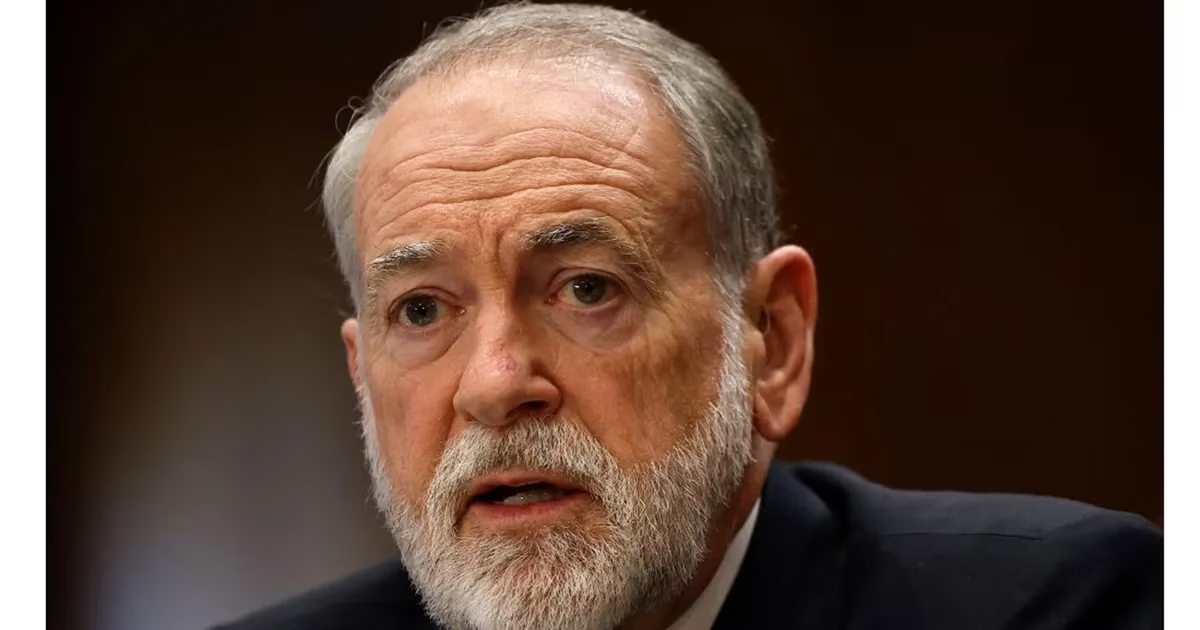
The appointment of Mike Huckabee to a high diplomatic post was not merely a fleeting administrative measure; rather, it revealed the depth of his evangelical background and its direct impact on his decisions. Nevertheless, this background was treated as part of a legitimate personal identity within an institutional system that claims separation of religion and state.
The great paradox lies in the fact that Western religiosity is often marketed as an individual conviction governed by modern constitutional controls, while Islamic orientation is classified as a reactionary project that threatens civility. This classification is not based on objective values but reflects power balances that grant one party the right to define what is civilized.
No serious international calls emerged demanding Ambassador Huckabee leave his 'Evangelical-Talmudic' beliefs at the threshold of his position, even though his stances further complicate the region's turmoil. Instead, he is allowed to pour oil on the burning fire under the guise of biased official diplomacy.
The priestly discourse adopted by some Western politicians is asked to be understood by the world within the context of multiculturalism, while any Islamic authority is preemptively assumed to be a threat to multiculturalism. This abhorrent duality reveals a structural flaw that threatens international peace and security and undermines the concept of justice.
In a related context to diplomatic movements in the region, Tel Aviv recently witnessed an Iftar dinner hosted by Emirati Ambassador Mohammed Al Khaja, attended by Israeli President Isaac Herzog. This event reflected attempts to establish a new political reality that transcends traditional conflicts under the name of peace.
During that dinner, Herzog praised Emirati President Mohammed bin Zayed, describing him as one of the most influential and wise leaders of the current era. Herzog considered the UAE a fundamental pillar of the Abraham Accords and a hub for stability in a region suffering from continuous unrest.
The Israeli President condemned what he described as campaigns of hatred and slander launched by some countries against the Emirati-Israeli peace process. He claimed that these alliances aim to build a common future, despite the ongoing Israeli military operations that draw widespread criticism in the Palestinian territories.
The meeting of representatives of different religions at the Emirati Embassy in Tel Aviv is presented as a model of religious tolerance, but it raises questions about the timing of these events. While Iftar dinners are held, human suffering continues in the occupied territories, highlighting a gap between diplomatic discourse and the reality on the ground.
Observers believe that this blend of religious values and politics is only permissible when it comes from dominant powers or those within their orbit. However, when others try to adhere to their value heritage, they face accusations of backwardness and attempts at isolation and political containment.
The legacy of power and colonial standards still controls the formulation of the current international system, where priestly obsession converges with major economic interests. This political recipe does not establish sustainable security but pushes towards an inevitable civilizational clash due to the absence of the principle of equality.
If the Western model allows the mixing of religion with politics to serve its interests, then condemning this behavior in others expresses a blatant privilege of power. The issue at its core is not the ambassador's religious identity, but the absence of the voice of reason and justice in dealing with the fateful issues of peoples.
Today, the Islamic world faces a great challenge in how to establish political legitimacy that respects its values and ancient heritage without sliding into absurd conflicts. What is needed is to build institutions that guarantee freedom and justice for all, away from the dominance of racist figures who impose their unilateral vision.
Ultimately, the question remains open about the international community's ability to overcome this duality and reach understandings that respect the specificities of peoples. True justice requires ceasing to grant immunity to certain identities and depriving others of the right to express themselves in the political sphere.
The issue is not the ambassador's religious identity as much as it is the absence of justice and the voice of reason in a world controlled by the privilege of power.
Share your opinion
Between Diplomacy and Priesthood: Double Standards in International Politics and 'Huckabee' Appointments