ARAB AND WORLD

Sat 07 Mar 2026 11:42 am - Jerusalem Time

Military escalation in the Gulf: Saudi Arabia intercepts missile, Qatar condemns Iranian attacks on civilian facilities

The Saudi Ministry of Defense announced that air defense forces successfully intercepted and destroyed a 'cruise' missile in the eastern region of Al-Kharj Governorate, part of the Riyadh region. Official sources clarified that the operation was successful with no casualties, at a time when the region is witnessing escalating security tensions due to mutual missile barrages.

In Manama, sirens blared across Bahrain, prompting the Ministry of Interior to issue urgent instructions to citizens and residents to remain calm and immediately proceed to the nearest shelters or safe places. Bahraini authorities emphasized the importance of obtaining information from official sources and avoiding rumors amidst the current circumstances.

Concurrently, the Kuwaiti Ministry of Defense confirmed that air defense systems effectively dealt with hostile targets that penetrated national airspace. Sources indicated that the attacks included missiles and drones attempting to target vital sites, affirming full readiness to protect the state's sovereignty and security.

For its part, the State of Qatar directed sharp criticism at Tehran during an emergency meeting of the Organization of Islamic Cooperation group in New York, where Permanent Representative Alia Ahmed bin Saif Al Thani described the attacks as a blatant violation of international laws. She affirmed that Doha would keep the UN Security Council constantly informed of all facts and aggressions affecting its national security.

The Qatari representative revealed details of the damage incurred within Qatar, noting that air defenses intercepted a series of attacks targeting sensitive civilian facilities. The targets included a main water tank and natural gas production stations, in addition to shrapnel falling in the vicinity of Hamad International Airport, resulting in human casualties and material damage.

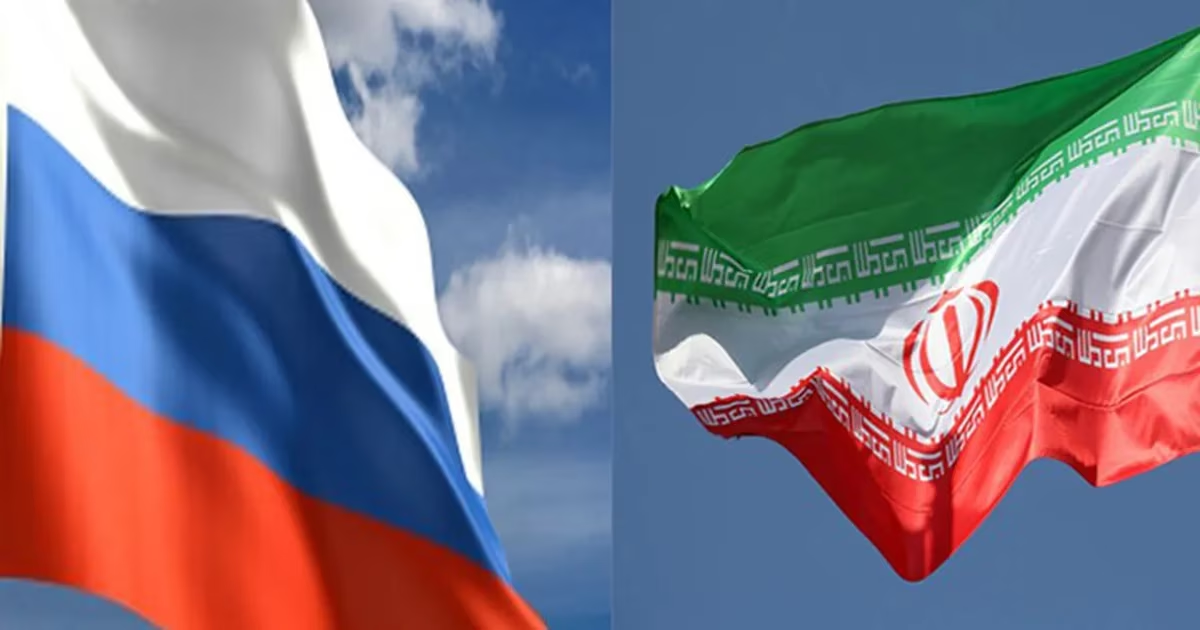
In a related context, Tehran vowed to escalate its military operations, declaring its readiness for a long-term confrontation in response to Israeli-American movements in the region. Iranian attacks target what it describes as American interests in the Gulf states, Iraq, and Jordan, which has led to damage to civilian assets and casualties in several Arab countries.

Qatar called on the Organization of Islamic Cooperation to take a unified and firm stance to condemn these attacks, which it described as illegal and unjustified. It clarified that the continuation of Iranian military operations comes despite all diplomatic efforts made by the Gulf Cooperation Council countries to de-escalate and avoid sliding into a comprehensive confrontation in the region.

Iranian attacks represent a blatant violation and a direct threat to the security and stability of the region, and have targeted vital civilian facilities in Qatar.

ARAB AND WORLD

Sat 07 Mar 2026 11:42 am - Jerusalem Time

Baghdad and Erbil affirm rejection of using Iraqi territory as a launchpad for aggression against neighboring countries

The central government in Baghdad and the Kurdistan Regional Government, today, Friday, emphasized their firm official stance rejecting the transformation of Iraqi territory into an arena for carrying out attacks against neighboring countries. This came during a phone call between Prime Minister Mohammed Shia' al-Sudani and the President of the Region, Nechirvan Barzani, where the two sides discussed recent security developments and threats to national sovereignty.

In separate statements, both sides affirmed the necessity of protecting border security and preventing any armed groups from using Iraqi depth as a launchpad for external military operations. The officials also expressed their categorical rejection of the repeated attacks targeting Iraqi cities and areas within the Kurdistan Region, considering this a blatant violation of international norms and regional stability.

This diplomatic move coincided with a series of military strikes targeting the headquarters of Iranian Kurdish opposition parties in northern Iraq. Field sources reported that the shelling targeted rear positions of these groups, amid accusations from Tehran that they were preparing for cross-border infiltration operations and implementing agendas serving hostile international powers.

In a parallel security development, the southern province of Basra witnessed the downing of four drones that targeted vital facilities, including Basra Airport and two oil fields. These incidents raise the level of concern among Iraqi authorities about the country sliding back into a spiral of regional proxy conflicts, after a period of relative stability witnessed on the local scene.

For its part, Tehran escalated its warning tone towards the Kurdistan Regional authorities, threatening to target all vital facilities in the region if it allowed the passage of opposition fighters towards its territory. The spokesman for Iran's 'Khatam al-Anbiya' headquarters, Ibrahim Dhul-Fiqari, stated that any cooperation for the stationing of hostile forces on the borders would be met with a firm and direct response from Iranian forces.

Reports indicate that the Kurdistan Region, which enjoys self-rule, is facing increasing pressure as a result of missile and drone attacks targeting various objectives. Iran accuses Kurdish groups stationed in the region of working for Western and Israeli interests, which has led to repeated strikes over the past years targeting camps and rear bases.

In a related context, media outlets circulated reports about American efforts to arm opposing Kurdish factions in the region to use them as a pressure tool against Tehran. These data further complicate Iraq's security landscape, as it strives to distance itself from the ongoing war between major powers and their allies in the region, and to maintain a policy of balance in its foreign relations.

Iraqi territory will not be a launchpad for attacking neighboring countries, and we reject attacks targeting Iraqi cities, including the Kurdistan Region.

ANALYSIS

Sat 07 Mar 2026 11:41 am - Jerusalem Time

Regional War Repercussions on Energy Markets: Between Sanctions on Moscow and Global Oil Pressures

Said Erikat

Opinion Writer

Washington – Said Arikat – 3/7/2026

News Analysis

Global energy markets are experiencing a highly turbulent phase amidst the increasing overlap between geopolitical conflicts and major economic decisions. In this context, Washington announced that recent measures related to Russian oil are not aimed at easing restrictions on Moscow, but are limited to dealing with shipments still en route to Russia, in an attempt to contain market disruption without a fundamental adjustment to the sanctions regime.

This announcement coincided with statements by US Treasury Secretary Scott Bessent on Friday, in which he indicated that the US administration is considering the possibility of lifting sanctions on additional quantities of Russian oil. This direction comes just one day after Washington temporarily allowed India to purchase Russian oil shipments stranded at sea, a move that reflects a clear attempt to increase oil supply in global markets experiencing sharp price increases.

These developments coincide with escalating tensions in the Middle East, where the US-Israeli war on Iran and retaliatory attacks launched by Tehran in the Gulf region have led to widespread disruption in the international energy and transport sectors. These disruptions culminated in a near halt to movement in the Strait of Hormuz, one of the most important maritime passages for oil transport in the world, raising significant concerns about the stability of global supplies.

These developments were quickly reflected in prices, as crude oil prices rose by 8.5% on Friday, marking an increase of nearly 30% in one week. This rise came after US President Donald Trump's statement that "unconditional surrender of Iran" is the only way to end the Middle East war, a statement that heightened global market fears about the potential for the conflict to expand.

In an interview with "Fox Business," Bessent explained that there are hundreds of millions of barrels of sanctioned crude oil at sea, noting that lifting restrictions on some of them could provide additional supplies to markets. However, Washington stressed that these steps do not reflect a change in its policy towards Moscow or its stance on the war in Ukraine, but rather fall within temporary measures to alleviate pressure on global and domestic markets.

Bessent added that the Treasury Department will continue to take measures aimed at easing tension in the energy market during the conflict, indicating the growing concern within the US administration about the repercussions of rising oil prices on the global economy and on American consumers at home.

In contrast, Kirill Dmitriev, economic advisor to the Kremlin, indicated that he is discussing this issue with the United States, asserting via the "X" platform that Western sanctions have harmed the global economy as much as they targeted Russia.

On Thursday, the US government announced a temporary easing of some sanctions to allow the sale of Russian oil stranded at sea to India. It clarified that these transactions, including those conducted via vessels listed on sanctions lists in various sanctions regimes, are permitted until the end of April 3, 2026.

This step reflects a delicate balance that Washington is trying to maintain between continuing political and economic pressure on Moscow on the one hand, and preventing a sharp shock in global energy markets on the other, at a time when geopolitical risks are increasing and the calculations of supply and demand in the international oil market are becoming more complex.

These developments reveal a paradox in US policy towards Russia, as Washington tries to maintain the sanctions regime as a tool of political pressure, while at the same time being forced to practically ease some restrictions to avoid a global energy crisis. A sharp rise in prices could negatively impact the US economy itself, especially given the sensitivity of domestic markets to fuel prices. Therefore, these measures appear to be more of a tactical management of the crisis, allowing for a temporary increase in supplies without officially acknowledging the easing of sanctions.

The Strait of Hormuz crisis once again confirms the fragility of the global energy system in the face of military conflicts in the Middle East. The mere disruption of navigation in this vital passage can push oil prices to record levels within a few days. This shows that markets react not only to the actual volume of supplies, but also to anticipated risks. Therefore, any additional military escalation in the region could push major consumer countries to search more quickly for long-term strategic alternatives.

On the other hand, this crisis gives Russia an opportunity to highlight its narrative that Western sanctions harm the global economy as much as they target Moscow. Allowing the sale of Russian oil stranded at sea, even if temporary, reflects a practical acknowledgment that excluding large quantities of Russian crude from the global market is not easy. Furthermore, continued demand for it from countries like India demonstrates that energy considerations often outweigh political calculations in the international economic system.

PALESTINE

Sat 07 Mar 2026 11:40 am - Jerusalem Time

Iran Facing the 'Pyramid Vacuum': Will the Regime Collapse After Khamenei's Assassination?

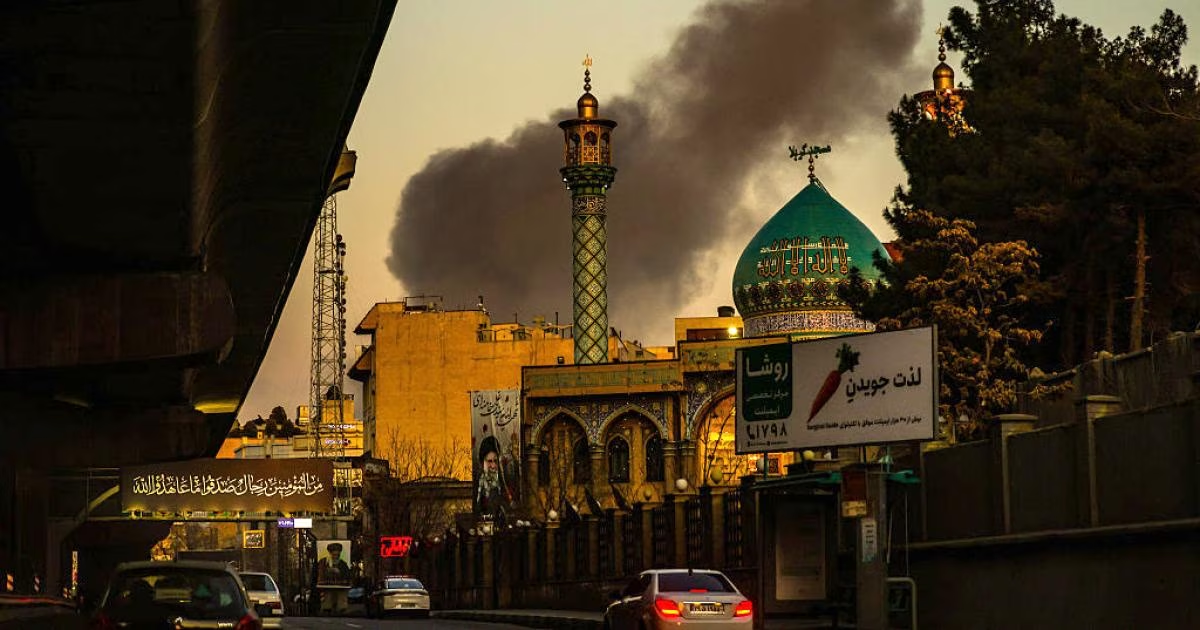
The first hours of the widespread Israeli-American aggression on Iranian territory witnessed an event that shook the foundations of the region: the assassination of the Supreme Leader of the Islamic Republic, Ali Khamenei, along with a number of senior military and political leaders. This targeting appeared to be an attempt to break the backbone of the Iranian regime by striking the head of the pyramid directly, at a time when columns of smoke rose over Tehran, announcing a new phase of open conflict.

In Washington, US President Donald Trump did not hide his enthusiasm for this development, describing the moment as a 'moment of freedom' for the Iranian people, and even went further by expressing his desire to directly intervene in the selection of Khamenei's successor. However, the old dilemma arises about the extent to which the absence of a pivotal figure can undermine a regime deeply rooted in complex military and ideological institutions, whose survival does not depend on a single individual.

On the ground, the Iranian response to the assassination was not delayed, as sources reported that vital sites in Gulf countries and oil tankers in the Gulf of Oman were targeted, threatening to disrupt global energy supplies. This escalation did not stop at the Iranian borders but extended to ignite the Lebanese front, which slid into a comprehensive confrontation, accompanied by unprecedented Israeli evacuation orders for large areas in the southern suburbs, the south, and the Beqaa.

On the internal political front, Tehran quickly activated constitutional continuity protocols, with a temporary leadership council assuming the powers of the Supreme Leader, including President Masoud Pezeshkian, the head of the judiciary, and prominent religious figures. This council is expected to manage the country's affairs until the Assembly of Experts chooses a permanent successor within a legal period not exceeding three months, amidst anticipation of the Revolutionary Guard's role in resolving this issue.

Observers believe that the Iranian regime is not a 'one-man system' in the traditional sense, but rather an institutional system that includes the Revolutionary Guard, the Guardian Council, and the Expediency Discernment Council. These structures possess a high capacity to absorb major security shocks and may seek to turn the assassination incident into an opportunity to strengthen internal cohesion and rally around 'the banner' instead of the collapse that Washington hopes for.

In contrast, Trump's strategy is characterized by ambiguity, with his statements oscillating between calling for the overthrow of the regime and the possibility of negotiating with a new, more moderate leadership, which is known as the 'behavior change' model. Trump cited the Venezuelan model, where he previously expressed willingness to work with Vice President Delcy Rodriguez after Maduro's detention, suggesting that he might accept a settlement with factions within the Iranian regime.

Historically, the record of American failures in 'system engineering' haunts the 'moment of freedom' promises made by the White House, starting from Roosevelt's promises in North Africa in 1942 to the invasion of Iraq in 2003. In the Iraqi case, George H.W. Bush's calls for an uprising in 1991 led to a great betrayal of the demonstrators, while George W. Bush's invasion ended with years of chaos, the rise of extremist groups, and exorbitant material costs.

Middle East experts warn that air power alone, no matter how precise and painful, rarely succeeds in changing political regimes without ground intervention or widespread military defections. As of now, there are no indications that the Iranian armed forces or the Revolutionary Guard are willing to abandon their loyalty to the regime, making the bet on a rapid fall of power a risky one.

Khamenei's absence, who ruled the country for 36 years, undoubtedly represents a major symbolic and practical loss, as he was the ultimate authority that balanced the conflicting currents within the state. But the religious establishment in Qom and the security networks that have accumulated over decades possess the experience that may enable them to overcome the vacuum, especially in the presence of a direct external threat that unites the internal front behind the interim leadership.

At the regional fronts, it appears that the Supreme Leader's assassination has accelerated the pace of war expansion, as Iran's allies in the region believe that targeting 'the head of the axis' requires a strategic response that goes beyond traditional rules of engagement. This explains Hezbollah's intense firepower in Lebanon and the waves of displaced people, putting the entire region on the brink of a volcano that could erupt at any moment.

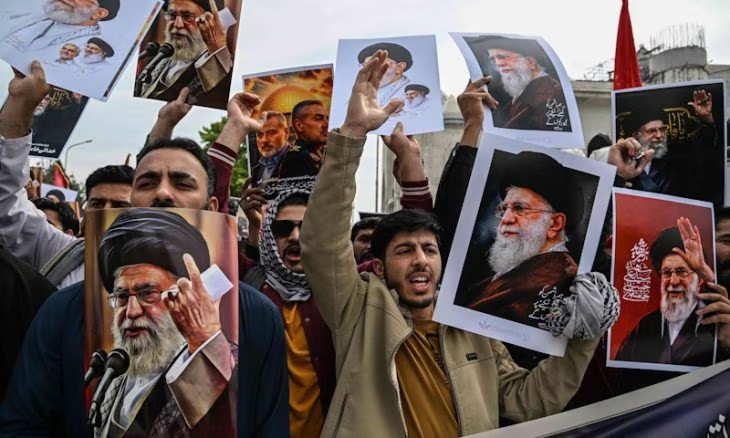
Intelligence reports indicate that the US Central Intelligence Agency (CIA) had been closely tracking Khamenei's movements before carrying out the strike on Saturday morning, reflecting an American desire to create a political 'shock and awe'. However, the scenes coming from Tehran, showing thousands of angry mourners, suggest that the shock may turn into fuel for the engine of revenge, complicating Washington's calculations in containing the conflict.

The American dilemma lies in the fact that Trump's political rhetoric always precedes the building of realistic plans for what happens after the fall of leaders, which has been repeated in previous experiences that led to counterproductive results. While Trump talks about destroying the nuclear program, the question remains about who will sign any future agreement if Iran enters a state of political chaos or a long civil war.

In this complex scene, the 'behavior change' hypothesis remains the most realistic in American decision-making circles, despite the revolutionary rhetoric surrounding the current administration's statements. The United States realizes that the human and material cost of overthrowing a regime the size of Iran would be many times what it paid in Iraq, which contradicts the 'America First' slogan raised by Trump.

In conclusion, 'post-Khamenei' Iran remains an open arena for all possibilities, between the resilience of ideological institutions and the slide into an internal power struggle fueled by external military pressure. But the only constant is that the region has entered a dark tunnel, where the assassination of leaders no longer guarantees the end of wars, but may merely be a spark to ignite wider, uncontrollable fires.

The distance between overthrowing a leader and creating an alternative is still wide, and American behavior oscillates between regime change and behavior change.

ARAB AND WORLD

Sat 07 Mar 2026 11:40 am - Jerusalem Time

Gitler: Trump Leads 'Third Gulf War' Against Iran Without Clear Exit Strategy

Investigative journalist Warren Gitler confirmed that US President Donald Trump has succeeded in overcoming initial opposition within Congress regarding his intensified military campaign against Iran. Despite the Senate's move to vote on a resolution forcing the administration to end airstrikes, expectations indicate that this move will not be able to bring about real change in the course of operations.

Gitler believes that Trump relies on a cohesive Republican majority in Congress, which provides him with the necessary political cover to bypass the War Powers Act. This law, enacted during the Vietnam War era, now appears to be merely a simple procedural obstacle to the current administration's ambitions to reshape the balance of power in the Middle East.

Reports indicate that the United States has effectively entered what can be called the 'Third Gulf War,' a comprehensive confrontation aimed at overthrowing the Iranian regime and dismantling its nuclear and missile capabilities. Trump clearly defined these objectives by the end of the first week of military operations, in which Israel is directly participating.

On the ground, American-Israeli strikes have succeeded in targeting Iranian central command, missile launch platforms, and naval vessels. However, the extent of damage to American bases in the region due to the Iranian response with ballistic missiles and drones remains significant and alarmingly continuous.

This confrontation differs from the First Gulf War in the nature of the weapons used, as it now relies on highly accurate and widely destructive guided missiles. Despite relatively low American casualties so far, concerns are growing about an increase in civilian casualties in the region's countries and within Iran.

The global economy has begun to be directly affected by the conflict, especially with escalating disputes in the Strait of Hormuz, which is a lifeline for 20% of global oil supplies. This tension has led to sharp jumps in energy prices, putting additional pressure on major capitals to find a way out of the crisis.

Strategic questions arise about the effectiveness of air bombardment alone in changing regimes, as history has proven that defeating an entrenched enemy requires more than just missiles. Washington and Tel Aviv are currently testing the hypothesis that military pressure will incite the Iranian people to revolt, which has not happened tangibly so far.

There are fears that widespread attacks could backfire by fueling anti-foreign nationalist sentiment among Iranians. This feeling could strengthen the internal front behind the regime instead of weakening it, a danger analysts have warned about since the beginning of planning the military campaign.

Domestically in Washington, there is concern about the depletion of advanced air defense systems such as 'Patriot,' 'Aegis,' and 'THAAD.' Sources indicate that the continuation of the war at the current pace could lead to the depletion of these interceptor missiles within a few weeks, leaving American forces and their allies exposed.

Senior military leaders have repeatedly warned Trump that the United States does not have sufficient stockpiles for a sustained air campaign aimed at regime change in a country the size of Iran. The administration is currently considering difficult options, including transferring defensive systems from vital American bases in South Korea to fill the deficit in the Middle East.

Iran, with a population of 92 million, possesses rugged mountainous terrain and the strongest missile arsenal in the region thanks to billions of dollars in investment. Its experience in developing drones, which have been effectively used in other international conflicts, gives it the ability to deliver painful strikes despite concentrated bombardment.

President Trump is hesitant to make a decision to send ground troops, fearing entanglement in a human quagmire that could affect his chances in the upcoming midterm elections. But experts question the possibility of achieving 'regime change' without boots on the ground, recalling the need for 400,000 troops in previous experiences.

Attention is now turning to the possibility of Washington resorting to Kurdish forces in Syria and Iraq to form a ground spearhead within Iranian territory. However, the question remains about the extent of the Kurds' response to this call, especially after previous experiences where they felt abandoned by the United States at critical moments.

Amid this ambiguity, international capitals such as London, Paris, and Berlin are demanding clear answers about an exit strategy from this war. As 2026 enters a major missile conflict phase, the most important question remains: what will success look like in Washington's eyes, and what will be the ultimate price the world pays?

The idea that American and Israeli strikes will be sufficient to urge the Iranian people to reclaim their destiny is being severely tested today in the absence of a tangible revolutionary uprising.

ARAB AND WORLD

Sat 07 Mar 2026 11:40 am - Jerusalem Time

Pezeshkian apologizes to Arabs: Iran pledges to stop attacks against neighboring countries and sets conditions for de-escalation

Iranian President Masoud Pezeshkian announced today, Saturday, a shift in his country's military policy towards the region, offering a formal apology to neighboring Arab countries, foremost among them the Gulf Cooperation Council states and Iraq. This apology came in the wake of a series of missile and drone attacks that targeted vital facilities in those countries over the past few days.

Pezeshkian affirmed in a video statement that the interim leadership council, which currently holds the reins in Tehran, approved a decision not to carry out any future attacks against neighboring countries. The Iranian president stipulated for adherence to this pledge that no hostile attacks against Iranian territory should originate from within the borders of those countries, emphasizing his country's desire to end the state of tension.

The Iranian president stressed in his speech the absence of any premeditated intention for hostility with the countries of the region, stating that Tehran does not seek to attack any neighboring party. These statements come under exceptional circumstances experienced by Iran following the assassination of Supreme Leader Ali Khamenei on February 28, which led to the formation of an interim leadership council to manage the crisis.

On the Arab diplomatic front, the Assistant Secretary-General of the Arab League, Hossam Zaki, revealed arrangements for an emergency meeting of Arab foreign ministers tomorrow, Sunday. The meeting, which will be held via video conference, will focus on discussing the repercussions of recent Iranian aggressions on the sovereignty of Arab territories in light of the ongoing military escalation.

Zaki explained that this Arab move came at the official request of several countries, including Saudi Arabia, Kuwait, Qatar, Oman, Egypt, and Jordan. The meeting aims to formulate a unified Arab position towards repeated Iranian violations that coincided with direct confrontations between Tehran on one hand and the United States and Israel on the other.

For his part, Arab League Secretary-General Ahmed Aboul Gheit strongly condemned the Iranian attacks, describing them as a blatant violation of international law and the United Nations Charter. Aboul Gheit warned that these actions create an unprecedented state of hostility and cause a deep rift in good neighborly relations, which will negatively affect the future of the region.

Aboul Gheit considered Tehran's attempts to drag Arab countries into a conflict that is not their war to be a grave strategic mistake that must be rectified immediately. He demanded a halt to all Iranian military operations targeting Arab facilities, stressing that there is no acceptable justification for targeting neighbors under any political or military pretext.

On the ground, the Saudi Ministry of Defense announced the success of its forces in intercepting and destroying 21 drones that were targeting the 'Shaybah' oil field located southeast of the Kingdom. This operation is considered one of the largest targeting attempts against Saudi oil facilities during the recent wave of escalation in the region.

In a related context, Saudi military sources confirmed the destruction of a ballistic missile that was heading towards Prince Sultan Air Base, which houses units of US forces. Air defenses also managed to intercept another drone in the skies of the capital Riyadh, in addition to thwarting previous attacks that targeted the strategic Ras Tanura refinery.

Saudi Defense Minister Prince Khalid bin Salman sent a firm message to Tehran, calling on it to prioritize reason and avoid miscalculations. Prince Khalid, after meeting with the Pakistani army chief, indicated that the Kingdom is exploring ways to stop these aggressions within the framework of joint strategic defense agreements to ensure the security and stability of the region.

These rapid developments come at a time when the Iranian capital, Tehran, was subjected to a widespread attack by about 80 Israeli fighter jets, in response to Iranian missile barrages. The region is in a state of high alert, awaiting the outcome of Arab and international diplomatic moves to contain the situation and prevent it from escalating into a comprehensive regional war.

Observers believe that Pezeshkian's apology may represent an attempt to calm the Arab front in light of the enormous military pressures Iran faces internally and externally. However, the gamble remains on the extent of Iranian military factions' commitment to the decisions of the interim leadership council, and the ability of Arab countries to extract real guarantees that prevent the recurrence of these aggressions in the future.

There is no animosity between Iran and the countries of the region, and we have no intention of attacking any neighboring country.

ARAB AND WORLD

Sat 07 Mar 2026 11:40 am - Jerusalem Time

Sanchez Defies Trump's Threats: Spain Rejects 'Blind Obedience' and Maintains its Stance Against War

Spanish Prime Minister Pedro Sanchez has emerged as one of the few European leaders who have chosen a public and firm confrontation with US President Donald Trump. This came in a ten-minute televised speech, described by observers as extremely bold, in which Sanchez responded to Washington's threats to cut trade relations with Madrid. The American threat followed the Spanish government's refusal to allow the use of two military bases in Andalusia for air strikes against Iranian targets.

Sanchez clarified in his speech that the core of the disagreement lies in Spain's view of the risks of a new war breaking out in the Middle East, emphasizing that such a conflict would lead to immense human losses and destabilize the global economy. The Spanish Prime Minister considered that the primary duty of governments is to protect the lives of their citizens, not to manipulate international conflicts for narrow political or economic gains. He stressed that using 'the veil of war' to cover up internal failures is absolutely unacceptable in international norms.

Sanchez's speech included harsh criticism of those he described as leaders who enrich the pockets of a select few through arms trade and missile building instead of hospitals. He affirmed that democracy and mutual respect among nations cannot arise from ruins, rejecting the idea of 'blind obedience' as a form of leadership. He indicated that Spain would not conspire in any act that contradicts its values and national interests, even if the price was facing retaliation from major powers.

Domestically, Sanchez's words resonated widely with the Spanish public, with opinion polls indicating that less than 16% of citizens view the current US President positively. This stance recalls the popular anger that swept Spain in 2003 due to the then-conservative government's support for the invasion of Iraq. However, Sanchez faced sharp criticism from the right-wing opposition, who accused him of jeopardizing strategic relations with the United States for partisan gains.

Alberto Núñez Feijóo, leader of the conservative Popular Party, accused the Prime Minister of pursuing a 'reckless' policy that could harm Spain's economic and security interests. For his part, Santiago Abascal, leader of the far-right Vox party, went further, hinting that the government's decisions are influenced by external parties. These divisions reflect the intensity of political polarization in Madrid regarding how to deal with the new US administration and its volatile negotiating style.

Sanchez's latest stance is not surprising to those who follow his foreign policy, as he is considered one of the strongest European critics of Israeli military operations in the Gaza Strip. Sanchez had previously accused the occupation of committing 'genocide' and starving children, a position that put him in repeated clashes with Washington's allies. He also opposed US military interventions in Venezuela, adhering to the necessity of diplomatic solutions and respecting national sovereignty.

In contrast, Sanchez's voice seems isolated on the European continent, which suffers from internal divisions and challenges that prevent its leaders from taking similar stances. While French President Emmanuel Macron expressed solidarity with Spain in the face of trade threats, he adopts a more pragmatic approach. Macron tries to walk a tightrope, criticizing violations of international law on the one hand, and holding the Iranian leadership responsible for the escalation on the other.

France moved the aircraft carrier 'Charles de Gaulle' to the Eastern Mediterranean, a move Macron described as 'purely defensive' to support regional allies. However, French diplomatic sources confirm that Paris's top priority is to find a political solution to the crisis and avoid sliding into an all-out war. This French position reflects a desire to maintain a mediating role without entering into a direct and public confrontation with the Trump administration.

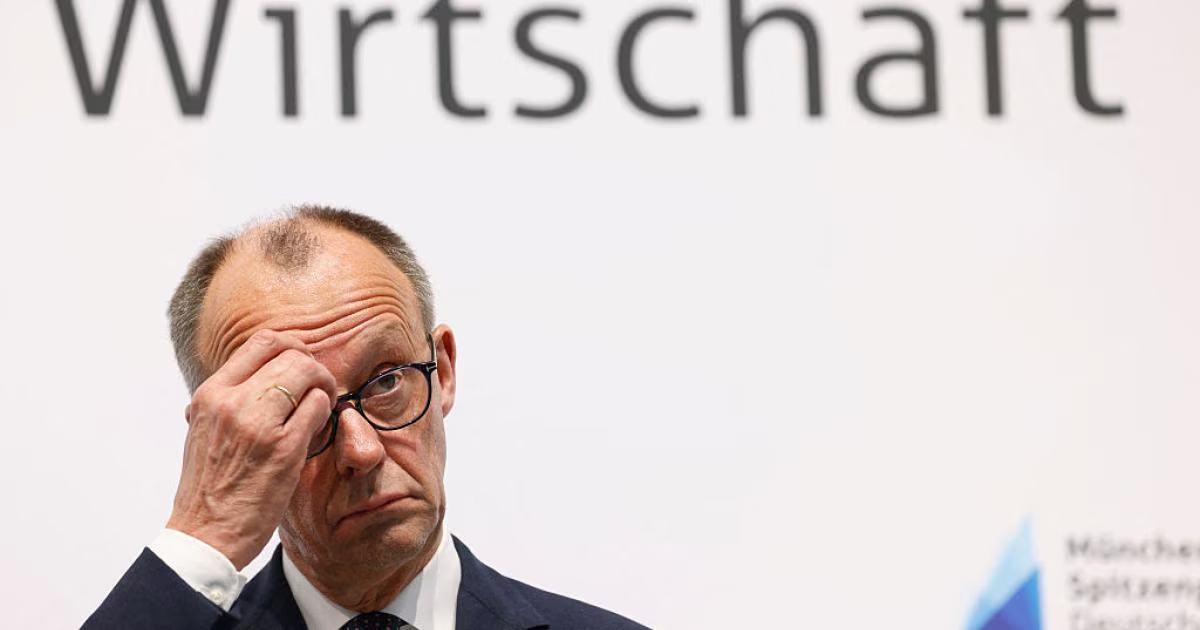
In Berlin, German Chancellor Friedrich Merz chose a remarkably conciliatory approach with Washington, clearly distancing himself from Madrid's position. Merz stated that now is not the time to blame allies, emphasizing the need for cooperation to achieve common goals despite reservations. It seems that German concerns about American tariffs and the stance on Ukraine are pushing Berlin to avoid any clash with Trump for now.

The German Chancellor went further when he endorsed Trump's criticisms of Spain regarding defense spending, which observers considered a stab in the back of European solidarity. Merz, who faces electoral challenges from the far-right and pressure to revive the economy, sees pragmatism as a means to secure room for maneuver with Washington. This German stance gave Trump a diplomatic victory in his efforts to sow discord among European allies and divide their positions.

In Italy, Prime Minister Giorgia Meloni follows a policy of 'deliberate ambiguity' to maintain a delicate balance between her loyalty to Trump and her European commitments. Meloni affirmed that her country is not at war and does not intend to enter one, but she avoided directly condemning American actions. This balance reflects Rome's desire not to cut ties with the White House, while maintaining sufficient distance to ensure it is not dragged into ill-considered military adventures.

Despite Meloni's caution, her Minister of Defense, Guido Crosetto, made more frank statements before Parliament, considering that the strikes on Iran were carried out outside the rules of international law. Crosetto indicated that the world found itself forced to manage the consequences of a war that broke out without the knowledge of allies, reflecting a hidden dissatisfaction within the Italian military establishment. Nevertheless, Rome remains ready to consider any American requests for the use of military bases if they are officially received.

The diplomatic confrontation moved to the realm of press statements, where the White House spokeswoman claimed that Madrid had changed its position and was ready to cooperate. This claim was met with a swift and decisive response from Spanish Foreign Minister José Manuel Albares, who denied these reports outright. Albares affirmed that Spain's position rejecting war is clear and unambiguous, emphasizing the independence of Spanish sovereign decision-making away from external dictates.

Spain continues to lead this solitary approach within the European Union, relying on the principles of international law and rejecting the politics of force. As the world watches the developments of the conflict with Iran, Sanchez's stance remains a true test of the ability of European countries to withstand American pressure. This crisis not only redraws transatlantic relations but also reveals the depth of the gap in strategic visions among major European capitals.

It is naive to believe that practicing blind obedience and complete submission is a form of leadership... We will not conspire in something that harms the world merely out of fear of retaliation.

PALESTINE

Sat 07 Mar 2026 11:40 am - Jerusalem Time

16 Dead in a Massacre in Nabi Chit and Fierce Clashes Following an Israeli Landing in Eastern Lebanon

The Israeli occupation army escalated its aggression on Lebanese territories at dawn today, Saturday, as its warplanes launched a series of intense raids targeting various areas in the South and Bekaa. The deadliest attacks were concentrated in the town of Nabi Chit in the eastern part of the country, resulting in a horrific massacre against civilians amidst ongoing Israeli military operations.

The Lebanese Ministry of Health announced in an official statement that the death toll from the Israeli raids on the town of Nabi Chit in the Bekaa has risen to 16 martyrs and 35 injured. The ministry clarified that these figures represent a total, non-final toll, as ambulance and rescue teams are still working in the targeted sites to remove rubble and search for missing persons.

On the ground, Hezbollah revealed details of a direct military confrontation that took place in the Bekaa Governorate, where its fighters confronted an attempted landing by an Israeli infantry force. Hezbollah stated in a communiqué that the infiltration operation began with the monitoring of four Israeli helicopters coming from the Syrian border, which landed soldiers at the triangle of the outskirts of the villages of Yahfoufa, Al-Khraiba, and Maarbon.

The statement indicated that the Israeli force attempted to advance towards the eastern neighborhood of Nabi Chit village, but the fighters ambushed them upon their arrival at the cemetery area and engaged in close-range clashes. This surprise engagement led to the disorientation of the moderate force and exposed its presence to the resistance fighters in the eastern border region.

In an attempt to secure the withdrawal of the besieged force, the occupation air force carried out what is known as 'fire belts,' with planes launching about 40 intense airstrikes targeting the vicinity of the engagement area. Local sources reported that the heavy shelling aimed to cut off the path for the defenders and provide air cover for the helicopters to extract the soldiers from the battlefield.

For its part, the official Lebanese National News Agency confirmed fierce clashes on the heights of the eastern mountain range, specifically in the Nabi Chit - Ham axis. The agency reported that the region's airspace witnessed intense overflights by warplanes and drones, with thermal balloons being heavily launched to mislead defensive missiles during the withdrawal operation.

In southern Lebanon, aerial and artillery shelling did not cease, as field sources reported that the raids targeted numerous villages around the city of Tyre, including the town of Majdal Zoun, from which columns of smoke were seen rising intensely. Aerial shelling also hit the towns of Sultaniyeh and Toulin, causing widespread destruction to property and infrastructure.

Israeli artillery directly targeted the towns of Khiam, Kfarkila, Adaysseh, and Taybeh, in an attempt to impose a fire belt along the border line. Hezbollah responded by targeting a gathering of occupation soldiers at the southern outskirts of Khiam city with a rocket barrage, confirming direct hits among the forces stationed there.

In the Nabatieh region, warplanes launched a morning raid targeting the town of Jibshit, followed by another raid targeting an amusement park on the Zawtar - Nabatieh Al-Fawqa road. The occupation also destroyed a house in the Al-Marja neighborhood of Jbaa town, resulting in injuries among citizens, coinciding with raids on Arabsalim and the Green Valley area.

On the other hand, Israeli media acknowledged the infiltration of drones from Lebanon towards the Galilee, with Channel 12 reporting that air defenses attempted to intercept three drones. These developments come amidst escalating tensions that have involved multiple fronts, especially after the expansion of the regional confrontation in recent days.

The Lebanese arena is witnessing an unprecedented escalation since the limited ground incursion by the occupation army last Tuesday, despite previous ceasefire agreements. Field reports confirm that the occupation is pursuing a scorched-earth policy in border villages to facilitate infiltration and landing operations, which Hezbollah fighters are fiercely confronting.

Humanitarian conditions in the Bekaa and Southern regions remain likely to deteriorate further with the continuation of intense raids that spare no residential areas. Lebanese Civil Defense teams continue their attempts to reach the affected areas, despite the high risks resulting from repeated Israeli shelling of the same targeted sites.

The Israeli force advanced towards the eastern neighborhood of Nabi Chit village, and upon reaching the village cemetery, our mujahideen clashed with it, which prompted the enemy to carry out 40 raids to secure its withdrawal.

PALESTINE

Sat 07 Mar 2026 11:39 am - Jerusalem Time

Washington approves emergency ammunition deal for Israel amid escalating military confrontation with Iran

The US State Department announced its official approval of a new military deal to sell ammunition and defensive equipment to Israel with a total value of $151.8 million. This step comes amid an atmosphere of escalating military tension in the region, especially with the continued direct confrontation between Tel Aviv and Tehran and the increasing operational needs of the Israeli army.

The deal includes providing the Israeli side with approximately 12,000 bomb bodies, each weighing 470 kilograms, according to an official request submitted by the Bureau of Political-Military Affairs at the Department. The State Department affirmed that these shipments aim to enhance Israeli readiness to confront current and future regional threats, thereby ensuring the maintenance of its qualitative military superiority.

In addition to heavy ammunition, the agreement includes an integrated package of engineering, logistical, and technical assistance services that the US government will provide to ensure the efficient use of these weapons. These services aim to support Israel's defensive infrastructure and facilitate maintenance operations and the technical integration of the new ammunition into the existing aerial arsenal.

In a notable development, US President Donald Trump revealed via social media platforms an agreement with major defense industry companies in the United States to increase the production of advanced weapons. According to his statements, production will quadruple, one week after the first joint military strikes between Washington and Tel Aviv against targets inside Iran.

Procedurally, Secretary of State Marco Rubio took an exceptional step by issuing a waiver allowing the deal to pass without undergoing the usual review procedures in the US Congress. Rubio based his decision on the Arms Export Control Act, providing detailed justifications for an emergency situation requiring the immediate transfer of defensive materials to protect US national security interests.

This legal circumvention sparked a wave of sharp criticism within the halls of Congress, with a number of lawmakers expressing concern about marginalizing the oversight role of the legislative branch. Opponents considered that the use of emergency powers at this time reflects the administration's desire to accelerate the pace of military escalation without sufficient political discussion about the consequences.

In this context, Democratic Representative Gregory Meeks, a member of the House Foreign Affairs Committee, criticized the administration's stance, describing it as contradictory. Meeks indicated that the Trump administration's quick recourse to emergency powers reveals flaws in its previous claims of full readiness for war, considering this crisis to be 'an emergency of the administration's own making.'

On the ground, informed sources reported a significant decline in the efficiency of early warning systems within Israel in recent hours. Sources observed a significant reduction in the time difference between the issuance of an alert and the activation of sirens, which in some areas reached only two minutes, placing immense pressure on civilians and air defense systems.

Press reports quoted Israeli military sources confirming that this reduction in response time is not due to a simple technical malfunction, but rather a deeper 'operational malfunction.' Experts suggest that this malfunction may be related to some advanced monitoring mechanisms and radars being subjected to direct targeting or complex jamming operations that affected the accuracy of incoming data.

This coincided with US media reports revealing that THAAD missile interception systems were subjected to attacks in multiple locations in the Middle East, including Jordan and the UAE. These systems are a fundamental pillar of the collective defense strategy led by Washington to protect its allies from cross-border ballistic threats.

In additional details, reports stated that the United States is racing against time to replace a THAAD radar in Jordan after it sustained severe damage. The attack is believed to have been carried out by a suicide drone launched by groups loyal to Iran, leading to a temporary disruption of monitoring capabilities in that vital sector.

Israel's air defense network relies heavily on integration with US and foreign radars deployed in the region to detect ballistic missiles immediately upon launch. Damage to any part of this network, such as THAAD radars designed for interception outside the atmosphere, poses a direct threat to Israel's ability to repel large-scale missile attacks.

The proposed sale would enhance Israel's ability to confront current and future threats, and support its defensive capabilities and regional deterrence.

ARAB AND WORLD

Sat 07 Mar 2026 11:39 am - Jerusalem Time

80 Israeli Fighters Bombard Tehran, Trump Demands Unconditional Surrender

The intensity of the direct military confrontation between Iran on one side, and the United States and Israel on the other, escalated as the aggression entered its second week today, Saturday. A state of ambiguity dominates the field and political scene amid the absence of any horizon for de-escalation, especially with the American administration's insistence on harsh conditions for halting military operations.

The Israeli occupation army announced a wide wave of violent air raids, in which more than eighty warplanes participated, targeting vital military sites and missile launchers in the capital Tehran and central regions of the country. These attacks come as part of an attempt to undermine Iranian defensive and offensive capabilities that targeted Israeli depth in recent hours.

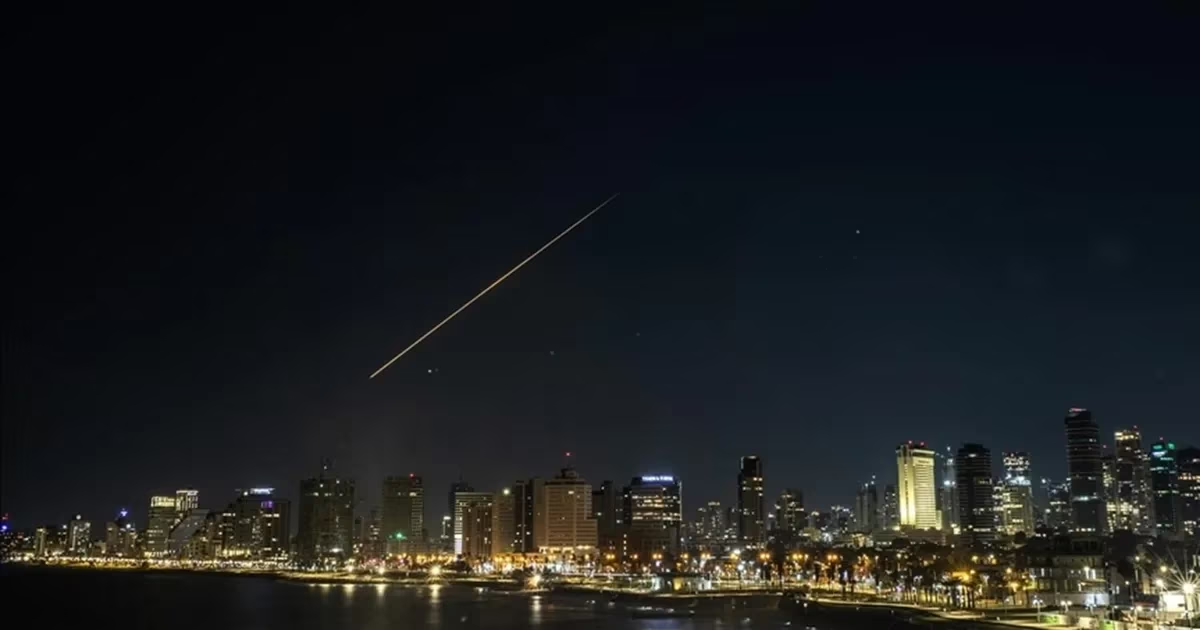
In response, Tehran retaliated by launching intense missile barrages, the second of their kind since dawn today, as sirens blared in Tel Aviv, central regions, and West Bank settlements. Field sources confirmed that Iranian missiles reached wide ranges including Jerusalem, the Dead Sea region, and the southern Negev, leading to a state of full alert.

Media sources reported the interception of an Iranian missile equipped with a fission warhead over the greater Tel Aviv area, while shrapnel and other missiles fell in open areas. This missile bombardment caused partial paralysis within major cities, amid reports of casualties since the start of the military escalation last week.

Iranian retaliation was not limited to ballistic missiles; the Iranian army announced widespread drone attacks targeting strategic sites. These attacks included military bases belonging to US forces in the region, specifically in the United Arab Emirates and Kuwait, in response to direct American support for Israeli raids.

The official Iranian news agency clarified that naval forces targeted Al Minhad Air Base in the UAE and another base in Kuwait, in addition to strategic facilities within the occupied territories. This development represents a dangerous expansion of the regional conflict to include countries and military bases outside the direct geographical scope of the confrontation.

On the political front, US President Donald Trump blocked any diplomatic mediation efforts, asserting that he would not accept any agreement with Tehran that does not include unconditional surrender. Trump wrote on his platforms that Washington and its allies would only work to rebuild Iran economically after the selection of a new internationally acceptable leadership.

In Tehran, the Iranian Revolutionary Guard showed clear defiance of American movements in the Strait of Hormuz, with its spokesman Ali Mohammad Naeini announcing that Iranian forces were 'waiting' for American warships. Naeini warned Washington against escorting commercial vessels, recalling historical and recent incidents of targeting oil tankers in the region.

Shipping traffic in the strategic Strait of Hormuz is experiencing a state of near-total paralysis due to escalating military tensions and mutual threats. This comes at a time when the US Energy Secretary announced the navy's readiness to escort commercial vessels to ensure the flow of energy supplies, which Tehran views as a direct provocation to its sovereignty.

On the ground, Iranian missile barrages extended to Haifa, the Galilee and Golan regions in the north, as well as Beersheba and settlements adjacent to the Gaza Strip. These coordinated attacks reflect Tehran's ability to target all Israeli-controlled geography simultaneously despite the intensity of air raids.

These successive developments led to severe disruptions in global financial markets, with oil prices recording significant increases due to fears of supply disruptions through vital waterways. Observers warn that the continuation of the war could lead to a global economic crisis extending beyond the Middle East.

Despite Iranian President Masoud Pezeshkian's reference to mediation efforts by unnamed countries, tough American statements and rapid field operations suggest that the conflict is heading towards further escalation. The second week of the confrontation remains open to all possibilities in the absence of any signs of retreat from the parties involved in the fighting.

There will be no agreement with Iran except through unconditional surrender!

OPINIONS

Sat 07 Mar 2026 11:39 am - Jerusalem Time

When the Algorithm Becomes a Refuge… Why Does the Digital World Seem Safer for Palestinians Than Their Reality?

In recent years, social media platforms have ceased to be mere platforms for communication or entertainment; for many Palestinians, they have transformed into an alternative space for daily life. This transformation cannot be understood solely from the perspective of technology or digital development; rather, it must be read within a highly complex socio-economic and political context. When reality becomes filled with restrictions and violations, societies tend to seek alternative spaces that provide them with a sense of security and control, even if this security is virtual, created by the algorithms of digital platforms.

Data from the Palestinian Central Bureau of Statistics indicates that the percentage of internet users in the Palestinian territories exceeds 86% of the population, while approximately 70-75% of Palestinians use social media platforms daily. These figures reflect the transformation of the digital space into an essential part of social and economic life. But behind this high percentage lies a deeper explanation: digital platforms not only provide a means of communication but also offer an environment where individuals feel a degree of control over their lives that they do not find in reality.

In the West Bank, for example, citizens face a complex network of field restrictions daily. Reports from the United Nations and the Office for the Coordination of Humanitarian Affairs (OCHA) indicate the presence of more than 900 barriers, checkpoints, and closures affecting the movement of Palestinians between cities and villages. These restrictions mean that a simple commute can turn into an unexpected journey filled with waiting and tension. In contrast, the digital world allows for instant movement between multiple spaces with a single click, without barriers or checkpoints.

The economic factor adds another layer of explanation. According to data from the World Bank and the International Monetary Fund, the unemployment rate in Palestine averages about 24%, while the economy suffers from chronic slowdown due to political and geographical restrictions. In this context, digital platforms become an alternative space for production, work, and marketing. Thousands of Palestinians today rely on e-commerce, content creation, and online freelancing. Here, the algorithm is not just an entertainment tool, but a new economic structure that offers opportunities not available in traditional reality.

However, the issue is not just economic; there is an important psychological and social dimension. Social psychology explains that humans always seek environments that give them a sense of stability and predictability. A reality filled with security surprises and military incursions generates a state of chronic stress, a concept referred to by mental health studies in conflict zones. In contrast, digital algorithms provide a predictable environment: content appears based on user interests, friends are known, and discussions can be controlled or easily left. This algorithmic structure creates what can be called cognitive security; that is, a feeling that the world can be understood and interacted with without direct threat.

From an algorithmic science perspective, platforms like Facebook, Instagram, and TikTok analyze user behavior through advanced machine learning models. These models suggest content that aligns with user preferences, increasing their time spent on the platform. DataReportal's 2025 reports indicate that the average time an Arab user spends on social media ranges between 3 and 4 hours daily. This figure is not just digital consumption; it is an indicator of a significant portion of social life shifting to the virtual space.

Nevertheless, it is wrong to believe that this space is free of risks. Algorithms themselves can create what researchers call filter bubbles, where users are exposed to only one type of information that reinforces their beliefs. Moreover, digital platforms are subject to the policies of global companies that may restrict or block political content. In other words, digital security here is relative, not a complete substitute for reality.

But the paradox remains clear: when the path to work is fraught with barriers, and when daily life turns into a series of economic and political restrictions, the smartphone seems like a window to a more livable world. In this digital world, individuals can work, talk, express themselves, and learn without being stopped by a barrier or hindered by a road closure.

The result is that the Palestinian's attachment to social media is not merely an attraction to technology, but a socio-psychological response to a complex reality. The algorithm here is not understood only as a mathematical equation that manages content, but as an alternative space for life, providing humans with a temporary sense of control and ability to move in a world where the physical space shrinks day by day.

* Researcher and Consultant in Media and Digital Marketing

ANALYSIS

Sat 07 Mar 2026 11:38 am - Jerusalem Time

Failure of American and Israeli Bets: How Did Tehran Withstand Calculations of Rapid Collapse?

The calculations upon which the Israeli entity and its American ally based their recent joint aggression against Iran are facing a real predicament, as signs of failure have begun to emerge despite media coverage attempts. Targeting senior political leaders in a sovereign state not only constitutes a violation of international norms but also reflects a losing bet that the assassination of the leadership pyramid would inevitably lead to the rapid collapse of the state from within.

Political assessments in Washington and Tel Aviv had predicted a complete collapse of the Iranian regime within four days to a maximum of one week, but reality imposed entirely different facts. Today, with the passage of time, the political discourse has shifted from talking about days to weeks and indefinite periods, revealing the extent of the inability to achieve the swift objectives desired from this military adventure.

Voices within the American political elite, including members of the Senate, are rising to condemn what they described as repeated lies about the 'imminent Iranian threat.' These individuals liken the current pretexts to those used by Colin Powell for the invasion of Iraq, pointing out that Trump's slogan 'America First' has practically turned into 'Israel First' at the expense of American national interests.

The violent and unexpected Iranian response came as a shock to decision-making circles, as strikes targeted American bases in the Gulf region and vital targets within the Israeli entity. This escalation, which was not calculated to this extent, proved that the deterrence model that the entity believed it had paralyzed since the events of June 2025, still possesses effectiveness and the ability to turn the tables.

In light of this military failure, hostile intelligence agencies are seeking to stir up sectarian strife to drag regional countries into an 'Abrahamic' alliance directed entirely against Tehran. The attempt to strike at the societal components in the Middle East aims to compensate for the failure to destroy Iranian infrastructure, which represents the last resort for a project seeking to reshape the region according to the Zionist vision.

Iranian steadfastness, despite severe economic losses and infrastructure destruction, remains a stumbling block to the ambitions of the White House and Tel Aviv. The continued functioning of the regime consecrates a political and strategic defeat for the aggressors and places Iran's neighbors before the responsibility to curb this aggression and prevent the region from being drawn into a comprehensive conflict that serves only colonial powers.

The mere continued existence of the Iranian regime after these strikes represents a resounding defeat for the White House and Tel Aviv, regardless of the extent of economic devastation.

PALESTINE

Sat 07 Mar 2026 11:38 am - Jerusalem Time

Hezbollah Thwarts Israeli Landing Operation in Bekaa: Details of Nabi Chit Clashes

Hezbollah in Lebanon announced, at dawn on Saturday, that it had engaged in fierce clashes with an Israeli infantry force that carried out an airborne landing operation in the Bekaa Governorate, eastern the country. In a military statement, the party clarified that its fighters detected the infiltration of four Israeli helicopters coming from the Syrian border, which landed soldiers at the triangle of the villages of Yahfoufa, Al-Khraiba, and Maarbon in the eastern mountain range.

Field sources reported that the infiltrating Israeli force attempted to advance towards the eastern neighborhood of Nabi Chit town, but the fighters ambushed them upon their arrival at the cemetery area. Direct confrontations erupted from close range, prompting the Israeli army to intervene with intensive air support to rescue its soldiers and secure their withdrawal route from the targeted area.

Bekaa's airspace witnessed intensive flights of warplanes and drones, as the occupation carried out what was described as 'fire belts' by launching about 40 airstrikes targeting the vicinity of the clash area. Sources stated that these violent raids were primarily aimed at cutting off roads, preventing the arrival of reinforcements, and providing fire cover for the withdrawal of the special force that fell into the ambush.

In a related context, medical sources confirmed the martyrdom of 10 people and the injury of 17 others as a result of the concentrated aerial bombardment that targeted Nabi Chit town and its surroundings during the night hours. Ambulance teams and paramedics were repeatedly targeted by Israeli aircraft, which hampered rescue operations and the provision of assistance to the injured at the bombing sites.

Hezbollah indicated that its artillery carried out precise and concentrated shelling along the withdrawal routes of the Israeli force, confirming definite casualties among the aggressors. The statement also highlighted the role played by the local residents in providing fire support, as local residents participated in confronting the Israeli force as soon as it was discovered in the town's neighborhoods.

This operation comes amidst speculation suggesting that the repeated Israeli targeting of Nabi Chit town is linked to claims about the presence of the remains of the missing Israeli pilot Ron Arad in that area. Military history recalls that Israel carried out similar landing operations in the Bekaa during the 2006 war, targeting Dar Al-Hikma Hospital and Buday town at that time.

For its part, official Lebanese sources stated that the heights of the eastern mountain range on the Lebanese-Syrian border witnessed unprecedented tension and the flight of Israeli thermal balloons. The sources confirmed that the resistance's air defense systems were activated in the Bekaa sky, forcing enemy warplanes to retreat after carrying out their aggressive missions.

This field escalation comes at a time when the region is witnessing a comprehensive explosion of conditions, following the collapse of the ceasefire agreement reached in November 2024. The scope of confrontations has expanded to include mutual strikes and assassinations targeting senior leaders, which prompted the Israeli army to begin what were described as limited ground incursions in several axes.

Israeli raids continue to target the southern suburbs of Beirut and wide areas in southern and eastern Lebanon, leaving dozens of martyrs and wounded daily. Observers believe that the failed landing operation in Nabi Chit represents an Israeli attempt to reach strategic targets deep inside Lebanese territory, away from the traditional confrontation lines at the southern border.

The clash escalated after the enemy force was exposed, with the Israeli enemy resorting to carrying out fire belts, including about 40 raids, to secure the withdrawal of the force.

ARAB AND WORLD

Sat 07 Mar 2026 11:38 am - Jerusalem Time

The 'Saltwater Fury' Quagmire: How Netanyahu Lured the Trump Administration into an Open Confrontation with Iran?

US President Donald Trump finds himself today in the midst of a large-scale military confrontation in the Middle East, after misleading Israeli calculations led him into an Iranian quagmire he had repeatedly vowed to avoid during his election campaigns. Field developments reveal the magnitude of the strategic error Washington has fallen into, as the military operation that began on February 28 has turned into an open war of attrition.

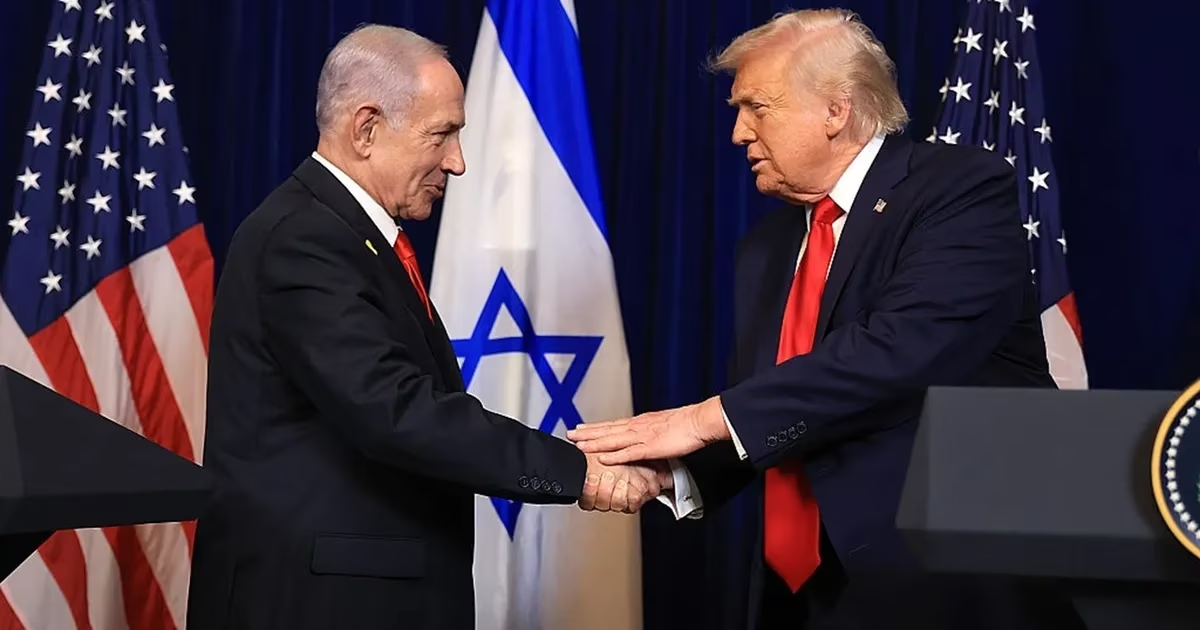
The story began with intense pressure exerted by Israeli Prime Minister Benjamin Netanyahu, exploiting his influence in American decision-making circles to convince the Trump administration that the Iranian regime was at its weakest. This pressure succeeded in undermining a diplomatic path led by the Sultanate of Oman, where Omani Foreign Minister Badr Al Busaidi confirmed that negotiations were active before they were suddenly sabotaged in favor of the military option.

In the early hours of what became known as the 'Saltwater Fury' operation, Israel crossed red lines by targeting a leadership meeting in Tehran, resulting in the death of Supreme Leader Ali Khamenei and senior commanders of the Revolutionary Guard. This unprecedented escalation presented the United States with a new fait accompli, transforming its role from a partner in a limited military campaign to a direct party in a major political assassination operation.

Contrary to American and Israeli expectations of a rapid collapse of the Iranian regime, Tehran demonstrated a high capacity to organize its ranks and respond with effective and painful military action. Iranian forces launched intensive missile and drone attacks, not only targeting deep inside Israel but also extending to directly and unprecedentedly strike vital American interests in the Gulf region.

Sources reported that Iranian missiles precisely targeted Al Udeid Air Base in Qatar and Al Dhafra Air Base in the UAE, in addition to Ali Al Salem Air Base in Kuwait and the headquarters of the Fifth Fleet in Bahrain. This broad response confirmed the failure of the 'decapitation' theory that Tel Aviv had bet on to cripple Iran's defensive and offensive capabilities, confusing military calculations in Washington.

For its part, the Pentagon announced the death of 6 American soldiers and serious injuries to others as a result of these attacks, which represents a severe blow to Trump's promises to protect American soldiers and end foreign wars. This field reality prompted the American administration to try to open back channels of communication with Tehran to request a ceasefire, which has been met with a categorical Iranian refusal so far.

Senior Iranian official Ali Larijani revealed that Tehran rejects any de-escalation at present, considering the assassination of the Supreme Leader to be a crossing of all red lines that cannot be overlooked without a comprehensive response. Larijani affirmed that all American and Israeli assets in the region have become legitimate targets, warning that the confrontation will not be bound by specific time or geographical limits.

Domestically, Trump faces a wave of sharp criticism from various political and media spectrums in the United States, as major television channels have begun to question the utility of this war. Prominent media voices warned that the Iranian Revolutionary Guard has a long breath in the confrontation, noting that American voters may feel deceived after 'America First' promises.

Even in conservative circles, strong opposition to the war emerged, with analysts pointing out that the United States is fighting a conflict that primarily serves Israeli interests and achieves no strategic gains for Washington. This division in Trump's electoral base weakens his political position, especially with the increasing human and material losses among forces deployed in the region.

Economically, the war caused violent disruptions in global markets, as the closure of the Strait of Hormuz led to a massive jump in global energy prices. Major shipping companies began rerouting away from the Gulf, signaling a crisis in global supply chains that could lead to an economic recession threatening the financial stability Trump has long boasted about.

Internationally, the United States finds itself increasingly isolated, with China and Russia describing the military operations as a blatant violation of international law. European allies also showed significant reservations, with French President Emmanuel Macron calling for an immediate halt to the escalation, warning that the entire region is sliding into an abyss whose end cannot be predicted.

Amidst this confusion, an American exit plan appears completely absent, with the White House content with general calls for Iranians to change their regime, calls observers deem naive. The reality indicates that the external attack has contributed to unifying the Iranian internal front behind the discourse of resistance, making it difficult to achieve any political change through military force.

Benjamin Netanyahu succeeded in dragging Washington into a direct confrontation with its biggest regional adversary, achieving what his predecessors failed to do through decades of incitement. It seems that Trump, who thought he was managing a winning deal with a preemptive strike, has fallen into a well-designed strategic trap by Tel Aviv to secure its own interests at the expense of regional and international stability.

The question remains in Washington's decision-making circles about the final cost of this adventure, and whether the administration is capable of containing the fire it ignited. The coming days will reveal whether the United States will proceed with an open war without clear objectives, or if it will find a way out that preserves what remains of its prestige and interests in the turbulent region.

The 'decapitation' theory that Israel bet on failed to achieve its primary goal of crippling Iran's ability to respond, and placed Washington in a real strategic predicament.

PALESTINE

Sat 07 Mar 2026 11:38 am - Jerusalem Time

Occupation forces ban Sheikh Ekrima Sabri from Jerusalem's Old City after interrogation targeting his religious stances

The preacher of the blessed Al-Aqsa Mosque and head of the Supreme Islamic Council in Jerusalem, Sheikh Ekrima Sabri, underwent a lengthy interrogation at the 'Moscovia' detention center belonging to the occupation authorities in occupied Jerusalem. The 87-year-old Sheikh appeared before the interrogators leaning on his cane, a move that reflects the occupation's insistence on pursuing religious figures in the holy city.

Following the two-hour interrogation, the occupation authorities decided to release Sheikh Sabri under restrictive conditions, which included a 15-day ban from Jerusalem's Old City. He was also required to sign a personal guarantee, with an obligation to reappear for interrogation if summoned again by the Israeli security services.

The interrogation session focused on Sheikh Sabri's recent statements, in which he expressed the Islamic legal opinion on the closure of Al-Aqsa Mosque and the prevention of worshippers from accessing it. The Sheikh confirmed after his release that his pursuit came because he clearly stated that it is not permissible to suspend Friday prayers or close the mosque from a religious perspective.

These developments come amidst the occupation authorities imposing strict restrictions on Al-Aqsa Mosque, exploiting the instructions of the Home Front Command issued concurrently with the recent military escalation. These measures led to the complete closure of the mosque since the first days of the confrontations, preventing worshippers from reaching its premises.

Sheikh Ekrima Sabri described the current situation at Al-Aqsa Mosque as 'very worrying,' especially since the closure coincided with the arrival of the blessed month of Ramadan, which usually witnesses hundreds of thousands of visitors. He indicated in statements to media sources that depriving Muslims of praying in their first Qibla is an arbitrary measure that lacks any legal or moral cover.

Al-Aqsa's preacher stressed that the mosque must remain far from political and military calculations and the emergency situations imposed by the occupation. He clarified that sovereignty over the mosque is an exclusive right of Muslims alone, and it is unacceptable to turn it into a military barracks or subject it to security decisions that prevent the performance of fundamental religious rituals.

In a message addressed to the Islamic nation, Sheikh Sabri called for the necessity of paying attention to the siege of Al-Aqsa Mosque and the absence of Friday and congregational prayers. He affirmed that suspending this ritual, which is a pillar of Islam, is something that cannot be tolerated, demanding the opening of mosques to worshippers without restrictions.

For its part, the legal team following Sheikh Sabri's case condemned this summons, considering it an attempt to silence voices and prevent influential figures from expressing their religious stances. Lawyer Khaled Zabarqa confirmed that what the Sheikh stated is purely a jurisprudential opinion that objects to exploiting regional circumstances to pass plans targeting the identity of Al-Aqsa Mosque.

Al-Aqsa Mosque should not be subject to emergency situations or be in the grip of the occupation authorities, and depriving Muslims of their worship is an illegal act.

ARAB AND WORLD

Sat 07 Mar 2026 11:37 am - Jerusalem Time

Washington Post: Iranian regime structure shows surprising cohesion despite severe American and Israeli strikes

A report published by the 'Washington Post' stated that the Iranian regime continues to exert full control over the state's joints, despite the heavy losses and devastating blows it has recently suffered. The report clarified that the structure of the ruling regime in Tehran has shown a surprising ability to persist, astonishing Western experts and officials who monitored the course of military operations.

Despite the intense war waged by the United States and Israel, the Iranian leadership has maintained its internal cohesion remarkably. According to European and Arab officials familiar with the situation assessments, these circumstances have not affected the regime's grip on power, although they have hindered some protocol procedures such as choosing a successor to the Supreme Leader.

Assessments indicate that Tehran had prepared itself in advance for this type of existential conflict by building flexible command structures. These structures were specifically designed to withstand direct targeted strikes, allowing the regime to continue directing regional retaliatory strikes within hours of being attacked.

On the ground, sources reported an intense security presence in the streets of major Iranian cities, where paramilitary Basij forces continue to patrol on motorcycles. This security presence aims to prevent any attempts at internal unrest and ensure that the streets remain under the strict control of sovereign agencies.

In contrast, the US administration boasted about the success of its operations in eliminating a number of senior Iranian leaders and destroying command and control centers. The US Secretary of Defense stated that what he described as the 'ruling council' had been scattered between dead and hiding in shelters, considering this a decisive blow to the regime's decision-making capability.

However, European and Arab intelligence assessments still adopt a different view from the official American narrative regarding imminent collapse. A prominent European official confirmed to the newspaper that there are no indications of defections within military ranks or the outbreak of widespread popular uprisings so far.

Experts attribute this resilience to the 'multi-level system' adopted by Tehran in distributing power and military responsibilities. This system ensures the immediate appointment of replacements for any key figure who is assassinated, which indeed happened after the killing of the Minister of Defense in recent airstrikes.

Washington's allies in the region had estimated that the assassination of top leaders would be a turning point that would ignite an internal revolution against the regime. However, the reality on the ground showed unexpected unity within state agencies, confusing the calculations of observers who expected the Iranian internal front to quickly fracture.

Iran is currently facing an almost complete internet blackout, making it extremely difficult to obtain accurate information from within. Nevertheless, visual analyses show severe damage to government buildings and vital military installations as a result of continuous bombardment targeting thousands of sites.

For his part, analyst Gregory Brew believes that Iran has been significantly weakened militarily after the destruction of most of its naval fleet and ballistic missile stockpiles. He pointed out that the bombing destroys the physical infrastructure of the Islamic Republic, but it may not necessarily succeed in dismantling the organizational structure of the security forces that spread rapidly.

Sources indicate that police and Basij forces deliberately evacuate barracks and known buildings to avoid direct aerial targeting. These tactics allow them to reappear and carry out their duties as soon as the raids stop, benefiting from not needing heavy weapons in internal security operations.

Iran's Foreign Minister had previously hinted in statements that military units operate according to 'pre-set general instructions' that grant them autonomy in movement. This approach reduces the impact of communication disruptions with the central command and ensures the continuation of combat and security operations in various regions.

With the escalation of Iranian retaliatory attacks against neighboring countries, Tehran appears to be betting on a 'long-breath' strategy in confronting adversaries. The Iranian leadership believes that its ability to withstand economic and field hardships exceeds the ability of the United States and its allies to continue an open war.

In conclusion, officials warn that the Iranian regime is designed to survive and will not easily relinquish its power, no matter how severe external pressures become. The current Iranian gamble is to inflict as much damage as possible on the region to force Washington to seek a path to de-escalation and exit the cycle of conflict.

There is no indication of anything collapsing in the regime, nothing, zero; control remains complete.

OPINIONS

Sat 07 Mar 2026 11:24 am - Jerusalem Time

When War Becomes a Television Spectacle

By Said Arikat

March 7, 2026

News Analysis


Washington, D.C. — Night after night, viewers of major American television networks are treated to a familiar ritual. On glowing screens, commentators stand before digital battlefield maps, tracing missile arcs and strike corridors as if narrating a playoff game. On networks such as CNN, NBC, CBS, ABC, and Fox News, panels filled with retired generals and security analysts walk audiences through the latest American–Israeli attacks on Iran in a tone that often sounds less like journalism than celebration.


The graphics are polished, the language confident, and the commentary heavy with tactical detail. Missiles are described as “precise,” operations as “successful,” and every strike as a calculated move on an ever-evolving chessboard. Arrows sweep across maps while analysts speculate about retaliation scenarios and escalation ladders. What viewers rarely hear, however, is the most basic journalistic question: was this war necessary in the first place?


Instead of interrogating the origins of the conflict, much of the coverage assumes its legitimacy and moves directly to discussing how it is being fought. This subtle framing matters. By treating the war as a given, television news shifts the conversation away from political responsibility and toward military performance. War becomes a technical exercise rather than a political choice made by leaders.


Another striking feature of the coverage is how faithfully many outlets echo official narratives coming from Washington and Tel Aviv. Statements from the White House and the Israeli government are frequently repeated almost verbatim, often with little scrutiny or historical context. Anchors introduce segments with language about “defending allies” or “restoring deterrence”—phrases that quietly assume the righteousness of the campaign before any real debate has begun.


Rarely mentioned in these nightly discussions is the decades-long political campaign by Israeli Prime Minister Benjamin Netanyahu to push the United States toward a war with Iran. For years, Netanyahu repeatedly warned that Iran represented an existential threat and insisted that diplomacy would never stop Tehran’s ambitions. Confronting Iran, he has said openly, has been one of the central missions of his political life.


Today he has a willing partner in President Donald Trump, whose administration has embraced Israel’s hard-line view of Iran with remarkable enthusiasm. Yet television audiences seldom hear this alignment examined critically. Instead, analysts focus on the mechanics of bombing campaigns, the range of missiles, or the resilience of Iranian air defenses.


The dominance of retired military officers on television panels helps explain this imbalance. Soldiers are trained to think about how to win wars, not whether wars should begin. When generals dominate airtime, conversations naturally revolve around strategy, targets, and escalation scenarios. Missing from the discussion are diplomats, historians, regional specialists, and critics who might ask whether the conflict itself was avoidable.


The result is a kind of televised war theater. Maps glow, graphics pulse, and experts narrate events in real time, but the deeper political story remains blurred. Viewers see where missiles land but rarely hear sustained discussion about why the war began or whose interests it ultimately serves.


This pattern is not new. During earlier conflicts, American television networks often echoed official narratives in the opening stages of war, only revisiting the underlying assumptions months or years later. The urgency of breaking news and the pressures of patriotism can narrow the boundaries of acceptable debate.


But the stakes of a war involving Iran are enormous. Iran is a large regional power with allies, proxies, and strategic reach stretching across the Middle East. A prolonged confrontation risks widening into a conflict that could destabilize energy markets, draw in other states, and reshape the region for years.


Those consequences demand journalism that questions power rather than amplifies it. Instead of simply replaying government talking points, networks could ask harder questions: What evidence justified war? What alternatives were ignored? Who benefits politically from escalation?


Until those questions are asked consistently, television coverage will continue to resemble a running commentary on military operations rather than an investigation into the decisions that produced them. The danger is not merely journalistic failure; it is democratic complacency.


Criticism of this pattern does not require sympathy for Iran’s government. Tehran’s policies, its repression at home, and its regional interventions deserve scrutiny. Yet acknowledging those realities does not relieve journalists of their obligation to question whether bombing campaigns were the only option available. Responsible reporting must be capable of holding two ideas at once: that Iran’s government can be deeply problematic, and that war against it still demands rigorous justification.


For now, however, much of cable news appears more comfortable illustrating airstrikes than interrogating the politics behind them. The maps glow, the generals explain, and the official narrative moves smoothly from podium to studio.


 Meanwhile, the central question remains largely absent from the broadcast: who decided this war was unavoidable, and why were Americans never seriously shown another path?


Television coverage of war shapes how the public understands it—and therefore how democracy responds to it. When networks treat conflict as a tactical spectacle while echoing official narratives, they risk normalizing decisions that deserve far deeper scrutiny. Journalism’s duty is not to choreograph missile strikes on digital maps but to interrogate the power that orders them. Without that critical distance, the media ceases to function as a watchdog and instead becomes, willingly or not, a megaphone for war.

OPINIONS

Fri 06 Mar 2026 8:33 pm - Jerusalem Time

The Illusion of Iran's Fall and Israel's Rise: A Reading of the Hegemony Narrative in the Middle East

Every time the confrontation between Israel and Iran escalates, an old political and media discourse resurfaces: if Iran falls or its power declines, Israel will become the dominant power in the Middle East. This idea seems logical at first glance, given Israel's military and technological superiority, and the strategic support it receives from the United States. However, a closer look at the structure of the regional system reveals that this narrative is closer to a political illusion than a realistic reading of the balance of power.

Historically, the Middle East has not been a region that allows a single power to dominate for a long time. Since the end of the Cold War, the region has been shaped by shifting balances between several regional powers, most notably Iran, Turkey, Saudi Arabia, and Israel. These powers differ in their tools: some rely on economic and religious weight, others on military power or geopolitical influence, but none has been able to impose comprehensive hegemony over the region.

In this context, Iran represents a special case. Iranian power is not based solely on traditional military capabilities or its missile and nuclear program, but also on a regional network of influence extending through local allies in several arenas. Therefore, talking about the "fall of Iran" as a rapid military event ignores the nature of Iranian power itself, which has been built over decades through a mix of politics, alliances, and the ability to operate in turbulent regional environments.

In contrast, there is no doubt that Israel possesses a qualitative superiority in military technology, intelligence, and air force, in addition to its deep alliance with the United States. The diplomatic shifts witnessed in the region in recent years, especially after the normalization agreements with some Arab countries, have also strengthened Israel's political and economic presence in the Middle East. However, this relative rise does not necessarily mean the region's transition to an Israeli-led regional system.

There are structural constraints that prevent this. First, Israel, despite its military strength, remains a relatively small country in terms of area and population compared to the countries of the region. Second, the political environment in the Middle East remains highly sensitive to the idea of external hegemony, making any project for regional control fraught with political and popular resistance. Third, other regional powers, especially Turkey and Saudi Arabia, will not easily accept a strategic vacuum that allows a single power to control regional balances.

Even in the hypothetical scenario where Iran loses the war and exits its position as a regional pole, the legacy of its influence will not automatically transfer to a single party. On the contrary, this legacy is likely to become an arena of competition among several regional powers. Countries that have built their security policies over the past decades on confronting Iran's rise – such as Israel, Turkey, Egypt, and Saudi Arabia – will find themselves with a wider space for strategic repositioning and strengthening their presence in arenas where Tehran was a key player.

This is because a large part of these countries' focus and resources were directed towards containing or balancing Iranian influence. If this balance is disrupted by Iran's exit or decline, all these powers will reap a kind of strategic credit: military and political resources that were allocated for confrontation may be redirected to enhance regional standing, and relatively closed spheres of influence may turn into new arenas of competition among them.

However, the most important factor in this landscape may not be only regional, but also international. Despite repeated talk in recent years about the possibility of a gradual US withdrawal from the Middle East, broader strategic data indicate that Washington may not easily leave the region. The challenge facing the United States is no longer limited to Iran or to managing traditional conflicts in the Middle East, but is also linked to the rapid rise of China as a competing global power.

From this perspective, the region may once again become an important arena in the competition between major powers. The presence of huge energy resources, strategic maritime passages, and massive financial and investment markets makes the Middle East an important part of the geopolitical calculations associated with China's rise.

Therefore, the United States is likely to seek to reshape its presence in the region not through withdrawal, but by building a wider network of regional alliances. This alliance framework may be mostly Arab, and perhaps Sunni in its political structure, relying on the significant economic weight of the Gulf states and major Arab countries to balance growing Chinese influence.

In this context, the Middle East may become a stage for the intersection of several levels of competition: regional competition among the major powers in the region, and international competition between the United States and China, with a Russian presence that also seeks to consolidate its position in the equation.

Hence, portraying any potential war against Iran as the path to an "Israeli-led Middle East" reflects in part a political or propaganda discourse more than it reflects a strategic reality. Even if Iran suffers severe blows or its military capability declines, this will most likely lead to a redistribution of influence among several parties, rather than the emergence of a single dominant power.

The Middle East, by virtue of its history and its political and demographic composition, always tends towards complex balances rather than absolute hegemony. Therefore, talking about the fall of Iran and the rise of Israel as a dominant power in the region may seem attractive in media headlines, but it remains closer to a political illusion than to a realistic analysis of the region's future.

PALESTINE

Fri 06 Mar 2026 7:57 pm - Jerusalem Time

The Killing of Nasrallah Abu Siam Reopens Accountability File: Senate Pressure on Trump Administration to Investigate

Said Erikat

Opinion Writer

Washington – Said Arikat – 3/6/2026

News Analysis

The killing of Palestinian-American youth Nasrallah Abu Siam in the occupied West Bank has reopened an old and renewed debate within Washington about the limits of US protection for its citizens abroad, and about its readiness to hold its allies accountable when they are accused in cases affecting the lives of Americans. The latest incident is not read as an isolated event, but as a new link in a series of similar incidents that have accumulated over the past few years and raised increasing questions within Congress and American policy circles.

In this context, more than thirty senators signed an official letter demanding that President Donald Trump's administration open an independent investigation into the killing of the 19-year-old, who was shot dead on February 18 in the village of Mukhamas, north of Jerusalem. The case, according to lawmakers, represents a clear example of a recurring pattern of American citizens being killed in the West Bank without investigations leading to criminal accountability.

The letter indicates that Abu Siam's killing is the ninth case of an American citizen killed in the West Bank since 2022 by Israeli soldiers or settlers, without any of these cases leading to a criminal conviction so far. The signatories believe that this accumulated record raises fundamental questions about the seriousness of investigations conducted in such incidents, as well as about the role the American government should play when the victims are its citizens.

The letter was led by Democratic Senator Chris Van Hollen of Maryland and addressed to Secretary of State Marco Rubio, Attorney General Pam Bondi, and US Ambassador to Israel Mike Huckabee. Lawmakers demanded a US-led investigation, in addition to a comprehensive report covering all nine cases, with a detailed briefing to Congress on the circumstances of Abu Siam's killing before April 5.

The letter stated that what is happening in the West Bank indicates a disturbing pattern, where Americans are killed by settlers or Israeli soldiers without justice being achieved, despite repeated promises from American officials to follow up on these cases. Lawmakers stressed that the absence of accountability undermines public trust in the United States' ability to protect its citizens abroad.

The Guardian was the first to reveal the letter, which was signed by 31 senators, including prominent figures in the Democratic Party such as Patty Murray, Dick Durbin, and Jack Reed, in addition to independent Senator Bernie Sanders. This number of signatories reflects the widening circle of concern within Congress regarding the official handling of these incidents.

However, what was striking at the same time was the absence of the signatures of Pennsylvania Senators, Democrat John Fetterman and Republican Dave McCormick, despite the victim being born in Philadelphia. Fetterman has been one of Israel's most prominent defenders in the Senate in recent years, and he has not issued any public comment on the incident, a silence that has drawn criticism in some political circles.

Abu Siam, born in Philadelphia, was killed when a group of masked settlers attacked Palestinian farmers near the village of Mukhamas. According to eyewitnesses, Israeli soldiers were present at the scene at the time of the attack, but they did not intervene to stop the assault, nor did they provide first aid to the injured or arrest any of the attackers.

The Israeli occupation army did not issue an immediate comment on the incident. The US State Department merely confirmed the death of an American citizen in the West Bank that day and said it expected a full and transparent investigation, noting that the US Embassy in Jerusalem was in contact with the victim's family. However, the statement did not include any reference to direct American involvement in the investigation.

This is not the first time that Congress has raised this issue. In July 2025, Van Hollen led a similar letter demanding clarification from the administration regarding the killing of American youth Saifullah Maslat from Florida, who was beaten to death by settlers in the West Bank. At the time, the US State Department merely called for accountability without announcing an independent investigation.

The list of victims in recent years includes prominent names, most notably Palestinian-American journalist Shireen Abu Akleh, who was shot in the head in 2022 while covering an Israeli military operation in Jenin, despite wearing a clear press vest. The case then sparked a wide wave of international criticism and calls for an independent investigation.

American activist Aysunur Ezgi Ege, a 26-year-old woman from Seattle, was also shot in the head during protests in the West Bank in 2024. In another incident, elderly Palestinian-American Omar Assad died after Israeli soldiers tied him up, blindfolded him, and left him in harsh conditions that led to a heart attack.

The incidents also included the death of Khamis Al-Ayada, a Palestinian-American in his forties, who suffocated from smoke after settlers set fire to his village. Three of the nine victims were minors, including a 14-year-old boy from New Jersey and two 17-year-old youths.

This issue comes amid an unprecedented escalation in settler violence in the West Bank over the past two years. Repeated attacks have forced dozens of small Palestinian communities to evacuate their homes, amid human rights reports indicating that many of these assaults occur in the presence of or under the protection of Israeli forces.

These tensions increased after President Trump's decision last January to revoke an executive order issued by former President Joe Biden, which imposed sanctions on settlers and organizations accused of involvement in violence against Palestinians. The decision led to the removal of sanctions on 33 individuals and organizations at once.

Critics of the decision believe that this step weakened the few remaining American pressure tools on extremist settler groups. Some lawmakers also believe that the political message sent by the decision contributed to an increased sense of impunity, which was reflected in a significant rise in the number of attacks.

At the end of their letter, lawmakers posed a question that reflects the extent of frustration within some congressional circles: How many Americans must die in the West Bank before the US government takes serious steps to ensure accountability?

This issue reveals increasing tension within American politics between the traditional commitment to supporting Israel and the growing pressure from within Congress and public opinion to demand real accountability when American citizens are harmed. As incidents continue without clear legal outcomes, some officials fear that this will undermine the credibility of the United States when it speaks of the rule of law and human rights in the world.


PALESTINE

Fri 06 Mar 2026 7:57 pm - Jerusalem Time

'Scorched Earth' Plan: Occupation Seeks to Expand Control 8 Kilometers Deep into Lebanon

The features of a new phase of Israeli military escalation on Lebanese territories are unfolding, as the occupation army has deployed two additional military divisions to reinforce its field operations. These movements aim to impose a new geographical reality that goes beyond previous deployments, seeking to expand the scope of influence and control deep within Lebanese territory.

Reports from informed sources indicate that the current Israeli plan aims to control areas extending up to eight kilometers at some points. Through this distance, the occupation seeks to secure complete freedom of movement for its forces and prevent any direct threats that might target border settlements in the north.

The Israeli strategy relies on what is known as the 'scorched earth' policy, which aims to transform border villages and towns into a buffer zone completely devoid of residents and buildings. Occupation forces are using heavy 'D9' bulldozers to destroy infrastructure and what remains of Hezbollah facilities in those areas.

In the context of field operations, sources reported that the occupation has already established five fixed military positions inside Lebanese territory to secure its defensive and offensive lines. This step aims to enable forces to confront anti-tank missiles and provide direct lines of sight and fire towards any hostile movements.

On the intelligence front, occupation estimates indicate that a few hundred 'Radwan Force' fighters are still deployed in the border area. These estimates confirm that these fighters operate individually without clear central command, making them rely on ambush tactics and surprise attacks.

As part of psychological and military pressure, the occupation army issued evacuation orders for residents of Beirut's southern suburb before carrying out intensive airstrikes. These strikes, according to media sources, aim to send pressing political and military messages rather than seeking a direct and comprehensive military decisive action at present.

On the joint diplomatic and military track, eight American officers met with Israeli army leaders at a northern military base to coordinate positions. These officers belong to a specialized unit established to monitor ceasefire agreements, and their duties are distributed between Beirut and Galilee under the supervision of the US Central Command.

Sources clarified that the American side expressed support for Israeli operations against Hezbollah's infrastructure, while placing strict reservations regarding harming the Lebanese state. Clear messages were conveyed to the Lebanese army about the necessity of evacuating some of its positions near the border to avoid engaging in direct confrontations.

For his part, Israeli Security Minister Yisrael Katz affirmed that military operations will continue and expand to additional points until their final objectives are achieved. Katz stressed the necessity for residents of northern settlements to remain in their homes, considering that reinforcing forces inside Lebanon is the only guarantee to change the security reality.

In contrast, Hezbollah did not stand idly by, issuing urgent warnings to residents of Israeli settlements within a five-kilometer range about the necessity of immediate evacuation. These mutual warnings reflect the escalating tension and the desire to impose new deterrence equations on both sides of the Lebanese-Palestinian border.

The plan aims to create a new type of security strip, without local residents or homes, to turn the area into a scorched earth.

PALESTINE

Fri 06 Mar 2026 7:56 pm - Jerusalem Time

Inspired by Gaza's steadfastness.. A Spanish youth embraces Islam and recounts details of his journey from Barcelona to Istanbul

In a story reflecting the deep moral impact of Palestinian steadfastness on the international stage, Spanish youth Ardea Clavel announced his embrace of the Islamic religion, explaining that his journey began in the streets of Barcelona and ended in the minarets of Istanbul. Clavel affirmed that his involvement in demonstrations condemning Israeli aggression and demanding Palestinian rights generated in him an overwhelming desire to understand the faith from which the people of Gaza derive their strength and steadfastness.

Sources reported that Clavel, who chose to spend Ramadan in Turkey, stressed that scientific research and reading are the only weapons to confront the smear campaigns that link Islam to violence in Western societies. He pointed out that his experience with Muslim communities and his direct exposure to Quranic texts revealed to him the falsity of the negative stereotypes prevalent in Spain, Europe, and Latin America.

Regarding his future plans, the Spanish youth affirmed his determination to work to spread awareness and correct misconceptions upon his return to his country, considering his personal experience as proof that knowledge is the true antidote to fanaticism. Clavel described the Ramadan atmosphere he is currently experiencing as a unique spiritual experience that reinforced his conviction in the beauty of the new religion he chose.

What cures fanaticism is knowledge, so I advise everyone to read and research more; for when you read the Quran, you find the exact opposite of what the West promotes.

ISRAELI AFFAIRS

Fri 06 Mar 2026 7:56 pm - Jerusalem Time

Strict Israeli Security Measures Around Diplomatic Missions Worldwide to Counter Aerial Threats

The Israeli Ministry of Foreign Affairs announced today, Friday, the commencement of a series of intensive security enhancements for its diplomatic missions spread around the world. Sources clarified that these measures vary between overt and covert, specifically targeting representations located in the Middle East, Europe, and Africa, due to security assessments indicating an elevated risk level.
A statement issued by the Foreign Ministry confirmed that the General Security Service (Shin Bet) is directly overseeing this updated global security system. The plan includes integrating advanced technological techniques dedicated to monitoring and identifying potential threats before they occur, as part of a proactive strategy to counter any attempts to target Israeli interests abroad.
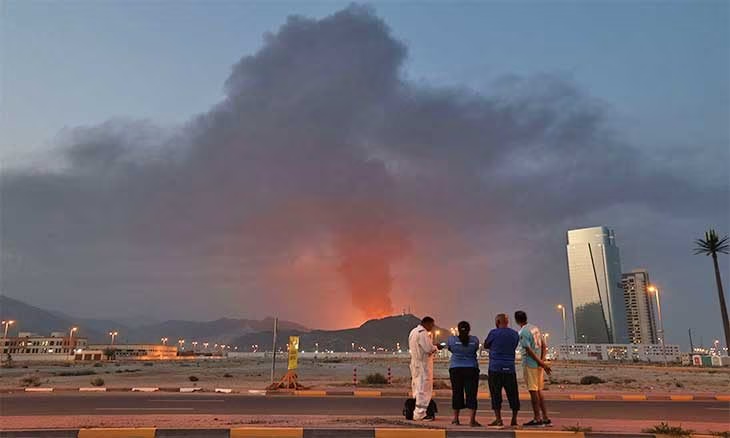
Based on current security situation assessments, field security teams have raised their operational readiness level in recent weeks. This move came in close coordination with local security authorities in host countries, to ensure the protection of Israeli targets and provide a tight security cover around diplomatic buildings and staff residences.

The new measures included developing rapid response protocols and dealing with emergency scenarios, including immediate evacuation plans in crisis situations. These steps aim to enhance the ability of field teams to efficiently address sudden security incidents, while reducing response time to any tangible threat that may arise on the international stage.

Sources indicated that the reinforcements were not limited to buildings only, but also included diplomats, official delegations, and sites related to air traffic. Special emphasis was placed on confronting aerial threats, which have recently escalated in intensity, with sensitive locations being equipped with advanced monitoring tools capable of dealing with drones and various aerial offensive means.

In a related context, it was decided to increase security presence in areas where Israelis gather around the world, especially in airports and waiting areas near flights operated by Israeli airlines. This step comes as a precautionary measure to secure passenger movement and ensure their safety amid the tense regional conditions in the region.

These security movements coincide with a widespread military escalation that began last February, with the arena witnessing an exchange of missile and aerial attacks between Israel and the United States on one hand, and Iran on the other. These confrontations have resulted in casualties and damage to vital civilian facilities, prompting Western and Israeli diplomatic missions to take the utmost precautions.

On the diplomatic front, the Iranian ambassador to Saudi Arabia denied accusations against his country regarding the targeting of the US Embassy compound in Riyadh by drones. This denial came at a time when international pressure on Tehran is increasing, amid accusations of launching attacks affecting international interests and civilian facilities in several Arab and Gulf countries.

Amid the continued tensions for the seventh consecutive day, the British Embassy in Manama announced its decision to withdraw part of its staff from Bahrain as a precautionary measure. This decision reflects the extent of international concern about the expansion of the conflict and its direct impact on the security of diplomatic missions in the region, necessitating a comprehensive review of all adopted security measures.

Advanced technological measures for threat detection were integrated, with the operational readiness level of security teams raised through dedicated activities.

ANALYSIS

Fri 06 Mar 2026 7:56 pm - Jerusalem Time

The Predicament of the Arab State: When Historical Ambition Turns into Mere Security Management

Contemporary Arab history is passing through a phase characterized by an extreme speed resembling the launch of rockets, while the Arab individual stands by as a spectator, unable to influence the course of events. Since the retreat of American forces from Vietnam, the Middle East has become a permanent arena for successive wars and international agendas that have drained human and material resources.

The current situation necessitates a return to Khaldunian lessons to understand the trajectories of the modern Arab state, specifically the Tunisian model, which embodies the theory of the ages of states. This perspective suggests that a state passes through three successive generations, beginning with construction and strength, and ending with decay and prosperity that kills the spirit of initiative and ambition.

The first generation, led by Habib Bourguiba, laid the foundations of the national state based on the legitimacy of the struggle for independence, sovereignty, and the aspiring spirit of the nation. Despite success in establishing an intellectual elite and a welfare state, this generation planted the 'germ of dictatorship' within the state's body, which paved the way for its subsequent demise.

With the second generation, represented by the era of Zine El Abidine Ben Ali, the state transitioned from a phase of national ambition to a phase of material satiety and consumer prosperity. In this phase, citizens replaced their political aspirations with consumer loans and false social appearances, leading to the erosion of strong neural and social ties.

This era witnessed a radical shift in values, where quick pleasures and individualistic tendencies overshadowed public interest and national cohesion. The gap between social classes widened, between those enjoying Parisian luxury and those suffering in forgotten rural areas, paving the way for a social explosion known as the Arab Spring.

The revolution came as a cry for help and a nervous movement attempting to restore the lost balance between the center and the peripheries, but it quickly lost its compass. Instead of producing a new national project, the revolution handed its leadership to old elites who reproduced the crisis in different political molds.

In the current phase, we find the state transformed into a mere bureaucratic administration that organizes the daily survival of the population without any symbolic horizon or future project. The grand national narrative that characterized the state's beginnings has faded, replaced by a system that sanctifies security calm at the expense of bothersome freedoms.

The transformation from a 'state of ambition' to an 'administrative state' reflects the collapse of the balance between the elite and the public, where institutions are unable to produce a unifying identity. This political and moral disintegration represents the core of the third generation's crisis, which lives in a state of inability to self-renew or establish a new historical path.

The crisis is clearly evident in the absence of a historical vision, where maintaining administrative stability becomes the supreme and sole goal of authority. In this context, the role of elites in inventing symbols or defending major causes declines, preferring self-isolation and observing global events as spectators.

The systematic focus on bureaucratic organization has weakened the capacity for political imagination, making security precede freedom in the hierarchy of priorities. This path inevitably led to the fading of the motivating 'asabiyyah' (group solidarity) that pushed society towards achieving tangible civilizational accomplishments.

When the national narrative is absent, the state transforms into a formal structure lacking a real popular base that protects it in major crises. Today, we see a state existing with its institutions, but without a soul or a project that connects individuals to a national identity transcending narrow material interests.

The signs of early political demise are evident in the exhaustion of intermediary systems and the cessation of elite imagination in providing solutions to accumulated crises. The situation has ended in a 'presidential' state lacking a historical narrative, making the state vulnerable to fluctuating political winds without internal immunity.

In this reality, elites evade their moral responsibilities towards fateful issues, such as the Palestinian cause or confronting international hegemony. These elites content themselves with inventing phrases of political evasion, considering issues like Gaza to be on another planet that does not concern them amidst their preoccupation with managing daily life.

In conclusion, it appears that the 'germ of dictatorship' has worked with high efficiency in destroying the foundations of the modern Arab state from within. Security management, no matter how precise, cannot be a substitute for a true state that builds ambition for its people and preserves their dignity and history.

The absence of a state project or historical vision is what kills the state more than luxury; a third generation manifests as a sign of an early and rapid political end.

ARAB AND WORLD

Fri 06 Mar 2026 7:56 pm - Jerusalem Time

Merz warns of consequences of Iranian state collapse and calls for preservation of its territorial integrity

German Chancellor Friedrich Merz stressed the need to preserve Iran's unity and territorial integrity, warning against sliding into scenarios of chaos. Merz explained during statements he made in the city of Munich that the stability of state institutions in Tehran is an international necessity, considering that the absence of public order there will create crises that transcend the region's borders, with direct repercussions reaching the European continent.

The German Chancellor indicated that Berlin is making intensive diplomatic efforts with its international partners to reach a common formula aimed at stopping the ongoing hostilities. He emphasized the importance of the Iranian state continuing to provide basic services to its citizens and ensuring the flow of vital needs, in order to avoid a comprehensive economic collapse that could lead to uncontrolled waves of migration towards Western countries.

In the context of political solutions, Merz noted that the international community might move towards lifting economic sanctions imposed on Tehran and providing technical and financial aid packages. The German Chancellor stipulated that for this to happen, the Iranian side must meet a set of necessary conditions that ensure de-escalation and adherence to international standards, thereby contributing to defusing a comprehensive explosion in the Middle East.

These German warnings come amidst an unprecedented military escalation that began since the end of last February, following attacks launched by Israel and the United States, which resulted in significant human losses, including senior leaders in the Iranian political hierarchy. This development has led the region into a spiral of mutual military responses, with Tehran using missiles and drones to target various locations.

On the regional level, the Gulf Cooperation Council countries expressed their grave concern about the accelerating events, condemning the attacks that targeted civilian facilities and vital installations in the region. The Gulf capitals called for the utmost restraint and an immediate halt to military escalation, to avoid the region sliding into a comprehensive war that threatens energy security and international navigation.

The collapse of the Iranian state or the outbreak of proxy conflicts on its territory is in no one's interest, and such scenarios could have far-reaching consequences for Europe.

PALESTINE

Fri 06 Mar 2026 7:56 pm - Jerusalem Time

Three Scenarios for Iran's Future: Will the US-Israeli Military Gamble Succeed?

The US-Israeli aggression against Iran entered its seventh day amidst unprecedented military escalation that encompassed vast geographical areas extending from the Arabian Gulf to the Indian Ocean. These developments come amid field confirmations of the martyrdom of Supreme Leader Ali Khamenei and Commander Mohammad Pakpour during the initial raids, placing the Iranian regime before its most difficult existential test in decades. In response, Tehran targeted American bases in the region and bombed vital installations with thousands of drones and missiles.

Amidst this complex scene, fundamental questions arise about the ability of military pressure to achieve real political change, especially recalling previous American experiences in Iraq and Afghanistan that ended in strategic failure. Analytical estimates suggest that history will not judge President Donald Trump's decision based on the accuracy of the airstrikes, but rather on the nature of the regime that will succeed the current chaos, and the extent of Washington's ability to contain the repercussions that have begun to shake the foundations of the global economy.

The first proposed scenario is to reach a political settlement in the 'Venezuelan style,' where the current structure of the regime is maintained through back channels but in a weakened and disarmed form. This path aims to reduce Iran's nuclear ambitions and curb the influence of its allies in the region in exchange for guarantees of continued power, an option that some may prefer to avoid a complete collapse that could lead to a permanent disruption of global energy supplies.

The second scenario warns of the Iranian state sliding into widespread internal chaos and a bitter power struggle following the collapse of central institutions. In this case, observers believe that the Iranian Revolutionary Guard will fill the security and political vacuum, transforming the country into a pure military dictatorship that adopts a more radical approach, which could open the door to long-term wars of attrition that extend beyond the Middle East, with their sparks reaching Europe and the Indian Ocean.

The third scenario, an orderly transition of power, remains theoretically the best option and the most difficult to implement on the ground. It requires the formation of an interim authority with international support and the redrafting of the constitution, with the army remaining aloof from political struggles. However, this path faces the obstacle of 'long-term commitment' from the United States, a commitment that successive American administrations lack, making it difficult to bet on building a stable democratic state amidst the rubble of war.

On the ground, the effects of the war have begun to clearly reflect on the international economy, with oil and gas prices jumping by 25% due to direct threats in the Strait of Hormuz, while the Israeli occupation's losses reached approximately 9.4 billion shekels weekly. In contrast, international divisions are growing over the utility of this war, with European countries such as Spain and Portugal refusing the use of their military bases, while Britain preferred the negotiating path, warning against being drawn into Netanyahu's escalatory goals.

On the diplomatic front, Russia, through its officials, warned of severe consequences for global stability due to NATO's involvement in this conflict, describing the attacks as an unjustified war that will lead to economic disasters. With the expansion of the confrontation to include targeting gas tankers and vital installations, the question remains as to how far this war can go, and whether the region will emerge with a new regional order or sink into decades of turmoil and destruction.

The most dangerous question today is not whether the military strikes will succeed in achieving their immediate objectives, but rather how this conflict will end and what will happen the day after the shells fall?

ARAB AND WORLD

Fri 06 Mar 2026 7:56 pm - Jerusalem Time

The Kremlin's Cold Calculations: Why Tehran's Fall Might Not Trouble Moscow?

There is a traditional conviction that Russia would be the biggest loser if the Iranian regime collapsed, but a careful reading of Kremlin policies reveals pragmatic calculations that transcend emotions. Moscow views the current confrontation between Washington and Tel Aviv on one hand, and Tehran on the other, as a complex equation of geopolitical gains and losses.

One of the primary opportunities lies in the possibility of diverting international attention from the Ukrainian front, which has drained Western resources for years. With the United States engaging in a new and costly theater of operations in the Middle East, the priority of the Kyiv file will automatically recede in global decision-making circles and major media coverage.

Observers believe that the American administration's preoccupation with a widespread regional crisis will necessarily lead to a slowdown in the pace of military and financial aid to Ukraine. This shift will make it difficult for the White House to pass new support packages amid a heated internal debate over the costs of engaging in multi-front conflicts.

In terms of energy, the war emerges as a catalyst for the growth of Russian revenues despite the severe sanctions imposed on it. The mere threat of disrupting navigation in the Strait of Hormuz or targeting oil facilities is enough to raise global crude oil prices, providing the Russian treasury with significant financial breathing room that compensates for price discounts.

Moscow mathematically benefits from every additional dollar in the price of a barrel of oil, as the global increase reduces the impact of Western restrictions on its exports. Thus, a geopolitical shock in the Gulf region could turn into a massive financial resource supporting the Russian war effort in other areas.

As for the third opportunity, it relates to European unity and the cohesion of NATO, as wars in the Middle East reactivate old fault lines. European countries' positions vary between those who see the need to contain escalation to avoid new waves of migration, and those who lean towards security hardening behind Washington.

These cracks within the Western camp weaken the ability to make unified and decisive decisions against Russia in the near future. The more European division increases over the cost of energy and the legitimacy of external interventions, the more Moscow finds an international environment that is less rigid and less willing to coordinate escalation against its interests.

Regarding regional influence, Russia is betting on the decline of US credibility as a guarantor of stability in the Arab region. The widening scope of confrontation under the American umbrella raises doubts among Arab capitals about the utility of complete reliance on Washington to secure navigation and energy.

This climate of doubt opens wide margins for maneuver for Russian diplomacy to present itself as an alternative or a reliable mediator who speaks with all parties. Moscow does not necessarily seek to completely displace Washington, but rather to seize the vacuums left by erratic American policies in the region.

The fall of the regime in Tehran, despite the risks of chaos it carries on the Caspian Sea borders, may give Russia an opportunity to redistribute strategic cards. An Iranian ally exhausted by sanctions may become a burden at some point, while regional chaos provides opportunities for Russian intervention in new forms.

Reports indicate that Moscow may invest in new arms deals and security partnerships with countries that were historically within the American sphere of influence. This shift in loyalties and alliances strengthens Russia's position as an international player that cannot be overlooked in future regional security arrangements.

For the Kremlin, prolonging the conflict in the Middle East serves its strategy of draining the political and military energy of the West. The more allies get bogged down in the details of the Iranian crisis, the less able they are to impose their terms in settlements related to Eastern Europe.

Ultimately, Russia does not view the collapse of its allies in terms of absolute loss, but in terms of alternative opportunities generated by radical change. It is the grand chess game in which Moscow excels at moving its pieces, exploiting every tremor in the global order to strengthen its position.

Thus, Russia's stance on escalation against Iran remains governed by a cold pragmatism that balances preserving its partner with capitalizing on its fall. It is a strategy of 'seizing gains' from the heart of crises, where the existential threats of others turn into golden opportunities to enhance Russian influence.

Moscow does not bet on Iran's collapse as a victory, but rather treats it as an event that rearranges international priorities, prices, and alliances.

ARAB AND WORLD

Fri 06 Mar 2026 7:55 pm - Jerusalem Time

The Arab Predicament Worsens as War on Iran Enters its Seventh Day, Targeting US Bases in the Gulf

The direct military confrontation between Iran and the American-Israeli alliance entered its seventh day, amidst unprecedented field escalation that included targeting US bases in the Gulf region with ballistic missiles and drones. Sources reported that the Gulf Cooperation Council countries, in conjunction with the European Union and Jordan, issued statements condemning what they described as reckless Iranian attacks, while Tehran affirmed that its operations are in response to the aggression that began on February 28th and resulted in the martyrdom of Supreme Leader Ali Khamenei and prominent military commanders.

In light of this crisis, Gulf positions emerged reflecting the extent of the geopolitical predicament, as the UAE announced it had been subjected to over a thousand attacks without changing its defensive stance, while Saudi Arabia, Qatar, and Kuwait hinted at taking measures to protect their sovereignty. Observers believe that these countries find themselves in the heart of a conflict they did not seek, where military operations are managed with a logic that prioritizes Israel's security over regional stability, threatening Gulf infrastructure and economies that have become caught in the crossfire between Washington and Tehran.

Internationally, signs of division in the Western camp began to clearly appear, as Spain and Portugal announced their categorical refusal to use their military bases as launchpads for attacks against Iranian territory. British Prime Minister Keir Starmer also favored the diplomatic path over military involvement, at a time when air traffic tracking platforms detected intensive movements of American refueling aircraft heading towards the Middle East via alternative routes in northern Europe.

Economically, the war and navigation disruptions in the Strait of Hormuz caused a massive 25% jump in global energy prices, prompting the Kremlin to announce an increase in demand for Russian energy. The US budget is suffering from severe depletion, costing up to one billion dollars daily, coinciding with massive losses to the Israeli economy estimated at billions of shekels weekly, amidst reports of a gradual depletion of strategic ammunition stockpiles for the occupation forces and the United States.

Analysts believe that the deep objectives of this war go beyond the Iranian nuclear file to an attempt to liquidate the Palestinian issue and subject the region to complete Israeli hegemony. Arab capitals fear that the elimination of the Iranian regime will lead to an imbalance of power that will give Netanyahu's extremist government a green light to expand its geographical and political influence, placing Arab countries before difficult choices between engaging in the conflict or bearing the exorbitant cost of neutrality.

Who gave you permission to turn our region into a battlefield? This war places Israel's security and interests above all other considerations.

PALESTINE

Fri 06 Mar 2026 7:55 pm - Jerusalem Time

For the seventh day.. The occupation continues to close Al-Aqsa and restricts prayer in the Ibrahimi Mosque

For the seventh consecutive day, the Israeli occupation authorities continued to close the blessed Al-Aqsa Mosque to worshipers, preventing them from performing the third Friday prayer of the holy month of Ramadan. Local sources confirmed that the occupation police informed the Islamic Endowments of the continued ban on prayer based on instructions from the Home Front, in an escalatory step not witnessed in the Holy City for many years.

The occupation forces began their repressive measures last Saturday morning, forcing worshipers and those in seclusion to leave the mosque courtyards under threat of arms. These restrictions included preventing the performance of evening and Taraweeh prayers throughout the past week, with intensive military reinforcements deployed in all alleys of the Old City and its main entrances.

In response to this ban, hundreds of Jerusalemites performed Friday prayers in the streets surrounding Bab Al-Amoud and in various neighborhoods of Jerusalem, expressing their adherence to their right to access their mosque. Camera lenses also captured Palestinian women performing prayers on the hills of the Mount of Olives overlooking the Dome of the Rock, in a scene that embodies the extent of deprivation imposed by the occupation.

This closure coincides with the imposition of a comprehensive security cordon on all governorates of the West Bank, following recent military developments and mutual attacks between Israel and Iran. It appears that the occupation seeks to exploit regional circumstances to impose a new reality in occupied Jerusalem, by reducing the Palestinian presence in Al-Aqsa Mosque to its lowest levels.

Historical records indicate that this is the fifth time Al-Aqsa has been closed on a Friday since the occupation of the city in 1967. Previous times were linked to major security events, such as the electronic gates uprising in 2017, or during periods of direct military aggression, which reflects the seriousness of the current stage and its repercussions on the existing situation.

In the city of Hebron, the situation was no better, as the occupation forces imposed strict restrictions on the entry of worshipers to the Ibrahimi Mosque. Official sources reported that the occupation allowed only 60 worshipers to enter, out of thousands who flocked from various villages and towns of Hebron to perform Friday prayers on this blessed day.

The director of the Ibrahimi Mosque, Moataz Abu Suneineh, described these measures as a blatant assault on freedom of worship guaranteed by international conventions. He explained that thousands of citizens remained stranded at the military checkpoints and electronic gates surrounding the sanctuary, without being able to reach the mosque courtyard to perform religious rituals.

Abu Suneineh clarified that the Ibrahimi Mosque suffers from a systematic policy of tightening aimed at Judaizing it completely by controlling the number of worshipers and their entry times. He pointed out that the occupation exploits Islamic religious occasions to increase the pace of repression, in an attempt to impose absolute Israeli sovereignty over the sanctuary and change its pure Islamic identity.

Since 1994, the Ibrahimi Mosque has been subject to an unjust temporal and spatial division, with settlers controlling 63% of its area, while the remaining area is allocated to Muslims. This division came as punishment for worshipers after the horrific massacre carried out by an extremist settler, which led to the martyrdom of 29 Palestinians while prostrating in dawn prayer.

It is worth noting that the occupation does not allow the Ibrahimi Mosque to be fully opened to Muslims except for ten days throughout the year. These days include the Fridays of Ramadan, Laylat al-Qadr, and religious holidays, but the recent measures have proven that even these few days are now threatened with complete prohibition and closure under flimsy security pretexts.

What is happening today is a dangerous precedent that represents a blatant violation of freedom of worship and a direct infringement on the rituals of Islam during the holiest times.

ARAB AND WORLD

Fri 06 Mar 2026 7:55 pm - Jerusalem Time

Rift in the International Coalition: Britain, Spain, and Portugal Refuse Military Involvement Against Iran

British Prime Minister, Keir Starmer, officially announced that the United Kingdom will not participate in ongoing military operations against Iran, emphasizing that his country prioritizes negotiation. Starmer clarified that the best path for Tehran and the international community lies in reaching a comprehensive political solution, provided the Iranian regime completely abandons its nuclear ambitions and capabilities.

These British statements come at a sensitive time when the administration of US President Donald Trump is facing difficulties in mobilizing a broad international coalition to support joint military operations with Israel. London appears to have chosen to distance itself from the initial strikes, despite its continued close cooperation with Washington on other security issues, reflecting a divergence in assessing the current military situation.

In Madrid, the Spanish government took a firm stance, refusing to allow its military bases to be used as launching pads for attacks against Iranian territory. Prime Minister Pedro Sánchez affirmed that defense agreements signed with the United States do not grant the right to use Spanish facilities for offensive purposes in this conflict, calling for diplomacy to prevail over the language of weapons.

Sánchez stressed that his country, despite condemning the repressive policies practiced by the Iranian regime against its citizens, does not see violence as a sustainable solution to international crises. He considered the belief that democracies can be built from under the rubble to be a kind of illusion, affirming that Spain will not be drawn into a military conflict that could lead to catastrophic consequences for global stability.

For its part, Portugal joined its neighbor Spain in closing its airspace and military facilities to offensive operations, with Lisbon refusing the use of the 'Lajes' air base in the Azores. Portuguese Prime Minister, Luís Montenegro, stated that any military action must adhere to the controls of international law in terms of necessity and proportionality, and be directed exclusively towards specific military targets.

These rigid European stances coincide with what 'Flightradar24' observed regarding intensive air movements of American warplanes and refueling aircraft that departed from Spain. This data indicates that Washington is trying to reposition its forces in Northern Europe and the Middle East to circumvent the restrictions imposed by Southern European countries on its bases.

France's position was partially different, as Paris allowed the US military to use military bases located only within French territory. The French General Staff clarified that this authorization does not include French bases deployed in the Gulf region, to avoid direct involvement in offensive operations and to limit support to defending regional partners.

On the ground, reports indicate that Iran managed to carry out a rapid military response following the joint US-Israeli strike launched in late February. The Iranian response included intensive shelling with drones and short-range missiles targeting vital American bases in the Gulf region, including Al Udeid Air Base, just one hour after senior Iranian leaders were targeted.

Field sources confirmed the martyrdom of Iranian Supreme Leader Ali Khamenei and Commander Mohammad Pakpour during the first airstrikes that targeted Tehran. This unprecedented escalation led to a surge in global energy markets, with oil and gas prices jumping by up to 25% due to direct threats to navigation in the strategic Strait of Hormuz.

Economically, the Israeli occupation faces immense pressure, with its weekly losses reaching approximately 9.4 billion shekels, while the United States incurs a billion dollars daily to fund its operations. This crisis is exacerbated by a severe depletion of American and Israeli ammunition stockpiles, which were already affected by the ongoing wars in Ukraine and the Gaza Strip.

Through these operations, the Trump administration seeks to achieve a stated goal of overthrowing the Iranian regime and changing the political map of the region. However, the absence of logistical support from traditional allies such as Britain and Spain weakens the effectiveness of this strategy and increases the military and financial burden on Washington and Tel Aviv in facing Iranian reactions.

Amidst this international division, fears arise of the conflict expanding to include Lebanon and other fronts in the Middle East, which France explicitly warned against. The question remains about the United States' ability to continue this unilateral military confrontation, given the increasing European voices calling for a return to the negotiating table to avoid a comprehensive regional war.

The real naivety is believing that violence is the solution, and that democracies or respect among nations can be born from under the rubble.

PALESTINE

Fri 06 Mar 2026 7:55 pm - Jerusalem Time

Major Humanitarian Emergency: 100,000 Displaced in Lebanon and Rising Casualty Toll Due to Aggression

The United Nations High Commissioner for Refugees (UNHCR) has confirmed that ongoing military operations in the Middle East region have led to a major humanitarian emergency requiring urgent international intervention. Ayaki Ito, the Regional Refugee Coordinator, explained that the escalating scale of the crisis necessitates immediate coordination to address the growing needs of affected populations amidst deteriorating conditions on the ground.\n\nUN data released today, Friday, revealed the displacement of approximately 100,000 citizens within Lebanese territory, fleeing intense shelling and military operations. In a related context, sources observed a reverse movement of tens of thousands of Syrian refugees who left Lebanon for their home country via land borders, seeking safety lost due to the continuous escalation.\n\nOn the ground, the Israeli occupation army continued to issue forced evacuation warnings to residents of large areas in southern Lebanon and the suburbs of the capital, Beirut. These threats coincide with fierce clashes and intense airstrikes, exacerbating the panic among civilians and forcing them to abandon their homes and properties under fire.\n\nRegarding the health situation, Dr. Hanan Balkhy, the Regional Director of the World Health Organization, warned of catastrophic risks threatening displaced persons in shelters. Balkhy indicated that overcrowding, lack of clean water supplies, and sanitation services increase the likelihood of outbreaks of epidemics and infectious diseases spiraling out of control.\n\nIn its latest report, the Lebanese Ministry of Health stated that the toll of the Israeli aggression has risen to 123 martyrs, in addition to 683 injured with varying degrees of severity. Medical teams are working under extremely complex conditions to try and save the injured, amidst direct and indirect targeting of infrastructure and vital facilities in the country.\n\nFor its part, the occupation army announced the resumption of a second round of intense airstrikes on the southern suburb of Beirut, targeting what it described as "incubating environments" and military targets. These raids followed a bloody night that saw intense shelling of residential neighborhoods, leading to widespread destruction of property and an increased pace of displacement from the capital.\n\nThe effects of the conflict were not limited to Lebanon but extended to other countries in the region, with international reports indicating the displacement of about 100,000 people within Iran during the first days of the confrontations. Relief teams receive hundreds of daily calls from citizens requesting urgent assistance to secure their basic needs of food, medicine, and shelter.\n\nUN estimates suggest that the announced displacement figures may be significantly lower than the actual reality, due to the difficulty of accessing some affected areas. International organizations emphasize the need to open safe corridors and provide urgent financial and logistical support to prevent this crisis from turning into an unprecedented humanitarian catastrophe in the region's modern history.\n\nThe escalating crisis in the Middle East calls for an immediate and coordinated response to meet the growing humanitarian needs.