






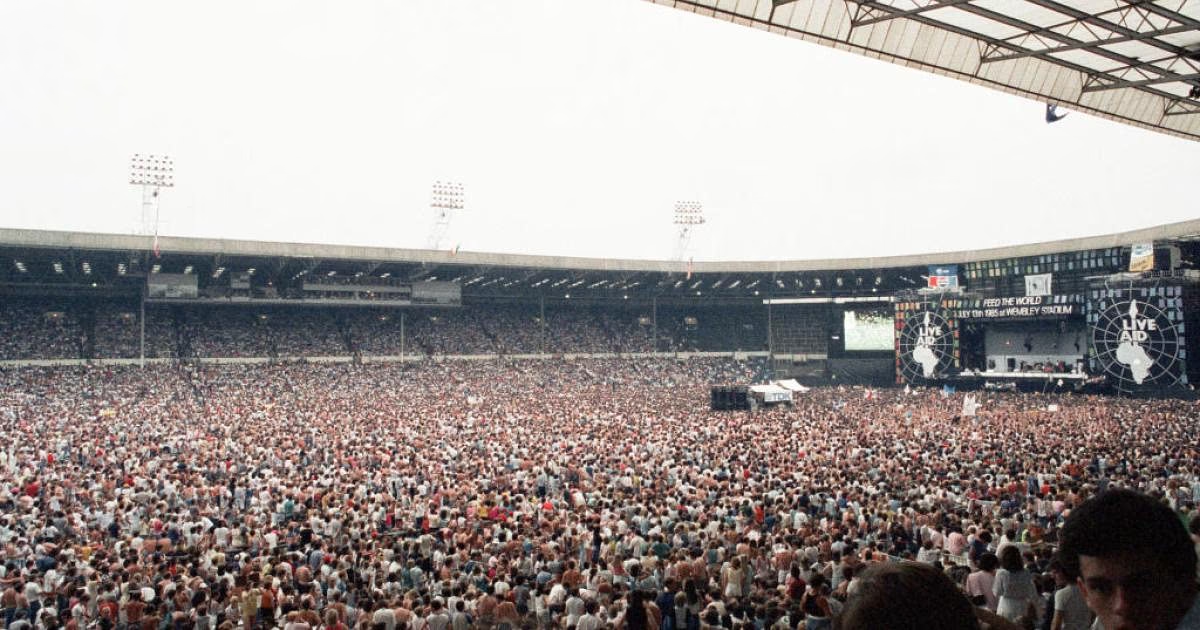
On July 13, 1985, the world witnessed an extraordinary event where music was not just entertainment, but a resounding humanitarian cry. Over 160,000 people gathered at Wembley Stadium in London and John F. Kennedy Stadium in Philadelphia, while more than a billion viewers were glued to their screens to watch the largest live broadcast in history at the time.
The event was named 'Live Aid' and was primarily aimed at raising funds to combat the devastating famine that struck Ethiopia. It was not just a concert, but an ambitious attempt to transform celebrity fame into an effective relief tool, and a window through which the world could see a humanitarian crisis that had long remained in the shadows.
The musical marathon lasted for 16 continuous hours, with major stars performing alternately on two stages separated by the Atlantic Ocean. The organizers succeeded in breaking geographical barriers, as the event provided a unique opportunity to raise awareness among vast numbers of people about the necessity of acting to eliminate hunger in Africa.
The concert remains present in collective memory, especially with the legendary performance of the band 'Queen' led by Freddie Mercury. History also recorded the journey of artist Phil Collins, who used a Concorde aircraft to cross the ocean and appear on both the London and Philadelphia stages on the same day, embodying the slogan 'one world'.
Behind these lights, Ethiopia was suffering from a famine that extended between 1983 and 1985, where drought factors intertwined with armed conflicts. The policies of Mengistu Haile Mariam's government, including forced population displacement and restrictions on economic activities, contributed to an unprecedented exacerbation of the humanitarian catastrophe.
The spark for action began when Irish musician Bob Geldof watched television reports showing the tragedy of the hungry in northern Ethiopia. Geldof collaborated with Midge Ure to produce the song 'Do They Know It's Christmas?', which brought together Britain's most famous artists and achieved amazing popularity, paving the way for the larger concert.
Donations poured in generously during the broadcast hours, with the final tally exceeding 100 million British pounds. This financial success proved that the viewer can transform from a passive follower of news to an active contributor in responding to major international crises.
'Live Aid' established a new model for humanitarian work driven by stardom and television imagery, where artists attract the public, who in turn pressure governments. This formula later became a common approach in confronting earthquakes, epidemics, and natural disasters around the world.
Despite its success, the concert faced sharp criticism regarding the way Africa was portrayed as a helpless continent awaiting a Western savior. Ethiopian voices were absent from the main platforms, and an entire continent was reduced to the image of 'hungry Africa', which distanced complex political factors from the core of public debate.
Long-standing questions were raised about the fate of the funds and ensuring their delivery to those in need under an authoritarian military rule. Despite claims that the money was used to buy weapons, subsequent investigations and official apologies from media institutions confirmed that there was no evidence to prove the diversion of aid for military purposes.
In 2005, Bob Geldof returned to organize 'Live 8', but this time with a political goal of pressuring the G8 leaders. The aim was to demand the cancellation of debts for poor countries and an increase in aid, recognizing that poverty requires radical political decisions, not just food shipments.
Experts believe that it is difficult to replicate the 'Live Aid' experience in the current era due to audience fragmentation across digital platforms and algorithms. However, the equation set by the concert still stands, with artists' social media accounts being used to mobilize rapid humanitarian support.
The famines and wars did not end after the lights of the Wembley stage went out, but the concert left a lasting institutional legacy. The 'Band Aid' charitable trust is still registered and active in Britain, providing annual grants of millions of pounds to combat poverty and disease in Africa.
In conclusion, 'Live Aid' remains a lesson in the limits and power of human empathy simultaneously, confirming that popular culture can move mountains. But it also reminds us that true aid requires understanding political contexts and involving those affected in shaping their future away from tutelage.
Live Aid proved that the public is not entirely helpless in the face of a disaster in a distant country, and that popular culture can impose a humanitarian issue on the media and governments.
شارك برأيك
How Did 'Live Aid' Reshape the Concept of Global Charity?