






By: Said Arikat
June 24, 2026
News analysis
Washington, D.C- The most consequential political struggle underway in Gaza today is not being fought on the battlefield. It is unfolding behind closed negotiating-room doors, where the future of Palestinian self-determination is increasingly being subordinated to a security architecture designed primarily to satisfy Israeli demands.
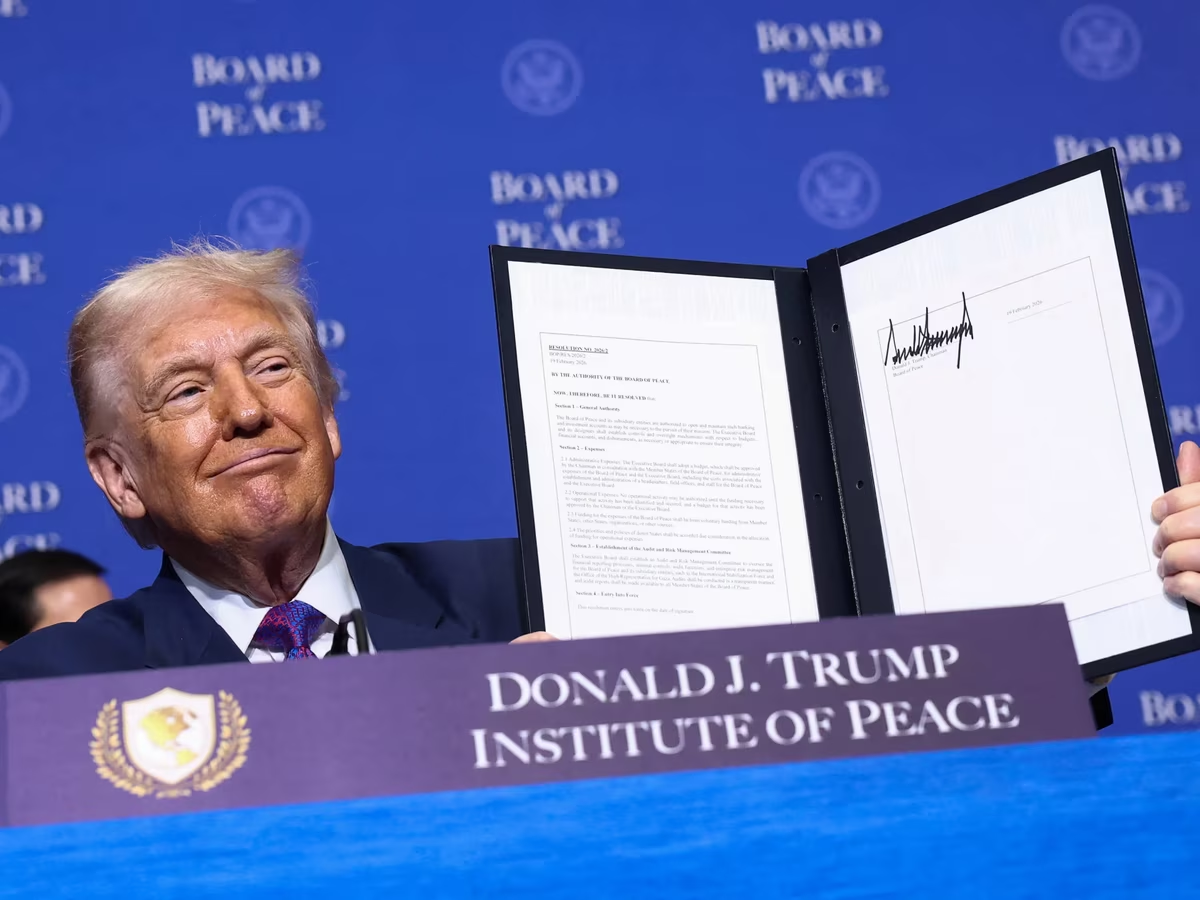
According to documents obtained and published by Drop Site News, negotiations between Palestinian factions and Donald Trump’s privately directed “Board of Peace” reveal a troubling reality: what began as a ceasefire arrangement is gradually being transformed into a political framework that conditions virtually every aspect of Palestinian life on the dismantling of Palestinian resistance, while offering little assurance of statehood, sovereignty, or protection from continued Israeli military domination.
If the reported documents accurately reflect the negotiations, they suggest that the central objective of the process is no longer ending the war in Gaza. Rather, it is reshaping Palestinian political realities in a manner that secures Israeli strategic objectives while postponing indefinitely the core Palestinian aspirations of independence and national self-determination.
The irony is difficult to ignore. Palestinians entered the October 2025 agreement seeking an end to a devastating war, humanitarian relief, reconstruction, and a pathway toward political recovery. Yet months later, the conversation appears increasingly focused not on Israeli obligations under the ceasefire but on Palestinian obligations to surrender the remaining instruments of resistance.
This shift reflects a familiar pattern that has characterized decades of failed diplomacy. Palestinian negotiators are asked to provide detailed commitments regarding security, weapons, governance, and political conduct. Israel, meanwhile, is often offered broad flexibility, vague obligations, and minimal accountability mechanisms when violations occur. The result is an asymmetrical negotiating environment where one side is required to prove its compliance while the other retains effective veto power over implementation.
The reported roadmap advanced by the Board of Peace appears to deepen this imbalance. Palestinian negotiators insist that discussions regarding weapons must be linked to a credible process leading to statehood and self-determination. The Board’s language reportedly removes such guarantees and replaces them with references to merely creating conditions for a possible future pathway. The distinction is not semantic. It is political.
A guaranteed path to statehood implies a destination. A pathway merely suggests a road that may or may not lead anywhere.
This ambiguity is especially significant given the realities on the ground. While negotiations continue, Israeli forces have reportedly expanded military infrastructure across Gaza, deepened territorial control, and publicly discussed long-term occupation plans. Under such circumstances, Palestinians naturally question whether disarmament is being proposed as part of a peace settlement or as a prerequisite for permanent political subordination.
Equally troubling is the emerging role envisioned for the Board of Peace itself. Rather than functioning as a neutral mediator, the institution appears increasingly positioned as an external governing authority overseeing major aspects of Gaza’s future administration, reconstruction, security arrangements, and political transition.
The concept raises profound questions about sovereignty. Who ultimately governs Gaza? Who controls reconstruction funds? Who determines security policy? Who defines compliance? If these powers are exercised by an international mechanism heavily influenced by Washington and aligned with Israeli security priorities, then Palestinians may find themselves living under a new form of external supervision rather than genuine self-rule.
The experience of previous peace processes offers little reassurance. For more than three decades, Palestinians have witnessed negotiations that promised statehood while producing expanding settlements, shrinking territorial continuity, and deepening occupation. The Oslo process became synonymous with endless interim arrangements that never reached their stated destination. Critics now fear that the Board of Peace risks creating a similar dynamic under a different name.
What makes the current moment especially alarming is the humanitarian context in which these demands are being advanced. Gaza remains devastated. Large portions of its infrastructure lie in ruins. Hundreds of thousands of Palestinians continue to struggle with displacement, food insecurity, inadequate healthcare, and economic collapse. Yet instead of prioritizing reconstruction and civilian recovery, negotiations appear consumed by security benchmarks and disarmament mechanisms.
Such an approach reflects a broader international failure to address the root causes of the conflict. Security cannot be separated from justice. Stability cannot be built on permanent inequality. No political framework can achieve lasting legitimacy if it ignores the national aspirations of the people it seeks to govern.
For Israel and its allies, the argument is straightforward: no sustainable peace can emerge while armed groups retain military capabilities. For Palestinians, however, the issue is inseparable from the realities of occupation, settlement expansion, and the absence of a sovereign state. Any discussion of weapons inevitably becomes a discussion about power, protection, and political rights.
This is why the negotiations have become so contentious. At stake is not simply the future of armed factions. At stake is the very definition of Palestinian political existence after the war.
The broader danger is that the international community may once again mistake management for resolution. Creating new committees, monitoring bodies, verification mechanisms, and security arrangements may temporarily reduce tensions. But none of these structures addresses the fundamental question at the heart of the conflict: whether Palestinians will ultimately enjoy the same right to self-determination that international law recognizes for all peoples.
A durable peace requires more than the absence of armed resistance. It requires political legitimacy, equal rights, accountability, and a clear end to military domination. Without those elements, any agreement risks becoming merely another chapter in a long history of imposed arrangements that postpone rather than resolve the conflict.
The documents reported by Drop Site suggest that Gaza may be approaching such a crossroads. The question is whether the international actors shaping its future are genuinely building a path toward Palestinian freedom—or constructing a more sophisticated framework for managing Palestinian dependency. The answer may determine not only the fate of Gaza but the future credibility of diplomacy itself.
شارك برأيك
From Ceasefire to Capitulation: The Hidden Agenda Behind Gaza’s “Board of Peace