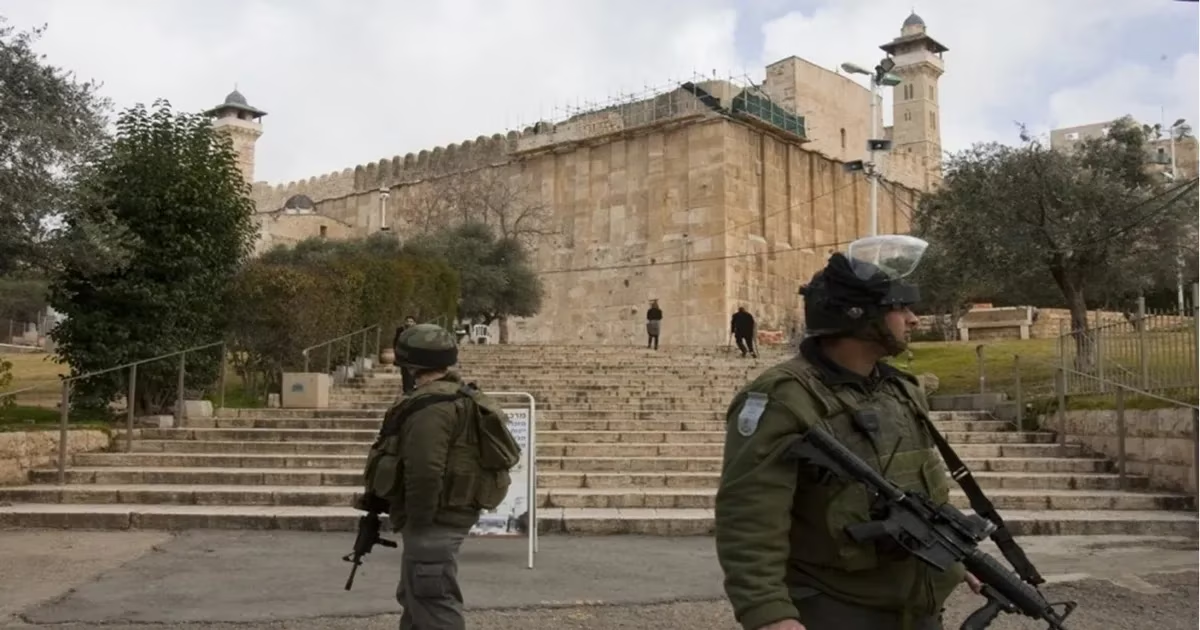







The city of Hebron is going through a pivotal political moment that seems like an open declaration of a new phase in managing the conflict within the West Bank. This comes after statements by the Finance Minister in the occupation government, Bezalel Smotrich, regarding the cancellation of what is known as the 'Hebron Agreements,' a step that goes beyond administrative modification to a comprehensive re-formulation of the city's identity.
This step represents a gradual dismantling of the arrangements approved in the mid-nineties following the Oslo Accords, which regulated the redeployment of forces within the city. These agreements had created a fragile form of joint administration between a Palestinian municipal authority with civilian tasks and an Israeli military authority holding security decisions.
According to the new data, the occupation seeks to withdraw the remaining civilian powers from Palestinian hands and concentrate them directly in the hands of the Israeli administration. This approach includes fundamental issues such as organization, construction, and urban planning, in addition to managing infrastructure in wide and sensitive areas of the city.
Reducing the role of the Hebron municipality to merely formal service functions means moving from a restricted administration model to an expanded direct administration model. This shift affects the core of daily life for Palestinian residents and places the future of urban and residential existence in the heart of the Old City under direct and continuous threat.
Hebron cannot be read as an ordinary city; it is the most sensitive point of friction where historical and religious layers exceptionally intertwine. The Ibrahimi Mosque lies at the heart of this conflict, where the Israeli narrative attempts to impose its control over the place and transform it into a central element in the equation of political and field control.
Any change in the powers related to the urban surroundings of the Ibrahimi Mosque becomes more than just a fleeting administrative measure. It is a step that affects one of the most sacred religious symbols and reveals a desire to politicize the sacred and use it as a tool to formulate new realities on the ground that serve settlement agendas.
Extremist currents in the occupation government use biblical discourse to justify settlement expansion in the heart of the Old City. In contrast, the Ibrahimi Mosque remains in Palestinian and Islamic consciousness part of a deeply rooted religious narrative that cannot be divided, making the conflict over the place a conflict over identity and existence.
Withdrawing planning and construction powers opens the door wide to accelerating settlement projects and changing the demographic map. Controlling Palestinian urban growth and imposing strict restrictions on it is an effective means of reshaping sensitive areas to serve the long-term Israeli vision in the West Bank.
These patterns of control are not new; rather, they are a repetition of policies witnessed in other areas, where the transfer of powers leads to a profound change in the structure of the place. These measures aim to make a return to any future political settlement practically and field-wise impossible.
Hebron is considered a central link in a broader project aimed at establishing new realities and reducing the role of Palestinian national institutions. Given its population size and geographical location in the southern West Bank, any change in its administrative structure will have a significant impact on the entire surrounding area.
On a practical level, direct control over planning will lead to reshaping the urban structure to serve the settlement outposts distributed in the heart of the city. This deliberate demographic pressure aims to push Palestinian residents to migrate from old city centers and empty them in favor of settlers.
As for the Ibrahimi Mosque, the proposed changes threaten the fragile balance that has existed for many years. Reshaping the balance in this sensitive site could lead to an explosion of field conditions, given the mosque's great status in the hearts of Palestinians and Muslims around the world.
This decision is consistent with the current Israeli government's trends, which adopt extremist views calling for an end to the Palestinian institutional presence. They see previous agreements as merely a transitional phase that must be overcome to achieve full and direct control without any legal or international obligations.
Ultimately, Hebron emerges as an arena whose details are being rewritten by successive powers and decisions, sometimes away from media noise. Between political discourse and field reality, the truth remains that the city is being pushed towards a new reality that replaces old understandings with the logic of force and absolute control.
Hebron today is a new testing ground for equations of control and re-engineering reality, where politics intersects with religion and history with the present.
شارك برأيك
Cancellation of Hebron Agreements: Occupation Begins Direct Control Engineering Over the City's Heart