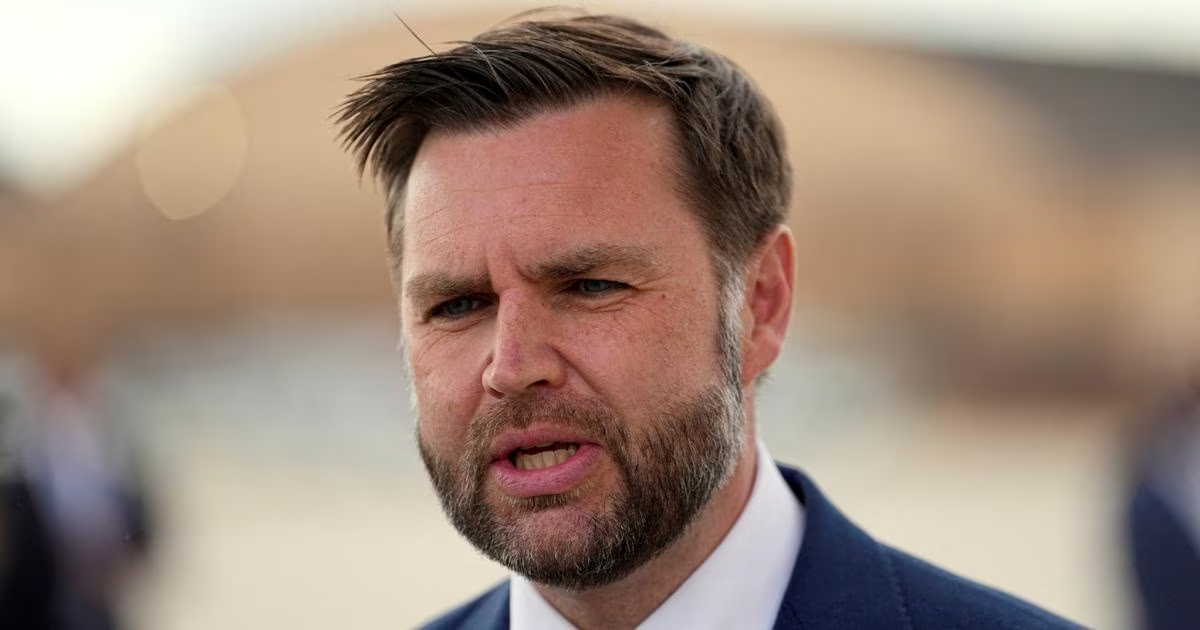







US Vice President J.D. Vance announced the outlines of what he described as an upcoming 'regional peace agreement' between Washington and Tehran, confirming that the proposed memorandum is based on three fundamental, non-negotiable pillars. Vance clarified that the first principle is the complete abandonment of nuclear weapons ambitions, while the second principle focuses on ensuring permanent freedom of international navigation in the Strait of Hormuz.
Vance indicated in press statements that the third pillar relates to linking any economic gains or sanctions relief to Tehran's actual behavior on the ground. He stressed that Iranians will not receive any benefits unless they prove their commitment to strict conditions regarding stopping the funding of armed groups and fundamentally changing their political approach in the region.
These statements come at a sensitive time, as sources revealed that the United States and Iran are close to officially signing the peace agreement in Switzerland next Friday. President Donald Trump has already sent a draft memorandum of understanding to Congress for review, indicating the administration's seriousness in moving forward towards a comprehensive settlement.
The US Vice President clarified that any easing of economic pressure would be conditional on stopping support for what he described as 'terrorism' and abandoning attempts to rebuild the nuclear program. He added clearly that if Tehran continues its current approach, it will gain nothing, while real benefits await it if it makes a tangible shift in its foreign policies.
Vance criticized Iranian attempts to portray the agreement as an unconditional victory, describing such narratives as 'misleading propaganda' that ignores the harsh conditions imposed. He affirmed that the US administration fully understands that the gains Tehran aspires to are exclusively linked to changing the way the state is managed and dealing with the international community.
In his reading of the agreement's outcomes, Vance considered that the United States would be a winner in both cases, whether Iran complied or rejected the conditions. In case of rejection, Washington would continue to undermine the nuclear program and ensure the security of waterways, and in case of acceptance, the world would have achieved a great diplomatic victory by changing the behavior of an adversary regime.
Vance stressed that the agreement places Iran under close scrutiny, as the country will enter a 'test period' to measure its seriousness. He affirmed that the new US policy is based on the principle of 'trust in actions, not promises,' an approach he learned from President Trump in dealing with allies and adversaries alike.
In a related context, the US Vice President denied any intentions by the Trump administration to impose regime change in Tehran or install specific political figures. He clarified that Washington has never sought to restore Reza Pahlavi, the son of the late Shah of Iran, to power, considering that the form of government is an internal matter to be decided by the Iranian people alone.
Vance described the memorandum as transcending the bilateral relationship to be a comprehensive 'regional peace agreement' involving multiple parties in the Middle East. He indicated that the agreement would include the Gulf states, Israel, and Lebanon, with the aim of creating a stable security environment that ends decades of tension and armed conflicts that have drained the region's resources.
For his part, President Donald Trump promoted the agreement on social media platforms, describing it as a 'great deal' that will bring security and stability. Trump considered that his administration succeeded where previous presidents failed, by finding an acceptable formula of understanding for regional leaders that ensures real and sustainable peace.
Reports indicate that the agreement includes strict verification mechanisms to ensure that prohibited nuclear activities do not resume under any guise. The next phase is also expected to see rounds of technical negotiations to implement the provisions of the memorandum, especially regarding the opening of trade and financial channels that were closed due to international sanctions imposed on Tehran.
In conclusion, Vance affirmed that the ball is now in Iran's court to choose the path the country desires, either integration into the regional system and obtaining economic support, or remaining under the weight of isolation. He stressed that Washington is prepared for all scenarios, always prioritizing the security of its allies and the stability of navigation in vital waterways.
The agreement is very simple: no nuclear weapons, the Strait of Hormuz open, and benefits conditional on good behavior.
شارك برأيك
Vance reveals pillars of 'regional peace agreement' with Iran: No nukes, no closure of shipping lanes