






Washington's Message
Washington – Said Arikat – 17/6/2026
News Analysis
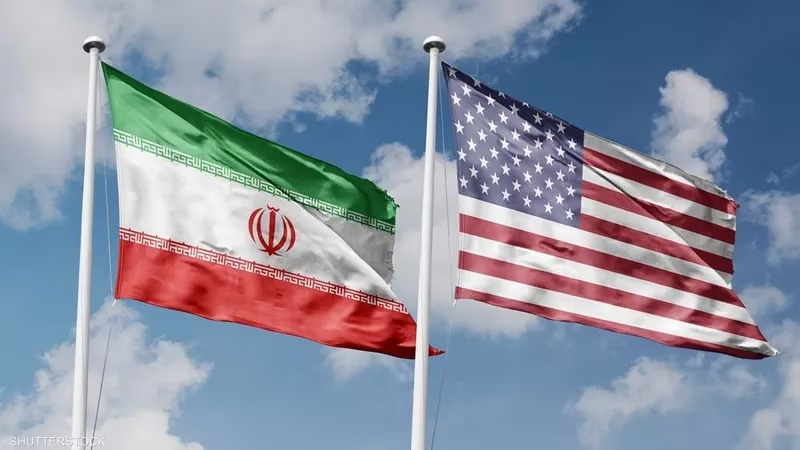
As eyes turn to Geneva, where increasing diplomatic leaks speak of a possible new agreement between the United States and Iran on June 19, ambiguity still surrounds the final details of the anticipated understanding. So far, no official announcement has confirmed the completion of the agreement or the date of its final signing. However, accumulated indicators suggest that both parties are approaching a political moment that may be the most significant in their relations since the collapse of the previous nuclear deal.
This development comes after months of mutual military tensions and economic pressures that pushed the region to the brink of a widespread confrontation. However, recent developments have revealed that both Washington and Tehran have reached a similar conclusion: continued escalation carries greater risks than potential benefits. On the one hand, the American administration realized that any open war with Iran could impose exorbitant economic and military costs that would be difficult to justify to the American public. On the other hand, Iran found itself facing increasing economic pressures and an urgent need to alleviate the financial isolation that has burdened its economy in recent years.
According to leaks from Western diplomatic circles, the agreement focuses on Iran's nuclear program, international monitoring mechanisms, and permissible enrichment levels, in exchange for a gradual easing of some economic and financial sanctions imposed on Tehran. The International Atomic Energy Agency (IAEA) is also expected to play a pivotal role in verification and follow-up operations, ensuring a permanent monitoring mechanism that allows for measuring Iran's compliance with the terms of the agreement.
Circulating information also indicates the possibility of a gradual release of some of Iran's frozen assets abroad and allowing a limited increase in Iranian oil exports, which could give the Iranian economy a much-needed breather. There is also talk of establishing joint mechanisms to address potential disputes and prevent the collapse of the agreement at the first political or security crisis, a point that negotiators see as essential in light of previous experiences between the two countries.
Nevertheless, key issues remain shrouded in ambiguity. The extent and duration of restrictions on Iran's nuclear program are not yet clear, nor are the details of the mechanism for reimposing sanctions in the event of a breach of the agreement. Similarly, ballistic missiles and Iran's regional influence remain among the most sensitive issues, especially as they have been a focal point of deep disagreements between Washington and its regional allies in recent years.
In the United States, the anticipated agreement has begun to stir clear political division even before its official announcement. The pro-agreement camp includes a number of former diplomats, nuclear non-proliferation experts, and prominent political figures who believe that diplomacy, despite its flaws, remains the most realistic option to prevent a new war. Among the names expected to defend the agreement are Senator Bernie Sanders, Senator Chris Murphy, and former Secretary of State John Kerry, in addition to a number of experts associated with influential research institutions such as the Quincy Institute and the Carnegie Endowment.
They argue that sanctions and military pressure have not succeeded in completely stopping Iran's nuclear program, and that the absence of an agreement could leave Iran freer to develop its nuclear capabilities. They also believe that the United States needs to focus its resources on other strategic challenges, primarily competition with China and rapid international developments in Asia and Europe.
In contrast, a broad camp of conservatives and hardline Republicans rejects any new agreement with Tehran. Prominent figures in this regard include Senator Tom Cotton, Senator Ted Cruz, Senator Lindsey Graham, former Secretary of State Mike Pompeo, and former National Security Advisor John Bolton. They believe that any easing of sanctions will give Iran additional resources that can be used to strengthen its regional influence, and they argue that economic pressures were bearing fruit and should have been continued instead of returning to the negotiating table.
Economically, the importance of the agreement extends beyond the bilateral relationship between Washington and Tehran. Stability in the Gulf remains an influential factor in global energy markets, and any reduction in the likelihood of military confrontation could positively impact oil prices and international trade. Furthermore, a decrease in geopolitical tension could contribute to boosting investor confidence and reducing the volatility witnessed in markets during previous periods of escalation.
President Donald Trump's administration realizes that this economic dimension holds special political importance with the upcoming midterm elections approaching. If the agreement succeeds in achieving some stability and reducing energy-related concerns and inflation, the administration may be able to present it as evidence of the success of its foreign policy. However, if implementation falters or early disagreements emerge between the parties, the agreement could become a major subject of political attack from White House opponents.
In this context, the Trump administration's concept of "victory" seems to differ from traditional concepts associated with military decisive action. The administration does not necessarily view the overthrow of the Iranian regime or engaging in an open confrontation as a measure of success. Instead, it believes that forcing an adversary to return to negotiations and accept new restrictions can constitute a political and strategic achievement in itself. From this perspective, the administration may seek to market the agreement as evidence of the success of its maximum pressure policy in pushing Iran to make concessions it was not previously willing to make.
Conversely, the administration defines defeat as being drawn into a long and costly war without achievable goals or sufficient public support. Therefore, avoiding a widespread military confrontation is a fundamental part of the calculations that led Washington to prefer the diplomatic path over continued escalation.
One of the most sensitive questions remains related to Israel and its Prime Minister Benjamin Netanyahu. Previous experiences have shown that any US-Iranian understanding raises deep concern for the Israeli government, which fears that easing pressure could strengthen Iran's capabilities in the long run. Washington is likely to exert political and security pressure on Netanyahu to avoid any steps that could threaten the agreement. However, the White House's ability to impose its will will remain constrained by internal American balances and the extent of support Israel enjoys within Congress.
Ultimately, the importance of the anticipated agreement lies not only in its signing but also in its ability to endure after signing. The long history of distrust between Washington and Tehran, and the presence of strong opponents of the agreement in the United States, Iran, and Israel, make the implementation phase the real test of any understanding reached. If the agreement succeeds in overcoming these obstacles, it could open the door to a new phase of managing regional conflicts through diplomacy instead of military confrontations. However, if it fails, it will strengthen the voices calling for a return to the logic of force, and return the region to the cycle of tension that the current negotiations sought to escape.
شارك برأيك
Between Diplomacy and Doubts: What Does the Anticipated Iran-US Agreement Mean?